Tibet is not a destination you book on a whim. It is a high plateau of monasteries, turquoise lakes and prayer flags strung across mountain passes, where the air is thin, the light is hard and clear, and the most famous palace in Asia rises from a red hill above a city that sits higher than most mountains in Europe. A trip here takes more planning than almost anywhere else on earth — permits, a licensed guide, a fixed route and a Chinese visa all have to be arranged before you travel — but for travellers who do the preparation, the reward is one of the most extraordinary journeys in the world. This Tibet travel guide explains, in plain terms, how the permit system works, when to go, how to handle the altitude, what Lhasa, Shigatse, the sacred lakes and Everest North Base Camp are really like, and what a trip costs in 2026, so you can decide whether Tibet is right for you and plan it properly if it is.
Quick answer: you cannot travel to Tibet independently as a foreign visitor. Every foreign traveller needs a Tibet Travel Permit (TTP) arranged through a licensed Tibetan travel agency, a valid Chinese visa, a licensed guide and an organised vehicle with a settled route for the whole trip. Start the permit process at least a month before you travel — agencies typically quote 7 to 10 working days for the permit itself, while other sources say about 15 days and sometimes up to 20 — and do not book flights or train tickets until the permit is in hand. Lhasa sits at 3,650 metres, so plan gentle first days, and the best months to visit are April to May and September to October. Read the permits section below before you spend any money.
Is Tibet Safe to Visit in 2026?
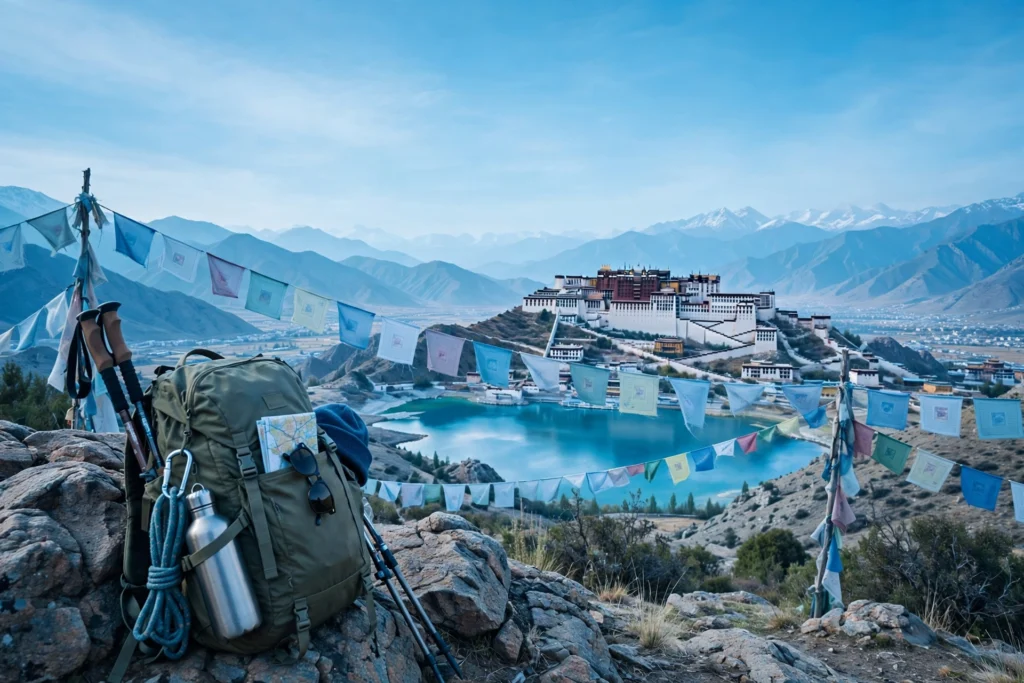
The first thing to understand about safety in Tibet is that the question has two parts: the official travel advisory for China, and the practical realities of travelling at very high altitude in a tightly controlled region. Both matter, and neither should be skipped.
The United States Department of State rates mainland China at Level 2: Exercise Increased Caution, reissued on 19 October 2026, with a “D” risk indicator for wrongful detention. The advisory summary says travellers should exercise increased caution in mainland China because of the arbitrary enforcement of local laws, the use of exit bans without a fair and transparent process under the law, and the risk of wrongful detention. The full advisory describes expansive national security, counterespionage and data security laws that give Chinese officials broad discretion to detain or interrogate foreign nationals, and it warns that exit bans can be imposed to force people to take part in investigations, to resolve civil disputes in favour of Chinese citizens, or to pressure family members to return to China. Travellers may only become aware of an exit ban when they try to leave. The advisory also states, in terms that matter directly for this trip, that the ability to provide emergency consular services in some regions, especially in the Tibet Autonomous Region, is severely limited. That is not a footnote — it means that if something goes wrong in Tibet, help from your own embassy may be slow or unavailable, and your travel agency, your guide and your travel insurance are your real safety net. Before you travel, read the full US State Department travel advisory for China and check it again close to departure, because advisory levels and wording can change. US citizens should also enrol in the Smart Traveler Enrollment Program (STEP).
Beyond the advisory, Tibet has its own practical risks, and altitude is the biggest of them. Lhasa sits at 3,650 metres, and many of the places visitors most want to see — Yamdrok Lake, Namtso Lake, Everest North Base Camp at 5,200 metres — are higher still. Acute mountain sickness is common, not rare, and it is the reason the first two days of any sensible itinerary are deliberately slow. There is a full section on altitude and acclimatisation below; treat it as essential reading, not optional background.
There are also rules that are specific to Tibet and strictly enforced. Photography is restricted inside many monasteries and temples, and at some sites it is banned entirely — always ask your guide before raising a camera. Drone use is heavily restricted and in practice not something a foreign visitor should attempt without explicit permission arranged in advance. Do not photograph military installations, police or government buildings. Religious sites are active places of worship, not museums: walk clockwise around temples and stupas, do not touch monks or their robes, dress modestly, and remove hats inside chapels. Your guide will explain the local etiquette at each stop, and following it is both respectful and the simplest way to avoid trouble.
One more practical point: Tibet is a region where conditions can change with little notice. Roads can close after landslides, border crossings can shut, and permit rules can shift between seasons. The Shigatse section below explains a real example from August 2026, when a mudslide at the Gyirong border crossing suspended electronic border-area permits for Shigatse. Build flexibility into your dates, keep your agency’s phone number saved offline, and do not plan a tight onward connection for the day you leave Tibet.
The Tibet Travel Permit: What You Need Before You Book Anything
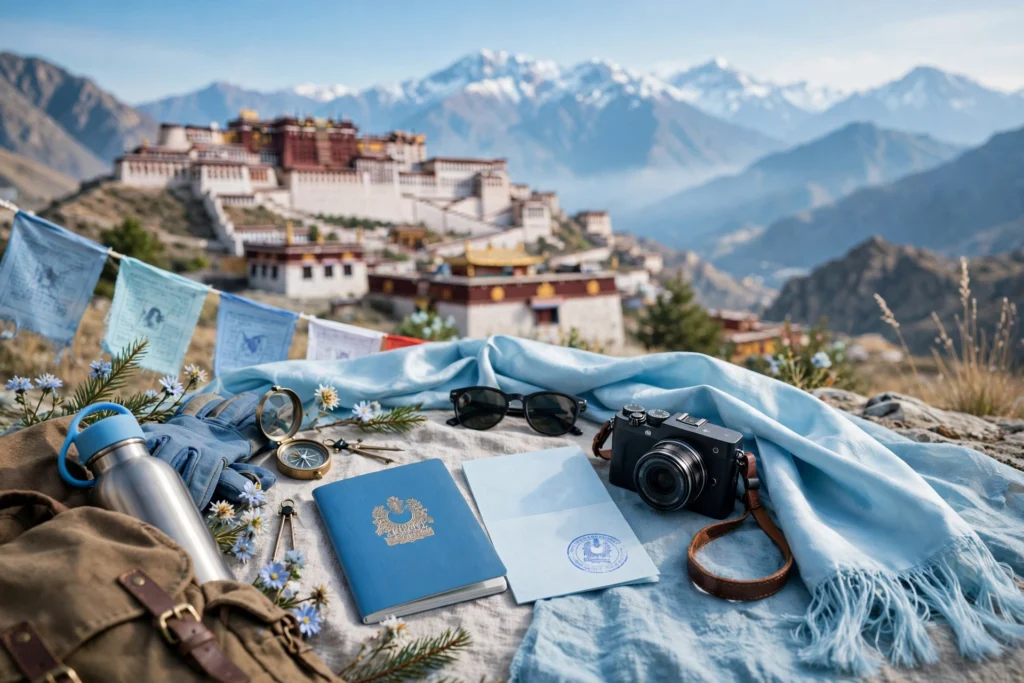
If you remember one thing from this guide, make it this: no foreign visitor travels to Tibet without a Tibet Travel Permit (TTP). The permit is not a formality you sort out at the airport. It is a separate document, issued by the Tibet Tourism Bureau, that you must hold before you board a flight or train to Lhasa — airlines and railway staff check it at departure, and you will be refused boarding without it. The permit is arranged through a licensed Tibetan travel agency, never directly by the traveller, and it is tied to a specific itinerary, a specific guide and a specific vehicle. That is why independent travel is not possible: the permit system, the guide requirement and the organised transport requirement are all part of the same arrangement, and they apply throughout your stay, not just in Lhasa.
The process works like this. First, choose a licensed agency and agree on an itinerary, dates and group size. The agency will ask for a scanned copy of your passport and your Chinese visa — you need the visa first, because the permit application requires it. The agency submits the application to the Tibet Tourism Bureau. Processing times vary by source: some agencies quote 7 to 10 working days, while other established guides say to allow about 15 days and sometimes up to 20. The honest answer is to allow a full month from the day you send your documents to the day you travel, and to treat the shorter estimates as the best case rather than the plan. Do not book non-refundable flights or train tickets until the agency confirms the permit is issued. Once issued, the agency sends you the original permit by courier or hands it to you at your gateway city in China — you need the original paper document, not a photograph of it, to board your transport to Lhasa.
The Tibet Travel Permit covers Lhasa and the standard tourist route. If your itinerary goes further — to Everest North Base Camp, Mount Kailash, or other remote areas — you need additional permits, and your agency arranges all of them. The two most common are the Alien’s Travel Permit (ATP), which covers travel outside Lhasa to places such as Shigatse, Gyantse and Everest Base Camp, and the Military Permit, which is required for sensitive border areas such as Mount Kailash and the Ngari region. The ATP typically costs around ¥50 and is arranged by your agency once you are in Tibet; the Military Permit takes longer and costs more, which is one reason Kailash trips need to be booked well in advance. Do not confuse the Alien’s Travel Permit with the electronic Border Administration Zone permit — they are different documents for different travellers. The electronic border pass is a document for Chinese citizens travelling to border areas; foreign visitors to Everest need the TTP plus the ATP, and your agency handles both.
| Permit | Who needs it | Arranged by | Typical timing |
|---|---|---|---|
| Chinese visa | Every foreign visitor to China, before the TTP | You, via a Chinese embassy or visa centre | Apply 4–6 weeks before travel |
| Tibet Travel Permit (TTP) | Every foreign visitor to Tibet, no exceptions | Your licensed Tibetan agency | 7–10 working days at best; allow about 15, sometimes 20 days |
| Alien’s Travel Permit (ATP) | Anyone travelling outside Lhasa, e.g. Shigatse, Gyantse, Everest Base Camp | Your agency, once in Tibet | A few days, around ¥50 |
| Military Permit | Mount Kailash, Ngari and other sensitive border areas | Your agency, well in advance | Several weeks; longer lead time than the ATP |
A few practical warnings. First, your passport must be valid for at least six months beyond your travel dates, with blank pages for the Chinese visa. Second, the permit lists your exact itinerary — if you want to change the route mid-trip, your guide must arrange it, and some changes are not possible at all. Third, travellers entering Tibet from Nepal need a separate group visa arranged through an agency in Kathmandu, and cannot use a standard Chinese visa obtained elsewhere; if you are planning the Nepal overland route, discuss this with your agency before you book anything in Nepal, and note that the Gyirong border crossing is currently closed (see the Shigatse section). Finally, be wary of any agency that promises a permit in two or three days or offers to arrange travel without one. A legitimate agency will be clear about the timeline, will ask for your passport and visa scans, and will put the itinerary in writing. If you are comparing agencies, ask each one the same three questions: how long will the permit take, what is included in the price, and what happens if the permit is delayed. The answers will tell you more than any brochure.
Best Time to Visit Tibet
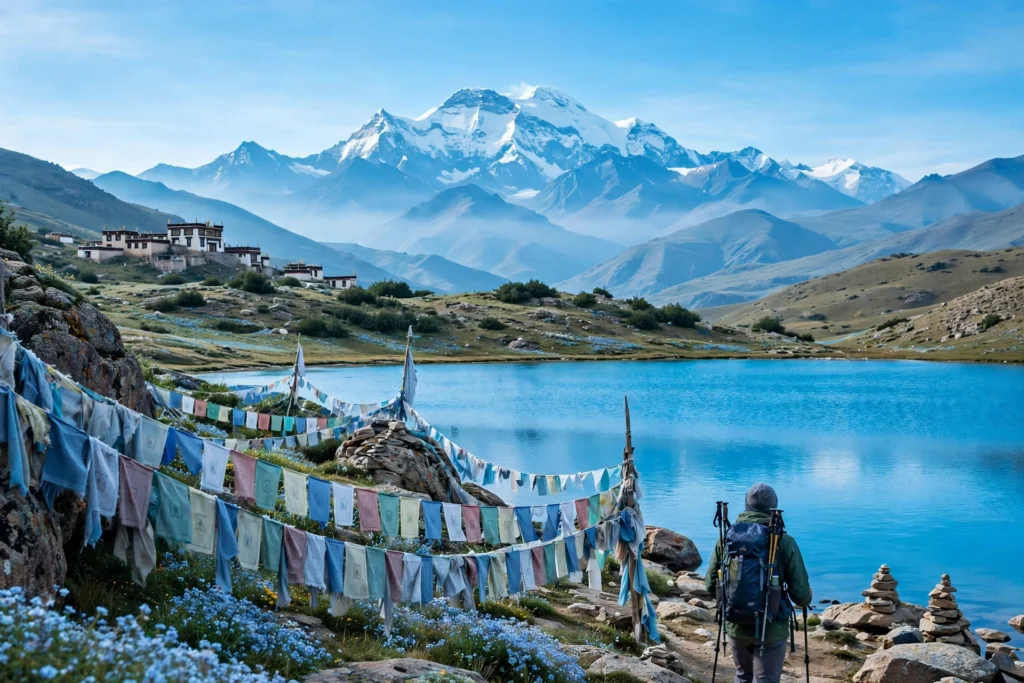
Tibet’s high plateau has a short, clear travel season and long, cold winters, and choosing the right month shapes everything about your trip — how much daylight you get, whether the mountain passes are open, how crowded the Potala Palace is, and whether you can see Everest at all. The two best windows, agreed by almost every experienced guide, are April to May and September to October. In those months the skies are at their clearest, the temperatures are manageable, and the summer crowds have either not yet arrived or already left. Mid-May to June and September to October are often singled out as the very best weeks, with late March to April bringing the peach blossom season in Nyingchi, when the valleys turn pink and photographers arrive in large numbers.
Summer, from June to August, is the peak season and the wettest. Rain falls mostly as afternoon showers, and the landscape is at its greenest, but the Potala Palace is at its busiest — tickets are issued in time slots and summer dates can sell out days ahead — and Everest views are more likely to be hidden by cloud. The Shoton Festival, with its famous unveiling of a giant thangka painting at Drepung Monastery, usually falls in summer, which draws large crowds to Lhasa. If you travel in summer, book the Potala Palace as early as your agency allows and accept that some mountain views will be a matter of luck.
Winter, from November to February, is cold, dry and very quiet. Daytime temperatures in Lhasa hover around 10°C but nights drop well below freezing, and some high passes and remote areas become difficult or impossible to reach. The upside is real: almost no crowds, the clearest winter light, lower prices, and the Losar (Tibetan New Year) festival, usually in February, which is the most important celebration in the Tibetan calendar. Winter suits experienced cold-weather travellers who are flexible about the route; it is not the best choice for a first trip or for anyone whose main goal is Everest.
| Month | Weather | Crowds | Best for |
|---|---|---|---|
| January–February | Cold and dry, Lhasa days around 7–10°C, nights below −10°C | Very low | Losar festival, empty temples, low prices |
| March | Warming up, still cold at night, windy | Low | Early-season trips, fewer visitors |
| April | Mild days, clear skies, Nyingchi peach blossom | Moderate | Peach blossom, photography, first good Everest views |
| May | Warm days, clear skies, best overall conditions | Moderate–high | First trips, Everest, trekking |
| June | Warm, afternoon rain begins | High | Green landscapes, Shoton Festival (some years) |
| July–August | Warmest, wettest, afternoon showers | Highest | Festivals, green valleys, but cloud can hide Everest |
| September | Clear, dry, warm days, cool nights | High, then easing | Everest views, trekking, photography |
| October | Clear and crisp, cool nights, golden light | Moderate | Everest views, autumn colours, comfortable walking |
| November | Cold and dry, clear skies | Low | Quiet temples, low prices, late-season Everest views |
| December | Very cold, dry, short days | Very low | Budget travel, winter light, flexible travellers |
Whatever month you choose, remember that Tibet’s weather changes fast and that a single clear morning at Everest is worth more than a week of overcast days. Build at least one spare day into any itinerary that includes Everest Base Camp, and ask your agency which days of your route have the best chance of a clear view. If you are planning around a festival — Losar in winter, Saga Dawa in late spring, Shoton in summer — confirm the exact dates with your agency, because Tibetan festival dates follow the lunar calendar and shift from year to year.
Altitude in Tibet: How to Acclimatise and Avoid AMS
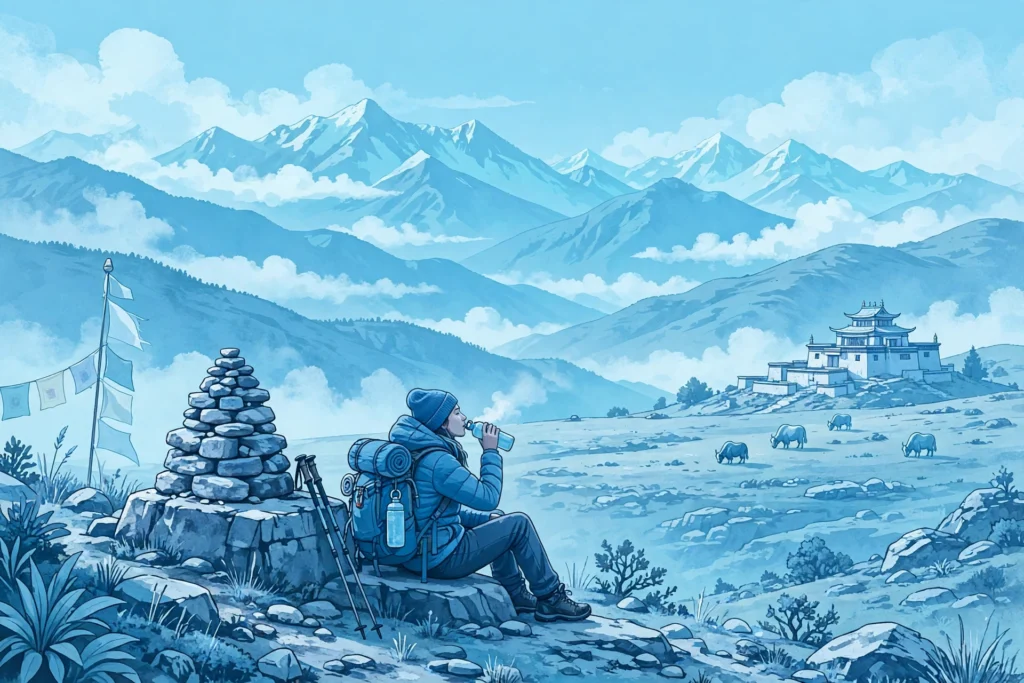
Altitude is the single most important health topic in Tibet, and it deserves more of your attention than any packing list or restaurant recommendation. Lhasa sits at 3,650 metres above sea level — higher than the summit of most Alpine ski resorts — and the places you will visit after Lhasa are higher still. Yamdrok Lake sits at around 4,400 metres, Namtso Lake at about 4,700 metres, and Everest North Base Camp at 5,200 metres. At those heights the air holds roughly half the oxygen it holds at sea level, and your body needs time to adjust. That adjustment is called acclimatisation, and there is no shortcut for it: fitness helps, but it does not make you immune, and even experienced mountaineers can feel unwell on their first day in Lhasa.
Acute mountain sickness (AMS) is the most common problem. Symptoms usually begin 6 to 10 hours after arrival at altitude and include headache, nausea, dizziness, poor sleep, loss of appetite and unusual tiredness. Most cases are mild and pass within a day or two as the body adjusts, but AMS can become serious if it is ignored — especially if you climb higher while still feeling unwell. The rules that every guide repeats are simple and worth following exactly: take it very easy for the first one to two days in Lhasa, walk slowly, avoid alcohol, drink plenty of water, eat light meals, and do not rush to higher places. Do not fly into Lhasa and drive straight to Everest Base Camp the next morning. A sensible itinerary spends at least two nights in Lhasa before going higher, and adds a rest day before any pass above 5,000 metres.
Before you travel, talk to your doctor about the trip, and ask specifically about medication for altitude sickness. Some travellers are prescribed acetazolamide (Diamox), which can help with acclimatisation, but it is a prescription medicine with side effects and it is not suitable for everyone — this guide does not give medical advice, and your doctor is the right person to decide what, if anything, you should take. Tell your doctor about any heart or lung condition, asthma, high blood pressure, pregnancy, or previous problems at altitude, and ask what warning signs should make you descend. Also ask about travel insurance that specifically covers high-altitude travel and emergency evacuation: a helicopter evacuation from a remote part of Tibet is extremely expensive, and standard travel insurance often excludes it. If you are comparing insurance, read the altitude clause rather than the headline price — the same discipline you would use when working out how to prepare a travel budget applies here, because the cheapest policy is rarely the one that covers a 5,200-metre evacuation.
| Day | Where | Altitude | What to do |
|---|---|---|---|
| Day 1 | Arrive Lhasa | 3,650 m | Rest at the hotel, short gentle walk only, early night, no alcohol |
| Day 2 | Lhasa | 3,650 m | Easy sightseeing — Jokhang Temple and Barkhor circuit, slow pace, plenty of water |
| Day 3 | Lhasa | 3,650–3,700 m | Potala Palace (climb slowly, rest on the steps), Sera Monastery in the afternoon |
| Day 4 | Lhasa to Gyantse | 3,950–4,000 m | Drive over passes, stop often, overnight at lower altitude than the passes |
| Day 5 | Gyantse to Shigatse | 3,800–3,900 m | Tashilhunpo Monastery, gentle day, sleep well before the higher days |
| Day 6 | Shigatse to Everest region | 4,300–5,200 m | Long drive, arrive at Rongbuk Monastery, rest on arrival |
| Day 7 | Everest North Base Camp | 5,200 m | Short walk to the viewpoint, return to lower altitude to sleep if possible |
A few more practical points. Sunburn happens fast at altitude, even on cloudy days — use high-factor sunscreen, lip balm with sun protection, sunglasses and a hat. The air is very dry, so drink more water than you think you need and carry lip balm and moisturiser. Sleep is often poor for the first night or two; that is normal at altitude, but if a headache gets worse, if you feel confused or unsteady, or if breathing becomes difficult at rest, tell your guide immediately and do not try to push through it. Your guide has seen altitude sickness many times and will know when to arrange a descent or medical help. Finally, children, older travellers and anyone with a medical condition can visit Tibet safely with the right preparation, but they should be extra careful about the pace of the first days — and, again, the conversation to have is with a doctor, not with a travel blog.
Getting to Tibet: Flights to Lhasa and the Qinghai-Tibet Railway
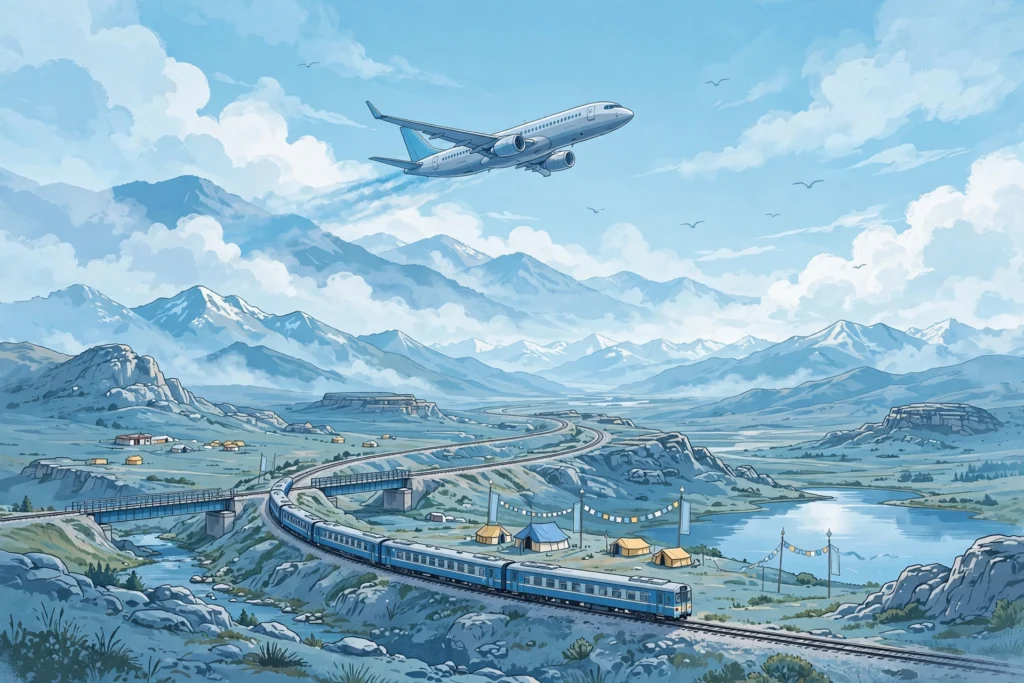
There are two ways into Tibet, and both start in mainland China: by air into Lhasa Gonggar Airport (LXA), or by train on the Qinghai-Tibet Railway. There are no direct international flights to Lhasa, so every journey involves a stop in a Chinese city such as Chengdu, Chongqing, Xi’an, Beijing or Shanghai, and your Tibet Travel Permit is checked before you board the Lhasa-bound flight or train. That check is the reason the permit must be in hand before you travel: without the original document, you will not be allowed to board.
Flying is the faster option. Lhasa Gonggar Airport sits about 60 kilometres southwest of the city, roughly an hour’s drive, at an altitude of around 3,570 metres — so you arrive at altitude immediately, which is another reason the first day in Lhasa should be restful. Flights from Chengdu take about two hours, from Chongqing a similar time, and from Beijing or Shanghai around four to five hours. The approach into Lhasa is spectacular on a clear day, with the Yarlung Tsangpo river winding below the aircraft, so ask for a window seat if you can. Flight schedules change with the season, and summer has the most departures; winter has fewer, and delays are more common. Book through your agency or a reputable Chinese booking platform, and confirm with your agency which flight you are on, because the agency needs the arrival details to arrange your airport pickup — you cannot simply take a taxi from the airport and start exploring on your own, since your guide meets you on arrival.
The Qinghai-Tibet Railway is the slower, more gradual and, for many travellers, the more memorable way in. Trains run from Xining, the capital of Qinghai province, to Lhasa in about 21 to 22 hours, crossing the Tanggula Pass at 5,072 metres — the highest railway pass in the world. The railway was built to carry oxygen-enriched air in the carriages, and the gradual climb is often said to help with acclimatisation, although it does not replace the need for gentle first days in Lhasa. There are also longer services that start in Beijing, Shanghai, Chengdu, Chongqing, Guangzhou and Xi’an and join the same line at Xining; the Beijing to Lhasa train takes around 40 hours. Sleeper berths are the sensible choice for an overnight journey, and they sell out quickly in peak season, so ask your agency to book train tickets as soon as your dates are fixed. The train journey is also a journey through some of the emptiest landscapes on earth — high grassland, salt lakes, snow peaks and herds of yak — and for many travellers it is one of the highlights of the whole trip. If you are weighing the two options, the honest summary is that the flight saves a day and the train gives you a day you will remember; if your main worry is altitude, the train’s gradual ascent is the gentler start, and the extra day on the railway is time well spent. Travellers who enjoy slow overland journeys will find the same appeal in the long rail and road days described in our Ecuador travel guide, though nothing quite matches the scale of the Tibetan plateau.
Once you are in Tibet, you travel by organised vehicle with your guide — usually a 4WD Land Cruiser for small groups or a minibus for larger ones — and the driving is a large part of the experience. Distances are long, roads climb over passes above 5,000 metres, and a day’s drive can take six or eight hours for what looks like a short distance on the map. Your driver knows the roads and the conditions; landslides and roadworks can change a route at short notice, and your guide will adjust the day accordingly. Fuel, road conditions and altitude all make driving in Tibet slower than driving at sea level, so do not plan a tight schedule with back-to-back long drives. The Friendship Highway, the road from Lhasa to the Nepal border via Shigatse and Gyantse, is the most famous of these routes, and it is covered in the Shigatse section below — with an important update about the Gyirong crossing that you need to know before you plan around it.
Lhasa: Potala Palace, Jokhang Temple and the Barkhor Circuit
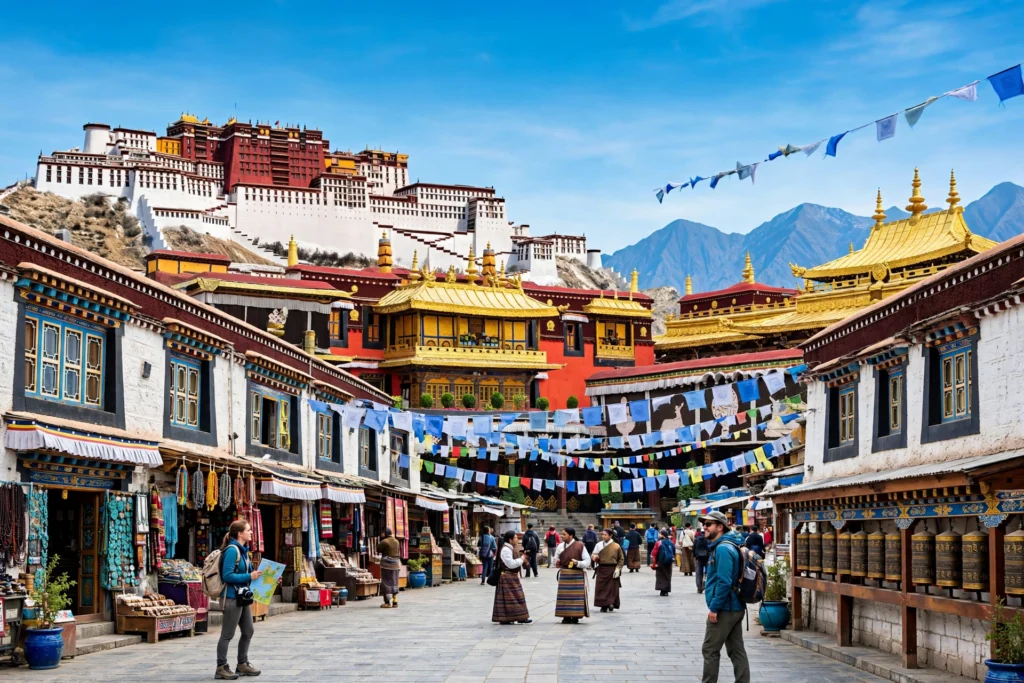
Lhasa is the heart of Tibet and the city where every trip begins, and it earns its two or three days. At 3,650 metres it is one of the highest cities in the world, and its old town still feels like a place of pilgrimage rather than a tourist resort: pilgrims circle the Jokhang Temple with prayer wheels, monks debate in monastery courtyards, butter lamps burn in dark chapels, and the smell of yak butter and incense drifts through the streets. The modern city has wide avenues, hotels and restaurants, but the old town around the Jokhang is where you should spend your time, and where your first gentle days of acclimatisation will pass most pleasantly.
The Potala Palace is the building every visitor comes to see, and it does not disappoint. Rising from Red Mountain in the centre of the Lhasa valley, its white and red palaces hold 698 murals, almost 10,000 painted scrolls, and the gilded burial stupas of past Dalai Lamas, and the whole ensemble — the Potala Palace, the Jokhang Temple and Norbulingka, the former summer palace — is inscribed on UNESCO’s World Heritage List. The palace was the winter residence of the Dalai Lama, and its chapels, audience halls and private rooms are still arranged as they were when it was in use. A visit takes about an hour inside, but the climb is the real challenge: there are several hundred steps to the entrance, and at 3,700 metres they feel much harder than they look. Climb slowly, rest on the landings, and do not be embarrassed about it — everyone does. Tickets are issued in time slots and must be booked in advance through your agency; in summer they can sell out days ahead, so confirm your Potala visit as early as possible and do not assume you can decide on the day. Photography is not allowed inside the palace, and bags are checked at the entrance. Read more about the site on the official UNESCO page for the Historic Ensemble of the Potala Palace, which lists the palace’s inscription in 1994 and the Jokhang Temple and Norbulingka extensions that followed.
The Jokhang Temple is older, smaller and, for many visitors, more moving than the Potala. Founded in the 7th century, it is the most revered temple in Tibet, and its rooftop — reached by a steep staircase — gives one of the best views in Lhasa, with the golden roofs of the temple in the foreground and the Potala Palace on its hill behind. Inside, the chapels are dark, crowded with pilgrims, and lit by butter lamps; the most sacred statue, the Jowo Rinpoche, draws a constant stream of worshippers who prostrate themselves before it. Around the temple runs the Barkhor circuit, a circular pilgrim path lined with shops selling prayer flags, turquoise jewellery, yak-wool blankets and thangka paintings. Walking the Barkhor with the pilgrims — always clockwise — is one of the great experiences of Tibet, and it is best done slowly, in the early morning or late afternoon when the light is golden and the crowds are thinner. The shops are worth browsing, but bargain politely and remember that the Barkhor is first a place of worship and second a market.
Beyond the two great sites, Lhasa rewards unhurried wandering. Norbulingka, the Dalai Lama’s former summer palace, is a walled garden of pavilions and chapels about two kilometres west of the Potala, and it is at its best in summer when the gardens are green. The Tibet Museum gives useful background on Tibetan history and culture, and it is a good stop on your first day when you want to stay indoors and rest. The city’s restaurants serve Tibetan food — thenthuk noodle soup, momos, yak meat dishes and butter tea — alongside Sichuan and Nepali places, and the rooftop restaurants near the Barkhor are good for an early dinner with a view of the Potala at sunset. If you are planning your days, a travel itinerary template can help you sketch the shape of the trip before your agency fixes the details, and the sample itineraries at the end of this guide give you a ready-made structure to discuss with them.
Monasteries and Culture: Sera, Drepung and Tibetan Daily Life
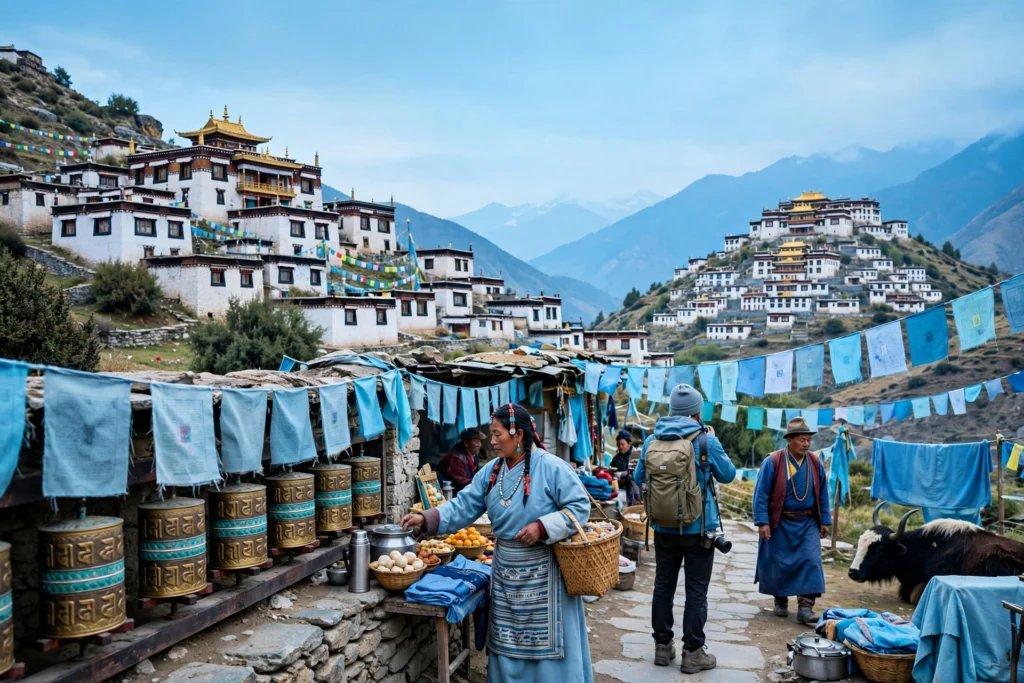
Lhasa’s great monasteries are where Tibetan Buddhism is most alive, and they deserve a full day of your trip. Sera Monastery, founded in 1419, is famous for its debating monks: every weekday afternoon, monks gather in a shaded courtyard and debate Buddhist philosophy in pairs, clapping their hands sharply to make a point, and visitors are welcome to watch from the edges of the courtyard. It is loud, theatrical and completely serious, and it is one of the most memorable sights in Tibet. Arrive in the early afternoon, find a place at the edge of the courtyard, and stay quiet — photography is allowed in the courtyard but not inside the chapels, and your guide will tell you where the line is.
Drepung Monastery, once home to around 10,000 monks and the largest monastery in Tibet, sits at the foot of a mountain west of Lhasa and feels more like a small town than a single building, with whitewashed chapels, monks’ quarters and assembly halls spread across the hillside. It is also the monastery associated with the Shoton Festival, when a giant thangka painting is unveiled on the hillside and crowds gather to watch — if your trip coincides with Shoton, your agency can arrange for you to be there, but expect very large crowds and book well ahead. Between the two monasteries, the contrast is instructive: Sera is compact and intense, Drepung is sprawling and quiet, and together they give a fuller picture of monastic life than either one alone.
Tibetan daily life is visible everywhere in Lhasa if you slow down enough to see it. In the early morning, pilgrims walk the Lingkhor, the outer pilgrim circuit around the old city, spinning prayer wheels and counting beads. In the markets, vendors sell yak butter, dried cheese, barley flour (tsampa) and prayer flags. In the teahouses, old men drink sweet milk tea and play dice games that can go on for hours. Butter tea — salty tea churned with yak butter — is an acquired taste, and you will be offered it often; try it at least once, and if you do not like it, a polite refusal is fine. Losar, the Tibetan New Year, usually in February, is the biggest festival of the year, with days of family visits, monastery ceremonies and new clothes; Shoton, in summer, is the festival of yoghurt and opera, centred on Drepung; and Saga Dawa, in late spring, marks the Buddha’s birth, enlightenment and death, and is a time when pilgrims walk the kora around Mount Kailash in especially large numbers. If a festival falls during your trip, your agency can build it into the itinerary, but be prepared for crowds, higher prices and the need to book everything earlier than usual. For travellers who enjoy festivals and cultural travel, the same planning logic applies to the big celebrations covered in our Morocco travel guide, where timing a trip around a festival also means booking early.
Shigatse and Gyantse: Tashilhunpo Monastery and the Friendship Highway
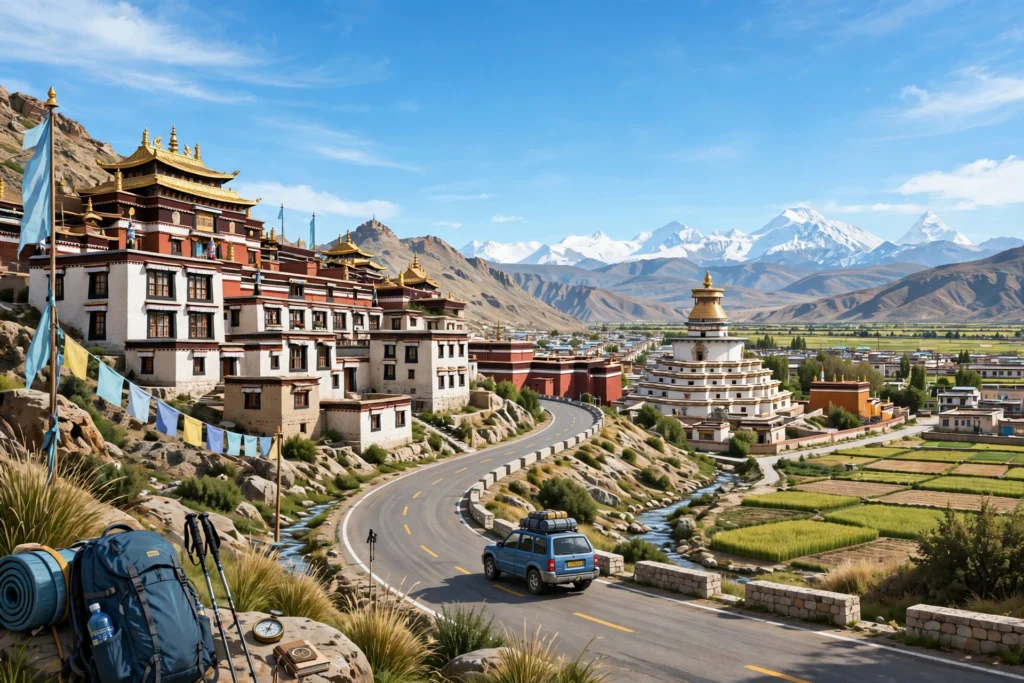
West of Lhasa, the road climbs over high passes and drops into the farming valleys of Gyantse and Shigatse, Tibet’s second city and the seat of the Panchen Lama. This is the classic overland route, and it is where a Tibet trip starts to feel like a journey rather than a city break. The drive from Lhasa to Gyantse takes most of a day, crossing the Kamba La pass at around 4,794 metres, with a first view of Yamdrok Lake — covered in the next section — spread out below the road like a sheet of turquoise glass.
Gyantse is a small, quiet town with one of the most distinctive buildings in Tibet: the Gyantse Kumbum, a multi-tiered chorten (stupa) with chapels on each level, built in the 15th century and famous for its murals. Climbing the Kumbum level by level, with the chapels getting smaller and darker as you rise, is a slow, rewarding experience, and the view from the top, over the town and the surrounding barley fields, is one of the best in Tibet. The Pelkor Chode Monastery beside it and the old fort on the hill above the town complete a half-day that feels unhurried and uncommercial — Gyantse sees far fewer visitors than Lhasa, and it shows in the best way.
Shigatse, at around 3,800 metres, is a larger, more modern city, and its centrepiece is Tashilhunpo Monastery, the seat of the Panchen Lama and one of the great monasteries of Tibet. Founded in 1447, Tashilhunpo holds a 26-metre-high statue of the Maitreya Buddha, gilded and jewelled, inside a chapel that takes a full day to appreciate properly, along with the tombs of past Panchen Lamas and a lively kora path that circles the monastery and climbs the hill behind it. Walking the kora in the early morning, with pilgrims and the sound of chanting from the chapels, is the best way to experience Tashilhunpo. The monastery also runs a debating courtyard similar to Sera’s, though smaller and quieter.
There is, however, an important update about Shigatse that affects planning. On 27 August 2026, China’s National Immigration Administration issued Announcement No. 5 of 2026, suspending the issuance of electronic Border Administration Zone permits for Shigatse City from 00:00 on 28 August 2026. The suspension followed a debris flow (mudslide) on the Nepalese side on 26 August 2026 that caused heavy casualties and missing persons at the Gyirong Port and cut road and communication links there. The announcement also asked people who already held a valid electronic border-area permit listing Shigatse as their destination to refrain from travelling to the area for the time being, and said the resumption of issuance would be announced separately. As of the latest update available at the time of writing, the Gyirong border port remains closed to ordinary passenger and freight traffic, with no official reopening date announced, and one travel source reported in September 2026 that in-person applications had resumed at designated local service windows in Shigatse. You can read the official notice on the National Immigration Administration website.
What does this mean for your trip? Two things, and the distinction matters. First, the suspended electronic border pass is a document for Chinese citizens travelling to border areas — it is not the Tibet Travel Permit, and it is not the Alien’s Travel Permit that foreign visitors need for Everest. A normal Lhasa–Gyantse–Shigatse–Everest itinerary for foreign visitors runs on the TTP plus the ATP, arranged by your agency, and that system has not been suspended. Second, the Gyirong overland crossing between Nepal and Tibet is currently impossible, and any Everest itinerary that depends on a border-area permit should be treated as unconfirmed until your agency confirms it in writing. Do not book an Everest trip, and do not book a Nepal overland crossing, until your agency has confirmed the current permit position in writing. The situation can change, and the only reliable source is your agency checking the current rules at the time you book. This is also why the Friendship Highway — the road from Lhasa through Gyantse and Shigatse toward the Nepal border — should be planned as a Lhasa-to-Everest route, not as a through-route to Kathmandu, until the border reopens. Travellers who enjoy long overland routes will recognise the same trade-off in the mountain drives described in our Iceland travel itinerary, where weather and road conditions also decide the day.
Yamdrok Lake and Namtso Lake: Tibet’s Sacred Lakes
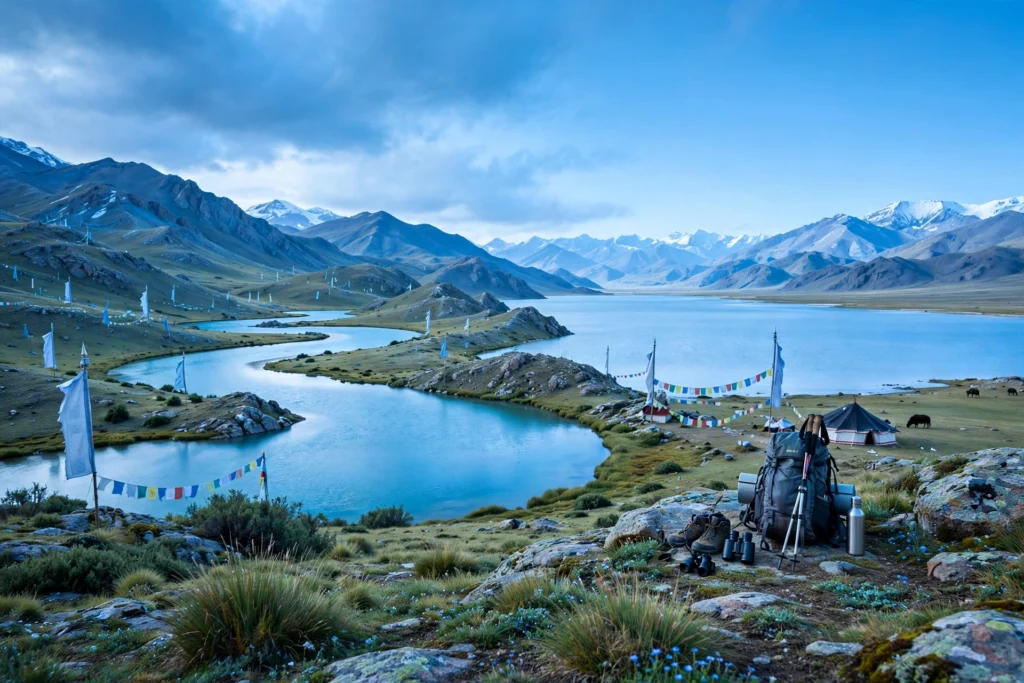
Tibet’s lakes are sacred, and they are also among the most beautiful places in Asia. Yamdrok Lake, at around 4,400 metres, is one of the three great sacred lakes of Tibet, and it is the one most visitors see, because the road from Lhasa to Gyantse crosses the Kamba La pass and drops down to its shore. From the pass, the lake looks like a scorpion, or a ribbon of turquoise folded into the mountains, and its colour changes with the light — deep blue in the morning, green at midday, silver in the late afternoon. There are viewpoints along the road where your driver will stop, and there are usually yaks and Tibetan mastiffs waiting for photographs (a small fee is expected if you pose with them). The lake is holy, and swimming is not appropriate; the experience is the view, the wind, and the sense of scale. Most itineraries stop at Yamdrok for an hour or so on the way to Gyantse, and that is enough — the lake is best seen from the pass road, not from a long stay at its shore.
Namtso Lake, at about 4,700 metres, is a different experience: larger, wilder and further from Lhasa, about a five-hour drive north. It is the highest saltwater lake in the world and one of the largest lakes in Tibet, and its deep blue water stretches to the horizon with the snow-capped Nyenchen Tanglha mountains behind it. The Tashi Dor peninsula, with its hermit caves and prayer-flag-covered rocks, is the main stopping point, and the light at sunrise and sunset is extraordinary. Namtso is a popular addition to a Lhasa-based trip, usually as an overnight excursion or a very long day trip, and it is worth the effort — but it is also a place where the altitude is felt keenly. At 4,700 metres, even walking slowly can leave you breathless, and the wind is cold even in summer. Bring warm layers, sun protection and water, take the walking slowly, and do not plan a long hike on your first visit. If your itinerary is short, Yamdrok gives you the lake experience on the way to somewhere else; if you have the time, Namtso is the deeper, wilder reward. Either way, both lakes are sacred to Tibetan Buddhists, and the respect you show — no swimming, no littering, no loud behaviour at the shore — is part of the visit. The same respect for sacred water runs through the island and lake destinations in our Tanzania travel guide, where lakes and wildlife also sit at the centre of the trip.
Everest North Base Camp: The Roof of the World at 5,200 Metres
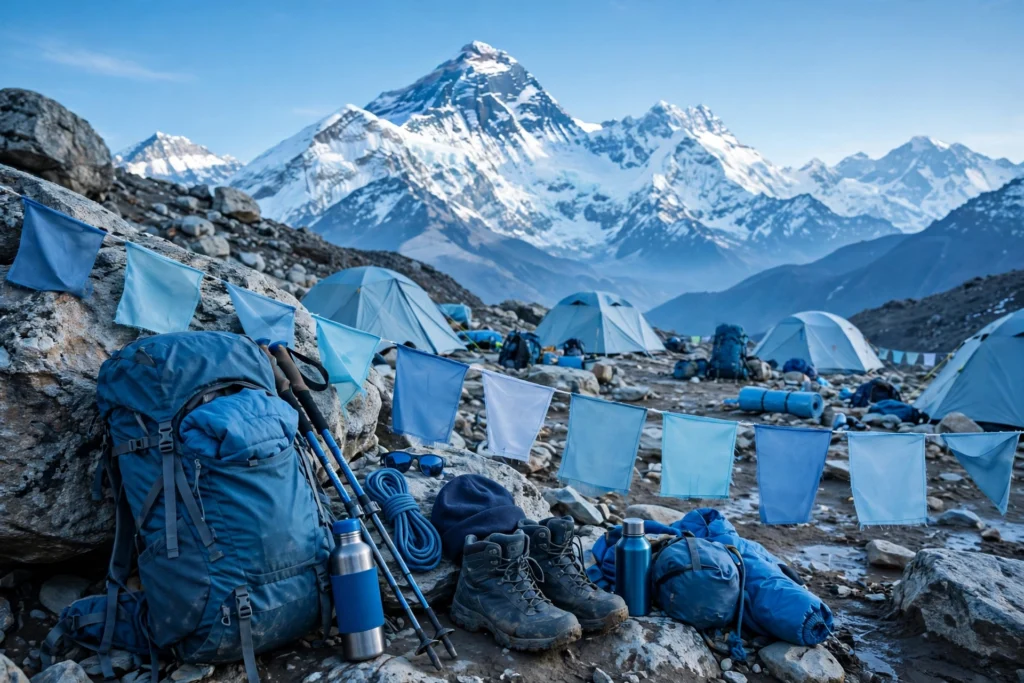
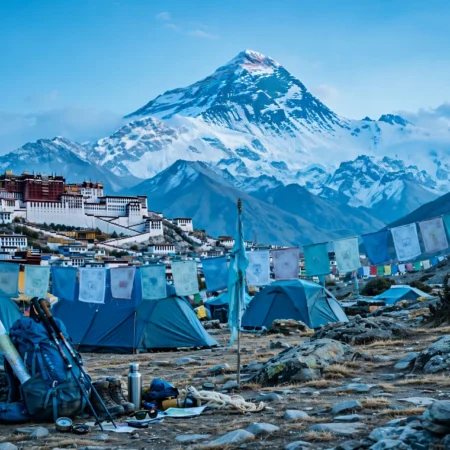
Everest North Base Camp is the reason many travellers come to Tibet at all, and it is worth every hour of the long drive to get there. From Shigatse, the road climbs south through Tingri and over the Gyawula Pass, and on a clear day the first sight of Everest — a black pyramid rising above a sea of white peaks — stops the whole vehicle. The base camp itself sits at 5,200 metres on the Rongbuk Glacier moraine, below Rongbuk Monastery, the highest monastery in the world. There is no climbing involved for visitors: the experience is standing at the foot of the highest mountain on earth, watching the light change on its north face, and sleeping (lightly, and probably badly) in a tent or guesthouse at an altitude where the air is thin enough to make every step an effort.
A few honest notes. First, the view is not guaranteed. Everest hides behind cloud for much of the summer, and the best chances of a clear view are in April to May and September to October, in the early morning before the clouds build. Build a spare day into your itinerary if Everest is the priority, and ask your agency to plan the arrival for the morning if the road allows it. Second, the altitude is serious. At 5,200 metres, headaches and poor sleep are normal even for people who felt fine in Lhasa, and the night at base camp is cold — temperatures can drop well below freezing even in summer, and the tent accommodation is basic, with shared facilities and no heating beyond a stove. Bring your warmest layers, a good sleeping bag liner if your agency suggests one, and a head torch. Third, the facilities are simple by design: this is a remote camp, not a resort, and the charm is in the simplicity. Rongbuk Monastery, a short walk from the camp, is worth a visit in the late afternoon, when the monks’ chanting drifts across the moraine and the mountain turns gold.
The permit position for the Everest route needs to be stated plainly. Foreign visitors need the Tibet Travel Permit plus the Alien’s Travel Permit (ATP), both arranged by your agency, and the route runs through Shigatse, which is a border area. Following the August 2026 suspension of electronic border-area permits for Shigatse and the closure of the Gyirong border port, treat any Everest itinerary as unconfirmed until your agency confirms it in writing. Ask your agency, in writing, three things before you pay a deposit: whether the Everest route is currently open to foreign visitors, which permits are required for your exact dates, and what happens to your deposit if the route closes. A reputable agency will answer all three clearly. If an agency cannot answer, or promises that everything is “no problem” without checking, choose another agency. The mountain will still be there next year; a lost deposit and a cancelled trip are harder to recover. For the practical side of planning a trip of this scale — distances, costs and contingency days — the structure in our travel bucket list is a useful way to think about which big trips deserve a spare day and which do not.
Nyingchi and Eastern Tibet: Peach Blossom and the Green Valleys
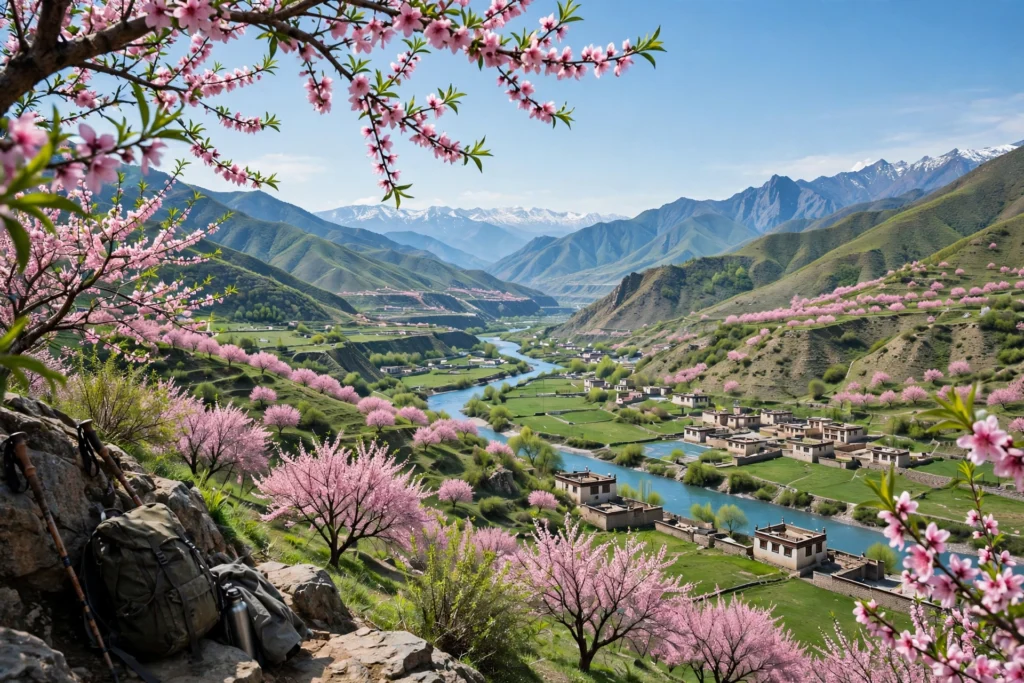
Eastern Tibet is the surprise of the plateau. While the west is high, dry and stark, Nyingchi — at a much lower altitude of around 3,000 metres — is green, forested and mild, with the Yarlung Tsangpo river cutting a deep gorge through the mountains on its way toward India. Travellers who only know Tibet from photographs of the Potala Palace are often startled by Nyingchi: there are pine forests, azaleas, waterfalls and villages that look more like the Himalayan foothills than the high plateau. It is also the easiest part of Tibet on the body, because the lower altitude means the air is richer and the walking is easier, which makes it a good choice for travellers who are worried about altitude or who want a gentler start.
The famous season in Nyingchi is peach blossom, from late March to mid-April, when the valleys fill with pink blossom and the region holds a peach blossom festival. The blossom is at its best in the villages around Bayi and along the Nyang River, and photographers arrive from all over China for it — book accommodation early if you travel then, and expect higher prices. Outside blossom season, Nyingchi is quieter, and the attractions are the landscape itself: the Yarlung Tsangpo Grand Canyon, one of the deepest canyons in the world; the Lulang Forest, a high meadow of wildflowers and pine trees; and the village of Lulang, where the meadows and the snow peaks behind them make one of the classic photographs of Tibet. There are also hot springs, small monasteries and riverside walks that suit a slow day.
Nyingchi is usually reached by a flight from Lhasa to Nyingchi Mainling Airport, or by a long drive over high passes from Lhasa — the drive takes a full day and is spectacular, but the flight is the practical choice for most itineraries. A typical Nyingchi addition is two or three days: one day for the peach blossom or the canyon viewpoints, one day for Lulang Forest and the surrounding villages, and a day to travel. Because Nyingchi is lower and greener, it also works well as a recovery stop after the high days around Everest, and some itineraries end here rather than returning directly to Lhasa. If you are choosing between Nyingchi and Namtso for your extra days, the choice is between green valleys and a high sacred lake — both are beautiful, and the right answer depends on whether you would rather rest at lower altitude or push higher for a wilder view. The green-valley landscapes of Nyingchi have more in common with the forested highlands in our Colombia travel guide than with the high desert of western Tibet, and travellers who love mountain scenery will enjoy both.
Mount Kailash and the Ngari Region: The 52 km Kora
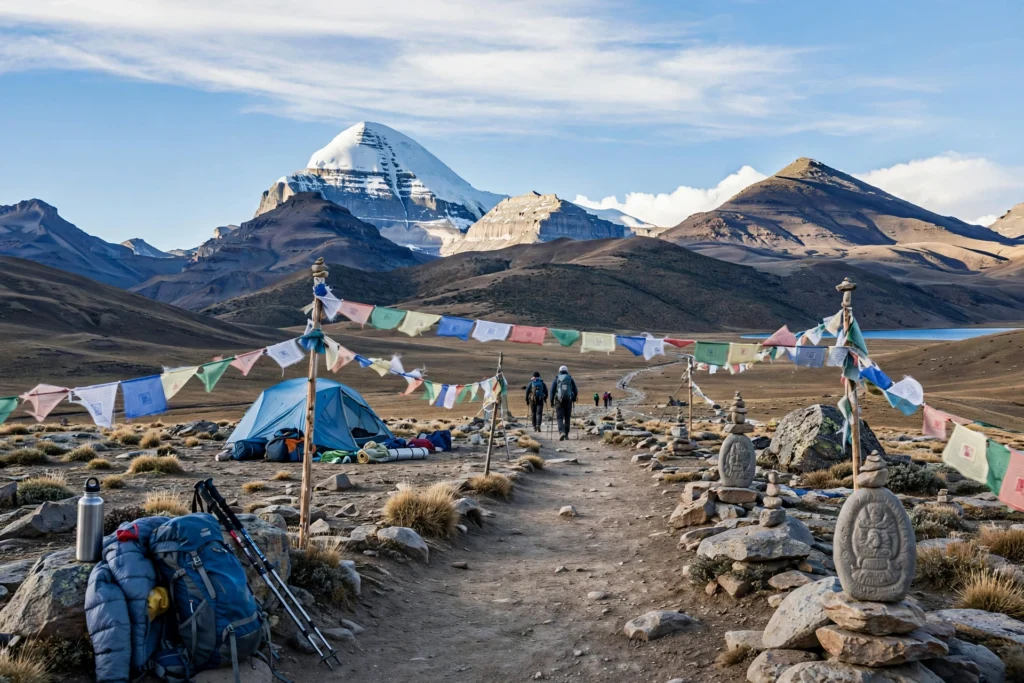
Mount Kailash is the most sacred mountain in Asia — holy to Tibetan Buddhists, Hindus, Jains and Bon practitioners alike — and the kora, the 52-kilometre pilgrim circuit around it, is one of the great walks in the world. Pilgrims believe that completing the kora washes away the sins of a lifetime, and many do it in a single day, walking through the night; most foreign visitors take three days, walking 20 kilometres or so a day at altitudes between 4,700 and 5,630 metres, crossing the Drolma La pass at 5,630 metres on the second day. The walk is not technically difficult — it is a well-worn trail, not a climb — but the altitude, the cold and the remoteness make it a serious undertaking, and it should only be attempted by travellers who have already spent several days acclimatising in Tibet and who are fit, well equipped and travelling with an experienced guide.
Getting to Kailash takes time. The Ngari region, in far western Tibet, is reached by a long overland journey from Lhasa or Shigatse — typically four to five days of driving — or by a flight to Ngari Gunsa Airport, followed by a drive to the mountain. The region also requires the Military Permit in addition to the TTP and ATP, which takes longer to arrange and is one reason Kailash trips must be booked well in advance — allow at least two months, and more if you are travelling in the peak Saga Dawa season, when the kora is at its busiest. The best months for Kailash are May to September; outside those months the passes can be blocked by snow and the kora is not practical. Accommodation on the kora is basic — guesthouses and simple lodges at Darchen, the starting town, and at the overnight stops — and you should carry your own water, snacks, sun protection and warm layers, because the weather at 5,600 metres changes in minutes.
A word of caution, and it is an important one: do not attempt the Kailash kora as your first experience of altitude. The standard advice from every agency is to spend at least a week in Tibet first — Lhasa, then Shigatse and Everest — before going to Kailash, so that your body has time to adjust to the height. Travellers who fly into Lhasa and drive straight to Kailash are the ones who get into trouble. If your time is limited, choose Everest instead; Kailash will still be there, and it deserves a trip of its own, planned properly, with the right permits and the right preparation. The discipline of building up to a big goal over several trips is the same one behind the travel goal approach — a major journey is better done slowly and well than rushed and regretted.
Where to Stay, What to Eat and What to Pack in Tibet
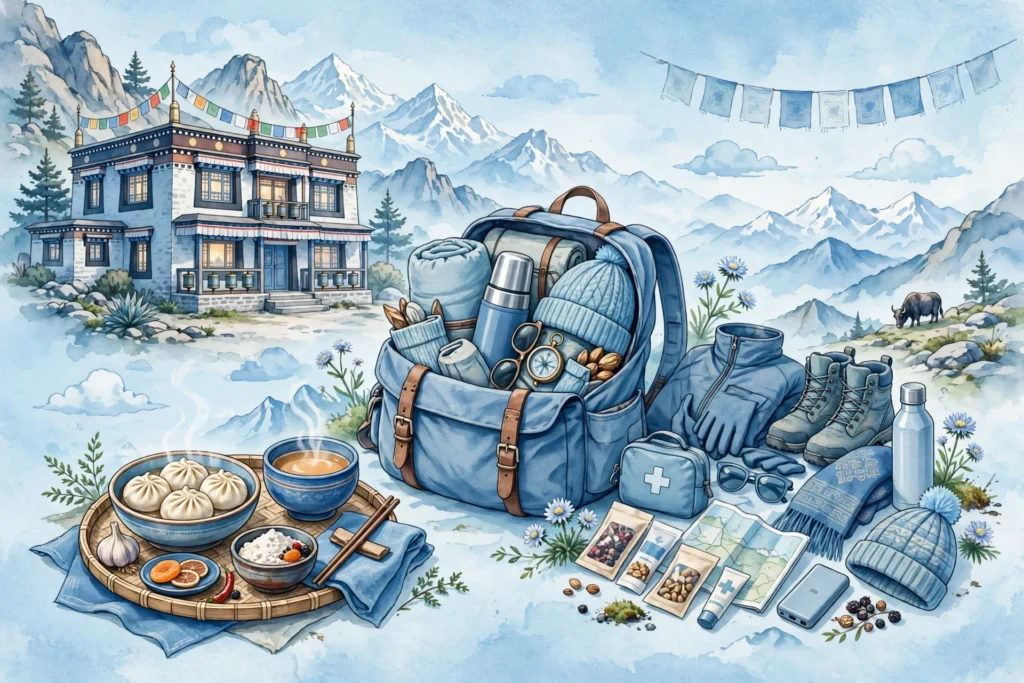
Where you stay in Tibet depends on where you are. Lhasa has the widest choice, from international-standard hotels in the modern part of the city to small guesthouses and boutique hotels in the old town near the Barkhor, where you can walk to the Jokhang Temple in minutes. In the old town, look for a hotel with oxygen supply in the rooms — many Lhasa hotels offer it, and it can make the first night noticeably easier — and with heating that works properly, because Lhasa nights are cold even in summer. In Shigatse and Gyantse the choice is smaller but comfortable, with mid-range hotels that are clean, warm and used to foreign guests. At Everest Base Camp and on the Kailash kora, the accommodation is basic by design: tent camps, simple guesthouses and shared facilities. Bring a sleeping bag liner, earplugs and a head torch for those nights, and set your expectations accordingly — the view is the luxury.
Tibetan food is hearty, simple and well suited to the cold and the altitude. The staples are tsampa (roasted barley flour, mixed with butter tea into a dough), thenthuk (hand-pulled noodle soup with vegetables and meat), momos (steamed dumplings, filled with yak meat or vegetables), and yak meat in various forms — dried, stewed or in soup. Butter tea, made with yak butter and salt, is served everywhere and is an acquired taste; sweet milk tea is the gentler alternative and is served in the teahouses of Lhasa. In Lhasa there are also Sichuan, Nepali and Western restaurants, so a picky eater will not go hungry, but outside Lhasa the choice narrows quickly to Tibetan and Sichuan cooking, and vegetarians should tell their agency in advance so the guide can arrange suitable meals. Drink bottled water, avoid tap water, and be careful with raw vegetables and street food in the smaller towns. Yak meat is rich and can be hard on an unsettled stomach at altitude, so eat lightly for the first two days and save the adventurous eating for later in the trip. The food culture of Tibet — barley, yak, butter tea — is as distinctive as the food cultures in our Singapore travel guide or our Budapest travel guide, and trying it properly is part of the journey.
Packing for Tibet is a matter of layers, because the temperature can swing by 15 to 20 degrees Celsius between day and night. A typical day in May might be 18°C in the afternoon sun and close to freezing after dark, and at Everest Base Camp the night temperature can drop well below zero even in summer. Pack a warm, windproof jacket, a fleece or down layer, thermal base layers, a warm hat and gloves, and sturdy walking shoes with good grip — the ground around monasteries and lakes is uneven, dusty and often steep. Sun protection is essential at altitude: high-factor sunscreen, lip balm with sun protection, sunglasses and a sun hat, even on cloudy days. Bring a reusable water bottle, a small daypack, a head torch, wet wipes, hand sanitiser, and any prescription medication in its original packaging, with a copy of the prescription. A power bank is useful, because charging points can be scarce outside Lhasa, and a universal adapter for Chinese sockets (Type A, C and I) is worth packing. Cash is important: the currency is the Chinese yuan (CNY, also called RMB), and while mobile payment apps dominate in Chinese cities, foreign visitors often cannot use them easily — carry enough cash in yuan for the whole trip, and change money in Lhasa or your gateway city, because ATMs and exchange facilities are scarce outside the main towns. Your agency will advise on how much cash to carry, but a useful rule is to assume you cannot pay by card outside Lhasa. For a full packing framework that works for any long trip, the checklist approach in our travel apps guide is a good starting point, adapted here for cold and altitude.
How Much Does Tibet Travel Cost?
Tibet is not a budget destination, and the honest reason is the permit system. Because every foreign visitor must travel with a licensed agency, a guide and an organised vehicle, the fixed costs of a Tibet trip are higher than a comparable trip elsewhere in Asia — and those costs are shared among the group, which is why group tours are much cheaper per person than private tours. A small-group tour of 5 to 8 days typically costs in the region of $1,200 to $2,500 per person, depending on the season, the route and the standard of hotels, while a private tour for two people over the same route can cost $2,500 to $4,500 per person or more. Everest and Kailash itineraries cost more again, because of the extra driving days, the extra permits and the remoteness. The figures below are planning ranges for a mid-range group tour in 2026, excluding international flights to China — confirm all prices with your agency before booking, because prices change with the season and with permit rules.
| Item | Typical range (per person) | Notes |
|---|---|---|
| 5-day Lhasa group tour | $1,200–$1,800 | TTP, guide, vehicle, hotels, some meals included |
| 8-day Lhasa–Shigatse–Everest group tour | $1,800–$2,800 | Adds ATP, longer driving, Everest camp night |
| 12–15 day Lhasa–Everest–Kailash tour | $3,000–$5,000 | Adds Military Permit, long overland days, basic lodges |
| Private tour supplement (2 people) | +$800–$1,500 per person | Private vehicle and guide, flexible pace |
| Chinese visa | $30–$140 | Varies by nationality and processing speed |
| Tibet Travel Permit | Usually included in tour price | Arranged by agency; confirm it is included |
| Flights to Lhasa (from Chengdu) | $150–$400 return | Book after the permit is issued |
| Qinghai-Tibet Railway sleeper | $80–$150 one way | Xining to Lhasa, book early in peak season |
| Daily spending money | $15–$40 per day | Meals not included, drinks, tips, souvenirs |
| Tips for guide and driver | $5–$10 per day, per person | At your discretion, given at the end of the trip |
What is included in a tour price varies a lot, so compare like with like. A good agency quote should list the permit fees, the guide, the vehicle and driver, accommodation, airport and station transfers, and which meals are included — and should say clearly what is not included, such as the Chinese visa, flights to China, travel insurance, tips and personal spending. Ask for the quote in writing, and ask what happens if the permit is delayed or the route changes: a reputable agency will have a clear answer, and a vague one is a warning sign. Tipping is not obligatory in Tibet, but a tip for your guide and driver at the end of the trip is customary and appreciated, particularly on a long overland journey where the driver has worked hard on difficult roads. Finally, remember that the cheapest Tibet tour is rarely the best value — the difference between a good agency and a poor one is the difference between a trip that runs smoothly and one that falls apart at the first closed road or delayed permit. Spend the money on the agency, and save it on the hotel. The same logic — paying for reliability where it matters and saving where it does not — is the thinking behind our best places to travel in Mexico budgeting advice, and it applies even more strongly in Tibet, where there is no fallback if the arrangements fail.
Sample Tibet Itineraries: 5 Days in Lhasa, 8 Days to Everest, and the Kailash Route
The itineraries below are realistic shapes for a first trip, a full trip and an expedition, and they are the right thing to discuss with your agency — not a fixed schedule to book blindly. Every one of them assumes two gentle days in Lhasa at the start, because altitude does not negotiate.
5 days — Lhasa and the sacred lake. Day 1: arrive in Lhasa by flight or train, rest at the hotel, short evening walk near the Barkhor. Day 2: Jokhang Temple and the Barkhor circuit in the morning, Tibet Museum in the afternoon, early night. Day 3: Potala Palace in the morning (climb slowly), Sera Monastery debating in the afternoon. Day 4: Drepung Monastery in the morning, Norbulingka in the afternoon, farewell dinner in the old town. Day 5: day trip to Namtso Lake (long day, early start) or a second day in Lhasa, then depart. This itinerary suits travellers who are short on time or who want a gentle introduction to Tibet, and it keeps you at or below 4,700 metres. If you are deciding how many days a destination deserves, the framework in our how to find travel inspiration guide is a useful way to match the length of a trip to what you actually want from it.
8 days — Lhasa, Nyingchi and Shigatse, or Lhasa to Everest. The Everest version: Days 1–3 as above in Lhasa. Day 4: drive to Gyantse via Yamdrok Lake and the Kamba La pass, overnight in Gyantse. Day 5: Gyantse Kumbum in the morning, drive to Shigatse, Tashilhunpo Monastery in the afternoon. Day 6: drive to Everest region via Tingri, overnight at Rongbuk Monastery. Day 7: sunrise at Everest North Base Camp, drive back to Shigatse. Day 8: return to Lhasa and depart. The alternative 8-day route swaps Everest for Nyingchi: Days 1–3 in Lhasa, Days 4–6 in Nyingchi for peach blossom or the Yarlung Tsangpo canyon and Lulang Forest, Days 7–8 back in Lhasa with a Namtso day trip. Both are good trips; the Everest version is the more dramatic, the Nyingchi version the more relaxing.
12 to 15 days — Lhasa, Everest and Mount Kailash. Days 1–3 in Lhasa, Days 4–5 Gyantse and Shigatse, Days 6–7 Everest Base Camp, Days 8–11 overland to Darchen via Saga and the high lakes of western Tibet, Days 12–14 the three-day Kailash kora, Day 15 return to Lhasa or fly out from Ngari. This is the full Tibet journey, and it needs the Military Permit, a fit and well-acclimatised traveller, and an agency with real experience in Ngari. Do not attempt it as a first trip to altitude, and do not book it until your agency has confirmed the permits for your exact dates in writing. For travellers weighing a long expedition against a shorter trip, the comparison in our travel hobby guide is a reminder that the best trips are the ones that match your fitness and your time, not the ones that sound most impressive.
Frequently Asked Questions About Tibet Travel
1. Can I travel to Tibet independently?
No. Foreign visitors cannot travel to Tibet independently. You need a Tibet Travel Permit arranged through a licensed Tibetan travel agency, a valid Chinese visa, a licensed guide and an organised vehicle with a settled route for the whole trip. Independent travel outside Lhasa is not permitted, and you cannot board a flight or train to Lhasa without the original permit. Travelling without a permit risks fines, detention and deportation.
2. Do I need a Chinese visa to visit Tibet?
Yes. Every foreign visitor needs a valid Chinese visa before the Tibet Travel Permit can be applied for, because the permit application requires it. The exception is travellers entering from Nepal, who need a separate group visa arranged through an agency in Kathmandu instead of a standard Chinese visa. Check the visa rules for your nationality well in advance, and allow four to six weeks for the visa.
3. How long does the Tibet Travel Permit take?
Sources differ: some agencies quote 7 to 10 working days, while other established guides say to allow about 15 days and sometimes up to 20. The safe plan is to allow a full month from sending your documents to travelling, and not to book non-refundable flights or train tickets until the permit is confirmed as issued. The permit is arranged by your agency, not by you directly.
4. How bad is the altitude in Tibet?
Lhasa sits at 3,650 metres, and Everest North Base Camp is at 5,200 metres. Most visitors feel the altitude on the first day or two — headache, poor sleep, tiredness — and acute mountain sickness usually begins 6 to 10 hours after arrival. Take the first one to two days very gently, drink plenty of water, avoid alcohol, and talk to your doctor before travelling about medication and about what warning signs should make you descend. Do not climb higher while you still feel unwell.
5. What is the best time to visit Tibet?
April to May and September to October are the best months, with clear skies, manageable temperatures and the best chances of seeing Everest. Late March to April brings the peach blossom season in Nyingchi. Summer is green but wet and crowded, and the Potala Palace can sell out days ahead. Winter is cold, dry and very quiet, with the Losar festival in February, but some high areas are difficult to reach.
6. Is the Everest route from Tibet open in 2026?
The Everest North Base Camp route for foreign visitors runs on the Tibet Travel Permit plus the Alien’s Travel Permit, arranged by your agency. However, following the August 2026 suspension of electronic border-area permits for Shigatse and the closure of the Gyirong border port, treat any Everest itinerary as unconfirmed until your agency confirms it in writing. Do not pay a deposit until you have that confirmation, and do not plan a Nepal overland crossing — the Gyirong crossing is currently closed to ordinary passenger traffic.
Conclusion
Tibet rewards the travellers who prepare for it and punishes the ones who do not. The permit system, the altitude and the remoteness are not obstacles put in your way for fun — they are the reason Tibet is still Tibet, and the reason a trip here feels different from anywhere else. Get the paperwork right, give your body time to adjust, choose an agency you trust, and build spare days into the plan, and you will stand under the Potala Palace, walk the Barkhor with the pilgrims, watch the sun rise on Everest, and understand why travellers have been making this journey for centuries. Start the permit process a month before you travel, check the US State Department travel advisory for China again before you go, and go with your eyes open. The Roof of the World is worth the effort — just make sure the effort happens before you leave home, not after you arrive.
People also read: London Travel Guide, Morocco Travel Guide, Iceland Travel Itinerary, Best Places to Travel in January, Travel Itinerary Template, How to Prepare a Travel Budget

M. Adil is the founder and editor of SoloTravelPro. He writes practical, research-based travel guides that help travellers plan with confidence — from first-time city breaks to national parks and island escapes. Every guide is built on official sources, current prices and honest, usable advice, so readers can plan smarter and travel better.