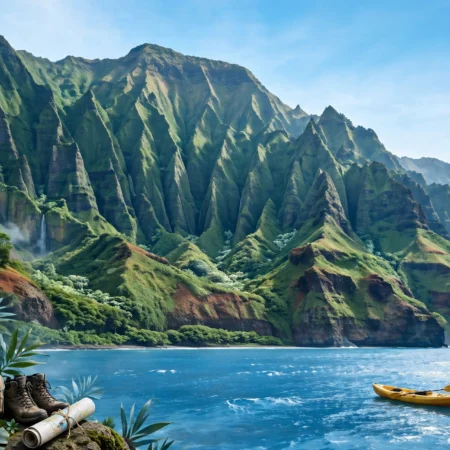
Kauai is the island Hawaii keeps for the travellers who want the wild version. It is the oldest of the main Hawaiian islands, around five million years old, and it shows its age in the best possible way: sheer green cliffs dropping into blue water, canyons cut deep into red rock, rivers you can paddle for miles, and valleys so steep and wet that about 90% of the island is inaccessible by road. The nickname is the Garden Isle, and it is earned — Kauai is the wettest, greenest, most rural of the islands most visitors reach, with no buildings taller than a coconut palm and no road that circles the whole island. That is the point. You come to Kauai to slow down, to hike, to swim in calm bays, to watch the sun set over Hanalei Bay, and to stand at the edge of Waimea Canyon wondering how a place this dramatic stayed this quiet for so long.
This Kauai travel guide is built for a first trip. It covers when to go, how many days you need, where to stay, how to get around, the Nā Pali Coast and the Kalalau Trail, Waimea Canyon, the beaches that are safe to swim in and the ones that are not, what a trip costs, what to eat and pack, and two full itineraries — five days and seven days — so you can plan a trip that is realistic rather than romanticised. Prices below are planning ranges only. Confirm figures before you book, as fares, fees and conditions can change at short notice.
Quick answer: the best time for Kauai travel is April to June or September to November, when the weather is warm, the ocean is calmer on the North Shore, and prices and crowds sit below the summer and Christmas peaks. Plan 5–7 nights, book a rental car before you fly, and base yourself on the South Shore (Poipu) for sunshine or the North Shore (Princeville–Hanalei) for scenery — or split your stay between the two. Budget roughly $200–350 a day for two people travelling mid-range, and book Hā’ena State Park reservations and any Kalalau Trail permit a full 30 days ahead.
Best Time to Visit Kauai
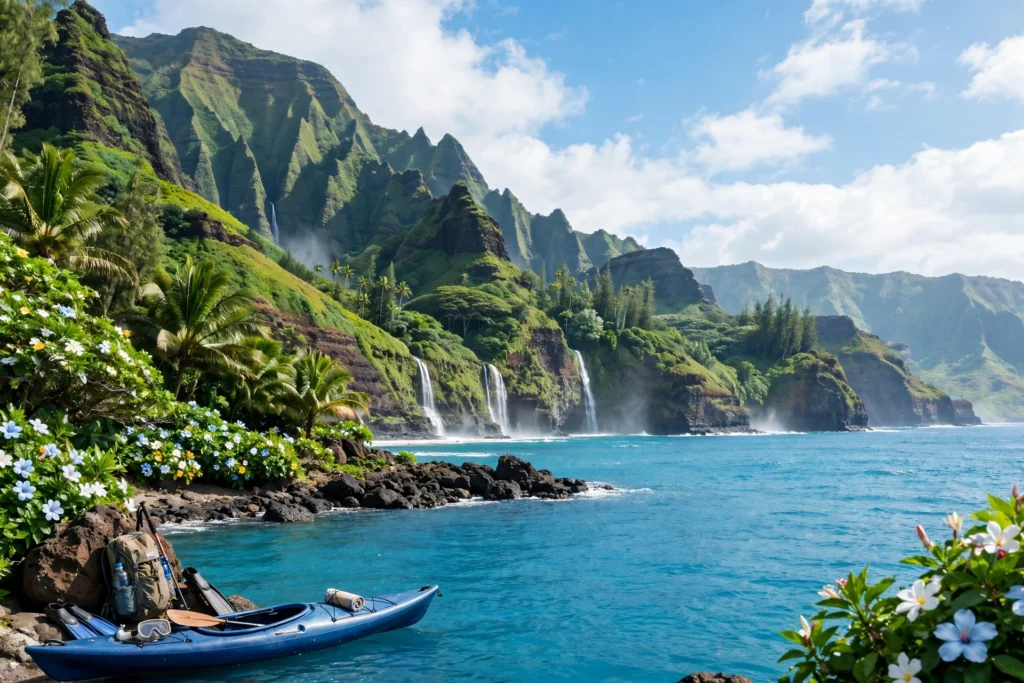
Kauai is warm all year. Daytime temperatures sit roughly between 24°C and 30°C (75–86°F) in every month, and the ocean stays warm enough to swim in year-round. The question is not temperature but rain, wind and swell — and those three change a lot depending on which side of the island you are on and which month you pick. Kauai has two faces: the North Shore, which catches the trade winds and the rain, and the South Shore, which sits in the rain shadow and stays drier and sunnier. In winter the North Shore gets the big surf and the heavy rain; in summer it calms down and becomes the best place on the island to swim.
The official Hawaii tourism site sums it up plainly: summer brings calmer ocean conditions for beach activities, winter brings bigger waves, and spring or fall give the best mix of weather, value and fewer crowds. That matches what you will actually experience. If your trip is built around swimming, snorkelling and the Kalalau Trail, aim for May to September. If your trip is built around whale watching, surfing and lower prices, aim for December to March — and base yourself in Poipu, where the winter weather is far more forgiving than Hanalei.
| Month | Weather | Ocean | Crowds and prices |
|---|---|---|---|
| January | Warm, wet on the North Shore, drier in Poipu | Big winter surf on the North Shore; whale season begins | High after New Year; whale watching peak starts |
| February | Similar to January; rain showers common | Big surf continues; whales at their best | High; Valentine’s and Presidents’ Day weekends busy |
| March | Rain easing; still wet up north | Surf easing; whale season continues | High; spring break crowds |
| April | Warmer, drier, flowers everywhere | Calming; good snorkelling returns to the North Shore | Shoulder season; good value |
| May | One of the driest months; warm and sunny | Calm seas; excellent snorkelling | Shoulder season; excellent all-round month |
| June | Dry, warm, long days | Calm; best swimming of the year | Summer season begins; prices climb |
| July | Dry and warm; trade winds steady | Calm on the North Shore; surf small | Peak summer; busiest family month |
| August | Hot and dry; occasional tropical moisture | Calm; warmest ocean of the year | Peak summer; book early |
| September | Warm; the quietest good-weather month | Calm; snorkelling still excellent | Shoulder season; best value for good weather |
| October | Warm; rain slowly returning | Calm early in the month; surf building late | Shoulder season; quiet beaches |
| November | Rain increasing on the North Shore; Poipu stays drier | Winter surf arriving; whales returning late in the month | Low; good deals before Thanksgiving |
| December | Wettest month on the North Shore; sunny spells in Poipu | Big surf; whale season begins | High over Christmas and New Year |
April to June is the sweet spot for most first trips. The winter rain has eased, the North Shore ocean has calmed enough for swimming at Hanalei Bay and Ke’e Beach, the waterfalls are still running full from the wet season, and the summer crowds have not yet arrived. September to November is the other sweet spot: the ocean is at its warmest, the summer families have gone home, and hotel rates drop. The trade-off in autumn is that the winter surf starts to build late in October, so plan your North Shore swimming early in the trip and keep Poipu as your backup.
The months to think twice about are December to February if you are set on the North Shore. Hanalei in January can be gloriously sunny one morning and drenched the next, and the surf can be big enough that the lifeguards keep everyone out of the water. That does not make winter a bad time to visit Kauai — Poipu in January is often sunny while Hanalei is raining, whale watching is at its best, and the island is at its greenest — but it does mean you should choose your base with the season in mind, not against it. If you are travelling in the best places to travel in January window, Kauai belongs on the list, but book the South Shore.
One more timing note: Kauai’s weather is local, not island-wide. It can be raining in Hanalei, sunny in Poipu and cloudy in Lihue at the same moment. Check the forecast for the specific side of the island you are heading to each morning, and keep a flexible plan — a rainy morning on the North Shore is often a sunny afternoon in Waimea Canyon, and the drive between the two is part of the experience.
How Many Days Do You Need in Kauai
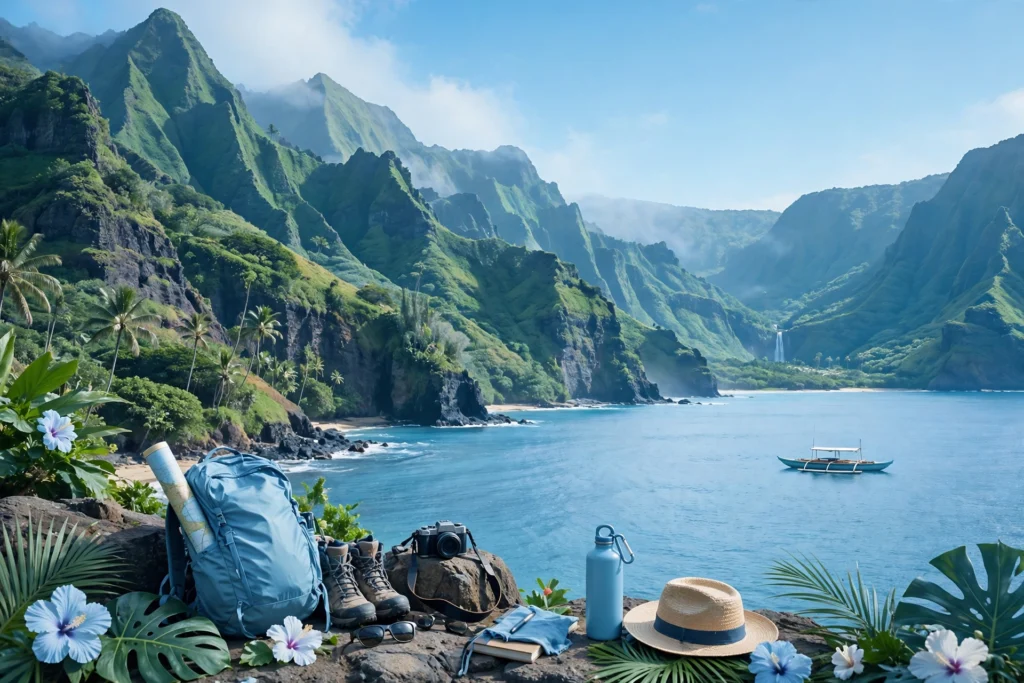
The honest answer is 5–7 nights. Kauai is not an island you rush. The distances look small on a map — the island is only about 40 km across — but the roads are slow, single-lane in places, and the whole point of being here is to stop. A three-night trip gives you a taste: one day on the South Shore, one day on the North Shore, one day in Waimea Canyon. You will leave knowing you missed the best of it. Five nights is the minimum for a proper first trip, and seven nights is the trip most people wish they had booked.
Here is how the days stack up. Day one is arrival and settling in: land at Lihue, collect the rental car, stock up on groceries, and watch the sunset from the beach nearest your stay. Day two belongs to the South Shore — Poipu Beach, Spouting Horn, a snorkel in the morning when the water is calmest. Day three belongs to Waimea Canyon and Kōke’e State Park, a full day of lookouts and short hikes. Day four belongs to the North Shore — Hanalei Bay, the drive to the end of the road at Hā’ena, and Ke’e Beach if you have a reservation. Day five belongs to the East Side — kayaking the Wailua River to Secret Falls, Wailua Falls and the Fern Grotto. That is five days, and you have not yet done a Nā Pali Coast boat tour, a helicopter tour, a full Kalalau Trail hike, or a second day anywhere you loved. Days six and seven are where the trip breathes: a boat tour along the Nā Pali Coast, a slow morning at a farmers market, a second hike, a beach day with no agenda at all.
If you only have four nights, cut the East Side day first and keep the canyon, the North Shore and the South Shore. If you have ten nights, add a second base — three nights in Poipu and four in Princeville, for example — and you will see both sides of the island in their best light without the long cross-island drives every day. The travel itinerary template is a useful way to lay this out before you book anything, because the single biggest mistake on Kauai is booking a hotel on one side of the island and then trying to do everything from there. The island rewards a split stay more than almost anywhere else in Hawaii.
Families should plan on the longer end. Kauai is excellent for children — calm beaches at Poipu and Lydgate, easy waterfall walks, boat tours where dolphins often show up — but the days are slower with children, and the driving between sights eats into beach time. Seven nights with a split stay works well: three nights in Poipu for the calm water and the resort pools, then four nights on the North Shore or the East Side for Hanalei Bay and the river kayaking. Teenagers who can hike will love the Kalalau Trail day hike to Hanakāpī’ai Beach; younger children will be happier at Lydgate Beach Park, which has a rock-enclosed swimming pond built for exactly that purpose.
Getting to Kauai: Lihue Airport and Getting Around
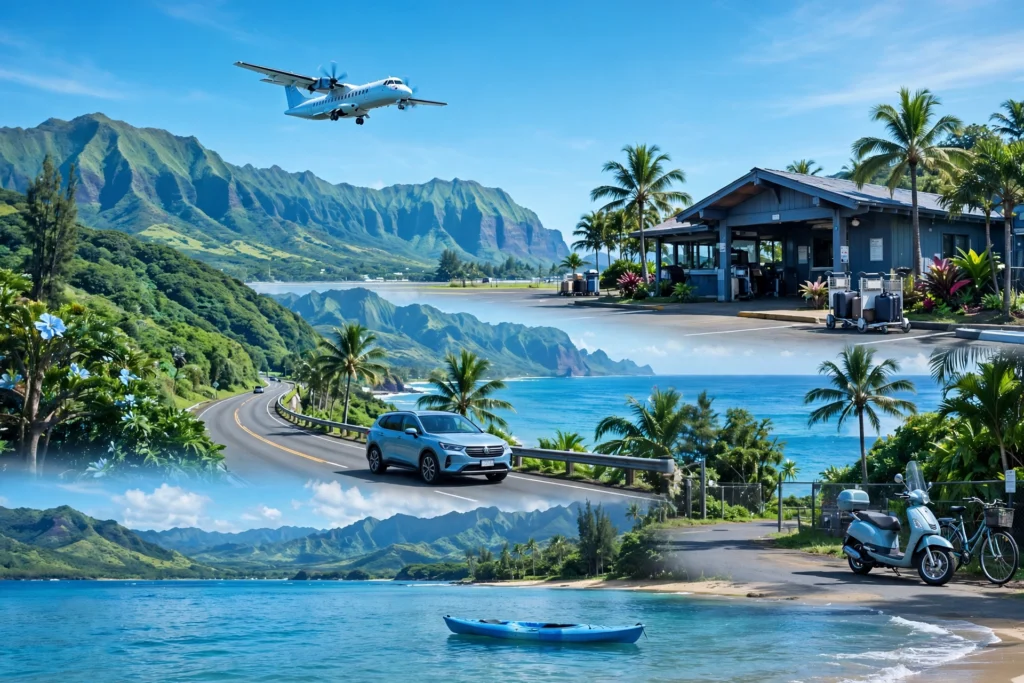
Every Kauai trip starts at Lihue Airport (LIH), the island’s only commercial airport, on the East Side near the town of Lihue. There are direct flights from West Coast cities including Los Angeles, San Francisco, Seattle, San Diego and Phoenix, and from Honolulu the hop is about 25 minutes, with flights running all day. Most visitors from the US East Coast and from Europe connect through Honolulu or a West Coast hub. The airport is small, open-air and easy: you walk off the plane into warm air, collect your bags, and you are on the road within half an hour of landing. The official Go Hawaii Kauai page confirms Lihue Airport as the island’s main gateway, with direct flights from many large US West Coast cities.
A rental car is essential on Kauai. This is not a suggestion; it is the single most important practical fact in this guide. There is no road circling the island, no train, no useful island-wide bus network for visitors, and the sights are spread across four coasts. The Kauai Bus exists and costs a couple of dollars a ride, and it is fine for a local trip between Lihue and Kapa’a, but it will not get you to Waimea Canyon at sunrise or to Hā’ena before your reservation window. Book the rental car at the same time as your flights — Kauai has had genuine car shortages in peak season, and walk-up prices at the airport can be double the advance rate. A standard car is fine for almost everything; you only need four-wheel drive if you are planning unpaved back roads, which most visitors should not be doing anyway. Expect roughly $60–120 a day for a standard car in shoulder season, more in summer and over Christmas.
Driving on Kauai is slow and, mostly, pleasant. The main road is Kuhio Highway (Highway 56) on the East Side and North Shore, and Kaumualii Highway (Highway 50) on the South and West Sides. Speed limits are low, the road narrows to one lane over several historic bridges on the North Shore — where the rule is that five to seven cars cross one way, then the other direction goes — and traffic backs up around Kapa’a in the afternoon. Allow more time than the map suggests: Lihue to Hanalei is about 45 minutes without traffic and well over an hour when it is busy; Lihue to Waimea Canyon lookout is about 90 minutes; Poipu to Princeville is about 75 minutes. Fill up when you see a petrol station, especially before heading to the canyon or the North Shore, where stations are few. Parking is the other thing to plan: beach car parks fill by mid-morning at Poipu, Hanalei and Ke’e, and Hā’ena requires a reservation that includes parking, so arrive early or take the shuttle.
Ride-hailing exists around Lihue, Kapa’a and Poipu but is thin elsewhere, and there is effectively none on the North Shore after dark or anywhere near the canyon. Taxis are expensive for the distances involved. If you are staying in one place and do not want to drive, a resort in Poipu with a shuttle and a couple of booked tours can work, but you will see a fraction of the island. For everyone else, the car is the trip. Download offline maps before you leave home — mobile signal drops out in the canyon, along the North Shore and on the Kalalau Trail — and the travel apps guide covers the navigation and offline-map tools worth loading before a trip like this.
Where to Stay in Kauai: North Shore vs South Shore
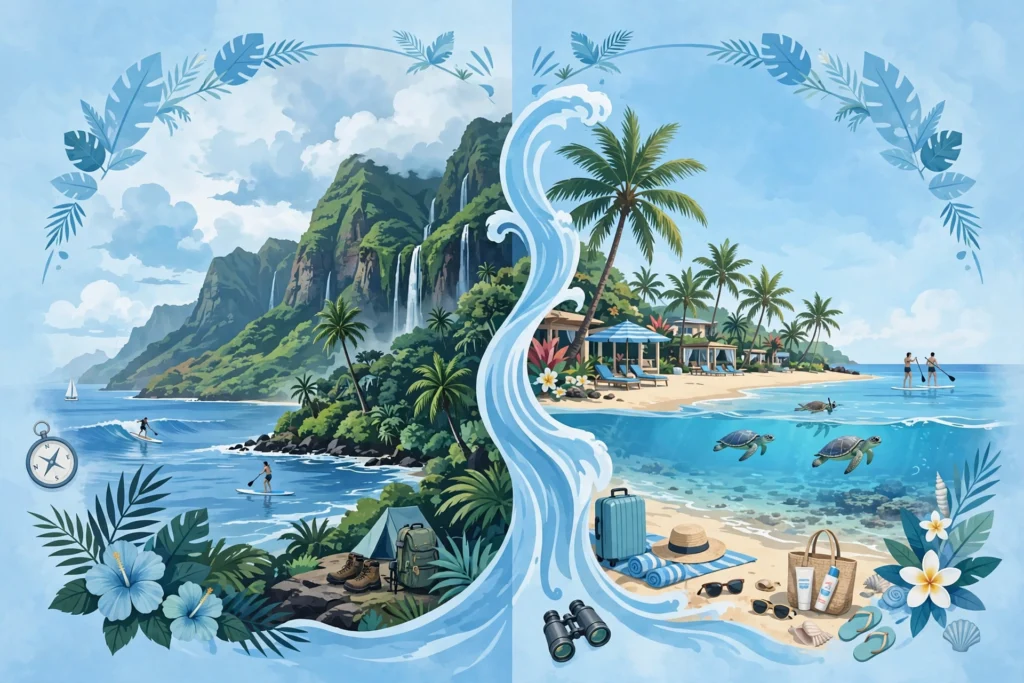
Where you stay on Kauai matters more than which hotel you pick, because the island’s weather, beaches and driving times all change with the coast. The choice is really North Shore vs South Shore, with the East Side and Lihue as the practical middle ground. There is no wrong answer, but there is a wrong answer for your month and your priorities, so choose with the season in mind.
The North Shore — Princeville and Hanalei — is the prettiest part of the island. Hanalei Bay is a two-mile crescent of sand backed by green mountains that look like a film set, the town is small and charming, and the whole coast feels like the Hawaii people imagine before they arrive. The trade-off is rain: the North Shore is the wettest inhabited part of Kauai, especially from November to March, and the surf can be too rough to swim in winter. Princeville sits on a bluff above the coast and has the North Shore’s main resorts and condos; Hanalei town has small inns, vacation rentals and a handful of places to eat. If you stay here, you are choosing scenery and a slow pace over sunshine reliability.
The South Shore — Poipu and Koloa — is the sunniest and most practical base. Poipu Beach is the island’s best all-round beach, the resorts and condos are concentrated here, and the weather is reliably drier than anywhere else on the island. It is also the most built-up part of Kauai, which means more restaurants, more shops and more people. If you are travelling in winter, or you want to swim every day, or you are travelling with children, Poipu is the safer base. Old Koloa Town, a few minutes inland, has the historic plantation-town feel and some of the island’s best food trucks and cafes.
The East Side — Kapa’a and Lihue — is the compromise. Kapa’a is the island’s most lived-in town, with the longest stretch of shops, food trucks and affordable condos, and the Royal Coconut Coast path runs along the shore for walking and cycling. Lihue is the working town around the airport, with the most hotels at the lowest prices, but it is not a resort area and the beaches nearby are not the island’s best. The East Side works well for a short stay, for a budget trip, or for the first and last nights of a longer trip, because everything is within 30 minutes.
| Area | Best for | Weather | Price level | Watch out for |
|---|---|---|---|---|
| Poipu / South Shore | Sunshine, swimming, families, resorts | Driest, sunniest; best in winter | $$$ resorts, $$ condos | Busiest beaches; book early in summer |
| Princeville / North Shore | Scenery, Hanalei Bay, quiet luxury | Wettest Nov–Mar; best May–Sep | $$$ resorts, $$$$ luxury | Winter surf; rain; long drive to the canyon |
| Hanalei town | Small-town feel, surf, food trucks | Same as North Shore; rainy in winter | $$ inns and rentals | Few rooms; books out fast; single-lane bridges |
| Kapa’a / East Side | Budget, food trucks, central location | Mixed; showers pass quickly | $$ condos, $ hotels | Afternoon traffic; beaches less swimmable |
| Lihue | Airport nights, lowest prices | Mixed; windy near the airport | $–$$ hotels | Not a beach-resort area |
Book early whatever you choose. Kauai has a limited supply of rooms, and the good ones — the Princeville resorts, the Poipu beachfront condos, the small Hanalei inns — sell out months ahead for summer and Christmas. Vacation rentals are a big part of the market here, especially in Princeville and Poipu, and they make sense for stays of five nights or more, when a kitchen and a washing machine start to matter. One local rule worth knowing: Kauai’s building code keeps hotels low — no buildings taller than a coconut palm is the saying, and the reality is low-rise resorts set in gardens rather than tower blocks. That is part of why the island feels the way it does, and it is also why rooms are scarce. If you are weighing an island stay against a mainland beach trip, the Malta travel guide shows how another small island handles the same trade-off between scenery, sunshine and a limited supply of rooms.
Nā Pali Coast and the Kalalau Trail
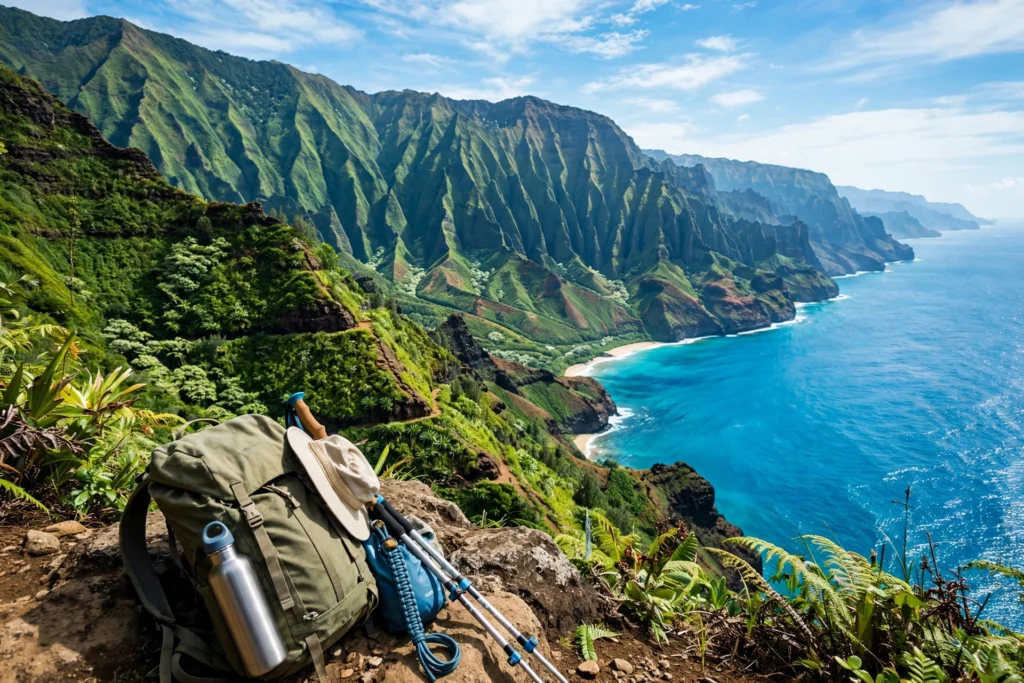
The Nā Pali Coast is the reason many people come to Kauai, and it is the one place on the island that cannot be reached by car. Seventeen miles of fluted green cliffs, sea caves, hidden valleys and beaches with no road access, it is the wild heart of the Garden Isle — and the part that demands the most planning. There are four ways to see it: hike it, boat past it, kayak it, or fly over it. Each one is worth doing, and each one has rules you need to know before you go.
The Kalalau Trail is the famous way in. It runs 11 miles one way from Ke’e Beach at Hā’ena State Park to Kalalau Beach, along the cliff edge, through five valleys and across streams that can flood after rain. It is widely described as one of the hardest and most beautiful day hikes in the United States, and that reputation is fair: the trail is narrow, muddy, exposed in places, and the elevation gain adds up to roughly 6,000 feet over the full route. Most people do not hike the whole trail in a day. The classic day hike is the first two miles to Hanakāpī’ai Beach, then a further two miles inland to Hanakāpī’ai Falls — an eight-mile round trip that takes five to seven hours and gives you a beach, a stream crossing and a 300-foot waterfall for your effort. That section needs no camping permit, but it does need a Hā’ena State Park reservation, which is where most people get caught out.
Hiking past Hanakāpī’ai Valley — that is, beyond the two-mile mark toward Kalalau — requires a camping permit for Nā Pali Coast State Wilderness Park, even if you are only going for the day. The full trail to Kalalau Beach is a two-day backpacking trip for most hikers, camping at Hanakoa or Kalalau, and permits are limited and sell out far in advance. Do not turn up expecting to get one on the day. The trail is also genuinely dangerous after rain: the stream crossings at Hanakāpī’ai can become impassable in a flash flood, the cliff sections are slippery when wet, and the heat and humidity are serious even in winter. Check conditions at the trailhead, carry more water than you think you need, wear shoes with real grip, and turn back if the streams are high. People are injured on this trail every year, almost always because they pushed on when they should have turned around.
Access to the trailhead is controlled through Hā’ena State Park, and the rules are strict and verified. Non-residents pay $5 per person for park entry and $10 per vehicle for parking, and a reservation is required in advance — reservations open 30 days ahead through the official state parks system, and they sell out quickly in summer. The park’s own page, run by the Hawaii Department of Land and Natural Resources, states the fees, the 30-day window and the fact that the Kalalau Trail is 11 miles, with the Hanakāpī’ai Falls hike an eight-mile round trip. Book your reservation the day it opens, and book the shuttle instead of parking if you can — the shuttle runs from Waipa and avoids the parking scramble entirely. The official Hā’ena State Park page is the place to confirm the current rules before you go, because they have changed before and they can change again.
If hiking 11 miles is not your idea of a holiday, the boat is the better option. Day tours run from Port Allen on the West Side and from Hanalei in summer, taking you along the base of the cliffs, into sea caves when conditions allow, and past waterfalls that fall straight into the ocean. The classic tour is a half day, four to five hours, with snorkelling at the end and often dolphins alongside the boat. Prices are roughly $150–250 per person, and the summer months (May to September) are the only reliable season for the North Shore departures, because winter surf closes that side of the coast. Kayaking the coast is the third option: a guided multi-day trip, usually four to five days in summer, paddling from Ha’ena to Polihale with camping on the beaches. It is a serious undertaking, not a casual rental, and it needs a guide, a permit and good weather. For most visitors, the boat tour plus the two-mile day hike gives you the Nā Pali Coast properly, without the risk and the logistics of the full trail. If long hikes are your thing, the travel hobby guide has practical advice on building up to a hike of this scale before you attempt it.
Waimea Canyon and Kōke’e State Park
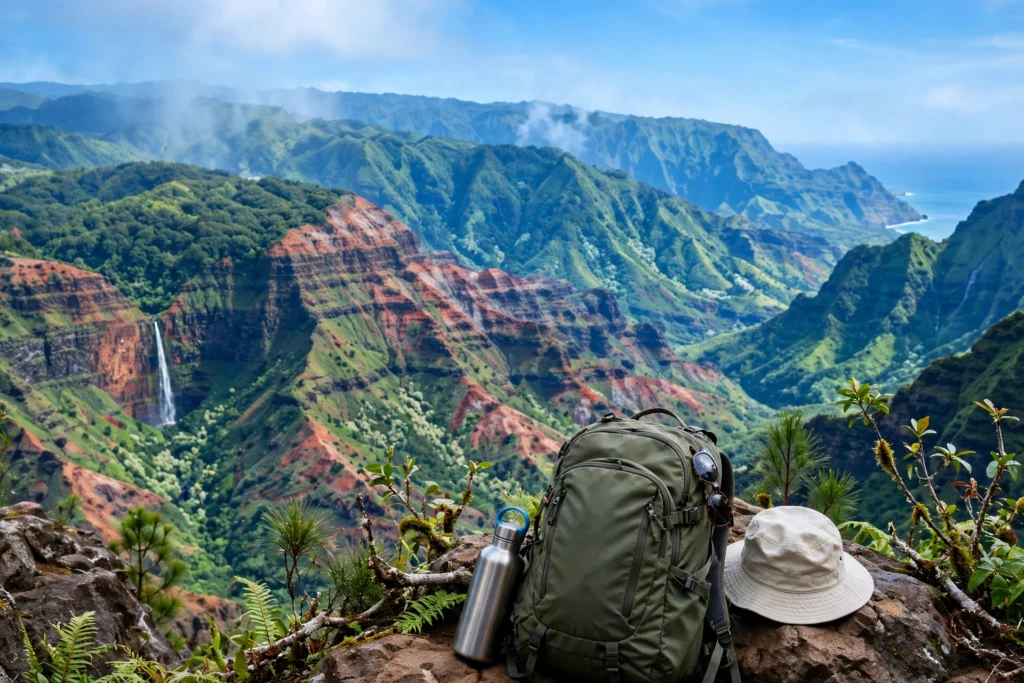
Waimea Canyon is the surprise of Kauai. Most people arrive expecting beaches and jungle, and then they drive up into the west of the island and find a canyon ten miles long and up to 3,000 feet deep, cut into red, orange and green rock that looks like the American Southwest dropped into the middle of the Pacific. Mark Twain is said to have called it the “Grand Canyon of the Pacific”, and the nickname has stuck for good reason. It is one of the best viewpoints in Hawaii, it is free to look at, and it is the easiest big sight on the island — a paved road runs right to the lookouts.
The road is Waimea Canyon Drive (Highway 550), which climbs from the town of Waimea on the West Side up through the canyon to Kōke’e State Park. The main lookout is about an hour from Lihue and 45 minutes from Poipu. Go early: the canyon is clearest in the morning, the clouds build over the interior by late morning, and by afternoon the lookouts can be fogged in completely. The first stop is Waimea Canyon Lookout, which gives you the classic view down the length of the canyon. Further up, the Pu’u Hinahina Lookout adds a view of the Nā Pali Coast in the distance, and the Kalalau Lookout at the end of the road looks straight down into Kalalau Valley — on a clear day it is one of the finest views in Hawaii, and on a cloudy day it is a wall of white. Kōke’e State Park, at the top of the road, has a small museum, picnic areas and the trailheads for the longer hikes, including the Awa’awapuhi Trail and the Pihea Trail, which run along the rim with views into the valley.
Entry to the state parks is not free for non-residents: Hawaii’s state parks charge a per-vehicle parking fee and a per-person entry fee at the popular parks, and Waimea Canyon and Kōke’e are among them. The official Waimea Canyon State Park page lists the current fees and hours — check it before you go, and bring a card, because the parks have moved to cashless payment in many places. The Hawaii State Parks Kauai index is the best single page for checking which parks charge what and which ones need reservations, since the rules differ from park to park.
The hiking here is the best on the island after the Kalalau Trail, and it is much more forgiving. The Canyon Trail to Waipo’o Falls is the classic: about 3.5 miles round trip, mostly downhill on the way out and uphill on the way back, ending at a waterfall you can swim under when conditions are right. The Iliau Nature Loop is a short, easy walk through native plants with canyon views. The Awa’awapuhi Trail is longer and harder — about 6 miles round trip along a narrow ridge — and it should only be attempted in dry weather, because the ridge is exposed and the mud is treacherous when wet. Whatever you hike, carry water, wear sun protection and start early: the canyon is hot, there is almost no shade on the trails, and the afternoon cloud can roll in fast. If you want a canyon comparison before you go, the Yellowstone travel guide covers the Grand Canyon of the Yellowstone — a very different canyon, but the same lesson applies: go early, carry water, and respect the edge.
Hanalei Bay and the North Shore
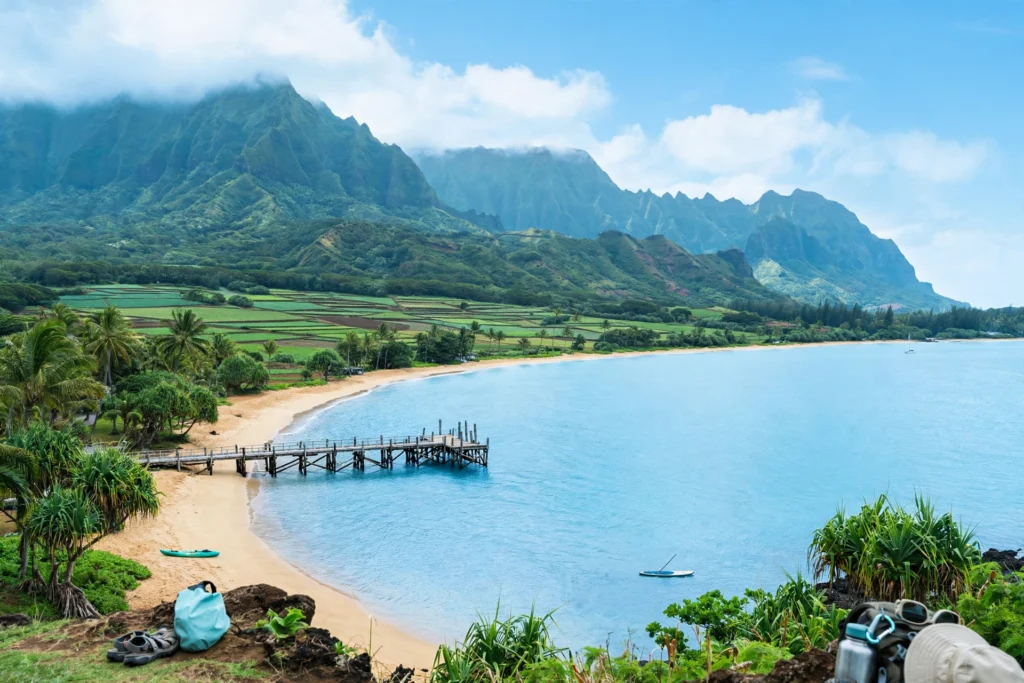
Hanalei Bay is the postcard. A two-mile crescent of sand, a historic pier stretching into calm blue water, green mountains rising behind the town, and taro fields in the valley that have been farmed for over a thousand years. It is the most beautiful beach setting on Kauai, and on a calm summer morning it is also one of the best places to swim on the island. In winter it is a different place: the surf comes up, the lifeguards fly the red flags, and the bay belongs to the surfers. Both versions are worth seeing, but only one of them is for swimming.
Hanalei town is small — a handful of streets with shops, galleries, food trucks and restaurants, and the kind of slow pace that makes people extend their stay. The pier, built in 1892, is the landmark: walk to the end of it at sunset and you will understand why so many people fall for this place. The taro fields behind the town are part of the Hanalei National Wildlife Refuge, and the view from the Hanalei Valley Lookout on the road into town — green fields, winding river, mountains behind — is one of the most photographed views in Hawaii. Stop there on your way in, not on your way out, because the light is better in the morning.
The rest of the North Shore rewards a slow drive. Kilauea Point National Wildlife Refuge, on the headland east of Hanalei, is home to a historic lighthouse and one of the best seabird colonies in Hawaii — red-footed boobies, Laysan albatross, and, in winter, humpback whales offshore. It needs a reservation in advance and it is closed on some days, so check before you go. Anini Beach, just west of Kilauea, has the longest reef in Hawaii and is one of the safest snorkelling spots on the North Shore, protected by the reef from the open ocean. Tunnels Beach (Makua Beach), at the far end of the road before Hā’ena, is the famous one — a wide reef, clear water, and some of the best snorkelling on the island in summer, but dangerous in winter when the surf comes up. Ke’e Beach, at the very end of the road, is where the Kalalau Trail starts and where the reef creates a calm lagoon in summer. All three need the same care: check the surf, swim near the lifeguard if there is one, and stay out of the water when the flags say so.
Eating on the North Shore is a pleasure in itself. Hanalei has food trucks serving garlic shrimp, poke bowls and shave ice, a couple of excellent small restaurants, and a Saturday farmers market. Princeville has the resort restaurants and a good grocery store. The pace is slow and the choices are limited compared with Poipu, which is part of the charm — but if you want variety, stock up in Kapa’a on the way up. Surfing is the other North Shore draw: Hanalei Bay is one of the best beginner surf spots in Hawaii in summer, with several surf schools operating from the beach, and the Nicaragua travel guide covers another Pacific coast where the surf culture shapes the whole town in a similar way.
Poipu Beach and the South Shore
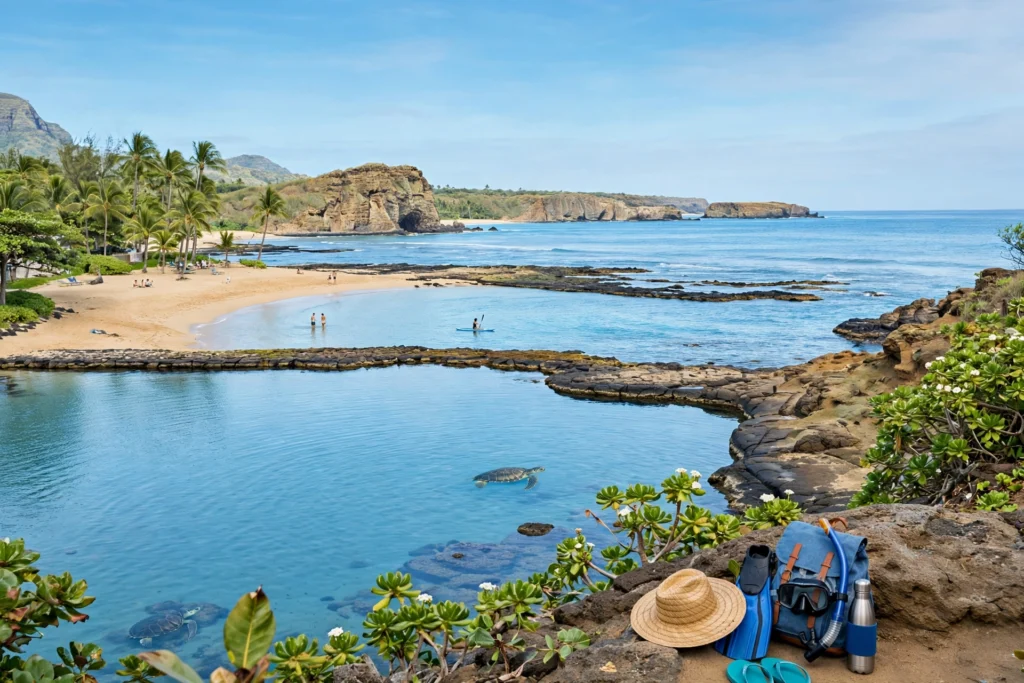
Poipu is where Kauai does its best impression of a classic beach holiday. The beach itself is a pair of crescents divided by a sandbar, with a protected swimming area, a snorkelling reef, and a lawn with picnic tables and showers behind it. It is the most reliable swimming beach on the island, the one lifeguards would pick if they had to pick one, and it is where Hawaiian monk seals haul out to rest on the sand — which is why you will see rope barriers and volunteers keeping people at a respectful distance. Give the seals space; they are endangered, they are protected by law, and they were here first.
The South Shore beyond Poipu is worth a full day. Spouting Horn, a few minutes west, is a lava tube that shoots seawater into the air when the waves hit it right — go at high tide or when the surf is up, and keep a respectful distance from the edge, because people have been swept off the rocks here. Allerton Garden and McBryde Garden, part of the National Tropical Botanical Garden, are the island’s best gardens: Allerton is the landscaped valley with the famous Moreton Bay fig trees, and McBryde is the larger, wilder research garden. Both need a guided tour or a reservation, and both are worth it if you like plants or photography. Old Koloa Town, the island’s oldest plantation town, has cafes, shops and a small history museum, and the Koloa Rum distillery nearby does tastings.
The South Shore also has the island’s best snorkelling in winter, when the North Shore is too rough. Poipu Beach Park is good for beginners, with fish and the occasional turtle in the protected area. Lawai Beach, just west of Poipu, is a small rocky cove with excellent snorkelling when the water is calm. Baby Beach, near the harbour at Port Allen, is a shallow, protected pool that is good for children. And Salt Pond Beach Park, further west past Waimea, is a local favourite: a natural salt pond, a protected swimming area, and a long sandy beach that rarely feels crowded. The Colombia travel guide covers another Caribbean coast where the snorkelling changes completely with the season, and the same rule applies here — the best beach is the one whose side of the island is calm today.
Wailua River, Secret Falls and the East Side
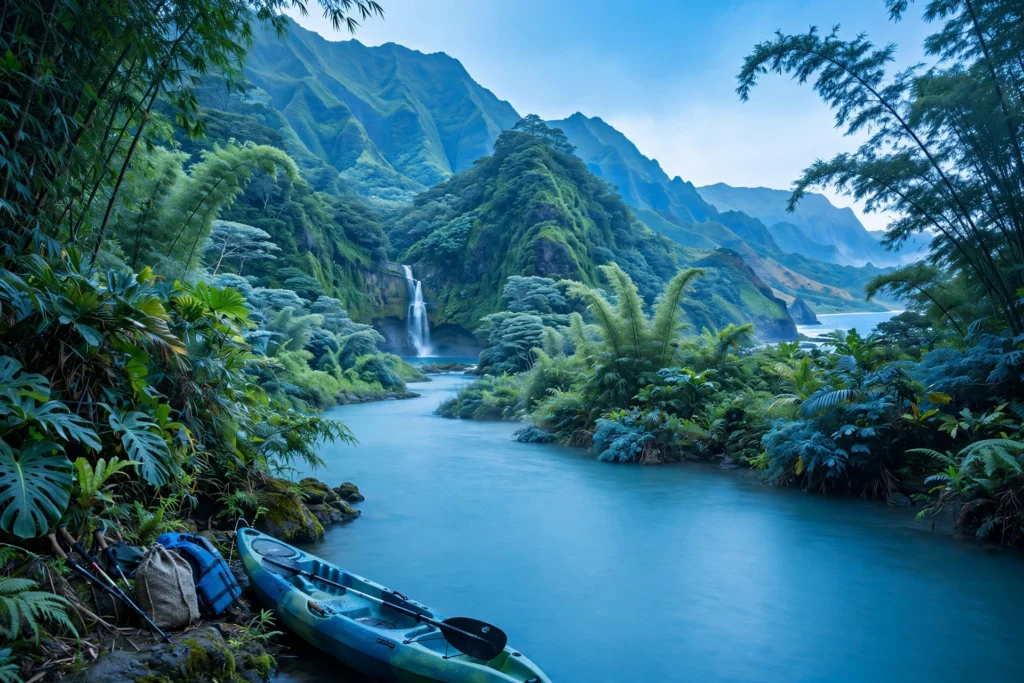
The Wailua River is the only navigable river in Hawaii, and it is the East Side’s best day out. It runs from the slopes of Mount Waialeale — one of the wettest places on Earth — down to the sea at Wailua, past fern-covered banks, ancient Hawaiian sites and waterfalls. The classic trip is the kayak to Secret Falls, properly called Uluwehi Falls: paddle about two miles up the river, beach the kayaks, then hike about a mile through muddy forest to a 120-foot waterfall falling into a pool you can swim in. The whole trip takes four to five hours, and it is one of the most popular activities on the island for good reason — it is active, it is beautiful, and it feels like an adventure without being dangerous. Book a guided tour if you have not kayaked before; the river is easy, but the hike is muddy and the trail is not always obvious. Rentals are available for experienced paddlers, and the going rate for a guided trip is roughly $80–130 per person.
The river has more to offer than the waterfall. The Fern Grotto, a lava cave draped in ferns, is reached by boat tour from the Wailua River Marina — it is a gentle, family-friendly trip, and the boats run daily. Wailua Falls, just up the road from Lihue, is the double waterfall you can see from the roadside lookout; it is about 80 feet high and at its best in the morning light. ‘Ōpaeka’a Falls, further up the same road, is a 151-foot waterfall visible from the lookout across the valley, with the Wailua River valley spreading out below. Both are roadside stops, not hikes, and both are worth ten minutes of your time.
The East Side beyond the river is Kauai’s everyday Hawaii. Kapa’a town has the island’s best concentration of food trucks, cafes and small shops, and the Ke Ala Hele Makalae coastal path runs for miles along the shore — it is the best place on the island for a morning walk, run or bike ride, with the ocean on one side and the town on the other. Lydgate Beach Park, just north of Lihue, has the rock-enclosed swimming ponds that make it the safest beach on the East Side for children, plus a playground and picnic areas. The Hindu Monastery and the Kauai Museum in Lihue are the two cultural stops worth making, and the Kilauea Point lighthouse is an easy half-day from here. If river towns are your thing, the Venice travel guide is a very different take on a place built around water — but the pleasure of exploring by boat is the same.
Best Beaches in Kauai: Swimming and Snorkelling Safety
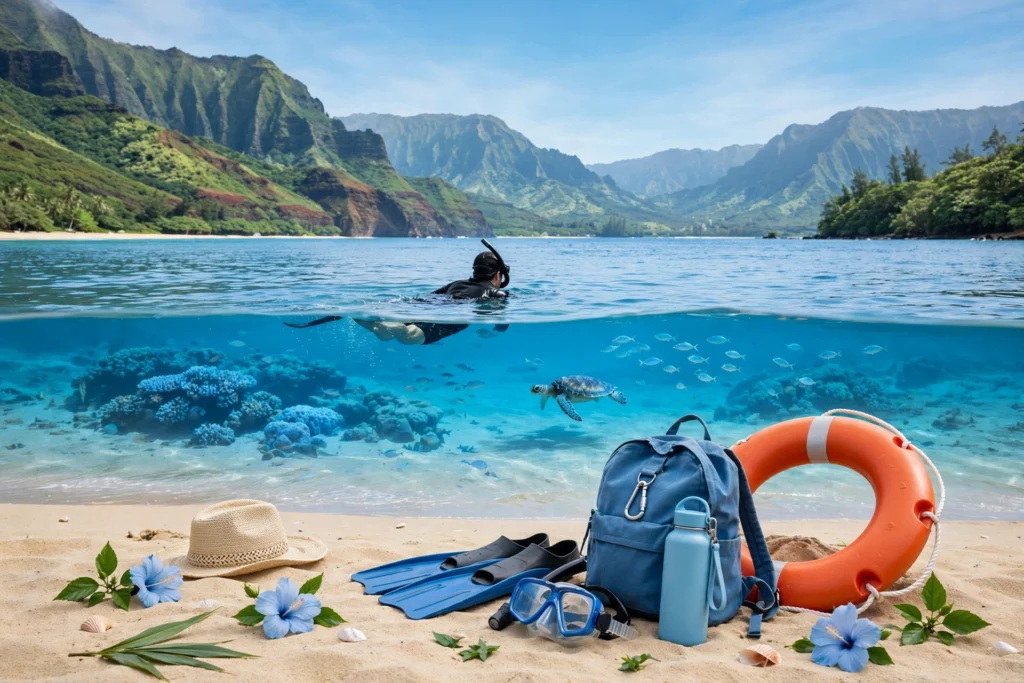
This is the most important section in this guide, and the one most travel articles get wrong by being vague. Kauai’s ocean is beautiful and it is dangerous. The island has more drownings than the rest of Hawaii combined in some years, and almost all of them happen at unguarded beaches, in winter surf, or in places where the current looks calm from the shore and is not. The rule is simple: swim at lifeguarded beaches, check the surf forecast every morning, never turn your back on the ocean, and never swim alone. If the lifeguards say stay out, stay out.
The pattern is seasonal and it is predictable. In summer (May to September), the North Shore is calm and the South Shore has a small south swell. In winter (November to March), the North Shore gets big surf and the South Shore is calm. The East Side is in between. That is why the “best beach” on Kauai changes with the month, and why a beach that is perfect in July can be dangerous in January.
| Beach | Best season | Swimming | Snorkelling | Lifeguard | Notes |
|---|---|---|---|---|---|
| Poipu Beach | Year-round; best in winter | Excellent, protected | Good, turtles common | Yes | Most reliable beach on the island; monk seals haul out here |
| Hanalei Bay | May–Sep | Excellent in summer | Fair | Yes | Dangerous surf in winter; check flags daily |
| Ke’e Beach | May–Sep | Good in summer, lagoon | Excellent in summer | Yes in summer | Needs Hā’ena reservation; rough in winter |
| Tunnels Beach | May–Sep | Good in summer | Excellent, best reef on the North Shore | No | No lifeguard; dangerous in winter surf |
| Anini Beach | Year-round | Good, reef-protected | Good, long reef | No | Safest North Shore snorkelling; watch for currents at the channel |
| Lydgate Beach Park | Year-round | Excellent, rock ponds | Fair | Yes | Best beach for children on the East Side |
| Lawai Beach | Oct–Apr | Fair | Excellent when calm | No | Small rocky cove; superb fish life; no lifeguard |
| Salt Pond Beach Park | Year-round | Good, protected area | Fair | Yes | Local favourite; natural salt ponds beside the beach |
| Polihale State Park | May–Sep | Poor, strong currents | Poor | No | Spectacular, remote, long beach; do not swim here |
| Lumaha’i Beach | Never for swimming | Dangerous | Dangerous | No | Beautiful and deadly; strong currents; stay on the sand |
A few safety rules that are specific to Kauai. First, the shorebreak: at beaches like Lumaha’i and Polihale, the waves break directly on the shore with enough force to injure you, even when the water looks inviting. Second, the currents: Hanakāpī’ai Beach on the Kalalau Trail has killed strong swimmers, and the rule there is simple — do not swim at Hanakāpī’ai Beach at all. Third, the rivers: after heavy rain, the rivers and streams run fast and brown, and flash floods can arrive with no rain falling where you are standing. Do not cross a flooded stream, and do not hike in a valley during a flash-flood warning. Fourth, the sun: Kauai is 22 degrees north of the equator, the sun is strong even on cloudy days, and the trade winds keep you cool enough that you do not feel yourself burning. Use reef-safe sunscreen, reapply often, and wear a rash guard when snorkelling.
Snorkelling is best in the morning, when the wind is down and the water is clearest. Poipu, Anini and Tunnels in summer, and Lawai in winter, are the four to remember. Bring your own gear if you can — rental gear is available everywhere, but a mask that fits is worth more than any tour. And remember the reef rules: do not stand on coral, do not touch the turtles, and keep at least 10 feet from monk seals. The reef is alive, the turtles are protected, and the seals are endangered. Because Kauai is in the United States, no passport is needed for US citizens — it is a domestic trip, which is one reason it appears on so many lists of places to travel without a passport.
Helicopter Tours and Other Ways to See Kauai
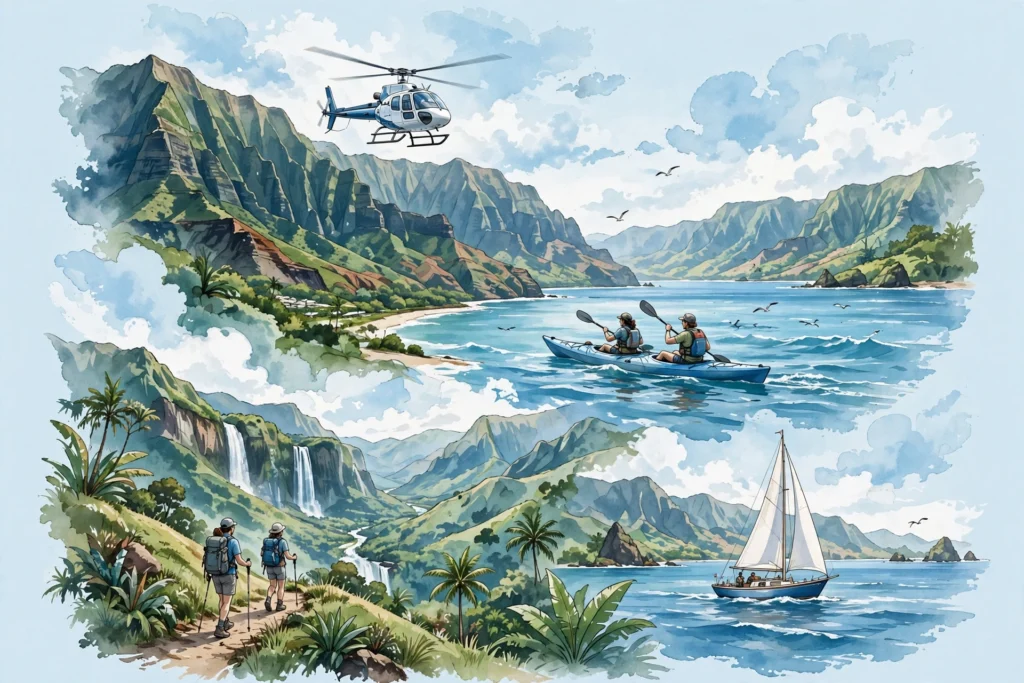
About 90% of Kauai is inaccessible by road, and the helicopter is the only way to see most of it. The Nā Pali Coast from the air, the interior valleys, the waterfalls that have no trail to them, Mount Waialeale with its rain-soaked summit — none of this is visible from a car. A helicopter tour is expensive, roughly $300–400 per person for a 50–60 minute flight, and it is the single best splurge on the island. Book the first flight of the day if you can: the interior clouds over by late morning, and the early light is better for photographs anyway. Doors-off flights exist for photographers, and they are worth it if you are comfortable with the wind and the exposure. If you are prone to motion sickness, take medication before you fly — the ride is smooth, but the banking turns over the cliffs get to some people.
The boat tour is the other essential way to see the Nā Pali Coast, and it is the better choice if you want to be in the water rather than above it. The half-day tours from Port Allen run year-round on the West Side; the North Shore departures from Hanalei only run in summer. A typical tour takes four to five hours, goes into the sea caves when the swell allows, and ends with snorkelling. Prices are roughly $150–250 per person, and the catamarans are more stable than the smaller rigid-hull boats — pick the catamaran if you are unsure about seasickness. The Panama travel guide covers another coast where the boat trip is the highlight of the whole visit, and the same advice applies: book the morning departure, when the sea is calmest.
Kayaking is the third way in. The Wailua River trip is the easy version, suitable for almost anyone. The Nā Pali Coast kayak trip is the hard version — a guided multi-day expedition, four to five days in summer only, paddling from Ha’ena to Polihale and camping on the beaches. It is a genuine expedition, not a day rental, and it needs a guide, a permit and good weather. If that sounds like too much, the sea kayaking at Hanalei Bay in summer is a good middle ground: calm water, mountain views, and an easy paddle.
There are quieter ways to see the island too. The Kilauea Point lighthouse, the Waimea Canyon lookouts, the Wailua River boat tour and the gardens at Allerton and McBryde all show you Kauai without a helicopter or a boat. And the simplest of all is the drive itself: the road from Lihue to Hanalei, the road up Waimea Canyon, and the coastal path at Kapa’a are all worth doing slowly, with stops. Kauai rewards the traveller who looks up from the itinerary. The best moments here are often unplanned — a rainbow over the taro fields, a turtle surfacing next to your kayak, a waterfall you did not know was there.
How Much Does Kauai Travel Cost?

Kauai is not a cheap destination. It is one of the most expensive places in the United States to visit, and the costs surprise first-time visitors more than anything else. The flights are the easy part; it is the rooms, the rental car and the food that add up. A mid-range trip for two people runs roughly $200–350 a day excluding flights, and a comfortable trip with a resort room, a rental car and a couple of tours runs closer to $400–600 a day. Budget travellers can do it for less, but Kauai does not reward cutting corners on the car or the room — a bad location costs you more in driving time than it saves in money.
The biggest single cost is the room. Resort rooms in Poipu and Princeville run roughly $350–600 a night in summer and over Christmas, and $250–400 in shoulder season. Condos and vacation rentals are the better value for stays of five nights or more, at roughly $200–350 a night for a one-bedroom, with a kitchen that saves real money on food. Budget hotels in Lihue run roughly $150–250 a night. The rental car is the second cost: roughly $60–120 a day for a standard car in shoulder season, more in summer, plus petrol at Hawaii prices. Food is the third: a plate lunch from a food truck is $15–20, a casual restaurant dinner is $25–40 per person, and a resort dinner is $50–80 per person. Groceries are expensive too — milk, bread and fresh produce cost noticeably more than on the mainland, because almost everything is shipped in.
| Item | Budget (per day) | Mid-range (per day) | Comfortable (per day) |
|---|---|---|---|
| Room (per night, 2 people) | $150–200 (Lihue hotel) | $250–350 (condo) | $400–600 (resort) |
| Rental car + petrol | $60–80 | $80–120 | $120–180 (SUV) |
| Food and drink | $40–60 (groceries + food trucks) | $70–110 (mix of cafes and restaurants) | $120–180 (restaurants) |
| Activities and tours | $0–30 (beaches, hikes) | $30–80 (one tour every other day) | $100–200 (helicopter, boat tour) |
| Park fees, parking, misc | $5–15 | $10–20 | $15–30 |
| Total per day (2 people) | $255–385 | $440–680 | $755–1,190 |
The daily budget table above is for two people sharing a room and a car; a single traveller pays roughly 60–70% of the two-person total, because the room and the car do not get cheaper. The best ways to save money are the obvious ones, and they work on Kauai: travel in shoulder season (April–May or September–October), book a condo with a kitchen and cook breakfast and half your dinners, book the car and the room months ahead, and pick free activities — beaches, hikes, lookouts, the coastal path — for most days, saving the paid tours for one or two highlights. The helicopter tour and the Nā Pali boat tour are the two splurges worth paying for; almost everything else on the island is free. For a proper budgeting framework before you book, the how to prepare a travel budget guide walks through exactly how to build a trip budget that survives contact with reality, and if the helicopter tour is the one big spend on your list, the travel bucket list guide is a good place to put it.
What to Eat, Drink and Pack in Kauai
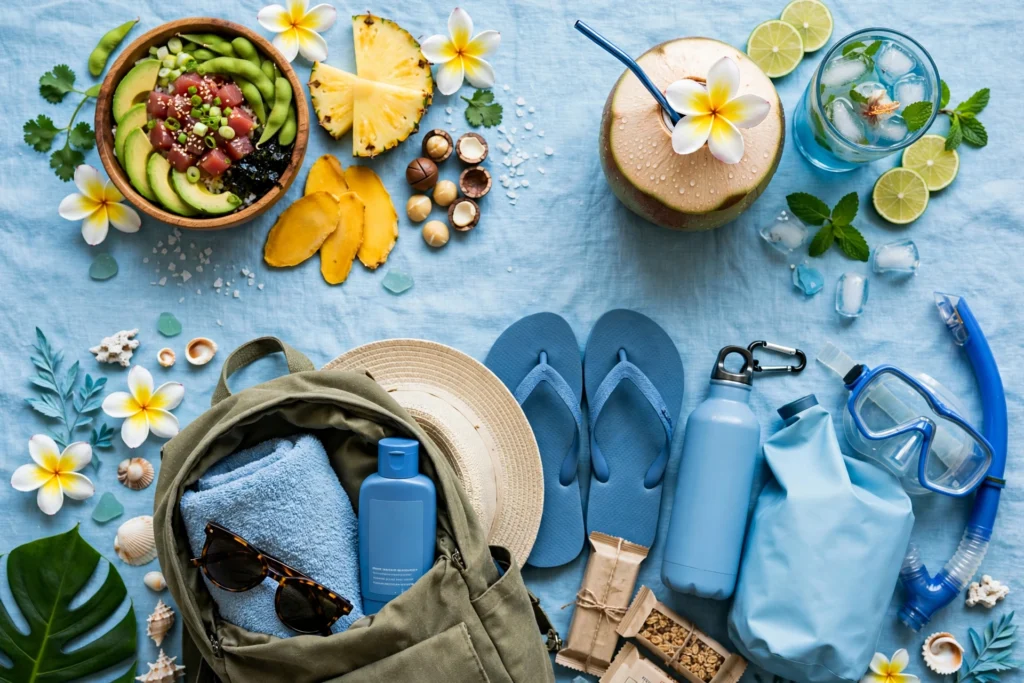
Kauai’s food is Hawaii’s food: plate lunches, poke, shave ice, food trucks and farmers markets, with a strong local twist. The plate lunch is the island’s signature meal — two scoops of rice, macaroni salad, and a main like kalua pork, chicken katsu or garlic shrimp, served from a food truck or a small cafe for $15–20. Poke is everywhere, and the best poke on Kauai comes from the grocery store delis and the fish markets, not the resort restaurants — fresh ahi tuna, cubed, seasoned with soy, sesame and onion, eaten the same day it was caught. Shave ice is the island’s dessert: fine shaved ice with syrup, condensed milk and sometimes ice cream underneath. The farmers markets are worth planning around: the Saturday market in Hanalei, the Wednesday market in Kapa’a, and the big Saturday market in Lihue sell tropical fruit you will not find on the mainland — apple bananas, lilikoi (passion fruit), rambutan in season, and Kauai-grown coffee.
For drinks, Kauai grows its own coffee in the Kalaheo area, and the Kauai Coffee Company estate is the largest coffee farm in the United States — the tour is free and the tasting is generous. Koloa Rum is distilled on the island and the tasting room in Lihue is worth a stop. The tap water is safe to drink, but most visitors buy bottled water for the beach and the trail. One practical note: Kauai’s restaurants are small and they fill up. Book ahead for dinner in Hanalei and Poipu, especially on weekends, and expect some restaurants to be closed on Sundays and Mondays.
Packing for Kauai is about rain, sun and mud, in that order. The packing list is short but specific: reef-safe sunscreen and a rash guard; a light rain jacket (not a poncho — the wind will defeat it); hiking shoes with real grip for the muddy trails; water shoes or sandals with a strap for the river crossings and the rocky beaches; a dry bag for the kayak and the boat tour; a reusable water bottle; insect repellent for the evenings; and a warm layer for Waimea Canyon and Kōke’e, where the elevation makes it noticeably cooler than the beach. Leave the formal clothes at home — Kauai’s nicest restaurants are still casual, and nobody dresses up. Bring a small daypack for the hikes, and pack a binocular if you are going to Kilauea Point or whale watching. If you are still deciding what the trip is for, the travel goal guide is a useful way to think about it before you start spending.
Sample Kauai Itineraries: 5 Days and 7 Days
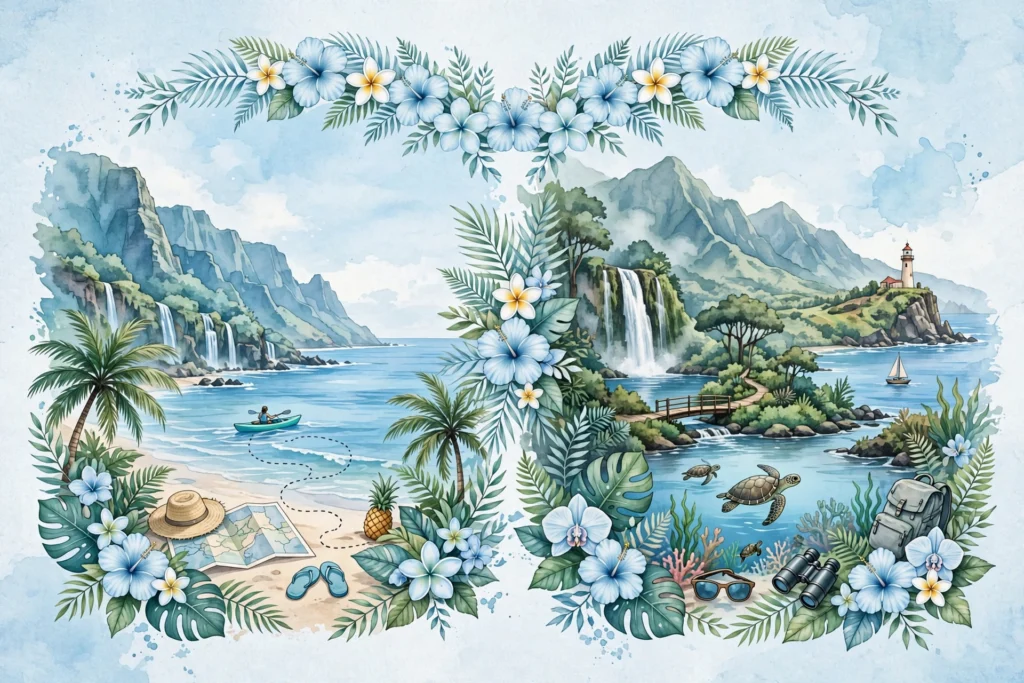
These itineraries assume a rental car, a base in Poipu for the 5-day trip, and a split stay for the 7-day trip. They are built around the seasons: the North Shore days work best from May to September, and in winter you should swap the North Shore swimming for extra time in Poipu and Waimea Canyon. Both itineraries leave room for a slow morning — Kauai punishes a schedule with no slack in it.
5-day Kauai itinerary (Poipu base)
Day 1 — Arrive and settle in. Land at Lihue Airport, collect the rental car, stop at a grocery store in Lihue or Kapa’a, and check in at Poipu. Sunset at Poipu Beach, dinner in Koloa Town. Early night — the time difference from the mainland is real.
Day 2 — South Shore. Morning snorkel at Poipu Beach, then Spouting Horn at high tide, Allerton Garden in the afternoon, and a sunset walk along the Poipu coastal path. Dinner at a food truck in Koloa.
Day 3 — Waimea Canyon and Kōke’e. Leave by 7:30 am. Waimea Canyon Lookout, Pu’u Hinahina Lookout, Kalalau Lookout, then the Canyon Trail to Waipo’o Falls if the weather is dry. Picnic lunch in Kōke’e State Park, back down via the town of Waimea for shave ice. Sunset at Salt Pond Beach Park on the way home.
Day 4 — North Shore. Drive to Hanalei early. Hanalei Valley Lookout, Hanalei Bay and the pier, lunch from a food truck, then Tunnels Beach or Ke’e Beach for the afternoon if you have a Hā’ena reservation. Drive back via Kilauea Point if it is open, or stop at Anini Beach for sunset snorkelling.
Day 5 — East Side and departure. Morning kayak on the Wailua River to Secret Falls, or the Fern Grotto boat tour if you prefer a gentler morning. Wailua Falls on the way back, lunch in Kapa’a, and a last walk on the coastal path before the flight home. If your flight is late, add the Kauai Museum in Lihue.
7-day Kauai itinerary (split stay: 3 nights Poipu, 4 nights Princeville)
Days 1–3 — Poipu. As the 5-day itinerary above: settle in, South Shore day, Waimea Canyon day. Add a morning at Lawai Beach for snorkelling and an evening at the Koloa Rum tasting room.
Day 4 — Move north. Drive to Princeville via Kapa’a, stopping at ‘Ōpaeka’a Falls and the Kilauea Point lighthouse on the way. Check in, sunset at Hanalei Bay, dinner in Hanalei town.
Day 5 — Nā Pali Coast. Full day: either the Kalalau Trail day hike to Hanakāpī’ai Falls (with your Hā’ena reservation booked 30 days ahead) or a morning boat tour along the coast from Hanalei. Afternoon rest at Anini Beach.
Day 6 — North Shore slow day. Morning surf lesson or paddle at Hanalei Bay, farmers market if it is Saturday, afternoon at Tunnels Beach, sunset from the pier. This is the day that makes the trip feel like a holiday rather than a checklist.
Day 7 — East Side and departure. Kayak the Wailua River to Secret Falls in the morning, lunch in Kapa’a, then drive to Lihue for the flight home. If you have a late flight, add a helicopter tour in the morning instead — it is the best last-day splurge on the island, and the early flight has the clearest skies.
If you want a template to adapt these plans to your own dates, the travel itinerary template lays out the structure, and the Iceland travel itinerary shows how the same 5–7 day structure works on a very different island — the principle is identical: one base per coast, one big day per area, and one day with nothing planned.
Frequently Asked Questions About Kauai Travel
Do you need a rental car in Kauai?
Yes. A rental car is essential. There is no road circling the island, no train, and the bus network is not useful for visitors. Book the car at the same time as your flights, because Kauai has had genuine shortages in peak season and airport walk-up prices can be double the advance rate.
How many days do you need in Kauai?
Plan 5–7 nights. Five nights covers the South Shore, Waimea Canyon, the North Shore and the Wailua River. Seven nights adds a Nā Pali Coast boat tour or a full Kalalau Trail hike, a split stay between Poipu and Princeville, and a day with nothing planned. Three nights is a taste, not a trip.
Do you need a permit for the Kalalau Trail?
You need a Hā’ena State Park reservation to enter the park and hike the first two miles to Hanakāpī’ai Beach — non-residents pay $5 per person for entry and $10 per vehicle for parking, and reservations open 30 days ahead. To hike past Hanakāpī’ai Valley toward Kalalau Beach you need a camping permit for Nā Pali Coast State Wilderness Park, which is limited and sells out far in advance.
Is Kauai good for families?
Yes, it is one of the best Hawaiian islands for families. Poipu Beach and Lydgate Beach Park have protected swimming areas, the Wailua River kayak trip suits older children, and the boat tours often include dolphin sightings. Stay in Poipu for the calmest water, and plan on seven nights with a split stay rather than rushing between coasts.
When is the best time to visit Kauai?
April to June and September to November are the best all-round months: warm weather, calm ocean on the North Shore, and lower prices than summer or Christmas. May and September are the two standout months. Winter (December to March) is best for whale watching and worst for North Shore swimming, so base yourself in Poipu if you travel then.
Is Kauai safe?
Kauai is in Hawaii, in the United States, so no US State Department travel advisory applies. The real safety issues are the ocean and the trails: swim only at lifeguarded beaches, check the surf forecast every morning, never swim at Hanakāpī’ai Beach or Lumaha’i Beach, do not cross flooded streams, and turn back on a hike if conditions change. The ocean here is beautiful and it deserves respect.
Conclusion
Kauai is not the easiest Hawaiian island to visit, and that is exactly why it is the best one for travellers who want the wild version of Hawaii. It asks more of you than the other islands — a rental car booked early, a reservation made 30 days ahead, a hike that leaves you muddy and tired, a drive that takes longer than the map says — and it gives more back. The Nā Pali Coast at sunrise from a boat, the view down Waimea Canyon in the morning light, the calm water at Hanalei Bay in July, the waterfall at the end of a muddy river trail: these are the moments that make a trip to Kauai stay with you long after you are home.
Plan for 5–7 nights, book the car and the Hā’ena reservation early, base yourself where the season suits you, and leave one day unplanned. Kauai rewards the traveller who slows down. Go in spring or autumn if you can, go in winter if you want the whales, and go whenever you can — the Garden Isle is waiting, and it has been waiting for about five million years.
People also read:
- Panama Travel Guide: The Canal, Caribbean Islands and Cloud Forests
- Malta Travel Guide: Valletta, Gozo, the Blue Lagoon and the Best Beaches
- Yellowstone Travel Guide: Geysers, Wildlife and the Grand Loop
- Seattle Travel Guide: Pike Place, the Space Needle and the Mountains Beyond
- Venice Travel Guide: Canals, Islands and the Lagoon
- Travel Itinerary Template: Plan Any Trip in One Page

M. Adil is the founder and editor of SoloTravelPro. He writes practical, research-based travel guides that help travellers plan with confidence — from first-time city breaks to national parks and island escapes. Every guide is built on official sources, current prices and honest, usable advice, so readers can plan smarter and travel better.