Beijing is a city that rewards preparation more than almost any other capital in the world. It holds seven UNESCO World Heritage sites inside one municipality, a palace complex so large it took 14 years to build, a wall that runs for thousands of kilometres, and neighbourhoods of grey-brick alleyways that have survived centuries of change — yet none of it opens up to a visitor who just turns up. The Forbidden City sells out days ahead and does not sell tickets at the gate. Tiananmen Square needs its own reservation. Most shops and taxis do not take foreign cards, and the apps that run daily life here do not work the way they do at home. This beijing travel guide covers all of it in one place: the safety picture as it stands in 2026, the visa rules, the best time to go, how to book the Forbidden City, which section of the Great Wall to choose, where to stay, what everything costs, and two ready-made itineraries, so you can arrive in Beijing already set up instead of spending your first day figuring the city out.
Quick answer: the best time for beijing travel is September to October, when the skies are at their clearest, the heat has eased and the autumn colours arrive; April to May is the second-best window. Allow at least 4 days for the Forbidden City, the Great Wall, the Temple of Heaven and the hutongs, and 5 days if you want the Summer Palace and a slower pace. Book Forbidden City tickets exactly 7 days ahead, set up Alipay and DiDi before you land, and carry your passport everywhere — you need it for tickets and entry at almost every major sight. Budget travellers can manage on roughly ¥250–400 a day (about $35–55), while a comfortable mid-range trip runs about ¥600–1,000 a day (about $85–140). Prices below are planning ranges only — confirm figures before you book, as fares, entry rules and conditions can change at short notice.
Is Beijing Safe to Visit in 2026?
This is the first question most travellers ask about Beijing, and it deserves a straight answer before anything else. The United States Department of State currently rates mainland China at Level 2: Exercise Increased Caution, and the advisory was reissued on 19 October 2026 with a new “D” risk indicator for wrongful detention. The level itself did not change — China was lowered from Level 3 to Level 2 in November 2024 — but the new indicator is a serious addition, and it is the part of the advisory that matters most for anyone planning a trip.
The advisory says travellers should exercise increased caution in mainland China due to the arbitrary enforcement of local laws, the use of exit bans without a fair and transparent process under the law, and the risk of wrongful detention. The State Department has determined that Americans are at serious risk of wrongful detention by the Government of China, and that wrongfully detained Americans may be held for years, in poor conditions, without due process or consistent access to US government staff. Exit bans — restrictions that prevent you leaving the country — can be used to force people to take part in investigations, to resolve civil disputes in favour of Chinese citizens, or to pressure family members to return to China. You might only discover an exit ban when you try to depart, and there may be no legal process to challenge it in court. The advisory also warns that expansive national security, counterespionage and data security laws give Chinese officials broad discretion to detain or interrogate foreign nationals, including for routine business, research or expression, and that people have been detained for sending private messages critical of the government — even messages sent outside China.
None of this means Beijing is dangerous in the everyday sense. Street crime against visitors is low, violent crime is rare, and the city centre is heavily policed and monitored. Pickpocketing happens in crowded places such as Wangfujing and on packed subway lines, and the scams to watch for are the familiar ones: the “tea ceremony” invitation from friendly strangers near tourist sites, overpriced taxis that refuse the meter, and unofficial guides at the Great Wall who push expensive tours. The practical advice is the same as in any big city: keep valuables out of sight in crowds, use DiDi or metered taxis, agree nothing with strangers who approach you at major sights, and avoid demonstrations entirely — the advisory is explicit that joining a protest can lead to arrest on serious charges.
A few groups face extra risk and should read the full advisory carefully. The advisory notes that US citizens of Chinese heritage or origin, people involved in business disputes, anyone with current or former ties to US law enforcement, the military or intelligence agencies, and people on US government-funded programmes may be targeted. China does not recognise dual nationality, and dual US-Chinese citizens may be treated as Chinese only, with US consular assistance restricted or refused. The advisory also states that the ability to provide emergency consular services in some regions, especially in the Tibet Autonomous Region, is severely limited. Before you travel, read the full US State Department travel advisory for China and check it again close to departure, because advisory levels can change. US citizens should also enrol in the Smart Traveler Enrollment Program (STEP) before departure. The emergency numbers in China are 110 for police, 120 for ambulance and 119 for fire, and the US Embassy in Beijing can be reached on +86-10-8531-4000.
What the advisory means in practice
For most visitors, the Level 2 rating means: go, but go informed. Read the advisory in full, keep your passport on you, avoid any political activity or sensitive topics in messages while you are in China, and do not carry work documents or data that could be misread under the national security laws. Keep a copy of your passport and visa separate from the original, and make sure someone at home knows your itinerary. If you are a journalist, academic, business traveller or dual national, the risk profile is different from a holidaymaker’s, and you should weigh the advisory more heavily. This guide gives you the practical detail to plan well; the advisory gives you the official risk picture to decide against.
Do You Need a Visa for Beijing? Visa-Free Entry Explained
The visa question is where many Beijing trips get complicated, because the answer depends entirely on your passport — and the rules changed significantly in 2024 and 2025. Get this section right before you book flights, because the wrong assumption can cost you the trip.
Many Western passports now enter China without a visa. Citizens of countries including France, Germany, Italy, Spain, the Netherlands, Australia, New Zealand, Japan and South Korea can currently enter visa-free for up to 30 days for tourism, under a policy China has repeatedly extended. British citizens are not currently covered by the 30-day visa-free scheme and generally need a visa. The list of eligible nationalities has changed more than once, so check the current list for your passport on your government’s travel advice pages or with the Chinese embassy before you rely on it. Do not assume a friend’s experience applies to you.
US citizens have a different route. The United States is not on the 30-day visa-free list, but US passport holders can use the 240-hour (10-day) visa-free transit policy, which covers 54 countries. Under this policy you can enter China without a visa for up to 10 days, provided you are genuinely in transit to a third country or region — flying into Beijing and out to Tokyo, Seoul, Hong Kong or London qualifies; flying in from New York and back to New York does not, because that is a return rather than a transit. You must enter and leave through designated ports, and your stay is limited to the permitted area, which for Beijing means the Beijing–Tianjin–Hebei region. You cannot use a transit stay to travel freely across the whole of China. If you want a longer stay, or you want to enter and leave through the same country, apply for a tourist (L) visa in advance through a Chinese visa centre. The classic tourist visa is usually a 10-year multiple-entry visa for US citizens, which is worth getting if you think you will return.
Whatever route you use, the paperwork at the border is real. Your passport must be valid for at least six months beyond your arrival date, and you may be asked for proof of onward travel, hotel bookings and sufficient funds. Every visitor’s fingerprints are taken on arrival, and you must register your accommodation with the local police within 24 hours — hotels do this automatically when you check in, but if you stay in a private apartment, the registration is your responsibility. Keep your passport with you at all times in Beijing: you need the original, not a copy, to buy Forbidden City and Great Wall tickets, to enter Tiananmen Square, and to check into hotels. If you are planning a wider trip and wondering which destinations need no visa at all, our guide to places to travel without a passport covers the options that involve the least paperwork — though China is not one of them, and Beijing is worth the effort.
Best Time to Visit Beijing
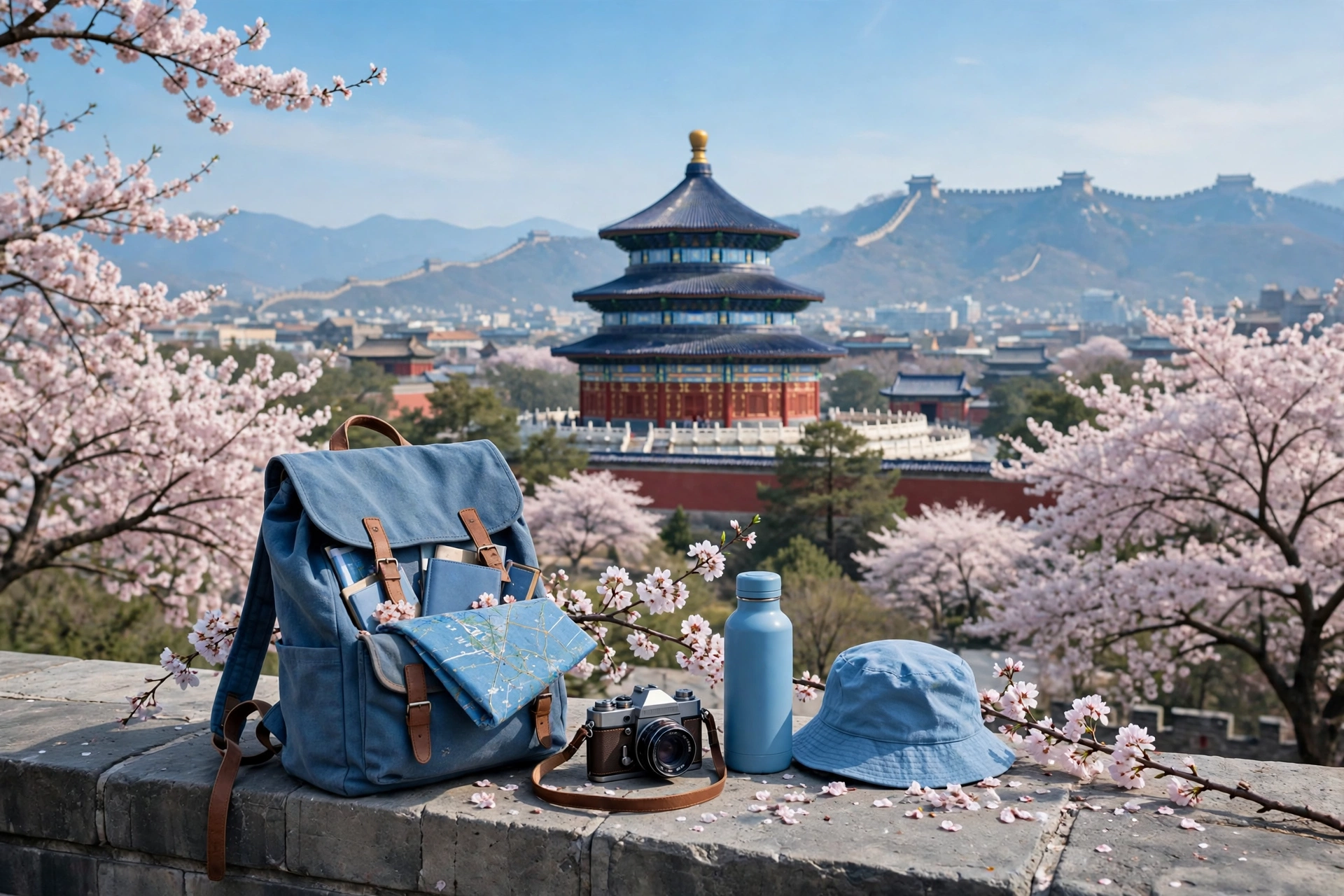
Beijing has four sharply distinct seasons, and the difference between the best and the worst month is enormous. The city sits on a dry northern plain, so summers are hot and humid with sudden downpours, winters are bitterly cold and dry, and spring brings the risk of sandstorms blowing in from the Gobi Desert. The two sweet spots are spring and autumn, and autumn wins.
September to October is the best time for beijing travel. The summer humidity has broken, daytime temperatures sit in the comfortable 18–26°C range, the skies are at their clearest of the year, and the autumn colours arrive in the parks and on the hills around the Great Wall in late October. April to May is the second-best window, with mild temperatures, blossom in the parks and long daylight hours — but watch for sandstorms and hazy days, which are most common in March and April. Summer (June to August) is hot, humid and crowded, with temperatures often above 30°C and afternoon thunderstorms; winter (November to February) is cold, dry and very quiet, with temperatures often below freezing and short days, though the snow-dusted Forbidden City and the frozen lakes at Shichahai have their own stark beauty, and January is one of the cheapest months to visit — as it is in many destinations, covered in our guide to the best places to travel in January.
Air quality is part of the timing decision in a way it is not in most capitals. Beijing’s air has improved dramatically over the past decade, and most days in autumn are clear, but winter brings the heating season and the worst air of the year, and spring sandstorms can push pollution up for days at a time. Check the air quality index (AQI) each morning in your weather app, and on days when the AQI climbs above 150, plan indoor sights — the museums inside the Forbidden City, the Capital Museum, or the 798 Art District galleries — and wear a proper mask outdoors. A good rule is to keep your first two days flexible so a bad-air day can be swapped for a museum day without losing anything.
Two holiday periods should be avoided unless you have no choice. Chinese New Year (late January or February) empties the city of residents but closes many small restaurants and shops, and Golden Week — the National Day holiday from 1 to 7 October — fills every major sight with domestic tourists; the Forbidden City sells out even faster and the Great Wall is at its most crowded. The May Day holiday (1 to 5 May) is similarly busy. If you must travel during these weeks, book everything further ahead than the lead times in this guide.
| Month | Weather | Crowds | AQI | Best for |
|---|---|---|---|---|
| January | −8 to 2°C, cold and dry | Very low | Poor (heating season) | Cheapest hotels, snow scenes, ice on Shichahai |
| February | −5 to 5°C, cold and dry | Low (Chinese New Year closures) | Poor | Winter sights, fewer tourists |
| March | 0 to 12°C, windy | Low–medium | Fair–poor (sandstorm risk) | Early blossom, low prices |
| April | 8 to 21°C, mild | Medium | Fair (sandstorm risk) | Blossom, hutongs, Great Wall hiking |
| May | 15 to 27°C, warm | High (May Day holiday) | Fair | Gardens, Summer Palace, long days |
| June | 20 to 31°C, hot and humid | High | Fair | Evening street food, parks |
| July | 23 to 32°C, hot, rainy | High | Fair | Summer Palace lakes, indoor museums |
| August | 22 to 31°C, hot, rainy | Very high | Fair | Summer evenings, Shichahai |
| September | 16 to 27°C, clear | Medium | Good | Best all-round month, Great Wall |
| October | 9 to 20°C, crisp | Very high 1–7 Oct, then low | Good | Autumn colours, clearest skies |
| November | 0 to 11°C, cold and dry | Low | Fair–poor | Late autumn colours, low prices |
| December | −7 to 3°C, cold and dry | Very low | Poor | Winter quiet, festive lights |
The Forbidden City and Tiananmen Square: How to Book and Visit
The Forbidden City — the Palace Museum — is the single most important sight in Beijing, and it is also the one most visitors get wrong. It is not a place you can decide to visit on the morning. Tickets sell out days ahead, there are no ticket sales at the gate, and entry is by passport only. Plan this first, and build the rest of your trip around the day you secure.
The scale is hard to grasp until you are inside it. The Forbidden City covers 72 hectares, holds around 980 surviving buildings, and was built between 1406 and 1420 under the Ming emperor Zhu Di. It was the home and political centre of 24 emperors — 14 Ming and 10 Qing — over 505 years, and it is inscribed on the UNESCO World Heritage List as part of the Imperial Palaces of the Ming and Qing Dynasties. Its layout follows the Central Axis exactly: the great ceremonial halls of the Outer Court at the front, the residential palaces of the Inner Court at the rear, and the whole complex arranged with strict symmetry. UNESCO’s own description calls it the supreme model of ancient Chinese palace development, and that is not an exaggeration — walking the axis from the Meridian Gate to the Gate of Divine Prowess is one of the great urban experiences in the world.
How to book Forbidden City tickets, step by step
- Count back 7 days from your chosen date. Tickets are released exactly 7 days ahead at 8pm Beijing time, and the popular dates sell out within hours — sometimes minutes. Set an alarm for the release time.
- Use the official channels. Book through the Palace Museum’s official English booking site or its WeChat mini-program. Third-party sellers such as Trip.com also sell tickets and can be easier for foreign cards, but they charge a service fee and still need your passport details. Avoid touts and street sellers entirely.
- Have every visitor’s passport ready. You book with the full passport number and name exactly as printed, and you enter with the physical passport — a photo or a copy will not get you through the gate. If a passport number is mistyped, the ticket is useless.
- Pick the morning slot if you can. The Forbidden City opens at 8:30am and closes at 5pm (last entry 4:10pm), and it is closed on Mondays except public holidays. Morning entry gives you the best light for photographs and the fullest day; the daily visitor cap is 80,000, so even a “quiet” day is busy.
- Pay the right price. Admission is 60 yuan from April to October and 40 yuan from November to March. Audio guides are available at the entrance, and the main halls have English signage.
- Enter from the south, exit to the north. The natural route runs from the Meridian Gate in the south, through the three great halls — the Hall of Supreme Harmony, the Hall of Central Harmony and the Hall of Preserving Harmony — then through the Inner Court palaces, and out through the Gate of Divine Prowess to the north. Allow at least 3 to 4 hours; a rushed visit misses the side courtyards, the Clock Gallery and the Treasure Gallery, which are where the best objects are.
Two practical warnings. First, the Forbidden City is enormous and almost entirely outdoors, with long stretches of stone courtyard and very little shade — bring water, sun protection and comfortable shoes, and in summer go early. Second, the ticket system is unforgiving: there are no refunds for a wrong date, no name changes, and no same-day purchase. If your date is sold out, your only options are a different date or a guided tour that includes a ticket, which is why some travellers book a tour for this one sight even if they do everything else independently. The timed-entry system is becoming common at major sights worldwide — Venice now runs a similar advance-booking system for day visitors, as covered in our Venice travel guide — but Beijing’s version is stricter, because your passport is the ticket.
Tiananmen Square
Tiananmen Square sits directly south of the Forbidden City, across Chang’an Avenue, and it needs a separate free reservation of its own. Book through the official WeChat mini-program, usually 1 to 7 days ahead, with your passport details; you enter through security checks at the square’s edges, and you cannot simply walk across from the Forbidden City without it. The square is vast — one of the largest public squares in the world — and its sights include the Monument to the People’s Heroes, the Great Hall of the People and the flag-raising ceremony at sunrise, which draws crowds even on weekday mornings. Combine the square with the Forbidden City on the same day, but budget the reservation and the security queues as part of the plan, not as an afterthought. Photography is allowed in the square, but do not photograph the security checkpoints, and keep behaviour respectful: this is a politically sensitive space, and the advisory’s warning about demonstrations applies here more than anywhere else in the city.
The Great Wall: Badaling, Mutianyu, Jinshanling and Simatai Compared
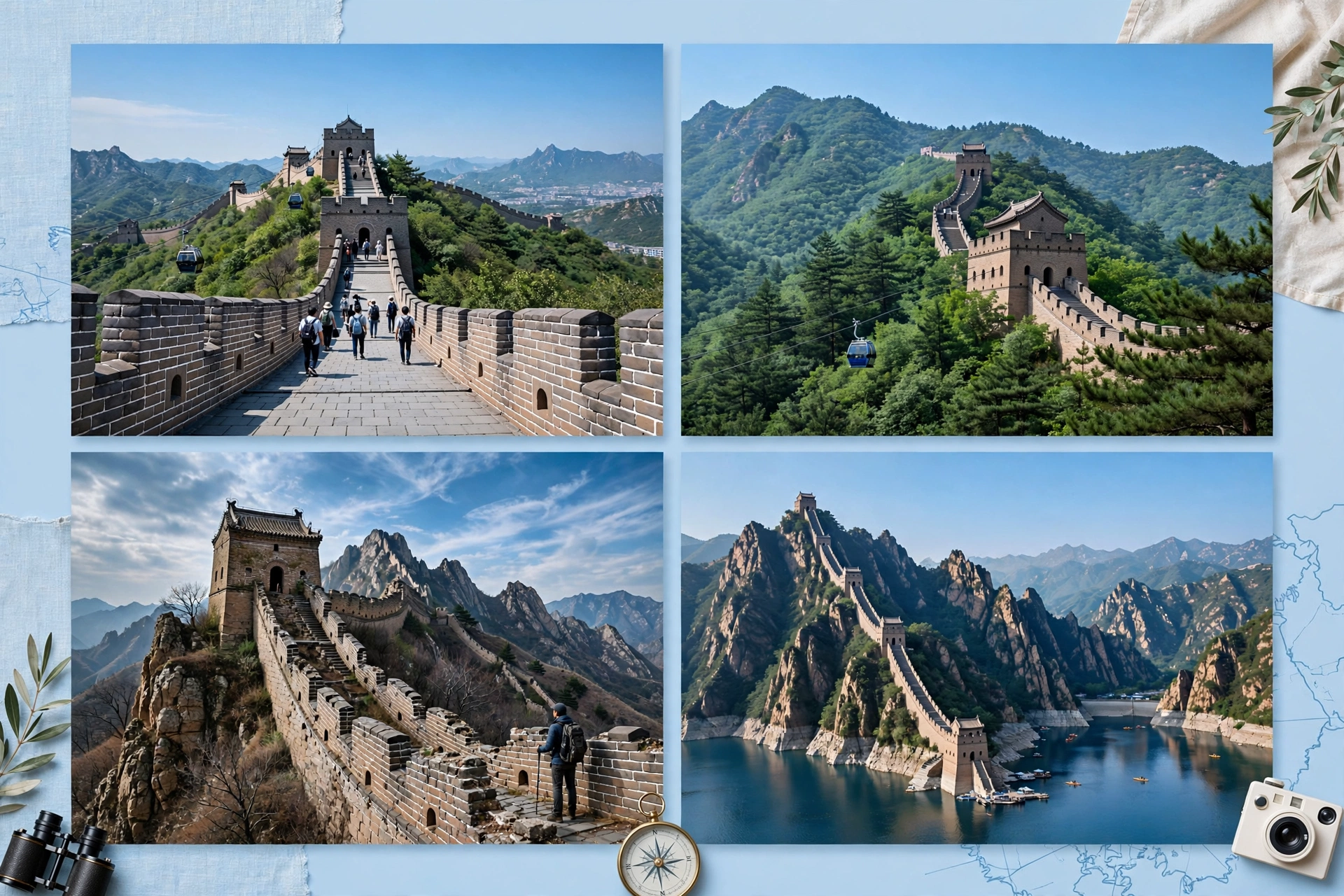
Every first-time visitor to Beijing wants to walk the Great Wall, and every first-time visitor asks the same question: which section? The answer matters more than most people expect, because the four sections reachable from Beijing are very different places — one is a crowded, fully restored tourist site, one is a quieter restored stretch with a toboggan ride down, and two are wild, unrestored ridges for serious hikers. Choose wrong and you spend the day in a queue; choose right and it is the highlight of the trip.
Badaling is the closest and most famous section, about 70 km northwest of Beijing, and the one most tour groups use. It is fully restored, has a cable car, and is easy to reach by train from Beijing North station in about an hour. It is also the most crowded section by a wide margin, and on weekends and holidays the wall can feel like a slow-moving queue. Go to Badaling if you are short on time, travelling with children or anyone with limited mobility, or if you want the classic postcard view with the least logistics. Avoid it on weekends and public holidays if you can.
Mutianyu is the section most independent travellers should choose. It is about 73 km northeast of Beijing, slightly further than Badaling but much less crowded, and it is widely considered the most beautiful restored section, with the wall snaking over forested ridges. There is a cable car up and a famous toboggan run down — a long metal slide that is genuinely fun and the fastest way back to the car park. The walking here is moderately steep but manageable, and the views are superb in autumn. Mutianyu is the best all-round choice for a first visit.
Jinshanling is for hikers. About 130 km northeast of Beijing, it is a half-restored, half-wild stretch where you can walk 10 km of wall from Jinshanling to Simatai West, climbing watchtower after watchtower along a ridge with almost nobody else on it. The wall here is original in places, uneven underfoot and genuinely strenuous, and there are few facilities — bring water, food and sun protection. Go to Jinshanling if you are fit, you have a full day, and you want the Great Wall to yourself.
Simatai is the wildest and most dramatic of the four, and the only section open at night, when the wall is lit and the town at its foot, Gubei Water Town, glows below. The wall here is steep and unrestored in places, with some sections closed for safety, and it is best visited as an overnight trip combined with Gubei Water Town rather than a rushed day trip.
| Section | Distance from Beijing | Crowds | Difficulty | Best for |
|---|---|---|---|---|
| Badaling | ~70 km NW, ~1 hr by train | Very high | Easy–moderate, restored, cable car | First-timers, families, limited mobility, short on time |
| Mutianyu | ~73 km NE, ~1.5 hrs by bus/car | Medium | Moderate, restored, cable car + toboggan | Best all-round first visit, autumn views |
| Jinshanling | ~130 km NE, ~2.5 hrs by car | Low | Hard, 10 km ridge hike, uneven | Fit hikers, photographers, solitude |
| Simatai | ~120 km NE, ~2.5 hrs by car | Low | Hard, steep, partly unrestored | Night visit, Gubei Water Town overnight |
Practical points for all four sections. Entry is roughly 40–45 yuan at Badaling and Mutianyu, with cable cars and the toboggan charged separately (around 100–140 yuan return for the cable car, and a similar price for the toboggan), so budget roughly ¥150–250 per person all in. Bring your passport — tickets are sold against it, as at the Forbidden City. Wear proper walking shoes with grip, not sandals, because the stone steps are steep, uneven and slippery when wet. Go on a weekday if you possibly can, arrive early, and check the weather: the wall is at its best on a clear autumn day and at its worst in summer heat or a sandstorm. Book transport in advance rather than taking a random tour from a tout near your hotel — the cheapest “Great Wall tours” sold on the street are notorious for forced shopping stops at jade factories and tea houses that eat half your day. A private car booked through DiDi or your hotel costs more but gives you the day back.
Temple of Heaven, Jingshan Park and the Central Axis
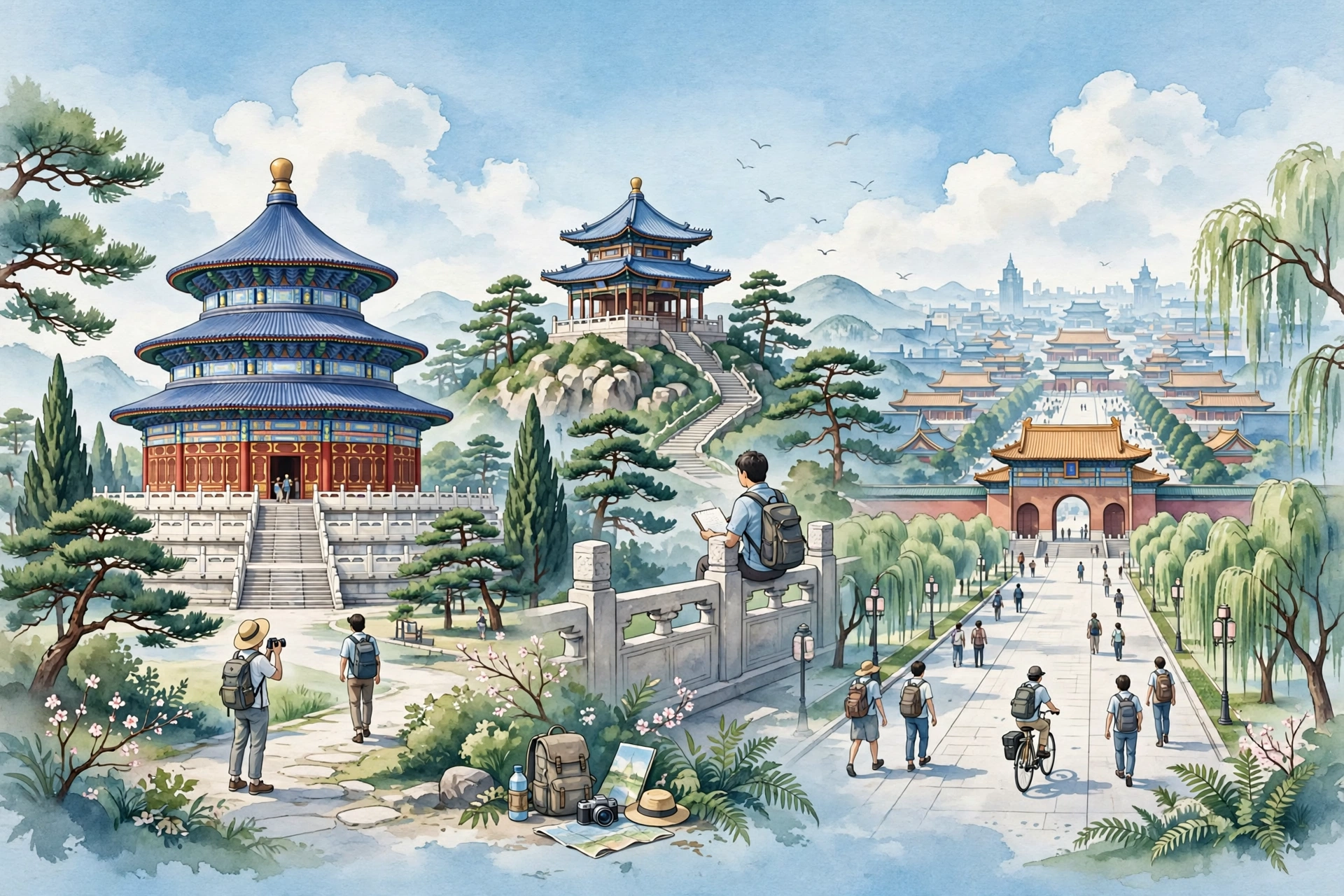
If the Forbidden City is Beijing’s grand statement, the Temple of Heaven is its most beautiful one. The Temple of Heaven is the great sacrificial complex where Ming and Qing emperors prayed for good harvests, and its centrepiece — the circular, triple-roofed Hall of Prayer for Good Harvests, built entirely of wood without nails — is one of the most photographed buildings in China. The park around it is as much the attraction as the temple: in the early morning, local residents practise tai chi, play badminton, sing opera and play cards under the cypress trees, and walking through it feels like stepping into Beijing’s daily life rather than its history. Entry to the park is about ¥15, with a combined ticket of around ¥28–34 in the low and high seasons that covers the main halls. Come early, before the tour groups arrive, and give it at least two hours.
Jingshan Park is small, cheap and essential. It sits directly north of the Forbidden City, and its artificial hill — built from the earth dug out to create the Forbidden City’s moat — gives the single best view in Beijing: from the pavilion at the top, the whole golden-roofed expanse of the Forbidden City spreads out below you, with the modern skyline behind it. Entry is just ¥2, and the climb takes about 15 minutes. Go in the late afternoon, when the low sun turns the palace roofs gold, or at sunrise if you are an early riser. It is the perfect end to a Forbidden City day, and it costs less than a bottle of water.
Both sights sit on the Beijing Central Axis, the 7.8 km north–south line that has organised the city since the Yuan Dynasty founded its capital here in the 13th century. The Axis runs from the Bell and Drum Towers in the north, through Jingshan and the Forbidden City, across Tiananmen Square, and south to the Temple of Heaven and beyond — a line of palaces, temples, gates and ceremonial buildings laid out according to the ancient principles of the Kaogongji, the Book of Diverse Crafts. In 2024 UNESCO inscribed the Beijing Central Axis on the World Heritage List as a building ensemble exhibiting the ideal order of the Chinese capital, making it the city’s seventh World Heritage site. UNESCO’s listing describes how the Axis bears testimony to the evolution of the city and the imperial dynastic system, and how its symmetry and balance express Confucian ideas of harmony. You can read the full listing on the UNESCO Beijing Central Axis page. Walking the Axis is the best way to understand Beijing: it is not a single sight but the spine the whole city hangs from, and once you have walked it, the city’s layout — its rings, its gates, its hutongs — starts to make sense.
The Summer Palace, Shichahai and Beijing’s Lakes
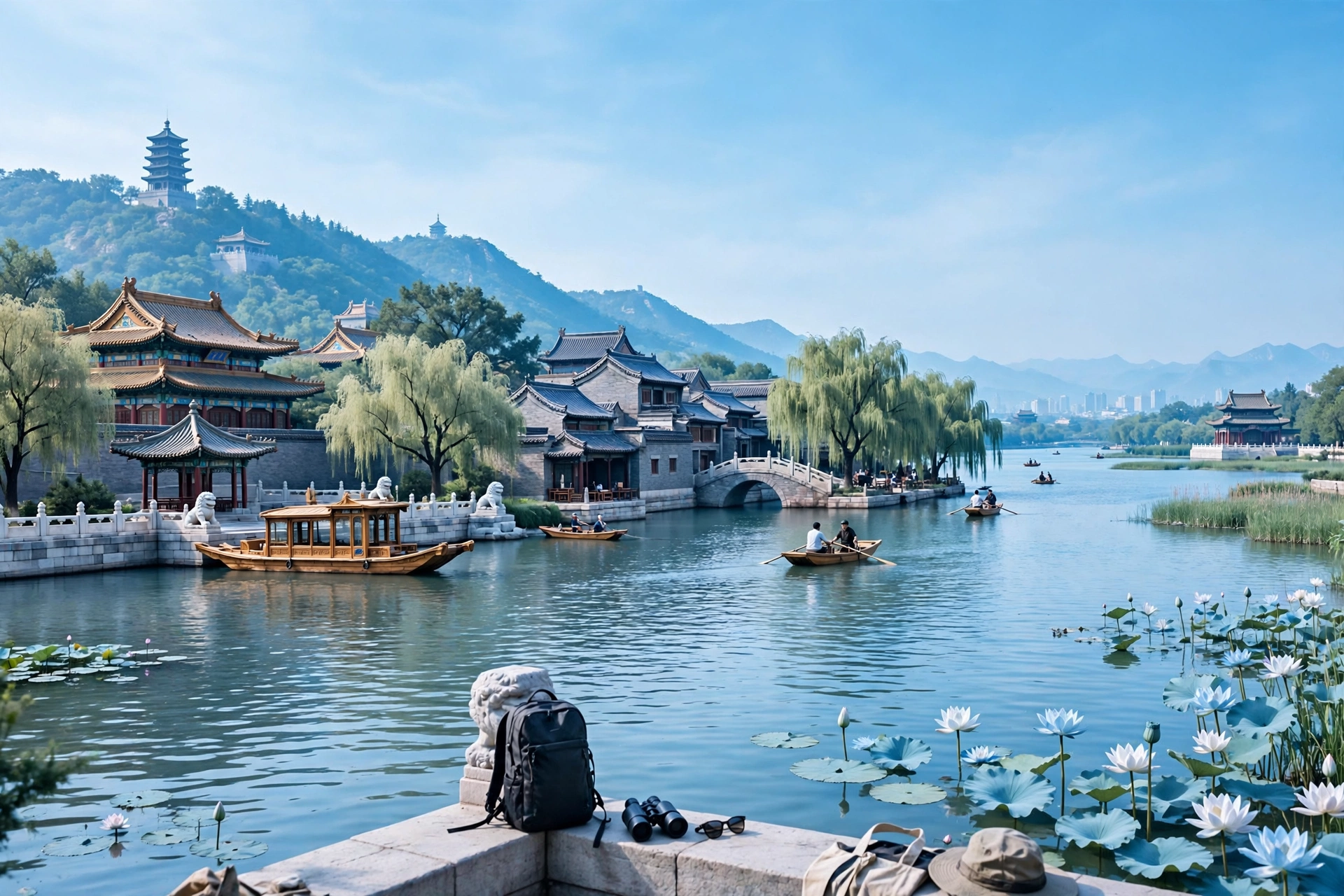
The Summer Palace is where the imperial court escaped the heat of the Forbidden City, and it is the most relaxing half-day in Beijing. Built around Kunming Lake, with the Long Corridor running along the shore and the Tower of Buddhist Incense rising on Longevity Hill, it is a landscape garden on a grand scale — part palace, part park, part lake. Entry is about ¥30 in the high season and ¥20 in the low season, and the best way to see it is slowly: walk the Long Corridor, climb Longevity Hill for the view over the lake, and take the short boat ride across to the Seventeen-Arch Bridge and the Marble Boat. Give it at least half a day, and in summer go early or late, when the lake is at its best and the crowds thin out. The Summer Palace is also one of the city’s seven UNESCO sites, and it pairs naturally with the Old Summer Palace ruins nearby if you have a full day for the northwest of the city.
Back in the centre, Beijing’s lakes are where the city relaxes. Shichahai — the three linked lakes of Qianhai, Houhai and Xihai — is the liveliest of them, ringed by bars, restaurants and old courtyard houses, with boats for hire in summer and skaters on the ice in winter. Walk the lakeside at dusk, when the lanterns come on and the bars fill, and you will see a Beijing that has nothing to do with palaces. In winter the frozen lake becomes a vast public skating rink, one of the great seasonal sights of the city. Nearby, Beihai Park — the oldest imperial garden in Beijing, with its white dagoba on Jade Flower Island — is quieter and older-feeling than Shichahai, and its lakeside paths are one of the best places in the city for a slow morning walk. Together, the lakes and the Summer Palace give you the water side of a city that most visitors think of as stone and dust, and they are the reason to keep at least one unhurried afternoon in your plan.
Hutongs, Qianmen, Dashilar, the Lama Temple and 798 Art District
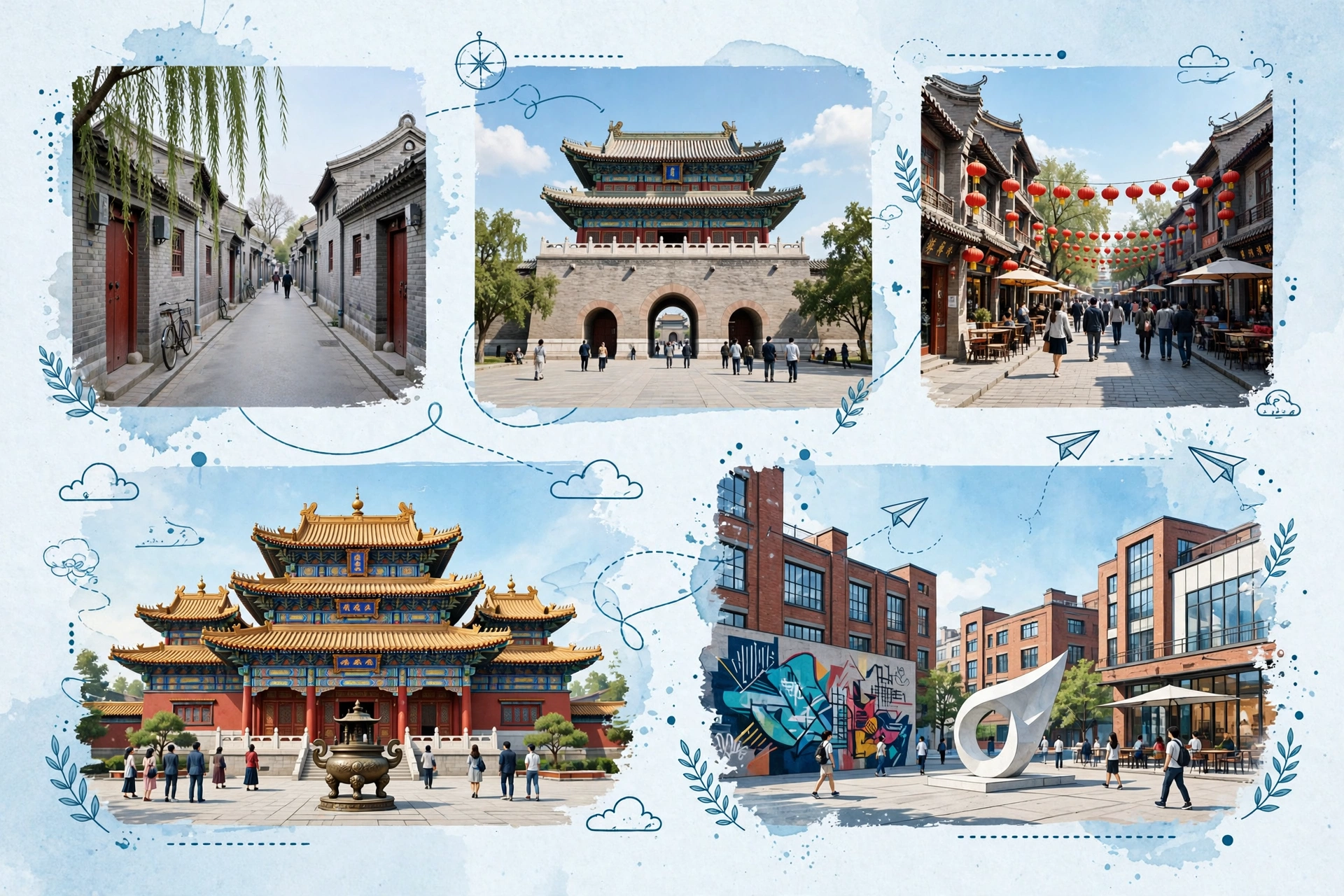
The hutongs are Beijing’s old soul: the narrow grey-brick alleyways that once made up most of the city, lined with siheyuan courtyard houses, corner shops, bicycle repair stalls and residents who have lived on the same lane for generations. Much of old Beijing was demolished in the rush to modernise, but the hutongs around Shichahai, the Drum Tower and Qianmen survive, and walking them is the closest you will get to the city as it was. The best way to see them is on foot or by bicycle in the early morning, when residents are out buying breakfast and the lanes are quiet: Nanluoguxiang is the most famous hutong and the most commercialised, so walk it once and then slip into the smaller lanes around it, where the real life is. A rickshaw tour can be fun but agree the price and the route first, and beware of rickshaw drivers who steer you to “tea houses” that are really sales pitches.
Qianmen and Dashilar, just south of Tiananmen Square, are the old commercial heart of the city. Qianmen Street was once the main road out of the imperial city, and its rebuilt shopfronts now mix historic brands — the century-old Quanjude roast duck restaurant, the Tongrentang pharmacy, traditional silk and cloth shops — with modern chains. Dashilar, the warren of lanes running west from Qianmen, is older and more atmospheric, with small workshops, snack stalls and the kind of shops that have traded on the same spot for a hundred years. Come here in the evening, when the street is lit and the food stalls are busy, and treat it as a place to wander rather than a checklist.
The Lama Temple (Yonghegong) is the finest Tibetan Buddhist temple outside Tibet, a working monastery in the northeast of the old city, and one of the most atmospheric religious sites in Beijing. Its five main halls climb a gentle slope, incense smoke hangs in the air, and the final hall holds an 18-metre statue of Maitreya carved from a single sandalwood tree. Entry is about ¥25. Visit in the morning, when monks are chanting and the temple is at its most alive, and remember it is a place of worship first and a tourist sight second: dress modestly, do not photograph inside the halls, and do not point your feet at statues.
For the other side of Beijing, take the subway out to the 798 Art District in the northeast, a sprawling complex of former military factories built in the 1950s with East German help, now filled with contemporary art galleries, design studios, cafes and street art. It is the best place in the city to see modern China thinking out loud, and it is free to wander — you pay only for individual gallery exhibitions. The contrast is the point: in one day you can walk a 600-year-old palace, eat noodles in a hutong, and stand in front of a vast installation in a factory hall. That range is what makes Beijing more than a museum city.
Getting to Beijing and Getting Around: Airports, Subway and DiDi
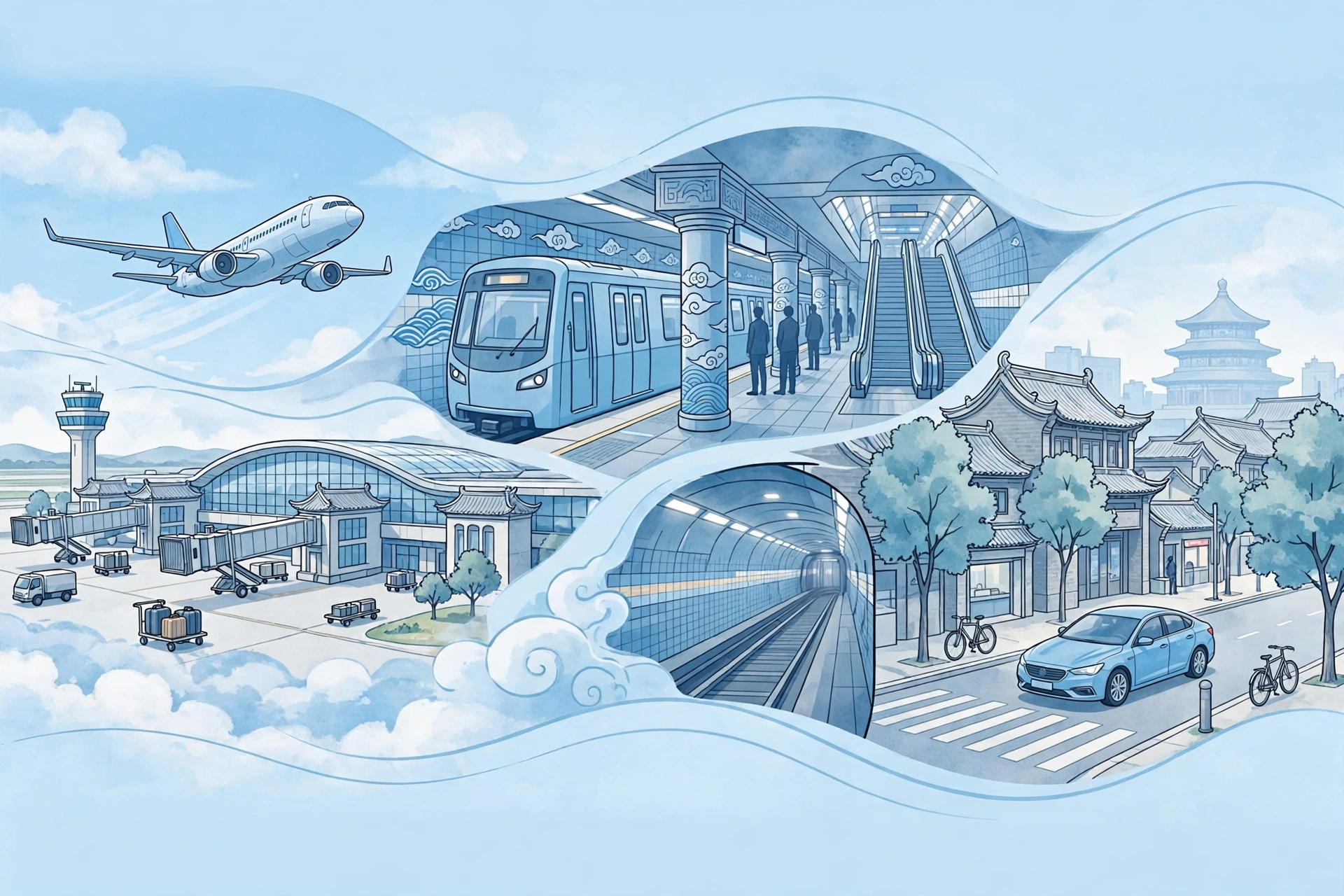
Beijing has two international airports, and knowing which one you are flying into changes your arrival plan. Beijing Capital International Airport (PEK) is the older airport, in the northeast of the city, about 25 km from the centre; the Airport Express train runs to Dongzhimen and Sanyuanqiao in about 20–30 minutes for ¥25, and a taxi to the centre costs roughly ¥80–120 depending on traffic. Beijing Daxing International Airport (PKX) is the vast new airport in the south, about 46 km from the centre; the Daxing Airport Express runs to Caoqiao station in about 20 minutes for ¥35, and a taxi costs roughly ¥150–200. Both airports have English signage and free Wi-Fi, but check your ticket carefully — PEK and PKX are not interchangeable, and a taxi to the wrong airport is an expensive mistake. International flights also connect through other Chinese hubs such as Shanghai and Guangzhou, and the high-speed rail network links Beijing to Shanghai in about 4.5 hours if you are combining cities. Long-haul flight planning is the same skill whatever the destination — our London travel guide covers the same kind of arrival planning for another great capital.
Once you are in the city, the subway is the backbone of getting around. Beijing’s subway is one of the largest in the world, with more than 25 lines and over 800 km of track, and it is cheap, fast and safe. Fares start at ¥3 and are capped at around ¥9 for the longest journeys, and you pay by tapping your phone with Alipay’s transport code or by buying a ticket at the machines. English signage is good on all lines, and the key stations for visitors are Tiananmen East and West (Forbidden City and the square), Qianmen (Qianmen and Dashilar), Dongsi and Nanluoguxiang (hutongs), Yonghegong (Lama Temple) and Beihai North (Beihai Park and Shichahai). The subway closes around 11pm, so plan evening returns accordingly.
For everything the subway does not reach — the Great Wall, the Summer Palace at night, or a hotel in a hutong — use DiDi, China’s ride-hailing app, which works inside Alipay and WeChat so you do not need a separate download. DiDi is metered, the price is shown before you book, and you do not need to negotiate or speak Chinese, because the destination is set in the app. Ordinary street taxis exist but are harder for visitors: many drivers do not speak English, some refuse the meter for foreigners, and you need the destination written in Chinese characters. Buses are cheap and extensive but slow and hard to navigate without Chinese. Cycling is a joy in Beijing — the city is flat, the bike lanes are wide, and shared bikes are everywhere — but traffic is aggressive and the rules of the road are loosely observed, so only cycle if you are confident. Walking is the best way to see the old centre: the Forbidden City, Tiananmen, Qianmen, the hutongs and Shichahai are all within a compact area, and the distances between them are walkable if you plan the order well.
Apps and Payments: Set Up Alipay, WeChat Pay and DiDi Before You Arrive

This section is the most important practical advice in this whole guide, because it is the thing that catches the most visitors out. Beijing is almost entirely cashless, and it runs on two apps — Alipay and WeChat Pay — that work differently from anything most visitors are used to. Foreign credit and debit cards are accepted in large international hotels and a few high-end restaurants, but they are largely unusable in the places you will actually spend your days: subway ticket machines, small restaurants, street food stalls, taxis, convenience stores and most ticket offices. Cash is legal tender and must be accepted by law, but in practice many small vendors have no change, and some will look at a ¥100 note with genuine confusion. Set up the apps before you arrive, not at the airport.
Alipay is the one to prioritise. Download it at home, create an account with your phone number, and link an international Visa or Mastercard through the Tour Pass or international card function. Verify your identity with your passport in the app, and test it with a small payment before you travel if you can. Once it works, Alipay does almost everything: it pays in shops and restaurants by QR code, it generates the subway transport code, it books DiDi rides, it buys attraction tickets, and it even handles the small deposit payments for shared bikes. WeChat Pay is the second system, and it is worth setting up too as a backup — it works the same way, with a foreign card linked to a WeChat account, and it is the system that handles the Tiananmen Square reservation mini-program. Between the two, you are covered everywhere.
DiDi runs inside both apps, so you do not need to install it separately, though the standalone DiDi app also works with a foreign number. Set your destination in English, confirm the price, and pay in the app — no cash, no negotiation, no language barrier. The subway transport code is also inside Alipay: open the Transport section, generate the metro QR code, and tap it at the gates.
There are two other digital facts to know before you land. First, Google does not work in China — no Google Maps, no Gmail, no Google Translate, no YouTube — and neither does WhatsApp, Instagram, Facebook or Uber. If you need these services, install a VPN before you arrive, because VPN apps cannot reliably be downloaded once you are in China. For maps, download Amap (Gaode Ditu) or Baidu Maps, which work well in English for navigation and public transport, and download an offline translation app with a Chinese language pack. Second, buy a local SIM card or an eSIM with a Chinese data plan at the airport or before departure, because the free Wi-Fi in hotels and cafes often requires a Chinese phone number for verification. A good travel-apps setup makes the difference between a smooth trip and a frustrating one — our guide to the best travel apps covers the general toolkit, but for Beijing the two apps above are non-negotiable.
One last money note: there is no tipping in China. Restaurants, hotels, drivers and guides do not expect tips, and offering one can cause confusion or embarrassment. Good service is part of the price, and the only exception is the occasional high-end international hotel, where a small tip for porters is accepted but never expected.
Where to Stay in Beijing
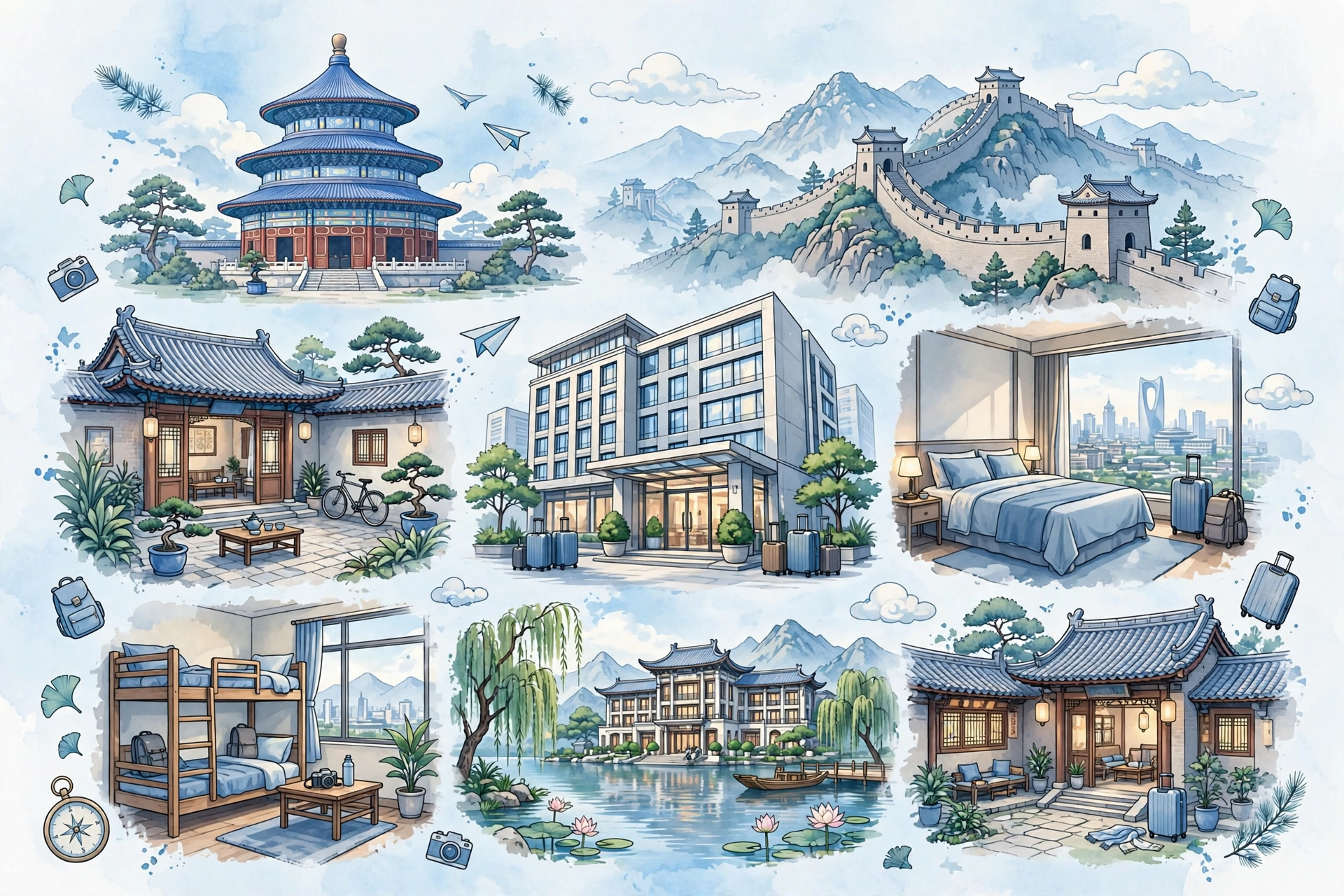
Where you stay in Beijing matters more than in most cities, because the sights are spread across a huge area and the traffic is slow. The right choice is to stay inside the Second Ring Road, in the old centre, where the Forbidden City, the hutongs and the subway lines converge. Staying outside the centre to save money is a false economy — you will spend the savings on taxis and time.
Dongcheng and Wangfujing are the best first-timer base: central, well connected, and within walking distance of the Forbidden City, Tiananmen Square and the hutongs. Qianmen and Dashilar are the most atmospheric choice, with courtyard hotels in converted siheyuan houses right beside the old commercial streets. Shichahai and the Drum Tower area suit travellers who want the hutong experience at its best, with lakeside bars and quiet lanes. Sanlitun and Chaoyang are the modern choice — embassies, international restaurants, nightlife and the big international hotel brands — but they are further from the historic sights. Wangfujing has the most mid-range hotels, while the area around the Summer Palace and the university district in the northwest suits longer stays and quieter nights.
| Area | Best for | Price range (per night) | Trade-off |
|---|---|---|---|
| Dongcheng / Wangfujing | First-timers, central sightseeing | ¥400–1,200 ($55–170) | Busy, touristy streets |
| Qianmen / Dashilar | Atmosphere, courtyard hotels | ¥350–1,000 ($50–140) | Smaller rooms, some noise |
| Shichahai / Drum Tower | Hutongs, lakes, evening life | ¥300–900 ($40–125) | Fewer big hotels, narrow lanes |
| Sanlitun / Chaoyang | Nightlife, international hotels | ¥500–1,800 ($70–250) | Far from historic sights |
| Summer Palace / Haidian | Quiet, longer stays, budget | ¥200–600 ($30–85) | Long subway rides to centre |
| Near PEK / PKX airport | Early flights only | ¥250–700 ($35–100) | Nothing to do nearby |
Book early for September and October, when the best central hotels sell out, and always check the hotel’s exact location on a map rather than trusting the neighbourhood name — “near the Forbidden City” can mean a 40-minute walk. All hotels require your passport at check-in and register you with the police automatically, so keep it handy. If you are weighing a courtyard guesthouse against a standard hotel, the courtyard stay is the more memorable experience, but check that it has proper heating in winter and air conditioning in summer — old buildings can be cold and draughty in January and stifling in July.
How Much Does Beijing Travel Cost?
Beijing is one of the best-value major capitals in the world. The subway costs a few yuan, the great sights cost less than a coffee back home, and a bowl of noodles costs less than the price of a bus ticket in many Western cities. What costs money is the accommodation, the Great Wall day trip and the Peking duck dinner — and even those are reasonable by capital-city standards. The table below is in Chinese yuan, with approximate US dollar equivalents at roughly ¥7 to $1; treat all figures as planning ranges and confirm them before you book.
| Item | Budget (per day) | Mid-range (per day) | Notes |
|---|---|---|---|
| Accommodation | ¥150–250 ($20–35) | ¥500–900 ($70–125) | Hostel dorm vs central 4-star hotel |
| Food and drink | ¥60–100 ($8–14) | ¥150–300 ($20–40) | Street food vs restaurant meals |
| Transport (subway + DiDi) | ¥20–40 ($3–6) | ¥50–100 ($7–14) | Subway ¥3–9 per ride |
| Sights and tickets | ¥40–80 ($6–11) | ¥80–150 ($11–20) | Forbidden City ¥40–60, Temple of Heaven ¥15 |
| Great Wall day trip | ¥150–250 ($20–35) | ¥300–500 ($40–70) | Transport + entry + cable car |
| Daily total | ¥250–400 ($35–55) | ¥600–1,000 ($85–140) | Excluding flights |
A four-day trip for one person, excluding international flights, typically costs around ¥1,500–2,500 ($210–350) on a budget and ¥3,500–6,000 ($500–850) at a comfortable mid-range level. The biggest savings come from travelling in the low season — January and February hotel prices can be half the autumn rates — and from eating where locals eat rather than in the tourist restaurants around Wangfujing and the Forbidden City. One cost that surprises visitors is how little the sights themselves add up: the Forbidden City, the Temple of Heaven, the Summer Palace, Jingshan Park and the Lama Temple together cost less than ¥150 in entry fees, which is less than a single major museum ticket in many European capitals. If you want a structured way to plan the numbers for any trip, our guide on how to prepare a travel budget walks through the same method step by step. For a wider sense of how Beijing compares with other destinations, the Panama travel guide and the Malta travel guide use the same budget-table format, so the figures are easy to compare.
What to Eat in Beijing: Peking Duck, Noodles and Hotpot
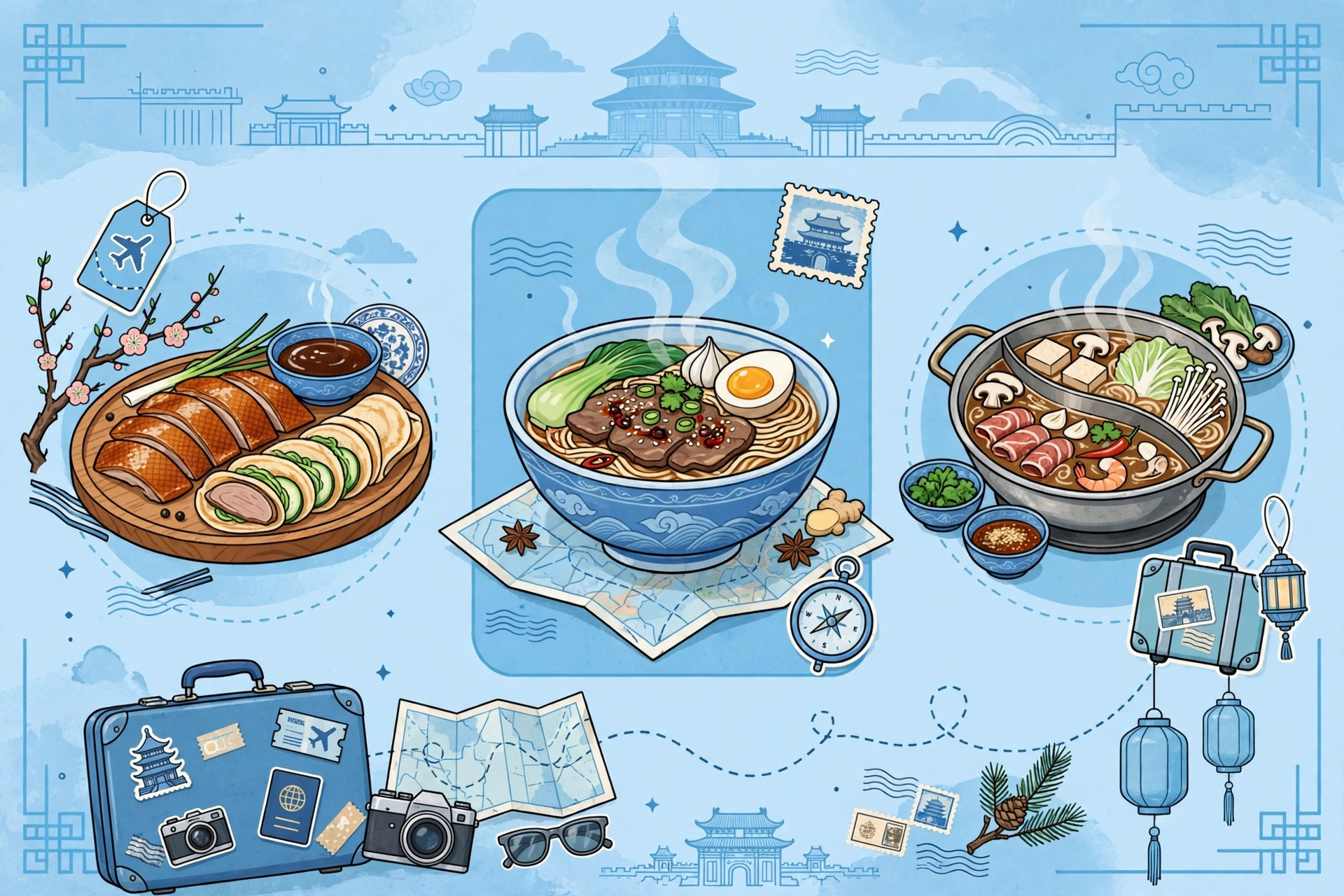
Beijing’s food is hearty northern Chinese cooking — wheat, not rice, is the staple — and it is one of the most enjoyable parts of the trip. The dish everyone comes for is Peking duck, and it is worth the ceremony: crisp-skinned duck carved at the table, wrapped in thin pancakes with spring onion, cucumber and sweet bean sauce. The two famous names are Quanjude, the century-old institution near Qianmen, and Da Dong, the modern favourite for crispier skin — expect to pay roughly ¥200–300 per person for a full duck dinner. Book ahead for both, especially at weekends. A cheaper and equally local alternative is to eat duck at one of the many neighbourhood roast duck restaurants, where the same meal costs half as much.
Beyond duck, the dishes to try are the everyday ones. Zhajiangmian — wheat noodles topped with fermented black soybean paste, diced pork and shredded vegetables — is Beijing’s signature noodle dish, served everywhere from street stalls to old restaurants. Jianbing, the savoury breakfast crepe filled with egg, pickled vegetables, chilli sauce and a crisp cracker, is sold from carts across the city in the morning and costs a few yuan. Lamb hotpot is the winter classic: thinly sliced lamb cooked in a bubbling copper pot of broth at the table, and the old restaurants in the hutong areas do it best. Add to that list the dumplings (jiaozi) sold by the dozen, the lamb skewers (chuanr) grilled over charcoal at night markets, and the sweet hawthorn snacks sold by street vendors in autumn. Eating well in Beijing does not require money or planning — it requires curiosity and a willingness to point at what the table next to you is having.
Practical food notes: breakfast is a street affair — jianbing carts, baozi steamers and noodle shops open early and close by mid-morning. Lunch is the main meal for many locals, and the best value is the set lunch in a small restaurant, often under ¥30. Dinner is when the hotpot and duck restaurants fill up. Vegetarians can eat well — Buddhist restaurants near the Lama Temple serve excellent meat-free food — but menus are rarely in English outside tourist areas, so a translation app with a camera function is invaluable. Tap water is not safe to drink; buy bottled water everywhere. And if you are a coffee drinker, note that good coffee is easy to find in Sanlitun and the 798 Art District, and much harder to find in the old centre — tea is the default drink in Beijing, and it is taken seriously. Food is one of the fastest ways to understand a place, and Beijing rewards the curious eater more than almost any other capital — the same is true of the street food scenes in the Singapore travel guide and the Nicaragua travel guide, where the best meals are also the cheapest ones.
Sample Beijing Itineraries: 4 Days and 5 Days
Four days is the minimum for a first visit to Beijing, and five days is the comfortable version that lets you slow down. Both itineraries below assume you have already set up Alipay and DiDi, and that your Forbidden City tickets are booked for Day 1. If you want to build your own version of either plan, our travel itinerary template gives you the same day-by-day structure to fill in.
The 4-day itinerary
Day 1 — The Central Axis. Morning: Tiananmen Square (reservation booked ahead), then the Forbidden City from the Meridian Gate to the Gate of Divine Prowess, 3 to 4 hours. Late afternoon: climb Jingshan Park for the view over the palace roofs at golden hour. Evening: dinner in Qianmen or Dashilar, and an early night — the Forbidden City is a long day on foot.
Day 2 — The Great Wall. A full day at Mutianyu: cable car up, walk the restored wall, toboggan down, back in Beijing by late afternoon. Evening: Shichahai lakeside walk and dinner, or lamb hotpot in the hutongs.
Day 3 — Temples and the old city. Morning: Temple of Heaven at opening time, when the park is full of tai chi and opera. Midday: the Lama Temple, then lunch in the hutong lanes nearby. Afternoon: hutong walking and cycling around Nanluoguxiang and the Drum and Bell Towers — climb the Drum Tower for the view and the drum performance. Evening: Peking duck dinner.
Day 4 — Gardens and modern Beijing. Morning: the Summer Palace, half a day around Kunming Lake. Afternoon: the 798 Art District, then shopping and street food on Wangfujing. Evening: a final hutong dinner or a night view of the Central Axis from Jingshan.
The 5-day itinerary
Follow the 4-day plan, then add Day 5 — Deeper Beijing. Morning: Beihai Park and a slow lakeside walk, or the Capital Museum for a deeper look at the city’s history. Afternoon: a cooking class, a second Great Wall section such as Jinshanling for hikers, or a day trip to the Ming Tombs. Evening: a farewell dinner in Sanlitun, and a last walk through the lit-up lanes of Dashilar. The extra day is also your insurance: if a bad-air day or a sandstorm hits, the 5-day plan has the slack to swap a museum day for an outdoor day without losing anything. The same logic applies to any multi-city trip — the Colombia travel guide and the Ecuador travel guide both use a spare-day structure for exactly this reason.
Frequently Asked Questions About Beijing Travel
How many days do you need in Beijing?
Four days is the minimum for a first visit — the Forbidden City, the Great Wall, the Temple of Heaven, the hutongs and the Summer Palace. Five days is better, because it adds a spare day for bad weather or a slower pace, and six days lets you add a second Great Wall section or a day trip. Less than three days means skipping something major.
Do I need a visa for Beijing?
It depends on your passport. Many nationalities, including France, Germany, Italy, Spain, Australia, New Zealand, Japan and South Korea, currently enter visa-free for up to 30 days. US citizens can use the 240-hour (10-day) visa-free transit policy if they are travelling onward to a third country, or apply for a tourist visa in advance. British citizens generally need a visa. Always verify the current rules for your passport before booking.
Can I use Google, Uber or foreign credit cards in Beijing?
Google services, WhatsApp, Instagram and Facebook are blocked in China, and Uber does not operate here — use DiDi instead, inside Alipay or WeChat. Foreign credit and debit cards work in large international hotels but are largely unusable in shops, restaurants, taxis and ticket offices. Set up Alipay and WeChat Pay with a foreign card before you arrive, and install a VPN before you land if you need Google services.
Do I need to book Forbidden City tickets in advance?
Yes — this is essential. Tickets are released exactly 7 days ahead, they sell out quickly, there are no ticket sales at the gate, and entry is by passport only. Book through the official Palace Museum channels or a reputable seller such as Trip.com, with the exact passport details of every visitor. Tiananmen Square needs a separate free reservation.
Which section of the Great Wall should I visit?
Mutianyu is the best all-round choice for a first visit — restored, beautiful, less crowded than Badaling, with a cable car and a toboggan down. Badaling is the easiest and most crowded. Jinshanling is for fit hikers who want a wild 10 km ridge walk, and Simatai is the only section open at night. Go on a weekday if you can.
When is the best time to visit Beijing?
September to October is the best time, with clear skies, comfortable temperatures and autumn colours. April to May is second best, with blossom and mild weather but a risk of sandstorms. Avoid the Golden Week holiday (1–7 October) and the May Day holiday (1–5 May) unless you have no choice, and expect the worst air quality in the winter heating season.
Conclusion
Beijing is not a city that gives up its best experiences easily — it asks you to book ahead, set up the apps, carry your passport and learn how the city works before you arrive. But the return on that preparation is extraordinary: a palace that took 14 years to build and held 24 emperors, a wall that runs over forested ridges to the horizon, temples where the morning is filled with tai chi and opera, hutong lanes that have survived centuries, and a food culture that rewards curiosity at every turn. Go in September or October if you can, give it at least four days, book the Forbidden City the moment tickets open, and set up Alipay before you land. Do that, and Beijing stops being a difficult destination and becomes one of the great trips of a lifetime — a capital that is 3,000 years old and still, unmistakably, itself.
People also read: Venice Travel Guide · Singapore Travel Guide · Malta Travel Guide · Travel Itinerary Template · How to Prepare a Travel Budget · Travel Apps

M. Adil is the founder and editor of SoloTravelPro. He writes practical, research-based travel guides that help travellers plan with confidence — from first-time city breaks to national parks and island escapes. Every guide is built on official sources, current prices and honest, usable advice, so readers can plan smarter and travel better.