
Quick Answer
Singapore is one of the easiest first trips to Asia you can take from the United States — and one of the most rewarding. It is a city-state about the size of New York City, where a gleaming waterfront, century-old shophouses, hawker stalls serving S$6 meals and a rainforest zoo all sit within a 45-minute train ride of each other. English is an official language, the metro is spotless and on time, the streets are safe at night, and the food is genuinely world-class at prices that would be unthinkable in most big American cities.
If you only have time for the short version, here it is: give Singapore four full days. Arrive through Changi Airport, submit the free SG Arrival Card within three days of landing, and plan your first look at Jewel’s Rain Vortex for your departure day, when you will have time to enjoy it. Stay in Chinatown, Bugis or Tiong Bahru for character and value, or Marina Bay if you want the skyline at your doorstep. Spend your mornings outdoors — Marina Bay, the Botanic Gardens, the heritage neighbourhoods — your afternoons indoors or under cover when the heat and the daily downpour arrive, and your evenings at a hawker centre and then the Supertree light show, which is free. Eat at hawker centres at least once a day. Use the MRT for almost everything, Grab when you are tired or carrying bags, and the bus when you want to see the city for the price of a coffee.
This singapore travel guide is written for travellers coming from the United States, so prices are in Singapore dollars (SGD) with US dollar equivalents, entry rules are the ones that apply to US passport holders, and the practical sections cover the things that actually trip people up: the arrival card, the heat, the hawker-centre etiquette nobody explains, and the local laws that are stricter than anything back home. All prices, fares and opening times in this guide are planning ranges — Singapore changes prices regularly, so confirm the current figure before you book or go.
The single most useful thing to understand before you land is that Singapore rewards a loose plan and punishes a rigid one. The weather will interrupt you — a sharp afternoon shower is a near-daily event, not bad luck. The city is built for that. Malls, metro stations and covered walkways connect almost everything, so a downpour is a 30-minute coffee break, not a ruined day. Build your days around that rhythm and Singapore feels effortless. Fight it, and you will spend your holiday hot, wet and frustrated.
Best Time to Visit Singapore
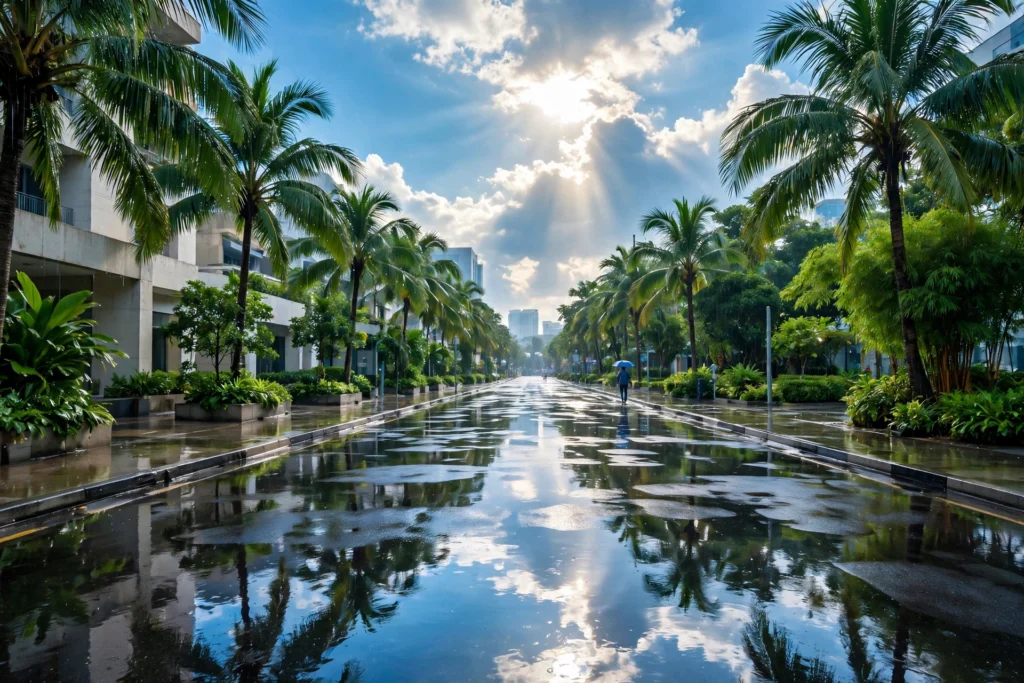
Singapore sits almost on the equator, so there is no winter, no summer and no bad season in the way most destinations have one. Temperatures sit between about 25°C and 33°C (77–91°F) all year, humidity rarely drops below 80 percent, and rain can fall in any month. The question is not whether it will be hot — it will be — but how much rain you are willing to plan around, and how much you care about crowds and hotel prices.
The driest and wettest months
February to April is generally the driest stretch of the year, and the one most guides recommend. You still get afternoon showers, but they tend to be shorter and less frequent, and the skies are clearer for the skyline views at Marina Bay. November to January is the wettest period, when the northeast monsoon brings heavier and longer rain, particularly in December. That said, the wet season is also when hotel rates soften and the city is at its most festive — Christmas lights on Orchard Road and Chinese New Year decorations in Chinatown are genuinely spectacular, and both fall in this window.
The honest version is this: there is no month in which Singapore is reliably dry, and no month in which it rains all day. Even in December, most days have long dry stretches. If you can only travel in the wet season, come anyway — just pack a small umbrella, plan indoor activities for the afternoons, and book a hotel with a pool you can actually enjoy between showers.
| Month | What to expect | Best for | Watch out for |
|---|---|---|---|
| January | Wettest stretch, monsoon rain, 24–31°C | Festive lights, lower hotel rates | Heavy showers, pack rain gear |
| February | Drying out, fewer showers, 25–32°C | Chinese New Year atmosphere in Chinatown | Holiday crowds and higher prices around the festival |
| March | One of the driest months, 25–33°C | Sightseeing, outdoor dining, photography | Heat builds by midday |
| April | Warm and relatively dry, 26–33°C | Gardens, Sentosa beaches, walking tours | Occasional sharp afternoon storms |
| May–June | Hot and humid, regular afternoon showers | School-holiday family trips, indoor attractions | Midday heat, book popular attractions ahead |
| July–August | Warm, humid, short heavy showers | Summer holidays, festivals | Peak family travel, higher hotel prices |
| September | Similar to July–August, 25–32°C | A good all-round month | Formula 1 Grand Prix week — prices spike |
| October | Warming showers return, 25–32°C | Deepavali lights in Little India | Rain becomes more frequent |
| November | Wet season begins, 24–31°C | Christmas lights start on Orchard Road | Longer, heavier rain |
| December | Wettest month, monsoon, 24–30°C | Christmas, New Year, festive markets | Rain most days, book hotels early |
The best time by trip type
- First-timers who want the classic sights: February to April, for the best odds of clear skies over Marina Bay.
- Budget travellers: November to January (outside the Christmas–New Year peak) or May, when hotel rates dip.
- Food-focused trips: any month. Hawker centres are covered, air-conditioned malls are everywhere, and the food does not have a season.
- Families: June or December school holidays, but book Sentosa and the wildlife parks early — those are the busiest weeks of the year.
- Festival hunters: Chinese New Year (January or February), Deepavali (October or November) and the Formula 1 Grand Prix in September.
How to actually plan around the heat and the rain
This is the part most guides get wrong. They tell you it is hot and humid and leave it at that. Here is how to live with it. Start your outdoor sightseeing at 8 or 9 a.m., when the air is warm but bearable and the light is good. By noon, move indoors — a museum, a mall, a long hawker lunch, the cooled conservatories at Gardens by the Bay. Expect a sharp downpour somewhere between 2 and 5 p.m.; when it comes, stay put for 30 to 45 minutes and it will usually pass. Then go back out for the evening, when the city is at its best: the waterfront cools down, the Supertrees light up, and the night markets and hawker centres come alive. Drink water constantly, carry a small umbrella rather than a raincoat, and wear light, quick-drying clothes. You will still sweat. Everyone does. Singaporeans just plan around it, and so should you.
How Many Days Do You Need in Singapore
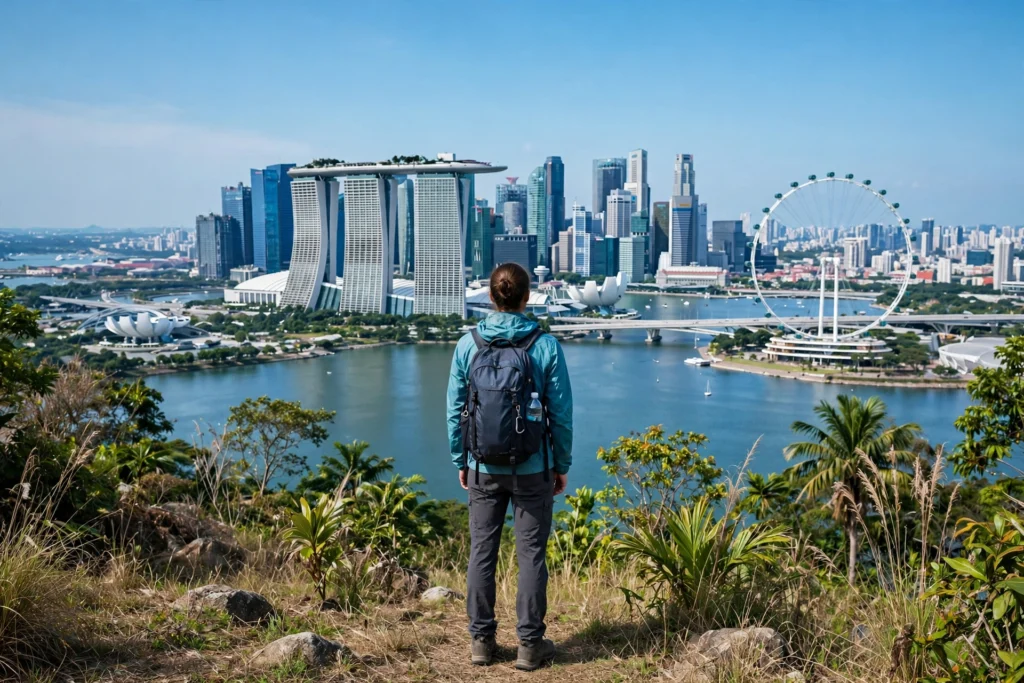
Three to five days is the sweet spot for a first visit, and four days is the ideal balance. Singapore is compact — you can cross the island by metro in about an hour — but it is dense with things worth your time, and the heat slows you down more than you expect. Rushing it in two days means skipping either the food or the nature, and both are the point.
- 2 days: the highlights only. Marina Bay and Gardens by the Bay, one heritage neighbourhood, one hawker centre, and a half-day on Sentosa. You will leave with good photographs and a list of things you missed.
- 3 days: the classic first trip. Everything above, plus a second neighbourhood, the Botanic Gardens, and a proper evening at a hawker centre. This is the minimum for a trip that feels complete rather than hurried.
- 4 days: the recommended trip, and the one this guide is built around. You get Marina Bay, the heritage neighbourhoods, hawker food, Sentosa, the wildlife parks or the Botanic Gardens, and a day that is not scheduled to the minute. It is the first length where Singapore starts to feel like a place rather than a checklist.
- 5–7 days: the slow version. Add a day trip to Pulau Ubin for cycling and village life, a second Sentosa day, the museums in the Civic District, and time to simply eat your way through a different hawker centre each day.
If you are combining Singapore with somewhere else in Southeast Asia — Bangkok, Bali, Kuala Lumpur — four days is still the right call. Singapore works beautifully as the easy, comfortable start or end of a longer trip, and Changi Airport makes connections painless. If Singapore is your only stop, five days lets you slow down properly.
A note on arrival day
Most flights from the US East Coast reach Singapore in the late afternoon or evening after a very long journey, and flights from the West Coast are not much kinder. Do not plan anything ambitious for arrival day. Clear immigration, get to your hotel, eat something good at a nearby hawker centre, and take a short evening walk if you have the energy. Your real trip starts the next morning. The itinerary in the final section of this guide is built on exactly this assumption, so you will not waste your first evening on a schedule you are too tired to enjoy.
Marina Bay and Gardens by the Bay
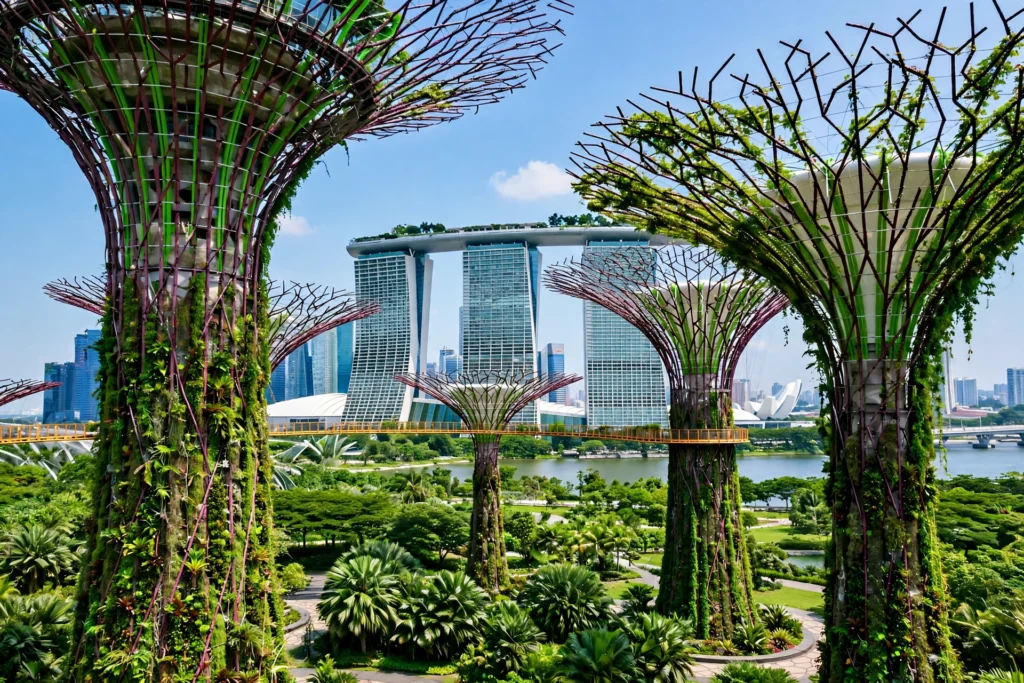
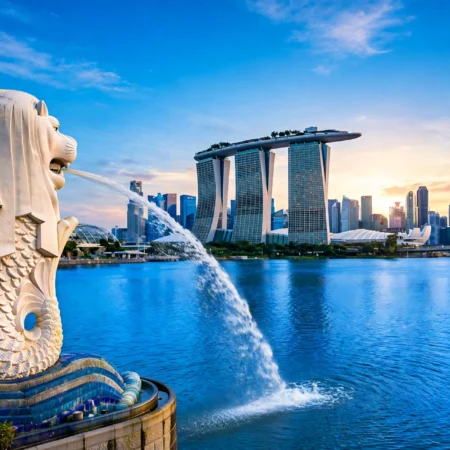
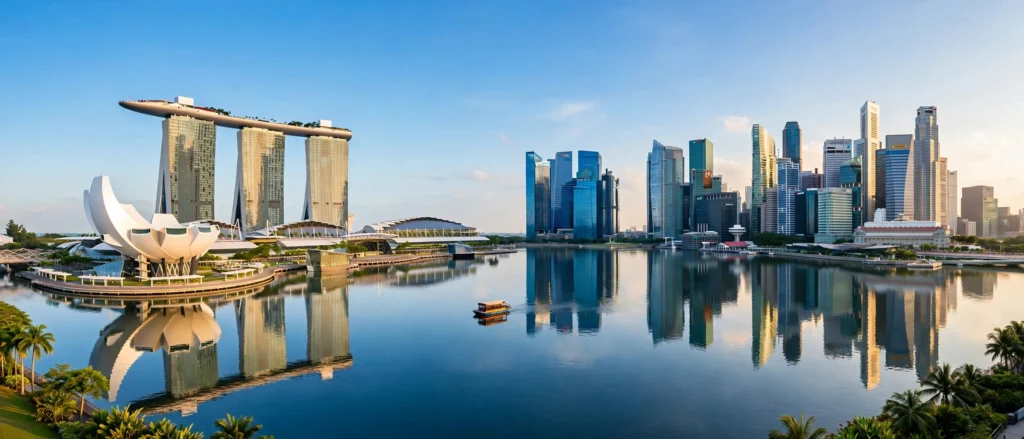
Marina Bay is the Singapore you have seen in photographs, and it is worth seeing in person. The bay is a loop of waterfront promenades, gardens and viewpoints, and it is best experienced on foot in the early morning or after sunset, when the heat eases and the skyline lights up. Start at Merlion Park, where the half-lion, half-fish statue spouts water into the bay with Marina Bay Sands behind it — go early, before the tour groups arrive, and you will have the view almost to yourself. From there, walk the promenade past the ArtScience Museum, shaped like a lotus flower, and across the Helix Bridge, a double-helix pedestrian bridge that is one of the best free viewpoints in the city.
Gardens by the Bay sits on the far side of the bay, and it is the single best use of half a day in Singapore. The outdoor gardens are free to enter and open from 5 a.m. to 2 a.m., which makes them a perfect early-morning or late-evening walk. The stars are the Supertrees — 18 vertical gardens between 25 and 50 metres tall, connected by the OCBC Skyway, a 128-metre walkway 22 metres up. The free Garden Rhapsody light-and-music show runs at the Supertree Grove every evening at 7:45 p.m. and 8:45 p.m.; arrive 20 minutes early, sit on the ground, and look straight up. It costs nothing and it is one of the best free shows in Asia.
The two cooled conservatories are the paid part, and both are worth it. The Flower Dome holds Mediterranean and semi-arid plants in a vast glasshouse that feels like stepping into a different climate — a relief on a hot afternoon. The Cloud Forest is the more dramatic of the two: a 35-metre indoor mountain covered in orchids and ferns, with a waterfall you can hear before you see it, and a walkway that circles through the mist. Check ticket prices and opening hours on the official Gardens by the Bay website before you go, as they change with exhibitions and seasons: https://www.gardensbythebay.com.sg
Marina Bay Sands and the SkyPark
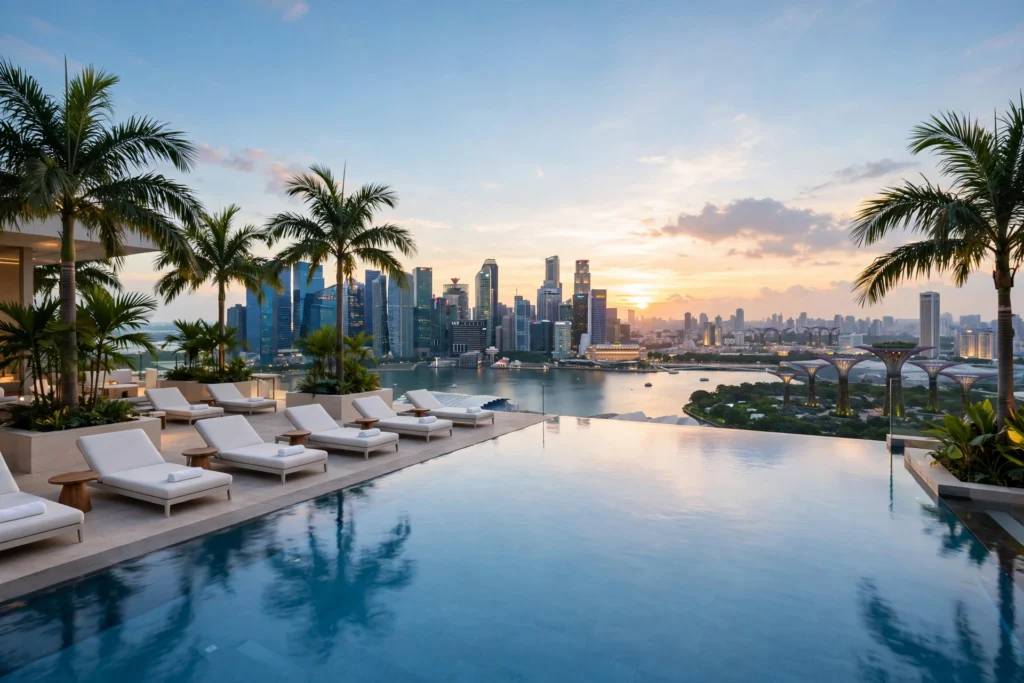
You do not need to stay at Marina Bay Sands to enjoy it. The SkyPark Observation Deck, on the 56th floor, gives you the classic postcard view over the bay, the gardens and the city — go at sunset if you can, and book ahead, because the deck sells out on clear evenings. The hotel’s famous infinity pool is for hotel guests only, so if the pool is the reason you want to stay there, you will need to book a room. For everyone else, the observation deck delivers the view at a fraction of the price. Below the hotel, the Shoppes at Marina Bay Sands mall is air-conditioned, connected to the metro, and a useful refuge during an afternoon downpour.
How to spend a Marina Bay morning
Arrive at 8 a.m. Walk from Merlion Park along the promenade to the Helix Bridge, cross into Gardens by the Bay, and spend an hour in the outdoor gardens before the heat builds. Do the Flower Dome and Cloud Forest between 10 a.m. and noon, when the air-conditioning feels like a gift. Eat lunch at Satay by the Bay, the open-air food court at the edge of the gardens, where satay skewers and sugarcane juice cost a few dollars and you can sit by the water. If you still have energy, cross back over the bridge in the late afternoon and end the day at the Supertree light show. That is a full, satisfying day built around one neighbourhood, with almost no transport needed.
Chinatown, Little India and Kampong Glam
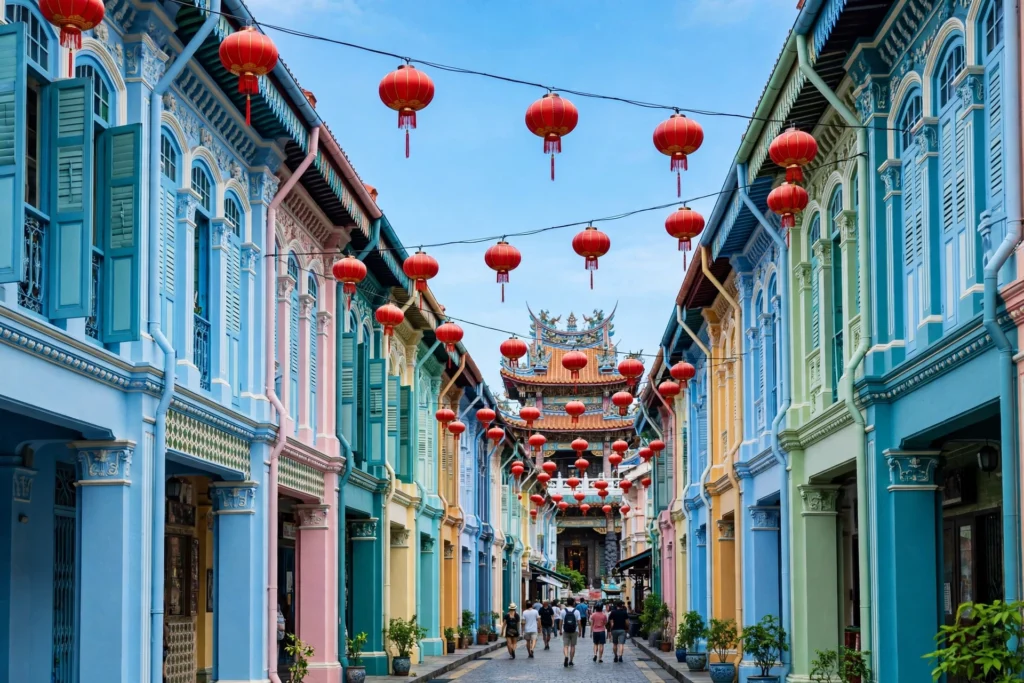
Singapore’s heritage neighbourhoods are where the city stops looking like a postcard and starts feeling like a place where people actually live. Each one is a short metro ride from the next, and together they are the best half-day walk in the city. Do them in the morning, when the markets are busy and the temples are open, and before the midday heat makes the narrow streets uncomfortable.
Chinatown
Chinatown is the most polished of the three, and the easiest to enjoy on a first visit. Start on Pagoda Street, where the shophouses have been restored in bright colours and the street market sells everything from silk to souvenirs. The Buddha Tooth Relic Temple on South Bridge Road is free to enter and genuinely beautiful inside — dress modestly, covering shoulders and knees, and remove your shoes where asked. Around the corner, the Sri Mariamman Temple, Singapore’s oldest Hindu temple, sits on the same street, which tells you most of what you need to know about how this neighbourhood works. Chinatown is also where you will find the Maxwell Food Centre, covered in detail in the hawker section below, and the Chinatown Complex, a warren of market stalls on the upper floors that sells fabrics, dried goods and tailoring. Come hungry, come early, and give yourself at least two hours.
Little India
Little India is louder, denser and more chaotic than Chinatown, and it is all the better for it. The main strip is Serangoon Road, where gold jewellers, sari shops, spice merchants and flower garland sellers crowd the pavements. Tekka Centre is the neighbourhood’s hawker and wet market — go for the Indian food, stay for the market stalls selling everything from jasmine garlands to fresh curry leaves. The Sri Veeramakaliamman Temple, with its riot of colourful statues, is one of the most photographed buildings in Singapore, and it is worth stepping inside quietly for a few minutes. Little India is at its best in the late afternoon, when the light turns golden and the streets fill with people heading home from work, and it is at its most magical during Deepavali, when the whole neighbourhood is strung with lights.
Kampong Glam
Kampong Glam is Singapore’s old Malay quarter, and it has become the city’s most stylish neighbourhood. The centrepiece is the Sultan Mosque, with its golden dome, on Muscat Street — visitors are welcome outside prayer times, and robes are provided at the entrance if you need them. The streets around it, Haji Lane and Arab Street, are lined with shophouses turned into independent boutiques, cafes and street-art murals. This is the best neighbourhood in Singapore for an unhurried afternoon: browse the shops, stop for Turkish coffee or teh tarik, and photograph the murals without the crowds you will find at Marina Bay. It is also the best place in the city for dinner if you want something different from hawker food — the Middle Eastern and Malay restaurants along Arab Street are excellent and reasonably priced.
How to do all three in one morning
Take the metro to Chinatown, spend two hours there, then ride two stops to Little India for lunch at Tekka Centre. From there, it is a 15-minute walk or one metro stop to Bugis, and a short stroll to Kampong Glam for the afternoon. Three neighbourhoods, three cultures, one metro line, and you will have seen more of real Singapore than most visitors manage in a whole trip.
Hawker Centres and What to Eat
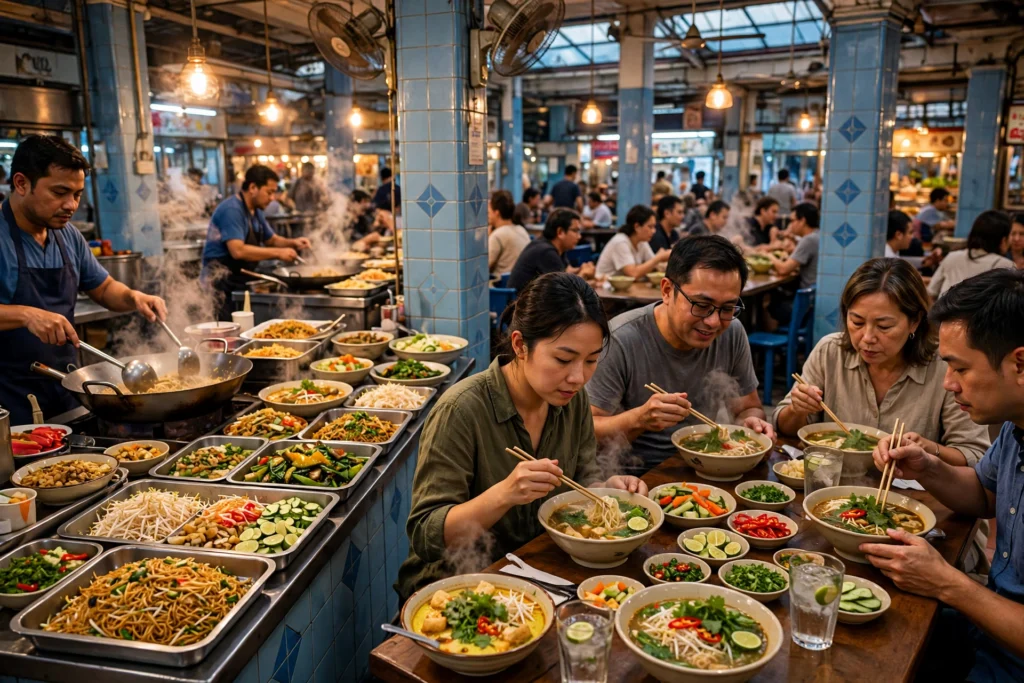
If you take one thing from this guide, let it be this: eat at hawker centres. These open-air food courts are where Singapore eats — office workers, families, taxi drivers and tourists all queue at the same stalls — and the food is extraordinary. In 2020, UNESCO added Singapore’s hawker culture to its Representative List of the Intangible Cultural Heritage of Humanity, and it shows: this is not street food as a novelty, it is a national institution. A full meal costs S$5–8, about US$4–6, and a good hawker lunch is one of the best-value meals in the developed world.
How hawker centres actually work
First-timers find hawker centres confusing for about five minutes, and then they make perfect sense. Here is the etiquette, which nobody explains and everyone expects you to know. First, find a table and reserve it — the famous Singaporean move is “chope”, placing a packet of tissues or an umbrella on the table to claim it while you go and order. It looks strange the first time you see it. It is completely normal, universally respected, and you should do it too. Second, order at the stall, pay there, and take your food back to your table — there is no table service. Third, return your tray and crockery to the return station when you finish; it is expected, and most centres now have a rule requiring it. Fourth, drinks come from a separate drinks stall, not the food stall. Fifth, most stalls take cards and mobile payment now, but carry some cash — a few of the best, oldest stalls are still cash-only, and a S$10 note will get you through any hawker lunch.
The centres to prioritise
- Maxwell Food Centre (Chinatown): the most famous, and the most crowded. Home to Tian Tian Hainanese Chicken Rice, the stall that put Singapore chicken rice on the map. Go early — before 11:30 a.m. — or be ready to queue.
- Lau Pa Sat (Downtown): a beautiful Victorian-era market hall in the middle of the financial district. By day it is a normal hawker centre; after 7 p.m., Boon Tat Street outside closes to traffic and becomes Satay Street, with smoke and skewers as far as you can see. It is the best hawker dinner experience in the city.
- Old Airport Road Food Centre: the locals’ favourite, and the one Singaporeans name when asked where they actually eat. It is further from the tourist trail, a short bus ride from the city, and it has more award-winning stalls than any other centre in the country. If you only visit one hawker centre properly, make it this one.
- Tiong Bahru Market: a neighbourhood market above a wet market in one of Singapore’s prettiest old housing estates. Come for breakfast — the chwee kueh (steamed rice cakes with preserved radish) and the fish soup are the local picks — and then wander the art-deco streets around it.
- Tekka Centre (Little India): the best Indian food in a hawker setting. Biryani, dosa, roti prata and teh tarik, all under one roof.
What to order
Start with Hainanese chicken rice — poached chicken, fragrant rice cooked in chicken stock, chilli sauce and ginger. It is Singapore’s national dish and the benchmark by which every visitor judges the city. Then try laksa, a spicy coconut noodle soup; char kway teow, smoky stir-fried flat noodles; satay, grilled meat skewers with peanut sauce; chilli crab, Singapore’s most famous splurge — order it at a hawker or neighbourhood restaurant rather than a tourist restaurant on the waterfront, where the same dish can cost three times as much. For breakfast, kaya toast with soft-boiled eggs and kopi (sweet, strong local coffee) is the Singaporean morning. For something sweet, ice kacang or chendol from a dessert stall will cool you down on a hot afternoon. And if you are feeling brave, try durian — the “king of fruits” — at a market stall. Just remember you cannot take it on the metro, which brings us to the laws section later in this guide.
Sentosa Island
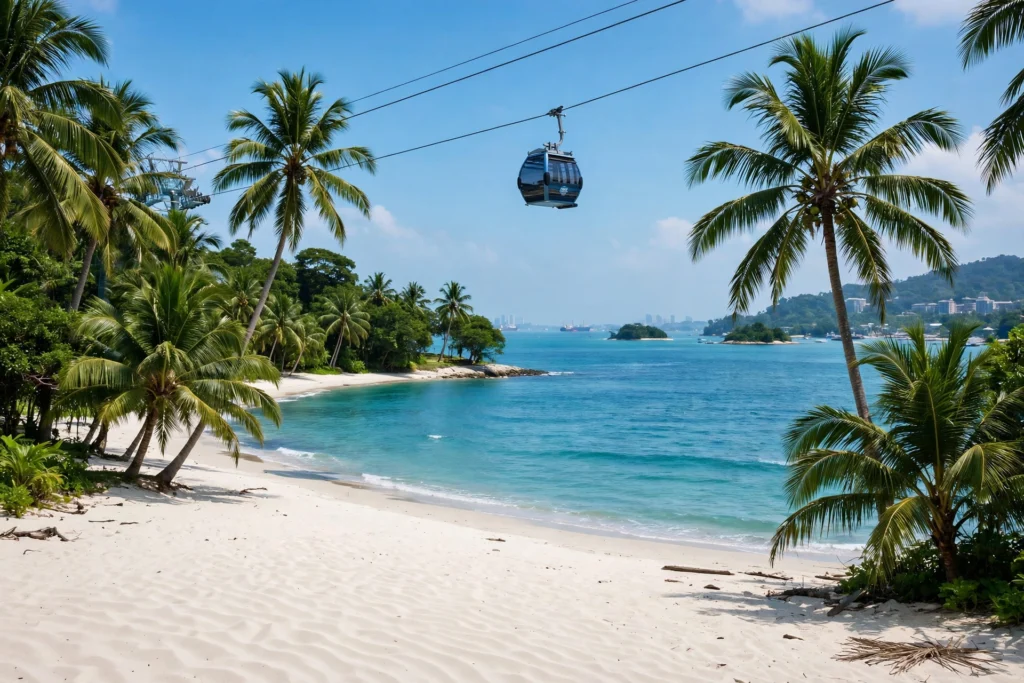
Sentosa is Singapore’s resort island, connected to the mainland by a causeway, a cable car and the Sentosa Express monorail from VivoCity mall. It is a strange and wonderful place: beaches, a Universal Studios theme park, an aquarium, a luge, a fort, beach clubs and a casino, all packed onto an island you can walk across in an hour. It is also the one part of Singapore that divides visitors most sharply. Some love it; some find it too polished. The truth is that it is worth half a day, and the trick is knowing which half to choose.
The beaches are the free attraction, and they are better than most visitors expect. Siloso Beach is the lively one, with beach clubs, volleyball and water sports. Palawan Beach is the family one, with a suspension bridge to a small islet that is billed as the southernmost point of continental Asia. Tanjong Beach is the quiet one, with a beach club and fewer crowds. None of them are wild, untouched beaches — the sand is imported and the water is calm — but they are clean, safe and a genuine break from the city. If you only want a beach afternoon, take the free shuttle from the Sentosa Express station, pick one beach, and stay there.
Universal Studios Singapore is the island’s biggest draw, and it is a proper full day on its own. If theme parks are your thing, give it a whole day and book tickets in advance — weekends and school holidays sell out. If they are not, skip it without guilt. The S.E.A. Aquarium is a good alternative for a couple of hours, especially with children, and the Skyline Luge is a surprisingly fun 20-minute ride down the hill. Fort Siloso, a restored coastal fort from the Second World War, is free, quiet and genuinely interesting, and it is the part of Sentosa most visitors never find.
Getting to Sentosa
Take the metro to HarbourFront station, walk through VivoCity mall, and ride the Sentosa Express monorail from level 3 — the ride itself costs a few dollars and drops you at the beach station. The more scenic option is the Singapore Cable Car from Mount Faber or HarbourFront, which glides over the harbour and the island with views worth the ticket price on a clear day. You can also walk across the Sentosa Boardwalk from VivoCity for about S$1, which is the cheapest way in and a pleasant stroll in the evening.
Mandai Wildlife Parks and the Botanic Gardens
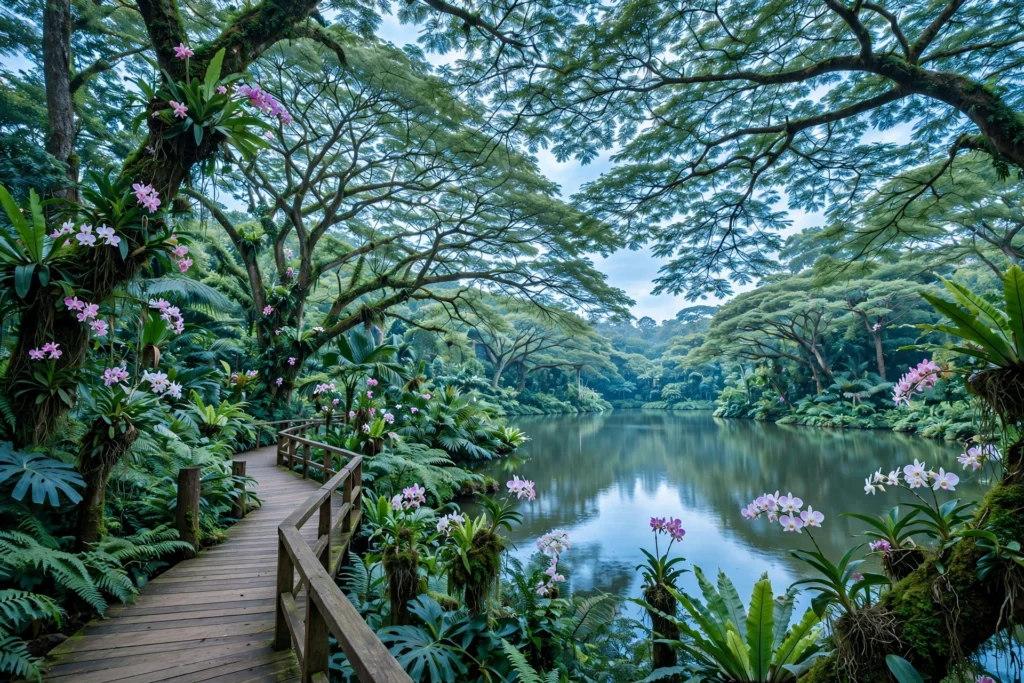
Singapore has two kinds of nature, and both are worth your time: the wild, rainforest kind at Mandai, and the manicured, garden-city kind at the Botanic Gardens. They are different experiences, and if you only have time for one, the choice depends on whether you want animals or plants — but if you can manage both, they are the two most relaxing days in this guide.
The Mandai wildlife parks
Mandai is a cluster of wildlife attractions in the north of the island, set in secondary rainforest around a reservoir. The Singapore Zoo is the headline act: open-concept enclosures, no bars, animals in habitats that feel genuinely spacious. It is one of the best zoos in the world, and it is worth a full morning. Next door, the River Wonders park (formerly the River Safari) has a giant-panda pair and a boat ride through recreated river habitats. Bird Paradise, which replaced the old Jurong Bird Park, is a large aviary park where you walk through habitats with free-flying birds. And the Night Safari, which opens after dark, is a tram ride through nocturnal animal enclosures — it is popular, it books out, and it is best enjoyed if you arrive early in the evening before the crowds peak.
The practical advice: pick one park per visit unless you have a full day and a multi-park ticket. The zoo alone takes three to four hours; the Night Safari takes an evening. Book tickets in advance — weekends and school holidays sell out, and the parks are at their busiest then. Arrive at the zoo at opening time (8:30 a.m.) when the animals are active and the heat is bearable. And bring water and a hat: Mandai is in real rainforest, which means real heat and real humidity, even under the trees.
The Singapore Botanic Gardens
The Botanic Gardens is a UNESCO World Heritage Site, free to enter, and open from 5 a.m. to midnight — which makes it one of the best-value attractions in the city. It is a 160-year-old tropical garden with rainforest, lakes, orchids and lawns, and it is where Singaporeans go to walk, run, picnic and escape the city without leaving it. The National Orchid Garden, inside the main gardens, is the one paid section, and it is worth the few dollars: thousands of orchids in a beautifully landscaped hillside garden, including the orchid named after Singapore itself.
Go early in the morning, when the light is soft and the gardens are at their most peaceful, or in the late afternoon. The gardens are at their best after rain, when the air smells of wet earth and the orchids are at their brightest. If you are staying nearby, a morning walk here before breakfast is one of the most pleasant starts to a day in Singapore.
Getting Around Singapore
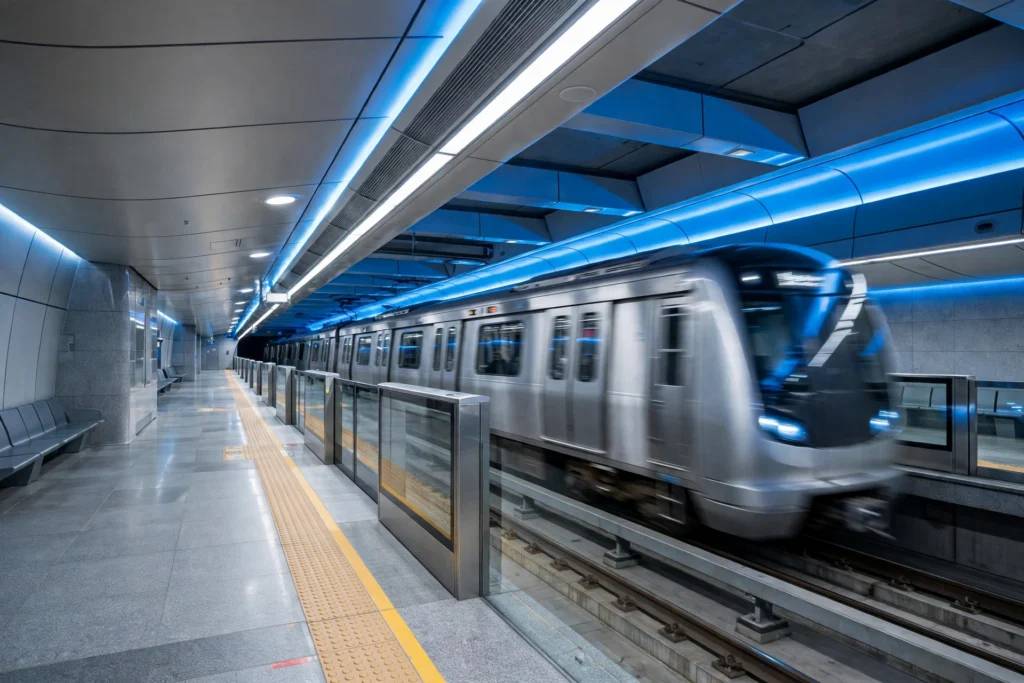
Singapore’s transport system is one of the best in the world, and it is the single biggest reason the city feels so easy for a first-time visitor. The metro is clean, on time, air-conditioned and signposted in English. Buses go everywhere the metro does not. Taxis and Grab are cheap by the standards of most big cities. And the whole system runs on a single contactless payment method, which means you can land at Changi, tap your card, and be in the city centre in under an hour without buying a ticket or queuing anywhere.
The MRT
The Mass Rapid Transit (MRT) is the backbone of getting around. It is fast, frequent — a train every few minutes on most lines — and it covers the whole island, from Changi Airport to the wildlife parks to Sentosa. The trains are spotless, the announcements are in English, and the stations are connected to malls and covered walkways, which means you can get almost anywhere without going outside in the heat. The main lines you will use are the East West Line (green), the North South Line (red), the Circle Line (orange) and the Downtown Line (blue).
To pay, you can use a contactless bank card or a phone with Apple Pay or Google Pay — just tap in and tap out at the gates, and the fare is charged automatically. This is the easiest option for most visitors from the US, and it works on both the MRT and buses. If you prefer a physical card, buy an EZ-Link card at the airport or any MRT station for a small deposit. Fares are distance-based and cheap: most rides within the city cost S$1–2, and even a long cross-island trip rarely costs more than S$2.50. Children under 0.9 metres tall travel free.
The bus
Buses fill the gaps the MRT does not reach, and they are worth using for the view alone. The same contactless card or phone works on buses — tap in when you board, tap out when you get off. Bus stops have electronic boards showing the next buses, and the routes are easy to follow on Google Maps, which is accurate for Singapore public transport. The bus is also the best way to reach the wildlife parks at Mandai and the quieter corners of the island, where the metro does not go. A bus ride across the city costs the same as a short MRT trip, and on a double-decker bus from the upper deck, it is one of the best sightseeing tours in Singapore for the price of a coffee.
Grab and taxis
Grab is Southeast Asia’s Uber, and it is the most convenient way to get around when you are tired, carrying bags, or travelling in a group. Download the app before you travel and add your payment card — fares are shown upfront, there is no haggling, and the cars are clean and air-conditioned. A Grab from Marina Bay to Chinatown costs around S$8–12, and from the airport to the city centre around S$20–30 depending on the time of day and the type of car. Traditional taxis are also plentiful and metered, and they are a good option at the airport, where there is a taxi queue. Both are considerably cheaper than in New York or London, and both are worth using when the heat or the rain makes the metro feel like too much effort.
The Singapore Tourist Pass and the Changi Airport connection
The Singapore Tourist Pass gives unlimited MRT and bus rides for one, two or three days, and it is worth considering if you plan to take more than four or five rides a day. For most visitors, though, tapping a contactless card is simpler and often cheaper — the tourist pass only saves money if you are riding constantly. Do the maths for your own trip: if you are taking the MRT three or four times a day, contactless wins on convenience and cost.
Getting from Changi Airport to the city is easy. The MRT runs from Changi Airport station (Terminals 1, 2 and 3) to the city centre in about 35 minutes, and it costs a couple of dollars. If you are arriving late at night, or with a lot of luggage, a Grab or taxi takes 20 to 30 minutes and costs around S$20–30. The airport itself is worth some time: Jewel Changi Airport, the glass dome with the Rain Vortex waterfall, is connected to Terminal 1, and it is a destination in its own right. If you have a long layover or a late flight, build in an hour for Jewel — it is free to enter, and the waterfall is genuinely spectacular. And if you are departing, plan to arrive at the airport early enough to enjoy it, rather than rushing through.
The SG Arrival Card and entry rules for US citizens
US passport holders do not need a visa for tourist visits to Singapore of up to 90 days. What you do need is the SG Arrival Card, a free electronic arrival declaration that you submit online within three days before you arrive. It is not a visa, and it costs nothing — submit it on the official Immigration & Checkpoints Authority website, and be wary of any third-party site that tries to charge you for it: https://eservices.ica.gov.sg/sgarrivalcard
The process takes a few minutes: your passport details, your flight, where you are staying, and a health declaration. You will receive an email confirmation, and your arrival is then linked to your passport — there is no paper card to carry. Do it as soon as you know your flight details, and do not leave it until the airport, where the Wi-Fi is good but the queues are long. And check the latest entry rules on the official Visit Singapore website before you travel, as they can change: https://www.visitsingapore.com/en_uk/travel-guide-tips/travel-essentials/
Where to Stay in Singapore
Singapore has a hotel for every budget, but the city is not cheap, and the neighbourhood you choose matters more than the star rating. Stay near an MRT station, in a neighbourhood with food nearby, and you will enjoy the city far more than if you save a few dollars by staying somewhere isolated. The three neighbourhoods below are the best choices for first-timers, and the table gives you a sense of what each one offers.
| Neighbourhood | Best for | Typical price per night | Why stay here |
|---|---|---|---|
| Chinatown | First-timers, food lovers, value | S$120–250 (US$90–185) | Heritage shophouses, hawker centres, metro on two lines |
| Bugis and Little India | Budget travellers, culture, shopping | S$100–200 (US$75–150) | Lively streets, markets, good budget hotels |
| Marina Bay | The skyline, luxury, special occasions | S$350–700+ (US$260–520+) | The view, the waterfront, the big-name hotels |
| Tiong Bahru | Character, cafes, a quieter stay | S$150–300 (US$110–220) | Art-deco streets, cafes, local feel |
| Orchard Road | Shopping, families, big hotels | S$200–400 (US$150–300) | Malls, metro, central location |
| Sentosa | Resort stays, families, theme parks | S$250–500+ (US$185–370+) | Beaches, Universal Studios, resort atmosphere |
Chinatown
Chinatown is the best all-round choice for a first visit. It is on two MRT lines, it has hawker centres and restaurants on every street, and the hotels range from good-value boutique hotels in restored shophouses to larger mid-range hotels. You can walk to the Buddha Tooth Relic Temple, Maxwell Food Centre and the shophouses of Pagoda Street, and you are two metro stops from Marina Bay. It is lively at night without being noisy, and it is one of the few neighbourhoods where you can eat well at midnight.
Bugis and Little India
Bugis is the best choice if you want value and energy. The area around Bugis Street market and the Bugis+ mall has some of the best budget and mid-range hotels in the city, and you are a short walk from Little India and Kampong Glam. The streets are busy, the food is cheap, and the metro connections are excellent. Little India itself has fewer hotels, but it is worth staying near if you love the food and the atmosphere — just be aware that the streets can be noisy late into the evening.
Marina Bay
Marina Bay is where you stay if you want the skyline at your window. The big hotels here — Marina Bay Sands, the Fullerton, the Ritz-Carlton Millenia — are expensive, but they are also spectacular, and for a special occasion they are worth it. If you stay here, you are paying for the view and the location: the waterfront promenade, Gardens by the Bay and the Supertrees are all on your doorstep. If the budget does not stretch to a Marina Bay hotel, consider one night here and the rest in Chinatown — it is a common split, and it gives you the experience without the full price.
A few practical booking tips
Book early, especially if you are travelling in December, around Chinese New Year, or during the Formula 1 Grand Prix in September — those are the weeks when prices spike and the good hotels sell out. Check whether your hotel charges the 9 percent Goods and Services Tax and the 10 percent service charge on top of the quoted rate, as both are standard in Singapore and can add nearly a fifth to the price. And if you are travelling with children, ask about family rooms and connecting rooms — Singapore hotels are generally family-friendly, but the standard rooms can be small, and a family room is worth the upgrade.
What a Singapore Trip Costs
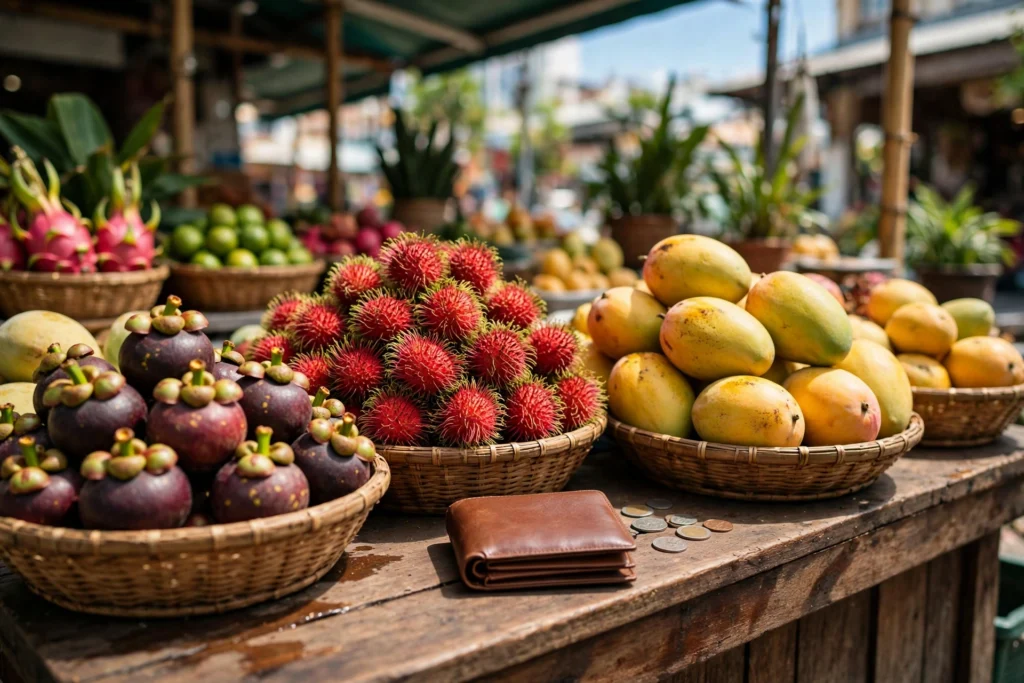
Singapore has a reputation for being expensive, and it can be — a night at Marina Bay Sands and dinner at a celebrity restaurant will cost you. But the everyday costs are reasonable, and the city is one of the best-value destinations in Asia once you understand where the money goes. The biggest cost is the hotel. The second biggest is the flight. Everything else — food, transport, attractions — is cheaper than in most American cities, and much of the best of Singapore is free.
| Category | Budget | Mid-range | Comfortable |
|---|---|---|---|
| Hotel (per night) | S$100–150 (US$75–110) | S$180–300 (US$135–220) | S$350–600 (US$260–445) |
| Food (per day) | S$25–40 (US$19–30) | S$50–80 (US$37–60) | S$100–180 (US$75–135) |
| Transport (per day) | S$5–10 (US$4–7) | S$10–20 (US$7–15) | S$20–40 (US$15–30) |
| Attractions (per day) | S$0–30 (US$0–22) | S$30–60 (US$22–45) | S$60–120 (US$45–90) |
| Total per day | S$130–230 (US$95–170) | S$270–460 (US$200–340) | S$530–940 (US$395–700) |
For a four-day trip, the totals look like this:
- Budget: around S$520–920 (US$385–680) per person, excluding flights, staying in a budget hotel or hostel, eating mostly at hawker centres, and using public transport.
- Mid-range: around S$1,080–1,840 (US$800–1,360) per person, excluding flights, staying in a comfortable mid-range hotel, eating a mix of hawker and restaurant meals, and visiting the main paid attractions.
- Comfortable: around S$2,120–3,760 (US$1,580–2,800) per person, excluding flights, staying in a good hotel, eating well, taking Grab when you feel like it, and not worrying about ticket prices.
Flights from the US are the wildcard. A return flight from the West Coast can be found for US$700–1,200 in the low season; from the East Coast, expect US$900–1,600. Book early, be flexible on dates, and consider a stopover — Singapore Airlines flies direct from several US cities, and a stopover in Singapore on the way to somewhere else in Asia is one of the best-value ways to see the city.
Money and payment
Singapore dollars (SGD) are the currency, and the exchange rate is roughly S$1.35 to US$1, though it moves — check the current rate before you travel. You do not need much cash. Cards and mobile payments are accepted almost everywhere: hotels, malls, restaurants, the MRT, buses and most hawker stalls. The exceptions are a few old hawker stalls and small market vendors, where cash is still king, so carry S$50 in small notes for those. There is no need to exchange money before you travel — withdraw Singapore dollars from an ATM at Changi Airport on arrival, or just use your card. Tell your bank you are travelling, and use a card with no foreign transaction fee if you have one. Tipping is not expected in Singapore: a 10 percent service charge is already added to restaurant and hotel bills, and tipping taxi drivers or hotel staff is appreciated but not required. If you found our budgeting tips helpful, our How to Prepare a Travel Budget guide goes deeper into planning costs for trips like this one.
Singapore Laws and Etiquette First-Timers Should Know
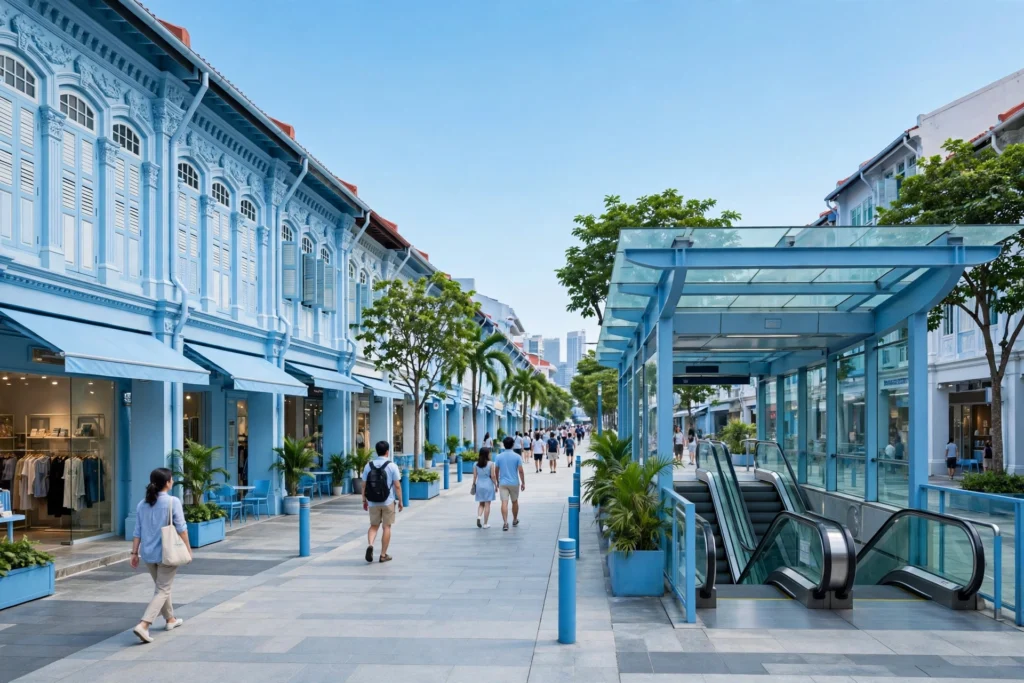
Singapore is famous for its strict laws, and the stories you have heard are mostly true — but they are also mostly beside the point for a careful visitor. The laws exist, they are enforced, and they are the reason the city is so clean and safe. You do not need to be anxious about them. You just need to know the handful that actually affect tourists, and to behave the way you would in any polite society.
The rules that actually affect you
Chewing gum is the famous one: it is illegal to import or sell chewing gum in Singapore, and you cannot buy it there. Bringing a small amount for personal use is generally tolerated, but do not chew it on the metro and do not stick it anywhere — littering carries a fine of up to S$2,000 for a first offence, and the city takes it seriously. Littering, jaywalking, smoking outside designated areas and eating or drinking on the MRT are all fineable offences. Smoking is banned in most public places, including parks, beaches and within a certain distance of building entrances; look for the designated smoking areas, which are marked with yellow lines.
The drug laws are the serious ones, and they are the reason Singapore has a reputation for severity. Drug trafficking carries the death penalty, and possession of even small amounts can lead to long prison sentences. This is not a scare story — it is the law, and it is enforced. Do not bring any drugs into Singapore, including cannabis, which is illegal even though it is legal in many US states. Prescription medication is fine, but bring it in its original packaging with a copy of your prescription, and check whether your medication is a controlled substance in Singapore before you travel.
Vaping is illegal in Singapore — e-cigarettes and vaping devices are banned, and bringing one in can result in a fine. Leave your vape at home.
Etiquette that will make your trip smoother
Beyond the law, there are social norms worth knowing. Remove your shoes when entering a home, a mosque or a temple — there will be a rack or an area by the door, and everyone else will be doing the same. Dress modestly when visiting temples and mosques: cover your shoulders and knees, and women may be asked to cover their hair in a mosque. Use your right hand to give and receive things, especially money and food, as the left hand is considered impolite in Malay and Indian culture. Do not point with your index finger — use an open hand or a nod. At a hawker centre, do not take a table someone has “choped” with tissues, and do not be offended if someone shares your table — it is normal. And when in doubt, watch what the locals do and copy them. Singaporeans are generally happy to help a polite visitor who asks.
The one thing not to do
Do not be the tourist who treats Singapore’s laws as a joke or a challenge. The stories about fines for chewing gum and caning for vandalism are not urban legends, and the city does not find them funny. Behave respectfully, follow the signs, and you will have no problems at all — which is, after all, the point of the laws in the first place.
Packing and Practical Tips for Singapore

Packing for Singapore is simple, because the weather does not change and the city has everything you might forget. The challenge is not what to bring, but what to leave behind — you will be walking a lot, in heat and humidity, and a heavy bag is a burden you will regret by the second day.
What to pack
- Light, quick-drying clothes: t-shirts, shorts, linen trousers and a light dress or two. Cotton is fine; synthetics dry faster. Bring enough for a change midday, because you will want one.
- Comfortable walking shoes: you will walk 15,000 to 20,000 steps a day, and the pavements are smooth, so trainers or comfortable sandals are ideal. Leave the heels at home.
- A small umbrella: not a raincoat, which will make you hotter — a compact umbrella that fits in your day bag.
- Sunscreen and insect repellent: the sun is strong year-round, and the mosquitoes are real, especially at the Botanic Gardens and Mandai. A small bottle of each is enough.
- A reusable water bottle: Singapore’s tap water is safe to drink, and there are water fountains in malls and parks. Refill as you go.
- A light layer: a cardigan or light jacket for air-conditioned malls, restaurants and the MRT, where the air-conditioning is fierce.
- Modest clothing for temples: a sarong or a long skirt and a top that covers your shoulders, for the temples and mosques.
- A power adapter: Singapore uses the Type G plug, the same three-pin plug as the UK. If you are coming from the US, you will need an adapter, and a small multi-adapter is the easiest option.
Practical tips that save time and money
- Get a local SIM or an eSIM: free Wi-Fi is everywhere, but a local data plan makes navigation and Grab much easier. Buy a tourist SIM at the airport, or set up an eSIM before you travel.
- Download the apps before you go: Grab for taxis, Google Maps for navigation, and the MyTransport app for real-time bus and MRT information.
- Stay hydrated: drink water constantly, and do not wait until you are thirsty. The humidity means you lose water faster than you realise.
- Book the popular things early: Gardens by the Bay conservatories, Universal Studios, the Night Safari and the SkyPark Observation Deck all sell out on weekends and school holidays. Book online before you travel.
- Keep your passport and valuables safe: Singapore is one of the safest cities in the world, but pickpocketing happens in crowded places. Use the hotel safe, and keep your passport in a secure pocket.
- Know the emergency number: 995 for ambulance and fire, 999 for police. Both are free to call.
A Realistic 4-Day Singapore Itinerary
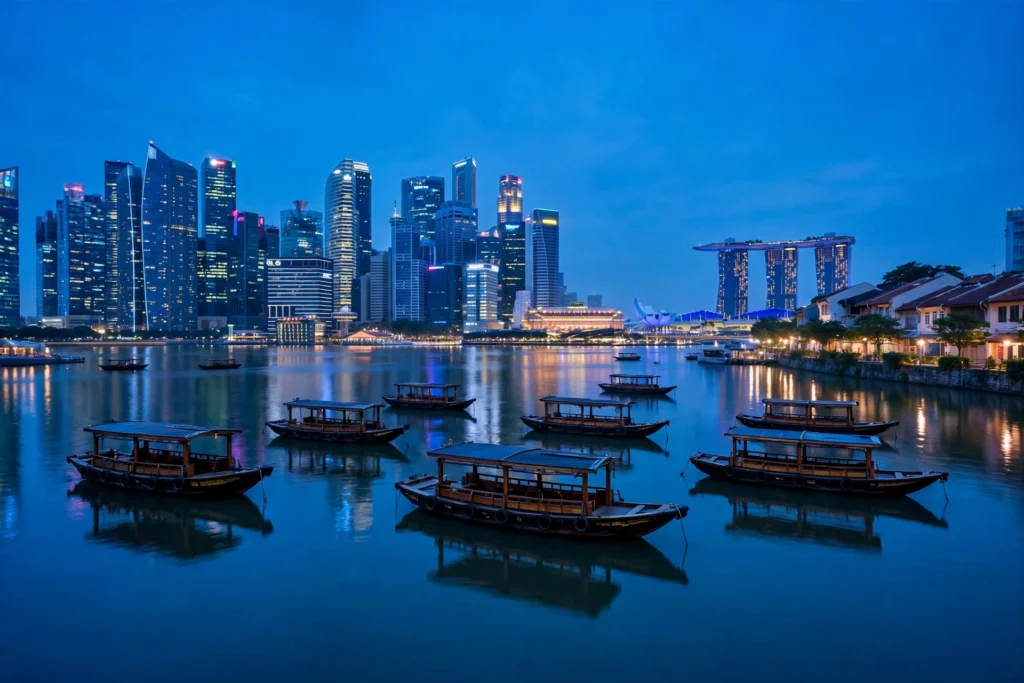
This is the itinerary the rest of this guide has been building towards. It is built around the rhythm Singapore rewards: mornings outdoors, afternoons under cover, evenings at a hawker centre and a light show. It assumes you arrive the evening before Day 1, and it leaves room to breathe.
Day 1: Marina Bay and Gardens by the Bay
Start at Merlion Park at 8 a.m., walk the promenade and the Helix Bridge, and spend the morning at Gardens by the Bay — the outdoor gardens, the Flower Dome and the Cloud Forest. Lunch at Satay by the Bay. In the afternoon, visit the SkyPark Observation Deck for the view, or the ArtScience Museum if you want air-conditioning and something different. In the evening, eat at Lau Pa Sat and walk to Satay Street, then end the night at the Supertree light show at 7:45 p.m. or 8:45 p.m.
Day 2: The heritage neighbourhoods and hawker food
Morning in Chinatown: Pagoda Street, the Buddha Tooth Relic Temple, the Sri Mariamman Temple and Maxwell Food Centre for chicken rice. After lunch, ride to Little India for Tekka Centre and the Sri Veeramakaliamman Temple, then on to Kampong Glam for the Sultan Mosque, Haji Lane and Arab Street. Dinner at a hawker centre or a restaurant on Arab Street, and a drink at a rooftop bar if you feel like it.
Day 3: Sentosa and the south
Take the morning slow — the Botanic Gardens for a walk and the National Orchid Garden, or a lie-in and a long breakfast at Tiong Bahru Market. In the afternoon, head to Sentosa: the beaches, the cable car, and the S.E.A. Aquarium or the Skyline Luge. Stay for the sunset on Siloso Beach, and eat at a beach club or back at VivoCity. If you are a theme-park person, swap this day for a full day at Universal Studios Singapore.
Day 4: Mandai and a proper farewell
Spend the morning at the Singapore Zoo, arriving at opening time. If you have the energy, add Bird Paradise or River Wonders in the afternoon. Alternatively, spend the day at the Night Safari the evening before and use Day 4 for the museums in the Civic District — the National Gallery, the Asian Civilisations Museum — and a final hawker lunch. End the trip with an early dinner at Old Airport Road Food Centre, the locals’ favourite, and a last walk along the waterfront. If your flight is in the evening, leave time for Jewel Changi Airport on the way out.
Easy swaps if you have more or fewer days
- Three days: drop the Mandai day and keep Marina Bay, the neighbourhoods and Sentosa. You will miss the zoo, but you will still see the best of the city.
- Five days: add a day trip to Pulau Ubin, a quiet island a short ferry ride from Changi, where you can cycle through village roads and mangroves. Or add a second Sentosa day and a full day at Universal Studios.
- With children: swap the Night Safari for the zoo in the daytime, add the S.E.A. Aquarium, and build in a pool break every afternoon.
- On a tight budget: skip the paid attractions and lean into the free ones — the outdoor gardens, the Supertree show, the Botanic Gardens, the beaches, the heritage neighbourhoods and the hawker centres. Singapore is remarkably generous for free.
Frequently Asked Questions
Is Singapore expensive to visit?
It can be, but it does not have to be. Hotels are the biggest cost, and they are genuinely expensive — a comfortable mid-range hotel costs S$180–300 a night. But food and transport are cheap: a hawker meal costs S$5–8, and a metro ride costs S$1–2. A mid-range traveller should budget around S$270–460 a day, and a budget traveller around S$130–230. The most expensive part of the trip for most visitors is the flight.
Do I need a visa to visit Singapore?
US passport holders do not need a visa for tourist visits of up to 90 days. You do need the SG Arrival Card, a free electronic arrival declaration submitted online within three days before you arrive. It costs nothing, and you should submit it on the official Immigration & Checkpoints Authority website — be wary of any third-party site that tries to charge you for it.
Is Singapore safe for tourists?
Yes. Singapore is one of the safest cities in the world, with very low violent crime and a visible police presence. The main risks are petty theft in crowded places and the heat, which is a more serious concern than crime. Use normal precautions — keep your passport secure, watch your bag in crowded markets — and you will be fine.
How many days do I need in Singapore?
Four days is the ideal first trip: enough for Marina Bay, the heritage neighbourhoods, hawker food, Sentosa and the wildlife parks or the Botanic Gardens, without rushing. Three days covers the highlights. Two days is possible but tight, and five days lets you slow down properly.
What is the best way to get around Singapore?
The MRT. It is clean, fast, air-conditioned and cheap, and it covers the whole island. Use a contactless bank card or phone to tap in and out — there is no need to buy a ticket. Buses fill the gaps, and Grab is the best option when you are tired or carrying bags.
What should I eat in Singapore?
Start with Hainanese chicken rice, laksa and char kway teow at a hawker centre. Try satay at Lau Pa Sat’s Satay Street, chilli crab at a neighbourhood restaurant, and kaya toast with kopi for breakfast. Eat at hawker centres at least once a day — the food is the best-value meal in the developed world, and it is the heart of Singaporean culture.
Conclusion
Singapore is one of the easiest and most rewarding first trips to Asia you can take, and it is a city that rewards a traveller who arrives with a loose plan and an appetite. Give it four days, eat at hawker centres, ride the MRT, and build your days around the heat and the rain rather than fighting them. The skyline at Marina Bay, the Supertrees at night, the chaos of Little India and the quiet of the Botanic Gardens will stay with you long after you have flown home — and you will leave already planning the next trip. Singapore has a way of doing that.
People also read: