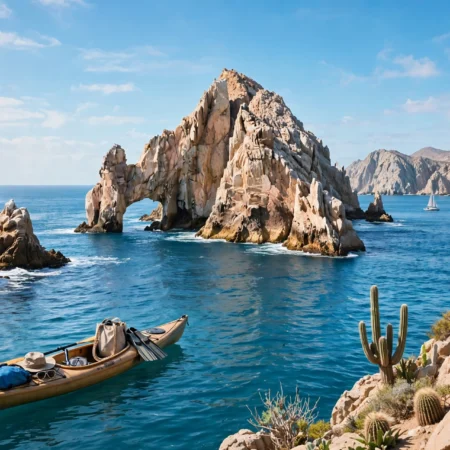
Cabo is the place where the desert meets two oceans at once. At the southern tip of Mexico’s Baja California Peninsula, the town of Cabo San Lucas sits at Land’s End, where the Pacific Ocean and the Sea of Cortez (the Gulf of California) collide beneath a granite arch that has become one of the most photographed rock formations in North America. Twenty miles up the coast, San José del Cabo moves at a slower, older rhythm — a colonial town square, art galleries and a Thursday art walk — and between the two runs the Tourist Corridor, a 20-mile strip of resorts, golf courses and quiet coves. This cabo travel guide covers all of it: whether Cabo is safe in 2026, the best time to visit for whales, fishing and swimming, which beaches you can actually swim at, how to get from the airport without overpaying, what a trip costs, and the day trips that turn a beach holiday into a proper Baja adventure.
Quick answer: the best time for cabo travel is December to April, when whale watching peaks (January to March), the weather is warm and dry, and the sea is calm enough for snorkelling. Allow at least 4 days for the arch, the beaches and one day trip, and 7 days if you want to add La Paz, Todos Santos or Cabo Pulmo. Budget travellers can manage on roughly $70–100 a day, while a comfortable mid-range trip runs about $150–250 a day. Prices below are planning ranges only — confirm figures before you book, as fares, entry rules and conditions can change at short notice.
Is Cabo Safe to Visit in 2026?
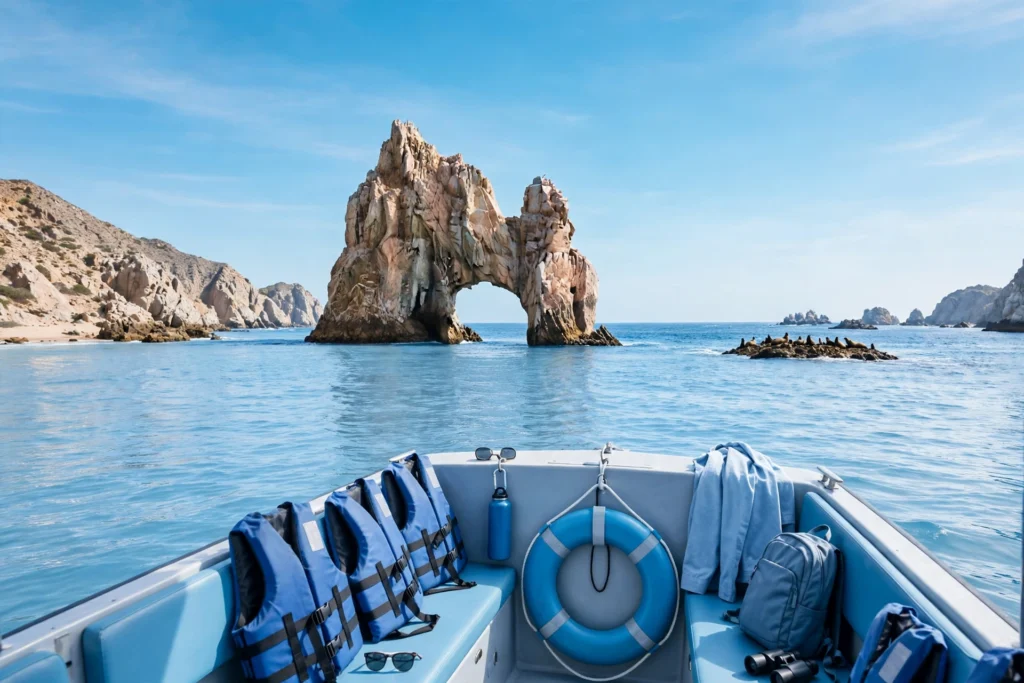
This is the first question most travellers ask about Cabo, and it deserves a straight answer before anything else. The United States Department of State currently rates Mexico overall at Level 2: Exercise Increased Caution, because of terrorism, crime and kidnapping, and it rates Baja California Sur — the state that contains Cabo San Lucas, San José del Cabo, La Paz and Todos Santos — at Level 2: Exercise Increased Caution due to terrorism and crime. The advisory was reissued on 11 August 2026. That is the official position, and it should be the starting point for any decision — not travel blogs, and not this article. Read the full US State Department travel advisory for Mexico and check it again close to departure, because advisory levels can change.
Two details in that advisory matter more than the headline level. First, the State Department lists no specific travel restrictions for US government employees in Baja California Sur state — a meaningful contrast with several other Mexican states, where government employees face curfews, highway bans or no-go zones. Second, do not confuse Baja California Sur with Baja California, the separate state to the north that includes Tijuana. Baja California is rated Level 3: Reconsider Travel — a different state, a different rating, and roughly a thousand miles of peninsula away from Cabo. Mixing the two up is the single most common safety mistake in Cabo research, and it leads people to cancel trips over a rating that does not apply to where they are going.
None of this means Cabo is risk-free, and a Level 2 rating is not a green light to switch your brain off. Most crime affecting visitors in Los Cabos is opportunistic — pickpocketing, bag snatching, drink spiking in crowded bars, and scams around timeshares and airport taxis — rather than the organised violence that drives the national advisory. The practical rules are the same ones that apply in any busy resort town: stay in well-lit tourist areas after dark, use dispatched taxis or ride-hailing apps rather than waving cars down on the street, keep valuables out of sight on the beach, watch your drink in the marina bars, and do not drive between towns after dark. The advisory also notes that US government employees may not travel between cities after dark and must rely on dispatched vehicles or app-based services — good advice for visitors too. Enrol in the Smart Traveler Enrollment Program (STEP) if you are an American citizen, and keep the emergency number in your phone: Mexico’s national emergency number is 911, the same as in the United States.
The other safety question in Cabo is not about crime at all — it is the ocean. Several of the most beautiful beaches in Los Cabos are genuinely dangerous to swim in, with strong Pacific currents, steep drop-offs and shore break that has caused drownings. This guide has a full beach-by-beach table in the beaches section below, and the rule is simple: swim only where the water is calm and other people are swimming, and obey the coloured flags on the beach. A red flag means stay out of the water, full stop. For the wider Mexico picture — entry rules, other regions and what else the country offers beyond Baja — see our guide to the best places to travel in Mexico, and if you are weighing destinations that need no passport at all, our list of places to travel without a passport is a useful comparison.
Best Time to Visit Cabo: Whales, Fishing and Sunshine by Month

Los Cabos claims around 350 days of sunshine a year, and the claim is not far off — this is a desert climate at the tip of a peninsula, with very little rain in most months. Daytime temperatures run from the mid-70s Fahrenheit in January to the low 90s in August, and the sea stays warm enough to swim in all year, from the low 70s in winter to the mid-80s in late summer. The real question when choosing dates is not sunshine but what you want to do: whales, fishing and snorkelling each have their own season, and the best month for one is the worst month for another.
| Month | Weather | Whales | Fishing | Snorkelling | Notes |
|---|---|---|---|---|---|
| Jan | 75°F, dry | Peak | Good | Good | Whale season peak; busiest, priciest month |
| Feb | 76°F, dry | Peak | Good | Good | Whale watching at its best; spring break crowds build late Feb |
| Mar | 78°F, dry | Peak | Good | Good | Spring break peak in Cabo San Lucas; book early |
| Apr | 81°F, dry | Last whales | Good | Very good | Whale season ends; calmer, cheaper than March |
| May | 85°F, dry | Gone | Marlin season starts | Excellent | Snorkelling season opens; warm sea, fewer crowds |
| Jun | 88°F, dry | Gone | Very good | Excellent | Hot and dry; great visibility underwater |
| Jul | 90°F, humid | Gone | Very good | Excellent | Warmest sea; humidity rises |
| Aug | 91°F, humid | Gone | Peak marlin | Excellent | Hottest month; hurricane season builds |
| Sep | 89°F, humid | Gone | Peak | Very good | Peak hurricane month; cheapest hotel rates |
| Oct | 87°F, warm | Arriving late | Peak (Bisbee’s) | Excellent | Bisbee’s tournament; shoulder season |
| Nov | 82°F, dry | Arriving | Good | Good | Weather turns dry again; good value |
| Dec | 77°F, dry | Season starts | Good | Good | Whale season opens mid-month; festive crowds |
December to April is the classic Cabo season, and for first-time visitors it is the right choice. Whale watching runs from mid-December to mid-April, peaking from January to March, when humpback whales migrate to the warm waters around the peninsula to breed and give birth. The weather is at its most comfortable — warm days, cool evenings, almost no rain — and the sea is calm. The trade-off is price and crowds: January to March is the most expensive time to visit, and March brings spring break, when Cabo San Lucas fills with students and the marina bars run at full volume. If you want the whales without the spring break scene, go in January, February or early April. For more ideas on where to go in the coldest month, see our guide to the best places to travel in January.
May to October is the warm-water season, and it suits a different kind of trip. Snorkelling is at its best from May to October, when the Sea of Cortez is warm and visibility is at its clearest around Chileno Bay and Santa María Bay. Marlin fishing runs from May to November, peaking in late summer and autumn. The catch is heat and hurricanes: August and September are hot and humid, and hurricane season runs from June to November, peaking in August and September. Cabo was badly hit by Hurricane Odile in 2014, and resorts have rebuilt stronger since, but a September trip should come with flexible plans and travel insurance that covers weather disruption. The upside is real: September and early October bring the lowest hotel rates of the year, and October brings the Bisbee’s Black and Blue Marlin Tournament, the richest fishing tournament in the world, when the marina turns into a festival. November is the sweet spot many regulars aim for — the weather has turned dry again, the sea is still warm, the crowds have gone, and prices have not yet climbed to winter levels.
How long do you need? Four days covers the essentials: a day for El Arco and the beaches of Cabo San Lucas, a day for snorkelling or a whale-watching cruise, a day in San José del Cabo and the Tourist Corridor, and a day trip to Todos Santos or Cabo Pulmo. Seven days lets you add La Paz and Balandra Beach, a second day trip, and a slow day doing nothing on Medano Beach — which, honestly, is half the point of coming here.
Where Is Cabo? Los Cabos, Cabo San Lucas and San José del Cabo Explained
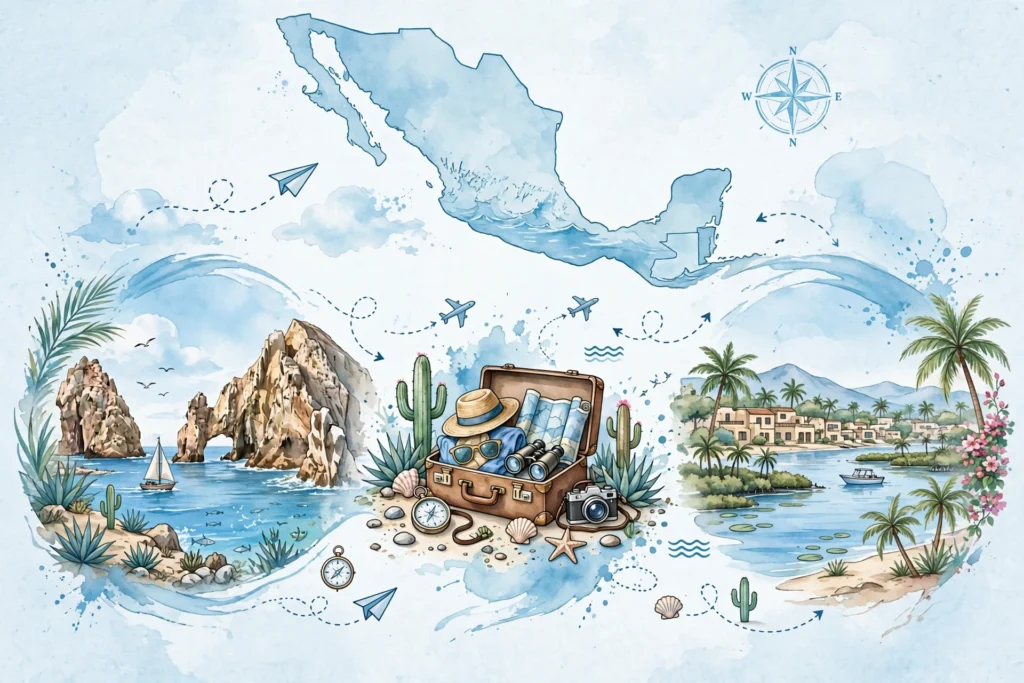
“Cabo” is three places at once, and most first-timer confusion comes from treating it as one town. Los Cabos is the municipality — the whole southern tip of the Baja California Peninsula in the Mexican state of Baja California Sur, on the Pacific coast of Mexico, roughly 1,000 miles south of San Diego. Inside it sit two very different towns, joined by a 20-mile road called the Tourist Corridor (also known as the Resort Corridor), which runs along the coast on Highway 1 and is lined with resorts, golf courses and a string of quiet coves.
Cabo San Lucas is the town at the very tip of the peninsula, where the Pacific Ocean meets the Sea of Cortez. This is the Cabo of the marina, the nightlife, the spring break crowds and Medano Beach. The harbour is the centre of everything: fishing charters leave at dawn, water taxis shuttle visitors to El Arco, sunset cruises board in the late afternoon, and the bars and restaurants around the marina stay loud late into the night. If you want action, boats and a party, stay here. The town itself is compact and walkable around the marina and Medano Beach, though the hills above the harbour are steep and best handled by taxi after dark.
San José del Cabo sits about 20 miles northeast of Cabo San Lucas, and it feels like a different world. Founded in 1730 as a Jesuit mission town, it has a proper historic centre — a main square, a mission church, and streets of galleries, cafés and boutiques — plus a Thursday evening Art Walk from November to June, when the galleries open their doors and the streets fill with music and food stalls. It is quieter, older and more Mexican than its sister town, and it suits travellers who want galleries and long dinners more than nightclubs. Just east of the old town is the San José Estuary, a freshwater lagoon and bird sanctuary that is one of the best birdwatching spots on the peninsula, and a reminder that Los Cabos is not only resorts: desert, estuary and ocean sit side by side here. The official Los Cabos tourism board is the best place to check current events and opening hours for both towns.
The Tourist Corridor between the two towns is where most of the big resorts sit — long stretches of beachfront hotels, championship golf courses and a handful of public-access coves, including Chileno Bay and Santa María Bay, which are among the best snorkelling spots in the area. Staying on the corridor means a quieter, more resort-focused trip: you will need a car or taxis to get anywhere, but you get space, views and direct beach access in return. The corridor is also where the two sides of Los Cabos meet geographically: beaches facing the Sea of Cortez are generally calm and swimmable, while beaches facing the Pacific are wilder and often unsafe for swimming. That split — calm Cortez side, rough Pacific side — is the single most useful fact for planning your beach days, and it comes up again in the beaches section below.
One more piece of geography worth knowing: Los Cabos sits at the southern end of a peninsula that runs nearly 800 miles from the US border, and the rest of Baja California Sur stretches north to La Paz, the state capital, about two hours’ drive away. That makes Cabo an excellent base for exploring the wider state, not just a resort strip — the day trips at the end of this guide cover the best of it. The Pacific coast of Mexico has a very different character from the Caribbean side of the country, and if you have only visited Cancún or the Riviera Maya, expect a drier, desert landscape, cooler evenings and a much stronger fishing and surfing culture. Our Panama travel guide covers another Pacific-coast destination with the same ocean-on-one-side, jungle-on-the-other contrast, while our Ecuador travel guide is useful if you are comparing Pacific coastlines across Latin America.
El Arco and Land’s End: The Arch, Lover’s Beach and Divorce Beach
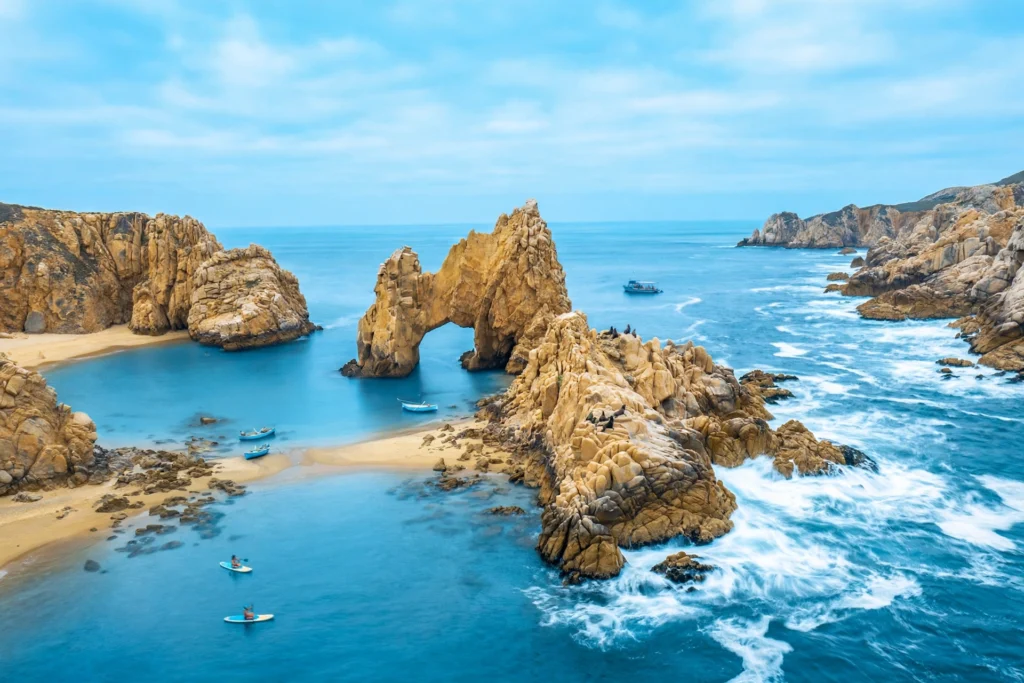
El Arco is the reason most people come to Cabo, and it earns the attention. A granite arch rising out of the sea at Land’s End, at the exact point where the Pacific Ocean and the Sea of Cortez meet, it is the defining landmark of Los Cabos — the image on every postcard, and the backdrop to almost every sunset cruise that leaves the marina. The arch formed over thousands of years as wind and waves wore through the granite headland, and at low tide you can sometimes walk under it, though that is rare and depends on the sand levels in a given year. Do not plan your trip around walking through it; plan around seeing it properly, which means getting on the water.
The cheapest way to see the arch is a water taxi from the marina in Cabo San Lucas. Small pangas run constantly during daylight hours, and a round trip to the arch with a drop-off at Lover’s Beach typically costs around $10–15 per person — agree the price and the return time before you board, and expect to haggle politely. Glass-bottom boat tours cost a little more and add a look at the fish and sea lions below the boat on the way out. Sunset cruises are the classic upgrade: two hours on a catamaran with drinks and snacks, the arch glowing gold as the sun drops into the Pacific, usually around $50–80 per person depending on the boat and what is included. Whale-watching boats in season pass the arch on every trip, so if you are visiting between December and April, combine the two and save a separate outing.
On the far side of the arch, tucked between the rock formations, sit two beaches with opposite personalities and a shared name story. Lover’s Beach (Playa del Amor) faces the Sea of Cortez, and it is calm, sheltered and swimmable — a small crescent of sand reached only by boat, where the water is clear enough to snorkel straight off the beach and sea lions haul out on the rocks nearby. Divorce Beach (Playa del Divorcio), a short walk over the sandbar to the other side of the same headland, faces the open Pacific. It is wild, beautiful and dangerous: strong currents, a steep drop-off and powerful shore break make it unsafe for swimming, and people have died there. The names tell the story — one side is calm and romantic, the other is rough and unforgiving — and the lesson applies to the whole of Los Cabos: the side of the rock you are standing on decides whether the water is safe. Bring your own water, snacks and shade to Lover’s Beach, because there are no shops, no umbrellas for hire and no lifeguard; the last water taxi back is usually around 4–5 pm, so confirm the time when you arrive. If a sunset cruise or an arch photo is the one memory you want from Cabo, this is where it happens — and if you are building a list of places that belong on a lifetime travel list, our travel bucket list is a good place to keep it.
Sea lions and the view from the water
The rocks around Land’s End are a sea lion colony, and on most boat trips you will see them lounging on the rocks below the arch, barking at each other and slipping into the water to chase fish. The colony is one of the reasons glass-bottom boats are worth the small premium over a plain water taxi: the water around the rocks is full of tropical fish, and on a calm day you can see them clearly through the glass panels. Kayak tours to the arch are another option for active travellers — a guided paddle from Medano Beach around the headland takes about two to three hours and gets you closer to the rocks than a big boat can, though it is only sensible in calm conditions and with a guide who knows the currents. Whichever way you go, bring a waterproof bag for your phone and camera: the ride out to the arch crosses open water, and spray is guaranteed.
The Best Beaches in Cabo: Swimmable, Snorkelling and Look-Only
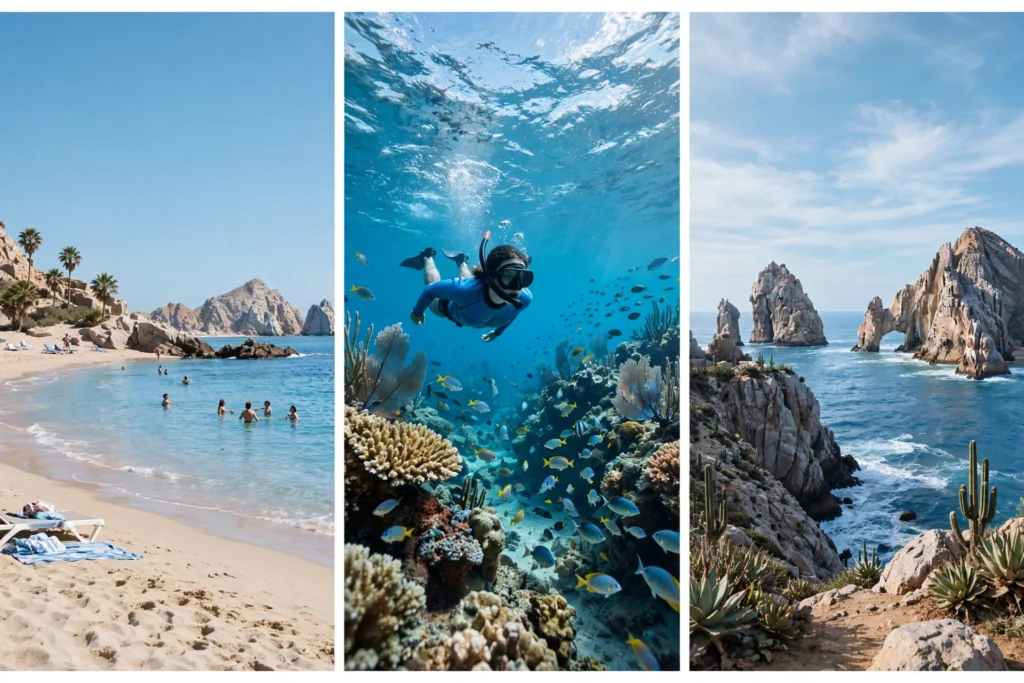
Cabo’s beaches are the main reason people come, and also the main source of disappointment for visitors who pick the wrong one. The rule is geographical: beaches on the Sea of Cortez side — the east and south-facing coves — are generally calm and swimmable, while beaches on the Pacific side face open ocean swell and are often dangerous. The table below is the short version. Read it before you choose a hotel, because a resort on a Pacific-facing beach can mean beautiful views and no swimming at all.
| Beach | Side | Swimming | Best for | Notes |
|---|---|---|---|---|
| Medano Beach | Sea of Cortez | Yes — calm | Swimming, beach clubs, families | Main beach of Cabo San Lucas; busiest, most facilities |
| Lover’s Beach | Sea of Cortez | Yes — calm | Snorkelling, photos, quiet | Boat access only; no shops or lifeguard |
| Chileno Bay | Sea of Cortez | Yes — calm | Snorkelling, families | Blue Flag beach; reef close to shore |
| Santa María Bay | Sea of Cortez | Yes — calm | Snorkelling, kayaking | Blue Flag beach; horseshoe cove, calm water |
| Palmilla Beach | Sea of Cortez | Yes — usually calm | Swimming, surfing (small) | Near San José del Cabo; popular with locals |
| Costa Azul | Sea of Cortez | Caution | Surfing | Stronger surf; swim only in calm spots |
| Divorce Beach | Pacific | No — dangerous | Photos only | Powerful currents and shore break; do not swim |
| Cerritos Beach | Pacific | Caution | Surfing | Near Todos Santos; surf schools, strong swell |
| Migriño Beach | Pacific | No — dangerous | ATV tours, horse riding | Strong currents; look-only beach |
| Playa Grande | Pacific | No — dangerous | Walking, views | Steep drop-off; do not swim |
Medano Beach is the main beach of Cabo San Lucas and the easiest choice for a first visit: a long, gently sloping curve of sand on the calm Cortez side, lined with beach clubs, restaurants and bars, with kayaks, paddleboards and jet skis for hire. It is the busiest beach in Los Cabos, especially in March, and the beach clubs can be loud — but it is also the most practical, with shade, food, toilets and a lifeguard presence that most other beaches lack. If you want a quieter day, walk to the far eastern end of Medano, away from the clubs, where the sand empties out and the water stays just as calm. Families with children should default to Medano or Chileno Bay: both have gentle entry, warm water and facilities nearby.
Chileno Bay and Santa María Bay are the two snorkelling beaches, and they sit on the Tourist Corridor between the two towns, about 15–20 minutes by car from Cabo San Lucas. Both hold Blue Flag status, which means clean water, lifeguards and environmental management, and both have coral and rock reefs close enough to shore that you can snorkel without a boat. Chileno Bay is the more family-friendly of the two, with palapas for shade, restrooms and a gentle sandy entry; Santa María Bay is a horseshoe-shaped cove with cliffs on both sides and clearer water on calm mornings, and it suits confident swimmers and kayakers. Arrive before 10 am for the calmest water and the best light, and bring reef-safe sunscreen — ordinary sunscreen damages the coral, and both bays are protected areas. The clear-water bays of the Mediterranean offer a useful comparison if you have snorkelled there before: our Croatia travel guide covers a coastline with the same mix of sheltered coves and open-water danger.
The Pacific-side beaches are for looking, walking and surfing — not swimming. Divorce Beach is the famous example, but the same warning applies to Migriño Beach and Playa Grande, where the surf is powerful and the drop-off is steep. Cerritos Beach, near Todos Santos, is the exception that proves the rule: it is a proper surf beach with surf schools and longboard waves, and swimmers should stay in the shallow shore zone or out of the water entirely. Wherever you swim, check the flag on the beach that day: green means calm, yellow means caution, red means stay out, and black means the beach is closed. Do not rely on how the water looks from your hotel balcony — Pacific swell can arrive with very little warning, and the most dangerous beaches are often the calmest-looking ones at first glance.
Whale Watching in Cabo: When, Where and What to Book
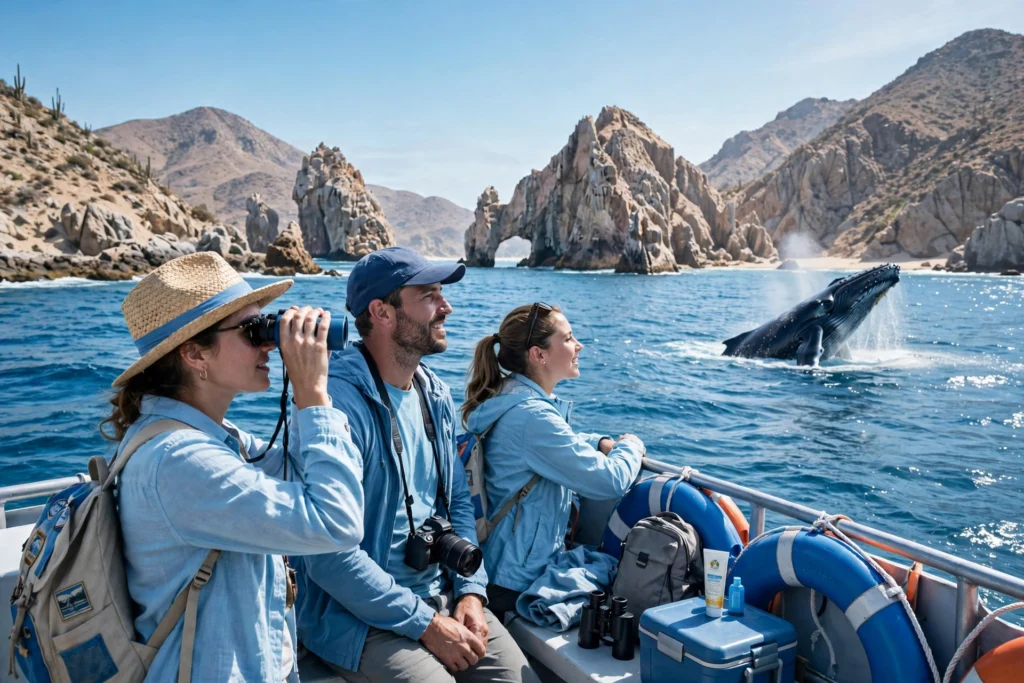
Whale watching is the single best wildlife experience in Cabo, and it is the main reason to visit between December and April. Every winter, humpback whales migrate from Alaska to the warm waters around the Baja Peninsula to breed and give birth, and Los Cabos sits directly on their route: the whales pass Land’s End, gather in the Sea of Cortez, and spend the season breaching, tail-slapping and nursing calves in water you can reach within twenty minutes of the marina. Grey whales and blue whales pass through too, and on a good day you can see mothers with calves so close to the boat that you hear them breathe before you see them.
The season runs from mid-December to mid-April, peaking from January to March. January and February are the most reliable months: the whales are at their most numerous, the weather is at its driest, and the sea is usually calm enough for small boats. March is still excellent, and by April the whales are thinning out as they begin the journey north — trips still run, but sightings are less certain. Book a morning trip if you can: the wind typically picks up in the afternoon, the sea gets choppier, and the whales are often more active early in the day. A standard whale-watching cruise lasts about two to two and a half hours and costs roughly $50–80 per person on a larger boat, or $80–120 on a smaller zodiac-style boat that gets closer to the action. Private charters cost far more and are only worth it for a special occasion. Most operators guarantee sightings in peak season — if no whale is spotted, you get a free second trip — but read the terms before you book, because “guarantee” means different things to different companies.
Choose your operator carefully. The best boats are the smaller ones with a naturalist guide on board, a hydrophone so you can hear the whales singing underwater, and a strict no-chase policy that keeps a legal distance from the animals. Mexico has rules about how close boats may approach whales, and reputable operators follow them: a boat that chases a whale for a photo is breaking the rules and stressing the animal. Ask before booking whether the company follows the official whale-watching guidelines, and avoid any operator that promises to let you swim with whales — that is not permitted here. Bring a windproof jacket even on a warm day, because the wind on the water is much colder than on land, and take seasickness tablets before you board if you are prone to it: the boats leave through the harbour mouth into open water, and the swell there catches plenty of first-timers out. If you have watched whales elsewhere, the experience here is different in one important way: the whales come to you, in warm, clear water, with the desert mountains of Baja behind them. Our Iceland travel itinerary covers whale watching in cold northern water, which makes a useful contrast — same animals, very different setting.
One more tip: whale watching and the arch are the same trip. Every whale-watching boat passes El Arco on the way out and back, so do not book a separate arch tour on the same day. And if you are visiting outside whale season, do not write the ocean off — the same boats run snorkelling and sunset cruises, the sea lions are at Land’s End all year, and from May onwards the water is warm enough that the snorkelling is arguably better than the whale watching. The ocean in Cabo is never empty; it just changes what it offers.
Snorkelling and Diving: Chileno Bay, Santa María Bay and Cabo Pulmo
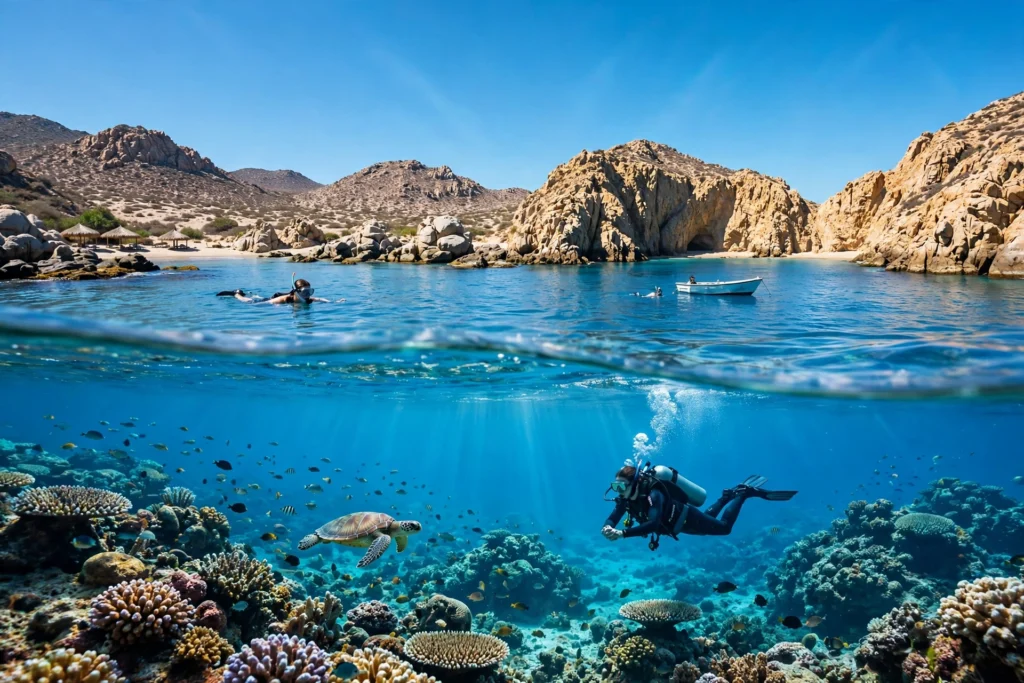
The snorkelling season in Cabo runs from May to October, when the Sea of Cortez is at its warmest — up into the low 80s Fahrenheit — and visibility is at its best. That is the opposite of the whale season, which is worth knowing when you pick your dates: a winter trip gives you whales and calm weather, a summer trip gives you the clearest water and the warmest swimming. If snorkelling is your priority, come between June and September, arrive at the beach before 10 am, and you will find water so clear you can see the reef from the surface.
Chileno Bay and Santa María Bay are the easy, shore-based options, covered in the beaches section above: reef close to shore, calm water, no boat needed, and plenty of fish — angelfish, parrotfish, pufferfish and the occasional sea turtle — within a few metres of the sand. Bring your own mask and snorkel if you have them, because hire gear on the corridor beaches is limited and the quality varies. A rash guard or long-sleeve swim top is worth more than extra sunscreen here: the sun reflects off the water and burns shoulders fast, and a rash guard protects the reef from sunscreen chemicals at the same time.
For serious diving, the destination is Cabo Pulmo National Park, about two hours’ drive northeast of San José del Cabo on the East Cape. Cabo Pulmo protects the only hard coral reef in the Gulf of California — a reef estimated to be around 20,000 years old — and it is one of the great conservation success stories in Mexico: after fishing was banned in the park in 1995, fish stocks rebounded dramatically, and the reef is now home to hundreds of fish species, sea turtles, rays and sharks. The park sits inside the UNESCO World Heritage property of the Islands and Protected Areas of the Gulf of California, inscribed in 2005, which covers 244 islands and nine protected areas across the gulf. Jacques Cousteau famously called the Gulf of California “the aquarium of the world”, and Cabo Pulmo is the clearest proof of why.
Diving at Cabo Pulmo is best from June to November, when the water is warmest and visibility is at its best, and the highlight is the school of bigeye jacks — thousands of fish moving as a single silver wall — along with bull sharks in season, turtles and rays. A two-tank dive typically costs around $120–160 per person including gear, and you will need to be a certified diver; snorkelling trips to the reef cost far less and still show you plenty. The park charges a small entry fee, and visitor numbers are capped, so book through a licensed operator in advance rather than turning up and hoping. The village of Cabo Pulmo itself is tiny — a handful of dive shops, a couple of restaurants and dirt roads — which is part of its charm and also a warning: bring cash, fill up the car before you leave San José del Cabo, and do not expect phone signal to be reliable. The drive there is partly unpaved, so a car with decent clearance helps, though a normal rental car can manage it in dry weather. If you have snorkelled in the Mediterranean, the comparison is instructive: our Malta travel guide covers the Blue Lagoon and Gozo’s clear-water bays, which are beautiful but cannot match the sheer density of marine life in the Sea of Cortez.
Fishing in Cabo: Marlin Season and What a Charter Really Costs
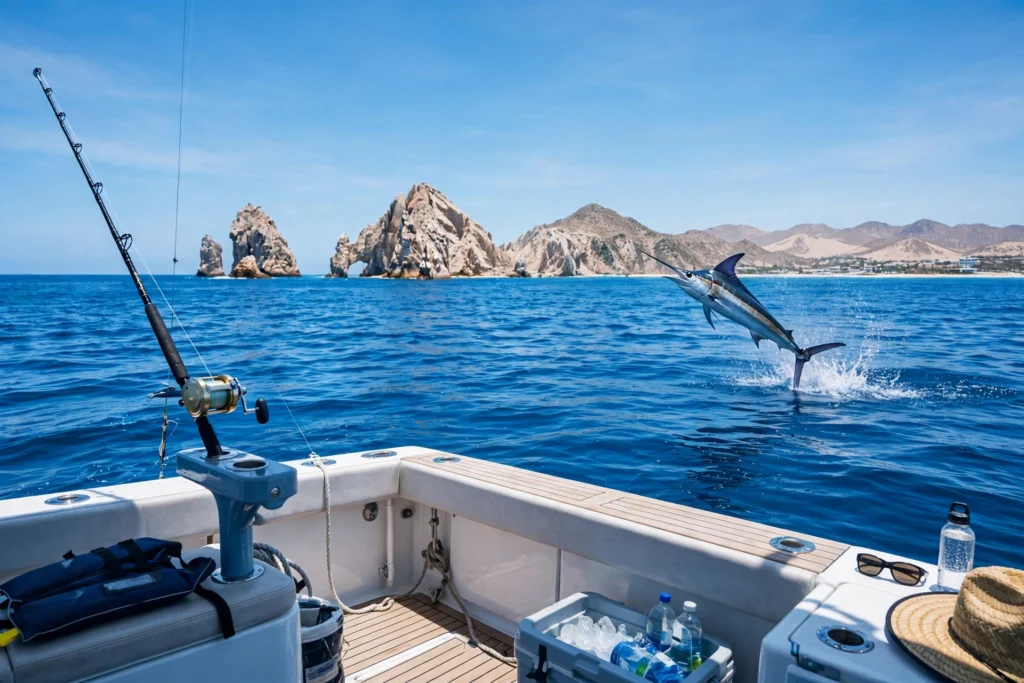
Cabo San Lucas is one of the great sport-fishing ports in the world, and marlin is the reason. The town sits where two oceans meet, and the deep water starts almost immediately offshore — you can be in 1,000 feet of water within a few miles of the marina — which is why striped marlin, blue marlin and black marlin all pass through here, along with dorado (mahi-mahi), tuna, wahoo and sailfish. The marlin season runs from May to November, with striped marlin available year-round and the biggest blue and black marlin arriving in late summer and autumn. The peak of the season is October, when the Bisbee’s Black and Blue Marlin Tournament — the richest fishing tournament in the world, with millions of dollars in prize money — turns the marina into a festival and the town into a party.
A fishing charter is not cheap, and you should know the real costs before you book. A shared panga — a small open boat with a captain, usually for two to four anglers — costs roughly $150–250 per person for a half day. A private charter on a proper sport-fishing boat with a fighting chair, outriggers and a full crew runs roughly $400–900 or more for a half day, depending on the size of the boat. Full-day charters cost roughly double. What is included varies enormously, so ask before you pay: bait, tackle, fishing licences, food, drinks and fish cleaning are sometimes included and sometimes charged extra. A Mexican fishing licence is required for everyone on board, and reputable operators include it in the price — if a cheap charter does not mention licences, that is a warning sign, not a bargain. Most charters operate on a catch-and-release basis for marlin, which is the right approach for a threatened species and is required by many tournaments; dorado and tuna are usually kept, and many restaurants in the marina will cook your catch for dinner the same evening.
The practical details matter more than the romance. Book through the marina offices or a well-reviewed operator, not through a tout on the street or at the airport — the cheapest offer is usually the one that cuts corners on safety equipment, licences or insurance. Go out early: boats leave at dawn, around 6–7 am, because the bite is best in the morning and the wind picks up in the afternoon. Take seasickness tablets the night before and again before boarding, because the ride out through the harbour mouth into Pacific swell is rough even on a calm day, and nothing ruins a $600 charter faster than spending it over the side. Bring a hat, long sleeves and reef-safe sunscreen, and drink more water than you think you need — the sun on open water is relentless. And set your expectations honestly: marlin fishing is called fishing, not catching, for a reason. A good day is a hook-up and a long fight; a great day is a fish at the boat; most days are somewhere in between, and the boat ride, the sea lions, the whales in season and the view of the arch are worth the price on their own. Fishing is a popular pastime for travellers who treat it as a hobby rather than a holiday activity, and if that is you, our travel hobby guide has ideas for building a trip around the things you actually love doing.
Getting to Cabo: SJD Airport, Transfers and the FMM Tourist Permit
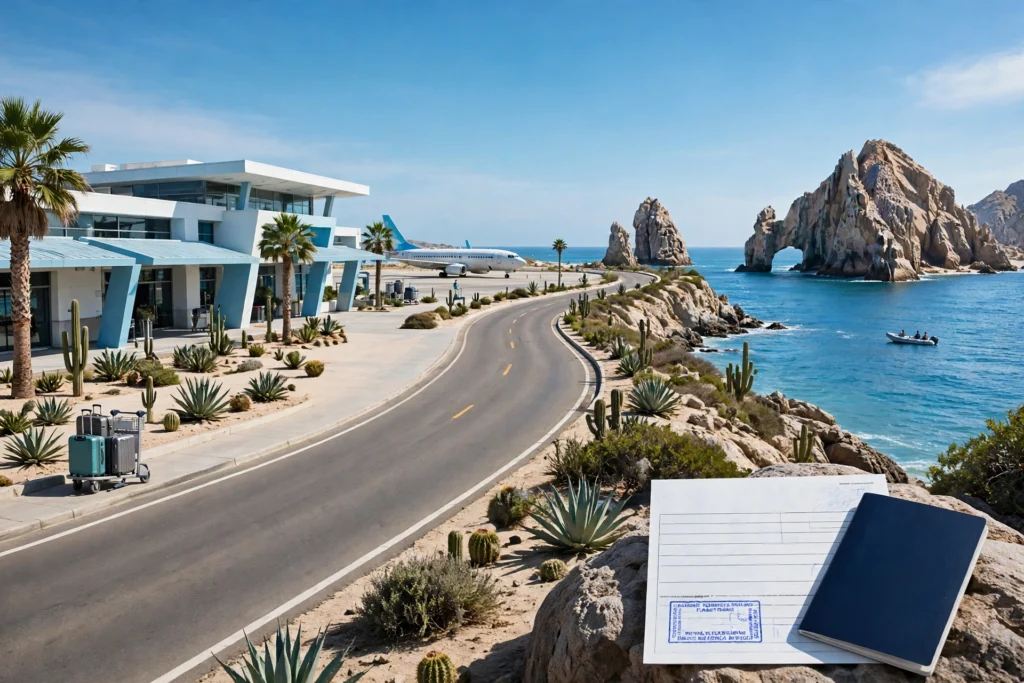
Almost every visitor to Los Cabos arrives through San José del Cabo International Airport (SJD), which sits about halfway between the two towns — roughly 15–20 minutes from San José del Cabo and 40–45 minutes from Cabo San Lucas along the Tourist Corridor. The airport handles direct flights from dozens of US cities, including Los Angeles, San Francisco, Dallas, Houston, Chicago, New York and Seattle, plus flights from Canada and Mexico City. Flying time from Los Angeles is about two hours, from Dallas about two and a half, and from New York about five and a half. There is no direct flight from most of Europe — the usual route is via a US hub or Mexico City — so check connection times carefully if you are flying from London or elsewhere in Europe.
The airport arrival experience has one rule that catches almost every first-timer: do not stop for the timeshare sellers inside the terminal. After customs, you will walk through a gauntlet of friendly people offering “free” transport, “information” and “welcome drinks”. They are timeshare salespeople, and the “free” ride comes with a 90-minute sales presentation. Walk straight past them to the official transport desks outside, or better still, pre-book your transfer before you land. A shared shuttle to Cabo San Lucas costs roughly $20–25 per person each way, a private transfer for two to four people costs roughly $70–90, and a taxi from the airport rank is the most expensive option — often $80 or more to Cabo San Lucas, and sometimes quoted in dollars at an unfavourable rate. Pre-booked private transfers are the best value for groups of three or more, and they mean a driver is waiting with your name on a board instead of a queue. Uber operates in Los Cabos but cannot pick up at the airport terminal itself, so do not plan on it for arrival.
Entry formalities for US citizens are straightforward. You need a passport valid at the time of entry — Mexico does not require six months’ validity, only that your passport is valid when you arrive — and you do not need a visa for tourist stays of up to 180 days. On arrival by air, Mexican immigration issues a digital FMM tourist permit (Forma Migratoria Múltiple Digital, or FMMD): your passport is stamped with your entry date, and you may be directed through a self-service electronic gate that prints a receipt with a QR code. Keep that receipt, and keep your passport safe — you will need the stamp and the FMM record if you are asked for them. The National Migration Institute (INM) is the authority that issues the permit, and its site is where you can download a record of your FMMD. If you arrive by land, the rules are different: all travellers must apply for an FMM online or at an immigration office, unless you are staying within 12 miles of the US border for six days or less. One practical warning: do not bring e-cigarettes or vaping devices into Mexico — they are prohibited — and do not bring any cannabis products, including medical marijuana or CBD, which are illegal in Mexico despite being legal in many US states. A good set of travel apps on your phone before departure — offline maps, a currency converter and your airline app — makes the arrival process far smoother, especially if the airport Wi-Fi is slow.
Money in Cabo runs on the Mexican peso, and while US dollars are accepted almost everywhere in the tourist areas, you will get a poor exchange rate paying in dollars — often 10–15% worse than the real rate. The peso traded at around 17–19 to the US dollar in 2026, but check the current rate before you travel and treat that figure as a planning range. The best approach is to pay in pesos wherever possible: withdraw pesos from a bank ATM (not a standalone tourist ATM, which charges high fees), decline the ATM’s offer to convert to dollars, and use a card with no foreign transaction fees for larger purchases. Credit cards are widely accepted in hotels, restaurants and larger shops, but small vendors, beach sellers and taxis are cash-only. Tipping is expected: 10–15% in restaurants, a few dollars per bag for porters, and $5–10 per person per day for housekeeping. And one rule that applies across Mexico: do not drink the tap water. Drink bottled water, avoid ice in street stalls (ice in hotels and restaurants is made from purified water and is fine), and brush your teeth with bottled water too.
Getting Around Los Cabos: The Tourist Corridor, Buses and Rental Cars
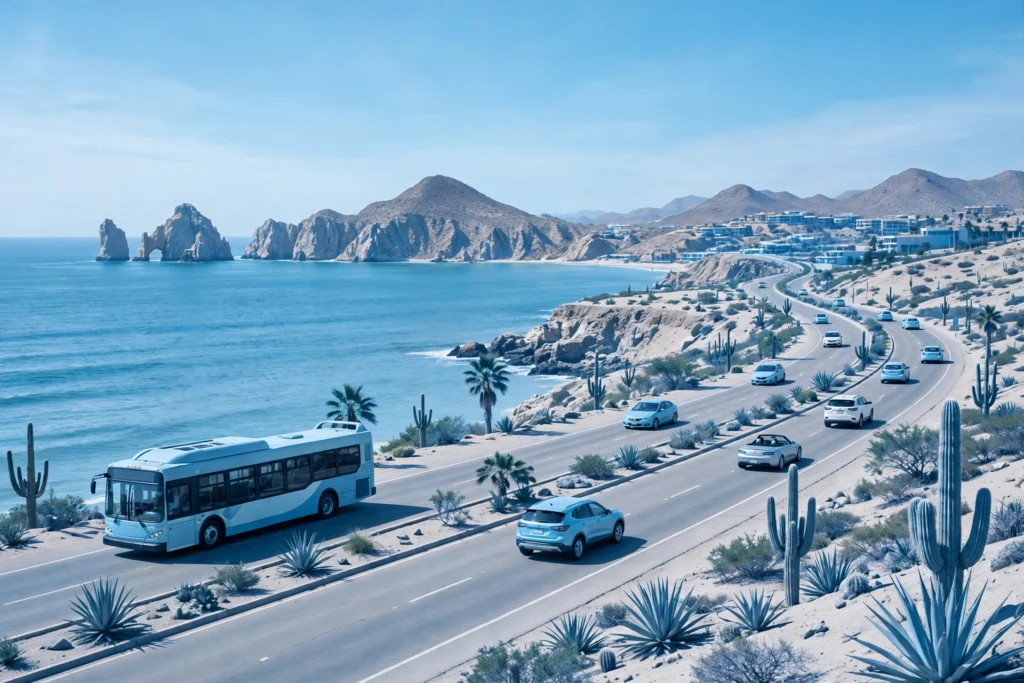
Los Cabos is spread out — 20 miles between the two towns, with the resorts strung along the corridor in between — so transport is a real part of the trip budget, not an afterthought. The good news is that the options are simple, and the right one depends mostly on where you stay.
The cheapest way to move around is the Ruta del Desierto, the purple-and-white public bus that runs the full length of the Tourist Corridor from Cabo San Lucas to San José del Cabo and on to the airport. It runs roughly every 15–20 minutes during the day, costs only a few dollars in pesos, and stops anywhere you flag it down along Highway 1. It is not air-conditioned to Western standards and it can be crowded, but it is reliable, safe and by far the best value for corridor trips — especially for getting to Chileno Bay and Santa María Bay, where the bus drops you at the highway entrance and you walk down to the beach. Local buses inside each town are even cheaper and run frequently around the main streets. If you are staying in Cabo San Lucas itself, you can walk almost everywhere that matters: the marina, Medano Beach and the town centre are all within a compact area, and taxis are only needed for the hills or late nights.
Taxis in Los Cabos are expensive by Mexican standards, and prices are not metered — agree the fare before you get in, in pesos if you can. A short ride inside Cabo San Lucas costs roughly $5–10, a ride from Cabo San Lucas to San José del Cabo costs roughly $35–50, and a ride from the corridor resorts into town costs roughly $15–25. Ride-hailing apps operate in Los Cabos and are usually cheaper than street taxis, but they cannot pick up at the airport and their availability thins out late at night and on the corridor. The State Department advisory recommends dispatched vehicles or app-based services over waving taxis down on the street, and that is good advice in practice as well as on paper.
A rental car makes sense if you plan day trips — to Todos Santos, La Paz or Cabo Pulmo — or if you are staying on the Tourist Corridor, where taxis add up fast. Rental rates start at roughly $30–50 a day for a small car in low season, more in winter, and you should book from a major company at the airport rather than a curbside tout. Two warnings: first, Mexican car insurance is legally required and is not covered by most US credit card policies, so buy the local liability cover even if it doubles the quoted price — driving without it can mean real trouble after an accident. Second, do not drive between towns after dark. The highways are good, but they are dark, livestock and unmarked speed bumps appear without warning, and the advisory’s rule about not travelling between cities after dark applies to visitors as well as government employees. If you are planning a multi-stop trip, sketch the route first with our travel itinerary template — it helps to see the distances on paper before you commit to a car.
Where to Stay in Cabo by Area and Budget

Where you stay in Los Cabos decides what kind of trip you have, more than in most destinations. The three areas — Cabo San Lucas, the Tourist Corridor and San José del Cabo — offer genuinely different holidays, and the table below is the quickest way to choose between them.
| Area | Vibe | Best for | Budget/night | Mid-range/night | Luxury/night |
|---|---|---|---|---|---|
| Cabo San Lucas (marina) | Lively, walkable, loud | Nightlife, fishing, first-timers | $60–100 | $150–250 | $400+ |
| Cabo San Lucas (Medano Beach) | Beach clubs, busy | Beach days, families, groups | $80–120 | $180–300 | $500+ |
| Tourist Corridor | Quiet, resort, spacious | Couples, golf, relaxation | $100–150 | $200–350 | $500–1,000+ |
| San José del Cabo (old town) | Colonial, calm, arty | Culture, food, longer stays | $50–90 | $120–200 | $300+ |
| San José del Cabo (hotel zone) | Beachfront, quiet | Beach, families, value | $70–110 | $150–250 | $350+ |
| East Cape / Cabo Pulmo | Remote, rustic | Diving, nature, escape | $40–80 | $100–150 | $200+ |
Cabo San Lucas is the right base if you want to be in the middle of everything: walk to the marina for boats, walk to Medano Beach for swimming, walk to dinner and back without thinking about transport. The trade-off is noise — the marina bars run late, and March brings spring break crowds that fill the town. Budget travellers will find hostels and small hotels a few blocks back from the marina for $60–100 a night in low season, while the beachfront hotels on Medano Beach start higher and climb steeply in winter. If you are choosing between neighbourhoods in a city you have never visited, the same logic applies everywhere: our London travel guide explains how to pick a base by neighbourhood, and the principles — walkability, noise, transport — work just as well in Cabo.
The Tourist Corridor is where the big resorts are: large beachfront properties with pools, spas, golf courses and restaurants on site, set along 20 miles of coastline between the two towns. It is the best choice for a resort-focused trip, for couples who want space and quiet, and for golfers — the corridor’s courses, including Cabo del Sol, Quivira and Diamante, are among the best in Mexico. The catch is that you will need a car or taxis for everything outside the resort, and the beaches here, while beautiful, are often on the Pacific side or on stretches where swimming is not safe. Check the beach at your specific resort before you book, not just the photos: a resort with a swimmable beach charges a premium for a reason, and a resort on a look-only beach should be priced accordingly.
San José del Cabo is the best value and the most Mexican-feeling base. The old town has boutique hotels and guesthouses in converted colonial buildings for $50–90 a night, the hotel zone east of town has beachfront resorts at lower prices than the corridor, and the food scene — especially around the Thursday Art Walk — is the best in Los Cabos. It suits travellers who want to walk to dinner, browse galleries and sleep without bass from a nightclub. The beach at San José del Cabo is wide and quiet but not always swimmable, so check conditions, and remember that getting to Cabo San Lucas for boats and tours takes 30–40 minutes each way. For a longer stay, San José del Cabo is also the better base for day trips north to La Paz and Todos Santos. Wherever you stay, book directly with the hotel or through a well-known platform, read recent reviews about the beach conditions, and be wary of timeshare presentations disguised as “free breakfast” or “welcome tours” — the same rule as at the airport. And if you are comparing old-town stays across destinations, our Venice travel guide covers another historic centre where the neighbourhood you pick changes the whole trip.
How Much Does Cabo Travel Cost?
Cabo has a reputation as an expensive destination, and it can be — the corridor resorts and the marina restaurants charge international prices. But it is also one of the more affordable beach destinations in Mexico if you plan around it: street tacos cost a few dollars, the public bus costs almost nothing, and the best experiences in Cabo — the arch, the beaches, the sunsets — are free or close to it. The table below gives daily planning ranges per person, excluding flights. Treat them as ranges, not quotes, and confirm figures before you book.
| Daily cost | Budget | Mid-range | Luxury |
|---|---|---|---|
| Accommodation (per person, sharing) | $30–50 | $75–125 | $200+ |
| Food and drink | $15–25 | $40–70 | $100+ |
| Local transport | $3–10 | $15–30 | $50+ (private driver) |
| Activities and tours | $10–20 | $40–80 | $100+ |
| Total per day | $70–100 | $150–250 | $400+ |
Flights are the biggest single cost for most visitors. From the US West Coast, return fares to SJD often run $300–500 in low season and $500–800 in winter; from the East Coast, expect $450–700 in low season and $700–1,000 or more in peak winter. Book two to three months ahead for the best winter fares, and be flexible by a day or two — a Tuesday departure can be substantially cheaper than a Saturday one. Once you are there, the costs that surprise people are the ones that look small: a beach club day bed, a round of drinks at a marina bar, and a taxi across town each add up, and a day of “just a few drinks” on Medano Beach can easily cost $50–80 for two people.
Tours are the other big line. A whale-watching cruise runs roughly $50–80 per person, a snorkelling trip to Chileno Bay or Santa María Bay runs roughly $40–70, a sunset cruise runs roughly $50–80, and a half-day fishing charter runs roughly $150–250 per person shared or $400–900 for a private boat. An arch water taxi is the bargain of the trip at roughly $10–15. None of these prices include tips for the crew — 10–15% is normal — and most operators add a small marine park fee. The single best money-saving move in Cabo is to pre-book your airport transfer and your first tour before you arrive, because the prices quoted by touts at the airport and on the marina are almost always higher than the same trip booked online. And the single best budgeting habit is the one that works everywhere: track what you spend for the first two days, then adjust. Our guide on how to prepare a travel budget walks through the method step by step, and it works just as well for a beach trip as for a city break.
What to Eat, Drink and Pack in Cabo

The food in Cabo is Baja food: seafood, tacos and produce from a desert that grows extraordinary vegetables. The dish to start with is the Baja fish taco — battered white fish, shredded cabbage, crema and salsa in a warm tortilla — invented up the coast in Ensenada and perfected in every taqueria in Los Cabos. Eat them standing up at a street stall for a few dollars, not sitting down at a marina restaurant for ten times the price. Ceviche is the other essential: raw fish or shrimp cured in lime juice with onion, tomato and chilli, served cold on a hot day. The marlin and dorado you see on menus are the same fish the charter boats bring in every morning, and many marina restaurants will cook your own catch. Beyond seafood, try tacos al pastor, birria, elote (grilled corn with mayonnaise, cheese and chilli) and churros from a street cart. San José del Cabo has the best sit-down food scene in Los Cabos — farm-to-table restaurants around the old town, and a food truck scene that punches well above its weight — while Cabo San Lucas has the best street food, concentrated in the streets a few blocks back from the marina.
To drink, start with the obvious: Mexican beer, ice cold, with lime. Mezcal is the spirit to learn about here — smokier and more varied than tequila, made from agave across Mexico, and served neat with orange slices and sal de gusano (chilli salt). Tequila is the safer bet if you are new to agave spirits: a good blanco or reposado, sipped, not shot. Both are widely available, and the best mezcal bars in San José del Cabo will let you taste before you commit to a bottle. One health rule matters more than any food recommendation: do not drink the tap water, and be careful with ice from street stalls. Ice in hotels and established restaurants is made from purified water and is safe; ice from a cart on the street may not be. Bottled water is cheap and everywhere — carry a bottle, and use it for brushing your teeth as well. If you have a sensitive stomach, eat at busy stalls where the food turns over fast, avoid raw vegetables washed in tap water at street stalls, and carry basic stomach medicine just in case. Most visitors have no trouble at all, and the food is one of the best parts of the trip.
Packing for Cabo is simple, but a few items make a real difference. Reef-safe sunscreen is the most important: the sun is strong all year, the reflection off the water doubles the burn, and ordinary sunscreen damages the coral at Chileno Bay, Santa María Bay and Cabo Pulmo. Bring a rash guard or long-sleeve swim top for snorkelling days. Water shoes help on rocky entries at the snorkelling bays. A light jacket or jumper is essential from December to March, when evenings drop into the 60s Fahrenheit and the wind on a sunset cruise is cold. A waterproof phone pouch is worth its weight for boat trips to the arch. And bring a small daypack for day trips — water, snacks, sunscreen and a hat — because the towns outside Los Cabos have fewer shops than you expect. If you are the kind of traveller who sets goals for each trip — a dish to try, a beach to find, a sunrise to catch — our travel goal guide is a light, practical way to do it.
Day Trips from Cabo: La Paz, Todos Santos and Cabo Pulmo

Cabo is a good base, but the best of Baja California Sur lies up the peninsula, and three day trips cover it. All three are easy by rental car or organised tour, and all three show a side of Baja that the resort corridor never will.
La Paz and Balandra Beach is the longest day trip — about two hours each way by car, roughly 100 miles north along Highway 1 — and the most rewarding. La Paz is the capital of Baja California Sur, a proper working city with a malecón (seafront promenade) that comes alive at sunset, seafood restaurants that serve the morning’s catch, and a much more local feel than Los Cabos. The destination is Balandra Beach, about 30 minutes north of the city: a shallow, calm bay of turquoise water and white sand, famous for El Hongo, the mushroom-shaped rock formation that stands in the shallows and has become the symbol of La Paz. Balandra is a protected area with a daily visitor cap, so arrive early — the beach opens in the morning and the car park fills fast, especially at weekends. The water is shallow for a long way out, which makes it one of the best swimming beaches in all of Baja, and kayaking around the bay is the best way to see it. From October to May, La Paz is also one of the best places in the world to swim with whale sharks — the gentle giants gather in the bay to feed, and licensed tours run from the malecón. Book the whale shark tour in advance in season, because numbers are strictly limited.
Todos Santos is the gentlest day trip — about an hour north of Cabo San Lucas on the Pacific side — and the best one for a slow day. Designated a Pueblo Mágico (Magical Town) by the Mexican government, Todos Santos is a small colonial town of art galleries, boutique hotels, cafés and a famous hotel: the Hotel California, a white colonial building on the main street that has become a pilgrimage site for Eagles fans, though the band has always said the song is not about this hotel. The town itself is worth the drive without the hotel: the mission church, the galleries, the farm-to-table restaurants and the slow pace are a complete contrast to the marina in Cabo San Lucas. Nearby Cerritos Beach is one of the best surfing beaches in Baja, with surf schools, longboard waves and a beach club scene that is far more relaxed than Medano Beach. Combine Todos Santos with Cerritos for a full day: morning in town, afternoon at the beach, sunset on the Pacific side — which, unlike the Cortez side, faces directly west and gives you a proper ocean sunset.
Cabo Pulmo National Park is the wild card — about two hours northeast of San José del Cabo, on the East Cape, and covered in detail in the snorkelling section above. As a day trip it works best as a diving or snorkelling day: leave early, dive or snorkel the reef in the morning, have lunch in the tiny village, and drive back in the afternoon. The road is partly unpaved and the village has almost no facilities, so this is a trip for travellers who are comfortable with a bit of roughness in exchange for one of the best reefs in the eastern Pacific. If you prefer your day trips with paved roads and restaurants, choose La Paz or Todos Santos instead. For a sense of how day trips work in other destinations, our Colombia travel guide covers multi-stop days in a very different landscape, while our Seattle travel guide and Yellowstone travel guide both have day-trip sections built the same way — distance, time, what to do, and what to skip.
Frequently Asked Questions About Cabo Travel
Is Cabo safe to visit in 2026?
Yes, with normal precautions. The US State Department rates Mexico overall and Baja California Sur at Level 2 (Exercise Increased Caution), reissued 11 August 2026, and lists no specific travel restrictions for US government employees in Baja California Sur. Stay in tourist areas after dark, use dispatched taxis or ride-hailing apps, watch your drink in bars, and respect the beach flags — the ocean is the bigger risk than crime in Los Cabos. Do not confuse Baja California Sur with Baja California (Tijuana area), which is Level 3 and a different state.
What is the best month to visit Cabo?
January to March for whale watching and the best weather; May to October for the warmest sea and the best snorkelling; November for good weather, warm water and lower prices. Avoid September if you dislike heat and humidity, and avoid March in Cabo San Lucas if you dislike spring break crowds.
Can you swim in the ocean in Cabo?
Yes, on the Sea of Cortez side. Medano Beach, Lover’s Beach, Chileno Bay, Santa María Bay and Palmilla Beach are all swimmable in normal conditions. Pacific-side beaches such as Divorce Beach, Migriño Beach and Playa Grande are dangerous and should not be swum in. Always check the coloured flag on the beach before getting in.
Do US citizens need a visa or passport for Cabo?
You need a passport valid at the time of entry, but no visa for tourist stays of up to 180 days. On arrival by air you receive a digital FMM tourist permit (FMMD), stamped in your passport. Keep the receipt and your passport safe for the duration of your stay.
How many days do you need in Cabo?
Four days covers El Arco, the beaches, a whale-watching or snorkelling trip, San José del Cabo and one day trip. Seven days lets you add La Paz and Balandra Beach, Todos Santos and Cabo Pulmo, and a slow beach day. Less than three days feels rushed, because the two towns and the corridor are spread over 20 miles.
Is Cabo expensive?
It can be, but it does not have to be. Budget travellers can manage on roughly $70–100 a day, mid-range travellers on $150–250 a day, and luxury travellers on $400 or more, excluding flights. The biggest savings come from paying in pesos, using the public bus, eating at street stalls, and pre-booking airport transfers and tours instead of buying them from touts.
Conclusion: Cabo Is Two Towns, One Arch and a Whole Lot of Ocean
Cabo works because it is not one place. It is a loud marina town and a quiet colonial town, a calm turquoise bay and a wild Pacific beach, a whale-watching cruise and a marlin charter, a spring break party and a deserted reef two hours up a dirt road. The arch at Land’s End is the postcard, but the trip is the contrast: the moment you step from the calm water of Lover’s Beach around the rocks to the crashing Pacific on Divorce Beach, you understand the place in a way no photograph can explain. Come between December and April for the whales, or between May and October for the warmest water. Swim where the flags say it is safe, pre-book your airport transfer, pay in pesos, and leave a day free for La Paz or Todos Santos. Baja California Sur rewards the traveller who looks past the resort strip — and Cabo, for all its fame, is still the best doorway into it.
People also read: Best Places to Travel in Mexico · Panama Travel Guide · Malta Travel Guide · Travel Itinerary Template · How to Prepare a Travel Budget · Best Places to Travel in January

M. Adil is the founder and editor of SoloTravelPro. He writes practical, research-based travel guides that help travellers plan with confidence — from first-time city breaks to national parks and island escapes. Every guide is built on official sources, current prices and honest, usable advice, so readers can plan smarter and travel better.