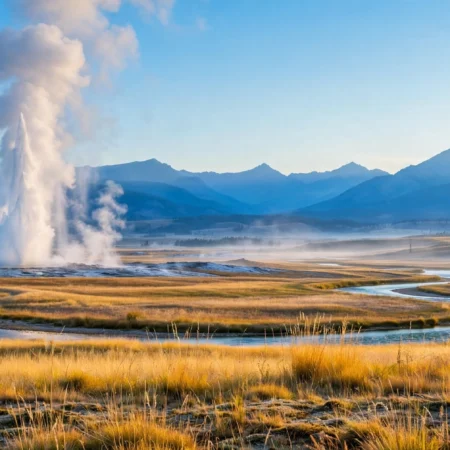

Yellowstone is the park every other national park is measured against. Established in 1872 as the world’s first national park, it covers about 2.2 million acres across Wyoming, Montana and Idaho — an area larger than Rhode Island and Delaware combined — and it holds roughly half of all the geysers on Earth, the largest high-elevation lake in North America, a canyon with a waterfall nearly twice the height of Niagara, and the most free-ranging wildlife in the lower 48 states. It is also the park that most often defeats first-time visitors, not because it is hard to enjoy, but because it is so big: the main road alone is 142 miles, and a single bison crossing can add an hour to your day. This Yellowstone travel guide is built to fix that. It covers the best time to visit, how many days you really need, what the entrance fees are in 2026, how to get there and get around, every major region in the order that makes sense on the road, where to stay, what it costs, and the safety rules that keep both you and the animals safe.
Quick answer: the best time for a first Yellowstone trip is June or September, when the full Grand Loop Road is open, the weather is workable and the crowds are thinner than in July and August. Plan on at least 3 days — 4 to 5 is better — and base yourself by region rather than commuting across the park each day. A private vehicle pass costs $35 for 7 days, and there is no timed-entry reservation to book. Book lodging and campgrounds months ahead, arrive at the famous sights early or late in the day, and check the National Park Service road status before you drive in. Prices below are planning ranges only — confirm figures before you book, as fees and opening dates can change.
Best Time to Visit Yellowstone
There is no single best month for Yellowstone, only the best month for the trip you want. The park changes completely with the seasons, and the right choice depends on whether you value full road access, wildlife, quiet, or winter scenery. The table below is the short version; the detail follows it.
| Month | Roads and access | Crowds | Best for |
|---|---|---|---|
| January – March | Only the North to Northeast road open to cars; interior by snowcoach or snowmobile | Very quiet | Winter scenery, steam against snow, wolf watching |
| April | Interior roads begin opening in stages from mid-April | Light | Waterfalls at full flow, bears emerging, low prices |
| May | Most roads open by late May; Dunraven Pass usually last | Moderate | Baby bison, wildflowers, fewer crowds than summer |
| June | Full loop open | Busy | Long days, all facilities open, wildflowers |
| July – August | Everything open | Peak crowds | Warmest weather, ranger programs, family trips |
| September | Full loop open, most facilities still running | Thinning fast | Elk rut, golden aspens, comfortable hiking |
| October | Roads begin closing in early November | Quiet | Fall colours, wildlife, last chance before winter |
| November – December | Interior roads close early November; oversnow travel from mid-December | Very quiet | Transition season, limited access |
June and September are the sweet spot for most first-time visitors. June gives you the longest days of the year, full road access, wildflowers in the meadows and waterfalls running at their strongest after the snowmelt. September gives you thinner crowds after Labor Day, golden aspens along the northern range, cooler hiking weather and the elk rut — bull elk bugling in the meadows around Mammoth Hot Springs, one of the great wildlife spectacles in North America. If you are choosing between the two, pick June for the fullest park and September for the calmest one. For more ideas on shoulder-season travel in general, the best places to travel in January guide shows how the same off-peak thinking works for winter trips elsewhere.
July and August are the warmest and busiest months. Every road, lodge, campground and ranger program is running, which makes planning easy, but the famous stops — Old Faithful, Grand Prismatic Spring, the Canyon — are crowded between about 10 a.m. and 4 p.m., and parking lots fill up. Afternoon thunderstorms are common, so carry a rain shell even on a sunny morning. If you travel in peak summer, the single best habit you can build is an early start: be at your first stop by 7 or 8 a.m. and you will have boardwalks nearly to yourself.
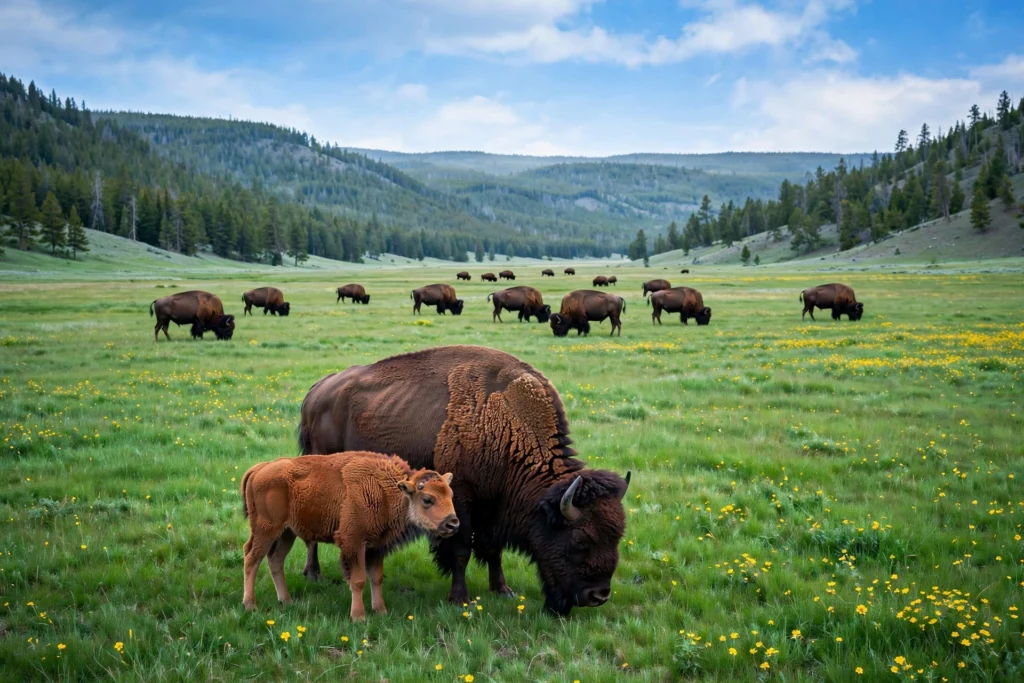
Spring, from April through early June, is the wildlife season. Bison calves — small, rust-red and wobbly — appear in the valleys, elk move down to lower ground as the snow melts, and bears come out of hibernation in April. The trade-off is weather: snow can still fall in May at elevation, and some high-country roads do not open until late May, so check the road status before you commit to a route. Winter is a different park entirely. From early November to mid-April most interior roads close to regular vehicles, and the only way to reach the geyser basins is by commercially guided snowcoach or snowmobile, mostly out of West Yellowstone or Mammoth. What you get in exchange is steam rising off thermal features against snow, far fewer people, and some of the best wolf watching of the year along the road between Mammoth and Cooke City, which stays open year-round. If a winter trip appeals to you, plan it as a separate kind of holiday, not as a cheaper version of a summer one.
How Many Days Do You Need in Yellowstone
You will not fit the highlights into less than three days. That is the honest answer, and every guide that promises Yellowstone in a day is really promising a long drive past it. The park is about 3,471 square miles, the Grand Loop Road alone is 142 miles, and drive times are always longer than the mileage suggests because of wildlife jams, construction and the fact that you will want to stop constantly. One day is a teaser. Two days lets you choose a couple of regions. Three days is the realistic minimum to see the main attractions, and four to five days is what you want if you actually want to slow down, watch wildlife and hike instead of driving past everything.
- 1 day: pick three highlights and accept that you are sampling, not seeing it all. The classic first-timer trio is Old Faithful, Grand Prismatic Spring and the Grand Canyon of the Yellowstone. Enter from the west or the south, drive the lower loop, and finish at Artist Point for the Lower Falls. Expect up to seven hours of driving before you factor in stops.
- 2 days: day one in the geyser country in the west (Old Faithful, Upper Geyser Basin, Grand Prismatic), day two at the canyon and the central thermal areas (Grand Canyon of the Yellowstone, Hayden Valley, Norris Geyser Basin). This is the minimum for a trip that feels like a visit rather than a drive-through.
- 3 days: the recommended minimum. Add the north — Lamar Valley at dawn for wildlife, Mammoth Hot Springs and the travertine terraces — and move your base partway through so you are not commuting across the park every morning. If you want a ready-made structure to adapt, a printable travel itinerary template is a useful way to lay out the three days by region instead of by clock time.
- 4 days: the three-day plan spread over four days, with two of the park’s best walks added — the Grand Prismatic Spring Overlook and Fairy Falls, and the Mount Washburn climb for strong hikers. A fourth day also gives you a buffer for weather, road delays or a morning you want to spend watching wolves in Lamar Valley instead of driving.
- 5 days: a fifth day buys you freedom. The four-day plan covers the highlights, so day five is for one thing you would not otherwise reach: horseback riding from one of the park concessions, kayaking or fishing on Yellowstone Lake, a backcountry overnight with a permit, or a long hike like the Lamar River Trail. This is also the length where combining Yellowstone with Grand Teton National Park starts to make sense — the south entrance leads straight into Grand Teton, and two days there turns a good trip into a great one.
Whatever length you choose, plan by region and move your base as you go. The single biggest planning mistake in Yellowstone is trying to commute across it daily from one hotel. For any trip of three days or longer, spend the first nights near the geyser country (West Yellowstone or the Old Faithful area) and the later nights in the north (Gardiner or Mammoth), so each day’s driving is short and each region gets a full morning. The same region-by-region approach works for other big road-trip destinations — the Iceland travel itinerary uses the same moving-base idea around the Ring Road.
Yellowstone Entrance Fees and Passes
Yellowstone charges by the vehicle, not by the person, and your pass is good for seven days. There is no timed-entry reservation for Yellowstone — unlike some other popular national parks, you do not need to book a time slot to enter. You simply pay at the entrance station, or show a pass you already hold. The fees below are the 2026 figures from the National Park Service, and they are worth knowing before you reach the gate, because entrance stations can have long queues in summer and there is no way to buy a pass online in advance for a private vehicle.
| Pass type | 2026 price | Good for |
|---|---|---|
| Private vehicle | $35 | 7 days, everyone in the car |
| Motorcycle | $30 | 7 days, up to 2 motorcycles and 4 people |
| On foot, bicycle or ski | $20 per person (16 and over) | 7 days |
| Yellowstone annual pass | $70 | 12 months, pass holder plus passengers in one vehicle |
| America the Beautiful (resident) | $80 | 12 months, all US national parks and federal recreation sites |
| America the Beautiful (non-resident) | $250 | 12 months, all US national parks and federal recreation sites |
| Senior annual pass (62+, residents) | $20 | 12 months |
| Senior lifetime pass (62+, residents) | $80 | Lifetime |
| Military and 4th-grade passes | Free | See NPS for eligibility |
Two things in that table catch people out. First, the non-resident surcharge: since 2026, every non-US resident aged 16 and over must pay an additional $100 per person on top of the standard entrance fee, unless they are admitted with an Annual or America the Beautiful pass. For an international family of four driving in, that surcharge can cost more than the vehicle pass itself — which is exactly why the $250 non-resident America the Beautiful annual pass often works out cheaper, especially if Grand Teton or another park is on the same trip. Second, children under 16 are admitted free and do not need a pass. The full, current fee schedule is published on the official NPS Yellowstone fees page, and it is worth checking before you travel, because fee rules have changed recently and can change again.
If you are visiting several parks in a year, the America the Beautiful pass is the easy choice: at $80 for US residents it pays for itself after three park visits, and it covers the entrance fee at every national park and federal recreation site in the country. Yellowstone also offers several free entrance days each year for US citizens and residents — in 2026 these include Memorial Day (25 May), the Independence Day weekend (3–5 July), the National Park Service birthday (25 August) and Veterans Day (11 November) — but free days only waive the entrance fee, not lodging, camping or tour costs, and they are among the busiest days of the year. When you are working out what the whole trip will cost, a proper travel budget plan helps — the entrance fee is the smallest part of a Yellowstone budget, and lodging, food and fuel are where the money actually goes.
Getting to Yellowstone: Airports and the Five Entrances
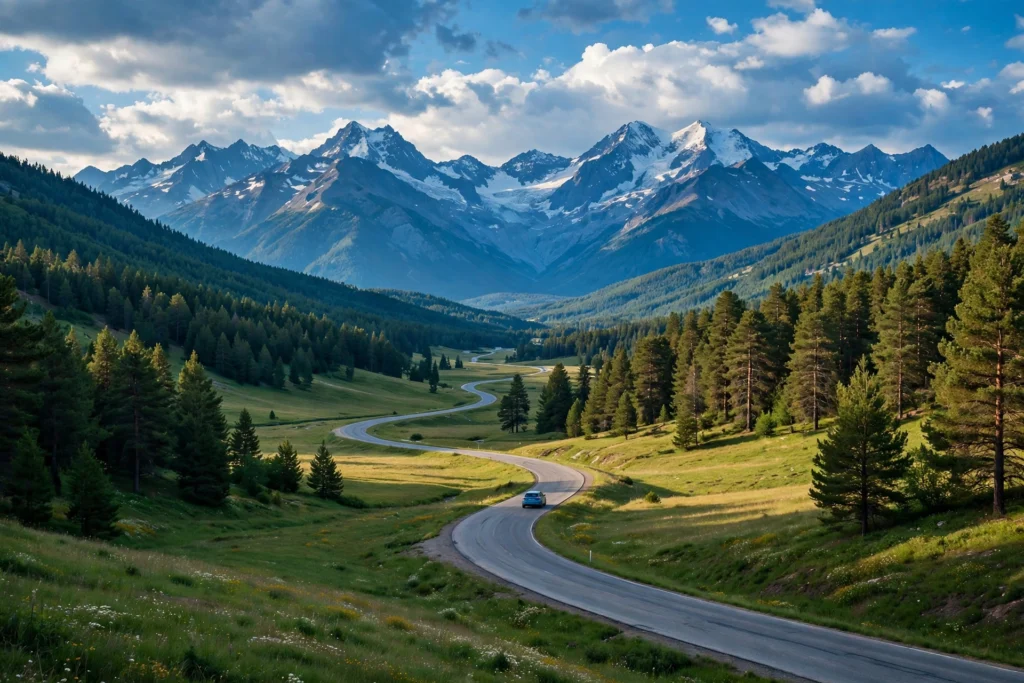
No airport sits inside Yellowstone, so you will fly into a regional gateway and drive the rest of the way. There are five entrances, each with its own gateway town, and which one you choose shapes your whole trip — so pick your entrance before you book your flight, not after.
| Gateway airport | Nearest entrance | Drive to the park | Best for |
|---|---|---|---|
| Bozeman Yellowstone International (BZN), Montana | North or West | About 90 minutes to West Yellowstone | Most flights, best car rental choice |
| Jackson Hole (JAC), Wyoming | South | About 1 hour to the South Entrance | Grand Teton combination, scenic approach |
| Idaho Falls Regional (IDA), Idaho | West | About 2 hours to West Yellowstone | Budget fares, smaller airport |
| Billings Logan (BIL), Montana | Northeast | About 3 hours to the North Entrance | Cheaper flights, Beartooth Highway approach |
| Salt Lake City (SLC), Utah | West | About 4.5–5 hours to West Yellowstone | Lowest fares from many US cities |
Bozeman is the most convenient choice for most visitors: it has the most flights, the widest rental-car choice, and it sits roughly 90 minutes from both the North Entrance at Gardiner and the West Entrance at West Yellowstone. Jackson Hole is the most scenic — the drive from the airport runs straight through Grand Teton National Park — but fares tend to run higher and rental cars are scarcer. Salt Lake City is the farthest of the common options, but it often has the cheapest flights, especially from the West Coast, and the drive is straightforward. There is no rail line into the park, and no public bus system inside it, so a rental car is effectively essential. Book the car at the same time as the flight: in summer, rental cars at Bozeman and Jackson Hole sell out, and prices climb steeply.
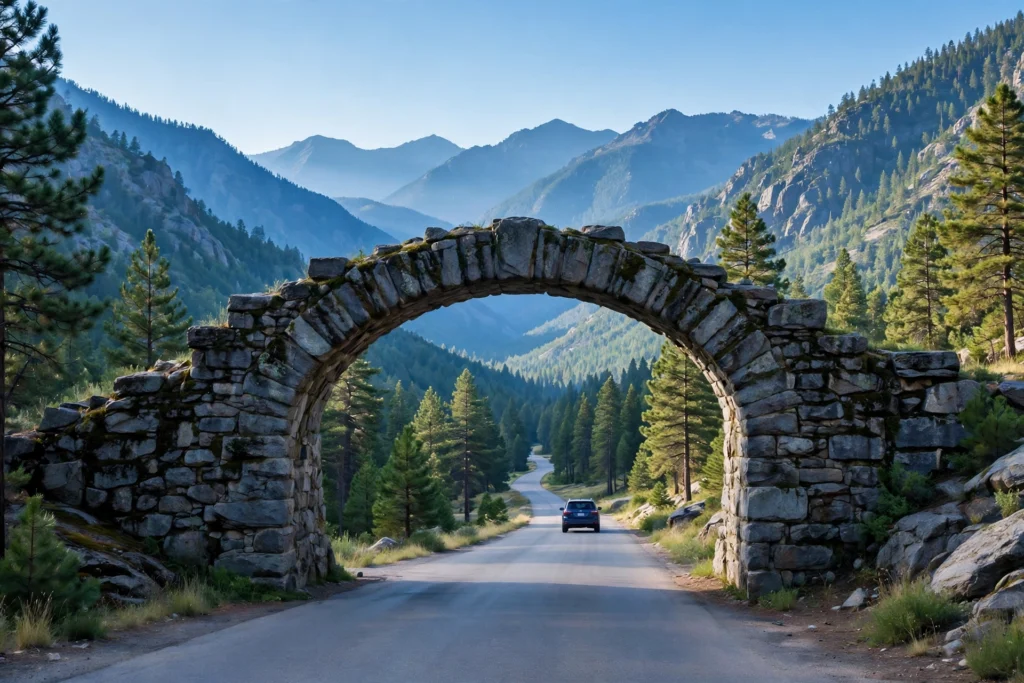
The five entrances each lead to a different part of the park. The West Entrance at West Yellowstone, Montana, is the most popular and the closest to the geyser country — Old Faithful is about 30 miles inside. The North Entrance at Gardiner, Montana, is the only one open to cars year-round, and it leads straight to Mammoth Hot Springs under the stone Roosevelt Arch. The Northeast Entrance near Cooke City, Montana, is the wildlife entrance, opening onto Lamar Valley, and the approach over the Beartooth Highway from Red Lodge is one of the great drives in America — typically open from the Friday of Memorial Day weekend to mid-October. The East Entrance near Cody, Wyoming, is about 15 miles from Yellowstone Lake and the canyon country. The South Entrance borders Grand Teton National Park and is the natural choice if you are combining the two parks. Because Yellowstone is entirely within the United States, US travellers need no passport — the same applies to many other domestic trips, as covered in the guide to places to travel without a passport. International visitors should carry their passport and check their visa requirements before flying, and remember the $100 non-resident entrance surcharge described above.
Getting Around Yellowstone: The Grand Loop Road and Drive Times
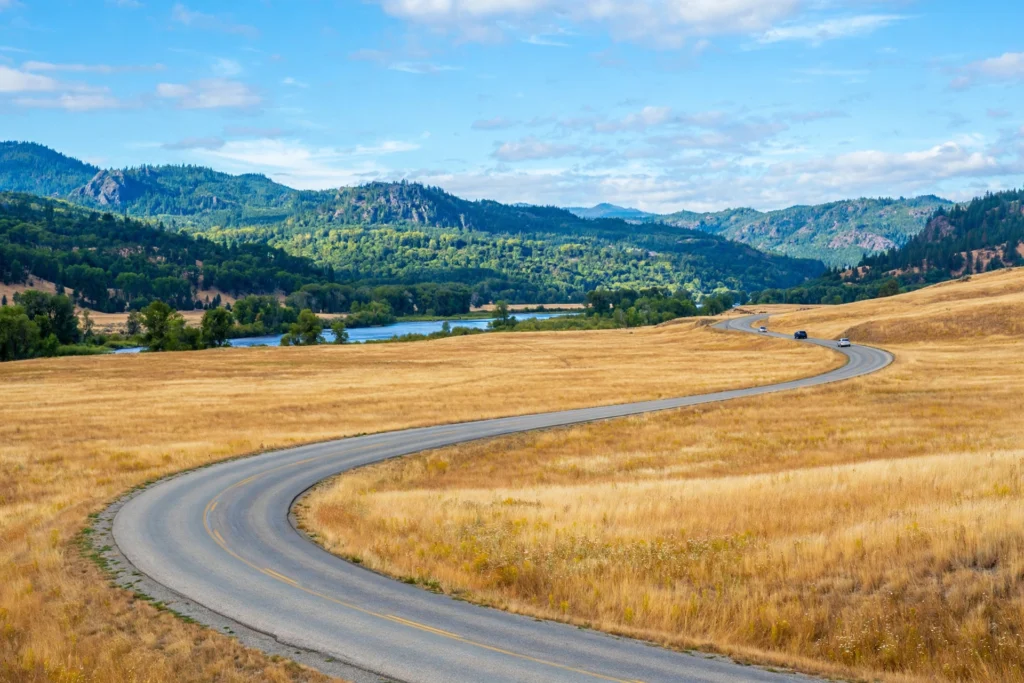
Yellowstone is a driving park with no shuttle system, and the distances are the thing that breaks itineraries. The Grand Loop Road forms a rough figure eight through the park’s interior, connecting all the major developed areas over about 142 miles. The upper loop runs from Mammoth Hot Springs through Tower-Roosevelt and Canyon to Norris; the lower loop runs from Norris through Madison to Old Faithful, West Thumb and Lake Village, then back up through Hayden Valley to Canyon. Learn the shape of that figure eight before you arrive and the park stops feeling random.
| From | To | Distance | Drive time (no stops) |
|---|---|---|---|
| West Entrance | Old Faithful | 30 miles | 45 minutes |
| Old Faithful | Grand Prismatic Spring (Midway Geyser Basin) | 7 miles | 15 minutes |
| Old Faithful | West Thumb Geyser Basin | 17 miles | 30 minutes |
| West Thumb | Grand Canyon of the Yellowstone (Canyon Village) | 37 miles | 1 hour |
| Canyon Village | Norris Geyser Basin | 12 miles | 25 minutes |
| Norris | Mammoth Hot Springs | 21 miles | 40 minutes |
| Canyon Village | Lamar Valley (via Dunraven Pass) | 43 miles | 1.5 hours |
| Mammoth Hot Springs | Lamar Valley | 29 miles | 50 minutes |
| South Entrance (from Grand Teton) | Old Faithful | 57 miles | 1.5 hours |
Those drive times are bare minimums. A single bison jam — a herd crossing the road while traffic waits — can add an hour, and road construction on the northern range can add 15 to 30 minutes in summer. Speed limits sit around 45 mph on open stretches and drop to 25 mph or lower through developed areas, and rangers do enforce them. Plan on an average speed well below the limit, and never plan a day that depends on a tight drive between two distant regions. A good rule is to treat every drive as if it will take 50 percent longer than the map says, and to build in a stop you actually want — a waterfall pullout, a valley viewpoint — rather than arriving frustrated at a parking lot.
Fuel is another planning item. Gas stations inside the park sit at Mammoth Hot Springs, Tower Junction, Canyon Village, Fishing Bridge, Grant Village and Old Faithful, but distances between them can run 30 miles or more, and fuel inside the park costs more than in the gateway towns. Fill the tank whenever you pass a station, and never let it drop below a quarter. Cell service is limited to almost nonexistent outside the main villages, so download offline maps before you lose signal — the best travel apps for offline maps and navigation are worth installing before you leave home, not at the entrance gate. There is no public transport inside the park, though several companies run guided bus tours from the gateway towns that hit the highlights in a single day; these suit travellers who want narration and do not want to deal with parking, though you give up the freedom to linger wherever you like. Cycling is allowed on park roads and can be a good way to see quieter stretches, particularly in spring before roads fully open to cars, but distances between sights are long and shoulders are narrow in places. The park’s official road status page is the NPS park roads page — check it the morning you drive in, because weather can close a pass with little warning.
Old Faithful and the Upper Geyser Basin
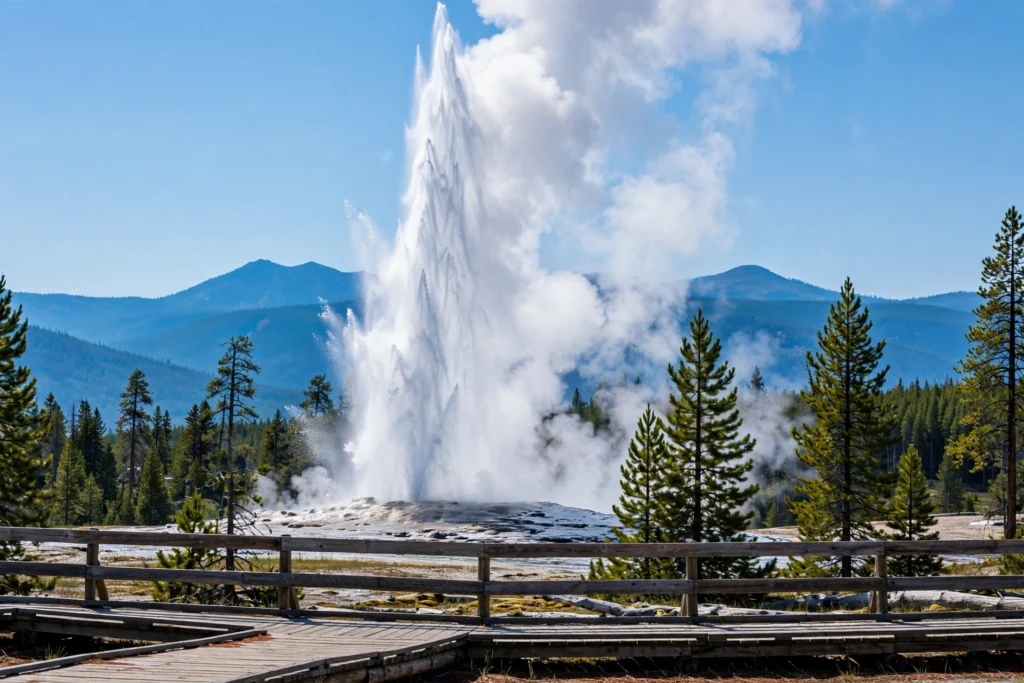
Old Faithful is the most famous geyser in the world, and the Upper Geyser Basin around it holds the densest concentration of geysers anywhere on Earth — more than 150 in about a square mile. It is the first stop for most visitors, and it rewards the ones who stay longer than a single eruption.
Old Faithful erupts on average about every 90 minutes, though the gap between eruptions ranges from roughly 35 minutes to two hours, and the current median cited by the National Park Service is closer to 100 minutes. The trick rangers use to predict it is the length of the previous eruption: a short eruption of under two and a half minutes is followed by a wait of about 65 minutes, while a longer eruption means a wait closer to 90 minutes. Using that relationship, rangers post the next eruption time on boards at the Old Faithful Visitor Education Center and in the NPS app, and the predictions are usually accurate to within about 10 minutes. Each eruption lasts between a minute and a half and five minutes and can throw water 100 feet or more into the air — some eruptions reach 180 feet. When you arrive, check the prediction board first, then plan the basin walk around it rather than standing in the crowd for an hour.
The basin itself is the real attraction. A boardwalk loop of about three miles winds past dozens of named geysers and hot springs: Castle Geyser, the oldest and largest cone in the basin; Riverside Geyser, which arcs gracefully over the Firehole River; Morning Glory Pool, whose colours shift with the seasons; and Grand Geyser, the tallest predictable geyser in the world, erupting to around 200 feet when it goes. Give the basin at least half a day. Walk the full loop in the morning, when the light is soft and the crowds are thin, then return for an eruption at midday. The Old Faithful Inn, the great log hotel that opened in 1904, anchors the area — its lobby alone is worth a look, with a stone fireplace that rises several storeys, and the dining room is worth a meal even if you are not staying there. The Old Faithful Snow Lodge is the only lodge open in winter, when the basin is reached by snowcoach. Watching an eruption here is the kind of moment that belongs on any travel bucket list — it is the single most iconic sight in the American national park system, and it has been drawing visitors since the Washburn expedition named it in 1870.
Practical tips for the Upper Geyser Basin
- Check the prediction board at the visitor centre the moment you arrive, and plan your walk around the next eruption.
- Stay on the boardwalks at all times. The ground around thermal features can be thin, and the water underneath runs near boiling — more people have been hurt by stepping off the boardwalk than by any animal in the park.
- Morning and evening are the quietest times. Between 10 a.m. and 4 p.m. in summer the viewing area is packed.
- Bring water and sun protection. The basin sits at around 7,300 feet, the sun is strong, and there is almost no shade on the boardwalks.
Grand Prismatic Spring and Midway Geyser Basin
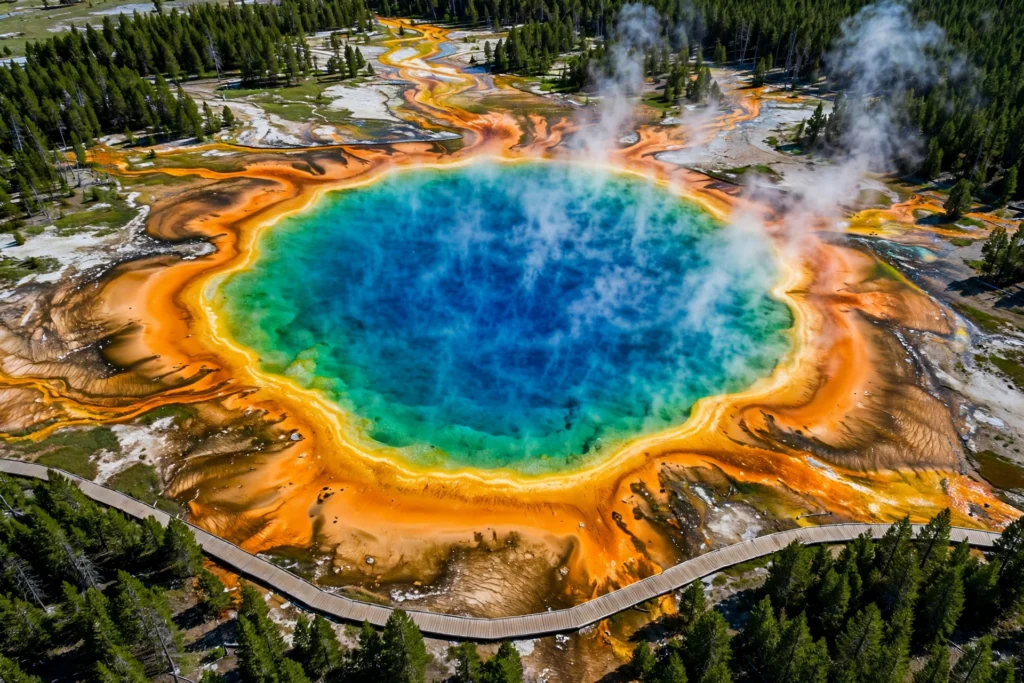
Grand Prismatic Spring is the largest hot spring in the United States and one of the most photographed places in the park — a pool about 370 feet across and roughly 120 feet deep, ringed with bands of orange, yellow, green and blue that look more like a painting than a landscape. The colours come from heat-loving microbes living in the mineral-rich water: different species thrive at different temperatures, so the bands mark the temperature gradient from the scalding blue centre out to the cooler orange edges. It is the third-largest hot spring in the world, and it sits in the Midway Geyser Basin, a short drive north of Old Faithful.
There are two ways to see it, and you should do both. The boardwalk through the Midway Geyser Basin takes you right past the spring at ground level, along with its neighbour Excelsior Geyser, a vast crater that constantly pours thousands of gallons of hot water a minute into the Firehole River. From the boardwalk the spring is impressive but hard to grasp — the steam and the sheer size of it fill your whole field of view. The second way is the Grand Prismatic Spring Overlook, reached from the Fairy Falls trailhead about a mile south. A short, moderately steep climb of about 1.5 miles round trip takes you to a viewing platform above the spring, and from there the full rainbow is visible at once. This is the photograph you came for, and it is one of the most rewarding short walks in the park. Go in the afternoon, when the sun is high and the cooler morning air has stopped throwing up steam that hides the colours. From the same trailhead you can continue on to Fairy Falls, a 200-foot waterfall about a mile further on, for a walk of roughly 5 miles round trip that is quiet even on busy days.
Midway is a small basin, and its parking lot is one of the worst bottlenecks in the park. Arrive before 9 a.m. or after 4 p.m., or park at the Fairy Falls trailhead and walk in. Do not park on the roadside or walk along the road — rangers ticket both, and the road is narrow and dangerous on foot. The basin is also the place where the thermal rules matter most: the boardwalk is the only safe path, the water is near boiling, and swimming in any hot spring in the park is prohibited. The colours are best on a sunny afternoon, worst on a cold, steamy morning, so if you have a choice, save the overlook for the warmest part of the day.
The Grand Canyon of the Yellowstone: Waterfalls and Viewpoints
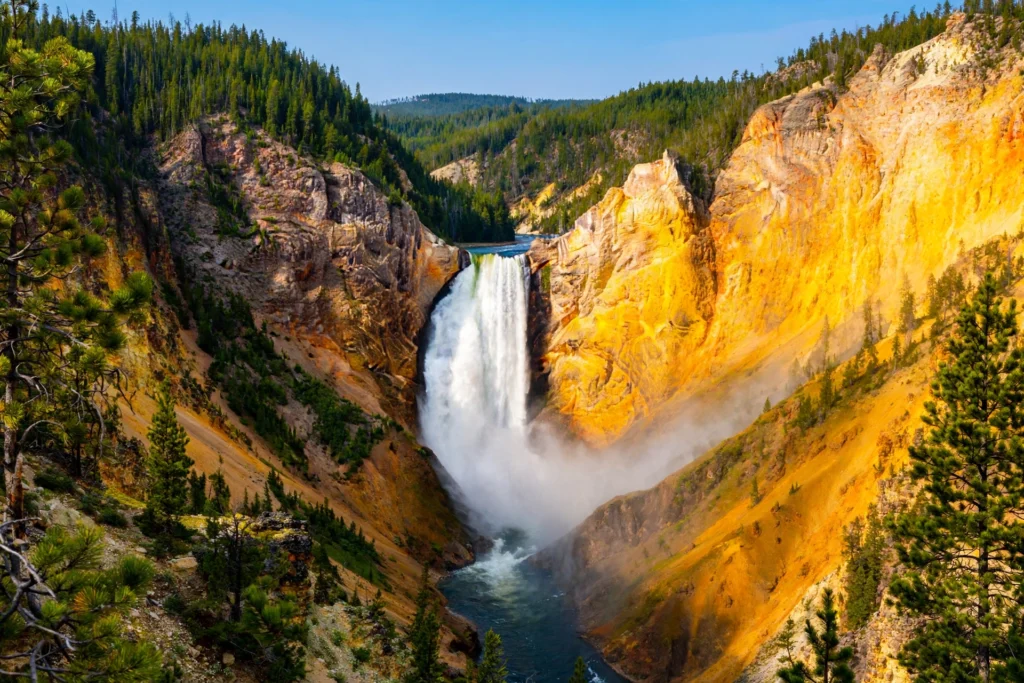
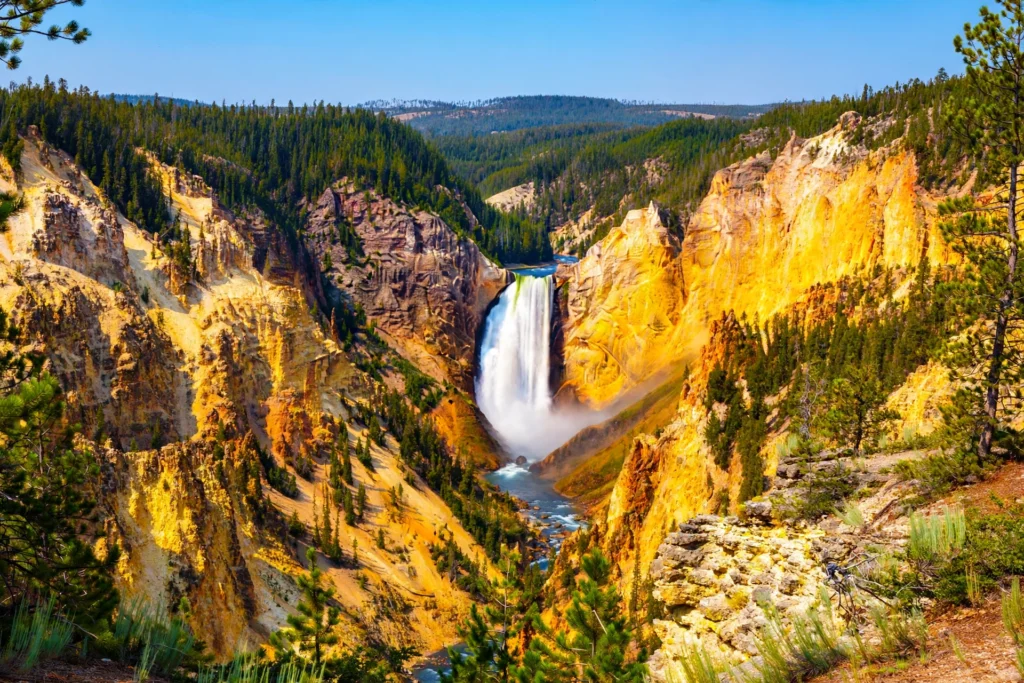
The Grand Canyon of the Yellowstone is not the Grand Canyon of Arizona — it is shorter, narrower and far more colourful, with yellow, orange and white canyon walls stained by the same hot water that feeds the park’s geysers. The Yellowstone River drops through it in two big waterfalls: the Upper Falls, 109 feet high, and the Lower Falls, 308 feet high — nearly twice the height of Niagara — thundering into a canyon about 1,000 feet deep. It is the most dramatic landscape in the park after the geyser basins, and it is the one place where you should plan to spend a full half day rather than a quick stop.
Both rims are worth walking, and they give you different views. The South Rim is the classic side: Artist Point, a short walk from the parking area, is the postcard view — the Lower Falls framed by yellow canyon walls, the view that the painter Thomas Moran made famous in the 1870s and that helped persuade Congress to create the park. Uncle Tom’s Trail, a steep staircase of more than 300 steps down the canyon wall, takes you to a viewpoint near the base of the Lower Falls; it is strenuous, and the climb back up is the hard part, so take it slowly and carry water. The North Rim is quieter and gives you Lookout Point, the Brink of the Lower Falls (a short, steep trail to the very lip of the waterfall, where you can feel the spray), Inspiration Point and the Grand View. If you only have an hour, do Artist Point and the Brink of the Lower Falls. If you have a morning, walk both rims — the South Rim trail to Artist Point is about 2.5 miles round trip, and the North Rim drive links its viewpoints with short walks.
Canyon Village, the largest developed area in the park, is your base for this region. It has the Canyon Visitor Education Center, which explains the geology of the canyon and the volcano beneath the park in more detail than anywhere else, plus restaurants, a store, a gas station and lodging. The canyon is also the gateway to Hayden Valley, the wildlife-rich valley just south of the village, and to the Mount Washburn trail — a six-mile round trip to a 10,219-foot summit with panoramic views over the whole park, one of the best day hikes in Yellowstone for strong walkers. Start early, carry bear spray, and watch for bighorn sheep near the summit. The canyon at sunrise, when the light hits the yellow walls and the mist rises off the river, is one of the quietest and most beautiful moments in the park — and it is almost empty, because most visitors are still driving in.
Mammoth Hot Springs and the Northern Range
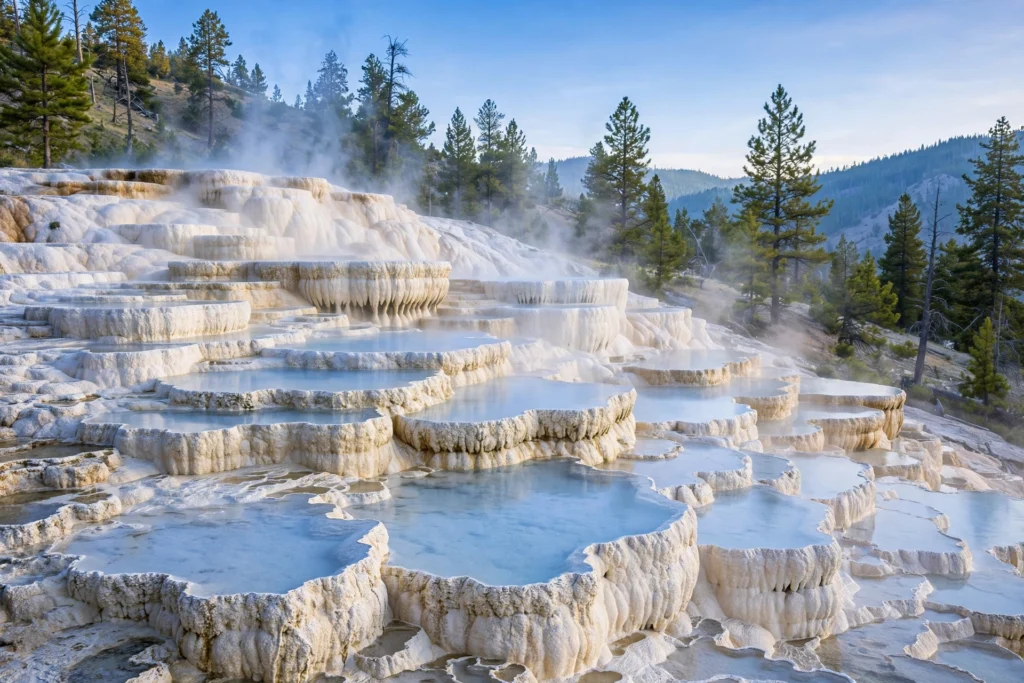
Mammoth Hot Springs is the strangest landscape in Yellowstone. Instead of the blue pools and steaming geysers of the southern basins, you get travertine terraces — white and cream steps of limestone built up by hot water over thousands of years, looking like a cave turned inside out. More than 50 hot springs feed the upper and lower terraces, and the formations grow faster here than anywhere else in the park, so the terraces change from year to year: a spring that was flowing last season may be dry this one, and a new terrace may be forming somewhere else. Walk the boardwalks of both terraces — the lower terrace is the larger and more colourful, the upper terrace drive loops past springs and the orange mound of Orange Spring — and allow at least two hours.
Mammoth is also the park’s headquarters and its only year-round developed area. The historic buildings of Fort Yellowstone, the old army post that protected the park from 1886 to 1918, still line the parade ground, and the Albright Visitor Center in the old bachelor officers’ quarters is one of the best places to learn the park’s human history. Elk graze on the lawns around the buildings so often that visitors barely look twice — which is a mistake, because elk are wild animals and the 25-yard rule applies to them just as it does to bison. In September, during the rut, bull elk bugle across the parade ground at dawn and dusk, and the whole area becomes a wildlife-viewing spot in its own right.
The northern range beyond Mammoth is the park’s wildlife heartland. The road from Mammoth through Tower-Roosevelt to Cooke City stays open year-round, making it the best winter wildlife drive in the country, and in summer it is the route to Lamar Valley. Stop at Tower Fall, a 132-foot waterfall framed by volcanic pinnacles, and at the Petrified Tree near Tower Junction, a redwood trunk turned to stone. Roosevelt Lodge, built in the 1920s, is the quietest of the park’s lodges, with a rustic barbecue restaurant and cabins that feel a long way from the crowds at Old Faithful. This corner of the park is also the closest Yellowstone comes to a desert: the northern range is drier and warmer than the rest of the park, with sagebrush valleys and pronghorn on the open grassland. It is the side of Yellowstone most visitors rush through on their way somewhere else, and it rewards the ones who slow down.
Norris Geyser Basin and the Central Thermal Areas
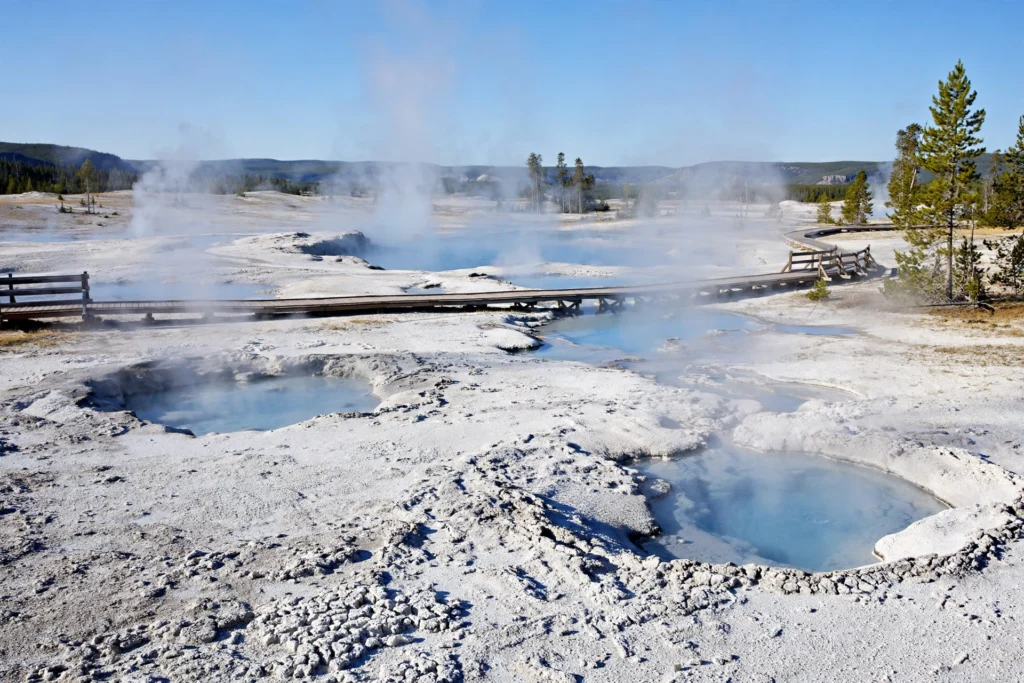
Norris is the hottest, most changeable thermal area in the park, and the one that feels most like another planet. The ground here is so hot that the basin’s features shift constantly — new springs appear, old ones go quiet, and the boardwalks are rerouted when the ground becomes unstable. In April 2024, a hydrothermal explosion in Norris was detected by instruments for the first time, a reminder that the ground under Yellowstone is genuinely active. The basin sits on the intersection of three major faults, which is why it is hotter and more unpredictable than any other thermal area in the park. The USGS Yellowstone Volcano Observatory monitors it constantly, and its weekly updates are worth reading if you are interested in the science behind what you are seeing.
Norris has two halves. Porcelain Basin is the open, bare, almost lunar half — a wide expanse of white sinter, steaming fumaroles and milky-blue pools, with almost no trees. It is the most photogenic part of Norris, and the boardwalk loop takes about 45 minutes. Back Basin is the wooded half, home to Steamboat Geyser, the tallest active geyser in the world, whose eruptions can reach 300 feet or more — though they are rare and unpredictable, sometimes years apart. Back Basin also holds Echinus Geyser, which erupted again in 2026 after nearly six years of dormancy, and a series of colourful pools and mud pots. Allow two hours for both basins, and walk Porcelain Basin first in the morning light.
Norris is the basin most visitors skip, and that is exactly why it is worth your time. It is quieter than Old Faithful and the Midway basin, it shows you the raw, unstable side of Yellowstone’s geology, and the boardwalk loops are short enough to fit into a morning between the canyon and Mammoth. On the way, stop at the smaller thermal areas that most people drive past: Artists Paintpots, a one-mile loop past pastel-coloured mud pots and small springs, and Gibbon Falls, an 84-foot waterfall on the Gibbon River just off the road. The Museum of the National Park Ranger at Norris, in a small log building near the basin, tells the story of the ranger profession — worth twenty minutes if you are passing.
Lamar Valley and Hayden Valley: Wildlife Watching
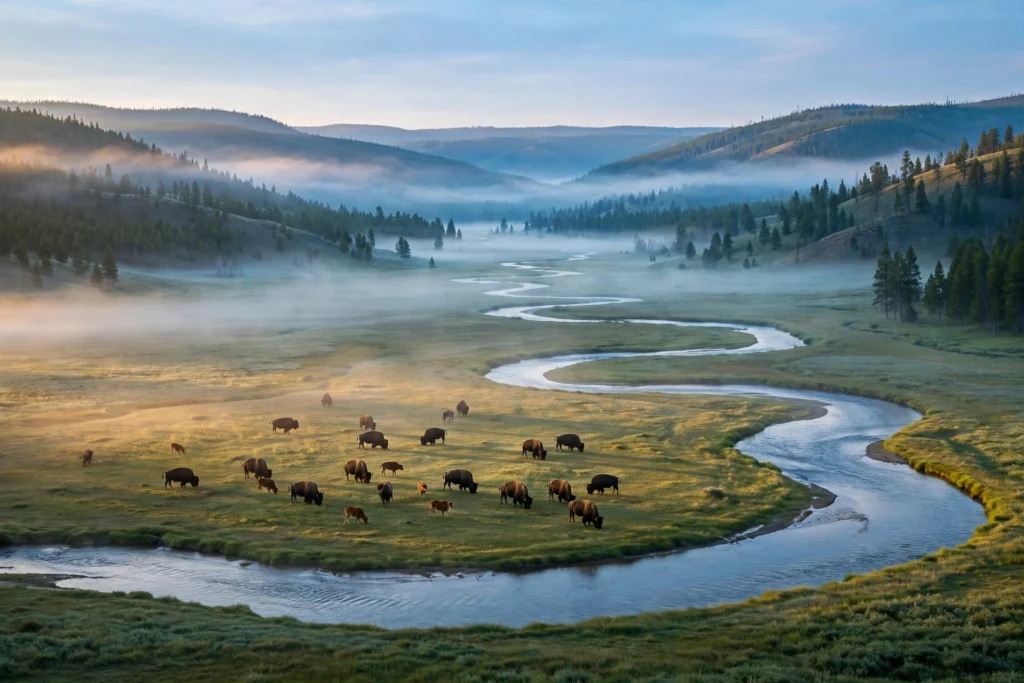
If the geysers are Yellowstone’s spectacle, the valleys are its soul. Lamar Valley, in the northeast, is called the Serengeti of North America, and it is the best place in the park to see wildlife — bison, elk, pronghorn, grizzly bears, and the wolves that were reintroduced here in 1995 after a seventy-year absence. Hayden Valley, south of Canyon Village along the Yellowstone River, is the second great wildlife valley, with large bison herds, grizzlies, pelicans and trumpeter swans on the river. Between them they hold the largest concentration of free-ranging wildlife in the lower 48 states, and a morning spent watching in either valley is the experience most visitors remember longest.
The rules of wildlife watching in Yellowstone are simple and non-negotiable. Stay at least 100 yards (91 metres) from bears and wolves and at least 25 yards (23 metres) from all other animals, including bison, elk, moose and pronghorn. Rangers cite people every summer for getting too close for a photograph, and bison injure more visitors than any other animal in the park — they can run at 35 miles per hour and charge without warning, and they look slow right up until they are not. Use binoculars or a spotting scope: the best wildlife watching in Lamar Valley is done from a pullout with a scope, watching a wolf pack work a distant hillside, not from ten feet away. If you want to compare the experience with a dedicated wildlife destination, the Tanzania travel guide covers safari-style watching in the Serengeti, and the Ecuador travel guide covers high-altitude wildlife in the Andes — Yellowstone holds its own against both.
Timing matters more than luck. Dawn and dusk are the golden hours: animals are most active, the light is best, and the roads are quiet. Be in Lamar Valley at first light — that means leaving your lodging before sunrise — and stay until mid-morning, when the animals bed down. In the evening, Hayden Valley is the better choice, with the sun setting behind the bison herds and the river. Midday is the worst time for wildlife and the best time for the geyser basins, so plan your day around that swap: valleys in the morning and evening, thermal areas in the middle of the day. Carry bear spray on every hike, know how to use it before you need it, and hike in groups of three or more in bear country. Make noise on blind corners, store food properly at campgrounds, and never approach a carcass or a kill site. The park’s wildlife is wild in the full sense of the word, and the visitors who get hurt are almost always the ones who forgot that.
Yellowstone Lake and West Thumb Geyser Basin
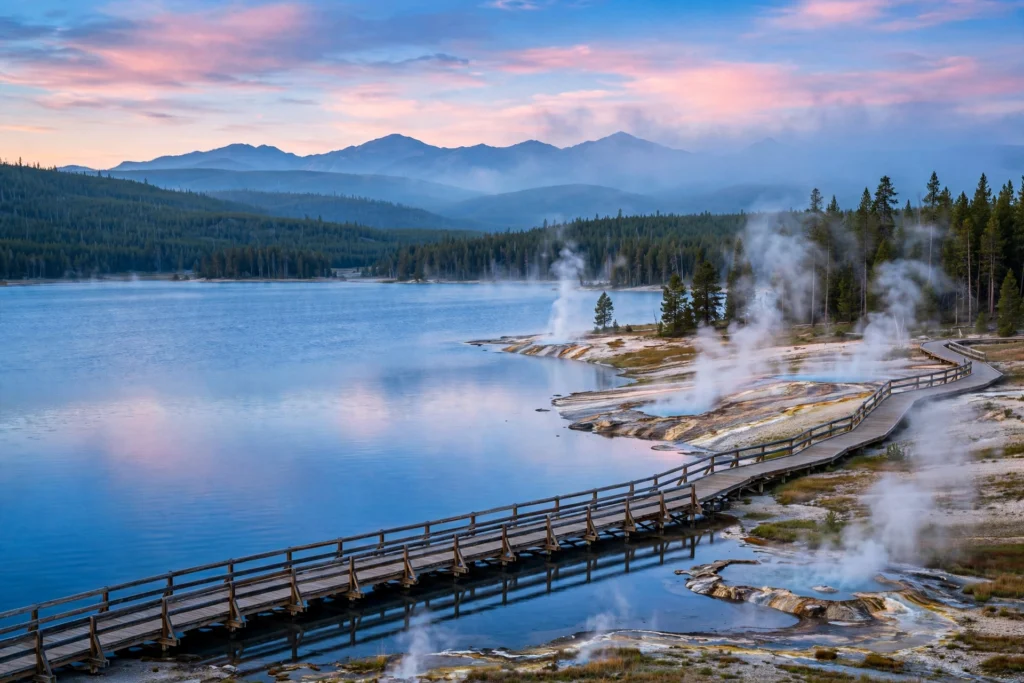
Yellowstone Lake is the largest high-elevation lake in North America, sitting at 7,733 feet with about 136 square miles of cold, clear water. It is also one of the quietest parts of the park — most visitors drive past it on the way between the canyon and the south entrance, and the ones who stop find a shoreline that feels like a mountain lake in the Alps, with the Absaroka Range rising on the far side. The lake is too cold for comfortable swimming, but it is a fine place for a slow morning: the Lake Yellowstone Hotel, a yellow colonial-style building from 1891, has a dining room and a lakeside porch that is one of the most peaceful spots in the park, and the Fishing Bridge area has a marina, a visitor centre and a general store.
West Thumb Geyser Basin, a short drive south of the lake’s west shore, is where the lake meets the thermal world. Its hot springs and geysers sit right at the water’s edge, and some of them — like Fishing Cone, a small cone in the lake itself — are submerged when the lake is high. The boardwalk loop is about a mile and takes less than an hour, and it is one of the most varied thermal walks in the park: blue pools, mud pots, and the Abyss Pool, one of the deepest hot springs in the park at more than 50 feet. West Thumb is also the gateway to Grant Village, the park’s southernmost developed area, with a lodge, campground and marina, and the starting point for the road south to Grand Teton.
The lake offers the park’s best water activities. You can kayak or canoe on Yellowstone Lake, fish for cutthroat trout with a park permit, or take a guided boat tour from the Bridge Bay Marina. All motorised and non-motorised watercraft must be inspected and permitted before launching, to prevent the spread of invasive species — check the current rules at the marina before you arrive. If you are combining Yellowstone with Grand Teton, the lake is the natural halfway point: spend a night at Lake Village or Grant Village, then drive south through the John D. Rockefeller Jr. Memorial Parkway into Grand Teton the next morning. The lake at sunrise, with steam rising off the West Thumb springs and the mountains catching the first light, is worth setting an alarm for.
Where to Stay in and Around Yellowstone
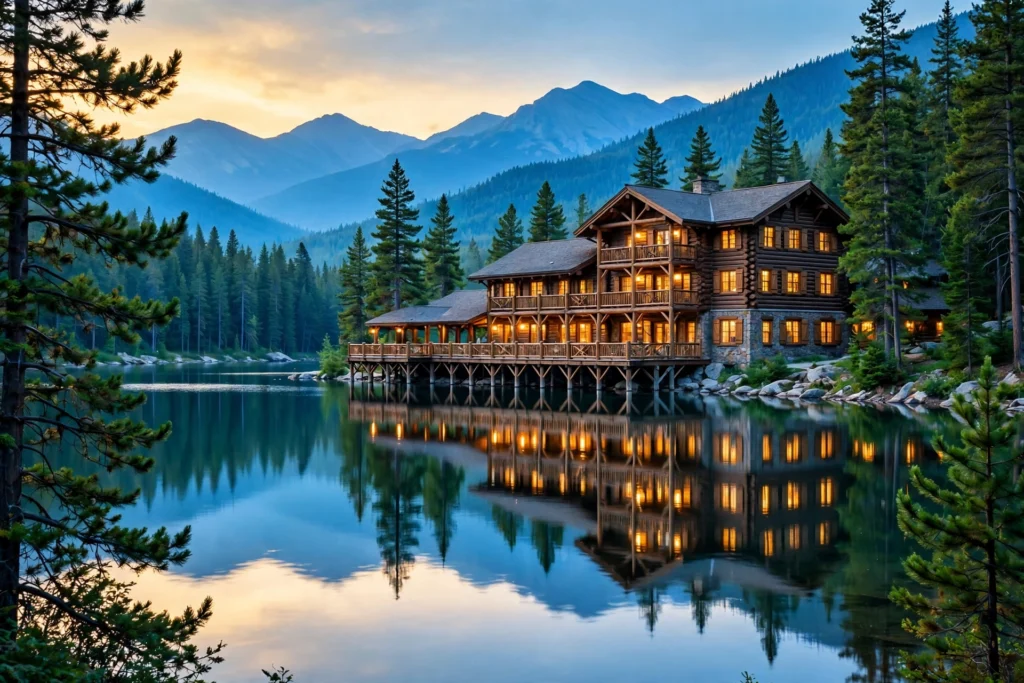
Where you sleep in Yellowstone matters more than where you sleep almost anywhere else, because the park is so big that a bad base costs you hours of driving every day. The rule is the same as for the itinerary: stay inside the park if you can, move your base between regions, and book as early as the system allows.
Inside the park. There are nine lodges with over 2,000 rooms, and in-park lodging books out fast on a 13-month window — for a summer trip, you should be booking the previous summer. The Old Faithful Inn (opened 1904) is the most famous, a great log structure with rooms ranging from historic shared-bath rooms to suites; the Lake Yellowstone Hotel is the most elegant, with a lakeside dining room; Canyon Lodge is the most practical base for the canyon country; Mammoth Hot Springs Hotel is the only lodge open in winter and the best base for the north; and Roosevelt Lodge is the quietest, with rustic cabins near Lamar Valley. Rooms inside the park are simpler and more expensive than equivalent hotels outside, and most have no television or air conditioning — you are paying for location, not luxury. Book through the park’s official lodging concessionaire and check back regularly for cancellations, which do appear.
Campgrounds. Yellowstone has 12 campgrounds, and most sites are reservable through Recreation.gov, the official federal booking service. The popular campgrounds — Madison, Canyon, Grant Village, Bridge Bay — book out within hours of their release for summer dates, so set a reminder for the day your dates open. A few campgrounds remain first-come, first-served, but relying on one in July is a gamble. Camping is limited to 14 days from 1 July through Labor Day. Campgrounds have no hookups for RVs, food must be stored properly, and bear safety rules are strictly enforced. Camping is the cheapest way to stay inside the park and the closest you will get to sleeping in the wild — but it is not a casual option, and you need proper gear for nights that can drop near freezing even in July.
Gateway towns. If you cannot get in-park lodging, the gateway towns are the next best thing. West Yellowstone, Montana, sits right at the West Entrance and has the most lodging and restaurant choice outside the park, plus the Grizzly and Wolf Discovery Center, which is worth an hour on a rest day. Gardiner, Montana, anchors the North Entrance and is the best base for the northern range and Lamar Valley; it is also the only gateway with year-round road access. Cody, Wyoming, near the East Entrance, is a proper western town with a nightly rodeo in summer and the Buffalo Bill Center of the West museum. Jackson, Wyoming, south of the park, has the widest range of upscale options and is the natural base for a Grand Teton combination. Cooke City, Montana, is tiny but perfectly placed for Lamar Valley dawn patrols. Whichever town you choose, book months ahead for summer — the good places go first, and the remaining options get expensive. Pets are not allowed on trails, boardwalks or in the backcountry, and they must stay in your vehicle or at your lodging — if you are travelling with an animal, read the guide to travelling with a cat for the general principles of travelling with a pet, and check the park’s pet rules before you go.
What to Pack and What to Eat in Yellowstone
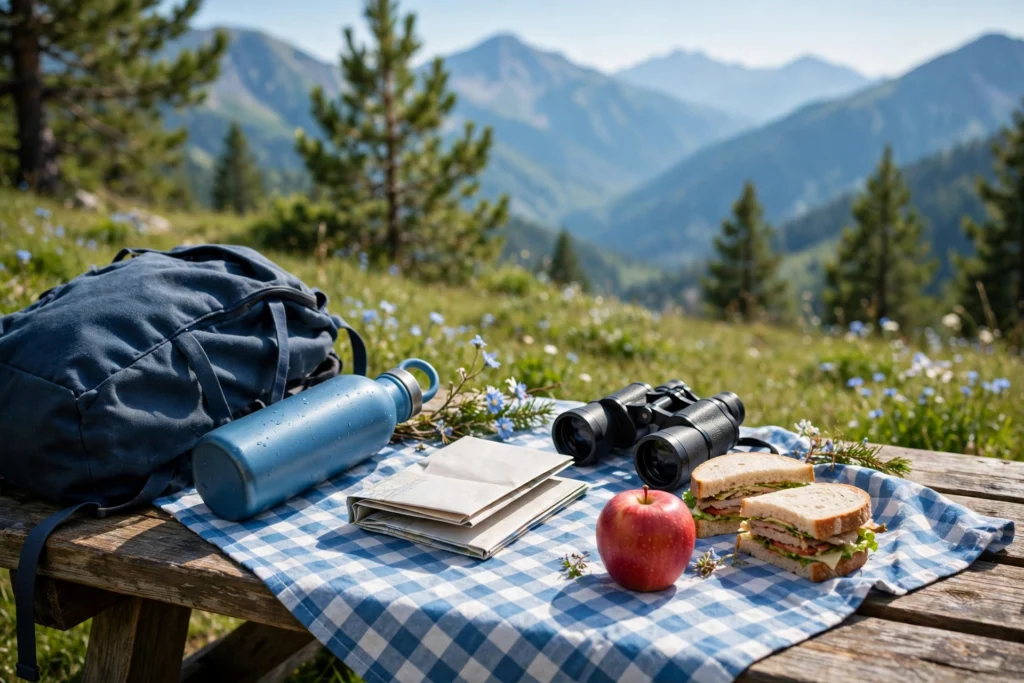
Yellowstone sits at 7,000 to 8,000 feet, the weather changes fast, and you will spend most of each day outdoors with no shops nearby. Packing right is not a detail — it is the difference between a good trip and a miserable one.
Packing checklist. Layers are the rule: a warm base layer, a fleece or insulated jacket, and a waterproof rain shell, even in July, because a sunny morning can turn into a cold, wet afternoon and nights can drop near freezing. Sturdy walking shoes or hiking boots with grip, because boardwalks are slippery when wet and trails are rocky. Sun protection — sunscreen, a hat and sunglasses — because the sun at 8,000 feet is far stronger than at sea level. A reusable water bottle, because you will be walking for hours and water fountains are scarce away from the developed areas. Binoculars or a spotting scope, which transform wildlife watching from a distant brown dot into an actual animal. Bear spray, bought or rented in a gateway town, and the knowledge of how to use it. Offline maps downloaded before you enter the park, because cell service is limited. A paper map from the entrance station, which works when your phone does not. Bug spray for June and July, when mosquitoes are active near the lakes and rivers. And a day pack to carry it all in — you will not want to walk back to the car for a jacket.
Food. There is no fine dining in Yellowstone, and that is part of the charm. The historic lodge dining rooms — the Old Faithful Inn Dining Room, the Lake Yellowstone Hotel Dining Room, the Mammoth Dining Room and the Roosevelt Lodge cookout — serve solid, sit-down meals in beautiful rooms, and they are worth one dinner each if you can get a reservation. The park’s grill counters, cafeterias and pizzerias cover lunch and quick dinners. Beyond that, the smart move is to pack your own food: the gateway towns have grocery stores, and a cooler with sandwiches, fruit and snacks saves both money and time, because you can eat at a viewpoint instead of driving back to a restaurant. Try the regional food while you are there — a bison burger, leaner than beef and widely available at park grills and gateway restaurants; anything huckleberry, from pie to ice cream, made from berries that grow wild in the surrounding mountains; and pan-seared trout from the park’s rivers and lakes. Fill up your water bottle whenever you pass a fountain, and carry more food than you think you need — distances between restaurants inside the park are long, and a missed lunch turns into a hungry afternoon.
How much does it cost? The entrance fee is the smallest part of a Yellowstone budget. The table below gives daily planning ranges per person, based on the prices in this guide. Confirm figures before you book.
| Daily cost | Budget | Mid-range | Comfortable |
|---|---|---|---|
| Lodging | $30–50 (campground) | $150–250 (gateway hotel or lodge room) | $300–450 (historic lodge or Jackson hotel) |
| Food | $20–30 (groceries and picnic lunches) | $50–70 (mix of packed lunches and lodge meals) | $90–120 (restaurants and lodge dining) |
| Fuel and car rental | $40–60 | $60–90 | $80–120 |
| Entrance fee (spread over 7 days) | $5 | $5 | $5 |
| Activities and tours | $0–20 | $20–50 | $50–100 |
| Total per person per day | $95–165 | $285–465 | $525–795 |
A three-day trip for two people, staying in a gateway hotel and eating a mix of packed lunches and restaurant dinners, typically lands in the $1,700–$2,800 range before flights. Camping and cooking your own food can cut that roughly in half; staying at a historic lodge and eating every meal in a dining room can double it. The biggest single saving is booking lodging early — the same room can cost twice as much booked a month before as it would a year before.
Frequently Asked Questions About Yellowstone Travel
Do you need a reservation or timed entry to visit Yellowstone?
No. Yellowstone does not use a timed-entry system. You pay the entrance fee at the gate or show a pass. What you do need to reserve, well in advance, is lodging and campgrounds — in-park rooms book out on a 13-month window, and popular campgrounds sell out within hours of release for summer dates.
How much is the Yellowstone entrance fee in 2026?
A private vehicle pass costs $35 and covers everyone in the car for seven days. Motorcycles are $30 and walk-in or bicycle entry is $20 per person aged 16 and over. Non-US residents aged 16 and over pay an additional $100 per person unless admitted with an Annual or America the Beautiful pass. Children under 16 enter free. Check the official NPS Yellowstone fees page before you travel.
How many days do you need in Yellowstone?
Three days is the realistic minimum to see the main attractions — the geyser basins, the canyon and the northern wildlife valleys. Two days covers the highlights in the south and centre. Four to five days is what you want if you like to hike, watch wildlife at dawn and dusk, and add a day for Grand Teton. One day is only a teaser, and you will spend most of it driving.
What is the best month to visit Yellowstone?
June and September suit most first-time visitors: the full loop is open, the weather is workable, and the crowds are thinner than in July and August. July and August are the warmest with everything open but also the busiest. Spring is best for wildlife, and winter — reached by snowcoach or snowmobile — is the quietest and most dramatic season of all.
Is Yellowstone safe?
Yes, for the vast majority of visitors who follow the basic rules. Stay on boardwalks and marked trails around thermal areas, because the ground can be thin and the water underneath is near boiling. Stay at least 100 yards from bears and wolves and 25 yards from all other animals. Carry bear spray when hiking, hike in groups of three or more, and never approach wildlife for a photograph. Most incidents in the park happen when people break one of these rules.
Can you visit Yellowstone in winter?
Yes, and it is a completely different park. From early November to mid-April most interior roads close to regular vehicles, and the geyser basins are reached by commercially guided snowcoach or snowmobile, mostly from West Yellowstone or Mammoth. The Old Faithful Snow Lodge is the only lodge open in winter. The road from the North Entrance at Gardiner through Mammoth to Cooke City stays open to cars all year and is one of the best winter wildlife drives in the country.
Conclusion
Yellowstone rewards the traveller who plans by region, starts early and stays out late. Three days is the minimum, five is the sweet spot, and the difference between a good trip and a great one is almost never the sights you choose — it is the order you see them in, the base you sleep in, and whether you were at Lamar Valley at dawn instead of in a parking queue at noon. Book your lodging months ahead, check the NPS Yellowstone site for road status and fees before you go, carry bear spray and binoculars, and give the geyser basins the time they deserve. The world’s first national park has been astonishing visitors for more than 150 years, and it has not run out of surprises yet.
People also read: London Travel Guide · Morocco Travel Guide · Iceland Travel Itinerary · Travel Itinerary Template · How to Prepare a Travel Budget · Best Places to Travel in January