
Quick Answer
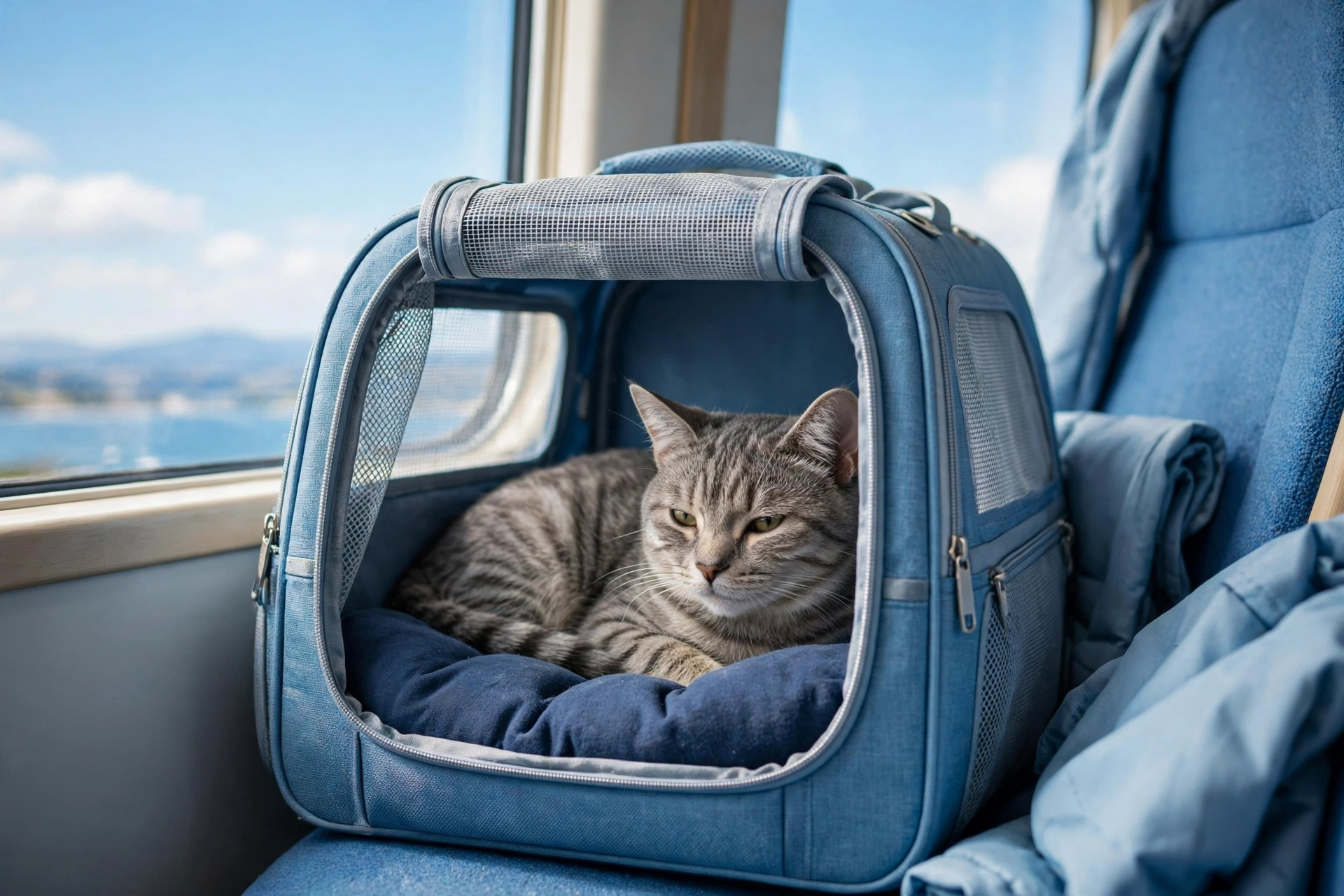
Learning how to travel with a cat comes down to three things: a carrier your cat accepts before travel day, a plan that respects how cats handle change, and paperwork checked early rather than at the last minute. Most cats do not love travel, but most can handle it well when the journey is short, predictable, and quiet, and when their food, scent, and routine stay as familiar as possible. This guide walks you through the decision to take your cat at all, the vet visit, carrier training, car and plane travel, packing, calming strategies, and what to do when things go wrong — so you can travel with confidence instead of guessing.
Cats are creatures of habit in a way that surprises first-time cat travelers. A dog may treat a car ride as an adventure. A cat treats a car ride as evidence that something in their world has gone wrong. That does not mean travel is cruel or impossible. It means the preparation matters more than the trip itself. The owners who report the calmest trips are almost always the ones who started weeks early, kept the carrier out in the living room instead of in a closet, and practiced short trips before the real one. If you only have a few days, you can still improve things a lot — but be honest about what is realistic, and consider whether leaving your cat at home with a trusted sitter is kinder for a very short trip.
This article is written for travelers in the United States, with official sources cited where rules matter. Rules for airlines, states, and other countries change, so treat the official pages linked here as your final check, not this article alone. When in doubt, call your vet and your airline, and get the answer in writing.
Should You Take Your Cat With You or Leave Them at Home?
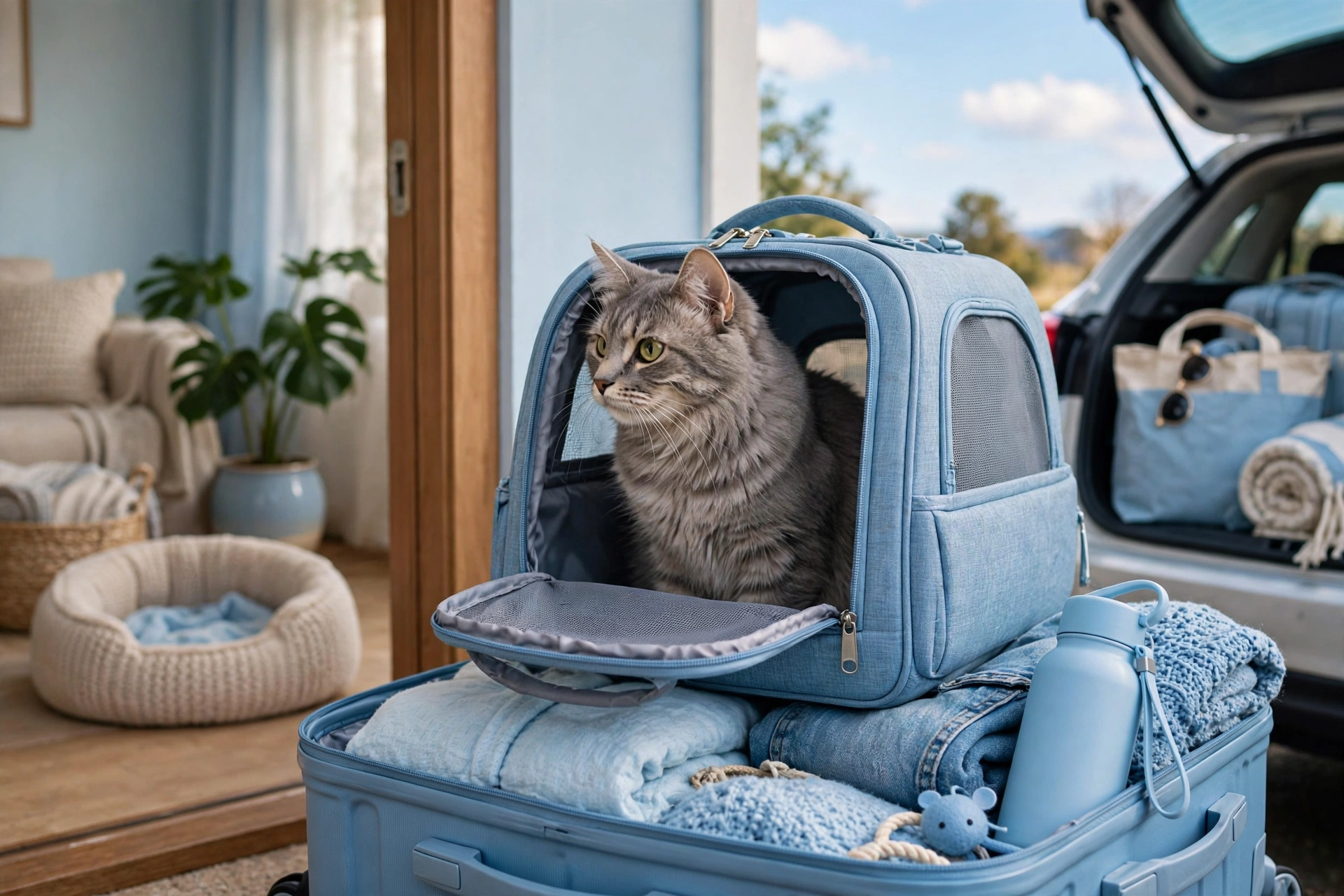
The first question is not which carrier to buy. It is whether your cat should travel at all. For a weekend trip, many cats are happier staying home with a sitter who visits once or twice a day, in a house that smells familiar, than they would be enduring a car ride, a strange hotel room, and another car ride. For a move, a trip of several weeks, or a situation where no reliable sitter exists, traveling together is clearly the better choice. For everything in between, weigh the length of the trip against the stress of the journey.
A useful rule of thumb is to compare total travel time with time away. If you will spend six hours driving each way for a two-night stay, your cat endures twelve hours of travel for forty-eight hours away. That ratio rarely favors the cat. If you are relocating, spending a month in a rental, or taking a long road trip where your cat will settle into one place for a while, the ratio looks much better. Age and health matter too. A healthy adult cat who is already comfortable in a carrier is a very different traveler from a senior cat with kidney disease, a kitten who has never left the house, or a cat who panics and injures themselves in a carrier. Your vet can help you judge this honestly.
There is also a middle option many owners forget: a trial. Take your cat on a short drive to nowhere, then home again, and watch what happens. Some cats meow for ten minutes and settle. Others pant, drool, vomit, or try to escape the carrier with real force. That trial tells you more than any article can. If the trial goes badly, you still have time to change plans, ask your vet about calming options, or arrange a sitter. If it goes well, your confidence — and your cat’s — grows before the real trip.
When you do decide to travel together, planning the trip around your cat pays off in ways that also make your own journey smoother. Building a realistic travel itinerary template with driving times, hotel stops, and buffer time means you are not rushing a stressed cat through a packed schedule. A calmer schedule is a kindness to both of you.
Start With a Vet Visit and the Right Paperwork
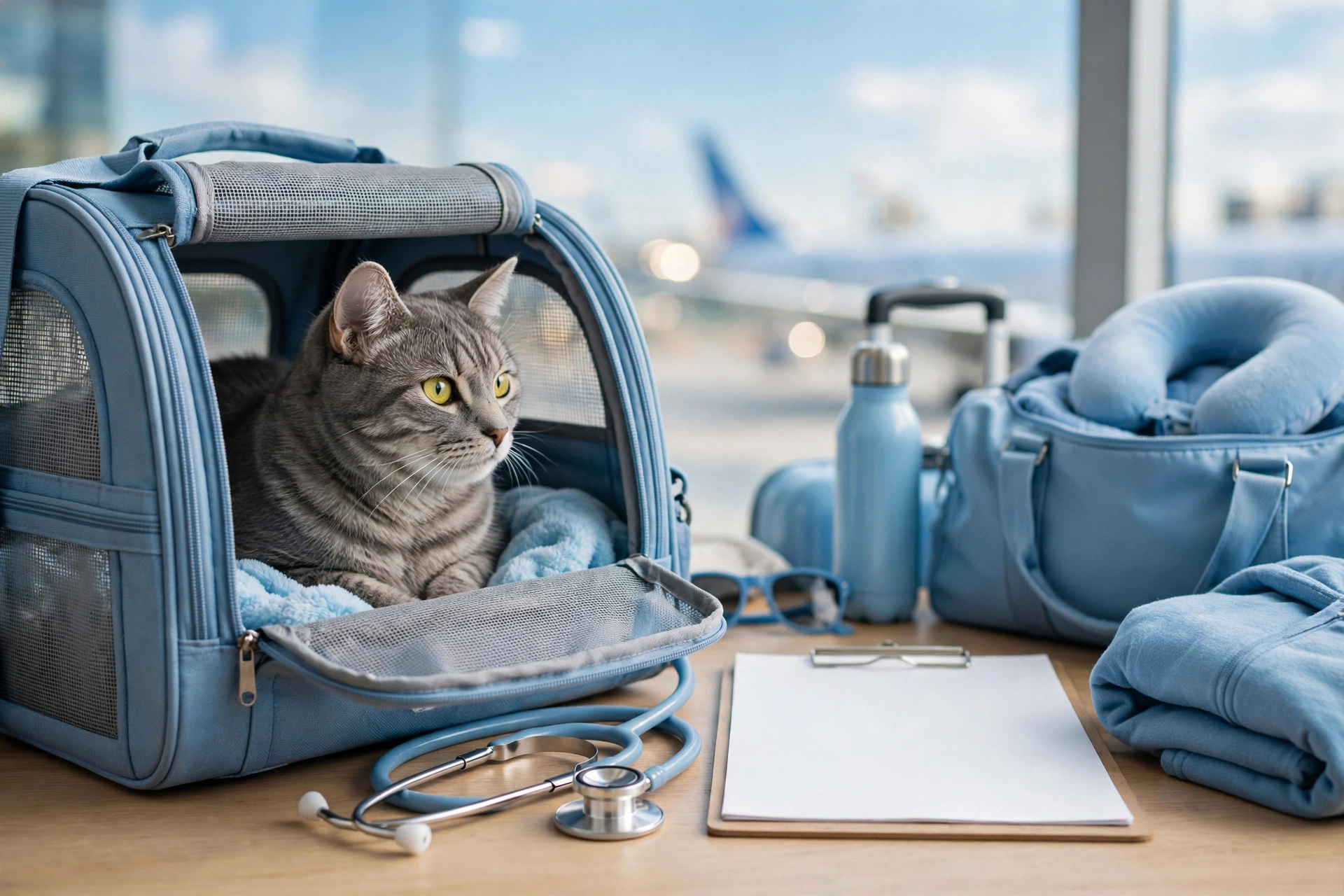
Book a vet visit well before you travel, ideally three to four weeks ahead for domestic trips and several months ahead for international travel. Tell the vet where you are going, how you are traveling, and how long you will be away. Ask for a general health check, a review of vaccinations, parasite prevention, and a conversation about travel anxiety. Bring your cat’s vaccination records, and ask what paperwork your destination, airline, or state may require. Some airlines and states ask for a health certificate issued within a short window, often ten days before travel, so the timing of this visit matters and you may need a second, closer-to-departure visit.
For travel within the United States, the federal picture for cats is simpler than many owners expect. The CDC guidance on bringing an animal into the United States states that cats must appear healthy on arrival, are subject to inspection at ports of entry, and are not federally required to show proof of rabies vaccination for importation, although vaccination is recommended and your destination state may have its own requirements. Hawaii and Guam are notable exceptions, with locally imposed quarantine requirements even for cats arriving from the U.S. mainland. That distinction matters: “no federal rule” does not mean “no rule at all.” Check your destination state, your airline, and your accommodation separately.
For international travel, start much earlier. The USDA APHIS guidance on taking a pet from the United States to another country explains that you should contact a USDA-accredited veterinarian as soon as you decide to travel, because destination countries set their own entry requirements, including vaccinations, tests, treatments, and a USDA-endorsed health certificate. Some destinations require a microchip placed before the rabies vaccination, a waiting period after vaccination, a blood test, or parasite treatment within a precise window. These timelines cannot be compressed at the last minute. If you miss a window by a day, you may have to postpone the trip. Write every deadline down, and confirm each one with your vet rather than relying on a blog post or a forum thread.
Paperwork is only part of the vet conversation. Ask your vet to check your cat’s weight, because airline carrier limits are strict and a cat who has gained weight since you bought the carrier may no longer fit the rules. Ask about motion sickness if your cat vomits in the car, and about anxiety if your cat panics. Some vets suggest pheromone sprays, calming supplements, or, for some cats, a prescription sedative for a specific journey. Sedation is not a casual choice: it must be trialed at home first, at the dose your vet prescribes, so you know how your cat responds before you are on a plane with no way back. Never use another pet’s medication, never sedate a cat without veterinary advice, and never assume a calm cat at home will be a calm cat in transit.
Identification deserves its own line on your checklist. Make sure your cat’s microchip registration has your current phone number, and that your cat wears a collar with an ID tag showing a mobile number you will answer while traveling. A cat who escapes in an unfamiliar town is already frightened; current identification is the simplest way to turn a bad hour into a reunion instead of a loss. Take a clear recent photo of your cat before you leave, and keep a copy of vaccination records and your vet’s phone number in your phone and in your cat’s travel bag.
Choose a Carrier Your Cat Can Actually Tolerate
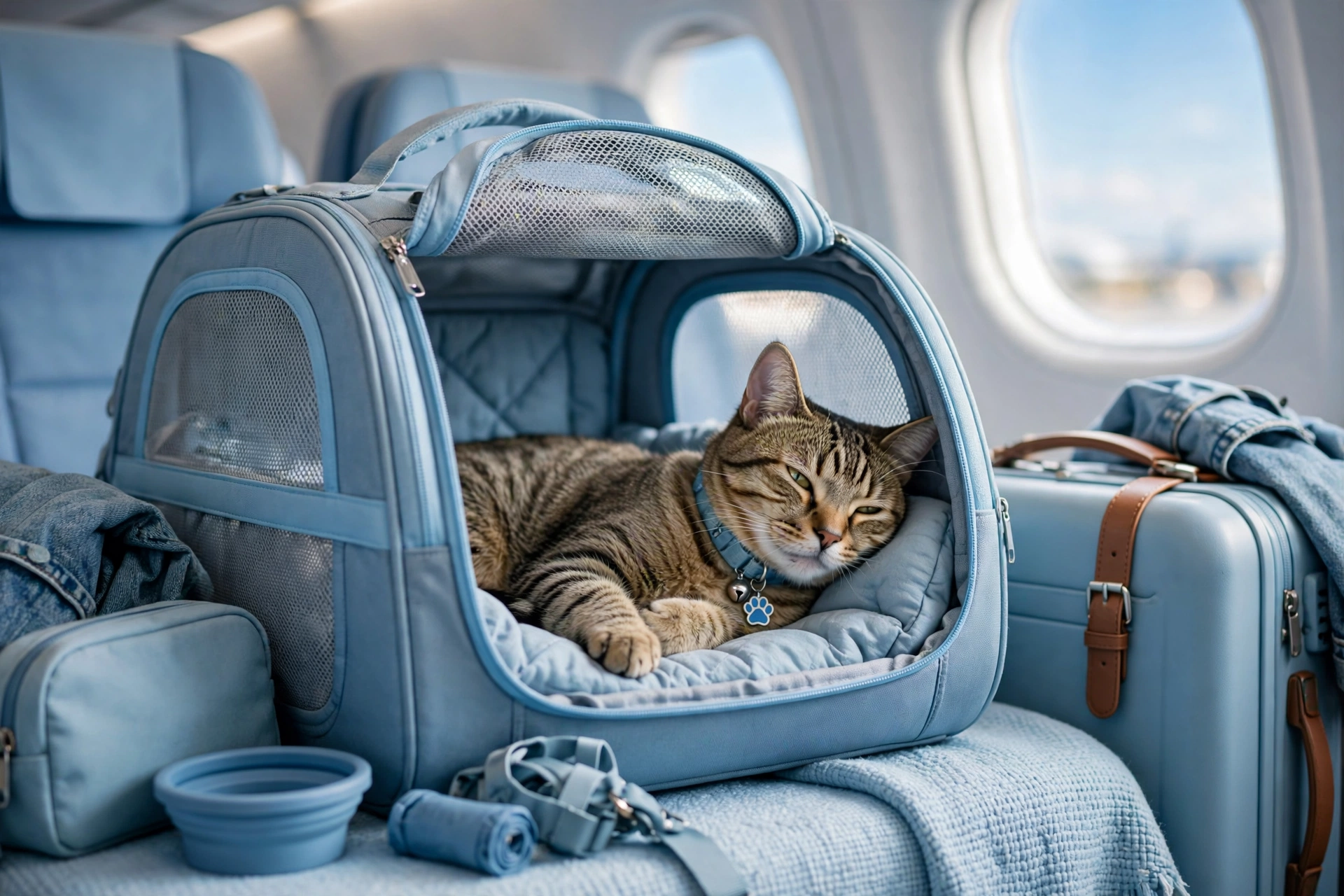
The carrier is the single most important purchase for cat travel, and it is worth choosing slowly. A good carrier is sturdy, well ventilated, easy to open without a struggle, and sized so your cat can stand, turn around, and lie down naturally. A carrier that is too small adds stress; one that is far too large lets your cat slide around in a moving car. For air travel, the airline’s under-seat dimensions are the deciding factor, and they vary by aircraft, so measure your carrier and confirm the exact limits for your specific flight before you buy or before you fly.
Hard-sided carriers offer the best protection in a sudden stop and are easy to clean if your cat has an accident. Soft-sided carriers are lighter, easier to carry through an airport, and often fit under seats more forgivingly, but they must hold their shape and close securely — a carrier that collapses inward when lifted is not safe. Look for multiple ventilation panels, a door that latches firmly and cannot pop open under pressure, a flat base that does not sag, and a top or side opening that lets you place your cat in gently or lift them out without a wrestling match. If your vet ever needs to examine a nervous cat, a top-loading carrier makes everyone’s life easier.
Think about how you will carry it, too. A shoulder strap, a handle that does not dig into your hand, and a carrier that sits level when you set it down all matter on a long travel day. Line the base with an absorbent pad and a familiar-smelling blanket or towel from home. Familiar scent is one of the few comforts you can carry with you, and it costs nothing. Avoid loose toys with small parts, dangling strings, or anything your cat could chew apart unsupervised in transit. A small, safe comfort item is plenty.
If you are traveling by car and the journey is longer than about six hours, a standard carrier alone may not be enough. Your cat will need a chance to drink and use a litter tray, which means either a larger crate setup in the vehicle or planned stops in a safe, enclosed space. Never open the carrier in an open car park or at a roadside stop where a frightened cat can bolt. Plan these stops around enclosed rooms — a hotel room, a friend’s house, or a pet-friendly rest area with a closed space — and keep a harness and leash on your cat before you open any door. Escapes happen in seconds and in the most ordinary moments: a door opened for a coffee, a carrier unlatched to check on a meowing cat. Treat every opening as a risk, and you will prevent most of them.
Carrier Training: A Slow, Low-Pressure Plan That Works
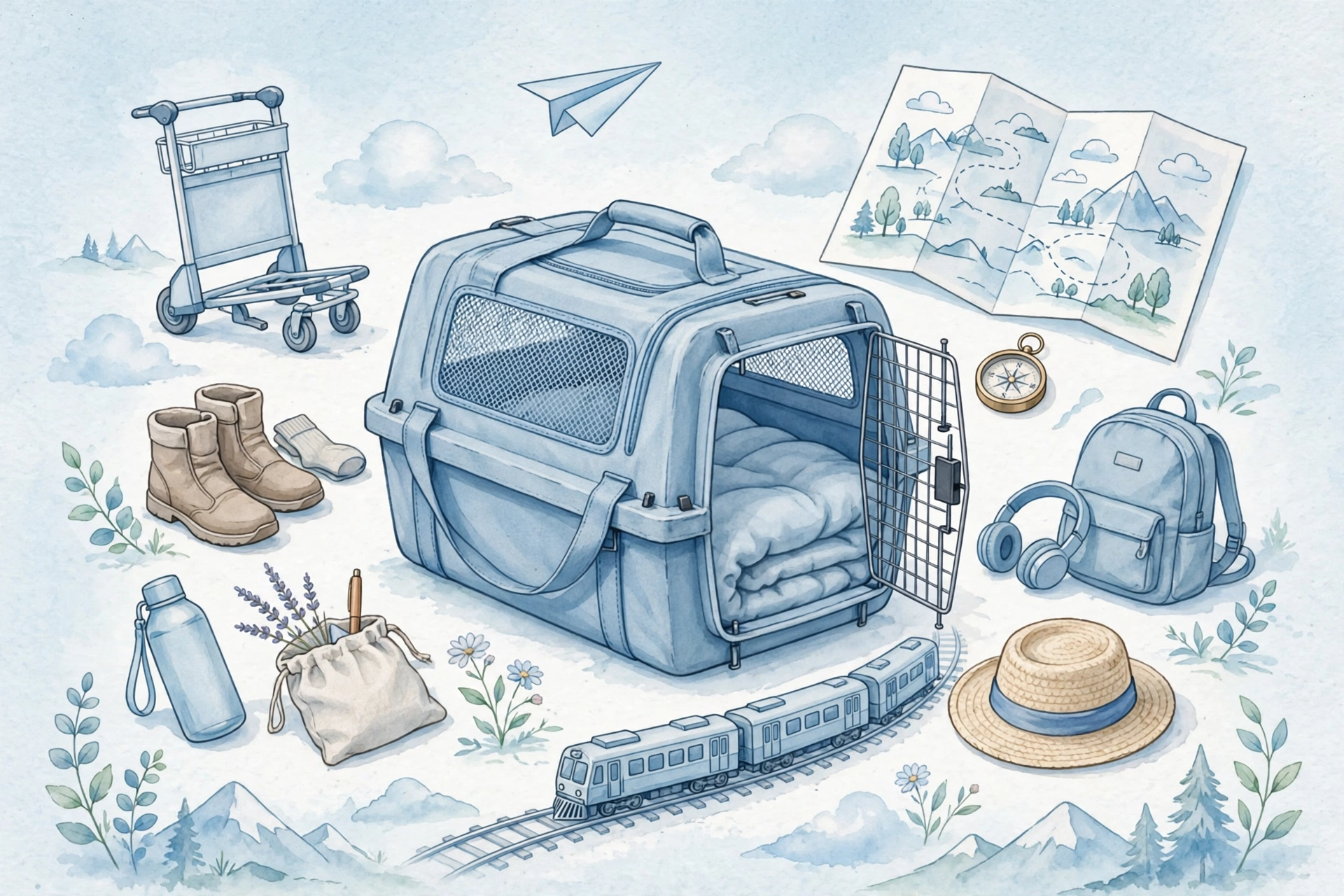
Most travel stress starts long before travel day, with a carrier that only appears when something unpleasant is about to happen. The fix is simple and takes patience: make the carrier part of the furniture. Leave it out in your cat’s favorite room with the door open, a soft blanket inside, and the occasional treat placed nearby. Let your cat investigate on their own schedule. Some cats walk in within an hour. Some take days. Both are normal. The goal is not to trick your cat into the carrier once, but to change what the carrier means.
Once your cat steps in and out willingly, add small steps one at a time. Close the door briefly, then open it again before your cat starts to struggle, and offer a treat. Carry the carrier around the house for a minute or two, keeping it level and steady. Then try a short car trip — around the block, engine on, carrier secured — and come straight home to a treat and a calm return to normal life. Lengthen the trips gradually over days or weeks. Short, calm repetitions beat one long, stressful practice run every time. If your cat has a bad session, do not push through it. End on a calm note, go back a step, and try again another day.
Pheromone sprays can help some cats, but test them at home first so travel day is not your first experiment. Spray the carrier bedding a short while before your cat uses it, following the product instructions, and watch for any reaction. The same principle applies to calming supplements or prescribed medication: trial at home, at the same time of day you expect to travel, and note how long the effect lasts and whether your cat seems groggy, unsteady, or unusually quiet. A cat who is too sedated to balance in a moving vehicle is not a safer cat. Your vet can adjust the plan based on what you observe.
Children and other family members should be part of the training, not spectators on travel day. Teach everyone the same calm routine: move slowly around the carrier, speak quietly, never chase a cat into a carrier, and never drag a cat out by force. If your cat hides under a bed when the carrier appears, give them time and use treats and patience rather than pursuit. A cat who is cornered and grabbed will remember that feeling, and the next trip will be harder. The slow way feels inefficient, but it is the fastest way to a cat who travels without a fight.
How to Travel With a Cat by Car
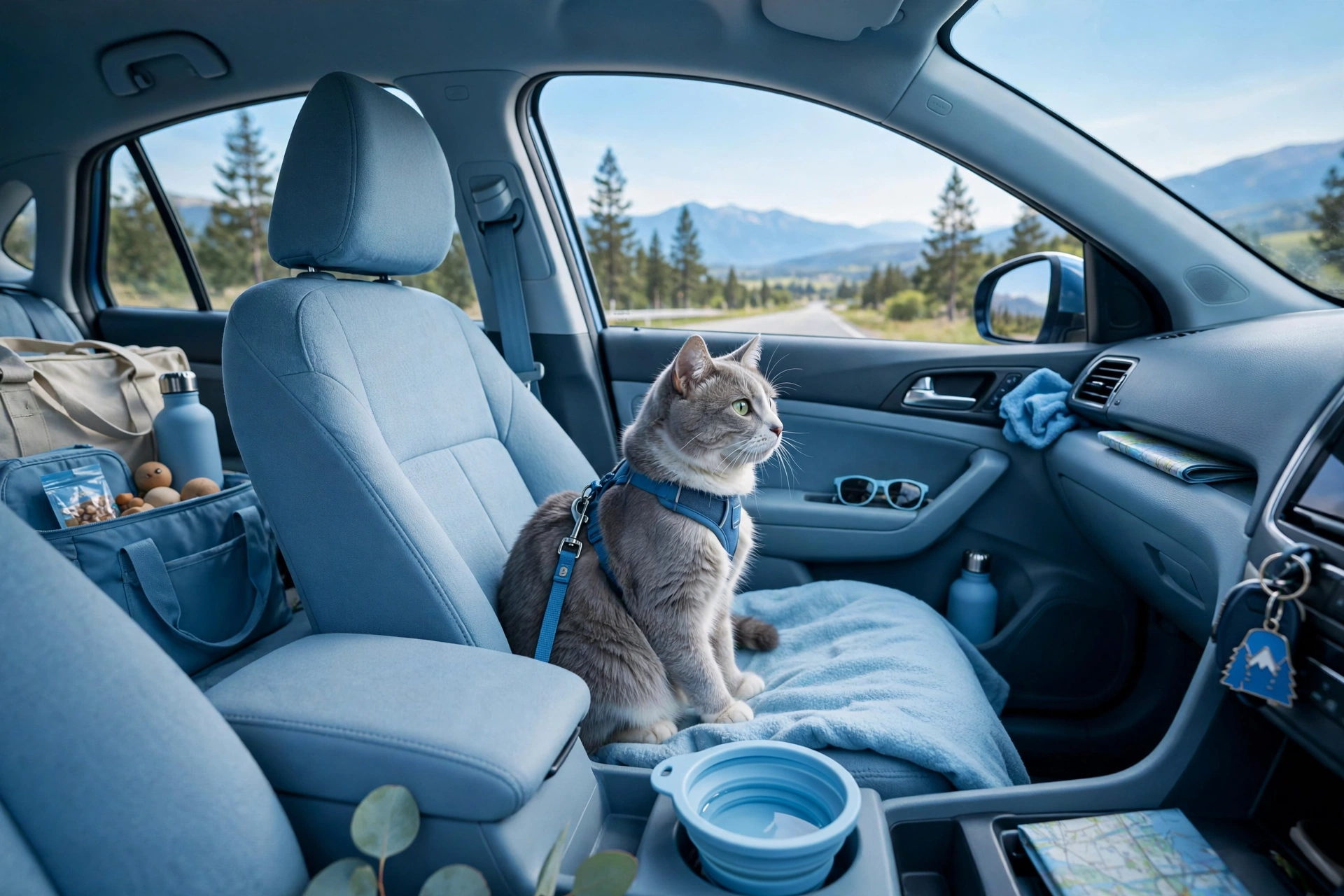
For most cat owners, the car is the best way to travel with a cat. You control the temperature, the noise, the stops, and the schedule, and your cat never leaves your care. The rules are straightforward but non-negotiable: your cat travels in a secured carrier for the entire time the vehicle is moving, the carrier sits on a level surface where it cannot slide or topple, and your cat is never left alone in a parked car. Heat builds fast in a parked vehicle, even on a mild day with windows cracked, and a cat left alone is also at risk of theft or escape. If you must stop and cannot take your cat with you, plan stops where your cat can stay with a traveling companion, or choose destinations where your cat is welcome inside.
Setting Up the Car for a Cat
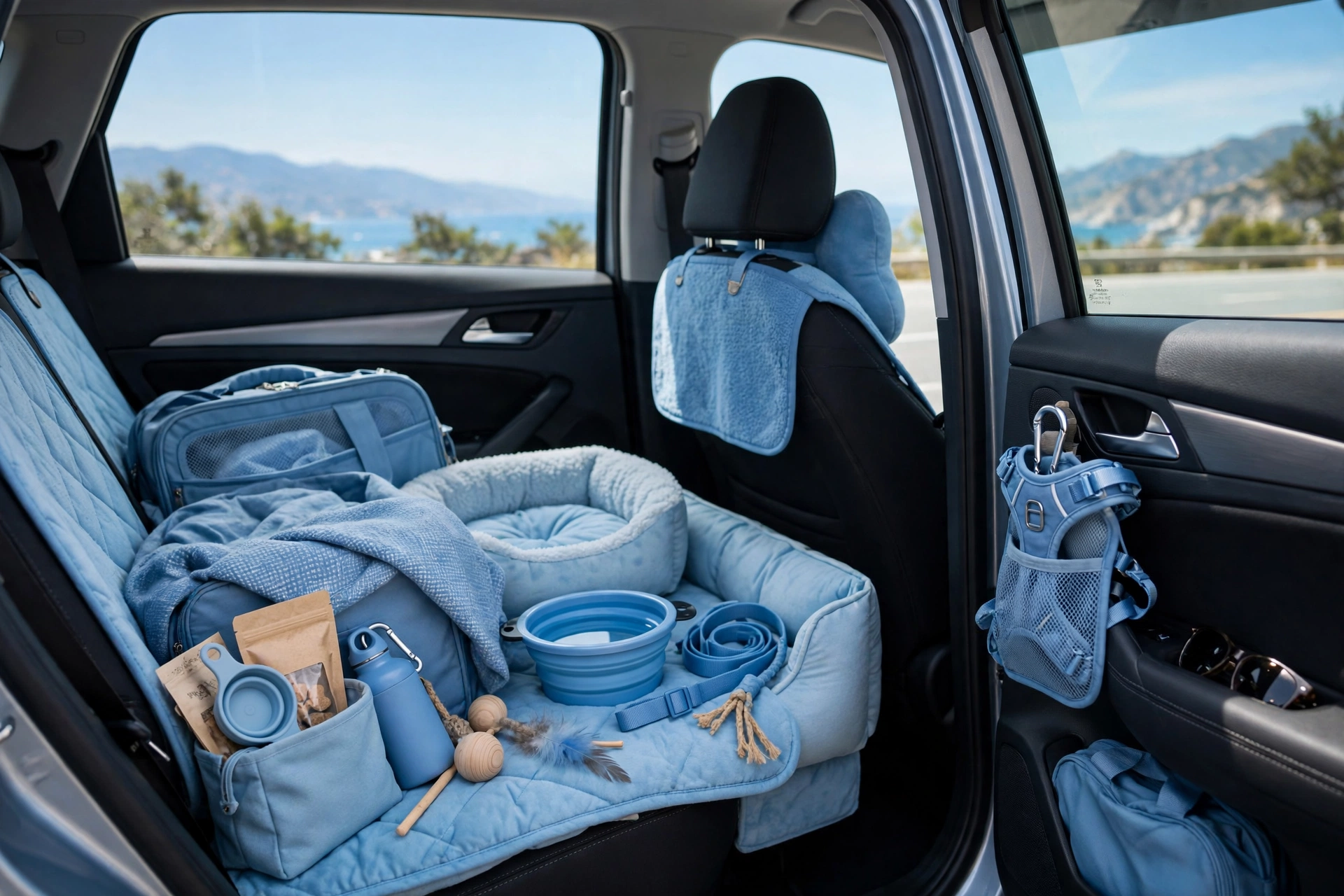
Place the carrier on the back seat, secured with a seat belt passed through the handle or around the carrier, or on the floor behind the front seats where it cannot move. Do not place a carrier in the trunk of a sedan, where airflow and safety are compromised, and do not put a carrier on the front seat, where airbag deployment is a danger. Keep the car at a comfortable, steady temperature — about the same as your cat’s home — and avoid sudden blasts of cold air or loud music. Many cats settle once the car’s rhythm becomes predictable, but the first ten to twenty minutes are often the loudest. A calm voice, a steady speed, and a covered carrier can help. Some cats relax when a familiar-smelling towel drapes over the carrier; others prefer to see out. Try both at home before the trip, and use whichever your cat prefers.
Secure everything else in the car, too. A loose bag that slides into the carrier during braking frightens a cat and can injure them. Keep your cat’s travel bag within reach but not on top of the carrier, and keep water, paper towels, spare pads, and a small trash bag easy to grab without opening the carrier. If another person is traveling with you, ask them to sit near the carrier and monitor your cat, speaking calmly if your cat meows. Your cat does not need constant entertainment, but a familiar person nearby is reassuring.
Food, Water, and Litter Stops on Long Drives

Feed a smaller, lighter meal than usual a few hours before departure, rather than a full meal right before you leave, to reduce the risk of motion sickness. Offer water at stops, but do not be surprised if your cat refuses to drink in the car — many cats will not drink or eat until they feel safe. For drives under about six hours, most cats manage fine in a standard carrier without food or a litter tray, as long as they have eaten, drunk, and used the litter tray before departure. For longer drives, plan a proper break in an enclosed space where your cat can drink, stretch, and use a portable litter tray in safety.
Portable litter trays designed for travel fold flat and use a small amount of your cat’s usual litter, which carries a familiar scent. Set the tray up in a hotel room or another closed room, place your cat in the room with the carrier door open, and give them time. Do not force the issue. Some cats will use the tray quickly; others will wait until they reach their final destination. Either way, keep the routine as close to home as possible: the same food, the same litter, the same feeding times. A sudden change of diet on a travel day is a reliable recipe for an upset stomach, so pack enough of your cat’s regular food for the whole trip plus a little extra, in case of delays.
Plan your driving day around your cat, not just the road. Shorter driving days with an overnight stop in a genuinely cat-friendly hotel beat a marathon drive that leaves everyone exhausted. When booking, confirm in writing that cats are welcome, not just pets in general, and ask about fees, floor preferences, and any restrictions. A hotel that welcomes dogs but not cats, or that charges a large fee per night, can change your budget quickly. Thinking through costs in advance, including pet fees, vet visits, and carrier purchases, is part of realistic planning, and a simple travel budget helps you see the full trip cost before you leave rather than discovering it on the road.
How to Travel With a Cat by Plane
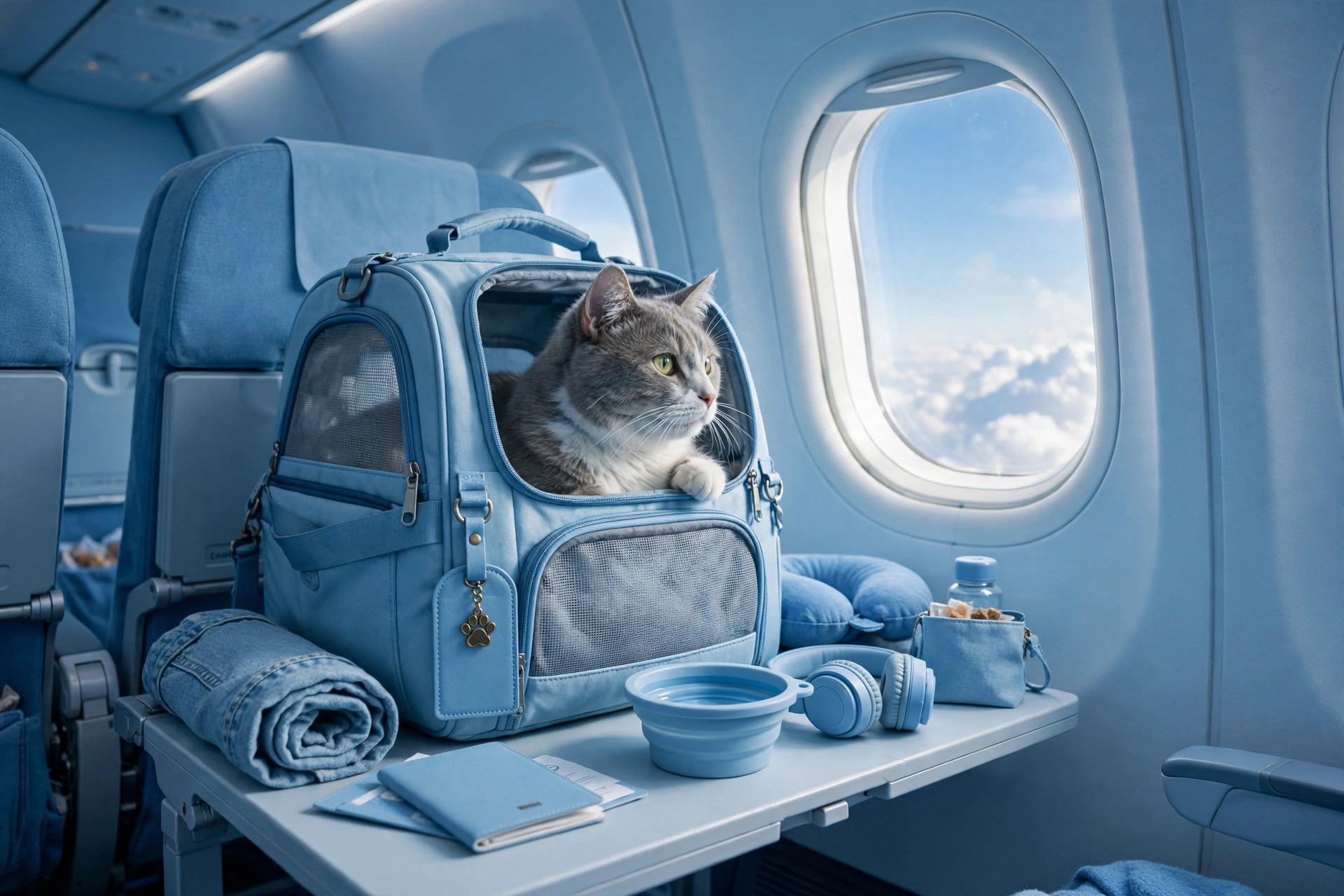
Flying with a cat is possible, but it demands more planning than driving, and it is worth considering honestly whether the flight is necessary. If driving is a realistic alternative, it is usually calmer for the cat. If you must fly, start with your airline’s pet policy, not a general guide. Each airline sets its own rules for cabin versus cargo travel, carrier dimensions, weight limits including the carrier, fees, age limits, and health documentation. These rules also vary by aircraft and route, and they change. Read the policy for your exact flight, confirm it by phone or in writing if anything is unclear, and arrive with printed copies of the policy and your cat’s paperwork.
In the Cabin or in Cargo: What to Decide
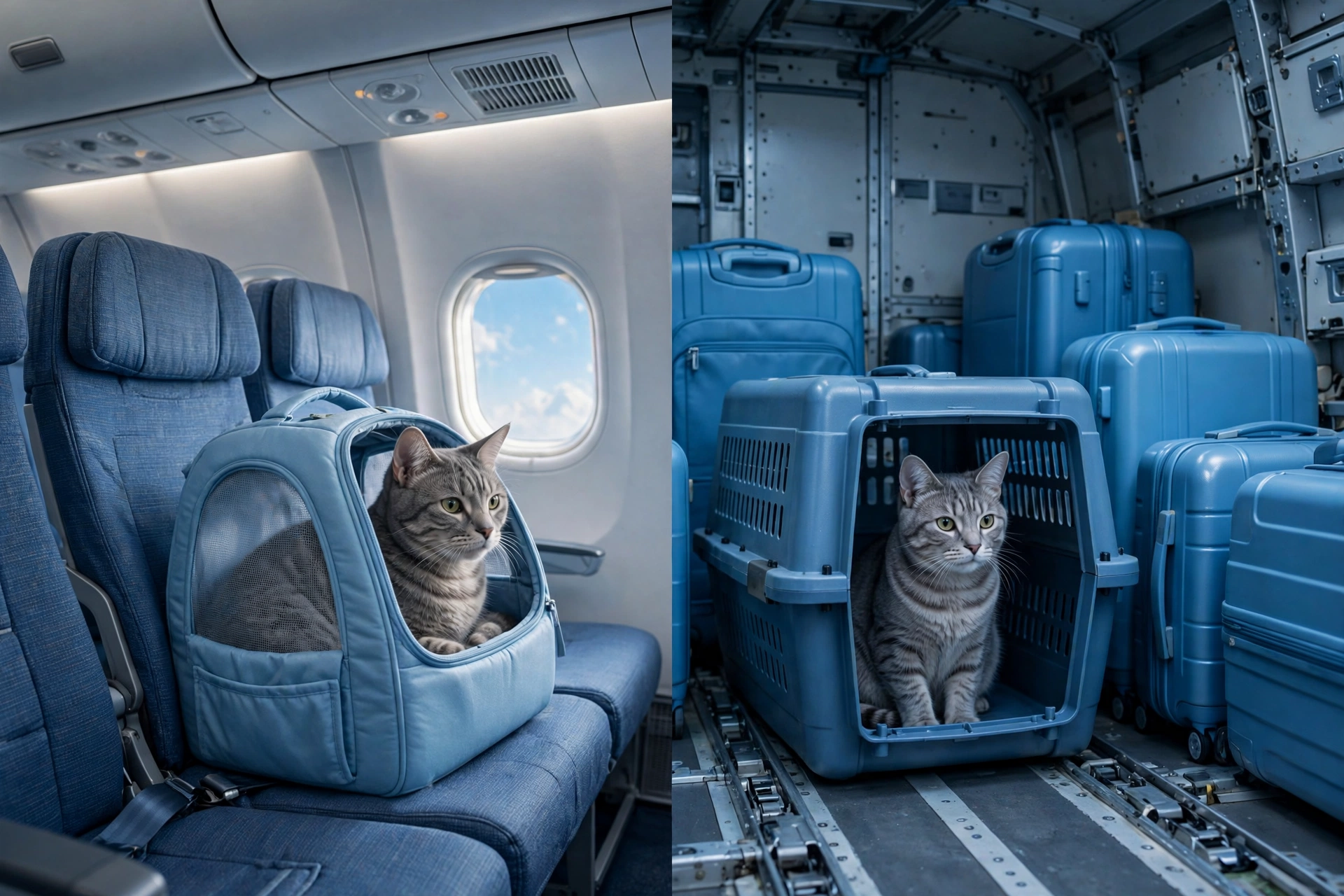
Most owners prefer in-cabin travel, where the cat stays with them under the seat in an airline-approved carrier. In-cabin space is limited and often must be reserved in advance, sometimes for a fee, and there may be a limit on the number of pets per flight, so book early. Your cat must be able to stand, turn around, and lie down in the carrier, and the carrier must fit under the seat in front of you. Practice at home with the exact carrier you will fly with, including the time your cat will spend zipped inside it.
Cargo travel is a bigger decision and should not be taken lightly. Cats in cargo travel in a pressurized, temperature-controlled hold, but they are separated from you, exposed to more noise and handling, and subject to temperature embargoes on very hot or cold days. Flat-faced breeds, very young kittens, senior cats, and cats with respiratory or heart conditions face higher risks in cargo, and some airlines restrict or refuse them. Discuss cargo travel with your vet before you book, and ask directly whether your cat is a good candidate. If your vet has reservations, listen. A cheaper or faster flight is never worth a serious health risk to your cat.
Direct flights are almost always better than connections for a traveling cat. Every connection is another loading, another wait on a tarmac, and another chance for a delay that leaves your cat waiting in an unfamiliar place. If a connection is unavoidable, allow a generous layover, confirm that your cat’s reservation carries through, and ask what happens to pets during irregular operations. Keep your cat’s food, medication, and a small comfort item in your personal item, not in checked luggage, so a delayed bag never means a hungry or unmedicated cat.
Getting Through Airport Security With a Cat
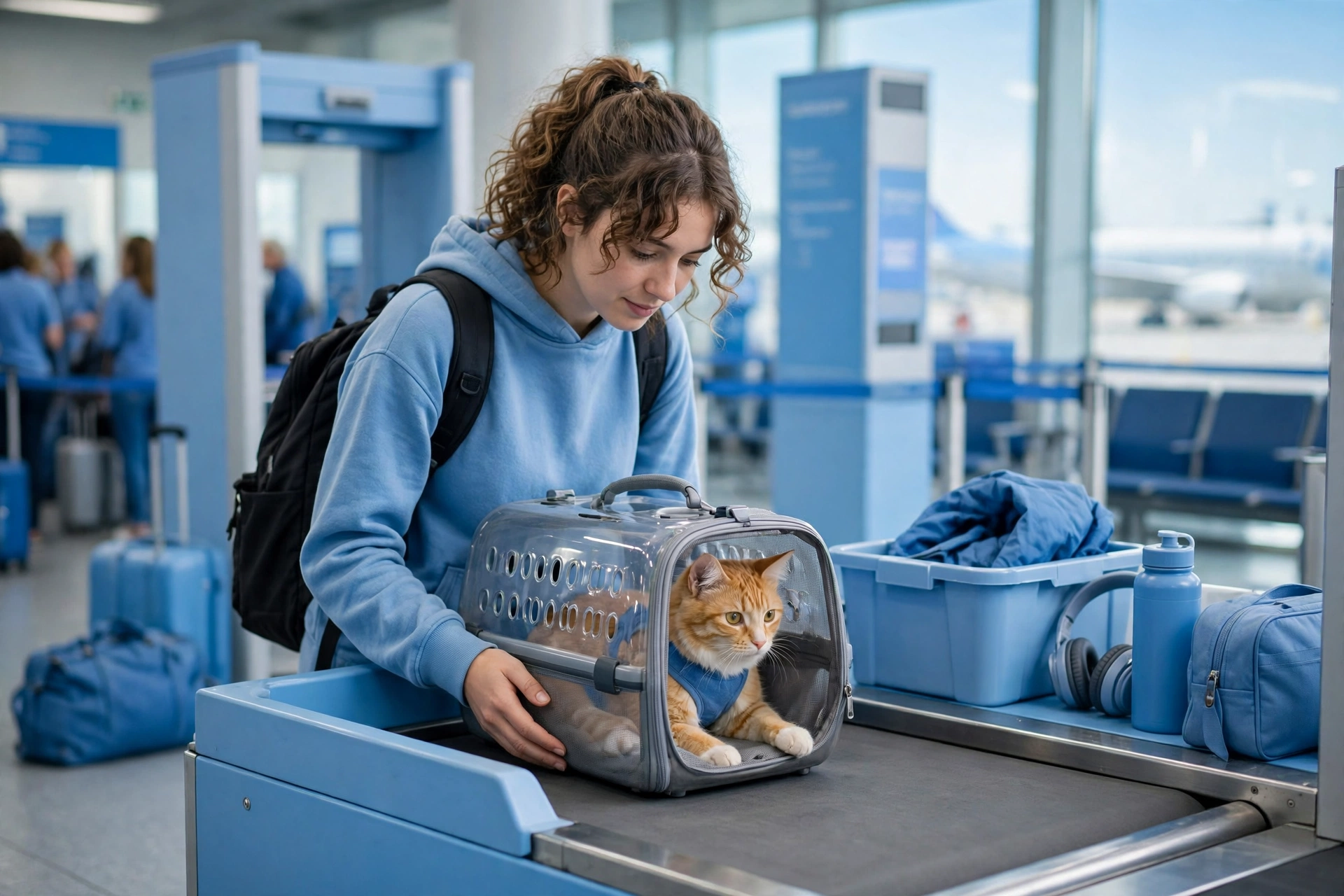
Airport security is the moment most cat owners worry about, and preparation turns it from a crisis into a routine. In the United States, you will typically remove your cat from the carrier, send the empty carrier through the X-ray machine, and carry your cat through the metal detector or walk them through on a leash, while an officer screens your hands. Your cat never goes through the X-ray machine. The risk is obvious: a frightened cat in a busy, noisy checkpoint can bolt. Reduce that risk before you reach the checkpoint. Put a secure harness and leash on your cat before you leave home, and keep them on under the carrier. Ask for a private screening room if your cat is likely to bolt — you can request this from an officer before you open the carrier. Arrive earlier than you would without a pet, so you are not rushing through this step.
Practice the sequence at home: harness on, cat into carrier, carrier out, cat held securely, cat back in. The more familiar the handling feels to your cat, the less they will struggle when it matters. At the checkpoint, move to the re-composure area away from the flow of passengers before you reopen the carrier, and double-check every latch before you walk away. Keep your cat’s carrier zipped and latched from that moment until you reach a private, enclosed space. A surprising number of escapes happen not at security, but in the minutes after it, when an owner opens the carrier to comfort a meowing cat in a crowded gate area.
On the plane, keep the carrier under the seat in front of you, as instructed, and resist the urge to open it during the flight. Talking softly to your cat is fine. Opening the carrier in a cabin full of strangers, with a frightened cat and nowhere safe for them to go, is not. Offer no food during the flight unless your vet advises otherwise, and do not be alarmed if your cat refuses water — most cats drink little during a flight and catch up once they reach a quiet room. After landing, move promptly to a calm space, offer water, and give your cat time before the next leg of the journey.
Trains, Buses, and Other Ways to Travel With a Cat

Trains can be a good middle ground between cars and planes, especially for medium-distance trips, but pet policies vary widely by operator and route. Some train services allow small pets in carriers, sometimes for a fee and sometimes only on certain services or in certain cars. Others allow only service animals. Check the operator’s policy for your exact route before you book, and confirm whether your cat must stay in the carrier for the whole journey, whether there are pet-free cars you must avoid, and what happens if the train is delayed. A carrier that works for a car may be too large for a train seat area, so measure the space you will actually have.
Buses are generally the hardest option for cat travel. Many intercity and local bus services do not allow pets, or allow only service animals, and those that do often require the animal to travel in a carrier in a luggage compartment, which is not a safe or kind option for a cat. If a bus is your only option, read the policy in full, call the operator, and be prepared to choose another mode of transport if the policy does not clearly allow your cat to travel safely in the cabin with you. Ferries vary too: some allow pets in carriers in passenger areas, others require pets to stay in vehicles or kennels, and crossing times can be long. For any of these modes, the same principles apply: carrier secured, cat contained, harness on before any door opens, and a plan for food, water, and litter on longer crossings.
Whatever mode you choose, think about the whole door-to-door journey, not just the main leg. A smooth flight followed by a long taxi ride with a loose cat undoes the good planning. A calm train ride followed by a hotel that turns out not to accept cats is a problem you could have prevented with one confirmation message. Planning the first night’s stay, the ground transport, and the return journey with the same care as the outbound trip is what separates a stressful trip from a manageable one. Useful travel apps can help you find pet-friendly stays and navigate an unfamiliar city, but always confirm a property’s cat policy directly before you rely on an app listing.
Packing Checklist for Traveling With a Cat
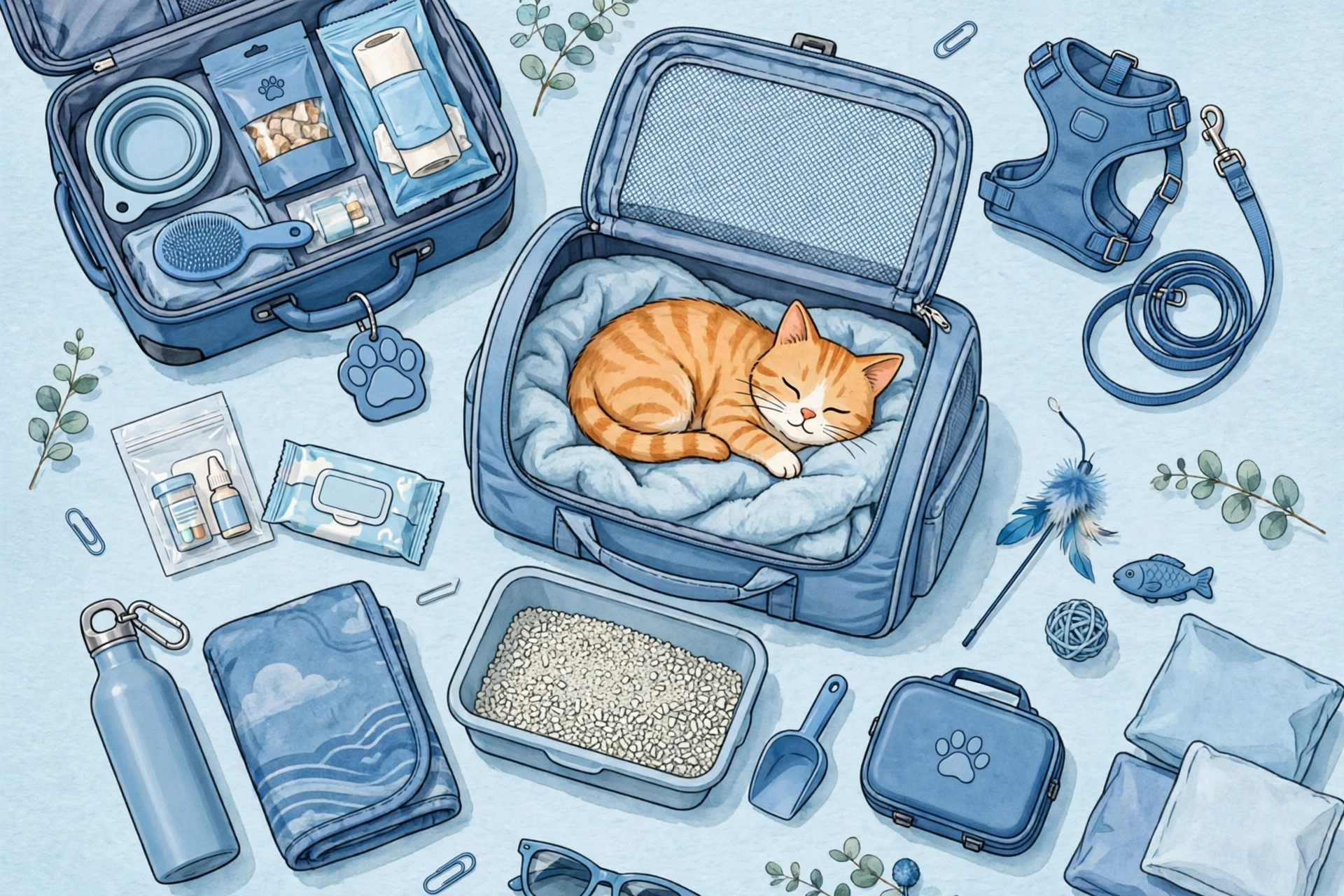
Pack your cat’s bag the day before you leave, and keep it where you can reach it without unpacking the car or opening the carrier. Start with food: enough of your cat’s regular food for the whole trip plus two extra days, packed in sealed portions, along with collapsible bowls or the bowls your cat already uses. Add bottled water or water from home for the first day, since a sudden change in water can upset a sensitive stomach. Pack any medication in its original packaging, with a copy of the prescription and your vet’s number, plus a small first-aid kit with gauze, saline, and any items your vet suggests for your cat specifically.
The carrier kit deserves its own section: absorbent pads for the carrier base, spare bedding, paper towels, waste bags, a small trash bag, and cleaning wipes for accidents. Add a portable litter tray and a bag of your cat’s usual litter for longer trips, plus a scoop. Identification goes in the same bag: a recent photo, vaccination records, health certificate if required, microchip number, and your vet’s contact details, in both paper and phone form. Add a harness and leash, a familiar blanket or towel, and one safe comfort item. Do not pack a new toy your cat has never seen, a noisy toy, or anything with small parts that could be swallowed during a stressful journey.
Keep a separate small kit in your personal bag for the journey itself: a few treats, a water bowl that will not spill, wipes, and your cat’s medication for that day. If you are flying, this kit goes in your carry-on, never in checked luggage. Label everything with your name and mobile number, including the carrier itself, in case it is separated from you. Finally, do a last check before you leave the house: carrier latched, harness on, food and water packed, litter tray accessible, vet number in your phone, hotel confirmed as cat-friendly. That five-minute check prevents most of the problems owners report after the fact.
Keeping Your Cat Calm on Travel Day
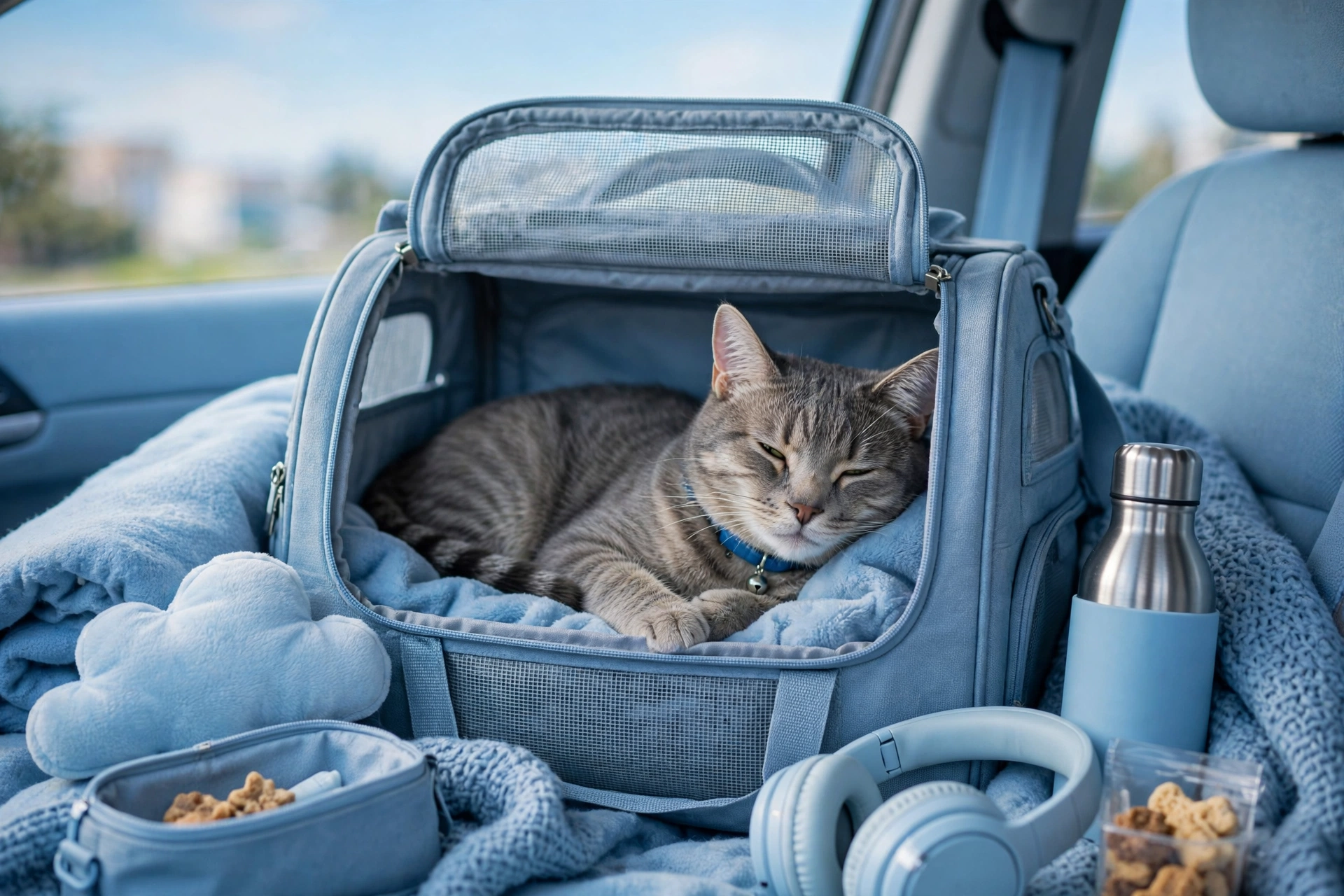
Travel day calm starts the night before. Keep the evening routine as normal as possible: the usual feeding time, the usual play, the usual sleeping spot. Avoid a big house clean, a flurry of suitcases in the hallway at midnight, or a change in your own behavior that signals something unusual is happening. Cats read your stress accurately. If you are rushing, loud, and tense, your cat will be too. Build buffer time into travel day so you are not chasing the clock with a cat in your arms.
On the morning of travel, feed a light meal a few hours before departure, offer water, and let your cat use the litter tray. Place your cat in the carrier calmly, in a small, quiet room with the door closed, rather than chasing them through the house. Speak softly, move slowly, and avoid a prolonged goodbye ritual that winds your cat up. Once the carrier is closed and latched, check it twice, and keep it level as you carry it. In the car, drive smoothly, avoid sudden braking where you can, and keep conversation and music at a low, steady level. If your cat meows, respond calmly without opening the carrier. Meowing is communication, not an emergency in itself, and most cats settle after the first part of a journey.
Watch for signs that need action rather than reassurance. Heavy panting with the mouth open, drooling, vomiting, or a cat who is unusually limp or unresponsive are reasons to stop safely, assess, and call your vet. A cat who has vomited may need a clean pad and a calm pause before continuing. A cat who is panting heavily in a hot car needs cooling and ventilation immediately, and the journey should not continue until the cat has recovered. Know your vet’s number and the location of an emergency vet along your route before you leave, especially on long drives through rural areas. A few minutes of preparation here can matter enormously if something goes wrong far from home.
Do not try a new calming product, a new food, a new carrier, or a new sedative on travel day. Every variable should have been tested at home. Travel day is for execution, not experimentation. If something in your plan did not work during practice, change it before travel day, not during it. And remember that your cat does not need you to be perfect. They need you to be predictable: same voice, same handling, same carrier, same food, same calm presence from departure to arrival.
Settling Your Cat Into a Hotel, Rental, or New Home
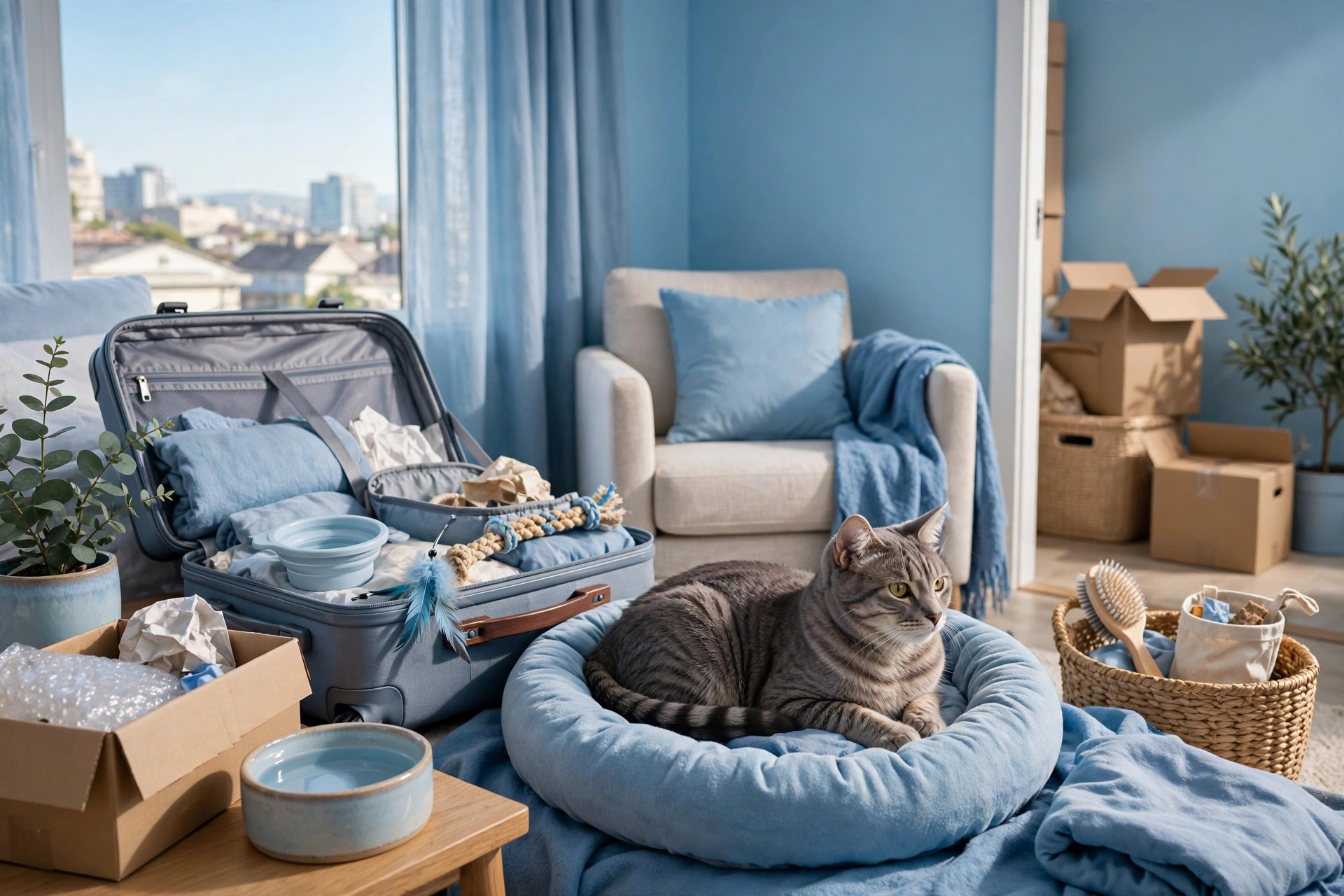
Arrival is not the end of the journey for a cat; it is the start of a second adjustment. Before you open the carrier, check the room. Close windows, check for gaps behind furniture, block access to spaces where a cat could hide and get stuck, and confirm there are no hazards such as open balconies, toxic plants, or cleaning chemicals left out. Set up the essentials first: litter tray in a quiet corner, food and water bowls nearby, and a familiar blanket on a bed or chair. Then open the carrier door and step back. Let your cat come out on their own time. Some cats explore within minutes. Some stay in the carrier for an hour. Both are normal, and forcing a cat out of the carrier in a strange room undoes the trust you built during training.
For the first day, keep your cat to one room if you can. A single room with familiar scents, a hiding spot, and everything they need is far less overwhelming than a whole house or a large rental. Keep the routine familiar: same food, same feeding times, same litter. Spend quiet time in the room without demanding attention. Reading, working, or simply sitting nearby lets your cat approach you when they are ready. Avoid inviting a crowd to meet your cat on arrival day, and avoid loud music, strong new scents, or a sudden change of bedding. If you are staying for a while, introduce new rooms gradually, one at a time, over days rather than hours.
If you have moved house rather than visiting, the same principles apply on a longer timescale. Keep your cat indoors for at least two to three weeks after a move, even if they were previously allowed outside, so they learn that the new house is home before they explore beyond it. Update the microchip registration with your new address promptly, and check fences, windows, and doors before any supervised outdoor time. Cats who escape in a new neighborhood have no mental map to find their way back, and a new address on a microchip is useless if it still points to the old house. Patience in the first weeks prevents a lost-cat search later.
What to Do If Your Cat Gets Sick, Escapes, or Refuses to Travel

Even with careful planning, things go wrong, and knowing the response in advance keeps a bad moment from becoming a crisis. If your cat vomits or has diarrhea during travel, stay calm, clean up at the next safe stop, offer a little water, and call your vet if it repeats, if there is blood, or if your cat becomes lethargic. Withhold food for a short period if your vet advises it, and return to the regular diet gradually. If your cat refuses to eat or drink for more than a day after arrival, or shows signs of urinary trouble such as straining, frequent small trips to the tray, or blood in the urine, contact a vet promptly — urinary problems in cats can become serious quickly, and stress is a known trigger.
If your cat escapes, do not chase. A frightened cat who is chased runs farther and hides deeper. Stay nearby, speak softly, and use familiar sounds: a treat bag, a familiar voice, the sound of food being prepared. Search quietly in nearby hiding places — under cars, in bushes, behind bins, in garages — and ask neighbors and nearby businesses to watch for your cat without chasing them. Put up notices with a clear photo and your mobile number, contact local shelters and vets, and post in local lost-pet groups. A cat who escapes in a hotel or rental often hides very close to where they were lost, sometimes for hours, so a patient, quiet search beats a loud, wide one.
If your cat refuses to travel despite weeks of training, that refusal is information, not failure. Some cats have deep carrier anxiety, a medical issue that makes travel painful, or a temperament that simply does not cope with transport. Talk to your vet about whether a different approach, a different carrier, a medical check, or a trial of prescribed calming medication changes the picture. If it does not, the kindest choice may be a trusted sitter at home, a professional pet sitter who visits daily, or a reputable boarding facility your cat has visited before. Choosing not to travel with a cat who cannot cope is not giving up. It is the same care, applied differently.
Finally, keep perspective. Most cat trips go better than owners fear, and the cats who travel worst are usually the ones whose owners had no time to prepare. You have already done the most important thing by reading this far and planning ahead. A carrier your cat knows, a vet visit booked early, a calm travel day, and a quiet arrival room will carry most cats through most journeys. Your cat does not need a perfect trip. They need a familiar person, a familiar scent, and a predictable routine — and you are the one who provides all three.
Frequently Asked Questions
How far in advance should I start preparing my cat for travel?
Start carrier training as early as you can, ideally several weeks before departure. Vet visits should be booked three to four weeks ahead for domestic trips and several months ahead for international travel, since some destinations require vaccinations, tests, or waiting periods that cannot be rushed.
Can cats travel in the cabin on a plane?
On many airlines, yes, in an airline-approved carrier that fits under the seat in front of you, subject to weight and size limits, availability, and a reservation fee. Rules vary by airline and aircraft, so confirm the policy for your exact flight before you book, and never assume one airline’s rules apply to another.
How long can a cat stay in a carrier?
For drives under about six hours, most cats manage in a standard carrier without food or a litter tray, provided they eat, drink, and use the tray before departure. For longer journeys, plan breaks in an enclosed space where your cat can drink and use a portable litter tray, and keep total daily driving time reasonable.
Should I sedate my cat for travel?
Only on veterinary advice, and only with a medication trialed at home first. Sedation is not right for every cat, and a cat who is too sedated to balance or regulate temperature is at risk. Ask your vet about the full range of options, including pheromone products, environmental preparation, and carrier training, before deciding.
What paperwork do I need to travel with a cat in the United States?
Requirements vary by state, airline, and accommodation, so check all three. Federally, cats entering the United States must appear healthy on arrival and may be inspected, and Hawaii and Guam impose additional quarantine rules. Keep vaccination records, your vet’s number, and any required health certificate with you.
What if my cat escapes during the trip?
Do not chase. Search quietly nearby, use familiar sounds, and alert local shelters, vets, and neighbors with a clear photo and your mobile number. A current microchip registration and an ID tag with a mobile number you will answer while traveling give a found cat the fastest route home.
Conclusion
Traveling with a cat is less about the journey and more about the preparation around it. Choose the carrier early, train slowly, visit the vet in good time, check the official rules for your destination and your airline, and keep travel day calm and predictable. Plan the route, the stops, and the first night’s stay with your cat in mind, pack the essentials the day before, and give your cat a quiet room and a familiar routine on arrival. Do those things, and most cats travel far better than their owners expect. If your cat genuinely cannot cope, choosing a trusted sitter at home is not a failure — it is the same care, applied in the way your cat needs most.
People also read: