
Quick Answer

Finding travel inspiration is not hard. Turning it into a trip is. Most people already have more inspiration than they can use — saved posts, screenshots, half-remembered films, places friends mentioned, and a list of “someday” destinations that grows every year. The problem is not a shortage of ideas. It is that the ideas never get filtered, tested, and turned into one decision. This guide gives you a system for that: collect everything in one place, describe the trip you want in three words, filter by season, budget, pace, and who is traveling, test two places instead of twenty, and then take one booking step.
The system works because it starts with you, not with a feed. Before you ask “where should I go?”, ask how you want your days to feel, what pace you crave, and what you want less of. A trip that matches the feeling you need — slow mornings and long walks, or busy streets and late dinners — will satisfy you far more than a trip to a place that merely photographs well. Inspiration that starts from a feeling survives contact with reality. Inspiration that starts from a trending post often does not, which is why this guide also warns you about the gap between social media and the place itself.
Where inspiration actually comes from

Inspiration rarely arrives as a single dramatic moment. It usually comes from five ordinary sources, and naming them helps you notice which ones actually move you. Books and films are the first. A novel set in a city, a film shot on a coastline, or a documentary about a mountain range can plant a place in your mind for years. The trick is to notice what exactly stayed with you — was it the city, or the feeling of walking its streets at dusk? The place matters less than the feeling, because the feeling is what you can recreate in more than one destination.
Hobbies are the second source, and often the strongest. If you love cooking, hiking, photography, surfing, or history, there are places that do that one thing better than anywhere else, and a trip built around the hobby practically plans itself. A surfer does not need a generic list of beach destinations; they need good waves in the right season. A cook does not need “foodie cities”; they need a market town with classes and ingredients they cannot get at home. If you already have a hobby you enjoy, let it choose the trip — the Travel Hobby guide explains how to pick a hobby that travels well and build a trip around it.
Past trips are the third source, and the most underused. The trips you still talk about years later are clues, not just memories. Ask what those trips had in common: was it the pace, the people, the landscape, the food, or the feeling of being far from routine? You do not have to return to the same places. You have to find new places with the same qualities. A traveler who loved slow mornings in a small coastal town will probably not love a packed week in a huge capital, no matter how famous the capital is. Your own history is a better filter than any trending list.
People and seasons are the last two sources. People — friends, family, hosts, even strangers whose stories stuck with you — often point you toward places you would never have found alone, and their honest advice about what they would skip is worth more than their highlight reel. Seasons shape inspiration too: a place in winter is a different trip from the same place in summer, and the season you imagine — snow, harvest, festivals, quiet streets — is often the real reason a destination appeals to you. Notice the season in your daydreams. It is part of the inspiration, not background detail.
Collect without drowning: one list, three trip words
The first step of the system is to collect, and the rule is strict: one list, in one place. Not a folder of screenshots, three apps, a notebook, and a mental list. One list — a note on your phone, a document, or a single board — where every idea goes the moment it appears. A film location, a friend’s recommendation, a photo that stopped your scroll, a place from a book: all of it goes on the same list, with one line about why it caught you. If you cannot write that line, the idea probably did not catch you at all, and it does not belong on the list.
The reason for one list is that inspiration drowns in volume. Twenty saved posts feel like research, but they are really just clutter, and clutter makes decisions harder, not easier. A single list forces you to see the whole pile at once, and seeing the pile is what lets you spot patterns. When you look at your list after a few weeks, do not just read the place names. Audit the patterns: what colors keep showing up, what landscapes, what pace of life? Are your saves full of quiet beaches or busy markets, mountains or museums, slow mornings or packed days? Those patterns reveal the feeling you are actually looking for, which is far more useful than any single destination on the list.
Then give that feeling a name in three trip words. Three words that describe the trip you want, not the place: “slow, coastal, food-focused” or “cold, quiet, walking” or “busy, historic, social.” Three words are enough to be useful and few enough to remember. Every idea on your list can then be tested against them in seconds: does this place offer slow coastal days with good food, or does it just look good in a photo? Ideas that fail the three words leave the list without guilt. You are not rejecting a destination forever. You are saying it does not match this trip, and that clarity is what turns a pile of ideas into a shortlist.
Here is what the three words look like in practice. Suppose your list contains a beach resort, a mountain town, a famous capital, and a small food-focused coastal city, and your three words are “slow, coastal, food-focused.” The resort fails on pace — it is built for doing nothing, and you want to wander and eat. The mountain town fails on coastal. The capital fails on slow. The small coastal city passes all three, and suddenly a list of four becomes a shortlist of one, without any agonizing. If instead your words were “busy, historic, social,” the capital would win and the coastal city would lose. The words do not judge the places. They judge the fit, and fit is what makes a trip satisfying.
There is one more habit worth building here: a weekly five-minute tidy. Once a week, open the list, delete anything that no longer excites you, and add the three trip words to any new idea. Ideas go stale faster than you think, and a list full of last year’s excitement is just as unhelpful as no list at all. If nothing on the list excites you anymore, that is useful information too — it usually means your three words have changed, or you are tired of scrolling rather than tired of traveling. In that case, stop collecting for a week and look at your past trips instead. Inspiration often returns when you stop chasing it.
Filter it: season / budget / pace / who is travelling
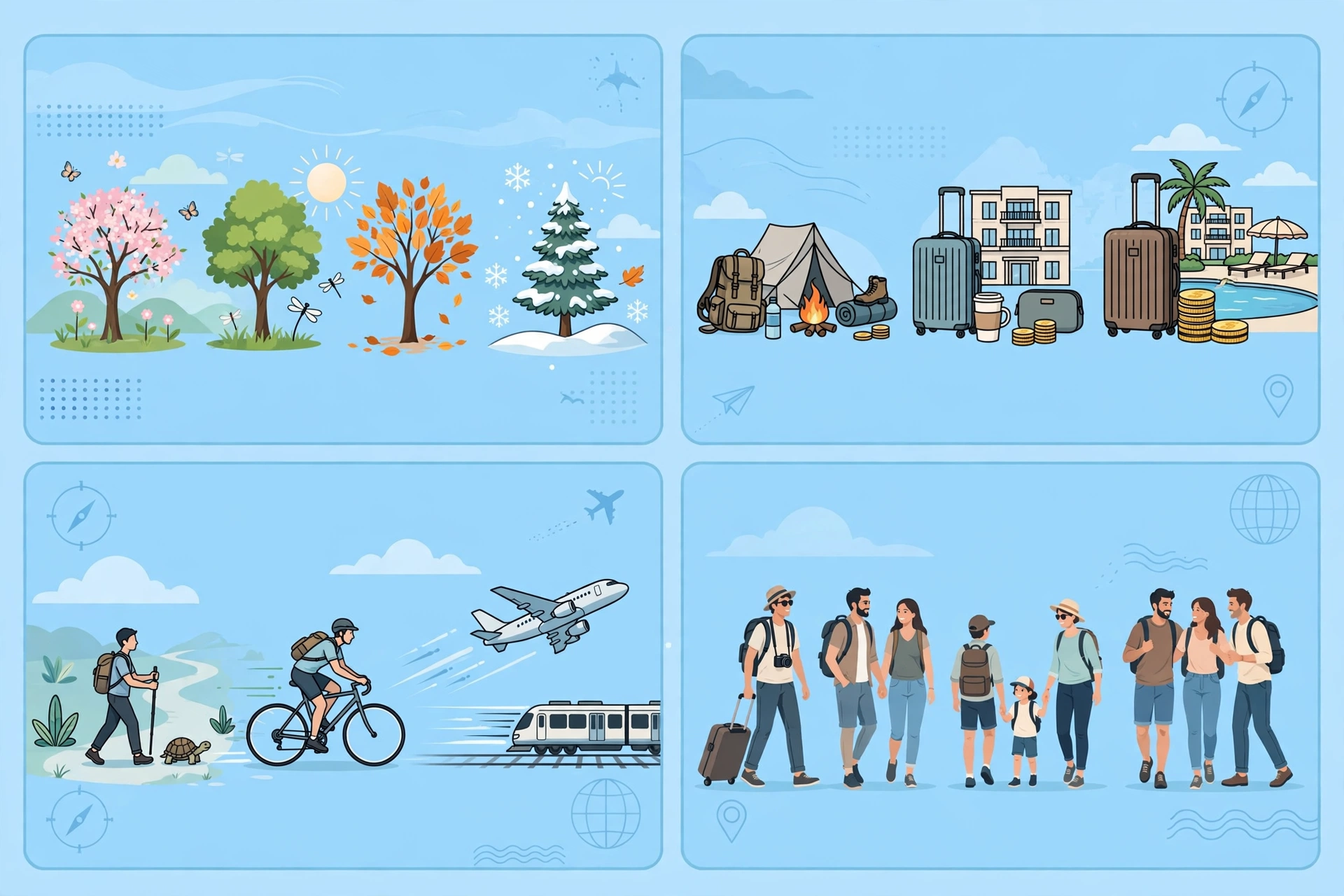
A shortlist is not a decision. The filter is what makes it one, and it has four questions. Season: when would this place actually be good, and when would it be miserable? A destination can be perfect in October and punishing in August, and the season you travel in changes the trip more than almost anything else. Budget: can you afford this place in the way you want to travel, not just the cheapest possible version of it? A place that only works if you stay far from everything and eat nothing interesting is not really affordable for you. Pace: does the place reward your natural pace, or fight it? A slow traveler in a city built for rushing will feel behind all week. Who is traveling: are you going alone, with a partner, with friends, or with children, and does the place suit that group?
Run each surviving idea through all four questions, and be honest about the answers. Seasonal picks are a good place to practice: if your three words point to winter light and quiet streets, a January trip might fit better than a summer one, and the Best Places to Travel in January guide shows how warm, cheap, snowy, and quiet January options differ in exactly these terms. The point of the filter is not to find a perfect place. It is to remove places that fail on a fact — wrong season, wrong budget, wrong pace, wrong group — before you spend emotional energy on them. Facts are cheaper than disappointment.
Pay special attention to two filters people usually skip. The first is “who is traveling” in its full sense: not just how many people, but what they need. A friend who hates early mornings will not enjoy a dawn-hiking trip, however beautiful the sunrise. A child who needs downtime will not enjoy a day packed with museums. A trip that suits the group is better than a trip that suits only you, unless you are traveling alone — in which case, be honest about that freedom and use it. The second skipped filter is your own energy. If you are exhausted, a trip that demands constant movement will not restore you, even if the destination is famous for adventure. Match the trip to the energy you will actually have, not the energy you wish you had.
By the end of the filter, your list should be down to three or four places at most. If it is still long, your three trip words are too vague, or your filter questions are being answered wishfully. Tighten the words, re-run the filter, and do not be afraid to cut. A shortlist of three good options is a success. A list of twenty “maybes” is the problem you started with.
Test two places, not twenty
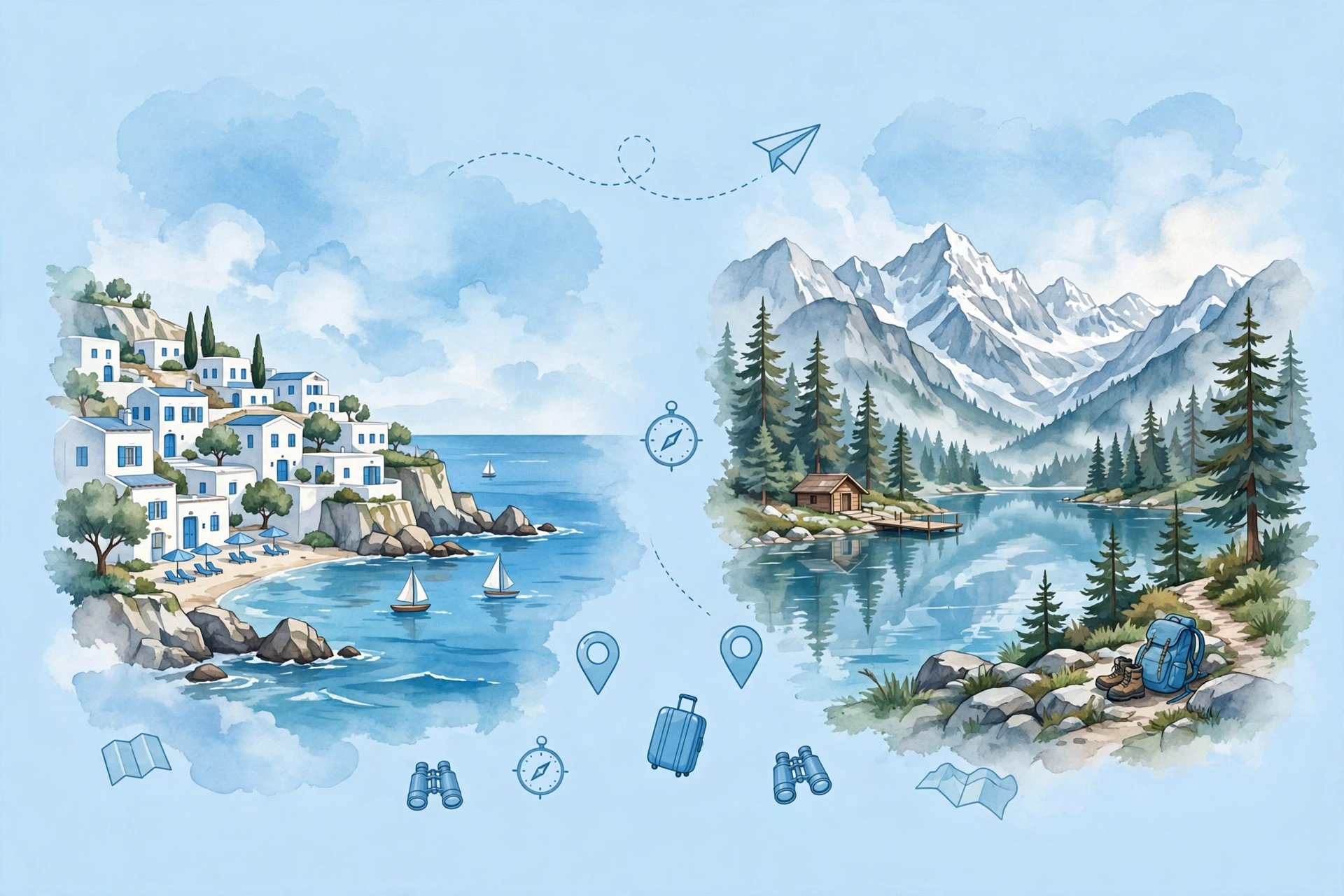
Testing is where most inspiration dies, because people try to research everything and end up researching nothing. The rule is: test two places, not twenty. Pick the two survivors that excite you most — not the two that seem most sensible, but the two you keep coming back to — and research only those two, properly, for a fixed amount of time. Two evenings of focused research beats two months of vague browsing, because a deadline forces decisions and browsing avoids them.
For each of the two places, answer the same five questions. What would a typical day actually look like, hour by hour, not in highlights? What does it cost in the season you would go, including stays, food, and local transport — not a cheapest-case fantasy, but a realistic day? How do you get there and move around, and does that journey suit your patience? What is one specific thing you would do there that you cannot do at home? And what would you skip, based on honest advice from people who have been? That last question is the most valuable one, and it is the one travel content rarely answers. Ask friends, or read accounts that mention disappointments, not just highlights. A place with no downsides in anything you read has not been described honestly.
A map test helps at this stage, and it is simple: pin the things you actually want to do in each place on a map and look at how they cluster. If the pins cluster in one area, you have a natural home base and easy days. If they scatter across a whole country, the trip will be mostly transit, and you should either shrink the trip to the cluster or pick the other place. The same test works for a theme: if your trip has a theme — food, hiking, history, music — the pins should tell a story about that theme, not a random scatter of famous sights. A trip with a clear theme and a tight map is almost always better than a trip that tries to cover everything.
A worked example shows how the test narrows things down. Imagine your two finalists are a well-known coastal city and a smaller coastal town in the same region. For the city, a typical day means a busy beach, a long lunch queue, and an evening in a crowded old town — exciting, but tiring, and the realistic daily cost is high in summer. For the town, a typical day means a quiet morning walk, a market lunch, and an afternoon beach that empties by evening — slower, cheaper, and closer to your three words if those words include “quiet.” The city wins on famous sights and nightlife; the town wins on pace, budget, and the feeling you said you wanted. If your three words were “busy, social, late nights,” the result would flip, and that is the point: the test does not pick the better place in general. It picks the better place for this trip, for you, right now.
At the end of the test, choose one place and let the other go — for this trip. Write down why you chose it in one sentence, using your three trip words, and keep the runner-up on the list for a future trip. Choosing does not mean the other place was bad. It means this trip has a shape now, and a trip with a shape can be booked. A trip with two shapes cannot.
From inspiration to first booking step

A chosen place is still not a trip. The bridge from inspiration to a real trip is one booking step, taken on a date you set in advance. The best first step is usually a changeable stay for your dates, because it makes the trip real without trapping you if plans shift, or a flight price alert if fares are the main variable. What matters is not which step you pick, but that you pick one and date it. “Book the stay in March” is a plan. “Book it sometime” is another saved post.
Once that step is taken, turn the chosen place into a funded goal. That means giving it a total cost, a date, and a monthly saving amount — the same structure as any serious plan. The Travel Goal guide walks through exactly that: how to price a trip honestly, divide it into monthly savings, and handle the trade-off between time, money, and comfort. Inspiration got you to the place. A goal gets you to the plane. Skipping the goal step is why so many inspired trips stay on a list for years.
Practical checks belong in this step too, and they are worth doing before you book anything nonrefundable. Check the season properly — not just average weather, but whether the things you want to do are open, whether timed entry or reservations are needed, and whether prices spike in your dates. For trips involving parks or outdoor places, the National Park Service travel tips page is a good official starting point: it covers choosing a park, checking maps and hours, reading basic information, and checking costs and reservations before you go. The same habit applies anywhere — check the official source for the place itself, not just a roundup article, before you commit money.
Finally, protect some open time in the plan. The best moments of a trip are often unplanned — a tiny village you did not know about, a long meal, a walk that goes nowhere in particular — and a schedule packed with every inspiration you collected leaves no room for them. Book the stay, book the one or two things that genuinely need advance booking, and leave the rest open. Inspiration should start the trip, not script every hour of it.
When inspiration misleads (social media vs reality, peak-season trap)
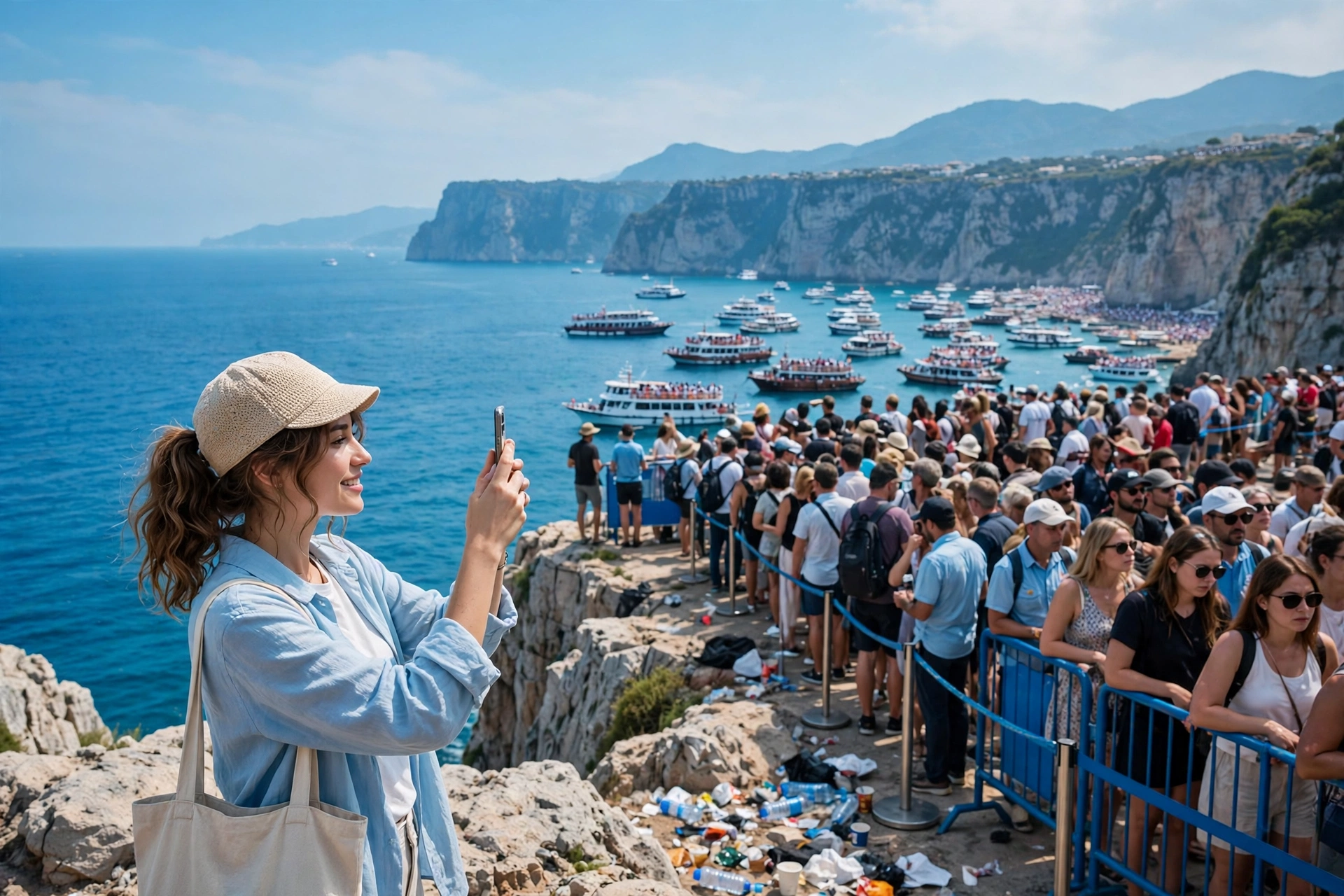
Inspiration misleads in two predictable ways, and knowing them in advance saves real disappointment. The first is social media versus reality. A photo shows a place at its best moment, in its best light, with its crowds cropped out. It does not show the queue, the heat, the closed trail, or the three hours of travel to reach a spot that looks remote and empty. Algorithms make this worse: they show you what is trending, not what suits you, and they reward novelty over fit. If you want a place because everyone is posting about it, ask whether you would still want it if no one had posted about it. If the answer is no, the inspiration belongs to the feed, not to you.
The second trap is the peak-season trap. The season when a place looks best online is often the season when it is most crowded, most expensive, and least like the photo. A beach town in peak summer, a famous city during a festival, or a viewpoint at midday in high season can feel nothing like the quiet image that inspired you. The fix is to check the place in the season you would actually go, and to consider the shoulder season — the weeks just before or after peak — when prices drop, crowds thin, and the place often feels more like itself. If your three trip words include “quiet,” peak season is almost certainly the wrong choice, however beautiful the photos are.
There are smaller misleads worth watching too. A single attraction is rarely worth a whole trip on its own, unless it is a day trip from home — build the trip around a cluster of things, not one photo. A destination that only appears in listicles may have been included for clicks rather than quality, so look for at least one detailed, honest account before you commit. And a place you loved years ago may have changed: prices, crowds, and even whole neighborhoods change, so re-check a beloved destination instead of assuming it is frozen in time.
None of this means you should distrust inspiration. It means you should treat inspiration as a starting point, not a verdict. Let a photo, a book, or a friend’s story point you toward a place, then run it through your three words, your four filters, and your two-place test. The places that survive that process are the ones worth booking — and they are usually the ones you will still love after you get home.
FAQ
Where do most people actually find travel inspiration?
From books and films, hobbies, past trips, people they know, and seasons. Social media is the loudest source, but it is rarely the most reliable, because it shows what is trending rather than what suits you.
How do I stop collecting ideas and actually choose a trip?
Use one list, describe the trip you want in three words, filter by season, budget, pace, and who is traveling, then test only two places properly. A deadline for the test matters more than more research.
What are three trip words?
Three words that describe the trip you want, not the place — for example “slow, coastal, food-focused” or “cold, quiet, walking.” Every idea on your list can be tested against them in seconds, and ideas that fail them leave the list.
Why does social media inspiration often disappoint?
Because a photo shows a place at its best moment with crowds cropped out, and algorithms show what is trending rather than what fits you. Ask whether you would still want the place if no one had posted about it.
What is the first booking step after choosing a place?
Usually a changeable stay for your dates, or a flight price alert if fares matter most. Set a date for that step in advance, then turn the trip into a funded goal with a total cost, a date, and a monthly saving amount.
Should I travel in peak season to the place I saw online?
Not automatically. Peak season often means crowds, high prices, and a very different experience from the photo. Check the place in the season you would actually go, and consider the shoulder season for a quieter, cheaper version of the same trip.
Conclusion
Travel inspiration is everywhere, and that is the problem. The answer is not more inspiration. It is a system that turns inspiration into a trip: one list, three words that describe the trip you want, four honest filters, two places tested properly, and one booking step taken on a date you chose. Start from how you want your days to feel, not from what is trending. Let your past trips, your hobbies, and the people you trust do more of the choosing than your feed. And leave room in the plan for the unplanned moments, because those are usually the ones you remember. A saved post is not a trip. A chosen place, a funded goal, and a booked stay are.
People also read: Best Places to Travel in January: Warm, Cheap, Snowy or Quiet — Pick by What You Want, Travel Goal: How to Set One You Actually Keep (and Fund), Travel Hobby: How to Pick a Hobby That Makes Every Trip Better


Other Articles