
Malta is the smallest country in the European Union, and it is also one of the most packed. Three inhabited islands, three UNESCO World Heritage Sites, temples older than the pyramids, a capital city you can walk across in twenty minutes, and some of the clearest swimming water in the Mediterranean all fit into an archipelago about twice the size of Washington, D.C. English is an official language, the currency is the euro, and the sun shines for around 300 days a year. This Malta travel guide is written for a first-time visitor from the United States who wants the practical facts — when to go, what things cost, how the buses and ferries work, which tickets to book weeks ahead — and the places that make the trip worth it.
Quick Answer
Plan five to seven days for a first trip to Malta. Fly into Malta International Airport (MLA), base yourself in Valletta or Sliema, and spend your days on the capital, Mdina, the megalithic temples, a day on Gozo and a day at the Blue Lagoon on Comino. US citizens need no visa for stays up to 90 days, and no ETIAS authorisation is in operation yet, so there is nothing extra to apply for before a 2026 trip. Book two things well ahead: the Ħal Saflieni Hypogeum, which admits only 80 visitors a day, and the free Blue Lagoon landing pass, which has been compulsory since May 2025. The best months are May, September and October. Budget roughly €100–€140 a day per person for a comfortable mid-range trip, including a hotel, meals, transport and sightseeing. All prices in this guide are planning ranges in euros; confirm the current figure on the official site or at the ticket office before you travel, because fares and rules change.
Is Malta Safe to Visit in 2026?
Yes. Malta is one of the safest countries in Europe for visitors, and the US State Department’s current advisory for Malta is Level 1, “Exercise normal precautions” — the lowest level on its four-level scale, issued on 9 July 2026. The advisory summary is short and reassuring: Malta is generally a safe destination for travellers. That matches what most visitors experience: low violent crime, English-speaking locals, well-regulated tourism and a modern hospital system. The same advisory is worth reading in full before you go, because the risks it does flag are specific and avoidable, and knowing them in advance is what keeps a trip smooth.
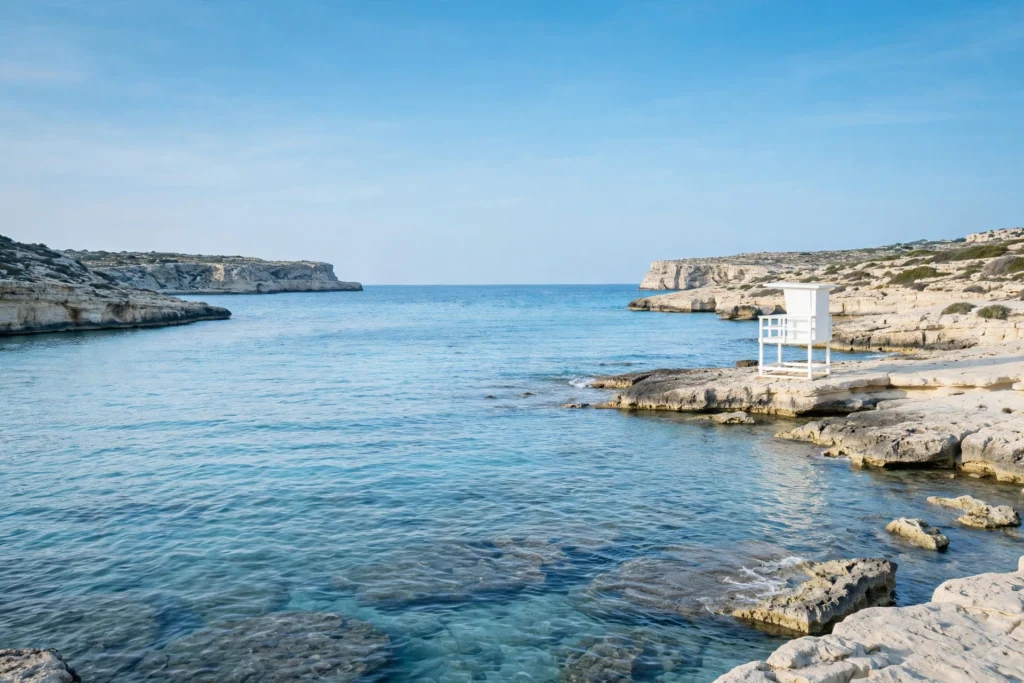
The main safety warning in the advisory is about the sea, not crime. Riptides have caused drowning deaths among tourists, and the State Department advises caution at local beaches and following lifeguards’ instructions. Malta’s best swimming spots are often rocky coves with no lifeguard at all, so the rule is simple: swim where other people are swimming, check the flags at official beaches, and stay out of the water when the sea looks rough or the wind is up. Jellyfish appear in some summers, and currents around headlands can be stronger than they look from the shore. If you are not a confident swimmer, stick to sandy, lifeguarded beaches such as Mellieħa Bay and Golden Bay, and treat cliff jumping at places like St Peter’s Pool as a locals-only activity unless you have checked the depth and the entry point with someone who knows it.
Petty crime exists, but at a low level. The most reported crimes are pickpocketing and petty theft, and criminals focus on areas visited by tourists — the main bus terminus in Valletta, crowded ferries and busy nightlife streets. Keep your bag closed and in front of you in a crowd, do not leave valuables unattended on a beach while you swim, and use the hotel safe for your passport. The State Department also warns about financial and romance scams, which it says are common in Malta: be careful of anyone asking for money online, especially people claiming to be US citizens in need of help, detained or hospitalised, or offering work permits and job offers. The Paceville nightclub district in St Julian’s gets a specific caution in the advisory — excessive drinking, large crowds and heavy-handed bouncers have led to violence, and drink spiking, robbery and assault have been reported at bars. Enjoy the nightlife, but watch your drink, stay with your group and take a licensed taxi or a rideshare home rather than walking alone late at night.
A few local rules catch visitors out. It is illegal to bring marijuana, cannabis or CBD products into Malta, and the advisory warns that travellers have been arrested and detained for long periods for doing so. If you fly a drone, you must register it with Transport Malta first. Malta is a largely Catholic country with a conservative streak: dress respectfully in churches, with shoulders and knees covered, and keep swimwear for the beach. The emergency number is 112, the same as the rest of the EU, and the US Embassy in Valletta can be reached at +356 2137 3100. Enrolling in the State Department’s Smart Traveler Enrollment Program (STEP) before you fly costs nothing and means the embassy can reach you if conditions change. Travel insurance is worth having — most US health plans do not cover medical costs abroad — and if you plan to dive, check that your policy covers diving specifically, because evacuation and treatment bills can be very large.
Best Time to Visit Malta
Malta is a year-round destination, but the difference between the best months and the worst is bigger than most people expect. The islands are small and low-lying, with almost no shade, so summer heat is the single biggest factor in how enjoyable a trip feels. The sweet spot for most first-time visitors is May, September or October: warm enough to swim, cool enough to walk around a stone city for hours, and busy without being overwhelming. If you are planning around beaches and nightlife, June to August delivers that, at the price of heat, crowds and the highest hotel rates of the year. If you are planning around history, walking and value, winter is genuinely good — Malta in January is milder than most of Europe, and the big sights are almost empty.
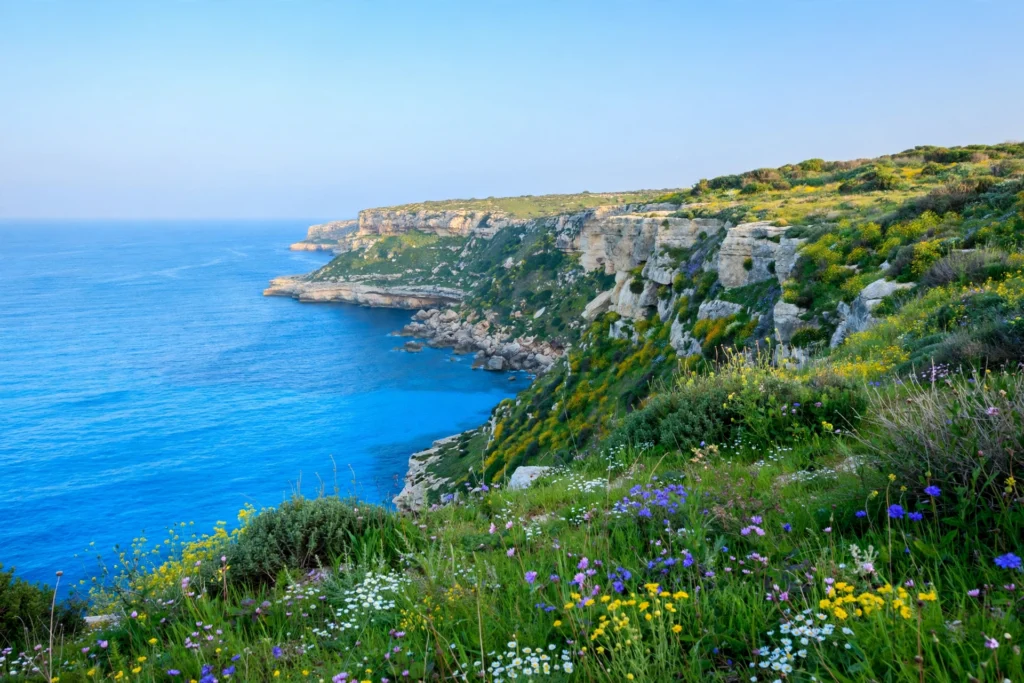
Spring, from March to May, is the season the islands look their best. Wildflowers cover the countryside, the cliffs are green rather than sun-bleached, and daytime temperatures climb from the high teens into the mid-twenties Celsius. April and May are the best months for hiking the coastal paths on Gozo and for sightseeing in Valletta and Mdina without the summer crush. Holy Week processions around Easter are one of Malta’s most atmospheric events, and the village festas begin to appear on the calendar as the weather warms.
Summer, from June to August, is hot, bright and crowded. Daytime highs regularly reach 30–35°C (86–95°F), humidity is high, and the sun is strong enough to burn in twenty minutes even under cloud. The sea is at its warmest, the Blue Lagoon is at its busiest, and Paceville in St Julian’s is in full swing. If summer is your only option, plan sightseeing for the morning and the late afternoon, take a long shaded lunch in the middle of the day, and book accommodation months ahead — prices roughly double in July and August compared with the shoulder season. The village festas reach their peak in summer too: each town celebrates its patron saint with processions, marching bands and enormous fireworks, and they are free, local and spectacular. Keep a sensible distance from the fireworks, which are launched from within residential streets and are very loud.
Autumn, from September to November, is the other sweet spot and the favourite season of many repeat visitors. September is effectively a second summer: the sea is at its warmest after months of sun, the air cools to the mid-twenties, and the crowds thin noticeably once the school holidays end. October is ideal for coastal walks, vineyard visits and temple sites, with warm days and cooler evenings. By November the weather turns changeable, with the first real rain of the year, but hotel prices drop and the islands feel local again.
Winter, from December to February, is the quiet season and the cheapest. Daytime temperatures are usually 14–18°C (57–64°F), the rain comes in short bursts, and January and February are the wettest months. You can still swim on a sunny winter day if you are brave, but the real winter pleasures are different: empty streets in Valletta, low hotel rates, Christmas lights in the capital, and Carnival in February, when Valletta fills with parades and costumes. The trade-off is that some smaller restaurants and seasonal boat services close, and a few rural sites feel windswept rather than inviting.
Malta by month at a glance
| Month | Weather | Crowds | Best for |
|---|---|---|---|
| March–April | Cool to mild, changeable | Moderate | Walking, wildflowers, Easter processions |
| May–June | Warm, long days | Moderate to high | Best all-round balance; swimming starts |
| July–August | Hot, humid, 30–35°C | Very high | Beaches, nightlife, festas; highest prices |
| September–October | Warm, sea at its warmest | Moderate | Swimming without the crowds; coastal walks |
| November | Mild, first rains | Low | City exploring, low prices |
| December–February | Cool, 14–18°C, wettest | Low | Budget travel, Carnival, empty sights |
Getting to Malta: Flights, Ferries and Entry Rules for US Citizens
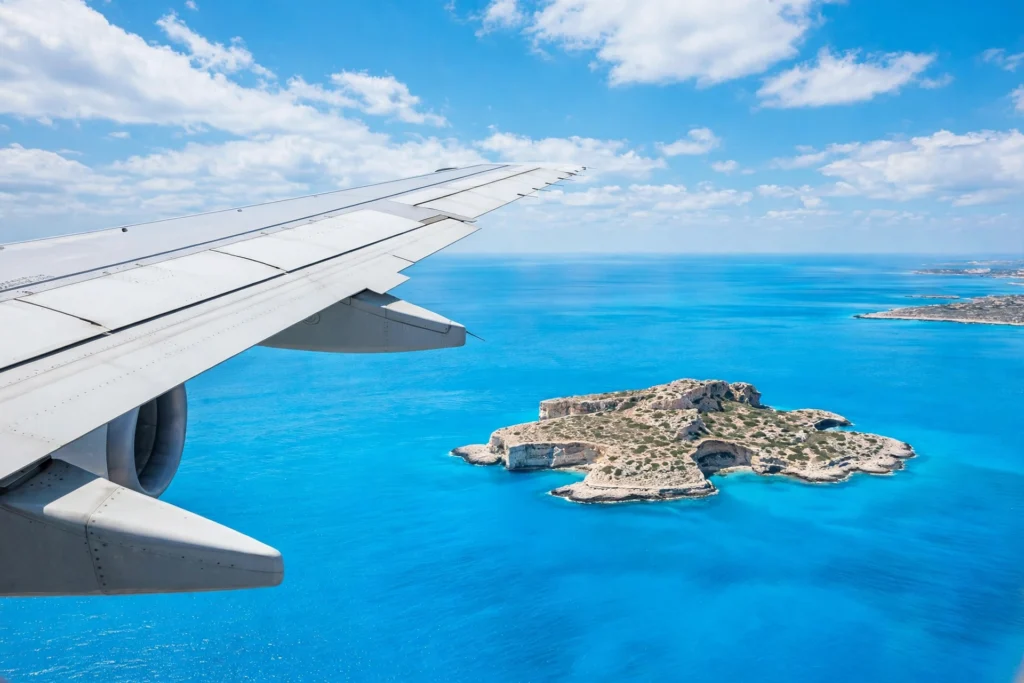
Malta has one airport and no land borders, so every arrival is either by air or by sea. Malta International Airport (MLA) is the country’s only airport, about 20–30 minutes by road from Valletta and Sliema. There are no direct flights from the United States, so most American visitors connect through a European hub — London, Paris, Amsterdam, Frankfurt, Rome or Madrid — or fly into a major European city and continue to Malta on a short hop. From London the flight is about three hours; from Rome it is about ninety minutes. Budget carriers serve the airport heavily, which keeps fares low outside the summer peak, but do check the baggage rules before booking, because the cheapest fares often include only a small cabin bag.
The airport is small and easy. Taxis and rideshares wait outside arrivals, the express bus to Valletta takes about 20–30 minutes, and car hire desks are in the terminal. If you arrive late at night, arrange a transfer in advance or confirm that your hotel offers one, because bus frequencies drop sharply after dark. Buy a local SIM card or an eSIM before you land if you want data from the first hour — Malta has three mobile operators, GO, Melita and Epic, and a week’s prepaid data package costs around €10. Coverage is good across all three islands, including remote corners of Gozo.
By sea, Malta has ferry links to Sicily, with crossings to Pozzallo and Catania. The crossing takes around ninety minutes to two hours depending on the route and the vessel, and it is a scenic way to arrive if you are combining Malta with a Sicily trip. Schedules and fares change by season, so check the operator’s site before booking rather than relying on a figure in any guide. There are no ferries from mainland Italy or from North Africa for ordinary travellers, so for almost everyone the practical choice is to fly.
Entry rules for US citizens
US citizens do not need a visa to visit Malta for tourism for up to 90 days in any 180-day period, and your passport must be valid for at least three months beyond your planned departure date. Malta is a full member of the European Union and the Schengen Area, so the 90-day limit counts across the whole Schengen zone, not just Malta — days spent in France, Italy or Spain on the same trip count against the same allowance. You may be asked for proof of onward travel and sufficient funds, so keep your return ticket and a bank card handy at the border. No vaccinations are required.
The one thing to get right is ETIAS, the EU’s new travel authorisation, because a lot of older guides still carry the wrong date. ETIAS — the European Travel Information and Authorisation System — is not in operation as of November 2026. The EU withdrew its target of launching it in the last quarter of 2026, and no official launch date has been set; press reports point to 2027, but that is reporting, not an official decision. That means no trip in 2026 needs an ETIAS, you cannot apply for one yet, and any website offering to sell you one today is not legitimate. When ETIAS does launch, it will be a quick online authorisation costing around €20, valid for up to three years, and it will apply to visa-exempt travellers from the United States and around 58 other countries visiting 30 European countries, including Malta. Check the official portal at travel-europe.europa.eu/etias before any future trip for the launch date. The EU’s separate Entry/Exit System, which records border crossings electronically, is fully operational, so expect a passport scan and a photo at the border rather than a stamp. If you are combining Malta with other European stops, the same logic that makes a good travel itinerary template applies here: count your Schengen days carefully and keep your passport validity well beyond your return date.
Valletta: Europe’s Smallest Capital
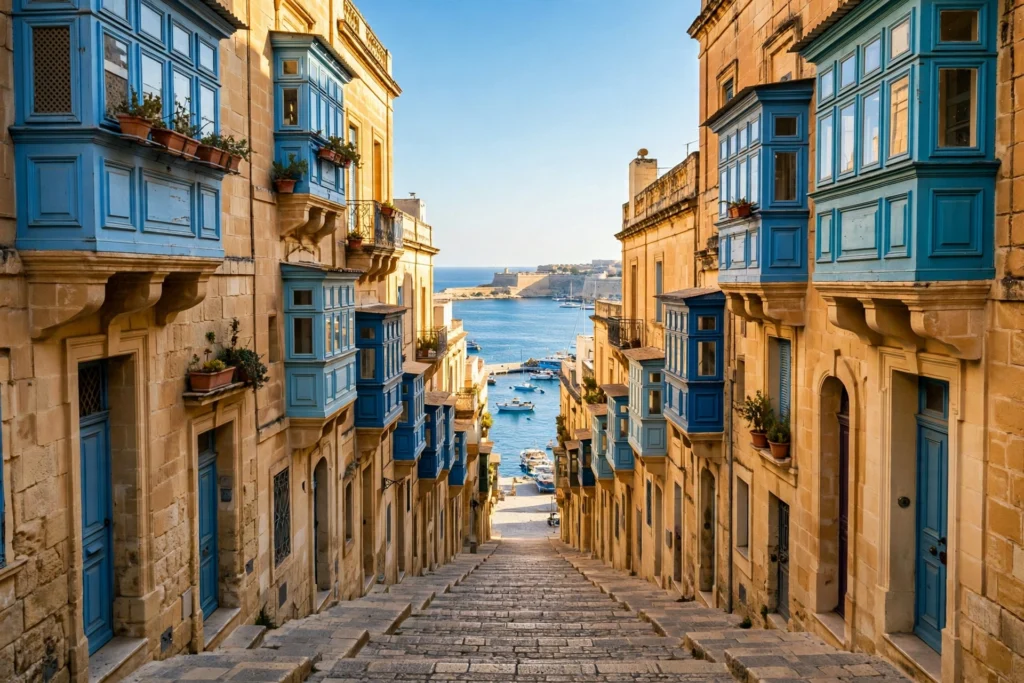
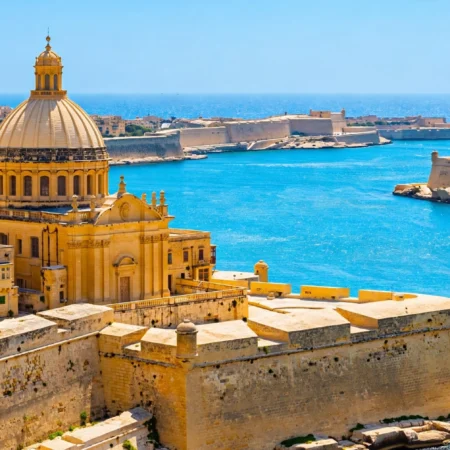
Valletta is the smallest capital city in the European Union, and it is also one of the most concentrated historic centres in the world. The whole city is a UNESCO World Heritage Site, inscribed in 1980, with around 320 monuments packed into a fortified peninsula you can walk end to end in about twenty minutes. It was founded in 1566 by the Knights of St John, the year after the Great Siege of 1565 drove the Ottoman fleet from Malta’s harbours, and it was built as a single planned city — a grid of straight streets inside massive bastions, designed so that the sea breeze could reach every corner. The honey-coloured limestone, the painted wooden balconies, the steep stepped streets and the views over the Grand Harbour make it feel less like a capital and more like a fortress that learned to be beautiful.
Start at the City Gate and walk down Republic Street, the main spine of the old city. St John’s Co-Cathedral is the must-see interior: a plain facade hides one of the most richly decorated churches in Europe, with a gold-leaf interior, a floor paved with more than 400 marble tombs of knights, and two paintings by Caravaggio, including The Beheading of Saint John the Baptist, his largest work. Go in the morning and take the audio guide, because without it you will walk straight past details that took the Knights decades to build. Entry is around €15, and the cathedral is an active place of worship, so dress respectfully with shoulders and knees covered, and expect access to be limited during services. The Grandmaster’s Palace, the former seat of the Knights and now the President’s office, and the National Museum of Archaeology, which holds the finds from the temples, are both worth an hour each. The Lascaris War Rooms, buried deep in the bastions, preserve the Allied command centre from the Second World War, with the original maps and equipment still in place — most visitors skip them, and the atmosphere is the stronger for it.
The best free view in Malta is from the Upper Barrakka Gardens, at the top of the city above the Grand Harbour. Every day at noon the saluting battery below the gardens fires its cannon, a tradition kept alive for centuries, so arrive at least ten minutes early and claim a place at the railing. From here you can see across the water to the Three Cities — Birgu, Senglea and Cospicua — the older harbourside towns where the Knights were based before Valletta was built. Birgu, also called Vittoriosa, is worth a slow afternoon of its own: quiet winding streets, Fort St Angelo at the tip of the peninsula, and the Maritime Museum. A traditional dghajsa boat — the small wooden water taxi that has worked the Grand Harbour for generations — will take you across from Valletta to Birgu for a couple of euros, and it is the best angle from which to understand the fortifications.
Valletta rewards staying overnight. The day-trippers leave in the late afternoon, the streets empty, and the city becomes what it was built to be: a small, walkable fortress town of wine bars, small restaurants and hidden staircases. Eat away from the main waterfront strip, where prices are highest and the food is least interesting, and look for the side streets around Strait Street and Merchant Street, where locals eat. If you are planning a wider Mediterranean trip, Valletta pairs well with other historic harbour cities — the same slow-evening logic that makes our Venice travel guide work applies here, and our Croatia travel guide covers another Adriatic old town built for walking.
Mdina and Rabat: The Silent City and the Catacombs
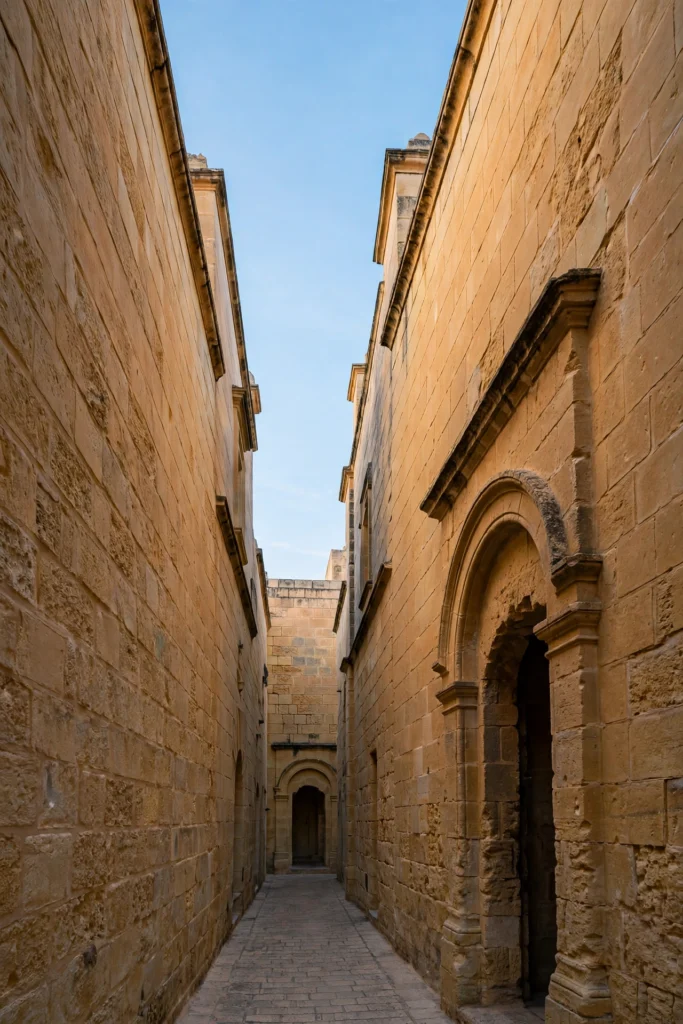
Mdina is Malta’s old capital, a fortified hilltop city with fewer than 300 residents, no cars inside the walls except for residents, and a silence that earns it the nickname the Silent City. It is about 4,000 years old, and walking through its narrow limestone lanes in the late afternoon feels like stepping out of the present altogether. Go around 2 pm, when most tour groups have left for the beach, and you will have the streets almost to yourself. The main gate, the cathedral square and the bastion walls are the obvious stops, but the real pleasure is the wandering: a palazzo doorway here, a view over the whole island from the walls there, a small cafe in a quiet square.
Mdina Cathedral, St Paul’s Cathedral, sits on the site where tradition says St Paul lived after his shipwreck on Malta in around 60 AD. The interior is baroque and rich, and the cathedral museum holds a collection of engravings and church silver. The Mdina Dungeons, in the former prison below the city, are a darker, more theatrical stop — fine for older children, skippable if you are short on time. From the bastions on the eastern side, the view stretches across the whole island to the sea, and it is one of the best sunset spots in Malta. If you stay for dinner, the restaurants inside the walls are more expensive than those outside, but the setting after dark — lantern-lit streets, almost no traffic, the sound of your own footsteps — is worth it at least once.
Rabat, the town just outside Mdina’s walls, is where the deeper history lies underground. The St Paul’s Catacombs and St Agatha’s Catacombs are early Christian burial complexes cut into the rock, with hundreds of tombs, small chapels and frescoes. They are cool, quiet and genuinely atmospheric, and they make a good contrast with the grand architecture above ground. The Domus Romana, a Roman townhouse with surviving mosaics, sits just outside the Mdina gate and is a quick, worthwhile stop. Rabat is also where the locals eat: the pastizzerias here, including the famous Crystal Palace, are where you will find the best pastizzi on the island, hot from the oven and costing well under a euro. A half-day covers Mdina and Rabat comfortably; combine it with the temples and the Blue Grotto in the south for a full day, as laid out in the itineraries at the end of this guide.
The Megalithic Temples: Ħaġar Qim, Mnajdra and Ġgantija
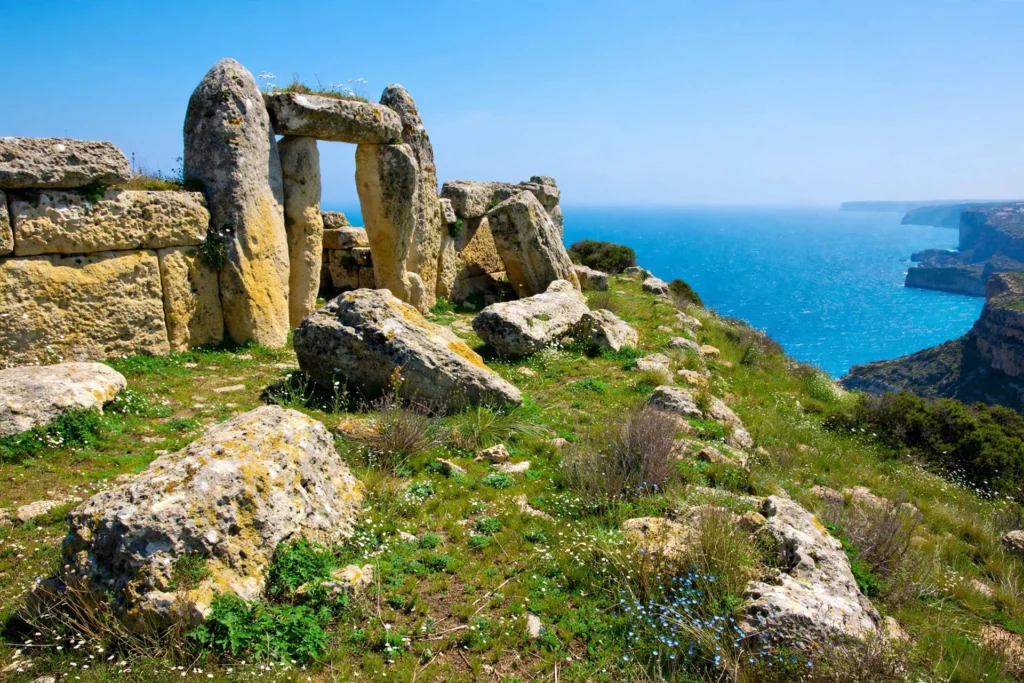
Malta’s temples are the oldest free-standing stone structures in the world. Built between 3600 and 2500 BC, they predate Stonehenge by around a thousand years and the Egyptian pyramids by roughly five centuries. Seven temples across Malta and Gozo form a single UNESCO World Heritage property, the Megalithic Temples of Malta, inscribed in 1980 and extended in 1992. They were built by a Neolithic farming people who quarried coralline limestone blocks weighing up to fifty tonnes and fitted them together without metal tools, and nobody knows exactly what happened to them — the temple culture faded around 2500 BC and the islands were largely empty for centuries afterwards. Standing inside one of these chambers, with the stone still warm from the sun, is one of the strangest and most moving experiences in the Mediterranean.
Ħaġar Qim and Mnajdra, on the southern cliffs near the village of Qrendi, are the most accessible pair and the best first stop. Ħaġar Qim is a large temple complex with a massive facade and a visitor centre that explains the site well; Mnajdra, a short walk down the hill, is the more atmospheric of the two, with three linked temples aligned to the sun — at the equinoxes, the rising sun shines directly through the doorway and onto the inner altar. Entry to Ħaġar Qim is around €10, and the site is now covered by a protective canopy, which keeps the rain off the stone but changes the light — go on a bright morning for the best effect. The Blue Grotto is about ten minutes away by bus, so the two pair naturally into a half-day.
On Gozo, Ġgantija is the oldest of the seven temples, built between 3600 and 3000 BC, and its outer walls still stand to nearly six metres. The name means “giant’s tower” in Maltese, because the locals who found it could not believe ordinary people had moved stones that big. The Tarxien Temples, in the town of Tarxien near the airport, are the most richly decorated, with spiral carvings and the famous statue of a skirted figure, though they are also the most enclosed by the modern town around them. If you only have time for one temple visit, choose Ħaġar Qim and Mnajdra for the setting and the sea views; if you have a second day, add Ġgantija on Gozo.
The third UNESCO property is the one you must plan furthest ahead: the Ħal Saflieni Hypogeum in Paola, a prehistoric underground temple and burial complex carved entirely from solid rock, descending three levels to a depth of around ten metres. It is the only prehistoric underground temple known to exist anywhere in the world, and it is also the hardest ticket in Malta. Entry is strictly limited to 80 visitors a day, and tickets sell out weeks or even months ahead. Book through Heritage Malta, the national agency that manages the site, and expect to pay roughly €35–€50 — confirm the current price when you book, because it varies. The visit lasts about an hour, photography is not allowed inside, and the experience is genuinely unlike anything else on the islands: a dark, quiet, hand-carved world five thousand years old. If you cannot get a ticket, the National Museum of Archaeology in Valletta holds the Hypogeum’s most famous finds, including the Sleeping Lady figurine, and is a good second best. If ancient sites are what draws you to travel, you will find the same deep-history feeling in our Ecuador travel guide and our Tanzania travel guide, which cover far older landscapes in very different ways.
Gozo: Malta’s Greener, Slower Sister Island
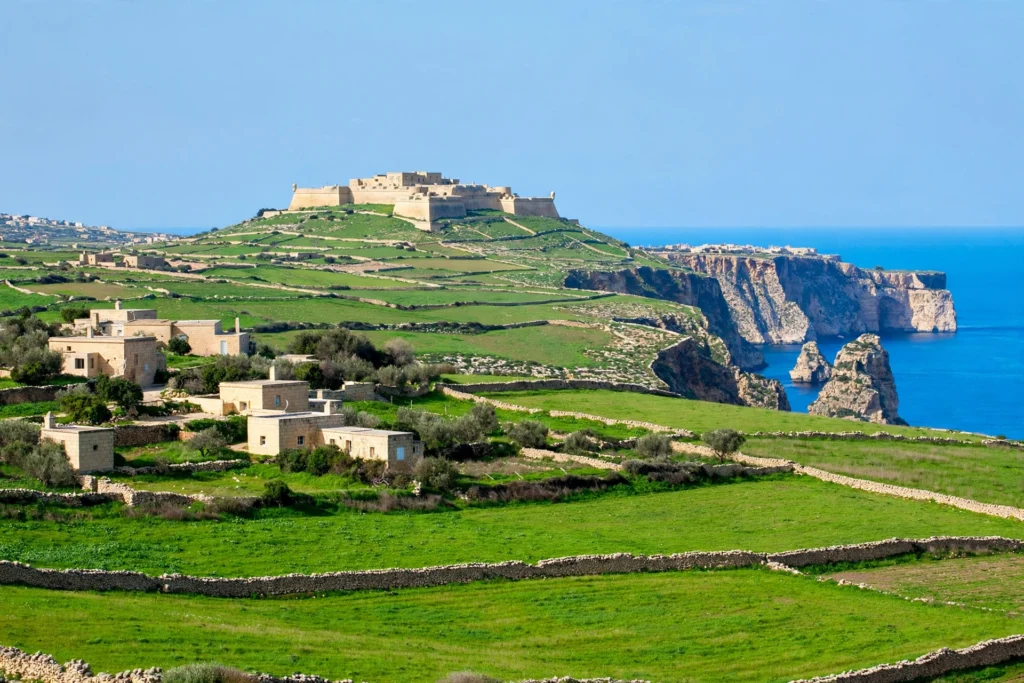
Gozo is Malta’s second island, and it feels like a different country. It is greener, quieter and slower, with rolling hills, small villages, dramatic cliffs and a pace of life that makes the main island feel busy by comparison. The crossing from Ċirkewwa at the northern tip of Malta takes 25 minutes on the Gozo Channel ferry, which runs every 30–45 minutes and costs €4.65 return for foot passengers — you only pay on the way back, when leaving Gozo for Malta. Cars cost €15.70 return. There is also a fast passenger ferry from Valletta to Mġarr, Gozo’s harbour, which takes 45 minutes and costs €7.50 one way — a better choice if you are staying in Valletta and do not want the bus ride to Ċirkewwa first. Since 2026 there are also fast passenger routes from Sliema and Buġibba. A day trip works, but an overnight stay is better: Gozo’s best moments are the early morning and the evening, when the day-trippers have gone.
Victoria, also called Rabat, is Gozo’s capital, a hilltop town with a winding old quarter and the Citadel, a fortified citadel with walls you can walk for sweeping views over the whole island. The Citadel was restored in recent years and now houses several small museums, including the Museum of Archaeology and the Old Prison. Below it, the town’s main square is full of cafes and bakeries, and it is a good base for exploring. The island’s other landmark is gone: the Azure Window, the famous limestone arch at Dwejra Bay, collapsed into the sea in a storm in 2017. The site is still worth visiting — the Inland Sea, a small lagoon connected to the open water by a tunnel through the cliffs, and the Fungus Rock are both there, and small boats take visitors through the tunnel when the sea is calm.
Gozo’s beaches are quieter than the main island’s. Ramla Bay, on the north-east coast, is Malta’s most beautiful sandy beach, with russet-red sand, shallow water and a view of the statue of the Virgin Mary on the hill above. San Blas Bay, a smaller red-sand cove nearby, takes a steep walk down to reach and rewards the effort with far fewer people. The coastal walking trails are the island’s best-kept secret: the cliffs around Ta’ Ċenċ, the salt pans at Xwejni, and the path from Mġarr to the fishing village of Marsalforn all show a Malta that most visitors never see. Renting a car, a scooter or a quad bike makes the most sense on Gozo, where the roads are quieter and parking is easier than on the main island. Food is a reason to linger too: Gozo’s wood-fired ftira, the flatbread topped with tuna, capers, olives and tomato, is a local institution, and the island’s farmhouses with private pools are the classic place to stay for a few slow days. If you like the idea of a quieter second island after a busy capital, the same pattern shows up in our Iceland travel itinerary, where the slower days outside the capital are the ones people remember.
Comino and the Blue Lagoon: The Pass You Must Book First
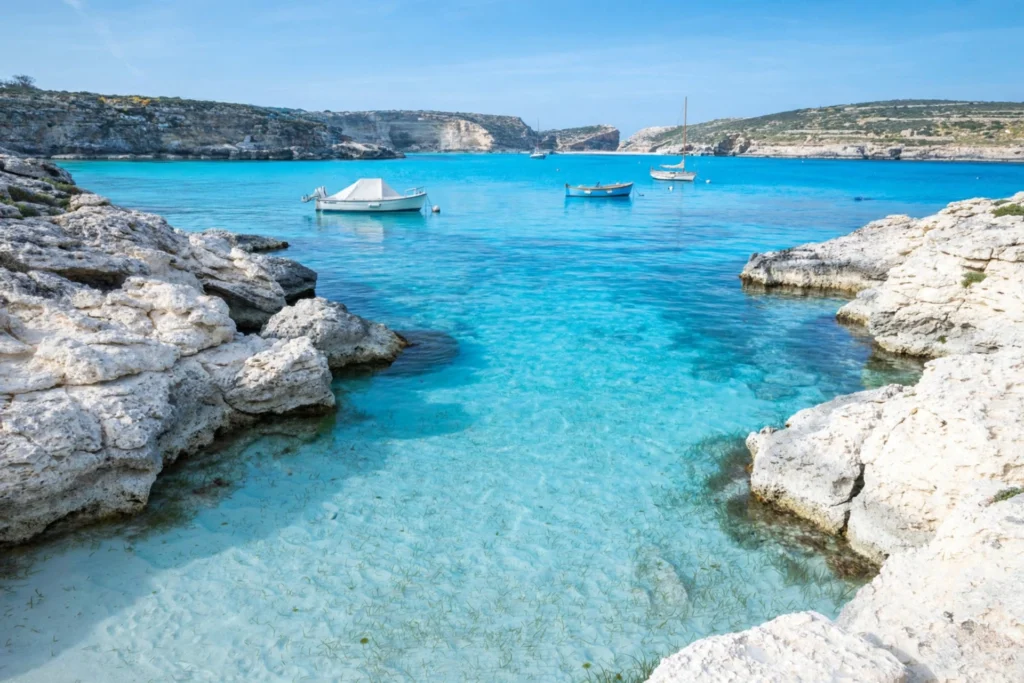
The Blue Lagoon on Comino is the most photographed place in Malta, and it is also the one that catches the most visitors out — because since 1 May 2025, nobody can step ashore there without a free landing pass booked in advance. The pass is part of the Malta Tourism Authority’s Access Management System, introduced after peak days brought up to 12,000 people to a bay that is a protected Natura 2000 site. Numbers are now capped at 4,000 people at a time, and there are three daily time slots: morning from 08:00 to 13:00, afternoon from 13:30 to 17:30, and sunset from 18:00 to 22:00. The pass is free, it comes as a QR code by email, and it is scanned at the jetty and exchanged for a wristband, which you hand back when you leave. Book it at blcomino.com, the official portal, up to two months ahead, for up to four people on one booking. Children under five do not need a pass. Bookings cannot be changed once made, so choose your boat first and then the slot that matches it. Landing without a valid pass is not allowed and can be fined — and the pass does not include the boat, so the two bookings are separate.
Comino itself is tiny, car-free and almost uninhabited, with three permanent residents, one hotel, one chapel and no shops. The lagoon is a shallow channel of clear turquoise water between Comino and the islet of Cominotto, and on a calm morning it looks exactly like the photographs. By midday in July and August it is a different place: crowded, noisy and hot, with boats anchored shoulder to shoulder. The way to enjoy it is to take the morning slot. The quickest and cheapest crossing is the shuttle ferry from Ċirkewwa, at the northern tip of Malta beside the Gozo ferry terminal — about 20 minutes, with return tickets from about €13–€15. Ferries also leave from Mġarr Harbour on Gozo, about 15 minutes. Full-day cruises from Sliema and Buġibba cost roughly €30–€50 and usually add the Crystal Lagoon, Gozo’s caves and lunch on board. Small-group boats and private charters cost more and arrive before the big boats. No Blue Lagoon boats leave from Valletta or St Julian’s; from Valletta, the quickest route is the harbour ferry to Sliema and then a cruise from the Sliema seafront.
Beyond the lagoon, Comino has a quieter side that most day visitors never see. The island’s coastal path leads to Santa Marija Bay, a sandy beach with far fewer people, and to the Santa Marija Tower, a 17th-century watchtower you can climb for views over the channel. There is almost no shade anywhere on the island, so bring water, sunscreen and a hat, and wear shoes you can walk on rock in — the ground is rough limestone, not sand. If the morning slot is sold out on your date, consider going for the sunset slot instead, when the light turns the water gold and the crowds thin, or visit on a weekday rather than a weekend. The official Visit Malta Blue Lagoon guide is kept up to date with the current rules and is worth checking before you book, because the system is still new and the details can change.
The Best Beaches in Malta
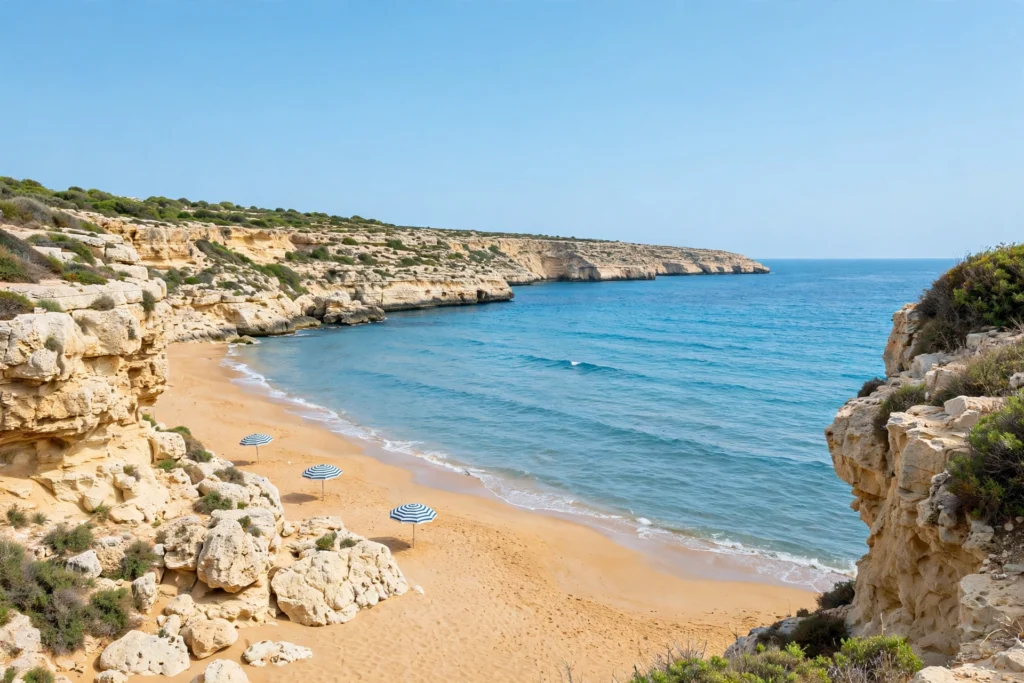
Malta is not a classic beach destination in the way the Greek islands are — much of the coastline is rocky, and the best swimming is often from a flat rock platform rather than a sandy beach. That is part of the charm: the water is clear, the coves are sheltered, and the swimming is some of the best in the Mediterranean. But if you want sand under your feet, you need to know where to go, because the sandy beaches are few and they fill up fast in summer.
| Beach | Island | Type | Best for |
|---|---|---|---|
| Blue Lagoon | Comino | Turquoise shallows | Swimming, snorkelling, photos |
| Ramla Bay | Gozo | Red sand | Scenery, relaxed day out |
| Golden Bay | Malta (north-west) | Sand, facilities | Families, sunset |
| Mellieħa Bay | Malta (north) | Sand, shallow | Families, paddling, windsurfing |
| St Peter’s Pool | Malta (south) | Natural rock pool | Local vibe, cliff jumping |
| Paradise Bay | Malta (north) | Small, sheltered | Quiet swimming |
| San Blas Bay | Gozo | Remote red sand | Hikers, quiet days |
| Għajn Tuffieħa | Malta (north-west) | Sand, steep steps | Views, fewer crowds than Golden Bay |
Mellieħa Bay, also called Għadira Bay, is the longest sandy beach in Malta and the easiest for families: shallow water, sunbeds and umbrellas for hire, cafes and a bus stop at the top of the hill. Golden Bay, next to the Radisson hotel on the north-west coast, has a similar setup with a big sandy stretch and a famous sunset — it is also one of the busiest beaches on the island in July and August, so arrive early. Għajn Tuffieħa, just south of Golden Bay down a long flight of steps, is quieter and more beautiful, with red-gold sand and cliffs on both sides. On Gozo, Ramla Bay is the standout: wide, red sand, shallow water and a view across to the statue on the hill. San Blas Bay is smaller and harder to reach, down a steep track, and that is exactly why it stays peaceful.
For a different kind of swimming, try the rocky spots. St Peter’s Pool, on the south coast near Marsaxlokk, is a natural limestone swimming hole with deep blue water and flat rocks for sunbathing — free, with no facilities, and popular with locals for cliff jumping. The water is deep and the entry is by ladder or by jumping, so it is not a place for weak swimmers or small children. Paradise Bay, near Ċirkewwa, is a small sheltered cove with sand and clear water, and a good stop if you are waiting for the Gozo ferry. Sliema and St Julian’s have rocky bathing platforms rather than beaches: ladders into the sea, flat rocks for towels, and some of the best sunset swimming on the island, right in the middle of town. Wherever you swim, remember the State Department’s warning about riptides, check the flags, and take lifeguard advice seriously. If you are comparing beach destinations for a wider trip, our guide to the best places to travel in Mexico covers a very different kind of coastline, and our Lisbon travel guide covers another European capital with easy beach escapes.
Getting Around Malta: Buses, Ferries and Driving on the Left
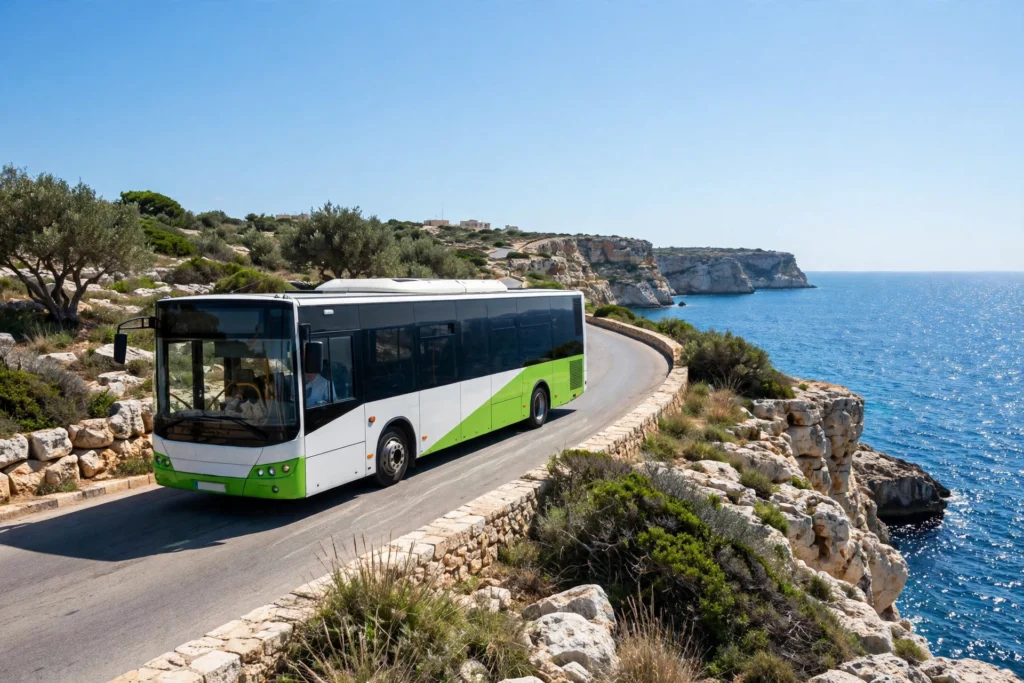
Malta is small — the main island is about 27 km by 14.5 km — but getting around it is not always as easy as the map suggests. The roads are narrow, traffic is heavy, and the buses are slow. Plan your days around one area at a time rather than zig-zagging across the island, and treat the timetable as a suggestion rather than a promise. The good news is that the whole system is cheap, English is spoken everywhere, and the ferry network is genuinely pleasant.
The bus network, run under the Tallinja brand, is the only public transport that reaches every village and beach on the islands. A single journey costs €2.00 in winter, €2.50 in summer, or €3.00 at night, and you can pay contactless on board. For unlimited travel, the Explore 7-Day Card costs around €25 and pays for itself after about ten rides — buy it at the airport or at the Valletta bus terminus if you plan to use buses most days. Download the Tallinja app for real-time routes and tracking, because the printed timetables are optimistic: a full bus will sail past your stop without slowing down, and summer traffic around Sliema and St Julian’s can double journey times. The main bus terminus is just outside Valletta’s City Gate, and most routes start and end there. Buses to Ċirkewwa, routes 41 and 42 from Valletta, take about 90 minutes, so build that into any Gozo or Comino day.
Ferries are the fastest and most enjoyable way to cross the harbours. The Valletta to Sliema ferry costs €1.50 one way and takes about ten minutes, saving a long bus ride around the harbour. Similar small passenger boats link Valletta with the Three Cities. The Gozo Channel ferry from Ċirkewwa to Mġarr runs every 30–45 minutes, takes 25 minutes and costs €4.65 return for foot passengers, paid only on the way back. The fast ferry from Valletta to Mġarr takes 45 minutes and costs €7.50 one way. Traditional dghajsa water taxis still work the Grand Harbour, and a couple of euros gets you from Valletta to Birgu with a view of the fortifications that no bus can match.
Renting a car gives you the most freedom, especially for reaching remote beaches and the quieter corners of Gozo, but it comes with trade-offs. Malta drives on the left, the lanes are very narrow, parking is permanently scarce in Valletta and Sliema, and local driving is assertive — expect sudden stops, buses pulling out without warning, and roundabouts taken at speed. Daily rental rates average €25–€50. If you do rent, take the smallest car on the lot so you can fit through the stone lanes, and never park on yellow lines: the fine and the tow truck are a certainty. US driving licences are accepted for short visits, but check with your rental company before you book, because some require an International Driving Permit as well. For most first-time visitors, the bus plus the occasional taxi is the better deal: Bolt and eCabs both operate across Malta, and a ride from the airport to Valletta costs around €20 and takes under half an hour. If you are travelling with a pet, note that our guide to how to travel with a cat covers the paperwork and transport rules that apply before you even reach the island.
Getting around at a glance
| Option | Cost (2026, planning range) | Best for |
|---|---|---|
| Single bus journey | €2.00 winter / €2.50 summer / €3.00 night | Cheapest way to reach anywhere |
| Explore 7-day bus card | Around €25 | Unlimited buses for a week |
| Valletta–Sliema ferry | €1.50 one way | Fast harbour crossing, 10 minutes |
| Gozo Channel ferry (foot) | €4.65 return | Day trips to Gozo |
| Valletta–Gozo fast ferry | €7.50 one way | Skipping the bus to Ċirkewwa |
| Comino shuttle ferry | Around €13–€15 return | Blue Lagoon day trips |
| Bolt / eCabs taxi | Around €20 airport to Valletta | Late nights, luggage, groups |
| Car rental | €25–€50 a day | Remote beaches, Gozo back roads |
Where to Stay in Malta by Area
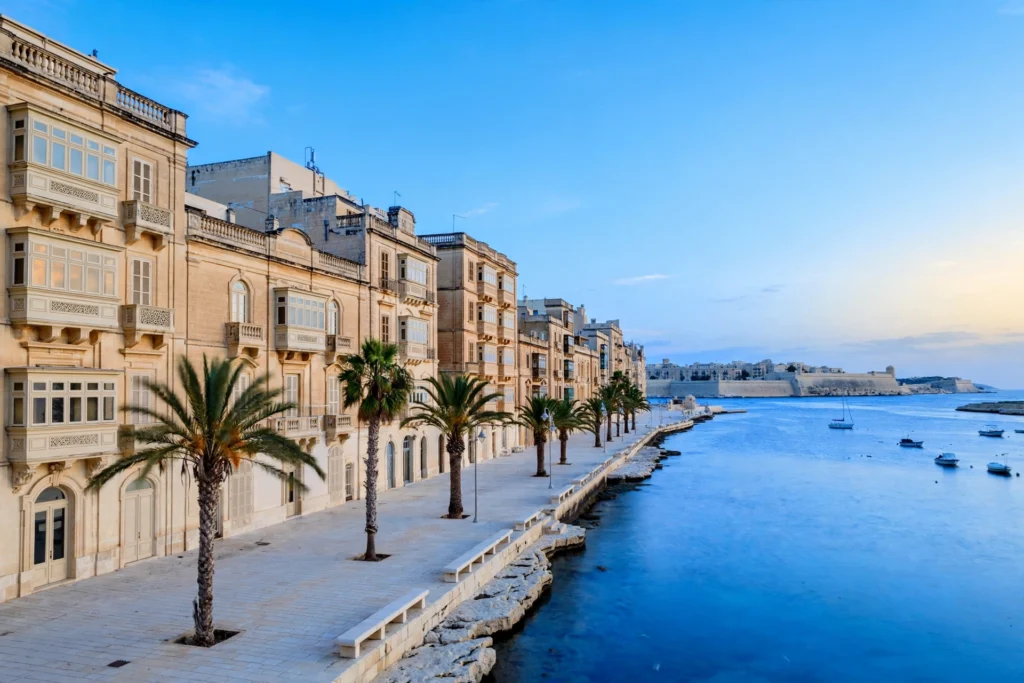
Where you stay in Malta matters more than in most destinations, because the islands are small but the traffic is slow, and the wrong base can add an hour to every day. The right choice depends on what you want most: atmosphere, practicality, nightlife or quiet. There is no single best area — there is a best area for the trip you are planning.
Valletta is the most atmospheric base and the best choice for a first visit focused on history. Staying inside the walls means stepping out into a UNESCO city every morning, and the evenings, once the day-trippers leave, are the best in Malta. The trade-offs are real: hotels are more expensive, many streets are pedestrian-only so you will carry your bags up stone steps, and parking is effectively impossible. Look for boutique stays in restored palazzi with high ceilings and bare stone walls, and book early — Valletta’s hotels fill up fast, especially in spring and autumn. If you are visiting in the hottest months, check that your room has proper air conditioning, because old limestone buildings can be brutally hot in summer and damp in winter.
Sliema is the most practical all-rounder and the best base for most travellers. It has a seaside promenade, loads of restaurants, good shopping, and a ten-minute ferry to Valletta. Buses leave from here to everywhere, and the rocky bathing platforms along the front are perfect for a sunset swim. Gżira, next door, offers similar practicality at slightly lower prices. St Julian’s, just north of Sliema, is the choice for nightlife and beach clubs: the Paceville area is where the bars and clubs are, and the hotels here tend to be larger resorts with pools. It is lively at night and noisy in summer, so ask for a room away from the street if you want sleep. Mellieħa, in the north, is quieter and closer to the best beaches — a good choice for families or for a slower trip, though you will be about an hour from Valletta by bus. On Gozo, converted farmhouses with private pools are the classic stay, and they work especially well for a few days of switching off. St Paul’s Bay and Buġibba, on the north-east coast, have the cheapest rates on the main island, with lots of inexpensive apartments and boat trips to Comino on the doorstep, but they are resort strips about an hour from the historic sights.
| Area | Vibe | Best for | Trade-off |
|---|---|---|---|
| Valletta | Historic, atmospheric | First-timers, history lovers | Pricier, steps and no parking |
| Sliema / Gżira | Practical, lively | Most travellers, best logistics | Rocky shore, not a beach town |
| St Julian’s | Nightlife, resorts | Parties, beach clubs, pools | Noisy in summer, touristy |
| Mellieħa | Quiet, near beaches | Families, slow trips | An hour from Valletta by bus |
| Gozo | Rural, peaceful | Slow days, farmhouses, walking | A ferry from everything else |
| St Paul’s Bay / Buġibba | Budget resort strip | Cheap stays, Comino boats | An hour from the historic sights |
Book early rather than cleverly. Prices roughly double in July and August, so summer stays are worth locking in six months ahead, while shoulder-season stays in May or October get you the same apartment for far less, with the sea still warm enough to swim. If you are still deciding how much to spend on the trip as a whole, our guide to how to prepare a travel budget walks through the same maths for any destination, and our Singapore travel guide shows how a small, dense city-state rewards the same kind of careful base choice.
How Much Does Malta Cost? Budget and Planning Ranges
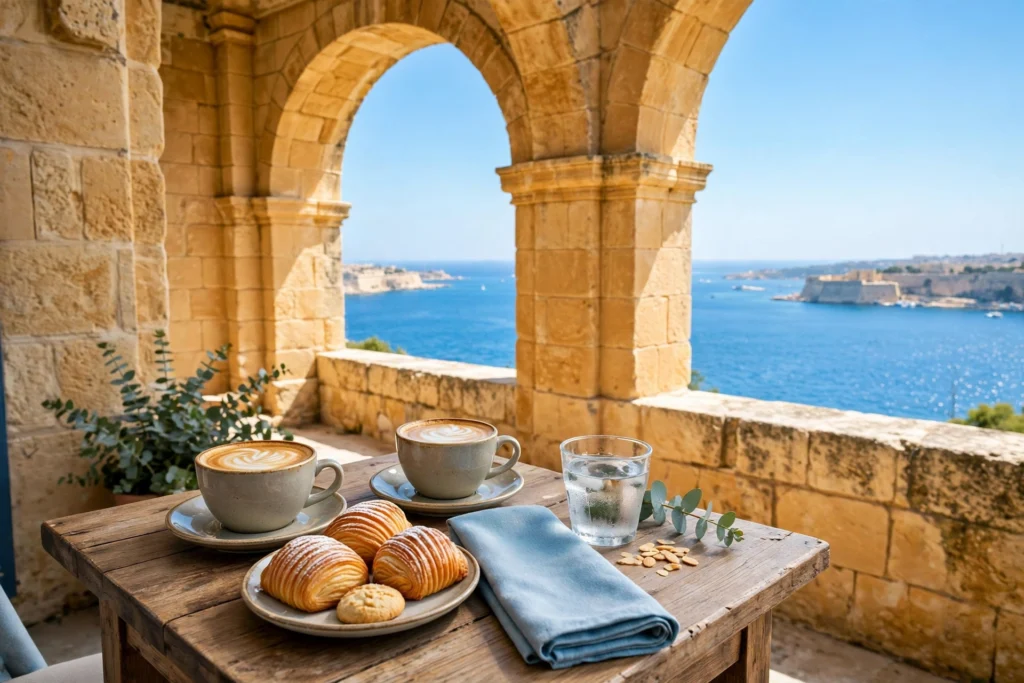
Malta is one of the more affordable destinations in the Mediterranean, and it is noticeably cheaper than Italy, France or Greece for the same standard of trip. A typical mid-range traveller spends around €100–€140 a day, covering a private hotel room, meals, transport and sightseeing. Budget travellers who stay in hostels, eat at local cafes, use the bus and focus on free attractions — beaches, Mdina, Valletta walks — can get by on €40–€70 a day. At the other end, a boutique hotel in Valletta, fine dining and private excursions will push the daily total past €250. The figures below are planning ranges for one person per day, excluding flights.
| Traveller type | Daily budget (per person) | What it covers |
|---|---|---|
| Budget | €40–€70 | Hostel dorm, pastizzi and local cafes, buses, free sights |
| Mid-range | €100–€140 | Private hotel, mid-range dining, ferries, paid sights |
| Comfortable | €140–€200 | Boutique hotel, good restaurants, tours, car hire |
| Luxury | €250+ | Valletta palazzo hotel, fine dining, private excursions |
Key expenses to plan for: St John’s Co-Cathedral around €15; Ħaġar Qim around €10; the Ħal Saflieni Hypogeum roughly €35–€50, booked weeks ahead; a Blue Lagoon boat trip around €13–€15 by shuttle ferry or €35–€45 for a full-day cruise; the Gozo ferry €4.65 return for foot passengers; a pastizzi under €0.50; a coffee around €2–€3; a casual lunch €10–€16; dinner with wine around €35–€40; a local beer around €4. Heritage Malta sells a multi-site pass covering more than 20 sites, which is good value if you plan to visit four or more of them — check the current price on the official site before you buy, because it changes. Tipping is modest: around 10% in restaurants when service is not already on the bill, and rounding up in taxis and small coffee bars is plenty. Always read the receipt first, because a service charge is sometimes added already.
A few money details that catch American visitors out. Malta uses the euro, and card payments are widely accepted, but American Express is patchy outside hotels and larger restaurants, so do not make it your only card — the State Department’s Malta page says the same. ATMs accept US-issued bank cards, but cash withdrawals frequently incur a fee, and if the machine offers its own conversion rate, decline it and let your bank convert instead. Keep some cash in small notes and coins: small cafes, pastizzerias, dghajsa boatmen and market stalls often take cash only. Tap water is desalinated and safe to drink, but it tastes heavily treated, so most visitors buy bottled water — factor a couple of euros a day into your budget. Sunscreen is expensive at tourist spots, so buy it at a supermarket on arrival. If you are building a longer trip around Malta, the budgeting method in our travel bucket list guide and the planning approach in our travel goal guide both help with the same question: how much to set aside, and where the money actually goes.
What to Eat, Drink and Pack in Malta
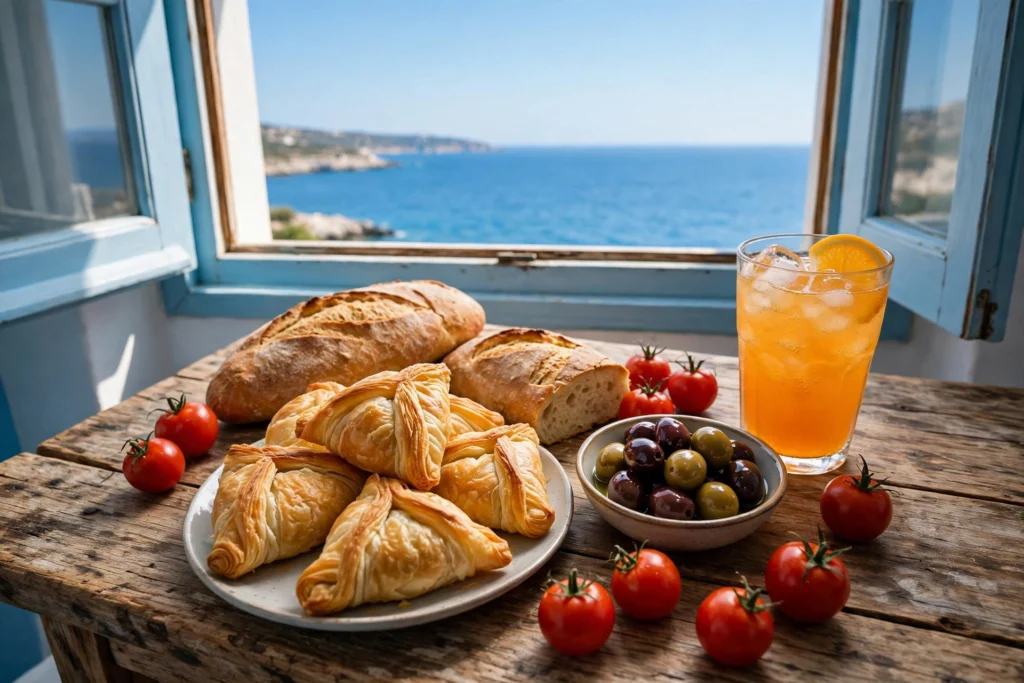
Maltese food is a genuinely interesting mix of Mediterranean influences — you will taste Italy, North Africa and Britain in the same meal, with a few dishes that exist nowhere else. The national snack is the pastizzi: a flaky, golden pastry filled with ricotta or mushy peas, sold hot from tiny pastizzerias on almost every corner for well under a euro. The best ones come from the old shops in Rabat, where there is always a queue of locals. The national dish is fenek, rabbit stewed in wine and garlic, often served in two courses, with the stewing juices used as a sauce for pasta first and the meat second. It is a generous, slow-cooked meal, and nearly every traditional restaurant serves it.
Beyond those two, the dishes to look for are ħobż biż-żejt, Maltese bread rubbed with tomatoes and drizzled with olive oil; ftira, a crisp bread ring topped with tuna, capers, olives and tomato, especially good from wood-fired ovens on Gozo; lampuki pie, a seasonal fish pie with spinach, olives and capers, made with the lampuki fish caught between August and November; kapunata, Malta’s take on ratatouille and a good vegetarian option; and bigilla, a broad-bean dip served with crusty bread. For fresh seafood, head to Marsaxlokk on a Sunday morning, when the fishing village holds its market and the waterfront restaurants serve the catch of the day — note that fresh fish is often priced per hundred grams on the menu, so ask the total before you order. Desserts show the Sicilian influence: cannoli, crisp tubes filled with sweet ricotta cream, sometimes with pistachio or chocolate, are made the classic way in Valletta’s pastry shops.
To drink, try Kinnie, the local soft drink made from bitter oranges and herbs — it tastes odd, somewhere near a non-alcoholic Campari, and it refreshes better than any cola in the heat. Cisk is the local lager, light and easy, and it goes perfectly with fish on the waterfront. Local wines, especially from the Meridiana and Marsovin labels, are worth trying, and the wineries in the north of the island offer tastings. Coffee is strong and properly made, and the local habit is to drink it slowly while watching the square. For a structured introduction to the food, a Valletta food tour early in your trip is one of the best ways to spend a few hours, and it will teach you where the locals eat for the rest of your stay.
What to pack
Malta’s packing list is short, but getting it wrong is annoying. Bring a UK-style Type G three-pin adapter, because Malta uses British plugs at 230 volts — your US plugs will not fit without one. Pack sunscreen with a high factor and reapply often: the sun is stronger than it feels, especially from June to September, and twenty minutes on the bastions will burn you even under cloud. Bring a hat, sunglasses and a reusable water bottle, and carry more drinking water than you think you need on walking days. Pack swimwear even in winter, because you might fancy a dip on a sunny day, and bring shoes you can walk on rock in for the coves and coastal paths. For churches, pack a light scarf or shawl to cover shoulders, and trousers or a skirt that covers the knees — the main cathedrals hand out cover-ups at the door, but having your own is easier. Leave the formal clothes at home: Malta is casual everywhere except the smartest Valletta restaurants. If you are travelling with gear for diving or photography, check the airline’s baggage rules before booking, because the cheapest Malta fares include only a small cabin bag. And if you are still choosing your travel apps for the trip, our travel apps guide covers the ones worth installing before you fly — Tallinja for buses, Bolt for taxis, and offline maps for Valletta’s staircases.
Sample Malta Itineraries: 3, 5 and 7 Days
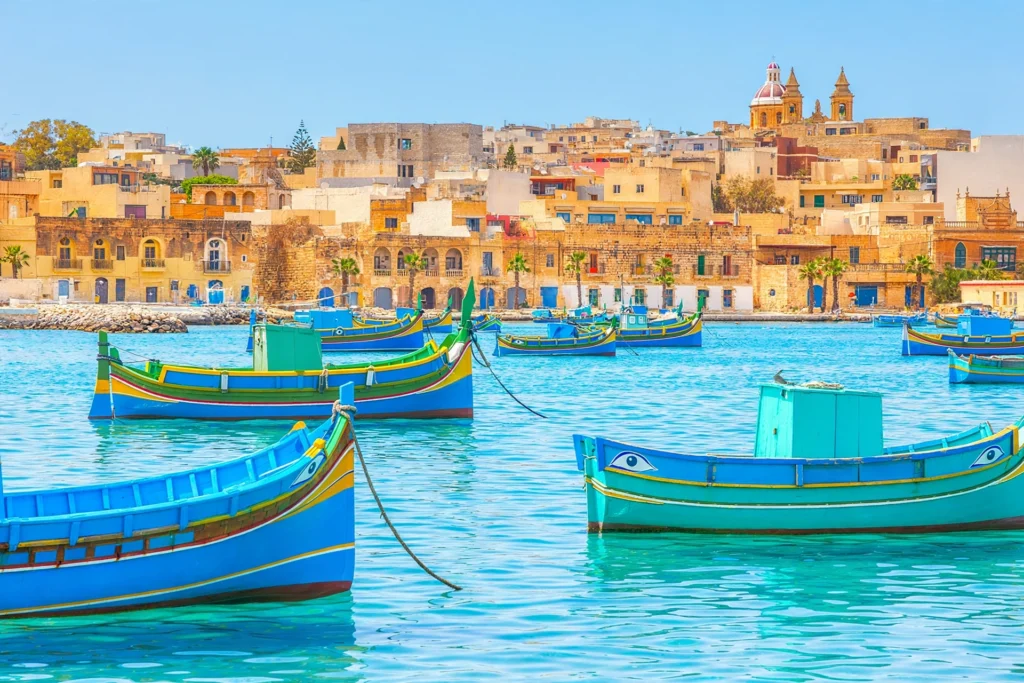
Three days is the minimum for a first visit, five days is comfortable, and seven days is what turns Malta from a checklist into a place you actually remember. The islands are small, but the sights are spread out, and the best days are the unhurried ones. Use these itineraries as a starting point and adjust them to the season — in summer, move the walking to the morning and the swimming to the late afternoon; in winter, do the opposite.
3-day itinerary — the highlights. Day 1: Valletta. Start at the City Gate, visit St John’s Co-Cathedral in the morning, walk to the Upper Barrakka Gardens for the noon cannon, spend the afternoon in the Three Cities across the harbour, and stay for dinner in Valletta once the day-trippers leave. Day 2: Mdina and the south. Morning in Mdina and Rabat, including the catacombs, then the Ħaġar Qim and Mnajdra temples in the afternoon, finishing at the Blue Grotto and sunset at the Dingli Cliffs. Day 3: Comino. Take the morning Blue Lagoon slot from Ċirkewwa, swim and snorkel until the afternoon, and spend the evening in Sliema or St Julian’s. This is a fast trip — you will see the headline sights and almost nothing else, and you will want to come back.
5-day itinerary — the comfortable trip. Follow the 3-day plan, then add Day 4: Gozo. Take the morning ferry from Ċirkewwa, visit the Citadel in Victoria, the Ġgantija temples and Ramla Bay, and stay overnight on Gozo if you can. Day 5: Gozo’s coast. Walk the cliffs at Dwejra and the salt pans at Xwejni, swim at San Blas Bay, and take the evening ferry back to Malta for a final dinner in Valletta. Five days is the sweet spot for a first trip, and it is the length most of the top guides recommend — the difference is that this version gives Gozo a full day and a half instead of a rushed afternoon.
7-day itinerary — the slow trip. Follow the 5-day plan, then add Day 6: the north and the beaches. Spend the day at Mellieħa Bay and Golden Bay, visit the Popeye Village film set if you are travelling with children, and watch the sunset from Għajn Tuffieħa. Day 7: a free day. Revisit your favourite place, take a food tour in Valletta, dive or snorkel from the Marfa Peninsula, or take a boat trip around the island. A week also gives you room for the Hypogeum, which needs to be booked weeks ahead, and for a village festa if your dates line up with one. If you are planning a longer European trip around Malta, our London travel guide and our Morocco travel guide cover two very different week-long options from the same starting point, and our guide to how to find travel inspiration helps when the next destination is still undecided.
Frequently Asked Questions
Do US citizens need a visa for Malta?
No. US citizens can visit Malta visa-free for up to 90 days in any 180-day period for tourism. Your passport must be valid for at least three months beyond your planned departure date. The 90-day limit counts across the whole Schengen Area, not just Malta.
Do I need ETIAS to visit Malta in 2026?
No. ETIAS is not in operation as of November 2026, and no launch date has been set. You cannot apply for one yet, and any website offering to sell you one is not legitimate. Check the official EU portal at travel-europe.europa.eu/etias before future trips.
What is the best time to visit Malta?
May, September and October are the best months for most visitors: warm enough to swim, cool enough to walk, and busy without being overwhelming. July and August are hottest and most crowded, with the highest hotel prices. Winter is the cheapest and quietest season.
How many days do you need in Malta?
Five to seven days is ideal for a first trip, covering Valletta, Mdina, the temples, a day on Gozo and a day at the Blue Lagoon. Three days covers the highlights but feels rushed. A single day is only enough for Valletta.
Do I need to book the Blue Lagoon in advance?
Yes. Since 1 May 2025, everyone who steps ashore at the Blue Lagoon needs a free landing pass booked in advance at blcomino.com, for one of three daily time slots. The pass is free, but the boat is separate, and landing without a pass can be fined. Book up to two months ahead.
Is Malta expensive?
Malta is one of the more affordable Mediterranean destinations. Budget travellers can manage on €40–€70 a day, and a comfortable mid-range trip costs around €100–€140 a day per person, including a hotel, meals, transport and sightseeing. The currency is the euro, and cards are widely accepted, though American Express is patchy outside hotels.
Conclusion: Malta Is Small, Old and Easy to Love
Malta does not try to impress you with size. It impresses you with density: a capital you can cross on foot, temples older than the pyramids, a lagoon the colour of a swimming pool, and a second island where the pace drops by half — all within an hour of each other. The practical side is easy too: English everywhere, the euro, no visa for US citizens, and a bus and ferry network that reaches every corner of the islands for a few euros. The two things that need planning are the two things that sell out: the Hypogeum, with its 80 visitors a day, and the Blue Lagoon landing pass, which has been compulsory since May 2025. Book those first, choose May, September or October if you can, and give the islands five to seven days. Malta rewards the traveller who slows down — the morning in Mdina before the tour buses arrive, the evening in Valletta after they leave, the second day on Gozo when the first day was only a taste. That is the trip worth planning.
People also read: London Travel Guide · Morocco Travel Guide · Croatia Travel Guide · Venice Travel Guide · Best Places to Travel in January · Travel Itinerary Template