Belize is the smallest country in Central America, and it is also one of the most varied. In a single week you can snorkel over the second-largest barrier reef in the world, dive into a deep blue sinkhole in the middle of the sea, eat lobster on a sandy caye where golf carts outnumber cars, and then drive inland to climb a Maya pyramid in the jungle, swim through a cave full of ancient pottery, and eat rice and beans with a family in San Ignacio. Few destinations pack that much contrast into such a small map. Belize is slightly larger than the state of Massachusetts, English is the official language, the currency is pegged two-to-one to the US dollar, and the whole country runs on Central Standard Time with no daylight saving. That makes it one of the easiest tropical destinations in the Americas for travellers from the United States — and one of the most rewarding, if you plan the reef half and the jungle half of the trip together instead of choosing between them. This Belize travel guide covers both halves: the safety picture in 2026 including the November state of emergency, the best months to go, the Great Blue Hole and the atolls, the four main bases, the Maya sites and the ATM Cave, transport, costs, food and packing, so you can build a trip that fits your budget and your appetite for adventure.
Quick answer: the best Belize trip splits about half the days on the cayes (Ambergris Caye or Caye Caulker) for the Belize Barrier Reef, the Great Blue Hole and the Hol Chan Marine Reserve, and half inland in San Ignacio and the Cayo District for the ATM Cave, Xunantunich and Caracol. Go in the dry season, roughly December to April, for the calmest seas and clearest water; budget travellers should plan on $60–100 per person per day, mid-range travellers $200–350, and high-end trips $600 or more, before international flights. US citizens need no visa for stays of 30 days or less. The US State Department rates Belize Level 2 (Exercise Increased Caution) because of crime, with Southside Belize City at Level 3, and a 30-day state of emergency is in force from 1 to 30 November 2026 in parts of Belize City, Ladyville, Cotton Tree and Unitedville — read the safety section below before you book anything in that window.
Is Belize Safe to Visit in 2026?
The honest answer is that Belize is safe to visit for most travellers who take the same precautions they would in any Caribbean destination — with one important exception, one live emergency, and a few practical rules that are specific to this country. Start with the official picture. The United States Department of State rates Belize Level 2: Exercise Increased Caution, issued on 12 March 2026, with the summary updated on 18 June 2026 without a level change, because of crime. The advisory says isolated incidents of violent crime can happen even during the day and in tourist areas, though the south side of Belize City has historically had the highest concentration of violent crime, and much of that violence is linked to gangs. It also warns that local police lack the resources and training to respond effectively to serious crimes, that most crimes remain unresolved and unprosecuted, and that emergency medical services are usually unavailable or significantly delayed — serious injuries or illnesses normally require medical evacuation to another country. That last point is why travel insurance with medical evacuation cover matters more in Belize than in most beach destinations, and why the cost section of this guide treats it as essential rather than optional. Before you travel, read the full US State Department page for Belize and check it again close to departure, because advisory levels and wording can change. US citizens should also enrol in the Smart Traveler Enrollment Program (STEP).
The higher-risk area is specific and easy to avoid. Southside Belize City — the part of the city south of Haulover Creek, down to Fabers Road — is rated Level 3: Reconsider Travel because of crime, and US government employees are strongly discouraged from travelling there and from driving between cities in Belize after dark. Most visitors never need to go to Southside at all: the international airport is outside the city, the water-taxi terminals and the cruise port sit on the north side, and the usual pattern is to land, transfer straight to a boat or a domestic flight, and spend the trip on the cayes or inland. If you do pass through Belize City, stay on the north side, use a hotel transfer or a licensed taxi, do not walk around after dark, and do not display expensive watches or jewellery. The same advice applies to ATMs and banks — be extra vigilant there, and do not physically resist any robbery attempt.
The second thing to know is time-sensitive and must be taken seriously. The Government of Belize declared a 30-day state of emergency on 1 November 2026 (signed by Governor-General Dame Froyla Tzalam on 31 October 2026, Statutory Instrument No. 130 of 2026) after an increase in gang violence. It covers 19 areas of Belize City — 17 of them south of Haulover Creek — plus Ladyville Village in the Belize District and Cotton Tree Village and Unitedville Village in the Cayo District, and it runs from 1 to 30 November 2026 unless it is lifted sooner. The US Embassy in Belize issued a security alert on 4 November 2026 confirming the declaration and reminding US citizens to exercise caution when travelling in and around Belize City because of gang violence and random, potentially violent crimes of opportunity. The UK Foreign, Commonwealth and Development Office updated its Belize advice on 5 November 2026 with the same information. The state of emergency is still in force today, 14 November 2026. In practice, for a tourist it means three things: carry valid identification at all times, expect an increased police presence with checkpoints on major roads and thoroughfares (which can also mean heavier traffic), and follow the instructions of police officers at checkpoints. The cruise port and the Fort Street Tourism Village area are outside the emergency zones, and cruise calls have continued. If your trip falls inside the 1–30 November window, check the embassy alert and the State Department page again before you travel, and ask your hotel or tour operator whether any part of your route passes through a designated area — most caye and Cayo itineraries do not, but the drive between Belize City and San Ignacio passes through the Belize District, so confirm the current checkpoint situation with your driver. Do not plan a trip that depends on spending a night in Southside Belize City, and do not treat the emergency as a reason to cancel a caye or jungle trip that avoids the designated areas — but do not ignore it either.
Beyond Belize City, the risks are the ordinary ones of a tropical, outdoor destination, and they deserve as much attention as the crime picture. The sea is the biggest everyday hazard: currents around the reef can be strong, boat trips can be rough in wind, and drownings happen to travellers who swim alone or snorkel beyond their ability. Always go out with a licensed operator, wear a life jacket when one is offered, and do not snorkel or dive alone. On land, the sun is fierce — sunburn and dehydration are the most common health problems visitors actually experience — and mosquitoes carry dengue, so repellent and long sleeves at dusk are worth the small effort. Belize was certified malaria-free in 2023, but dengue is still a risk. Driving deserves respect too: roads outside the main highways can be rough, unlit and unsigned, animals cross at night, and the advisory’s warning not to drive between cities after dark is good advice even without the crime angle. Finally, a practical rule that surprises many visitors: the Government of Belize currently prohibits the temporary importation of drones for recreational or personal use, so leave the drone at home unless you have been hired for a job by an approved local business. The State Department page also warns that some US citizens have died from carbon monoxide poisoning in Belize and that many hotels and vacation rentals do not have carbon monoxide detectors — if your accommodation does not provide one, bring a portable detector. None of this should put you off Belize. It should shape how you travel there: stay on the north side of Belize City or skip the city entirely, book licensed operators, buy insurance that covers medical evacuation, and keep the safety section of this guide in mind when you choose where to sleep. The same discipline you would use when working out how to prepare a travel budget applies here — the cheapest option is rarely the one that keeps you safe.
Best Time to Visit Belize
Belize has two seasons rather than four, and the difference between them decides what your trip feels like. The dry season, roughly December to late April, brings the calmest seas, the clearest water for snorkelling and diving, the least rain and the most visitors. The wet season, roughly May to November, brings afternoon rain, rougher seas, fewer visitors and lower prices — and the Atlantic hurricane season, which runs from 1 June to 30 November. Within those two broad seasons, the sweet spots are February to May for the driest weather and the best visibility underwater, and March to June for whale sharks off Placencia. The most crowded weeks are Christmas, New Year and Easter, when prices peak and the best rooms book out early. If you want the best of both worlds — good weather without peak-season prices — aim for late April, May or early November, and accept a higher chance of a rainy afternoon.
The dry season is the obvious choice for a first trip. From December to April the trade winds are steady, the seas are usually flat enough for comfortable boat trips to the Blue Hole and the atolls, and the reef visibility can reach 30 metres or more. Daytime temperatures sit around 27–29°C (81–84°F), nights are cooler, and rain is usually a short shower rather than a day-long washout. The trade-off is price and crowds: hotels on Ambergris Caye and Caye Caulker charge their highest rates, the popular snorkel sites can feel busy, and the lobster season — which runs from 1 July to 14 February, with a closed season from 15 February to 30 June — is open, which is good news for dinner but also means the best restaurants need booking. The dry season is also the best time for the jungle half of the trip: the ATM Cave is at its most accessible, the roads to Caracol are in their best condition, and the Maya sites are dry underfoot.
The wet season is cheaper and quieter, but it asks more of you. From May to October, rain usually arrives as heavy afternoon showers that clear quickly, mornings are often bright, and the jungle is at its greenest — which is why photographers and birdwatchers often prefer these months. Hotel rates drop, sometimes by a third or more, and you can walk into restaurants and tour boats that would be booked solid in February. The downsides are real: seas are rougher, so Blue Hole and atoll trips are cancelled more often; the ATM Cave can close after heavy rain when the river inside rises; and the roads to Caracol and other remote sites can become difficult. The hurricane season runs from June to November, and while a direct hit on Belize is not an annual event, it is a real risk that you should plan for rather than ignore. If you travel between June and November, buy travel insurance that covers trip cancellation and interruption, watch the forecasts from a few days before departure, and choose accommodation with a clear hurricane policy — and remember that the state of emergency described above runs through 30 November 2026, so a November trip needs both a weather check and a security check. September and October are the wettest months and the quietest on the cayes; some small guesthouses and restaurants close for a break, which is worth confirming before you book.
| Month | Weather | Seas and visibility | Crowds and prices | Best for |
|---|---|---|---|---|
| January | Dry, warm days, cool nights | Calm, very clear | High season, high prices | Reef trips, Blue Hole, dry jungle |
| February | Driest month, sunny | Calm, excellent visibility | High season, high prices | Diving, snorkelling, lobster season |
| March | Dry, warm, breezy | Calm, excellent visibility | High season | Whale sharks begin, reef trips |
| April | Dry, hot, still calm | Calm, very clear | High, then easing after Easter | Whale sharks, Easter festivals |
| May | First rains, hot and humid | Good mornings, rougher afternoons | Shoulder, prices dropping | Green jungle, fewer crowds |
| June | Wet season begins, afternoon rain | Rougher, visibility variable | Low season, lower prices | Whale sharks, budget travel |
| July | Warm, rainy afternoons | Rougher seas | Low season | Lobster season reopens 1 July |
| August | Wet, humid, warm sea | Rougher, cancellations more likely | Low season | Budget travel, green landscapes |
| September | Wettest month, hurricane risk | Roughest, most cancellations | Lowest crowds, lowest prices | Budget travel only with flexibility |
| October | Wet, still hurricane season | Rough, variable | Low season | Budget travel, birdwatching |
| November | Rain easing, hurricane season ends 30 Nov | Improving late in the month | Shoulder, prices rising | Late-month trips, Garifuna Settlement Day 19 Nov |
| December | Dry season begins, breezy | Calm and clearing | High season from Christmas | Reef trips, festive atmosphere |
Two events are worth planning around. Garifuna Settlement Day on 19 November is Belize’s most joyful festival, centred on Dangriga and Hopkins on the southern coast, with drumming, dancing and the re-enactment of the Garifuna arrival by canoe — if you are in the south in mid-November, it is unmissable, though it falls inside the state of emergency window in 2026, so check the current advice for the coastal towns before you go. Lobster season runs from 1 July to 14 February, and the lobster festivals in San Pedro, Caye Caulker and Placencia in July are a genuine local celebration rather than a tourist show. Whale shark season, March to June off Placencia, is covered in the Placencia section below. If you are choosing between months and your main goal is the reef, pick February to April; if your main goal is value and you can live with rain, pick May or June; and if you are travelling in the hurricane season, build in a spare day and flexible flights. Travellers planning a winter escape will find the same seasonal logic in our best places to travel in January, where the dry season is also the prize.
Belize Barrier Reef and the Great Blue Hole: Day Trips from the Cayes
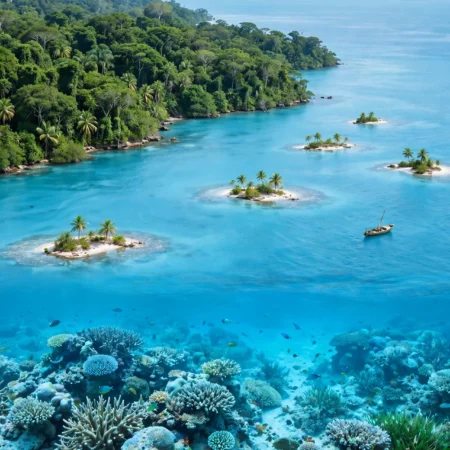
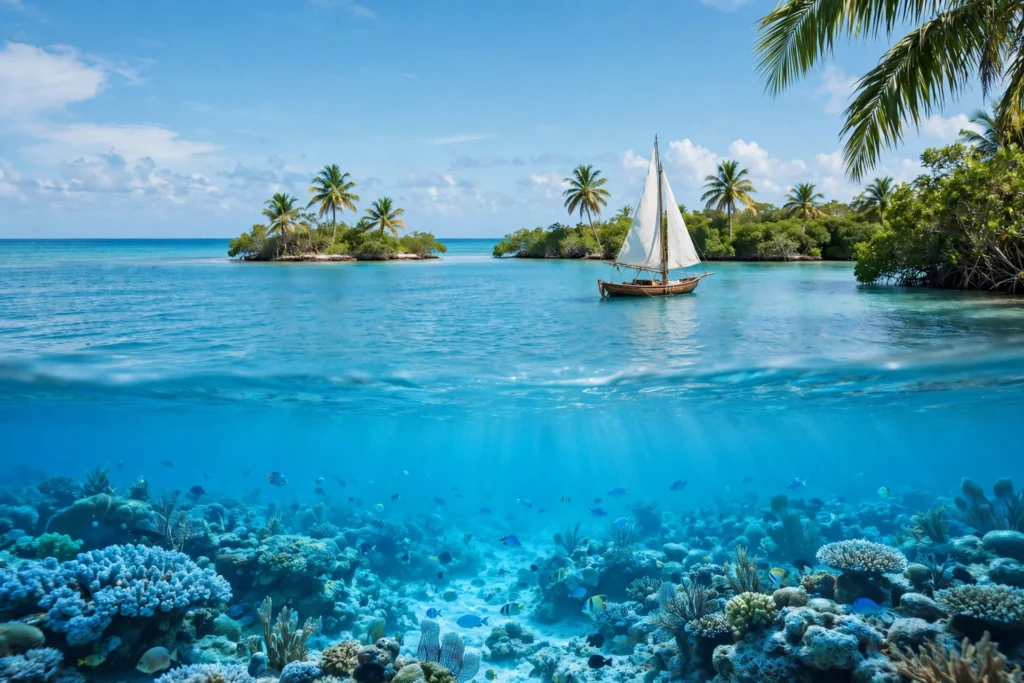
The Belize Barrier Reef is the reason most people come to Belize, and it earns its reputation. It is the largest barrier reef in the Northern Hemisphere and the second-largest reef system in the world after Australia’s Great Barrier Reef, running for about 300 kilometres along the Belize coast as part of the Mesoamerican Barrier Reef System. The reef is protected as the Belize Barrier Reef Reserve System, inscribed on UNESCO’s World Heritage List in 1996, a serial property of seven protected areas including Bacalar Chico, the Blue Hole Natural Monument, Half Moon Caye, South Water Caye, Glover’s Reef, Laughing Bird Caye and the Sapodilla Cayes. UNESCO describes it as the largest reef complex in the Atlantic-Caribbean region, home to more than 500 species of fish, 65 species of stony coral, West Indian manatees, three species of sea turtle and the American crocodile, with three offshore atolls — Turneffe, Lighthouse Reef and Glover’s Reef — beyond the main barrier. You can read the full listing on the official UNESCO page for the Belize Barrier Reef Reserve System. For a traveller, what matters is simpler: the reef sits close to shore, the water is warm and clear, and the snorkelling and diving are among the best in the Caribbean, with healthy coral, big schools of fish, turtles, rays and nurse sharks as a matter of course rather than a lucky sighting.
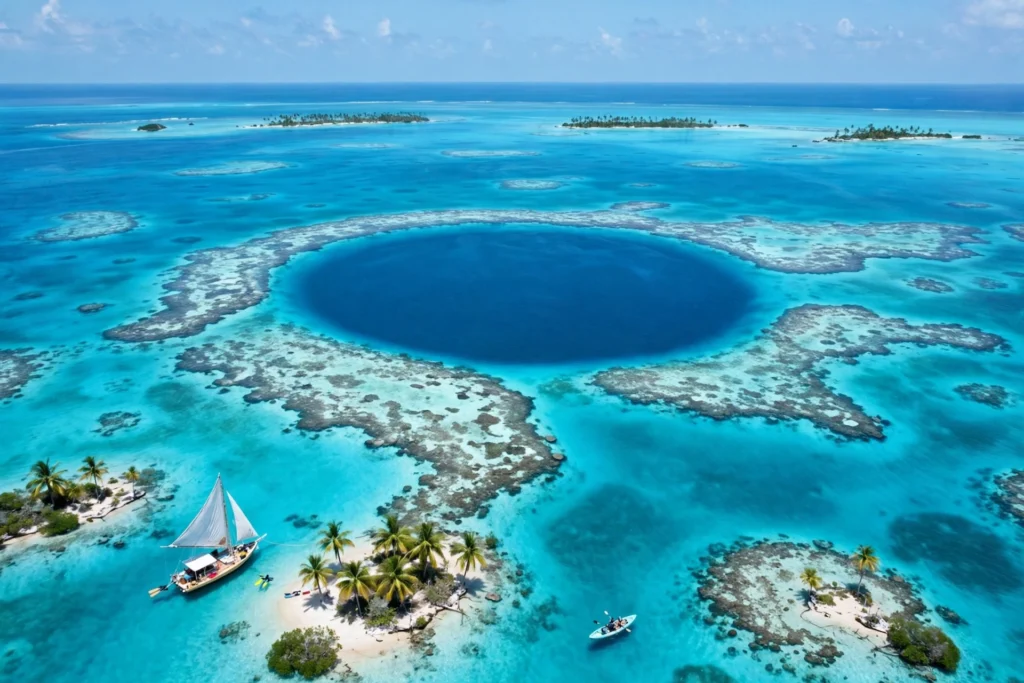
The most famous single site is the Great Blue Hole, a near-perfect circular sinkhole about 300 metres across and 125 metres deep, sitting in the middle of Lighthouse Reef Atoll about 70 kilometres offshore. From the air it looks like a dark blue eye in a turquoise sea, and it is one of the most photographed places in Central America. The honest truth about the Blue Hole is that it is a better sight than a dive for most people. The dive itself is deep, dark and short — experienced divers descend past stalactites to about 40 metres and come back up — while snorkellers stay at the surface and see little more than deep blue water. The real value of a Blue Hole day trip is everything around it: the boat ride out through the atolls, the snorkelling at Half Moon Caye with its red-footed booby colony, and the shallow coral gardens at the Aquarium, where the fish life is far richer than inside the hole itself. If you are a certified advanced diver with deep-diving experience, the Blue Hole is a bucket-list dive. If you are a snorkeller, book the trip for the atolls and the caye, and treat the Blue Hole as the spectacular photo stop it is. Either way, book with a licensed operator, check the weather the night before, and expect a very early start and a long day on the water — the round trip from San Pedro or Caye Caulker takes about two hours each way, and the sea can be rough.
Closer to shore, the everyday snorkelling is what most visitors actually remember. Hol Chan Marine Reserve, just off the southern tip of Ambergris Caye, is a protected channel through the reef where the coral is dense and the fish are abundant; its Shark Ray Alley, a shallow sand flat where nurse sharks and southern stingrays gather, is the single most popular snorkel stop in Belize and is suitable for confident swimmers and first-timers alike. Shark Ray Alley works because the animals are used to boats and the water is only a few metres deep — you float on the surface and watch the sharks glide underneath you, which is thrilling without being frightening. From Caye Caulker, the same sites are a shorter boat ride, and the Coral Gardens and the nearby Caye Bokel area offer quieter alternatives. South Water Caye, off Dangriga and Hopkins, is a smaller, quieter marine reserve with excellent snorkelling straight off the beach, and it is the best choice if you are staying on the southern coast rather than the northern cayes. Glover’s Reef Atoll, further south, is the most remote and the most pristine of the three atolls, and it suits divers and kayakers who want a multi-day trip rather than a day out.
| Day trip | From | Typical price (per person, planning range) | Time | Best for |
|---|---|---|---|---|
| Hol Chan Marine Reserve + Shark Ray Alley | San Pedro / Caye Caulker | $50–90 | Half day | First-time snorkellers, families |
| Great Blue Hole + Half Moon Caye + the Aquarium | San Pedro / Caye Caulker | $200–300 | Full day, early start | Divers, photographers, bucket-list trips |
| Turneffe Atoll snorkel / dive | San Pedro / Belize City | $150–250 | Full day | Divers, remote reef, fewer boats |
| South Water Caye snorkel | Dangriga / Hopkins / Placencia | $80–130 | Half to full day | Quiet snorkelling, southern coast stays |
| Glover’s Reef Atoll (multi-day) | Dangriga / Hopkins | $300–600+ for 2–3 days | 2–3 days | Kayaking, diving, off-grid stays |
| Whale shark snorkel (Mar–Jun) | Placencia | $150–250 | Full day | Whale sharks, seasonal only |
A few practical rules will make your reef days better. Book reef trips a day or two ahead in high season, and confirm the departure time and the meeting point in person the evening before — boat times shift with the tide and the weather. Bring reef-safe sunscreen, a rash guard, and a dry bag for your phone and passport; the sun on the water is far stronger than on land, and ordinary sunscreen damages coral. Do not touch the coral, do not stand on it, and do not feed the fish — the reserves are protected for a reason, and licensed guides will explain the rules before you get in the water. If you are diving, bring your certification card and your logbook, and be honest about your experience level; the Blue Hole is not a first deep dive. If you are prone to seasickness, take medication before you board, not after you feel ill, and sit near the back of the boat. Prices in the table above are planning ranges — confirm the exact figure with your operator, and check what is included (park fees, lunch, equipment hire and transfers are sometimes extra). The reef is the heart of any Belize trip, and the same care with licensed operators and protected sites applies to the Caribbean coast in our Colombia travel guide, where the reef and the jungle also sit side by side.
Ambergris Caye and San Pedro: Belize’s Main Island
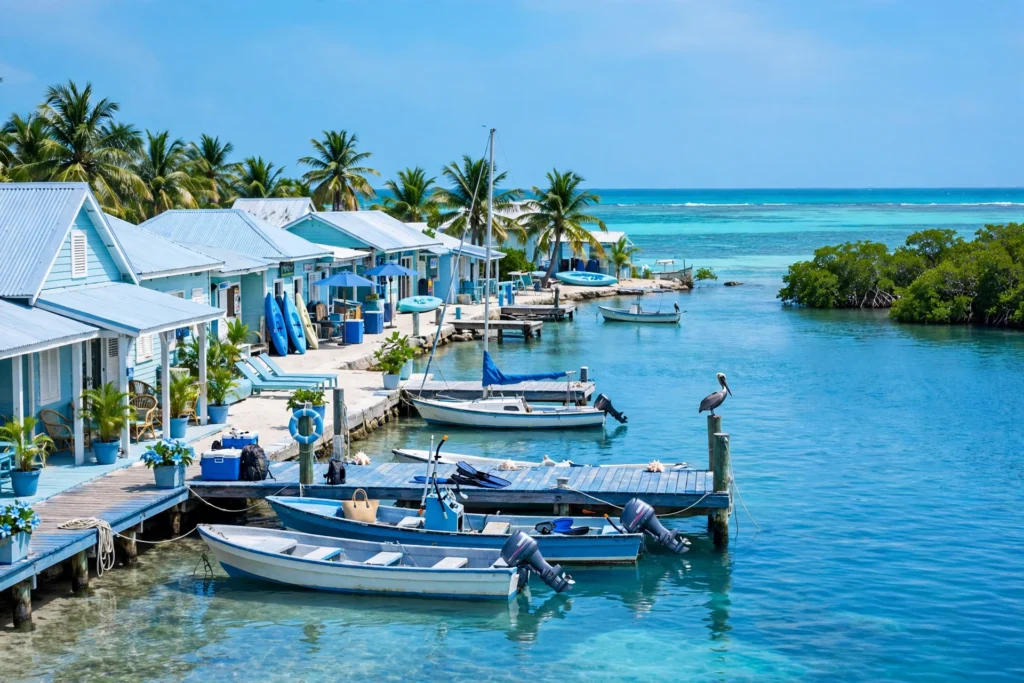
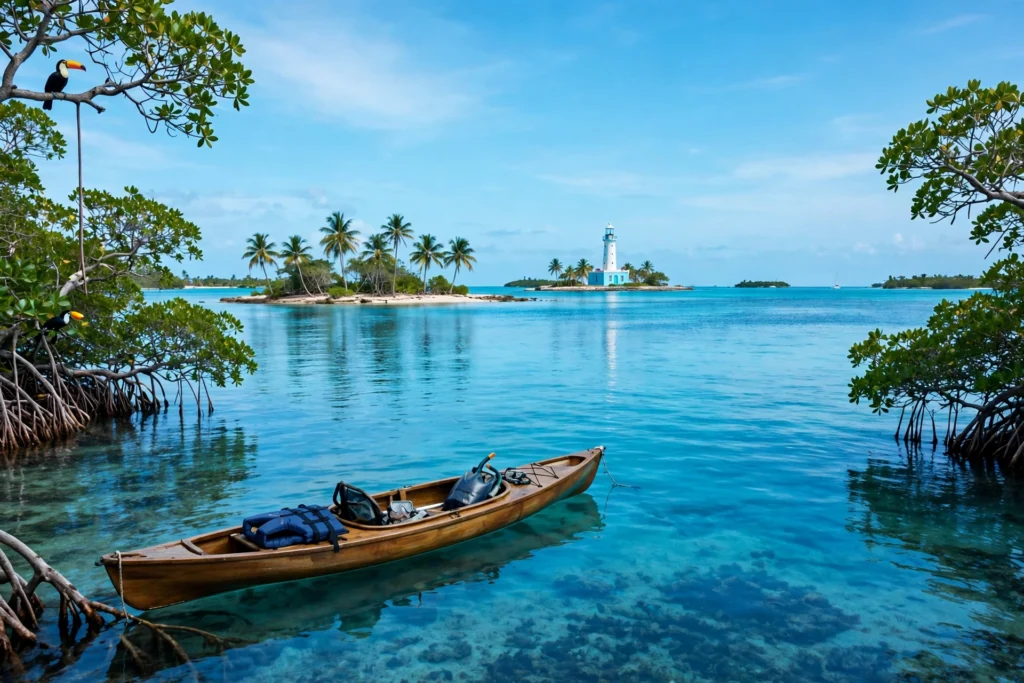
Ambergris Caye is Belize’s largest and busiest island, and San Pedro, its only town, is the country’s main tourist hub. The island sits just a few hundred metres from the barrier reef in places, which is why the snorkelling is so good and why the town has the most dive shops, tour operators, restaurants and hotels in the country. San Pedro is a small, sandy, low-rise town where the main transport is a golf cart, the main street is a mix of dive shops, gift shops, beach bars and seafood restaurants, and the main sound is reggae drifting from a bar somewhere. It is not a polished resort town — the streets are sandy, the buildings are colourful and sometimes weathered, and the pace is slow — and that is exactly why people like it. If you want the widest choice of tours, the best restaurants and the easiest logistics, Ambergris Caye is the right base. If you want quiet, look at Caye Caulker or Placencia instead.
Getting there is straightforward. Most visitors fly into Philip Goldson International Airport (BZE) near Belize City and then take a 15-minute domestic flight to San Pedro on a small propeller plane — the flight is short, scenic and worth the roughly $100–180 return fare — or take a taxi to the water-taxi terminal in Belize City and catch a 90-minute boat to San Pedro. The water taxi is cheaper, roughly $30–40 each way, and it is a pleasant ride on a calm day, but it is slower and rougher in wind. Once on the island, you will walk most places in town, rent a golf cart for the day to explore the north and south of the island, or hire a bicycle. There are no rental cars in the usual sense, and you do not need one. The island’s best beach is Secret Beach, a lagoon on the west side about a 30-minute golf-cart ride from town, with shallow water, beach bars and palapa tables in the shallows — it is the place to spend a lazy afternoon, though it can be busy on weekends.
The diving and snorkelling from San Pedro are the best in the country for variety. Hol Chan Marine Reserve and Shark Ray Alley are a 10-minute boat ride away, the Blue Hole trips leave before dawn, and the dive sites along the reef wall — with drop-offs, canyons and swim-throughs — suit everyone from newly certified divers to veterans. The town also has the best infrastructure for divers: equipment rental, air fills, dive courses and liveaboard departures. On land, the food is the best on the cayes, from beachfront lobster grills to taco stands and bakeries, and the nightlife — such as it is — runs to live music, beach bars and the occasional street party rather than clubs. San Pedro is also the most expensive base in Belize, with hotel rates and restaurant prices noticeably higher than Caye Caulker or the mainland, which is the main reason to compare it carefully in the where-to-stay section below. For travellers who collect island experiences, the same trade-off between the busiest island and the quieter one runs through our Kauai travel guide, where the main island also has the most choice and the highest prices.
Caye Caulker: Slow Days on the Split
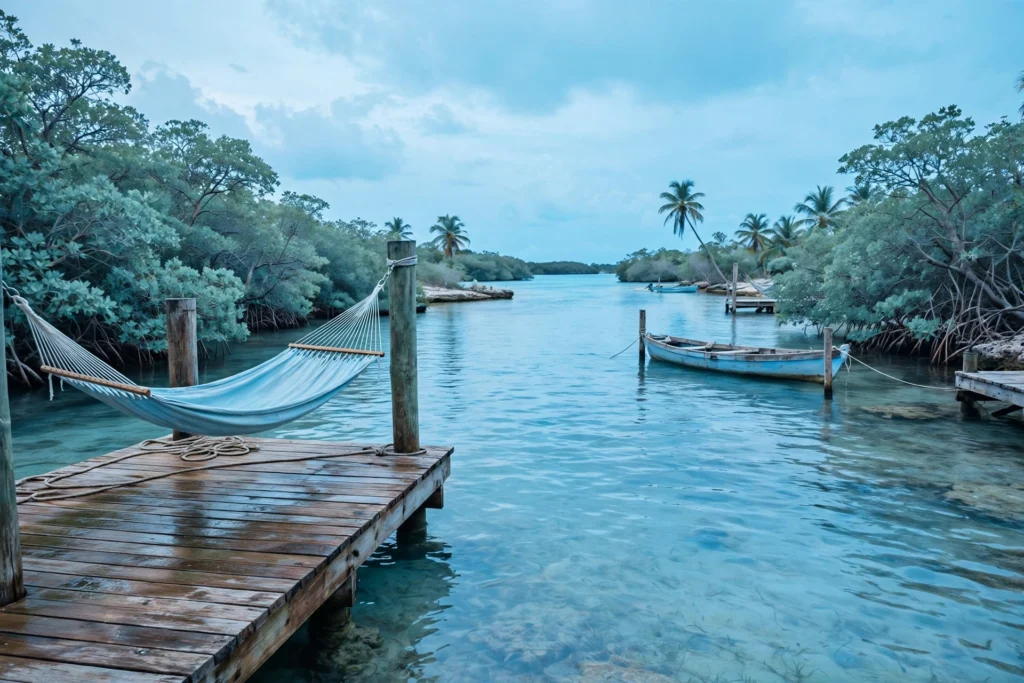
Caye Caulker is Ambergris Caye’s smaller, slower neighbour, and its motto — “Go Slow” — is painted on signs all over the island and taken seriously. The island is about 8 kilometres long and less than a kilometre wide, there are no cars, and the main ways to get around are on foot, by bicycle or by golf cart. The town is a handful of sandy streets lined with guesthouses, dive shops, bakeries and beach bars, and the pace is set by the water taxis and the tide. Caye Caulker suits travellers who want the reef without the resort feel: the snorkelling is just as good as from San Pedro, the island is cheaper, and the atmosphere is backpacker-friendly without being rough. It is also the best base for the Blue Hole on a budget, since the boat ride is shorter and the trips are often a little cheaper than from San Pedro.
The island’s social centre is the Split, a narrow channel of water at the northern end of the village where a hurricane divided the island in 1961. Today the Split is a swimming and sunbathing spot with a bar, a small beach, and a wooden dock where people gather in the late afternoon to swim, drink and watch the sunset. It is the place to meet other travellers, and it is also the best swimming spot on the island — Caye Caulker has almost no natural beach, so the Split and the docks are where everyone swims. The rest of the island is for walking and cycling: the southern tip has a small airstrip and a quiet stretch of shore, the middle has the guesthouses and restaurants, and the northern side, across the Split, has a few lodges and a nature reserve with mangroves and birdlife. The food is simple and good — lobster, conch fritters, fry jacks for breakfast, and the bakery’s cinnamon rolls, which are famous enough to be worth a special mention.
Caye Caulker is also the practical choice for travellers who want to keep costs down. Guesthouses and hostels are cheaper than on Ambergris Caye, the restaurants are simpler, and the water taxi from Belize City is a shorter and cheaper ride. The trade-off is choice: there are fewer tour operators, fewer restaurants, and fewer hotel options, and in the low season some places close. The island can also feel very small after three or four days, which is why most itineraries pair two or three nights on Caye Caulker with two or three nights inland in San Ignacio. If you are deciding between the two northern cayes, the short version is this: Ambergris Caye for choice, comfort and diving infrastructure; Caye Caulker for price, atmosphere and a slower pace. Either way, book the reef trips early in high season, and remember that the island’s relaxed feel does not extend to the sea — the same boat safety rules apply, and the currents at the Split itself can be strong, so swim where the locals swim and do not try to cross the channel. For travellers who enjoy places that reward slowing down, the same feeling runs through our guide to finding travel inspiration, where the best trips often come from staying put rather than rushing on.
Placencia: Beaches, Whale Sharks and the Southern Coast
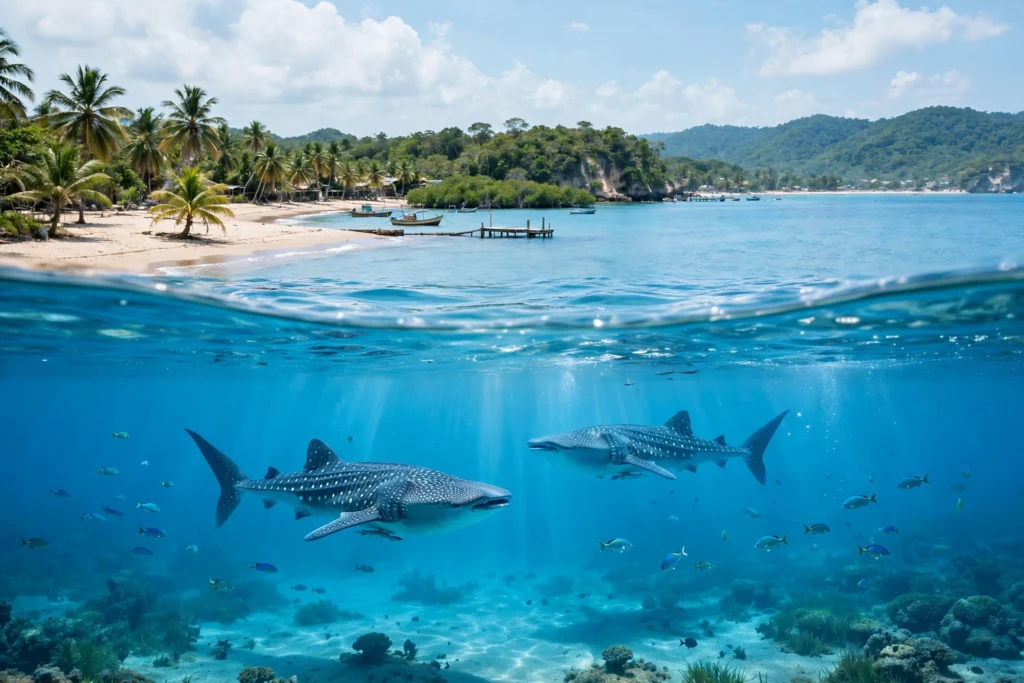
Placencia is the exception to the Belize rule that the cayes have the best beaches. This long, narrow peninsula on the southern mainland has the best sandy beach in the country — a 26-kilometre stretch of pale sand fringed with palms — and a laid-back village at its southern tip where the main street is a pedestrian-only sidewalk lined with gift shops, cafes and guesthouses. Placencia suits travellers who want a beach holiday with the reef still within reach, and it is the only base where you can combine a proper beach, whale sharks, the southern cayes and the Garifuna coast in one stay. It is quieter and more spread out than San Pedro, the pace is slower, and the crowd is a mix of families, divers and travellers who have already done the northern cayes and want something different.
The main reason to time a Placencia trip carefully is the whale sharks. From March to June, around the full moon, whale sharks gather at Gladden Spit, a reef promontory about 35 kilometres offshore, to feed on the eggs of spawning cubera snapper. The season is short, the sightings are not guaranteed, and the trips are regulated — only licensed operators with permits can run them, and the number of snorkellers in the water is limited. A whale shark trip is a full day, costs roughly $150–250 per person as a planning range, and involves a long boat ride and a lot of waiting, followed by a few minutes in the water with the largest fish in the world, which can reach 12 metres long. It is one of the great wildlife experiences in the Caribbean, and it is worth booking well ahead — the best operators fill up for the full-moon windows, and you should ask in advance what happens if no whale shark is seen (most operators offer a partial credit or a second trip at a reduced rate). Outside whale shark season, Placencia’s reef trips go to Silk Cayes, a pair of tiny sand islands with excellent snorkelling, and to Laughing Bird Caye National Park, a protected island with coral gardens and a small beach. The diving at Glovers Reef Atoll is also reachable from Placencia, and the atoll’s remote, pristine reef is the best in the south for experienced divers.
On land, Placencia’s appeal is the village itself and the Garifuna culture of the southern coast. The peninsula’s villages — Placencia village, Seine Bight and Hopkins further north — are Garifuna communities, and the drumming, dancing and food of the Garifuna people are a living part of daily life here, not a performance for tourists. The food section below covers hudut and the Garifuna kitchen in detail, but the short version is that a meal in a family-run restaurant in Seine Bight or Hopkins is one of the most authentic experiences in Belize. The southern coast is also the base for the inland south: the Cockscomb Basin Wildlife Sanctuary, the world’s first jaguar reserve, is a day trip from Placencia, with hiking trails, waterfalls and a real (if small) chance of seeing jaguar tracks, and the Maya site of Lubaantun and the cave systems of the south are within reach. Placencia is reached by a domestic flight to the small airstrip, by bus from Belize City or Dangriga, or by a long drive down the Southern Highway — the drive is scenic and takes about three hours from Belize City, and the road is paved the whole way. For a taste of the same warm-water, seafood-rich coast further north, see our Cabo travel guide.
San Ignacio and the Cayo District: Jungle, Caves and Maya Cities
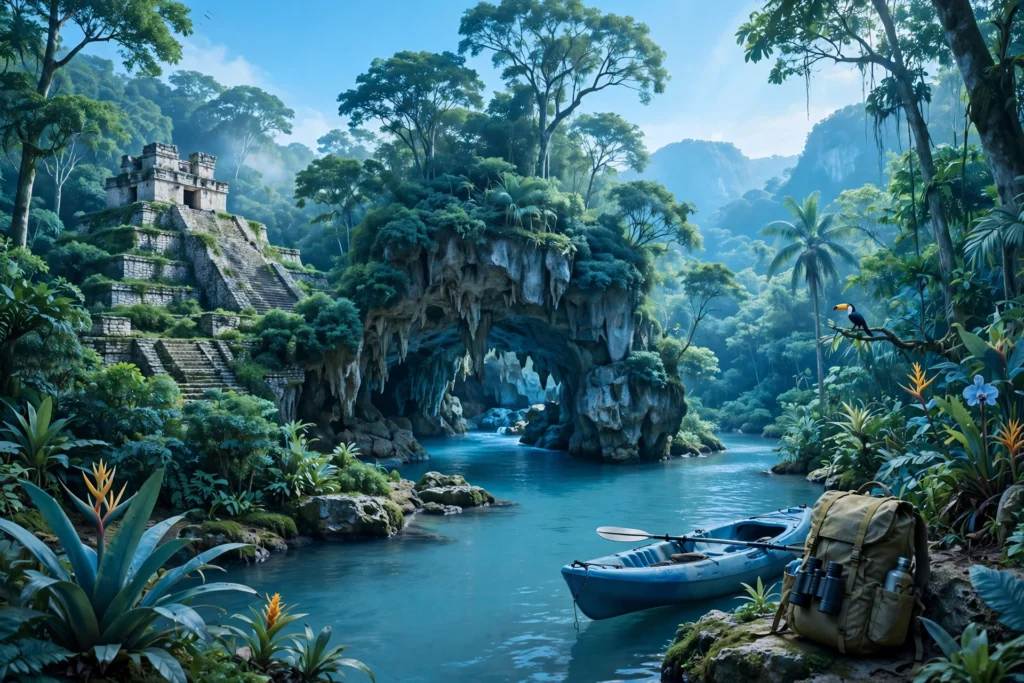
If the cayes are Belize’s reef half, San Ignacio and the Cayo District are its jungle half, and a trip that skips Cayo misses half the country. San Ignacio is a busy market town near the Guatemalan border, set in rolling green hills on the banks of the Macal River, and it is the base for the best inland adventures in Belize: the ATM Cave, the Maya cities of Xunantunich and Caracol, cave tubing, zip-lining, horse riding, and the Mountain Pine Ridge Forest Reserve with its waterfalls and swimming holes. The town itself is worth a day: the Saturday market is the best in the country, with Maya, Mestizo and Mennonite vendors selling fruit, vegetables, crafts and hot food; the Cahal Pech Maya site sits on a hill above the town and is an easy walk; and the restaurants and guesthouses are cheaper and more local in feel than anything on the cayes. San Ignacio is also the cheapest of the four main bases, which is why the where-to-stay comparison below gives it the best value rating.
The Cayo District is where Belize’s jungle is most accessible. The Mountain Pine Ridge Forest Reserve, about an hour’s drive south of San Ignacio, is a landscape of pine forest, granite outcrops, waterfalls and natural pools — the Rio On Pools, a series of smooth granite pools linked by small waterfalls, are the best swimming spot in the district, and Big Rock Falls is a short hike from the road. The reserve is also home to the Thousand Foot Falls, one of the highest waterfalls in Central America, and to the caves and sinkholes that make the district a centre for caving. Closer to town, the Macal River offers canoeing and kayaking, and the Barton Creek Cave can be explored by canoe, paddling through a cave system that the Maya used for ceremonies, with pottery and human remains still visible on the ledges. The district’s wildlife is the richest in Belize: howler monkeys, toucans, parrots, iguanas and, for the very lucky, a jaguar. The best wildlife watching is at dawn, and a guided birdwatching walk is worth the early start — Belize has more than 500 recorded bird species, and Cayo is one of the best places to see them.
San Ignacio is also the gateway to Guatemala for travellers who want to add Tikal, the great Maya city across the border, to their trip. Tikal is about a two-hour drive from San Ignacio, and many operators run day trips that handle the border crossing, though you will need to check your visa requirements for Guatemala and allow a full day. The border crossing itself is straightforward but can be slow, and you should carry your passport and keep your Belize departure stamp safe. For travellers who enjoy the same mix of wildlife, jungle and archaeology in Africa, the approach — a comfortable base town, a good guide, and early starts — is the same in our Tanzania travel guide. The practical point for Belize is that Cayo deserves at least three nights: one for the ATM Cave, one for a Maya site, and one for the Mountain Pine Ridge or the river. Two nights is the minimum, and one night is not enough.
ATM Cave and the Maya Sites: Xunantunich, Caracol and More
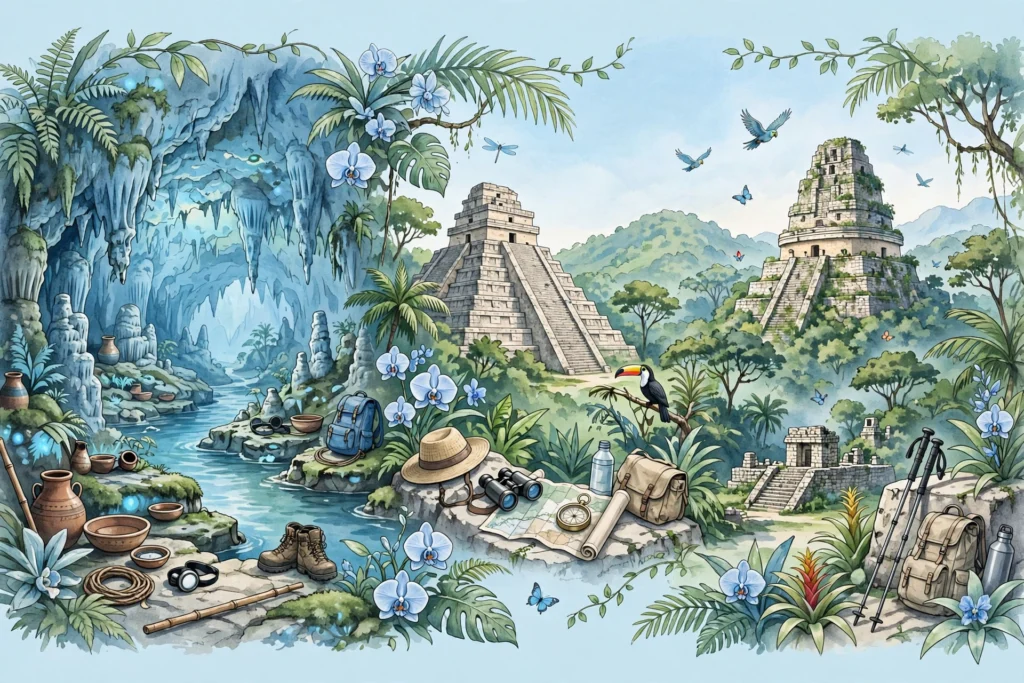
The ATM Cave — Actun Tunichil Muknal, the Cave of the Crystal Sepulchre — is the single best inland experience in Belize, and it is the one that most visitors remember longest. It is not a walk-through cave with lights and handrails. It is a full-day adventure that begins with a hike through the jungle, continues with a swim into the mouth of the cave, and then wades, climbs and squeezes through a river cave for several hours, past pottery, stone tools and the skeletal remains of Maya sacrifice victims, including the famous Crystal Maiden, a skeleton calcified by the cave’s minerals until it sparkles. The cave was a sacred Maya site, used for ceremonies and offerings, and the artefacts are still in place where they were left a thousand years ago — which is why the cave is only visited with a licensed guide, why cameras are banned inside (a tourist dropped one on a skull in 2012, and the ban has been strict ever since), and why you must be able to swim, climb and fit through tight spaces. The trip costs roughly $100–150 per person as a planning range, including the guide, transport, lunch and equipment, and it is a full day from San Ignacio. It is physically demanding, it is not suitable for anyone with claustrophobia, a fear of water or limited mobility, and it can close after heavy rain when the river inside rises — so book it for the middle of your Cayo stay, not the first day, and have a backup plan. If you can do it, do it: there is nothing else like it in Central America.
The Maya sites of Belize are less famous than Tikal across the border, but they are quieter, easier to visit, and in some ways more rewarding. Xunantunich, about 15 minutes from San Ignacio, is the easiest to reach: a short drive, a hand-cranked ferry across the Mopan River, and a climb up El Castillo, the site’s main pyramid, for a view across the jungle to Guatemala. Caracol, deep in the Chiquibul Forest Reserve near the Guatemalan border, is the largest Maya site in Belize, with the Caana pyramid — at 43 metres, the tallest man-made structure in the country — and a vast plaza that once held a city of 100,000 people. Caracol is a full-day trip on a rough road that needs a 4WD and a guide, and it is best visited in the dry season, when the road is passable; in the wet season it can be closed or very slow. Cahal Pech, on a hill above San Ignacio, is the smallest and the most convenient, a 15-minute walk from the town centre, with a small museum and a cluster of plazas and temples that make a good introduction to Maya architecture. Lamanai, in the north near Orange Walk, is reached by a scenic boat ride up the New River, past crocodiles and howler monkeys, and its temples sit in a jungle clearing that feels more remote than its easy access suggests. Altun Ha, near Belize City, is the closest Maya site to the airport and a good stop on the way to or from the cayes. Together, these sites tell the story of a civilisation that built cities across this landscape for more than a thousand years, and they are the reason the jungle half of a Belize trip matters as much as the reef half.
A few rules apply to all of the Maya sites and the caves. Go with a licensed guide — the guides are trained, they know the history, and they keep you safe in places where the paths are unmarked and the wildlife is real. Do not climb on structures that are roped off, do not take artefacts, and do not enter caves without a guide. Bring water, sun protection and insect repellent, wear shoes with grip, and carry cash in small notes for entrance fees and the ferry. Entrance fees are modest, roughly $5–15 per site as a planning range, and they are usually paid in cash. If you are travelling onwards to Guatemala, the same Maya world continues across the border, and the border crossing from San Ignacio is the natural next step — our Nicaragua travel guide covers another Central American country where the same mix of volcanoes, colonial towns and archaeology shapes the trip.
Getting to Belize and Getting Around: Flights, Water Taxis and Buses
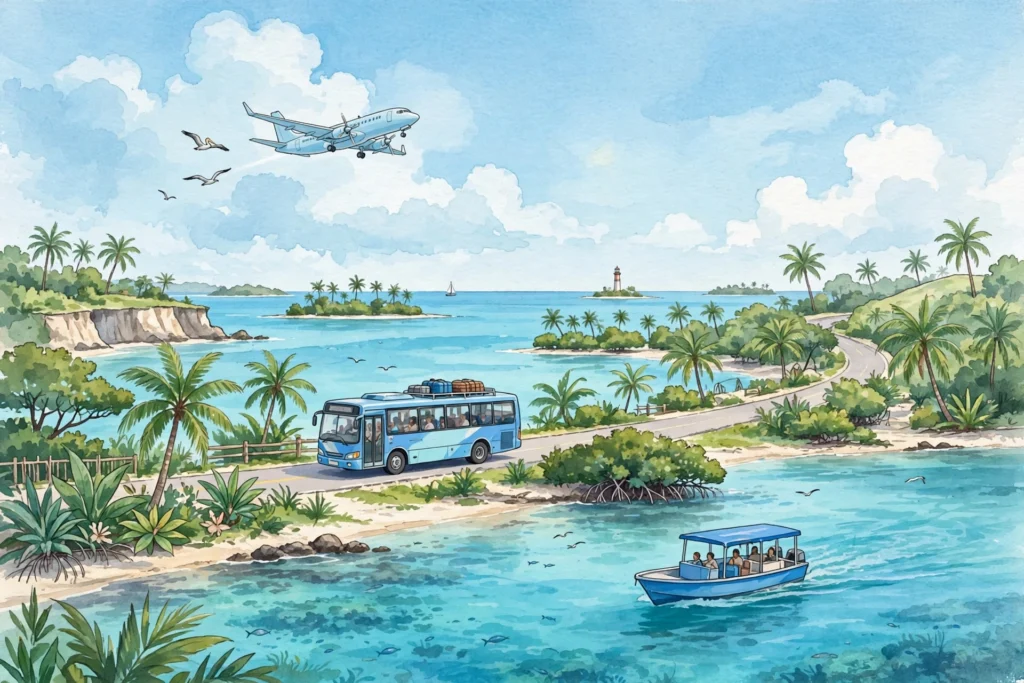
Getting to Belize from the United States is easy. The main gateway is Philip Goldson International Airport (BZE), about 15 kilometres north of Belize City, with direct flights from several US cities including Miami, Houston, Dallas, Atlanta, Los Angeles, New York and Charlotte, as well as from Toronto and a few Central American hubs. Flight times from the southern US are short — about two hours from Miami, three from Houston — which makes Belize one of the quickest tropical escapes from the US. Most visitors arrive by air, and the airport is small and straightforward: immigration, baggage and customs are quick, and the domestic flight terminal and the taxi rank are a short walk away. If you are arriving by land, Belize shares borders with Mexico to the north and Guatemala to the west; the main crossings are at Corozal from Mexico and at Benque Viejo del Carmen from Guatemala, and both are used by bus travellers and by visitors combining Belize with a wider Central America trip. The State Department page confirms that US citizens need a passport book to enter by air or land (a passport card is not enough), must show proof of an onward or return ticket and sufficient funds, and can stay for 30 days without a visa — longer stays cost $100 per month at an immigration office, for up to six months. Other nationalities should check the Belize immigration website, as the visa-free list is generous but not universal, and the rules can change.
Getting around Belize is a matter of choosing the right transport for each leg, because no single mode covers the whole country. Domestic flights are the fastest way to move between the airport, the cayes and the south: the two local airlines run frequent small-plane services from the international airport and the municipal airstrip in Belize City to San Pedro, Caye Caulker, Placencia and Dangriga, with flights taking 15 to 45 minutes and costing roughly $100–180 return as a planning range. The flights are scenic — the view of the reef and the cayes from a small plane at low altitude is one of the best in the Caribbean — and they are worth the cost if your time is short. Water taxis are the cheapest way to the northern cayes: the two main companies run regular boats from the terminals in Belize City to San Pedro (about 90 minutes, $30–40 each way) and Caye Caulker (about 45 minutes, $20–30 each way), with several departures a day. The boats are comfortable on calm days and rough in wind, and the schedules can change, so confirm the departure time the day before and arrive early in high season. Buses are the cheapest way to travel on the mainland: the local bus network runs from Belize City to San Ignacio, Dangriga, Placencia and the other main towns, with fares of a few dollars and frequent departures, but the buses are old, slow and crowded, and they stop everywhere. For the main routes they are fine; for remote sites they are not enough.
| Transport | Route | Typical cost (planning range) | Time | Best for |
|---|---|---|---|---|
| Domestic flight | Belize City–San Pedro | $100–180 return | 15 min | Short trips, comfort, views |
| Domestic flight | Belize City–Placencia | $150–250 return | 45 min | Southern coast, saving a long drive |
| Water taxi | Belize City–Caye Caulker | $20–30 one way | 45 min | Budget trips to the northern cayes |
| Water taxi | Belize City–San Pedro | $30–40 one way | 90 min | Budget trips to Ambergris Caye |
| Local bus | Belize City–San Ignacio | $5–10 | 2–2.5 hrs | Budget mainland travel |
| Local bus | Belize City–Placencia | $10–15 | 3–4 hrs | Budget southern travel |
| Rental car / 4WD | Belize City–San Ignacio | $60–100/day | 2 hrs | Cayo, Caracol, Mountain Pine Ridge |
| Taxi / private transfer | Airport–water taxi terminal | $25–30 | 30 min | Arrivals, late flights |
Driving is the best option for the Cayo District and the south, and the only practical way to reach Caracol and the Mountain Pine Ridge. Rental cars are available at the airport and in Belize City, and a 4WD is worth the extra cost if you plan to visit Caracol or the reserve — the roads to both are unpaved and rough, and a standard car will struggle. Driving in Belize is on the right, the main highways are paved and in reasonable condition, and the distances are short, but the secondary roads can be rough, unlit and unsigned, and animals and pedestrians share the road. Do not drive between cities after dark, as the State Department advises, and fill up with fuel when you can — petrol stations are sparse outside the main towns. Golf carts are the transport of choice on the cayes, rented by the day for roughly $40–60, and they are all you need on Ambergris Caye or Caye Caulker. For planning the shape of a trip that mixes flights, boats and buses, a travel itinerary template will help you lay out the days before you book anything.
Where to Stay in Belize: Ambergris vs Caye Caulker vs Placencia vs San Ignacio
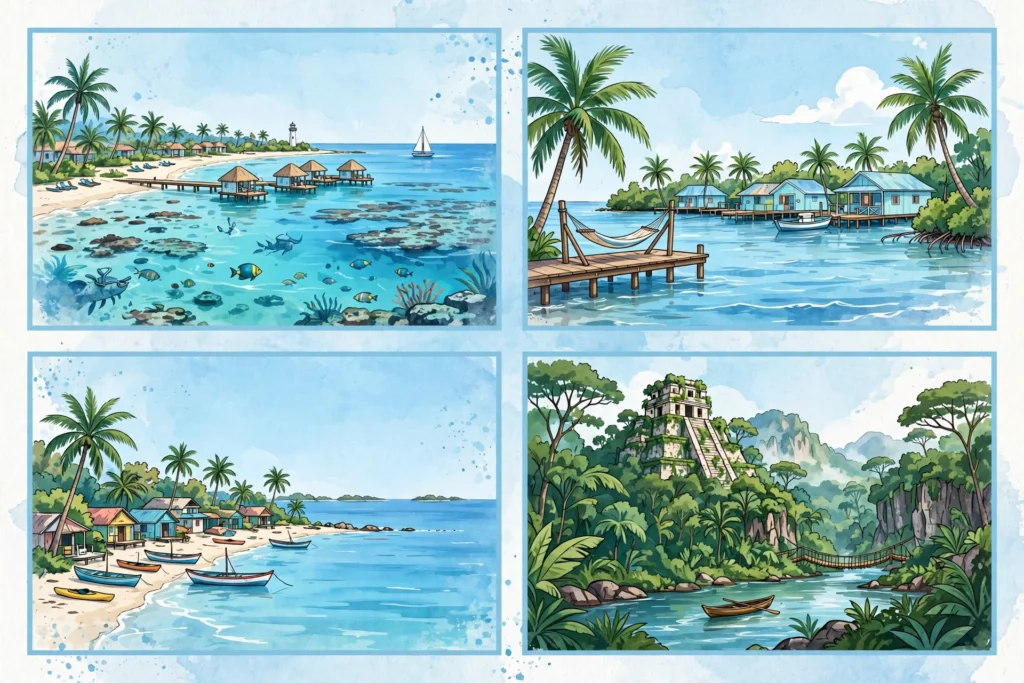
Belize has four main bases, and the right choice depends on what you want from the trip, not on which one is “best” in the abstract. The short version is that Ambergris Caye is the most comfortable and the most expensive, Caye Caulker is the cheapest and the most relaxed, Placencia is the best for beaches and whale sharks, and San Ignacio is the best for the jungle and the best value overall. Most good itineraries use two bases — one on the water and one inland — and the comparison below is designed to help you choose that pair. A note on Belize City: most visitors should not stay overnight in the city. The airport and the water-taxi terminals are outside the city centre, the city has the country’s highest crime rate, and the hotels are functional rather than charming. If you must stay a night, choose a hotel on the north side, use a hotel transfer, and do not walk around after dark.
On the cayes, the choice is between the resort feel of Ambergris Caye and the guesthouse feel of Caye Caulker. Ambergris Caye has the widest range of accommodation, from luxury beachfront resorts with private piers to mid-range hotels and condos, and the best restaurants and dive shops. It also has the highest prices: a mid-range hotel room in high season can cost $200–400 a night, and the best beachfront rooms cost more. Caye Caulker has mostly guesthouses, hostels and small hotels, with rooms from $40–120 a night, and the atmosphere is far more casual — you will eat at the same small restaurants as the dive guides, and you will know the island by the end of the first day. Placencia sits in the middle on price, with a mix of beachfront resorts, condos and guesthouses, and the best beach in the country as its main selling point. San Ignacio has the best value: comfortable guesthouses and small hotels for $50–120 a night, with local restaurants and the market on the doorstep, and it is the only base where you can walk to a Maya site.
| Base | Vibe | Nightly room (mid-range, planning range) | Best for | Watch out for |
|---|---|---|---|---|
| Ambergris Caye / San Pedro | Busy, resort, most choice | $200–400 | Diving, restaurants, first-timers | Highest prices, busiest |
| Caye Caulker | Slow, backpacker, friendly | $40–120 | Budget, atmosphere, Blue Hole | Few beaches, small island feel |
| Placencia | Beach, laid-back, spread out | $120–300 | Beaches, whale sharks, Garifuna coast | Needs a car or taxi to get around |
| San Ignacio / Cayo | Market town, jungle base | $50–120 | Maya sites, ATM Cave, value | No beach, long drive to the coast |
| Belize City | Transit only | $80–150 | One night if unavoidable | Highest crime, stay north side only |
A few booking rules apply everywhere in Belize. Book ahead in the dry season, especially for Christmas, Easter and the whale shark full-moon windows, when the best rooms sell out weeks in advance. Confirm what is included — breakfast, transfers, tour pick-ups and park fees are sometimes extra, and the price on the booking site is not always the price you pay. Ask about the cancellation policy, and check whether the hotel has a hurricane policy if you are travelling in the wet season. Bring a portable carbon monoxide detector if your accommodation does not provide one, as the State Department advises, and check that your room has a safe for your passport and valuables. For a comparison of island stays elsewhere, the same logic — the busiest island has the most choice and the highest prices — runs through our Kauai travel guide.
What to Eat in Belize: Fry Jacks, Lobster and Garifuna Food
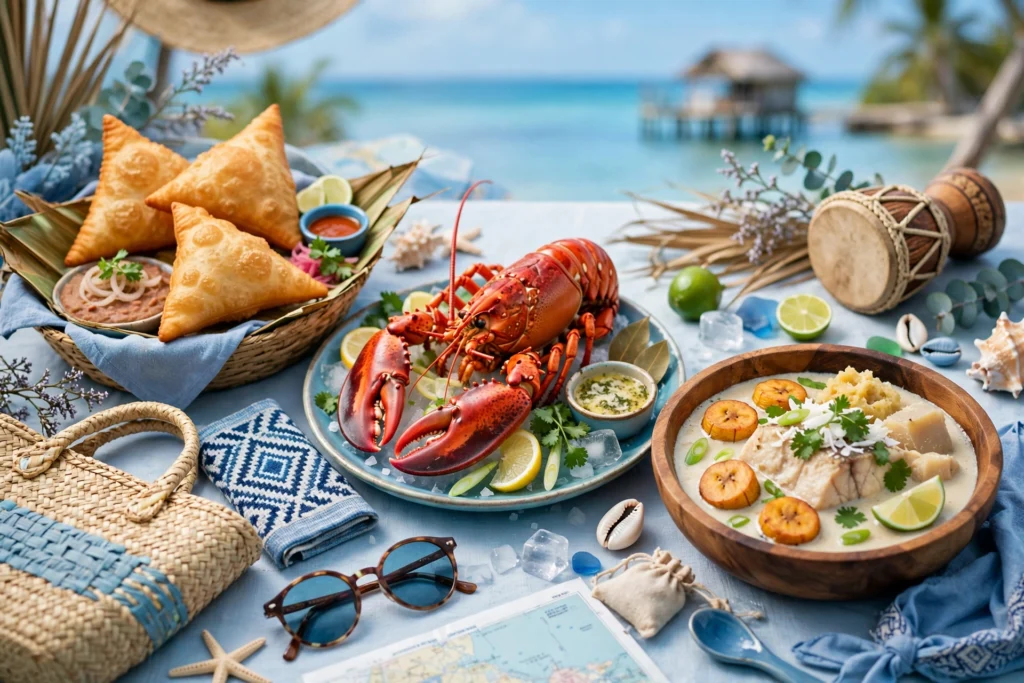
Belizean food is a mix of Caribbean, Maya, Mestizo and Garifuna cooking, and it is one of the most enjoyable parts of the trip. The national dish is rice and beans — not rice and peas, as in Jamaica, but red beans cooked in coconut milk with rice, served with stewed chicken, potato salad and fried plantain — and you will eat it everywhere, from market stalls to hotel restaurants. Breakfast is fry jacks, deep-fried dough served hot with refried beans, eggs, cheese or jam, and it is the best way to start a day of diving or caving. The seafood is the star on the cayes: lobster (in season, 1 July to 14 February), conch fritters, grilled snapper and whole fried fish, usually served with rice, beans and a cold Belikin beer, the local lager. The lobster season matters — during the closed season from 15 February to 30 June, lobster is not legally caught or sold, and any restaurant offering it then is breaking the law. Conch has its own closed season too, so ask what is in season rather than assuming everything is available all year.
The most distinctive food in Belize is Garifuna food, from the Garifuna people of the southern coast. The signature dish is hudut, a coconut fish stew served with mashed green and ripe plantain, and it is worth seeking out in Hopkins, Seine Bight or Dangriga, where family-run restaurants cook it the traditional way. Other Garifuna dishes include sere, a fish soup with coconut milk, and darasa, a spiced corn tamale. The Garifuna kitchen is also the home of Belize’s drumming culture — a meal in Hopkins with a drum circle afterwards is one of the most memorable evenings in the country, and the Garifuna Settlement Day celebrations on 19 November are built around the same music and food. Inland, the food is more Maya and Mestizo: tamales, escabeche (onion soup with chicken), salbutes and panades (fried tortillas with fillings), and the Mennonite communities of the Cayo District produce excellent cheese, bread and ice cream. The markets are the best place to taste all of this — the Saturday market in San Ignacio is the best in the country, and the street food stalls around it are cheap, fresh and generous.
A few practical notes. Tap water in Belize is not reliably safe to drink in all areas — the official advice varies by location, and most visitors drink bottled or filtered water, which is cheap and widely available. The same applies to ice in drinks: in tourist restaurants it is usually made from filtered water, but in remote areas it is safer to ask. Street food is generally safe if it is cooked fresh and served hot, and the busiest stalls are usually the safest bet. Tipping is not as formal as in the United States, but 10–15% in restaurants is appreciated, and a small tip for guides and drivers is normal. Prices are higher than in Mexico or Guatemala — a meal in a tourist restaurant on the cayes can cost $15–30 per person, while a market meal inland costs $5–10 — which is why the cost table below gives a wide range. For a taste of another seafood-rich coast, see our Cabo travel guide, where the same mix of fresh fish, cold beer and beachfront grills shapes the food scene.
How Much Does Belize Travel Cost?
Belize is not a cheap destination by Central American standards. It is more expensive than Mexico or Guatemala, and the gap is widest on the cayes, where almost everything is imported and the tourist infrastructure is priced for US visitors. That said, it is still good value compared with the Caribbean, and the range between a budget trip and a luxury trip is wide — the table below gives the daily cost per person for the three main styles, excluding international flights. The budget style uses guesthouses and hostels, local buses and water taxis, market food and group snorkel trips. The mid-range style uses comfortable hotels, domestic flights for the longer legs, restaurant meals and a mix of group and private tours. The high-end style uses beachfront resorts, private guides, private boats and the best restaurants. All figures are planning ranges in US dollars — confirm the exact prices with your hotel and operator before you book, and remember that the Belize dollar is pegged at 2 BZD to 1 USD, so US dollars are accepted almost everywhere and the conversion is simple.
| Daily cost per person | Budget | Mid-range | High-end |
|---|---|---|---|
| Accommodation | $30–50 (hostel / guesthouse) | $100–200 (hotel) | $300–500+ (resort) |
| Food and drink | $15–25 (markets, street food) | $40–70 (restaurants) | $80–150 (best restaurants) |
| Transport (local) | $5–15 (bus, water taxi) | $20–50 (flights, golf cart) | $50–100+ (private transfers) |
| Tours and activities | $10–30 (group snorkel, site fees) | $50–100 (reef trips, caves) | $150–300+ (private guides, diving) |
| Total per day | $60–100 | $200–350 | $600+ |
On top of the daily cost, budget for the big-ticket items. A Blue Hole day trip costs roughly $200–300 per person, the ATM Cave roughly $100–150, a whale shark trip roughly $150–250, and a domestic flight return to San Pedro roughly $100–180. Travel insurance with medical evacuation cover is essential rather than optional — the State Department warns that emergency medical services are usually unavailable or significantly delayed, and that serious injuries normally require evacuation to another country, which can cost tens of thousands of dollars without insurance. A week’s trip for two people in the mid-range style, including international flights from the US, typically works out at $2,500–4,500 in total as a planning range, while a budget week can be done for $1,200–2,000 and a luxury week can easily pass $7,000. The best ways to save money are to travel in the wet season, stay on Caye Caulker or in San Ignacio rather than Ambergris Caye, eat at markets and local restaurants, use water taxis and buses instead of domestic flights, and book reef trips as group tours rather than private charters. For a disciplined approach to working out the numbers before you book, the structure in our guide to preparing a travel budget will help you separate the fixed costs from the daily ones — and if you are setting a savings target for the trip, our travel goal guide will help you plan it.
What to Pack and Practical Tips for Belize
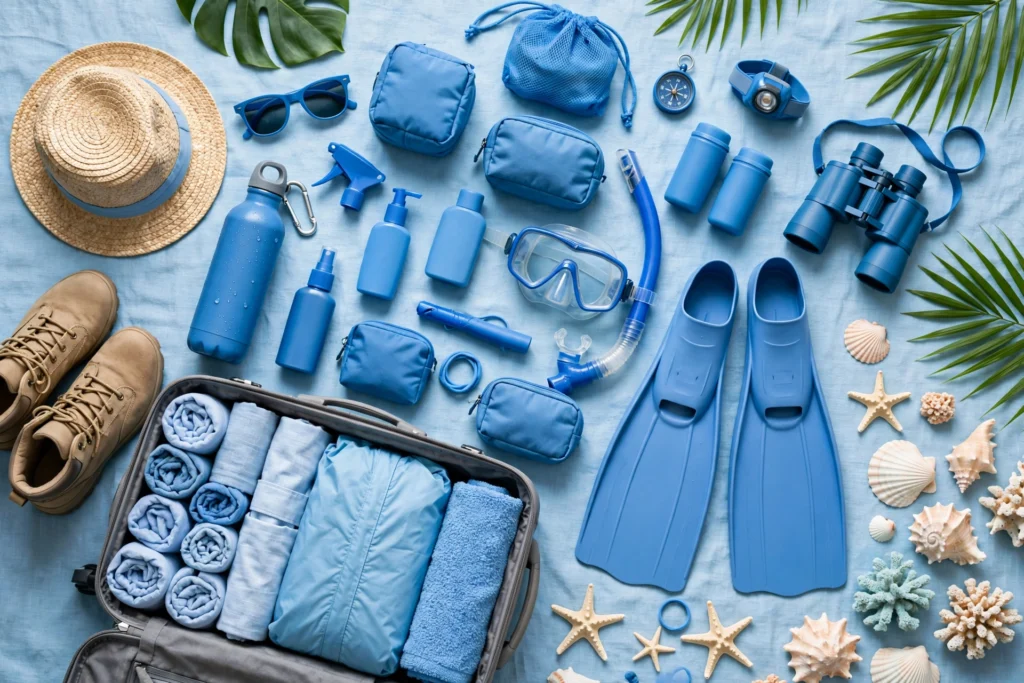
Packing for Belize is a matter of preparing for two trips at once: the reef and the jungle. The reef half needs swimwear, a rash guard, reef-safe sunscreen, a dry bag, a waterproof phone case and a light cover-up for the boat. The jungle half needs closed shoes with grip, long trousers, insect repellent, a rain jacket and a small daypack. Both halves need sun protection, a hat, sunglasses, a reusable water bottle and a first-aid kit with plasters, antiseptic and any prescription medication you need — pharmacies outside the main towns are limited, and specific medicines can be hard to find. A portable carbon monoxide detector is worth packing, as the State Department advises, since many hotels and vacation rentals do not have one. A head torch is useful for the ATM Cave and for early-morning birdwatching, and a pair of binoculars will transform the wildlife watching in Cayo. Pack light: the domestic flights have strict luggage limits, the water taxis have limited space, and you will be moving between bases, so a single soft bag or a small suitcase plus a daypack is the right amount.
Money is simple in Belize, which is part of its appeal. The Belize dollar (BZD) is pegged at 2 BZD to 1 USD, and US dollars are accepted almost everywhere — shops, restaurants, hotels and tour operators will all take them, and change is often given in Belize dollars. That makes the mental arithmetic easy: divide the Belize dollar price by two to get the US dollar price. Most establishments accept credit cards, though some charge an extra fee for card use, and ATMs that accept US-issued bankcards are available in Belize City, San Pedro, San Ignacio, Placencia and Dangriga — though some charge high fees, and you should be extra vigilant at ATMs, as the State Department advises. Most establishments do not accept worn, torn or written-on US dollar bills, and $1 bills are often refused, so bring clean, crisp notes in $5, $10 and $20 denominations. Carry cash in small notes for entrance fees, market stalls, water taxis and tips, and keep the bulk of your cash and your passport in your hotel safe. The language is English, the time zone is Central Standard Time with no daylight saving, and the country is one hour behind Washington DC during Eastern Standard Time, so jet lag from the US is minimal.
Health and safety preparation is worth doing before you leave. There are no vaccinations required for entry to Belize for most travellers, but you should check the CDC page for the latest travel health information and make sure your routine vaccinations are up to date. Dengue is a risk, so insect repellent and long sleeves at dusk are worth the effort, and Belize was certified malaria-free in 2023. Drink bottled or filtered water, and be careful with ice in remote areas. Do not bring a drone — recreational drone import is currently prohibited — and do not bring firearms, ammunition or even empty shell casings, which are a serious crime to import and can lead to large fines or a long prison sentence. Keep your passport safe, carry a copy with you, and keep your travel insurance details and your embassy’s contact number saved offline. The emergency number in Belize is 911 for police and ambulance. For the tech side of the trip — offline maps, translation, currency conversion and booking apps — the travel apps guide covers the tools that work best when you are moving between islands and jungle with patchy signal.
Sample Itineraries: 5, 7 and 10 Days in Belize
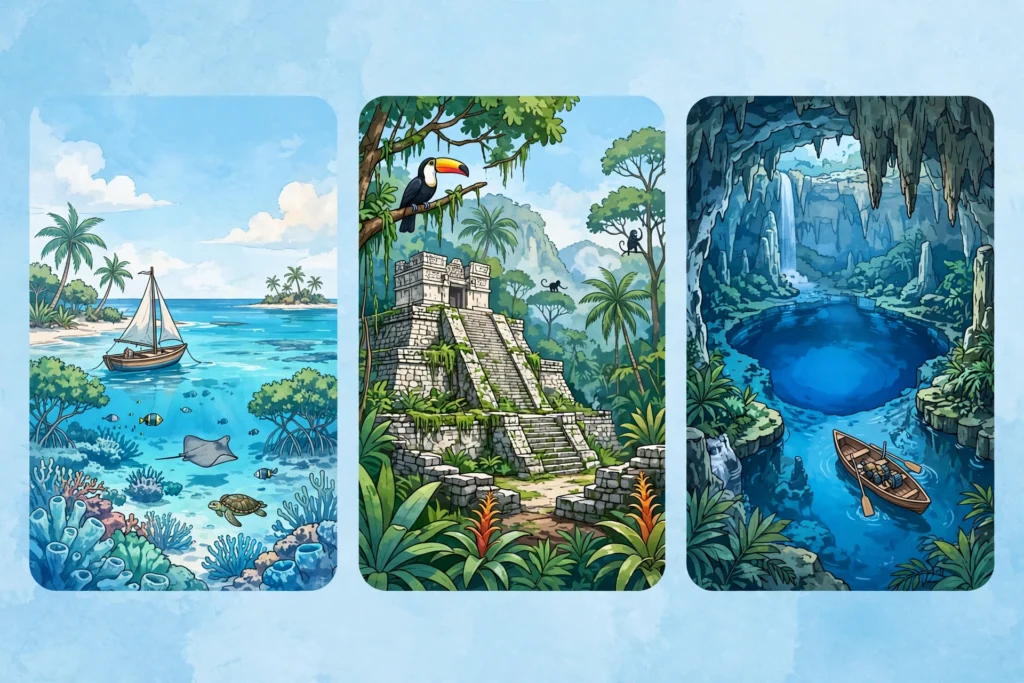
The best Belize itineraries all follow the same shape: reef first, jungle second, with a travel day in between. The reef half needs at least three days, the jungle half needs at least three, and five days is the minimum for a trip that does both justice. If you only have five days, keep it simple: three nights on the cayes and two nights in San Ignacio. If you have seven days, add a day on each side. If you have ten days, add Placencia and the southern coast. The itineraries below are starting points — adjust them to your interests, your budget and the season, and book the big-ticket trips (Blue Hole, ATM Cave, whale sharks) as soon as your dates are fixed, since they fill up first. For the general structure of a trip plan, a travel itinerary template will help you lay out the days, the transport and the costs in one place.
5 days: the essentials
Day 1 — Arrive and reach the cayes. Land at BZE, take a domestic flight or water taxi to Caye Caulker or San Pedro, settle in, and spend the afternoon swimming at the Split or Secret Beach. Dinner of lobster or grilled fish on the beach.
Day 2 — Hol Chan and Shark Ray Alley. A half-day snorkel trip to the Hol Chan Marine Reserve and Shark Ray Alley, back for lunch, and an afternoon of cycling or kayaking around the island. Sunset at the Split.
Day 3 — Blue Hole day trip. An early start for the full-day trip to the Great Blue Hole, Half Moon Caye and the Aquarium. Back in the late afternoon, tired and happy.
Day 4 — To San Ignacio. Water taxi or flight back to Belize City, then bus or transfer to San Ignacio. Afternoon at Cahal Pech and the market, dinner in town.
Day 5 — ATM Cave. A full day in the ATM Cave with a licensed guide. Return to Belize City in the evening or fly home the next morning.
7 days: reef and jungle in full
Days 1–3 — Caye Caulker. As in the 5-day plan, but with an extra day for a second reef trip — South Water Caye, a dive, or a fishing trip — and a slow morning on the island.
Day 4 — To San Ignacio. Travel to San Ignacio via Belize City, with a stop at Altun Ha on the way if time allows. Afternoon at Cahal Pech.
Day 5 — ATM Cave. The full-day cave trip, as above.
Day 6 — Xunantunich and the Mountain Pine Ridge. A morning at Xunantunich, an afternoon at the Rio On Pools and Big Rock Falls.
Day 7 — Caracol or the Macal River. A full-day trip to Caracol in the dry season, or a canoe trip on the Macal River and a visit to Barton Creek Cave in the wet season. Return to Belize City in the evening.
10 days: the full country
Days 1–3 — Ambergris Caye. Three nights in San Pedro, with Hol Chan, the Blue Hole and a dive or a fishing trip, plus an afternoon at Secret Beach.
Days 4–6 — San Ignacio and Cayo. Three nights in San Ignacio, with the ATM Cave, Xunantunich, Caracol and the Mountain Pine Ridge.
Days 7–9 — Placencia. Three nights on the southern coast, with a whale shark trip in season (March to June), Silk Cayes snorkelling, and a day trip to the Cockscomb Basin Wildlife Sanctuary.
Day 10 — Return. Drive or fly back to Belize City, with a stop in Hopkins or Dangriga for a Garifuna lunch on the way. Fly home the same day or the next morning.
If you are adding a second Central American country, the natural extension is Guatemala — Tikal is a day trip from San Ignacio, and the border crossing is straightforward — or a longer loop through the region. Our Panama travel guide covers another country where the same mix of reef, jungle and canal-side cities makes a good second stop.
Frequently Asked Questions About Belize Travel
Is Belize safe?
Belize is safe to visit for most travellers who take sensible precautions, but the US State Department rates it Level 2 (Exercise Increased Caution) because of crime, and Southside Belize City is Level 3 (Reconsider Travel). The violent crime is concentrated in Southside Belize City and is largely gang-related; the cayes, Placencia and San Ignacio are materially lower risk with normal precautions. A 30-day state of emergency is in force from 1 to 30 November 2026 in parts of Belize City, Ladyville, Cotton Tree and Unitedville — carry valid ID, expect checkpoints, and check the current advice before you travel in that window.
Do I need a visa for Belize?
US citizens need no visa for stays of 30 days or less, just a passport book valid for the length of the stay, proof of an onward or return ticket, and sufficient funds. Longer stays cost $100 per month at an immigration office, for up to six months. Many other nationalities are also visa-free for 30 days, but check the Belize immigration website for your nationality before you book.
Is tap water safe to drink in Belize?
Tap water is not reliably safe to drink in all areas of Belize, and most visitors drink bottled or filtered water, which is cheap and widely available. Be careful with ice in remote areas, and ask in restaurants whether the ice is made from filtered water.
When is whale shark season in Belize?
Whale sharks gather at Gladden Spit off Placencia from March to June, around the full moon, to feed on spawning snapper eggs. Trips are run by licensed operators only, sightings are not guaranteed, and the best operators book up for the full-moon windows — book well ahead and ask what happens if no whale shark is seen.
What is the best time to visit Belize?
The dry season, December to April, has the calmest seas and the clearest water, and February to April is the best window for diving and snorkelling. May and June are cheaper and greener, with whale sharks in season, while September and October are the wettest months and the quietest on the cayes. The hurricane season runs from 1 June to 30 November.
How much does a trip to Belize cost?
As a planning range, budget travellers should allow $60–100 per person per day, mid-range travellers $200–350, and high-end travellers $600 or more, excluding international flights. A Blue Hole day trip costs roughly $200–300 per person, the ATM Cave roughly $100–150, and a domestic flight return to San Pedro roughly $100–180. Confirm all figures with your operator before you book.
Can I use US dollars in Belize?
Yes. The Belize dollar is pegged at 2 BZD to 1 USD, and US dollars are accepted almost everywhere. Change is often given in Belize dollars. Bring clean, crisp notes — worn, torn or written-on bills are often refused, and $1 bills are often not accepted.
Do I need a guide for the ATM Cave?
Yes. The ATM Cave is only visited with a licensed guide, and cameras are banned inside. You must be able to swim, climb and fit through tight spaces, and the trip is a full day from San Ignacio. Book it for the middle of your Cayo stay so you have a backup day if it closes after heavy rain.
Conclusion
Belize is a small country that delivers far more than its size suggests. The reef is world-class, the Blue Hole is a genuine wonder, the cayes are the easiest island escape in the Caribbean, and the jungle half — the ATM Cave, the Maya cities, the rivers and the waterfalls of Cayo — is just as good as the reef half, and far less visited. The practical side is simple: English is spoken, the dollar is pegged two-to-one, the flights from the US are short, and the country is small enough to see properly in a week. The safety picture needs respect rather than fear: stay out of Southside Belize City, take the November 2026 state of emergency seriously if your trip falls in that window, buy insurance with medical evacuation cover, and book licensed operators for the reef and the caves. Plan the trip as a split — half reef, half jungle — go in the dry season if you can, budget honestly, and confirm every price before you book. Do that, and Belize will give you one of the best weeks in Central America.
People also read:
- London Travel Guide
- Morocco Travel Guide
- Iceland Travel Itinerary
- Best Places to Travel in January
- Travel Itinerary Template
- How to Prepare a Travel Budget

M. Adil is the founder and editor of SoloTravelPro. He writes practical, research-based travel guides that help travellers plan with confidence — from first-time city breaks to national parks and island escapes. Every guide is built on official sources, current prices and honest, usable advice, so readers can plan smarter and travel better.

El Salvador Travel Guide: Volcanoes, Surf and the Safest Trip Yet (2026)