El Salvador is the smallest country in Central America, and for years it was also the one most travellers skipped. That is changing fast. In a single week you can climb a volcano and look down into a turquoise crater lake, surf a black-sand beach that has hosted world championship events, walk a cobbled colonial street in a town that time seems to have forgotten, stand in a Maya village frozen in volcanic ash, and eat your way through a weekend food festival in the coffee hills — all without ever driving more than two or three hours. The country is compact in a way that makes trip planning genuinely easy: the capital, the volcanoes, the Maya sites, the coffee towns and the Pacific surf coast all sit within a half-day of each other, so a five-day trip can feel full and a seven-day trip can feel complete.
Quick answer: yes, El Salvador is worth visiting in 2026, and it is the easiest it has ever been to visit. The US State Department rates the country Level 1: Exercise Normal Precautions, issued 8 April 2025, with no higher regional levels. US citizens need no visa — you enter visa-free for up to 90 days under the CA-4 agreement shared with Guatemala, Honduras and Nicaragua. The best time to go is November to April, the dry season, with the coffee harvest running November to February and the biggest surf swells from March to October. Fly into San Salvador’s international airport, pre-book an airport transfer, base yourself in San Salvador for the volcanoes and Maya sites, then move to the surf coast at El Tunco or La Libertad. Budget roughly $60 to $120 a day for a comfortable mid-range trip, excluding flights. Read the safety section below before you book anything, because the state of exception changes how you should behave even though the country is far safer than it was.
Is El Salvador Safe to Visit in 2026?
The honest answer to the safety question has two parts, and both matter. The first part is the good news, and it is dramatic. The United States Department of State rates El Salvador at Level 1: Exercise Normal Precautions, its lowest advisory level, in an advisory issued on 8 April 2025. The advisory says that gang activity has decreased over the last three years and that this has caused a drop in violent crimes and murders. The live advisory page, checked on 14 November 2026, says the same thing in even stronger terms: gang activity has decreased dramatically since 2022, causing a drop in violent crime and murders. There are no higher regional levels inside the country — the whole of El Salvador carries the same Level 1 rating, which is a striking change for a country that was once rated far more severely and that most guidebooks used to warn travellers away from entirely. Before you travel, read the full US State Department travel advisory for El Salvador and check it again close to departure, because advisory levels and wording can change.
The second part is the state of exception, and any honest guide has to explain it. In March 2022 the government declared a state of exception in response to a surge in gang murders, and it has been renewed repeatedly ever since — it was still in force as of October and November 2026. Under the state of exception, local authorities can arrest anyone they think is involved in gang activity, several constitutional rights are suspended, including the normal protections of criminal procedure such as the right to a speedy trial and access to counsel, and tens of thousands of people are in prison awaiting trial. Several US citizens have been detained under the state of exception and have yet to face trial. That is the context in which the Level 1 rating sits, and it is why the practical rules below are not optional extras.
What does the state of exception mean for you as a tourist, in practice? First, carry a copy of your passport photo page with you at all times, and keep the original in your hotel safe — you may be asked for identification at checkpoints, and having a copy ready makes the encounter short and polite. Second, expect police and army checkpoints on main roads, particularly around San Salvador and on the routes to the coast and the volcanoes. They are routine, they are generally quick, and the right approach is to be calm, polite and cooperative, and to let the driver do the talking if you are in a vehicle. Third, do not photograph security personnel, police, soldiers, checkpoints or military installations. Fourth, political activity by foreigners is banned, so do not take part in demonstrations or political gatherings, and stay away from any protest you happen across. Fifth, keep your behaviour unremarkable: dress plainly, avoid displaying expensive jewellery or electronics, and do not wander into neighbourhoods you have no reason to be in, especially after dark.
There are also a few rules that apply specifically to how the US government treats its own staff in the country, and they are a useful guide to sensible behaviour. US government employees working in El Salvador are allowed to travel throughout the country during daylight hours, but because of road conditions, hilly terrain, possible landslides during the rainy season and a general lack of streetlights, they are prohibited from travelling between cities or departments at night. They are allowed to travel at all hours between San Salvador and the international airport and the department of La Libertad. And they are prohibited from using public buses. The lesson for an ordinary visitor is the same: plan your long drives for daylight, be at your hotel before dark, and do not use the public bus network — the transport section below explains the alternatives.
Beyond the state of exception, the ordinary travel-safety advice still applies. Violent crime has fallen sharply, but petty crime still exists, and the UK Foreign Office’s updated advice from late October 2026 notes that security has improved while violent and petty crime still occur. The safest districts of San Salvador — San Benito, Santa Elena and Maquilishuat — are where most visitors stay, and they are also where the best hotels and restaurants are. Guided volcano hikes should be done in daylight with a registered guide. Keep a photocopy of your passport separate from the original, and enrol in the Smart Traveler Enrollment Program (STEP) before you go so the embassy can reach you if conditions change. Tap water is not safe to drink, so drink bottled water. If you are comparing El Salvador with its neighbours, the contrast with the Nicaragua travel guide is instructive: both countries share the CA-4 border agreement, but Nicaragua carries a much higher advisory level, and the two trips need very different planning.
Entry Rules, Visa and the CA-4 90-Day Limit
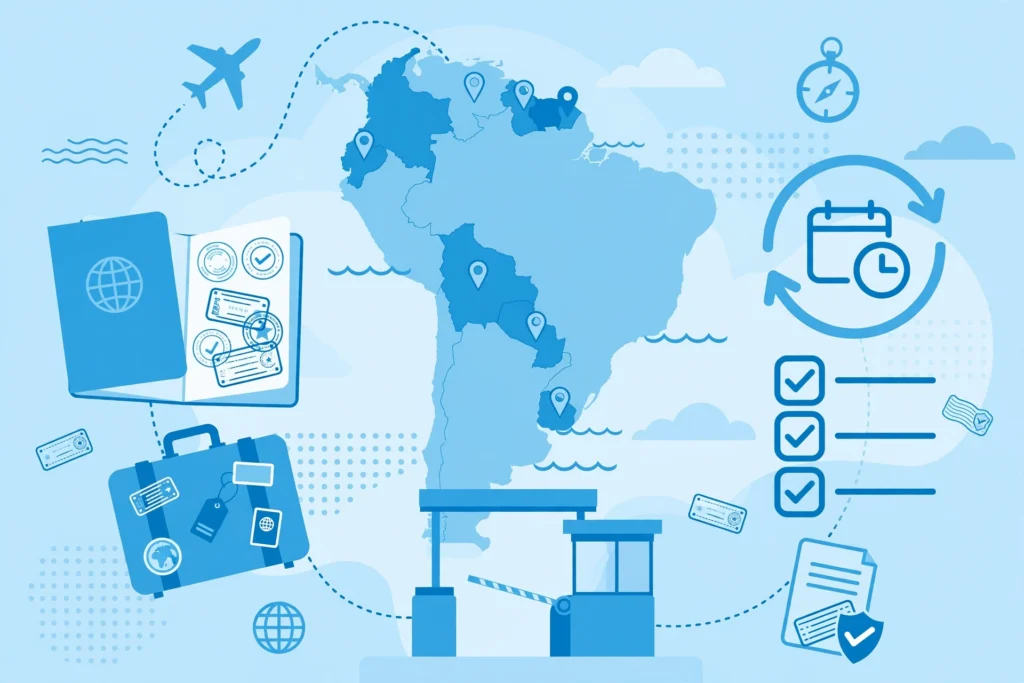
Getting into El Salvador is straightforward for most visitors, and for US citizens it is one of the easiest entries in Central America. US citizens do not need a visa. You enter visa-free under the CA-4 agreement, the Central America-4 Border Control Agreement, which El Salvador shares with Guatemala, Honduras and Nicaragua. Under CA-4 you are allowed up to 90 days in total across all four countries combined — not 90 days per country. That single detail catches more travellers than any other rule in this guide, so it is worth understanding properly before you plan a multi-country trip.
Here is how the 90 days work. The clock starts when you first enter any CA-4 country, and it keeps running while you move between them. If you spend 30 days in Guatemala, then cross into El Salvador, you have 60 days left for El Salvador, Honduras and Nicaragua together. Crossing a border does not reset the clock, and you cannot leave for a day and come back for a fresh 90 days. If you overstay, you can be fined, and you may have trouble entering again. If you want to stay longer than 90 days, you need to apply for an extension with the immigration authorities, or leave the CA-4 area entirely and re-enter. For a one- or two-week holiday, none of this matters.
Your passport must be valid for at least six months beyond your travel dates, and you should have at least one blank page. Immigration may ask for proof of onward travel — a return flight booking or a bus ticket out of the country — and for proof that you can support yourself during your stay, so keep a copy of your return ticket and a bank card handy. There is no visa to apply for in advance, no visa form to fill in at the airport, and no visa fee to pay for US citizens. Travellers from other countries should check the rules for their nationality before travelling, because the visa-free list is not the same for everyone: citizens of the European Union, the United Kingdom, Canada, Australia and many Latin American countries are also visa-free for tourism, but some nationalities need a visa in advance, and the rules can change. If you are not a US citizen, check with the nearest Salvadoran consulate or the official immigration website rather than relying on a blog post.
A note on what this guide deliberately does not say: you may come across older articles or forum posts mentioning an entry fee at the airport. Press reports from April 2025 said such a fee had been removed, but no official page confirms the current position, so this guide does not state any entry fee as fact. If you are charged anything at the airport, ask for a receipt and pay by card where you can. Similarly, one aggregator reported new health-related entry measures in November 2026, but that report comes from a single secondary source and could not be verified against any official page, so it is left out of this guide entirely. Check the official advisory and the airline’s requirements close to departure, and do not rely on a single unverified report for entry rules.
Best Time to Visit El Salvador
El Salvador has two seasons, and choosing between them shapes almost everything about your trip: how green the volcanoes look, how big the surf is, how much it rains in the afternoon, and how much you pay for a hotel. The dry season runs from November to April, and it is the best time for most visitors. The rainy season runs from May to October, and it is the best time for surfers and for travellers who want lower prices and greener landscapes. There is no bad month to visit, but there is a right month for the trip you want, and the table below makes the trade-offs plain.
The dry season is the easy choice for a first trip. Skies are clear, rain is rare, the roads are at their best, and the volcano hikes have the clearest views. November to February is the coolest and driest part of the year, with daytime temperatures in San Salvador around 27 to 30°C and cooler nights in the highlands. This is also the coffee harvest, which runs from November to February: the coffee farms of the Ruta de las Flores and the Apaneca mountains are at their busiest, pickers are in the fields, the beneficios (processing plants) are running, and many farms offer tours where you can see the harvest, the drying patios and the roasting in a single visit. If coffee is part of why you are coming, plan your trip for these months and book farm tours in advance, because the best ones fill up. December is also when the country is at its most festive, with Christmas lights and celebrations running from mid-December, and Holy Week — the week before Easter — is the busiest travel period of the year, when Salvadorans themselves travel in large numbers and hotels on the coast book out. If you travel over Holy Week, book months ahead and expect higher prices.
March to May is the hottest part of the year. Temperatures climb, the air gets humid, and the first rains usually arrive in May. This is also when the surf swells start to build: the biggest swells of the year arrive from March to October, driven by storms far out in the South Pacific, and experienced surfers plan their trips for these months.
The rainy season, from June to October, is greener, quieter and cheaper. Rain usually falls as heavy afternoon showers rather than all-day rain, so mornings are often clear and bright, and the volcanoes and coffee hills look their best — deep green, with clouds drifting through the valleys. Hotel prices drop, the beaches are emptier, and the waterfalls on the Ruta de las Flores are at their fullest. The trade-offs are real, though: dirt roads can become muddy, landslides are possible in the rainy season (one reason the advisory warns about road conditions), and some rural routes can be slow or briefly impassable after a heavy storm. If you travel in the rainy season, build flexibility into your plans, check the weather each morning, and do not plan a tight onward connection for the day after a long drive. Surfers, meanwhile, get the best of both worlds in these months: the biggest swells, from March to October, overlap with the rainy season, and the cleaner waves of November to April — smaller, but more consistent and better shaped — suit beginners and intermediate surfers better. The surf section below explains which beaches suit which level.
If you are weighing a January departure, our best places to travel in January guide covers dry-season planning in general, and the same logic applies here: go when the weather suits the activities you actually want.
| Month | Weather | Surf | Crowds | Best for |
|---|---|---|---|---|
| January | Dry, cool, clear | Cleaner waves, smaller swells | Moderate | Coffee harvest, volcano hikes, first trips |
| February | Dry, cool, clear | Cleaner waves, smaller swells | Moderate | Coffee harvest, volcano hikes, festivals |
| March | Hot, dry, humid building | Biggest swells begin | Moderate | Experienced surfers, beach days |
| April | Hot, first rains late in the month | Big swells, warm water | High over Holy Week | Surf, Holy Week travel (book early) |
| May | Hot, rainy season begins | Big swells | Low | Surf, green landscapes, lower prices |
| June | Rainy, afternoon showers | Big swells | Low | Surf, waterfalls, budget travel |
| July | Rainy, green, humid | Big swells | Low–moderate | Surf, coffee hills in full green |
| August | Rainy, busiest Salvadoran holiday month | Big swells | High (local holidays) | Surf, festivals (book early) |
| September | Rainy, wettest month | Big swells | Low | Surf, waterfalls, quiet beaches |
| October | Rainy easing, still green | Big swells, last of the season | Low | Surf, green volcanoes, lower prices |
| November | Dry season begins, clear skies | Cleaner waves return | Moderate | First trips, volcano hikes, coffee harvest begins |
| December | Dry, clear, festive | Cleaner waves | High over Christmas | Christmas lights, volcano hikes, coffee harvest |
Getting to El Salvador: Airport, Transfers and Getting Around
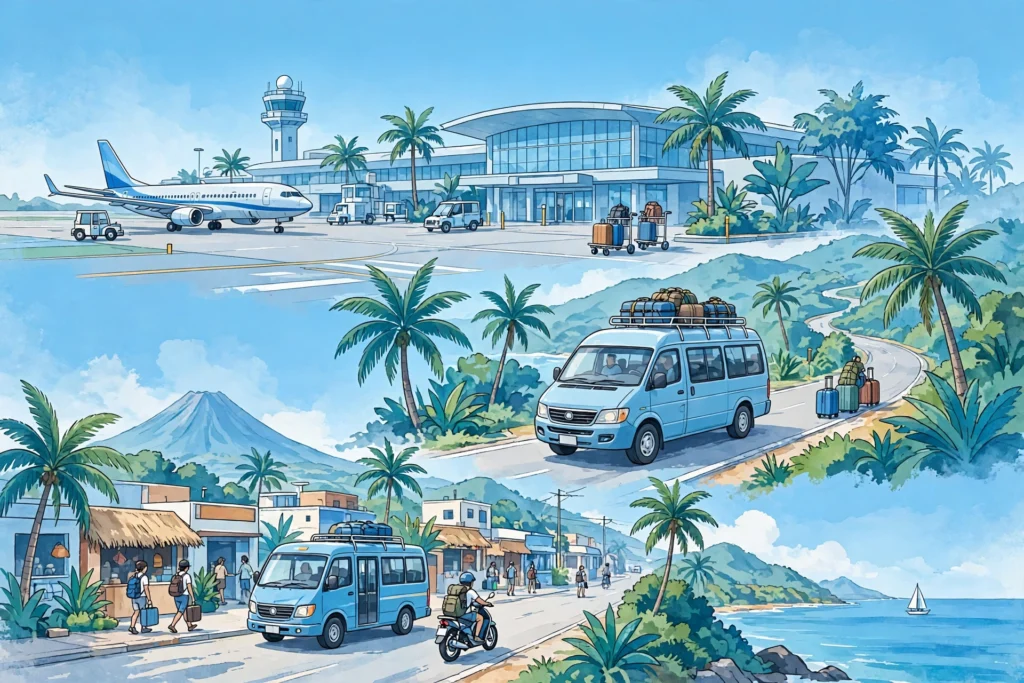
El Salvador is reached by air, and the journey is simpler than most travellers expect. The country’s only international airport is Monseñor Óscar Arnulfo Romero International Airport (SAL), about 40 kilometres south of San Salvador in the department of La Paz, roughly a 45-minute drive from the capital in normal traffic. Direct flights run from several US cities, including Miami, Houston, Dallas, Atlanta, Los Angeles, New York and Washington, with a flight time of around three to five hours depending on where you start. The airport is modern, compact and easy to navigate: you land, walk through immigration with your passport, collect your bags, pass through customs, and you are outside in under an hour on a normal day.
The single most important decision in this section is the airport transfer, and it should be made before you land. Pre-book a transfer with your hotel or a reputable private driver, and do not take an unmarked taxi from outside the terminal. Your hotel can arrange a driver to meet you at arrivals with a name board, and the cost is a planning range of roughly $25 to $40 to San Salvador or $35 to $50 to the surf coast at El Tunco and La Libertad — confirm the price with your hotel before you travel, and agree it in writing. If you arrive late, go straight to your hotel and do not stop anywhere on the way: the advisory’s rule about not travelling between cities at night applies to you too, and the airport road is a main highway, not a place to linger.
Getting around inside the country is where the advice gets specific. El Salvador is small — San Salvador to the surf coast is about an hour, San Salvador to Santa Ana is about an hour and a half, San Salvador to Suchitoto is about an hour — but the roads are hilly, winding and often narrow, and driving standards are different from what you are used to. For most visitors, the best approach is a mix of three options: a private driver for day trips and transfers, hotel-arranged shuttles for the surf coast, and short ride-hailing trips inside San Salvador. A private driver for a full day costs a planning range of roughly $60 to $100, depending on the route, and it is money well spent: the driver knows the roads, the checkpoints and the parking, and you can relax and look at the landscape instead of the road. Many drivers also act as informal guides, and a good one is worth asking for by name at your hotel. If you are comparing transport costs, the same discipline you would use when working out how to prepare a travel budget applies here — the cheapest option is rarely the one that saves you the most time and trouble.
What you should not do is use the public bus network. The UK Foreign Office advises against public “chicken” buses — the converted former US school buses that run most local routes — and the US advisory prohibits its own employees from using public buses entirely. The buses are crowded, slow, and the places where tourists are most likely to have a problem. The same applies to walking between towns on main roads, which have little or no pavement and fast traffic. Between cities, use a private driver, a hotel shuttle, or a reputable tour company. Inside San Salvador, ride-hailing apps and hotel taxis are fine during the day; at night, use a car your hotel has called for you rather than hailing one on the street.
Should you rent a car and drive yourself? For most visitors, no. Driving in El Salvador means unmarked speed bumps, sudden roadworks, livestock on rural roads, heavy rain in the wet season, and police checkpoints. A private driver is cheaper than a rental car once you add insurance and fuel, and it is far less stressful. The country is small enough that a driver for three or four days covers everything in the itineraries at the end of this guide. For the practical side of navigating a new country — offline maps, translation and ride-hailing — the apps in our travel apps guide are worth downloading before you land, and an offline map of El Salvador is the single most useful thing on the list.
San Salvador: Capital, Neighbourhoods and First-Day Plan
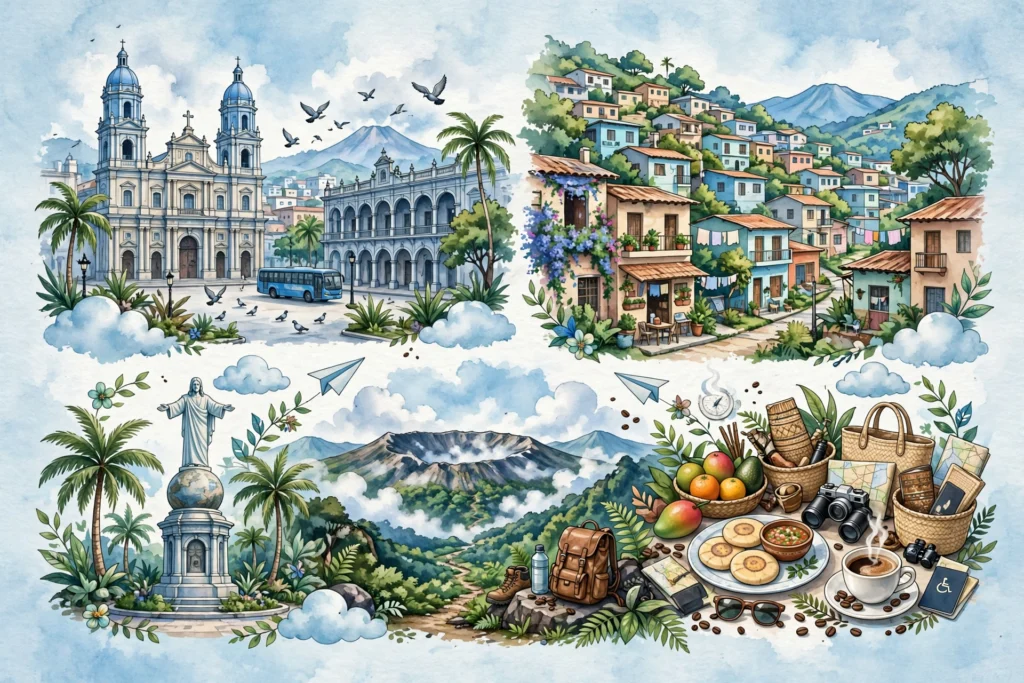
San Salvador is not a pretty city in the postcard sense, and that is part of its appeal. It is a working capital of about half a million people, set in a valley ringed by volcanoes, with a historic centre that has been cleaned up and rebuilt in recent years, modern neighbourhoods full of restaurants and malls, and a volcano — San Salvador Volcano, also called El Boquerón — rising directly above the city. Most visitors spend one or two nights here at the start of a trip, and that is the right amount: long enough to see the historic centre, eat well, and arrange your onward travel, and short enough that you are not spending beach days in a city.
Where you stay matters more in San Salvador than in most capitals, so choose by neighbourhood. San Benito, Santa Elena and Maquilishuat are the safest and most comfortable districts, and they are where most visitors stay. San Benito has the best restaurants and nightlife in the city, along the Zona Rosa, and it is the natural base for a first night. Santa Elena, just south of San Benito, is quieter and more residential, with good hotels and the US Embassy nearby. Maquilishuat is a pleasant, leafy residential area with guesthouses and small hotels. The historic centre, El Centro, is where the sightseeing is, but it is not where you should sleep: stay in San Benito or Santa Elena and visit El Centro during the day.
El Centro is the highlight of a day in the capital, and it has changed a great deal in recent years. The Metropolitan Cathedral, on the Plaza Gerardo Barrios, is the city’s main church and the burial place of Archbishop Óscar Romero, whose murder in 1980 made him one of the most important figures in Salvadoran history — his tomb, in the crypt, is a place of quiet pilgrimage, and the cathedral’s modern facade, with its colourful murals, is one of the most photographed sights in the city. Across the plaza stands the National Palace, a grand early-twentieth-century building that now hosts exhibitions and cultural events, and nearby is the National Theatre, a French Renaissance-style building from 1917 that is worth a look even if you do not see a performance. The church of El Rosario, a concrete arch that looks unremarkable from outside and extraordinary inside, has stained-glass windows that throw coloured light across the whole interior — it is one of the most surprising buildings in Central America. Walk the centre in the morning, when the light is good and the streets are busy, and take a break for lunch in one of the cafes around the plazas.
Above the city, El Boquerón National Park is the easiest volcano experience in the country and the best half-day trip from the capital. The San Salvador Volcano’s crater is a vast, green bowl about 1.5 kilometres across, and a short walk from the car park brings you to a viewpoint on the crater rim, with the city spread out below and the crater floor — a smaller cone called Boqueroncito — rising in the middle. It takes about 45 minutes to drive there from San Salvador, the walk is easy, and the air is cooler and fresher than in the city. Go in the morning, when the crater is clearest, and combine it with lunch back in San Benito. If you only have one day in the capital, this is the shape of it: morning in El Centro, lunch in the historic centre, afternoon at El Boquerón, dinner in the Zona Rosa. If you are sketching the day before you go, a travel itinerary template is a useful way to lay it out, and the same structure — one big sight in the morning, one in the afternoon, dinner in the best neighbourhood — works for every day of this trip.
Santa Ana Volcano, Cerro Verde and Lake Coatepeque
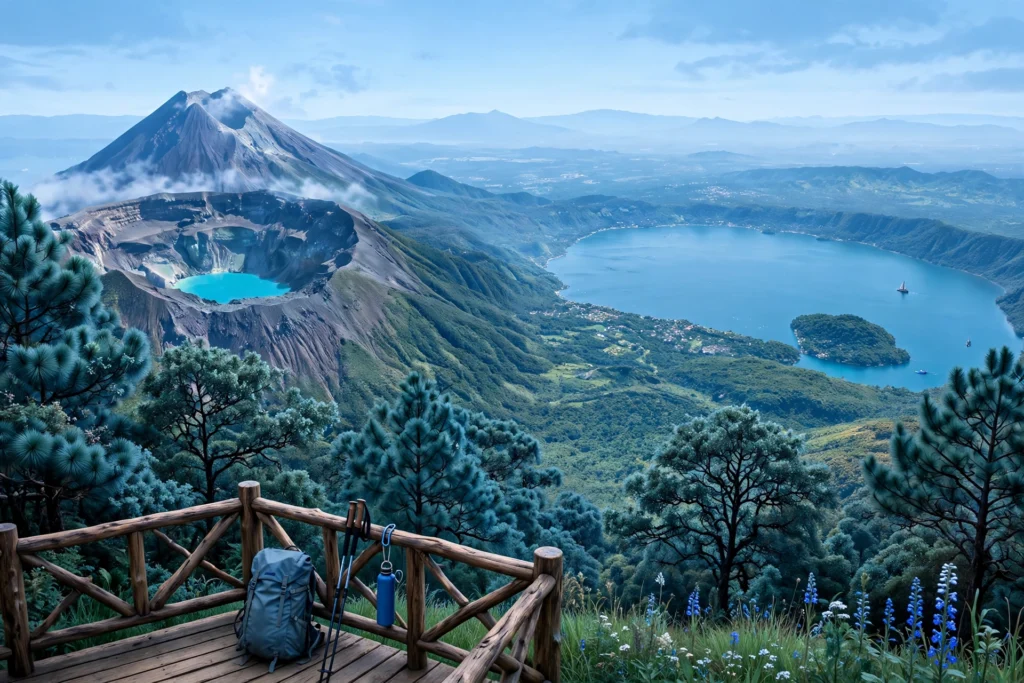
If you do one volcano in El Salvador, make it Santa Ana. At 2,381 metres, Ilamatepec — its indigenous name — is the highest volcano in the country, and the hike to its summit is the single best day walk in El Salvador: a steady climb through cloud forest, a view across the whole volcanic chain, and at the top a crater lake of impossible turquoise, steaming gently in the sun. It is the image on a hundred postcards, and it is better in person.
The hike starts from Cerro Verde National Park, about an hour and a half west of San Salvador and close to the city of Santa Ana. The trail is about 7 kilometres return, takes roughly four hours up and down, and climbs around 600 metres. It is a moderate hike — not technical, but steep in places, and the altitude makes it feel harder than the distance suggests. You need sturdy shoes with grip, water, sunscreen and a hat, and a rain jacket in the wet season. The trail is well marked, but you should still go with a registered guide: the park requires it, the guide knows the route and the weather, and the guidance from the Foreign Office is to do guided volcano hikes in daylight. Start early — the park opens in the morning, and the crater is clearest before the clouds build in the afternoon. If the clouds come in, be patient: they often clear for a few minutes, and a few minutes of the crater lake in full sun is worth the wait.
Cerro Verde itself is worth an hour before or after the Santa Ana hike. The park sits on the slopes of the Cerro Verde volcano, between Santa Ana and Izalco, and its viewpoints look across to both. Izalco — the “Lighthouse of the Pacific”, a near-perfect cone that used to glow at night when it was erupting — is the classic photograph from Cerro Verde, a dark cone rising from green forest with the Pacific in the distance. There are short trails through the cloud forest, a small visitor centre, and a cool, misty climate that feels like a different country from the hot coast an hour away.
Lake Coatepeque is the reward at the end of the day. It is a crater lake, formed when a volcano collapsed thousands of years ago, and it is one of the most beautiful lakes in Central America: deep blue, ringed by steep green hills, with houses, restaurants and small hotels along its shore. The water is warm enough to swim in, and there are kayaks, paddleboards and boat trips available from the lakeside restaurants. If volcano hikes are your thing, the same early-start discipline applies in our Iceland travel itinerary, where the best views also belong to the travellers who set off first. The classic way to do the day is to hike Santa Ana in the morning, have lunch at Cerro Verde, and spend the afternoon at the lake — a swim, a boat ride, and dinner at a lakeside restaurant as the sun goes down. Staying overnight at the lake is also worth considering: there are small hotels and guesthouses on the shore, the mornings are quiet and misty, and it is a much better base for the Ruta de las Flores the next day than driving back to San Salvador.
| Place | Type | What it is | Time needed | Best for |
|---|---|---|---|---|
| Santa Ana Volcano (Ilamatepec, 2,381 m) | Volcano | Summit hike to a turquoise crater lake | Half day, ~4 hours hiking | Hikers, photographers, the classic El Salvador day |
| Cerro Verde | Volcano / national park | Viewpoints over Santa Ana and Izalco | 1–2 hours | Easy views, cloud forest, families |
| Lake Coatepeque | Crater lake | Deep blue lake with swimming, kayaking, lakeside dining | Half day or overnight | Swimming, relaxing, sunset dinner |
| El Tunco / La Libertad | Surf coast | Black-sand surf beaches, seafood, nightlife | 2–3 days | Surfing, beach life, sunsets |
| El Zonte (Bitcoin Beach) | Surf coast | Quiet surf village, Bitcoin history | 1–2 days | Surfing, slow travel, Bitcoin curiosity |
| Ruta de las Flores | Coffee towns | Colonial towns, coffee farms, waterfalls, weekend market | 1–2 days | Coffee, food, markets, waterfalls |
| Suchitoto | Colonial town | Cobbled streets, church, lake birdwatching | 1 day or overnight | Slow travel, photography, birds |
| Joya de Cerén (UNESCO) | Maya site | Pre-Hispanic farming village buried in ash | Half day | History, archaeology |
| Tazumal | Maya site | Largest Maya pyramid in El Salvador | Half day, with Santa Ana | History, archaeology |
| San Salvador | Capital | Historic centre, museums, El Boquerón | 1–2 days | First night, food, city sights |
Ruta de las Flores: Coffee Towns, Waterfalls and the Weekend Market
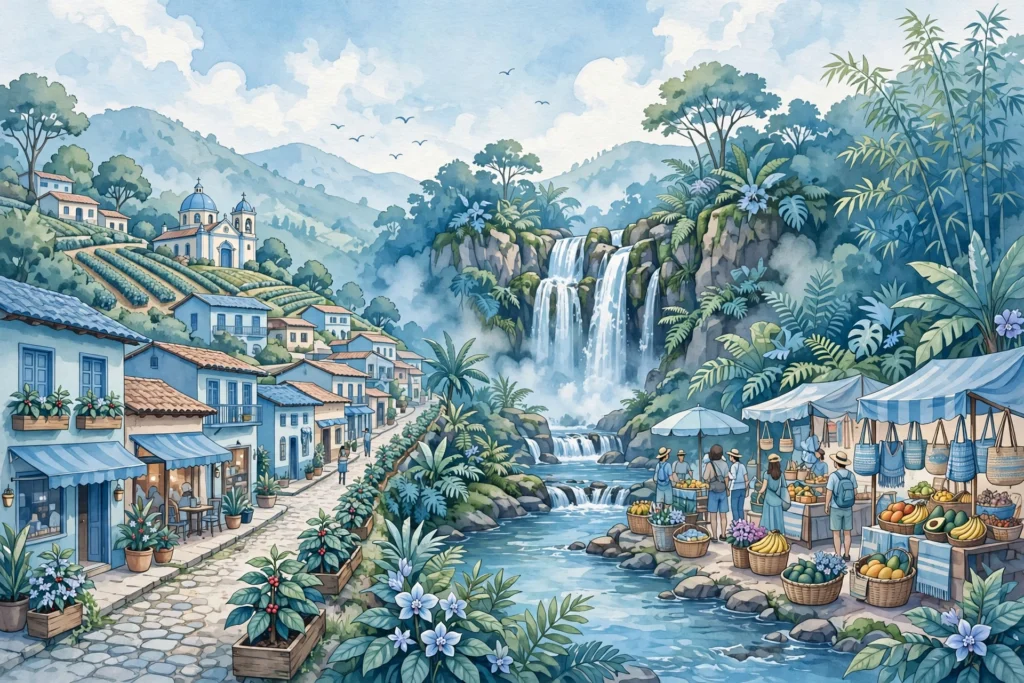
The Ruta de las Flores — the Route of the Flowers — is the prettiest drive in El Salvador, and it is the best two days in the country for travellers who like food, coffee and small towns. The route runs through the Apaneca mountains in the west of the country, linking five colonial towns — Nahuizalco, Salcoatitán, Juayúa, Apaneca and Ataco — along a winding road through coffee farms, flower nurseries and cloud forest. The name comes from the wildflowers that bloom along the road in the dry season, but the real attraction is the combination: a coffee farm in the morning, a waterfall in the afternoon, and a food festival in the evening.
Juayúa is the town to base yourself in. It is the largest town on the route, it has the best choice of hotels and restaurants, and it hosts the famous weekend food festival — the Feria Gastronómica — every Saturday and Sunday, when the main square fills with stalls selling pupusas, grilled meats, seafood, tamales, desserts and fresh juices, with live music and a crowd of Salvadoran families. Go hungry, go early, and try things you have never heard of: the festival is the best introduction to Salvadoran food in the country, and it is also the cheapest. Juayúa is also the starting point for the Chorros de la Calera, a series of waterfalls a short walk from the town, where you can swim in natural pools under the falls. The walk is easy, the pools are cold and clear, and it is the perfect way to spend a hot afternoon.
Ataco, at the far end of the route, is the prettiest town on it: steep cobbled streets, brightly painted houses, murals on the walls, and small shops selling woven textiles, coffee and handicrafts. It is the town to wander in without a plan — up one street, down another, stopping for coffee in a cafe with a view over the valley. Apaneca, between Juayúa and Ataco, is the highest town on the route and the centre of the coffee country: the farms around it are some of the best in El Salvador, and several offer tours where you can walk the coffee rows, see the picking and processing, and taste the coffee at the end. Salcoatitán is the smallest town on the route, with a pretty white church and a quiet square, and Nahuizalco, at the start of the route, is known for its night market and its indigenous Pipil heritage, including the wicker and wood crafts sold in the town’s workshops.
The coffee is the thread that ties the route together, and the timing matters. The coffee harvest runs from November to February, and those are the months when the farms are at their busiest and the tours are at their best: you can see the red coffee cherries being picked, the beans being washed and dried on the patios, and the roasting in the beneficio. Outside harvest season the farms are still open, but the tours are quieter and more about the landscape than the work. If you are visiting in the harvest months, book a farm tour in advance and ask whether the tour includes the picking, the processing and a tasting — the best ones do all three, and they last two to three hours. A good farm tour costs a planning range of roughly $10 to $25 per person, and it is one of the best-value experiences in the country.
Suchitoto: Colonial Streets, Lake Suchitlán and Birdwatching
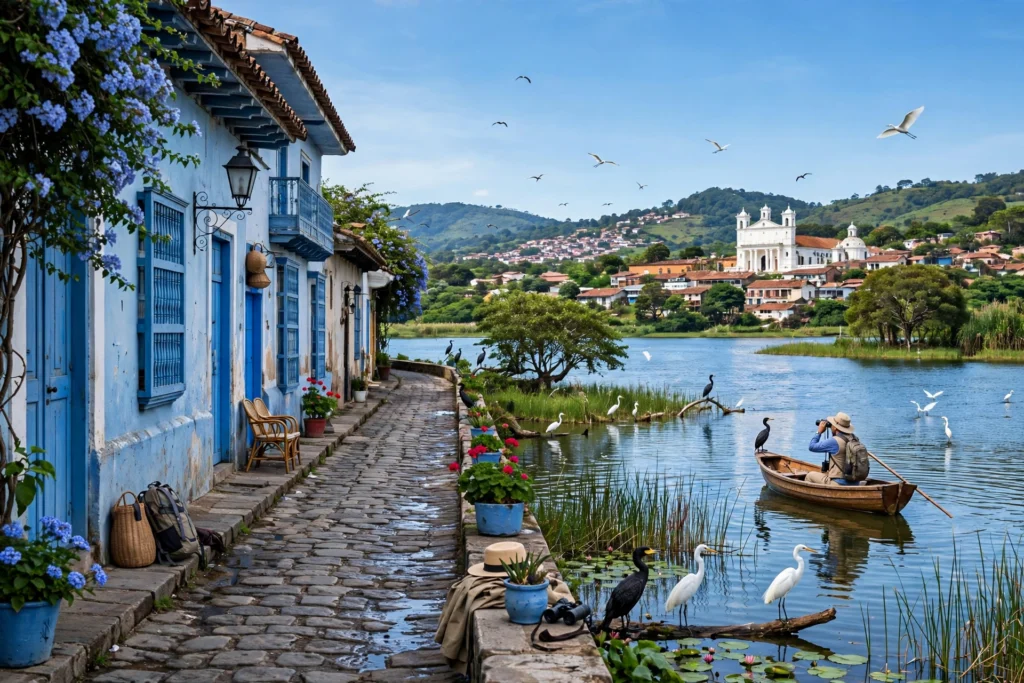
Suchitoto is the town travellers fall in love with. It sits on a hill above Lake Suchitlán, about an hour north of San Salvador, and it feels like a place that the modern world forgot to hurry: cobbled streets, whitewashed houses with blue doors, bougainvillea spilling over garden walls, and a church — Santa Lucía, built in the nineteenth century — that dominates the main square. It is the best-preserved colonial town in El Salvador, and it is the best place in the country to slow down for a day.
The town itself is small enough to explore on foot in a morning. Start at the main square and the Santa Lucía church, then wander the streets around it: the houses are the attraction, with their tiled roofs, wooden balconies and flower-filled courtyards, and the views open up suddenly at the end of a street, over the rooftops to the lake below. There are small galleries, craft shops and cafes in the centre, and the town has a quiet artistic life — painters, musicians and writers have settled here, and there are often exhibitions and small concerts in the cultural centre. The food is good and cheap, and the cafes on the square are the place to sit with a coffee and watch the town go by. If you are looking for the feeling of a place rather than a list of sights, Suchitoto is the town to give a day to, and the framework in our how to find travel inspiration guide — that the best trips are the ones that leave room for wandering — applies here more than anywhere else in El Salvador.
The lake is the other half of the visit. Lake Suchitlán is a large artificial lake, created by the Cerrón Grande dam on the Lempa River, and it is one of the best birdwatching sites in Central America. More than two hundred species of birds have been recorded here, including herons, egrets, cormorants, kingfishers, ospreys and, in the dry season, migratory birds from North America. The best way to see them is a boat trip from the town’s small port: local boatmen take visitors out for an hour or two, usually in the early morning when the birds are most active, and the cost is a planning range of roughly $10 to $20 per person. Bring binoculars if you have them, wear a hat and sunscreen, and go early — the light is better, the birds are busier, and the lake is calm. The boat trip also gives you the best view of Suchitoto itself, from the water, with the church tower rising above the rooftops.
Suchitoto also carries a heavier history, and it is worth knowing. The town was badly affected by the civil war of the 1980s, and many of its people left; the quiet streets you walk today are quiet partly because the town is still rebuilding its life. There are memorials and small museums in the town that tell that story, and a visit to one of them is a respectful way to understand the country beyond the beaches and volcanoes.
Maya History: Joya de Cerén, Tazumal and San Andrés
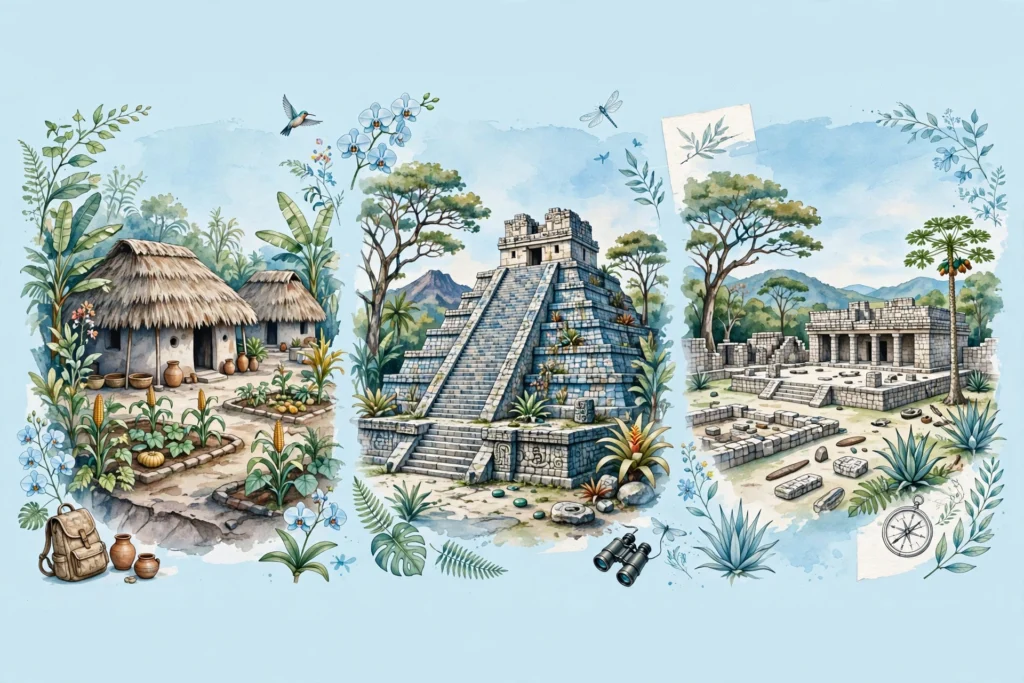
El Salvador’s Maya history is smaller in scale than the great sites of Mexico and Guatemala, but it is more intimate — and in one case, more extraordinary — than anywhere else in the Maya world. The three sites in this section can be visited in a single day from San Salvador, and together they tell a story that runs from ordinary village life to the largest pyramid in the country.
Joya de Cerén is the site that makes the trip. It is El Salvador’s only UNESCO World Heritage Site, and it is unlike any other Maya site: not a city of pyramids and palaces, but a farming village, buried in volcanic ash in the seventh century AD and preserved almost exactly as it was left. The UNESCO listing describes it as the best-preserved example of a pre-Hispanic village in Mesoamerica, with the remains of houses, storehouses, a kitchen, a sweat bath, a community building and a religious building, all preserved with their contents in place — pots of beans, sleeping mats, garden tools, maize fields, a herb garden and a cacao grove. The site was discovered in 1976, when a bulldozer building grain-storage silos exposed a clay structure, and excavations have continued since 1989. To date, 18 structures have been identified and 10 have been completely or partially excavated. The village was founded after the Ilopango volcano buried the region in ash around AD 500, and it was destroyed not long afterwards by the eruption of the Loma Caldera. You can read the full history on the official UNESCO page for Joya de Cerén, which calls the site a time capsule of unprecedented scientific value and a unique window into the daily lives of ordinary Maya farmers — the people history usually forgets, preserved here in a way that has no parallel in Mesoamerica. The site is small, it takes about an hour to visit, and it is best seen with the small museum at the entrance, which explains what you are looking at. Go in the morning, when it is cool, and combine it with San Andrés, which is a short drive away.
San Andrés is the ceremonial centre that served the valley around Joya de Cerén. It is a larger site, with pyramids, plazas and a ball court, and it gives you the monumental side of Maya life that Joya de Cerén does not: the scale of the pyramids, the layout of the plazas, the sense of a city that was a regional centre. It is less visited than Joya de Cerén, and that is part of its charm — you can walk the site in peace, and the views across the valley to the volcanoes are beautiful. Tazumal, near the town of Chalchuapa and close to Santa Ana, is the largest Maya site in El Salvador: a great stepped pyramid, around 24 metres high, with a ball court and tombs, built and rebuilt over centuries. It is the site to combine with a Santa Ana Volcano day, since it is on the same side of the country, and the small museum at the entrance has finds from the site, including the famous Xipe Totec statue. Together, the three sites take a day and a half to see properly, and they are worth that time: El Salvador’s Maya heritage is not a footnote to Mexico’s, but Joya de Cerén, the village frozen in ash, is something Mexico does not have, and it is the reason this day belongs in every El Salvador itinerary.
The Pacific Surf Coast: El Tunco, La Libertad and El Zonte
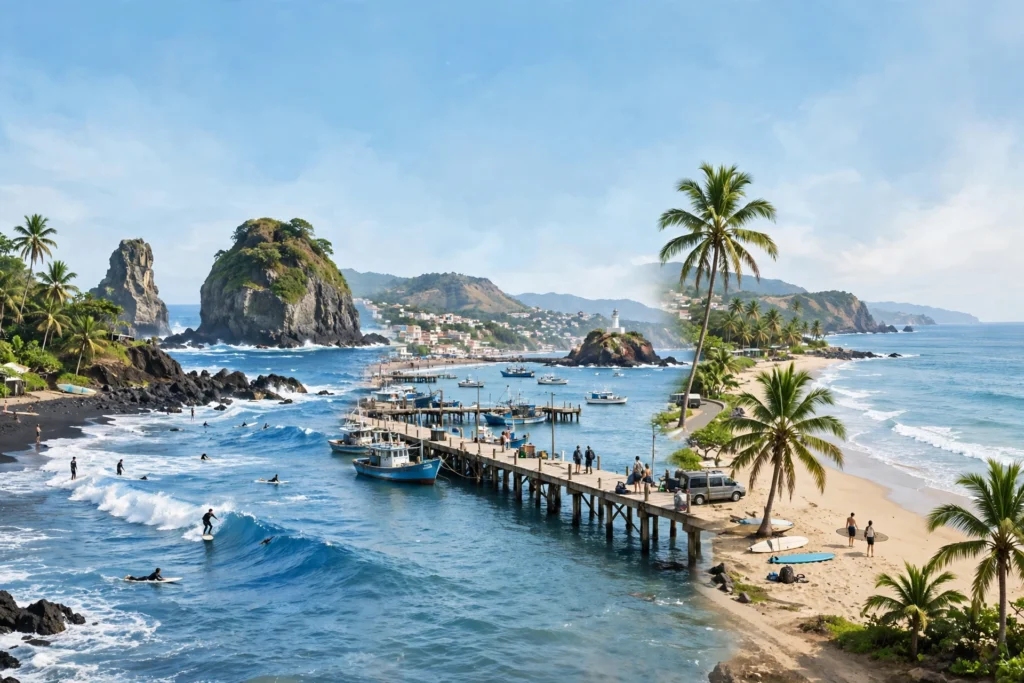
The surf coast is the reason many travellers come to El Salvador, and it is the part of the country that has changed most in the last few years. The coast runs west from La Libertad, about 40 minutes from San Salvador, along a string of black-sand beaches with some of the most consistent surf in the Americas. The sand is volcanic black, the water is warm all year, and the waves break over rock and sand in a way that produces long, clean rides. The World Surf League has held championship events here, and the coast now has the hotels, surf schools and restaurants to match — without yet feeling crowded.
El Tunco is the centre of it all. It is a small village built around a rock formation — the Tunco rock, which gives the place its name — with a black-sand beach, a row of surf shops, hostels, hotels and restaurants along a single main street, and a sunset that draws everyone to the beach every evening. The surf at El Tunco suits intermediate and experienced surfers best: the main break is a right-hand point break that works on a south swell, and it can be powerful. Beginners should take a lesson with a local school and surf the smaller inside section, or go to the gentler beaches nearby. El Tunco is also the best base on the coast for non-surfers: there are yoga classes, good restaurants, live music at weekends, and a relaxed, barefoot atmosphere that makes it easy to spend three days doing very little. Book ahead in the dry season and over holidays, when the best rooms go quickly.
La Libertad is the working port town just east of El Tunco, and it is worth a visit for a different reason: the fish. The town’s pier, the Muelle Turístico, is lined with seafood restaurants where the catch comes straight off the boats, and the fish market below it is one of the most vivid places on the coast. Come for lunch, eat grilled fish or ceviche, watch the boats come in, and walk the pier at sunset. La Libertad also has the best surf break on the coast for experienced surfers — Punta Roca, a powerful right-hand point break that hosts the championship events — but it is not a beginner wave, and it should be left to surfers who know what they are doing. The town itself is less polished than El Tunco, and that is its appeal: it is a real fishing port, not a resort, and it gives you a sense of the coast as Salvadorans live it.
El Zonte, about 15 minutes west of El Tunco, is the quieter alternative, and it is famous for something that has nothing to do with surf. Known as Bitcoin Beach, El Zonte is where Bitcoin first took hold in El Salvador: local businesses began accepting it in 2019, and after Bitcoin became legal tender in 2021, the village became a symbol of the country’s Bitcoin experiment. The surf here is good for all levels, the village is small and relaxed, and there are surf schools, yoga studios and cafes that accept Bitcoin alongside dollars and cards. The money section below explains the practical side of Bitcoin in El Salvador, but the short version is this: El Zonte is worth a visit for the surf and the atmosphere, and the Bitcoin story is an interesting footnote, not a reason to change how you pay for things. The surf seasons are worth planning around. The biggest swells arrive from March to October, driven by storms in the South Pacific, and those months suit experienced surfers who want size and power. The cleaner waves come from November to April, when the swells are smaller but the wind is offshore and the waves are better shaped — those months suit beginners, intermediates and anyone who wants to learn. Water temperature is warm all year, around 26 to 29°C, so a rash guard is enough for most people and a thin wetsuit top is plenty for early mornings. Surfboard rental costs a planning range of roughly $10 to $20 a day, a group lesson roughly $20 to $35, and a private lesson roughly $40 to $60 — confirm prices with the school before you book.
Beaches Beyond the Surf: Costa del Sol, Los Cóbanos and the East Coast
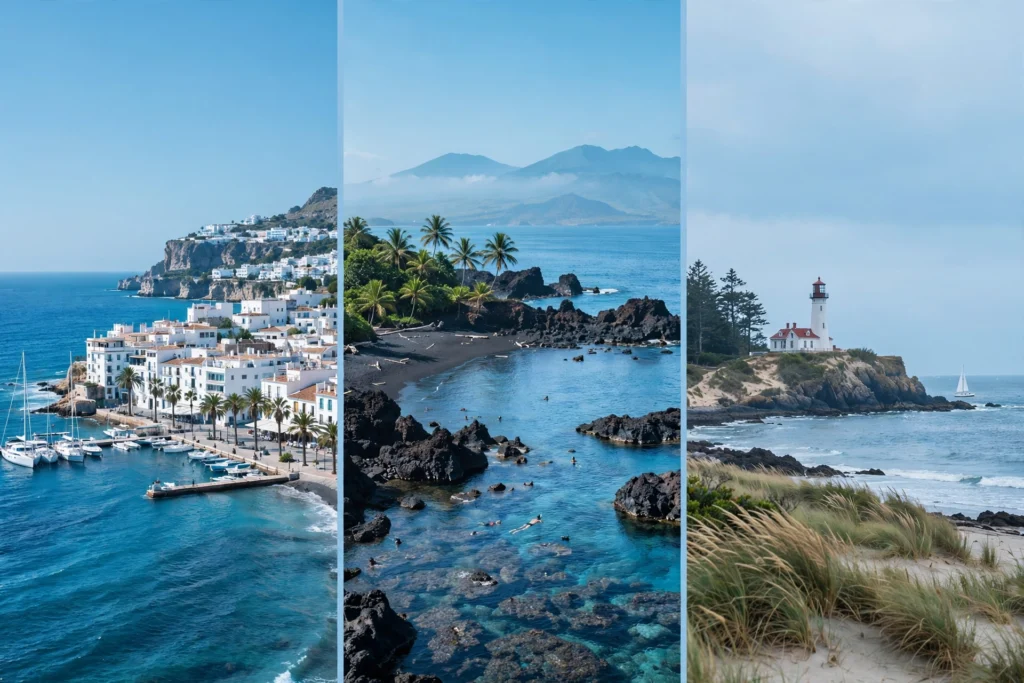
Not every beach in El Salvador is a surf beach, and the quieter stretches of coast are worth a day for travellers who want to swim, eat seafood and do very little. The coast east of the airport is flatter, calmer and less developed than the surf coast, and it has a different character: estuaries, mangroves, fishing villages and long, empty beaches.
Costa del Sol is the closest beach resort area to the airport, about 30 minutes east of it, and it is the easiest beach day from San Salvador. The beach is a long stretch of grey sand on a narrow strip between the Pacific and the Jaltepeque estuary, and it is lined with hotels, restaurants and weekend houses. The water here is calmer than on the surf coast, the swimming is better, and the seafood — particularly the mariscada, a mixed seafood soup — is excellent. It is a popular weekend destination for families from San Salvador, so it is busiest on Saturdays and Sundays and quiet during the week. If you have a free day before an afternoon flight, Costa del Sol is the beach to go to: it is close to the airport, the seafood lunch is the best in the area, and you can be back at the terminal in half an hour.
Los Cóbanos, west of the port of Acajutla, is the best snorkelling and diving spot in the country. The beach is a rocky reef, not a sand beach, and the water is clear enough to see coral, tropical fish and sea turtles — it is the one place on the Salvadoran coast where the underwater life is the attraction rather than the waves. There are small hotels and dive operators in the area, and the best time to visit is the dry season, when the water is clearest. The beach itself is rocky and not comfortable for sunbathing, so come for the water, not the sand: bring reef-safe sunscreen, water shoes for the rocks, and a mask and snorkel if you have them. Los Cóbanos is also a sea turtle nesting area, and local conservation projects protect the nests — if you visit during nesting season, follow the guides’ instructions, do not use flash photography, and do not touch the turtles.
The east coast is the least visited part of El Salvador’s shoreline, and it is the most rewarding for travellers who like empty places. Playa El Cuco and Las Flores, near the town of San Miguel, are long, quiet beaches with good surf for intermediates and almost no crowds. The Gulf of Fonseca, shared with Honduras and Nicaragua, is a wide, calm gulf with islands, mangroves and fishing villages, and boat trips from the port of La Unión visit the islands and the bird colonies. The east is further from San Salvador — about three hours by car — so it suits a trip of seven days or more rather than a short break, and it is best done with a driver and an overnight stay. The Pacific coast of Central America continues north and south from here, and the neighbouring Panama travel guide covers the same ocean from the other side of the region — but the Salvadoran east coast is quieter than either, and that quiet is the point.
Food in El Salvador: Pupusas, Coffee and Markets
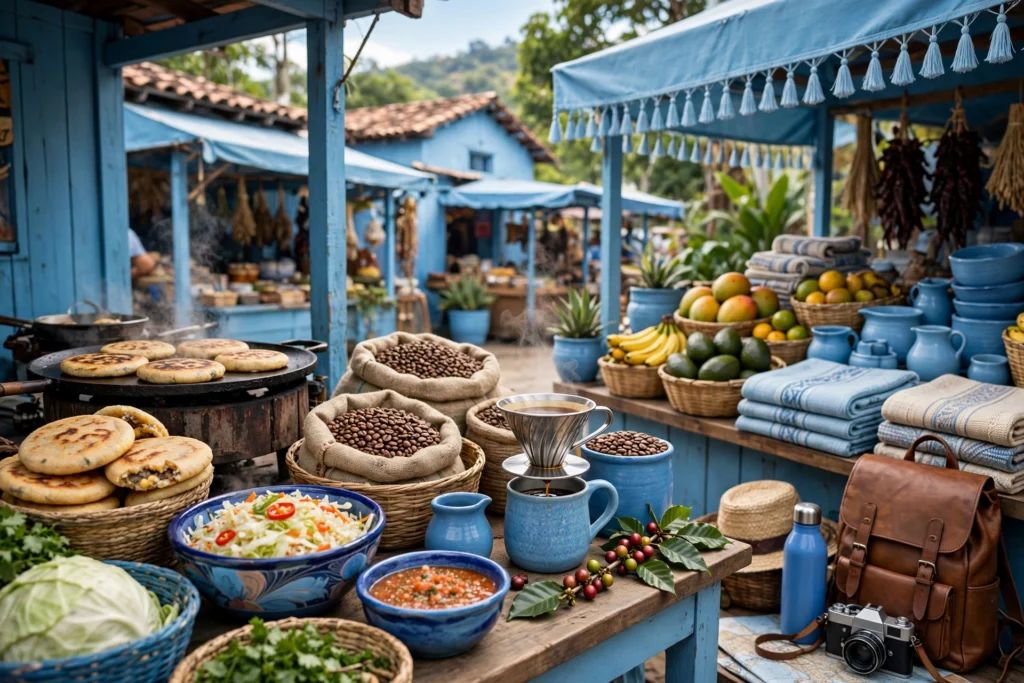
El Salvador’s food is simple, cheap and deeply satisfying, and it is one of the best reasons to visit. The national dish is the pupusa, and you will eat it within hours of arriving: a thick corn or rice flour flatbread, griddled on a hot plate and stuffed with quesillo (a soft, mild cheese), chicharrón (seasoned ground pork), beans, loroco (an edible flower bud with a delicate, green flavour), or combinations of all of them. Pupusas are served with curtido — a pickled cabbage, carrot and onion slaw with a little chilli — and a thin tomato salsa, and they cost a planning range of roughly $1 to $2 each from a street stall or a pupusería. Two or three make a meal. The best pupusas are found in the small, family-run pupuserías rather than the restaurants, and the town of Olocuilta, on the road between the airport and San Salvador, is famous for its rice-flour pupusas — stop there on the way from the airport if you have time. Eating pupusas is a hands-on business: pick them up, add curtido, eat them hot, and do not worry about being neat.
Beyond pupusas, the food is the food of the coast and the countryside. Yuca frita — fried cassava with chicharrón and curtido — is the classic snack. Mariscada, the mixed seafood soup, is the dish to order on the coast, and it is at its best at La Libertad and Costa del Sol. Sopa de gallina india, a free-range chicken soup, is the Sunday lunch of the countryside. Tamales — corn dough steamed in banana leaves — are sold in markets and from street vendors, and they make a good breakfast. Empanadas de plátano, fried plantain turnovers filled with milk custard or beans, are the sweet snack to look for in the markets. And the drinks are worth trying: horchata, a sweet rice and cinnamon drink served over ice; tamarindo and cebada, the barley drink sold in markets; and atol de elote, a warm, sweet corn drink that is a breakfast in itself. The coffee, of course, is excellent — El Salvador grows some of the best coffee in Central America, and the cafes of San Salvador and the Ruta de las Flores serve it properly, as a pour-over or a French press rather than an afterthought.
The markets are where the food culture is most alive. Travellers who enjoy food-led trips will find the same market-first approach in our Colombia travel guide, where coffee and arepas play a similar role. The municipal markets in San Salvador and Santa Ana are big, noisy and overwhelming in the best way: stalls of fruit, vegetables, cheese, flowers, clothes and household goods, with food stalls at the back serving breakfast and lunch to the market workers. Go in the morning, go hungry, and eat what the locals are eating. The Juayúa weekend food festival, covered in the Ruta de las Flores section, is the most tourist-friendly version of the same thing. And the coffee farms of the Ruta de las Flores are the place to understand the drink: a farm tour, a tasting, and a bag of beans to take home are the best souvenir in the country.
Where to Stay, What to Pack and Money: Dollars, Cards and Bitcoin
Where you stay in El Salvador depends on where you are in the trip, and the country rewards travellers who move around rather than staying in one place. In San Salvador, stay in San Benito, Santa Elena or Maquilishuat: the hotels there range from comfortable mid-range business hotels to good boutique guesthouses, and they are the safest and most convenient base. A mid-range hotel in the capital costs a planning range of roughly $60 to $120 a night. In Santa Ana and the volcanoes, the choice is smaller: there are good hotels in the city of Santa Ana itself, and small lakeside hotels at Lake Coatepeque, which are the better choice if you want the lake in the morning. On the Ruta de las Flores, stay in Juayúa or Ataco: small hotels and guesthouses, often in colonial houses, at a planning range of roughly $40 to $80 a night, with breakfast included. In Suchitoto, the guesthouses in the centre are the place to stay — book ahead at weekends, when the town fills up. And on the surf coast, the choice runs from surfer hostels at roughly $15 to $30 a night for a dorm bed, through beach hotels and guesthouses at roughly $50 to $100 a night, to a few higher-end boutique hotels at El Tunco and El Zonte.
Packing for El Salvador is packing for two climates. The coast and the lowlands are hot and humid all year: light, breathable clothes, swimwear, sandals, a hat and strong sunscreen. The highlands — the Ruta de las Flores, Cerro Verde, the volcano hikes — are cooler, especially in the morning and evening, and the rainy season brings sudden downpours: bring a light rain jacket, a fleece or a light jumper, and long trousers for the evenings. For the Santa Ana hike you need proper walking shoes with grip, not sandals, and a daypack with water, sunscreen and a snack. For the beach you need reef-safe sunscreen, a rash guard if you surf, and water shoes for the rocky beaches like Los Cóbanos. For the towns you need modest clothes for churches and a little smartness for restaurants in San Salvador — the capital dresses up more than the coast. And for the state of exception, pack a photocopy of your passport photo page to carry with you, and keep the original in your hotel safe. The currency is the US dollar, so there is no money to change, and the plug type is the same as in the United States (Type A and B), so no adapter is needed for US travellers.
Money is simple, and that is one of El Salvador’s great advantages for US travellers. The currency is the US dollar, adopted in 2001, so there is no exchange rate to work out and no money to change: your dollars work exactly as they do at home, and the prices in this guide are in dollars for that reason. ATMs are widespread in San Salvador, Santa Ana, La Libertad and the main towns, and they dispense dollars; use ATMs inside banks or malls during the day, and take out enough cash for a few days at a time, because ATMs are scarcer in the small towns and on the coast. Cards are widely accepted in hotels, restaurants and shops in the cities and on the coast, but cash is essential in markets, for street food, for small guesthouses, for boat trips and for tipping drivers and guides. Carry small bills: a $20 bill is fine, a $100 bill will be hard to break in a market, and coins are useful for pupusas and buses you are not taking.
Bitcoin is the question everyone asks, and the answer is practical rather than ideological. Bitcoin has been legal tender in El Salvador since 2021, and it is accepted in El Zonte and in some businesses in San Salvador and on the coast, usually through the Chivo wallet or the Lightning Network. The right approach for a visitor is to treat Bitcoin as a curiosity, not a payment method: bring dollars and cards, use cash for the small things, and if you want to try paying in Bitcoin at El Zonte, do it for a coffee, not for your hotel. Do not convert your travel money into Bitcoin before you arrive, do not rely on it for anything essential, and do not assume a business accepts it until you have asked. The FAQ below answers the Bitcoin question in full, but the short version is the one that matters: dollars first, cards second, Bitcoin only if you are curious and the amount is small.
How Much Does El Salvador Travel Cost?
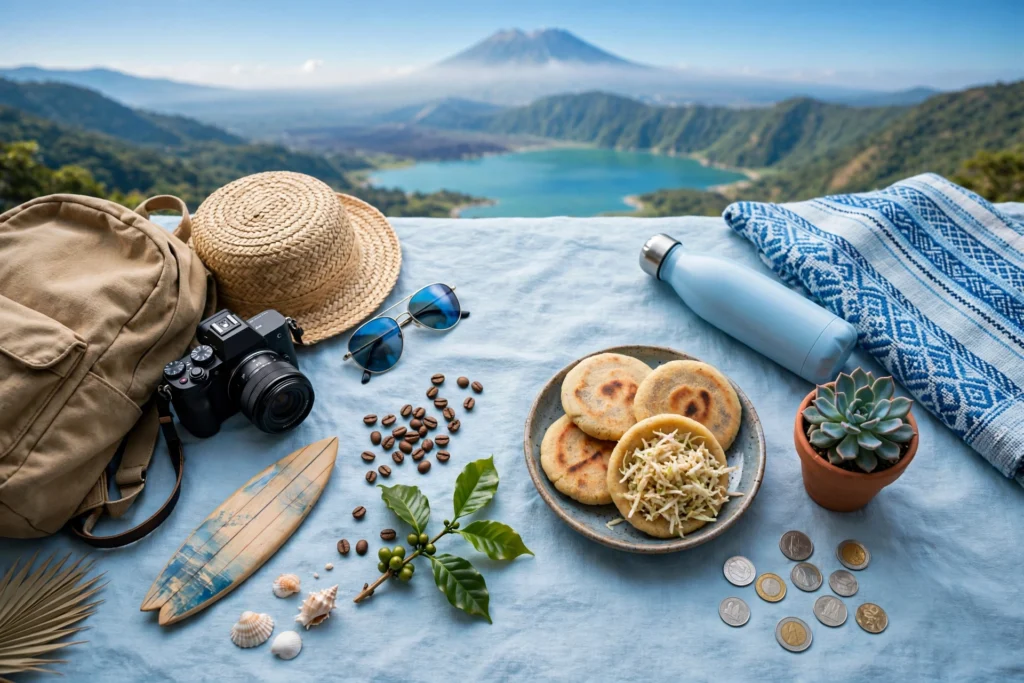
El Salvador is one of the cheapest destinations in the Americas, and it is good value at every level. A budget traveller can get by on roughly $40 to $60 a day, a mid-range traveller on roughly $60 to $120 a day, and a comfortable traveller on roughly $120 to $200 a day, excluding international flights. The figures below are planning ranges for 2026 — confirm all prices before you book, because prices change with the season, and the coast is more expensive in the dry season and over holidays. The reason the country is cheap is not that it is poor value: the food is excellent, the hotels are good, and the activities — volcano hikes, surf lessons, farm tours, boat trips — are inexpensive by international standards. The money you save on the basics can go toward an extra day, a better hotel, or a private driver for the volcanoes, and that is the best use of it.
| Item | Budget (per person, per day) | Mid-range (per person, per day) | Notes |
|---|---|---|---|
| Accommodation | $15–$30 (hostel dorm) | $50–$100 (hotel / guesthouse) | Coast and capital are dearer; small towns are cheaper |
| Food | $10–$15 (markets, pupuserías) | $20–$35 (restaurants, seafood) | Pupusas $1–$2 each; market lunch $3–$6 |
| Local transport | $5–$15 (ride-hailing, short trips) | $20–$40 (share of a private driver) | Private driver $60–$100 a day for the car |
| Activities | $5–$15 (hikes, beaches, museums) | $15–$40 (surf lesson, farm tour, boat trip) | Santa Ana guide, surf lesson, coffee tour |
| Airport transfer | $25–$40 one way | $25–$40 one way | Pre-book with your hotel; confirm in writing |
| Daily total (excl. flights) | $40–$60 | $60–$120 | Comfortable travel $120–$200 a day |
| International flights (US return) | $250–$500 | $250–$500 | Varies by city and season; book early for Holy Week |
Sample El Salvador Itineraries: 5 Days and 7 Days
The itineraries below are realistic shapes for a first trip, and they are the right thing to discuss with your hotel and your driver — not a fixed schedule to book blindly. Every one of them assumes daylight driving, a base in San Salvador at the start, and time on the surf coast at the end.
5 days — volcanoes, Maya sites and the surf coast. Day 1: arrive at San Salvador airport, transfer to San Benito, afternoon in El Centro (cathedral, National Palace, El Rosario church), dinner in the Zona Rosa. Day 2: early start for Santa Ana Volcano — hike to the crater lake, lunch at Cerro Verde, afternoon at Lake Coatepeque, overnight at the lake. Day 3: Joya de Cerén and San Andrés in the morning, drive to the surf coast in the afternoon, sunset at El Tunco. Day 4: surf lesson or beach day at El Tunco, lunch at La Libertad pier, afternoon at El Zonte. Day 5: morning surf or beach walk, seafood lunch at Costa del Sol on the way to the airport, afternoon flight home. This itinerary suits travellers who are short on time and want the three things El Salvador does best — volcanoes, history and surf — in a single week.
| Day | 5-day itinerary | 7-day itinerary |
|---|---|---|
| Day 1 | Arrive San Salvador, El Centro, dinner in Zona Rosa | Arrive San Salvador, El Centro, dinner in Zona Rosa |
| Day 2 | Santa Ana Volcano hike, Cerro Verde, Lake Coatepeque | Santa Ana Volcano hike, Cerro Verde, Lake Coatepeque, overnight at the lake |
| Day 3 | Joya de Cerén + San Andrés, drive to El Tunco | Ruta de las Flores: Juayúa food festival, Chorros de la Calera waterfalls |
| Day 4 | Surf / beach day El Tunco, La Libertad pier lunch | Ataco + Apaneca coffee farm tour, drive to Suchitoto |
| Day 5 | Morning surf, Costa del Sol lunch, fly home | Suchitoto morning, Lake Suchitlán boat trip, drive to El Tunco |
| Day 6 | — | Surf day El Tunco, La Libertad pier, sunset at El Zonte |
| Day 7 | — | Morning surf or Los Cóbanos snorkelling, Costa del Sol lunch, fly home |
7 days — the full trip. Days 1–2 as above, with an overnight at Lake Coatepeque. Day 3: the Ruta de las Flores — Juayúa food festival and the Chorros de la Calera waterfalls, overnight in Juayúa or Ataco. Day 4: Ataco and a coffee farm tour in Apaneca, then drive to Suchitoto. Day 5: Suchitoto in the morning and a Lake Suchitlán boat trip, then drive to the surf coast. Day 6: a full surf day at El Tunco, lunch at the La Libertad pier, sunset at El Zonte. Day 7: a morning surf or a snorkelling trip at Los Cóbanos, a seafood lunch at Costa del Sol on the way to the airport, and an afternoon flight home. The seven-day trip is the one this guide recommends: it is the same trip as the five-day version, with the coffee towns and Suchitoto added, and those two days are the ones travellers remember most. If you are deciding how many days a destination deserves, the framework in our travel itinerary template guide is a useful way to match the length of the trip to what you actually want from it.
Frequently Asked Questions About El Salvador Travel
1. Is El Salvador safe now?
Yes, it is far safer than it was, and the US State Department rates the whole country Level 1: Exercise Normal Precautions, issued 8 April 2025, with no higher regional levels. Gang activity has decreased dramatically since 2022, and violent crime and murders have fallen sharply. But a state of exception is still in force: carry a copy of your passport photo page, expect checkpoints, do not photograph security personnel, do not take part in political activity, travel between cities in daylight, and do not use public buses. Stay in the safe districts of San Salvador, use a private driver or hotel transfers, and read the safety section of this guide before you go.
2. Do I need a visa to visit El Salvador?
US citizens do not need a visa. You enter visa-free under the CA-4 agreement, which El Salvador shares with Guatemala, Honduras and Nicaragua, for up to 90 days in total across all four countries combined — not 90 days per country. Your passport must be valid for at least six months, and immigration may ask for proof of onward travel. Citizens of the EU, the UK, Canada, Australia and many Latin American countries are also visa-free, but some nationalities need a visa in advance, so check the rules for your nationality before travelling.
3. Is Bitcoin usable in El Salvador?
Bitcoin is legal tender, and it is accepted in El Zonte and in some businesses in San Salvador and on the coast, usually through the Chivo wallet or the Lightning Network. In practice, though, dollars are what almost everyone uses, and Bitcoin acceptance is patchy and unreliable outside El Zonte. Bring US dollars and cards, use cash for markets and small purchases, and treat Bitcoin as a curiosity to try for a coffee — not as a way to pay for your hotel or your transport.
4. What is the best time to visit El Salvador?
November to April is the best time for most visitors: the dry season, with clear skies, the coffee harvest from November to February, and the cleanest waves for learning to surf. March to October brings the biggest surf swells and suits experienced surfers, but it is also the rainy season, with hot, humid weather and afternoon showers. The cheapest months are the rainy season, from June to October, when hotel prices drop and the country is at its greenest.
5. How many days do I need in El Salvador?
Five days is enough for the highlights: San Salvador, Santa Ana Volcano, the Maya sites and the surf coast. Seven days is the trip this guide recommends, because it adds the Ruta de las Flores and Suchitoto, which are the two most memorable parts of the country. If you have ten days, add the east coast — Playa El Cuco, Las Flores and the Gulf of Fonseca — and a second day on the surf coast.
6. Do I need to speak Spanish?
It helps a great deal, but you can travel without it. Hotel and restaurant staff in San Salvador, El Tunco and the main tourist towns often speak some English, and surf schools and tour guides usually speak English well. Outside those places, English is rare. Learn a few phrases — hello, please, thank you, the bill, where is the bathroom — and download an offline translation app before you go. A little Spanish goes a long way, and Salvadorans are patient and friendly with visitors who try.
7. Is the tap water safe to drink in El Salvador?
No. Do not drink tap water anywhere in El Salvador. Drink bottled water, which is cheap and widely available, and be careful with ice and raw salads in small towns — the ice in good hotels and restaurants is made from purified water, but street stalls are a different matter. Bottled water, sealed drinks and hot drinks are safe, and brushing your teeth with bottled water is a sensible habit for the first few days.
Conclusion
El Salvador is a country that rewards the travellers who arrive with their eyes open. It is small enough to see properly in a week, cheap enough to enjoy without worrying about the bill, and varied enough that no two days feel the same: a volcano crater lake in the morning, a Maya village frozen in ash at midday, a pupusa festival in the coffee hills in the afternoon, and a black-sand beach at sunset. The safety story is real, and so is the state of exception that came with it — and the travellers who enjoy the country most are the ones who respect both, who carry their passport copy, who travel in daylight, and who let the country show them what it has become rather than what it used to be.
Start with the practical steps: check the US State Department travel advisory for El Salvador again before you go, book your airport transfer in advance, base your first nights in San Salvador, and give yourself seven days if you can. Hike Santa Ana early, eat pupusas in Juayúa on a Saturday, take the boat on Lake Suchitlán at dawn, stand in the village at Joya de Cerén and think about the farmers who left their pots of beans behind, and watch the sun go down at El Tunco with sand still on your feet. El Salvador has waited a long time for travellers to come back. In 2026, it is ready — and so, with this guide in hand, are you.
People also read: Nicaragua Travel Guide, Panama Travel Guide, Best Places to Travel in Mexico, Colombia Travel Guide, Travel Itinerary Template, How to Prepare a Travel Budget

M. Adil is the founder and editor of SoloTravelPro. He writes practical, research-based travel guides that help travellers plan with confidence — from first-time city breaks to national parks and island escapes. Every guide is built on official sources, current prices and honest, usable advice, so readers can plan smarter and travel better.

Other Articles
Belize Travel Guide: Reef, Jungle and Cayes in 2026
Rio de Janeiro Travel Guide: Beaches, Neighbourhoods and Safety in 2026