Quick Answer: Hanoi travel rewards travellers who slow down. Plan three days in the city itself: one day for the Old Quarter and Hoan Kiem Lake, one day for the Temple of Literature, the museums and the French Quarter, and one day for food, coffee and the lakes. The best months are October and November, when the heat has eased and the rain has dropped away. US citizens need an e-visa before flying — apply on the official portal evisa.gov.vn, where the fee is $25 for single entry or $50 for multiple entry and the visa is valid for up to 90 days. Budget roughly $40–$90 per person per day as a planning figure for a comfortable mid-range trip, and add a day trip to Ha Long Bay or Ninh Binh if you have a fourth or fifth day. This guide covers the Old Quarter street by street, the food worth seeking out, where to stay, how to get around, what everything costs, and complete 2, 3 and 5-day itineraries.
Hanoi is more than 1,000 years old, and it shows its age in the best way: temple courtyards sit beside French colonial boulevards, lakes break up the traffic, and the Old Quarter still runs on the trade streets that gave it its shape. It is also one of the most affordable capital cities in Asia, with some of the best street food in the world served from plastic stools on the pavement. If you want the dreamy, bucket-list version of Asian travel, our dream travel destinations guide covers the places people fantasise about. This article is the practical one: how Hanoi travel actually works, day by day, meal by meal, and what it costs.
How to Plan Your Hanoi Travel Trip: First Steps

Hanoi travel starts with three decisions, and getting them right shapes everything else: when to go, how long to stay, and where to base yourself. The city is compact — most of what first-time visitors want sits within a 3–4 km radius of Hoan Kiem Lake — so a good plan is less about covering ground and more about choosing the right pace. Hanoi rewards travellers who walk, sit, eat and watch. The travellers who enjoy it least are the ones who try to tick off twenty sights in two days and spend the whole trip in traffic.
Start with the visa, because it is the one step that cannot be fixed at the airport. US citizens are not visa-exempt for Vietnam, so every American passport holder needs a visa before boarding a flight. The e-visa is the default route for nearly every visitor: apply on the official portal at evisa.gov.vn, choose single or multiple entry, and the visa is valid for up to 90 days. The official government fee is $25 for a single-entry e-visa and $50 for multiple entry, and the Immigration Department states a processing time of 3 working days. Apply at least two weeks before departure, double-check every letter of your name and passport number against your passport before you pay, and print the e-visa to carry with you. Type the address into your browser yourself rather than following an advertisement or a search result — any site that does not end in .gov.vn is not the Vietnamese government, and unofficial sites routinely charge double or triple the official fee for the same application. Your passport should be valid well beyond your travel dates; check the current passport rule on the official portal before you apply, because the portal’s own requirement is what immigration officers will apply.
Next, fix the safety picture from an official source. The US State Department rates Vietnam Level 1, “Exercise Normal Precautions”, its lowest advisory level, in an advisory issued on 24 June 2026. The advisory’s summary is straightforward: Vietnam is generally a safe destination for travellers, petty crime is common in popular tourist locations, and visitors should stay aware of their surroundings. It also notes that landmines and unexploded ordnance exist in Vietnam, with the greatest risk at construction sites and a low risk in urban and populated areas, including tourist destinations. Read the full advisory on the State Department’s Vietnam travel advisory page before you travel, and check it again in the week before departure, because advisory levels change. Our own guide to whether it is safe to travel to Vietnam right now covers the same ground in more detail, including the practical risks that matter most on the street: traffic, bag snatching and scams.
Then decide how long to stay. Two days is the minimum for a real visit — one day for the Old Quarter and the lake, one day for the museums and the food — but it leaves no room for a day trip, and Ha Long Bay is the single most common regret of travellers who leave too soon. Three days is the sweet spot for the city itself. Four to five days lets you add Ha Long Bay or Ninh Binh without rushing. A full week lets you add Sapa as well, or simply slow down and spend mornings in cafes and evenings at the lake, which is how Hanoi is best enjoyed. The itineraries in section 14 lay out all three options in full.
Hanoi travel at a glance
| Fact | What to know |
|---|---|
| Capital of | Vietnam, on the western bank of the Red River, about 1,760 km north of Ho Chi Minh City |
| Age | More than 1,000 years old, one of Asia’s oldest capitals |
| Best months | October and November; March and April are the next best |
| Visa for US citizens | E-visa required; apply at evisa.gov.vn; $25 single / $50 multiple entry; valid up to 90 days; about 3 working days to process |
| Safety advisory | US State Department Level 1, “Exercise Normal Precautions”, issued 24 June 2026 |
| Currency | Vietnamese dong (VND); cash is essential for street food and small shops |
| Language | Vietnamese; English is widely spoken in tourist areas and hotels |
| Getting around | Walking in the Old Quarter, Grab for rides, buses for longer trips |
| Tap water | Not drinkable; buy bottled water everywhere |
| Ideal first trip | 3 days in Hanoi plus 1–2 days for Ha Long Bay or Ninh Binh |
Money deserves a little planning. Vietnam runs on cash far more than most visitors expect. Street food stalls, small shops, markets and many cafes take cash only, so carry Vietnamese dong in small notes and keep a reserve of larger notes in your hotel safe. ATMs are common in the Old Quarter and the French Quarter, and most charge a withdrawal fee, so taking out larger amounts less often usually works out cheaper. Cards are accepted at larger hotels, restaurants and shops, but never assume a card will work at a food stall. Tell your bank you are travelling before you leave, and keep a second card in a separate place from the first. Prices in this guide are planning figures in US dollars, not quotes: the dong moves, menus change, and a stall that charged one price in spring may charge another by autumn. Treat every figure as a way to compare options, not as a promise.
Packing for Hanoi is mostly about the weather and the walking. The city has four real seasons, which surprises people who pack only for the tropics, so check the month-by-month guide in section 11 before you pack. In general, bring comfortable walking shoes with good grip — Old Quarter pavements are uneven, wet and crowded — a light rain jacket from May to October, a warm layer from December to February, and modest clothing that covers shoulders and knees for temple visits. A small day bag that closes securely, a refillable water bottle, sunscreen and insect repellent cover most days. Our travel packing checklist is a useful starting point if you are building a packing list from scratch, and the travel itinerary template will help you turn the itineraries in this guide into a day-by-day plan of your own.
Three rules that make Hanoi travel easy
Rule one: base yourself near Hoan Kiem Lake. Almost everything a first-time visitor wants is within walking distance of the lake. Staying there saves an hour of traffic a day and turns every evening into a walk, not a ride. The French Quarter and West Lake are lovely, but they add a ride to every meal and every sight.
Rule two: walk in the morning, eat at midday, rest in the afternoon heat. Hanoi’s best hours are 6am to 11am and 4pm to 9pm. The middle of the day in summer is hot, humid and best spent in a museum, a cafe or a shaded courtyard. The city wakes early — by 6.30am the pho stalls are already serving — so an early start buys you the city at its best.
Rule three: never rush a crossing, and never trust a menu you cannot read. Cross the street slowly and steadily so motorbike riders can predict your path, and eat where the food is cooked in front of you and the customers are local. Both rules sound small. Both will shape your trip more than any single sight.
The Old Quarter: Hanoi’s Beating Heart
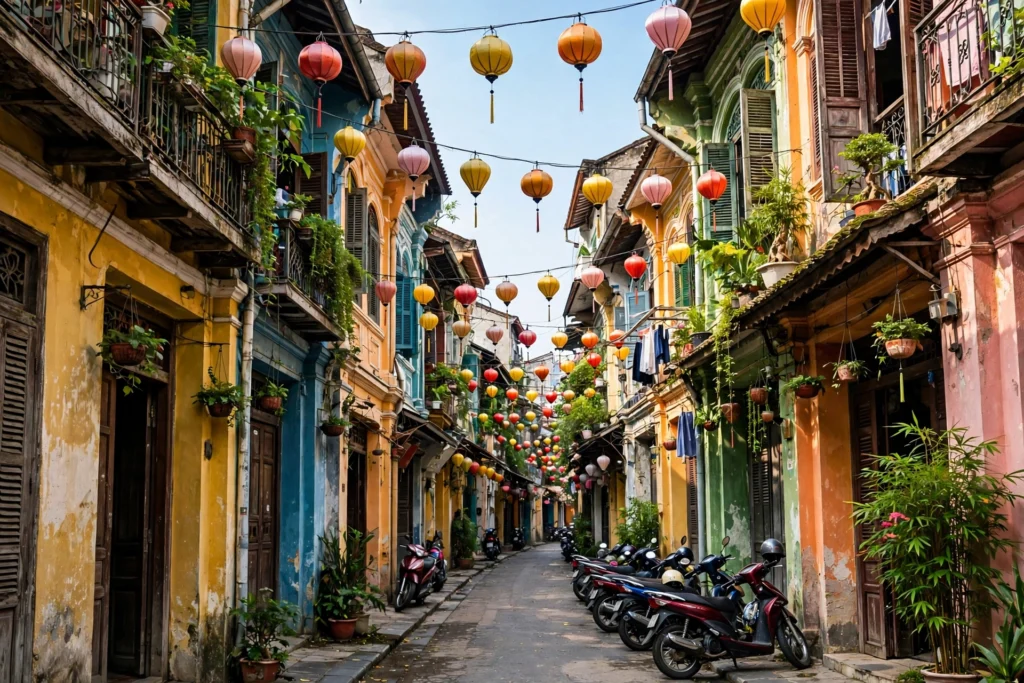
The Old Quarter is the heart of Hanoi travel, and the best way to understand it is to walk it without a list. It is not a set of sights to tick off but a dense maze of narrow streets where the experience is simply being in it: shophouse fronts, motorbikes, hanging lanterns, steam from food stalls, and shopkeepers who have worked the same street for decades. The quarter’s famous 36 guild streets were historically organised by trade, and the street names still reflect what was once sold there — Hang Bac for silver, Hang Gai for silk, Hang Ma for paper offerings, Hang Dong for copper. The trades have mostly moved on, but the names remain, and walking from one to the next is still the best orientation a first-time visitor can get.
Start at Hoan Kiem Lake and walk north into the quarter in the early morning, when the light is soft and the stalls are setting up. The streets run in a tight grid, and it is easy to get turned around, which is part of the pleasure — every wrong turn leads to another food stall, another temple doorway, another shophouse balcony draped in plants. Give yourself a full morning for this first walk, with no destination beyond the quarter itself. The most atmospheric streets for a first wander are Hang Gai for silk and souvenirs, Hang Ma for decorations and lanterns — it transforms for each festival, going all out for Tet, the Mid-Autumn Festival and Christmas — and Ta Hien, the famous Beer Street, which is the nightlife hub in the evening and a good place to watch the city relax.
Three small sights inside the quarter are worth seeking out deliberately. Bach Ma Temple is the oldest temple in the Old Quarter, a small atmospheric shrine dedicated to the white horse that legend says helped site the city walls. The Hanoi Old City Gate, Quan Chuong, is the last surviving gate of the old citadel wall and a rare piece of the city’s defences still standing. And the weekend night market on Hang Dao runs every Friday to Sunday evening, when the street closes to traffic and fills with stalls — go for the atmosphere and the street food rather than the shopping, which is largely the same souvenirs you will see everywhere else.
The Old Quarter is also where Hanoi’s famous Train Street sits, a narrow residential lane where a train passes within arm’s reach of the houses several times a day. It has become one of the city’s most photographed corners, and also one of its most managed: access is restricted at times, cafes along the track open and close with the train schedule, and visitors are asked to stay behind the marked lines. Go if you are nearby and the track is open, arrive early, buy a drink from one of the trackside cafes, and follow the instructions of the staff on the ground. Do not walk on the tracks, do not block residents’ doorways, and do not treat the lane as a theme park — people live there.
How to walk the Old Quarter without getting lost or exhausted
The quarter rewards a loop, not a route march. Walk one street north, turn onto the next, and come back down a parallel street, so you see two streets for every block you cover. Stop often: for coffee, for a bowl of noodles, for a look inside a temple courtyard. The quarter is at its best between 7am and 10am, when the food stalls are busy and the light is good, and again after 5pm, when the heat breaks and the beer corners fill up. Between 11am and 3pm in summer, the heat and the crowds make it hard work — that is the time for a museum, a long lunch, or a rest back at your hotel.
Wear shoes you can walk in for hours, carry water, and keep your bag in front of you in the busiest streets. The pavements are narrow and often blocked by parked motorbikes, so you will spend much of your walk stepping into the road — look both ways, move steadily, and never run. If you want a guided introduction, a walking tour or a street food tour on your first evening is money well spent: a good guide will show you which stalls to trust, how to order, and which streets to come back to. After that, the quarter is yours to explore on your own.
Families travel well in the Old Quarter, with one caution: the traffic. Small children need a hand at every crossing, and a baby carrier works far better than a pushchair on these pavements. If you are travelling with children, our guide to the best places to travel with a baby has practical advice on pacing, gear and food that applies well beyond Hanoi. The quarter’s food, colours and street life are genuinely absorbing for children, and the lakeside is a calm place to decompress when the noise gets too much.
Hoan Kiem Lake and Hanoi’s Great Landmarks

Hoan Kiem Lake is the emotional centre of Hanoi, and the best place to begin any visit. Its name means Lake of the Returned Sword, after the legend of a magical sword returned to a golden turtle in its waters, and the lake still carries that mythic weight: at dawn the paths fill with tai chi, badminton and wedding photography, and in the evening the whole city seems to come out to walk its edge. The Turtle Tower stands on a small island in the middle of the water, and the red-painted Huc Bridge leads across to Ngoc Son Temple, the Temple of the Jade Mountain, on its own small island at the lake’s northern end. It is Hanoi’s most visited shrine, and it repays a visit: cross the bridge slowly, look down at the water, and remember to dress modestly, with shoulders and knees covered. Entry is about 30,000 VND as a planning figure, roughly a dollar and a little more, and half an hour is enough.
The lake is also the city’s compass. North of it lies the Old Quarter, south and east lies the French Quarter with its wide tree-lined boulevards and the Opera House, and west lies Ba Dinh, the political district, home to the Ho Chi Minh Mausoleum complex, the Presidential Palace grounds, the One Pillar Pagoda and the UNESCO-listed Imperial Citadel of Thang Long. Most tourist attractions sit within a 3–4 km radius of the lake, which makes the city surprisingly walkable if you are based in the right neighbourhood — and a good reason to choose a hotel near the water rather than on the outskirts.
Beyond the lake, four landmarks anchor any first visit. The Temple of Literature, built in 1070, is home to Vietnam’s first university, with five elegant courtyards, lotus ponds and 82 remaining stone stelae listing the names of exceptional scholars. Allow one to one and a half hours, and go early, before the tour groups arrive — the courtyards are at their most peaceful in the first hour after opening. The Ho Chi Minh Mausoleum in Ba Dinh Square is the most formal sight in the city: a vast granite structure where visitors file past in silence, with strict rules on dress, bags and photography. Check the opening days before you go, because the mausoleum closes for maintenance for part of each year, and queues form early. The One Pillar Pagoda, a small wooden temple on a single stone pillar beside the mausoleum, is a quick stop that pairs naturally with it. And the Imperial Citadel of Thang Long, a UNESCO World Heritage Site, holds the layered history of the city — royal palaces, French colonial buildings and wartime bunkers on one site — and deserves at least an hour of unhurried walking.
West Lake, Ho Tay, is the city’s other great body of water and a different mood entirely: larger, calmer, and ringed by cafes, temples and expatriate life. The Tran Quoc Pagoda on its eastern shore is the oldest Buddhist temple in Hanoi, and the lakeside road is one of the best places in the city for a slow evening walk or a cycle. If Hoan Kiem Lake is the city’s living room, West Lake is its garden — go there when you want space, sky and a slower pace. The French Quarter, meanwhile, is the place for architecture: the Opera House, the grand hotels, the embassies and the wide boulevards that feel a world away from the Old Quarter’s narrow lanes, all within a short walk of the lake.
Hanoi’s great landmarks at a glance
| Landmark | What it is | Time needed | Planning cost |
|---|---|---|---|
| Hoan Kiem Lake | The city’s central lake, with the Turtle Tower and lakeside paths | 1 hour, or an evening stroll | Free |
| Ngoc Son Temple | Temple of the Jade Mountain, reached by the red Huc Bridge | 30–45 minutes | About 30,000 VND |
| Temple of Literature | Built 1070, Vietnam’s first university, five courtyards and 82 stelae | 1–1.5 hours | About 45,000 VND |
| Ho Chi Minh Mausoleum | Granite mausoleum in Ba Dinh Square, formal dress and conduct rules | 1–2 hours including the queue | Free; check opening days |
| One Pillar Pagoda | Small wooden pagoda on a single stone pillar, beside the mausoleum | 20 minutes | Free |
| Imperial Citadel of Thang Long | UNESCO-listed citadel, palaces, colonial buildings and bunkers | 1–1.5 hours | About 30,000–70,000 VND |
| Tran Quoc Pagoda | Oldest Buddhist temple in Hanoi, on the shore of West Lake | 30–45 minutes | Free, donations welcome |
| Hanoi Opera House | French colonial opera house in the French Quarter | 30 minutes outside; tours inside when available | Free outside |
| St Joseph’s Cathedral | Neo-Gothic cathedral on Nha Chung Street, near the lake | 20–30 minutes | Free |
| Thang Long Water Puppet Theatre | Traditional water puppet shows beside Hoan Kiem Lake | 1 hour per show | About 100,000–200,000 VND |
Costs are planning figures, not quotes, and entry fees change. The table’s purpose is to help you choose: if you have one day, do the lake, the temple and the Temple of Literature. If you have two, add the mausoleum, the citadel and West Lake. Everything else is a bonus, and Hanoi has plenty of bonuses.
The water puppet show, and whether it is worth an evening
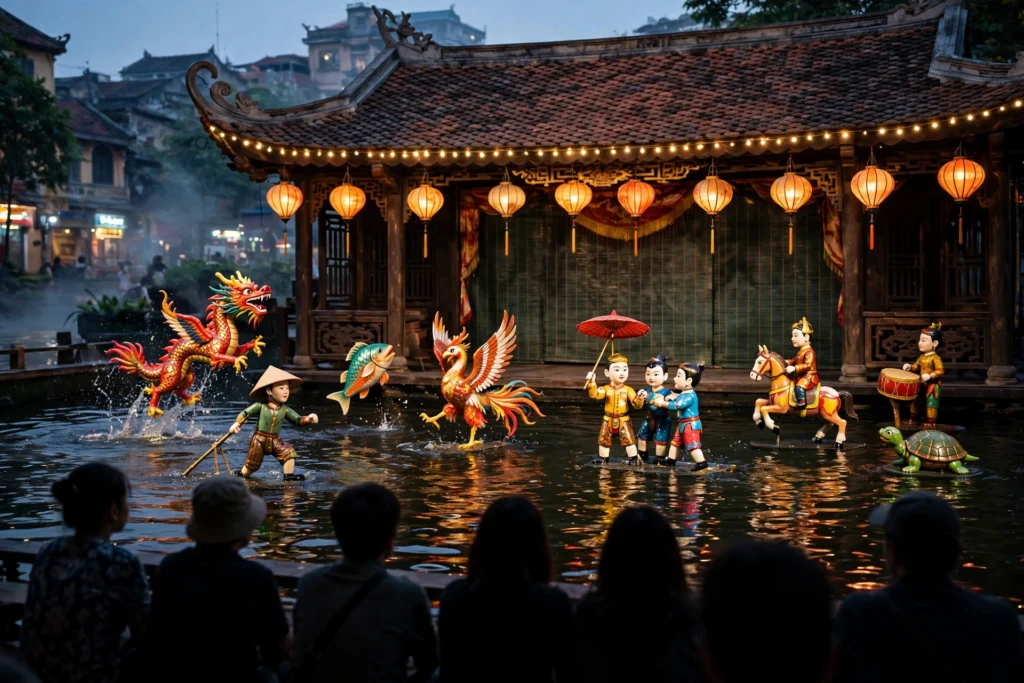
The Thang Long Water Puppet Theatre beside Hoan Kiem Lake is the original and best-known water puppet venue in Vietnam, with several short shows a day. Puppeteers stand waist-deep in water behind a screen and move lacquered wooden puppets across the surface to live traditional music — dragons, farmers, fishermen and buffaloes playing out folk tales and village life. Tickets run roughly 100,000 to 200,000 VND depending on the seat, as a planning figure, and the show lasts about an hour. It is one of the most distinctive performances in Southeast Asia, and it is genuinely worth an evening even if puppet theatre sounds like a hard sell. Book a day ahead in high season, choose a seat near the centre, and arrive early — the theatre fills up, and the best seats go first. Children love it, and it is one of the few evening entertainments in the Old Quarter that works for every age.
Hanoi Street Food: What to Eat and Where to Find It
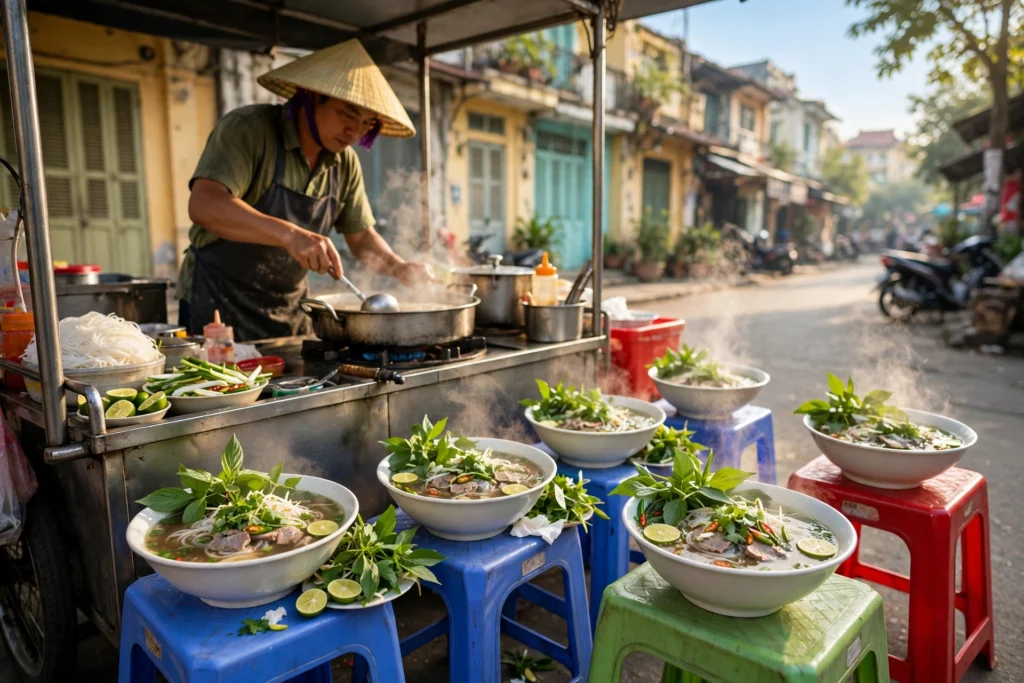
Hanoi has one of the most distinct food cultures in Vietnam, and eating well here is less about restaurants than about stalls, stools and timing. Northern cuisine tends to be less sweet and less spiced than its southern counterpart, placing greater emphasis on clean broths, fresh herbs and subtle balance. The best meals in the city often cost less than a few dollars, served on a plastic stool at a stall that has cooked the same dish for decades. Most of the best meals in Hanoi cost less than US$3 as a planning figure, and the city rewards travellers who eat early, eat where the locals eat, and order the one thing a stall does best rather than the dish with the longest menu.
Pho is the dish to start with, and Hanoi is its home. Hanoi-style beef noodle soup — pho bo — is served in a clear, star-anise-scented broth with flat rice noodles, sliced beef and a plate of fresh herbs, lime and chilli on the side. The broth is the whole point: it should be clear, fragrant and deeply savoury, simmered since the small hours. Eat it for breakfast, the way locals do — by 6.30am the plastic stools are already out along Bat Dan and Hang Ga, cauldrons of beef broth have been simmering since the small hours, and office workers lean over bowls while motorbikes slide past their elbows. Add herbs and lime to taste, eat the noodles first while they are hot, and drink the broth at the end. A good bowl of pho is the single best breakfast in Southeast Asia, and it costs less than a coffee back home.
Beyond pho, five dishes define Hanoi eating. Bun cha is grilled pork patties and sliced pork in a sweet-sour dipping broth, served with rice noodles, herbs and garlic — a lunch dish, best eaten at midday when the grills are going. Cha ca is turmeric fish fried at the table with dill and spring onions, served with noodles and peanuts, and it is the dish most visitors remember longest. Banh mi, the Vietnamese baguette sandwich, is a perfect walking lunch: crisp bread, pate, cold cuts or grilled meat, pickled vegetables and herbs. Bun bo nam bo is a dry noodle bowl with stir-fried beef, peanuts, herbs and a light fish-sauce dressing — no broth, all freshness. And banh cuon, steamed rice rolls filled with minced pork and mushrooms, is the quiet classic: delicate, light, and best eaten in the morning from a stall that makes the sheets fresh in front of you.
How to eat street food safely and well
The rules are simple and they work. Eat where the food is cooked in front of you, where the turnover is fast, and where the customers are local — a stall with a queue of Vietnamese office workers is a better recommendation than any guidebook. Choose stalls that cook one dish, or a small handful of dishes, rather than a stall with a twenty-item menu. Drink bottled water, and skip ice in the smallest stalls unless you can see it comes from a sealed bag or a reputable supplier — larger restaurants and cafes are generally fine. Wash your hands before eating, carry hand sanitiser, and eat the food while it is hot. If you have a sensitive stomach, start gently: a bowl of pho and a banh mi on day one, then branch out as your stomach settles. Most travellers eat street food for days without any trouble at all, and the cautious approach costs nothing.
Money is part of the etiquette. Carry small notes, pay in cash, and do not expect change for a large note at a tiny stall. Prices are usually written on a board or a menu — if there is no price, ask before you order, politely and with a smile. Tipping is not expected at street stalls; rounding up the bill is appreciated but never required. Learn three phrases — hello, thank you, and how much — and use them. Vietnamese is a tonal language and your pronunciation will be imperfect, but the effort is always welcome, and it changes how stallholders treat you.
A street food tour is worth it on night one
For first-time visitors, a guided street food tour on the first evening is one of the best investments in Hanoi travel. A good guide takes you to stalls you would never find on your own, orders for you, explains what you are eating, and shows you how to cross the road, sit on a stool and eat like a local. It also answers the question every first-timer asks — is this safe to eat — with the confidence of someone who eats there every day. Book a small-group tour rather than a large one, go hungry, and tell the guide about allergies or dietary needs in advance. Vegetarians can eat well in Hanoi, but it takes more planning: look for stalls that cook vegetarian dishes specifically, learn the phrase for no meat, and lean on the city’s Buddhist vegetarian restaurants, which are more common than most visitors expect. After the tour, you will know which streets to come back to, which dishes are yours, and how to order them — and the rest of the trip’s eating takes care of itself.
Egg Coffee and Hanoi’s Cafe Culture
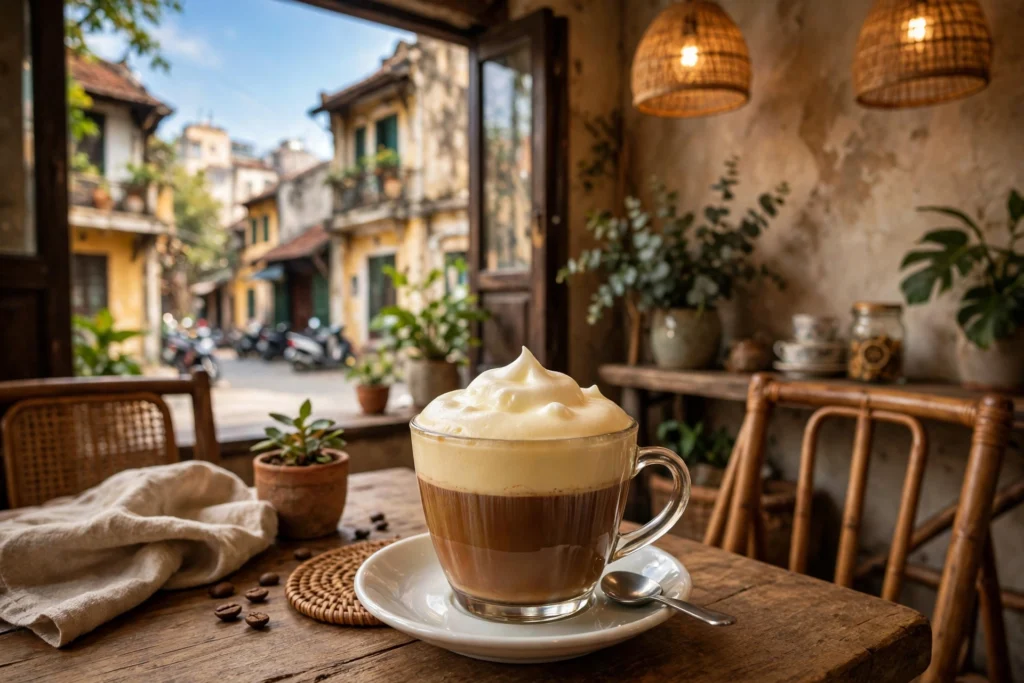
Hanoi takes its coffee seriously, and the city’s signature drink is egg coffee — ca phe trung — strong coffee under a thick, sweet whipped egg-yolk cream that tastes more like dessert than a drink. It was invented in the 1940s, when fresh milk was scarce and a bartender began whisking egg yolk with sugar and condensed milk as a substitute, and it has been a Hanoi institution ever since. The classic version is served hot, in a small cup set inside a bowl of warm water to keep it warm, and you eat it with a spoon as much as you drink it: the cream first, then the coffee beneath, stirred together at the end. It is rich, sweet and strong, and one cup is enough for most people. The original cafe that invented it still serves it in the Old Quarter, and the queue outside on a weekend morning tells you everything about how the city feels about its own invention.
Egg coffee is only the beginning of Hanoi’s cafe culture. Vietnam is one of the world’s great coffee countries, and Hanoi drinks it everywhere: on plastic stools at dawn, on balconies above the Old Quarter, in garden cafes around West Lake, and in the long, slow afternoons that the city does so well. Ca phe sua da — iced coffee with condensed milk — is the everyday drink, dark, sweet and strong, poured over ice in a tall glass. Ca phe den is the black version, unsweetened and unapologetic. Ca phe cot dua, coconut coffee, blends coffee with coconut milk and crushed ice into something closer to a milkshake, and it is the drink most visitors come back for a second time. And in the summer, lotus tea and iced jasmine tea are the cool alternatives, served in tall glasses with the same unhurried ceremony.
The cafes themselves are part of the experience. The Old Quarter’s cafes are small, layered and vertical: a narrow doorway, a staircase, a balcony with two chairs and a view over the street below. The French Quarter’s cafes are grander, with high ceilings and colonial architecture. West Lake’s cafes are gardens, with lake views and slow mornings. And the train-street cafes, the lakeside cafes and the book cafes each have their own following. The point of a Hanoi cafe is not the coffee alone but the sitting: an hour with a book, a view and a drink is a legitimate use of a morning here, and the city is built for it. Plan for at least one long cafe stop a day — it is the cheapest rest in the city and the best way to watch Hanoi go by.
Where to drink, and what to order
Start with egg coffee in the Old Quarter, hot, at the cafe that invented it or at any of the long-established cafes nearby — the recipe has spread across the city, and the quality is high almost everywhere that specialises in it. Then try iced coffee with condensed milk at a street stall in the morning, when the city is drinking it too. Coconut coffee is the afternoon drink, best on a hot day. If you do not drink coffee, order iced lotus tea or fresh sugarcane juice, both widely available and both excellent. Prices are modest: a street coffee costs a dollar or two as a planning figure, a cafe coffee a little more, and egg coffee in a well-known cafe a little more again. Pay in cash at small stalls, and check whether a cafe charges extra for a balcony seat — some do, and it is worth it for the view.
A note for travellers who are sensitive to caffeine: Vietnamese coffee is strong, and a large iced coffee late in the day will keep you awake. Drink your last coffee by mid-afternoon, switch to tea in the evening, and save the egg coffee for the morning. The city’s cafes stay open late, but the best cafe hours are the morning and the late afternoon, when the light is good and the streets are at their liveliest.
Hanoi’s History and Museums: Temple of Literature, Hoa Lo and the Citadel
Hanoi’s history stretches back over 1,000 years, and the city’s museums and historic sites tell that story in layers — imperial, colonial, wartime and modern — often on the same site. A day spent on history is a day well spent in Hanoi, and it changes how you see everything else: the Old Quarter’s street names, the French Quarter’s boulevards and the lakes all make more sense once you know what happened here.
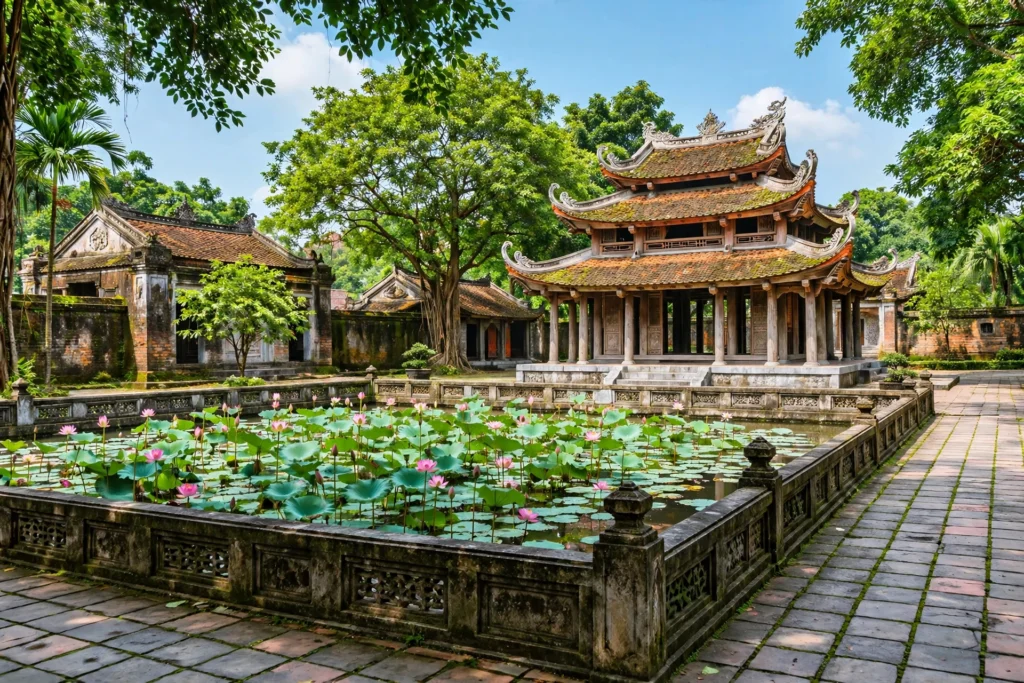
The Temple of Literature is the place to start. Built in 1070, it is home to Vietnam’s first university, and its five courtyards, lotus ponds and 82 remaining stone stelae — each one listing the names of exceptional scholars — make it the most beautiful historic site in the city. Walk the courtyards in order, from the great gate to the sanctuary at the back, and give yourself time to sit by the lotus pond. The temple is also a working symbol: graduating students come here in their gowns for photographs, and the stelae are a reminder that Vietnam has valued learning for nearly a thousand years. Go early in the morning, dress modestly, and allow one to one and a half hours. Entry is about 45,000 VND as a planning figure.
Hoa Lo Prison, nicknamed the “Hanoi Hilton”, is one of the city’s most affecting museums. Built by the French for Vietnamese revolutionaries, it was later used by North Vietnam for captured American pilots, and the museum tells both stories without flinching. The exhibits are frank, the atmosphere is sombre, and the audio guide is worth the small extra cost — it gives context that the labels alone cannot. Allow one to two hours, and go in the morning, when it is quieter. It is not an easy visit, but it is an important one, and it is the museum most visitors talk about afterwards.
The Imperial Citadel of Thang Long is the deepest layer of the city’s history. A UNESCO World Heritage Site, it holds the remains of royal palaces, French colonial buildings and wartime bunkers on a single site, and the excavations in the central courtyard show foundations going back centuries. It is less polished than the Temple of Literature and all the more interesting for it: you can see the archaeology in progress, walk through the underground command bunker, and stand on the flag tower for a view over the city. Allow at least an hour, and pair it with the Ho Chi Minh Mausoleum and the One Pillar Pagoda, which sit nearby in the Ba Dinh district.
The museums worth your time
Beyond the big three, Hanoi’s museums reward a selective approach. The Vietnam Museum of Ethnology, a short ride from the centre, is the best museum in the city for many visitors: indoor galleries on Vietnam’s 54 ethnic groups and an outdoor park of full-size traditional houses, including stilt houses you can walk through. Allow two to three hours, and go on a weekday if you can. The Vietnamese Women’s Museum, near Hoan Kiem Lake, tells the story of Vietnamese women through history — family, work, war and art — and it is one of the most thoughtfully curated museums in Southeast Asia. The National Museum of Vietnamese History, in the French Quarter, covers the country from prehistory to the modern era, and its building is worth the visit alone. And the Fine Arts Museum, in a colonial building near the Temple of Literature, holds lacquerware, silk painting and sculpture that show a side of Vietnamese art most visitors never see.
Choose two museums at most for a single day, and do them in the heat of the afternoon, when the air conditioning is a blessing and the streets are at their hottest. Museums in Hanoi generally open in the morning, close for a lunch break, and reopen in the afternoon — check opening hours before you go, because the lunch closure catches many visitors out. Photography rules vary: some galleries allow it, some do not, and flash is almost always forbidden. Ask at the entrance, follow the signs, and be respectful in the memorial spaces — these are places of remembrance as much as museums, and quiet behaviour is expected.
History also lives in the streets themselves. The Long Bien Bridge, built by the French at the start of the 20th century, still carries the railway across the Red River, and a walk across it at sunset — on the pedestrian path, carefully — gives you a view of the river, the city and the countryside beyond. The Old Quarter’s tube houses, long and narrow because houses were once taxed on their street frontage, explain why the streets look the way they do. And the French Quarter’s villas, with their shutters, balconies and courtyards, are a reminder that Hanoi has been many cities in its thousand years, and that each one left something behind.
Where to Stay in Hanoi: Old Quarter, French Quarter and West Lake
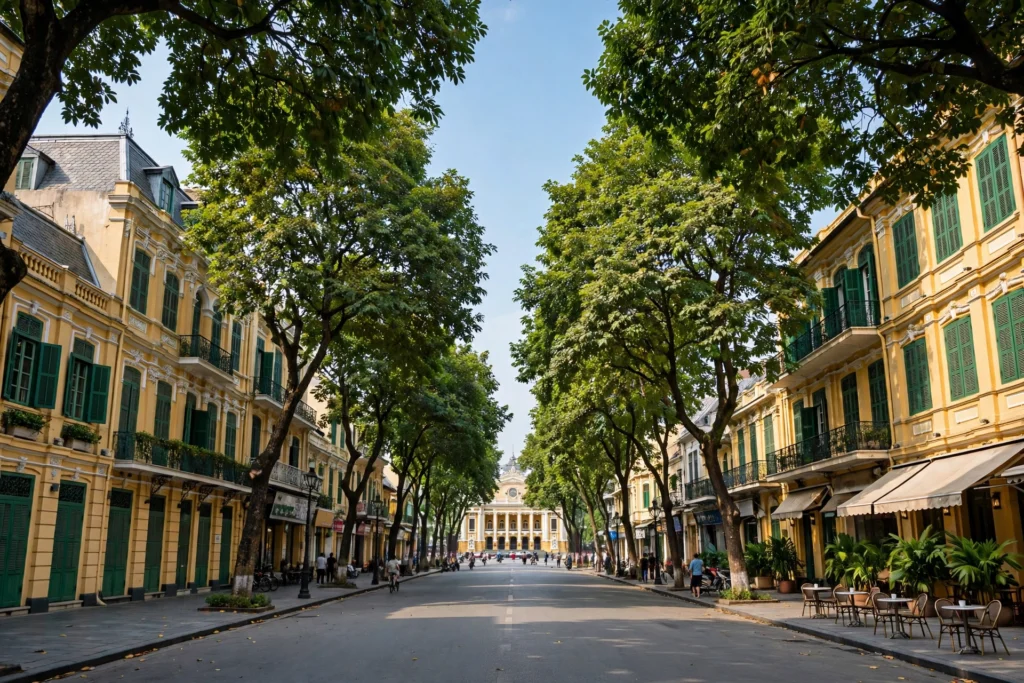
Where you stay in Hanoi matters more than in most cities, because the neighbourhood you choose decides how much of the city you walk and how much you ride. The three main choices — the Old Quarter, the French Quarter and West Lake — suit different trips, and the right answer depends on what you want from your days.
The Old Quarter is the best base for first-time visitors. It has the highest concentration of guesthouses, street food and historic sites, the most atmosphere, and the shortest walks to everything that matters. Stay on a quieter side street rather than on Ta Hien or Hang Dao if you want to sleep — the quarter is noisy from dawn to midnight, and a room facing a courtyard or a back lane is worth more than a room with a view of a busy street. The quarter’s accommodation ranges from hostels with dormitory beds to comfortable boutique hotels in converted shophouses, and the standard is generally high for the price. Book a place with an elevator if stairs are a concern, because many Old Quarter buildings are narrow and tall, and confirm that the room has a window — some of the cheapest rooms are internal, with no natural light at all.
The French Quarter is the best base for travellers who want comfort and quiet. Its wide tree-lined boulevards, grand hotels and embassies make it calmer after dark, and the Opera House area has the city’s best high-end hotels. It is a short walk from Hoan Kiem Lake, so you lose little in convenience, and you gain space, quiet and a more residential feel. The French Quarter suits couples, business travellers and anyone who wants a hotel with a proper lobby, a good restaurant and a room you can actually relax in. The trade-off is atmosphere: the quarter is beautiful, but it is not the Hanoi of the postcards, and you will walk into the Old Quarter for most of your meals and sightseeing.
West Lake, Tay Ho, is the best base for a longer stay. The pace is slower, the cafes sit on the lakeshore, and many expatriates live in the north-west of the city around the lake. It suits travellers staying a week or more, families who want space, and anyone who wants to run, cycle or walk by the water every morning. The trade-off is distance: every trip into the Old Quarter is a ride, and the lakeside restaurants, while good, do not match the Old Quarter’s street food. If you are staying three days, choose the Old Quarter. If you are staying ten, West Lake starts to make sense.
What to look for in a Hanoi hotel
Whatever neighbourhood you choose, four things matter. First, location within the neighbourhood: a hotel two streets from the lake is worth more than a hotel ten streets away, and a hotel on a pedestrian-friendly street is worth more than one on a main road. Second, soundproofing: Hanoi is loud, and a room with double glazing and a quiet side is worth paying extra for. Third, breakfast: a good hotel breakfast, with pho and fresh fruit, saves you a morning of searching, and it is often included in the rate. Fourth, staff who can help: a hotel that can book a Ha Long Bay cruise, arrange an airport transfer and answer questions about the e-visa is worth more than a hotel with a fancier lobby. Read recent reviews, not old ones, and check whether the hotel charges for an airport transfer — many do, and the price varies widely.
Book early for October and November, the best months, and for Tet, the Lunar New Year festival, when the city fills up and many businesses close. Prices rise in high season and fall in the summer heat, so a room that costs one price in November may cost noticeably less in July. All prices in this guide are planning figures, and hotel rates move with season, demand and the day of the week — check current rates before booking, and book directly with the hotel where you can, because the hotel can usually match the price and will treat a direct booking better.
Getting Around Hanoi: Walking, Grab, Buses and Motorbikes
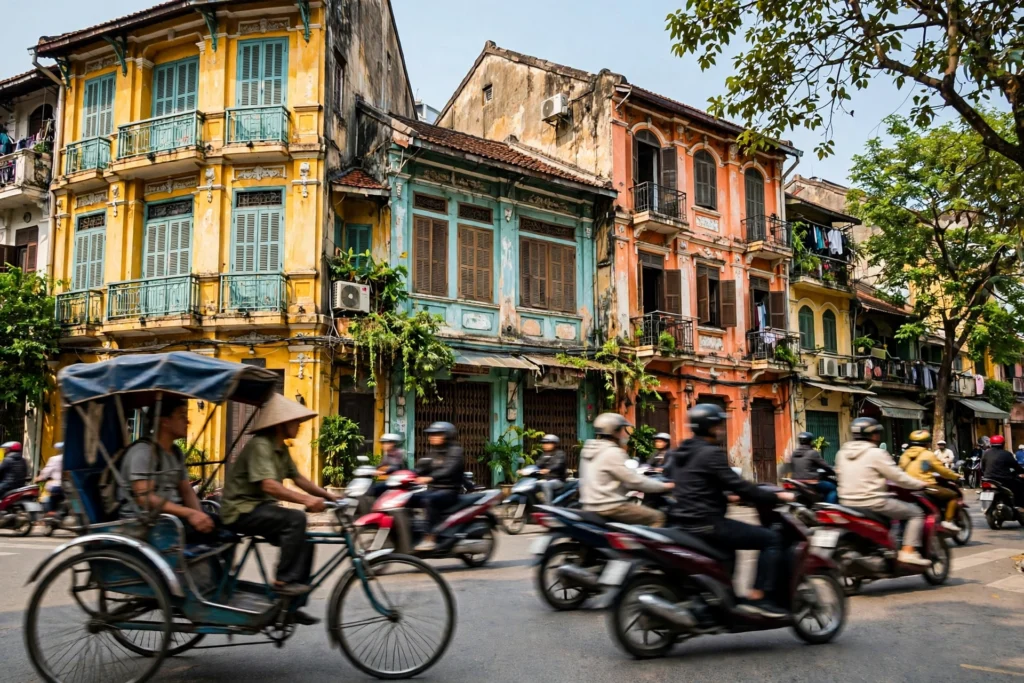
Hanoi is a walking city in its centre and a riding city everywhere else, and the trick is knowing which is which. The Old Quarter, Hoan Kiem Lake and the French Quarter are best on foot — the sights cluster within a few kilometres, the streets are the attraction, and a car would only slow you down. The museums in Ba Dinh, the Temple of Literature, West Lake and the airport are rides. Plan your days around that split, and you will spend your time seeing the city rather than sitting in its traffic.
Walking is the default. The core of the city can be crossed on foot in about 40 minutes, and the lakeside paths are the best walking in the city — flat, shaded and closed to traffic in places on weekend evenings, when the streets around Hoan Kiem Lake become pedestrian-only. Walk on the pavement where it exists, step into the road where it does not, and cross the road slowly and steadily, without stopping, running or changing direction suddenly. Motorbike riders expect you to keep moving at a steady pace, and they will flow around you. The rule sounds alarming the first time you hear it, and it works from the first time you try it. Look both ways, pick a gap, walk steadily, and do not hesitate in the middle of the road.
Grab is the easiest way to get a ride. The ride-hailing app works across Hanoi for both cars and motorbikes, with the price shown before you book, and it removes the two hardest parts of a Hanoi taxi: explaining where you are going and agreeing a price. Download the app and set up payment before you arrive, keep mobile data or a local SIM working, and use Grab for the airport, for West Lake, for the museums and for any ride after dark. A car costs more than a motorbike taxi and is slower in traffic; a motorbike taxi is faster and cheaper, and the driver provides a helmet. Hold on, keep your bag in front of you, and agree nothing — the price is in the app.
Buses, cyclos, trains and renting a motorbike
Public buses are cheap and cover the whole city, including the airport, but they are slow, crowded and hard to navigate without Vietnamese. They are worth trying for a single straightforward journey — the airport bus, for example, or a bus to the Museum of Ethnology — but they are not the best way to explore the city day to day. A cyclo, the bicycle rickshaw, is a different thing entirely: a slow, open ride through the Old Quarter, best booked through your hotel for a fixed price and a fixed time. Agree the price and the duration before you get in, and treat it as a sightseeing experience rather than transport — it is the slowest way to get anywhere and the most charming way to see the streets.
Renting a motorbike is the option most first-time visitors should skip. The traffic is dense, the rules are unwritten, and most foreign visitors do not hold a valid Vietnamese licence — motorbikes are not allowed on the main expressways, and riders take longer national routes through heavier traffic. If you do ride, wear a helmet, carry an international driving permit with the correct category, and never ride after drinking. For most travellers, a Grab motorbike with a local driver is a better idea than a rented bike: you get the speed and the wind without the risk or the paperwork.
Getting to and from the airport is straightforward. Noi Bai International Airport sits north of the city, and the ride into the Old Quarter takes roughly 45 minutes to an hour depending on traffic. A Grab car or a hotel airport transfer is the simplest option, with the price fixed in advance. The airport bus is cheaper and slower, and it drops you at a central stop rather than at your hotel. Whatever you choose, allow extra time for the return journey — Hanoi’s traffic is unpredictable, and the airport is not the place to discover that your ride is running late. Our travel itinerary template has a useful pre-departure checklist if you are building your own arrival and departure plan.
Ha Long Bay From Hanoi: Day Trip or Overnight Cruise

Ha Long Bay is the single best day trip from Hanoi, and the reason most visitors add a day to their trip. A UNESCO World Heritage Site, the bay holds around 1,600 limestone islands and islets rising from the Gulf of Tonkin, and since 2023 it has been part of the Ha Long Bay – Cat Ba Archipelago World Heritage Site. The limestone karsts, the caves, the floating villages and the sheer scale of the place make it one of the most photographed landscapes in Asia — and one of the few that looks better in person than in the photographs.
Getting there is straightforward. Ha Long Bay sits about 165–170 km east of Hanoi, and the Hanoi–Hai Phong–Ha Long expressway has cut the drive to about 2.5 to 3 hours each way. A typical day trip starts with a hotel pickup between 7.00am and 8.00am, arrives at the harbour by late morning, and gives you about five to six hours on the water before the return journey brings you back to Hanoi between 8.30pm and 9.30pm. It is a long day — twelve to thirteen hours from door to door — but most of the time is spent on the water, not on the road, and the cruise itself is the point: limestone islands sliding past, caves to explore, kayaking or a bamboo boat at Luon Cave, and the viewpoint from Ti Top Island.
The question is whether to do a day trip or an overnight cruise, and the honest answer depends on how much time you have and how much you like boats. A day trip is cheaper, simpler and fits into a tight itinerary: you see the main highlights, you sleep in your own hotel, and you lose only one day. An overnight cruise is slower, quieter and more complete: you see the bay at sunset and at sunrise, when the day boats have gone and the water is empty, and you have time for kayaking, swimming and a morning tai chi session on deck. If you have five days in Hanoi, take the overnight cruise. If you have three, take the day trip and do not feel you have missed out — the day cruise covers the same famous sights, and the bay is spectacular even in six hours.
Day trip or overnight cruise: the trade-off
| Factor | Day trip | 2-day, 1-night cruise | 3-day, 2-night cruise |
|---|---|---|---|
| Time on the water | About 5–6 hours | About 24 hours | About 48 hours |
| Total commitment | 12–13 hours, back in Hanoi the same night | 2 days, 1 night on board | 3 days, 2 nights on board |
| Best for | Tight itineraries, first-timers, budget travellers | Most travellers — the best balance | Slow travellers, photographers, couples |
| Highlights | Sung Sot Cave, Luon Cave, Ti Top Island, lunch on board | Sunset and sunrise on the bay, kayaking, swimming, quieter anchorages | Cat Ba Island, deeper caves, remote lagoons |
| Cost (planning figure) | Lowest of the three | Mid-range | Highest of the three |
| Downside | A long day, busy at popular stops, no sunset on the bay | Costs more, one night on a boat | Needs three days, diminishing returns for some |
Book through your hotel or a reputable operator, and check what is included before you pay: transfers, lunch, cave entry, kayaking and the guide are usually included, but drinks, tips and some activities may not be. Boats follow official sightseeing routes, and from June to October storms can suspend sailings at short notice — if that happens, a good operator will re-plan the day with you rather than leaving you stranded. Check the weather the day before, pack a light jacket for the evening on deck, and bring motion-sickness tablets if you are prone to seasickness. The bay is usually calm, but the open water can surprise you.
One practical note: the seaplane flights over the bay that some older guides mention ended on 1 April 2026, so do not plan a trip around them. The road and the boat are the ways to get there now, and they are both good. And if you are choosing between Ha Long Bay and Ninh Binh with only one free day, choose Ha Long Bay for the spectacle and Ninh Binh for the quiet — the next section covers Ninh Binh in full, so you can decide with both in front of you.
Best Day Trips From Hanoi: Ninh Binh, Sapa and the Perfume Pagoda
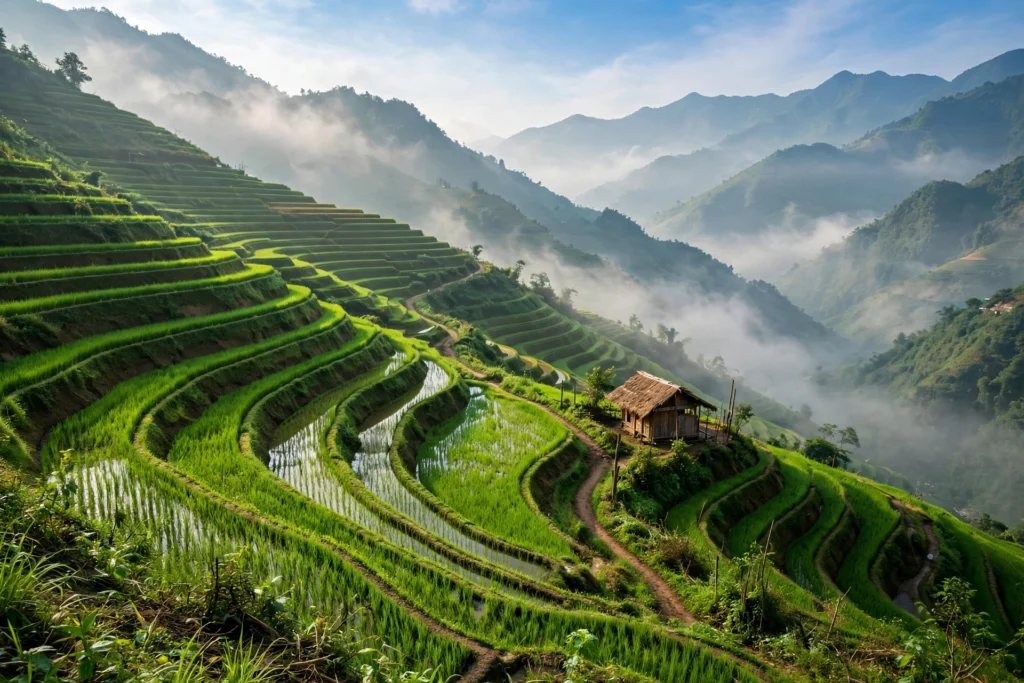
Hanoi is one of the best bases in Asia for day trips, because two of Vietnam’s great landscapes — the limestone islands of Ha Long Bay and the flooded karst valleys of Ninh Binh — are two to three hours away, and the mountains of Sapa are an overnight train ride. The city is compact, the expressways are good, and a single extra day buys you a completely different landscape. If you have four or five days, take at least one day trip. If you have a week, take two.
Ninh Binh is the quiet alternative to Ha Long Bay, and for many travellers it is the better day. It sits about 95 km south of Hanoi in the Red River Delta, roughly 1.5 to 2 hours by road, and it is celebrated for vertical limestone karsts rising out of emerald rice paddies and meandering riverways — the same geology as Ha Long Bay, but on land and on rivers instead of on the sea. The classic day is a sampan boat ride through Trang An or Tam Coc, where rowers paddle you through caves and between karst cliffs, followed by the climb up the Hang Mua dragon stairway for the view over the river valley, and a visit to Hoa Lu, the ancient capital. Trang An is the calmer, more scenic boat ride; Tam Coc is the busier, more famous one. Either is a full day, and either is worth it. Ninh Binh is also easier than Ha Long Bay in bad weather — a river sampan runs in conditions that would keep a cruise boat in harbour — and it is the better choice if you prefer walking, climbing and villages to sitting on a boat.
Sapa is the mountain trip, and it needs more than a day. The rice terraces, the misty valleys and the hill-tribe villages around Sapa are among the most beautiful landscapes in Vietnam, but the town sits a long way north of Hanoi, and the honest way to do it is an overnight train or a long bus ride, two nights in Sapa, and a return the same way. A single day in Sapa from Hanoi is possible on paper and miserable in practice — you would spend most of it in transit. If you have a week, add Sapa. If you have five days, choose between Sapa and Ha Long Bay, and choose Ha Long Bay unless mountains are the reason you came. The best months for Sapa are September and October, when the rice terraces are golden before harvest, and March and April, when the weather is clear and the flowers are out. Winter is cold and misty, and summer is wet — check the season before you commit.
Three day trips compared
| Day trip | Distance from Hanoi | One-way travel | What you get | Best for |
|---|---|---|---|---|
| Ha Long Bay | About 165 km east | 2.5–3 hours by expressway | Limestone islands, caves, kayaking, Ti Top viewpoint | First-timers, spectacle, photography |
| Ninh Binh | About 95 km south | 1.5–2 hours by road or train | Sampan rides through Trang An or Tam Coc, Hang Mua climb, Hoa Lu ancient capital | A quieter day, walking and climbing, bad weather |
| Perfume Pagoda | About 60 km south-west | 1.5–2 hours by road and boat | River boat to a mountain pagoda complex, caves, pilgrimage atmosphere | Culture, temples, a half-day escape |
| Sapa | Far north, overnight | Overnight train or long bus | Rice terraces, misty valleys, hill-tribe villages | A week-long trip, mountain lovers |
The Perfume Pagoda is the third option, and the one most visitors miss. About 60 km south-west of Hanoi, it is a complex of temples and shrines in a mountain setting, reached by a boat ride along a river lined with rice paddies, then a walk or a cable car up to the main pagoda in a cave. It is a pilgrimage site as much as a tourist attraction, and it is at its busiest during the festival season after Tet, when thousands of pilgrims make the journey. Go on a weekday outside festival season, go early, and treat it as a cultural visit rather than a sightseeing checklist — the boat ride is the best part, and the mountain air is a welcome change from the city.
Mai Chau is the fourth option, and the gentlest: a peaceful green valley of rice paddies and stilt-house homestays, closer and easier than Sapa, with cycling, village walks and home-cooked food. It suits travellers who want the mountain-valley experience without the long journey or the crowds, and it works as an overnight trip with a homestay. If Sapa feels like too much and Ninh Binh feels like too little, Mai Chau is the middle path.
The Best Time to Visit Hanoi: A Month-by-Month Guide
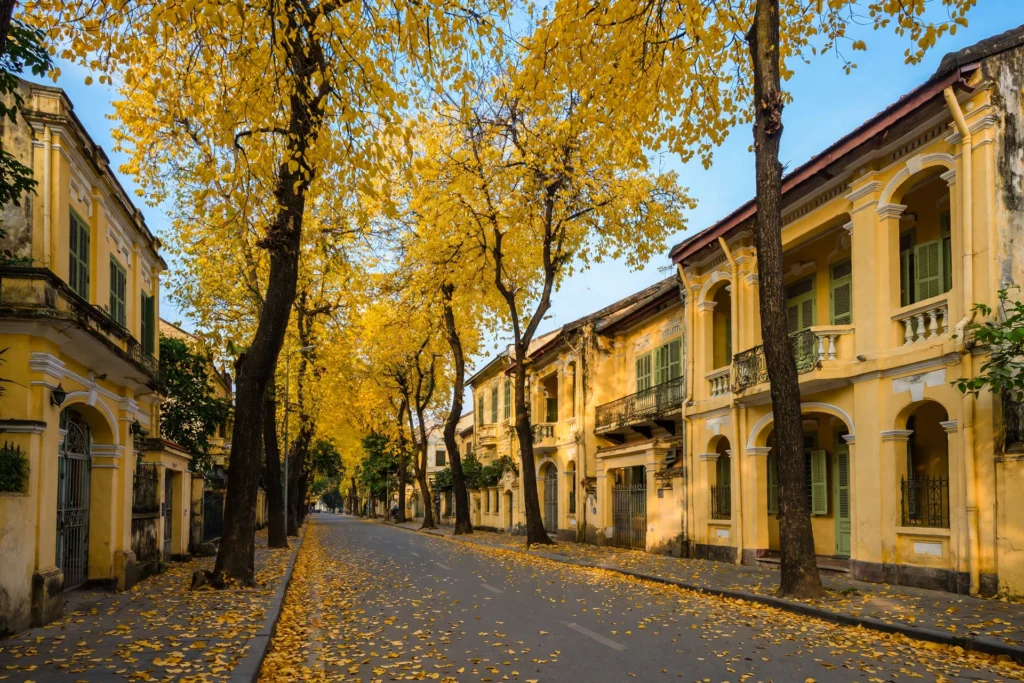
Hanoi has four distinct seasons, which surprises people who pack only for the tropics — and the month you choose changes the trip more than almost any other decision. The city is a year-round destination, but each season creates a noticeably different mood, from misty winter mornings and humid summer days to the golden, breezy charm of autumn. The short answer is simple: the best time to visit Hanoi is autumn, especially October and November, when the heat has softened, rainfall is lower than in summer, and the city’s lakes, old streets, cafes and markets are more pleasant to enjoy slowly.
October and November are the reward months. In October the average daily high is about 29.6°C and the low about 22.4°C, with around 126 mm of rain across the month. In November the high falls to about 26.3°C and the low to about 19.2°C, with only about 48 mm of rain — the best balance of comfortable temperatures, relatively dry weather and outdoor-friendly conditions in the whole year. The evenings are cool enough to sit outside, the air is clearer, and the city is at its most walkable. Book early: most visitors target these months, and the best hotels and the best Ha Long Bay boats sell out first. Late October and early November are often more comfortable than early October, when the heat can still linger.
Spring, from February to April, is the second-best season, and the prettiest in a gentle way. March and April bring clearer skies and mild temperatures, with average highs in the low to mid-twenties, and the city fills with flowers and the energy of Tet, the Lunar New Year festival, which falls in late January or February. Spring can be humid or drizzly — February and March are the dampest months for drizzle, with many grey days and light rain that rarely becomes a washout — so it suits travellers who do not mind a softer, more atmospheric version of the city. If you are travelling for Tet itself, plan carefully: the festival is the biggest holiday of the Vietnamese year, many businesses close, transport fills up, and the city empties as people travel home to their families. It is a wonderful time to be in Vietnam if you are prepared, and a frustrating one if you are not.
Hanoi weather month by month
| Month | Average daily low–high | Monthly rainfall | What it feels like |
|---|---|---|---|
| January | 14.6–20.0°C | About 28 mm | Cool, dry, often grey; pack a jacket |
| February | 16.2–21.3°C | About 19 mm | Cool, damp, drizzly; Tet festival season |
| March | 18.7–23.5°C | About 55 mm | Mild, humid, grey; spring flowers |
| April | About 20–27°C | Rising | Warm, pleasant; one of the best months |
| May | About 24–31°C | Rising | Hot and humid; summer begins |
| June | About 26–33°C | Heavy | Hottest, humid, afternoon storms |
| July | About 26–33°C | Heavy | Hot, wet, frequent downpours |
| August | About 26–33°C | About 335 mm, the wettest month | Hot, wet, short violent downpours |
| September | About 25–32°C | High, falling | Still hot and rainy, improving late in the month |
| October | 22.4–29.6°C | About 126 mm | Warm, less humid, increasingly dry — best month |
| November | 19.2–26.3°C | About 48 mm | Mild, dry, comfortable — best month |
| December | 15–22°C | About 20 mm | Cool, cloudy, mostly dry; winter city breaks |
Figures are long-term climate averages for 1991–2020, not forecasts for a particular year, and different climate datasets vary slightly depending on the weather station and averaging period. The pattern is what matters: about three-quarters of the year’s rain falls between May and September, and the dry, comfortable window runs from October to April.
Summer, from May to August, is the hardest season for sightseeing. Temperatures often reach 35°C or higher, humidity is heavy, and sudden downpours can interrupt outdoor plans — August is the wettest month, with about 335 mm of rain. Summer has its compensations: the lotus season, the long evenings, the lowest hotel prices of the year, and the city’s cafes at their most alive in the early morning and late evening. If you travel in summer, plan your sightseeing for the morning and the evening, rest in the middle of the day, carry a light rain jacket, and drink water constantly. Winter, from December to February, is cool and often grey, with average highs of 20–22°C and lows of 14–16°C, light drizzle and low sun — but it is dry enough for sightseeing if you pack a jacket, and the city is at its quietest. If you are planning a winter trip, our guide to the best places to travel in January covers cold-weather packing and planning in more detail, and the Christmas travel guide covers festive-season trips, including how Hanoi celebrates the end of the year.
How Much Does Hanoi Travel Cost? Budgets by Trip Style
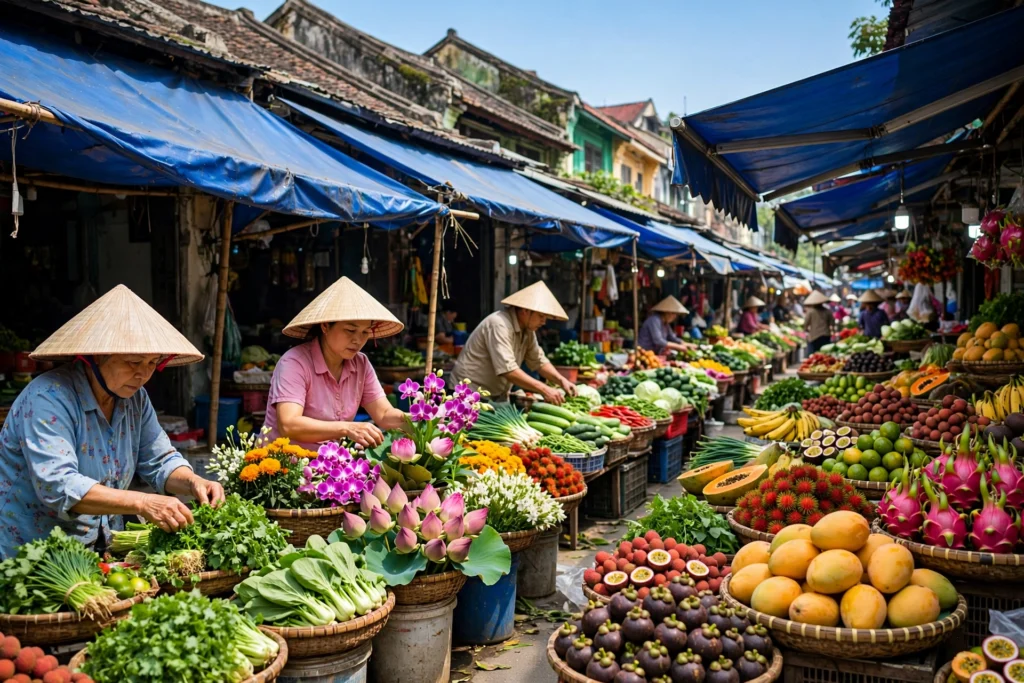
Hanoi is one of the most affordable capital cities in Asia, and the gap between a budget trip and a comfortable trip is smaller here than in almost any other capital. A bowl of pho costs less than a coffee back home, a Grab ride across the city costs a few dollars, and a comfortable hotel room costs a fraction of what the same room would cost in Tokyo, Paris or New York. That does not mean the city is free — it means your money goes further, and the difference between trip styles is mostly about the hotel and the day trips, not about food or transport.
The table below gives planning figures per person per day, excluding international flights. They assume a normal sightseeing day: a hotel, three meals, transport around the city, and one or two paid sights. They are planning figures, not quotes — prices move with season, the dong moves against the dollar, and a stall that charged one price in spring may charge another by autumn. Treat them as a way to compare trip styles, not as a promise.
Hanoi travel budgets by trip style
| Trip style | Hotel per night | Food per day | Transport per day | Sights per day | Total per day |
|---|---|---|---|---|---|
| Budget | Hostel dorm or basic guesthouse | Street food and markets | Walking and buses | One paid sight, free lakes and streets | About $25–$45 |
| Mid-range | Comfortable boutique hotel in the Old Quarter | Street food plus one sit-down meal | Grab rides and walking | Two paid sights | About $60–$110 |
| Comfortable | Good hotel in the French Quarter or West Lake | Restaurants and cafes | Grab cars, occasional driver | Museums, shows, guided tours | About $130–$220 |
| Family of four | Two rooms or a family room | Mix of street food and restaurants | Grab cars, more rides | Museums and shows for four | About $180–$320 for the family |
A mid-range traveller spending three days in Hanoi, with one Ha Long Bay day trip, should plan on roughly $250–$450 per person for the Hanoi part of the trip, excluding international flights, as a planning figure. Add roughly $100–$200 per person for a Ha Long Bay overnight cruise instead of a day trip, and more again for Sapa. These figures are deliberately conservative: most travellers find Hanoi cheaper than they expected, not more expensive, and the city’s best experiences — the lakes, the Old Quarter, the street food, the morning markets — cost little or nothing.
Where the money actually goes
Food is the best value in the city. A bowl of pho, a banh mi and a coffee together cost less than a single lunch in most Western capitals, and the street food that defines Hanoi is also its cheapest food. Sit-down restaurants cost more, and the French Quarter’s restaurants cost more again, but even a good dinner in a proper restaurant is modest by international standards. The expensive meals in Hanoi are the ones aimed at tourists — the rooftop restaurants, the hotel dining rooms, the set menus with a view. They are fine, but they are not where the city’s food lives, and you do not need them to eat well.
Transport is the second-best value. Walking is free, Grab rides are cheap, and the airport transfer is the only ride that costs real money. The trap is the unmetered taxi: always use Grab, or agree the price before you get in, and never get into a taxi whose meter is “broken”. Hotels are the biggest cost, and the biggest variable. The difference between a basic guesthouse and a good boutique hotel is the difference between a $25 day and a $100 day, and it is the single decision that moves your budget most. Choose the hotel for location first and luxury second: a modest room two streets from the lake beats a grand room an hour from everything.
Sights are cheap. Most temples and museums charge entry fees of roughly a dollar to a few dollars, the lakes are free, and the water puppet show is the most expensive single ticket most visitors buy. Ha Long Bay is the exception — a day cruise or an overnight boat is the biggest single expense of a Hanoi trip, and it is worth budgeting for it separately, as its own line, rather than folding it into a daily average. Our guide to how to prepare a travel budget has a simple framework for building a trip budget from these pieces, and our guide to how much to travel to Japan shows how Hanoi’s costs compare with another Asian capital, if you are choosing between the two.
Staying Safe in Hanoi: Scams, Traffic and Practical Etiquette
Hanoi is a safe city by the standards of any large capital, and the US State Department’s Level 1 advisory — “Exercise Normal Precautions”, issued 24 June 2026 — reflects that. Violent crime against visitors is rare. The real risks are the ones that show up in every big city in Southeast Asia: traffic, petty theft, scams and the occasional stomach bug. None of them should stop you travelling. All of them are manageable with a little preparation, and this section covers them plainly.
Traffic is the single biggest risk in Hanoi, and it deserves respect. The city runs on motorbikes, and the Old Quarter’s streets are a constant flow of two-wheeled traffic with no clear lanes. Cross the road slowly and steadily, at a predictable pace, and never run, stop suddenly or change direction in the middle of the road. Riders will flow around you if you keep moving steadily; they cannot predict you if you hesitate. Look both ways before you step off the pavement, keep children close at every crossing, and use pedestrian crossings and traffic lights where they exist. Do not use your phone while crossing. At night, wear light clothing and stay on lit streets. If you are riding on the back of a Grab motorbike, wear the helmet the driver provides, hold on, and keep your bag in front of you.
Petty crime is the second risk, and it is mostly about bags and phones. Bag snatching by passing motorbikes happens, usually at night, usually to a bag carried on the road side. Carry your bag on the building side, not the road side, keep it closed and in front of you in crowded streets, and do not dangle a phone in your hand at the edge of a pavement. Pickpocketing happens in the busiest markets and on crowded buses — keep valuables in a front pocket or a bag you can see, and leave the passport in the hotel safe, carrying a copy instead. Our guide to whether it is safe to travel to Vietnam right now covers these risks in more detail, including what to do if something is stolen.
Scams to know about before you arrive
The scams in Hanoi are small, familiar and easy to avoid once you know them. The shoe-shine scam: someone points at your shoes, offers to clean them, and then demands an inflated price — walk past, politely and firmly. The cyclo overcharge: a ride agreed at one price becomes a much higher price at the end — agree the price and the duration in writing, or book through your hotel. The “free” fruit or the friendly stranger who wants to practise English and then steers you to a shop or a restaurant where they earn a commission — be friendly, be cautious, and never follow a stranger to a second location. The taxi with a fast meter or a “broken” meter — use Grab, where the price is fixed in advance. And the unofficial e-visa site that charges double or triple the official $25 or $50 fee — use evisa.gov.vn and nothing else.
Health is mostly about water, food and heat. The tap water is not drinkable: buy bottled water everywhere, check the seal is unbroken, and use bottled water for brushing your teeth if you are cautious. Eat street food that is cooked in front of you and served hot, wash your hands before eating, and carry hand sanitiser. The heat is a real risk in summer: drink water constantly, wear sunscreen and a hat, rest in the middle of the day, and watch for the signs of heat exhaustion — dizziness, nausea, a headache that will not go away. If you feel unwell, rest, drink water, and seek a pharmacy or a clinic if symptoms persist. Travel insurance is worth having for any trip to Vietnam: check that it covers medical care and emergency evacuation, and carry the policy number with you. Insect repellent is worth packing year-round, and more so in the rainy season.
Etiquette matters more than most visitors expect, and it is mostly about respect. Dress modestly at temples and the mausoleum — shoulders and knees covered, no hats inside, no loud conversation. Remove your shoes where asked, and never point your feet at a Buddha image or a person. Ask before photographing people, especially monks, children and market vendors. Do not touch anyone’s head. Bargain politely in markets — a smile, a counter-offer, and a willingness to walk away will get you a fair price, and haggling aggressively over a few thousand dong is poor form. And at the mausoleum, follow the rules exactly: no photography, no hands in pockets, no talking, and dress as if you were visiting a place of remembrance, because that is what it is.
Hanoi Travel Itineraries: 2 Days, 3 Days and 5 Days

The best Hanoi travel itinerary is the one that matches the time you actually have, and the city rewards all three of these options. The 2-day itinerary is a sprint: it covers the essentials and nothing else, and it works if Hanoi is one stop on a longer Vietnam trip. The 3-day itinerary is the sweet spot: the city itself, properly, with room to breathe. The 5-day itinerary is the complete trip: the city plus Ha Long Bay, with time for the food, the cafes and the lakes that make Hanoi more than a checklist.
2 days in Hanoi: the essentials
Day one starts at Hoan Kiem Lake at dawn, when the tai chi groups are out and the light is at its best. Walk the lake, cross the red bridge to Ngoc Son Temple, and then walk north into the Old Quarter for a slow morning among the trade streets, finishing with pho for a late breakfast. Spend the afternoon at the Temple of Literature, then walk back through the French Quarter to the Opera House as the light turns golden. In the evening, take a street food tour — it is the fastest way to learn the city’s food, and it turns your first night into a proper introduction rather than a guess.
Day two starts with egg coffee and a banh mi, then the Ho Chi Minh Mausoleum, the One Pillar Pagoda and the Imperial Citadel of Thang Long in the morning, when the queues are shortest. Spend the afternoon at Hoa Lo Prison and the Vietnamese Women’s Museum, or at the Museum of Ethnology if you would rather see the country’s diversity than its history. Finish the day at West Lake for sunset, with dinner at a lakeside restaurant, and a final walk around Hoan Kiem Lake after dark, when the city is at its most beautiful.
3 days in Hanoi: the sweet spot
Days one and two follow the 2-day plan above, at a slower pace. Day three is the food and cafe day, and it is the day that turns a good trip into a great one. Start with a morning market walk — the flower market, the food stalls, the vendors setting up — then a cooking class or a longer street food tour, trying the dishes you missed on day one: bun cha for lunch, cha ca in the afternoon, banh cuon the next morning. Spend the afternoon in a cafe, reading, watching the street, and letting the city come to you. In the evening, see a water puppet show at the Thang Long Theatre, then dinner in the Old Quarter and a walk through the night market if it is a weekend. Three days is enough to eat well, see the great sights, and still have time to sit still — and sitting still is half of Hanoi.
5 days in Hanoi: the complete trip
Days one to three follow the 3-day plan. Day four is Ha Long Bay: an early pickup, a day cruise or the first day of an overnight cruise, with Sung Sot Cave, Luon Cave and Ti Top Island, and a return to Hanoi in the evening — or a night on the water, waking to the sunrise over the karsts. Day five is Ninh Binh: a sampan ride through Trang An or Tam Coc, the climb up Hang Mua, and Hoa Lu, the ancient capital, with a return to Hanoi in the evening and a final dinner in the Old Quarter. Five days gives you the city, the bay and the river valley, and it is the itinerary to choose if Hanoi is the main stop on your Vietnam trip rather than one of many.
If you have a week, add Sapa as an overnight trip after day five, or simply add two slow days in Hanoi — a morning at West Lake, an afternoon at the Museum of Ethnology, a second water puppet show, a cooking class, and the cafes you did not have time for on the first pass. Hanoi rewards a slow second look more than most cities, and the travellers who enjoy it most are usually the ones who stayed a day longer than they planned.
Frequently Asked Questions About Hanoi Travel
Is Hanoi worth visiting?
Yes. Hanoi is one of the most rewarding cities in Southeast Asia: more than 1,000 years of history, some of the best street food in the world, a compact walkable centre, and prices that make a comfortable trip affordable. It is also the gateway to Ha Long Bay and northern Vietnam, so it works as a destination in its own right and as a base for the region.
How many days do I need in Hanoi?
Three days is the sweet spot for the city itself: one day for the Old Quarter and Hoan Kiem Lake, one day for the Temple of Literature, the museums and the French Quarter, and one day for food, coffee and the lakes. Add a fourth day for Ha Long Bay or Ninh Binh, and a fifth for the other one. Two days covers the essentials but leaves no room for a day trip.
What is the best time to visit Hanoi?
October and November are the best months, with mild temperatures, lower humidity and the least rain. March and April are the next best. Summer, from May to August, is hot, humid and wet, with August the wettest month. Winter, from December to February, is cool and often grey but dry enough for sightseeing if you pack a jacket.
Do US citizens need a visa for Vietnam?
Yes. US citizens are not visa-exempt for Vietnam. Apply for an e-visa on the official portal at evisa.gov.vn before you fly. The fee is $25 for single entry or $50 for multiple entry, the visa is valid for up to 90 days, and the stated processing time is 3 working days. Use only the official portal — any site that does not end in .gov.vn is not the Vietnamese government.
Is Hanoi safe for visitors?
Yes. The US State Department rates Vietnam Level 1, “Exercise Normal Precautions”, its lowest level, in an advisory issued 24 June 2026. Violent crime against visitors is rare. The real risks are traffic, bag snatching and small scams, and all of them are manageable with the precautions in section 13 of this guide.
How much does a trip to Hanoi cost?
A mid-range traveller should plan on roughly $60–$110 per person per day in Hanoi, excluding international flights, as a planning figure. A budget traveller can manage on about $25–$45 a day, and a comfortable trip runs about $130–$220 a day. A Ha Long Bay day trip or overnight cruise is the biggest single expense and should be budgeted separately.
What is the best area to stay in Hanoi?
The Old Quarter is the best base for first-time visitors, because most sights, food and atmosphere are within walking distance. The French Quarter is quieter and more comfortable, and West Lake is best for a longer stay. Whatever you choose, stay near Hoan Kiem Lake rather than on the outskirts.
Can I do Ha Long Bay as a day trip from Hanoi?
Yes. Ha Long Bay is about 165–170 km from Hanoi, and the expressway has cut the drive to about 2.5 to 3 hours each way. A typical day trip gives you five to six hours on the water, including Sung Sot Cave, Luon Cave and Ti Top Island, and brings you back to Hanoi the same evening. An overnight cruise is better if you have the time, because you see the bay at sunset and sunrise.
What should I eat in Hanoi?
Start with pho bo, the Hanoi beef noodle soup, for breakfast. Then try bun cha, cha ca, banh mi, bun bo nam bo and banh cuon. Drink egg coffee, iced coffee with condensed milk, and coconut coffee. Eat where the locals eat, order the dish a stall specialises in, and take a street food tour on your first evening.
How do I get from the airport to the Old Quarter?
Noi Bai International Airport sits north of the city, and the ride into the Old Quarter takes roughly 45 minutes to an hour depending on traffic. A Grab car or a hotel airport transfer is the simplest option, with the price fixed in advance. The airport bus is cheaper and slower.
Is the tap water safe to drink in Hanoi?
No. The tap water in Hanoi is not drinkable. Buy bottled water everywhere, check the seal is unbroken, and use bottled water for brushing your teeth if you are cautious. Bottled water is cheap and sold everywhere.
What should I wear when visiting temples in Hanoi?
Dress modestly, with shoulders and knees covered, and remove your shoes where asked. This applies at Ngoc Son Temple, the Temple of Literature, the Tran Quoc Pagoda and the Ho Chi Minh Mausoleum, where the dress and conduct rules are strictest. Bring a light scarf or shawl if you are wearing a sleeveless top.
Conclusion: Hanoi Rewards Travellers Who Slow Down
Hanoi is not a city that gives up its best experiences to travellers in a hurry. Its rewards are slow ones: a bowl of pho at dawn, a morning on the lake, an hour in a cafe, a walk through the Old Quarter with no destination at all. The city is more than 1,000 years old, and it has learned patience — the travellers who enjoy it most are the ones who learn it too. Come in October or November, stay three days or five, base yourself near the lake, eat where the locals eat, and let the city set the pace. Book the e-visa early, carry cash, cross the road steadily, and leave room in the plan for the things you did not plan: a street you wandered down by mistake, a cafe you stopped at for ten minutes and stayed in for two hours, a dish you had never heard of that becomes the meal you remember. That is Hanoi travel at its best — not a checklist, but a city that rewards the time you give it.
People also read:
- Is It Safe to Travel to Vietnam Right Now?
- How Much to Travel to Japan
- Best Travel Destinations
- Christmas Travel
- Best Places to Travel in January
- Dream Travel Destinations
- Luxury Travel Destinations
- Places to Travel in Texas
- Kauai Travel
- Cabo Travel
- Fun Places to Travel in the US
- Travel Packing Checklist PDF Free

M. Adil is the founder and editor of SoloTravelPro. He writes practical, research-based travel guides that help travellers plan with confidence — from first-time city breaks to national parks and island escapes. Every guide is built on official sources, current prices and honest, usable advice, so readers can plan smarter and travel better.