Places to Travel in Texas: The Complete 2026 Guide to the Lone Star State
Texas is the hardest state in America to plan a trip around, and the most rewarding once you do it right. It covers about 268,600 square miles — bigger than France and nearly three times the size of the United Kingdom — and the drive from El Paso to the Louisiana border takes around 10 to 12 hours, longer than the drive from Paris to Amsterdam. That size is the whole story of travelling in Texas: you cannot see it all in one trip, and anyone who tries ends up spending the holiday on the highway. The trick is to pick one or two regions, base yourself well, and let the state come to you.
The good news is that Texas rewards that approach generously. In a single state you get a world-class food city in Austin, a UNESCO-listed mission trail and one of America’s great urban rivers in San Antonio, the official visitor centre of NASA’s Johnson Space Center in Houston, a twice-daily cattle drive in Fort Worth, some of the darkest night skies in the country in Big Bend, the second-largest canyon in the United States at Palo Duro, the longest undeveloped barrier island in the world at Padre Island, and the highest point in the state at Guadalupe Peak. This guide covers all of them — where to go, how long each place needs, what it costs, when to go, how to drive between regions, and what to watch out for, from summer heat to Gulf hurricanes to flash floods. Everything about Big Bend and Hamilton Pool was checked against the official sources on 18 November 2026, and the dates are given so you can check them again before you travel. And because Texas is in the United States, no passport is needed for the trip itself — our guide to places to travel without a passport covers the same kind of domestic planning in more detail.
The Best Places to Travel in Texas at a Glance
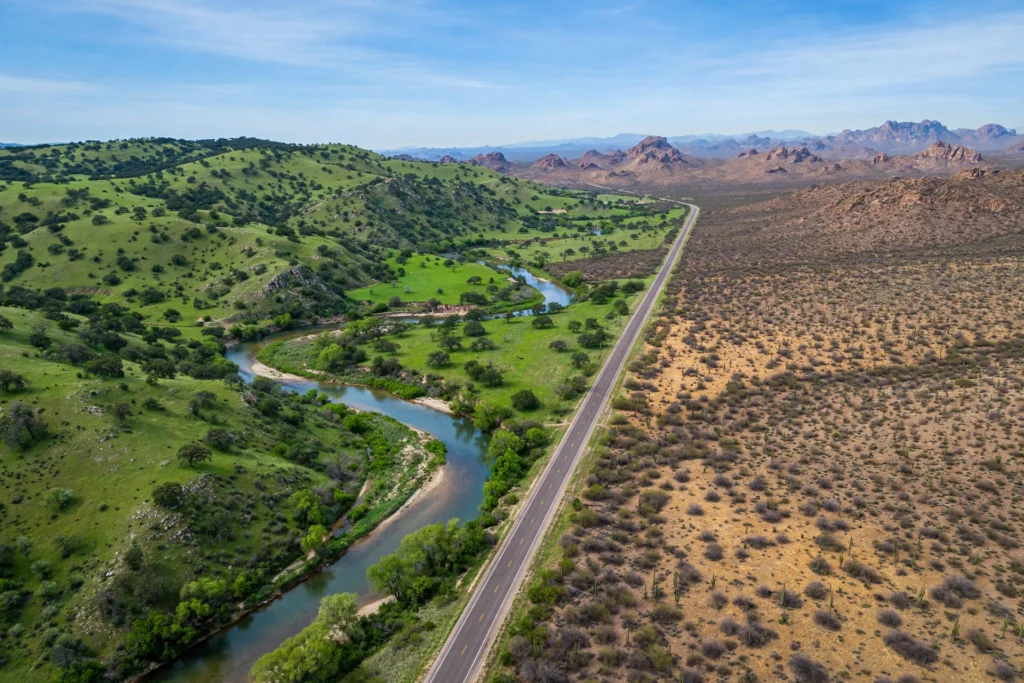
Texas breaks naturally into regions, and the first decision you make is which region — or which two — your trip belongs to. The competitors’ lists all agree on the shape of it: San Antonio is the strongest first-timer pick, Austin and the Hill Country are the best all-rounder, Houston and Galveston are the best family combination, Dallas and Fort Worth are the best city pair, and Big Bend is the place you plan a whole trip around rather than squeezing into a spare day. The table below is the whole guide in one view. Use it to choose, then read the section for the places you pick.
| Place | Region | Best for | Time needed | Best season |
|---|---|---|---|---|
| San Antonio | South Texas | First-timers, history, food, River Walk | 2–3 days | March–May, Oct–Nov |
| Austin + Hill Country | Central Texas | Live music, food, swimming holes, wildflowers | 3–4 days | March–May, Oct–Nov |
| Houston + Galveston | Gulf Coast | Families, space, museums, beaches | 2–3 days | March–May, Oct–Nov |
| Dallas + Fort Worth | North Texas | Art, sports, cowboy heritage, city breaks | 2–3 days | March–May, Oct–Nov |
| Big Bend National Park | West Texas | Desert, dark skies, hiking, remoteness | 3–4 days | Nov–April |
| Palo Duro Canyon | Panhandle | Canyon views, hiking, horseback riding | 1–2 days | March–May, Sep–Nov |
| Padre Island + Corpus Christi | Gulf Coast | Beaches, sea turtles, fishing, slow days | 2–3 days | April–June, Sep–Oct |
| Guadalupe Mountains | West Texas | Hiking, the highest point in Texas, fall colour | 1–2 days | Oct–Nov, March–April |
| Marfa + West Texas | West Texas | Art, desert light, the Marfa lights, stargazing | 1–2 days | Oct–April |
| Fredericksburg + wine country | Hill Country | Wine tasting, German heritage, small-town days | 1–2 days | March–May, Oct–Nov |
| Caddo Lake + East Texas | East Texas | Cypress swamps, kayaking, quiet nature | 1–2 days | March–May, Oct |
| South Padre Island | South Texas Gulf | Resort beaches, water sports, birding | 2–3 days | March–May, Sep–Oct |
Read the table with the drive times in mind, because the distances are what turn a good Texas plan into a bad one. San Antonio, Austin and the Hill Country sit close together in the middle of the state and combine easily into a single 5- to 7-day trip. Dallas and Fort Worth are a separate pair, about three hours north of Austin. Houston and Galveston are a separate pair on the Gulf Coast, about three hours east of Austin. Big Bend, Guadalupe Mountains and Marfa are all in far West Texas, seven to nine hours from the central cities, and they belong together on a dedicated West Texas trip, not as a day trip from anywhere. Palo Duro is in the Panhandle, five hours north of Austin and a world of its own. Pick your cluster, then stop adding places to it. Texas rewards depth, not mileage.
The other thing the table shows is that there is no single best season for the whole state, because Texas has several climates in one border. The Hill Country and the cities are at their best in spring and autumn, when the wildflowers are out or the heat has broken. Big Bend and the desert west are at their best in winter, when the desert floor is walkable and the nights are cold and clear. The Gulf Coast is at its best in late spring and early autumn, between the winter cold fronts and the peak of hurricane season. The month-by-month table later in this guide sets all of that out in detail, so you can match your dates to your region rather than hoping the weather cooperates everywhere at once.
A final note before the detail: Texas is a driving state, and this guide assumes you will have a car for most of it. The cities have some public transport, and you can do a San Antonio or Austin city break without a car if you stay central, but the Hill Country, Big Bend, Palo Duro, Guadalupe Mountains and Padre Island are all car trips. There is no train that joins the regions up, and the buses between cities are slow. If you are flying in, the practical airports are Austin, Dallas–Fort Worth, Houston (two airports), San Antonio, El Paso for the far west, and Amarillo for the Panhandle. Fly into the airport nearest your region, rent the car there, and return it there. Do not fly into Dallas to see Big Bend. That is the single most common Texas planning mistake, and it costs a full day of driving each way.
San Antonio: The Alamo, the River Walk and the Missions
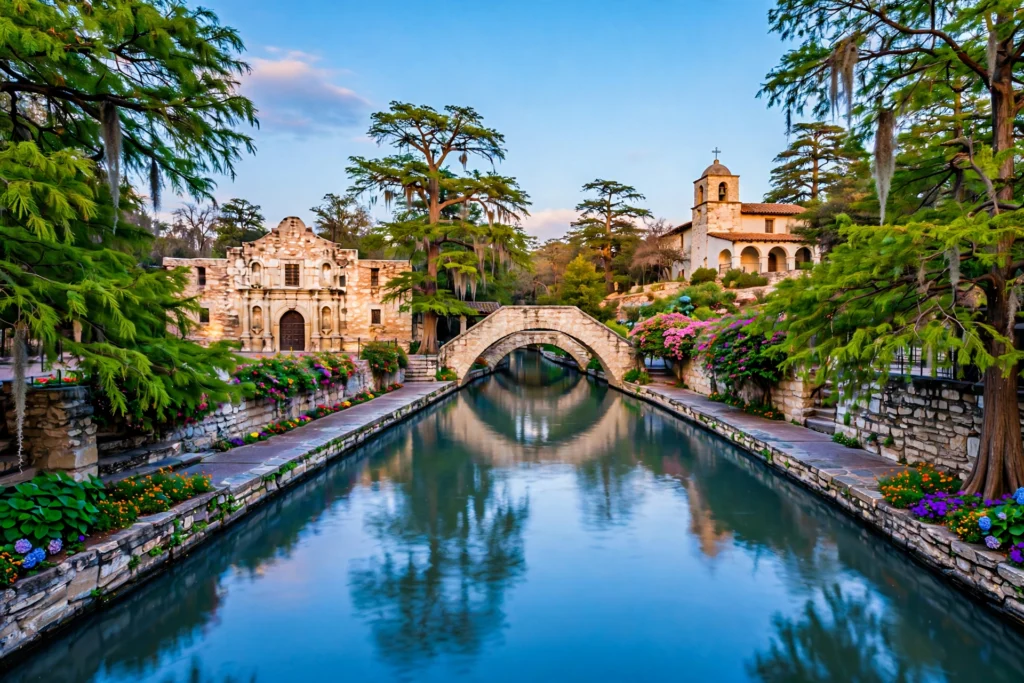
San Antonio is the best first stop in Texas, and the competitors agree on why: it is the one Texas city where the history, the food and the atmosphere are all in the same walkable place, and it is the easiest city in the state to enjoy without a car. The Alamo, the River Walk and the Spanish missions are the three things that define it, and they are all worth your time for different reasons. Give San Antonio two full days, three if you want to slow down, and stay near the River Walk or in the Pearl district so you can walk to dinner.
The Alamo
The Alamo is the most famous building in Texas, and the one most visitors misunderstand. It is not a grand fortress. It is a small, plain mission church in the middle of downtown, and its power comes from what happened there in 1836, when a small Texian force held it for thirteen days against a much larger Mexican army before being overrun. The site is free to enter, and the Alamo itself is the place to start: the church, the long barrack, the gardens and the exhibits tell the story plainly, including the parts that are still argued over. Go early in the morning, before the tour groups arrive, and give it an unhurried hour. The mistake is to treat the Alamo as a photo stop on the way to lunch. It is a small site, but it is the reason San Antonio exists as a tourist city, and it deserves the hour.
The River Walk
The San Antonio River Walk is about 15 miles of walkways along the San Antonio River, winding below street level through the centre of the city, lined with restaurants, bars, shops and cypress trees. The downtown loop is the part most visitors see, and it is at its best in the evening, when the lights come on and the river barges drift past. Take a river barge cruise on your first evening — it is the best orientation to the city, and it explains the layout faster than any map. Then walk it. The quieter stretches, north toward the Pearl district and south toward the missions, are where the River Walk stops feeling like a theme park and starts feeling like a city. The Pearl is the old brewery district, now restaurants, a weekend farmers market and a long stretch of riverside path, and it is the best place in San Antonio for a slow morning. Eat on the river at least once, but eat in the neighbourhoods too: San Antonio’s food is Tex-Mex and Mexican food taken seriously, and the best of it is not on the main loop.
The San Antonio Missions
The missions are the part of San Antonio most first-timers miss, and the part that makes the city more than a weekend break. Four Spanish colonial missions — Concepción, San José, San Juan and Espada — run along the San Antonio River south of downtown, and together with the Alamo they form the San Antonio Missions National Historical Park, a UNESCO World Heritage Site. Mission San José, known as the Queen of the Missions, is the grandest, with its carved stone church and its walled compound. Mission Concepción is the oldest unrestored stone church in the United States and still holds services. The missions are free to enter, they are quiet, and they are best reached by bike or car along the Mission Reach stretch of the river, which is a paved trail of about eight miles. Half a day covers two missions well; a full day covers all four and the walk between them. The National Park Service runs the San Antonio Missions site, and its visitor information is the place to check opening times before you go.
How to spend two days in San Antonio
Day one: the Alamo in the morning, the downtown River Walk and a barge cruise in the afternoon and evening, dinner on the river or in the Pearl. Day two: the missions in the morning — San José and Concepción at minimum — then the Pearl farmers market if it is a weekend, the San Antonio Museum of Art or the Witte Museum in the afternoon, and dinner in Southtown, the artsy neighbourhood south of downtown. If you have a third day, take it slow: a morning at the Japanese Tea Garden and the San Antonio Botanical Garden, an afternoon at the shops on the River Walk’s quieter stretches, and an evening back on the river. San Antonio is a city that rewards a slow pace. The visitors who enjoy it least are the ones who try to do it in a day.
Austin and the Hill Country: Live Music, Food and Swimming Holes
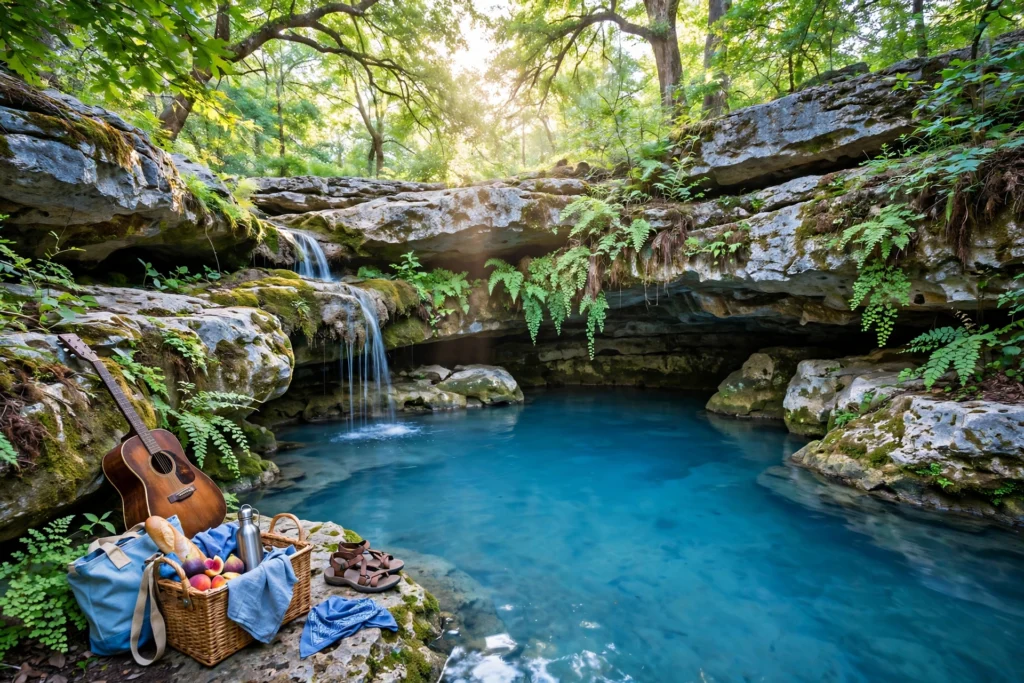
Austin is the capital of Texas and the city most visitors end up loving most, and the Hill Country around it is the prettiest driving in the state. Together they make the best all-round Texas trip: a city with live music every night of the week, some of the best barbecue and breakfast tacos in America, a river running through the middle of town, and within an hour’s drive, rolling hills, wildflower fields, swimming holes, wineries and small German-heritage towns. Give Austin two days and the Hill Country one or two more, and stay central in Austin — South Congress, downtown or East Austin — so the music and the food are on foot.
Austin: the Live Music Capital of the World
Austin calls itself the Live Music Capital of the World, and it earns the title on volume alone: more than 250 live music venues, with shows every night of the week, from tiny bars on Red River Street to the big rooms on South Congress. You do not need a plan for the music. Walk Sixth Street or Red River in the evening, listen at the door, and go in where it sounds good. The big festivals are South by Southwest in March and Austin City Limits in October, and both need booking months ahead — hotel prices spike and rooms sell out. Outside festival weeks, Austin is an easy city: walkable in the centre, friendly, and full of food trucks. Eat barbecue at least once — Franklin Barbecue is the famous name and the queue is part of the experience, but there are excellent barbecue joints all over town if you do not want to wait — and eat breakfast tacos, which are Austin’s other great contribution to American food. Lady Bird Lake, the river through the centre of the city, has a ten-mile hike-and-bike trail around it, and the Congress Avenue Bridge is home to one of the largest urban bat colonies in North America: from roughly March to October, the bats stream out at dusk, and the crowds gather on the bridge and the lawn below to watch.
The Hill Country: swimming holes, wildflowers and small towns
The Hill Country is the rolling limestone country west of Austin, and it is where the Austin trip becomes a Texas trip. The swimming holes are the draw in summer: natural pools of clear, cold water under limestone cliffs, fed by springs. The most famous is Hamilton Pool Preserve, near Dripping Springs, about an hour west of downtown Austin — and it is also the one that needs the most careful planning. Hamilton Pool is a Travis County preserve, it is reservation-only every day of the year, and a reservation does not guarantee a swim. As of 18 November 2026, the official Travis County page says water access at the pool is currently not allowed, because of recent rain and high bacteria, with the earliest date swimming might be allowed given as Friday, 20 November — and even when swimming is allowed, only a very limited part of the pool is open because of falling rocks, and the trail under the overhanging cliff is closed. Swimming is decided day by day, from bacteria levels and recent rain, and it is frequently not allowed. That is the honest position, and it is why you should never build a Hill Country day around a Hamilton Pool swim. Book the reservation if you want to see the grotto — it is beautiful even from the beach — but have a backup swimming hole in mind, and check the county’s recorded information line on 512-854-2581, updated at 8:30 a.m. daily, on the morning you go. The Hamilton Pool Preserve page on the Travis County Parks site is the only source that matters for the day’s status.
Other Hill Country swimming holes are easier. Barton Springs Pool, in the middle of Austin in Zilker Park, is a spring-fed pool that stays around 68°F (20°C) all year and is the city’s great leveller — everyone swims there. Jacob’s Well, near Wimberley, is a deep artesian spring that needs a reservation in summer. Blue Hole in Wimberley is a shaded cypress-lined pool, also reservation-only for swimming in the summer months. All of them are cold, all of them are crowded on summer weekends, and all of them are worth it on a hot day. The rule for all of them is the same: book ahead, go on a weekday if you can, and never assume the water will be open.
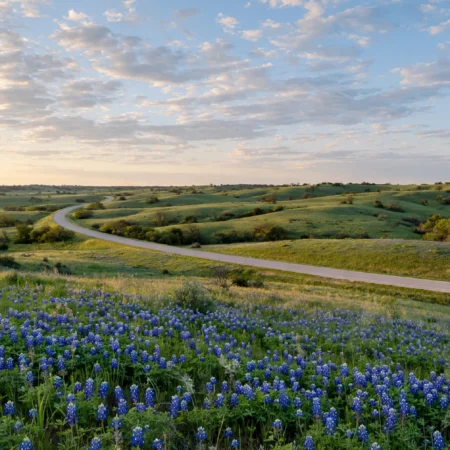
Spring in the Hill Country belongs to the wildflowers. The bluebonnets — the Texas state flower — peak from late March to mid-April, and the hillsides along the roads west of Austin turn blue. The Willow City Loop, northwest of Fredericksburg, is the famous drive, and it is crowded at peak bloom; go on a weekday morning and pull off only where it is safe and legal. Do not trample the flowers for a photo, and do not pick them on private land. The wildflower season is also the best time for the Hill Country’s wineries. Fredericksburg, the German-heritage town at the heart of the wine country, has dozens of tasting rooms, and the drive between Fredericksburg, Luckenbach and the wineries along Highway 290 is one of the prettiest in Texas. Fredericksburg itself is worth a slow afternoon: German food, Main Street shops, the National Museum of the Pacific War, and Enchanted Rock State Natural Area a short drive north — a huge pink granite dome you can hike to the top of for the view across the hills.
How to spend three or four days
Day one in Austin: the city centre, South Congress for shopping and food, the hike-and-bike trail around Lady Bird Lake, and live music in the evening. Day two: Barton Springs in the morning, the Texas State Capitol and the Blanton Museum of Art, food trucks for lunch, and the Congress Avenue bats at dusk if it is the season. Day three: the Hill Country — Dripping Springs and Hamilton Pool in the morning (with the swimming caveat above), Wimberley or Jacob’s Well, and Fredericksburg for the evening. Day four, if you have it: Enchanted Rock in the morning, the Willow City Loop if it is wildflower season, and a winery or two on the way back to Austin. The Hill Country is a place to drive slowly, stop often, and not over-schedule. The best of it is found between the stops.
Houston and Galveston: Space, Museums and the Gulf Coast
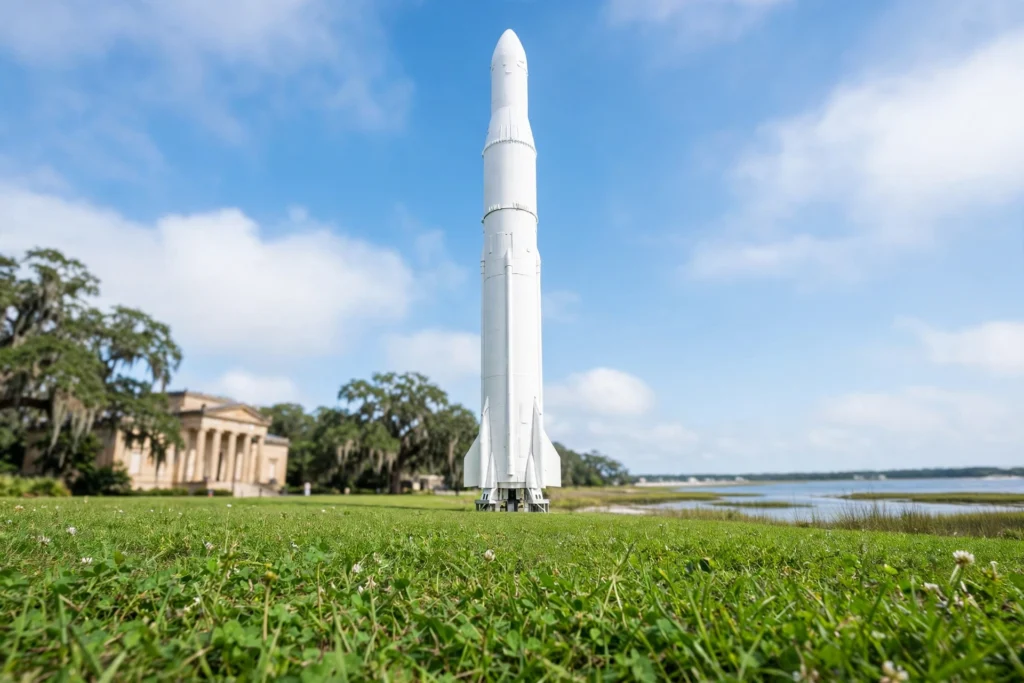
Houston is the fourth-largest city in the United States, and the Texas city most first-timers underestimate. It is not a pretty city in the way San Antonio is, and it is not a compact one — it sprawls, and you need a car. But it has the best museums in Texas, the best food scene in the state, and the one attraction that belongs on every Texas itinerary: Space Center Houston. Pair it with Galveston, the historic island city an hour down the coast, and you have the best family combination in Texas. Give Houston two days and Galveston one, and stay in the Museum District or downtown in Houston, and on the Seawall or in the Strand district in Galveston.
Space Center Houston
Space Center Houston is the official visitor centre of NASA’s Johnson Space Center, and a Smithsonian Affiliate, and it is the single best indoor attraction in Texas. The centre has flown spacecraft on display, including a flown capsule and a full-size shuttle replica mounted on a 747, a mission control you can walk through, and the tram tour out to the working Johnson Space Center, where astronauts train and missions are run. The tram tour is the part to prioritise — it takes you behind the scenes of a working space centre, and it is the reason to go rather than just looking at the exhibits. Give it a full day, not a half day, and book the tram tour early in your visit because the popular departures fill up. Space Center Houston is open 10 a.m. to 5 p.m. on the day checked, 18 November 2026, and it runs seasonal evening events in the winter months, so check the site for the day’s hours before you go. It is the best family stop in Texas, and the one place in the state where a child who likes space will remember the trip for years.
Houston’s museums and food
Houston’s Museum District has 19 museums in a walkable area, and it is the densest cultural district in the South. The Museum of Fine Arts, Houston, and the Houston Museum of Natural Science are the two big ones — the natural science museum’s dinosaur hall and its gem vault are the highlights — and the Children’s Museum of Houston is one of the best in the country. The Menil Collection, a free museum in a quiet residential neighbourhood, is the art lover’s pick, and the Rothko Chapel next door is one of the most unusual rooms in America. Houston’s food is the other reason to stay: it is the most diverse food city in Texas, with Vietnamese, Mexican, Indian, Nigerian and Gulf seafood restaurants that are as good as anywhere in the country, and barbecue and Tex-Mex that hold their own against Austin. The practical advice is simple: eat in the neighbourhoods, not downtown, and ask locals where they eat. Houston rewards the visitor who treats it as a food city first and a sightseeing city second.
Galveston: the island city
Galveston is an hour’s drive southeast of Houston, on a barrier island in the Gulf, and it is a completely different place from Houston: a historic port city with Victorian houses, a beachfront Seawall, and a downtown Strand district of 19th-century warehouses that survived the great hurricane of 1900, the deadliest natural disaster in American history. The Strand is the place to walk, with its shops, galleries and restaurants, and the Seawall is the place for a slow evening. Moody Gardens, with its pyramids, aquarium and rainforest, is the family draw, and the Pleasure Pier is the classic seaside amusement pier. The beaches are wide and flat and the water is warm in summer, but they are Gulf beaches — brownish water, gentle waves, seaweed after storms — not Caribbean beaches, and it is better to know that before you arrive. Galveston is a one-day trip from Houston, and an easy overnight if you want a slow beach evening. It is also the best base for the Gulf Coast if you want to combine the beach with the city.
Dallas and Fort Worth: Art, Sports and Cowboy Heritage
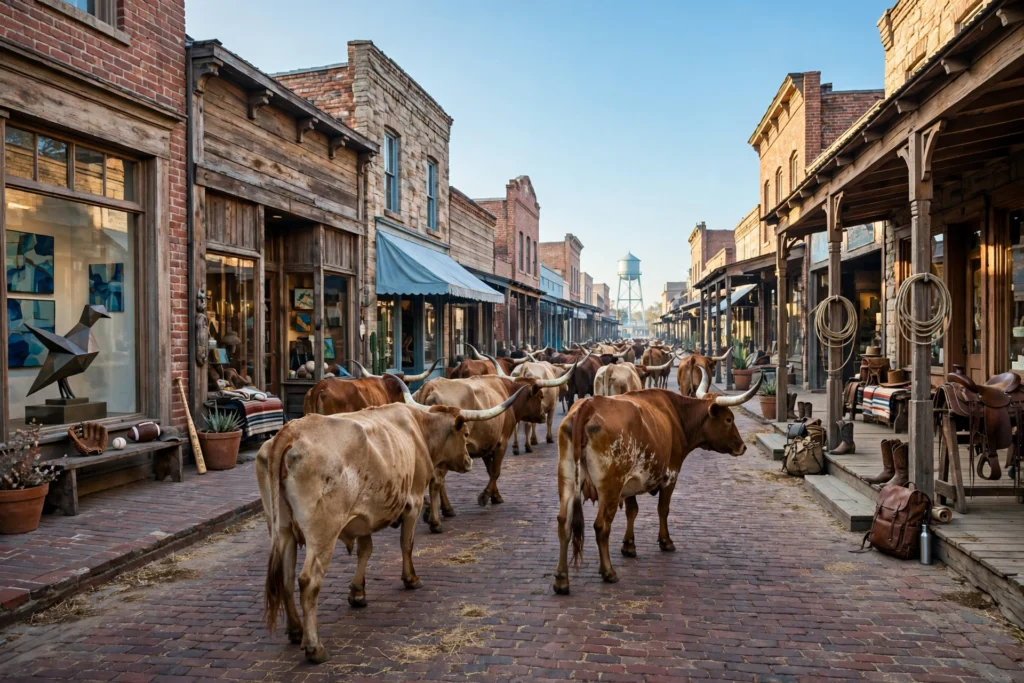
Dallas and Fort Worth are twin cities about 30 miles apart, and they are a study in contrast: Dallas is the glossy, modern, corporate city, and Fort Worth is the slower, more Western one, and together they make a good two- or three-day city break. The honest advice is to stay in Fort Worth if you want atmosphere, and visit Dallas for the museums and the history. Both are car cities, and the drive between them is under an hour on the highway, so you can base in one and see both.
Fort Worth: the Stockyards and the museums
Fort Worth is the Texas city that feels most like Texas. The Fort Worth Stockyards are the historic cattle-market district, and they are the real thing: a twice-daily cattle drive of Texas longhorns down Exchange Avenue, rodeos at the Cowtown Coliseum, honky-tonks, Western shops and the old livestock exchange building. The cattle drive is short — a few minutes — and it is crowded, so arrive early and stand where you can see. The Stockyards are touristy, and they know it, but they are also genuine, and they are the best place in Texas to see cowboy heritage without driving to a ranch. Fort Worth’s other surprise is its museums. The Kimbell Art Museum is one of the finest small art museums in America, with a collection that punches far above its size, and the Modern Art Museum of Fort Worth, next door, is its contemporary counterpart. The two of them, plus the Amon Carter Museum of American Art, make the Cultural District one of the best museum clusters in the country. Give Fort Worth a full day: the Stockyards in the morning, the museums in the afternoon, and dinner in the Stockyards or in Sundance Square downtown.
Dallas: history, art and the city
Dallas is the bigger, busier twin, and its best stops are the ones that tell an American story. The Sixth Floor Museum at Dealey Plaza, in the former Texas School Book Depository, is the museum of the Kennedy assassination, and it is done with care and restraint — give it two unhurried hours. The Dallas Museum of Art and the Nasher Sculpture Center, in the downtown Arts District, are the art picks, and the Dallas Arboretum, on the shore of White Rock Lake, is the city’s great garden, at its best in spring and autumn. Deep Ellum, the old entertainment district east of downtown, is where the live music and the street art are, and the State Fair of Texas, held in late September and October at Fair Park, is the great Texas fair — fried food, livestock, football and the Big Tex statue — and worth planning a trip around if your dates line up. Dallas is also a good base for a day trip: the small towns and lakes north of the city, and the Fort Worth Stockyards, are all within an hour or two.
A note on city safety
Dallas, Fort Worth and Houston are big American cities, and the safety advice for them is the same as for any big American city: stay in well-lit, busy areas at night, use rideshares or taxis after dark rather than walking through quiet districts, keep valuables out of sight in a parked car, and check the neighbourhood before booking a cheap hotel on the edge of town. There is no US State Department travel advisory for American cities — the State Department issues advisories for other countries, not for the United States — so there is no advisory level to cite for Dallas or Houston, and any site that claims one is inventing it. The practical habits are the same ones our guide to is it safe to travel to Chicago right now sets out for another big American city, and they transfer directly: choose your neighbourhood, plan your night transport, and tell someone where you are going.
Big Bend and West Texas: Desert, Dark Skies and Marfa
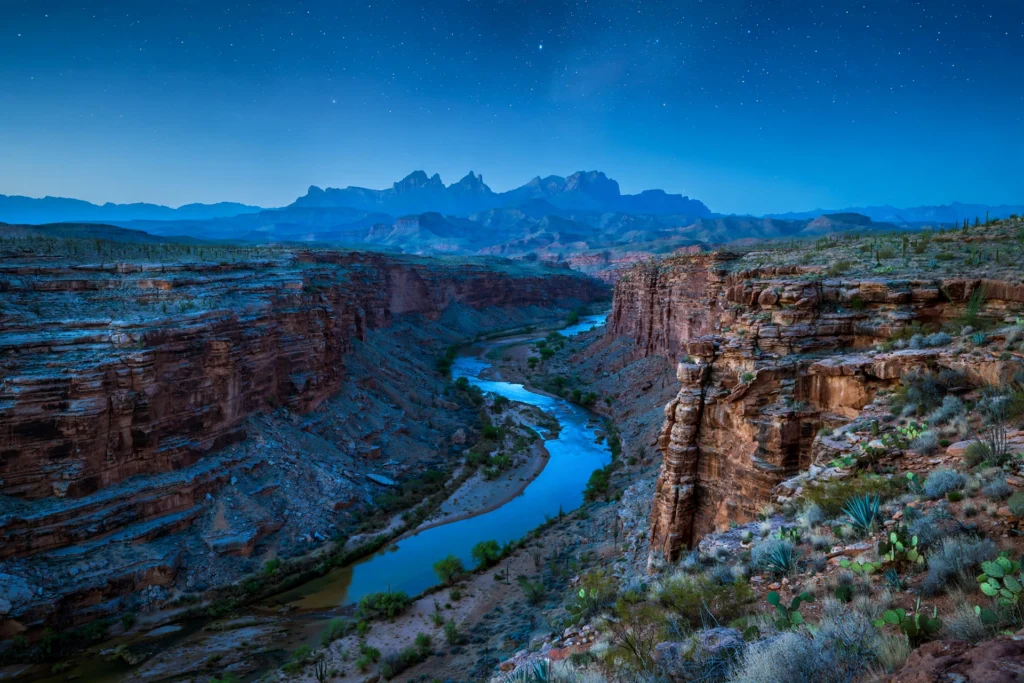
Big Bend National Park is the wildest place in Texas, and the one that most rewards a dedicated trip. It protects more than 800,000 acres of the Chihuahuan Desert in the great bend of the Rio Grande, along 118 miles of the river that forms the border with Mexico, and it is one of the least-visited national parks in the country precisely because it is so far from everywhere. That is the point. Big Bend is a place of desert mountains, river canyons, hot springs and some of the darkest night skies in the United States, and it is not a place to squeeze into a spare day. The competitors all say the same thing, and they are right: give Big Bend three or four days, base yourself in or near the park, and do not try to combine it with anything else. Our Yellowstone travel guide uses the same planning method for another big, remote national park, and the habits transfer: book ahead, carry water, and check the official alerts before you drive in.
Chisos Basin: the heart of the park — and the construction question
The Chisos Basin is the heart of Big Bend: a mountain basin at around 5,400 feet, cooler than the desert floor, with the park’s only lodge, its campground, its visitor centre and the trailheads for the best hikes in the park — the Lost Mine Trail, about five miles round trip to a ridge with views across the desert, and the Window Trail, about five and a half miles round trip to the famous gap in the mountains where the sun sets. The Basin is also the subject of the most confusing planning question in Texas travel right now, so here is the position as checked live on 18 November 2026. A two-year closure of the Chisos Basin was announced to begin in May 2026, to demolish and rebuild the 1964 Chisos Mountains Lodge and overhaul the water system. That project will not proceed as planned. The National Park Service’s own construction-cancelled page says the planned construction of the lodge and other Chisos Basin facility improvements, originally scheduled to begin in May 2026, will not proceed as planned, because design complexity and delays extended the timeline and construction costs rose sharply, leaving a budget shortfall. The Park Service plans to reissue a contract covering only the water system rehabilitation, with no schedule announced yet. And the page says plainly: Big Bend National Park remains fully open to visitors, and the previously planned closures of the Chisos Basin will not take place. So the Basin, the lodge, the campground and the trails are open. One warning: the park’s older construction pages on nps.gov still describe the May 2026 closure as if it were going ahead, and they contradict the cancellation page. The cancellation page is the newer one, and it is the one to trust — but check the park’s alerts page on nps.gov on the morning you drive in, because desert roads can also close after storms, and the park’s conditions change with the weather.
The river, the desert and the dark skies
Big Bend has three landscapes, and a good trip touches all three. The desert floor is the Chihuahuan Desert at its most dramatic: cactus, ocotillo, roadrunners and long empty roads, with the Chisos Mountains rising out of it. The river is the Rio Grande, which the park follows for 118 miles, cutting three great canyons — Santa Elena, Mariscal and Boquillas — and the Santa Elena Canyon trail, a short walk of about a mile and a half into the mouth of the canyon, is the easiest way to stand inside one of them. The hot springs near the old resort at the end of Hot Springs Road are a short walk from the river, and the Boquillas Canyon trail leads to the old river crossing, where you can see the village of Boquillas del Carmen across the water in Mexico. Crossing into Mexico needs a valid passport and the crossing has limited hours, so check the park’s current information before you plan on it. The third landscape is the night sky. Big Bend is a Gold Tier International Dark Sky Park, and on a clear, moonless night the Milky Way is bright enough to cast a shadow. That is not an exaggeration; it is what a truly dark sky looks like, and most visitors have never seen one. Stay up late at least once. The stars are the best free thing in the park.
Practicalities: the honest warnings
Big Bend is remote, and the warnings are real. There is no timed-entry reservation and no entry reservation of any kind, but there is an entrance fee: $30 per private vehicle, valid for seven days, payable by card only — no cash is accepted — and the America the Beautiful pass covers it. Campsites must be reserved in advance through Recreation.gov, and they sell out months ahead for the winter season; backcountry camping needs a permit. Fuel is the practical worry: fill the tank before you enter the park, and again whenever you see a station, because the distances inside the park are long and the next station may be an hour away. Water is the other one: carry more than you think you need, at least a gallon per person per day for hiking, because there is no water on the trails and the desert heat is serious. In summer the desert floor regularly tops 100°F (38°C), and hiking in the middle of the day is dangerous — the park’s own advice is to hike early, rest in the heat of the day, and hike again in the evening. Cell service is limited to nonexistent across most of the park, so download offline maps before you go — our travel apps guide covers the offline maps that work when the signal does not — and tell someone outside the park where you are going each day. The gateway towns are Terlingua and Study Butte, just outside the park’s west entrance, and Alpine and Marathon to the north; stay in Terlingua for the atmosphere — a semi-ghost town of adobe ruins, food trucks and stargazing — or in Alpine for the services.
Marfa and the desert west
Marfa is the small desert town an hour and a half north of Big Bend, and it is one of the strangest and most rewarding stops in Texas: a high-desert art town of galleries, a famous Prada Marfa installation on the highway outside town, and the Marfa lights, the unexplained lights that appear on the horizon south of town on clear nights. The lights are best seen from the official viewing platform east of town, and they are genuinely unexplained — there are theories, from car headlights to atmospheric effects, and none of them settles it. Marfa is a slow town: galleries in the day, dinner at one of the small restaurants, and the lights after dark. Combine it with Big Bend on the same West Texas trip, and with the Guadalupe Mountains if you have the days. Do not try to do Marfa as a day trip from Austin. It is a seven-hour drive, and it deserves an overnight.
Palo Duro Canyon and the Texas Panhandle
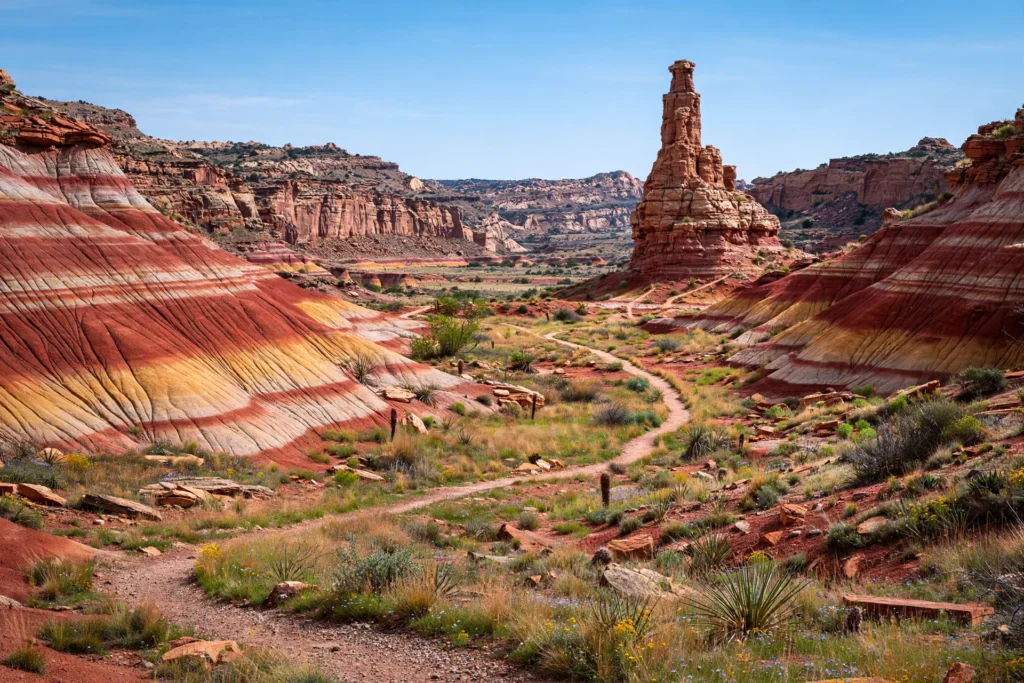
Palo Duro Canyon is the second-largest canyon system in the United States, and it is the place in Texas that most surprises first-timers, because nobody expects a canyon in the flat Panhandle. The Texas Parks and Wildlife Department describes it plainly: the canyon is about 120 miles long, up to 20 miles wide in places, and up to 800 feet deep, cut by the Prairie Dog Town Fork of the Red River into the flat High Plains. The state park sits in the upper canyon, about 30 minutes southeast of Amarillo, and it is a Texas state park, not a national park — your federal America the Beautiful pass does not work here, and the park has its own entrance fee and its own day-use reservation system. Book the day pass in advance for weekends and holidays, because the park can fill up.
What to do there
The signature hike is the Lighthouse Trail, about five and a half to six miles round trip across the canyon floor to the Lighthouse, a 310-foot rock column that is the park’s symbol. It is a beautiful hike and a hot one: there is almost no shade, and the Texas Parks and Wildlife Department warns that most heat-related incidents in the park happen on this trail. Start early, carry more water than you think you need, wear a hat, and turn back if you feel unwell. The drive down into the canyon is an experience in itself — the road drops steeply from the rim to the floor, and the views change with every turn. There are cabins on the canyon rim and campgrounds on the floor, and horseback riding is available in the park. In summer, the outdoor musical drama TEXAS has been performed in the park’s amphitheatre since 1966, telling the story of the Panhandle under the stars. One or two days is enough for Palo Duro: a day for the Lighthouse Trail and the rim drive, and a second for the other trails or a horseback ride. Amarillo is the base, and it is also the gateway to Route 66, which runs through the city — the old highway, the Cadillac Ranch art installation west of town, and the steakhouse culture are all part of the Panhandle trip. Palo Duro is the reason to go to Amarillo. The rest is a bonus.
The Gulf Coast: Padre Island, Corpus Christi and South Padre Island
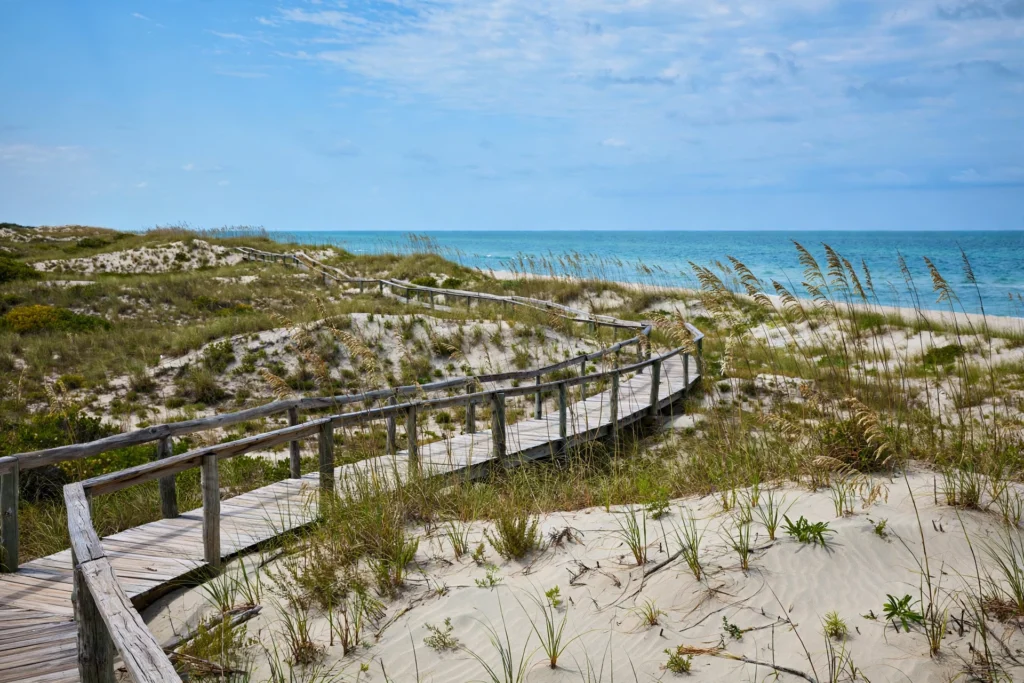
The Texas Gulf Coast is the state’s slow, salty side: long flat beaches, warm water, fishing piers, sea turtles and small beach towns, and it is the best part of Texas for a trip that is mostly about doing very little. There are two Padre Islands, and the distinction matters. Padre Island National Seashore is the long, wild, undeveloped barrier island run by the National Park Service — the longest undeveloped barrier island in the world, about 70 miles of beach, dunes and grassland, with no shops, no hotels and no crowds once you drive past the first few miles. South Padre Island is the resort town at the southern end of the island chain, with hotels, restaurants, water sports and nightlife. Both are worth visiting, and they are not the same trip. Corpus Christi sits between them, on the mainland, and it is the practical base for the National Seashore.
Padre Island National Seashore
Padre Island National Seashore is the natural Gulf Coast, and the competitors all name it as the place to go if you want the coast without the resort. The entrance fee is $10 per vehicle for a day pass, with a seven-day vehicle pass available for $25, and the America the Beautiful pass covers it. The first few miles of beach are the developed part, with a visitor centre, a campground and Malaquite Beach, the main swimming beach. Drive further south on the beach — four-wheel drive is recommended beyond a certain point, and the sand gets soft — and the island empties out into miles of dunes, sea oats and open beach. This is Kemp’s ridley sea turtle country: the National Seashore runs a turtle nesting and release programme, and in the summer months, hatchling releases are held on the beach, open to the public, when nests are ready. Check the park’s Padre Island page for the season’s release schedule, because the dates depend on the turtles, not the calendar. Bring everything you need — water, food, shade, sunscreen — because there is nothing to buy on the island, and check the weather before you drive on the beach, because the sand floods after storms and the park can close sections. Two days is enough: a day on the beach and a day for the turtle programme, the birding, or a slow drive down the island.
Corpus Christi and South Padre Island
Corpus Christi is the mainland city and the practical base: hotels, restaurants, the Texas State Aquarium, and the USS Lexington, the Second World War aircraft carrier moored in the harbour as a museum ship. The Lexington is the city’s best stop — a full day on a carrier, from the flight deck to the engine room — and the aquarium is the best family stop on this coast. South Padre Island, about two and a half hours south of Corpus Christi, is the resort end of the coast: a long beach town with hotels on the sand, dolphin-watching boats, kiteboarding, fishing charters and a lively strip of restaurants and bars. It is busiest in spring break, when the college crowds arrive, and quietest in autumn, when the water is still warm and the town is calm. The sea turtle rescue centre on the island, Sea Turtle Inc., rehabilitates injured turtles and is worth a visit. Choose Corpus Christi and the National Seashore if you want nature and quiet; choose South Padre if you want a resort beach with things to do. Either way, the Gulf Coast is a two- or three-day trip, and it combines well with San Antonio, about two and a half hours to the northwest.
A note on the water
The Gulf of Mexico off Texas is warm, shallow and brownish — the colour comes from the rivers that feed it, not from pollution — and the waves are gentle. That makes it good for families and for swimming, and bad for anyone expecting Caribbean blue water. Seaweed washes up after storms, jellyfish appear in the summer months, and rip currents can form after weather. Swim near the lifeguarded beaches, check the flags, and do not swim after a storm. The Gulf Coast is also hurricane country, and the season runs from 1 June to 30 November, with the peak in August and September. That is covered in the practical section below, but the short version is: watch the National Hurricane Center if you are travelling in late summer, and have a flexible plan.
Guadalupe Mountains: The Highest Point in Texas
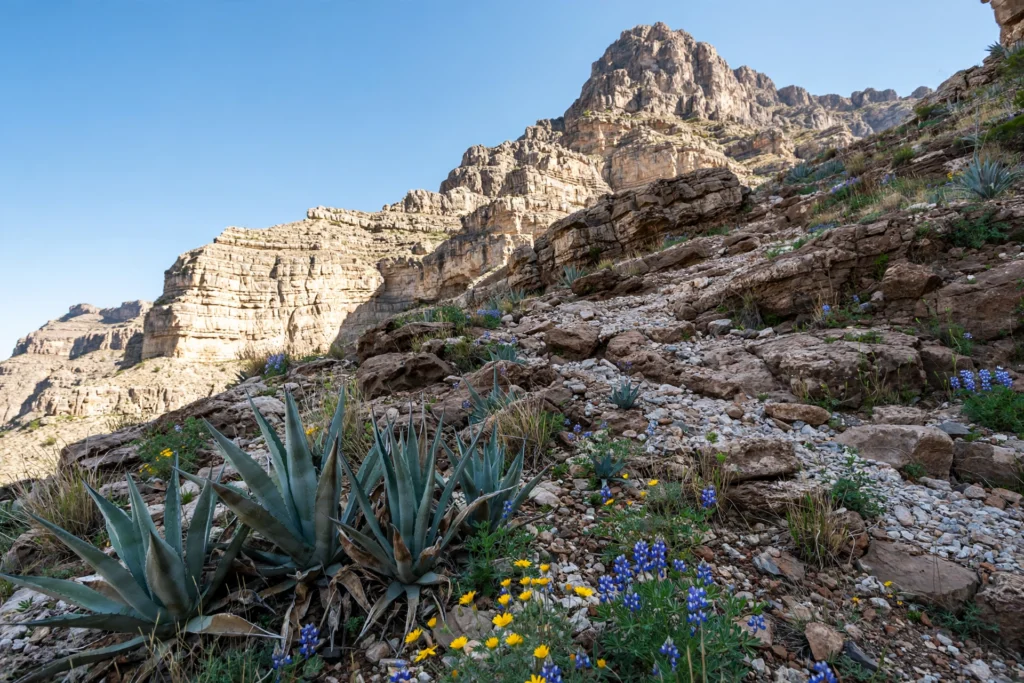
Guadalupe Mountains National Park is the quietest national park in Texas, and the one that hikers love most. It protects the Guadalupe Mountains, an ancient fossil reef that rose out of a Permian sea, and its centrepiece is Guadalupe Peak, at 8,751 feet the highest natural point in Texas. The park is in far West Texas, about two hours east of El Paso, and it is a hiking park, not a driving park: there is no scenic road through it, no lodge, no restaurant, and the rewards are all on foot. That is the appeal. Give it one or two days, and combine it with Big Bend and Marfa on a West Texas trip, or with Carlsbad Caverns, just across the state line in New Mexico, which is about an hour away.
The hike to the top
The Guadalupe Peak Trail is about eight and a half miles round trip, strenuous, with about 3,000 feet of climbing, and it takes most hikers six to eight hours. The reward is the view from the summit: a stainless-steel pyramid marking the highest point in Texas, and a panorama across the desert to El Paso and into New Mexico. Start early, carry at least a gallon of water per person, and check the weather — the peak is exposed, and thunderstorms build fast in the afternoon. If the summit hike is too much, the park has easier options: the McKittrick Canyon trail, which is at its best in late October and November when the bigtooth maples turn red and gold — the best fall colour in Texas — and the short trails to the old stagecoach station at Pine Springs and the desert springs. The entrance fee is $10 per person, and the America the Beautiful pass covers it. There is no camping inside the park except backcountry permits, so most visitors stay in Van Horn or in El Paso and drive in. The Guadalupe Mountains page on nps.gov has the current trail conditions and the entrance details, and it is the place to check before you set out. Guadalupe Mountains is not a park you visit by accident. It is a park you visit because you wanted to stand on the top of Texas, and that is a good enough reason.
Places to Travel in Texas by Trip Type: First-Timer, Family, Nature, Food and Road Trip
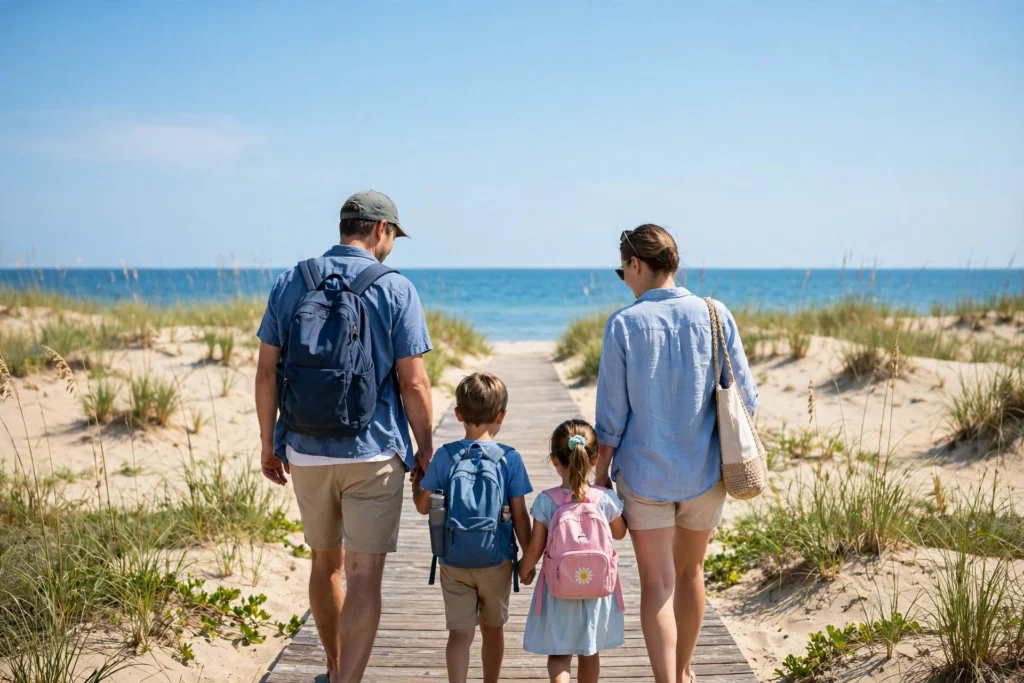
The competitors’ lists are all built the same way — a list of places — and that is their weakness. A list does not tell you which places fit your trip. This section does. Pick your trip type, take the places that match it, and ignore the rest. That is how you build a Texas trip that feels like yours rather than someone else’s list.
| Trip type | Best places | Why they fit | How many days |
|---|---|---|---|
| First-timer | San Antonio, Austin, Hill Country | History, food, music and scenery in one compact cluster | 5–7 days |
| Family with kids | Houston + Galveston, San Antonio, South Padre Island | Space Center, River Walk, beaches, aquariums, short drives | 4–6 days |
| Nature and hiking | Big Bend, Guadalupe Mountains, Palo Duro Canyon | Deserts, canyons, dark skies, the highest point in Texas | 5–7 days |
| Food | Austin, Houston, San Antonio, Fredericksburg | Barbecue, Tex-Mex, food trucks, wine country, diverse cuisines | 4–5 days |
| Road trip | Hill Country loop, West Texas loop, Gulf Coast drive | Open roads, small towns, scenery that changes every hour | 7–10 days |
| Beach and slow days | Padre Island, South Padre Island, Galveston | Long beaches, warm water, fishing, turtle releases | 3–5 days |
| City break | Dallas + Fort Worth, Houston, Austin | Museums, sports, music, restaurants, walkable districts | 2–4 days |
| Budget | San Antonio, Palo Duro Canyon, state parks | Free missions and River Walk, cheap camping, state park passes | 3–5 days |
First-timer: San Antonio, Austin and the Hill Country
If you have one Texas trip, make it this one. Fly into Austin or San Antonio, spend two days in San Antonio — the Alamo, the River Walk, the missions — then drive the 80 miles to Austin for two days of music and food, and finish with a day or two in the Hill Country: Fredericksburg, Enchanted Rock, the wildflowers if it is spring, and a swimming hole if it is summer. The drives are short, the food is the best in the state, and you will have seen the Texas that most visitors fall in love with. Five to seven days, one rental car, and no flight between regions.
Family: Houston, Galveston and San Antonio
Families do best where the drives are short and the attractions are indoors as well as outdoors. Houston and Galveston are the strongest family pair: Space Center Houston, the Children’s Museum, the Museum of Natural Science, Moody Gardens and the beach, all within an hour of each other. Add San Antonio for the River Walk, the barge cruise and the missions — children like the river and the missions more than adults expect — and South Padre Island if you want a proper beach holiday. Keep the driving to under three hours a day, book hotels with pools, and plan one big attraction a day rather than two. Our guide to the best places to travel with a baby covers the same planning habits — short drives, one big stop a day, and hotels chosen for the pool and the location — for the youngest travellers, and the habits work just as well for older children.
Nature: Big Bend, Guadalupe Mountains and Palo Duro
Nature in Texas means desert, canyon and coast, and the best nature trip is a West Texas loop: Big Bend for three or four days, Guadalupe Mountains for one or two, Marfa for a night, and Palo Duro if you can stretch to the Panhandle. This is the trip for hikers and stargazers, and it needs the most preparation: reservations for campsites, water for every hike, offline maps, and a car you trust on long empty roads. The reward is the emptiest, darkest, quietest Texas there is. Go in winter, when the desert is walkable and the skies are clearest.
Food: Austin, Houston and San Antonio
Texas food is barbecue, Tex-Mex, breakfast tacos, Gulf seafood and, increasingly, everything else. Austin is the barbecue and food-truck capital. Houston is the most diverse food city in the state, and the best place to eat Vietnamese, Nigerian, Indian and Mexican food in the same weekend. San Antonio is the Tex-Mex capital, and the Pearl district is the best place to eat well in the city. Fredericksburg is the wine-country stop, with tasting rooms and German food. A food trip is four or five days, and the rule is the same as everywhere: eat where the locals eat, not where the tour buses stop, and do not plan more than two big meals a day.
Road trip: the loops that work
Texas is a road-trip state, and the loops that work are the ones that follow the regions rather than fighting them. The Hill Country loop — Austin, Fredericksburg, Luckenbach, Wimberley, Dripping Springs, back to Austin — is a three-day drive with a stop every hour. The West Texas loop — El Paso, Guadalupe Mountains, Marfa, Big Bend, Terlingua — is a five- to seven-day drive through the emptiest part of the state, and the one that feels most like a road trip. The Gulf Coast drive — Houston, Galveston, Corpus Christi, Padre Island, South Padre — is a four-day drive along the water. In all three, the rule is the same: no more than three or four hours of driving a day, a base for two nights wherever you can, and a full tank before every long stretch. Buc-ee’s, the giant Texas travel centres with the beaver logo, are a road-trip institution — enormous, clean, and full of snacks and barbecue — but treat them as a road-trip stop, a place to fill up, use the restroom and stretch your legs, not as a destination in themselves. The destination is the place at the end of the road.
How Long to Spend in Texas and How to Get Around: Drive Times Between the Regions
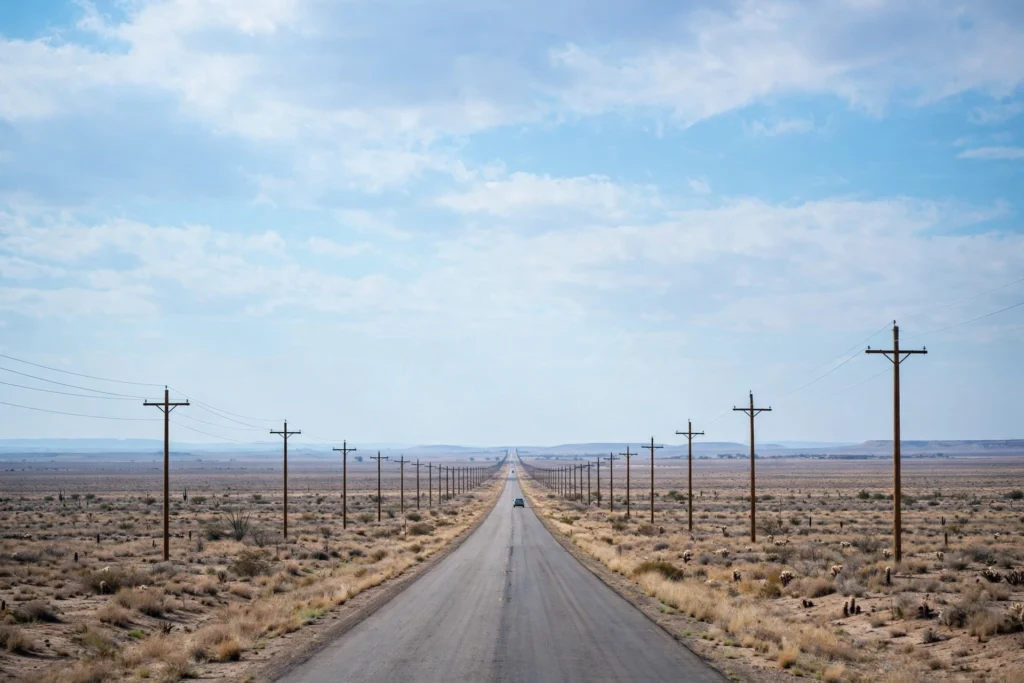
How long do you need for Texas? The honest answer is that a week is the minimum for a real trip, ten days is comfortable, and two weeks is what it takes to see more than one region properly. A long weekend — three or four days — is enough for one city pair: San Antonio and Austin, or Dallas and Fort Worth, or Houston and Galveston. A week covers one region well: the Hill Country and the central cities, or the Gulf Coast, or West Texas. Ten days covers two regions, if you fly into one and out of the other, or if you accept a long drive between them. Two weeks is the trip that takes in the centre and the west, or the centre and the coast, without rushing. Do not plan a week that includes San Antonio, Big Bend and Palo Duro. That is three regions, two of them seven hours apart, and the trip will be spent on the highway.
Drive times between the regions
The table below gives approximate driving times without stops, before traffic, on the highways. Texas highways are good and fast — the speed limit is 75 mph on many rural stretches, and 80 or 85 mph on some West Texas highways — but the distances are so long that even fast roads take hours. Treat these as planning figures, not promises: roadworks, weather and Austin traffic all add time.
| Route | Distance | Driving time (approx.) |
|---|---|---|
| Austin to San Antonio | ~80 miles | ~1.5 hours |
| Dallas to Fort Worth | ~30 miles | Under 1 hour |
| Houston to Galveston | ~50 miles | ~1 hour |
| Houston to Austin | ~165 miles | ~3 hours |
| Dallas to Austin | ~200 miles | ~3.5 hours |
| San Antonio to Corpus Christi | ~145 miles | ~2.5 hours |
| Austin to Big Bend (Terlingua) | ~340 miles | ~6.5–7 hours |
| Dallas to Big Bend (Terlingua) | ~450 miles | ~8–9 hours |
| Houston to Big Bend (Terlingua) | ~550 miles | ~9–10 hours |
| El Paso to Guadalupe Mountains | ~100 miles | ~2 hours |
| El Paso to Marfa | ~200 miles | ~3 hours |
| Amarillo to Palo Duro Canyon | ~30 miles | ~30–40 minutes |
| Austin to Palo Duro Canyon | ~350 miles | ~5.5–6 hours |
| El Paso to the Louisiana border | ~880 miles | ~10–12 hours |
Getting around: cars, flights and the practical details
A rental car is the default for Texas, and the practicalities are simple. Book the car with the flight, because walk-up prices at Texas airports are high and the car classes sell out in spring and around festivals. A standard sedan is enough for the cities, the Hill Country and the Gulf Coast. For Big Bend and Padre Island’s backcountry beach, a high-clearance vehicle is more comfortable, but the main park roads and the first miles of the beach are passable in a normal car. Fuel is cheaper than in most of the United States, and the stations are frequent on the highways and rare in the desert — the rule is to fill up at half a tank, not at empty, in West Texas. Toll roads exist around Austin, Dallas and Houston, and the rental car companies will charge you for them, often with a fee on top, so ask about the toll policy when you collect the car. Parking is easy and usually free outside the downtown cores; in downtown Austin, San Antonio and Houston, use a garage rather than hunting for street parking.
Flying between regions is possible — Dallas, Houston, Austin, San Antonio, El Paso and Amarillo all have airports, and there are flights between them — but it rarely saves time once you count the airport hours, and it leaves you without a car at the other end. The one case where it makes sense is the West Texas trip: fly into El Paso, rent a car there, and drive to Guadalupe Mountains, Marfa and Big Bend, rather than driving seven hours from Austin. For the rest, drive. The driving is the trip.
Three itineraries that work
A 5-day first-timer trip: fly into San Antonio, two days there, drive to Austin for two days, and a day in the Hill Country before flying out of Austin. A 7-day West Texas trip: fly into El Paso, a day in Guadalupe Mountains, a night in Marfa, three days in Big Bend, and a night in Terlingua before driving back to El Paso. A 7-day Gulf Coast and central trip: fly into Houston, two days in Houston and Galveston, drive to San Antonio for two days, and finish with two days in Austin and the Hill Country. Our travel itinerary template shows how to turn any of these into a day-by-day plan with the same method this site uses for every destination. Whichever you choose, build in a slow day. Texas is a state that punishes a packed schedule and rewards a spare afternoon.
The Best Time to Visit Texas: A Month-by-Month Guide
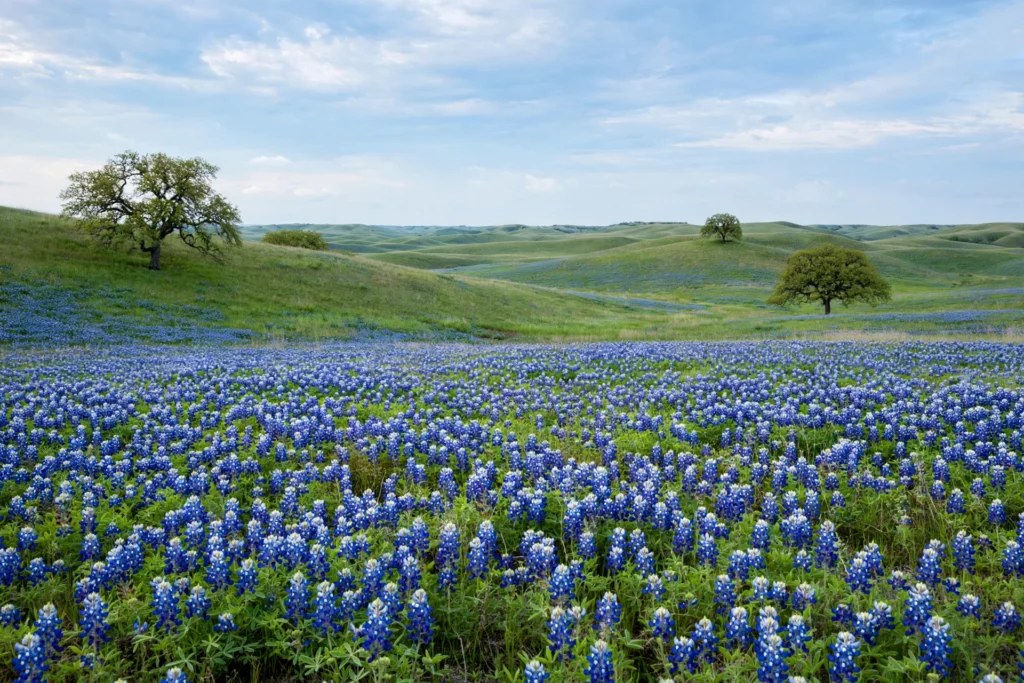
There is no single best month for Texas, because the state has several climates and they peak at different times. The shape of the year is simple: spring and autumn are the best months for the cities and the Hill Country, winter is the best for the desert west, and the Gulf Coast is best in late spring and early autumn, between the cold fronts and the hurricane peak. Summer is the hardest season everywhere except the coast, and it is the season most visitors arrive in, because it is when the school holidays are. The table below sets out the trade-offs so you can choose your month for your region.
| Month | Weather | Best for | Watch out for |
|---|---|---|---|
| January | Cool, 50s–60s°F in the south, colder in the north and west | Big Bend, desert hiking, city breaks, low prices | Cold fronts, short days, some Hill Country closures |
| February | Cool, warming, wildflowers starting | Big Bend, early wildflowers, city breaks | Cold fronts, changeable weather |
| March | Mild, 70s°F, wildflowers beginning | Hill Country, Austin (SXSW), San Antonio, best all-round month | SXSW crowds and prices in Austin, spring break on the coast |
| April | Warm, wildflower peak, long days | Bluebonnets, Hill Country, wineries, festivals | Thunderstorms, spring break crowds early in the month |
| May | Warm to hot, long days | Hill Country, Gulf Coast, swimming holes, best late-spring month | Thunderstorms and flash flooding, heat building |
| June | Hot, humid on the coast, dry heat in the west | Gulf Coast beaches, early summer trips, long days | Heat, hurricane season begins 1 June, crowds |
| July | Very hot, humid, 90s–100s°F | Gulf Coast, swimming holes, water parks | Dangerous heat inland, afternoon storms, hurricane season |
| August | Hottest month, humid | Gulf Coast, water activities, indoor attractions | Peak heat, peak hurricane season, school holidays |
| September | Hot but easing, warm water | Gulf Coast, Big Bend (late month), fewer crowds | Peak hurricane season, heat lingering |
| October | Mild, 70s–80s°F, fall colour in the mountains | Best all-round month, Austin City Limits, Guadalupe fall colour | Occasional cold fronts, ACL crowds in Austin |
| November | Cool, pleasant, clear desert skies | Big Bend, Marfa, Guadalupe fall colour, city breaks | Cold fronts, short days, Hamilton Pool water often closed |
| December | Cool, mild in the south, cold in the west | Big Bend, city lights, low prices, quiet parks | Cold fronts, short days, some attractions on winter hours |
Spring: March to May, the best season
Spring is the best season for most of Texas. The wildflowers peak from late March to mid-April, the temperatures are in the 70s, and the Hill Country is at its prettiest. March is the best all-round month for a first trip, with the one caveat that South by Southwest in Austin pushes hotel prices up sharply, and spring break fills the Gulf Coast resorts. April is the wildflower month, and the best time for the Hill Country drive. May is warmer and the swimming holes are at their best, but the thunderstorms arrive, and with them the flash flooding that Texas is known for. Spring is also the season of the blue norther — the cold front that drops the temperature by twenty or thirty degrees in a day — so pack a layer even in April.
Summer: June to August, the hardest season
Summer in Texas is hot, and the heat is not a detail, it is the trip. Inland, the desert floor in Big Bend regularly tops 100°F (38°C), and the cities sit in the high 90s with humidity on the coast. Hiking in the middle of the day is dangerous in the desert and unpleasant everywhere else, and the heat catches visitors who are used to dry heat or no heat at all. That said, summer is the season for the Gulf Coast and the swimming holes, and it is when the long days and the school holidays make a family trip possible. If you go in summer, plan around the heat: outdoor things in the morning, air conditioning and water in the afternoon, and evenings outside. Drink water constantly, wear a hat, and take the heat warnings seriously — heat exhaustion is the most common reason visitors end up in a Texas emergency room in summer, and it is entirely preventable.
Autumn: September to November, the second best season
Autumn is the second-best season for Texas, and the best for the desert west. October is the best all-round month after March: the heat has broken, the skies are clear, Austin City Limits fills the city with music, and the bigtooth maples in McKittrick Canyon turn red and gold. November is the best month for Big Bend and Marfa, when the desert days are mild and the nights are cold and clear for stargazing. The caveat is hurricane season, which runs to 30 November, and the peak of it is August and September — so an early autumn Gulf Coast trip needs a weather watch, and a late autumn one does not.
Winter: December to February, the desert season
Winter is the best season for Big Bend and the desert west, and the cheapest season for the cities. The desert days are mild, the nights are cold, the skies are the clearest of the year, and the parks are quiet. The cities are pleasant, with temperatures in the 50s and 60s, and the Christmas lights in San Antonio and Austin are worth seeing. The caveat is the cold front: a blue norther can drop the temperature below freezing overnight, and the Hill Country and the Panhandle can see ice and even snow. Winter is not the season for the swimming holes — the water is cold, and Hamilton Pool’s water is often closed in winter and spring — and it is not the season for the Gulf Coast beaches, which are quiet and grey. But for a desert trip, winter is the season. Our guide to the best places to travel in January covers winter travel planning in the same practical style if you are leaning toward a cold-weather trip.
Where to Stay in Texas: Where to Base Yourself in Each Region
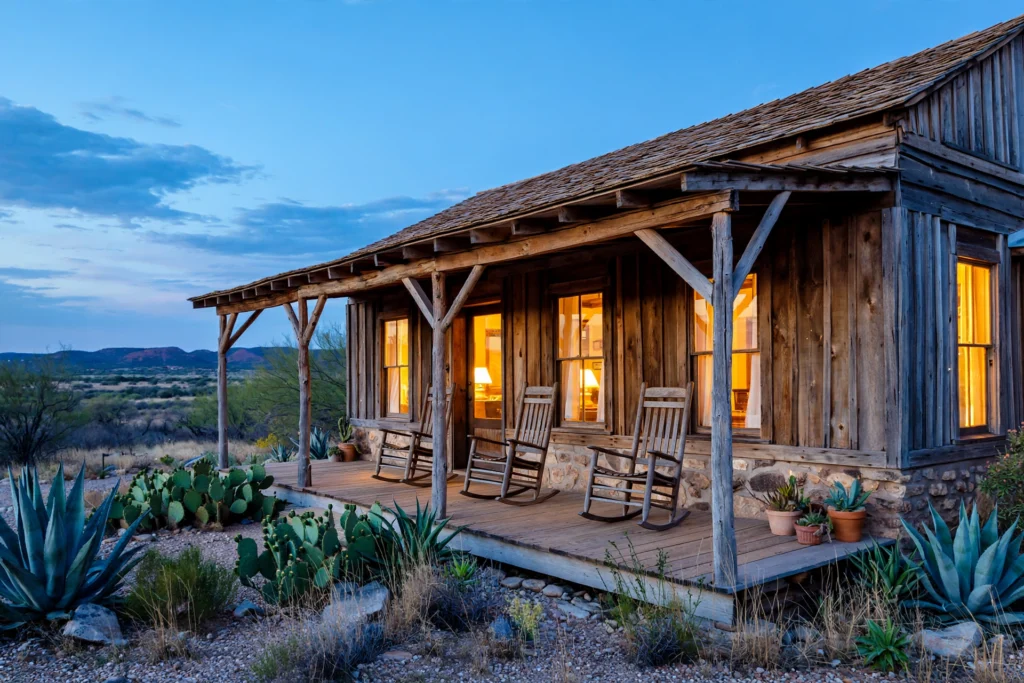
Texas accommodation is straightforward, and the rule is the same as the driving rule: base yourself in the region, not between regions. A hotel halfway between Austin and Big Bend is not a base; it is a petrol station with a bed. The table below gives the base for each region, what to stay in, and what to expect.
| Region | Base yourself in | Stay in | Why |
|---|---|---|---|
| San Antonio | River Walk or the Pearl | Hotel or apartment | Walk to the Alamo, the river and dinner |
| Austin | South Congress, downtown or East Austin | Hotel or apartment | Walk to music, food and the lake trail |
| Hill Country | Fredericksburg or Dripping Springs | Inn, B&B or cabin | Central for wineries, Enchanted Rock and swimming holes |
| Houston | Museum District or downtown | Hotel | Museums, food and the Space Center drive |
| Galveston | The Strand or the Seawall | Hotel or beach rental | Walk to the Strand, the beach and the pier |
| Dallas–Fort Worth | Fort Worth Stockyards or downtown Dallas | Hotel | Atmosphere in Fort Worth, museums in Dallas |
| Big Bend | Terlingua, Study Butte or inside the park | Lodge, cabin or campsite | Closest to the park; book months ahead |
| Marfa | Marfa itself | Small hotel or casita | The town is the experience; stay in it |
| Guadalupe Mountains | Van Horn or El Paso | Hotel | Nearest towns with services; drive in for the day |
| Palo Duro Canyon | Amarillo or Canyon | Hotel or park cabin | Amarillo for services, cabins for the canyon rim |
| Corpus Christi / Padre Island | Corpus Christi or Port Aransas | Hotel or beach rental | Base for the National Seashore and the city |
| South Padre Island | South Padre Island | Beach hotel or condo | On the sand, walk to restaurants and the beach |
Hotels, cabins, camping and the booking windows
Texas has every kind of stay, and the choice is mostly about the region. In the cities, hotels are the default, and the downtown and neighbourhood hotels are worth the premium over the highway motels, because they put you where the food and the music are. In the Hill Country, the inns and bed-and-breakfasts in Fredericksburg and Dripping Springs are the best stays, and the cabins and guest ranches are the best for families. In Big Bend, the Chisos Mountains Lodge inside the park is the only lodge, and it books up months ahead for the winter season — if it is full, the cabins and motels in Terlingua and Study Butte are the next best thing, and they have the desert atmosphere the park does not. Camping is the cheapest roof in the parks: Big Bend’s campgrounds need reservations through Recreation.gov and sell out for the winter months, Palo Duro has campgrounds on the canyon floor and cabins on the rim, and the Texas state parks have campsites and cabins across the state. The Texas State Parks Pass covers day entry to the state parks, but it does not cover camping, and it does not work at the national parks. Book the popular places early: Austin in March for South by Southwest and in October for Austin City Limits, Big Bend from November to April, and the Gulf Coast for spring break. Outside those windows, Texas is an easy state to book late.
What a day in Texas costs
Texas is a mid-priced American destination: cheaper than New York or California, more expensive than the rural Midwest, and the cost depends more on where you stay than on where you go. The table below gives planning ranges per person per day, excluding flights, for 2026. Prices move with the season — Austin in March and Big Bend in January are the expensive windows — so use these ranges to build your trip total and check live prices before you book. Our guide on how to prepare a travel budget shows how to build these lines into a trip total.
| Daily cost for one person | Budget | Mid-range | Comfortable |
|---|---|---|---|
| Accommodation (hostel / hotel / lodge) | $50–$80 | $120–$200 | $200–$350 |
| Food (self-catering / café + restaurant / restaurants) | $30–$50 | $60–$100 | $100–$160 |
| Car + fuel (shared over the trip) | $40–$60 | $60–$90 | $90–$140 |
| Activities (one paid entry or tour per day, averaged) | $15–$30 | $30–$60 | $60–$120 |
| Local transport / parking / misc | $5–$15 | $10–$20 | $15–$30 |
| Total per day (excluding flights) | $140–$235 | $280–$470 | $465–$800 |
Read the table with the regions in mind. The budget column assumes a hostel or a cheap motel, self-catering or food trucks, and a shared car — it is realistic in San Antonio and the Panhandle, and hard in Austin in March. The mid-range column is the realistic figure for most travellers: a decent hotel, a café lunch and a restaurant dinner, a rental car, and one paid attraction a day. A 7-day mid-range trip is roughly $1,960 to $3,290 excluding flights. The comfortable column is a good hotel, restaurants, and two paid activities a day. The cheapest way to cut the cost is to stay outside the downtown cores, eat at food trucks and taco stands, and use the free attractions — the missions, the River Walk, the parks, the beaches — which are some of the best things in the state anyway.
What to Know Before You Go: Heat, Storms, Water and Practical Tips
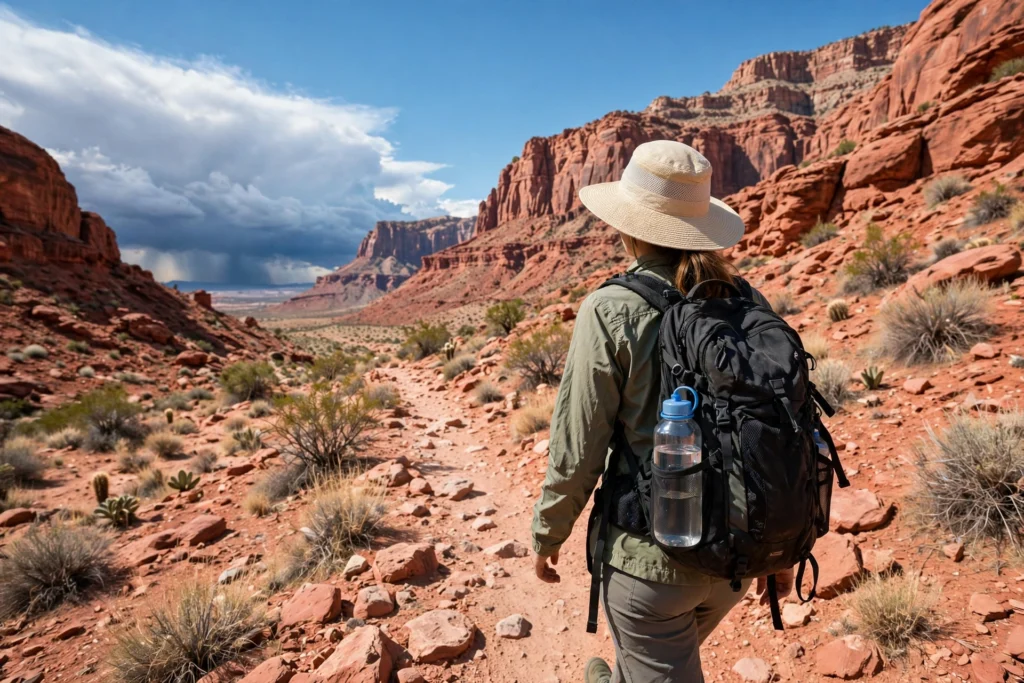
Texas is a safe and easy state to travel in, and the things that catch visitors out are the weather and the distances, not crime. This section is the practical checklist: the heat, the storms, the water, the driving and the documents, in one place.
Heat
Heat is the biggest safety issue in Texas, and it is the one visitors underestimate most. The desert floor in Big Bend regularly tops 100°F (38°C) in summer, and the cities sit in the 90s with humidity that makes it feel worse. Heat exhaustion and heatstroke are real risks, and they happen to fit, young visitors as well as older ones. Drink water constantly — at least a gallon a person a day when hiking — wear a hat and sunscreen, hike early in the morning and rest in the middle of the day, and never leave children or pets in a parked car. If you feel dizzy, nauseous or confused, stop, get into the shade, drink water, and seek help. The park rangers in Big Bend and Palo Duro see heat illness every summer, and most of it is preventable. The same advice applies to the Hill Country trails and the Guadalupe Peak hike: start early, carry more water than you think you need, and turn back if the heat wins.
Storms, hurricanes and flash flooding
Texas has three storm risks, and they belong to different seasons and different regions. Thunderstorms and flash flooding are a year-round risk, and they are worst in spring and autumn in Central Texas. The Hill Country is known as Flash Flood Alley, and the rule is absolute: never drive through flooded water, never walk into a flooded low-water crossing, and never camp in a dry creek bed. Six inches of moving water can knock you down; a foot of it can carry a car away. Turn around, don’t drown — it is the state’s own advice, and it is worth remembering. Hurricanes are a Gulf Coast risk, and the Atlantic hurricane season runs from 1 June to 30 November, with the peak in August and September. If you are travelling on the coast in late summer, watch the National Hurricane Center and have a flexible plan — a hurricane does not need to hit your town to close the roads and the beaches. Winter cold fronts, the blue northers, are the third risk: they can drop the temperature by twenty or thirty degrees in a day, bring ice to the Hill Country and the Panhandle, and close roads. Check the forecast every morning, and take the warnings seriously.
Water
Water in Texas is a pleasure and a risk in the same breath. The swimming holes are cold — Barton Springs stays around 68°F (20°C) all year, and Hamilton Pool drops below 50°F in winter and spring — and cold water shocks the body, so ease in rather than jumping. The rivers and creeks rise fast after rain, and the currents are stronger than they look. The Gulf is warm and shallow, but rip currents form after storms, and jellyfish appear in summer. Swim near lifeguarded beaches, check the flags, and do not swim alone in remote water. And never assume a swimming hole is open: Hamilton Pool’s water is decided day by day from bacteria levels and recent rain, and it is frequently not allowed, as the section above explains. The same is true of the other reservation swimming holes in summer — a reservation gets you into the preserve, not necessarily into the water.
Driving and documents
Texas is a driving state, and the driving rules are the ones that surprise visitors. The speed limits are high on rural highways, and the distances are long, so fatigue is a real risk — plan no more than four hours of driving a day, and stop every two hours. The highways are good, but the farm-to-market roads in West Texas are narrow and empty, and wildlife — deer, javelinas, roadrunners — crosses them at dawn and dusk. Fill the tank at half, not at empty, in West Texas, and download offline maps before you leave the cities, because cell service disappears in the desert and the canyons. For documents, Texas is in the United States, so American citizens need no passport and no visa, and international visitors need the same visa or ESTA they need for the rest of the United States. The one exception is the Boquillas crossing from Big Bend into Mexico, which needs a valid passport and has limited hours. There is no State Department travel advisory for Texas or for any American state — the State Department issues advisories for other countries, not for the United States — so there is no advisory level to cite, and any site that claims one is inventing it. Travel insurance is still worth having: medical care is expensive, and a rescue from a remote desert trail is not cheap.
A packing checklist for Texas
- Water and a reusable bottle. Carry more than you think you need, and refill whenever you see a tap.
- Sun protection. Sunscreen, a hat, sunglasses, and light long sleeves for the desert.
- Layers. A warm layer for desert nights and cold fronts, even in summer — Big Bend nights are cold.
- Sturdy shoes. Hiking boots or sturdy trainers for the trails, and sandals for the beach and the swimming holes.
- A swimsuit and a towel. For the swimming holes, the pools and the Gulf.
- A portable phone charger. Cold and heat both drain batteries, and you will use your phone for maps and photos.
- Offline maps. Download them before you leave the cities — our travel apps guide covers the ones that work without signal.
- Cash. Most places take cards, but the small towns, the food trucks and the park gates are easier with cash in hand.
- Insect repellent. Mosquitoes are a real presence on the Gulf Coast and in East Texas in summer.
Frequently Asked Questions About Places to Travel in Texas
What are the best places to travel in Texas for a first visit?
San Antonio, Austin and the Hill Country, in that order. San Antonio has the Alamo, the River Walk and the missions; Austin has the music, the food and the river; and the Hill Country has the wildflowers, the wineries and the swimming holes. The three sit within 80 miles of each other, so you can see them all in five to seven days with short drives and no flights between regions.
How many days do you need for Texas?
A long weekend — three or four days — is enough for one city pair, such as San Antonio and Austin or Houston and Galveston. A week covers one region well. Ten days covers two regions. Two weeks is what it takes to see the centre and the west, or the centre and the coast, without rushing. Do not plan a week that includes San Antonio, Big Bend and Palo Duro — the drives between them eat the trip.
What is the best time to visit Texas?
March to May and October to November are the best months for the cities and the Hill Country. November to April is the best for Big Bend and the desert west. April to June and September to October are the best for the Gulf Coast. Summer is the hardest season inland because of the heat, and the hurricane season on the coast runs from 1 June to 30 November.
Do I need a car to travel in Texas?
For most of the state, yes. The cities have some public transport, and you can do a San Antonio or Austin city break without a car if you stay central, but the Hill Country, Big Bend, Palo Duro, Guadalupe Mountains and Padre Island are all car trips. There is no train that joins the regions up. Fly into the airport nearest your region, rent the car there, and return it there.
Is Big Bend National Park open in 2026?
Yes. Big Bend National Park is fully open to visitors. A two-year closure of the Chisos Basin, announced to begin in May 2026 to rebuild the Chisos Mountains Lodge, will not proceed as planned — the National Park Service cancelled the project because of design complexity, delays and a budget shortfall, and the Chisos Basin, the lodge, the campground and the trails remain open. The Park Service plans to reissue a contract for the water system alone, with no schedule announced. Check the park’s alerts page before you go, because desert roads can close after storms.
Can you swim at Hamilton Pool?
Sometimes, and never guaranteed. Hamilton Pool Preserve is reservation-only every day of the year, and swimming is decided day by day from bacteria levels and recent rain. As of 18 November 2026, the official Travis County page says water access is currently not allowed, because of recent rain and high bacteria, with the earliest date swimming might be allowed given as Friday, 20 November — and even when it is allowed, only a very limited part of the pool is open because of falling rocks. A reservation gets you into the preserve, not into the water. Check the county’s information line on 512-854-2581, updated at 8:30 a.m. daily, on the morning you go.
Is Texas good for families?
Yes — it is one of the best family states in the US. Houston and Galveston are the strongest family pair, with Space Center Houston, the Children’s Museum, Moody Gardens and the beach within an hour of each other. San Antonio works well for families too, with the River Walk, the barge cruise and the missions, and South Padre Island is the best resort beach for a family holiday. Keep the driving under three hours a day and plan one big attraction a day.
Is Texas safe to visit?
Yes, with the usual big-city care. Texas is a safe state to travel in, and the risks that catch visitors are the weather and the distances, not crime. Stay in well-lit, busy areas at night in the big cities, use rideshares after dark, keep valuables out of sight in a parked car, and take the heat, the storms and the flash flooding seriously. There is no US State Department travel advisory for Texas or for any American state — the State Department issues advisories for other countries, not for the United States.
Do you need a passport to travel to Texas?
No, if you are an American citizen travelling within the United States — Texas is a domestic trip, and no passport is needed. International visitors need the same visa or ESTA they need for the rest of the United States. The one exception is the Boquillas crossing from Big Bend into Mexico, which needs a valid passport and has limited hours.
What is the best place in Texas for nature?
Big Bend National Park, for desert, river canyons and dark skies; Palo Duro Canyon, for the second-largest canyon in the United States; Guadalupe Mountains, for the highest point in Texas; and Padre Island National Seashore, for the longest undeveloped barrier island in the world. A West Texas loop that takes in Big Bend, Guadalupe Mountains and Marfa is the best nature trip in the state, and it needs five to seven days.
How much does a trip to Texas cost?
As a planning range per person per day, excluding flights: roughly $140–$235 on a budget, $280–$470 mid-range, and $465–$800 comfortable. A 7-day mid-range trip is roughly $1,960 to $3,290. The biggest cost is accommodation, and the cheapest way to cut it is to stay outside the downtown cores, eat at food trucks and taco stands, and use the free attractions — the missions, the River Walk, the parks and the beaches.
What should I pack for Texas?
Water and a reusable bottle, sun protection, layers for desert nights and cold fronts, sturdy shoes for the trails, a swimsuit for the swimming holes and the Gulf, a portable phone charger, offline maps downloaded before you leave the cities, cash for small towns and food trucks, and insect repellent for the Gulf Coast and East Texas in summer.
Conclusion: Texas Rewards the Traveller Who Picks a Region and Stays There
Texas is too big to see in one trip, and that is not a problem to solve — it is the point of the place. The travellers who love Texas are the ones who pick a region, base themselves well, and let the state come to them: a slow week in San Antonio, Austin and the Hill Country, with music at night and wildflowers in the day; a West Texas loop through Big Bend, Marfa and the Guadalupe Mountains, with dark skies and long empty roads; a Gulf Coast week of beaches, sea turtles and slow mornings in Corpus Christi and South Padre. The travellers who do not love Texas are the ones who try to see it all, and spend the holiday on the highway between places that deserved a day each.
So pick your cluster. If it is your first trip, pick San Antonio, Austin and the Hill Country. If it is your second, pick the West Texas desert. If it is a family trip, pick Houston and Galveston. Book the car, book the campsites and the swimming-hole reservations early, check the official pages for Big Bend and Hamilton Pool before you go, and pack for the heat and the cold front in the same bag. Texas will do the rest: the food, the music, the rivers, the canyons, the beaches and the night sky are all there, and they have been waiting for you to stop driving and start looking.
People also read:
- Is It Safe to Travel to Chicago Right Now? An Honest 2026 Guide
- Best Places to Travel Solo Female in the US
- Best Places to Travel With a Baby
- Yellowstone Travel Guide
- How to Prepare a Travel Budget
- Travel Apps
- Best Places to Travel in January
- Dream Travel Destinations

M. Adil is the founder and editor of SoloTravelPro. He writes practical, research-based travel guides that help travellers plan with confidence — from first-time city breaks to national parks and island escapes. Every guide is built on official sources, current prices and honest, usable advice, so readers can plan smarter and travel better.

Other Articles

How to Become a Travel Agent for Free: The Honest 2026 Guide