What Is a Travel Document Number? Where to Find It on Your Passport, Visa and More
Quick Answer: What Is a Travel Document Number?
A travel document number is the unique number printed on the document you travel on — for most people, that is simply your passport number. When a form, an airline booking or a visa application asks for your “travel document number,” it almost always wants the number on the passport you will use for that trip. It is not your Social Security number, not your visa number, not your I-94 number and not the A-Number on a green card, even though all of those numbers live in the same world of travel paperwork and all of them get confused with each other constantly.
The confusion is understandable, because “travel document number” is a category, not one single number. A passport has one. A visa foil has a different one. A refugee travel document has its own. Your I-94 arrival record has its own 11-character number. The trick is not memorising every format — it is knowing which document the form in front of you is asking about, and then copying the number from exactly that document, exactly as printed, letter for letter and digit for digit.
This guide does that job properly. It explains what a travel document number is and what it is not, shows you where to find the number on every common document — a US passport book, a US passport card, a visa, an I-94 record, a green card, a refugee travel document and a re-entry permit — gives you the formats so you can recognise a number at a glance, and then walks through the four forms travellers actually meet: the DS-160 visa application, ESTA, an airline booking and the CBP I-94 lookup. It also covers the mistakes that cause the most rejections, what to do when a passport is lost, stolen or renewed in the middle of a trip, and how to keep the number safe without handing it to a scammer.
One thing this guide will not do is show you a real passport number. The format examples here use obviously made-up strings such as “X12345678”, labelled as examples. This is general travel information, not legal or immigration advice: for visa refusals, green cards or asylum, the official source for your document type — the State Department, Customs and Border Protection or Citizenship and Immigration Services — is the authority, and a qualified immigration lawyer is the person to ask when the stakes are high.
What Is a Travel Document Number? The Short Answer

A travel document number is the unique identifier printed on a travel document. A travel document is any official credential that authorises you to cross an international border: a passport, a passport card, a visa, a refugee travel document, a re-entry permit or an advance parole document. Each of those documents carries its own number, and that number is how governments, airlines and border systems tell one document from another.
The most important fact about these numbers is that they belong to the document, not to you. Your name, your date of birth and your citizenship stay the same for life. Your travel document number does not. When you renew a passport, the new book gets a completely new number and the old number is retired for good — it can never be reused. When you get a new visa, it has a new visa number. When you enter the United States again, you get a new I-94 number for that entry. The number identifies a single physical document, or a single entry, and when that document or entry is finished, the number goes with it.
That single fact explains most of the mistakes people make. They type an old passport number into a new visa application. They give an airline the number from a passport they have since renewed. They copy the number off a visa foil when the form wanted the passport number. They enter their A-Number — a permanent personal identifier — into a field that wanted the number of the document they travelled on. Every one of those errors is fixable, but some of them are expensive: a wrong number on an ESTA can mean a new application and a new fee, because the passport fields on an ESTA cannot be corrected after submission, and a wrong number on a visa application can mean a delay or a refusal at the interview.
The one-sentence rule
If you remember nothing else from this guide, remember this: when a form asks for your travel document number, give it the number printed on the document you are travelling on. For the overwhelming majority of travellers, that document is a passport, so the answer is the passport number. If you are travelling on a refugee travel document or a re-entry permit instead of a passport, the answer is the number printed on that booklet. If the form is asking about something else — your visa, your I-94 record, your green card — it will say so, usually by naming the document: “visa number,” “I-94 number,” “USCIS number.” Read the label on the field, not the label you expected to see.
The master table: every travel document number in one place
This is the table to bookmark. It covers every document this guide discusses, where its number sits, what the number looks like and which form asks for it.
| Document | Where the number is | Format | Which form asks for it |
|---|---|---|---|
| US passport book (Next Generation, issued 2021 onwards) | Upper-right corner of the photo data page; also perforated at the bottom of every page and in the machine-readable zone | 1 letter + 8 digits (9 characters), e.g. example format “X12345678” | DS-160, ESTA, airline booking, I-94 lookup, most visa applications |
| US passport book (older, issued before 2021) | Upper-right corner of the photo data page; also in the machine-readable zone | 9 digits, no letters | Same as above |
| US passport card | Front of the card, labelled as the card number; also on the back and in the machine-readable zone | Letter “C” + 8 digits (9 characters), e.g. example format “C12345678” | Land and sea travel forms; not valid for international air travel |
| US visa (foil in your passport) | Red number on the visa foil, usually lower right | 8 digits, printed in red | DS-160 (separate “visa number” question), some USCIS forms |
| I-94 Arrival/Departure Record | Not printed in your passport — retrieve it online at the official CBP I-94 website | 11 characters; before May 2019 all digits, since May 2019 nine digits + a letter + a digit | USCIS forms, Social Security and driver’s licence applications, I-485 |
| Green card (Form I-551) — USCIS number / A-Number | Front of the card, labelled “USCIS#” (older cards: “A#”) | Letter “A” + 7 to 9 digits; the USCIS number is the same digits without the “A” | USCIS forms — this is a personal identifier, NOT a travel document number |
| Refugee travel document (Form I-571) | Printed document number on the booklet itself | Varies by booklet | USCIS forms asking for “passport or travel document” |
| Re-entry permit (Form I-327) | Printed document number on the booklet itself | Varies by booklet | USCIS forms asking for “passport or travel document” |
| Global Entry card — PASSID | Back of the card, upper-left corner, labelled “PASSID” | 9 digits | Airline booking “Known Traveler Number” field for TSA PreCheck — NOT a travel document number |
Two rows in that table deserve a warning right now, because they are the two most common mix-ups in the whole subject. The first is the visa number: it is printed in red on the visa foil inside your passport, and it is a different number from your passport number. A form that asks for your travel document number does not want the red number. A form that asks for your visa number does. The second is the A-Number: it is printed on a green card under the label “USCIS#”, it belongs to you as a person rather than to any single document, and it stays with you for life. It is not a travel document number, and entering it where a passport number belongs is one of the most frequent errors on USCIS forms.
Why the number exists at all
Governments need a way to match a person to a document without relying on names, which change, are spelled differently in different alphabets, and can be shared by two people. A document number is unique to one booklet, so when a border officer scans your passport, the system pulls up exactly your record. When a consulate issues a visa, it ties the visa to the passport number, so the visa is only valid in that passport — which is why a new passport usually means a new visa or a new travel authorisation.
Is a Travel Document Number the Same as a Passport Number?

Almost always, yes — but not always, and the exceptions are exactly where people get caught out. For most travellers, in most situations, “travel document number” and “passport number” mean the same thing, because the passport is the travel document they are using. If you hold a passport and a form asks for your travel document number, enter your passport number and move on. The rest of this section is for the cases where that simple answer is wrong.
When they are different
The answer changes when you are not travelling on a passport at all. Three groups of people travel on something else, and for them the travel document number is the number on that something else.
The first group is refugees and asylees who hold a refugee travel document, Form I-571, issued by US Citizenship and Immigration Services after they file Form I-131. That booklet looks something like a passport and functions as one for international travel, and it carries its own printed document number. When a form asks for the travel document number of someone travelling on an I-571, the answer is the number on that booklet — not the person’s A-Number, and not the receipt number from the I-797 approval notice that came with it.
The second group is lawful permanent residents — green card holders — who plan a long trip abroad and obtain a re-entry permit, Form I-327, also issued after filing Form I-131. A re-entry permit is a booklet that lets a permanent resident return to the United States after an extended absence without abandoning their status. It too has its own document number, printed on the booklet, and that number is the travel document number when the person travels on the permit.
In all three cases the rule is the same: the travel document number is the number on the document you are actually travelling on. The A-Number never counts, because it identifies the person, not the document. The USCIS receipt number never counts, because it identifies a filing, not a document. The visa number never counts, because it identifies a permission, not the document that carries it.
The passport book number trap
There is one more distinction that causes real trouble, and it sits inside the DS-160 itself. The DS-160 asks two separate questions that sound almost identical: “Passport/Travel Document Number” and “Passport Book Number.” They are not the same field, and they do not want the same answer.
The passport book number is what the State Department calls an inventory control number — a secondary number that some countries print in their passports and others do not. US passports do not have a separate book number at all. So if you hold a US passport and the DS-160 asks for a passport book number, the correct answer is “Does Not Apply” — the form offers that option precisely for this reason. Do not copy your passport number into the book number field. Entering the same number twice suggests your passport has two distinct numbers when it has only one, and that can cause processing confusion at the consulate.
Travellers from countries whose passports do print a separate book number should enter it, following the guidance of their own passport authority. The point is to read each field on its own terms and to answer the question that is actually being asked, not the one you assume is being asked.
Where to Find Your Travel Document Number on a US Passport
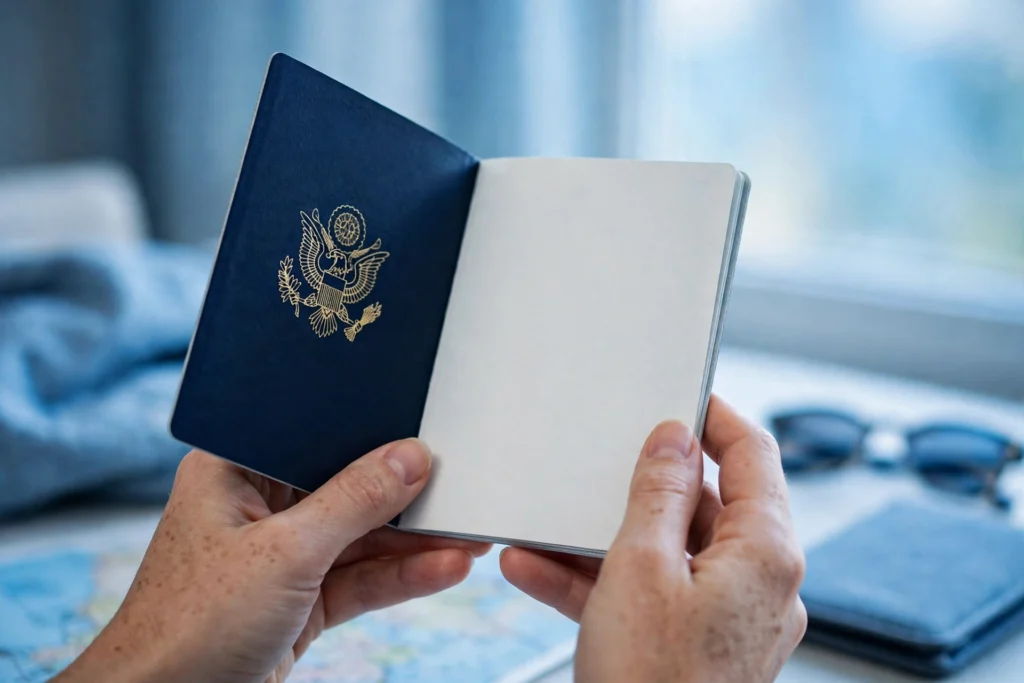
Open your passport book to the biographical data page — the page with your photograph, your name, your date of birth and your nationality. On the current Next Generation passport, that page is a hard polycarbonate page, not paper, with the photograph and details laser-engraved into it. Your travel document number is printed in the upper-right corner of that page. That is the whole answer for most people, and it has been the answer for decades: the number sits in the same place on every US passport book, old or new.
There are three other places the same number appears, and knowing them saves you when the data page is hard to read. On a Next Generation passport book, issued since 2021, the number is perforated through every page of the book — the State Department describes it as “a perforated alphanumeric passport number on every page” — so you can read it from any page you flip to. It also appears in the machine-readable zone at the bottom of the data page, encoded in the two lines of characters that border gates and airline kiosks scan. And on older books it appears in the machine-readable zone as well, even though it is not repeated on every page.
How to read it without mistakes
The two mistakes that cause the most trouble are both about lookalike characters: the letter O and the digit 0, and the letter I and the digit 1. On a Next Generation passport this matters more than it used to, because the number now starts with a letter. If you are unsure whether a character is a letter or a digit, look at the machine-readable zone at the bottom of the data page — it uses a standardised font designed to remove exactly this ambiguity.
A few practical rules for copying the number:
- Copy it exactly as printed, including the leading letter. The letter is part of the number, not a prefix you can leave off. A form that expects nine characters will reject eight, and a system that matches your booking against your passport will fail on a missing letter.
- Do not add spaces or hyphens. Passport numbers contain neither, and adding one can break an automated check.
- Do not guess from memory. Even if you have typed the number a dozen times, check it against the book before you submit a visa application or an ESTA. A single wrong character on an ESTA cannot be fixed after submission — the passport fields are locked — and the only remedy is a new application and a new fee.
- Check the expiry date at the same time. Many countries require your passport to be valid for six months beyond your travel dates, and a number copied from an expired passport is useless even if it is copied perfectly. If you are planning a trip and your passport is close to expiry, renew first and then use the new number everywhere.
What if you cannot find your passport?
There is no online portal where you can look up your own passport number. The State Department does not offer one, and any website that claims to look it up for you is not an official service. If your passport is at home and you are somewhere else, the realistic options are a photograph or photocopy of the data page that you took before you left, a copy held by your travel agent or employer, or the number recorded on a previous visa application, airline booking or ESTA confirmation. That is why this guide recommends, in the safety section below, keeping a secure copy of the data page before every trip — not because the number is secret, but because the number is only printed in one place in the world, and that place is the book itself.
If the passport is lost or stolen, do not go looking for the number first. Report it to the State Department right away — online at travel.state.gov or by calling 1-877-487-2778 — and then deal with the replacement. The section on lost, stolen and renewed passports below covers that process in full.
If you have never held a passport and you are wondering whether you even need one, our guide to places to travel without a passport covers the destinations US citizens can visit with other documents — but for almost every international trip, a passport book is the document you will need, and its number is the travel document number you will use.
What a US Passport Number Looks Like: The Two Formats in Circulation

There are two US passport number formats in circulation right now, and which one you have depends entirely on when your book was issued. Both are valid. Neither is better than the other. But if you do not know which format to expect, your own number can look wrong to you — and that is when people start “correcting” a number that was already right.
The Next Generation format: one letter followed by eight digits
The State Department began issuing the Next Generation passport book in 2021. Its number is a letter followed by eight numbers — nine characters in total. The State Department’s own page on the design of the document says exactly this: the book carries “a perforated alphanumeric passport number on every page, which is a letter followed by 8 numbers.” That page was read live on 18 November 2026, and it is the authoritative source for the format.
An example of the format — and this is an obviously made-up example, not a real number — looks like “X12345678”: one letter, then eight digits. The State Department describes passport numbers as randomly assigned and has not publicly explained what the leading letter signifies, so the letter is not a code for the issuing office, the passport type or anything else you can decode. It is simply part of the number, and it must be included every time you type the number into a form.
The Next Generation book also introduced the polycarbonate data page, laser engraving, updated artwork and security fibres in the paper. The perforated number on every page is a security feature: if a page were swapped, the number would no longer match. For the traveller, the practical benefit is simpler — you can read your number from any page of the book, which helps when the data page itself is worn or hard to read.
The older format: nine digits, no letters
Passports issued before the Next Generation rollout carry a straight nine-digit number with no letters. Those books remain valid for international travel until their printed expiration date, and some of them will not expire until 2030 or later — so both formats will be in circulation for years. If your passport number is nine digits and contains no letter at all, that is not an error and it does not mean your passport is fake or outdated. It means your book was issued before 2021.
The one thing that changes when you renew is the format. A renewal always produces a new book in the current format, so renewing an older all-numeric passport gives you a new number in the letter-plus-eight-digits format. That is normal, and it is another reason to update every booking, visa and travel authorisation after a renewal — the number has changed, and the format has changed with it.
How long is a passport number?
Nine characters, in both formats. That is close to a global norm, because the International Civil Aviation Organization’s standard, Doc 9303, allocates nine positions for the document number in the machine-readable zone. Other countries fill those nine positions differently, but the nine-position frame is consistent. If a form tells you to enter a nine-character document number and yours is shorter, check whether you are looking at the right document: a passport card number, a visa number and an I-94 number all have different lengths, and a number that is too short is usually a number from the wrong document.
The number changes every time you renew
This is worth stating plainly, because it surprises people every year. Every new passport book gets a completely new number. The State Department confirms that the number on a renewed passport will be different from the one on the previous book, and the old number is permanently retired — it can never be reused. The number belongs to the physical booklet, not to you as a person.
That matters in three everyday situations. First, if you booked flights or applied for a visa under the old number and then renewed, update the booking and the visa or travel authorisation — immigration systems match your entry documents against the passport you physically present. Second, an ESTA is tied to the passport number it was issued against: a new passport means a new ESTA application. Third, keep a copy of the old data page when you renew, because you may need the old number later and there is no portal that will give it back to you.
Where to Find the Number on a US Passport Card

A US passport card is a wallet-sized card, roughly the size of a driver’s licence, first issued in 2008. It is a real passport document — it confirms both your identity and your US citizenship, and it is REAL ID compliant — but it is not a passport book, and its number is not your passport book number. If you hold both a book and a card, you have two different travel document numbers, and using the wrong one is a common and entirely avoidable error.
The format
A passport card number begins with the letter C followed by eight digits — nine characters in total. An example of the format, again obviously made up and not a real number, looks like “C12345678”. The “C” is part of the number, and it must be included whenever you enter the card number on a form.
Where it is printed
The card number is printed on the front of the card, labelled as the card number, alongside your name, date of birth and nationality. It also appears on the back of the card — once in raised, tactile print next to the eagle graphic, and once in the machine-readable zone along the bottom edge. If the front of the card is worn, the back is your second source, and the machine-readable zone is the most reliable of all, for the same reason it is on the book: it uses a standardised font that removes the letter-versus-digit ambiguity.
What the card is — and is not — good for
This is the part that matters most, because the card’s limits are easy to misunderstand. A passport card is valid for travel by land and by sea between the United States and Canada, Mexico, Bermuda and some Caribbean destinations. It is not valid for international travel by air. You cannot fly to another country on a passport card, and you cannot use a card number in place of a passport book number on an airline booking for an international flight.
So when a form asks for your passport number and you are flying internationally, it wants the book number — the number from the passport book, not the card. When a form asks for your travel document number for a land or sea crossing to Canada or Mexico, and you are travelling on the card, the card number is the right answer. The rule, as always, is to give the number of the document you are actually travelling on.
The card also has a practical advantage at land borders: it carries an RFID chip, and it lets you use the Ready Lanes at US land border crossings, where you display the card to in-lane RFID readers before reaching a customs officer. That is a convenience, not a separate number — the number is the same C-plus-eight-digits string wherever you use it.
Where to Find Your Travel Document Number on a Visa
A visa is a permission, not a travel document in the passport sense — but it is a document with its own number, and that number has its own place and its own purpose. The most important thing to understand about a visa number is that it is not your travel document number. The two numbers sit in the same passport, sometimes on facing pages, and they get swapped constantly.
The visa number
A US visa is a foil — a sticker — pasted into your passport. Its number is printed in red, usually in the lower right of the foil, and it is eight digits long. That red number is the visa number. It identifies the visa itself: the permission to seek entry to the United States for a particular purpose and period. It is the number a consulate will ask about if there is a question about your visa, and it is the number the DS-160 asks for in its separate “visa number” question when you have held a US visa before.
What it is not: it is not the number to enter when a form asks for your travel document number or your passport number. The travel document number on a visa application is the passport number. The visa number is a second, separate field, and most forms that want it will label it explicitly as “visa number.”
Where the passport number sits relative to the visa
Your passport number is on the data page of the passport book. Your visa foil is pasted onto a visa page elsewhere in the book. The two numbers are never the same, and they are never interchangeable. If you are filling in a form and you find yourself copying a red number into a field labelled “passport number” or “travel document number,” stop — you have the wrong number.
A note on e-visas and electronic travel authorisations
Many countries now issue visas electronically, with no foil at all — the permission is linked to your passport number in the destination country’s system. In that case there may be no visa number to find, only an application or reference number on your confirmation email. That reference number is for tracking your application; it is not a travel document number. Your passport number is still the travel document number, and it is the number the electronic visa is tied to — which is why a new passport after an e-visa is issued usually means applying again.
Where to Find Your I-94 Number — and Why It Is Not Your Passport Number

The I-94 is the document that causes the most confusion in this whole subject, and the reason is simple: it is a number that does not live on any document you carry. It lives in a database, and you have to go and fetch it.
What the I-94 is
Form I-94, the Arrival/Departure Record, is the official record of a foreign national’s arrival in, and departure from, the United States. Every time a nonimmigrant enters the United States, US Customs and Border Protection creates an I-94 record showing when they entered, the class of admission (the visa category they were admitted under, such as B-2 or F-1) and how long they are authorised to stay — the “admit until” date. That date, not the visa expiry date, is what controls how long a visitor may legally remain in the country, and it is the single most important field on the record.
Since 30 April 2013, CBP has created I-94 records electronically for air and sea arrivals. There is no paper form to fill in at the airport and nothing to carry away from the inspection booth except the entry stamp in your passport. The record is created automatically from your travel documents and the carrier’s passenger manifest during admission. Land border arrivals are also electronic in most cases today.
The format: 11 characters
Your I-94 number — the admission number — is 11 characters long. The format changed in May 2019. Numbers issued before that date contain only digits. Numbers issued since then follow an alphanumeric pattern: nine digits, then a letter in the tenth position, then a final digit. An example of the current format, again obviously made up, looks like “123456789A1”.
A new I-94 number is generated every time you are admitted. Your old number does not carry over, and the CBP website shows only your most recent I-94 — so download or print a copy after each entry, and keep it with your passport as proof of lawful admission.
How to retrieve it
Go to the official CBP I-94 website at i94.cbp.dhs.gov and select “Get Most Recent I-94/I-95.” The system asks for your family name, first name, date of birth, passport number and country of citizenship, each of which must match your passport’s machine-readable zone exactly — not your memory of how your name is spelled. The lookup takes about two minutes. Print the record or save it as a PDF.
The same site offers a travel history tool that shows your US arrivals and departures over the past ten years, and the free CBP Link mobile app retrieves the same record on your phone. CBP also maintains I-94 records going back to 1983 for most admission classes.
Two timing notes. First, if you entered within the last day or two, your record may not be available yet — allow 24 to 48 hours after arrival. Second, check your departure record after you leave: if CBP’s system has no record of your exit, it may look like an overstay on your next visa application.
Why it is not your passport number
The I-94 number is an admission number: it identifies one entry into the United States. Your passport number identifies one document. They are different numbers, with different lengths (11 characters against 9), different purposes and different sources. The I-94 number is not printed in your passport. A CBP officer stamps your passport with the date and class of admission, but the I-94 record itself — including its 11-character number — lives only in CBP’s database until you retrieve it.
And remember the trap from the earlier section: when you do retrieve the record, you will see a field on it literally labelled “Document Number,” and that field shows your passport number, not the I-94 number. The I-94 number itself is labelled “Admission Number” (also called the departure number or admission record number). If a form asks for your I-94 number, give the 11-character admission number. If it asks for the document number shown on the I-94, give the passport number in that field.
The A-Number and USCIS Number on a Green Card: Numbers That Are Not Travel Document Numbers

If the I-94 is the most confusing number, the A-Number is the most frequently misused one. It appears on the most important card many immigrants carry, it looks like a document number, and it is entered into the travel document number field on USCIS forms more often than any other wrong number. It is not a travel document number, and understanding why will save you from the most common error on the forms that matter most.
What the A-Number is
The A-Number — the Alien Registration Number, also called the Alien Number — is a unique seven- to nine-digit number that the Department of Homeland Security assigns to a noncitizen in the US immigration system. It is written as the letter “A” followed by seven to nine digits. It is assigned to you as a person, and it stays with you for life, regardless of how your immigration status changes. Renewing an expiring green card, replacing a lost one, or changing your status does not generate a new A-Number. That permanence is precisely what makes it different from a travel document number, which belongs to a single document and dies with it.
You will find the A-Number on most official immigration paperwork: on your green card, on your Employment Authorization Document, on immigrant visa stamps and on USCIS notices of action (Form I-797). If your A-Number has fewer than nine digits, you may see a leading zero added after the “A” to pad it out to nine digits.
The USCIS number is the same number
On green cards issued after 10 May 2010, the A-Number is printed on the front of the card under the label “USCIS#”, near your photograph. On older cards it appears under the label “A#” instead. The same number also appears on the back of the card, embedded in the machine-readable zone.
This relabelling is the source of half the confusion. “USCIS number” and “A-Number” are the same number. The USCIS number is the A-Number without the leading “A” — so if your A-Number is A012345678, your USCIS number is 012345678. When a form asks for your “USCIS Number,” enter your A-Number (usually without the “A”, following the form’s own instructions). When a form asks for your “A-Number,” enter the same digits with the “A”. Either way, you are giving a personal identifier, not a travel document number.
The numbers that are not travel document numbers
Here is the whole family of lookalike numbers in one place, so you can check a number against the list before you enter it.
| Number | What it identifies | Where to find it | Is it a travel document number? |
|---|---|---|---|
| Passport number | One passport book | Data page, upper right | Yes — for most travellers, this is the answer |
| Passport card number | One passport card | Front (and back) of the card | Yes — when travelling on the card by land or sea |
| Visa number | One visa (a permission) | Red number on the visa foil | No — it identifies the permission, not the document |
| I-94 admission number | One entry into the US | CBP I-94 website, “Admission Number” | No — it identifies an entry, and it is not printed in your passport |
| A-Number / USCIS number | You, as a person, for life | Green card front, “USCIS#” | No — it is a permanent personal identifier |
| Green card card number | One physical green card | Back of the card, 13 characters | No — it identifies the card |
| USCIS receipt number | One filing | I-797 notice, upper left; 3 letters + 10 digits | No — it identifies a petition or application |
| Global Entry PASSID / Known Traveler Number | Your Trusted Traveler membership | Back of the Global Entry card, upper left; also at ttp.dhs.gov | No — it is a membership number used for TSA PreCheck |
| Social Security number | You, for US tax and benefits purposes | Social Security card | No — never enter it where a travel document number is asked for |
| Application locator number | One passport application while it is being processed | Passport application receipt or confirmation | No — it only matters while the application is pending |
Three rows in that table deserve emphasis. The Social Security number should never be entered into a travel document number field, and no legitimate travel form will ask for it as one. The USCIS receipt number — 13 characters starting with three letters, such as IOE for online filings — identifies a single filing and is used to check case status online. And the Global Entry PASSID, a nine-digit number on the back of your Global Entry card and in your Trusted Traveler Programs account at ttp.dhs.gov, is your Known Traveler Number for TSA PreCheck — a membership number, not a travel document number.
Refugee Travel Documents, Re-Entry Permits and Advance Parole

Not everyone travels on a passport. For refugees, asylees and some permanent residents, the document that authorises international travel is a booklet issued by US Citizenship and Immigration Services, and its number is the travel document number for that trip. This section is short, because the rule is simple — but it matters, because the people it applies to are also the people most likely to be filling in USCIS forms, where the wrong number has the highest stakes.
The three booklets
All three documents are applied for on the same form, Form I-131, the Application for Travel Document. The form itself does not have a field called “travel document number” — it is the form you file to get the document, not a form that asks for the number of one you already hold.
- Refugee travel document (Form I-571). Issued to refugees and asylees. It looks something like a passport and functions as one for international travel, letting the holder leave and re-enter the United States without abandoning their protected status. Its document number is printed on the booklet itself, and that number is the travel document number when the holder travels on it.
- Re-entry permit (Form I-327). Issued to lawful permanent residents who plan a long trip abroad — typically more than a year and less than two — and want to return without abandoning their permanent resident status. It is also a booklet, and it also carries its own printed document number, which is the travel document number for travel on the permit.
- Advance parole document (Form I-512L). Issued to people with a pending adjustment of status application, allowing them to travel abroad and return without invalidating the application. The document number is printed on the face of the document.
In each case, do not enter your A-Number in place of the booklet’s number, and do not enter the receipt number from the I-797 approval notice that arrived with it. The A-Number identifies you. The receipt number identifies the filing. The number printed on the booklet identifies the travel document, and that is the number the form wants.
Where the number is printed
The exact position varies by booklet, but the number is printed on the booklet itself, on the biographical information page. If you cannot find it, check the USCIS instructions for the form you are completing, or ask USCIS directly through the Contact Center at 1-800-375-5283. Do not guess, and do not copy a number from a different document.
A warning about travel on these documents
Travelling on one of these documents is not the same as travelling on a passport, and the consequences of a mistake are higher — a refugee travel document does not guarantee re-entry in every circumstance, and advance parole does not guarantee admission on return. This guide is general travel information, not legal advice. Confirm the rules for your own status with USCIS or a qualified immigration lawyer before booking. The official starting point is uscis.gov, where the Form I-131 instructions set out the current rules.
What to Enter on Each Form: DS-160, ESTA, Airline Bookings and the I-94 Lookup

This is the section most readers came for. Four forms, four answers, and each one is slightly different. Read the row for the form you are holding, and ignore the rest until you need it.
| Form | Field wording | What to enter | Where to find it | What happens if it is wrong |
|---|---|---|---|---|
| DS-160 (US nonimmigrant visa application) | “Passport/Travel Document Number” | The number of the passport or travel document you will use to travel to the US | Data page of your passport book, upper right | The application may be rejected or delayed; the consulate matches the visa to this number |
| DS-160 — second field | “Passport Book Number” | “Does Not Apply” if you hold a US passport (US passports have no separate book number); otherwise the inventory control number, if your country’s passport prints one | Your passport, if it prints one | Entering your passport number here creates a false second number and can cause processing confusion |
| ESTA (Visa Waiver Program) | “Passport Number” | Your passport number, exactly as printed, including the leading letter | Data page of your passport book, upper right | The passport fields cannot be corrected after submission — a wrong number means a new application and a new fee |
| Airline booking | “Passport number” / “Travel document number” | The number of the passport you will travel on | Data page of your passport book, upper right | Check-in or boarding can fail; the airline sends the number to the destination’s border system in advance |
| Airline booking — second field | “Known Traveler Number” | Your Global Entry PASSID (9 digits) — only if you are a member | Back of your Global Entry card, upper left, or ttp.dhs.gov | TSA PreCheck simply does not attach to the booking; it does not block travel |
| CBP I-94 lookup | The lookup asks for your passport details to find the record | Your passport number, name, date of birth and country of citizenship, exactly as in the machine-readable zone | Data page and machine-readable zone | The system returns no record; check the spelling against the machine-readable zone and try again |
| USCIS forms (e.g. I-485, I-765, I-129, I-539) | “Passport or travel document number” | The number of the document you used at your last arrival | The document you travelled on | The form may be returned or delayed; the A-Number belongs in its own field, not here |
| USCIS forms — I-94 field | “I-94 number” / “Admission number” | The 11-character I-94 admission number | CBP I-94 website | The form may be returned; do not enter the passport number shown in the “Document Number” field of the I-94 record |
DS-160: the US visa application
The DS-160 is the online nonimmigrant visa application, completed through the State Department’s Consular Electronic Application Center at ceac.state.gov. Its passport section asks for the passport or travel document type (for a standard passport, select REGULAR), the passport or travel document number, the country or authority that issued it, and the issue and expiry dates. The number it wants is the number shown on the passport or travel document you will use to travel to the United States, and the document must be valid — your passport should be valid for at least six months beyond your intended stay.
Then comes the separate “Passport Book Number” field, covered above: if you hold a US passport, select “Does Not Apply.” If you hold a passport from a country that prints a separate book number, enter it. The DS-160’s own frequently asked questions explain that a passport book number is commonly called the inventory control number and that you may or may not have one, depending on the issuing country. That is the official position, and it is the reason the form offers a “Does Not Apply” option at all.
Complete the DS-160 with the passport open in front of you, not from memory. The form generates a confirmation page with a barcode starting with “AA” — that barcode, not your passport number, is the reference the consulate uses to track your application.
ESTA: the Visa Waiver Program authorisation
ESTA — the Electronic System for Travel Authorization — is the online authorisation that citizens of Visa Waiver Program countries need before travelling to the United States without a visa. The only official website is esta.cbp.dhs.gov, and it is worth typing that address directly into your browser: search results are full of third-party sites that charge far more than the official fee, and any site that asks for a Social Security number or a tax number is not the official site.
The ESTA application asks for your passport number, the issuing country, and the issue and expiry dates. Since December 2022, applicants upload a scan or photograph of their passport, and the system reads the details from it — but the reading is not perfect: it can confuse the letter O with the digit 0, and the letter I with the digit 1, and nobody checks it for you. Read every field against the physical passport before you pay, because four fields can never be corrected, not even before payment: passport number, issuing country, nationality and date of birth. A wrong character in any of those four means a new application and a new fee.
An ESTA is tied to the passport it was issued against. It is valid for two years or until the passport expires, whichever comes first. Renew your passport and you need a new ESTA — the old one does not transfer. The official fee changed in October 2026, rising to $40.62 from 16 October 2026; check the official site for the current fee before you pay, because third-party sites will charge you more and the fee is adjusted periodically.
Airline bookings
When you book a flight, the airline asks for your passport number — sometimes labelled “passport number,” sometimes “travel document number,” sometimes “document number.” It wants the number of the passport you will travel on, exactly as printed, including the leading letter. The airline sends that number to the destination country’s border system in advance of the flight, as part of the Advance Passenger Information, so the decision about whether you can board is partly made before you reach the airport. A wrong number may not surface until check-in or the gate, when the system fails to match the booking to the passport you present.
Most airlines let you update the passport number on a reservation online or at check-in, so a mistake caught early is usually fixable. But if you renewed your passport after booking, update the booking yourself — do not assume the airline will notice. And if you are travelling with children, each child needs their own passport number on their own booking; a child cannot travel on a parent’s passport number, and since 2026-era rules, children need their own passport books for international air travel. Our guide to the best places to travel with a baby covers the practical side of travelling with little ones, including passports for infants.
One more field on airline bookings causes confusion: “Known Traveler Number.” That is where your Global Entry PASSID goes — the nine-digit number on the back of your Global Entry card — and it is what attaches TSA PreCheck to your boarding pass. It is not a passport number field. If you do not have one, leave it blank; it is optional.
The CBP I-94 lookup
The I-94 lookup is the one form on this list that does not ask for a travel document number at all — it asks for your passport details so it can find your I-94 record. Go to i94.cbp.dhs.gov, select “Get Most Recent I-94/I-95,” and enter your family name, first name, date of birth, passport number and country of citizenship exactly as they appear in your passport’s machine-readable zone. If the system returns no record, the most likely cause is a mismatch between what you typed and what the machine-readable zone says — check the spelling of your name first, then the passport number, then the date of birth. And remember the timing rule: allow 24 to 48 hours after arrival before you look the record up.
For the practical side of keeping these details organised before a trip — passport numbers, booking references, insurance details and the rest — our travel itinerary template includes a place to record them, and our travel apps guide covers the document apps that store a secure copy of your passport on your phone for exactly this kind of lookup.
Common Mistakes When You Enter a Travel Document Number

Most travel document number problems are not mysteries. They are the same handful of errors, made by millions of people, and every one of them is preventable. Here they are, in the order of how often they cause real trouble.
Entering the visa number instead of the passport number
The red eight-digit number on the visa foil is the single most commonly mis-entered number in travel paperwork. It sits inside your passport, it looks official, and it is the wrong answer to almost every question that asks for a travel document number. The fix is simple: the travel document number comes from the data page, not from the visa foil. If the number you are about to type is printed in red, stop.
Entering the A-Number instead of the passport number
The second most common error, and the most consequential on USCIS forms. The A-Number is printed on the green card under the friendly label “USCIS#”, it is the number most immigrants know by heart, and it is a personal identifier, not a document number. When a form asks for a passport or travel document number, it wants the number of the document you travelled on. The A-Number belongs in the field labelled “A-Number” or “USCIS Number,” and nowhere else.
Leaving off the leading letter
A Next Generation passport number starts with a letter, and that letter is part of the number. Leaving it off gives the system eight characters where it expects nine, and the check fails — or worse, the check passes against a different, shorter number and the mismatch only appears at the border. The same applies to the “C” at the start of a passport card number. Copy all nine characters, every time.
Confusing O with 0 and I with 1
The oldest error in the book, and still the most frequent. The letter O and the digit 0, the letter I and the digit 1, look identical in many fonts. The machine-readable zone at the bottom of the data page uses a standardised font that distinguishes them, so if you are unsure, copy from there. On an ESTA this matters more than anywhere else, because the passport fields cannot be corrected after submission.
Using an old passport’s number after a renewal
A renewal means a new number. A new ESTA, a new visa application and updated airline bookings follow from that. The old number is retired the moment the new book is issued — it is not a backup, and it will not work. Update every place the old number lives: bookings, ESTA, visas, travel insurance, trusted traveller profiles, and any employer or school record that holds a copy.
Giving the number to the wrong website
A form that asks for your passport number should be on an official government domain — travel.state.gov, ceac.state.gov, esta.cbp.dhs.gov, i94.cbp.dhs.gov, uscis.gov, ttp.dhs.gov — or on an airline or travel provider you chose yourself. A website that reaches out to you by email or text and asks for your passport number is not legitimate, however official it looks, and no legitimate site will ever ask for your Social Security number in place of a travel document number.
What to Do If Your Passport Is Lost, Stolen or Renewed Mid-Trip

A lost or stolen passport is stressful, but it is also a routine event — consulates deal with it every day — and the process is well established. The key is to act in the right order: report it, replace it, then update everything that was tied to the old number.
If it is lost or stolen
Report it to the State Department right away, either online at travel.state.gov or by calling 1-877-487-2778. Reporting it invalidates the old passport, which protects you if someone else tries to use it, and it is the step that makes the replacement possible. If you are abroad, contact the nearest US embassy or consulate, which can issue an emergency passport for urgent travel. If you are in the United States, apply for a replacement through the normal passport process.
Do not delay the report while you search. A passport that is reported lost is cancelled, and a cancelled passport cannot be used again even if you find it later. If you find it after reporting, it stays cancelled, and you travel on the replacement.
The new number
Your replacement passport will have a completely new number. The old number is permanently retired and can never be reused. That means every booking, visa, ESTA and travel authorisation tied to the old number needs attention. Most airlines let you update the passport number on a reservation online or at check-in. An ESTA tied to the old passport is no longer valid — apply for a new one against the new passport. A visa in the old passport is a separate question: in many cases a valid visa in a cancelled passport can still be used if you carry both passports, but the rules vary by country and by visa type, so check with the issuing consulate rather than assuming.
Renewed mid-trip
Renewing between booking and travelling is the same problem in a friendlier form. The new book has a new number, so update the airline booking, apply for a new ESTA if you need one, and check whether any visa or authorisation needs to be reissued or transferred — as soon as the new passport arrives, not at the airport. Keep a copy of the old data page, because you may need the old number later and there is no portal that will give it back to you.
When a passport can be blocked
A passport can also be denied or revoked. The rules are set out in US law — 22 U.S.C. § 2714 and 22 CFR 51.60 — and they include seriously delinquent child support (more than $2,500 in arrears) and seriously delinquent federal tax debt (a threshold of $66,000 for 2026). Our guide to can felons travel internationally explains those rules in full, including the time it takes to clear a block. This article does not repeat that table — but if you have ever had a passport application refused, or you know you owe child support or federal tax, check the block rules before you book a non-refundable trip.
Keeping Your Travel Document Number Safe: Copies, Photos and Scams

Your travel document number is not as sensitive as your Social Security number, but it is still personal information, and it is most useful to a scammer when it is combined with your name, date of birth and a photograph of your data page. The goal is not to hide the number — you will type it into forms constantly — but to control where copies of it live, and to make sure the copies you keep are the ones you can reach when you need them.
Before every trip: make a secure copy
Photograph or photocopy the data page of your passport — the page with your photo and your number — and store the copy somewhere you can reach it without the passport itself. A password-protected note on your phone, a secure document app, or a copy in your email that only you can access are all reasonable choices. The point of the copy is not to replace the passport; a photograph of a passport is not a travel document, and no border officer will accept it as one. The point is to have the number, the issue and expiry dates, and the exact spelling of your name available when the passport itself is in a hotel safe, in a bag on another continent, or at the bottom of a river.
Keep a second copy somewhere separate from the first — one on your phone, one at home — and record the number with your booking references and insurance details.
At the border and at check-in: who gets to see it
Airlines, hotels and border officers will ask for your passport and record the number — that is normal and legitimate. What is not normal is a stranger, a website you did not choose, or a message that arrived out of nowhere asking for the number. A hotel does not need a photograph of your data page sent by email, and an email claiming your ESTA has expired and asking you to re-enter your passport number on a linked site is a phishing attempt.
The ESTA and visa copycat problem
The most common scam in this area is the copycat ESTA site: a website that looks like the official ESTA portal, charges $80 or $120 instead of the official fee, and may or may not actually submit your application. The defence is boring and effective: type esta.cbp.dhs.gov into your browser yourself, and never follow a link to an ESTA application from a search advertisement, an email or a social media post.
If your number is exposed
If you believe your passport number has been exposed, report the passport lost or stolen if the document itself is gone — a number alone, without the document, is of limited use to a thief. Monitor your accounts and credit, as you would after any exposure of personal information. And if you are concerned, renewing the passport gives you a new number and retires the old one — the most complete remedy available.
One more habit worth building: never post a photograph of your passport, your visa or your boarding pass on social media. A boarding pass barcode contains your passport details and your booking reference, and a passport photograph contains everything a scammer needs to start. The photograph that proves you are travelling is the one of the view, not the one of the document.
Travel Document Numbers for Children and for Other Countries’ Passports

The rules in this guide are written for a US passport, because that is the document most readers of this site hold. Two groups of readers need a slightly different version: parents travelling with children, and travellers holding a passport from another country. Both are covered here, briefly, because the differences are small but the mistakes they cause are not.
Children
Every child needs their own passport for international air travel — children cannot travel on a parent’s passport, and a child cannot travel on a parent’s passport number. A child’s passport has its own number, in the same format as an adult’s, and that number goes on the child’s own booking, the child’s own visa application and the child’s own ESTA.
Children’s passports are valid for five years rather than ten, and both parents’ consent is normally required for the application. A single parent travelling with a child should carry a notarised consent letter from the absent parent, as the State Department recommends. The number itself works exactly like an adult’s: it belongs to the document, it changes on renewal, and it must be copied exactly, including the leading letter.
For the practical side of choosing where to go with little ones, and what the airlines and hotels actually provide, our guide to the best places to travel with a baby covers destinations by trip type, the age-by-age packing list and the bassinet rules that catch first-time parents out.
Other countries’ passports
The phrase “travel document number” means the same thing everywhere: the number on the document you travel on. The format is what changes. The International Civil Aviation Organization’s Doc 9303 standard allocates nine positions for the document number in the machine-readable zone, and countries fill those positions in their own way:
- United Kingdom: nine digits, no letters, on the photo page.
- Canada: two letters followed by six digits, on the photo page.
- Australia: a letter followed by seven digits.
- India: a letter followed by seven digits.
- China and Malaysia: a letter followed by eight digits, the same shape as the US Next Generation format.
- Philippines: two letters followed by seven digits.
- Singapore: a letter followed by seven digits plus a trailing letter as a check character.
- Thailand: a two-letter prefix followed by digits.
These are the formats as generally published; if your passport’s number does not match the shape listed for your country, trust the passport, not this list — formats change. The rule does not change: copy the number exactly as printed on your own document’s data page, including every letter.
The five-minute check before you book
Before you pay for anything, take five minutes with the passport open in front of you and check five things: the number, copied exactly including the leading letter; the expiry date, with at least six months beyond your travel dates; the name, spelled exactly as on the data page; the country of issue; and the machine-readable zone, to resolve any letter-versus-digit doubt. That five-minute check is the cheapest travel insurance there is.
Frequently Asked Questions About Travel Document Numbers
1. What is a travel document number?
A travel document number is the unique number printed on the document you travel on. For most people that is the passport number. It belongs to the document, not to you — a new passport gets a new number, and the old number is retired for good.
2. Is a travel document number the same as a passport number?
Almost always, yes. When a form asks for your travel document number, it almost always wants the number of the passport you will travel on. The exceptions are people travelling on a refugee travel document, a re-entry permit or an advance parole document instead of a passport — for them, the number on that booklet is the travel document number.
3. Where do I find my travel document number on a US passport?
On the biographical data page — the page with your photograph — in the upper-right corner. On a Next Generation passport (issued since 2021) the number is also perforated at the bottom of every page, and it appears in the machine-readable zone at the bottom of the data page.
4. What does a US passport number look like?
Nine characters. On Next Generation passports issued since 2021, it is one letter followed by eight digits — for example, the made-up format example “X12345678”. On older books issued before 2021, it is nine digits with no letters. Both formats are valid until the passport expires.
5. Is my travel document number the same as my Social Security number?
No, and the two should never be confused. Your Social Security number is a personal identifier for US tax and benefits purposes. Your travel document number identifies a single travel document. No legitimate travel form will ask for your Social Security number in place of a travel document number.
6. Is my visa number my travel document number?
No. The visa number is the red eight-digit number on the visa foil inside your passport. It identifies the visa — the permission — not the passport. When a form asks for your travel document number, enter your passport number. When a form asks for your visa number, enter the red number.
7. What is my I-94 number, and where do I find it?
Your I-94 number is the 11-character admission number on your Form I-94 Arrival/Departure Record. It is not printed in your passport. Retrieve it from the official CBP website at i94.cbp.dhs.gov by entering your passport details. Numbers issued since May 2019 are nine digits, a letter and a digit; older ones are all digits.
8. Is the A-Number on my green card a travel document number?
No. The A-Number (Alien Registration Number), printed on a green card under the label “USCIS#”, is a personal identifier that stays with you for life. It is not a travel document number. Enter it only in a field that asks for the A-Number or USCIS number.
9. What do I enter on the DS-160 for “Passport Book Number”?
If you hold a US passport, select “Does Not Apply” — US passports do not have a separate book number. Do not copy your passport number into that field. Travellers from countries whose passports do print a separate book number should enter it.
10. What happens if I enter the wrong number on an ESTA?
The passport fields on an ESTA — passport number, issuing country, nationality and date of birth — cannot be corrected after submission, not even before payment. A wrong character means a new application and a new fee. Check every field against the physical passport before you pay, and use only the official site, esta.cbp.dhs.gov.
11. Does my travel document number change when I renew my passport?
Yes, always. Every new passport book gets a completely new number, and the old number is retired permanently. After a renewal, update your airline bookings, apply for a new ESTA, and check whether any visa or travel authorisation needs attention.
12. Is my Global Entry PASSID a travel document number?
No. The PASSID is a nine-digit membership number printed on the back of your Global Entry card, and it is the same thing as your Known Traveler Number. It goes in the airline’s “Known Traveler Number” field for TSA PreCheck, not in the passport number field.
Conclusion: Know the Document, Copy the Number, Check It Twice
A travel document number is a simple idea wrapped in confusing labels. It is the number on the document you travel on — for most people, the passport number, printed in the upper-right corner of the data page. It belongs to the document, not to you, so it changes every time you renew. It is not your visa number, not your I-94 number, not your A-Number, not your Social Security number and not your Global Entry PASSID, even though all of those numbers live in the same paperwork and all of them get entered into the wrong field by people in a hurry.
The habit that prevents nearly every problem in this guide takes five minutes and costs nothing: open the passport, copy the number exactly as printed — letter included, no spaces, no hyphens — check it against the machine-readable zone, and check the expiry date at the same time. Do that before you book, before you apply for a visa, and before you submit an ESTA, and the number will stop being a source of stress and go back to being what it is: nine characters that tell a border system which document you are carrying, and nothing more.
If your situation involves a visa refusal, a green card or a refugee travel document, this guide is general information, not legal advice. The State Department, Customs and Border Protection and US Citizenship and Immigration Services are the authorities for your document type, and a qualified immigration lawyer is the person to ask when the stakes are high.
People also read:
- Places to Travel Without a Passport — the destinations US citizens can visit without a passport book
- Can Felons Travel Internationally? — the passport-block rules, including child support and tax debt, explained in full
- Travel Itinerary Template: Plan Any Trip Without the Stress — a place to record passport numbers, booking references and insurance details before you go
- How to Prepare a Travel Budget That Actually Works — the full cost of a trip, including passport and visa fees
- Travel Apps — the document and offline-map apps that work when the signal does not
- Best Places to Travel With a Baby — destinations by trip type, plus passports for infants and bassinet rules
- How Much to Travel to Japan — full trip costs, including the documents you need before you fly
- Is It Safe to Travel to Vietnam? — advisories, scams and the entry documents that matter

M. Adil is the founder and editor of SoloTravelPro. He writes practical, research-based travel guides that help travellers plan with confidence — from first-time city breaks to national parks and island escapes. Every guide is built on official sources, current prices and honest, usable advice, so readers can plan smarter and travel better.

Other Articles