

Switzerland is the easiest country in Europe to get wrong and the easiest to get right, and the difference is one decision: how many places you sleep. Most first-timers try to see Zurich, Lucerne, Interlaken, Zermatt, Geneva and the Bernese Oberland in a week, changing hotels every night, and they spend the trip packing, checking in, and watching the Alps through a train window. This Switzerland travel guide is built on the opposite rule — two or three bases, never a new bed every night — and on the scenic-train spine that connects them: the Luzern–Interlaken Express, the GoldenPass and the Glacier Express. Inside you will find the base rule that makes the whole trip work, the month-by-month season calendar with what actually closes in November and April, the visa and entry rules for US citizens as they stand in late 2026, what the US travel advisory really means, the Swiss Travel Pass versus Half Fare Card decision worked out with 2026 prices verified live, the three scenic trains compared side by side, Lucerne, Interlaken, Zermatt and Lake Geneva in practical detail, 4-day, 7-day, 10-day and 14-day itineraries built from the same route, food by region, and a fully costed trip budget in Swiss francs, so you can plan a first trip to Switzerland without the mistakes most first-timers make.
Switzerland Travel Guide: The 2–3 Base Rule — One Country, Four Languages, One Slow Route
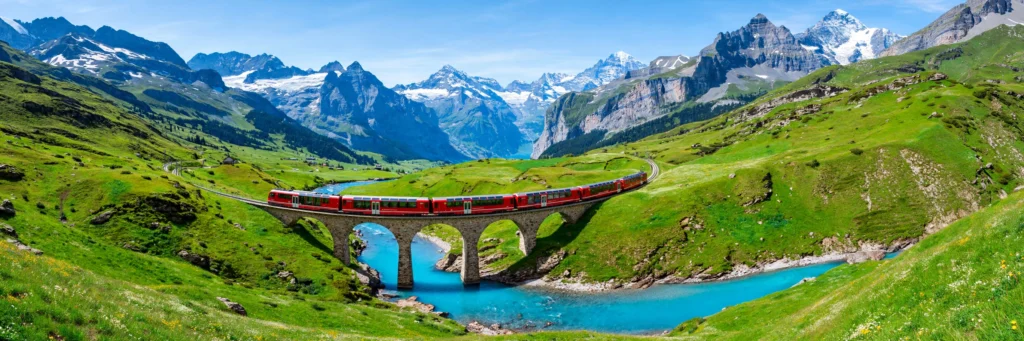
The single most important fact in this whole Switzerland travel guide is the size of the country. Switzerland is small — about twice the size of New Jersey, with around nine million people — and you can cross it by train from north to south in about three hours and from west to east in about five.Yet it holds four national languages, 26 cantons with their own customs, and almost one and a half thousand lakes, and the Alps and the Jura cover two thirds of its territory. Every short trip therefore means both cities and mountains, and every first trip means choosing, because no one sees all of it in one visit. The travellers who love Switzerland most are rarely the ones who saw the most places. They are the ones who gave Lucerne three nights instead of one, who slept in the Bernese Oberland instead of passing through it, and who watched the Matterhorn from a village they actually stayed in.
The second reality check is about what the classic route actually is. For a first trip, it has three bases and almost nothing else: Lucerne on Lake Lucerne, the Bernese Oberland around Interlaken, Grindelwald and Lauterbrunnen, and Zermatt under the Matterhorn, with Zurich or Geneva as the arrival and departure city and Lake Geneva as the optional fourth stop. That is the route this guide builds, because it is the route that works in seven to fourteen days, and because every stop on it earns its place. Everything else — the Engadine and St. Moritz, Ticino and Lugano, Basel and the Rhine, the Appenzell hills, the Jura — is a second trip, not a detour. Switzerland rewards depth over breadth more than almost any country in Europe, because its best experiences are slow ones: a morning boat on a lake, a full day on one mountain, a valley walk that starts at your hotel door.
The third reality check is the base rule itself, and it shapes everything else in this guide. Pick two bases for a week and three for ten days or more, and stay at least three nights in each. Never sleep one night per stop. A one-night stay in Switzerland costs you most of a day: you check out by ten, you carry your bags to the station, you ride two hours, you check in at three, and by the time you have found dinner you have seen nothing but the inside of a train and a hotel lobby. Three nights in one place buys you something no timetable can: a spare morning for the mountain when the first day is cloudy, a day trip you had not planned, and the chance to learn which bakery opens first. The three bases in this guide are chosen so that each one unlocks a different Switzerland — Lucerne for lakes and old towns, the Bernese Oberland for the high Alps and waterfalls, Zermatt for the Matterhorn and the car-free mountain village — and so that the train between them is itself one of the best days of the trip.
The fourth reality check is about direction. There is no single correct direction, but there is a wrong one: zigzagging. Fly into Zurich and out of Geneva, or the other way round, and move in one direction — east to west, or west to east — so you never cross the country twice. Zurich is the better arrival airport for Lucerne, the Bernese Oberland and Graubünden, and Geneva is the better one for Lake Geneva, the Valais and Verbier. If you are heading for Lugano, Milan Malpensa over the border in Italy has a direct train. The classic first-timer route runs Zurich to Lucerne to Interlaken to Zermatt to Lake Geneva to Geneva, and it works because each leg is short, scenic, and downhill in effort: Lucerne to Interlaken is about two hours, Interlaken to Zermatt about two and a half, Zermatt to Montreux about three and a half on the scenic route, and Montreux to Geneva about an hour and a quarter.
The fifth reality check is about language and money, because both surprise first-timers. Switzerland has four national languages — German is spoken by about 60 percent of the population, French by about 23 percent, Italian by about 8 percent, and Romansh by under 1 percent — and the language changes by region, not by person: German in Zurich, Lucerne, Bern, Interlaken and Zermatt, French in Geneva, Lausanne, Montreux and Verbier, Italian in Lugano and Locarno, Romansh in parts of Graubünden. English is understood almost everywhere tourists go, in hotels, at lift stations and on the lake boats, so you do not need German or French to travel well — but learning “Grüezi” in the German-speaking part and “Bonjour” in the French-speaking part buys you a warmer welcome everywhere. The currency is the Swiss franc, not the euro. Euros are accepted in far fewer places than you might expect, change is given in francs, and the rate is usually poor, so pay in francs and use a card with no foreign transaction fee. Visa and Mastercard are accepted almost everywhere, including ticket machines at stations and mountain cafés, and contactless payment is the norm.
The three bases at a glance
| Base | Nights | What it unlocks | Best for |
|---|---|---|---|
| Lucerne | 3 | Lake Lucerne steamers, Pilatus, Rigi, old town | First base, lakes, easy mountains, rainy-day museums |
| Interlaken and the Bernese Oberland | 3–4 | Jungfraujoch, Lauterbrunnen waterfalls, Grindelwald, lakes Thun and Brienz | The high Alps, hiking, the trip’s biggest day |
| Zermatt | 2–3 | Matterhorn, Gornergrat, Glacier Paradise, car-free village | The mountain itself, slow mornings, glacier views |
| Lake Geneva (optional fourth) | 2 | Lavaux vineyards, Chillon Castle, Montreux, Lausanne | Wine, castles, a gentler end to the trip |
The mistakes first-timers make
The first mistake is the base-hopping mistake, covered above: a new hotel every night, so the trip becomes a packing exercise. The second is booking the Jungfraujoch as a rushed half-day from Zurich, which means five hours of trains for ninety minutes at the summit — the mountain deserves a full day from a Bernese Oberland base, with a spare morning in case of cloud. The third is buying the wrong rail pass, or none at all, and then paying full fare for every mountain railway — the pass section below works out the decision with real 2026 prices, because the wrong choice costs hundreds of francs. The fourth is travelling in November or late April without knowing that many lifts, boats and mountain hotels close for maintenance between seasons — the season calendar below names what actually closes. And the fifth is underestimating the cost and then cutting the wrong corners: skipping the mountain day to save money, when the mountain day is the reason you came. Switzerland is expensive, and this guide does not pretend otherwise — but it shows you exactly where the money goes and where it can be saved without spoiling the trip.
How to use this guide
Read the sections in order if this is your first trip: the best time to go, the visa rules, the safety picture, then getting around and the pass decision, then the scenic trains, then the three bases and Lake Geneva, then the itineraries, food and costs. If you already know when you are going, skip straight to the itinerary that matches your trip length — the 4-day, 7-day, 10-day and 14-day plans are built from the same three bases, so you can see exactly what each extra day buys you. Every price in this guide is given in Swiss francs, because that is the currency you will pay in, with approximate dollar equivalents where they help; the prices are checked against live official pages in November 2026, and the guide tells you where to check the current figure before you pay, because Swiss fares move every December.
Best Time to Visit Switzerland: Month by Month, and What Actually Closes
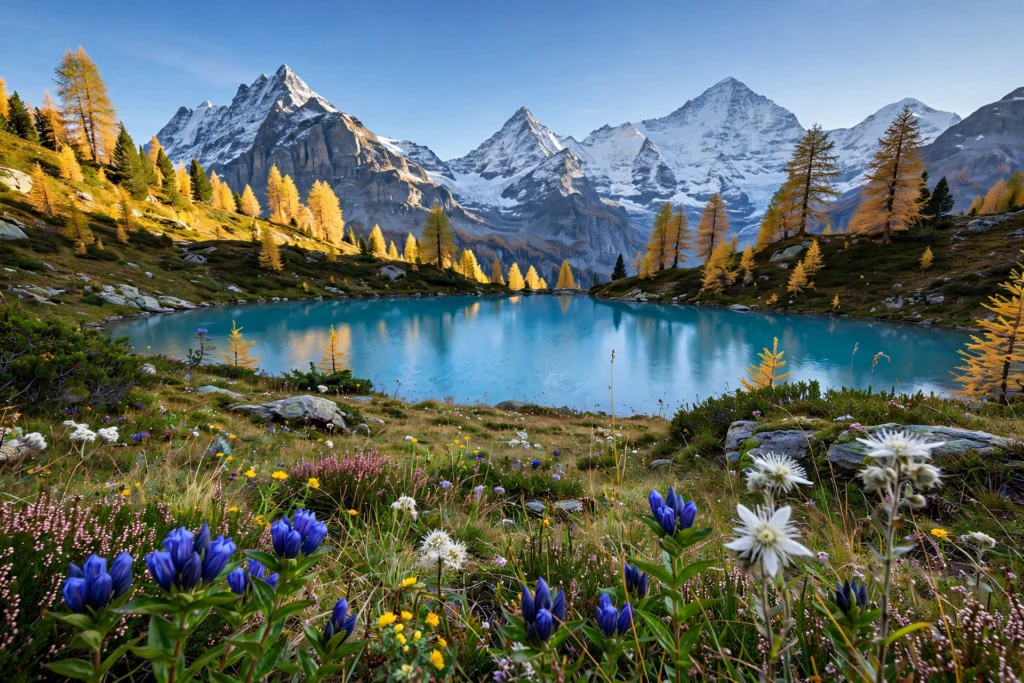
There is no single best month for the whole of Switzerland, because the country has mountains, lakes and cities at once, and each one peaks in a different season. The answer depends on what you want the trip to be, but for the classic three-base route the sweet spot is clear: mid-June to mid-October for hiking and lakes, with September as the single best month, and January to March for skiing. September gives you the high paths clear of snow, the lake boats still on their summer timetable, golden larches in the Engadine and the Valais, the grape harvest on the Lavaux terraces, and fewer wet days in Zurich than June, July or August. It is the month this guide recommends for a first trip.
Summer, from June to August, is the high season: all lifts, mountain roads and trails are open, the lakes are warm enough for swimming, and the days are long. It is also the busiest and most expensive time, so book accommodation in Zermatt, Grindelwald and Lucerne well in advance. Afternoon thunderstorms are common in the mountains, so set off on hikes in the morning and plan the summit for the first clear hour of the day. July and August are the warmest months, with valley temperatures in the mid-twenties Celsius, but the big summits stay cold — the Jungfraujoch averages around 3 degrees Celsius by day even in July, so take a jacket and gloves to every summit, whatever the month. Early autumn, from September to mid-October, is the best time for hiking: fewer tourists, settled weather, golden larches, and the harvest on the Lavaux terraces above Lake Geneva.
The shoulder seasons are where first-timers get caught out, and this is the honest part of the calendar. Late October to November and April to May are cheaper, and the cities, museums and Ticino are good then — but many lifts and mountain hotels close for maintenance, high Alpine passes stay shut until June, and the lake boats run a reduced timetable. In 2026 the Gornergrat railway was closed completely from 2 to 14 November for construction work, the Glacier Express did not run between seasons from 11 October to 4 December, the Pilatus gondola and cable car were closed for maintenance from 19 October to 27 November, and the Pilatus cogwheel railway stopped for the winter after 29 November. November is the quietest month in the mountains and the one that demands the most checking: before you book a November or April trip, check the lift and boat timetables for your exact dates, and build the trip around the cities and the lakes rather than the summits. Winter, from December to March, is ski season, with Christmas markets in December, winter walking trails and toboggan runs, and the resorts at their best from January to March, when the snow is most reliable.
Spring, from April to June, is the season of two halves. April and early May are still shoulder season in the mountains, with many resorts closed between the skiing and summer seasons, usually April to June, and high trails still under snow. Late May and June bring the change: the lifts reopen, the meadows fill with wildflowers, the waterfalls run at their fullest with the snowmelt, and the mountain roads open. Basel is a party city during its three-day carnival, Basler Fasnacht, and the Montreux Jazz Festival takes place on the banks of Lake Geneva in July. Swiss National Day, on 1 August, is celebrated nationwide with bonfires and fireworks, and communities light fires on the mountainsides, including on the Stanserhorn above Lucerne.
Month-by-month at a glance
| Month | Mountains | Lakes and cities | Crowds and prices | Verdict |
|---|---|---|---|---|
| January | Ski season, best snow | Cold cities, quiet museums | High in resorts, low in cities | Ski trips only |
| February | Ski season, reliable snow | Cold, short days | High in resorts | Ski trips only |
| March | Ski season, longer days | Warming up, still quiet | High in resorts, easing | Skiing, then cities |
| April | Many lifts closed, passes shut | Mild cities, Ticino good | Low, shoulder season | Cities and Ticino only |
| May | Lifts reopening, trails wet | Green, wildflowers, mild | Low to moderate | Good, check lift dates |
| June | High trails opening, waterfalls full | Warm, long days | Rising | Very good |
| July | All open, thunderstorms | Warm lakes, festivals | Busiest, most expensive | Great, book early |
| August | All open, warmest | Warmest lakes, National Day | Busiest, most expensive | Great, book early |
| September | Best hiking, golden larches | Warm lakes, harvest | Thinning, easing | Best month |
| October | Lifts closing late in the month | Golden light, quiet | Low to moderate | Good early, risky late |
| November | Most lifts closed | Grey cities, quiet | Lowest | Cities only, check everything |
| December | Ski season opens, markets | Christmas markets, festive | Rising in resorts | Ski and markets |
How the seasons affect prices
Prices follow the seasons more sharply in Switzerland than in most of Europe, and the difference between a November hotel and a July hotel in the same mountain village can be a factor of two. Hotels in Zermatt and Grindelwald are most expensive in July, August and the February ski weeks, and cheapest in November and April, when many of them are closed altogether. Train fares are the exception: the Swiss Travel Pass price is fixed for the calendar year, and the main fares change once a year, with the timetable change in December — from 13 December 2026 transport fares rise by 3.6 percent on average, so a trip in early December 2026 and a trip in January 2027 are priced differently. Mountain railway fares are seasonal too: the Gornergrat return costs CHF 132 in summer and CHF 102 in winter, and the Jungfraujoch return costs CHF 271.20 in summer and CHF 224.40 in the first winter weeks. If your dates are flexible, the cheapest good-weather window is usually late September or early October, and the cheapest weeks of all are late April and early May — but only if you are happy with a city-and-lake trip rather than a mountain trip. For more on picking cheap months in general, our guide to the cheapest time to travel explains how shoulder seasons work across destinations.
Do US Citizens Need a Visa for Switzerland? EES, ETIAS and the 90-Day Rule
The short answer, for most American travellers, is no visa is needed. Ordinary US passport holders do not need a visa to visit Switzerland for tourism or short business trips. You can stay visa-free for up to 90 days in any 180-day period, and there is no visa fee to pay. That rule is confirmed on the US State Department’s Switzerland page, checked live in November 2026, which states plainly: “No visa is required for stays less than 90 days.” It is the same 90/180 rule that applies across the whole Schengen area, so days spent in Switzerland, France, Italy, Germany, Austria or any other Schengen country all count toward the same 90 days. Keep a count, because the 90 days are counted over a rolling 180-day window, not per trip — a long stay followed by a quick return can catch you out. If you want to combine Switzerland with our neighbouring-country guides, the same rule covers a trip that pairs Switzerland with our Austria travel guide or our Germany travel guide, both of which sit inside the same Schengen count.
Your passport itself has rules too. It must be valid for at least three months beyond your date of departure from the Schengen area, though the State Department recommends six months of validity remaining, and the Swiss authorities strictly enforce the six-month rule on entry — do not travel on a passport that expires within six months of your arrival. You also need proof of funds and a return ticket, and you must declare cash of 10,000 Swiss francs or more on entry and exit. Switzerland is not in the European Union, so there are customs checks at the border, and the duty-free allowances are stricter than within the EU: in 2026 you can bring in duty-free up to 1 kilogram of meat, up to 5 litres of alcohol up to 18 percent and 1 litre over 18 percent, and 250 cigarettes per person aged over 17. If all your purchases together are worth more than 150 francs, VAT is payable. Meat, dairy and other animal products may only be brought in from EU countries, Iceland, Norway and Northern Ireland — importing them from anywhere else is prohibited.
EES: the system that is already running
The change that actually affects US travellers in 2026 is the Entry/Exit System, known as EES. This is the European Union’s digital border register, and it has been fully operational since 10 April 2026, after a phased rollout that began on 12 October 2025. On your first entry into the Schengen area, a border officer records your fingerprints and takes a facial image, and the system creates a digital record of your entry and exit instead of stamping your passport. On later trips, the system checks your face against that record. In practice, this means two things for you: allow extra time at passport control on your first trip since the system started, because the first registration takes a few minutes, and do not expect a passport stamp as proof of your entry date — the EES record is the proof, and the system counts your days against the 90/180 rule itself.
ETIAS: the system that is not running yet
ETIAS — the European Travel Information and Authorisation System — is the one that causes the confusion, because it has been announced, delayed, and announced again. Here is the position as it stands in late November 2026, checked against the European Commission’s own ETIAS page: ETIAS is currently not in operation and no applications for travel authorisations are being collected. The European Union removed its late-2026 launch target from the official pages in July 2026 and has not set a replacement date; the official position is that the EU will inform travellers about the specific date for the start of ETIAS several months before its launch. You do not need an ETIAS authorisation to visit Switzerland today, there is nothing to apply for, and any website that asks you to apply and pay right now is selling something that does not exist — more than a hundred such fake sites have been identified. When ETIAS does eventually open, it will be an online pre-travel authorisation for visa-exempt travellers to 30 European countries, the fee will be 20 euros, and the only official application channel will be the EU’s own Travel Europe website under the europa.eu domain. Check the European Commission’s ETIAS page before you travel, because this is the one rule in this guide most likely to change between now and your trip.
Entry checklist for US citizens
| Requirement | The rule for US citizens (checked November 2026) |
|---|---|
| Visa for tourism | Not required — visa-free up to 90 days in any 180-day period |
| Passport validity | At least 6 months from date of entry (Swiss rule, strictly enforced) |
| Blank pages | At least 1 blank page; 2 is the safe rule |
| EES registration | Fingerprints and photo on first Schengen entry since April 2026 |
| ETIAS authorisation | Not in operation, no start date — nothing to apply for |
| Proof of funds and return ticket | Required; carry both |
| Cash declaration | CHF 10,000 or more must be declared |
| Work or study | Visa required — apply at a Swiss embassy or consulate |
| Driving | US licence accepted for short visits; motorway vignette required |
Is Switzerland Safe for US Travellers? The Advisory, Honestly Explained
The US State Department rates Switzerland at Level 1: Exercise Normal Precautions. That is the fact that matters most, and it is the best news in this guide, because Level 1 is the lowest tier the State Department gives — the same tier it gives to Japan, South Korea, Australia and most of Western Europe. The advisory was issued on 15 January 2026 and, checked live in November 2026, it reads: “Exercise normal precautions in Switzerland.” You can read the full text on the State Department’s Switzerland travel advisory page, and you should read it twice — once when you book, and again the week before you fly, because advisories change. Our own guide to travel safety tips covers the same preparation in depth for any destination.
The detail underneath the headline is where the real information lives. The advisory’s warnings are about petty crime, not about violence. The majority of crimes targeting foreign visitors, including US citizens, involve pickpocketing, vehicle break-ins, bicycle theft and other forms of theft. Most reported thefts occur at crowded tourist sites, at airports, car rental agencies, on public buses, trams and trains, and at major railway stations. Organised groups of pickpockets work at major tourist sites and are also present when conferences, festivals, shows or exhibitions take place, and thieves frequently work in pairs — one member creates a distraction while the other steals. Stay aware of your surroundings, keep your bag in front of you in crowded places, do not leave bags unattended, and split your money and cards so one theft cannot strand you. Violent crime against tourists is rare, and no part of the country is rated at a higher level by the United States. Financial scams are common in Switzerland, according to the same advisory: be careful of anyone asking for money, especially people who start a romantic relationship online or claim local authorities want money, and beware the familiar list — people claiming to be US military personnel, people claiming to be detained or hospitalised abroad, romance and online dating scams, money transfers, grandparent targeting, free-trip and luggage scams, lotteries, inheritance notices and work-permit offers.
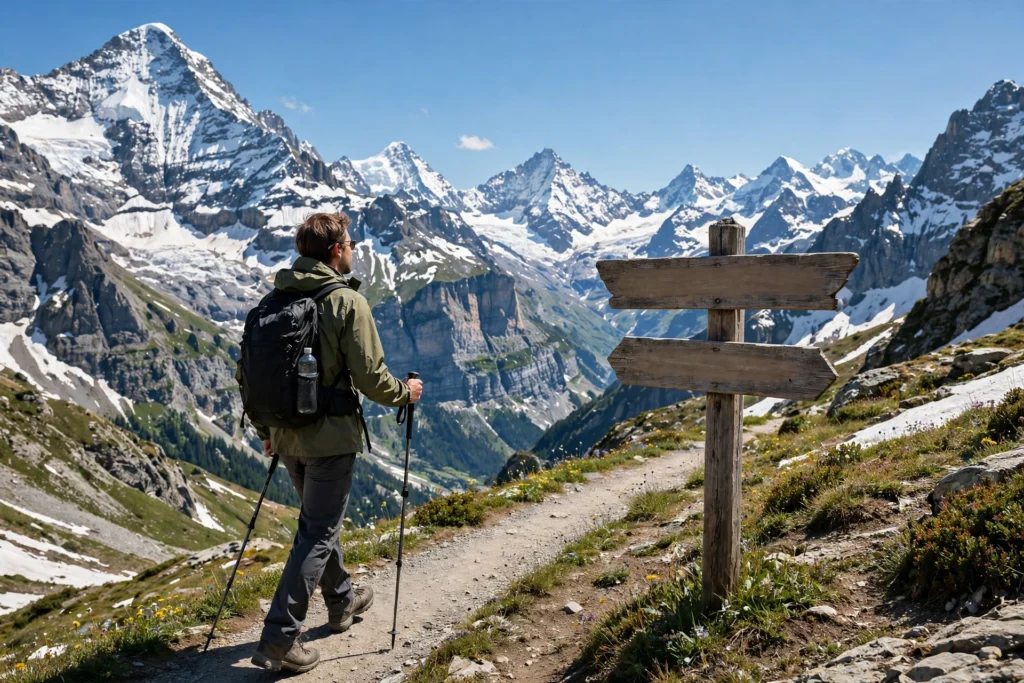
The risks that actually affect tourists most often are far more ordinary, and the biggest one is the mountains. Alpine hazards are common all year: avalanches and snowdrifts, landslides and flooding, glacial crevasses, falling rocks, sun exposure and sudden weather changes. Although safety standards are excellent, public safety warnings are not comparable to those found in the United States. Hiking paths and ski slopes are clearly marked, but not all possibly hazardous situations will have clear warning signs, and people are expected to use common sense. The State Department’s own advice is plain: stay on designated paths or slopes, follow the advice of local authorities and guides, take note of weather forecasts and conditions, form a team of at least two when participating in mountain activities, and inform someone of your plans and anticipated time of return. Mountain rescues can be extremely expensive, so make sure your travel insurance covers mountain search and rescue — and check whether your policy covers off-piste skiing and glacier walking, because many standard policies do not. The non-profit Swiss Air Rescue organisation, Rega, offers a membership that waives the costs of rescue missions, and US citizens can join as well. It is worth the small annual fee on any trip that includes high mountain walking.
There are two other warnings worth taking seriously. The first is about demonstrations: they occur frequently in Switzerland, can take place in response to political or economic issues, on politically significant holidays, and during international events, and demonstrations intended to be peaceful can turn confrontational and possibly become violent. Avoid areas around protests and check local media for updates. The second is about the weather itself: Switzerland’s mountain weather changes fast, and the afternoon thunderstorms of summer are a real hazard above the tree line. If you are caught on an exposed ridge when a storm builds, descend — do not wait it out on the summit. The Swiss use the phrase “the mountain decides” for a reason, and the best mountain days in this guide are the ones with a spare morning built in, so a cloudy day costs you nothing.
What to do before you go
Enrol in the Smart Traveler Enrollment Program, known as STEP, on the State Department’s STEP enrolment page. It is free, it takes about ten minutes, and it lets the nearest US embassy or consulate contact you in an emergency and help your family reach you. Save the emergency numbers — 112 for all emergencies across Europe, 117 for police, 144 for ambulance, 118 for fire, and 1414 for Rega mountain rescue. Download the AlertSwiss app provided by the Swiss Federal Government, which gives information and alerts in real time. Read the CDC Travelers’ Health pages for Switzerland: no vaccinations are required for most travellers, but routine vaccinations should be up to date, and tick-borne encephalitis vaccination is worth discussing with your doctor if you plan to hike in forested lowland areas in spring and summer. Buy travel insurance that covers emergency medical care, evacuation and mountain rescue, and read what it excludes before you need it — our guide to what travel insurance covers explains the exclusions that catch people out, including the one that matters most here: rescue from a mountain.
Staying safe day to day
Switzerland is one of the safest countries in Europe to walk around at night, and its cities are calm after dark in a way that surprises first-timers from American cities. The practical rules are the same as anywhere: keep your phone and wallet out of easy reach on crowded trains and at stations, lock your hire car and never leave bags visible inside it, and be careful on the roads — Swiss drivers are disciplined, but the mountain roads are narrow, the tunnels are long, and winter tyres are effectively essential from November to April. If you are driving, remember that the motorway vignette is compulsory, speed limits are 50 kilometres per hour in towns, 80 outside built-up areas and 120 on motorways, and fines are very high. And one small Swiss habit is worth adopting: in the mountains, greet other walkers. It is the local custom, and it is also how people notice if someone is missing.
How to Get Around Switzerland: Trains, Buses, Boats and the SBB App
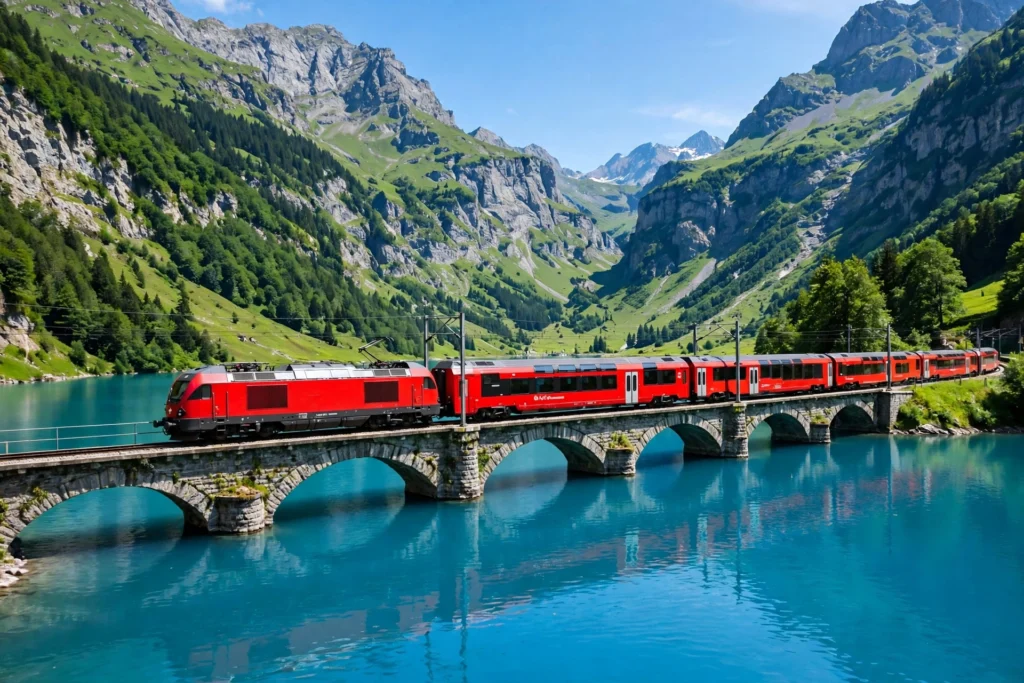
Public transport is Switzerland’s greatest convenience, and it is the reason this guide never asks you to hire a car. SBB trains, yellow PostBuses, city trams, lake boats and many mountain railways all run on one integrated timetable: connections take just minutes, and a train three minutes behind schedule counts as late. You will rarely need a car — and you cannot drive into Zermatt, Wengen or Mürren at all. The network is dense enough that almost every sight in this guide is reachable by train, bus, boat or cableway, and the journeys themselves are part of the trip: the train from Lucerne to Interlaken runs along two lakes and over the Brünig Pass, and the boat across Lake Lucerne is one of the best hours in Switzerland.
The easiest way to buy tickets is in the SBB Mobile app or on sbb.ch, and you should install the app before you leave home. It gives you the timetable for every train, bus, boat and cableway in the country in one search, it sells tickets and passes, it shows the platform for every departure, and it works offline for saved journeys. Buy your ticket before you board — tickets bought on the train cost more, and on some services they are not sold at all. If you hold a Swiss Travel Pass, you do not need a ticket for the trains, buses and boats it covers; you show the pass, in the app or as a QR code, during ticket inspection. Typical journey times give you a sense of the scale: Zurich to Lucerne takes 45 minutes, Zurich to Bern about an hour, Zurich to Geneva 2 hours 45 minutes, Zurich to Lugano about two hours through the Gotthard Base Tunnel, which at 57 kilometres is the world’s longest railway tunnel, and Zurich Airport is only 10 to 12 minutes by train from the city centre.
The lake boats deserve a section of their own, because they are the most underrated transport in Switzerland. Five historic paddle steamers ply Lake Lucerne, and a trip to Vitznau or Flüelen is an outing in itself; the boats on Lakes Thun and Brienz connect Interlaken with castles and waterfalls you cannot reach by road; and the boats on Lake Geneva run between Lausanne, Montreux and the French shore. Boats are covered by the Swiss Travel Pass, they run a summer timetable from roughly May to October and a reduced winter one, and they are the slowest and most relaxing way to travel in the country. If you have a free afternoon in Lucerne or Interlaken, take a boat for two hours and do nothing — it is one of the best afternoons in this guide.
The yellow PostBuses fill the gaps the trains leave. They run up the valleys the railways do not reach, over the high passes in summer, and to the trailheads and villages where the hiking starts. They are covered by the Swiss Travel Pass, they connect with the trains by design — the bus waits for the train — and the drivers will tell you which stop to get off at if you ask. In the mountains, the bus is often the difference between a walk that starts at a car park and a walk that starts at a pass. Driving, by contrast, is a choice for a particular kind of trip: a car helps most on the high pass roads, which are a summer trip, and for families with small children and a lot of luggage. If you do drive, the motorway vignette costs CHF 40 for a single annual one, valid from 1 December 2025 to 31 January 2027, with no short-term option, and you can buy the e-vignette online. High Alpine passes — the Furka, Grimsel, Susten and Nufenen — are usually closed from October or November until May or June, so check before you plan a driving route over them.
Transport at a glance
| Mode | Best for | Notes |
|---|---|---|
| SBB trains | Between bases and cities | Punctual, frequent, no reservation needed on most services |
| Scenic trains | The journey itself | Reservations required — see the scenic-train section |
| PostBuses | Valleys, passes, trailheads | Yellow, covered by the pass, connect with trains |
| Lake boats | Lucerne, Thun, Brienz, Geneva | Covered by the pass, summer timetable May–October |
| Mountain railways and cableways | Summits | Half price or free with a pass, not free without one |
| City trams and buses | Zurich, Bern, Geneva, Basel | Covered by the pass in more than 90 towns |
| Car hire | High pass roads, families | Vignette CHF 40, car-free villages unreachable by car |
| Domestic flights | Nowhere — the country is too small | Trains are faster door to door |
Swiss Travel Pass vs Half Fare Card vs Point-to-Point Tickets: The Decision That Saves You Hundreds
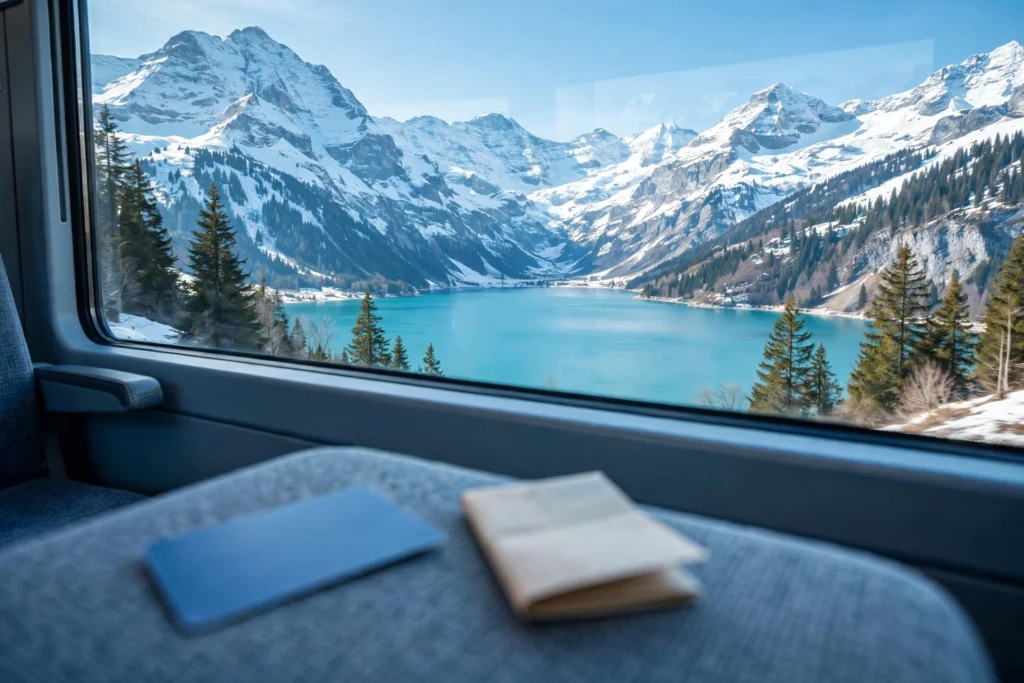
This is the most expensive decision in the whole trip, and it is the one most first-timers get wrong. Switzerland sells three ways to pay for transport, and the right one depends entirely on how you travel, not on how long you stay. Get it right and you save hundreds of francs; get it wrong and you pay full fare for every mountain railway, which is where the real money goes. The three options are the Swiss Travel Pass, the Swiss Half Fare Card, and point-to-point tickets bought as you go. Here they are, with the 2026 prices verified live on the SBB website in November 2026.
The Swiss Travel Pass is a pass for visitors, sold only to people who live outside Switzerland and Liechtenstein, and valid only with a passport or identity card. It is valid for 3, 4, 6, 8 or 15 consecutive days, and the Flex version lets you choose your travel days within a month. It covers trains, buses, boats and city transport in more than 90 towns, admission to more than 500 museums, the whole of Mount Rigi, the Stanserhorn and Stoos, and a discount of usually 25 to 50 percent on most other mountain railways. The 2026 adult prices in second class, valid until 31 December 2026, are CHF 254 for 3 days, CHF 309 for 4 days, CHF 399 for 6 days, CHF 439 for 8 days and CHF 499 for 15 days. First class costs CHF 405, CHF 492, CHF 634, CHF 697 and CHF 787 for the same durations. The Flex version costs CHF 289, CHF 349, CHF 424, CHF 459 and CHF 519 in second class. Young people under 25 get a 30 percent discount with the Swiss Travel Pass Youth — CHF 179 for 3 days, CHF 218 for 4, CHF 282 for 6, CHF 311 for 8 and CHF 356 for 15 days in second class. Children under 6 travel free, and children aged 6 to 16 travel free with a parent on the free Swiss Family Card, which is issued together with the pass. You can buy the pass on the SBB Swiss Travel Pass page, as a guest with a QR code by email, or with a login so it appears in the SBB Mobile app.
The Swiss Half Fare Card costs CHF 150 for one month for non-residents of Switzerland, and it gives 50 percent off almost everything: trains, buses, boats and most mountain railways. It is the better choice if you stay mostly in one place and travel mainly up into the mountains, because the mountain railways are where the pass discount matters most — the Jungfraujoch, the Gornergrat and Pilatus are all half price with it, while the Swiss Travel Pass gives only a 25 to 50 percent discount on them and covers the valley trains for free. The Half Fare Card pays for itself fast: a single return to the Jungfraujoch from Interlaken Ost costs CHF 271.20 at full fare and CHF 140.60 with the Half Fare Card, a saving of CHF 130.60 on one trip — almost the whole price of the card. Point-to-point tickets are the third option: buy each journey separately, in the SBB app, and use Saver tickets, which are tickets for a specific train at a discount of up to 50 percent or more, on sale up to six months in advance in limited numbers. There are also Saver Day Passes, priced according to the date. Point-to-point wins on a short, slow trip with few long journeys and no mountain days — but it loses the moment you add two mountains.
The decision rule is simple, and it is worth doing the sums before you buy anything. If your trip changes base often, with a long train journey on most days, plus museums and boats, buy the Swiss Travel Pass — it suits a trip that moves. If your trip stays mostly in one or two bases and the big spending is on mountain railways, buy the Half Fare Card and pay half fare for everything — it almost always wins on a mountain-led trip. If your trip is four days or fewer, with one base and one mountain, cost out the point-to-point tickets and Saver fares first, because they can beat both passes. And whatever you buy, remember what no pass covers: the scenic trains charge a seat reservation on top of the pass, the Jungfraujoch is discounted rather than included, and the mountain railways above the valleys are never free except for Rigi, Stanserhorn and Stoos. Before buying a pass, cost out your route — with two or three long journeys and one mountain, a Half Fare Card plus tickets often works out cheaper than the full pass.
The pass decision table
| Your trip | Best choice | Why |
|---|---|---|
| 7–10 days, 3 bases, train most days | Swiss Travel Pass 8 days, CHF 439 | Free trains, buses, boats and museums every day |
| 7 days, 2 bases, 2–3 mountain days | Swiss Half Fare Card, CHF 150 | Half price on the expensive mountain railways |
| 4 days, 1 base, 1 mountain | Point-to-point + Saver tickets | Cheapest when you barely move |
| 14 days, slow pace, travel days spread out | Swiss Travel Pass Flex 15 days, CHF 519 | Pay only for the days you travel |
| Under 25, any trip | Swiss Travel Pass Youth, 30% off | Same cover, CHF 179 for 3 days |
| With children 6–16 | Either pass + free Swiss Family Card | Children travel free with a parent |
A worked example: the 8-day trip in this guide
Take the 8-day version of the route in this guide — Lucerne 3 nights, Bernese Oberland 3 nights, Zermatt 2 nights — and cost it three ways, using the 2026 fares in this guide. With the Swiss Travel Pass for 8 days at CHF 439, every train, bus and boat is free, the museums are free, Rigi is free, and the mountain railways are discounted: the Jungfraujoch costs CHF 189.60 instead of CHF 271.20, the Gornergrat CHF 66 instead of CHF 132, and Pilatus CHF 42 instead of CHF 84. Add the Glacier Express or GoldenPass seat reservations on top. With the Half Fare Card at CHF 150, you pay half fare for every train and half price for every mountain railway: the Jungfraujoch CHF 140.60, the Gornergrat CHF 66, Pilatus CHF 42, and every valley train at half price — which, on a trip with three long train days, usually comes out CHF 50 to CHF 150 cheaper than the pass, unless you also visit several museums and take the boats every day. With point-to-point tickets and Saver fares, you can beat both on the valley trains if you book weeks ahead, but you pay full fare for the mountains, and the Jungfraujoch alone wipes out the saving. The honest answer for most first-timers on the route in this guide is the Half Fare Card — and the honest exception is the traveller who moves every day and visits museums, for whom the pass wins.
The Scenic-Train Spine: Luzern–Interlaken Express, GoldenPass and Glacier Express
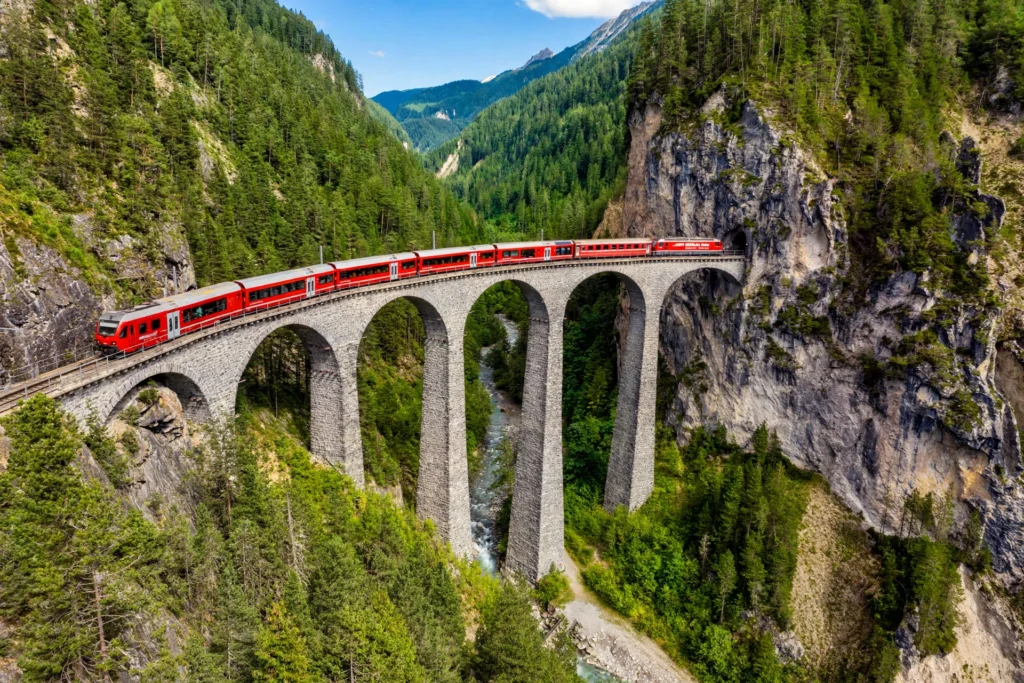
Switzerland’s scenic trains are the most famous railway journeys in Europe, and they are also the most misunderstood. The famous trains run on ordinary lines, so you can enjoy the same views from a regional train — cheaper and with no compulsory reservation. The panoramic carriages offer huge windows reaching into the roof, commentary through headphones and fewer changes, and they are worth booking for the experience. But the views belong to the line, not to the train, and if the panoramic carriages sell out, ride the same stretch on a regional train — the views are just the same. Book several weeks ahead in summer, because the panoramic carriages do sell out, and remember that the pass covers the journey but not the seat reservation, which is compulsory on the Glacier Express and the Bernina Express all year, and on the GoldenPass Express in the panoramic coaches.
The spine of this guide is three trains that link the three bases in order, and each one is a day in itself. The Luzern–Interlaken Express runs from Lucerne to Interlaken Ost in about two hours, over the Brünig Pass, past Lake Lucerne, Lake Sarnen and Lake Brienz, with panoramic windows and no reservation needed. It is the transfer between base one and base two, and it is the gentlest introduction to Swiss scenic rail: lakes, meadows, forested hills and the first sight of the Bernese Oberland. The GoldenPass runs from Interlaken to Montreux in about three hours and fifteen minutes, via Zweisimmen and Gstaad, from the lakes of the Bernese Oberland through the Simmental valley to the vineyards above Lake Geneva — and the GoldenPass Express runs the whole way without changing, because the train changes its track gauge along the way. The Glacier Express runs from Zermatt to St. Moritz in about eight hours, over 291 bridges and through 91 tunnels, crossing the Oberalp Pass at 2,033 metres, and it is the slowest express train in the world for a reason: it is built for looking out of the window, not for getting somewhere fast.
The Glacier Express deserves a paragraph of its own, because it is the one people book first and understand last. A seat reservation is compulsory even with a pass: in 2026 it costs CHF 54 in first and second class, and CHF 540 in Excellence Class, which includes a multi-course lunch. The train does not run between seasons — in 2026, from 11 October to 4 December — so a November trip cannot include it at all. You do not need to ride the whole eight hours: the best section is Zermatt to Chur, and many travellers ride that and continue by regional train. If you ride it, book the morning departure, sit on the right-hand side going east for the Landwasser Viaduct, and treat the day as a sightseeing day, not a transfer day — you will arrive in St. Moritz too late to do anything else. The Bernina Express is the other great line, and for many railway fans it is the most beautiful in the country: from Chur or St. Moritz to Tirano in Italy in about four hours, over the Albula viaducts, past the glaciers near the Bernina Pass at 2,253 metres, the highest point, and down the spiral viaduct at Brusio. The Albula and Bernina lines are UNESCO World Heritage sites, and the reservation is compulsory — but the regional trains on the same line can be boarded without one, and the views are identical.
The scenic trains compared
| Train | Route | Time | Reservation | Best for |
|---|---|---|---|---|
| Luzern–Interlaken Express | Lucerne–Interlaken Ost | ~2h | None needed | The transfer between bases one and two |
| GoldenPass Express | Montreux–Interlaken | ~3h15 | Required in panoramic coaches | Vineyards, Gstaad, two lakes in one ride |
| Glacier Express | Zermatt–St. Moritz | ~8h | Compulsory, CHF 54 | The full-day classic, Landwasser Viaduct |
| Bernina Express | Chur/St. Moritz–Tirano | ~4h | Compulsory | Glaciers, the Brusio spiral, Italy for lunch |
| Gotthard Panorama Express | Lucerne–Lugano | ~5h | Required | Boat on Lake Lucerne, then the old Gotthard line |
How to ride them well
The first rule is to book the reservation, not the train: the pass or ticket covers the journey, and the reservation is a separate seat booking, so a “sold out” Glacier Express usually means the panoramic seats are gone, not the line. The second rule is to check the season before you build the trip around a train: the Glacier Express does not run from mid-October to early December, the Gotthard Panorama Express runs only from spring to autumn, and the Bernina Express runs all year but with a reduced winter timetable. The third rule is to sit on the correct side — right-hand side going east on the Glacier Express for the Landwasser Viaduct, left-hand side going south on the Bernina line for the glaciers — and to keep your camera ready for the first hour, when the views are newest. And the fourth rule is the one this guide keeps repeating: keep a spare morning at every mountain base, in case cloud hides the summit on the day you planned, and never build a scenic train day and a summit day into the same morning. If you are extending the trip east after Zermatt, the Glacier Express is the way to do it; if you are heading west to Lake Geneva, the GoldenPass is. Either way, the train is the day — plan nothing else on it.
Lucerne: The First Base — Lake, Old Town, Pilatus and Rigi
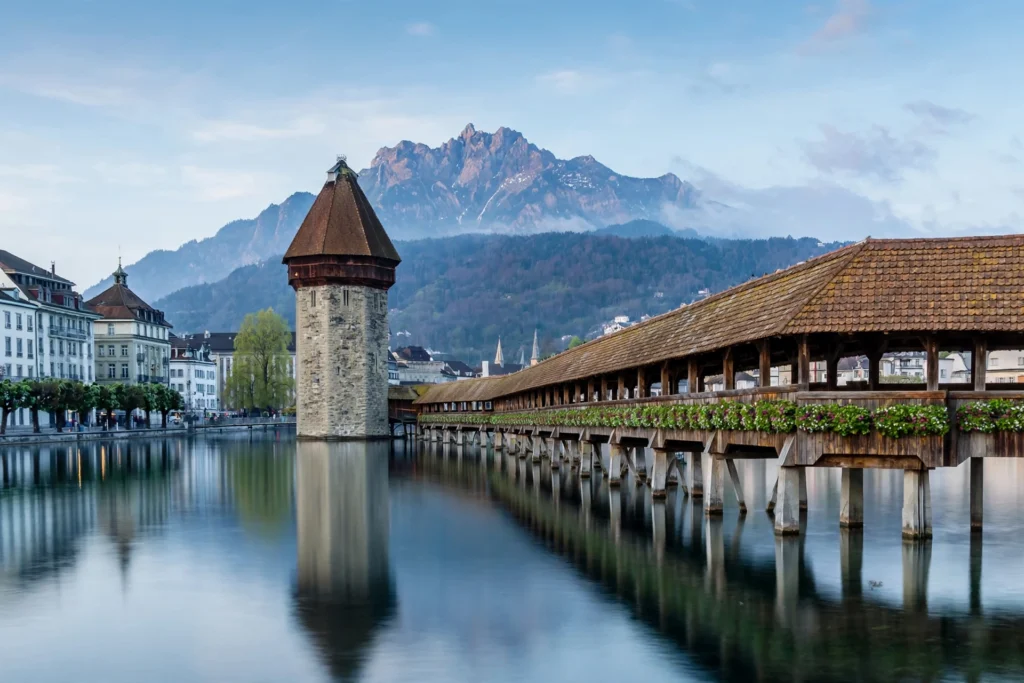
If there is one place in Switzerland where you can see it all in a couple of days — a medieval town, a lake with steamers and three famous mountains — it is Lucerne. It is compact, the whole centre can be explored on foot, and the mountains start right at the pier. Lucerne is the simplest first base in Switzerland, and it is the one this guide recommends for every first trip, because it forgives the two things every arrival day brings: jet lag and bad weather. If the mountain is in cloud, the old town and the museums are waiting. If the sun comes out, the boats and the cableways are at the station pier. No other base in Switzerland gives you that much choice within ten minutes of your hotel.
The old town is the place to start, and it repays a slow morning. The Chapel Bridge, the Kapellbrücke, is a 14th-century covered wooden bridge with its Water Tower, one of the oldest in Europe; it almost entirely burnt down in 1993 and was rebuilt, and some of the paintings under the roof are original. Cross it at dawn, before the day-trippers arrive, and you have the river to yourself. The old town squares have painted façades, and in summer you can climb some of the towers of the Musegg Wall free of charge for a view over the rooftops. The Lion Monument is a dying lion carved into the rock in memory of the Swiss Guards killed in Paris in 1792; Mark Twain called it the saddest piece of stone in the world, and he was right — give it ten quiet minutes rather than a photograph and a walk-on. The Swiss Museum of Transport is the most visited museum in the country, with trains, planes, ships and a planetarium, and it is a great choice for a rainy day. The Swiss National Museum is not in Lucerne — it is in Zurich, next to the station — but Lucerne’s own museums, the Rosengart collection and the Richard Wagner Museum on the lake, are worth an hour each on a wet afternoon.
The lake is the second half of Lucerne, and the steamers are the reason to stay three nights rather than two. Five historic paddle steamers ply the lake, and a trip to Vitznau or Flüelen is an outing in itself — the boats are covered by the Swiss Travel Pass, they leave from the pier directly opposite the station, and the round trip to Flüelen and back takes most of a morning. The lake is long and narrow, fjord-like, with mountains rising straight from the water, and the boat is the slowest and most relaxing way to see it. If you have only one afternoon, take the boat to Vitznau, ride the cog railway up the Rigi, and come back by boat — the classic Lucerne day, and the one the Swiss themselves recommend.
The mountains are the third half, and Lucerne has two of the best, plus a third within an hour. Mount Rigi, at 1,798 metres, is the “Queen of the Mountains”: a cog railway, opened in 1871, climbs up from Vitznau, and from the summit you see the lakes and a semicircle of Alps. It is free with the Swiss Travel Pass, it is an easy half-day, and it is the best first mountain in Switzerland because it asks nothing of you except a train ride and a walk to the viewpoint. Mount Pilatus, at 2,132 metres, is the dramatic one: from Alpnachstad the world’s steepest cog railway climbs the mountain, with a gradient of up to 48 percent, roughly from May to November, and from Kriens a cable car runs all year. The Golden Round Trip is the way to do it — boat from Lucerne to Alpnachstad, cogwheel railway up, cable car and gondola down to Kriens, bus back to Lucerne — and it costs CHF 119.80 per adult with a second-class boat in 2026, or CHF 42 with a Swiss Travel Pass, because the pass covers the boat and bus and halves the mountain railways. The round trip on the mountain alone costs CHF 84 in summer, CHF 42 with a Half Fare Card or the Swiss Travel Pass, and CHF 60 in winter from Kriens, when only the cable-car side runs. The cogwheel railway runs from 11 May to 29 November 2026, and the gondola and cable car were closed for maintenance from 19 October to 27 November 2026, so in late autumn the only way up is the cogwheel railway from Alpnachstad — check the operator’s dates for your exact week. Mount Titlis, above Engelberg, is the third mountain, about an hour from Lucerne by train, with a glacier, the world’s first revolving cable car, and snow all year; it is the best choice on a cloudy day in the Bernese Oberland, because it is a different mountain in a different valley.
Lucerne in three days
| Day | Morning | Afternoon | Evening |
|---|---|---|---|
| Day 1 | Arrive from Zurich, old town and Chapel Bridge | Lion Monument, Musegg Wall towers | Dinner in the old town, river walk |
| Day 2 | Golden Round Trip up Pilatus | Lake steamer to Vitznau or lakeside walk | Sunset from the Chapel Bridge |
| Day 3 | Rigi by cog railway from Vitznau | Swiss Museum of Transport or boat to Flüelen | Early night — the Bernese Oberland starts tomorrow |
Where to stay in Lucerne
Stay in the old town or within ten minutes’ walk of the station, because everything in Lucerne starts at the station pier. The old town has the atmosphere and the restaurants; the streets near the station have the hotels with lake views and the easiest mornings. Do not stay across the lake unless you enjoy a bus ride before breakfast. Lucerne is the most expensive base in this guide after Zermatt, and a double room in a three-star hotel runs CHF 150 to CHF 280 a night, more in July and August — book early, and remember that breakfast from a Coop or Migros supermarket, which have self-service cafés, is the easiest way to save CHF 20 a day without noticing.
Interlaken and the Bernese Oberland: Jungfraujoch, Lauterbrunnen and Grindelwald
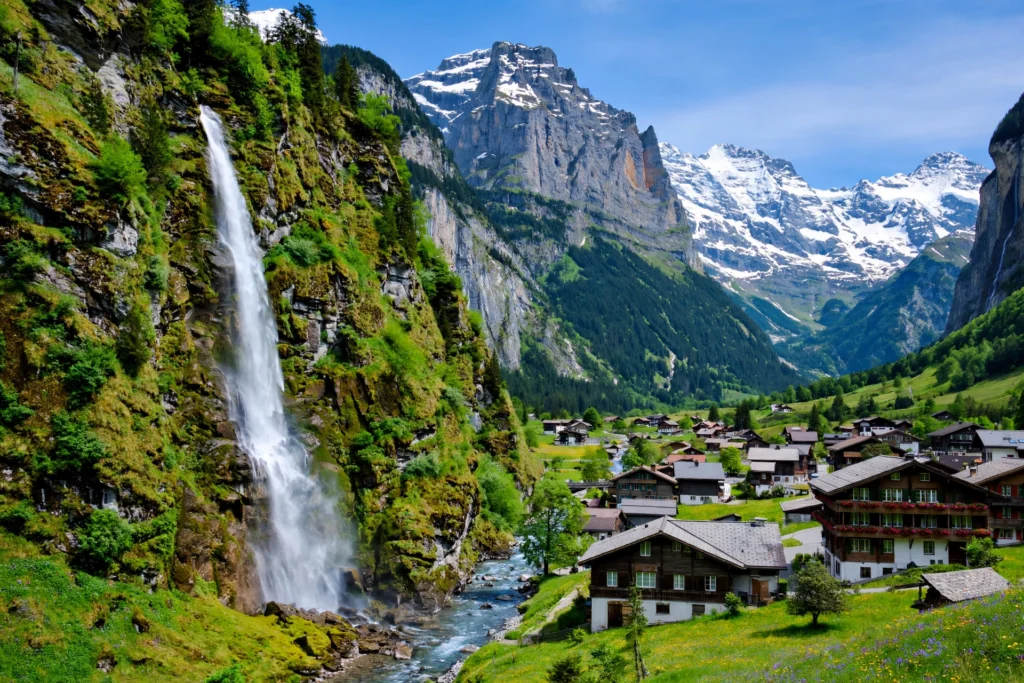
The Bernese Oberland is the reason most people come to Switzerland, and it is the base where the trip either works or falls apart. The region is a knot of two valleys — Lauterbrunnen and Grindelwald — between two lakes, Thun and Brienz, under three famous peaks, the Eiger, the Mönch and the Jungfrau, and it holds the highest railway station in Europe, the longest glacier in the Alps, and more waterfalls than anywhere else in the country. Interlaken itself is the transport hub, not the destination: it sits between the two lakes, it has the trains to both valleys, and it is the place to sleep if you want the easiest logistics. But the villages are the place to stay if you want the mountains: Grindelwald for high walks straight off the gondola, Lauterbrunnen for waterfalls within a walk of your room, Wengen and Mürren for car-free villages with the big peaks in view from the breakfast table. This guide recommends three or four nights here, with Interlaken as the base for the first visit and a village as the upgrade on the second.
The Jungfraujoch is the biggest day of the trip, and it deserves a full day, a clear morning, and an early start. The Jungfraujoch, at 3,454 metres, is Europe’s highest railway station, and it is marketed as the Top of Europe — the highest-altitude railway station on the continent, between the Jungfrau at 4,158 metres and the Mönch at 4,107 metres, with a view down the Aletsch Glacier, the longest glacier in the Alps at 23 kilometres. From Interlaken Ost it takes about two hours: the Bernese Oberland Railway to Grindelwald or Lauterbrunnen, then the Eiger Express tricable gondola from Grindelwald Terminal to Eigergletscher, and the Jungfrau Railway through the Eiger and the Mönch to the summit. At the top there is the Sphinx Observatory, whose outdoor terrace at 3,571 metres is the highest publicly accessible viewpoint in Europe reachable without mountaineering, the Ice Palace, a tunnel carved into the glacier, and a snow plateau you can walk on in every month of the year. Go early, because the light is best before midday and the crowds build after ten, and because the afternoon cloud that builds over the Alps can hide the view by two o’clock.
The ticket is the most expensive single ticket in Switzerland, so here it is in full, with the 2026 prices checked against the operator’s own price list in November 2026. A standard return from Interlaken Ost costs CHF 271.20 in summer, from 1 May to 31 October 2026, including the mandatory CHF 10 seat reservation, and CHF 224.40 in the first winter weeks, from 1 November to 12 December. With a Swiss Half Fare Card it drops to CHF 140.60 in summer; with a Swiss Travel Pass it costs CHF 189.60, because the pass covers you free as far as Grindelwald or Wengen and gives 25 percent off above that. The seat reservation is compulsory from 1 May to 31 October 2026 and costs CHF 10 per person for the return journey, children included. The Good Morning Ticket gives a 20 percent discount on the first two connections of the day — the cheapest way up if you are willing to leave before nine. The Jungfrau Travel Pass, from CHF 165 for 3 to 8 days, covers unlimited travel throughout the Jungfrau region including trains, buses, boats and mountain railways, with a special fare for the Jungfraujoch, and it is worth pricing if you are staying in the region for more than three days. Book your ticket on the operator’s own site, jungfrau.ch, and check the weather the night before: if the summit forecast is cloud, move the trip to the next morning, because a whiteout at CHF 271 is the most expensive disappointment in Switzerland.
Lauterbrunnen is the valley that makes the Bernese Oberland feel like a fairy tale, and it is the best base in the region if you want waterfalls rather than altitude. The valley has 72 waterfalls, and the Staubbach Falls drop nearly 300 metres down the cliff beside the village, so close you can walk to them from your hotel. From Lauterbrunnen you can ride up to Wengen, a car-free village on a sunny shelf with the Eiger across the valley, or take the cable car to Mürren, the village on the other side, and the Schilthorn above it, with its revolving restaurant and a view across the valley at the Eiger. The Trümmelbach Falls, inside the mountain, are the one waterfall you pay to see, and they are worth it: ten glacier waterfalls thundering through a gorge, reached by a lift inside the rock. Grindelwald is the other valley, and it is the base for high walks: three gondolas start here and each reaches a different one, the First gondola climbs to the cliff walk and the Bachalpsee, a mountain lake that mirrors the Wetterhorn, and the Eiger trail runs along the foot of the north face. The two lakes are the gentler side of the region: Lake Thun, the wider one, with five castles around its shore, and Lake Brienz, the narrow turquoise one, and a steamer stop at Giessbach, where you step off the boat below a waterfall, is one of the best afternoons in Switzerland.
The summit picker: which mountain, and why
| Summit | Height | Cost (return, adult, summer 2026) | Best for |
|---|---|---|---|
| Jungfraujoch | 3,454 m | CHF 271.20 from Interlaken Ost | The highest, snow all year, Aletsch Glacier |
| Gornergrat | 3,089 m | CHF 132 from Zermatt | The Matterhorn, 28 peaks over 4,000 m |
| Pilatus | 2,132 m | CHF 84, or CHF 119.80 Golden Round Trip | Lucerne day trip, steepest cog railway |
| Titlis | 3,238 m | Check the operator for the current fare | Glacier, revolving cable car, Engelberg |
| Schilthorn | 2,970 m | Check the operator for the current fare | Revolving restaurant, Eiger view, Mürren |
Bernese Oberland in three days
| Day | Plan | Why it works |
|---|---|---|
| Day 1 | Arrive by Luzern–Interlaken Express, lake steamer on Brienz or Thun | Gentle arrival, the lakes first |
| Day 2 | Jungfraujoch, early start, full day | The biggest day, with a spare morning if it clouds over |
| Day 3 | Lauterbrunnen waterfalls and Wengen or Mürren | The valley day, slow and close to the hotel |
| Day 4 (if you have it) | Grindelwald First and the Bachalpsee | The high walk, and the best photographs of the trip |
Where to stay in the Bernese Oberland
Interlaken is the practical choice: the most hotels, the most restaurants, the station for both valleys, and the cheapest rooms in the region. Grindelwald is the walker’s choice: the gondolas start in the village, the high walks start at your door, and the Eiger is outside your window — but the hotels cost more and the village is quieter at night. Lauterbrunnen is the waterfall choice: the valley is the most beautiful place to wake up in Switzerland, the walks start at your door, and the village is small enough to feel like a village. Wengen and Mürren are the view choices: car-free, quiet, and with the peaks in front of you at breakfast and at sunset, but further from the stations and the shops. For a first trip, stay in Interlaken or Grindelwald; for a second trip, stay in Wengen or Mürren and do not leave the valley for three days.
Zermatt and the Matterhorn: Gornergrat, Glacier Paradise and the Car-Free Village
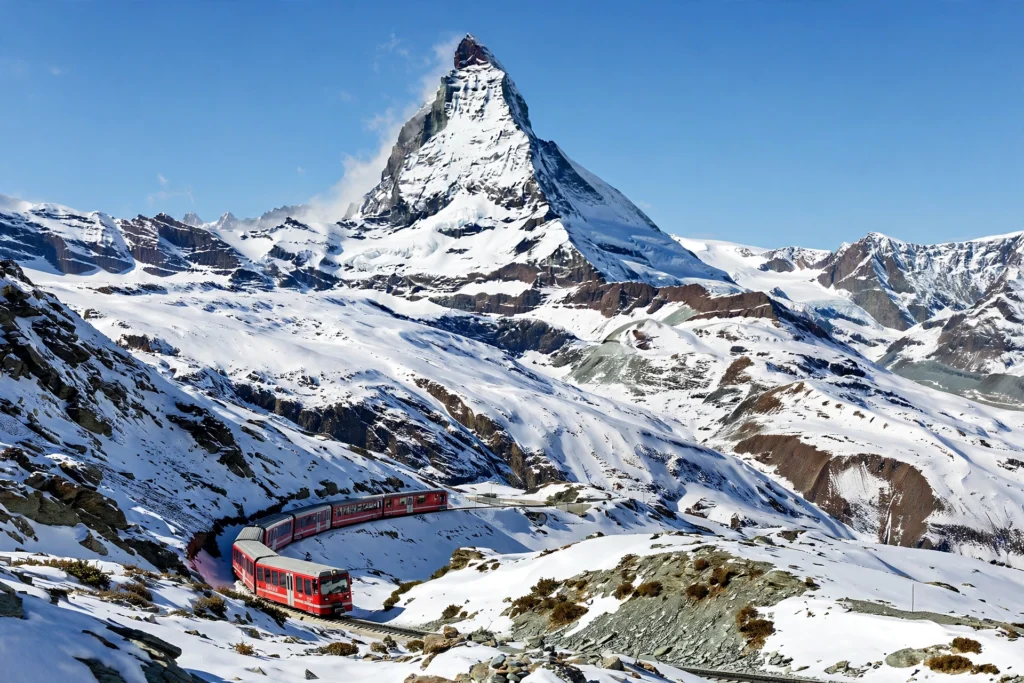
Zermatt is the third base, and it is the one that feels most like a different world. The village is car-free: you park in Täsch, take the shuttle train, which leaves every 20 minutes and takes 12 minutes, and you arrive in a village of wooden chalets and electric taxis where the Matterhorn fills the end of the main street. The Matterhorn, at 4,478 metres, is Switzerland’s most recognisable mountain, and it is the reason Zermatt exists as a tourist village at all. It is also the furthest base from an airport, which is why this guide gives it two or three nights rather than one — a single night in Zermatt is a long journey for a short stay, and the mountain deserves a spare morning, because the Matterhorn hides in cloud on roughly one day in three.
The Gornergrat is the classic Zermatt day, and it is the best viewpoint in Switzerland for the money. The Gornergrat railway climbs from Zermatt to 3,089 metres in 33 minutes, and from the summit station you look straight at the Matterhorn and at a horseshoe of 28 peaks over 4,000 metres around the Gorner Glacier. A return ticket costs CHF 132 in summer, from May to October 2026, and CHF 102 in winter, from November 2026 to April 2027; with a Swiss Travel Pass, a Half Fare Card or a GA travelcard you pay half — CHF 66 in summer, CHF 51 in winter — which makes the Gornergrat the single biggest saving available to a visitor with a rail pass. Get off at Rotenboden, the stop for the Riffelsee, the small lake that mirrors the Matterhorn on a still morning, and walk the last stretch to the summit on the path rather than staying on the train — the Riffelsee at sunrise is the most photographed lake in Switzerland, and it is worth the early start. Note the closure: the railway was closed completely from 2 to 14 November 2026 for construction work, with no trains at all, so check the operator’s dates if you travel in November. The Matterhorn Glacier Paradise is the second viewpoint, and the higher one: a cable car climbs to 3,883 metres, the highest cable-car station in Europe, with an ice palace inside the glacier and a view into Italy. It costs more than the Gornergrat, and the two viewpoints are different enough to do both if you have three nights — the Gornergrat for the panorama, the Glacier Paradise for the altitude and the ice.
Zermatt itself repays slow days. The village has no cars, so the streets are quiet enough to hear the cowbells, and the best walks start at the edge of the village: the five-lakes walk, which links Stellisee, Grindjisee, Grünsee, Moosjisee and Leisee in a half-day loop, is the finest easy walk in Switzerland, and the lakes mirror the Matterhorn on still mornings. The old village, with its wooden barns on stilts, is a ten-minute walk from the main street and feels a century older than the hotels. In winter, Zermatt is one of the great ski resorts of the world, with skiing into Italy over the Theodul Pass and a glacier that holds snow all year, and the village is at its most expensive in February and March. In summer, the hiking is the point, and the village is quieter and cheaper than in the ski season. Eat in the village at least once: the mountain restaurants above Zermatt are among the best in the Alps, and a lunch on a sunny terrace with the Matterhorn in front of you is the meal this whole guide is built around.
Zermatt in two days
| Day | Morning | Afternoon | Evening |
|---|---|---|---|
| Day 1 | Arrive from Interlaken, walk the old village | Gornergrat railway, Riffelsee stop | Dinner in the village, Matterhorn at dusk |
| Day 2 | Five-lakes walk or Glacier Paradise | Sunnegga viewpoint, village museums | Early night — the Glacier Express or GoldenPass leaves in the morning |
| Day 3 (if you have it) | Sunrise at the Riffelsee | Hike to the Hörnlihütte base camp | The slow day Zermatt is built for |
The Matterhorn: what to know before you go
The Matterhorn is a mountain to look at, not to climb, unless you are a mountaineer with a guide — the summit is a serious climbing route, and it is not a hike. The best views are from the Gornergrat, from the Riffelsee and the Stellisee, from the Sunnegga viewpoint, and from the village itself at dawn, when the first light turns the peak gold. The mountain makes its own weather, and the cloud that hides it in the afternoon often clears at dawn, so set an alarm for the sunrise at least once. And if you are travelling onward to Italy, Zermatt is the gateway: the cable car over the Theodul Pass drops you into Cervinia, and the train from Täsch runs down the Rhône valley to Brig, where the Simplon line continues to Milan.
Lake Geneva, Bern and the Rest: Lausanne, Montreux, Bern and Lugano
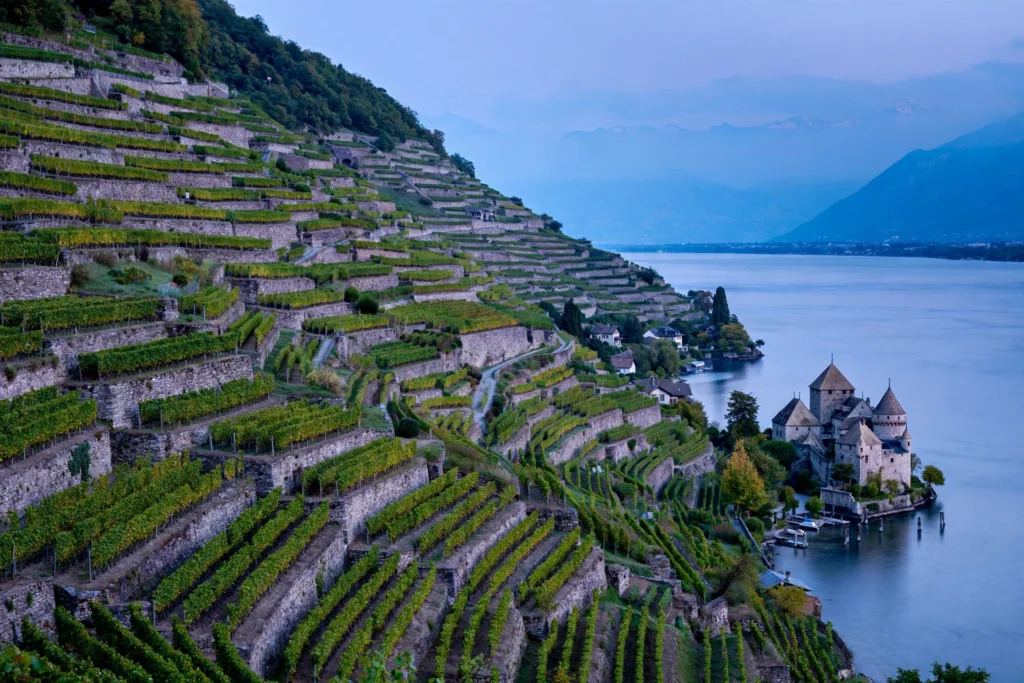
Lake Geneva is the gentler end of the trip, and it is the right fourth base for a ten-day or fourteen-day route. The lake is the largest in Switzerland, the shore is French-speaking, and the pace is slower than the Alps: vineyards, castles, jazz and museums instead of summits. The choice on the lake is between Lausanne and Montreux, and it is a real choice. Lausanne has the museums, the Olympic Museum with the largest archive of modern Olympic artefacts in the world, a hilly old town, and the Lavaux vineyards on its doorstep. Montreux has the Château de Chillon, the mountain railways, and the jazz festival in July. Stay in Lausanne for Lavaux and the museums and a city’s evenings; stay in Montreux for Chillon and the train up the Rochers-de-Naye, and book near the station if the summits matter most. Between them, the Lavaux vineyard terraces drop to the lake in a UNESCO World Heritage landscape, and the walk from Lausanne to Montreux through the terraces is one of the best easy walks in Switzerland — a full day, mostly flat, with wine villages and lake views the whole way.
The Château de Chillon is the single sight on the lake that justifies a detour, and it is the most visited historic building in Switzerland. The lakeside fortress sits on a rock at the water’s edge near Montreux, it has been a castle, a prison and a residence, and the self-guided visit takes two hours and is genuinely good — go early, because the tour groups arrive by ten. Geneva, at the western end of the lake, is the city most travellers either start or finish in, and it deserves a day rather than a night: the international quarter with the Palais des Nations, the old town and the harbour, the Jet d’Eau, and the Red Cross museum. If the trip is mostly the shore further east, stay in Lausanne; if Geneva is the city, give it a full day and stay in the old town, not the international quarter.
Bern is the capital, and it is the city most first-timers skip and most second-timers love. The old town is UNESCO-listed, with nearly four miles of medieval shopping arcades — the longest covered shopping promenade in Europe — and the river Aare loops around it, green and cold, and in summer the locals swim in it. Two nights in Bern give you the arcaded old town, a river to swim in, and fast trains to the rest of the country. Bern is also the best base for the Emmental and the Gantrisch, and for the Ballenberg open-air museum, which is a day in itself. If you want a lake outside the window, sleep in Thun instead: the boats, the river and the old town are all a walk from the station, and the Jungfrau lifts are closer to Interlaken.
Lugano is the other Switzerland — Italian-speaking Ticino, Mediterranean squares, subtropical gardens, and a lake that feels more like Italy than the Alps. Lugano is the base for the two funicular mountains, Monte Brè and Monte San Salvatore, the boats to Gandria and Morcote, and a city’s evenings. For Lake Maggiore, Locarno is half an hour away on the direct train, and the valleys behind it — the Verzasca, with its double-arched stone bridge, and the Maggia — are among the wildest in the country. Ticino is the best answer to the shoulder-season problem in this guide: when the high Alps are closed in April and November, Lugano is warm, open and quiet. And if you are continuing south, the train from Lugano to Milan takes about an hour, which is why this guide mentions it — Switzerland pairs naturally with northern Italy, and our Italy travel guide picks up where this one leaves off. The same is true in the west: Geneva pairs with France, and our France travel guide covers Paris, the Loire and the Riviera for travellers who want to keep going.
The rest of Switzerland at a glance
| Place | Best for | How long | How to get there |
|---|---|---|---|
| Lausanne | Lavaux, museums, Olympic Museum | 2 nights | 40 minutes from Geneva by train |
| Montreux | Chillon Castle, jazz, Rochers-de-Naye | 1–2 nights | 20 minutes from Lausanne |
| Geneva | International quarter, old town, harbour | 1 day | Fly in or out, or 1h15 from Montreux |
| Bern | Arcaded old town, Aare swimming | 1–2 nights | 1 hour from Zurich, 1 hour from Lucerne |
| Lugano | Ticino, funiculars, Lake Maggiore | 2 nights | 2 hours from Zurich via the Gotthard |
| Basel | Art, Rhine swimming, Fasnacht | 1 day | 1 hour from Zurich |
| St. Moritz | Engadine, Bernina trains, lakes | 2–3 nights | Glacier Express or Bernina Express |
The 4-Day, 7-Day, 10-Day and 14-Day Switzerland Itineraries
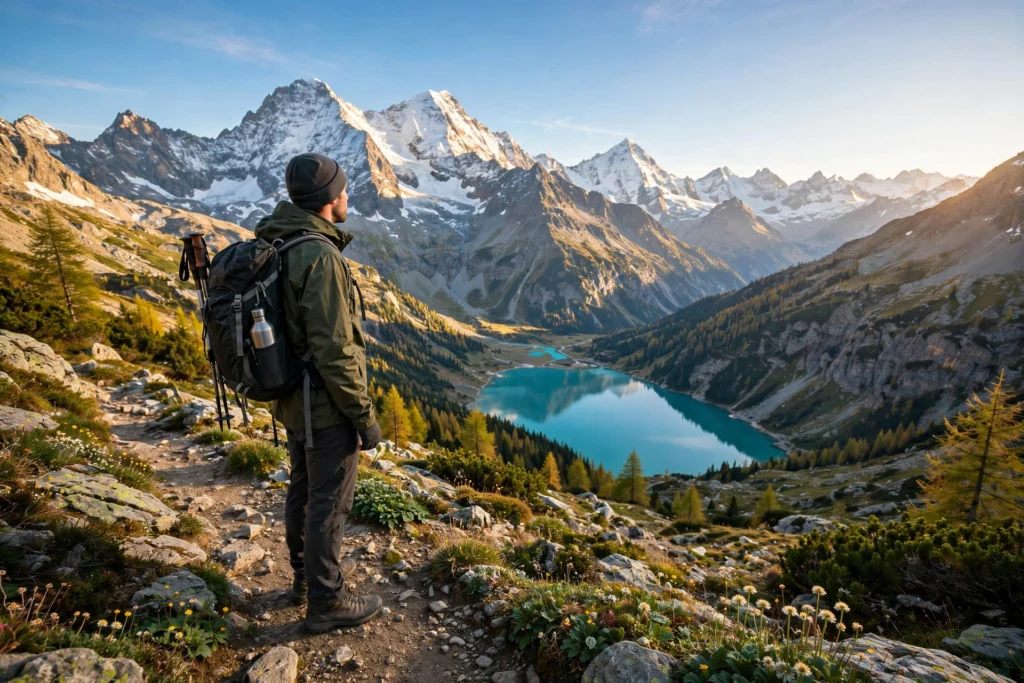
Every itinerary in this guide is built from the same three bases, so you can see exactly what each extra day buys you. The 4-day trip is one base done properly. The 7-day trip is two bases and the first scenic train. The 10-day trip is the classic three-base route, and it is the version this guide recommends for a first trip. The 14-day trip adds Lake Geneva and the Glacier Express, and it is the version for travellers who want the whole country at a walking pace. None of them base-hop nightly, none of them zigzag, and all of them keep a spare morning at every mountain base, because the mountain decides the weather and the itinerary should not fight it.
The 4-day trip is Lucerne alone, and it is better than a rushed week. Fly into Zurich, take the 45-minute train to Lucerne, and stay four nights in one hotel. Day one is the old town, the Chapel Bridge and the Lion Monument. Day two is the Golden Round Trip up Pilatus. Day three is the Rigi and a lake steamer. Day four is a day trip — Engelberg and Titlis, or Bern, or the Rhine Falls near Schaffhausen — and the train back to Zurich. You see one region properly, you never pack a bag, and you leave understanding why Switzerland is worth a longer trip. If you have four days and you try to see three bases, you will see three stations and no mountains.
The 7-day trip is two bases: Lucerne for three nights and the Bernese Oberland for four. Fly into Zurich and out of Geneva, or into Zurich and out of Zurich — the route is short enough that a return to Zurich costs little. Days one to three are Lucerne, exactly as above. Day four is the Luzern–Interlaken Express, the transfer that is also a sightseeing day, and the afternoon on Lake Brienz. Day five is the Jungfraujoch, early start, full day. Day six is Lauterbrunnen and the waterfalls, or Grindelwald First. Day seven is the train to Geneva or Zurich and the flight home, with a morning in Bern on the way if the flight is late. The 7-day trip is the minimum that earns the name “Switzerland travel guide” in full, because it gives you a lake base and a mountain base, and the train between them.
The 10-day trip is the classic, and it is the one this guide recommends. Lucerne for three nights, the Bernese Oberland for four, Zermatt for three. Days one to three are Lucerne. Day four is the Luzern–Interlaken Express. Days five and six are the Jungfraujoch and Lauterbrunnen. Day seven is Grindelwald First and the Bachalpsee, or a second valley day. Day eight is the train to Zermatt, via Spiez and Visp, and the afternoon in the old village. Day nine is the Gornergrat and the Riffelsee. Day ten is the five-lakes walk in the morning and the train to Geneva or Zurich in the afternoon. The 10-day trip is the first version in which nothing feels rushed, and the first in which a cloudy day costs you nothing, because every base has a spare morning.
The 14-day trip adds Lake Geneva and the Glacier Express, and it is the slow version. Days one to ten are the classic route. Day eleven is the Glacier Express from Zermatt to St. Moritz, a full day on the train, and a night in the Engadine. Day twelve is the Bernina Express to Tirano and back, or a day on the lakes of St. Moritz. Day thirteen is the train west to Montreux, via Chur and Lausanne, and the afternoon at the Château de Chillon. Day fourteen is the Lavaux terraces and the train to Geneva. The 14-day trip is the one for travellers who want to see the whole country, and it is the only version in which the Glacier Express earns its place — on a shorter trip, the eight hours are better spent on a mountain.
The itineraries compared
| Trip length | Bases | Route | Best for |
|---|---|---|---|
| 4 days | 1 — Lucerne | Zurich–Lucerne–Zurich | A long weekend, one region done properly |
| 7 days | 2 — Lucerne, Bernese Oberland | Zurich–Lucerne–Interlaken–Geneva | The minimum full trip, lakes and mountains |
| 10 days | 3 — Lucerne, Bernese Oberland, Zermatt | Zurich–Lucerne–Interlaken–Zermatt–Geneva | The classic, and the recommended first trip |
| 14 days | 4 — plus Lake Geneva and St. Moritz | Zurich–Lucerne–Interlaken–Zermatt–St. Moritz–Montreux–Geneva | The whole country at a walking pace |
Which trip length is right for you
Pick the 4-day trip if you have a long weekend and you want to know whether Switzerland is for you — it is, and you will be back. Pick the 7-day trip if you have a week and you want the two halves of the country, the lakes and the high Alps. Pick the 10-day trip if you can, because it is the first version in which the Matterhorn appears, and the Matterhorn is the reason most people come. Pick the 14-day trip if you have the time and the budget, because the Glacier Express and the Engadine are the best days in Switzerland after the Jungfraujoch and the Gornergrat, and they deserve a trip of their own. And whatever length you pick, book the hotels before the trains: the hotels in Zermatt and Grindelwald sell out first, the scenic-train reservations sell out second, and the valley trains never sell out at all.
What to Eat in Switzerland: Cheese, Chocolate and the Restaurant Bill
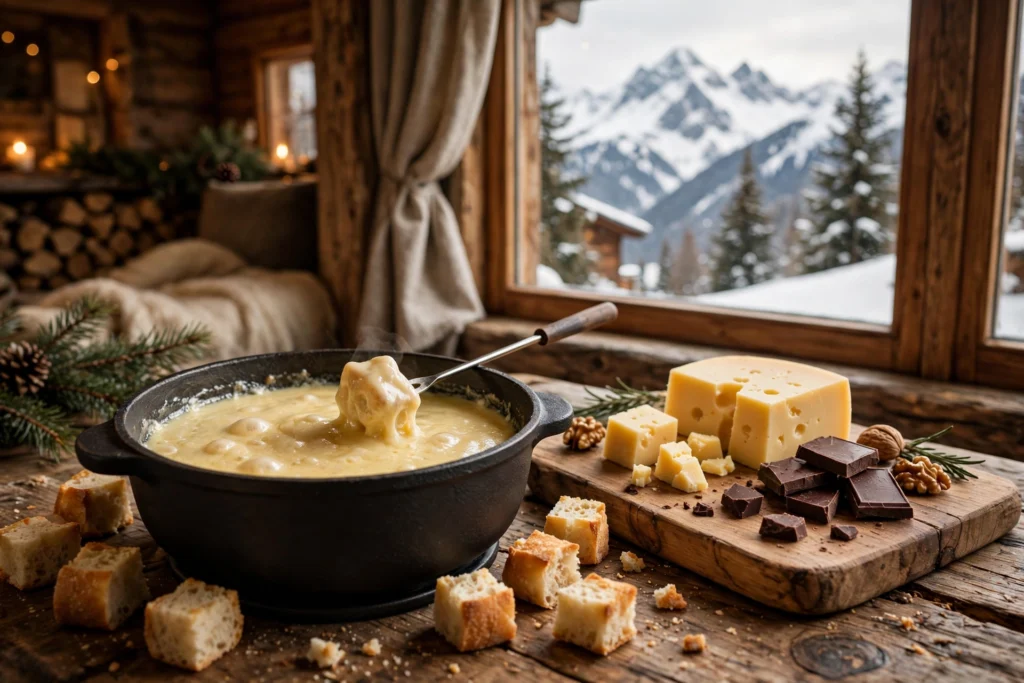
Switzerland eats well, and it eats expensively, and the two facts are related: the food is good because the ingredients are local, and it is expensive because the wages behind it are high. The honest way to eat in Switzerland is to mix the two: a supermarket breakfast, a bakery lunch, and one proper restaurant dinner a day. The Coop and Migros supermarkets are the secret weapon of the Swiss trip — the larger ones have self-service cafés, the bread is excellent, the cheese counter is the cheapest way to eat well in the country, and a ready-made supermarket lunch costs CHF 8 to CHF 15. A coffee in a café costs CHF 4.50 to CHF 6, a restaurant dish of the day at lunch costs CHF 20 to CHF 30, dinner in a restaurant costs CHF 40 to CHF 70 per person, and a fondue or raclette costs CHF 25 to CHF 40 per person. A beer, half a litre, in a bar costs CHF 6 to CHF 9. Service is included in the bill, and if you enjoyed the service it is customary to round up or leave 5 to 10 percent, but this is not obligatory. VAT, at 8.1 percent, is included in prices, and if you do not live in Switzerland and spend more than CHF 300 in one shop, you can claim a tax refund.
The dishes to know are few, and they are all worth eating once. Fondue is melted cheese — Gruyère and Vacherin — in a pot, eaten with bread cubes on long forks, and it is a winter dish, served in mountain restaurants all year because tourists ask for it. Raclette is cheese melted and scraped onto potatoes, pickles and cured meat, and it is the dish of the Valais. Rösti is a fried potato cake, served as a side or as a meal with cheese, egg or bacon, and it is the dish of German-speaking Switzerland. Zürcher Geschnetzeltes is sliced veal in a cream and mushroom sauce, served with rösti, and it is the dish of Zurich. Älplermagronen is a hearty pasta, potato, cheese, cream and onion dish from the mountain huts, and it is the best lunch after a long walk. And the chocolate is not a cliché: the Lindt Home of Chocolate in Kilchberg, half an hour from Zurich by train or boat, is the best introduction to it, but the small makers in every town are better than the big brands, and a bar from a local chocolatier is the best souvenir in Switzerland.
Food changes by region, and the regions in this guide each have a plate worth planning around. Lucerne and Central Switzerland are the home of cheese and the lake fish — perch from Lake Lucerne, served fried with butter and lemon, is the dish to order on the lake. The Bernese Oberland is the home of the mountain hut lunch: Älplermagronen, barley soup, and the cheese from the alps above Grindelwald. The Valais is the home of raclette, of dried meat, and of the wines from the terraces above the Rhône — the white Fendant is the one to try, and it is rarely exported. Lake Geneva is the home of the Lavaux wines, of perch from the lake, and of the papet vaudois, a leek and potato dish with sausage. Ticino is the home of the grotto — a rustic restaurant under the chestnut trees, serving polenta, risotto and local Merlot — and it is the most Italian eating in Switzerland. And everywhere, the bread is the quiet triumph: the bakeries open early, the loaves are dense and dark, and a bread roll with cheese from the supermarket is a CHF 5 lunch that beats most restaurant meals.
Food by region
| Region | Dish to try | Where to eat it | Price guide |
|---|---|---|---|
| Lucerne and Central Switzerland | Fried lake perch, cheese from the alps | Lakeside restaurants, old town | CHF 25–40 |
| Bernese Oberland | Älplermagronen, barley soup | Mountain huts, Grindelwald | CHF 20–30 |
| Valais and Zermatt | Raclette, dried meat, Fendant wine | Mountain restaurants, village | CHF 25–40 |
| Lake Geneva and Vaud | Papet vaudois, Lavaux wines | Lausanne, Lavaux villages | CHF 25–40 |
| Ticino | Polenta, risotto, Merlot in a grotto | Lugano, Locarno | CHF 20–35 |
| Zurich | Zürcher Geschnetzeltes with rösti | Old town restaurants | CHF 35–50 |
| Everywhere | Fondue, chocolate from a local maker | Mountain restaurants, chocolatiers | CHF 25–40 |
How to eat well without the restaurant bill
The first rule is to eat breakfast from the supermarket: a roll, cheese and fruit for CHF 5, instead of a hotel breakfast for CHF 25. The second rule is to make lunch the main restaurant meal, because the dish of the day at lunch is the same food as dinner for half the price. The third rule is to drink tap water: it is drinkable everywhere in Switzerland, including from most city fountains, and carrying a bottle saves CHF 5 a day. The fourth rule is to eat in the mountain restaurants at lunchtime, not dinner, because the view is the same and the menu is cheaper. And the fifth rule is to buy chocolate from a local maker, not from the airport, because the airport price is double and the chocolate is the same.
How Much Does Switzerland Cost? A Fully Costed Trip Budget
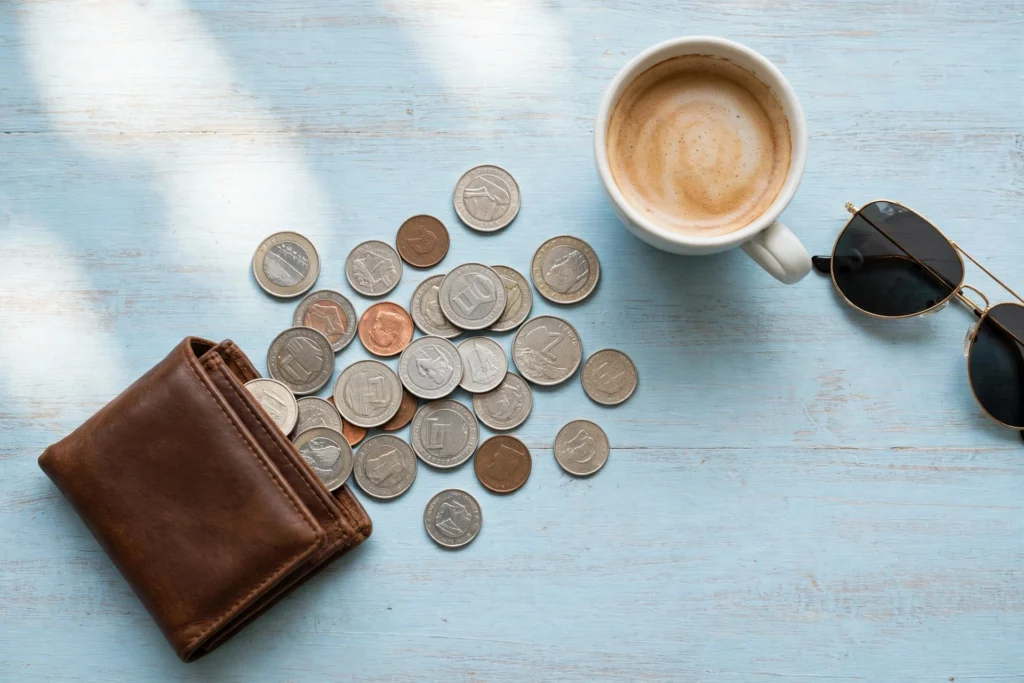
Switzerland is the most expensive country in Western Europe for a traveller, and this guide does not pretend otherwise. The question is not whether it is expensive — it is — but how much, and where the money goes, and what you can do about it. The answer, for the 10-day trip in this guide, is that a mid-range traveller should budget roughly CHF 250 to CHF 350 a day, excluding international flights, and a budget traveller who stays in hostels, eats from supermarkets and walks instead of riding every mountain railway can manage on roughly CHF 150 to CHF 200 a day. The biggest costs, in order, are the hotel, the mountain railways, and food — and the biggest savings, in order, are the rail pass decision, the supermarket, and the shoulder season.
The hotel is the largest single cost, and it is the one with the most range. A hostel bed costs CHF 40 to CHF 70 a night. A double room in a three-star hotel costs CHF 150 to CHF 280 a night, more in the mountains in high season. A double room in a four-star hotel in Zermatt or Grindelwald in July can cost CHF 350 to CHF 500 a night, and the same room in November can cost half that — if it is open at all. The mountain railways are the second cost, and they are the one that surprises people: the Jungfraujoch return is CHF 271.20, the Gornergrat return is CHF 132, Pilatus is CHF 84, and a traveller who rides all three at full fare has spent CHF 487 before buying a single train ticket. The rail pass decision in this guide exists to cut that figure roughly in half. Food is the third cost, and it is the most controllable: a day of supermarket breakfast, bakery lunch and one restaurant dinner costs roughly CHF 60 to CHF 80, while a day of three restaurant meals costs CHF 120 to CHF 160.
Transport within Switzerland, once the pass is bought, is the most predictable cost in the trip. The Swiss Travel Pass for 8 days costs CHF 439, and the Half Fare Card costs CHF 150 — and after that, the valley trains, buses and boats are free or half price, and the mountain railways are discounted. The scenic-train reservations are extra: CHF 54 for the Glacier Express, and a similar figure for the Bernina Express. A taxi in Switzerland is expensive and rarely necessary — the trains and buses go everywhere, and the villages in this guide are walkable. The small costs add up too: a coffee CHF 4.50 to CHF 6, a beer CHF 6 to CHF 9, a museum ticket CHF 15 to CHF 25 (free with the Swiss Travel Pass), and the tourist tax, which is charged per person per night on top of the room rate in most towns and runs to a few francs a night.
The 10-day trip, fully costed (per person, mid-range, excluding international flights)
| Item | Cost (CHF) | Notes |
|---|---|---|
| Hotels, 9 nights, 3-star double shared | 1,350–2,250 | CHF 150–250 a night per person sharing |
| Swiss Travel Pass 8 days, 2nd class | 439 | Or Half Fare Card CHF 150 + half-fare tickets |
| Jungfraujoch return | 190 | With Swiss Travel Pass; CHF 271 full fare |
| Gornergrat return | 66 | With pass or Half Fare Card; CHF 132 full fare |
| Pilatus Golden Round Trip | 42 | With pass; CHF 119.80 full fare |
| Glacier Express reservation | 54 | If riding the Glacier Express |
| Food, 10 days | 600–800 | Supermarket breakfast, one restaurant meal a day |
| Museums, boats and extras | 100–150 | Most museums free with the pass |
| Total, 10 days | 2,850–4,000 | Roughly CHF 285–400 a day |
How to spend less without spoiling the trip
The first saving is the pass decision: cost out the Half Fare Card before you buy the full pass, because on a mountain-led trip it usually wins by CHF 50 to CHF 150. The second saving is the supermarket: breakfast and lunch from Coop and Migros save roughly CHF 30 a day, which is CHF 300 on a ten-day trip. The third saving is the season: late September and early October give you the best weather and the lowest high-season prices, and the hotels are cheaper than in July and August. The fourth saving is the mountain choice: pick two summits, not four, and spend the saved money on a second night in the village below. The fifth saving is the booking window: Saver tickets for the valley trains are on sale up to six months in advance, and the hotels in Zermatt and Grindelwald are cheapest when booked months ahead. And the saving that is not a saving: do not skip the Jungfraujoch to save CHF 271, because the Jungfraujoch is the reason you came, and a Switzerland trip without a high summit is a trip to a very expensive country with the best part left out. For more on choosing cheap months in general, our guide to the cheapest time to travel explains how shoulder seasons work across destinations, and our travel packing checklist covers what to bring so you do not have to buy it at Swiss prices.
Frequently Asked Questions About Switzerland Travel
Do US citizens need a visa for Switzerland?
No. US passport holders do not need a visa for tourism or short business trips of up to 90 days in any 180-day period, under the Schengen rule. Your passport must be valid for at least six months from your date of entry, and the Swiss authorities strictly enforce that rule. ETIAS, the new pre-travel authorisation, is not in operation as of November 2026 and has no start date, so there is nothing to apply for. The Entry/Exit System, EES, has been fully operational since 10 April 2026, so expect fingerprints and a photograph on your first entry into the Schengen area.
Is Switzerland safe for US tourists?
The US State Department rates Switzerland at Level 1, Exercise Normal Precautions, issued 15 January 2026 — its lowest tier, the same as Japan and South Korea. The advisory warns about pickpocketing and theft at crowded tourist sites and major railway stations, and about Alpine hazards: avalanches, landslides, glacial crevasses, falling rocks and sudden weather changes. No part of the country is rated at a higher level. Exercise normal caution, stay on marked paths in the mountains, and read the full advisory before you travel and again the week before you fly.
How many days do you need in Switzerland?
Four days is the minimum for a good trip — Lucerne alone, done properly. Seven days covers two bases, Lucerne and the Bernese Oberland, and the first scenic train. Ten days is the recommended length, because it adds Zermatt and the Matterhorn, and it is the first version in which nothing feels rushed. Fourteen days is the version this guide recommends if you have the time, because it adds Lake Geneva, the Glacier Express and the Engadine, and every base gets a spare morning.
What is the best time to visit Switzerland?
September is the single best month for a first trip: the high paths are clear of snow, the lake boats still run their summer timetable, the larches turn golden, and the crowds have thinned. June to August is the high season, with everything open and the lakes warm enough for swimming, but also the busiest and most expensive time. January to March is ski season. November and April to May are the shoulder seasons, when many lifts, boats and mountain hotels close for maintenance — good for cities and Ticino, risky for the summits.
Is the Swiss Travel Pass worth it?
It depends on how you travel. The 8-day pass costs CHF 439 in second class in 2026, and it suits a trip that changes base often, with a long train journey on most days, plus museums and boats. The Swiss Half Fare Card costs CHF 150 for a month and gives 50 percent off almost everything, including the mountain railways, and it usually wins on a mountain-led trip that stays in one or two bases — a single Jungfraujoch return saves CHF 130.60 with it. Cost out your route before you buy, and remember that no pass covers the scenic-train seat reservations.
How much does a trip to Switzerland cost?
A mid-range traveller should budget roughly CHF 250 to CHF 350 a day, excluding international flights, and a budget traveller can manage on roughly CHF 150 to CHF 200 a day. A 10-day mid-range trip, excluding international flights, runs roughly CHF 2,850 to CHF 4,000 per person, with hotels the largest cost, the mountain railways the second, and food the third. The biggest savings are the rail pass decision, the supermarket, and the shoulder season.
What is the best base in Switzerland for a first trip?
Lucerne, for three nights. It is the simplest first base: a medieval old town, a lake with steamers, and three mountains — Pilatus, Rigi and Titlis — within an hour, so a cloudy day costs you nothing. Interlaken and the Bernese Oberland come second, for the Jungfraujoch and the waterfalls, and Zermatt third, for the Matterhorn. Never sleep one night per stop — stay at least three nights in each base.
Do I need a car in Switzerland?
No. Trains, PostBuses, boats and cableways reach every place in this guide, and you cannot drive into Zermatt, Wengen or Mürren at all. A car helps most on the high pass roads, which are a summer trip, and for families with small children and a lot of luggage. If you do drive, the motorway vignette costs CHF 40 a year, and high Alpine passes are usually closed from October or November until May or June.
What is the currency in Switzerland?
The Swiss franc, CHF. Switzerland is not in the European Union and does not use the euro; euros are accepted in far fewer places than you might expect, change is given in francs, and the rate is usually poor. Cards are accepted almost everywhere, including ticket machines and mountain cafés, and contactless payment is the norm. In November 2026 one Swiss franc was worth roughly 1.20 US dollars, but the rate moves — check it before you travel.
Can I drink the tap water in Switzerland?
Yes. Tap water is drinkable everywhere in Switzerland, including from most city fountains, unless a sign says otherwise — “Kein Trinkwasser” in German or “Eau non potable” in French. Carry a reusable bottle and refill it at the fountains; it saves money and it is what the Swiss do.
What should I wear in Switzerland?
Layers, in every season. The valleys can be 25 degrees Celsius in July while the Jungfraujoch is 3 degrees, and the weather changes fast in the mountains. Bring a waterproof jacket, proper walking shoes with grip, a warm layer for every summit, sun protection — the sun is strong at altitude — and, in winter, warm clothes and shoes with grip for ice. Shops are closed on Sundays outside stations, so buy anything you need on Saturday.
Is Switzerland a good first trip to Europe?
Yes, and it is one of the best first trips in Europe for an American traveller: a single small country with medieval old towns, turquoise lakes, the highest railway station in Europe, the most famous mountain in the world, and a public transport system that runs to the minute. The only things it demands are the ones this guide covers — pick two or three bases, buy the right rail pass, keep a spare morning for the mountain, and budget honestly for the cost.
Conclusion: Switzerland Rewards the Traveller Who Stays Put
Switzerland is not a country to rush, and the travellers who love it most are rarely the ones who saw the most places. They are the ones who gave Lucerne three days instead of one, who slept in the Bernese Oberland instead of passing through it, who waited for the Matterhorn at dawn instead of seeing it through a train window, and who took the boat across the lake instead of the fastest train around it. The country punishes hurry and rewards patience, and the classic route works precisely because it does three things well instead of ten things badly. Plan it the way the guide lays it out. Pick two or three bases and stay three nights in each. Fly into one city and out of another, and move in one direction. Buy the right rail pass before you leave, and cost it out properly. Go in September if you can, and keep a spare morning at every mountain base. Book the Jungfraujoch early, ride the scenic trains as a day in themselves, eat breakfast from the supermarket and dinner in a restaurant, and carry the passport that gets you in for 90 days. Enrol in STEP, buy the insurance that covers mountain rescue, and check the advisory again the week before you fly. Do those things, and Switzerland gives you what few destinations can: a lake with steamers and a medieval bridge, a valley with 72 waterfalls, a railway station at 3,454 metres, a mountain that turns gold at dawn, and a train journey across the Alps that is worth the trip on its own. The trip is worth the planning, and the planning is mostly done — now go and book it.
People also read:
- Austria Travel Guide
- Germany Travel Guide
- France Travel Guide
- Italy Travel Guide
- Travel Safety Tips
- Cheapest Time to Travel

M. Adil is the founder and editor of SoloTravelPro. He writes practical, research-based travel guides that help travellers plan with confidence — from first-time city breaks to national parks and island escapes. Every guide is built on official sources, current prices and honest, usable advice, so readers can plan smarter and travel better.

Other Articles
Germany Travel Guide: North to South in 7, 10 or 14 Days (2026–27)
Bali Travel Guide: Two Bases, One Island, Zero Regrets in 2026–27
One Comment
Comments are closed.
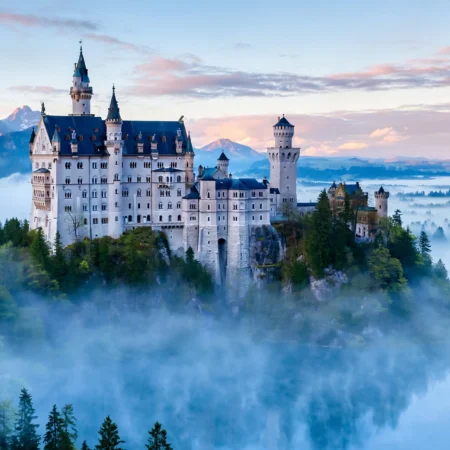
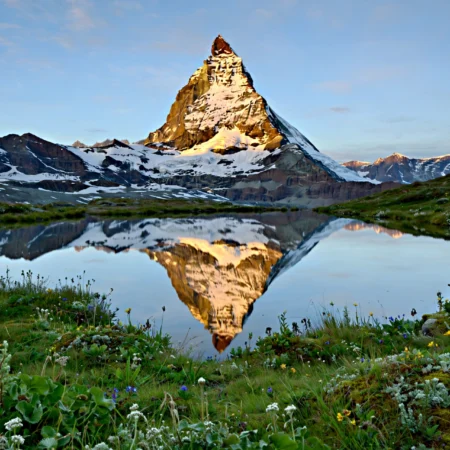
[…] in November 2026. For the neighbouring countries this route connects to, our guides to Austria and Switzerland pick up where this one leaves off, and our France travel guide covers the western neighbour across […]