Germany is not a country you see from one base, and it is not a country you see by zigzagging between its famous names. It is a long country — about 870 kilometres from the Baltic coast to the Alps — with no single centre: Berlin is the capital, Frankfurt is the airport and finance hub, Munich is the Bavarian capital and the gateway to the castles and the Alps, and Hamburg is the port. The mistake most first-timers make is trying to see all of it in one sprint, or bouncing between Berlin and Munich and back again, and arriving everywhere tired. This Germany travel guide gives you the honest version: the north-to-south spine that actually works, the train-versus-car decision that shapes the whole trip, the visa and entry rules for US citizens as they stand in late 2026, what the US travel advisory really means, three 7-day routes built for different trip styles, 10-day and 14-day versions of the same spine, food by region, and real costs in euros, so you can plan a first trip to Germany without the mistakes most first-timers make.
Germany Travel Guide: The North-to-South Reality Check — One Direction, No Zigzag
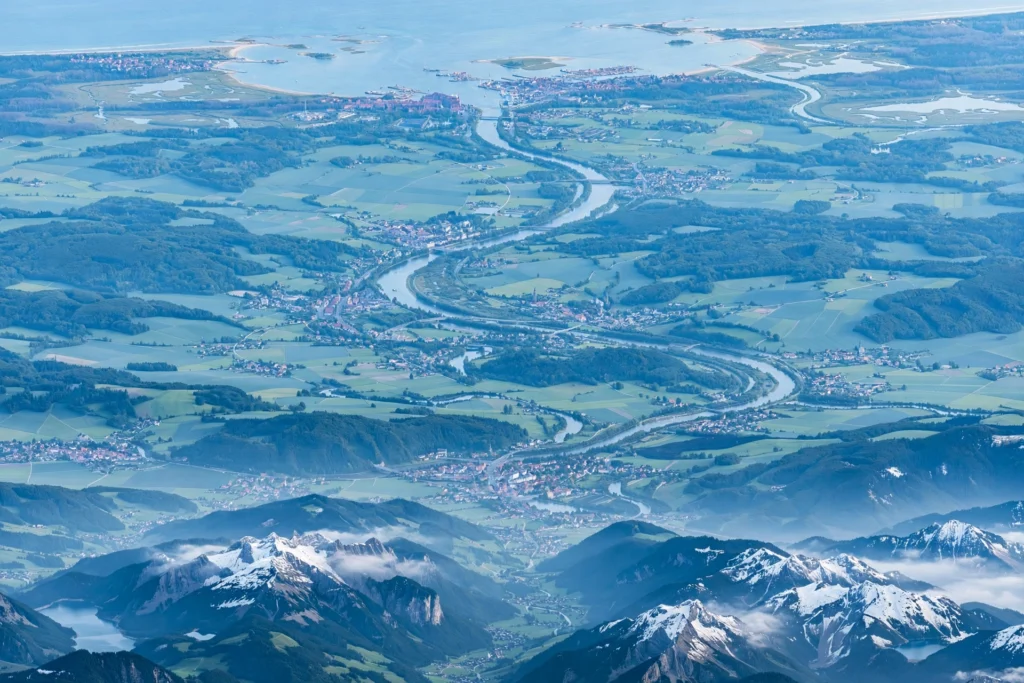
The single most important fact in this whole Germany travel guide is the shape of the country and the direction you travel through it. Germany is slightly smaller than Montana, about 540 miles (870 kilometres) from north to south, with about 84 million people and one of the densest rail networks in Europe. It divides naturally into five travel zones: the capital and the east, Bavaria in the south, the Rhine Valley and the west, Hamburg and the north, and the Black Forest and the Romantic Road. A week covers Berlin plus one more region comfortably. Ten to fourteen days covers three or four regions. Nobody covers all five well in a week, and the guides that pretend otherwise are selling a checklist, not a trip.
The second reality check is about direction. North to south is the classic way to do Germany, and it is classic for a reason. You start in Hamburg or Berlin, where the country is at its most modern and its most haunted by the twentieth century, and you end in Munich and the Bavarian Alps, where it is at its most traditional and most scenic. The landscape improves as you go: the flat north gives way to the river valleys of the centre, then to the half-timbered towns of the Romantic Road, then to the Alps. Fly into one city and out of another — into Hamburg or Berlin, out of Munich, or into Frankfurt and out of Munich — and you save a full day of backtracking. A return flight to the same city costs you a day on the train at the end of the trip, and in a seven-day trip a day is fifteen percent of everything you have.
The third reality check is about bases. Germany punishes the one-night stop. A one-night stop in a city means a train in the morning, a rushed afternoon, and a train the next morning, and the net result is about four hours of sightseeing. The rule that makes this guide work is simple: no more than four bases in ten days, at least two nights in every base, and day trips for everything else. Berlin and Munich are the two bases that anchor almost every first trip — they are about four and a half hours apart by fast train — and the third and fourth bases are chosen from Dresden, Nuremberg, the Rhine, Heidelberg or Hamburg, depending on the trip style. Everything else is a day trip from one of those bases.
The fourth reality check is about what the classic route actually is. For a first trip, it has five stops and almost nothing else: Berlin and Potsdam in the north-east, Dresden and Saxon Switzerland in the east, Nuremberg and the Romantic Road in the centre, Munich and Neuschwanstein in the south, and the Rhine or the Black Forest in the west if you have the days. That is the route this guide builds, because it is the route that works in 7 to 14 days, and because every stop on it earns its place. Everything else — the Baltic coast, the Harz mountains, Lake Constance, the Moselle villages, the far north-west — is a second trip, not a detour.
The north-to-south spine at a glance
| Stop | Nights | How you get there | Why it earns its place |
|---|---|---|---|
| Hamburg (optional start) | 2 | Fly in, or 1h45 by ICE from Berlin | Harbour, Speicherstadt, Elbphilharmonie, the north |
| Berlin | 3 | 1h45 by ICE from Hamburg, or fly in | The Wall, Museum Island, Reichstag, the capital’s history |
| Dresden | 1–2 | About 2h10 by ICE from Berlin | Baroque old town, the Elbe, Saxon Switzerland |
| Nuremberg and the Romantic Road | 2 | About 3h by ICE from Berlin, 1h10 from Munich | Imperial castle, Rothenburg, half-timbered towns |
| Munich | 3 | 1h10 by ICE from Nuremberg | Marienplatz, beer halls, the Alps, Oktoberfest |
| Neuschwanstein and the Bavarian Alps | 1 (day trip) | About 2h by train from Munich | The fairy-tale castle, the Alps, the lakes |
| Rhine and Moselle (optional) | 2 | 1–1.5h by ICE from Frankfurt | Castles, vineyards, river boats, wine villages |
| Cologne and Heidelberg (optional) | 1–2 | 1h10 by ICE Frankfurt–Cologne | The cathedral, the castle ruin, the Black Forest |
The mistakes first-timers make
The first mistake is the zigzag: Berlin to Munich to Berlin again, or Munich to the Rhine and back to Munich, because the flights were booked as a return to one city. Book an open-jaw flight — into one city, out of another — and the route becomes a straight line. The second is the one-night stop, covered above: four bases in ten days is the maximum, and three is better. The third is treating the Romantic Road as a drive-by: the road is a string of walled towns, and it needs two days by car or a full day on the train and bus, not an afternoon. The fourth is booking Neuschwanstein as a same-day walk-up — the castle sells out, the tickets are timed, and the village needs an hour and a half of lead time. And the fifth is the train mistake: buying the wrong ticket. The Deutschlandticket covers regional trains but not the ICE, and a last-minute ICE fare costs three or four times the advance fare. The train section below gives the current rules, checked against live sources in November 2026, so you do not make it.
How to use this guide
Read the sections in order if this is your first trip: the best time to go, the visa and entry rules, the safety picture, then the train-versus-car decision, then the stops from north to south, then the itineraries, food and costs. If you already know when you are going, skip straight to the itinerary that matches your trip length — the three 7-day routes and the 10-day and 14-day versions are built from the same spine, so you can see exactly what each extra day buys you. Every price in this guide is given as a range, because the euro moves against the dollar and a figure quoted as exact would be out of date within weeks; the ranges are checked against live operator and official pages in November 2026. For the neighbouring countries this route connects to, our guides to Austria and Switzerland pick up where this one leaves off, and our France travel guide covers the western neighbour across the Rhine.
Best Time to Visit Germany: Month by Month, Region by Region
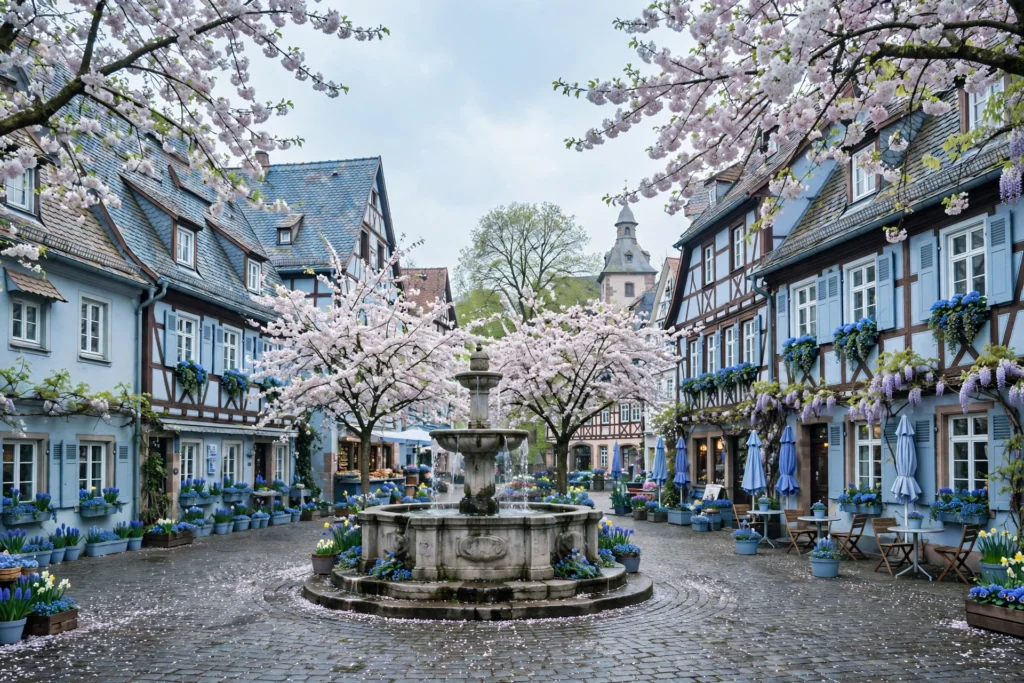
There is no single best month for the whole of Germany, because the country stretches from the Baltic coast to the Alps and its regions behave differently. The answer depends on which stops matter most to you, but for the classic north-to-south route the sweet spot is clear: May to June and September to early October. Those are the months when the cities are warm and walkable, the Rhine boats are running, the Alpine lifts are open, the beer gardens are full, and the crowds are thinner than in July and August. May to June and September to early October are the windows this guide recommends for a first trip.
The north — Hamburg, Lübeck, the Baltic coast and the North Sea islands — is a summer region. The beaches and the island resorts are at their best from June to September, and the coastal towns largely shut down in winter, with ferries reduced and hotels closed. Hamburg itself is fine all year, but the coast is not a winter trip. The east — Berlin, Dresden and Saxony — is a year-round region, but it is at its best from May to September, when the parks and the riverbanks are in use and the long evenings make the cities easy to walk. Berlin in November is grey and compact, and the city is a safer bet for things to do than the countryside in that month, because the museums and the concert halls carry the trip.
The centre — the Rhine, the Moselle, the Romantic Road and the Black Forest — has the longest season in the country. The Rhine boats run from late March to late October, the vineyards are green from May and golden in October, and the wine festivals run through the autumn. The wine villages are at their best in September and October, when the harvest festivals are on and the slopes turn colour. The Black Forest is a hiking region from May to October and a snow region in winter, and the spa towns of Baden-Baden and the Upper Rhine Plain are year-round, because the Upper Rhine Plain is one of Germany’s sunniest zones. The south — Munich, the Bavarian Alps and the lakes — is a two-season region: June to early October for hiking and the castles, December to March for skiing, and the shoulder months of April and November are the quietest and the least reliable for mountain weather.
Summer, from June to August, is the warmest and the busiest season, with daytime highs of 13 to 25 degrees Celsius and the highest prices, the longest queues, and the most crowded attractions, especially in July and August. The beer gardens are at their best, the riverbanks are full, and the festivals are constant — but so are the crowds, and the hotels in Munich and the classic market towns book out months ahead. Spring, from April to May, and autumn, from September to October, are the shoulder seasons: mild temperatures, lower crowds, colourful landscapes, and changeable weather, so layers and rain gear are essential. Winter, from November to March, is cold, with daytime temperatures of minus 1 to 8 degrees, and it is the season of the Christmas markets and the Alpine skiing — and of the lowest hotel prices outside the market towns and the ski resorts.
Month-by-month at a glance
| Month | North (Hamburg, Baltic) | East (Berlin, Dresden) | Centre (Rhine, Romantic Road) | South (Munich, Alps) | Verdict |
|---|---|---|---|---|---|
| January | Cold, quiet, windy | Cold, museums carry the trip | Quiet, wine villages asleep | Ski season, cold in the valleys | Winter sports only |
| February | Cold, quiet | Cold, Berlinale film festival | Quiet, Carnival in Cologne | Ski season, Carnival season | Skiing and Carnival |
| March | Cold, clearing | Mild, early spring | Rhine boats restart late March | Snow still in the Alps | Early shoulder |
| April | Mild, blossom | Mild, parks open | Mild, vineyards greening | Hiking starts at low altitude | Good shoulder |
| May | Mild, coast opens | Warm, long evenings | Warm, best walking weather | Warm, Alpine lifts open | Excellent |
| June | Warm, beach season | Warm, festivals begin | Warm, Rhine at its best | Warm, best hiking | Best month |
| July | Warm, busiest coast | Warm, busiest cities | Warm, crowded river towns | Warm, afternoon storms | Good, but crowded |
| August | Warm, beach season | Warm, crowded | Warm, wine festivals start | Warm, busiest Alps | Good, but crowded |
| September | Mild, coast quietens | Mild, golden light | Harvest, wine festivals | Mild, best Alpine light | Excellent |
| October | Cool, ferries reduce | Cool, autumn colour | Golden vineyards, boats end late Oct | Cool, lifts wind down | Excellent early, fading late |
| November | Grey, coast shuts down | Grey, damp, markets arrive | Quiet, markets from late Nov | Cold, first snow | Christmas markets begin |
| December | Cold, markets in Hamburg | Cold, markets everywhere | Markets in every town | Ski season begins | Christmas markets |
The two festival seasons that change everything
Oktoberfest and the Christmas markets are the two seasons that change the whole trip, and they need to be planned around rather than stumbled into. Oktoberfest 2027 runs from Saturday 18 September to Sunday 3 October 2027 on the Theresienwiese in Munich, closing on German Unity Day, and it is the 192nd edition of the world’s largest folk festival. It is free to enter and possible without a reservation, but the beer tents fill by midday on weekends, the hotels in Munich double in price and book out months ahead, and the city is at its most crowded. If you want Oktoberfest, book the hotel eight to twelve months ahead and go midweek; if you do not want it, avoid Munich in those two and a half weeks, or stay in the city and enjoy the rest of it while the festival runs on the edge of town.
The Christmas markets are the other season, and they are a better reason to visit in winter than anything else in the country. The big four in 2026 are Nuremberg’s Christkindlesmarkt, from 27 November to 24 December, Dresden’s Striezelmarkt, from 25 November to 24 December, Munich’s market, from 20 November to 24 December, and Cologne’s cathedral market, from 16 November to 23 December, with Rothenburg’s Reiterlesmarkt from 20 November to 23 December and Heidelberg’s market from 23 November to 22 December. Most markets close by 23 or 24 December, and almost everything in Germany is shut on Christmas Day, so plan to be somewhere else — or in one place, settled — on 25 December. The winter version of the north-to-south route is a different trip from the summer one, and the itineraries section at the end of this guide gives it its own plan.
How the seasons affect prices
Prices follow the seasons more sharply in Germany than in most of Western Europe. Hotels in Munich can cost roughly twice as much during Oktoberfest as in a normal week, and the classic Christmas market towns double in price in December and book out months ahead. The Rhine boats and the Alpine lifts are cheapest in the shoulder months and most expensive in July and August, when the weather is best and the boats sell out. Long-distance train fares are cheapest when booked weeks ahead and most expensive in the days before departure, especially around Oktoberfest and the Christmas markets. If your dates are flexible, the cheapest good-weather window is usually late April or late September. For more on picking cheap months in general, our guide to the cheapest time to travel explains how shoulder seasons work across destinations.
Do US Citizens Need a Visa for Germany? Schengen, EES and ETIAS in 2026–27

The short answer, for most American travellers, is no — you do not need a visa, and you do not need to apply for anything before you travel. US passport holders enter Germany visa-free for short stays of up to 90 days in any 180-day period, under the Schengen rules. The 90 days are counted across the whole Schengen area, not per country, so a week in Germany and a week in France and a week in Italy adds up to 21 days of the same 90. The good news is that there is no application, no fee and no embassy visit for a tourist trip under 90 days. The part that catches people out is the two new systems at the border — the Entry/Exit System, which is live, and ETIAS, which is not — and the fact that the 90-day clock is now counted by a computer, not by a stamp in your passport.
The Entry/Exit System, known as EES, is the system that is already running. It began progressive implementation on 12 October 2025 and became fully operational on 10 April 2026, and it electronically records non-EU short-stay travellers crossing the external Schengen borders, including fingerprints and a facial image, instead of stamping passports. On your first entry you give fingerprints and a photo at the border, and the system counts your days against the 90-day limit itself. The practical consequences are twofold: allow extra time at passport control on arrival, especially at Frankfurt and Munich, because the biometric capture takes longer than a stamp, and do not try to game the 90-day rule, because overstays are now detected automatically and can lead to fines, an entry ban and problems on future trips. The European Commission publishes a short-stay calculator on its home-affairs website, and it is worth using if your trip touches several Schengen countries.
ETIAS is the system that is not running, and the distinction matters, because a whole industry of websites is already selling it. ETIAS — the European Travel Information and Authorisation System — will eventually require visa-exempt visitors to apply online for a travel authorisation before travelling to most Schengen countries, at a fee set at 20 euros once it starts. As checked in November 2026, it is not in operation, no applications are being collected, and there is no confirmed start date: the earlier target of the last quarter of 2026 was removed from the EU’s official information, the EU says it will announce the start date several months before launch, and press reports in autumn 2026 point to 2027, which is not official. There is nothing to apply for today, and any website offering an ETIAS application or pre-registration for a fee is not official. When ETIAS launches, the only official application channels will be the EU’s own website and app, announced on the EU’s travel-europe.europa.eu site. Check that site before you travel, and do not pay anyone for an ETIAS authorisation in the meantime.
The passport rules are straightforward but strict. Your passport must be valid for at least three months beyond your planned date of departure from the Schengen area, you need at least two blank passport pages, and six months’ validity is recommended even though it is not required. No vaccinations are required for Germany. Over 10,000 euros in cash, or the equivalent, must be declared on entry and on exit. Longer stays, work or study require a national German visa or residence permit applied for before arrival. If someone in your party holds a different passport, the rule is decided passport by passport: a spouse with a British or Canadian passport enters under the same visa-free rule, but a companion from a country that needs a Schengen visa must hold one, even though you are travelling together. Check every passport in your party separately before you book.
Entry checklist for US citizens
| Requirement | The rule for US citizens (checked November 2026) |
|---|---|
| Visa for tourism | Not required — visa-free for up to 90 days in any 180-day period |
| 90-day rule | Counted across the whole Schengen area, not per country |
| EES (Entry/Exit System) | Live and fully operational since 10 April 2026 — fingerprints and photo at the border |
| ETIAS | Not in operation as of November 2026; no start date; fee set at 20 euros once live |
| Passport validity | At least 3 months beyond your departure date; 6 months recommended |
| Blank pages | At least 2 blank passport pages |
| Cash declaration | Over 10,000 euros must be declared on entry and exit |
| Vaccinations | None required |
| Work or study | National German visa required, applied for before arrival |
| Official check | The EU’s travel-europe.europa.eu site for ETIAS; the State Department’s Germany page for entry rules |
Is Germany Safe for US Travellers? The Advisory, Honestly Explained
The US State Department rates Germany at Level 2: Exercise Increased Caution, due to terrorism. That is the fact that matters most, and it deserves a plain reading, because Level 2 is the tier the State Department gives to most of Western Europe — France, Italy, Spain and the United Kingdom are all at Level 2 as well. The advisory was issued on 13 May 2025 and, checked live in November 2026, it is still the current rating: the level and the risk indicator did not change in the most recent revision, and the State Department reconfirmed the Level 2 rating for Germany in August 2026. Level 2 does not mean you should avoid Germany; it is only at Level 3 that reconsidering travel is recommended, and at Level 4 that travel is advised against. You can read the full text on the State Department’s Germany travel advisory page, and you should read it twice — once when you book, and again the week before you fly, because advisories change. Our own guide to travel safety tips covers the same preparation in depth for any destination.
The detail underneath the headline is where the real information lives. The advisory’s warning is about terrorism, not about crime. Terrorist groups and lone actors remain a constant threat in Germany and Europe, and the advisory says attacks may occur with little or no warning and may target tourist locations, transportation centres, markets and shopping malls, hotels, clubs and restaurants, places of worship, parks, and major sporting and cultural events. The State Department’s advice is practical rather than alarming: be aware of your surroundings in tourist locations and crowded public venues, follow the instructions of local authorities, monitor local media for breaking events, and enrol in the Smart Traveler Enrollment Program, known as STEP, which is free and lets the nearest US embassy or consulate contact you in an emergency. The US embassy in Berlin also issued a Europe-wide security alert on 16 November 2026 urging Americans to stay vigilant around crowds, markets and transport hubs during the holiday season, without pointing to any specific plot, city or date — the alert is advice, not a restriction, and it did not change the advisory level.
The crime picture is the one that actually affects tourists most often, and it is far more ordinary. Violent crime is rare in Germany but can occur, and it is more common in the larger cities, in large metropolitan subway systems, and in train stations. Most incidents of street crime involve the theft of unattended items and pickpocketing, and theft and pickpocketing happen mainly at train stations and on public transport, and also at tourist spots and large public events. Most crimes occur during the late night or early morning hours. The advice is the same as in any big European city: keep your bag in front of you in crowded places, keep your valuables out of easy reach on trains and in stations, stay aware of your surroundings, and exercise caution in popular expatriate hangouts late at night. Financial scams are common, and they often begin through online posts, emails or letters from scammers pretending to be US citizens in need of help — the red flags are a faraway location, a new social media profile, a relationship moving too quickly, or a request for money.
There are two other warnings worth taking seriously. The first is about demonstrations: they occur frequently in Germany, they can be unpredictable, and they may take place in response to political or economic issues or on politically significant holidays such as German Labor Day on 1 May. Avoid the areas around protests, check local media for updates and traffic advisories, and remember that strikes can interfere with travel plans — check transport schedules before you travel on a strike day. The second is about the roads and the mountains: every year, people are injured or killed in Germany’s Alpine and coastal regions, most often while skiing, hiking, snowboarding, mountain biking, sledding, climbing, paragliding or swimming. Alpine sports enthusiasts are strongly encouraged to register with the German Alpine Club, the Alpenverein, and medical care outside the major cities can take longer to reach you, so buy travel insurance that covers emergency medical care and evacuation. Our guide to what travel insurance covers explains the exclusions that catch people out.
What to do before you go
Enrol in STEP on the State Department’s STEP enrolment page. It is free, it takes about ten minutes, and it lets the nearest US embassy or consulate contact you in an emergency and help your family reach you. Save the emergency numbers — 112 for ambulance and fire, and 110 for the police. Check with the German Federal Institute for Drugs and Medical Devices that your medication is legal in Germany before you travel, and carry a doctor’s letter for prescription drugs. Buy travel insurance that covers emergency medical care, evacuation and trip cancellation, and read what it excludes before you need it. And remember the local laws that catch visitors out: it is illegal to bring into or take out of Germany any literature, music or items that glorify fascism, the Nazi past or the Third Reich, and Germany has strict customs rules on firearms, military artefacts from the Second World War, antiques, medications and business equipment.
Staying safe day to day
Keep your bag in front of you in crowded places and on public transport, use ATMs inside banks, and carry some cash, because many small shops, bakeries, cafes and market stalls are cash-only or card-reluctant, and some ticket machines refuse large notes. Drink the tap water — it is safe all over Germany — and eat the street food, which is regulated and safe. At the beach on the North Sea and Baltic coasts, swim only where it is supervised and be careful with strong currents and tides. If something goes wrong, call 110 for the police or 112 for an ambulance first, then your insurer’s 24-hour assistance line, then the US embassy in Berlin on +49-30-8305-0.
Train vs Car: The Decision That Shapes Your Whole Trip
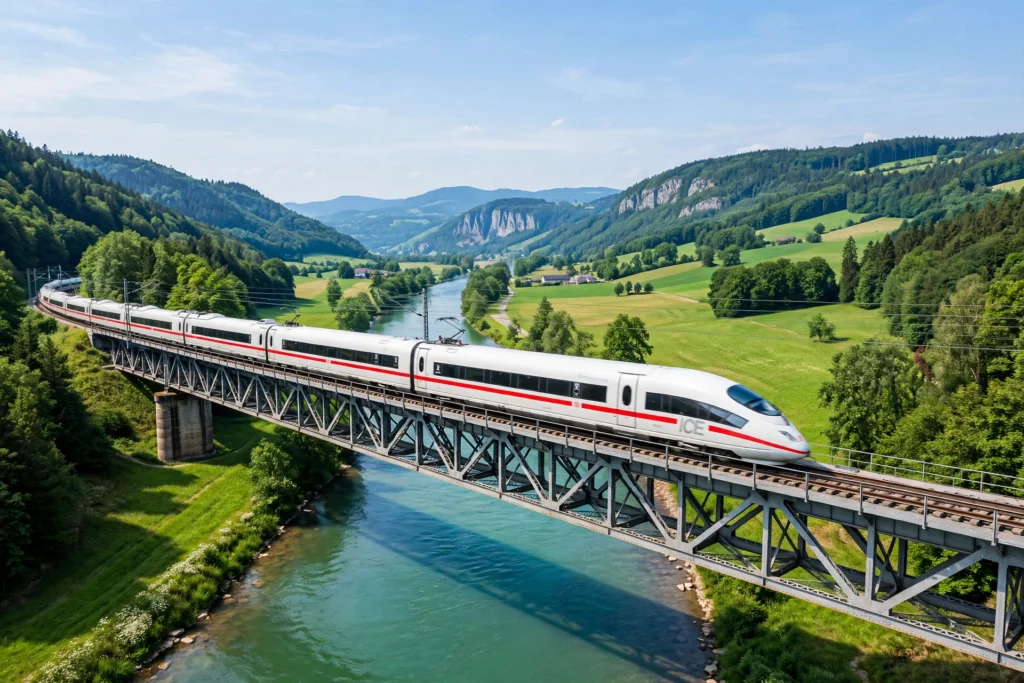
This is the decision that shapes the whole trip, and it is the decision most first-timers get wrong, because they make it on habit rather than on the route. Germany has two excellent ways to travel — the ICE spine and the self-drive road — and they suit different trips. The ICE spine suits the classic north-to-south route: Berlin to Nuremberg to Munich, with Dresden and the Rhine reached by fast train, and the Romantic Road done as a day trip or a short bus ride. The car suits the countryside routes: the Romantic Road itself, the Black Forest, the Moselle villages and the Bavarian Alps, where the towns are small, the buses are infrequent, and the best stops are the ones with no station. The wrong choice is the one most people make by default: renting a car for the whole trip and then paying to park it in Berlin and Munich, or taking the train everywhere and then discovering that the Romantic Road’s best towns are a bus ride from the nearest station.
The ICE spine is the backbone of the classic route. Berlin to Munich takes about four and a half hours by ICE, Berlin to Hamburg about one hour and forty-five minutes, Berlin to Dresden about two hours and ten minutes, Munich to Frankfurt about three and a quarter to three and a half hours, Frankfurt to Cologne about one hour and ten minutes, and Munich to Nuremberg about one hour and ten minutes. The trains are hourly or more frequent on the main lines, the stations are in the city centres, and a train day is a half day, not an afternoon — you leave after breakfast, arrive by lunch, and have the afternoon in the new city. The catch is the fare: a last-minute ICE ticket costs three or four times the advance fare, so book the long legs weeks ahead, and buy the Sparpreis advance fare, which is tied to one train but far cheaper. If Deutsche Bahn expects you to arrive twenty minutes or more late, a cheap Sparpreis ticket is no longer tied to its train and you can take another one, and delays of an hour or more earn a partial refund. And delays happen: only about sixty percent of long-distance trains ran on time in 2025, and the average for January to October 2026 was about fifty-seven percent of trains and sixty-one percent of passengers on time. Build slack into any trip that depends on a tight connection, and never book a flight that leaves less than three hours after your train is due to arrive.
The Deutschlandticket is the other half of the train picture, and it is widely misunderstood. It costs 63 euros per month from 1 January 2026, rising to 66.80 euros from 1 January 2027, and it is sold only as a monthly subscription, valid for a calendar month, renewing automatically until you cancel by the 10th of the month. It covers all local and regional trains, S-Bahn, trams and buses nationwide — but it does not cover ICE, IC or EC long-distance trains. For a tourist it is a good deal only if you will ride regional lines most days for a month, or if you are based in one city and riding its trams and regional trains daily; for a short trip built on ICE legs, single tickets and advance fares are usually the better deal. Day tickets and group tickets from the regional transport associations are the other bargain — a Bavaria Ticket, for example, covers a whole day of regional trains in Bavaria for a small group at a flat price. Check the live price on the Deutsche Bahn site before you buy, because the fares change and the ticket names change with them.
The car suits the countryside, and the countryside is where Germany is at its best. The Romantic Road, from Würzburg to Füssen, is about 350 kilometres of walled towns, and it is best by car, because the towns are small and the bus between them is slow. The Black Forest, the Moselle valley and the Bavarian Alps are the same: the best stops are the villages, the viewpoints and the lakes, and a car turns a day of buses into a day of stops. The rules are simple: traffic keeps right, cars pay no Autobahn toll, stretches without a posted limit have an advisory limit of 130 kilometres per hour and everywhere else the limits are strictly camera-enforced, turning right on red is allowed only where a small green arrow sign is fixed beside the light and only after a full stop, and winter tyres are compulsory whenever the roads are icy or snowy. Around sixty cities, including Berlin, Munich, Cologne and Stuttgart, have low-emission zones that need a green Umweltplakette sticker on the windscreen — rental cars normally have one, but check before you drive into a city centre. Stopping on the Autobahn because your tank is empty can earn a fine. And the costs are real: fuel, parking in the cities, and the rental itself add up to more than the train on the classic route, which is why the car belongs to the countryside legs and not to the whole trip.
Train vs car: the decision table
| Train (ICE spine) | Car (self-drive) | |
|---|---|---|
| Best for | Berlin–Nuremberg–Munich, Dresden, the Rhine cities | Romantic Road, Black Forest, Moselle, Bavarian Alps |
| Speed city to city | Berlin–Munich ~4.5h, Berlin–Hamburg ~1h45 | Slower city to city, faster village to village |
| Cost | Advance Sparpreis fares are cheap; last-minute fares are 3–4x | Rental + fuel + city parking; dearer on the classic route |
| Flexibility | Fixed times, hourly or better on main lines | Stop anywhere, any time |
| Where it fails | Small towns with no station, infrequent rural buses | City centres: parking, low-emission zones, traffic |
| The ticket to know | Sparpreis advance fare; Deutschlandticket 63 euros/month (regional only) | Green Umweltplakette sticker for city low-emission zones |
| The catch | Only ~60% of long-distance trains on time — build in slack | Never park a rental in Berlin or Munich for days |
How to combine them
The best first trip uses both, and the combination is the point of this guide. Take the train for the long legs — Berlin to Dresden, Dresden to Nuremberg, Nuremberg to Munich — and rent a car for two or three days in the middle, for the Romantic Road or the Black Forest, picking it up in one town and dropping it off in another. Pick the car up at a station or an airport, not in a city centre, and drop it off before you reach Munich, where you do not need it. If you are doing the Rhine, take the train to Koblenz or Bingen and the boat down the river, not a car along the bank road, because the river is the point and the boat is the way to see it. And if you are flying in and out of Frankfurt, remember that the airport has its own long-distance station: you can land, walk to the platform, and be in Cologne in an hour and ten minutes or in Heidelberg in under an hour, without ever entering Frankfurt itself.
Berlin in 3 Days: History, the Wall and Museum Island
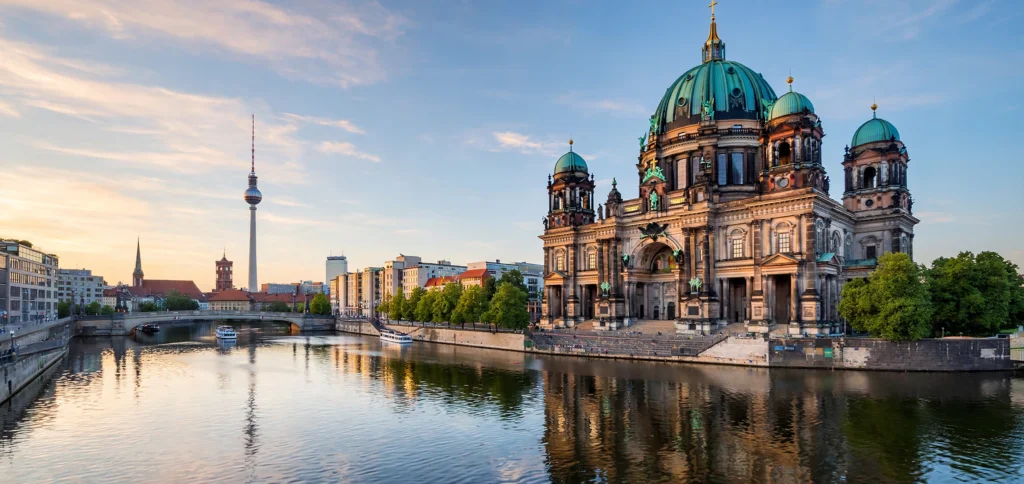
Berlin is the city where most Germany trips begin, and it is the city that most rewards a slow start, because it is not one city but three layered on top of each other: the Prussian capital, the divided city, and the reunified capital that is still rebuilding itself. Berlin was flattened in 1945, split by a wall for 28 years, and reunified in 1990, and you can trace all three eras on a single afternoon walk. It is Germany’s biggest draw for first-time visitors, and three days is the right amount of time: one day for the historic centre and the Wall, one day for the museums, and one day for the neighbourhoods and the slow hours that make Berlin what it is. Stay in Mitte if this is your first visit and you want the sights on foot, in Kreuzberg or Prenzlauer Berg if you want the neighbourhoods and the nightlife, and near the station if you are arriving late and leaving early.
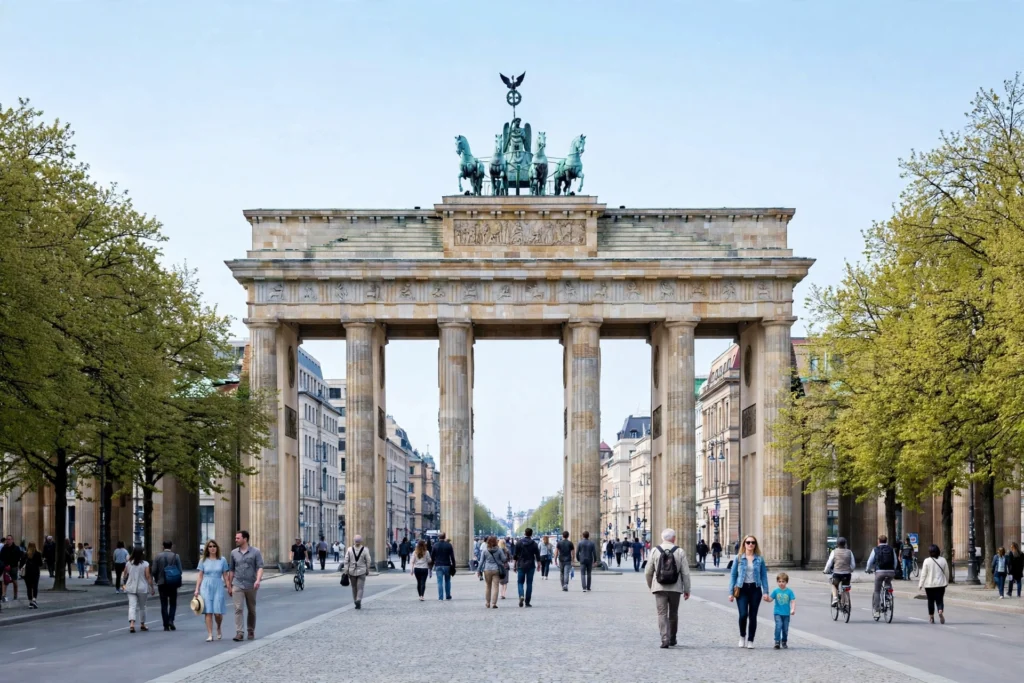
Start in the centre, and start with the Brandenburg Gate. The gate is the symbol of the city, and the walk from it down Unter den Linden to Museum Island is the best introduction to Berlin: the Reichstag with its glass dome a short walk to the west, the Memorial to the Murdered Jews of Europe a few minutes to the south, and the long, tree-lined boulevard that was once the ceremonial heart of Prussia. The Reichstag dome is free but requires advance registration, so book it before you travel — the view over the city from the dome is the best free view in Berlin, and the building itself is the story of the country in one place, from the fire of 1933 to the wrapping by Christo in 1995 to the glass dome that now sits on top of it. The Memorial to the Murdered Jews of Europe, the field of 2,711 concrete slabs, is a place to walk through slowly and quietly, and the information centre underneath it is worth an hour.
The Wall is the second day’s subject, and it needs a full day, because the Wall is not one site but a line through the city. The East Side Gallery is the longest surviving stretch, 1.3 kilometres of the Wall covered in murals, and it is the most visited piece of it. The Berlin Wall Memorial on Bernauer Strasse is the more serious visit: an open-air memorial with the original wall, the death strip, a documentation centre and a viewing platform, and it is the place that explains how the Wall actually worked. The Topography of Terror, on the site of the former Gestapo and SS headquarters, is the documentation centre for the machinery of the Nazi state, and it is a difficult but important visit. Checkpoint Charlie is the famous one, and it is also the most disappointing: the checkpoint hut is a reconstruction, the crowds are thick, and the museum is small. Go for the photograph if you must, and spend your time at Bernauer Strasse instead. Potsdam, with Frederick the Great’s palaces at Sanssouci, is the day trip from Berlin, about 30 to 40 minutes by regional train, and it is worth a full day if you have one to spare — the palaces and the gardens are the most beautiful in Germany outside Munich.
Day by day in Berlin
Day one is the historic centre: the Brandenburg Gate in the morning, the Reichstag dome, the Memorial to the Murdered Jews of Europe, Unter den Linden and the Gendarmenmarkt, and the Nikolaiviertel in the evening, where the old town of Berlin survives in a small, quiet quarter. Day two is the Wall and the twentieth century: the Berlin Wall Memorial on Bernauer Strasse in the morning, the Topography of Terror, the East Side Gallery in the afternoon, and Kreuzberg in the evening, for the markets, the street food and the Turkish restaurants along the canal. Day three is the museums and the neighbourhoods: Museum Island in the morning, the Hackescher Markt and the courtyards, Prenzlauer Berg in the afternoon, and the evening in Kreuzberg or Neukölln, where the city’s nightlife and its food are at their best.
Museum Island and the Pergamonmuseum: what to know before you go
Museum Island is a UNESCO World Heritage site and the best museum cluster in Germany, and it needs a plan, because it is five museums and you cannot do them all in a day. The Neues Museum holds the bust of Nefertiti, the 3,000-year-old Egyptian queen, and the Altes Museum holds the antiquities. The Bode Museum holds the sculpture and the Byzantine art, and the Alte Nationalgalerie holds the paintings, including the most famous works of Caspar David Friedrich. The Pergamonmuseum, the most famous of the five, is closed for renovation and will largely reopen on 4 June 2027, when the north wing and the central building reopen with the Pergamon Altar, the Hall of Hellenistic Architecture and the Museum of Islamic Art, including the Mschatta Façade and the Aleppo Room. Until then, the exhibition “Pergamon Museum: The Panorama”, with Yadegar Asisi’s 360-degree panorama and original artefacts from Pergamon, brings the altar to life directly opposite Museum Island, and it is covered by the Museum Island ticket. The Ishtar Gate and the Market Gate of Miletus will not be on display again until the 2030s, when the south wing reopens. Individual tickets for the reopened museum go on sale from 1 December 2026. If your trip falls before June 2027, plan Museum Island around the four open museums and the Panorama, and do not build a day around a Pergamonmuseum that is still closed. If your trip falls after June 2027, book the Pergamonmuseum first, because it will be the most in-demand ticket in Berlin.
Eating and getting around in Berlin
Berlin is the best food city in the north, and the cheapest good meals are the simplest ones: a currywurst from an imbiss stand, a döner kebab — Berlin’s own invention, and better here than anywhere else in Germany — a pretzel from a bakery, and a beer in a beer garden or a courtyard bar. The city eats late, and the neighbourhood restaurants in Kreuzberg and Neukölln are where the best food is, not the restaurants around the Brandenburg Gate. Getting around is easy: the U-Bahn, S-Bahn, trams and buses run all night on weekends, a day ticket covers the whole network, and the city is flat and bike-friendly. The Deutschlandticket covers all of it, and so does a Berlin day ticket. Never drive in Berlin — the traffic, the parking and the low-emission zone make the car a burden, and the public transport is better.
Dresden and Saxony: Baroque, the Elbe and Saxon Switzerland
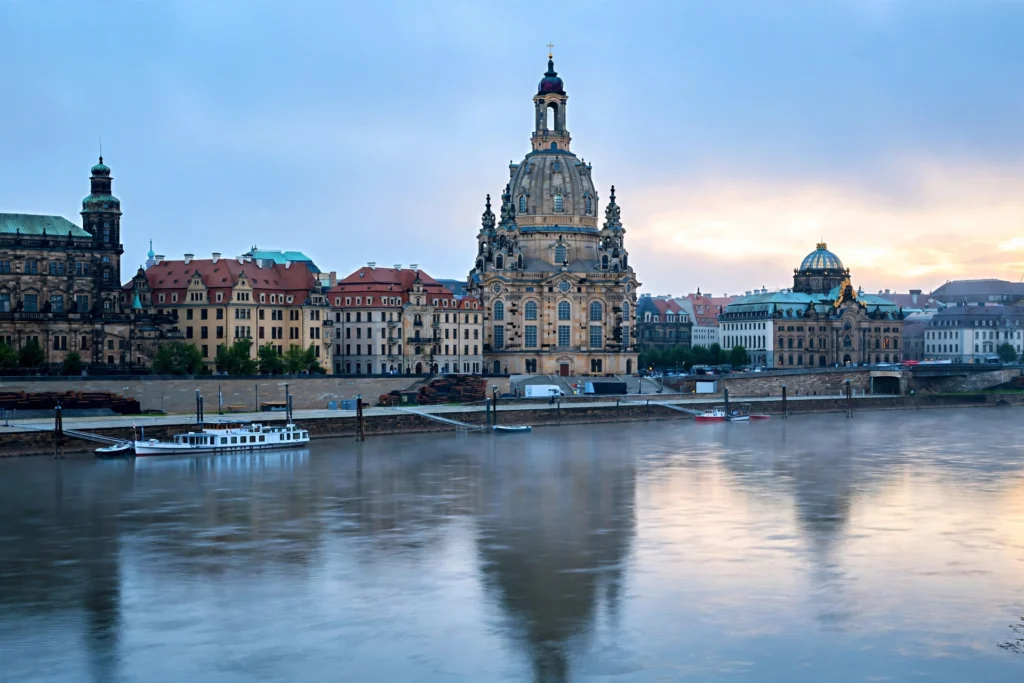
Dresden is the stop on the north-to-south route that most often surprises people, because it is not on the first-timer’s list and it should be. The city is about two hours and ten minutes from Berlin by ICE, it is the baroque capital of Germany, and it is the gateway to Saxon Switzerland, the sandstone peaks and the Bastei Bridge on the Elbe. One or two days is the right amount of time: one day for the old town and the river, and a second day for Saxon Switzerland if you have it. Dresden is also the stop that teaches the route’s lesson about the east: the cities of the former East Germany are cheaper, quieter and less crowded than the west, and they are where the best value on the trip is.
Start in the Altstadt, the old town on the south bank of the Elbe, and start with the Frauenkirche. The church was destroyed in the bombing of February 1945 and rebuilt stone by stone after reunification, and it is the symbol of the city — climb the dome for the view over the river and the old town. The Zwinger, the baroque palace next door, holds the Old Masters Picture Gallery and the porcelain collection, and the Semperoper, the opera house on the Theaterplatz, is one of the most beautiful in Europe. The Green Vault, in the Royal Palace, holds the Saxon crown jewels and the most famous treasury in Germany, and it needs a timed ticket, so book it before you travel. The Brühl’s Terrace, the balcony of Europe, runs along the river above the old town, and it is the place to walk in the late afternoon, when the light comes off the Elbe and the sandstone turns gold.
The second day is Saxon Switzerland, and it is worth the day. The Bastei Bridge, a sandstone bridge between the cliffs above the Elbe, is the most photographed place in Saxony, and the walk from the village of Rathen up to the Bastei and along the cliff tops is one of the great short hikes in Germany. The national park is about an hour from Dresden by S-Bahn and bus, or by car, and the round trip is a full day. Leipzig, about an hour and a quarter from Dresden, is the alternative second day: the music city, with Bach and the St Thomas Church, the publishing and gallery scene, and a livelier, younger centre than Dresden. If you have only one day in Dresden, stay in the city and walk the old town and the river; if you have two, give the second to the Bastei.
Where to stay and how to get around
Stay in the Altstadt if this is your first visit and you want the sights on foot, or across the river in the Neustadt if you want the bars, the restaurants and the younger side of the city. The old town is compact and walkable, the trams cover the rest, and the S-Bahn runs along the Elbe to Meissen, the porcelain town, and to the Saxon Switzerland villages. Meissen is the half-day trip from Dresden: the porcelain factory, the Albrechtsburg castle, and the old town above the river. The Christmas market in Dresden, the Striezelmarkt, runs from 25 November to 24 December 2026, and it is one of the oldest and largest in Germany — if your trip falls in December, Dresden is the place to be for it.
Eating in Dresden
Dresden’s food is Saxon and hearty: the Stollen, the Christmas bread that the Striezelmarkt is named after, the Sauerbraten and the potato dishes, and the beer from the local breweries. The Neustadt has the best restaurants and the best beer gardens, and the prices are lower than in Berlin or Munich — a full meal in a good restaurant in Dresden costs noticeably less than the same meal in Munich, and that is true across the east. The Elbe riverbanks are where the city goes in summer, with the beer gardens and the cycle paths, and the river cruise from Dresden to Meissen or to the Saxon Switzerland is the slow way to see the valley.
Nuremberg and the Romantic Road: Rothenburg, Würzburg and Füssen
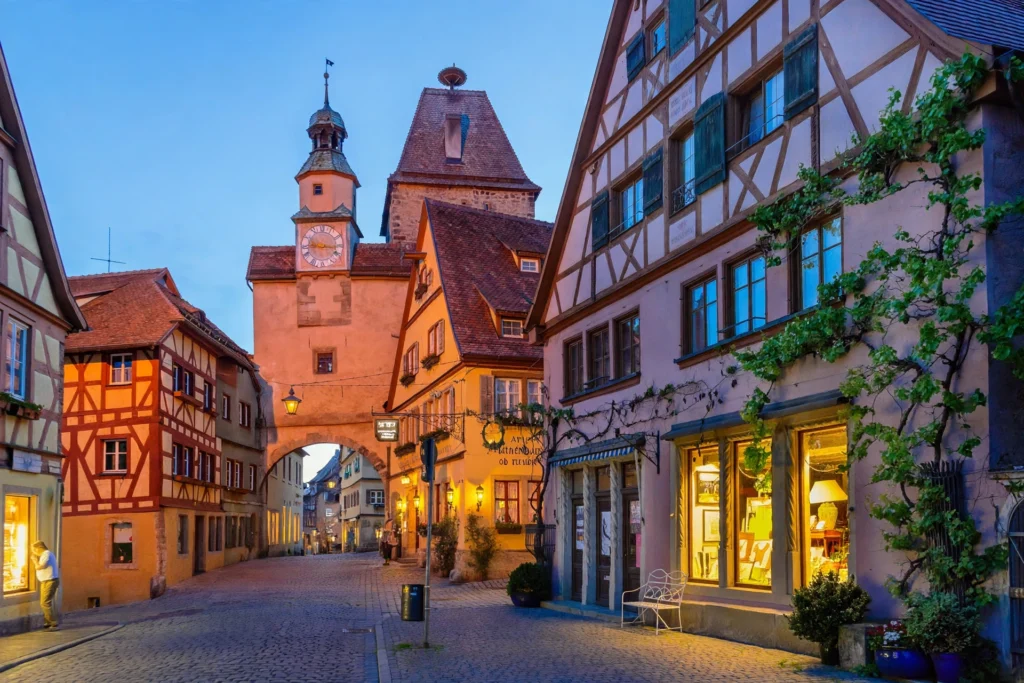
Nuremberg is the hinge of the north-to-south route: the city where the ICE spine meets the Romantic Road, about three hours from Berlin and one hour and ten minutes from Munich, and the place where the trip turns from history into fairy tale. One or two days is the right amount of time: one day for the old town and the castle, and a second day for the Nazi Party Rally Grounds and the Documentation Center, which is the most important and the most difficult visit in the city. Nuremberg is also the Christmas market city: the Christkindlesmarkt, from 27 November to 24 December 2026, is the most famous in Germany, and it is the reason many travellers plan a December trip around this stop.
Start in the old town, and start with the castle. The Kaiserburg, the imperial castle above the city, is the best-preserved imperial castle in Germany, and the view from its tower over the red roofs of the old town is the best view in the city. The old town below it is a compact grid of half-timbered houses, churches and market squares, and it is one of the most walkable old towns in the country. The Hauptmarkt, the main market square, is where the Christmas market stands in December and where the daily market stands the rest of the year, and the bratwurst — small, grilled, eaten three in a roll — is the food to try here. The Documentation Center at the former Nazi Party Rally Grounds, on the edge of the city, tells the story of the rallies and the regime, and Courtroom 600 in the Palace of Justice, where the Nuremberg Trials were held, is the other half of that history. Both are essential if you want to understand the city, and both need half a day each.
The Romantic Road begins in Nuremberg’s shadow and runs south to Füssen, and it is the part of the trip that most rewards a car. The road is about 350 kilometres of walled towns, from Würzburg through Rothenburg ob der Tauber, Dinkelsbühl and Nördlingen to Füssen, near Neuschwanstein. Rothenburg is the famous one, and it is the town that most rewards an overnight stay: the walls you can walk, the Plönlein corner, the night watchman’s tour, and the quiet of the town after the day-trip buses leave. Würzburg, at the northern end, has the Residenz, the baroque palace and a UNESCO World Heritage site, and the vineyards above the Main. Dinkelsbühl and Nördlingen are the quieter walled towns, and they are the ones that feel most like the road itself, without the crowds. Füssen, at the southern end, is the base for Neuschwanstein, and it is where the road ends and the Alps begin. Two days by car is the right amount of time for the road; one day by train and bus is possible, but it is a long day, and the bus between the towns is slow. The Romantic Road is also workable with trains and the local bus, and the town of Rothenburg has its own station, but the car is the way to do it properly.
The Romantic Road stops at a glance
| Town | Why stop | How long | How to get there |
|---|---|---|---|
| Würzburg | The Residenz palace, the Main vineyards | Half a day | 1h25 by ICE from Frankfurt |
| Rothenburg ob der Tauber | The walls, the Plönlein, the night watchman | 1 day, overnight if you can | Train from Nuremberg or Würzburg, or by car |
| Dinkelsbühl | The quietest walled town, the most intact | Half a day | By car, or bus from Rothenburg |
| Nördlingen | The crater town, the walls, the tower | Half a day | By car, or train from Donauwörth |
| Füssen | The base for Neuschwanstein, the Alps | 1 day | Train from Munich, or the end of the road |
How to do the Romantic Road well
Drive it if you can, and give it two days: Würzburg and Rothenburg on the first day, Dinkelsbühl and Nördlingen on the second, and Füssen on the third morning, with Neuschwanstein after lunch. Stay overnight in Rothenburg, not in a day-trip hotel outside the walls, because the town after dark is the experience, and the morning before the buses arrive is the best hour in Rothenburg. Book the Neuschwanstein tickets before you leave home, because the castle is the bottleneck at the end of the road, and the tickets are timed. And do not try to do the Romantic Road as a day trip from Munich: the drive is two hours each way, the towns need a day, and the result is a rushed afternoon and a long drive home in the dark. The road is a route, not a stop.
Munich in 3 Days: Beer Halls, Marienplatz and the Alps on the Doorstep
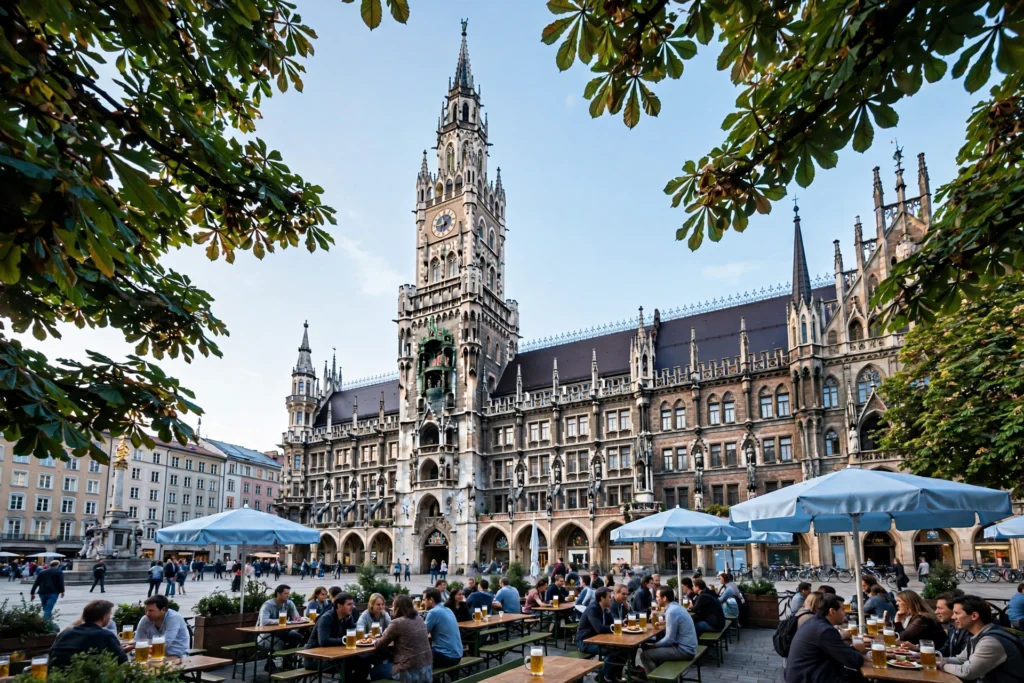
Munich is the city where the north-to-south route ends, and it is the city that most first-timers love most, because it is the most traditional and the most relaxed of the big German cities. It is the Bavarian capital, the gateway to the Alps and the castles, and the home of the beer halls, the beer gardens and Oktoberfest. Three days is the right amount of time: one day for the old town and the beer halls, one day for the museums and the parks, and one day for the Alps — either Neuschwanstein, which has its own section below, or the Bavarian Alps themselves. Stay in the Altstadt if this is your first visit and you want the sights on foot, in Schwabing if you want the cafes and the university quarter, or near the Hauptbahnhof if you are arriving by train and leaving by train.
Start in the old town, and start with the Marienplatz. The square is the heart of the city, with the New Town Hall and its Glockenspiel, the clocktower that plays its figures at 11 in the morning and at noon, and the old town streets that run off it in every direction. The Viktualienmarkt, the food market a few minutes away, is the place to go for lunch: the stalls, the beer garden, the cheese and the sausage stands, and the best people-watching in the city. The Residenz, the former palace of the Bavarian kings, is the most important museum in Munich, and it needs half a day — the treasury, the state rooms and the Cuvilliés Theatre are the highlights. The Englischer Garten, the park that is larger than Central Park, is the place to go in the late afternoon: the beer garden at the Chinese Tower, the surfers on the Eisbach wave, and the long meadows where the city goes to relax.
The second day is the museums and the beer halls. The Alte Pinakothek, the Neue Pinakothek and the Pinakothek der Moderne form the museum quarter, and they hold one of the great art collections in Europe — the old masters, the nineteenth century, and the modern collection, each in its own building. The Deutsches Museum, on its own island in the Isar, is the largest science and technology museum in the world, and it needs a full day on its own if you are the kind of traveller who reads every label. The beer halls are the evening: the Hofbräuhaus, the most famous beer hall in the world, is the one to see once, and the Augustiner-Keller and the Hirschgarten are the ones to return to, because they are where the locals go. A litre of beer in a Munich beer garden costs roughly 8 to 10 euros in 2026, a meal in a beer hall roughly 15 to 25 euros, and the rule is simple: sit at a communal table, order a litre, and talk to the people next to you.
Day by day in Munich
Day one is the old town: the Marienplatz and the Glockenspiel in the morning, the Viktualienmarkt for lunch, the Residenz in the afternoon, and the Hofbräuhaus in the evening. Day two is the museums and the parks: the Pinakothek quarter in the morning, the Deutsches Museum or the Englischer Garten in the afternoon, and a beer garden in the evening — the Chinese Tower in the Englischer Garten is the classic one. Day three is the Alps: Neuschwanstein as a day trip, or Garmisch-Partenkirchen and the Zugspitze, Germany’s highest mountain at 2,962 metres, reached by cable car from the town. The Zugspitze is the mountain trip for a clear day; Neuschwanstein is the castle trip for any day. Both are about two hours from Munich by train.
Oktoberfest: the practical version
Oktoberfest runs from 18 September to 3 October 2027, and it is the 192nd edition of the festival. The practical facts are these: entry to the festival grounds is free, a table reservation is not required but the tents fill by midday on weekends, and the best time to go is a weekday morning, when the tents are open and the crowds are thin. Book the hotel eight to twelve months ahead, because Munich’s hotels double in price and sell out for the festival, and book a table in January or February if you are a group of five or more. The beer is served in litres, the food is Bavarian and hearty, and the festival is a folk festival, not a pub crawl — families, traditional dress, the parades on the first weekend and the concert on the last Sunday are the point, and the drinking is only part of it. If you are in Munich during Oktoberfest and you do not want the festival, the rest of the city carries on as normal, and the museums, the parks and the old town are quieter than usual, because everyone else is on the Theresienwiese.
Neuschwanstein Castle: Tickets, Timing and the Day-Trip Plan
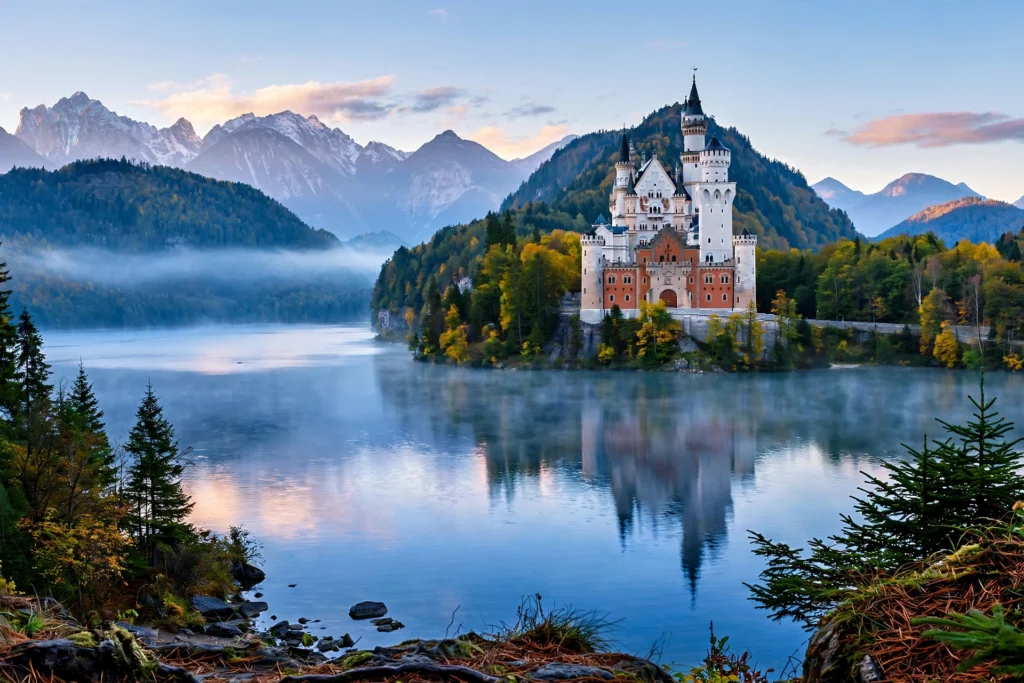
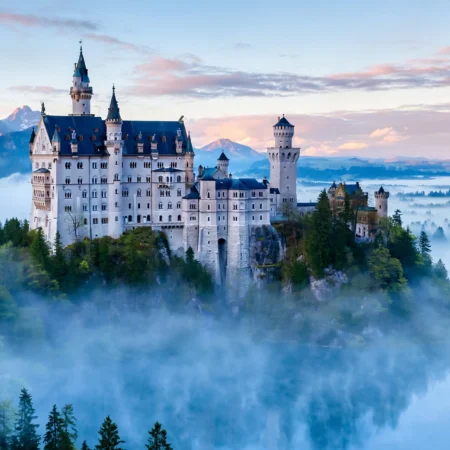
Neuschwanstein is the image on every Germany postcard: the fairy-tale castle above the village of Hohenschwangau, the towers and the turrets, the lake and the Alps behind it, the castle that inspired Disney’s Sleeping Beauty Castle. It is also the stop on the classic route that most often goes wrong, because the castle is not a walk-up attraction and the village is not a place you arrive at casually. The castle was begun for Ludwig II in 1869 and never completed, and it can only be visited as part of a fixed-time guided tour of about thirty minutes, in a group capped at 35 people. Buy the ticket and you are not buying admission for the day; you are buying a place in one specific tour group, and late arrivals lose that place outright. This section is the plan that makes it work.
The tickets are the first thing to sort out, and they should be sorted out before you leave home. Admission in 2026 is 21 euros for a regular adult ticket and 20 euros reduced, with children under 18 admitted free — but every child still needs their own free ticket. Buying online adds a booking fee of 2.50 euros per ticket, including free children’s tickets, so an adult ticket bought online costs 23.50 euros. The combination tickets are the better deal if you want more than the castle: the Prince-Ticket, Neuschwanstein plus the Museum of the Bavarian Kings, costs 33.50 euros per adult; the Kings-Ticket, Neuschwanstein plus Hohenschwangau Castle, costs 43.50 euros; and the Swan-Ticket, both castles plus the museum, costs 56 euros, with a higher online fee for the combinations. The official ticket shop is the only place to buy in advance, and the official ticket page warns of unauthorised websites using the Ticket Center’s name and logo without any affiliation — buy only from the official shop, linked from the castle’s own site at neuschwanstein.de. Same-day tickets are sold at the Ticket Center in Hohenschwangau from 8 in the morning, but only for the same day and only subject to availability, and in the summer they sell out. Book online, in advance, and check the official prices on the Neuschwanstein admission page before you travel.
The timing is the second thing, and it is where most day trips fail. The official ticket page asks you to reach the village of Hohenschwangau at least one and a half to two hours before your tour, because there is no ticket counter at the castle itself, and the walk or the bus from the village to the castle takes time. From 16 October to 27 March the castle opens from 10 in the morning to 4 in the afternoon, and in the summer it opens earlier and closes later. The tour itself is about thirty minutes, and it is guided and fixed: you see the throne room, the singers’ hall, the king’s apartments, and the views from the windows, and then you are out. The best view of the castle is not from the castle but from the Marienbrücke, the bridge over the gorge behind it, which is a ten-minute walk uphill from the castle courtyard — go there before or after your tour, and go early, because it is the most photographed spot in Germany and it is crowded by midday.
The day trip from Munich, step by step
Take the train from Munich Hauptbahnhof to Füssen, about two hours, then the bus from Füssen station to Hohenschwangau, about ten minutes. Aim for a tour time in the late morning, so you reach the village by 9 or 10, walk up to the Marienbrücke first, take the tour, and then have lunch in the village. The afternoon is for Hohenschwangau Castle, the king’s childhood home, or for the Museum of the Bavarian Kings, or for the lake — the Alpsee, below the castle, is the place to walk in the afternoon, and the Tegelberg cable car, from the village, is the mountain view. The last train back to Munich leaves Füssen in the early evening, and the round trip is a full day: leave Munich by 8, and you are back by 8. If you are driving the Romantic Road, Füssen is the end of the road, and Neuschwanstein is the reason to spend the night there rather than driving on. And if you are visiting in the winter, the castle in the snow is the most beautiful version of it — but the Marienbrücke can be closed in icy conditions, and the daylight is short, so book the earliest tour you can.
The Rhine and Moselle: Castles, Wine Villages and River Boats
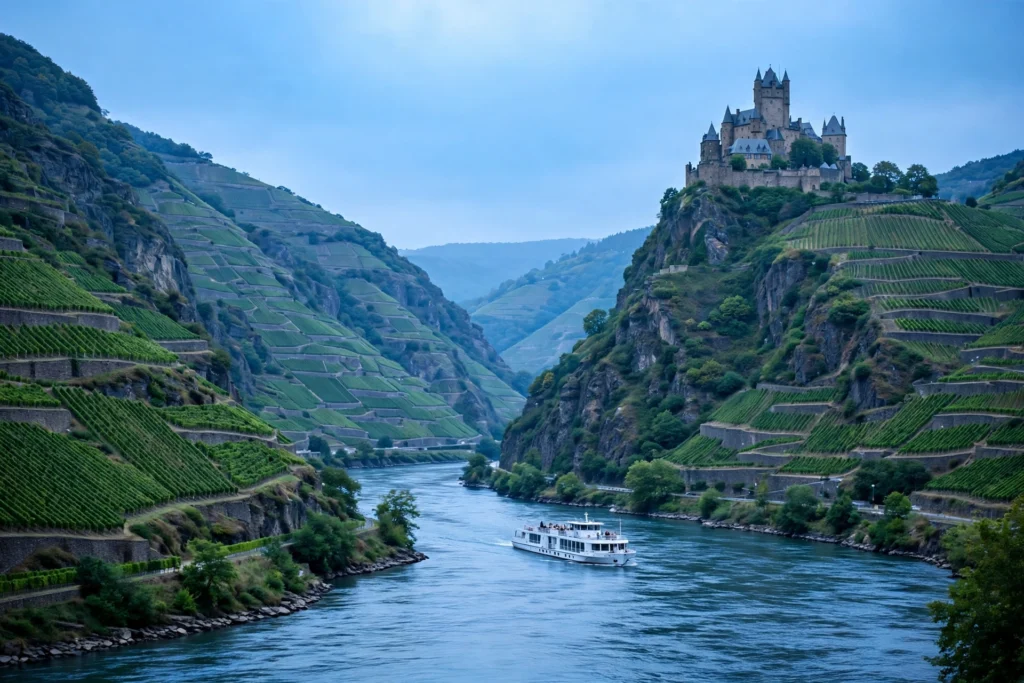
The Rhine is the river that most first-timers picture when they picture Germany, and it is the part of the trip that is most unlike the rest of it. The Upper Middle Rhine Valley, from Bingen to Koblenz, is a UNESCO World Heritage site, a 65-kilometre gorge where the river runs between steep vineyards and hilltop castles, past wine villages and riverside towns, and it is the most scenic stretch of river in the country. Two or three days is the right amount of time: one day on the boat, one day in the villages, and a third day on the Moselle if you have it. The Rhine is also the stop that needs the most attention to the calendar, because the scheduled boats run only from late March to late October — in 2026 they ran from 28 March to 25 October — and the 2027 dates were not yet published when this guide was checked in November 2026. Outside the boat season, the valley is still beautiful, but the boat is the point, and the boat is not running.
The boat is the way to see the Rhine, and the classic stretch is from Bingen or Rüdesheim to Koblenz, or from Koblenz to St Goar. The KD boats run the gorge in both directions, and the trip takes about two to three hours downstream and longer upstream, with the castles on both banks: the Lorelei rock, the famous viewpoint above the narrowest part of the river, the Marksburg, the only Rhine castle never destroyed, the Pfalzgrafenstein, the toll castle on its own island in the middle of the river, and the villages of Bacharach and St Goarshausen, where the half-timbered houses run down to the water. Take the boat in one direction and the train back in the other, because the train runs along both banks and the view from the train is the same valley from the land. The best seat on the boat is on the top deck, on the side facing the castles, and the best time is a weekday morning, before the tour groups arrive.
The Moselle is the quieter river, and it is the one that most rewards a slow day. The valley from Trier to Koblenz is lined with steep vineyards, and the towns are smaller and less crowded than the Rhine: Cochem, with its hilltop castle and its riverside promenade, is the base, and Bernkastel-Kues, with its market square and its wine cellars, is the town to stay in if you have the night. Burg Eltz, the castle in the forest above the Moselle, is the most beautiful castle in Germany after Neuschwanstein, and it is reached by a walk through the woods from the car park, not by a road to the door. The Moselle is a wine region first and a sightseeing region second: the Riesling is the wine to try, the wine taverns — the Weinstuben — are the places to try it, and the wine festivals in the autumn are the best time to be there. The water levels in the Rhine hit record lows in August 2026, and low water can disrupt the boats, so check the boat operator’s site before you travel in a dry summer.
The Rhine towns at a glance
| Town | Why stop | How long | How to get there |
|---|---|---|---|
| Rüdesheim | The Drosselgasse, the cable car, the wine | Half a day | Train from Frankfurt, about 1h15 |
| Bacharach | The most beautiful Rhine village, the walls | Half a day | Train or boat from Bingen |
| St Goar | The Lorelei, the Rheinfels castle | Half a day | Boat or train from Koblenz |
| Koblenz | The Deutsches Eck, the cable car, the base | 1 day | 1h10 by ICE from Frankfurt |
| Cochem (Moselle) | The castle, the promenade, the base | 1 day | Train from Koblenz, about 40 minutes |
| Bernkastel-Kues (Moselle) | The market square, the wine cellars | Half a day | Bus from the Moselle stations, or by car |
| Trier (Moselle) | Germany’s best Roman ruins | 1 day | Train from Koblenz, about 1h30 |
How to do the Rhine well
Base yourself in one town and use the boat and the train, not a car: Koblenz or Bingen at the ends of the gorge, or Bacharach or St Goar in the middle. Take the boat downstream in the morning and the train back in the afternoon, and spend the evening in the village where you are staying, because the river towns are at their best after the day-trippers leave. Book the boat in advance in July and August, and check the water levels in a dry summer. And if you are continuing to France, the Rhine is the natural crossing point: the route from the Rhine to the French border is short, and our France travel guide picks up on the other side of the river.
Cologne, Heidelberg and the Black Forest: The Western Loop
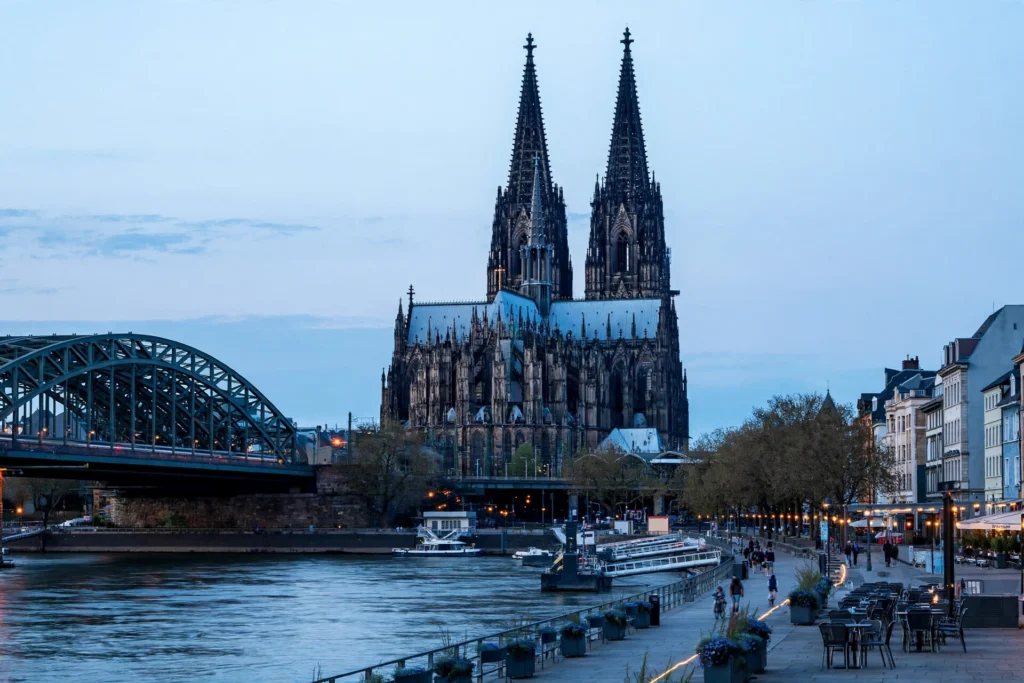
The western loop is the part of the trip that most first-timers skip, and it is the part that most rewards the traveller who has the days. Cologne, Heidelberg and the Black Forest are three different Germanys in one corner of the country: the Rhineland city, the university town, and the forest. One or two days each is the right amount of time, and the loop works as an extension of the Rhine section, or as a route of its own from Frankfurt. The train times are short — Frankfurt to Cologne is about one hour and ten minutes by ICE, Frankfurt to Heidelberg about an hour — and the loop is the easiest part of the country to add to a trip that starts or ends in Frankfurt.
Cologne is the city of the cathedral, and the cathedral is the reason to go. The twin-spired Gothic cathedral dominates the Rhine skyline, it is a UNESCO World Heritage site, and it is the most visited sight in Germany. Entry to the cathedral is free, but the tower climb and the treasury are charged, and the cathedral now charges 12 euros for entry to the tower and the treasury areas — check the live price before you travel, because it has changed. The old town around the cathedral, the Alter Markt and the Heumarkt, is where the Kölsch beer halls are: Kölsch is the local beer, served in small glasses that are refilled until you put your coaster on top of yours, and the beer halls are the place to try it. The Museum Ludwig, next to the cathedral, holds one of the best modern art collections in Germany, and the Chocolate Museum, on the river, is the family stop. Cologne Carnival, with Rose Monday on 8 February 2027, is the biggest street party in Germany, and the city books out for it — if your trip falls in February, book early, and if it does not, the Carnival is the reason to come back.
Heidelberg is the university town, and it is the most romantic town in Germany. The castle ruin above the Neckar, the old town below it, and the river between them make the classic view, and the town is at its best in the late afternoon, when the light comes over the castle and the students fill the old town squares. Heidelberg Castle’s ticket is 11 euros until the end of 2026 and 12 euros from January 2027, and it covers the castle, the gardens and the funicular railway. The Philosopher’s Walk, on the far bank of the Neckar, is the walk to take for the view back over the town, and the old town’s Hauptstrasse, one of the longest pedestrian streets in Europe, is the place to wander in the evening. Heidelberg’s Christmas market runs from 23 November to 22 December 2026, and it is smaller and quieter than Nuremberg’s or Dresden’s, which is exactly why it is worth a visit.
The Black Forest is the forest itself, and it is the part of the loop that needs a car. The region is a dense, dark forest of firs and spruce, with cuckoo-clock villages, waterfalls and lakes, and the towns of Freiburg, Triberg and Titisee are the bases. Triberg Waterfalls, the highest waterfalls in Germany, are the classic stop, and the Black Forest Open Air Museum, with its farmhouses and its mills, is the place that explains how people lived in the forest. Baden-Baden, on the edge of the forest, is the spa town: the thermal baths, the casino, and the Kurhaus are the reason to go, and the town is a year-round stop, because the baths are indoors and the forest is beautiful in every season. The Black Forest is a hiking region from May to October, and the trails are well-marked and well-maintained — the Westweg, the long-distance trail through the forest, is the classic multi-day hike, and the day hikes around Triberg and Titisee are the ones for a first visit. The food here is the Black Forest ham, the Black Forest gateau, and the trout from the forest streams, and the wine is from the vineyards of the Upper Rhine Plain, one of Germany’s sunniest zones.
The western loop at a glance
| Stop | Nights | How you get there | Why it earns its place |
|---|---|---|---|
| Cologne | 1–2 | 1h10 by ICE from Frankfurt | The cathedral, the Kölsch halls, Carnival |
| Heidelberg | 1 | 1h by ICE from Frankfurt | The castle ruin, the old town, the Neckar |
| Baden-Baden | 1 | 1h30 by train from Heidelberg | The thermal baths, the spa town |
| Freiburg and the Black Forest | 2 | 2h by train from Heidelberg | The forest, the waterfalls, the hiking |
| Lake Constance (optional) | 2 | 2.5h by train from Munich | The lake, the flower island of Mainau, the boats |
Hamburg and the North: Hanseatic Towns, the Baltic Coast and the Lakes
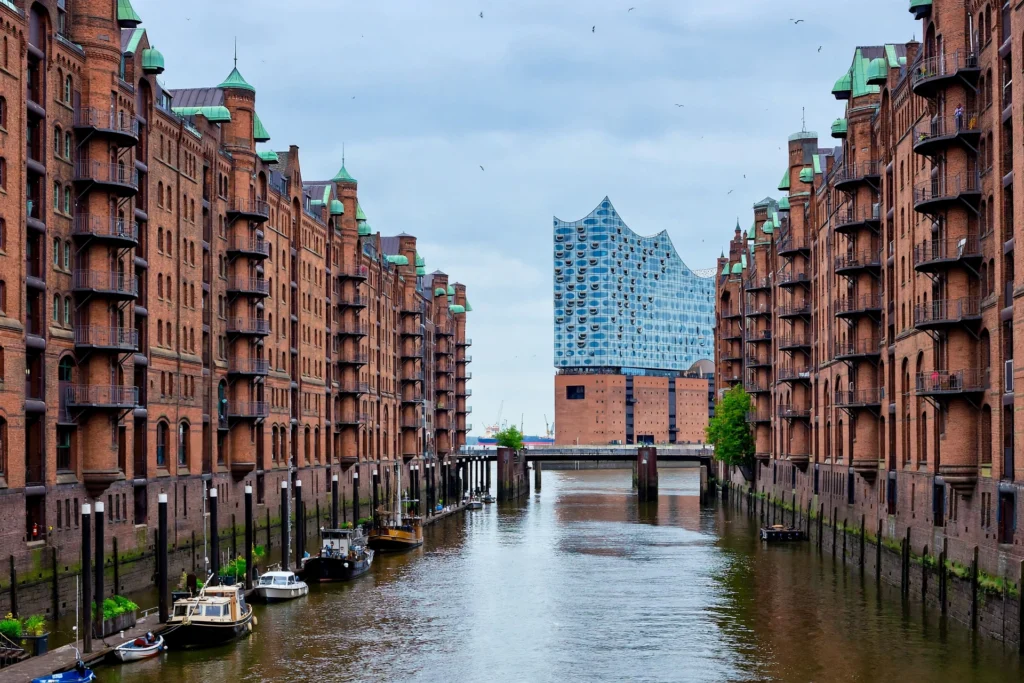
Hamburg is the port, and the north is the part of Germany that most first-timers never reach, because the classic route runs north to south and the north is the starting point that gets skipped. Two or three days is the right amount of time: two days in Hamburg, and a third day for Lübeck or the Baltic coast. Hamburg is about one hour and forty-five minutes from Berlin by ICE, and it is the natural place to fly into if you are starting the route in the north — fly into Hamburg, take the train to Berlin, and run the route south from there. The city is Germany’s second largest, and it is the most maritime of the big cities: the harbour, the canals, the warehouse district, and the Elbphilharmonie, the concert hall on the water, are the sights, and the St Pauli district is the nightlife.
Start in the Speicherstadt, the warehouse district on the canals, and start with the water. The Speicherstadt is a UNESCO World Heritage site, a grid of red-brick warehouses on canals, and it is the most beautiful part of the city — walk it in the morning, when the light comes off the water, and take a harbour boat in the afternoon, because the harbour is the point of Hamburg and the boat is the way to see it. Miniatur Wunderland, in the Speicherstadt, is the largest model railway in the world, and it is the most visited attraction in Germany — book a timed ticket before you travel, because it sells out. The Elbphilharmonie, the glass concert hall on the water, has a free viewing platform, the Plaza, with the best view over the harbour, and the concerts inside are among the best in Europe. The St Pauli district, with the Reeperbahn, is the nightlife, and the Planten un Blomen park is the green heart of the city, with its water-light concerts in summer.
Lübeck is the day trip from Hamburg, and it is the most beautiful Hanseatic town in Germany. The old town is a UNESCO World Heritage site, a grid of Brick Gothic churches and merchants’ houses on an island in the river, and the Holstentor, the gate that is the symbol of the city, is the place to start. Lübeck is about an hour from Hamburg by train, and it is a full day if you walk the old town, the churches and the river. The Baltic coast beyond Lübeck — the island of Rügen, with its chalk cliffs and its seaside resorts, the island of Usedom, the towns of Rostock and Stralsund — is the summer region, and it needs three to five days of its own, in one place, in June to September. The Mecklenburg Lake District, between Hamburg and Berlin, is the other northern region: a maze of lakes and forests, best by boat or by bike, and best in summer. The north is not a day trip from Berlin; it is a trip of its own, and the right way to do it is to start the north-to-south route here, in Hamburg, and run south from the sea.
The north at a glance
| Stop | Nights | How you get there | Why it earns its place |
|---|---|---|---|
| Hamburg | 2–3 | Fly in, or 1h45 by ICE from Berlin | The harbour, the Speicherstadt, the Elbphilharmonie |
| Lübeck | Day trip | About 1h by train from Hamburg | The Hanseatic old town, the Holstentor |
| Rügen and the Baltic coast | 3–5 | 3h by train from Berlin to Stralsund | Chalk cliffs, beaches, seaside resorts |
| Mecklenburg Lake District | 2–3 | Between Hamburg and Berlin | Lakes, forests, boating and cycling |
| Bremen | Day trip | 1h by train from Hamburg | The Hanseatic town, the town musicians |
Eating in the north
The north eats from the sea: the fish rolls, the Fischbrötchen, sold from stalls in the harbour, the Labskaus, the sailor’s dish of corned beef, potatoes and beetroot, and the beer from the local breweries. Hamburg’s fish market, on Sunday mornings, is the institution: the stalls, the shouting, the live music, and the breakfast of fish rolls and beer at seven in the morning. The prices in the north are lower than in Munich, and the harbour restaurants are the place to eat well without paying Munich prices. The coffee is the other northern habit: Hamburg is the coffee port, and the city’s coffee houses are the best in Germany.
The Three 7-Day Germany Routes — Plus 10-Day and 14-Day Versions
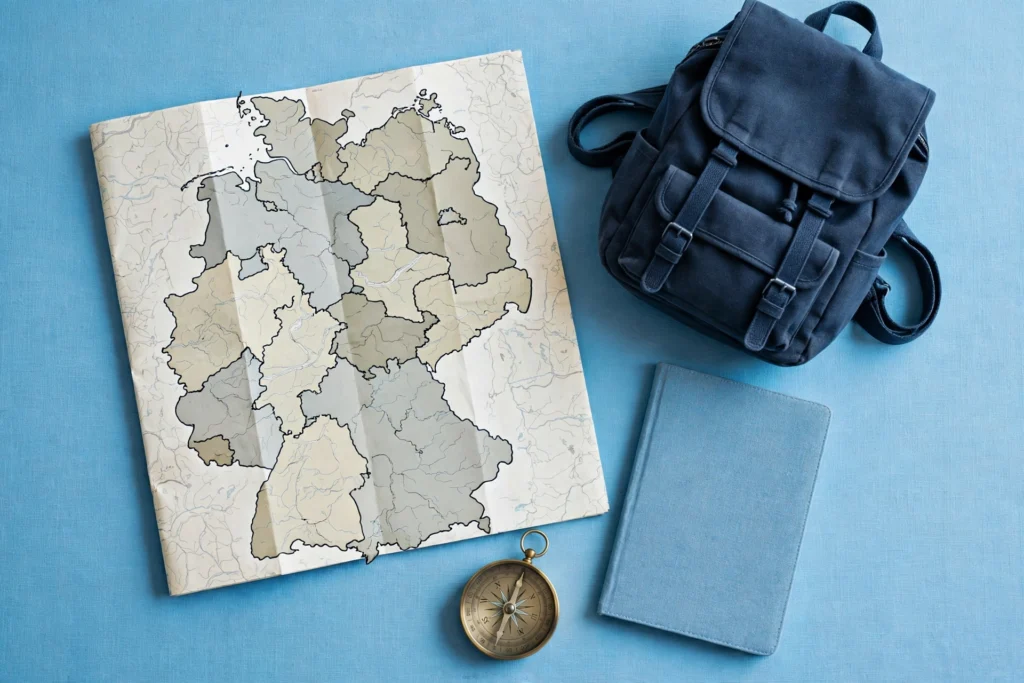
This is the section the whole guide has been building towards, and it is the section that fixes the gap in the top-ranking guides: they give you one 7-day plan, or a rough week count, or a list of places, and none of them gives you a choice. Germany is not one trip, and the right route depends on what you want from it. Here are three 7-day routes, built from the same north-to-south spine, each for a different trip style, and then the 10-day and 14-day versions that add the regions the 7-day routes leave out. All three routes follow the same rules: fly into one city and out of another, no more than four bases, at least two nights in every base, and day trips for everything else.
Route A: Cities and history — the classic first trip
This is the route for the traveller who wants the big cities and the history, and it is the route this guide recommends for a first trip. Fly into Berlin and out of Munich. Three nights in Berlin, with the Wall, Museum Island and the neighbourhoods; a morning train to Dresden for one night, with the old town and the Elbe; a train to Nuremberg for one night, with the castle and the old town; and three nights in Munich, with the old town, the beer halls and a day trip to Neuschwanstein. Seven days, four bases, and the whole arc of the twentieth century in one trip: the Wall, the rebuilt Frauenkirche, the Rally Grounds, and the Bavarian capital at the end. The cost is the lowest of the three routes, because the cities are on the ICE spine and the hotels are the cheapest in the east.
Route B: Castles and countryside — the Romantic Road by car
This is the route for the traveller who wants the fairy tale, and it is the route that needs a car. Fly into Frankfurt and out of Munich. One night in Frankfurt, or skip it and take the train straight to Würzburg; one night in Würzburg, with the Residenz and the vineyards; one night in Rothenburg, with the walls and the night watchman; one night in Füssen, with Neuschwanstein; and three nights in Munich, with the old town and the Alps. Seven days, five stops, and the car is the point: the road between the towns is the trip, and the towns are the stops. The cost is higher than Route A, because of the rental and the fuel, and the driving is easy — the roads are good, the towns are small, and the parking is outside the walls. Pick the car up in Würzburg and drop it off in Munich, and do not drive it into Munich’s centre.
Route C: Rhine and scenery — the river route
This is the route for the traveller who wants the scenery and the wine, and it is the route that works best from April to October, when the boats are running. Fly into Frankfurt and out of Frankfurt, or into Cologne and out of Frankfurt. Two nights in Cologne, with the cathedral and the old town; two nights on the Rhine, in Bacharach or St Goar, with the boat down the gorge and the castles; one night in Heidelberg, with the castle and the old town; and two nights in the Black Forest, in Freiburg or Triberg, with the waterfalls and the hiking. Seven days, four bases, and the river is the spine instead of the ICE. The cost is in the middle of the three routes, and the season matters more than on the other two: outside late March to late October, the boats are not running, and the route loses its point.
The three routes compared
| Route A: Cities and history | Route B: Castles and countryside | Route C: Rhine and scenery | |
|---|---|---|---|
| Fly in / out | Berlin in, Munich out | Frankfurt in, Munich out | Frankfurt or Cologne in, Frankfurt out |
| Bases | Berlin 3, Dresden 1, Nuremberg 1, Munich 3 | Würzburg 1, Rothenburg 1, Füssen 1, Munich 3 | Cologne 2, Rhine 2, Heidelberg 1, Black Forest 2 |
| Transport | Train only, ICE spine | Car for the Romantic Road, train to Munich | Train and boat, car optional in the Black Forest |
| Best season | Year-round | April–October | Late March–late October (boats) |
| The signature day | The Wall in Berlin | Rothenburg after dark | The boat down the Rhine gorge |
| Budget (excl. flights) | Lowest | Highest (rental + fuel) | Middle |
The 10-day Germany itinerary: the classic route, with the Rhine
Ten days is the length this guide recommends if you have the time, because it is the length at which the route stops being a sprint and starts being a trip. Fly into Hamburg and out of Munich. Two nights in Hamburg, with the harbour and Lübeck as a day trip; three nights in Berlin, with the Wall, Museum Island and Potsdam; one night in Dresden, with the old town and the Bastei if you have the day; one night in Nuremberg, with the castle and the Rally Grounds; and three nights in Munich, with the old town, the beer halls and Neuschwanstein. Ten days, five bases, and the north is in the trip instead of being the part you skipped. The extra three days over the 7-day route buy you Hamburg and the north, and a day in Saxon Switzerland, and they are the three days that make the trip feel complete rather than rushed.
The 14-day Germany itinerary: the classic route, done properly
Fourteen days is the version this guide recommends if you have the time and the budget, because it is the version that does the country properly. Fly into Hamburg and out of Munich, or into Hamburg and out of Frankfurt if you want the west as well. Two nights in Hamburg, three nights in Berlin, two nights in Dresden with Saxon Switzerland, two nights on the Romantic Road with Rothenburg overnight, three nights in Munich with Neuschwanstein and the Alps, and two nights on the Rhine, with the boat down the gorge and the Moselle. Fourteen days, six bases, and every region in the guide is in the trip: the north, the east, the centre, the south and the west. The extra four days over the 10-day route buy you the Romantic Road done properly, with two nights instead of a drive-by, and the Rhine, with two nights instead of none. If you have fourteen days and you want the west as well, swap the second Rhine night for a night in Cologne, and fly out of Frankfurt instead of Munich.
The winter version: the Christmas-market route
December is a different trip, and it needs its own plan, because the boats are not running, the Alpine lifts are open, and the markets are the point. Fly into Berlin and out of Munich, or into Frankfurt and out of Munich. Two nights in Berlin, with the markets at Gendarmenmarkt and the Alexanderplatz; one night in Dresden, with the Striezelmarkt, the oldest and largest in Germany; one night in Nuremberg, with the Christkindlesmarkt; one night in Rothenburg, with the Reiterlesmarkt, the smallest and the most atmospheric; and three nights in Munich, with the market at Marienplatz and the Alps in the snow. Seven days, five bases, and the markets are the spine instead of the ICE. Book the hotels months ahead, because the market towns double in price and sell out, and plan to be in one place on Christmas Day, when almost everything is shut. The winter route is also the route for the Alps: swap a market night for a night in Garmisch-Partenkirchen, and ski the Zugspitze in the morning and the market in the evening.
What to eat in Germany: food by region
German food is regional, and the regions eat differently. The north eats from the sea, the centre eats from the vineyards, and the south eats from the beer halls, and the food is the best way to tell where you are. The table below is the short version: the dish, the region, and where to try it.
| Region | The dish to try | Where to try it |
|---|---|---|
| Hamburg and the north | Fischbrötchen, the fish roll; Labskaus | The harbour stalls, the Sunday fish market |
| Berlin | Currywurst; the döner kebab | An imbiss stand, a Kreuzberg kebab shop |
| Dresden and Saxony | Stollen; Sauerbraten | The Neustadt restaurants, the Striezelmarkt |
| Nuremberg and Franconia | Nürnberger bratwurst, three in a roll; Schäufele | The Hauptmarkt, the old town restaurants |
| Munich and Bavaria | Weisswurst and pretzels; Schweinshaxe; Obatzda | The Viktualienmarkt, the beer halls |
| The Rhine and Moselle | Riesling; Saumagen; wine tavern food | A Weinstube in Cochem or Bernkastel |
| Cologne and the Rhineland | Kölsch; Himmel un Äd; Reibekuchen | A Kölsch beer hall in the old town |
| The Black Forest | Black Forest ham; Black Forest gateau; trout | A Gasthaus in Triberg or Freiburg |
Eating well without overpaying
Eat like a local and the food is cheap: a bakery breakfast of bread, cheese and coffee costs a few euros, a market lunch of a sausage roll or a fish roll costs 5 to 8 euros, and a beer hall dinner costs 15 to 25 euros. The lunch menus in restaurants are often cheaper than the dinner menus, and the bakeries are the best value in the country — a pretzel, a bread roll and a coffee is the cheapest good breakfast in Germany. The beer is cheaper than the wine in the south and the wine is cheaper than the beer on the Rhine, and the water is free from the tap in restaurants if you ask for Leitungswasser, though most restaurants will bring mineral water unless you ask. Tipping is modest: round up the bill or leave 5 to 10 percent in restaurants, and when you hand the money to the server, tell them the total you intend to give rather than leaving change on the table. And remember the Sunday rule: most shops are closed on Sundays, so do the grocery run on Saturday, and eat in restaurants and bakeries on Sunday, because they are open.
How much does a Germany trip cost? Budgets in euros
Germany is more affordable than its reputation suggests, and it is cheaper than France, Italy or Switzerland for the same standard of trip. A currywurst or a döner costs 5 to 7 euros, a large beer in a beer garden runs 4 to 6 euros in most cities and 8 to 10 euros in Munich, a local public transport ride costs 2.80 to 3.50 euros, and a mid-range hotel double costs 90 to 180 euros a night. The daily budgets below are per person, excluding international flights, and they are planning ranges checked in November 2026, not quotes.
| Budget | Mid-range | Comfort | |
|---|---|---|---|
| Daily spend | 50–80 euros | 100–170 euros | 200–350 euros |
| Stay | Hostel dorm or budget guesthouse | Private hotel or pension | Upmarket hotel |
| Eat | Bakeries, markets, street food | Mid-range restaurants, beer halls | Better restaurants, wine taverns |
| Move | Regional trains, day tickets, walking | ICE advance fares, city day tickets | ICE flexible fares, taxis, rental car |
| See | Free sights, parks, markets | Paid museums, castles, boat trips | Private tours, concerts, spa days |
A 14-day trip, costed
| Item | Budget (14 days) | Mid-range (14 days) |
|---|---|---|
| Hotels | 700–1,260 euros | 1,260–2,520 euros |
| Food | 350–700 euros | 700–1,400 euros |
| Trains (ICE advance fares + regional) | 200–350 euros | 300–500 euros |
| Car rental (3 days, Romantic Road) | 150–250 euros | 200–350 euros |
| Sights, museums, castles, boats | 150–250 euros | 250–450 euros |
| Local transport and day tickets | 70–140 euros | 100–200 euros |
| Total, excluding international flights | 1,620–3,150 euros | 2,810–5,420 euros |
Money tips that save real money
Book the ICE legs weeks ahead, because the advance Sparpreis fare is a fraction of the last-minute fare, and the difference on a Berlin to Munich ticket can be fifty euros or more. Book the hotels early for Oktoberfest and the Christmas markets, because the prices double and the rooms sell out months ahead. Carry cash, because many small shops, bakeries, cafes and market stalls are cash-only or card-reluctant, and some ticket machines refuse notes of 50 euros and up, so break big notes at a supermarket. Use ATMs inside banks, decline the machine’s currency conversion, and always choose to be billed in euros, not in your home currency. Prices include 19 percent VAT, 7 percent on food and some services, and visitors from outside the EU can reclaim it on goods taken home unused: ask the shop for a tax-free form and get it stamped by customs at your last EU exit point before checking your bag. And check the prices before you travel, because the euro moves against the dollar and a figure quoted as exact would be out of date within weeks — the ranges in this guide are checked in November 2026.
Frequently Asked Questions About Germany Travel
Do US citizens need a visa for Germany?
No. US passport holders enter Germany visa-free for up to 90 days in any 180-day period under the Schengen rules, and the 90 days are counted across the whole Schengen area, not per country. Your passport must be valid for at least three months beyond your departure date, and you need at least two blank pages. The Entry/Exit System is live and fully operational since 10 April 2026, so you give fingerprints and a photo at the border on your first entry. ETIAS is not in operation as of November 2026, there is no start date, and there is nothing to apply for — do not pay any website for an ETIAS authorisation.
Is Germany safe for US tourists?
The US State Department rates Germany at Level 2, Exercise Increased Caution, due to terrorism, issued 13 May 2025 and still current in November 2026. Level 2 is the same tier the State Department gives to France, Italy, Spain and the United Kingdom, and it does not mean you should avoid Germany. Violent crime is rare, and the crime that affects tourists most often is pickpocketing and theft at train stations, on public transport and at large events. Stay aware of your surroundings in crowded places, keep your valuables out of easy reach, enrol in STEP, and read the full advisory before you travel and again the week before you fly.
How many days do you need in Germany?
Seven days is the minimum for a good trip — Berlin and Munich, with one stop between them, is the classic 7-day route. Ten days is the length this guide recommends, because it adds Hamburg and the north, or the Rhine, and the route stops being a sprint. Fourteen days is the version that does the country properly, with the Romantic Road and the Rhine as well as the cities. More than fourteen days, and you can add the Baltic coast, Lake Constance or the Moselle villages as a second trip within the trip.
What is the best time to visit Germany?
May to June and September to early October are the best windows for the classic north-to-south route — warm and walkable cities, the Rhine boats running, the Alpine lifts open, and thinner crowds than in July and August. June is the single best month. Late November to December is the Christmas-market season, and it is a different trip, with its own route in this guide. Avoid the Baltic coast in winter, when the resorts shut down, and avoid Munich from 18 September to 3 October 2027 unless you want Oktoberfest, because the hotels double in price.
Should I travel Germany by train or by car?
Take the train for the long legs and rent a car for the countryside. The ICE spine — Berlin to Nuremberg to Munich, about four and a half hours from Berlin to Munich — suits the classic route, and advance Sparpreis fares are cheap. The car suits the Romantic Road, the Black Forest, the Moselle villages and the Bavarian Alps, where the towns are small and the buses are infrequent. The best first trip uses both: the train for the long legs, and a car for two or three days in the middle, picked up in one town and dropped off in another. Do not drive a rental into Berlin or Munich and pay to park it for days.
How much does a Neuschwanstein Castle ticket cost?
Admission in 2026 is 21 euros for a regular adult ticket and 20 euros reduced, with children under 18 admitted free, though every child still needs their own free ticket. Buying online adds a booking fee of 2.50 euros per ticket, so an adult ticket bought online costs 23.50 euros. The combination tickets are the better deal if you want more: the Prince-Ticket, Neuschwanstein plus the Museum of the Bavarian Kings, is 33.50 euros, and the Kings-Ticket, both castles, is 43.50 euros. Book online in advance from the official shop, and reach the village of Hohenschwangau at least one and a half to two hours before your timed tour.
Is the Pergamonmuseum open?
No, not yet. The Pergamonmuseum on Berlin’s Museum Island has been closed for renovation since October 2023, and it will largely reopen on 4 June 2027, when the north wing and the central building reopen with the Pergamon Altar, the Hall of Hellenistic Architecture and the Museum of Islamic Art. Individual tickets go on sale from 1 December 2026. Until then, the exhibition “Pergamon Museum: The Panorama” brings the altar to life opposite Museum Island, and the four other museums on the island are open. The Ishtar Gate and the Market Gate of Miletus will not be on display again until the 2030s.
How much does a trip to Germany cost?
A budget traveller can manage on roughly 50 to 80 euros a day, a mid-range traveller on roughly 100 to 170 euros a day, and a comfort traveller on roughly 200 to 350 euros a day, excluding international flights. A 14-day trip excluding international flights runs roughly 1,620 to 3,150 euros on a budget and 2,810 to 5,420 euros mid-range, with the hotels, the season and the train fares making the biggest difference. Munich during Oktoberfest and the Christmas market towns in December are the most expensive times and places on the trip.
Do I need the Deutschlandticket?
Probably not for a short tourist trip. The Deutschlandticket costs 63 euros per month from 1 January 2026, rising to 66.80 euros from 1 January 2027, it is sold only as a monthly subscription, and it covers local and regional trains, S-Bahn, trams and buses nationwide — but it does not cover ICE, IC or EC long-distance trains. It is a good deal if you will ride regional lines most days for a month, or if you are based in one city and riding its trams daily. For a short trip built on ICE legs, advance Sparpreis fares and regional day tickets are usually the better deal.
What is the currency in Germany, and are cards accepted?
The euro. Cards are widely accepted in cities, hotels, restaurants and large shops, but many small shops, bakeries, cafes, market stalls and ticket machines are cash-only or card-reluctant, so always carry some cash. Break large notes at a supermarket, because small shops and some ticket machines refuse notes of 50 euros and up. Use ATMs inside banks, decline the machine’s currency conversion, and always choose to be billed in euros. Tipping is modest: round up the bill or leave 5 to 10 percent in restaurants.
When is Oktoberfest 2027?
Oktoberfest 2027 runs from Saturday 18 September to Sunday 3 October 2027 on the Theresienwiese in Munich, closing on German Unity Day, and it is the 192nd edition of the festival. Entry to the grounds is free, the tents fill by midday on weekends, and the best time to go is a weekday morning. Book the hotel eight to twelve months ahead, because Munich’s hotels double in price and sell out, and book a table in January or February if you are a group of five or more.
Is Germany a good first trip to Europe?
Yes, and it is one of the best first trips in Europe for an American traveller: a single country with a great capital, a baroque city, a fairy-tale castle, a river gorge, a wine region, a forest and the Alps, good infrastructure, honest prices, and a rail network that makes the whole country easy without a car. The only things it demands are the ones this guide covers — go north to south, book the train legs and the castle tickets early, give each base at least two nights, and read the advisory before you fly.
Conclusion: Germany Rewards the Traveller Who Goes in One Direction
Germany is not a country to zigzag, and the travellers who love it most are rarely the ones who saw the most places. They are the ones who gave Berlin three days instead of one, who slept in Rothenburg after dark instead of passing through, who took the boat down the Rhine instead of driving along the bank, and who stood on the Marienbrücke in the morning before the crowds arrived. The country punishes hurry and rewards patience, and the north-to-south route works precisely because it does five things well instead of ten things badly. Plan it the way the guide lays it out. Fly into one city and out of another. Take the train for the long legs and a car for the countryside. Go in May or June, or in September or early October, if you can. Book the ICE fares and the Neuschwanstein tickets early, enrol in STEP, buy the insurance, and carry the passport that gets you in for 90 days. Eat what each region is known for, pay in euros where you can, and give each base at least two nights. Do those things, and Germany gives you what few destinations can: a capital that still carries the twentieth century in its streets, a baroque city on the Elbe, a walled town that glows after dark, a castle above a lake, a river gorge full of castles, and the Alps at the end of the road. The trip is worth the planning, and the planning is mostly done — now go and book it.
People also read:
- Austria Travel Guide
- Switzerland Travel Guide
- France Travel Guide
- Netherlands Travel Guide
- Italy Travel Guide
- Travel Safety Tips

M. Adil is the founder and editor of SoloTravelPro. He writes practical, research-based travel guides that help travellers plan with confidence — from first-time city breaks to national parks and island escapes. Every guide is built on official sources, current prices and honest, usable advice, so readers can plan smarter and travel better.

Other Articles