Staying safe while traveling is mostly preparation, not luck: check the official travel advisory for your destination before you book, buy travel insurance that covers medical care and evacuation, keep copies of your documents separate from the originals, arrive in daylight, split your money and cards so one theft cannot strand you, and treat road safety and your health as seriously as crime. This travel safety tips guide is a complete checklist for US travellers — before you go, on arrival, on the move, with your money, against scams and pickpockets, and when something goes wrong — with the official sources to check at every step, so you can travel with confidence instead of worry.
How to Stay Safe While Traveling: Start With the Right Mindset
Most travel safety tips fail because they treat every risk as equal. They are not. The single most useful idea in this whole guide is proportion: spend your energy on the risks that actually hurt travellers most often, and do not spend it on the ones that only frighten people. Road crashes injure and kill far more travellers than terrorism does, even in countries that make the news for the wrong reasons. Drowning, falls, food and water illness, sun and heat, and ordinary theft are the everyday risks. Violent crime against tourists is real in some places and rare in others, and the official travel advisory for your destination exists precisely to tell you which one you are dealing with. Start there, and let the advisory set the tone for the rest of your planning.
The second idea is that safety is a habit, not a purchase. No single gadget makes you safe. A money belt helps only if you actually use it. Travel insurance helps only if you read what it covers before you need it. A hotel safe helps only if your passport is inside it instead of in the pocket of the jacket you left on a restaurant chair. The travellers who stay safe are rarely the most cautious people in the room. They are the ones who made a few simple decisions before they left home and then stuck to them without thinking about it again: documents copied, money split, phone charged, hotel address saved, emergency numbers known. That is the whole system, and this guide builds it step by step.
The third idea is to behave abroad the way you would behave at home, with one adjustment: abroad you know less. At home you know which streets to avoid after dark, which taxi to trust, how a scam sounds, and who to call. Abroad you know none of that on day one, so you borrow local knowledge instead. Ask the hotel receptionist where not to walk at night. Ask a shopkeeper which taxi company is honest. Read the destination guide for the place you are actually going, not a general article about the whole country. And accept that the first day in a new place is the day you are most vulnerable, because everything is unfamiliar and you are carrying everything you own. Plan the first day to be easy on purpose: a daylight arrival, a short transfer, a hotel you have already found on a map, and nothing ambitious until you have your bearings.
A final point before the checklist begins. Safety advice is not a reason to stay home. Millions of Americans travel abroad every year and come home with nothing worse than a sunburn and a good story. The point of these travel safety tips is not to make you afraid of travel. It is to move the avoidable problems — the stolen wallet, the missed connection, the hospital bill, the scam at the airport — out of your trip before they happen, so the trip itself can be about the reason you went. Work through the sections in order, tick off the checklist at the end of each one, and by the time you board the plane the safety part of your trip will already be done.
The risks that actually hurt travellers most
Think of travel risk in three groups. The first group is the everyday group: road crashes, drowning, falls, heat, sunburn, insect bites, and stomach illness from food and water. These cause the most harm to travellers by a wide margin, and they are also the most preventable, because they respond to simple behaviour — wearing a seatbelt, swimming only where it is supervised, drinking bottled water, wearing sunscreen, and not riding a scooter after drinking. The second group is property crime: pickpockets, bag theft, hotel-room theft, card skimming, and the scams that separate you from your money without violence. These are common in tourist areas everywhere, including in the United States, and they are beaten by habits, not by force. The third group is the rare but serious group: violent crime, civil unrest, natural disaster, and serious illness far from a good hospital. These are uncommon for most tourist trips, and the way to handle them is preparation — the advisory, the insurance, the embassy registration, the emergency numbers — rather than worry.
A one-page safety plan for every trip
Before every trip, write down five things and keep them in your phone and on a piece of paper in your bag: the address and phone number of your hotel, the local emergency number, the phone number of your insurer’s 24-hour assistance line, the address of the nearest US embassy or consulate, and the phone number to block each of your cards. That is your safety plan. Everything in this guide is either building that list or making sure you never need it. If you do nothing else in this article, do that, and you will already be better prepared than most travellers on your flight.
| Risk group | Examples | Best defence |
|---|---|---|
| Everyday health and road risks | Road crashes, drowning, falls, heat, food and water illness | Seatbelts, supervised swimming, safe water, sun protection, no scooter after drinking |
| Property crime | Pickpockets, bag theft, card skimming, scams | Split money and cards, front pockets and cross-body bags, ATMs inside banks |
| Rare but serious | Violent crime, unrest, natural disaster, serious illness | Official advisory, travel insurance, embassy registration, emergency numbers |
| Digital risks | Booking fraud, public Wi-Fi theft, oversharing location | Reputable booking sites, mobile data, multifactor authentication |
Before You Go: Check the Travel Advisory and Register Your Trip
The first of all travel safety tips is also the simplest: before you book anything non-refundable, read the official travel advisory for your destination. For US citizens, that means the US State Department’s travel advisory pages, which rate every country on a four-level scale and explain, in plain language, what the risks are and where exactly they apply. Level 1 means exercise normal precautions. Level 2 means exercise increased caution. Level 3 means reconsider travel. Level 4 means do not travel. The level alone is not the whole story, and this is where most travellers go wrong: they read the headline level and stop. The useful part is the text underneath, which usually says that the risk is concentrated in a specific region, a border area, or a particular kind of place, while the tourist areas are different. A country can carry a Level 2 rating overall while the beach town or the capital’s historic centre that you are actually visiting is calm. Equally, a country can look safe on a map while one province is under a stricter warning. Read the whole advisory, including the section that names the areas to avoid, and then plan your route around what it actually says.
Check the advisory twice: once when you are choosing the destination, and again in the week before you fly. Advisories change. A country that was Level 1 when you booked can move after an election, a natural disaster, or a security incident, and the change is exactly the kind of thing you want to know about before you are standing at the airport. The State Department publishes its advisories on the US State Department travel advisories index, where you can find the current page for any country. If your destination’s advisory names specific regions to avoid, take that seriously and do not improvise around it — no viewpoint, beach, or shortcut is worth entering an area your own government has told you to avoid. And if the advisory is Level 3 or Level 4 for the place you planned to visit, the honest answer is usually to change the plan. There are many beautiful places in the world. You do not need the one your government is telling you not to visit.
Alongside the advisory, read the destination-specific safety reporting that goes deeper than the advisory itself. The Overseas Security Advisory Council, known as OSAC, publishes country security reports and crime and safety reports written for Americans living and travelling abroad, and they are a useful second source when you want to understand street crime, transport risks, and the practical security picture in a city rather than a whole country. You can find them on the Overseas Security Advisory Council site. For a destination-specific picture from this site, our own safety guides cover the places readers ask about most: is it safe to travel to Belize right now, is it safe to travel to Vietnam, and is it safe to travel to Chicago right now. Each one reads the current advisory honestly and explains what it means for a tourist, rather than repeating the headline level.
Enrol in STEP before you fly
The Smart Traveler Enrollment Program, known as STEP, is a free service from the US State Department that takes about ten minutes and is worth doing for every international trip. You register your trip dates and destination, and in return the nearest US embassy or consulate can contact you if there is an emergency — a natural disaster, civil unrest, or a family emergency back home — and can help your family reach you. It also makes it easier for the embassy to help you if your passport is lost or stolen, because they already have your details. Enrol on the Smart Traveler Enrollment Program page before you leave. It costs nothing, it takes minutes, and it is the single most overlooked of all travel safety tips for tourists. While you are there, save the address and phone number of the nearest US embassy or consulate at your destination into your phone. You will probably never need it. If you do, you will not want to be searching for it.
Know the local laws before you land
Something that is legal at home can be illegal at your destination, and “I did not know” is not a defence in any country. The advisory page for each country has a section on local laws and special circumstances, and it is worth reading in full rather than skimming. The recurring traps are the same almost everywhere: drugs, including medicines that are sold over the counter in the United States but controlled abroad; alcohol rules, including drinking ages and where drinking in public is an offence; photography bans around military sites, airports, and government buildings; dress rules at religious sites; and strict penalties for criticising the head of state, national symbols, or the national religion in some countries. Prescription medicines deserve special attention: carry them in their original containers with the prescription or a doctor’s letter, check whether any of them is controlled at your destination, and never carry anyone else’s medicine. If you take a medicine that contains a controlled substance, check the rules in advance, because some countries require permission applied for before you travel. The same applies to anything you would use for self-defence at home — pepper spray and similar items are illegal in many countries, and carrying one can create a worse problem than it solves.
| Before-you-go check | Where to check it | When |
|---|---|---|
| Travel advisory level and areas to avoid | US State Department travel advisories | When choosing the destination, and again the week before flying |
| Country security picture | OSAC country security reports | During planning, for city-level detail |
| Trip registration | STEP enrolment | Before departure, free, about ten minutes |
| Local laws and customs | Advisory page, local laws section | Before departure |
| Embassy contact | Nearest US embassy or consulate | Save to your phone before departure |
| Entry rules | Advisory page and airline requirements | Before booking non-refundable travel |
Before You Go: Travel Insurance, Health Cover and Medical Evacuation
The most expensive travel safety tips mistake is also the most common: assuming your US health insurance covers you abroad. For most Americans it does not, or it covers far less than they think. Medicare, in particular, generally does not cover medical care outside the United States, and many private plans cover only emergency care abroad, with high deductibles and no cover for evacuation. A hospital stay abroad can cost thousands of dollars a day, and a medical evacuation flight home can cost tens of thousands. Travel insurance exists for exactly this reason, and it is the one purchase in this whole guide that can turn a disaster into an inconvenience. Buy it before you travel, not after something goes wrong, because no insurer will cover a problem that has already happened.
What to look for in a policy is more important than the price. The core cover you need is emergency medical care abroad, emergency medical evacuation to the nearest suitable hospital and then home if needed, and trip cancellation and interruption cover for the money you have already spent. Read the exclusions as carefully as the cover, because exclusions are where claims are refused. The common ones are pre-existing medical conditions, injuries from adventure activities such as scuba diving, skiing, or riding a scooter, alcohol-related incidents, and travel to a destination under a Level 3 or Level 4 advisory. If you plan to hike at altitude, dive, ski, or ride a motorbike, check that the policy covers those activities at the altitude or depth you will actually reach — standard policies often exclude trekking above a certain height and diving below a certain depth, and an exclusion you discover in a hospital is no use to anyone. If you have a pre-existing condition, look for a policy with a pre-existing condition waiver, which usually has to be bought within a short window after your first trip payment. For a full explanation of what each benefit actually means, what is usually excluded, and how claims work, read our guide to what travel insurance covers before you buy.
Once you have the policy, do three things with it. First, save the insurer’s 24-hour emergency assistance number in your phone and on the paper copy in your bag, because the first call after an accident should be to them, not to your family — the assistance team arranges the hospital, the guarantee of payment, and the evacuation, and calling them first is often a condition of the cover. Second, carry the policy number and a copy of the policy summary with you, separate from your passport. Third, tell someone at home which insurer you are with and what the policy number is, so they can call on your behalf if you cannot. If your trip involves a cruise, a remote area, or a place a long way from a good hospital, medical evacuation cover is not optional. It is the whole point.
What to do if your policy does not cover something
If the policy you can afford does not cover an activity you plan to do, you have two honest options: change the activity, or buy a top-up policy that covers it. What you should not do is do the activity anyway and hope. Hope is not cover. The same logic applies to destinations under a higher advisory level: many standard policies exclude or limit cover for travel to Level 3 and Level 4 destinations, so if your destination’s advisory has changed since you booked, call the insurer and ask directly whether you are still covered. Get the answer in writing, by email, and keep it. A verbal assurance from a sales line is worth very little when a claim is assessed. And if you are travelling on a credit card that advertises travel protection, read the card’s own terms rather than the marketing: card cover is often secondary, which means it pays only after your other insurance, it often has low limits for medical evacuation, and it often requires the trip to have been paid for with that card. Card protection is a useful extra. It is rarely a substitute for a proper policy.
Vaccines, medicines and a pre-trip health check
See your doctor or a travel clinic four to six weeks before departure, especially for a first trip to a tropical or developing region. That is the window in which vaccines can take effect, prescriptions can be arranged, and a malaria prevention plan can be started if your destination needs one. The CDC Travelers’ Health pages list the recommended and required vaccines and the health risks for every destination, and they are the authoritative place to check rather than a travel forum. Bring any regular medicines in your carry-on, in their original containers, with enough supply for the whole trip plus a few extra days in case of delay, and carry a written list of your medicines, allergies, blood type, and any medical conditions in your wallet and your phone. If you wear glasses or contact lenses, bring a spare pair and your written prescription. None of this is dramatic. It is the difference between a pharmacy visit and a hospital visit, and it is the cheapest health cover you will ever buy.
| Insurance question | What to check before you buy |
|---|---|
| Does my US health plan cover me abroad? | Assume no, or emergency only, until you have read the terms |
| Emergency medical cover | Limit high enough for a hospital stay abroad |
| Medical evacuation | Covers evacuation to the nearest suitable hospital and home |
| Adventure activities | Trekking altitude, diving depth, scooter use covered or excluded |
| Pre-existing conditions | Waiver available, and the deadline to buy it |
| Advisory level | Cover still valid at your destination’s current advisory level |
| 24-hour assistance number | Saved in your phone and on paper before departure |
Before You Go: Documents, Copies and Emergency Numbers
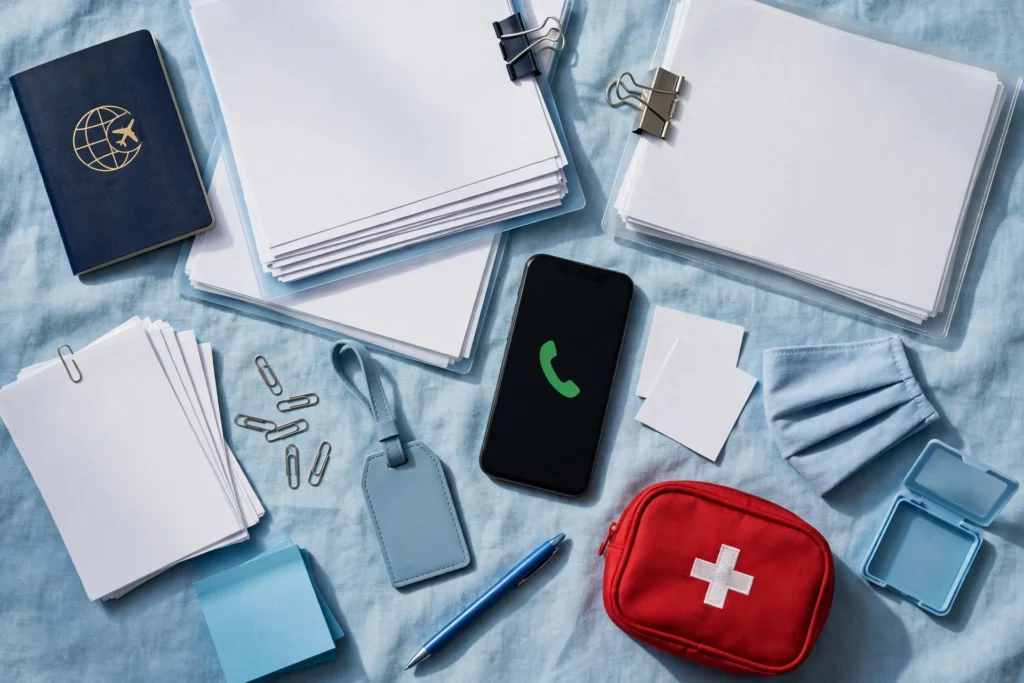
A lost or stolen passport is not a disaster if you have prepared for it, and it is a trip-ending crisis if you have not. The preparation takes twenty minutes at home and costs nothing. First, check your passport’s expiry date and the entry rules for your destination. Many countries require your passport to be valid for six months beyond your arrival date, and some require a certain number of blank pages. Airlines can refuse to board you if your passport does not meet the destination’s rules, and that refusal happens at the check-in desk, not at the border. If your passport is close to expiry, renew it before you travel. If you are unsure what your travel document number is or where to find it on the passport, our explainer on what a travel document number is walks through it. Check visa requirements at the same time, and check whether your destination needs an electronic authorisation completed before departure — several countries now require one, and arriving without it means a long delay or a refused entry.
Second, make copies. Photocopy or photograph the photo page of your passport, your visa or entry authorisation, your travel insurance policy, your flight and hotel confirmations, and the front and back of every card you are carrying. Keep one set of copies separate from the originals — in a different bag, or in your hotel safe while the originals are with you — and keep a second set at home with someone you trust. Email a set to yourself as well, so you can open it from any computer, and store the card cancellation numbers separately from the cards themselves. The point is simple: if your bag is stolen, you should still be able to prove who you are, cancel your cards, call your insurer, and get to your embassy with a copy in your hand. Travellers who have done this get a replacement passport in hours or a day. Travellers who have not can lose days.
Third, build your emergency list. The local emergency number is not 911 everywhere. In much of Europe it is 112. In the United Kingdom it is 999. In many countries the police, ambulance, and fire services have different numbers, and some have a separate number for tourists. Look up the numbers for your destination before you go and save them in your phone under names you will find under stress — “Police — Lisbon”, not a string of digits. Add the phone number to block each card, your insurer’s assistance line, your airline’s rebooking number, and the nearest US embassy or consulate. Write the same list on a card in your wallet, because a phone with a dead battery or a stolen phone cannot show you a number. If you are travelling with children, put a card in each child’s pocket with your name, your phone number, and your hotel’s name and address, in the local language if you can. It is the cheapest insurance in this whole guide.
Keep your documents safe while you travel
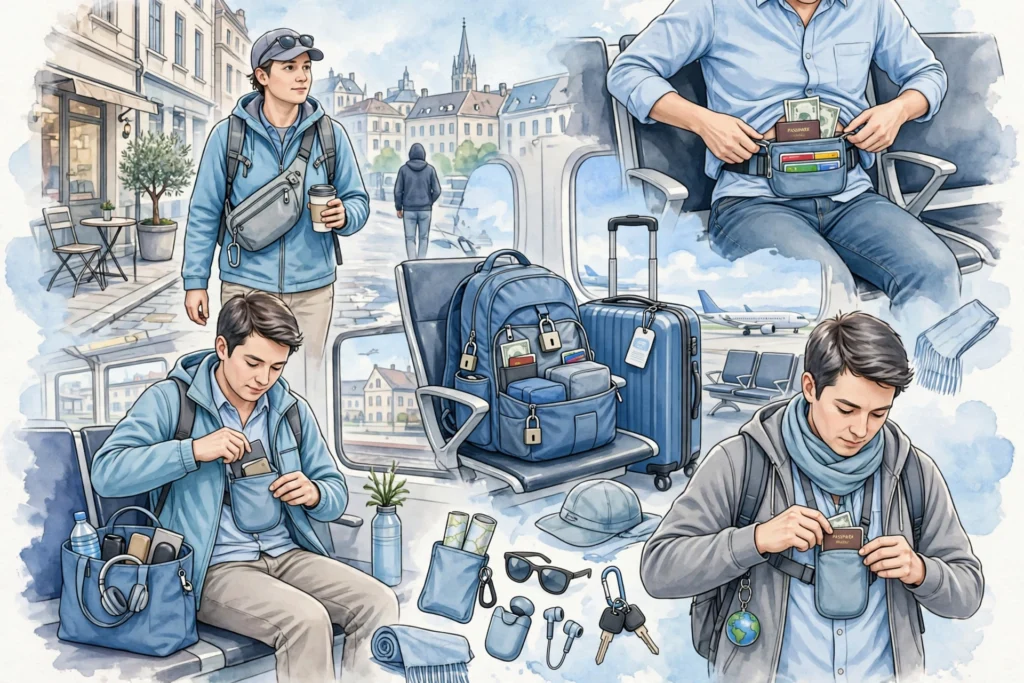
On the move, your passport should be in one of two places: in your hotel safe, or on your body in a place a thief cannot reach without you noticing. A money belt worn under your clothes, a neck pouch under your shirt, or a zipped inside pocket all work. A back pocket, a jacket pocket on a chair, and the outside pocket of a backpack do not. In most destinations you do not need to carry your passport all day — a photocopy is enough for everyday identification, and the original can stay locked up. The exception is when you are crossing a border, checking into a hotel, or somewhere the law requires the original, so check the local rule when you arrive. Never hand your passport to a stranger who asks for it in the street, including someone claiming to be police: a real officer will show identification and will usually be in uniform, and if you are unsure, offer to walk together to the nearest police station or hotel rather than handing it over on the pavement. Never leave your passport, cards, or electronics visible in a parked car, even for a few minutes, and never leave your bag unattended in an airport, a station, or a restaurant — not even while you go to the counter to order.
Before You Go: Packing, Medicines and Your Health Kit
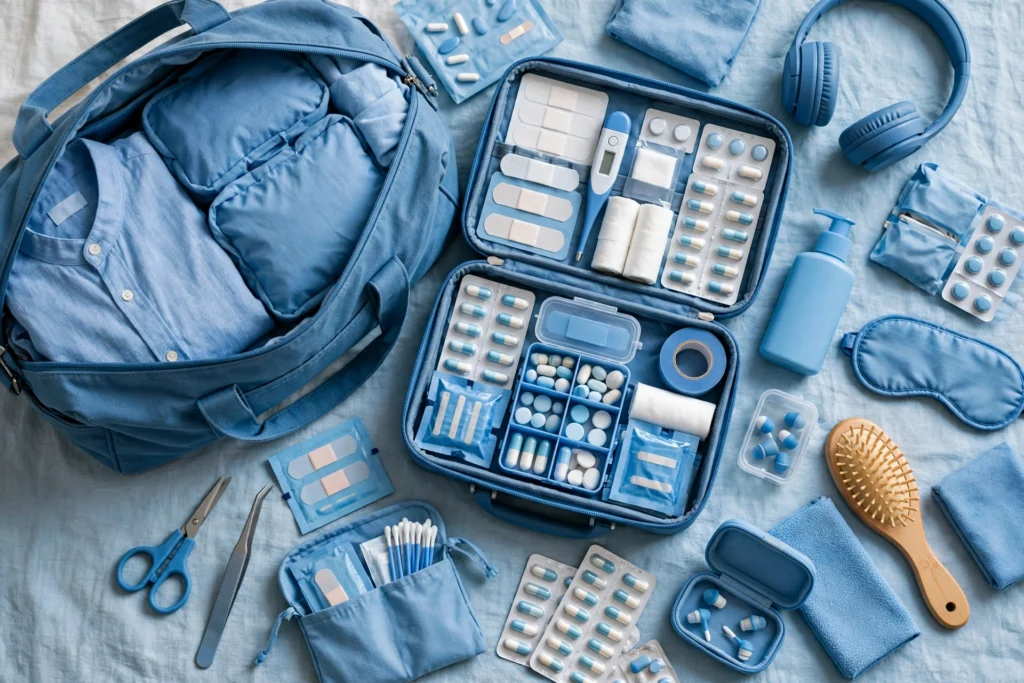
Packing for safety is mostly packing light and packing deliberately. The more you carry, the more you have to watch, and the more attractive a target you are. The rule is to take only the valuables you actually need for the trip, and to leave the rest at home: the expensive watch, the extra jewellery, the second camera, the laptop you will not use. If you would be upset to lose it, and you do not need it on this trip, it should not be in your bag. What you do need is a small health kit, a few practical safety items, and clothes that help you blend in rather than stand out. Flashy clothes, obvious designer logos, and expensive accessories mark you as a visitor with money, and in a crowded market or a busy station that is an invitation you do not need to send. Dress like a local where you can, or at least dress plainly, and save the smart outfit for the restaurant, not the street.
Your health kit belongs in your carry-on, not in your checked luggage, because checked bags go missing and medicines cannot wait. The basics are: any prescription medicines in their original containers with the prescription, a small supply of pain relief, antihistamine tablets, rehydration salts, plasters and antiseptic wipes, insect repellent, sunscreen, hand sanitiser, and any medicine your doctor has prescribed for the trip, such as treatment for travellers’ diarrhoea or altitude sickness. Add a thermometer if you are travelling with children, and a copy of your prescriptions in case a pharmacist abroad needs to understand what you take. If you use an EpiPen or similar emergency medicine, carry it on your person, not in your bag, and make sure your travelling companions know where it is and how to use it. If you are going somewhere with a malaria risk, take the prevention your doctor prescribed exactly as directed — the tablets only work if you take them, and stopping early is one of the most common mistakes travellers make.
A few practical items earn their place in every bag. A small padlock for your bag on overnight trains and buses, and for hostel lockers. A doorstop or a portable door lock for hotel rooms, which costs little and gives real peace of mind in a room with a weak lock. A head torch or small flashlight, because power cuts happen and dark streets are easier to navigate with light. A power bank, charged, because a phone is your map, your translator, your emergency call, and your boarding pass, and a dead phone is a real safety problem, not just an inconvenience. A photocopy of your passport and your emergency numbers, as described in the section above. And a basic first-aid kit that you actually know how to use — a kit you have never opened is just weight. If you want a full packing list to work from, our free travel packing checklist covers the whole trip, and this safety kit slots straight into it.
What to wear and what to leave behind
The right clothes for safety are comfortable, modest where the local culture expects modesty, and suited to the weather you will actually face. In hot climates that means light, loose clothing, a hat, and sunscreen, because heat illness and sunburn are far more likely to spoil your trip than crime. In cold or mountain climates it means layers and proper footwear with grip, because a fall on wet stone or ice is a real risk. At religious sites, cover shoulders and knees unless you know the local rule is different, and carry a scarf or shawl for the purpose. Footwear matters more than most people think: you will walk further than you expect, on uneven ground, and the shoes that are fine for a shopping trip at home may be dangerous on a wet cobbled hill. Break new shoes in before you travel. And leave the valuables at home: if you would not walk around your own city wearing it, do not wear it in a city you do not know.
| Packing item | Why it matters for safety | Where to keep it |
|---|---|---|
| Prescription medicines in original containers | Needed daily, hard to replace abroad | Carry-on, on your person |
| Photocopies of passport, insurance, cards | Proves identity, speeds replacement | Separate bag, and emailed to yourself |
| Padlock and doorstop | Secures bags on trains, rooms with weak locks | Day pack |
| Power bank, charged | Phone is map, translator and emergency call | Day pack |
| Sunscreen, insect repellent, rehydration salts | Prevents the most common travel illnesses | Day pack |
| Emergency numbers on paper | Works when the phone is dead or stolen | Wallet |
| Modest layers and a scarf | Respects local dress rules, sun and cold protection | Main bag |
Arriving Safely: Daylight Arrival, Airports and Getting to Your Hotel

The first hours in a new place are the most vulnerable of the whole trip. You are tired, you are carrying everything you own, you do not know the streets, and you are easy to spot. The single best decision you can make is to arrive in daylight. If you have a choice of flights, choose the one that lands in the morning or the early afternoon, even if it costs a little more. A daylight arrival means you can see where you are going, find your hotel without wandering, read street signs, and judge a neighbourhood with your eyes open. A late-night arrival in an unfamiliar city means navigating in the dark, with fewer people around, fewer transport options, and a tired brain making decisions. If a night arrival is unavoidable, arrange the transfer in advance: a hotel car, a pre-booked airport transfer, or a reputable taxi booked through the hotel, with the driver’s name and the price agreed before you land. Do not improvise transport at midnight in a city you have never visited.
At the airport, keep your belongings where you can see them and your documents where a thief cannot reach them. Before you fly, it is worth reading the TSA security screening rules so you know what to expect at the checkpoint and can get through it without fumbling with bags and documents in a crowd. The classic airport thefts happen at the moments you are distracted: at the baggage carousel, at the currency exchange desk, in the queue for a taxi, and in the café where you put your bag down to order. Keep your bag between your feet or across your body at the carousel, not behind you. Count your money and put it away before you turn away from the exchange desk or the ATM. Use the official taxi rank or the ride-hailing pickup point, not the driver who approaches you inside the terminal offering a cheaper ride — that driver is not offering a bargain, he is offering a risk, and the official rank exists for a reason. If someone offers to carry your bags and you did not ask, a polite no is enough. And if you are approached by someone claiming your hotel is closed, overbooked, or has moved, do not believe them: this is one of the oldest airport scams in the world, and the answer is to go to the hotel yourself or call it on the number you already have.
Getting from the airport to your hotel
Before you fly, learn the route. Know the name and address of your hotel, save its location offline in your phone’s map app, and know roughly how long the journey should take and what it should cost. Download the offline map for the city before you leave home, because airport Wi-Fi is unreliable and mobile data may not work until you have a local SIM. Agree the taxi fare before you get in, or insist on the meter, and check that the taxi has a visible licence and a meter that is running. If you use a ride-hailing app, check that the car’s number plate, the driver’s name, and the driver’s photo all match the app before you open the door, and sit in the back seat. On public transport from the airport, keep your bag on your lap or between your feet, not on the rack above a stranger, and keep your phone and wallet in a front or inside pocket. If the bus or train is crowded, that is when pickpockets work, so be most alert exactly when you are most squeezed. And when you arrive at the hotel, do not stand on the pavement with your luggage spread around you while you search for the entrance — walk in, put your bags down inside, and then get your bearings.
The first evening in a new place
Keep the first evening simple. Eat near the hotel, walk the streets around it in daylight first so you know them after dark, and learn where the nearest pharmacy and the nearest hospital are — not because you expect to need them, but because knowing where they are is the kind of knowledge that is useless to acquire in a hurry. Ask the receptionist which areas to avoid after dark and which streets are fine, and believe them over anything you read online: they live there. If you go out in the evening, take only what you need — one card, a little cash, your phone, and a copy of your passport — and leave the rest locked in the room safe. Tell someone where you are going, even if that someone is just a message to a friend at home. And if a street feels wrong, trust the feeling and leave. You do not need a reason. Your instincts are a safety tool, and they work best when you listen to them the first time.
Hotel Safety: Choosing, Checking In and Sleeping Soundly
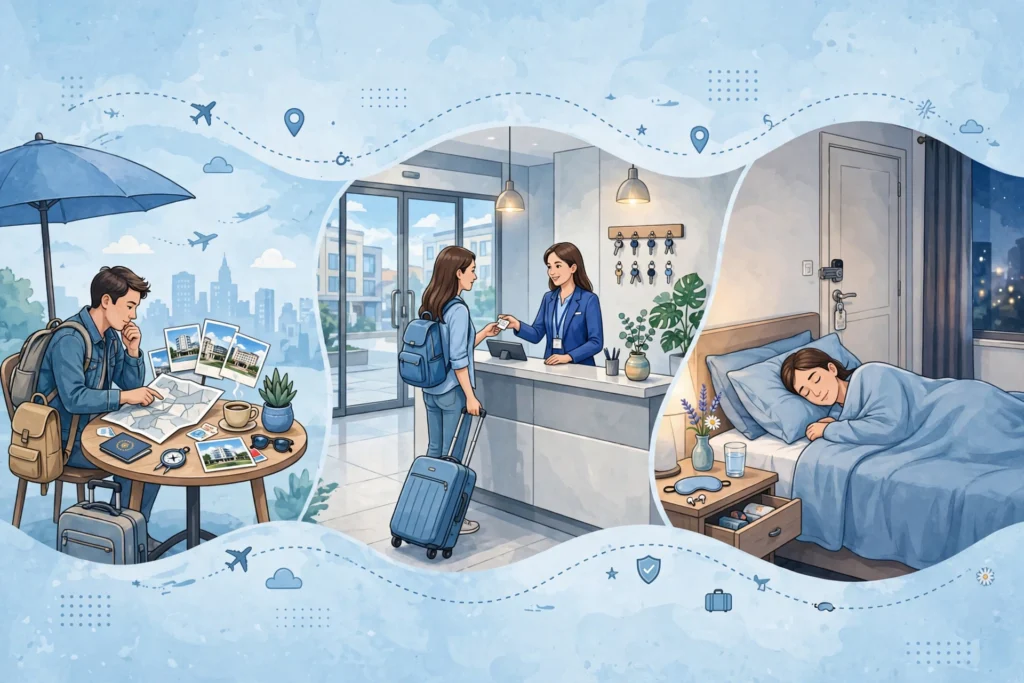
Choose your hotel for safety as well as for price. A hotel in a well-lit, busy area near the centre is worth more than a cheaper room down a quiet side street that empties after dark. Before you book, read recent reviews with safety in mind: look for mentions of the neighbourhood at night, the security at the entrance, whether the reception is staffed around the clock, and whether rooms have safes. A hotel with a 24-hour reception, a secure entrance, and a safe in the room is worth paying a little extra for, because those three things solve most hotel safety problems before they start. Check that the building has smoke detectors and a clear fire escape route: when you arrive in any hotel room, find the fire exit and count the doors to it, so you can find it in the dark or in smoke. It takes thirty seconds and it is the kind of preparation that only matters once, when it matters completely.
At check-in, protect your privacy. If the receptionist says your room number out loud in a lobby full of strangers, ask for a different room or ask them to write it down instead. If you are travelling alone, do not let your room number be announced, and if a stranger in the lift asks which floor you are on, it is fine not to answer. When you reach your room, check the basics before you unpack: lock the door and test it, check that the windows lock, check that the phone works, and look for the fire escape plan on the back of the door. Use the safe for your passport, your spare cash, your spare card, and anything you would be upset to lose — and remember that a safe is only useful if you actually put things in it. If the room has a balcony, keep the door locked when you are out and at night. If the room is on the ground floor, keep the windows locked and the curtains closed after dark.
Sleeping safely in a hotel, hostel or rental
In a hotel, use every lock the door has: the main lock, the chain or bolt, and the deadbolt if there is one. A portable doorstop or a travel door lock adds a second layer in rooms where the fitted lock is weak, and it weighs almost nothing. Do not open the door to someone you are not expecting: check through the peephole first, and if someone claims to be hotel staff, call reception to confirm before you open the door. Housekeeping and maintenance should always be expected — if nobody was scheduled, do not open the door. In a hostel, use the locker provided, bring your own padlock, and keep your valuables on your person or locked away when you sleep — never loose on the bed or in an open bag. In a holiday rental, check the reviews for security mentions, check that the doors and windows lock properly on arrival, and know how to contact the host or the property manager at night. Wherever you sleep, keep your phone, your room key, and a torch within reach of the bed, and keep your shoes by the door — if you have to leave in a hurry, in the dark, you will want both.
What to do if you feel unsafe in your room
If something about a room or a hotel feels wrong — a lock that does not work, a window that does not close, a stranger who seems to know your room number — do not try to fix it yourself and do not ignore it. Go to reception and ask to change rooms, and if the hotel cannot fix the problem, ask for a different hotel or leave. Your comfort is not a small thing: a room you do not feel safe in will cost you sleep, and tired travellers make worse decisions the next day. If you are ever in immediate danger in a hotel, call the local emergency number first and reception second. And if you are travelling alone, tell the receptionist that you expect a wake-up call or that a friend will call you at a certain time — a small routine that means someone notices if you do not answer. It costs nothing and it is the kind of quiet precaution that good hotels are used to.
Getting Around Safely: Transport, Taxis and Road Safety
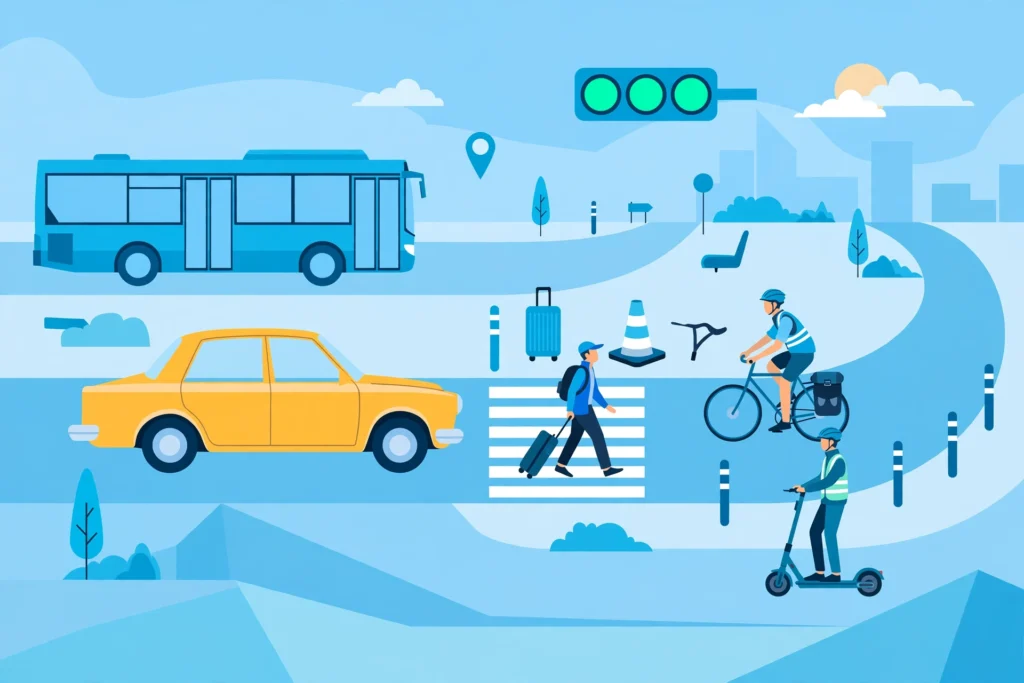
Road crashes are the risk travellers most often underestimate, and the one that causes the most serious harm. The rules that keep you safe at home apply abroad, with one difference: abroad the roads, the vehicles, the driving habits, and the laws are all unfamiliar, so the margin for error is smaller. The basics are not negotiable. Wear a seatbelt in every vehicle that has one, including the back seat and including taxis — if the taxi has no working seatbelts, take a different taxi. Wear a helmet on any motorbike, scooter, or bicycle, and if no helmet is offered, do not ride. Do not ride a scooter or a motorbike after drinking, and do not ride one at all in a place where you do not know the roads, because a scooter is the single most dangerous thing most travellers do on holiday, and it is dangerous precisely because it feels easy. Do not drive after drinking, do not drive at night on rural roads you do not know, and do not drive when you are tired after a long flight. If you are hiring a car, inspect it before you drive away: tyres, lights, brakes, and the spare wheel. If the car is not roadworthy, refuse it and ask for another.
Before you use any transport, learn how it is supposed to work. In some cities the bus is safe and the unmarked taxi is not. In others the metro is the safe option and the bus is where pickpockets work. Ask at the hotel which transport to use and which to avoid, and use the official version: the licensed taxi from the rank, the ride-hailing car whose plate matches the app, the bus from the proper stop. Never get into an unmarked car that offers you a lift, however friendly the driver, and never accept a ride from a stranger at an airport or a station. On public transport, keep your bag on your lap or between your feet, keep your phone in a front pocket, and be most alert when the vehicle is crowded and you are being jostled — that is when a pickpocket works. If you are travelling overnight on a train or a bus, lock your bag to the rack or to your seat with a cable lock, keep your valuables in a pouch on your body, and sleep with your bag where you can feel it move.
Taxis and ride-hailing: the rules that work everywhere
Agree the price before the journey starts, or make sure the meter is running and the starting fare is what it should be. Check that the taxi is licensed: a sign on the roof, a licence displayed inside, a meter, and a driver identification card. If any of those are missing, take the next taxi. Sit in the back seat, keep your bag with you rather than in the boot if you can, and follow the route on your own phone map so you know if the driver is taking a longer route than necessary. If the route looks wrong, say so calmly and ask to be taken to a well-lit public place where you can get out safely. Never let a taxi driver choose your hotel for you, and never let a driver take you to a shop, a restaurant, or a tour office for a commission — the recommendation is paid for, not honest. With ride-hailing, the checks are simpler but just as important: the car model, colour, and number plate must match the app, the driver’s name and photo must match, and you should ask the driver to confirm your name before you get in, rather than saying it yourself.
Walking, cycling and crossing the road
Pedestrians are the most vulnerable road users, and the danger is worst in places where the traffic drives on the opposite side of the road from home. Before you step off a kerb in a new country, stop and look the right way — twice. Learn whether cars stop for pedestrians at crossings, because in many cities they do not, and never assume a green light means the traffic will stop. Walk on pavements where they exist, wear something light-coloured or reflective at night, and do not walk on the road while looking at your phone. If you are cycling, wear a helmet, use lights at night, and ride where cyclists are expected rather than on a busy road with no cycle lane. And never walk on a motorway, a dual carriageway, or a rural road after dark — if you are on foot at night, stay on lit streets with other people around you, and take a taxi rather than walking through an area you do not know.
| Transport | Safety check before you use it | On board |
|---|---|---|
| Taxi | Licensed, meter running or price agreed, driver ID visible | Back seat, bag with you, follow the route on your map |
| Ride-hailing | Plate, car, driver name and photo all match the app | Ask the driver to confirm your name |
| Bus and metro | Official stop, valid ticket, bag on your lap | Most alert when crowded and jostled |
| Overnight train or bus | Lock your bag to the rack or seat | Valuables in a pouch on your body |
| Rental car | Tyres, lights, brakes, spare wheel inspected | Seatbelt always, no night driving on unknown rural roads |
| Scooter or motorbike | Helmet provided, roads known, sober | If no helmet, do not ride |
Money and Cards: ATMs, Skimming and Splitting Your Cash
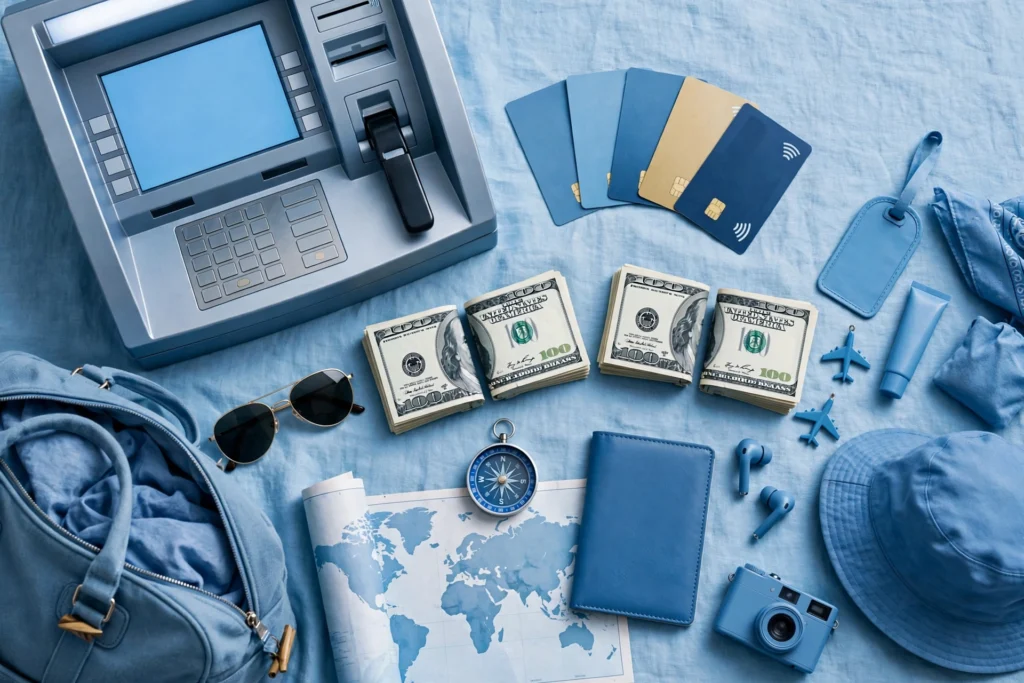
The money rule is the simplest in this whole guide: never keep all of your money in one place. Split it so that one theft, one lost wallet, or one swallowed card cannot strand you. Carry a day wallet with one card and enough cash for the day, and keep your spare card, your backup cash, and your passport copies somewhere else — in the hotel safe, in a money belt under your clothes, or in a different bag. If your wallet is stolen, you should lose a day’s money and one card, not your whole trip. Tell your bank and your card providers that you are travelling, and the dates and countries, so a foreign transaction is not blocked as suspicious. And know the phone number to block each card, saved in your phone and on paper, because the first hour after a theft is when a stolen card does its damage, and a card blocked in ten minutes is a card that cannot be used.
Cash still matters, even in a world of cards. Some places are cash only: markets, small restaurants, rural guesthouses, buses, and tips. Carry a mix of small notes and a card, and keep the bulk of your cash out of sight — count it in private, not on the street, and never show a thick wallet when you pay for something small. Use a separate small purse or wallet for day spending, so the pickpocket who gets your day wallet does not get your main money. And keep an emergency reserve — a folded note in your shoe, in your luggage lining, or in a separate pocket — that you never touch except in a real emergency. It is the money that gets you to the embassy, to the hotel, or to the airport when everything else has gone wrong.
ATMs: how to use them safely
Use ATMs inside banks, during opening hours, whenever you can. An ATM inside a bank branch is harder to tamper with, it is watched, and if the machine swallows your card, there is a person inside who can help. Avoid standalone ATMs in dark streets, in tourist bars, and in places with no one around, because those are the machines most often fitted with skimming devices that copy your card. Before you use any ATM, look at the card slot and the keypad: if anything looks loose, bulky, or different from the machine next to it, do not use it. Cover the keypad with your other hand when you enter your PIN, so a hidden camera cannot read it. Decline the machine’s offer to convert the withdrawal into your home currency — the machine’s exchange rate is almost always worse than your bank’s, and the difference adds up over a trip. Withdraw larger amounts less often, rather than small amounts every day, so you spend less time standing at machines, and put the cash away before you walk away from the machine. If the ATM keeps your card, do not leave immediately: stay, call the bank’s number on the machine, and report it. And never let a stranger “help” you at an ATM, however friendly — that help is the scam.
Cards, contactless and fraud alerts
Set up transaction alerts on every card before you travel, so your phone tells you the moment a payment is made. Check your statements every few days while you travel, and report anything you do not recognise immediately — the sooner a fraudulent charge is reported, the sooner it is stopped, and the easier it is to prove you did not make it. Keep your cards in a front or inside pocket, not in a back pocket or an open bag. Use contactless or a digital wallet where it is accepted, because a phone payment does not expose your card number the way a physical card can, and a digital wallet can be updated with a replacement card while you are still abroad. Know your PINs before you travel — some countries still require a PIN for card payments, and a forgotten PIN at a foreign till is a miserable experience. And if a card is lost or stolen, block it first and worry about the replacement second: most banks can send a replacement card to your hotel or to a branch, and some can put a replacement into your digital wallet the same day.
Pickpockets and Theft: How to Carry Your Belongings
Pickpockets do not pick rich people. They pick distracted people. They work in the places where tourists are most distracted: crowded metros, busy markets, famous squares, airport queues, festival crowds, and anywhere a crowd is squeezed together and jostled. They work in teams: one person bumps you or asks you a question, another takes your wallet while your attention is on the first person, and a third carries it away. They use the same tricks in almost every city in the world — the spilled drink, the map thrust in your face, the child asking for money, the stranger who points at something behind you — and the defence is the same everywhere: keep your valuables where a hand cannot reach them without you feeling it, and keep your attention on your belongings when you are in a crowd.
How you carry your things matters more than what you carry them in. The safest places for your phone, your cards, and your cash are a front trouser pocket, a zipped inside jacket pocket, or a cross-body bag worn in front of you with the opening against your body. The worst places are a back pocket, an open tote bag, a backpack’s outer pocket, and a jacket hung on the back of your chair. If you wear a backpack in a crowd, wear it on your front, or at least keep the zips against your back. Use a bag with zips rather than an open top, and keep the zip closed. If you stop at a café, keep your bag on your lap or between your feet with a strap around your leg or the chair leg — never on the back of the chair, never on the table, and never on the floor beside you where a hand can lift it while you look the other way. On a train or a bus, keep your bag where you can see it and feel it. At the beach, take only what you need, and take turns watching the bags if you are with someone — or use a waterproof pouch you can wear into the water.
What to do if you are robbed
If someone threatens you and demands your bag or your wallet, give it to them. No wallet is worth an injury, and no phone is worth a fight. Hand it over, step back, and let them go. This is the advice every police force and every travel advisory gives, and it is the advice most people find hardest to follow in the moment, because the instinct is to hold on. Practise the decision now, before it happens: your day wallet is expendable by design, because your real money and your spare card are somewhere else. That is why you split your money. Once you are safe, call the local emergency number, then go to the nearest police station and report the theft — you will need the police report for your insurance claim and for a replacement passport, so get a copy or a reference number and keep it. Then call your bank to block the cards, call your insurer’s assistance line, and contact your embassy if your passport was taken. It will ruin an afternoon. It should not ruin a trip.
Bag, phone and camera habits that stop theft
Lock your bag’s zips together with a small padlock when you are in transit, and use a cable lock to attach your bag to a fixed object on overnight trains and buses and in hostels. Do not leave your phone on a restaurant table or a bar counter, even for a moment — phone snatching from tables is one of the most common thefts in tourist cities, and it takes two seconds. Hold your phone with both hands when you use it on a busy street, and step into a shop or against a wall to check your map rather than standing in the flow of people with your phone out. If you are carrying a camera, use a strap around your neck or wrist, keep it in your bag when you are not using it, and do not leave it hanging from a chair. And when you are in a crowd, do a quick check every few minutes: phone, wallet, bag. It takes two seconds, and it is the habit that catches a theft while the thief is still within reach.
Travel Scams to Avoid: The Most Common Tricks by Setting
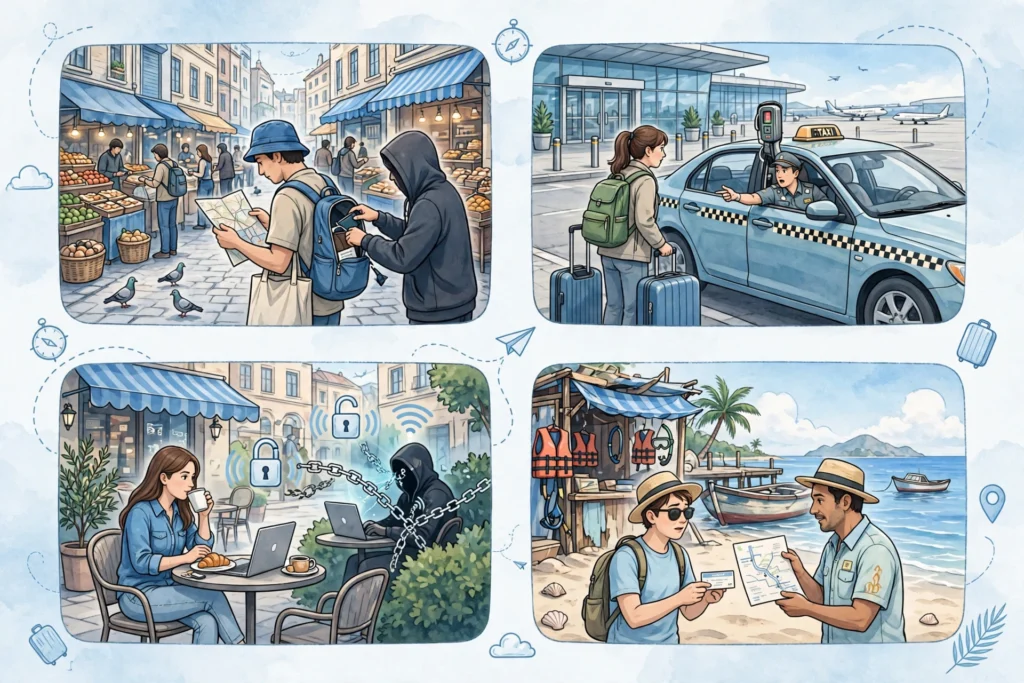
Every travel scam works the same way: it creates urgency, confusion, or a feeling of obligation, and then asks for money before you have time to think. The defence is also always the same: slow down, say no, and check with someone you trust. A genuine offer will still be there in ten minutes. A scam will not, because the scammer needs you to decide now. If someone is rushing you, that is the warning. If an offer seems too good to be true — a free tour, a luxury hotel at a quarter of the price, a gemstone you can sell for ten times what you pay — it is too good to be true. If someone you have just met is suddenly your best friend and wants to take you to a shop, a bar, or a ceremony, be polite and walk away. And if you feel embarrassed or pressured, remember that the embarrassment is the tool: the scammer is counting on you being too polite to say no.
The scams below are the ones reported most often by travellers, in the settings where they happen. Learn the shape of them, not just the details, because the details change from city to city while the shape stays the same: a helpful stranger, an urgent problem, a bargain, or a bill you did not expect.
Scams at airports, stations and on the street
The closed-hotel scam: a driver or a stranger tells you your hotel is closed, overbooked, or in a dangerous area, and offers to take you to a better one. The better one pays them a commission. Ignore it and go to your hotel. The broken-meter scam: the taxi driver claims the meter is broken and names a price several times the normal fare. Get out and take another taxi. The friendly local scam: a stranger strikes up a conversation, invites you for a drink or to see a ceremony, and you end up in a bar or a shop with an enormous bill and an intimidating demand to pay. Be friendly in the street, but do not follow strangers to a second location. The fake police scam: someone claiming to be a police officer asks to see your wallet or your passport to check for counterfeit money, or demands an on-the-spot fine. Real police do not inspect wallets on the street. Offer to go to the nearest police station together, and watch how quickly the conversation ends. The distraction scam: one person spills something on you, asks for directions, or shows you a map, while another takes your bag. If someone creates a distraction around you, your first move is to check your belongings, not to help with the distraction.
Scams in shops, restaurants and tours
The gem and carpet scam: a friendly stranger, often a fellow traveller or a helpful shopkeeper, tells you about a special government shop or a one-day sale where you can buy gems, carpets, or art cheaply and sell them at home for a fortune. The goods are worthless. There is no resale market. Walk away. The menu scam: a restaurant has no prices on the menu, or a second menu with higher prices appears for tourists, and the bill at the end is several times what you expected. Always check prices before you order, and if a menu has no prices, eat somewhere else. The tour and ticket scam: someone sells you tickets to an attraction, a show, or a tour at a discount, and the tickets are fake or for the wrong day. Buy tickets only from the official ticket office or the official website, never from a tout on the street. The charity and petition scam: someone asks you to sign a petition or donate to a charity, and while you are signing, your pocket is picked or you are pressured to give money. A genuine charity does not work this way on the street. And the bill padding scam: extra items appear on your bill, or your card is charged twice. Check every bill before you pay, keep your receipts, and check your card statement while you travel.
Scams when booking and paying
Book through reputable, established websites and check that the company has a verifiable phone number and address before you pay. Be suspicious of a deal that is far cheaper than every other offer for the same thing, of a host who asks you to pay outside the booking platform, and of a listing whose photos look too perfect or are stolen from another property. Never pay by bank transfer or by gift card to someone you have not met, and never share your card details or a one-time passcode with anyone who contacts you claiming to be your bank, your airline, or your hotel. If you receive a message saying your booking has a problem and asking you to click a link and re-enter your payment details, do not click it: go to the company’s own website or app and check your booking there. The same rule applies to messages about a parcel, a refund, or a prize. The link is the scam. The real company is one search away.
| Setting | The scam | The defence |
|---|---|---|
| Airport and station | Closed-hotel story, unlicensed taxi, fake help with bags | Official rank, pre-booked transfer, call the hotel yourself |
| Street | Fake police, distraction theft, friendly stranger leading you to a bar | Offer to go to a police station, check your belongings first |
| Shop or restaurant | Gem and carpet sale, menu with no prices, padded bill | Official shops only, prices before ordering, check every bill |
| Tour and tickets | Discounted tickets from a tout, fake tour operator | Official ticket office or official website only |
| Booking and payment | Pay outside the platform, phishing link about your booking | Reputable sites, never pay by transfer or gift card, check in the app |
Staying Safe Online: Wi-Fi, Booking Fraud and Social Media
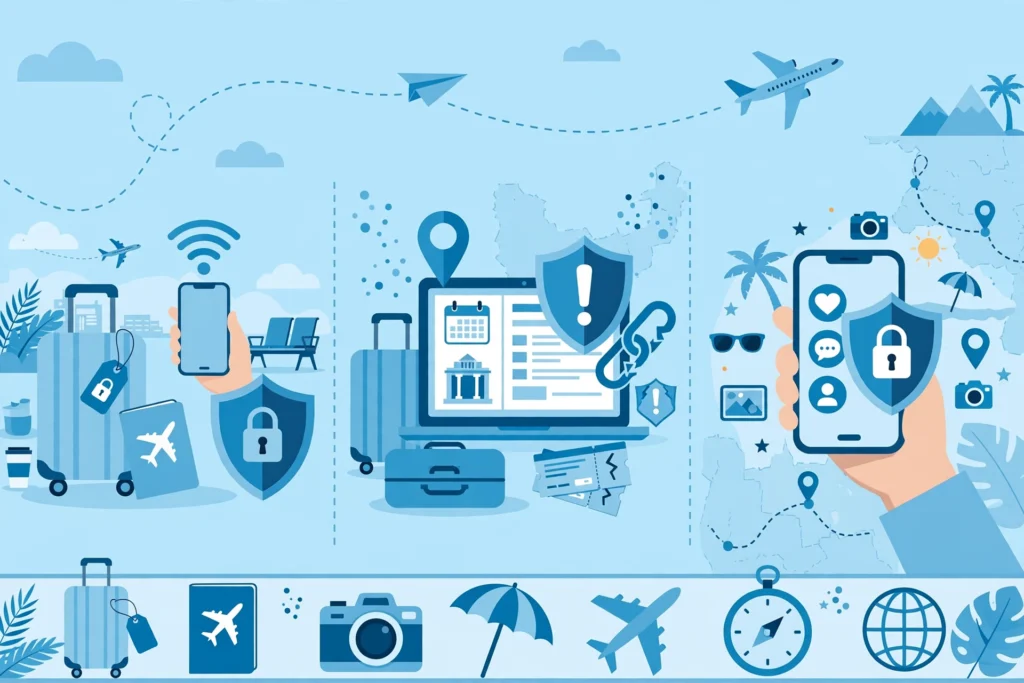
Travel safety tips for tourists used to be only about streets and hotels. Today they must also cover your phone, because your phone now holds your money, your identity, your tickets, and your location, and a thief who gets into your phone can do more damage than one who gets your wallet. The rules are simple, and they start before you leave. Turn on multifactor authentication for your email, your bank, and your booking accounts, so a stolen password alone is not enough to get in. Make sure your phone’s operating system and your apps are updated, because updates close the security holes that attackers use. Set your phone to lock automatically after a short time, and use a strong passcode or a fingerprint rather than a simple pattern. Back up your phone and your photos to the cloud before you travel, and carry hard copies of your essential documents, so a lost or stolen phone does not mean a lost trip.
Public Wi-Fi is the risk most travellers ignore. The free Wi-Fi in an airport, a station, a café, or a hotel is convenient, and it is also the easiest place for someone to watch what you do. Never log in to your bank, make a payment, or enter a password on a public Wi-Fi network. Use your mobile data instead, or wait until you are on a network you trust. If you must use public Wi-Fi, use it only for browsing, and use your phone’s own hotspot or a virtual private network if you have one. Keep your device’s Bluetooth and file-sharing switched off when you are not using them, and never plug your phone into a public USB charging port with a data cable — a public USB port can copy data from your phone while it charges, so carry a charging plug and use a power socket, or use a charge-only cable that cannot transfer data. These are small habits, and they close the doors that most digital theft walks through.
Social media and oversharing
Do not post your location or your travel plans in real time. A photo of your boarding pass, a check-in at the airport, or a post saying your house is empty for two weeks tells a stranger exactly where you are and where you are not. Post your photos after you have left a place, not while you are there, and keep your home address, your hotel name, and your room number out of your posts entirely. The same care applies to your out-of-office email message: say you are away and when you will reply, but do not say where you are or for how long. Review your privacy settings before you travel, and think about who can see your posts — a public post is public to everyone, including people you have never met. And be careful with the photos you share: a photo of your passport, your tickets, or your hotel key card can contain enough detail for someone to misuse it. Keep those photos private, and never post them at all.
Booking fraud and fake listings
The most expensive online travel scam is the fake listing: a holiday rental or a hotel that does not exist, or that is not what the photos show, paid for in advance. Protect yourself by booking through established platforms with verified reviews, by checking that the property’s reviews are recent and written by different people, and by searching for the property’s name and photos elsewhere — a listing whose photos appear on several different sites under different names is a warning. Never pay outside the platform, however good the reason sounds, because the platform’s protection disappears the moment you do. If a host asks you to pay by bank transfer, by gift card, or by a payment app to a personal account, stop and report the listing. And if a deal is far cheaper than every comparable property in the same area, ask why before you pay. A bargain is sometimes a bargain. A bargain that is half the price of everything else is usually a trap.
Health and Water Safety: Food, Water, Sun, Insects and Swimming

Most travel illness is not dramatic. It is a stomach bug from water or food, a sunburn, a heat headache, or a dozen insect bites that keep you awake. All of it is preventable, and all of it is more likely to spoil your trip than crime. Start with water. In many parts of the world the tap water is not safe to drink, and the rule is simple: if you are not sure, do not drink it, and do not drink ice made from it, and do not brush your teeth with it. Drink bottled water with an unbroken seal, or water that has been boiled or treated, and use it for brushing your teeth too. Carbonated drinks, sealed juices, and hot tea and coffee are safe. When you are unsure about the water in a place, ask at the hotel — the staff will tell you straight away, because they answer the question every day. For the authoritative picture of health risks at your destination, including which vaccines are recommended and whether malaria prevention is needed, check the CDC Travelers’ Health pages for your destination before you travel, and follow your doctor’s advice over anything you read in a travel article, including this one.
Food follows the same rule, and it is an old one because it works: eat it cooked, eat it hot, peel it yourself, or leave it. Food that is well cooked and served hot is usually safe. Meat, poultry, and seafood should be well cooked, not raw or rare. Thick-skinned fruit that you peel yourself — bananas, oranges, mangoes — is usually safe. Salads, raw leafy greens, and uncooked food washed in local water are risky in places where the water is not safe, and so is food from a stall with no customers and no turnover. That does not mean you should avoid street food: some of the best meals in the world are sold from street stalls, and a busy stall with a long queue of local customers and food cooked in front of you is often safer than an empty restaurant. The test is not the price or the setting. It is whether the food is fresh, hot, and cooked in front of you. Wash your hands before you eat and after you use the bathroom, and carry hand sanitiser or wipes for the times when soap and water are not available.
Sun, heat and insects
Sun and heat are underestimated because they do not feel dangerous while they are happening. At altitude and near the equator the sun burns faster than you expect, and it burns through cloud and through a breeze that makes you feel cool. Use sunscreen with a sun-protection factor of 30 or higher, apply it before you go out and reapply it often, wear a hat and sunglasses, and wear light, loose clothing. Drink water through the day and do not wait until you feel thirsty, because thirst arrives after you are already dehydrated. Rest in the shade in the hottest part of the day, and go easy on exercise in the first few days in a hot place until your body has adjusted. If you feel dizzy, nauseous, or unusually tired in the heat, get into the shade, drink water, and cool down — and get medical help if you do not feel better quickly, because heat illness can become serious fast.
Insects are more than an irritation in many destinations: mosquitoes carry malaria, dengue, and other illnesses, and the best protection is not to be bitten. Use an insect repellent with DEET or picaridin, apply sunscreen first and repellent second, wear long sleeves and long trousers at dusk when mosquitoes are most active, and sleep under a treated mosquito net where one is provided. Light-coloured clothing attracts fewer insects than dark clothing. If you are in a malaria area and you have been prescribed prevention, take it exactly as directed and keep taking it for the full period your doctor advised after you return home. If you develop a fever after travelling in a malaria area, seek medical care immediately and tell the doctor where you have been — a fever after travel is not something to wait out at home.
Swimming and water safety
Drowning is one of the most common causes of death among travellers, and it is almost always preventable. Swim only in safe swimming areas — supervised beaches, hotel pools, and places where local people swim — and ask local people about tides, currents, and underwater hazards before you get into the sea. A beach that looks calm can have a strong rip current, and a river that looks gentle can be fast and cold. Never swim alone in an unfamiliar place, never swim after drinking, and never dive into water you cannot see the bottom of. Children need watching at all times near water, even in a hotel pool, because drowning is silent and fast. If you are going boating, kayaking, or on any water trip, wear a life jacket, even if nobody else is wearing one, and check that the boat has enough life jackets for everyone on board before it leaves. If it does not, do not get on.
| Health risk | Prevention | If it happens |
|---|---|---|
| Unsafe water | Bottled water with unbroken seal, boiled or treated water | Rehydration salts, rest, medical help if it lasts more than a day or there is blood or fever |
| Food illness | Eat it cooked, eat it hot, peel it yourself | Rest, fluids, medical help if there is a high fever, blood, or severe pain |
| Sun and heat | SPF 30+, hat, shade at midday, water through the day | Shade, water, cooling down, medical help if not better quickly |
| Insect bites | DEET or picaridin repellent, long sleeves at dusk, treated nets | Medical help for fever after travel in a malaria area |
| Swimming | Supervised areas only, ask locals about currents, no swimming after drinking | Life jacket on boats, never swim alone in unfamiliar water |
What to Do If Something Happens: Theft, Illness, Arrest and Emergencies Abroad
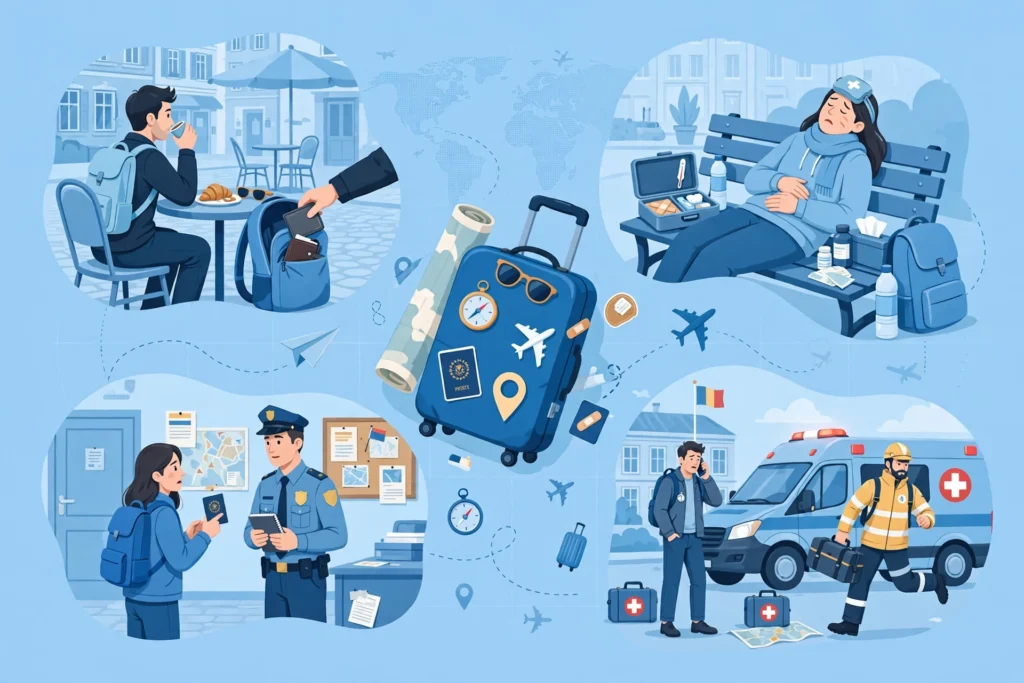
Emergencies abroad feel worse than emergencies at home for one reason: you do not know the system. You do not know the number to call, the hospital to go to, the words to use, or who can help. That is why this section exists, and why the preparation in the earlier sections matters. If you have your emergency list, your insurance number, and your embassy’s address already saved, then an emergency becomes a series of phone calls, not a crisis. The first rule in any emergency is to get safe first and sort the paperwork second. Move to a safe, public place. Call the local emergency number. Then call your insurer’s assistance line. Then, if you need to, call your embassy. In that order. Do not try to negotiate, argue, or fix a bureaucratic problem while you are still in danger.
If your passport is lost or stolen, report it to the local police and get a copy of the report, then contact the nearest US embassy or consulate, which can issue an emergency passport to get you home. Bring your photocopy of the passport, your police report, your travel itinerary, and a passport photo if you have one — the photocopy and the report are the reason the earlier sections told you to make copies. If your wallet or cards are stolen, block the cards immediately, then report the theft to the police for the insurance claim. If you are ill or injured, call your insurer’s assistance line before you go to a hospital if you safely can, because they will direct you to a suitable hospital and arrange a guarantee of payment, which is what stops a hospital from asking for a large payment before treatment. If it is a serious emergency, call the local emergency number first and sort the insurance afterwards — your health comes first, and the insurer can be called from the hospital.
If you are arrested or in trouble with the police
If you are arrested or detained abroad, stay calm, be polite, and do not resist, argue, or try to run — in any country, that makes things worse. Ask to contact the nearest US embassy or consulate, and say so clearly: under international agreements, US citizens abroad have the right to have their embassy notified of an arrest, and the embassy can visit you, provide a list of local lawyers, contact your family, and make sure you are treated fairly. The embassy cannot get you released, cannot pay your bail, and cannot interfere in the local legal process, but it can make sure you are not alone in it. Do not sign any document you do not understand, and ask for a translator or a lawyer before you sign anything. Do not make statements to the police without legal advice if you are accused of a crime, and do not try to pay a bribe — in many countries that is itself a crime, and it will make your situation worse, not better. The best protection against this whole section is the section on local laws earlier in this guide: the arrests that happen to travellers are usually for things the traveller did not know were illegal.
Natural disasters, unrest and getting home
If a natural disaster, a storm, or civil unrest happens while you are travelling, follow the instructions of the local authorities first — they know the area and the danger. Move away from the affected area, avoid crowds and demonstrations, and do not go to see what is happening. Contact your embassy and your family to let them know you are safe, and check the State Department’s advisory page and your airline’s information for updates. If you are registered with STEP, the embassy can reach you with instructions, which is the reason the enrolment matters. Keep your documents and your emergency cash with you, keep your phone charged, and keep enough water and food for a day if you can. If your flight is cancelled, contact your airline before you go to the airport — the rebooking queue at the airport is always longer than the phone queue. And if you need to leave a country quickly, your insurer’s assistance line and your embassy are the two calls that can make it happen. That is what they are there for, and you have already paid for the insurance and already registered with the embassy, so use them.
Frequently Asked Questions About Travel Safety Tips
What are the most important travel safety tips for a first international trip?
Check the official travel advisory for your destination, enrol in STEP, buy travel insurance that covers medical care and evacuation, copy your documents and keep the copies separate from the originals, save the local emergency number and your insurer’s number in your phone, arrive in daylight, split your money and cards, and use ATMs inside banks. Those eight steps cover most of what can go wrong on a first trip, and they take less than an hour to do before you leave.
Is it safe to travel right now?
It depends on where you are going, not on travel in general. Some destinations are calm and welcoming, others have regions under a strict advisory, and the picture changes over time. Read the current travel advisory for the specific place you plan to visit, read a destination safety guide for that place, and check the advisory again the week before you fly. A country-level headline is not enough — the advisory’s text about which regions are affected is the useful part.
Do I really need travel insurance?
Yes, for any international trip. Your US health plan usually does not cover you abroad, Medicare generally does not cover care outside the United States, and a hospital stay or a medical evacuation can cost far more than the trip itself. A policy that covers emergency medical care, evacuation, and trip cancellation is the most important purchase in this guide, and you should read the exclusions — especially for adventure activities and pre-existing conditions — before you buy.
How do I keep my money safe while traveling?
Split it. Carry a day wallet with one card and a day’s cash, keep a spare card and backup cash somewhere else, and keep an emergency reserve you never touch except in a real emergency. Use ATMs inside banks during opening hours, cover the keypad when you enter your PIN, decline the machine’s currency conversion, and set up transaction alerts so you see every payment immediately. If a card is lost or stolen, block it within minutes.
What should I do if my passport is stolen abroad?
Report it to the local police and get a copy of the report, then contact the nearest US embassy or consulate with your photocopy of the passport, the police report, and your itinerary. The embassy can issue an emergency passport to get you home. This is why the guide tells you to carry photocopies and to keep them separate from the originals — a traveller with copies gets a replacement in hours or a day, and a traveller without them can lose days.
Are pickpockets a problem everywhere?
Pickpockets work wherever tourists gather and are distracted: crowded metros, busy markets, famous squares, festival crowds, and airport queues. They are a problem in most tourist cities, including cities in the United States and Europe. The defence is the same everywhere: front pockets and zipped inside pockets, a cross-body bag worn in front of you, a bag kept on your lap or between your feet, and extra attention in a crowd.
What are the most common travel scams?
The closed-hotel story at the airport, the taxi with a broken meter, the friendly stranger who leads you to a bar or a shop with an enormous bill, the fake police officer who wants to inspect your wallet, the gem or carpet deal you can supposedly resell at home, the menu with no prices, fake tickets sold on the street, and booking messages with a link asking you to re-enter your payment details. Every one of them relies on urgency or pressure. Slow down, say no, and check with someone you trust.
Is it safe to use public Wi-Fi while traveling?
Public Wi-Fi in airports, stations, cafés, and hotels is convenient and is also the easiest place for someone to watch what you do. Do not log in to your bank, make a payment, or enter a password on public Wi-Fi. Use your mobile data instead, keep your software updated, turn on multifactor authentication, and never plug your phone into a public USB port with a data cable — use a power socket and a charging plug.
How can I stay safe in a hotel?
Choose a hotel in a well-lit, busy area with a 24-hour reception and a safe in the room. Do not let your room number be announced in the lobby. Check the locks, the windows, and the fire exit when you arrive, use the safe for your passport and spare money, use every lock on the door at night, and do not open the door to anyone you are not expecting without calling reception to confirm who they are.
What should I pack for safety?
A small health kit with your medicines in their original containers, rehydration salts, plasters, sunscreen, and insect repellent; photocopies of your passport, insurance, and cards; a padlock and a doorstop; a charged power bank; a torch; and your emergency numbers on paper. Pack light, leave valuables you do not need at home, and dress plainly rather than flashily.
Is it safe to drink the tap water abroad?
It depends on the destination. In much of Western Europe, Canada, Australia, and New Zealand the tap water is safe, but in many other places it is not. If you are not sure, drink bottled water with an unbroken seal, or water that has been boiled or treated, and use it for brushing your teeth too. Avoid ice made from tap water, and check the CDC Travelers’ Health pages for your destination before you travel.
What do I do if something goes wrong abroad?
Get safe first, then call for help in this order: the local emergency number, your insurer’s 24-hour assistance line, and your embassy or consulate. Report theft to the police and get a copy of the report for your insurance claim. If you are arrested, stay calm, ask to contact the US embassy, and do not sign anything you do not understand. If you are registered with STEP, the embassy can reach you in a crisis.
Conclusion: Travel Safety Is a Checklist, Not a Worry
Travel safety tips only work if you use them, and the good news is that using them takes less time than packing. Check the advisory. Enrol in STEP. Buy the insurance and save the assistance number. Copy your documents. Save the emergency numbers. Arrive in daylight. Split your money. Use the ATM inside the bank. Keep your bag where you can feel it. Say no to the stranger with the urgent bargain. Drink the bottled water, wear the sunscreen, wear the seatbelt, and swim where it is supervised. None of this is difficult, and none of it is expensive. It is a set of small decisions made at home, in daylight, with a clear head, so that you do not have to make them abroad, at night, under pressure.
The travellers who come home with the best stories are rarely the ones who took the most risks. They are the ones who prepared, and then forgot about safety entirely, because the preparation was already done. That is the goal of this guide: a trip where safety is a checklist you finished before you left, not a worry you carry with you. Work through it once, tick the boxes, and then go and enjoy the reason you booked the trip in the first place. The world is worth seeing, and seeing it prepared is the best way to see it well.
People also read:
- What Does Travel Insurance Cover?
- What Is a Travel Document Number?
- Is It Safe to Travel to Belize Right Now?
- Is It Safe to Travel to Vietnam?
- Is It Safe to Travel to Chicago Right Now?
- Belize Travel Guide
- Myanmar Travel Guide
- Travel Packing Checklist (Free PDF)
- Travel Itinerary Template
- Best Places to Travel in December

M. Adil is the founder and editor of SoloTravelPro. He writes practical, research-based travel guides that help travellers plan with confidence — from first-time city breaks to national parks and island escapes. Every guide is built on official sources, current prices and honest, usable advice, so readers can plan smarter and travel better.