Bali Travel Guide: Two Bases, One Island, Zero Regrets in 2026–27
Bali is not one destination. It is a small island of very different places stitched together by slow, winding roads: beach clubs and surf towns on the south coast, jungle valleys and temples around Ubud, sheer cliffs on the Bukit Peninsula, quiet fishing villages in the east, and misty mountain lakes in the north. The travellers who love Bali most are the ones who stop trying to see all of it from one hotel and instead pick two bases — the south coast first, Ubud second — and let the island come to them. This Bali travel guide is built on that two-base rule: honest drive times instead of map times, a base picker for every kind of traveller, the visa and tourist levy rules for US citizens as they stand in late 2026, what the US travel advisory really means for Bali, the Nusa Penida day-trip decision, 3-day, 5-day, 7-day and 10-day versions of the same route, temple etiquette, the scooter-versus-driver decision, and real costs in rupiah and dollars, so a first trip to Bali in 2026–27 works the first time.
Bali Travel Guide: The Two-Base Rule — Why Two Bases Beat One Big Loop
The single most important fact in this whole Bali travel guide is that Bali looks small on a map and drives big on the ground. The island is roughly 140 kilometres from east to west and 80 kilometres north to south — smaller than the state of Connecticut — and yet a drive that looks like 40 kilometres on a map can take two hours, because the roads are narrow, winding, shared with scooters, trucks and ceremony processions, and often reduced to one lane each way through villages. Travellers who book one hotel for a whole week and plan day trips to everywhere — Uluwatu in the morning, Ubud in the afternoon, the north the next day — spend most of their holiday in the back seat of a car, arriving everywhere tired and late. That is the most common way a first trip to Bali goes wrong, and it is entirely avoidable.
The fix is the two-base rule, and it shapes everything else in this guide: stay on the south coast for the first half of your trip, then move to Ubud for the second half, and finish calm. The south coast gives you the beaches, the surf, the sunsets, the restaurants and the easy arrival after a long flight. Ubud gives you the rice terraces, the temples, the jungle, the wellness scene and the slower mornings. Between them you cover the two Balis that matter most on a first trip, with one move — one drive of about 90 minutes — instead of a different long drive every single day. Everything else on the island — the Bukit cliffs, Nusa Penida, the east coast, the north — is a day trip from one of those two bases, or a reason to come back.
The order matters as much as the bases. Start on the south coast, because that is where the airport is, and because a beach base forgives jet lag: you can land, check in, walk to the sand, eat well and sleep properly without needing to be anywhere at a particular time. Then move to Ubud, where the days are slower and the mornings start early — temple visits, rice terrace walks and jungle swings all work best before the heat and the crowds build. Finishing in Ubud also means your last days are the calm ones, not the frantic ones, and the drive back to the airport from Ubud is a single straightforward journey you can time properly. Travellers who do it the other way round — Ubud first, beach second — often find the beach days feel like an afterthought, and the last-day rush to the airport from a far-flung beach town is the most stressful part of the trip.
The two-base rule also protects your budget. Two hotels booked for three or four nights each are usually cheaper per night than a new hotel every night, and you save the daily driver cost of long day trips to places you could have slept next to instead. A private driver for a full day costs roughly IDR 500,000 to IDR 700,000 (about $30 to $45), and that adds up fast when every day is a long drive. Two bases mean most days need no driver at all — you walk, or you take a short ride — and you hire a driver only for the two or three days when you genuinely want to go further.
There is one exception to the rule, and it is worth naming: if your trip is three days or shorter, pick one base, not two. Three days split across two hotels means two check-ins, two check-outs and a move in the middle of a trip that is already short, and you will see less, not more. For a long weekend, choose the south coast if you want beaches and restaurants, or Ubud if you want culture and jungle, and do the other one properly next time. For five days or more, two bases are the right call, and for ten days or more you can add a third — a night or two in the east or the north — without breaking the rhythm. The east and north section later in this guide explains when that third base is worth it and when it is not.
The two bases at a glance
| Base | Nights on a 7-day trip | What it gives you | Who it suits best |
|---|---|---|---|
| South coast (Seminyak, Canggu, Uluwatu, Nusa Dua or Sanur) | 3–4 | Beaches, surf, sunsets, beach clubs, restaurants, easy airport access | First-timers, beach lovers, families, surfers, food lovers |
| Ubud | 3–4 | Rice terraces, temples, jungle, wellness, crafts, slow mornings | Culture lovers, walkers, wellness travellers, photographers |
| Nusa Penida (optional overnight) | 1 | Dramatic cliffs, Kelingking Beach, snorkelling with manta rays | Travellers with 7+ days who want the island’s best views |
| East or north (optional third base) | 1–2 | Amed diving, Sidemen valleys, Munduk waterfalls, Lovina dolphins | Second trips, or 10+ day first trips |
The mistakes first-timers make
The first mistake is the one-base mistake, covered above: trying to see the whole island from a single hotel. The second is trusting map times — a drive the map calls 45 minutes is routinely 90 minutes in traffic, and the section on getting around gives real times, not map times. The third is booking a hotel in the wrong base for the wrong reason: a party hotel in Kuta when you wanted quiet, or a remote jungle villa when you wanted to walk to dinner. The base picker section below exists to stop that happening. The fourth is the scooter mistake — renting a scooter on day one, without a licence or experience, on roads that injure thousands of visitors a year. The transport section gives the honest version of that decision. And the fifth is the paperwork mistake — arriving without the tourist levy paid, without the arrival card filed, or without realising the visa fee may be changing. The visa section below gives the current rules, checked against the official sources in November 2026, so you do not make it.
Best Time to Visit Bali: Dry Season, Wet Season and the Sweet Spots
Bali sits just south of the equator, so it does not have four seasons. It has two: a dry season from roughly April to October, and a wet season from roughly November to March. Temperatures barely move all year — daytime highs sit around 30 to 32°C (86 to 90°F) in the south and a few degrees cooler in the hills around Ubud and the north — so the question is never really about warmth. It is about rain, crowds, prices and surf, and the answer depends on which of those matters most to you.
The dry season is the straightforward choice for a first trip. From April to October the rain is light and brief, the skies are blue, the rice terraces are green from the early-season rains, the seas are calmer for boat trips to Nusa Penida, and the island is at its most reliable. Within the dry season there are sweet spots, and they are worth planning around. April, May and June are the best months for most travellers: the rains have just ended, the island is at its greenest, the crowds have not yet peaked, and hotel prices are still reasonable. September is the other sweet spot — the peak-season crowds have thinned, the sea is at its warmest, the light is good for photography, and prices start to soften. July and August are the busiest months of the year, when European summer holidays and Australian winter holidays overlap: the weather is excellent, but the traffic is at its worst, the popular beaches and temples are at their most crowded, and hotels charge their highest rates.
The wet season, from November to March, is the season most first-timers are warned about and fewer understand. It does not rain all day, every day. The usual pattern is a heavy downpour in the late afternoon or overnight, with sunny mornings in between, and even in the wettest months — December and January — there are long stretches of blue sky. What the wet season does bring is humidity, muddy paths at waterfalls and rice terraces, rougher seas that can cancel fast boats to Nusa Penida, and the occasional day when the rain simply does not stop. It also brings the lowest hotel prices of the year, the emptiest temples, and an island that belongs to locals again. A wet-season trip suits travellers who are flexible, who do not mind rearranging a day around the weather, and who would rather have Bali quiet and cheap than Bali sunny and crowded. It does not suit a trip built around a single unmissable boat day or a single sunrise viewpoint — those are the plans the rain cancels.
Two practical notes cut across the seasons. First, the surf reverses with the seasons: the west coast — Canggu, Seminyak, Kuta and Uluwatu — has its best waves in the dry season, from April to October, while the east coast works better in the wet season. If surfing is the point of your trip, the season decides the coast, not the other way round. Second, Balinese festivals run all year and do not follow the tourist calendar. Nyepi, the Day of Silence, falls in March — in 2027 it is expected around mid-March, and the exact date is set by the Balinese calendar — and on that day the whole island shuts down: no flights, no traffic, no lights after dark, and everyone stays indoors. It is a remarkable experience if you are already on the island, and a ruined arrival day if you land on it unprepared. Check the Nyepi date for your year before you book flights, and if you will be in Bali for Nyepi, plan to spend it in your hotel, which is exactly what the day asks of you.
Month-by-month at a glance
| Month | Rain | Crowds | Prices | Verdict |
|---|---|---|---|---|
| April | Light, ending | Moderate | Moderate | Excellent — green, quiet, reliable |
| May–June | Light | Moderate | Moderate | Best months for a first trip |
| July–August | Very light | Peak | Highest | Great weather, worst traffic and crowds |
| September | Light | Thinning | Softening | Excellent — warm sea, fewer people |
| October | Increasing | Moderate | Moderate | Very good, with afternoon showers |
| November–December | Heavy at times | Low | Lowest | Good value if you stay flexible |
| January–February | Heaviest | Lowest | Lowest | Cheapest, wettest, quietest |
| March | Heavy, easing | Low | Low | Good value; check the Nyepi date |
How the seasons affect prices
Prices follow the seasons more gently in Bali than in many destinations, but the difference is still real. A mid-range hotel that costs IDR 1,500,000 a night in August can cost IDR 900,000 to IDR 1,100,000 for the same room in February, and villas with private pools — the signature Bali stay — discount most steeply in the wet season. Flights from the US are the bigger variable: fares to Denpasar (DPS) are usually lowest in the wet season and highest in July and August and over the Christmas and New Year period, when the island fills with Australians on summer holiday. If your dates are flexible, the cheapest good-weather window is usually late April or late September — shoulder-season prices with near-peak weather. For more on picking cheap months in general, our guide to the cheapest time to travel explains how shoulder seasons work across destinations.
Bali Visa, Tourist Levy and Arrival: What US Citizens Need in 2026–27

Bali has three separate arrival requirements, and confusing them is the most common paperwork mistake Americans make. There is the visa, which is a national Indonesian immigration matter. There is the tourist levy, which is a Bali provincial matter, paid to the Bali government and nothing to do with immigration. And there is the arrival card, which is a free digital form. They are paid on different websites, to different authorities, and none of them covers the others. Get all three right before you fly, and arrival at Denpasar airport is straightforward. Miss one, and you will be sorting it out in the arrivals hall after a very long flight.
The visa first. US passport holders are eligible for a visa on arrival, officially the B1 visa, which costs IDR 500,000 per person — about $30 — gives you 30 days from the day you land, and can be extended once for another 30 days, taking you to 60 days in total. You can buy it in either of two ways, and they are the same visa at the same price: apply online before you fly as an e-VOA through the official immigration portal at evisa.imigrasi.go.id, or buy it at the counter on arrival at Ngurah Rai airport. The e-VOA is the better choice for most travellers: it lets you use the airport autogates and skip the visa counter queue, it can be filed for up to five people in one application, and it must be used within 90 days of issue, so apply in the two weeks before you travel rather than months ahead. The extension, if you need it, costs another IDR 500,000, and since mid-2025 it is no longer a fully online process — allow time for it and do not leave it to the last day. If you overstay, the fine is IDR 1,000,000 per day, about $60, and overstaying can also mean detention, deportation or being refused re-entry, so count your days from the arrival day, which counts as day one.
One warning about the visa fee, because it is genuinely in flux. In August 2026 the Director General of Immigration announced tiered fees — IDR 750,000 for the e-VOA and IDR 1,000,000 at the airport counter — but as of early November 2026 the official immigration pages still listed IDR 500,000, and the new fees had not taken effect. That means the price you pay may be IDR 500,000 or may be higher, depending on when the change lands. The practical advice is simple: check the official e-VOA portal for the current fee in the week before you pay, apply online rather than at the counter — the online fee is the lower one under the announced change — and never pay a third-party site that charges a markup. The only government portal is evisa.imigrasi.go.id, and Indonesian immigration has warned about lookalike sites taking payments for visas that never arrive. If a website quotes you a fee far above the official figure, it is either out of date or adding its own service charge.
The tourist levy is separate, and it catches people out because it is unique to Bali. Every foreign tourist entering Bali pays a levy of IDR 150,000 per person — about $9 — once per trip, under a Bali provincial regulation that has been in effect since 14 February 2024. It is paid cashless through the official Love Bali system at lovebali.baliprov.go.id, before you travel or on arrival at the payment counters at the airport and seaport, and you receive a levy voucher with a QR code by email, which you should keep on your phone. The levy is not part of the visa and not included in the visa fee — you pay both, separately, and the State Department’s own Indonesia page confirms the levy and the amount. A proposal to raise the levy to somewhere between IDR 250,000 and IDR 500,000 has been talked about by the provincial government, but the rate is still IDR 150,000 as of November 2026, and the Love Bali FAQ is the place to check before you travel. Exemptions exist for diplomatic and official visa holders, transport crew, and holders of stay permits such as KITAS and KITAP — ordinary tourists on a visa on arrival are not exempt, and you should not expect to be waved through without the voucher.
The third requirement is the arrival card, and it is free. Since October 2025 every passenger arriving in Indonesia from abroad must file the All Indonesia digital arrival card, which replaced the old paper cards. It is filed online within three days before arrival, it costs nothing, and you save the QR code to show on landing. The State Department’s Indonesia page says the same thing — complete it within 72 hours of arrival, through the All Indonesia system or app, and save the QR code. Anyone charging you for an arrival card is selling you something that is free, and any site other than the official immigration system should be treated with suspicion.
Entry checklist for US citizens (checked November 2026)
| Requirement | The rule (checked November 2026) |
|---|---|
| Visa on arrival (B1) | IDR 500,000, 30 days, one 30-day extension; e-VOA at evisa.imigrasi.go.id or counter at the airport |
| Visa fee change | Tiered rise announced August 2026 (IDR 750,000 online / IDR 1,000,000 at counter) — not in effect as of early November 2026; check the official portal before paying |
| Bali tourist levy | IDR 150,000 per person, once per trip, cashless via lovebali.baliprov.go.id; QR voucher by email |
| Arrival card | Free, file within 3 days before arrival via the All Indonesia system; save the QR code |
| Passport validity | At least 6 months beyond your arrival date |
| Blank pages | 2 blank pages required for entry |
| Onward ticket | A return or onward ticket is required |
| Overstay fine | IDR 1,000,000 per day |
| e-VOA validity | Must be used within 90 days of issue; one application covers up to five people |
Your passport itself has rules too. It must be valid for at least six months beyond your arrival date, must not be damaged or altered, and must have two blank pages. Indonesian immigration can refuse entry for a damaged passport, and airlines can refuse to board you if the passport does not meet the destination’s rules, so check the physical condition of your passport — water damage, a loose cover, a torn page — before you fly, not at the check-in desk. Keep a photocopy or a phone photo of your passport’s data page separate from the passport itself, and carry your passport with you when you travel between regions, because domestic flights and some hotels will ask for it. If your passport is lost or stolen in Bali, the US Consular Agency in Jimbaran is the nearest American presence, and the US Embassy in Jakarta handles the rest — save the Jimbaran number in your phone before you need it.
Is Bali Safe for US Travellers? The Advisory, the Roads and the Real Risks
The US State Department rates Indonesia at Level 2: Exercise Increased Caution. That is the fact that matters most, and it needs context, because a bare “Level 2” tells you almost nothing on its own. The advisory was issued on 9 July 2026 and, checked live in November 2026, it reads: “Exercise increased caution in Indonesia due to risk of natural disasters, unrest, and terrorism. Some areas have increased risk.” Level 2 is the same tier the United States gives to much of Western Europe, including France, Italy, Spain and the United Kingdom, and it means something specific: travel, but be more alert than you would be at home, and read the detail underneath the headline. You can read the full text on the State Department’s Indonesia travel advisory page, and you should read it twice — once when you book, and again the week before you fly, because advisories change.
The detail underneath the headline is where the real information lives, and for Bali it is reassuring in a specific way: Bali carries no separate, harsher rating. The advisory’s Level 4 — Do Not Travel — applies to two provinces far from Bali: Central Papua and Highland Papua, where the State Department cites civil unrest and notes that armed separatist groups have kidnapped foreign nationals in isolated incidents. Those provinces are thousands of kilometres from Bali, on a different island, and they have nothing to do with a holiday in Seminyak or Ubud. The Level 2 rating for the rest of the country reflects three background risks — natural disasters, unrest and terrorism — and the advisory is honest about what they mean in practice: demonstrations occur frequently in Indonesia and can turn violent, so avoid demonstrations and crowds; Indonesia regularly experiences earthquakes, tsunamis and volcanic eruptions, which can disrupt transport, infrastructure, sanitation and health services; and there is a risk of terrorist violence, with little or no warning, targeting police stations, places of worship, hotels, bars, nightclubs, markets, shopping malls and restaurants. That is the right way to read it: ordinary alertness in crowded public places, plus a plan for natural disasters, plus one hard rule — do not travel to Central Papua or Highland Papua for any reason.
The risks that actually affect tourists in Bali most often are far more ordinary than the advisory’s headlines, and they deserve more of your attention than the Level 2 label. The first is the road. Scooter crashes injure thousands of visitors in Bali every year, and they are the single most common reason tourists end up in a Bali hospital. The roads are narrow, the traffic is dense, the driving is on the left, and a scooter offers no protection at all. If you have never ridden a scooter, Bali is not the place to learn, and if you do ride, a proper licence, a helmet that actually fits, no alcohol, and daylight hours are the minimum — the transport section below gives the full version of this advice. The second ordinary risk is the sea. The south coast beaches — Kuta, Legian and Seminyak in particular — have strong rip currents and grey-brown sand that surprises travellers expecting white sand and calm water, and drownings happen every year, almost always to swimmers who went in where there was no lifeguard and no flag. Swim only where lifeguards are present, respect the red flags, and never swim alone at a beach you do not know.
The third ordinary risk is the one visitors least expect: the law. Indonesia’s drug laws are among the strictest in the world, and the State Department’s Indonesia page is blunt about it: marijuana, cannabis, CBD products and some prescription medications, including some prescribed for ADHD, are illegal in Indonesia, customs does not publish a list of prohibited drugs, and criminal convictions can result in heavy fines and long jail sentences, with the death penalty possible in extreme cases. Do not bring CBD oil, do not bring edibles, and check any prescription medication with the Indonesian embassy before you travel — what is legal at home may be a criminal offence in Bali. Indonesia’s revised criminal code also came into force on 2 January 2026, and while its provisions on personal conduct are aimed at Indonesian citizens and enforcement against tourists has been a matter of public debate, the sensible approach is the same as anywhere: respect local law and local norms, keep public displays of affection discreet, and remember that you are a guest in a deeply religious, Hindu-majority island where the local community sets the tone. Bali is notably tolerant and welcoming by Indonesian standards, and the new code has not changed the experience of the overwhelming majority of visitors — but it is a reason to behave thoughtfully, not a reason to stay away.
Health deserves a short, practical paragraph. No vaccinations are required to enter Indonesia, but the CDC recommends that travellers to Indonesia be up to date on routine vaccines and consider hepatitis A and typhoid. Bali itself is low-risk for malaria, but dengue fever, carried by daytime mosquitoes, is a real and common risk on the island, so use repellent during the day as well as in the evening. The water is the other health basic: do not drink the tap water, drink bottled water with an unbroken seal, and be careful with ice in small warungs if you are unsure of its source. Bali belly — travellers’ diarrhoea — is common and usually mild, but it can ruin two days of a short trip, so eat where the food is freshly cooked and busy, and wash your hands.
Staying safe day to day
Keep your bag in front of you in crowded markets, use ATMs inside banks and malls, split your money and cards so one theft cannot strand you, and agree taxi fares or use a ride-hailing app rather than an unmarked car. Dress modestly at temples, which the etiquette section below covers in full. At the beach, swim only where it is supervised. Bali is, by the standards of the region, a safe and welcoming destination, and the overwhelming majority of visitors have no trouble at all — the preparation above is what keeps it that way.
Where to Stay in Bali: Picking Your First Base on the South Coast

The south coast is not one place. It is five different bases with five different personalities, and picking the wrong one is the most common accommodation mistake on a first Bali trip. The names sound interchangeable to someone who has never been — Seminyak, Canggu, Uluwatu, Nusa Dua, Sanur — but they are not interchangeable at all, and the right choice depends on what you actually want from your beach days. This section is the base picker: read it before you book, not after.
Seminyak is the polished, grown-up beach town. It has the best restaurants on the island, the best shopping, the most stylish hotels and villas, and the famous beach clubs — Potato Head, Ku De Ta, Mrs Sippy — where a day bed, a pool and a sunset cost real money and deliver a real experience. The beach itself is wide and golden, with surf that suits beginners and a sunset that fills the sand with people every evening. Seminyak suits travellers who want comfort, good food and a lively scene without the chaos of Kuta, and couples and friends who want to walk to dinner. It does not suit travellers on a tight budget, or anyone looking for quiet — Seminyak is busy, its traffic is heavy, and its prices are the highest on the south coast outside the luxury resorts.
Canggu is the younger, looser neighbour to the north, and it is the base that has changed most in the last few years. It is the digital-nomad capital of Bali: cafés with fast wifi, co-working spaces, yoga studios, surf schools, beach bars and a sprawling, village-like layout that sprawls across rice fields and narrow lanes. The beaches — Echo Beach, Batu Bolong, Berawa — are surf beaches with dark sand and strong currents, better for watching and surfing than for swimming, and the sunsets are superb. Canggu suits younger travellers, surfers, remote workers and anyone who wants a café scene and a relaxed, barefoot pace. It does not suit families with small children, or anyone who dislikes traffic — Canggu’s lanes are famously congested, the “shortcut” through the rice fields is a single-file scooter track at rush hour, and a ten-minute drive can take forty. If you stay in Canggu, stay near the beach or near the main café strip, not in a villa deep in the rice fields that needs a scooter for every meal.
Uluwatu and the Bukit Peninsula are the dramatic south: high limestone cliffs, big surf, hidden beaches reached by steep stairs, and the island’s best sunsets. The Bukit is quieter and more spread out than Seminyak or Canggu — resorts and villas sit on clifftops with ocean views, and you need transport to get anywhere, because nothing is really walkable. It suits surfers chasing the famous Bukit breaks — Uluwatu, Padang Padang, Bingin — couples who want a clifftop villa with a view, and travellers who want the temple and the Kecak dance on their doorstep. It does not suit travellers who want to walk to dinner or to a beach, or families with small children, because the beaches here are reached by long staircases and the surf is powerful. The Bukit gets its own section later in this guide, because it is both a base and a destination.
Nusa Dua is the resort enclave: a gated, manicured stretch of white-sand beach lined with large international hotels, manicured gardens and a calm, swimmable sea protected by a reef. It is the most polished and the least Balinese-feeling base on the island, and that is exactly why some travellers choose it — everything works, the beach is safe for children, the hotels have kids’ clubs and multiple restaurants, and you can have a genuinely relaxing holiday without ever leaving the enclave. It suits families with children, travellers who want a resort holiday, and anyone who values a calm beach over local character. It does not suit travellers who want to experience Bali’s culture, food and street life, because Nusa Dua is deliberately separated from them — you will need a car to reach anything local, and the restaurants inside the enclave are hotel restaurants at hotel prices.
Sanur is the quiet, old-fashioned alternative, and it is the base most first-timers overlook and most repeat visitors recommend. It is a low-key beach town on the calm east side of the south coast, with a long, flat beachfront promenade, gentle water that is safe for swimming, family-run guesthouses and mid-range hotels, and a slow, village pace that feels like Bali twenty years ago. It suits families, older travellers, anyone who wants to swim in a calm sea, and travellers who want to walk to dinner along a seafront path rather than fight traffic. It is also the departure point for the fast boats to Nusa Penida and Nusa Lembongan, which makes it the best base for the island day trip. It does not suit surfers, night owls or anyone who wants beach clubs and a scene — Sanur goes to bed early, and that is the point.
The south coast base picker
| Base | Beach | Best for | Watch out for |
|---|---|---|---|
| Seminyak | Wide, golden, surf | Restaurants, beach clubs, couples, shopping | Highest prices, heavy traffic |
| Canggu | Dark sand, surf | Cafés, surf, remote work, younger travellers | Worst traffic, poor swimming, sprawling layout |
| Uluwatu / Bukit | Cliffs, hidden coves | Surf, clifftop villas, sunsets, Kecak dance | Needs transport, steep beach access, strong surf |
| Nusa Dua | White sand, calm, reef-protected | Families, resort holidays, safe swimming | Least local character, hotel prices, needs a car |
| Sanur | Calm, flat, promenade | Families, swimming, slow pace, Nusa Penida boats | Quiet at night, no surf, few beach clubs |
| Kuta / Legian | Wide, busy, surf | Budget stays, beginners’ surf lessons, nightlife | Crowded, touts, rip currents, grey-brown sand |
Ubud: Your Second Base — Rice Terraces, Temples and Slow Mornings
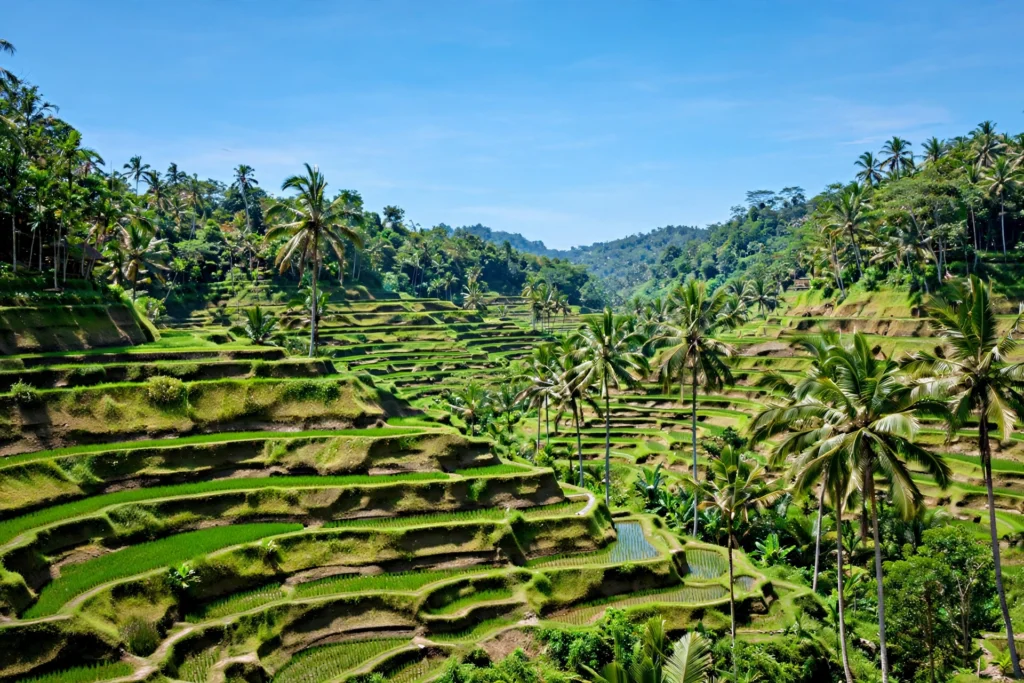
Ubud is the reason the two-base rule works. It is not a beach town, and that is the point: after three or four days of surf and beach clubs, Ubud is a different Bali — cooler air, green valleys, temple bells in the morning, rice terraces that change colour with the light, and a pace that makes you slow down whether you planned to or not. It is the cultural heart of the island, the town where Balinese dance, painting, woodcarving and gamelan music are not tourist shows but living traditions, and it is the base from which the island’s best inland sights are all within an hour.
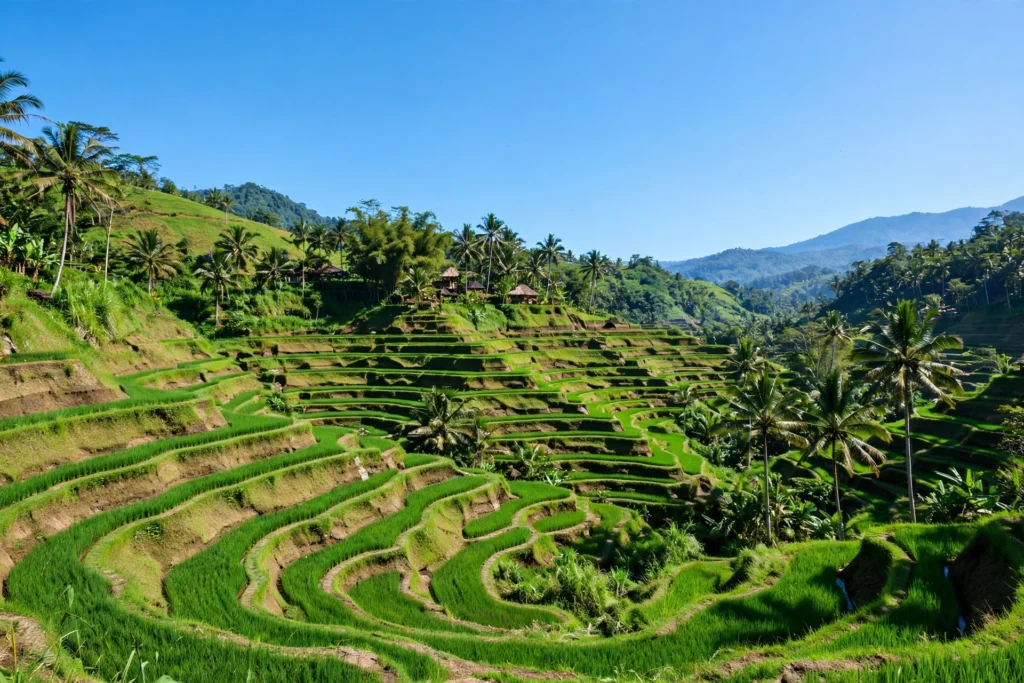
Start with the rice terraces, because they are the image of Bali most people carry home. The Tegallalang Rice Terrace, about 20 minutes north of central Ubud, is the famous one: layered green terraces dropping into a valley, coconut palms, and a viewpoint that fills with photographers at sunrise. Go early — before 8 a.m. — and you will have the terraces nearly to yourself, with mist in the valley and the light low and golden. Go at midday and you will share them with crowds, selfie swings and entrance fees at every viewpoint. The terraces are a working landscape, not a park: farmers tend the rice, irrigation channels run through the fields, and the small fees at the viewpoints go to the farming families who maintain them. Pay them gladly, stay on the paths, and do not walk through the rice itself. If Tegallalang feels too busy, the Jatiluwih Rice Terraces, about an hour west of Ubud, are the quieter, grander alternative — a UNESCO-listed landscape of vast, sweeping terraces that sees a fraction of the visitors, and the better choice if you have a driver for the day.
The temples around Ubud are the second reason to base here, and they reward the traveller who visits them properly rather than ticking them off. Tirta Empul, the holy spring temple about 30 minutes north of Ubud, is where Balinese Hindus come for ritual purification, bathing under the temple’s spouts in a ceremony that is open to visitors who follow the rules — a sarong, a respectful manner, and no photography of people mid-prayer. Goa Gajah, the Elephant Cave, is a small, atmospheric site with a carved cave mouth, a bathing pool and a quiet jungle walk behind it. The Saraswati Temple, in the centre of Ubud, is the most accessible of all: a lotus pond, carved stone, and a dance performance in the evening that is worth booking ahead. And Gunung Kawi, a little further north, is the most impressive — ten massive shrines carved directly into a cliff face in a river valley, reached by a long staircase down through the rice fields, and one of the most beautiful places on the island. Visit one or two temples well rather than five badly, go early, and hire a local guide at the temple gate — they explain what you are looking at, which is the difference between seeing a temple and understanding one.
Temple etiquette is not optional, and it is simple. Wear a sarong and a sash — they are provided or rented at every temple entrance, and you should wear them even if you are only visiting as a tourist. Cover your shoulders and your knees. Remove your shoes where asked. Do not point your feet at shrines or at people praying. Do not climb on temple structures or sit on offering platforms. Women who are menstruating are traditionally asked not to enter temples — this is a religious rule, not a tourist regulation, and it is worth knowing before you go so it does not catch you by surprise. Never step over or kick the small palm-leaf offerings, called canang sari, that you will see on pavements, doorsteps and dashboards all over Bali: they are daily offerings to the gods, they are everywhere, and stepping on one is the fastest way to cause offence without meaning to. And at any temple, ask before photographing people at prayer — a smile and a gesture is usually enough, and a refusal should be accepted gracefully.
Ubud town itself deserves a slow day. The central streets — Monkey Forest Road, Hanoman Street, Goutama Street — are lined with cafés, craft shops, galleries and spas, and the Ubud Art Market is the place to buy textiles, carvings and jewellery, with bargaining expected and good humour essential. The Sacred Monkey Forest Sanctuary, at the southern end of Monkey Forest Road, is a jungle temple complex inhabited by hundreds of long-tailed macaques: it is genuinely atmospheric, and it is also the place where most visitors lose something to a monkey. Keep your sunglasses, phone and snacks inside your bag, do not feed the monkeys, do not make eye contact, and do not carry a plastic bag — the monkeys associate plastic bags with food and will take them. The Campuhan Ridge Walk, a gentle ridge path starting near the centre of town, is the best free walk in Ubud: a paved path along a grassy ridge with views over the valleys, best done early in the morning or late in the afternoon, when the light is good and the heat is down.
Where to stay in Ubud
Stay in central Ubud if you want to walk to restaurants, the market and the Monkey Forest, and do not mind the traffic on the main streets. Stay on the outskirts — in Penestanan, Nyuh Bojog or the Sayan valley — if you want a villa with a jungle or rice-field view, a private pool, and quiet nights, and you are happy to take a short ride into town for dinner. The outskirts are where the best value is: a private-pool villa in the rice fields outside Ubud can cost less than a standard hotel room in Seminyak, especially in the wet season. Two or three nights is the minimum for Ubud; four is better, because it gives you a full day for the terraces and temples, a full day for the town and the ridge walk, and a slow morning before you move on.
Uluwatu and the Bukit Peninsula: Cliffs, Surf and the Kecak Dance
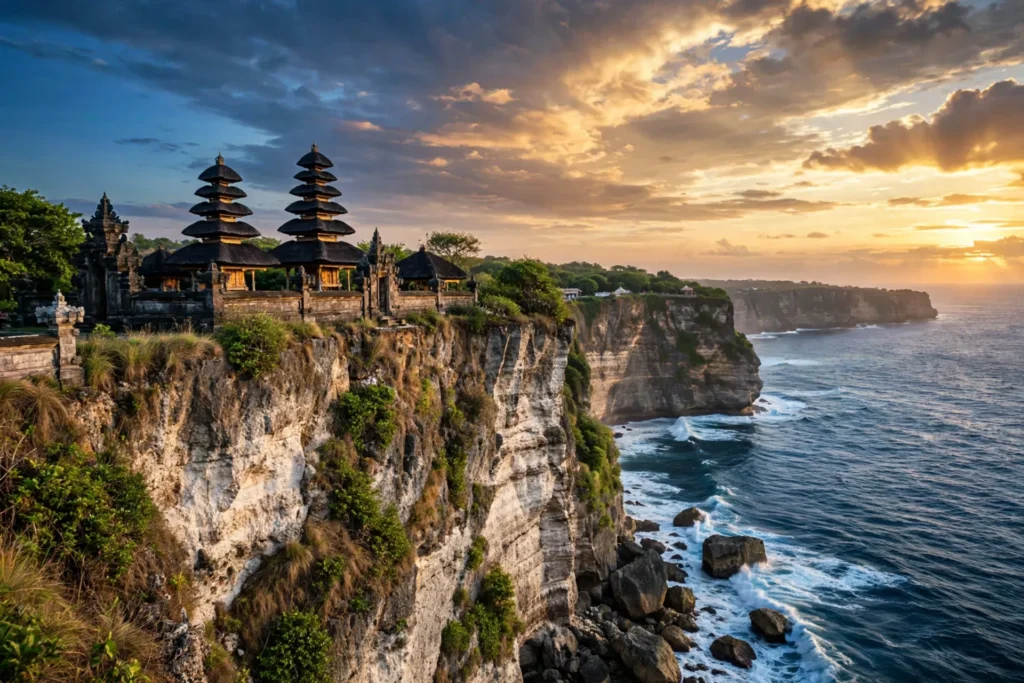
The Bukit Peninsula is the limestone thumb that sticks out of Bali’s south, and it is the most dramatic landscape on the island. The cliffs rise 70 metres above the Indian Ocean, the surf breaks on reefs below, and the temples, beaches and viewpoints are strung along clifftop roads that feel a world away from the flat beach towns to the north. It works as a day trip from any south coast base, and it works as a base in its own right for travellers who want cliffs and surf rather than beach clubs. Either way, it deserves a full day, not a rushed afternoon.
Uluwatu Temple — Pura Luhur Uluwatu — is the reason most people come to the Bukit, and it earns its reputation. The temple sits on the very edge of a cliff, 70 metres above the sea, with views along the coast in both directions and a forest of long-tailed macaques in the grounds behind it. Go in the late afternoon, walk the clifftop path as the light turns gold, and stay for the Kecak dance at sunset. The temple entry for foreign adults is about IDR 60,000, checked in October 2026, and the Kecak dance is a separate ticket: IDR 150,000 for adults and IDR 75,000 for children aged 2 to 9, for the daily performance from 6 p.m. to 7 p.m., with the gate opening at 4 p.m. The dance itself is extraordinary — a chorus of bare-chested men chanting “cak-cak-cak” in a circle, telling the story of the Ramayana, with fire and a sunset behind them — and it is also popular enough to sell out, so arrive by 4.30 p.m. to buy tickets and find a seat, and bring cash, because the booth is generally cash-only and the dance ticket does not include the temple entry or the parking. Keep a firm grip on your belongings in the temple grounds: the macaques here are famous for snatching sunglasses, hats and phones, and the temple staff will retrieve them for a small fee and a piece of fruit.
The beaches of the Bukit are the island’s best-kept secret and its worst-kept one at the same time. Padang Padang is the famous one — a small, perfect cove reached through a gap in the rocks, with turquoise water and a surf break that hosts international competitions. Bingin is the quieter, prettier one: a cliffside village of small guesthouses and warungs reached by a long staircase, with a reef break for experienced surfers and rock pools at low tide. Balangan is the long, empty one: a wide beach with a viewpoint above it that is one of the best sunset spots on the island, and almost no development at all. And Melasti Beach, at the southern tip, is the newest: a wide, white-sand beach with a dramatic cliff road down to it, popular with local families at weekends and increasingly with visitors. What the Bukit beaches share is access: almost all of them are reached by steep stairs, and almost none of them is safe for weak swimmers. The surf is powerful, the currents are strong, and the reef is shallow. Swim only where the water is calm and other people are swimming, and never swim alone at a beach you do not know.
Tanah Lot, on the west coast north of the Bukit, belongs in this section because it is the sunset temple most first-timers visit, and it is the one most often misunderstood. The temple sits on a rock in the sea, cut off from the shore at high tide, and at sunset the silhouette is one of the most photographed scenes in Indonesia. What the photographs do not show is the crowd: Tanah Lot is the busiest temple on the island at sunset, with tour buses, market stalls and a long walk from the car park. It is worth visiting once, and the best way to do it is to arrive in the late afternoon, walk the clifftop path, watch the sun go down, and leave before the car park empties.
A Bukit day, done properly
A good Bukit day starts late and ends late, because the Bukit is at its best in the afternoon light. Start with a slow morning at your base — a beach club, a surf lesson, a long breakfast — then drive to the Bukit in the early afternoon. Visit Padang Padang or Bingin for a swim and a late lunch at a clifftop warung, drive to Balangan viewpoint for the golden hour, then reach Uluwatu Temple by 4 p.m., buy your Kecak tickets, walk the clifftop path, and watch the dance as the sun sets into the ocean. Eat dinner in Jimbaran afterwards, at one of the seafood restaurants on the beach, where the catch is grilled over coconut husks and eaten with your feet in the sand. That is a full day, and it is the best single day on the south coast. If you are basing on the Bukit itself, the same day works in reverse: beach in the morning, temple in the evening, and no long drive home in the dark.
Nusa Penida: Day Trip or Overnight? How to Decide
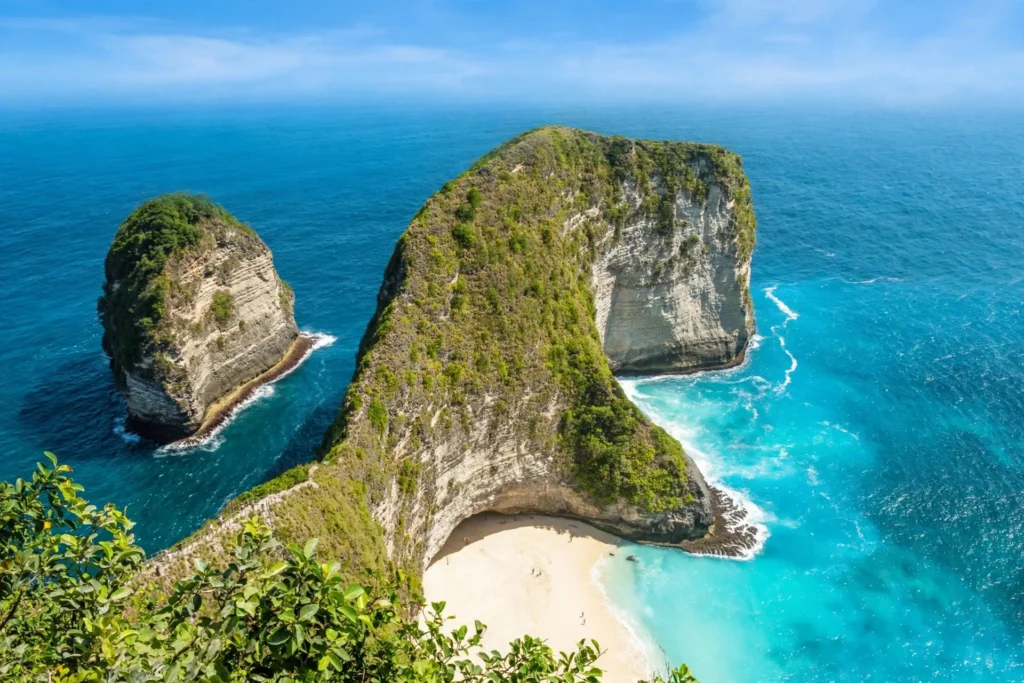
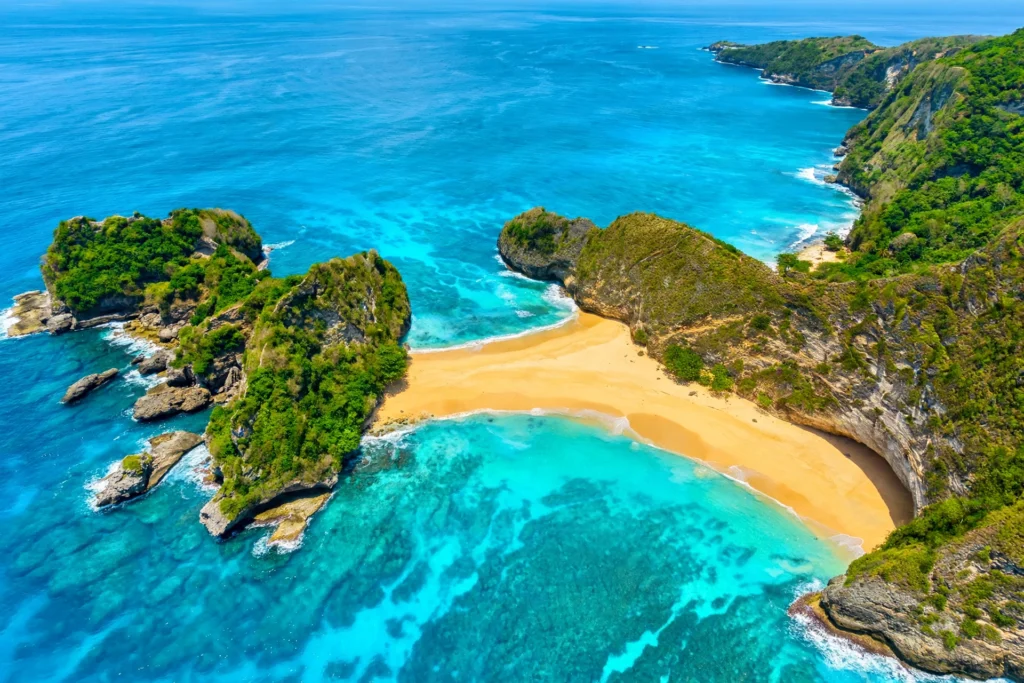
Nusa Penida is the island you can see from Sanur on a clear day, and it is the single most photographed place in Bali — Kelingking Beach, the cliff viewpoint that looks like a dinosaur’s head above a turquoise cove, is the image that fills every Bali feed. It is also the place most first-timers get wrong, because they treat it as a casual day trip and discover too late that it is a big, rugged, poorly roaded island where the famous sights are hours apart from each other. The decision that matters is not whether to go. It is whether to go for a day or stay overnight, and the honest answer is that it depends on your trip length and your tolerance for long drives on bad roads.
A day trip works, and it is what most visitors do. The fast boat from Sanur takes about 30 to 45 minutes, and the standard day-trip route covers the west coast: Kelingking Beach viewpoint, Broken Beach and Angel’s Billabong, and Crystal Bay for a swim and a late lunch. That is a full day — an early boat out, a long drive between sights on rough roads, and a late boat back — and it gives you the photographs and the views that make Penida famous. What it does not give you is the east coast: Diamond Beach, Atuh Beach and the Thousand Island viewpoint, which are a separate long drive in the opposite direction, and which almost no day trip reaches. It also does not give you a relaxed pace. The roads on Penida are the worst on any Bali itinerary — narrow, steep, potholed, and shared with trucks — and a day trip means four to five hours in a car on those roads, which is tiring in the heat. If you do a day trip, book the earliest boat, hire a driver on the island rather than trying to ride a scooter, and accept that you will see the west coast well and the east coast not at all.
An overnight stay changes the island completely. With two days, you can do the west coast on day one, sleep on the island, and do the east coast on day two — Diamond Beach and Atuh Beach in the morning light, the Thousand Island viewpoint, and a snorkelling trip to Manta Point, where manta rays gather and where the boat trip is the best snorkelling in the Bali area. You also get the island after the day-trippers leave, when the viewpoints empty and the sunsets belong to the handful of people who stayed. The accommodation is simple — small hotels and guesthouses, mostly around Toya Pakeh and Crystal Bay — and the restaurants are basic, but the trade is worth it if you have seven days or more on Bali. If your trip is five days or shorter, the overnight is hard to justify: it costs you a day of Bali for a day of Penida, and the two-base route gives you more for the same time.
The boat is the part of the trip that needs the most care. Fast boats from Sanur to Nusa Penida run throughout the day, take 30 to 45 minutes, and cost roughly IDR 150,000 to IDR 250,000 one way, with the return usually booked as a pair — check the live price when you book, because fares vary by operator and season, and book through a reputable operator or your hotel rather than a tout on the beach. The sea between Bali and Penida can be rough, especially in the wet season from November to March, and crossings are sometimes cancelled or delayed when the swell is up. If you are prone to seasickness, take medication before you board, sit near the back of the boat, and do not plan a tight connection on the other side. If the crossing is cancelled, do not argue with the operator — a cancelled crossing is a safety decision, and the island will still be there tomorrow. Nusa Lembongan, Penida’s smaller, gentler neighbour, is the alternative for travellers who want an island day without Penida’s rough roads: it is 30 minutes from Sanur, it has calm lagoons, mangrove forests and a famous Devil’s Tear viewpoint, and it can be explored by scooter or on foot at a much easier pace.
Nusa Penida: day trip vs overnight
| Day trip | Overnight (2 days) | |
|---|---|---|
| What you see | West coast: Kelingking, Broken Beach, Angel’s Billabong, Crystal Bay | West coast day one, east coast day two: Diamond Beach, Atuh Beach, Thousand Island viewpoint |
| Boat | Early boat out, late boat back from Sanur | Same boats, but no rush to catch the last one |
| Driving | 4–5 hours on rough roads in one day | Split across two days, far less tiring |
| Snorkelling | Usually skipped for time | Manta Point trip possible on day two |
| Best for | Trips of 5–7 days, first-timers short on time | Trips of 7+ days, photographers, snorkellers |
| Downside | Rushed, no east coast, long day | Costs a day of Bali, simple accommodation |
East and North Bali: Amed, Sidemen, Munduk and Lovina for a Second Trip

The east and the north are the Bali that most first-timers never see, and that is a shame, because they hold the island’s quietest and most beautiful corners. They are also the reason this guide keeps them in a separate section rather than folding them into the classic route: they are far from the south coast and from Ubud, the drives are long, and they reward travellers who have time, not travellers who are trying to squeeze them into a week. If your trip is ten days or longer, add a night or two here. If it is shorter, save them for a second trip — they are a better reason to come back than a reason to rush.
Amed, on the far east coast, is the island’s best diving and snorkelling base, and the most laid-back town on the island. It is a string of small fishing villages along a black-sand coast, with Mount Agung rising behind it, and it has the best shore diving in Bali: coral gardens a few metres from the beach, the USAT Liberty wreck at nearby Tulamben, and a slow, village pace that feels a world away from Seminyak. The beach is dark volcanic sand, not white, and the town is quiet at night — a handful of warungs, a few dive shops, and early mornings. Amed suits divers, snorkellers, and travellers who want the Bali that existed before the beach clubs. It does not suit anyone looking for nightlife, shopping or a resort, and the drive from Ubud takes two to two and three-quarter hours, which is why it works as an overnight, not a day trip.
Sidemen, in the east’s interior, is the valley the guidebooks call the “real Bali” and the one place where the phrase is almost justified. It is a long, green valley of rice terraces, rivers and small villages, overlooked by Mount Agung, with guesthouses and small hotels that sit in the middle of the fields and a pace so slow that the main activity is walking through the valley and watching the light change. There is little to “do” in Sidemen, and that is the point: a day here is a walk through the terraces, a visit to a weaving village, a swim in a river, and a long dinner with a view of the volcano. Sidemen suits travellers who have already seen Ubud and want somewhere quieter and greener, and couples who want a romantic valley stay. It is a good overnight from Ubud, and a good first stop on the way to Amed, which is about an hour further east.
Munduk and Lovina, in the north, are the mountain and coast pair that most visitors reach last, if they reach them at all. Munduk is a cool mountain village of waterfalls, clove plantations and misty viewpoints, with the twin lakes of Buyan and Tamblingan nearby and some of the best waterfall walks on the island — Gitgit, Sekumpul and Aling Aling are all within an hour’s drive. Lovina, on the north coast, is a quiet beach town famous for its early-morning dolphin-watching boats, its black-sand beaches, and its hot springs at Banjar. The north is cooler, quieter and cheaper than the south, and it feels like a different island: fewer tourists, more local life, and a landscape of mountains and lakes rather than beaches and clubs. It suits second trips, slow travellers, and anyone with ten days or more. It does not suit a first trip of a week, because the drive from Ubud is two to three hours each way, and a day trip to the north means six hours in a car for two hours of sightseeing.
East and north at a glance
| Place | What it is | Drive from Ubud | Best for |
|---|---|---|---|
| Amed | Black-sand fishing villages, diving, Mount Agung views | 2–2h45 | Diving, snorkelling, slow coastal days |
| Sidemen | Green rice valley, weaving villages, volcano views | About 1h15 | Quiet valley stays, walking, romance |
| Munduk | Mountain village, waterfalls, twin lakes, clove farms | About 2h | Waterfalls, cool air, mountain walks |
| Lovina | Quiet north-coast town, dolphin boats, hot springs | About 2h30–3h | Dolphin watching, black-sand beaches, slow days |
| Tulamben | Shore diving, USAT Liberty wreck | About 2h30 | Divers, wreck diving |
The practical rule for the east and north is simple: stay overnight, or do not go. A day trip to Amed from Ubud is five hours of driving for two hours at the beach, and a day trip to Lovina is worse. One night in Amed or Sidemen, or two nights split between Munduk and Lovina, turns a punishing drive into a proper part of the trip.
What to Eat and Drink in Bali: Food, Coffee and the Arak Warning
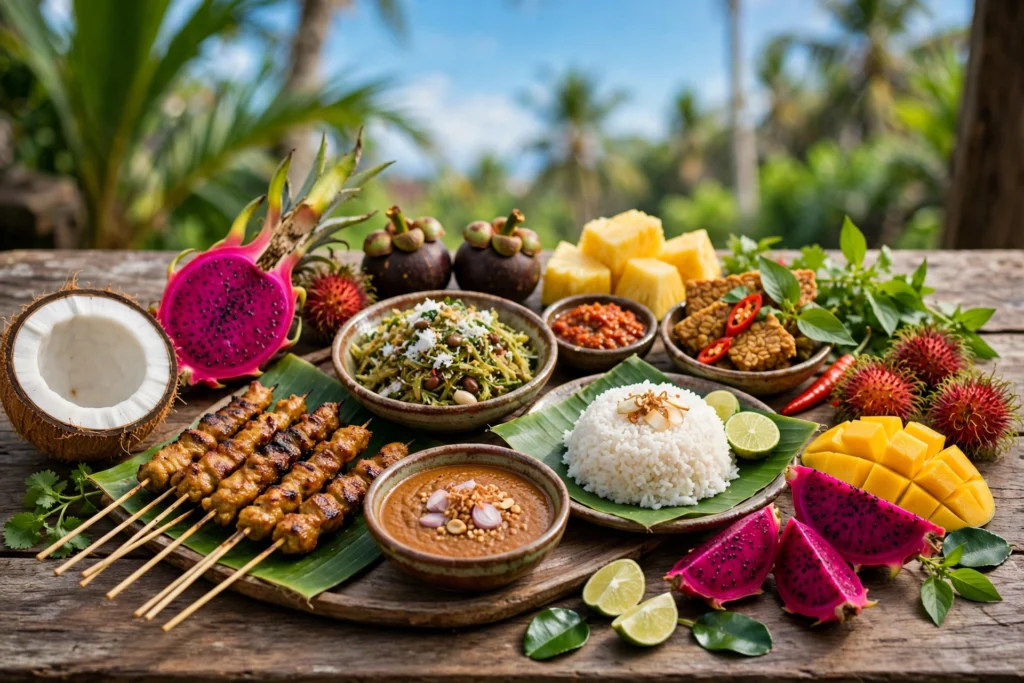
Bali is one of the best-value food destinations in Southeast Asia, and the range is wider than most visitors expect. At one end is the warung — the small, family-run eatery where a plate of nasi goreng or mie goreng costs IDR 25,000 to IDR 50,000 (about $2 to $3) and is cooked to order in front of you. At the other end are the restaurants of Seminyak and Ubud, where a three-course dinner with a cocktail costs IDR 300,000 to IDR 600,000 (about $18 to $36) and the cooking is as good as anywhere in Asia. Between them is everything: beach cafés, jungle restaurants, night markets, coffee shops, juice bars and the island’s famous brunch scene. The mistake is to eat only at one end — only warungs, or only hotel restaurants — because the food that makes Bali memorable is spread across the whole range.
Start with the dishes that define Balinese food. Nasi campur is the essential plate: rice with a selection of small dishes — shredded chicken, spiced vegetables, tempeh, egg and sambal — and every warung makes its own version. Babi guling is the ceremonial roast pork, served with rice, crackling and spicy sausage, and the best place to try it is a specialist warung in Ubud or Gianyar, where it is cooked in the morning and sold until it runs out. Bebek betutu is the slow-cooked duck, wrapped in banana leaves and steamed for hours, and it needs to be ordered ahead at most restaurants. Satay lilit is the Balinese satay: minced fish or chicken wrapped around a lemongrass stalk and grilled over coconut husks. And lawar, the mixed salad of vegetables, coconut and minced meat, is the dish that appears at every ceremony and every family meal. For breakfast, the island does both: the Indonesian breakfast of nasi goreng and a fried egg, and the café breakfast of smoothie bowls, avocado toast and Balinese coffee that Canggu made famous. For a drink, try es kelapa muda — young coconut water served in the shell — and the island’s excellent coffee, grown in the Kintamani highlands and served everywhere from warungs to speciality roasters in Ubud.
The arak warning is the serious part of this section, and it needs to be stated plainly. Arak is the local distilled spirit, traditionally made from palm sap or rice, and it is served in cocktails and sold in bottles across the island. The problem is methanol: illegally produced or adulterated arak can contain methanol, a toxic alcohol that causes blindness and death, and tourists have died in Bali after drinking it. The State Department’s Indonesia page does not name arak specifically, but the risk is well documented by Australian and Indonesian health authorities, and it is the single most dangerous thing you can drink on the island. The rules are simple and absolute: drink only in licensed bars, restaurants and hotels; never buy arak from a street vendor, a market stall or an unlabelled bottle; never accept a free shot from a stranger; and if a cocktail tastes unusually harsh, chemical or wrong, stop drinking it and do not finish it. The same caution applies to any unlabelled local spirit anywhere in Indonesia. This is not a reason to avoid drinking in Bali — the licensed bars and restaurants are safe, and the cocktails are good — but it is a reason to be careful about where your drink comes from, and to treat a cheap, unlabelled bottle as a health risk rather than a bargain.
Food and drink at a glance
| Dish or drink | What it is | Where to try it | Rough price |
|---|---|---|---|
| Nasi campur | Rice with a selection of small dishes | Any warung | IDR 25,000–50,000 |
| Nasi goreng / mie goreng | Fried rice / fried noodles | Any warung or café | IDR 25,000–60,000 |
| Babi guling | Ceremonial roast pork with rice and crackling | Specialist warungs, Ubud and Gianyar | IDR 50,000–100,000 |
| Bebek betutu | Slow-cooked duck in banana leaves | Ubud restaurants, order ahead | IDR 100,000–200,000 |
| Satay lilit | Minced fish or chicken on lemongrass | Warungs and restaurants | IDR 30,000–60,000 |
| Balinese coffee | Kintamani highland coffee | Cafés in Ubud and Canggu | IDR 25,000–50,000 |
| Es kelapa muda | Young coconut water in the shell | Beach vendors and warungs | IDR 15,000–30,000 |
| Jimbaran seafood grill | Grilled fish and prawns on the beach | Jimbaran Bay restaurants | IDR 150,000–300,000 per person |
The 3-Day, 5-Day, 7-Day and 10-Day Bali Itineraries
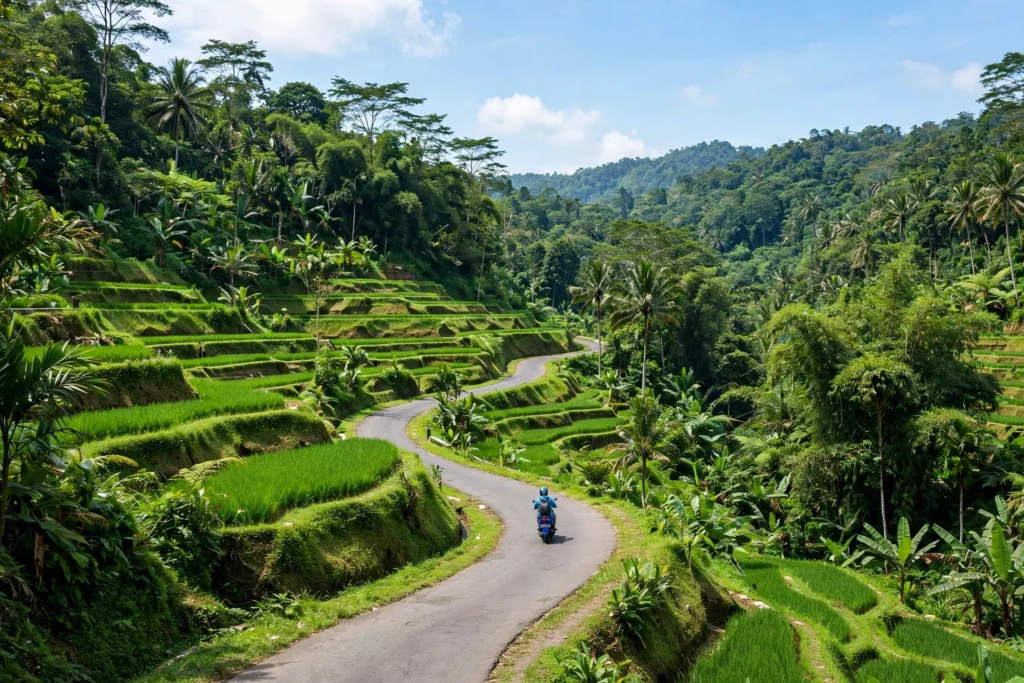
All four itineraries below are built from the same two bases, so they are versions of one route rather than four different trips. The difference between them is not where you go but how much time you have at each stop, and the extra days are spent slowing down, not adding more places. That is deliberate: the best Bali trips are the ones with a spare morning, a long lunch and an afternoon with nothing planned, and the itineraries below protect that time rather than filling it.
The 3-day trip is a single-base trip, and the base should be the south coast. Day one is arrival and recovery: land at Denpasar, check in, walk to the beach, eat well and sleep. Day two is the Bukit: a late morning at the beach or a surf lesson, an afternoon at Padang Padang or Bingin, Uluwatu Temple and the Kecak dance at sunset, and dinner in Jimbaran. Day three is a slow morning — a beach club, a spa, a long breakfast — and a flight home. That is a good long weekend, and it is honest about what three days can hold. What it cannot hold is Ubud, and travellers who try to add Ubud to a three-day trip spend a day of it in a car. Save Ubud for a longer trip.
The 5-day trip is the first two-base trip, and it is the minimum for seeing both Balis. Days one and two are the south coast: arrival and recovery on day one, the Bukit and the Kecak dance on day two. Day three is the move: drive to Ubud in the morning, stop at the Tegallalang Rice Terrace on the way, check in, and spend the afternoon walking the Campuhan Ridge and exploring the town. Day four is Ubud’s big day: Tirta Empul in the morning, the Monkey Forest and the art market in the afternoon, and a dance performance in the evening. Day five is a slow morning in Ubud — a spa, a long breakfast, a last walk through the terraces — and the drive back to the airport. Five days is tight, but it works, because the two bases are doing the work and no day is wasted on a long drive to somewhere you are not sleeping.
The 7-day trip is the recommended length, and it is the itinerary this guide is built around. Days one to three are the south coast: arrival and recovery, the Bukit and the Kecak dance, and a full beach day — a surf lesson, a beach club, a spa, and a long dinner in Seminyak. Day four is the move to Ubud, via Tegallalang. Days five and six are Ubud: the temples and the Monkey Forest on day five, and a day trip on day six — either the Jatiluwih Rice Terraces and a waterfall in the west, or a sunrise hike and a coffee plantation in the Kintamani highlands. Day seven is a slow morning in Ubud and the drive to the airport, or, if your flight is late, a final afternoon on the south coast. Seven days gives you the two bases, the Bukit, the temples, the terraces and a day trip, with a spare morning built in. It is the trip most first-timers should book.
The 10-day trip adds the islands and the east, and it is the trip for travellers who want Bali in full. Days one to three are the south coast, as in the 7-day plan. Day four is the move to Ubud. Days five and six are Ubud and the day trip. Days seven and eight are Nusa Penida: an early boat from Sanur on day seven, the west coast that day, an overnight on the island, and the east coast and a snorkelling trip on day eight. Days nine and ten are the east: a night in Sidemen or Amed, a valley walk or a morning dive, and the drive back to the airport.
The itineraries at a glance
| Day | 3-day trip | 5-day trip | 7-day trip | 10-day trip |
|---|---|---|---|---|
| 1 | Arrive, south coast, beach | Arrive, south coast, beach | Arrive, south coast, beach | Arrive, south coast, beach |
| 2 | Bukit, Uluwatu, Kecak, Jimbaran | Bukit, Uluwatu, Kecak, Jimbaran | Bukit, Uluwatu, Kecak, Jimbaran | Bukit, Uluwatu, Kecak, Jimbaran |
| 3 | Beach club, spa, fly home | Move to Ubud via Tegallalang | Beach day, surf, Seminyak dinner | Beach day, surf, Seminyak dinner |
| 4 | — | Tirta Empul, Monkey Forest, market | Move to Ubud via Tegallalang | Move to Ubud via Tegallalang |
| 5 | — | Slow morning, fly home | Tirta Empul, Monkey Forest, market | Tirta Empul, Monkey Forest, market |
| 6 | — | — | Day trip: Jatiluwih or Kintamani | Day trip: Jatiluwih or Kintamani |
| 7 | — | — | Slow morning, fly home | Boat to Nusa Penida, west coast |
| 8 | — | — | — | Penida east coast, snorkelling, return |
| 9 | — | — | — | Sidemen or Amed, valley walk or dive |
| 10 | — | — | — | Slow morning, fly home |
How Much Does a Bali Trip Cost? Budgets in Rupiah and Dollars
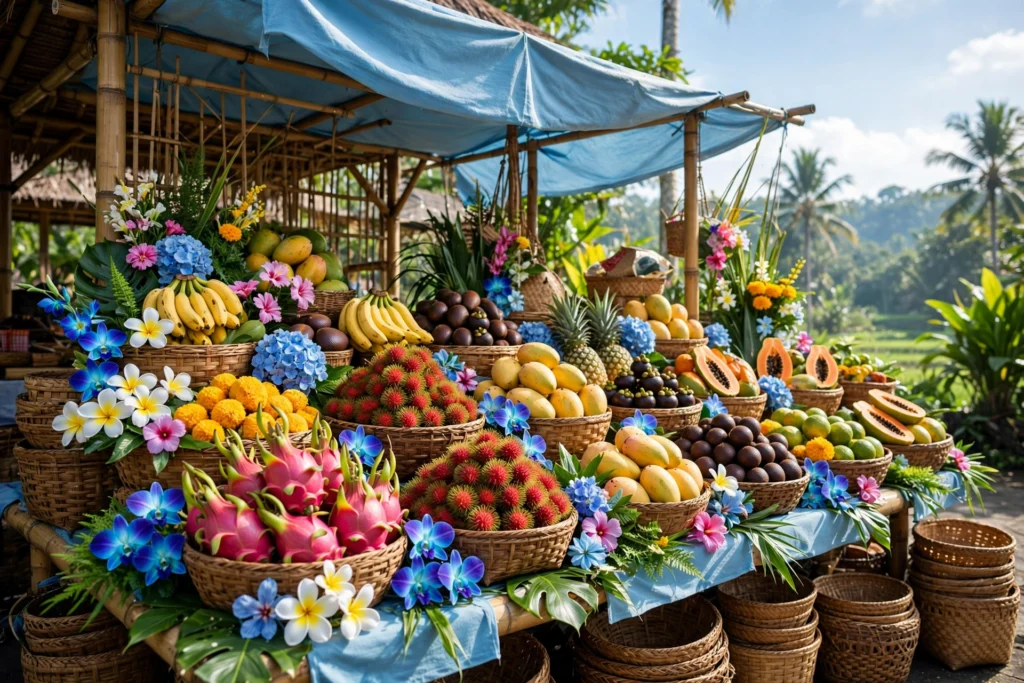
Bali is one of the best-value destinations in Asia for American travellers, and it is also one of the easiest to overspend in, because the range between a warung meal and a beach club day is enormous. The honest way to present costs is as ranges, checked in November 2026, with the warning that a figure you read today may already be stale by the time you travel — and with the reminder that the rupiah figures are the ones you will actually pay. The dollar equivalents below use a rough rate of about IDR 16,500 to the dollar, and they will move with the exchange rate. Use the ranges for planning, and check the live price before you pay for anything expensive.
The currency is the Indonesian rupiah, abbreviated IDR or Rp. Cards — Visa and Mastercard — are accepted in hotels, larger restaurants, beach clubs and malls, and contactless payment is common in the tourist areas. But cash still matters: warungs, markets, small guesthouses, temple donations, drivers and tips are often cash only, and some smaller establishments have difficulty with foreign cards, so carry rupiah as well as cards. ATMs are everywhere in the tourist areas and accept US-issued bank cards, though they may charge fees — use ATMs inside banks and malls during opening hours, decline the machine’s offer to convert the withdrawal into dollars, and withdraw larger amounts less often. Keep small notes for markets, tips and temple donations, because large notes are hard to change in small shops. And note the State Department’s figure: the maximum cash you can carry in or out of Indonesia is IDR 100,000,000, about $5,900, so do not arrive with a large stack of cash.
Daily budgets
A budget traveller — a guesthouse or hostel, warung meals, a scooter or local transport, and free or cheap sights — can manage on roughly $40 to $70 a day, and the lower end of that range is realistic outside Seminyak and Ubud’s centre. A mid-range traveller — a comfortable hotel or a private-pool villa in the shoulder season, sit-down meals, a private driver on the sightseeing days and a beach club afternoon — should plan on roughly $90 to $160 a day. A comfortable trip with boutique villas, good restaurants, a spa treatment and a private driver most days runs higher, and the villa is the single biggest cost — a private-pool villa in the dry season can cost as much as a week of warung meals. The single biggest saving on any Bali trip is the season: a villa in February can cost half what it costs in August, and a hotel in the wet season is often a third cheaper than the same room in July. For more on picking cheap months in general, our guide to the cheapest time to travel explains how shoulder seasons work across destinations.
A 7-day trip, costed
| Item | Budget | Mid-range | Notes |
|---|---|---|---|
| International flights (US–Denpasar) | $800–$1,200 | $1,000–$1,800 | Return, booked weeks ahead; West Coast cheaper |
| Visa on arrival | $30 | $30 | IDR 500,000 per person, checked November 2026 |
| Tourist levy | $9 | $9 | IDR 150,000 per person, once per trip |
| Hotels (6 nights) | $180–$420 | $540–$1,200 | Guesthouses vs hotels and private-pool villas |
| Food and drink | $150–$300 | $300–$600 | Warungs vs sit-down restaurants and beach clubs |
| Transport on the ground | $60–$150 | $150–$350 | Scooter hire vs private driver on 3–4 days |
| Sites and activities | $60–$150 | $150–$400 | Temples, Kecak dance, boat to Nusa Penida, spa |
| Total, excluding international flights | $489–$1,059 | $1,329–$2,599 | Per person, 7 days |
These are planning ranges, not quotes. The international flight is the largest single cost and the most variable: fares from the US West Coast to Denpasar are often in the $800 to $1,200 range when booked a few weeks ahead, and higher from the East Coast and in peak season, because there are no direct flights from the US mainland and every route connects through Taipei, Singapore, Hong Kong, Tokyo or the Middle East. The villa is the second-biggest variable, and it is also the place where the best value is: a private-pool villa outside Ubud or in the Bukit can cost less per night than a standard hotel room in Seminyak, especially if you book for four nights or more. And the activities are the costs worth splurging on: the Kecak dance, a day on Nusa Penida and a proper spa treatment are the experiences people remember longest, and they are cheap by American standards.
Money tips that save real money
Pay in rupiah where you can, and let your bank do the conversion rather than the merchant or the ATM — the machine’s rate is almost always worse. Keep a small emergency reserve of cash separate from your day money, as our travel safety tips guide recommends, so that one lost wallet cannot strand you. Tipping is appreciated but not obligatory in Bali: 10 per cent in restaurants if service is not included, small tips for drivers and guides, and a little extra for hotel staff.
Getting Around Bali: Drivers, Scooters and the Honest Drive Times
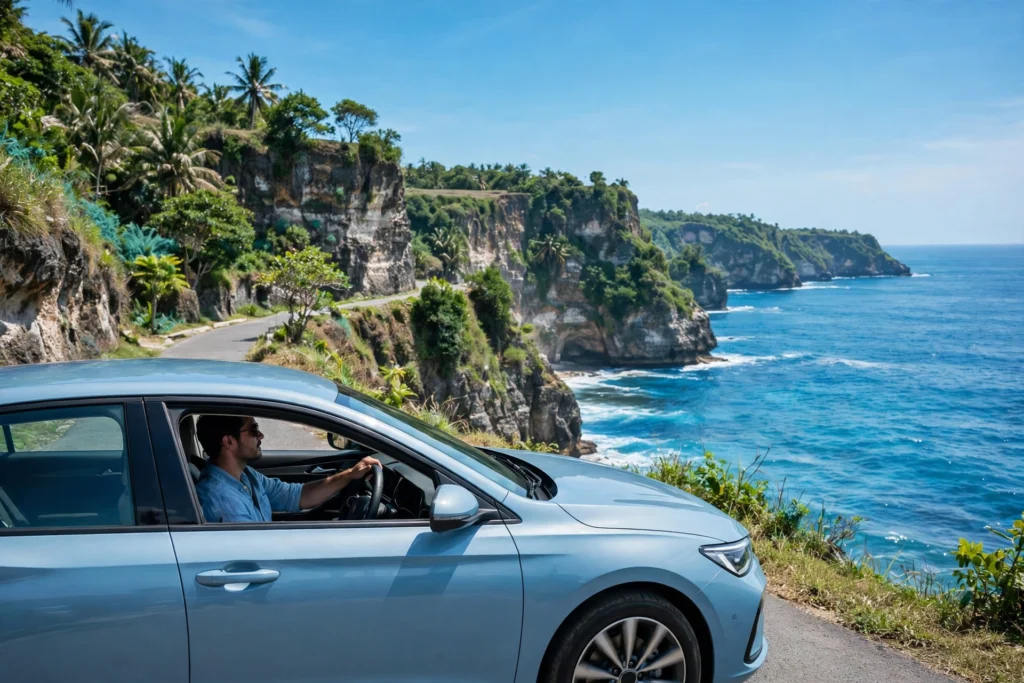
Getting around Bali is easy once you accept the one rule this guide keeps repeating: the map lies about time. A drive the map calls 45 minutes is routinely 90 minutes in traffic, and a drive the map calls two hours can be three. The roads are narrow, winding and shared with scooters, trucks, dogs and ceremony processions, and the traffic in Canggu, Seminyak and Ubud is heavy for most of the day. The table below gives real times — the times travellers actually experience, with traffic — not map times, and it is the table to use when you plan your days.
The private driver is the best way to get around Bali for most visitors, and it is also one of the best bargains on the island. A driver with a comfortable, air-conditioned car for a full day — typically 8 to 10 hours — costs roughly IDR 500,000 to IDR 700,000, about $30 to $45, and that covers the car, the fuel and the driver’s local knowledge, which is worth as much as the driving. A good driver knows which temple to visit first, which road is closed for a ceremony, where to eat lunch, and how long the drive really takes. Book through your hotel, a reputable local company, or a driver recommended by other travellers, agree the price and the itinerary before you set off, and pay at the end of the day. For short trips — an airport transfer, a ride to dinner, a trip to the next town — use a ride-hailing app such as Gojek or Grab, which work well in the south coast and Ubud and give you a fixed price before you book. Taxis exist but are less reliable on price, and unmarked cars should be avoided. For more on planning transport costs in general, our guide to how to find cheap flights covers the flight side of the journey.
The scooter is the decision that needs the most honesty in this whole guide. Scooters are cheap — roughly IDR 75,000 to IDR 100,000 a day, about $5 to $6 — they are everywhere, and they are the way most locals get around. They are also the way most tourists get hurt. Scooter crashes injure thousands of visitors in Bali every year, and the injuries are often serious: broken bones, head injuries, and long hospital stays. The reasons are simple: the roads are narrow and unpredictable, the traffic is dense, the driving is on the left, and a scooter offers no protection at all. If you have never ridden a scooter or a motorbike, Bali is not the place to learn. If you do ride, the minimum is a proper licence — an international driving permit with a motorcycle endorsement, which Indonesian law requires and which your travel insurance will ask for if you claim — a helmet that actually fits, no alcohol, daylight hours only, and a speed that matches the road, not the traffic around you. And check your travel insurance before you ride: many policies exclude scooter accidents entirely, or exclude them unless you hold the right licence, and a hospital stay in Bali without cover can cost thousands of dollars. For most visitors, the honest answer is to hire a driver for the sightseeing days and use ride-hailing for the short trips, and to leave the scooter to the travellers who already know how to ride one.
Honest drive times (with traffic, not map times)
| Route | Map time | Real time | Notes |
|---|---|---|---|
| Airport (DPS) to Seminyak | 25 min | 40–60 min | Worse in the evening rush |
| Airport (DPS) to Canggu | 35 min | 45 min–1h15 | Canggu’s lanes are the slowest on the island |
| Airport (DPS) to Uluwatu | 30 min | 45 min–1h | Quieter roads, but the last stretch is steep |
| Airport (DPS) to Ubud | 1h | 1h30–2h | Allow 2 hours for an evening arrival |
| Airport (DPS) to Sanur | 25 min | 30–45 min | The easiest airport transfer |
| Uluwatu to Ubud | 1h15 | 1h15–2h | The one big move of the trip |
| Ubud to Amed | 1h45 | 2h–2h45 | Winding mountain and coastal roads |
| Ubud to Sidemen | 1h | 1h15 | Easy drive, good road |
| Ubud to Munduk | 1h30 | 2h | Mountain road, slower in rain |
| Seminyak to Uluwatu | 45 min | 1h–1h30 | Heavy traffic through Kuta and Jimbaran |
| Sanur to Nusa Penida | 30–45 min by fast boat | 30–45 min | Sea conditions can delay or cancel crossings |
Transport at a glance
| Mode | Best for | Notes |
|---|---|---|
| Private driver | Sightseeing days, the move between bases | IDR 500,000–700,000 per day; book through hotel or a recommended driver |
| Ride-hailing (Gojek, Grab) | Short trips, airport transfers, dinner rides | Fixed price before booking; works best on the south coast and in Ubud |
| Scooter hire | Experienced riders only | IDR 75,000–100,000 per day; licence and insurance required; high injury risk |
| Fast boat | Nusa Penida, Nusa Lembongan | 30–45 min from Sanur; check the live price and the sea conditions |
| Walking | Inside Seminyak, Sanur, central Ubud | The best way to see a town; pavements are uneven, so watch your step |
| Domestic flight | Leaving Bali for another Indonesian island | Fly from Denpasar; Lombok is 25 minutes away |
Bali Practical Tips: Money, Packing, Etiquette and Health

The practical details are what turn a good Bali trip into a smooth one, and they are the details most guides leave to the end, when you have already stopped reading. Read this section before you pack, not after you land.
Money first. Bring a debit card and a credit card from different networks, and tell your bank you are travelling so a transaction in Bali does not trigger a fraud block. Withdraw rupiah from ATMs inside banks and malls, decline the machine’s currency conversion, and keep a mix of notes — small notes for warungs, markets and temple donations, larger notes for hotels and drivers. Exchange money only at licensed, reputable money changers with a clear rate board, and count the money in front of the cashier before you leave: the unlicensed changers who offer a rate far above the market are running a scam, usually by sleight of hand with the notes. Never change money on the street. Keep your passport number, your insurer’s 24-hour number and your bank’s lost-card number saved in your phone and on a piece of paper separate from your wallet.
Packing for Bali is light and specific. Pack light, breathable clothes, a sarong — which doubles as a temple cover-up, a beach towel and a blanket on a cold mountain morning — and a light rain jacket for the wet season, even in the dry season, because a tropical downpour can arrive in any month. Pack proper walking shoes for the rice terraces and the temples, reef-safe sunscreen, insect repellent for daytime mosquitoes, and a dry bag for boat trips and waterfall walks. Leave the formal clothes at home: Bali is casual everywhere, including the best restaurants, and a smart shirt and sandals are dressed up enough. If you plan to ride a scooter, pack a proper helmet of your own or hire one that fits — the free helmets at rental shops are often cracked, loose or decades old, and a helmet that does not fit is barely better than no helmet at all.
Etiquette is the section that matters most to the Balinese people you will meet, and it is mostly about respect for a deeply religious culture. Bali is a Hindu-majority island in a Muslim-majority country, and its religion is woven into daily life in a way that is visible everywhere: the offerings on the doorstep, the temple on every corner, the ceremonies that close roads and fill the streets. Dress modestly at temples — sarong and sash, shoulders and knees covered — and remove your shoes where asked. Do not touch people’s heads, including children’s, because the head is considered sacred. Use your right hand to give and receive things. Do not point with your index finger; use your thumb or an open hand instead. Do not step over or kick the canang sari offerings on the ground. Do not photograph people at prayer without asking. And be patient with ceremonies: if a road is closed for a procession, wait, watch, and enjoy it — it is not an inconvenience, it is the reason you came.
Health is the last practical piece, and it is mostly about water, sun and mosquitoes. Drink bottled water with an unbroken seal, and use it for brushing your teeth as well. Wear sunscreen and reapply it — the equatorial sun is strong even on a cloudy day, and sunburn is the most common health complaint on the island. Use insect repellent during the day as well as in the evening, because the mosquitoes that carry dengue bite in daylight. Eat where the food is freshly cooked and busy, wash your hands, and carry a basic medical kit: rehydration salts, painkillers, plasters, and any prescription medication you need, in its original packaging, with a copy of the prescription. And check the CDC’s travel health pages for Indonesia before you go, so your vaccinations are up to date. If you need medical care, the international-standard hospitals are in Denpasar and Kuta, and your insurer’s assistance line can direct you to the nearest one — save the number before you need it.
Frequently Asked Questions
Do US citizens need a visa for Bali?
Yes, in the form of a visa on arrival. US passport holders are eligible for the B1 visa on arrival, which costs IDR 500,000 (about $30), gives you 30 days from the day you land, and can be extended once for another 30 days. You can apply online before you fly as an e-VOA through evisa.imigrasi.go.id, or buy it at the counter on arrival at Denpasar airport. A fee rise was announced in August 2026 but had not taken effect as of early November 2026, so check the official portal for the current fee before you pay.
What is the Bali tourist levy and how do I pay it?
The tourist levy is a Bali provincial charge of IDR 150,000 per person (about $9), paid once per trip, and it is separate from the visa fee. Pay it cashless through the official Love Bali system at lovebali.baliprov.go.id, before you travel or on arrival at the payment counters at the airport and seaport, and keep the QR-code voucher that arrives by email on your phone. It has been in effect since 14 February 2024, and the rate is still IDR 150,000 as of November 2026.
Is Bali safe for US travellers?
The US State Department rates Indonesia at Level 2, Exercise Increased Caution, issued 9 July 2026, because of natural disasters, unrest and terrorism. Bali carries no separate, harsher rating, and the Level 4 warning applies only to Central Papua and Highland Papua, thousands of kilometres away on a different island. The risks that most often affect tourists in Bali are road accidents, rip currents and the strict drug laws — read the safety section of this guide, enrol in STEP, and buy travel insurance that covers medical care and evacuation.
How many days do you need in Bali?
Five days is the minimum for a good first trip — three days on the south coast and two in Ubud. Seven days is the recommended length, because it adds a full beach day, a day trip from Ubud, and a spare morning. Three days is enough for a single base on the south coast only. Ten days adds Nusa Penida and a night in the east, and longer than that is best spent slowing down rather than adding more places.
What is the best time to visit Bali?
April to June and September are the best months for most travellers — the dry season, green terraces, moderate crowds and reasonable prices. July and August have the best weather but the worst traffic and the highest prices. November to March is the wet season: cheaper and quieter, with afternoon downpours and rougher seas, and it suits flexible travellers who do not mind rearranging a day around the rain.
Where should I stay in Bali for the first time?
Pick two bases: the south coast first, then Ubud. On the south coast, Seminyak suits food and beach clubs, Canggu suits cafés and surf, Uluwatu suits cliffs and surf, Nusa Dua suits families and resort holidays, and Sanur suits a calm beach and the Nusa Penida boats. Ubud suits culture, rice terraces, temples and slow mornings. Read the base picker section before you book, because the five south-coast bases are very different places.
Should I rent a scooter in Bali?
Only if you already know how to ride one and hold the right licence — an international driving permit with a motorcycle endorsement. Scooter crashes injure thousands of visitors in Bali every year, and many travel insurance policies exclude scooter accidents or exclude them without the correct licence. For most visitors, a private driver for the sightseeing days and ride-hailing for short trips is safer, cheaper than a hospital stay, and more relaxing.
How much does the Uluwatu Kecak dance cost?
IDR 150,000 for adults and IDR 75,000 for children aged 2 to 9, for the daily performance from 6 p.m. to 7 p.m., with the gate opening at 4 p.m. The ticket is separate from the temple entry, which is about IDR 60,000 for foreign adults, and the dance booth is generally cash-only. Arrive by 4.30 p.m. to buy tickets and find a seat, because the performance sells out.
Is Nusa Penida a day trip or an overnight?
It depends on your trip length. A day trip from Sanur covers the west coast — Kelingking Beach, Broken Beach, Angel’s Billabong and Crystal Bay — and it is a long day on rough roads. An overnight lets you see the east coast as well — Diamond Beach, Atuh Beach and the Thousand Island viewpoint — and add a snorkelling trip to Manta Point. For trips of five to seven days, a day trip is the right call; for seven days or more, the overnight is worth it.
Can I drink the tap water in Bali?
No. Drink bottled water with an unbroken seal, and use it for brushing your teeth as well. Be careful with ice in small warungs if you are unsure of its source, eat where the food is freshly cooked and busy, and carry rehydration salts. Bali belly — travellers’ diarrhoea — is common and usually mild, but it can cost you two days of a short trip.
What should I wear at temples in Bali?
A sarong and a sash, which are provided or rented at every temple entrance, with your shoulders and knees covered. Remove your shoes where asked, do not point your feet at shrines or at people praying, do not climb on temple structures, and do not step over the small palm-leaf offerings on the ground. Women who are menstruating are traditionally asked not to enter temples, and it is worth knowing that before you go.
How much does a Bali trip cost?
Excluding international flights, a 7-day trip runs roughly $489 to $1,059 per person on a budget and $1,329 to $2,599 mid-range, with the villa, the season and the activities making the biggest difference. The visa is IDR 500,000, the tourist levy is IDR 150,000, a private driver is roughly IDR 500,000 to IDR 700,000 a day, and a warung meal is IDR 25,000 to IDR 50,000. Flights from the US are the largest single cost and the most variable.
Conclusion: Bali Rewards the Traveller Who Picks Two Bases and Slows Down
Bali is not a destination to rush, and the travellers who love it most are rarely the ones who saw the most places. They are the ones who gave the south coast three days instead of one, who moved to Ubud and stayed there, who watched the Kecak dance as the sun set into the ocean instead of ticking off a viewpoint, and who spent a slow morning in the rice terraces instead of driving to the next sight. The roads in this Bali travel guide are the reason: an island this small punishes hurry and rewards patience, and the two-base route works precisely because it does two things well instead of ten things badly.
Plan it the way the guide lays it out. Fly into Denpasar, pay the levy and file the arrival card before you travel, and get the e-VOA online so you skip the counter queue. Start on the south coast and finish in Ubud. Go in April, May, June or September if you can. Hire a driver for the sightseeing days and leave the scooter to the riders who already know how to ride one. Read the advisory, enrol in STEP, buy the insurance, and carry the passport that gets you in for 30 days. Eat at the warungs and the good restaurants, drink only in licensed places, dress properly at the temples, and keep a spare morning free for the weather. Do those things, and Bali gives you what few destinations can: a beach, a jungle, a temple and a volcano in a single week, and an island that makes you want to come back. The trip is worth the planning, and the planning is mostly done — now go and book it.
People also read:
- Thailand Travel Guide
- Singapore Travel Guide
- Vietnam Travel Guide
- Travel Safety Tips
- What Does Travel Insurance Cover?
- Cheapest Time to Travel

M. Adil is the founder and editor of SoloTravelPro. He writes practical, research-based travel guides that help travellers plan with confidence — from first-time city breaks to national parks and island escapes. Every guide is built on official sources, current prices and honest, usable advice, so readers can plan smarter and travel better.

Other Articles
Vietnam Travel Guide: North to South the Slow Way in 2026–27