Portugal Travel Guide: Lisbon, Porto and the Algarve by Train in 2026–27
Portugal is the easiest country in Western Europe to see without a car, and that single fact should shape your whole trip. One main railway line runs from Porto in the north, through Coimbra, to Lisbon, and on to Faro in the Algarve, with a branch line following the Douro River through the vineyards and a short suburban ride to Sintra. This Portugal travel guide builds your trip around that line: the rail-first route that actually works, the entry rules for US citizens as they stand in late 2026, what the Level 1 travel advisory really means, Lisbon and Porto in depth, the Douro by train, Sintra in one day, the Algarve as a real either-or choice between west cliffs and east lagoons, food by region, and costed 7-day, 10-day and 14-day itineraries, so you can plan a first trip to Portugal without the mistakes most first-timers make.
Portugal Travel Guide: The Rail-First Reality Check — One Line, No Car Needed
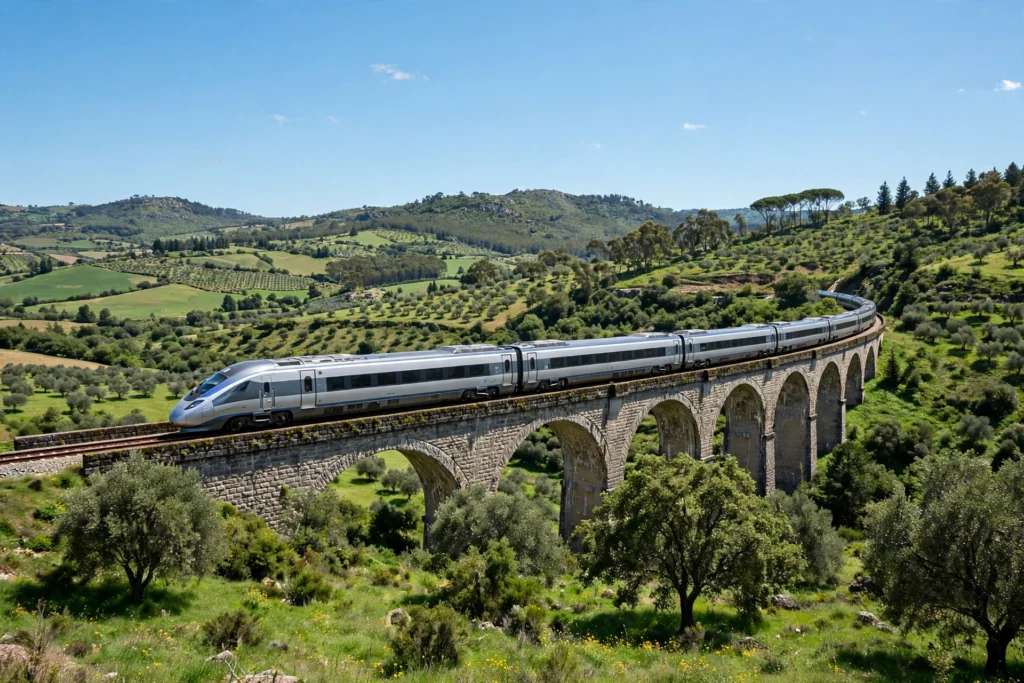
The most important fact in this whole Portugal travel guide is the shape of the country. Portugal is a long, narrow strip on the Atlantic edge of the Iberian Peninsula, about 560 kilometres from Porto in the north to Faro in the south, and almost everything a first-time visitor wants to see sits on or near a single railway spine. The fast Alfa Pendular and the slower Intercidades trains run from Porto Campanhã south through Aveiro and Coimbra-B to Lisbon, and from Lisbon south to Faro. A branch line, the Linha do Douro, leaves Porto and follows the Douro River east through the terraced vineyards to Peso da Régua and Pinhão. Suburban trains run from Lisbon to Sintra in about 40 minutes and from Lisbon to Cascais along the coast. That is the whole classic trip, and none of it needs a car.
This matters because the alternative — driving — is the most common way a first trip to Portugal goes wrong. Lisbon and Porto are both cities of steep hills, narrow streets, scarce parking and traffic that rewards local knowledge, and the Algarve in summer is a long line of resort traffic on the A22 motorway. A car is useful for two things only: the deep Alentejo countryside and the far corners of the Douro Valley beyond the railway. For a first trip built on Lisbon, Porto, Coimbra, the Douro and the Algarve, a car adds cost, stress and parking fees, and saves almost no time. The train, by contrast, drops you in the centre of every city, lets you watch the countryside instead of the road, and costs far less than a hire car once you count fuel, tolls and parking.
The second reality check is about what the classic route actually is. For a first trip, it has five stops and almost nothing else: Lisbon, Sintra as a day trip from Lisbon, Porto, the Douro Valley as a day trip or an overnight from Porto, and the Algarve. Coimbra sits on the line between Porto and Lisbon and makes a natural half-day or overnight stop. Évora, in the Alentejo, is a detour east from Lisbon rather than a stop on the main line. Everything else — the Minho and the far north, the Azores, Madeira, the Alentejo coast, the Serra da Estrela mountains — is a second trip, not a detour. The islands in particular are not add-ons: the Azores lie about 1,400 kilometres out in the Atlantic, and Madeira is a separate flight too, so both belong in their own trip rather than squeezed into a mainland itinerary. This guide says so plainly, because the guides that pretend you can do the mainland and the islands in ten days are the ones that leave travellers exhausted. The official tourism site, Visit Portugal, is a good place to browse the regions you are skipping, so you know what a second trip could hold.
The third reality check is about pace. Portugal rewards slow days, and the train makes slow days easy. Lisbon needs three days, not one, because the city is a collection of hillside neighbourhoods and its best experiences are unhurried ones: a tram ride through Alfama, a long lunch in Bairro Alto, an evening in Belém. Porto needs two or three days, not a day trip, because the old town, the port lodges across the river and the Douro Valley all deserve their own time. The Douro needs a full day on the train, not a rushed half day. The Algarve needs three days if you want to see both its coasts properly, and two if you pick one coast and do it well. If your trip is shorter than five days, pick one city — Lisbon alone, or Porto alone — and do it properly. A rushed Portugal trip is worse than a short one, because the hills punish every shortcut and the queues at Pena Palace punish every late start.
The five-stop route at a glance
| Stop | Nights | How you get there | Why it earns its place |
|---|---|---|---|
| Lisbon | 3 | Fly in from the US | Hills, trams, Alfama, Belém, fado, custard tarts |
| Sintra | 0 (day trip) | 40-minute suburban train from Lisbon | Pena Palace, Quinta da Regaleira, Moorish Castle |
| Porto | 2–3 | Alfa Pendular, about 2h45 from Lisbon | Riverside old town, port lodges, bridges, food |
| Douro Valley | 0–1 (day trip or overnight) | Linha do Douro train from Porto | Terraced vineyards, river, wine estates, the oldest demarcated wine region in the world |
| Algarve | 2–3 | Alfa Pendular or Intercidades from Lisbon to Faro | Golden cliffs in the west, calm lagoons in the east |
The mistakes first-timers make
The first mistake is the driving mistake, covered above: hiring a car for the whole trip and spending it looking for parking in Lisbon and Porto. The second is treating Porto as a day trip from Lisbon; the train takes nearly three hours each way, so a day trip gives you about five hours in Porto for six hours on trains, and Porto deserves far more than that. The third is trying to see all of Sintra in a half day without a timed Pena Palace ticket, and arriving to find the next available slot is hours away or sold out. The fourth is booking the Algarve without choosing a coast, and staying in a resort town that is convenient for neither the cliffs nor the lagoons. And the fifth is the entry mistake — believing an old blog post that says Americans need a visa or an ETIAS authorisation, and paying a third-party site for a document that is not required at all. The entry section below gives the current rule, checked against the official sources in November 2026, so you do not make it.
How to use this guide
Read the sections in order if this is your first trip: the best time to go, the entry rules, the safety picture, then the five stops, then the itineraries, food, costs and transport. If you already know when you are going, skip straight to the itinerary that matches your trip length — the 7-day, 10-day and 14-day plans are built from the same five stops, so you can see exactly what each extra day buys you. Every price in this guide is given in euros, because Portugal uses the euro, and as a range where prices move with the season, because a figure quoted as exact would be out of date within weeks; the ranges are checked against live pages in November 2026, and the guide tells you where to check the current figure before you pay.
Best Time to Visit Portugal: When to Go and When to Skip It
There is no single best month for the whole of Portugal, because the country has several climates at once: Lisbon and the Algarve are warm and Mediterranean, Porto and the Douro are cooler and greener, and the north can be wet when the south is dry. The answer depends on which stops matter most to you, but for the classic five-stop route the sweet spot is clear: April to June, and September to October. Those are the months when Lisbon and Porto are comfortable for walking, the Douro is green or golden, the Algarve is warm enough to swim in, and the crowds are thinner than in high summer.
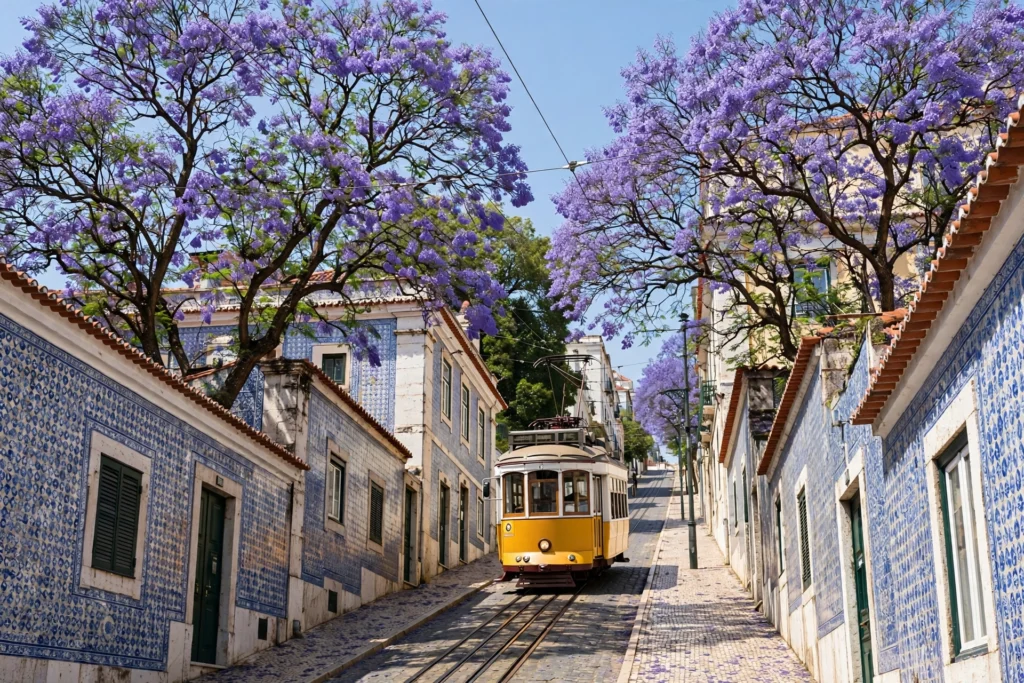
May is, for most travellers, the single best month: warm everywhere, jacaranda trees in bloom in Lisbon, wildflowers in the Douro, warm enough to swim in the Algarve by mid-May, and still ahead of the summer crowds. April is nearly as good, with mild days and the first warm weather, though the Atlantic can still be cool and the north can still be rainy. June is warm and long-dayed, with the Algarve in full season and the popular Saints’ festivals in Lisbon and Porto — the Festas de Lisboa in June, with street parties in Alfama, and São João in Porto on the night of 23–24 June, when the whole riverside celebrates. September is the other great month: the sea is at its warmest after the summer, the crowds thin, the light in the Douro turns golden, and Lisbon is at its most pleasant. October keeps the sea warm into the first half of the month and brings autumn colour to the Douro vineyards, with cooler evenings that suit walking, though rain becomes more likely in the north.
Summer — July and August — is the season to think about carefully rather than to avoid outright. The Algarve is at its best, the sea is warm, the resorts are fully open, and the long evenings are made for harbour dinners. But Lisbon is hot, the queues at Pena Palace and the Jerónimos Monastery are at their longest, the Douro Valley is brutally hot by midday, and Porto’s riverside is crowded. If summer is the only time you can go, build the trip around the Algarve and do the cities early in the morning; do not try to do the whole classic route at midday pace in August. Book accommodation early for July and August, because the best places in the Algarve and in central Lisbon sell out weeks ahead.
Winter — November to March — is the cheapest season and the quietest, and it suits a particular kind of trip very well. Lisbon in winter is atmospheric, cheaper, and mostly free of queues, and the city belongs to locals again. Porto in winter is moody and beautiful, with rain on the Douro and the port lodges warm inside. But the Algarve in winter is a different place: many hotels, restaurants and boat operators close or cut back sharply from November, and the sea is too cold for swimming. A winter trip should be Lisbon plus Porto and the Douro, not the Algarve, and it should allow for rain — the north in particular can be wet for days at a time. Christmas in Lisbon, with the lights in the Chiado and the Baixa, is genuinely lovely, and New Year in Porto, with fireworks over the Douro, is worth the trip on its own.
The seasons also affect prices sharply. Hotels in the Algarve can cost roughly half as much in January as in August. Lisbon hotels peak in May, June and September, and drop steeply in January and February. Train fares do not change with the season in the same way — the full Alfa Pendular fare is the same all year — but the cheap advance Promo fares are scarcer in peak season, so book early for summer travel. If your dates are flexible, the cheapest good-weather window is usually late April or late October: shoulder-season prices with near-peak weather. For more on picking cheap months in general, our guide to the cheapest time to travel explains how shoulder seasons work across destinations.
Month-by-month at a glance
| Month | Lisbon | Porto and the Douro | Algarve | Verdict |
|---|---|---|---|---|
| April | Mild, spring flowers | Mild, green, some rain | Warming up, quiet | Very good |
| May | Warm, jacaranda in bloom | Warm, green valleys | Warm sea by mid-May | Best month |
| June | Warm, festivals | Warm, long days | Full beach season | Very good |
| July–August | Hot, queues | Warm, crowded riverside | Best sea, busiest | Good for the coast |
| September | Pleasant, golden | Golden light, harvest | Warmest sea, thinner crowds | Excellent |
| October | Cool evenings | Autumn colour, rain possible | Warm sea early in the month | Very good |
| November–March | Cool, quiet, cheap | Cold, wet, atmospheric | Many resorts closed | Cities only |
Do US Citizens Need a Visa for Portugal? Entry Rules for 2026–27

The short answer, for most American travellers, is no. Ordinary US passport holders do not need a visa to visit Portugal for tourism or short business trips. You can stay visa-free for up to 90 days in any 180-day period, and there is no visa fee to pay. That rule was confirmed on the US State Department’s Portugal page, opened live on 26 November 2026, which states plainly: “No visa is required for 90 days or less.” Portugal is in the Schengen Area, so those 90 days are counted across the whole Schengen Area, not per country — a week in Portugal followed by a week in Spain and a week in France uses 21 of your 90 days, not three separate allowances.
The passport rules matter as much as the visa rule. Your US passport must be valid for at least three months beyond your date of departure from the Schengen Area, and it must have at least two blank pages for entry stamps and records. That is the rule on the State Department’s Portugal page, and it is stricter than the six-month rule some countries apply, so do not assume the rule you know from another destination applies here. If your passport is close to expiry, renew it before you travel. The State Department also notes a declaration-of-entry rule that catches some travellers out: US citizens who enter Portugal from another EU member state, without passing through airport or immigration control, must make a declaration of entry with the police within three working days — unless they are staying in a hotel or equivalent accommodation, which registers them automatically. In practice, staying in a hotel covers you, but if you are staying in a private home after arriving overland from Spain, ask your host about it.
Two new European border systems cause more confusion than anything else in Portugal entry rules, and both need a plain explanation. The first is the Entry/Exit System, known as EES. It is real, and it is running. EES began a phased rollout on 12 October 2025 and became fully operational on 10 April 2026. On your first entry into the Schengen Area, border officers record your fingerprints and take a facial image, and the system counts your days against the 90/180 rule itself. It replaces the passport stamp for non-EU short-stay travellers, so do not be surprised if your passport comes back without a stamp. Allow extra time at the border on your first entry, especially at Lisbon airport, because the biometric enrolment takes a few minutes longer than the old stamp.
The second system is ETIAS, the European Travel Information and Authorisation System, and the honest position in late November 2026 is that it is not in operation and has no confirmed start date. The European Union’s official ETIAS portal confirms that the system is not in operation and that no applications are being collected. The earlier target of the last quarter of 2026 was removed from the official site in mid-2026, and the EU says it will announce the start date several months before launch. Press reports in autumn 2026 point to 2027, but that is an expectation, not an official date, and this guide does not state a launch date because there is no official one to state. For a trip in 2026 or early 2027, you do not need an ETIAS authorisation, and any website that offers to sell you one today is not official — treat it with caution and do not pay. When ETIAS does launch, the fee is expected to be €20, and the only official channels will be those announced on the EU’s travel-europe.europa.eu site. Check that site again in the weeks before you travel, because the position could change with several months’ notice.
The exemption has edges, and they matter. It covers ordinary tourist passports only, for tourism and short business visits. If you plan to work in Portugal, study at a Portuguese university, or stay longer than 90 days in a 180-day period, you need a proper visa from a Portuguese embassy or consulate before you travel. The 90 days are counted over a rolling 180-day window, not per trip, so a long stay followed by a quick return can catch you out — count your days across the whole six-month period, not just the current trip. If someone in your party holds a different passport, the rule is decided passport by passport, not by the group: check every passport separately on the State Department’s Portugal page before you book.
Entry checklist for US citizens
| Requirement | The rule for US citizens (checked 26 November 2026) |
|---|---|
| Visa for tourism | Not required — visa-free up to 90 days in any 180 days across Schengen |
| ETIAS | Not in operation; no confirmed start date; no application needed |
| EES | Fully operational since 10 April 2026 — fingerprints and facial image on first entry |
| Passport validity | At least 3 months beyond your date of departure from Schengen |
| Blank pages | At least 2 pages |
| Currency on entry or exit | €10,000 or equivalent maximum without declaration |
| Work or study | Visa from a Portuguese embassy or consulate, applied for in advance |
| Stay beyond 90 days | Visa or residence permit, applied for before you travel |
If you arrive overland from Spain
Portugal and Spain share an open land border, and there are no routine border checks, but the rules still apply. Keep your passport with you, keep your return flight details and your first night’s hotel address easy to reach on your phone, and if you are staying in a private home rather than a hotel, remember the declaration-of-entry rule above. The State Department also notes that you can drive in Portugal with a US driver’s licence for up to six months, that many motorways require tolls, and that speeding, driving under the influence and using a phone while driving are illegal, with high fines. If you do drive, the emergency number is 112, the same as across the European Union.
Is Portugal Safe for US Travellers? The Level 1 Advisory, Honestly Explained
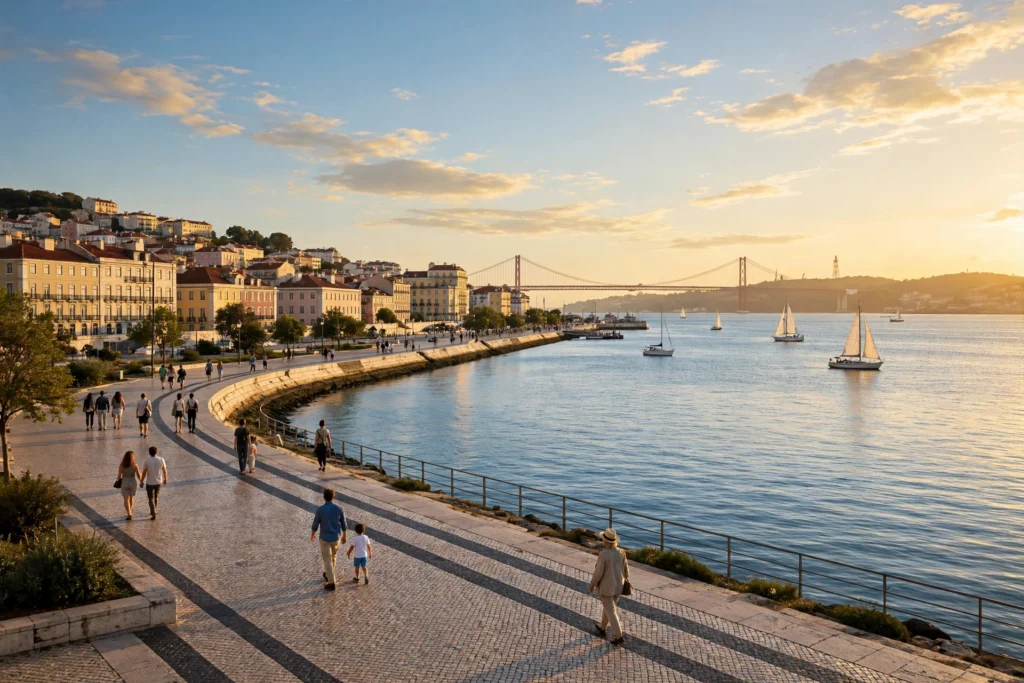
The US State Department rates Portugal at Level 1: Exercise Normal Precautions. That is the fact that matters most, and it needs context, because a bare “Level 1” tells you almost nothing on its own. The advisory was issued on 11 December 2025 and, opened live on 26 November 2026, it reads: “Exercise normal precaution in Portugal. Portugal is generally a safe destination for travelers.” Level 1 is the lowest tier the State Department gives any foreign country — the same tier it gives to Japan, Iceland and Switzerland — and it means something specific: travel as you normally would, with the ordinary care you would take anywhere. You can read the full text on the State Department’s Portugal travel advisory page, and you should read it twice — once when you book, and again the week before you fly, because advisories change.
The detail underneath the headline is where the real information lives. The advisory’s one warning is about petty theft: “Travelers should remain vigilant against petty theft, particularly in crowded tourist areas and on public transportation.” That is the whole safety story for most visitors. Lisbon’s trams, especially the famous Tram 28 through Alfama, are the classic pickpocket spot, along with the crowded streets of the Baixa, the queues at Belém, and Porto’s riverside at night. The fix is ordinary and it works: a bag you can close and keep in front of you, nothing valuable in a back pocket, a money belt or an inside pocket for your passport and cards, and a copy of your passport on your phone. Portugal is also one of the safest countries in the world by the numbers — it ranked 7th of 163 countries in the 2026 Global Peace Index — and violent crime against tourists is genuinely rare.
The advisory also carries a Europe-wide security alert worth knowing about. On 13 November 2026, US embassies across Europe issued a holiday-season security alert asking travellers to stay vigilant at holiday markets, events and transport hubs. It did not change the advisory level of any European country, including Portugal, and it is a reminder to stay alert, not a warning against travel. The US Embassy in Lisbon also issued a security alert on 1 November 2026, which you can read on the embassy’s site. None of this changes the Level 1 rating, but it is the reason to enrol in the Smart Traveler Enrollment Program, known as STEP, on the State Department’s STEP page. It is free, it takes about ten minutes, and it lets the nearest US embassy or consulate contact you in an emergency and help your family reach you.
The risks that actually affect tourists most often are far more ordinary than the advisory suggests. The Atlantic is the real danger in Portugal: the ocean off the west and south coasts has strong currents and powerful waves, and every year visitors drown at beaches with no lifeguard or in conditions they misjudged. Swim only where a lifeguard is on duty, obey the flag system — green means safe, yellow means caution, red means do not enter the water — and never turn your back on the ocean on the wild west coast, where waves can sweep across rocks without warning. The second risk is the sun and the heat: Lisbon and the Algarve in July and August are hot enough to cause heat exhaustion if you walk the hills at midday without water, shade and a hat. The third is traffic: Portuguese drivers are fast, pedestrian crossings are not always respected, and the steep, cobbled streets of Lisbon and Porto are slippery when wet, so wear shoes with grip and watch your step.
The State Department’s Portugal page also carries local-law notes that are easy to miss and expensive to ignore. Most Portuguese cities ban drinking alcohol in the street, except at registered cafés and bars. It is illegal to bring marijuana, cannabis or CBD products into Portugal, with fines from €1,000 to €10,000 and possible arrest and detention — the country’s decriminalisation of small amounts for personal use does not make importation legal, and it does not protect a visitor. The possession or use of pepper spray is not permitted in Portugal, and you may face fines or other legal penalties. Leave both at home.
What to do before you go
Enrol in STEP, save the emergency number — 112 works for police, ambulance and fire across Portugal and the whole European Union — and save the address of the US Embassy in Lisbon, on Avenida das Forças Armadas, in your phone. The embassy’s main telephone is +351-21-770-2122, and the after-hours emergency line is +351-21-727-3300. Read the CDC Travelers’ Health pages for Portugal: no vaccination is required for most travellers, but stay up to date on the routine vaccinations the CDC recommends. Buy travel insurance that covers emergency medical care and evacuation, and read what it excludes before you need it — our guide to what travel insurance covers explains the exclusions that catch people out, and our full travel safety tips guide covers the same preparation in depth for any destination. Keep a copy of your passport, your insurance details and your hotel addresses on your phone and in your email, so a lost bag does not strand you.
Staying safe day to day
Keep your bag in front of you in crowded places, use ATMs inside banks, split your money and cards so one theft cannot strand you, and agree taxi fares or insist on the meter. In Lisbon, the metro is the safest way to move at night, and the trams are the place to be most careful. At the coast, swim only where it is supervised and be careful with strong currents on the Algarve’s west coast in particular. If something goes wrong, call 112 first, then your insurer’s 24-hour assistance line, then the embassy. And if you are ever told by a stranger at the airport that your hotel is closed or overbooked, do not believe it — that is one of the oldest scams in the world, and the answer is to go to the hotel yourself or call it on the number you already have.
Lisbon in 3 Days: Hills, Trams and the Tagus
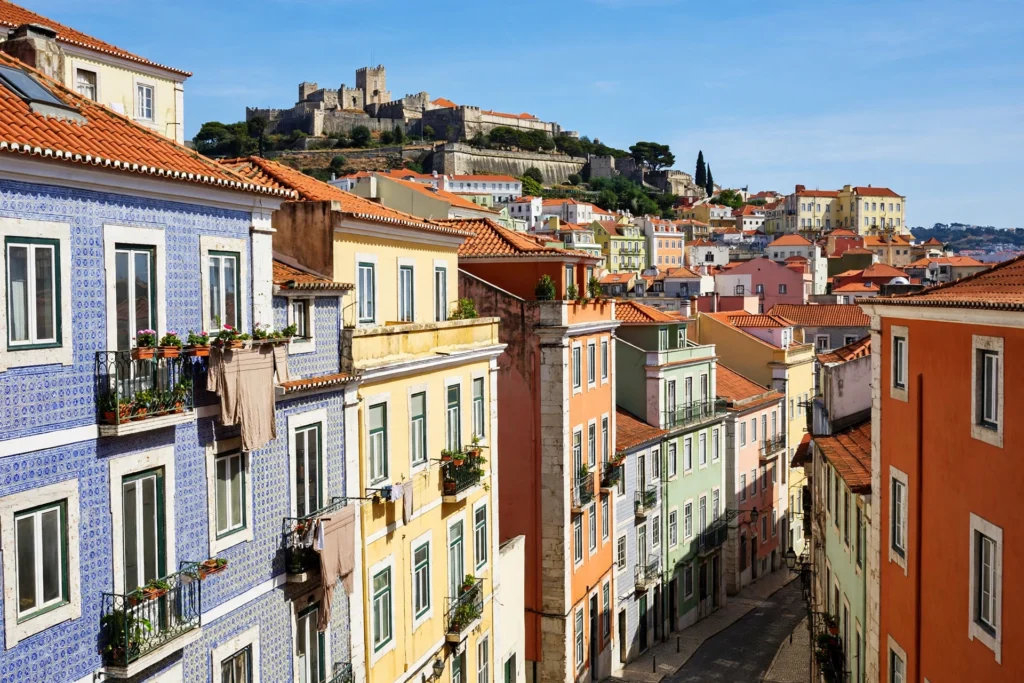
Lisbon is a city of seven hills, and it behaves like several small cities stitched together by trams, funiculars and lifts. The historic core holds the Alfama, the oldest neighbourhood, with its maze of lanes under the castle; the Baixa, the grid of streets rebuilt after the 1755 earthquake; the Chiado, the elegant shopping district; and Bairro Alto, the nightlife quarter. Across the river, in Belém, stand the monuments of the Age of Discoveries. Three days is the right amount of time: one day for Alfama and the castle, one day for the Baixa, the Chiado and Bairro Alto, and one day for Belém. If you want the full Lisbon picture, our Lisbon travel guide covers the city in depth; this section gives you the three-day plan that fits inside a country trip.
Start in Alfama, and start early. The neighbourhood is a maze of narrow lanes, laundry lines, tiled facades and small squares, and it is best before the tour groups arrive. Walk up to the São Jorge Castle, the Moorish fortress on the highest hill, for the view over the whole city and the river — the castle itself is mostly walls and courtyards, and the view is the point. From the castle, walk down through Alfama to the Lisbon Cathedral, the Sé, the oldest church in the city, and then to the viewpoints, the miradouros, that are Lisbon’s great free pleasure: the Miradouro da Graça, the Miradouro da Senhora do Monte, and the Miradouro de Santa Luzia, with its tiled panels and its view over the rooftops. The famous Tram 28 runs through Alfama, and it is worth riding once — but ride it early in the morning, when it is a local service rather than a rolling queue, and keep your bag in front of you, because it is the most pickpocketed tram in Europe.
Day two is the Baixa and the Chiado. Start at the Praça do Comércio, the great riverside square where the royal palace once stood, and walk up through the Baixa’s grid to the Rossio square, with its wave-patterned pavement. Take the Santa Justa Lift, the iron elevator built in 1902, up to the Chiado for the view, and spend the afternoon in the Chiado’s bookshops, cafés and tiled streets. In the evening, go up to Bairro Alto, the quarter of small bars and restaurants that comes alive after dark, and listen to fado — the melancholy Portuguese song — in a small tasca, where the singer stands among the tables and the room falls silent. Fado is not background music; it is a performance that asks for quiet, and the best places are the small ones, not the large dinner-show venues.
Day three is Belém, and it needs a full morning. The Jerónimos Monastery is the great monument of the Age of Discoveries, built from 1501 with money from the spice trade, and the finest example of the Manueline style, the sea-themed Portuguese Gothic that covers its stone with ropes, shells and armillary spheres. The church is free to enter, and the two-storey cloister is the paid part: €18 for an adult in 2026, €9 for ages 13 to 24 and over 65, free for children up to 12, with timed entry slots that often sell out, so book in advance on the official ticket shop of Museus e Monumentos de Portugal. The monastery is closed on Mondays. Next door stands the Belém Tower, the small fortress in the river that guarded the harbour, with its own €15 ticket and timed slots, and between the two, the Monument to the Discoveries, the great stone prow that celebrates the navigators. Finish in Belém with a custard tart, a pastel de nata, from the original bakery, Pastéis de Belém, which has made them since 1837 — the queue moves fast, and the tarts are worth it.
Where to stay and how to get around
Stay in the Baixa or the Chiado if this is your first visit and you want the sights on foot, in Alfama if you want atmosphere and do not mind the hills, or in Bairro Alto if you want nightlife and do not mind the noise. Buy a Lisboa Card if you plan to visit several museums and use public transport a lot — it covers the metro, trams, buses and funiculars, and gives free entry to the Jerónimos Monastery and the Belém Tower among others — but do the maths first, because a three-day card only pays for itself if you visit the big-ticket sights. The metro is fast and clean, the trams are slow and charming, and the funiculars — the Glória, the Lavra and the Bica — are the practical way up the steepest hills. Never drive in Lisbon, and do not take a taxi without the meter running or a fare agreed in advance; for short trips, ride-hailing apps work well. For the airport, the metro’s Red Line runs from the airport to the city centre in about 20 minutes.
Eating in Lisbon
Lisbon is the best food city in the country for range, and the cheapest good meals are the simplest ones: a custard tart and a coffee standing at a counter for breakfast; a bowl of soup and fresh bread at a tasca, the small family restaurants where locals eat; grilled sardines with a glass of vinho verde at a summer street festival; and a proper dinner in the Chiado. Save one evening for a fado dinner in Alfama, and one morning for a long breakfast in the Chiado. The food section later in this guide covers the regional dishes in full, but Lisbon is where you should eat widest, because every region of Portugal is represented here. And remember the city tax: Lisbon charges €4 per guest per night, for guests aged 13 and over, for at most seven nights per stay, so no more than €28 per person. It is added to your accommodation bill, and it is worth knowing about before you check out, not after.
Porto in 2–3 Days: Riverside, Port Lodges and the Old Town
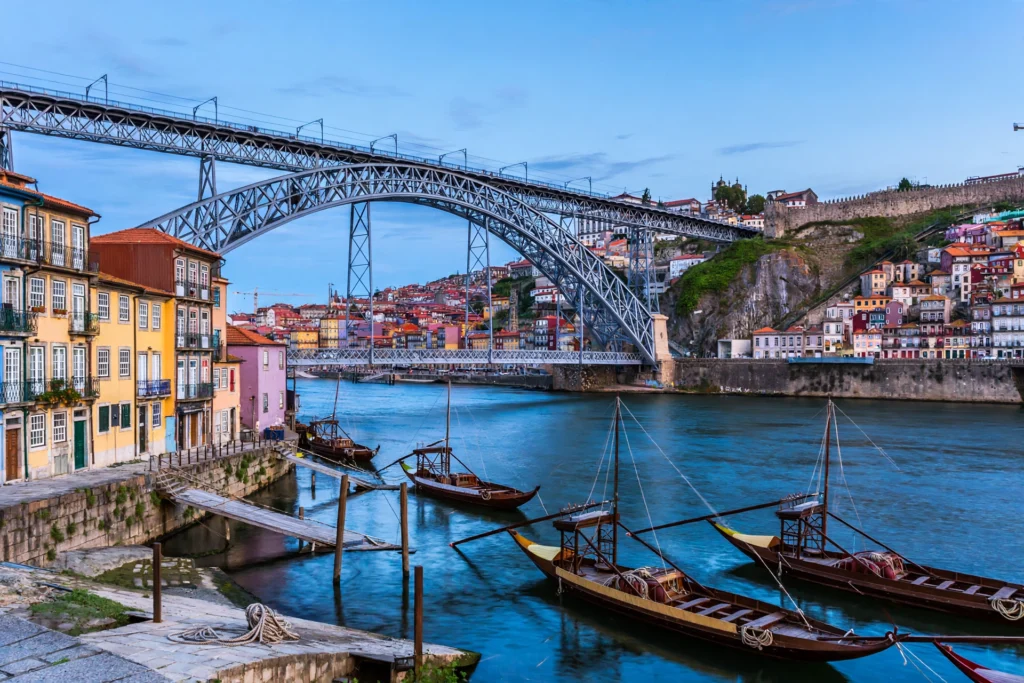
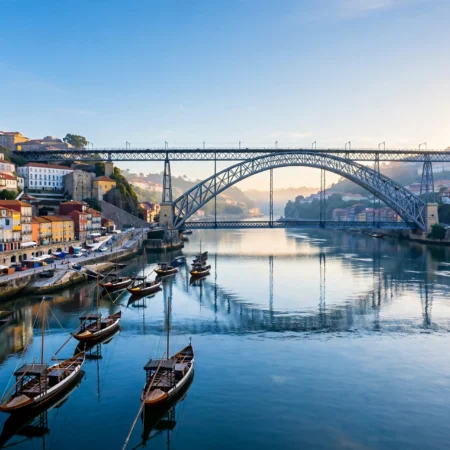
Porto is smaller than Lisbon, steeper than Lisbon, and, for many visitors, more lovable than Lisbon. The old town, the Ribeira, is a UNESCO World Heritage Site, a tangle of narrow streets and colourful houses tumbling down to the Douro River, with the great iron arch of the Dom Luís I Bridge overhead and the port lodges of Vila Nova de Gaia across the water. Two or three days is the right amount of time: one day for the old town and the river, one day for the port lodges and Gaia, and a third day for the Douro Valley or for the city at a slower pace. Porto is not a day trip from Lisbon — the train takes nearly three hours each way — and treating it as one is the mistake that leaves visitors with a photograph of the bridge and no memory of the city.
Start in the Ribeira, and start on foot. The old town is best walked slowly: the Sé, the cathedral on the hill, with its cloister and its view; the São Bento station, whose entrance hall is covered in blue-and-white azulejo tiles telling the history of Portugal; the Clérigos Tower, the baroque bell tower you can climb for the view over the rooftops; and the Bolhão Market, the great covered market that is the city’s larder. Walk down to the Ribeira waterfront in the late afternoon, when the light turns the river gold, and cross the Dom Luís I Bridge on its upper deck for the view back over the old town — the upper deck is for pedestrians and the metro, the lower deck for cars and walkers, and the walk across is one of the great free experiences in Portugal.
Day two is for the port lodges, and it is the day that explains Porto. Cross the bridge to Vila Nova de Gaia, on the south bank of the Douro, where the great port houses — Taylor’s, Graham’s, Sandeman, Ferreira and the rest — keep their lodges, the warehouses where port wine ages in barrels. A lodge visit is a tour of the cellars and a tasting, and it is worth doing properly: pick one or two lodges, not five, and take the tour that explains how port is made, why it is fortified, and what the difference is between a ruby, a tawny and a vintage. A tasting of three ports typically costs €15 to €25, and the lodges are at their best in the late afternoon, when the sun is on the Gaia waterfront and the old town glows across the river. Stay for dinner in Gaia, where the restaurants have the best view in the city, and walk back across the bridge at night, when the old town is lit up.
If you have a third day, spend it on the Douro Valley — the next section covers that in full — or spend it in Porto itself, slowly. The Serralves Museum and its park, the modern art museum in a great garden, is worth a half day. The Foz do Douro, where the river meets the Atlantic, is a tram ride away and a different Porto altogether: beaches, a lighthouse, and a long promenade. And the city’s food deserves a day of its own: the francesinha, the great Porto sandwich of bread, ham, sausage and steak covered in melted cheese and beer sauce, is a meal that needs a whole afternoon to recover from, and the city’s bakeries, markets and small restaurants are the reason Porto is now talked about as one of the great food cities in Europe.
Where to stay and how to get around
Stay in the Ribeira or the Baixa if this is your first visit and you want the old town on foot, in Cedofeita or Miragaia if you want a quieter neighbourhood with good restaurants, or in Gaia if you want the view and do not mind crossing the bridge. Porto’s metro is modern and easy, the historic tram line 1 runs along the river to Foz, and the funicular, the Guindais, climbs from the Ribeira to the Batalha square. The city is steep — steeper than Lisbon in places — so wear shoes with grip and plan your days around the hills, not against them. Porto charges a city tax of €3 per guest per night, for guests aged 13 and over, for at most seven nights per stay, so no more than €21 per person, and Gaia charges the same €3 per night since August 2026. Like Lisbon’s, it is added to your accommodation bill.
The port lodges, honestly
Port is not a single wine, and the lodges are not all the same. Ruby port is young, fruity and red, and it is the one to start with. Tawny port is aged in wood, nutty and amber, and it is the one that rewards a slow tasting. Vintage port is the great wine of the Douro, made only in the best years, and it is the one to save for a special occasion. A lodge tour that gives you three tastes for €15 to €20 is good value; a tour that gives you one taste for the same price is not. Book the popular lodges a day ahead in summer, because the best time slots fill up. And remember that the lodges are in Gaia, not in Porto itself — the distinction matters for your hotel, your city tax, and your walk home.
Lisbon or Porto First? How to Pick Your Base City
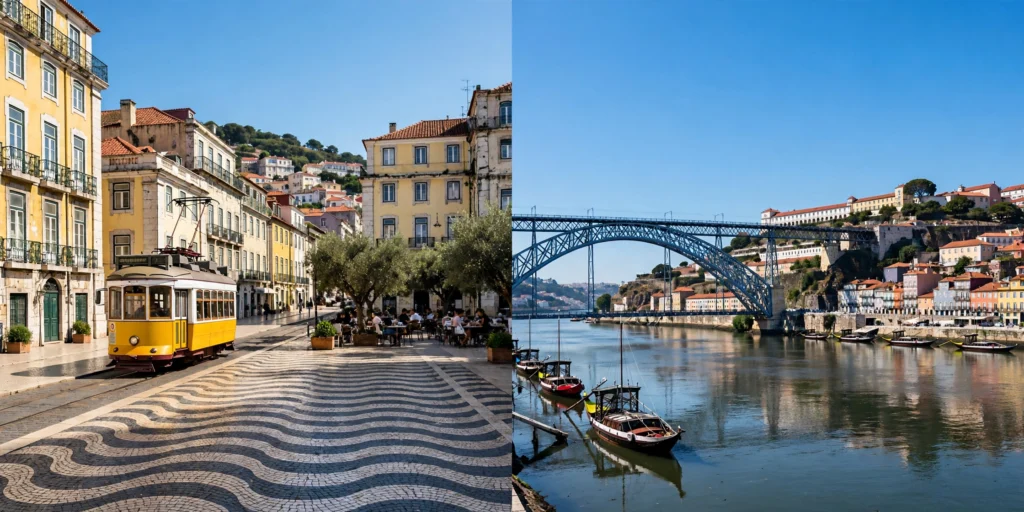
Every Portugal trip has to answer one question before any other: Lisbon first, or Porto first? The two cities are the twin poles of the country, and they are genuinely different — not two versions of the same place, but two cities with different characters, different food, different light and different pleasures. The honest answer is that you should see both, and the order matters less than the time you give each. But if your trip is short, or if you are flying in and out of one city, the choice matters, and this section makes it plainly.
Pick Lisbon first if this is your first trip to Portugal and you have a week or less. Lisbon is bigger, easier to fly into from the United States, and it has more to do in a short time: the historic neighbourhoods, the Belém monuments, the museums, the day trip to Sintra, and the beaches of Cascais. Lisbon is also the better base for the south: the Algarve is a direct train ride away, and Évora is a short trip east. Lisbon is the city for travellers who want variety — history, food, nightlife, museums and day trips — and who want a city that is easy to navigate by metro and tram.
Pick Porto first if you love food and wine, if you want a smaller and more walkable city, and if the Douro Valley is the reason you are coming. Porto is the better base for the north: the Douro Valley is a direct train ride away, and the Minho region, with its green valleys and its vinho verde, is a short trip north. Porto is also cheaper than Lisbon for hotels and restaurants, and it is the city for travellers who want to slow down — to spend an afternoon in a port lodge, to walk the river at dusk, to eat well without a plan. Porto is the city that rewards a second visit, because its pleasures are quieter and take longer to find.
The practical answer, for most trips, is to fly into one and out of the other. Fly into Lisbon, spend three days there, take the train north to Porto, spend two or three days there, and fly home from Porto. Or do it in reverse. The train between the two cities takes about 2 hours 45 minutes on the Alfa Pendular, and the one-way fare is €35.70 in second class at the 2026 full fare, with cheaper advance Promo fares if you book early. Flying into one city and out of the other saves a whole day of backtracking, and it is the single best piece of logistics advice in this guide. If you must fly in and out of the same city, Lisbon is the easier choice, because it has more flights from the United States and the train to Porto is straightforward.
The two cities at a glance
| Lisbon | Porto | |
|---|---|---|
| Character | Grand, sunny, varied | Intimate, steep, food-obsessed |
| Best for | First-timers, museums, day trips, nightlife | Food, wine, the Douro, slow days |
| Days needed | 3 | 2–3 |
| Fly in from the US | More direct flights | Fewer direct flights, often via Lisbon |
| Day trips | Sintra, Cascais, Évora | Douro Valley, Minho, Guimarães |
| City tax | €4 per night, max 7 nights | €3 per night, max 7 nights |
| Signature food | Custard tarts, grilled sardines | Francesinha, port wine, tripe |
| Signature view | The Tagus from a miradouro | The Douro from the Dom Luís I Bridge |
If you can only pick one
If your trip is five days or less and you can only pick one city, pick Lisbon. It has more to do, it is easier to reach, and Sintra alone is worth a day. But do not pick Lisbon and then spend a day of it on a rushed day trip to Porto — that is the mistake that leaves you with neither city. Pick one, do it properly, and save the other for a second trip. Portugal is a country that rewards a return visit, and the second trip is often the better one, because you already know the shape of the place.
The Douro Valley by Train: Vineyards Without a Car
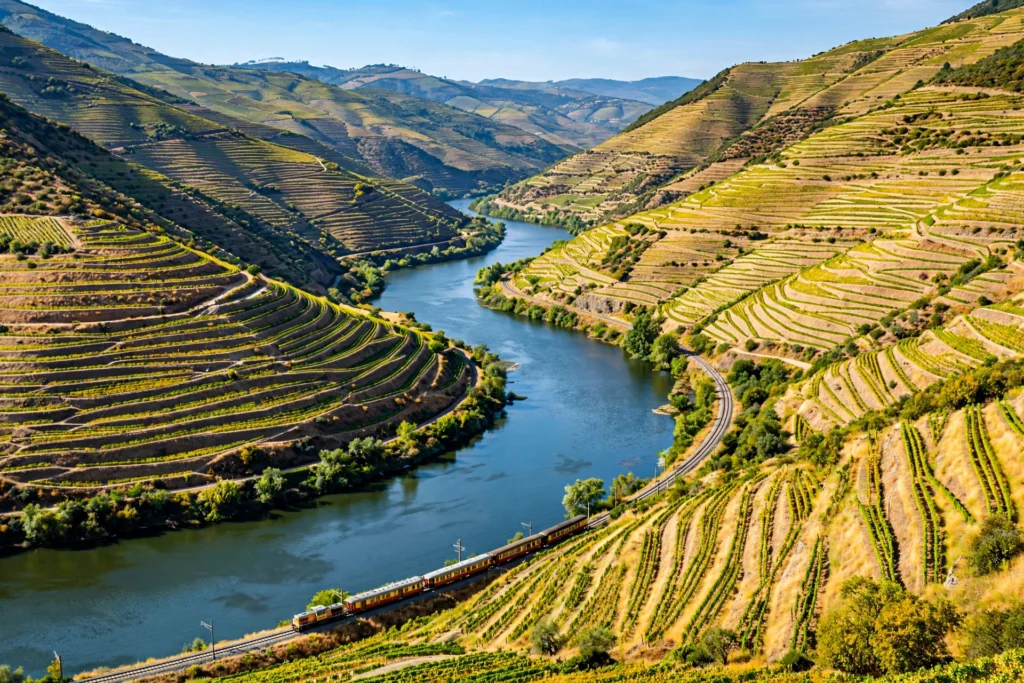
The Douro Valley is the most beautiful train ride in Portugal, and it is the reason this guide is built around the railway. The Linha do Douro leaves Porto’s São Bento station, in the middle of the old town, and follows the river east through terraced vineyards that climb the hills on both banks, past small stations and wine estates, to Peso da Régua and Pinhão. The Alto Douro Wine Region is a UNESCO World Heritage Site, inscribed in 2001, and it is the oldest demarcated and regulated wine region in the world — the boundaries were set by law in 1756, under the Marquis of Pombal. The landscape itself is the attraction: steep hills covered in carefully arranged vineyards, rising above the winding river, with the grapes that make port wine and the Douro’s own table wines.
The train is the way to see it, and the guide says so plainly because the alternative — driving — is the most common way a Douro trip goes wrong. The road along the river, the N222 from Peso da Régua to Pinhão, is one of the best drives in the country, but it is narrow, winding, and busy in summer, and it does not mix well with wine tasting. The train lets you taste at a quinta, a wine estate, and take the train home, and it lets you look at the vineyards instead of the road. The journey from Porto São Bento to Pinhão takes about 2 hours 30 minutes, and the views from the right-hand side of the train going upriver are the best. Sit on the right on the way out, and on the left on the way back, and you will see the river for the whole journey.
A day trip from Porto works like this. Take an early train from São Bento to Pinhão, the small town at the heart of the valley, and spend the morning there: the Pinhão station itself, with its azulejo panels showing the harvest, is worth a visit, and the riverfront is a good place for a coffee. From Pinhão, take a boat trip on the river — the one-hour and two-hour cruises run from the town’s quay, and they are the best way to see the terraces from below. In the afternoon, visit a quinta: many estates offer tours and tastings, and the ones near Pinhão are reachable by taxi or by the quinta’s own shuttle. Book the tasting in advance, because the popular estates fill up, and allow at least two hours for a proper visit. Take a late afternoon train back to Porto, and you will be home in time for dinner on the riverside.
An overnight in the Douro is better than a day trip, if you have the time. Stay in Pinhão or in Peso da Régua, the larger town further downriver, and you can visit two quintas in a day, take a longer boat trip, and see the valley at dawn and dusk, when the light is at its best. The harvest, in September and early October, is the busiest and most interesting time in the valley, with grape picking and crushing at many estates, but it is also the time when accommodation and tastings need to be booked furthest ahead. In winter, the valley is quiet and the vines are bare, but the quintas are open and the train ride is just as beautiful in a different way.
Douro by train vs Douro by car
| By train | By car | |
|---|---|---|
| Best for | Tasting wine, watching the river, no stress | Stopping at small quintas, the N222 drive |
| Journey | Porto São Bento to Pinhão, about 2h30 | Porto to Pinhão, about 2 hours by motorway and river road |
| Cost | A few euros each way on a regional train | Hire, fuel, tolls and parking, plus a designated driver |
| Wine tasting | Easy — no one has to drive | Hard — someone has to stay sober |
| The view | The river, from the window, the whole way | The road, with stops for viewpoints |
| Verdict | The right choice for a first visit | The right choice for a second visit, with a driver |
How long to spend
Give the Douro a full day, including the train there and back. If you are doing it as a day trip from Porto, leave early — the 8 a.m. trains are the ones that give you a full day in the valley — and do not try to add a second valley stop to the same day. If you are staying overnight, give it two days: one for the train and the river, and one for the quintas. And do not try to do the Douro and the Algarve in the same day, or the Douro and Sintra in the same day. The valley is a slow place, and it punishes rushing more than anywhere else in Portugal.
Sintra in One Day: Pena Palace and Quinta da Regaleira Done Right

Sintra is the day trip that every Lisbon visitor takes, and it is the day trip that most often goes wrong. The town sits in the forested hills above the Atlantic, about 40 minutes from Lisbon’s Rossio station on a suburban train that leaves every 20 to 30 minutes, and it holds a concentration of palaces, castles and gardens that is unlike anywhere else in Europe. The Cultural Landscape of Sintra is a UNESCO World Heritage Site, inscribed in 1995, and it was the first site in Europe to be inscribed as a cultural landscape — not a single monument, but a whole range of forested hills where kings, aristocrats and nineteenth-century romantics built palaces, castles, convents and gardens. The problem is that everyone goes, the roads are narrow and winding, and the palaces are timed and ticketed. The fix is a plan, and this section is the plan.
The first rule is to book Pena Palace in advance, and to book the right ticket. Parques de Sintra, the public company that runs the monument, sells five ticket types, and the differences matter. The Essential visit, €20 for an adult in 2026, covers the palace rooms, the terraces and the park, and it is the ticket most first-timers should buy. The Park only ticket, €12, gets you into the 85 hectares of garden and onto the terraces around the palace, which is where the famous photographs are taken, but it does not include the palace interior. The Complete visit, €45, adds the private apartments and the spaces that are not on the essential route. The prices were checked against the official Parques de Sintra price list in November 2026, and they are the figures to plan with — but check the live price on the official ticket shop, before you pay, because prices change. The palace entry is timed to the minute, with slots every 30 minutes from 09:30 to 17:30, and a missed slot is gone for good, with no refund. Book the 09:30 or 10:00 slot, a few days ahead, and arrive at the palace door at that time, not before and not after. It takes about 30 minutes to walk from the park gate to the palace, or you can take the shuttle bus, €4.50 return, which runs every 15 minutes.
The second rule is to do Pena and Quinta da Regaleira in one day, and nothing else. Quinta da Regaleira is the other great Sintra sight: a palace and garden built by a wealthy eccentric in the early twentieth century, with tunnels, grottoes, a chapel and the famous Initiation Well, a spiral staircase that descends into the earth like a tower turned upside down. It is a short walk from the town centre, and it needs two hours of its own. The Moorish Castle, the ruined walls on the hill between the town and Pena, is the third sight, and it is worth it if you have the time and the legs — the walk along the walls, with the view down onto Pena, is one of the great views in Portugal — but it is the one to drop if you are short on time. The National Palace, in the town centre, with its twin chimneys, is the fourth, and it is the one to save for a second visit.
A day in Sintra, hour by hour
Take the 08:00 train from Lisbon Rossio to Sintra, and you will be in the town by 08:40. Take the bus up to Pena — the 434 tourist bus runs from the station to the palace, and it is the easiest way up the hill — and be at the park gate by 09:00 for a 09:30 palace slot. Spend the morning at Pena: the palace rooms, the terraces, and the park, which is a garden in its own right, with lakes, ferns and viewpoints. Come down to the town for lunch — the small restaurants in the old town are better and cheaper than the ones at the palace — and spend the afternoon at Quinta da Regaleira, walking the gardens, descending the Initiation Well, and exploring the tunnels. If you have the energy, walk up to the Moorish Castle in the late afternoon, when the light is at its best and the crowds have thinned. Take a late train back to Lisbon, and you will be home in time for dinner.
The mistakes to avoid
Do not drive to Sintra. The roads are narrow, the parking is scarce, and private cars may no longer drive up to Pena Palace. Do not try to see everything in Sintra in one day — the town has a dozen palaces and gardens, and the ones you miss are the reason to come back. Do not buy a Pena ticket from a reseller at a markup; the official ticket shop is the cheapest place, and the only channel selling at the gate price. Do not arrive at Pena without a timed ticket and expect to get in; the palace is timed, the slots sell out, and the queue for the next available slot can be hours long. And do not skip the park at Pena — the palace is the photograph, but the park is the place, and the walk through the forest is the part of Sintra that stays with you.
The Algarve: West Cliffs or East Lagoons — Which Coast Should You Pick?
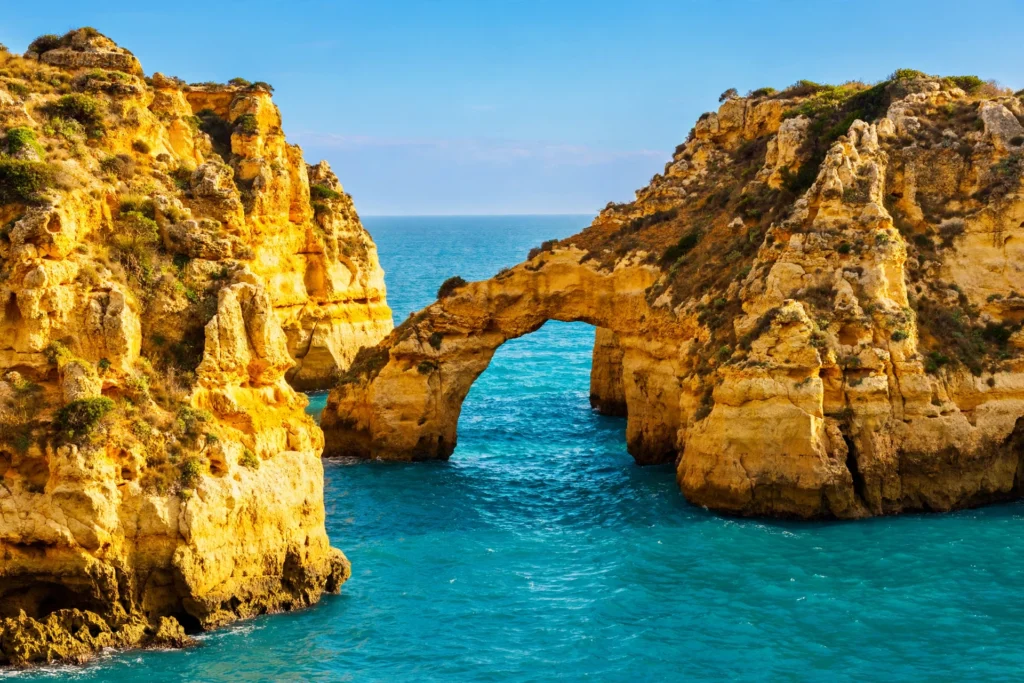
The Algarve is not one coast. It is two coasts, and the choice between them is the most personal decision in this guide. The west, the Barlavento, is the coast of golden limestone cliffs, sea arches, caves and surf: Lagos, Sagres, the Ponta da Piedade, and the wild Atlantic beaches around the western tip. The east, the Sotavento, is the coast of calm lagoons, barrier islands, salt marshes and fishing towns: Tavira, Olhão, Faro and the Ria Formosa, the great lagoon system that shelters the eastern Algarve from the Atlantic. They are not the same holiday. The west is dramatic and exposed; the east is calm and sheltered. Both are beautiful, both are worth a trip, and in a week you should pick one and do it properly rather than trying to do both badly.
Pick the west if you want cliffs, caves and surf. Lagos is the working town and the best base: a lively old town inside its walls, a harbour full of boats, and day trips to the Ponta da Piedade, the great rock formations just south of the town, where boat trips run through the arches and into the caves. The boat trip is the signature west-coast experience, and it is worth doing properly: take a small boat, not a large one, go in the morning when the sea is calmest, and allow two hours. Sagres, at the western tip, is the wild end of Europe: the fortress on the cliff, the lighthouse, and the Atlantic stretching to America, with some of the best surfing in Europe on the beaches nearby. The west coast is also the coast for walking: the cliff-top trail from Lagos to Luz, and the longer trails around Sagres, are among the best coastal walks in Portugal. The sea on the west coast is cooler and rougher than on the east, and the beaches are smaller and wilder — which is exactly the point.
Pick the east if you want calm water, islands and fishing towns. Tavira is the prettiest town in the Algarve, a whitewashed town on a river, with a Roman bridge, a castle, and a ferry to the island beach of Tavira Island, a long strip of sand in the lagoon that is one of the best beaches in Portugal. Olhão is the working fishing town, with a great market and a harbour full of boats, and it is the base for the islands of the Ria Formosa: Armona, Culatra and Farol, each a car-free island of sand and fishermen’s houses, reached by ferry. Faro, the capital of the Algarve and the end of the railway line, is a town in its own right, with a walled old town, a cathedral, and a ferry to the beach. The east coast is the coast for families and for swimmers, because the lagoon water is calm and warm, and it is the coast for birdwatchers, because the Ria Formosa is one of the great wetlands in Europe.
The coast choice at a glance
| West (Barlavento) | East (Sotavento) | |
|---|---|---|
| Best for | Cliffs, caves, surfing, walking | Calm lagoons, islands, fishing towns |
| Main bases | Lagos, Sagres, Albufeira | Tavira, Olhão, Faro |
| Sea | Cooler, rougher, Atlantic swell | Calmer, warmer, sheltered lagoon |
| Signature experience | Boat trip through the Ponta da Piedade | Ferry to a car-free lagoon island |
| Beaches | Small coves between cliffs | Long sandy islands in the lagoon |
| Pace | Active, outdoors, dramatic | Slow, local, more food-focused |
| Best months | May–October | April–October |
Getting to the Algarve by train
The train to the Algarve is part of the rail-first route, and it is straightforward. Alfa Pendular and Intercidades trains run from Lisbon to Faro, the capital of the Algarve, in about three hours, and the railway then runs west along the coast to Lagos, with stops at Albufeira and Portimão. Faro is the right arrival point for the east coast, and Lagos is the right base for the west, with the train between them taking about two hours. If you are coming from Porto, take the Alfa Pendular to Lisbon and change there — there is no direct train from Porto to the Algarve. Book the Lisbon to Faro leg in advance for the best Promo fares, and allow a full morning for the journey, because the train is the slow pleasure of the trip, not a chore to be rushed.
If you have time for both
If your trip is 12 days or longer, you can do both coasts properly: the west for three days, then the east for three more, with the train between Lagos and Faro as the link. The drive along the coast road is part of the experience, but the train is the easier way to move between the two, and it lets you see the coast without driving it. But do not try to squeeze both coasts into a 10-day trip by cutting Lisbon or Porto short. The coasts will still be there for a second trip, and a rushed coast is a wasted coast. And remember that the Algarve is a summer destination at heart: in winter, many hotels, restaurants and boat operators close, and the coast is a different, quieter place, which suits some travellers and disappoints others.
Between Lisbon and Porto: Coimbra, Évora and the Places the Train Passes
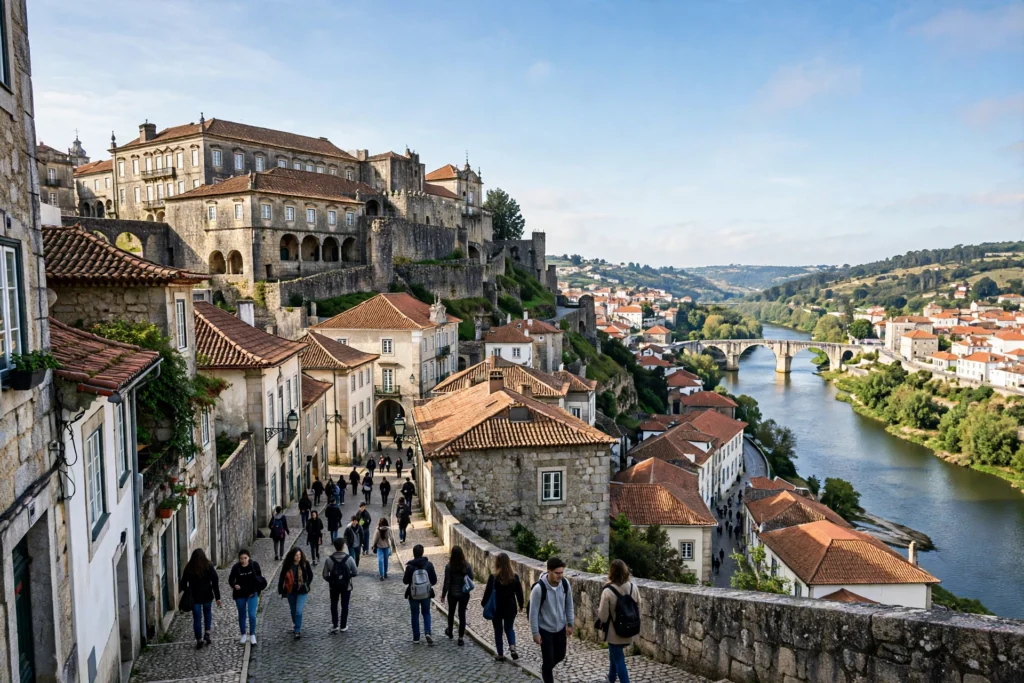
The train between Lisbon and Porto passes places that most travellers never stop at, and that is a shame, because two of them are worth a stop. Coimbra, halfway between the two cities, is the old university town, and Évora, east of Lisbon in the Alentejo, is the walled town that is the gateway to the great plain. This section covers both, and the other places the train passes, so you can decide whether to stop or to keep going.
Coimbra is the stop to make. The University of Coimbra, founded in 1290, is one of the oldest universities in the world, and its hilltop campus is a UNESCO World Heritage Site, inscribed in 2013. The Joanina Library, the great baroque library with its gilded shelves and its resident bats, is the sight to book in advance — the library is timed and ticketed, and the slots sell out. The old town below the university is a maze of steep lanes, and the river Mondego, with its long promenade, is the place to walk in the evening. Coimbra is a half-day stop on the train between Lisbon and Porto: get off at Coimbra-B, the main station on the line, take the short local train or bus into the town centre, spend the afternoon, and catch an evening train on to Porto. Or stay overnight, and see the university properly, with the library, the old cathedral, and the botanical garden. The town is also the place to try the food of the central region: the roast leitão of the Bairrada, just north of Coimbra, is one of the great dishes in Portugal, and the town’s restaurants serve it properly.
Évora is the detour to make, if you have a day to spare. The town sits in the Alentejo, the great plain of cork oaks and wheat fields east of Lisbon, and its walled old town is a UNESCO World Heritage Site, inscribed in 1986. The Roman Temple, the great marble temple in the middle of the old town, is the most photographed building in the Alentejo, and the Chapel of Bones, the small chapel lined with human bones, is the most memorable. Évora is a day trip from Lisbon by train or bus, about an hour and a half each way, and it is the right introduction to the Alentejo — the region of slow food, cork oak landscapes, and whitewashed towns. If you have more time, the Alentejo rewards a longer stay, with its hilltop towns, its wineries, and its dark-sky stargazing, but that is a second trip, not a day trip, and this guide does not pretend otherwise.
The other places the train passes are the ones to note and keep going. Aveiro, between Coimbra and Porto, is the lagoon town known as the Venice of Portugal, with its canals and its colourful moliceiro boats, and it is worth a half-day stop if you like water towns — but it is a detour, not a destination, and the town is small enough to see in an afternoon. Guimarães, north of Porto, is the birthplace of Portugal, with a castle and a medieval old town that is a UNESCO site in its own right, and it is a day trip from Porto by train. Braga, further north, is the religious capital, with its great sanctuary of Bom Jesus do Monte, the baroque staircase that climbs the hill, and its old town. Both are worth a day, and both are the reason to stay in Porto for a third day rather than rushing on to the Algarve.
The stops between the cities
| Stop | From Lisbon | Time needed | Worth it for |
|---|---|---|---|
| Coimbra | Alfa Pendular, about 1h45 | Half a day to a day | University, library, old town |
| Aveiro | Alfa Pendular, about 2h15 | Half a day | Canals, boats, lagoon |
| Évora | Train or bus, about 1h30 | A full day | Roman temple, old town, Alentejo |
| Guimarães | Train from Porto, about 1h | A full day | Castle, medieval old town |
| Braga | Train from Porto, about 1h | A full day | Bom Jesus, old town |
Madeira and the Azores: a second trip, clearly marked
The islands are the question every Portugal guide has to answer honestly, and the answer is that they are not part of a mainland trip. Madeira, the Atlantic island of gardens and levada walks, is a separate flight from Lisbon or Porto, and it needs at least four days of its own. The Azores, the nine-island archipelago in the middle of the Atlantic, is a separate flight too, and it needs at least a week. Both are wonderful, and both are worth a trip, but neither belongs in a 10-day mainland itinerary. The guides that pretend you can do Lisbon, Porto, the Douro, the Algarve and the islands in ten days are the ones that leave travellers exhausted and disappointed. Save the islands for a second trip, and do the mainland properly first.
What to Eat in Portugal: Food by Region
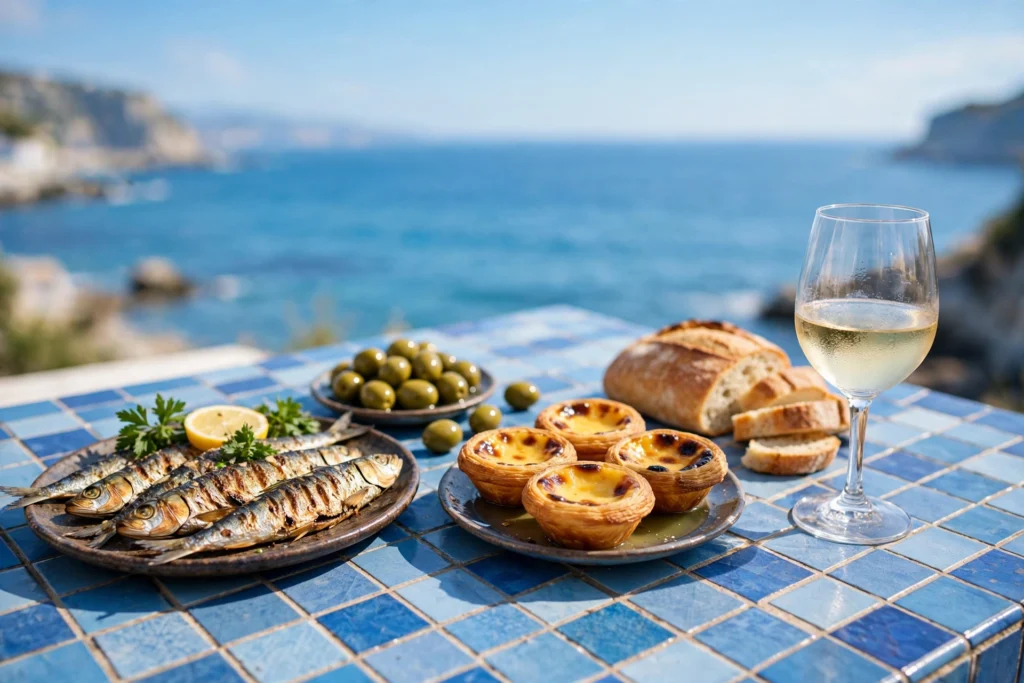
Portuguese food is not a single cuisine. It is a set of regional cuisines, and the joy of a Portugal trip is eating your way from region to region, with the food changing as the landscape changes. The fish of the Atlantic coast, the meat of the interior, the wine of the Douro, and the sweets of the convents all belong to different places, and the best meals in Portugal are the ones that belong to the place you are in. This section is organised by region, because that is how the food works.
In Lisbon, eat the custard tart, the pastel de nata, warm from the oven with cinnamon and icing sugar, and the grilled sardines, the sardinhas assadas, that are the food of the summer festivals. The sardines are grilled over charcoal, served with bread and salad, and eaten with your hands, and they are the reason June in Lisbon smells of smoke and fish. The city’s tascas, the small family restaurants, serve the food of the whole country: bacalhau, the salt cod that Portugal claims to cook in 365 ways, one for every day of the year, and the most famous of them, bacalhau à brás, shredded cod with egg, onion and fried potato. The cod is the national dish, and the claim is not a joke: the Portuguese eat more cod per person than any other country, and the fish comes from the cold waters of the North Atlantic, salted and dried, because Portugal has no cod of its own.
In Porto, eat the francesinha, the great sandwich of bread, ham, sausage and steak, covered in melted cheese and a beer and tomato sauce, and served with chips. It is a meal that needs a whole afternoon to recover from, and it is the dish that defines the city. Porto is also the city for tripe, the tripas à moda do Porto, the dish that gave the city’s people their nickname, the tripeiros, and for the fresh fish of the Matosinhos, the fishing port just north of the city, where the restaurants grill the catch of the day over charcoal. And Porto is the city for port wine, not as a dessert but as a drink in its own right: a glass of tawny port, aged in wood, with a piece of cheese, is one of the great pleasures in Portugal.
In the Douro Valley, eat the food of the wine country: the roast kid, the cabrito assado, the smoked meats, the cornbread, and the olive oil that is pressed in the valley itself. The quintas serve lunch with their tastings, and the best meals in the Douro are the ones at the estates, where the food is cooked for the harvest workers and the wine is the estate’s own. The Douro’s table wines, the reds and whites that are not port, are among the best in Portugal, and they are the wines to drink with dinner in the valley, not the port, which is for after.
In the Algarve, eat the fish of the Atlantic: the grilled sardines, the cataplana, the great copper pot of clams, prawns and fish cooked in white wine, and the percebes, the goose barnacles that are the most expensive and most prized shellfish in Portugal. The Algarve’s food is the food of the fishing towns: simple, fresh, and cooked over charcoal, with bread and olive oil. The region’s sweets are the almond and fig cakes of the convents, and its wine is the light, fresh wine of the region, to be drunk cold with fish.
In the Alentejo, eat the food of the plain: the black pork, the porco preto, the free-range black pork that feeds on acorns and gives the region its great hams and sausages, the bread, the olive oil, and the hearty soups and stews that are the food of the farm. The Alentejo is the region for slow food, and its restaurants are the ones to linger in, with a bottle of the region’s red wine and a long lunch. And everywhere in Portugal, eat the bread: the Portuguese bake some of the best bread in Europe, and the bread on the table is not a filler, it is part of the meal.
Food by region at a glance
| Region | Eat this | Drink this | Where to eat it |
|---|---|---|---|
| Lisbon | Custard tarts, grilled sardines, bacalhau à brás | Vinho verde, ginjinha | Tascas, Belém bakery |
| Porto | Francesinha, tripe, fresh fish | Port, Douro red | Riverside restaurants, Matosinhos |
| Douro Valley | Roast kid, smoked meats, cornbread | Douro table wine, port after dinner | Quintas, Pinhão restaurants |
| Algarve | Cataplana, grilled sardines, percebes | Algarve white, vinho verde | Fishing-town restaurants, Lagos, Olhão |
| Alentejo | Black pork, bread, olive oil, stews | Alentejo red | Évora restaurants, farm restaurants |
| Central (Coimbra) | Roast leitão, river fish | Bairrada wine | Coimbra restaurants, Bairrada |
The wine, honestly
Portugal makes more wine than it drinks, and the wine is better than most visitors expect. Vinho verde, the light, slightly sparkling wine of the Minho, is the wine for a hot day, and it is the wine to drink with fish in Lisbon and Porto. The Douro’s table wines are the great reds of the country, and they are the wines to drink with dinner in the valley and in Porto. Port is the wine for after dinner, or for a tasting in a lodge, and it is the wine to buy as a souvenir, because a bottle of vintage port is a gift that ages well. The Alentejo’s reds are the great wines of the plain, and they are the wines to drink with the region’s meat. And the rule for wine in Portugal is the same as the rule for food: drink the wine of the place you are in, and you will rarely go wrong.
How Much Does Portugal Cost? Real Budgets for 7, 10 and 14 Days
Portugal is one of the cheapest countries in Western Europe for eating out, and that is the fact that shapes the budget. A meal in a tasca, the small family restaurant where locals eat, costs about €12 to €15 for a main course, bread, wine and coffee, and a coffee standing at a counter costs about €1. Hotels are the biggest cost, and they vary sharply with the season: a good mid-range hotel in Lisbon costs €90 to €150 a night in May and September, and €60 to €90 in January. The train is cheap by European standards: the full Alfa Pendular fare from Lisbon to Porto is €35.70 in second class, and the advance Promo fares can be much cheaper, with sales from as low as €7.50 and typical advance fares in the €10 to €25 range. The daily budget for a mid-range traveller, staying in a good hotel, eating well, and taking the train between cities, is about €90 to €130 a day, and the table below breaks that down.
The costs that catch first-timers out are the small ones. The city tax — €4 a night in Lisbon, €3 in Porto, for at most seven nights — adds €28 or €21 per person to a week-long stay, and it is not always included in the price you see online. The Pena Palace ticket, €20, and the Jerónimos Monastery cloister, €18, are the two big-ticket sights, and they add up if you visit several museums. The port lodge tastings, €15 to €25 each, add up if you visit several lodges. And the Algarve in summer is more expensive than the rest of the country, with hotels and restaurants charging peak-season prices. The fix is to budget for the small costs, not just the big ones, and to book the big-ticket sights in advance, so you know what you are paying before you go.
The costed trip table below is for one person, sharing a mid-range double room, travelling in May or September, and it is a planning range, not a quote. Flights from the United States are not included, because they vary too much by city and by season, but a return flight from the East Coast to Lisbon in shoulder season typically costs $600 to $900, and from the West Coast $800 to $1,200. Check the live price for your dates before you book, and treat the figures below as the range to plan with, not the price you will pay.
Daily budget for a mid-range traveller
| Item | Per day, per person |
|---|---|
| Hotel (half of a mid-range double) | €45–€75 |
| Food and drink | €30–€45 |
| Transport (metro, tram, local trains) | €5–€10 |
| Sights and tastings | €10–€20 |
| City tax (averaged over a week) | €3–€4 |
| Total | €90–€150 |
Costed trips: 7, 10 and 14 days
| Trip | Days | Hotel | Food | Trains and transport | Sights | Total per person |
|---|---|---|---|---|---|---|
| 7 days: Lisbon, Sintra, Porto | 7 | €350–€500 | €220–€300 | €80–€120 | €70–€110 | €720–€1,030 |
| 10 days: Lisbon, Porto, Douro, Algarve | 10 | €500–€750 | €320–€450 | €130–€200 | €110–€170 | €1,060–€1,570 |
| 14 days: Lisbon, Porto, Douro, Algarve, Évora | 14 | €700–€1,050 | €450–€630 | €180–€280 | €150–€240 | €1,480–€2,200 |
These totals are for one person sharing a room, in shoulder season, and they are the realistic picture for planning. A budget traveller, staying in hostels and eating in tascas, can do the same trips for about €60 to €90 a day, and a luxury traveller, staying in boutique hotels and eating in the best restaurants, will spend €200 a day or more. The point of the table is not the exact figure, but the shape: hotels are the biggest cost, food is the best value, and the train is the cheapest way to move between cities. Portugal is a country where the money goes further than in France, Italy or Spain, and that is one of the reasons it is so popular.
How to save money without spoiling the trip
Book the train early, because the Promo fares are the cheapest way to travel between cities, and they sell out. Book the hotel early for May, June and September, because the best mid-range hotels sell out weeks ahead. Eat in the tascas, not in the restaurants on the main tourist squares, because the food is better and the price is half. Buy a Lisboa Card only if you will visit the big-ticket sights, because it only pays for itself if you use it. And travel in May or September, not in July or August, because the hotels are cheaper, the queues are shorter, and the weather is better. The cheapest good-weather window is late April or late October, when the prices are at their lowest and the weather is still good.
The 7-Day, 10-Day and 14-Day Portugal Itineraries by Train
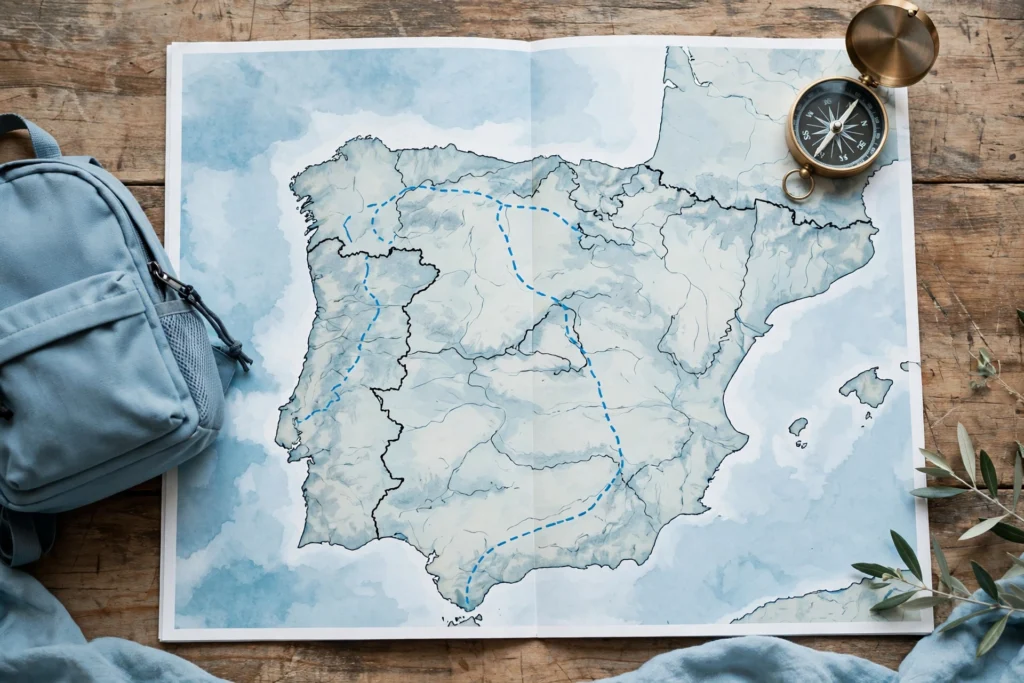
The itineraries below are built from the same five stops, so you can see exactly what each extra day buys you. The 7-day trip is the classic first trip: Lisbon, Sintra, Porto and the Douro. The 10-day trip adds the Algarve. The 14-day trip adds the Algarve properly, with both coasts, and Évora. All three use the train, and none of them needs a car. Book the Alfa Pendular legs in advance for the best Promo fares on the CP journey planner, and book Pena Palace and the Jerónimos Monastery in advance for the timed slots.
The 7-day itinerary: Lisbon, Sintra, Porto and the Douro
| Day | Where | What you do |
|---|---|---|
| 1 | Lisbon | Arrive, Alfama and the castle, dinner in Bairro Alto |
| 2 | Lisbon | Baixa, Chiado, Santa Justa Lift, fado in the evening |
| 3 | Lisbon and Sintra | Day trip to Sintra: Pena Palace in the morning, Quinta da Regaleira in the afternoon |
| 4 | Lisbon and Belém | Jerónimos Monastery, Belém Tower, custard tarts, evening train to Porto |
| 5 | Porto | Old town, Sé, São Bento station, Clérigos Tower, Ribeira at dusk |
| 6 | Porto and Gaia | Port lodges in Gaia, dinner on the Gaia waterfront |
| 7 | Douro Valley | Day trip by train to Pinhão, boat trip, quinta tasting, evening train back to Porto, fly home |
The 10-day itinerary: the 7-day trip plus the Algarve
| Day | Where | What you do |
|---|---|---|
| 1–3 | Lisbon | As in the 7-day trip, with an extra day for the museums and the Chiado |
| 4 | Sintra | Day trip: Pena Palace and Quinta da Regaleira |
| 5 | Lisbon to Porto | Morning train to Porto, afternoon in the old town |
| 6 | Porto | Port lodges, Gaia, dinner on the waterfront |
| 7 | Douro Valley | Day trip by train to Pinhão, boat trip, quinta tasting |
| 8 | Porto to the Algarve | Morning train to Faro, afternoon in the old town, evening in Tavira |
| 9 | Algarve east | Ferry to Tavira Island, lunch in Olhão, Ria Formosa |
| 10 | Algarve west | Train to Lagos, boat trip through the Ponta da Piedade, fly home from Faro |
The 14-day itinerary: the 10-day trip, done properly
| Day | Where | What you do |
|---|---|---|
| 1–3 | Lisbon | As in the 7-day trip, with a day for Cascais and the coast |
| 4 | Sintra | Day trip: Pena Palace, Quinta da Regaleira and the Moorish Castle |
| 5 | Évora | Day trip to Évora: Roman Temple, Chapel of Bones, Alentejo lunch |
| 6 | Lisbon to Porto | Morning train to Porto, with a half-day stop in Coimbra |
| 7–8 | Porto | Old town, port lodges, Foz do Douro, a slow day |
| 9 | Douro Valley | Overnight in Pinhão: two quintas, a long boat trip, the valley at dawn |
| 10 | Douro to the Algarve | Train back to Porto, then south to Faro, evening in Tavira |
| 11–12 | Algarve east | Tavira, Olhão, the Ria Formosa islands, Faro |
| 13–14 | Algarve west | Lagos, Sagres, the Ponta da Piedade, the cliff walks, fly home from Faro |
How to choose your itinerary
Pick the 7-day trip if this is your first visit and you have a week. It is the classic route, and it is the one that gives you Lisbon, Porto and the Douro without rushing. Pick the 10-day trip if you want the Algarve as well, and you are happy to move every two or three days. Pick the 14-day trip if you want to do the country properly, with both Algarve coasts and Évora, and you want a day to spare for the unexpected. And remember the rule that runs through this whole guide: if your trip is shorter than five days, pick one city and do it properly. A rushed Portugal trip is worse than a short one, and the country will still be there for a second trip.
Frequently Asked Questions
Do US citizens need a visa for Portugal?
No. Ordinary US passport holders do not need a visa for tourism or short business trips of up to 90 days in any 180-day period across the Schengen Area. Your passport must be valid for at least three months beyond your date of departure from Schengen, and it must have at least two blank pages. There is no visa fee to pay.
Do I need an ETIAS authorisation for Portugal?
Not for a trip in 2026 or early 2027. ETIAS is not in operation as of late November 2026, and it has no confirmed start date. The European Union’s official portal confirms that no applications are being collected, and the EU says it will announce the start date several months before launch. Do not pay any website that offers to sell you an ETIAS authorisation today.
What is EES, and will it affect my trip?
EES is the Entry/Exit System, the European Union’s digital border register for non-EU short-stay travellers. It began a phased rollout on 12 October 2025 and became fully operational on 10 April 2026. On your first entry into the Schengen Area, border officers record your fingerprints and take a facial image, and the system counts your days against the 90/180 rule. Allow extra time at the border on your first entry, and do not be surprised if your passport comes back without a stamp.
How long is the train from Lisbon to Porto?
The Alfa Pendular takes about 2 hours 45 minutes from Lisbon to Porto Campanhã, and the slower Intercidades takes about 3 hours 15 minutes. The full Alfa Pendular fare in second class is €35.70 in 2026, with cheaper advance Promo fares if you book early. Both trains leave from Lisbon Santa Apolónia and Lisbon Oriente, and both stop at Coimbra-B on the way.
How many days do I need in Portugal?
Seven days is the minimum for a proper first trip: three days in Lisbon, a day trip to Sintra, two or three days in Porto, and a day in the Douro Valley. Ten days adds the Algarve. Fourteen days lets you do the Algarve properly, with both coasts, and add Évora. If you have fewer than five days, pick one city — Lisbon or Porto — and do it properly.
Is Portugal safe for US travellers?
Yes. The US State Department rates Portugal at Level 1, Exercise Normal Precautions, the lowest tier it gives any foreign country, with an advisory issued on 11 December 2025. The main risk is petty theft in crowded tourist areas and on public transport, especially Lisbon’s Tram 28. Keep your bag in front of you, and you will be fine. The Atlantic is the real danger: swim only where a lifeguard is on duty, and obey the flag system.
What is the best time to visit Portugal?
May and September are the best months for the classic route: warm everywhere, the sea warm enough to swim in, and the crowds thinner than in high summer. April and October are nearly as good. July and August are best for the Algarve, but hot and crowded in the cities. Winter is cheapest and quietest, and it suits Lisbon and Porto, but many Algarve resorts close.
Do I need a car in Portugal?
No, not for a first trip. The train runs from Porto through Coimbra to Lisbon and on to Faro, with a branch line through the Douro Valley and suburban trains to Sintra and Cascais. A car is useful only for the deep Alentejo and the far corners of the Douro Valley beyond the railway. Lisbon and Porto are both cities of steep hills and scarce parking, and a car adds cost and stress.
How much does a trip to Portugal cost?
A mid-range traveller, sharing a double room, should budget about €90 to €150 a day, or about €720 to €1,030 for a 7-day trip, €1,060 to €1,570 for 10 days, and €1,480 to €2,200 for 14 days, not including flights from the United States. Portugal is one of the cheapest countries in Western Europe for eating out, with a meal in a local restaurant costing about €12 to €15.
What is the city tax in Lisbon and Porto?
Lisbon charges €4 per guest per night, for guests aged 13 and over, for at most seven nights per stay, so no more than €28 per person. Porto charges €3 per guest per night, on the same basis, so no more than €21 per person, and Vila Nova de Gaia charges the same €3. The tax is added to your accommodation bill, and it is set by each city council, so it can change.
Can I do the Douro Valley as a day trip from Porto?
Yes, and the train is the way to do it. The Linha do Douro leaves Porto São Bento and follows the river to Pinhão in about 2 hours 30 minutes. Take an early train, spend the morning in Pinhão, take a boat trip on the river, visit a quinta in the afternoon, and take a late train back to Porto. An overnight in the valley is better if you have the time, because it lets you visit two quintas and see the valley at dawn.
Should I visit Madeira or the Azores on the same trip?
No, not on a first mainland trip. Madeira and the Azores are separate flights from Lisbon or Porto, and each needs its own trip — at least four days for Madeira, and at least a week for the Azores. The islands are wonderful, but they are not add-ons to a mainland itinerary. Save them for a second trip, and do the mainland properly first.
Conclusion: Portugal by Train Is the Trip to Take in 2026–27
Portugal is the easiest country in Western Europe to see without a car, and that is the reason to go by train. One line runs from Porto through Coimbra to Lisbon and on to Faro, with a branch through the Douro Valley and a short ride to Sintra, and that line holds the whole classic trip. Lisbon in three days, Porto in two or three, the Douro in a day, Sintra in a day, and the Algarve in two or three, with the west cliffs and the east lagoons as a real choice, not a compromise. The entry rules are simple — no visa for US citizens, no ETIAS yet, and a biometric border system that is already running. The advisory is Level 1, the lowest tier. The food is regional, the wine is better than you expect, and the costs are among the lowest in Western Europe. Book the train early, book Pena Palace and the Jerónimos Monastery in advance, pick one Algarve coast and do it properly, and leave the islands for a second trip. Portugal by train is not the rushed version of the country. It is the right version, and it is the trip to take in 2026–27.
People also read:
- Lisbon travel guide — the city in depth, with the neighbourhoods, the trams and the day trips that this country guide only summarises.
- Spain travel guide — the neighbour across the border, and the natural next trip after Portugal.
- France travel guide — the other great rail-first country in Western Europe, and the model for the train-first trip.
- Italy travel guide — the Mediterranean classic, with the same rail-first logic applied to a longer route.
- Travel safety tips — the preparation that makes any trip safer, from packing to insurance to what to do if something goes wrong.
- What travel insurance covers — the exclusions that catch people out, and what to check before you buy.

M. Adil is the founder and editor of SoloTravelPro. He writes practical, research-based travel guides that help travellers plan with confidence — from first-time city breaks to national parks and island escapes. Every guide is built on official sources, current prices and honest, usable advice, so readers can plan smarter and travel better.

Other Articles

Vietnam Travel Guide: North to South the Slow Way in 2026–27
France Travel Guide: Paris, the Loire and the Riviera in 2026–27