France Travel Guide: Paris, the Loire and the Riviera in 2026–27
France is the most visited country on earth, and it is also the easiest European trip to get wrong. The mistake is almost always the same: trying to see all of it at once. Paris, the Loire châteaux, Provence, the Riviera, Normandy, Bordeaux and the Alps are each a full holiday on their own, and they are spread across a country larger than California. This France travel guide is built on one rule that fixes that istake — pick Paris plus ONE region, and give that region the days it deserves. Inside you will find the cluster-first plan, the best months with honest crowd and price trade-offs, the visa and entry rules for US citizens as they stand in late 2026, what the US travel advisory really means, day-by-day Paris plans, a Loire châteaux picker, a Riviera base choice, Normandy logistics, 7-day, 10-day and 14-day routes, TGV booking logic, food by region, and a fully costed trip budget in euros, so you can plan a first trip to France without the mistakes most first-timers make.
France Travel Guide: The Cluster Rule — Pick One Region to Pair with Paris
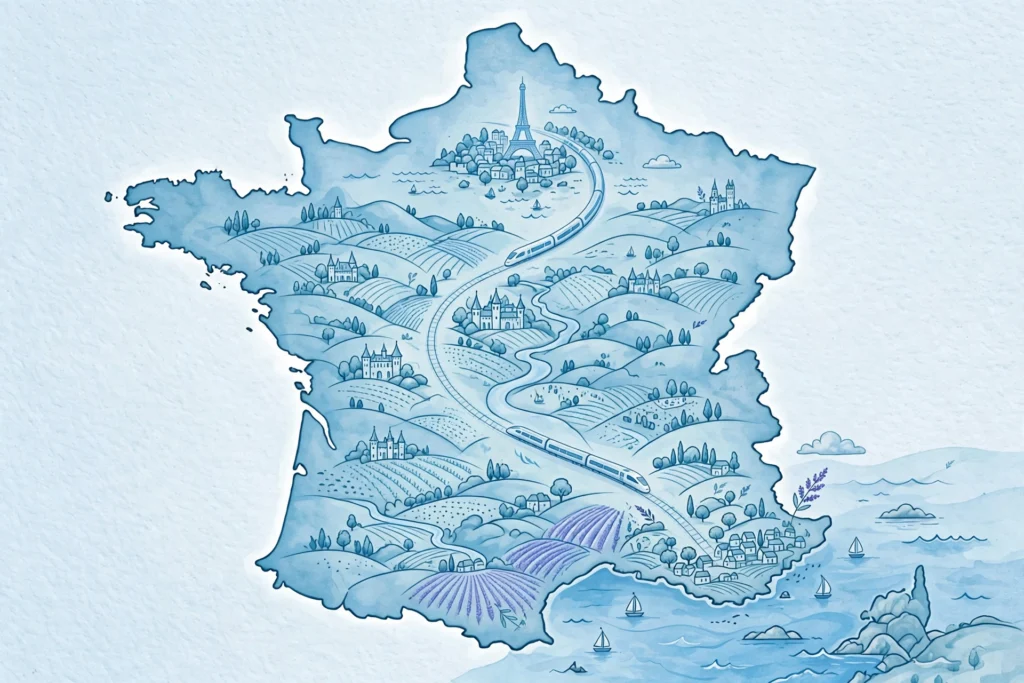
The single most important fact in this whole France travel guide is the shape of the country. Metropolitan France covers about 551,000 square kilometres, and its great sights are not arranged in a neat line. Paris to Nice is roughly 930 kilometres. Paris to the D-Day beaches of Normandy is about 300 kilometres in the opposite direction. Paris to Bordeaux is around 580 kilometres. A traveller who tries to cover Paris, the Loire, Provence, the Riviera and Normandy in ten days spends most of the trip in transit, arriving everywhere tired and seeing everything through a train window. That is the most common way a first trip to France goes wrong, and it is entirely avoidable.
The fix is the cluster rule, and it shapes everything else in this guide: Paris plus one region. Paris is the anchor — it is where most flights from the United States land, it holds the densest collection of world-class sights anywhere in Europe, and it deserves four full days on its own. Then you add exactly one cluster, chosen by what you actually want from the trip, and you give it three to seven days. The clusters are the Loire Valley for châteaux and gardens, the French Riviera for coast and glamour, Normandy for history and the sea, Provence for villages and lavender, Bordeaux for wine, and the Alps for mountains. Each one is a complete holiday. Two clusters in one trip is possible on a 14-day trip if they sit on the same rail line — Paris, the Loire and then Provence works, because the TGV runs south through both — but three clusters in any trip under two weeks is a mistake, and the guide will keep saying so, because the temptation to add “just one more” is the trip-killer.
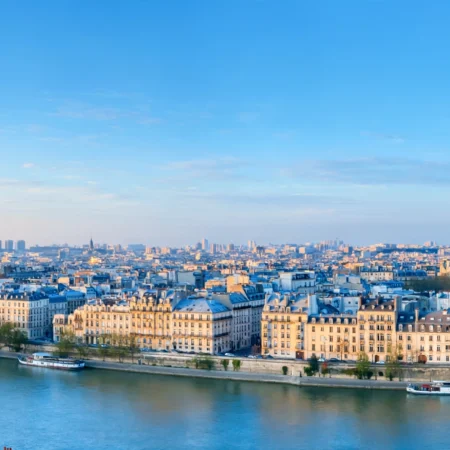
The second reality check is about pace. France rewards slow days more than almost any country in Europe. Paris needs four days, not two, because the city is a collection of villages — the Marais, Montmartre, Saint-Germain, the Latin Quarter — and because its best experiences are unhurried ones: a long lunch, an hour in a museum you chose deliberately, a walk along the Seine at dusk. The Loire needs at least three days, because the châteaux are spread along 280 kilometres of river and each one deserves half a day. The Riviera needs four days, because the coast towns are close together but each one — Nice, Antibes, Èze, Menton — rewards a slow morning. If your trip is shorter than five days, pick Paris alone and do it properly. A rushed France trip is worse than a short one, because the distances punish every shortcut and the queues punish every late start.
The third reality check is about what “seeing France” actually means. France is not a checklist of famous names. The Eiffel Tower, the Louvre and Versailles are extraordinary, but the trip most travellers remember is the one with a morning market in a small town, a vineyard lunch, a beach at sunset, or a village square where the only sound is a fountain. That is why this guide spends as much time on how to choose a base and how to move slowly as it does on the famous sights. The famous sights are in here too, with the practical detail — ticket prices, opening days, booking windows — that turns a name on a list into a day that works.
The six clusters at a glance
| Cluster | Best for | Days needed | TGV from Paris |
|---|---|---|---|
| Loire Valley | Châteaux, gardens, wine, cycling | 3–4 | ~1h to Tours, then car or local train |
| French Riviera | Coast, beaches, hill villages, glamour | 4–5 | ~5h30 to Nice, ~3h to Avignon then on |
| Normandy | D-Day history, Mont-Saint-Michel, food | 3–4 | ~2h to Caen or Bayeux via train |
| Provence | Lavender, villages, markets, Roman sites | 4–5 | ~2h40 to Avignon, ~3h to Marseille |
| Bordeaux and the southwest | Wine, Atlantic coast, food | 3–4 | ~2h05 to Bordeaux |
| French Alps | Mountains, skiing, lakes, hiking | 4–5 | ~3h to Annecy or Grenoble, then bus |
How to use this guide
Read the sections in order if this is your first trip: the best time to go, the visa and entry rules, the safety picture, then Paris, then the clusters, then the itineraries, food, costs and transport. If you already know when you are going, skip straight to the itinerary that matches your trip length — the 7-day, 10-day and 14-day plans are built from the same clusters, so you can see exactly what each extra day buys you. Every price in this guide is given as a range in euros, because a figure quoted as exact would be out of date within weeks; the ranges are checked against live official pages in November 2026, and the guide tells you where to check the current figure before you pay.
Best Time to Visit France: Months, Crowds and Prices
There is no single best month for the whole of France, because the country has several climates at once: Paris is temperate and changeable, the Riviera is Mediterranean and mild, the Loire is gentle and green, the Alps are cold in winter and fresh in summer, and Provence can be fiercely hot in July. The answer depends on which cluster you have chosen, but for the classic first trip — Paris plus one region — the sweet spot is clear: April to June, and September to October. Those are the months when Paris is comfortable, the gardens are at their best, the châteaux are open and uncrowded, the Riviera is warm enough to swim in, and the prices have not yet hit their summer peak.
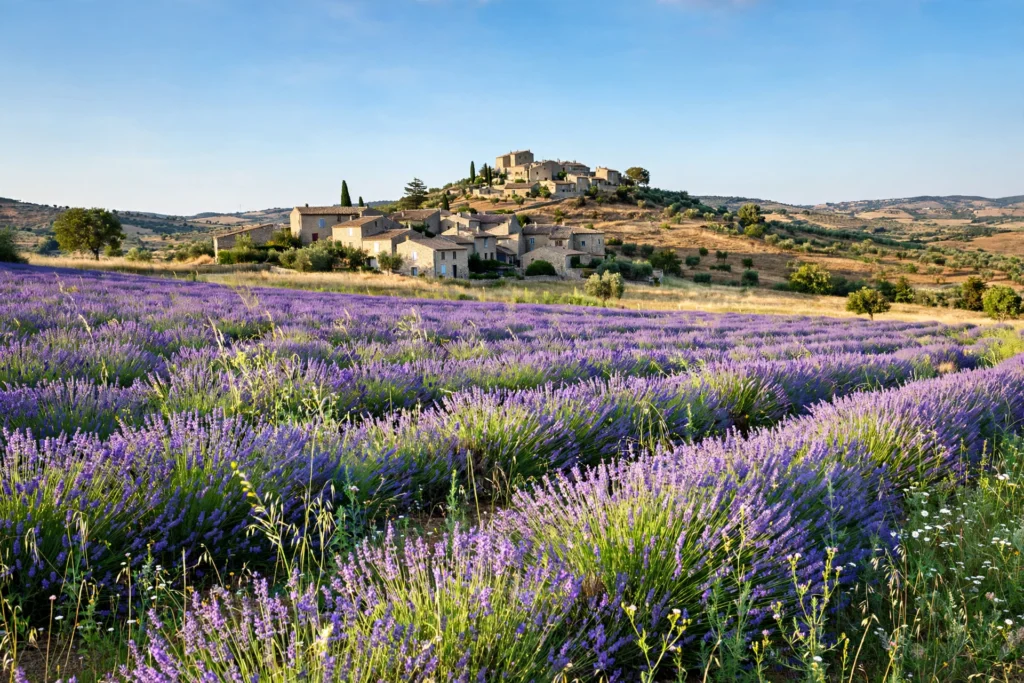
April is the month of blossom and long light. Paris in April averages around 12–16°C, the chestnut trees along the boulevards are in flower, and the museum queues are still manageable. The Loire is green and quiet, and the gardens at Villandry and Chaumont-sur-Loire are at their most beautiful. May is, for most travellers, the single best month: warm everywhere, with Paris around 16–20°C, the Riviera already warm enough for the beach, lavender beginning to colour the fields of Provence, and the whole country ahead of the summer crowds. June is warm and long-dayed, with daylight until nearly 10 p.m. in Paris, the lavender in full bloom in Provence by mid-to-late June, and the coast in full season — but the inland sites start to get hot by midday, and the school holidays in France begin to push prices up at the end of the month.
Summer — July and August — is the season to think about carefully rather than to avoid outright. The Riviera is at its best, the sea is warm, the resorts are fully open, and the long evenings are made for harbour dinners. But Paris is hot and crowded, the queues at the Louvre and the Eiffel Tower are at their longest, the châteaux are packed with tour groups, and Provence can reach 35°C or more, which makes village walking a morning-only activity. August is also the month when many small French businesses close for holidays, so a village that looks lively in June can feel shuttered in August. If summer is the only time you can go, build the trip around the coast and the mountains, book everything early, and do the big sights first thing in the morning. For more on picking cheap months in general, our guide to the cheapest time to travel explains how shoulder seasons work across destinations.
September is the other great month. The sea is at its warmest after the summer, the crowds thin sharply after the first week, the light in Provence turns golden, the grape harvest begins in Bordeaux and Burgundy, and Paris is at its most pleasant. October keeps the Riviera warm into the first half of the month and brings autumn colour to the Loire, with cooler evenings that suit walking — and it is the month when the great museums offer free admission on the first Sunday, a tradition that runs from October to March. Winter — November to March — is the cheapest season and the quietest, and it suits a particular kind of trip very well. Paris in winter is atmospheric, cheaper, and mostly free of queues, and the city belongs to locals again. The Christmas markets in Strasbourg and the Fête des Lumières in Lyon in early December are genuinely special. But the Riviera is quiet and cool, many coastal hotels and restaurants close, the Loire gardens are bare, and the Alps are the exception — winter is their high season, with skiing at its best from December to March.
Month-by-month at a glance
| Month | Paris | Loire | Riviera | Provence | Verdict |
|---|---|---|---|---|---|
| April | Mild, blossom, 12–16°C | Green, quiet gardens | Mild, 17–20°C | Mild, wildflowers | Excellent |
| May | Warm, 16–20°C | Warm, best gardens | Warm, beach season starts | Warm, lavender begins | Best month |
| June | Warm, long days | Warm, long days | Warm sea, busy | Lavender in bloom | Very good |
| July–August | Hot, crowded, queues | Hot at midday | Best sea, busiest | Very hot, 30–35°C | Good for the coast |
| September | Pleasant, golden | Golden light | Warmest sea, thinner crowds | Harvest, golden | Excellent |
| October | Cool evenings | Autumn colour | Warm sea early in the month | Cool, quiet villages | Very good |
| November–March | Cool, quiet, cheap | Bare gardens, quiet | Cool, many places closed | Quiet, mistral winds | Paris and the Alps only |
How the seasons affect prices
Prices follow the seasons more sharply in France than in most of Europe. A hotel in Nice can cost roughly twice as much in July as in January. Paris hotel rates peak in May, June and September — the conference and fashion seasons — and drop in January and February. TGV fares are cheapest when booked about three months ahead and most expensive in the week before departure, especially around French school holidays. If your dates are flexible, the cheapest good-weather window is usually late April or late October — shoulder-season prices with near-peak weather. The tourist tax is an extra cost to budget for: in Paris in 2026 it runs from €2.60 a night per adult in a one-star hotel to €15.93 in a palace hotel, with a three-star hotel at €5.53 a night per adult, according to the official rates published by the French public service. That tax is charged per person per night on top of the room rate, and it applies across the Paris region.
Foodie seasons worth planning around
France eats by the season, and the calendar of food is one of the best reasons to choose your month deliberately. January is truffle season in the Périgord and Provence, when black truffles appear on menus across the southwest. Spring brings asparagus and the first strawberries. Summer is tomato, peach and melon season in Provence, and oyster season never really stops on the Atlantic coast, though the oysters are at their finest in the months with an “r” in the name. September to March is Mont d’Or season — the soft, runny cheese from the Jura mountains that is sold in wooden boxes and eaten with a spoon. October is the grape harvest and the mushroom season. December is oyster and foie gras season, and the Christmas markets sell vin chaud by the cup. If food is the reason you are going, pick the month by the plate, not by the weather forecast.
Do US Citizens Need a Visa for France? EES, ETIAS and the 90-Day Rule
The short answer, for most American travellers, is no visa is needed. Ordinary US passport holders do not need a visa to visit France for tourism or short business trips. You can stay visa-free for up to 90 days in any 180-day period, and there is no visa fee to pay. That rule is confirmed on the US State Department’s France page, checked live in November 2026, which states plainly: “No visa required for stays less than 90 days.” It is the same 90/180 rule that applies across the whole Schengen area, so days spent in France, Italy, Spain, Germany or any other Schengen country all count toward the same 90 days. Keep a count, because the 90 days are counted over a rolling 180-day window, not per trip — a long stay followed by a quick return can catch you out.
Your passport itself has rules too. It must be valid for at least three months beyond your date of departure from the Schengen area, though the State Department recommends six months of validity remaining, and it must have at least one blank page. France does not recognise the 12-page US emergency passport for entry — immigration officers can refuse boarding or entry, so do not travel to France on an emergency passport unless you have checked with the French authorities first. You also need proof of funds and a return ticket, and you must declare cash of €10,000 or more on entry and exit.
EES: the system that is already running
The change that actually affects US travellers in 2026 is the Entry/Exit System, known as EES. This is the European Union’s digital border register, and it has been fully operational since 10 April 2026, after a phased rollout that began on 12 October 2025. On your first entry into the Schengen area, a border officer records your fingerprints and takes a facial image, and the system creates a digital record of your entry and exit instead of stamping your passport. On later trips, the system checks your face against that record. In practice, this means two things for you: allow extra time at passport control on your first trip since the system started, because the first registration takes a few minutes, and do not expect a passport stamp as proof of your entry date — the EES record is the proof, and the system counts your days against the 90/180 rule itself.
ETIAS: the system that is not running yet
ETIAS — the European Travel Information and Authorisation System — is the one that causes the confusion, because it has been announced, delayed, and announced again for years. Here is the position as checked live on 26 November 2026: ETIAS is not in operation, no applications are being collected, and there is no confirmed launch date. The European Union removed its previous “last quarter of 2026” launch target from the official ETIAS website in July 2026, and the EU agency that builds the system, eu-LISA, states plainly on its official page that “ETIAS is currently not in operation and no applications for travel authorisations are collected at this point.” Press reports in autumn 2026 point to 2027 as the likely launch year, but that is an expectation, not an official date, and the EU has promised to announce the start date several months in advance.
What this means for your trip is simple: you do not need an ETIAS authorisation to travel to France in 2026, and there is nothing to apply for and nothing to pay. When ETIAS does launch, it will be an online pre-travel authorisation for visa-exempt travellers, including US citizens, costing €20, valid for short stays in 30 European countries, and applied for only through the official EU website. Until then, any website that offers to sell you an ETIAS authorisation today is fraudulent — the French embassy’s own pages say so in plain language, and you should never pay a third-party site for a document that does not exist yet. Check the official ETIAS status on the eu-LISA ETIAS page before you travel, and do not trust any other site on this question.
Entry checklist for US citizens
| Requirement | The rule for US citizens (checked November 2026) |
|---|---|
| Visa for tourism | Not required — visa-free up to 90 days in any 180 days |
| ETIAS authorisation | Not in operation — nothing to apply for or pay |
| EES registration | Fingerprints and facial image on first entry since April 2026 |
| Passport validity | At least 3 months beyond departure from Schengen; 6 months recommended |
| Blank pages | At least one page for stamps |
| Emergency passport | 12-page US emergency passport not recognised for entry into France |
| Work or study | Visa from a French embassy or consulate, applied for in advance |
| Stay beyond 90 days | Long-stay visa, applied for before travel |
| Cash declaration | €10,000 or more must be declared on entry and exit |
If someone in your party holds a different passport
The rule is decided passport by passport, not by the group. A spouse or travelling companion with a passport that is not visa-exempt may still need a Schengen visa, even though you do not. Check every passport in your party separately on the French embassy or consulate website before you book, and apply only through the official channels — never through a third-party site that charges a markup. And remember the practical side: even without a visa, border officers still check that you are a genuine visitor, so keep your return flight details and your first night’s hotel address easy to reach on your phone.
Is France Safe for US Travellers? The Advisory, Honestly Explained
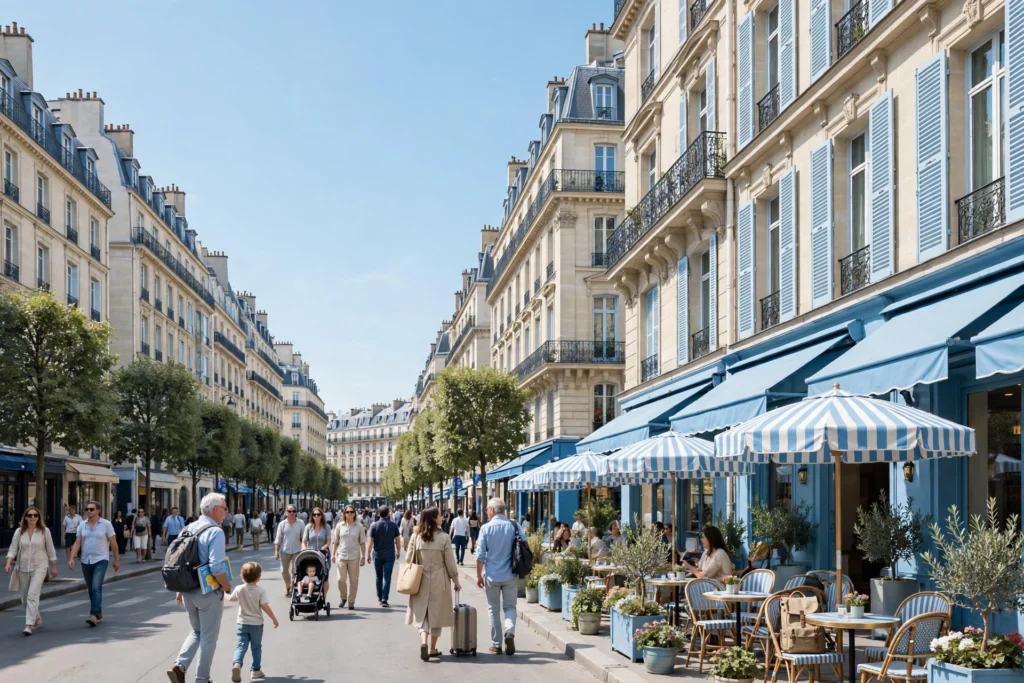
The US State Department rates France at Level 2: Exercise Increased Caution. That is the fact that matters most, and it needs context, because a bare “Level 2” tells you almost nothing on its own. The advisory was reissued on 21 October 2026 and, checked live in November 2026, it reads: “Exercise increased caution in France due to terrorism and unrest.” Level 2 is the same tier the United States gives to much of Western Europe, including Italy, Spain, Germany and the United Kingdom, and it means something specific: travel, but be more alert than you would be at home, and read the detail underneath the headline. You can read the full text on the State Department’s France travel advisory page, and you should read it twice — once when you book, and again the week before you fly, because advisories change.
The detail underneath the headline is where the real information lives. The October 2026 update followed a wave of protests and rioting, and the advisory’s summary is blunt: “Violence and rioting have recently occurred in France and may continue. Avoid demonstrations and areas of unrest. Stay away from areas with large crowds or significant police activity.” Demonstrations and strikes happen often in Paris and other French cities, and the advisory warns that protests can disrupt transport, can turn violent or cause property damage, and that police may respond with force, including water cannons and tear gas. That is the practical core of the advisory: avoid demonstrations entirely, stay away from areas with large crowds or heavy police activity, and be ready to change your plans at short notice if a protest day closes a metro station or a museum.
The advisory also covers terrorism, and this part deserves a plain reading. Terrorist groups continue to plan possible attacks in France and may attack with little or no warning, and the advisory lists the possible targets: tourist locations, transport hubs and airports, markets and shopping malls, local government facilities, hotels, restaurants and clubs, places of worship, major sporting and cultural events, educational institutions, parks and other public areas. That list is frightening to read, and it is also the standard list the State Department attaches to every Level 2 European country. The right way to read it is as background alertness, not as a reason to stay home: stay alert in crowded public places, follow the instructions of local authorities, and check local media for breaking events. A Europe-wide holiday security alert issued on 13 November 2026 asked Americans to stay vigilant at holiday markets, festivals and transport hubs; it did not change France’s advisory level.
The risks that actually affect tourists most often are far more ordinary. Pickpocketing and phone thefts are common, especially in crowded places — the advisory names airports, subways and train cars, tourist attractions and train stations — and Paris has some of the most skilled pickpockets in Europe, working the queues at the Eiffel Tower, the steps of Sacré-Cœur, the RER from the airport, and the crowded carriages of metro line 1. The practical advice is simple: keep your bag in front of you, keep your phone in an inside pocket, wear a money belt or a cross-body bag with a zip, and never put a bag on the back of a chair in a café. Our full travel safety tips guide covers the same preparation in depth for any destination.
What to do before you go
Enrol in the Smart Traveler Enrollment Program, known as STEP, on the State Department’s STEP enrolment page. It is free, it takes about ten minutes, and it lets the nearest US embassy or consulate contact you in an emergency and help your family reach you. Save the emergency number — 112 works for police, ambulance and fire across France and the whole European Union — and save the address of the US Embassy in Paris, 2 Avenue Gabriel, 75008 Paris, telephone +33-1-43-12-22-22. Read the CDC Travelers’ Health pages for France: no vaccinations are required for most travellers. Buy travel insurance that covers emergency medical care and evacuation, and read what it excludes before you need it — our guide to what travel insurance covers explains the exclusions that catch people out.
Staying safe day to day
Keep your bag in front of you in crowded places, use ATMs inside banks, split your money and cards so one theft cannot strand you, and agree taxi fares in advance or use the meter — or use a ride-hailing app rather than an unmarked car. Dress modestly in churches, and remember that France has strict rules about photographing military sites and security installations. If a protest blocks your route, do not try to push through it; find a safe place, shelter in place if you cannot leave the area, and wait for the crowd to pass. If something goes wrong, call 112 first, then your insurer’s 24-hour assistance line, then the embassy. And if you are ever told by a stranger at the airport or the station that your hotel is closed or overbooked, do not believe it — that is one of the oldest scams in the world, and the answer is to go to the hotel yourself or call it on the number you already have.
Paris in 4 Days: The Capital, Done Properly
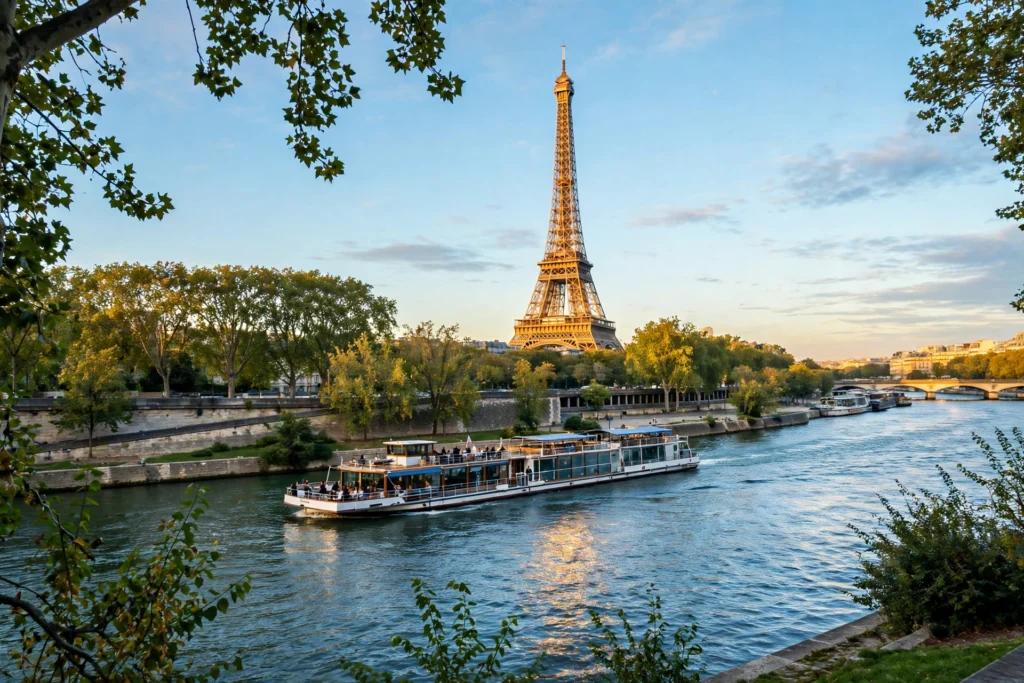
Paris is the only city in the world that rewards four days and still leaves you wanting more, and it is also the city most punished by a rushed visit. Four days is the right amount of time: one day for the icons, one day for the museums, one day for the neighbourhoods, and one day for Versailles or a slow day of your own choosing. The plan below assumes you are staying centrally — the Marais, Saint-Germain, the Latin Quarter or the area around the Louvre — and that you are using the metro, which is fast, cheap and runs until around 1 a.m. on Fridays and Saturdays. Buy a Navigo Easy card and load it with tickets on your phone, or buy a carnet of ten tickets; a single ride costs a little over €2, and a day pass is worth it only if you are riding more than five times.
Start with the icons, and start early. The Eiffel Tower opens at 9:30 a.m., and the first hour of the day is the only time the queues are short. Book the summit in advance on the official tower website — the ticket to the summit costs around €29–€30 for an adult, the second floor around €18–€19, and the stairs to the second floor are the cheapest way up and the best workout in Paris. From the tower, walk along the Seine to the Louvre, and spend the afternoon there — but do it with a plan, because the Louvre is the largest museum in the world and a planless visit is a wasted one. Book a timed ticket on the official Louvre ticket office: since 14 January 2026 the full-price ticket costs €32 for visitors from outside the European Economic Area, including US citizens, and €22 for EEA citizens and residents, with free entry for under-18s and for EEA residents aged 18 to 25. The museum is closed every Tuesday, open until 9 p.m. on Wednesdays and Fridays, and until 6 p.m. on other days, with last entry one hour before closing. Go straight to the Denon wing for the Mona Lisa and the Winged Victory, then out into the Richelieu or Sully wings while your legs are still fresh. Two hours is enough for the highlights; a full day is enough for the museum to defeat you.
Day two is the museum day, and the rule is one big museum in the morning and one small one in the afternoon. The Musée d’Orsay, in a converted railway station across the river from the Louvre, holds the world’s great collection of Impressionist painting — Monet, Renoir, Degas, Van Gogh — and it is a far more human-sized museum than the Louvre, at around €16 for an adult. In the afternoon, choose by taste: the Rodin Museum for sculpture and a beautiful garden, the Musée de l’Orangerie for Monet’s Water Lilies in two oval rooms, or the Centre Pompidou for modern art and the best rooftop view in Paris. Between them, walk through the Tuileries Gardens and across the Pont des Arts, and stop for a long lunch — Paris is a city where lunch is an event, not a refuelling stop, and a two-course formule at a neighbourhood bistro costs around €18–€25.
Day three: the neighbourhoods
Day three belongs to the neighbourhoods, and it is the day most first-timers skip and most return visitors say was their favourite. Start in Montmartre, early, before the crowds reach the steps of Sacré-Cœur. The basilica is free to enter and the view from its steps is the best free view in Paris. Then walk down through the village streets of Montmartre — the Rue du Chevalier de la Barre, the Place du Tertre, the vineyard on the Rue des Saules — and down to the Marais for the afternoon. The Marais is the oldest part of Paris still standing, and it is where you will find the Place des Vosges, the oldest planned square in the city, the Picasso Museum, and the best falafel and the best Jewish bakeries in Paris on the Rue des Rosiers. Finish the day in Saint-Germain-des-Prés, with a coffee at Les Deux Magots or the Café de Flore — expensive, yes, and worth it once — and a walk along the Rue Bonaparte as the light turns gold.
Day four: Versailles, or a slow Paris
Day four is a choice. Versailles, 20 kilometres southwest of Paris, is the most visited palace in France, and it deserves a full day: the Hall of Mirrors, the King’s apartments, the gardens designed by Le Nôtre, and the Trianon palaces and Marie Antoinette’s hamlet at the far end of the park. Take the RER C to Versailles Rive Gauche, book a timed ticket in advance, and arrive at opening time — the palace is closed on Mondays. Alternatively, stay in Paris and have the slow day the city rewards: the Père Lachaise cemetery in the morning, the Canal Saint-Martin in the afternoon, a market on the Rue Mouffetard, and a Seine cruise at sunset. A one-hour cruise costs around €12–€17, and the hour after sunset, when the monuments light up, is the best hour on the river.
Where to stay in Paris
Where you stay matters more in Paris than in most cities, because the city is a collection of villages and the wrong base costs you an hour a day. The Marais is the best first-timer base: central, beautiful, full of restaurants, and walkable to the Louvre, Notre-Dame and the Place des Vosges. Saint-Germain-des-Prés is the most elegant base, and the most expensive. The Latin Quarter is the liveliest and the best value, with the cheapest bistros and the most student energy. Montmartre is the most romantic and the least central, with the steepest streets. Avoid staying near the Gare du Nord and Gare de l’Est unless you have a reason to be there — the area is convenient for trains and thin on charm. Budget around €150–€250 a night for a decent three-star hotel in the centre in shoulder season, €100–€150 for a good two-star, and €60–€100 for a well-reviewed hostel bed in a dorm or a small private room outside the centre. Add the tourist tax on top: €5.53 a night per adult in a three-star hotel in 2026.
Paris day by day
| Day | Morning | Afternoon | Evening |
|---|---|---|---|
| Day 1 | Eiffel Tower at opening, Champ de Mars | Louvre, Denon wing first | Seine walk, dinner in the Marais |
| Day 2 | Musée d’Orsay | Rodin or Orangerie, Tuileries | Saint-Germain café, Rue Bonaparte |
| Day 3 | Montmartre and Sacré-Cœur | Marais, Place des Vosges | Latin Quarter, Rue Mouffetard |
| Day 4 | Versailles, or Père Lachaise | Gardens and Trianon, or Canal Saint-Martin | Seine cruise at sunset |
The Loire Valley: How to Pick Your Châteaux
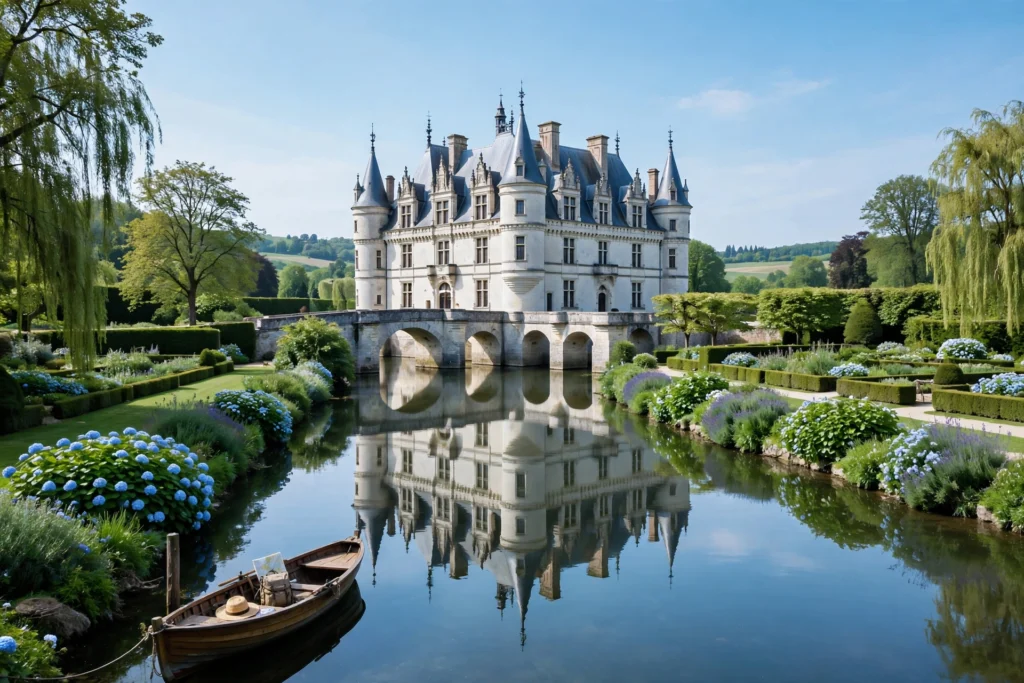
The Loire Valley is the easiest cluster in this guide to get wrong, because there are more than 300 châteaux along the river and its tributaries, and the difference between a great three days and a forgettable one is which five or six you choose. The valley is a UNESCO World Heritage site, the river is France’s longest, and the châteaux were built by kings and their courtiers in the 15th and 16th centuries, when the Loire was the centre of French power. The rule is simple: pick five châteaux, see one in the morning and one in the afternoon, and spend the time between them in the gardens, the villages and the vineyards, not on the road. A car is the best way to see the Loire — the châteaux are spread along 280 kilometres of river, and public transport between them is slow — but you can do it by train and bicycle too, and the Loire à Vélo cycle route runs 900 kilometres along the river, flat and well marked.
The picker below is built on one question: what do you actually want from a château? If you want the most beautiful, go to Chenonceau. If you want the biggest and the most spectacular, go to Chambord. If you want the gardens, go to Villandry. If you want the history, go to Amboise, where Leonardo da Vinci spent his last years. If you want the most romantic, go to Azay-le-Rideau, reflected in its lake. If you want the most dramatic setting, go to Chaumont-sur-Loire, high above the river with its festival of gardens. Five châteaux, three days, one base — that is the Loire done properly.
The châteaux picker
| Château | What it is | Why pick it | Time needed |
|---|---|---|---|
| Chenonceau | The “ladies’ château”, arched over the river Cher | The most beautiful château in France | Half a day |
| Chambord | The largest Loire château, 440 rooms, double-helix staircase | Scale, the roofline, the park | Half a day |
| Villandry | Renaissance château with famous formal gardens | The gardens, not the house | Half a day |
| Amboise | Royal residence, Leonardo da Vinci’s tomb | History, the town, the views | Half a day |
| Azay-le-Rideau | Small château on an island in the Indre | Romance, the reflection, the park | 2–3 hours |
| Chaumont-sur-Loire | Hilltop château with a garden festival | The setting, the garden festival | Half a day |
| Blois | Four wings, four centuries of architecture | The architecture lesson | 2–3 hours |
| Chinon | Fortress above the Vienne, Joan of Arc | Medieval history, the wine town | Half a day |
Chenonceau deserves the first morning. The château spans the river Cher on five arches, and the gallery that crosses the water is one of the most beautiful rooms in France. It was built and loved by a succession of powerful women — Diane de Poitiers and Catherine de’ Medici among them — which is why it is called the château des dames. Arrive at opening time, walk the gallery before the tour groups arrive, and then spend an hour in the gardens and the vegetable garden, which supplies the château’s own restaurant. Admission is around €15–€17 for an adult. Chambord deserves the second morning, and for the opposite reason: it is enormous, with 440 rooms, 365 fireplaces and a double-helix staircase that is attributed to Leonardo da Vinci, and the roofline — a forest of chimneys, turrets and lanterns — is the most photographed silhouette in the valley. Rent a bicycle in the park, ride to the canal, and look back at the château from the water.
Where to base yourself in the Loire
Tours is the best base for a first Loire trip: a proper city with a good train station, a lively old town, and easy access to Chenonceau, Villandry, Azay-le-Rideau and Amboise. Amboise is the prettiest base, a small town on the river with the royal château above it and Leonardo’s house, the Clos Lucé, a short walk away — but it has fewer restaurants and less to do in the evening. Blois is the most central base, good for Chambord and Chaumont, but less charming than Amboise. Wherever you base yourself, rent a car for at least two days; the train from Paris to Tours takes about an hour on the TGV, and the car hire desks at Tours station are used to exactly this trip. Budget around €100–€150 a night for a good hotel in Tours or Amboise in shoulder season, and €60–€80 a day for a rental car with insurance.
The Loire in three days
Day one: TGV from Paris to Tours, pick up the car, drive to Villandry for the gardens in the morning and Azay-le-Rideau in the afternoon, then dinner in Tours. Day two: Chenonceau in the morning, Amboise and the Clos Lucé in the afternoon, with a wine tasting in Vouvray on the way back — the white wines of Vouvray and Montlouis are the Loire’s great secret, and a tasting at a small producer costs around €10–€15. Day three: Chambord in the morning, Chaumont-sur-Loire in the afternoon, then the TGV back to Paris or onward south. Three days, five châteaux, one wine tasting, and no day longer than an hour’s driving — that is the Loire at its best.
The French Riviera: Nice, Cannes or Antibes as Your Base
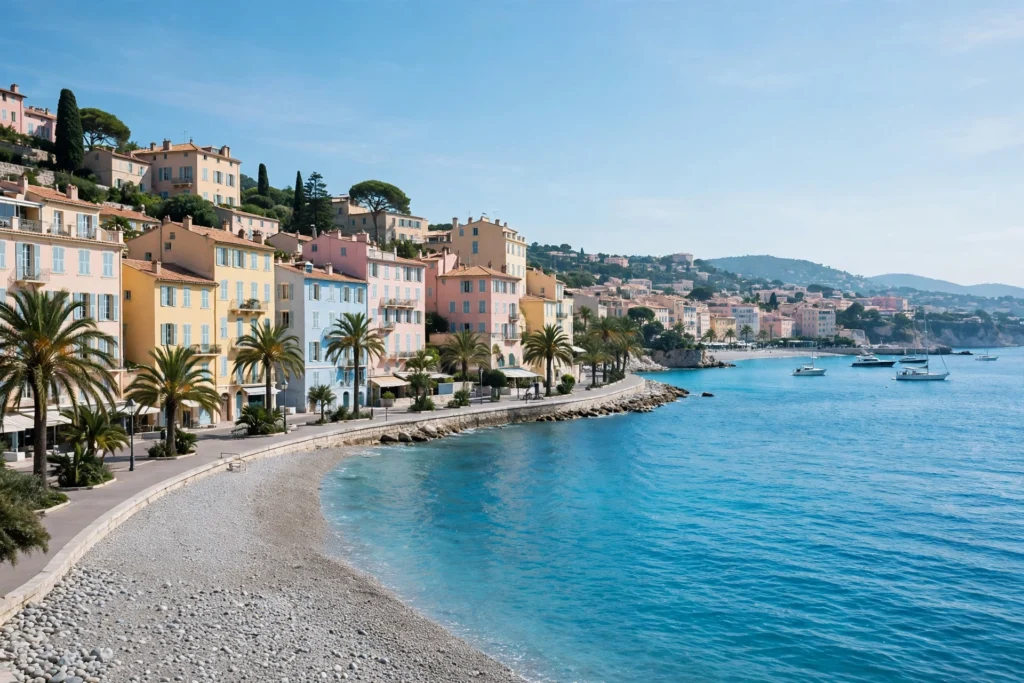
The French Riviera — the Côte d’Azur — is the most glamorous coastline in Europe, and the most misunderstood. First-timers imagine it as one long beach of luxury hotels, and then discover that it is actually a string of very different towns, each with its own character, joined by a coastal railway that makes the whole coast easy to explore without a car. The rule for the Riviera is the base rule: pick one town, stay there for four or five nights, and use the train to visit the others. Moving hotels every night along the coast is the fastest way to spend the trip packing and unpacking, and the coast is small enough that a single base works — Nice to Cannes is about an hour by train, Nice to Menton is about 40 minutes, and Nice to Antibes is about 20 minutes.
Nice is the best base for most travellers. It is a real city, not just a resort, with a beautiful old town, the Cours Saleya flower market, the Promenade des Anglais along the bay, and the best transport links on the coast — the airport, the main train station, and the tram to the old town. The beaches in Nice are pebble, not sand, which surprises first-timers; bring water shoes or buy a pair at the market for a few euros. Cannes is the most glamorous base, and the most expensive — the Croisette, the film festival palace, the sandy beaches, and the harbour full of yachts — but it is also the least interesting town to walk in, and it empties out when the festival is not on. Antibes is the best base for travellers who want charm over glamour: a walled old town, a superb market, the Picasso Museum in the Château Grimaldi, and sandy beaches at Juan-les-Pins, with prices noticeably lower than Nice or Cannes.
The Riviera base comparison
| Base | Best for | Beaches | Prices | Train links |
|---|---|---|---|---|
| Nice | First-timers, food, markets, transport | Pebble, bring water shoes | Mid-range | Best on the coast |
| Cannes | Glamour, film festival, sandy beaches | Sand, private beach clubs | Highest | Good |
| Antibes | Charm, markets, Picasso, families | Sand at Juan-les-Pins | Lower than Nice | Good |
| Menton | Quiet, Italian border, lemons, gardens | Pebble and sand mix | Mid-range | Good, end of the line |
| Èze | A day trip, not a base | None — hilltop village | High | Bus only, no station |
What to do on the Riviera
Start with Nice itself: the Cours Saleya market in the morning, the old town’s narrow streets, the climb to Castle Hill for the view over the Baie des Anges, and a swim from the pebble beach in the afternoon. The Matisse Museum and the Chagall Museum are both in the Cimiez quarter, and both are worth half a day each — Matisse lived in Nice for decades, and the museum holds the largest collection of his work anywhere. Then take the train to Antibes for the market and the Picasso Museum, where Picasso worked in 1946 and left behind a series of paintings and ceramics. Take the bus up to Èze, the hilltop village between Nice and Monaco, and walk the Nietzsche path down to the sea if your knees are up to it — the view from the exotic garden at the top is one of the best on the coast, and the garden costs around €7 to enter.
Monaco deserves half a day, not a full one, and the train from Nice takes about 20 minutes. Walk the harbour, see the Prince’s Palace and the changing of the guard at 11:55 a.m., visit the Oceanographic Museum, and stand on the steps of the Casino de Monte-Carlo — you do not need to go inside, and the dress code and the €18 entry fee put most travellers off. Then come back to Nice for dinner in the old town, where a socca — the chickpea pancake that is Nice’s street food — costs around €3–€4 and is the best cheap meal on the coast. Our guide to the cheapest time to travel has more on how shoulder seasons cut Riviera prices, and the Italy travel guide covers the Ligurian coast just across the border from Menton, which makes a natural extension to a Riviera trip.
Riviera costs and practicalities
The Riviera is the most expensive cluster in this guide, and the costs are concentrated in two places: hotels and beach clubs. A private beach club in Cannes or Nice charges around €25–€40 a day for a sun lounger and umbrella in summer, while the public beaches are free and just as good for swimming. A hotel in Nice costs around €150–€250 a night in shoulder season and €250–€400 in July and August. Restaurants on the seafront charge a premium for the view; walk one street back from the water and the same meal costs a third less. The coastal train is the best deal on the Riviera: a day ticket covering Nice to Cannes to Menton costs only a few euros more than a single journey, and the trains run every 30 minutes.
Normandy: D-Day Beaches and Mont-Saint-Michel
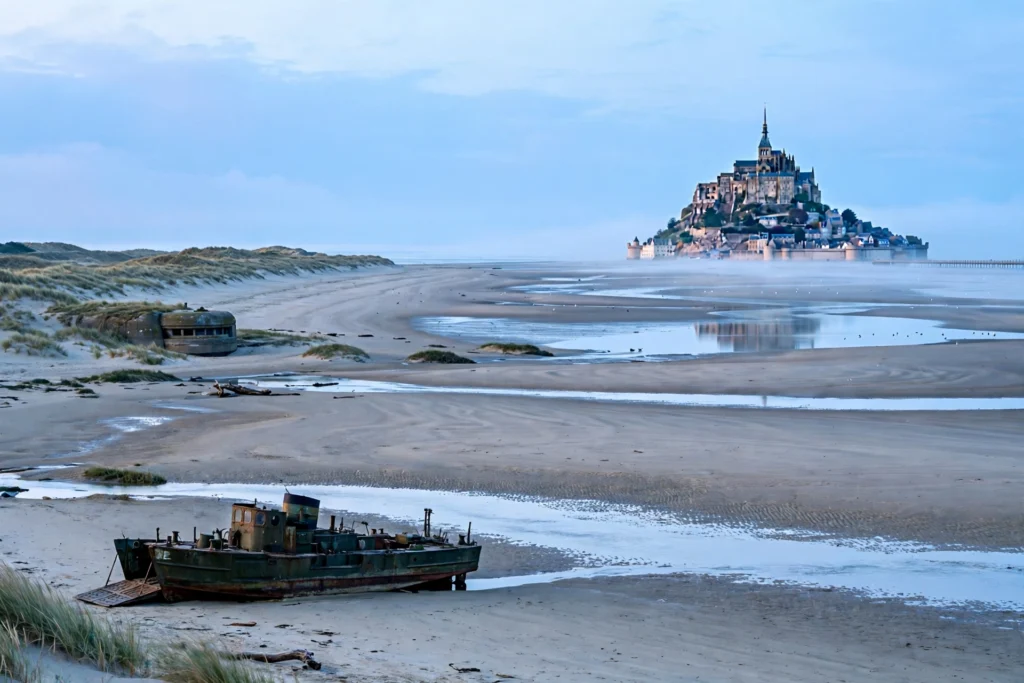
Normandy is the cluster that most first-timers add as an afterthought and most return travellers say was the highlight. It has two completely different draws — the D-Day beaches and the great abbey of Mont-Saint-Michel — and they sit about 150 kilometres apart, which is why the cluster needs three or four days and a car. The history is the reason most people come, and it deserves to be taken slowly: the beaches, the cemeteries and the museums are not a checklist, and the best way to see them is to base yourself in Bayeux, a small medieval town that was the first French town liberated on D-Day and that escaped the bombing almost untouched.
Start with the beaches, and start with the American sector. Omaha Beach is the most famous, and the most moving: a long, flat, beautiful beach that looks peaceful now and was a killing ground on 6 June 1944. Above it sits the Normandy American Cemetery at Colleville-sur-Mer, with 9,388 white crosses and Stars of David in perfect rows on the bluff, and the visitor centre that tells the story of the landing through the words of the men who were there. Admission to the cemetery is free, and the visitor centre is free too. Utah Beach, to the west, is quieter and has an excellent museum in a former German bunker. Pointe du Hoc, between Omaha and Utah, is where US Rangers scaled 30-metre cliffs under fire, and the cratered ground is still visible today. On the British and Canadian side, Gold Beach at Arromanches still has the remains of the Mulberry artificial harbour visible at low tide, and the museum at Arromanches explains how it was built; Juno Beach has the Canadian centre, and Sword Beach has the Pegasus Bridge museum, where the first glider troops landed in the early hours of D-Day.
The Normandy plan
| Day | Where | What to see |
|---|---|---|
| Day 1 | Bayeux | Bayeux Tapestry, cathedral, old town |
| Day 2 | American sector | Omaha Beach, American Cemetery, Pointe du Hoc, Utah Beach |
| Day 3 | British and Canadian sector | Arromanches, Gold Beach, Juno Beach, Pegasus Bridge |
| Day 4 | Mont-Saint-Michel | The abbey, the bay, the causeway at high tide |
Bayeux itself deserves a full day, and not just as a base. The Bayeux Tapestry — an 11th-century embroidery, 70 metres long, telling the story of the Norman Conquest of England — is one of the great artworks of the medieval world, and the museum that holds it is excellent, with an audio guide that walks you through the story scene by scene. Admission is around €12–€15. The cathedral is one of the finest Norman Romanesque churches in France, and the old town, with its timber-framed houses and its river, is the most beautiful small town in Normandy. Eat in Bayeux, too: the town’s restaurants serve the best of Norman food — Camembert from the village of the same name, cider from the orchards, and the seafood of the Cotentin coast.
Mont-Saint-Michel is the second half of the cluster, and it needs a full day of its own. The abbey rises from a tidal island in a vast bay, and the tides here are among the largest in Europe — the difference between high and low water can be 14 metres, and the sea comes in, as Victor Hugo wrote, “at the speed of a galloping horse”. The practical rules are simple: park at the visitor car park and take the free shuttle to the island, or walk the causeway in about 35 minutes; book the abbey ticket in advance, around €13–€16 for an adult; arrive early or late in the day to avoid the crowds; and never, ever walk out onto the bay without a licensed guide, because the quicksand and the rising tide have killed people. The best time to see the island is at high tide, when it becomes a true island again, and the tide times are published on the abbey’s website — check them before you choose your day. Staying overnight on the island itself is expensive and the rooms are small, but the evening, after the day visitors have left, is magical; the alternative is to stay in the village at the foot of the causeway or in the town of Avranches, 20 minutes away.
Normandy food and drink
Normandy is the food cluster as much as the history cluster. The region produces Camembert, Livarot and Pont-l’Évêque cheeses, cider and Calvados apple brandy, and the best seafood in France — oysters from the Cotentin, mussels from the bay, and the scallops of Port-en-Bessin. A meal in a Bayeux bistro costs around €20–€30 for two courses, and a bottle of local cider costs less than a glass of wine in Paris. The Cider Route, a 40-kilometre signposted drive through the Pays d’Auge, takes you through orchards and half-timbered villages to small producers who will let you taste for free — and it is the best slow afternoon in Normandy after the beaches.
Provence, Bordeaux and the Alps: The Other Clusters
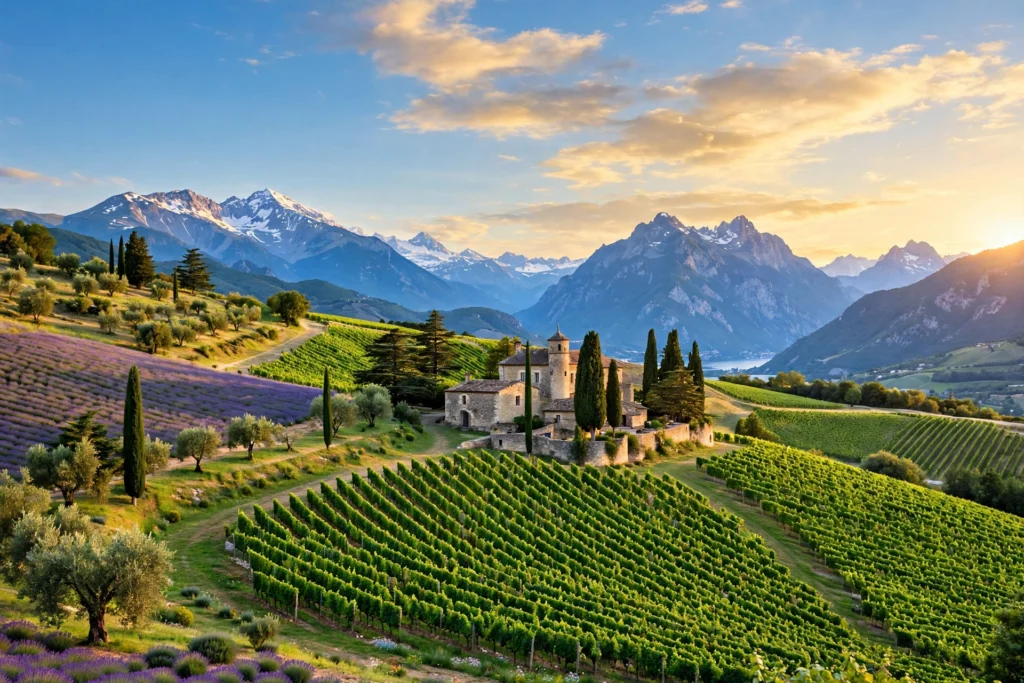
If the Loire, the Riviera and Normandy do not fit your trip, the other three clusters are just as strong, and the choice between them comes down to what you want the trip to feel like. Provence is the cluster for villages and light. Bordeaux is the cluster for wine and food. The Alps are the cluster for mountains and fresh air. Each one is a full holiday, and each one pairs with Paris on the same TGV lines, so the logistics are the same: four days in Paris, then the TGV south or east, then three to five days in the cluster.
Provence is the region of lavender, hilltop villages, Roman ruins and markets, and it is best seen slowly, by car, from a base in Avignon or Aix-en-Provence. Avignon is the better base for a first trip: the Palais des Papes, the largest Gothic palace in Europe, dominates the old town, and the Pont Saint-Bénézet — the broken bridge of the song — stands in the Rhône below it. From Avignon you can reach the Pont du Gard, the best-preserved Roman aqueduct in the world, in 30 minutes; the hilltop village of Les Baux-de-Provence in 40 minutes; and the Luberon villages of Gordes, Roussillon and Bonnieux in about an hour. The lavender fields bloom from mid-June to mid-July, and the Valensole plateau, an hour east of Avignon, is where the great purple fields are — go at sunrise, when the light is soft and the tour buses have not arrived. Aix-en-Provence, an hour south, is the prettier base, with its Cours Mirabeau, its fountains and its Cézanne trail, but it is further from the Luberon and the Rhône. Budget around €120–€200 a night for a good hotel in Avignon or Aix in shoulder season.
Bordeaux is the wine cluster, and it is the most underrated city in France. The city itself was transformed in the last twenty years: the riverfront was rebuilt, the Place de la Bourse and its water mirror became one of the most photographed squares in Europe, and the Cité du Vin, a museum shaped like a wine glass, opened on the river. The TGV from Paris takes about 2 hours 5 minutes, which makes Bordeaux the fastest cluster in this guide to reach. The wine country starts 30 minutes outside the city: Saint-Émilion, a medieval village built around a monolithic church carved from rock, is the prettiest wine town in France, and the Médoc, north of the city, holds the great châteaux of Margaux, Pauillac and Saint-Julien. A tasting at a small producer costs around €10–€20, and a tour of a great château costs €25–€50; book both in advance, because the best producers do not take walk-ins. Bordeaux is also the gateway to the Atlantic coast: Arcachon, an hour away, has the great dune of Pilat, the largest sand dune in Europe, and the oyster villages of the bay.
The French Alps are the mountain cluster, and they are the best choice if your trip is in winter or if you want fresh air and lakes in summer. Annecy is the prettiest base, a town of canals and pastel houses on a turquoise lake, with the mountains rising behind it — and it is a genuine town, not a ski resort, so it works in every season. Chamonix is the great mountain base, at the foot of Mont Blanc, with the Aiguille du Midi cable car rising to 3,842 metres in 20 minutes — the view from the top, across the glaciers and the peaks, is one of the great sights in Europe, and the ticket costs around €70–€75 return. In summer the Alps are for hiking, lake swimming and mountain biking; in winter they are for skiing, and the resorts of Courchevel, Méribel and Val d’Isère are among the best in the world, with lift passes around €60–€70 a day. The TGV from Paris to Annecy takes about 3 hours 40 minutes with a change, and to Grenoble about 3 hours.
Which cluster fits your trip?
| Cluster | Pick it if you want | Skip it if | Best months |
|---|---|---|---|
| Provence | Villages, lavender, markets, Roman sites | You dislike driving | May–June, September |
| Bordeaux | Wine, food, a beautiful city | You do not drink wine | May–June, September–October |
| Alps | Mountains, lakes, skiing, hiking | You want beaches or cities | December–March, June–September |
| Loire | Châteaux, gardens, gentle cycling | You want the sea | April–June, September |
| Riviera | Coast, glamour, hill villages | You are on a tight budget | May–June, September |
| Normandy | History, food, the sea | You have less than 3 days | May–September |
The 7-Day, 10-Day and 14-Day France Itineraries
The itineraries below are built from the same pieces — four days in Paris, then one cluster — so you can see exactly what each extra day buys you. They are not the only way to do France, but they are the way that works: they keep the travel days short, they keep the bases to two, and they leave room for the slow days that make the trip memorable. Every itinerary assumes you fly into Paris and out of Paris, or out of Nice or Marseille if you are doing the southern clusters, which saves a day of backtracking.
The 7-day trip is Paris plus the Loire, and it is the best first trip to France that exists. Days one to four are the Paris plan from the Paris section: the icons and the Louvre, the museums, the neighbourhoods, and Versailles or a slow day. Day five is the TGV to Tours, the car, and Villandry and Azay-le-Rideau. Day six is Chenonceau in the morning and Amboise in the afternoon, with a wine tasting in Vouvray. Day seven is Chambord in the morning and the TGV back to Paris in the afternoon. Seven days, two bases, five châteaux, and not a single day with more than an hour’s driving. If you have only a week, this is the trip.
The 10-day trip adds the Riviera, and it is the classic France holiday: Paris, then the TGV south to the coast. Days one to four are Paris. Day five is the TGV from Paris to Avignon, about 2 hours 40 minutes, and the afternoon in Avignon — the Palais des Papes and the old town. Day six is the Luberon villages: Gordes, Roussillon and Bonnieux, with lunch in a village square. Day seven is the drive or train to Nice, and the afternoon on the Promenade des Anglais and in the old town. Day eight is Antibes and the Picasso Museum in the morning, and Èze in the afternoon. Day nine is Monaco in the morning and a last swim and dinner in Nice. Day ten is the flight home from Nice airport, which is 20 minutes from the old town by tram. Ten days, three bases, and the two great southern regions in one trip — but note that this itinerary works because Provence and the Riviera sit on the same rail line south from Paris. Two clusters only work when they are neighbours.
The 14-day trip is the full version: Paris, the Loire, Provence and the Riviera, in that order, following the TGV south. Days one to four are Paris. Days five to seven are the Loire, as in the 7-day plan. Days eight to ten are Provence, based in Avignon: the Palais des Papes, the Pont du Gard, and the Luberon villages. Days eleven to thirteen are the Riviera, based in Nice: the old town and the markets, Antibes and Èze, and Monaco. Day fourteen is the flight home from Nice. Fourteen days, four bases, and the whole arc of France from the capital to the Mediterranean — and still no day with more than three hours of travel, because the TGV does the long distances and the car does the short ones.
The three itineraries compared
| Trip | Days | Route | Bases | Best for |
|---|---|---|---|---|
| 7-day | 7 | Paris + Loire | Paris, Tours | First trip, châteaux |
| 10-day | 10 | Paris + Provence + Riviera | Paris, Avignon, Nice | The classic south |
| 14-day | 14 | Paris + Loire + Provence + Riviera | Paris, Tours, Avignon, Nice | The full arc |
| 7-day Normandy | 7 | Paris + Normandy | Paris, Bayeux | History, D-Day |
| 10-day wine | 10 | Paris + Loire + Bordeaux | Paris, Tours, Bordeaux | Wine and food |
The Normandy and wine variants
If history is the reason you are going, swap the Loire for Normandy: four days in Paris, then the train to Bayeux, and three days for the beaches, the tapestry and Mont-Saint-Michel. If wine is the reason, swap Provence for Bordeaux: four days in Paris, three days in the Loire, and three days in Bordeaux and Saint-Émilion, flying home from Bordeaux airport. The structure is the same — Paris plus one or two neighbouring clusters — and the structure is what makes the trip work, whatever you put inside it.
Getting Around France: TGV, OUIGO and Driving
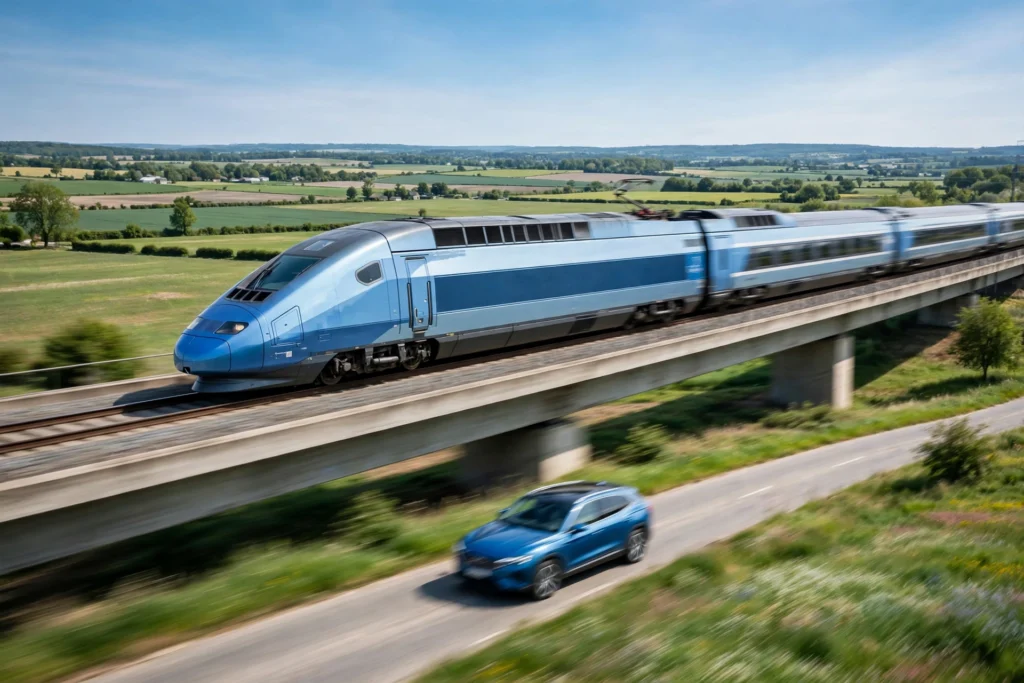
France has the best train network in Europe for a visitor, and the worst thing you can do is ignore it. The TGV — Train à Grande Vitesse — runs at up to 320 km/h on dedicated high-speed lines, and it turns journeys that would take a day by car into a morning’s ride. The rule is simple: take the train between regions, and drive or take local transport inside a region. The train is faster, cheaper when booked early, and far less tiring than driving, and it drops you in the centre of the city, not at an airport an hour away.
Book on SNCF Connect, the official booking platform, which sells TGV INOUI, the low-cost OUIGO, Intercités and regional TER tickets, and which works in English. Book as early as you can — tickets go on sale about three to four months ahead, and the cheapest fares sell first. A Paris to Lyon ticket booked three months ahead can cost €19–€29; the same ticket bought the day before can cost €80–€120. That is not a small difference; it is the difference between the train being the cheapest option and the most expensive one. The same logic applies to every route: book early, travel off-peak, and avoid Friday evenings and Sunday evenings, when the trains are full of weekend travellers and the fares are at their highest.
TGV times from Paris
| Route | Fastest time | Paris station | Book-early fare | Last-minute fare |
|---|---|---|---|---|
| Paris to Lyon | ~2h | Gare de Lyon | €19–€29 | €80–€120 |
| Paris to Bordeaux | ~2h05 | Montparnasse | €19–€29 | €80–€120 |
| Paris to Strasbourg | ~1h45 | Gare de l’Est | €19–€29 | €70–€100 |
| Paris to Avignon | ~2h40 | Gare de Lyon | €25–€39 | €90–€130 |
| Paris to Marseille | ~3h15 | Gare de Lyon | €25–€39 | €90–€130 |
| Paris to Nice | ~5h30 | Gare de Lyon | €29–€49 | €110–€160 |
| Paris to Rennes | ~1h25 | Montparnasse | €19–€29 | €70–€100 |
OUIGO is the low-cost TGV, and it deserves a paragraph of its own, because it is both the cheapest way to cross France and the easiest to get wrong. OUIGO fares start from €10–€19, and the trains are the same high-speed trains on the same lines — but the rules are stricter: the luggage allowance is smaller and strictly enforced, with a fee for oversized bags; the trains sometimes leave from different stations, including the out-of-town Marne-la-Vallée and Massy stations; and the tickets are non-changeable and non-refundable. Check your departure station before you book, pack light, and measure your bag — OUIGO staff do check, and the fee at the station is higher than the fee online. If you are travelling with a large suitcase and a carry-on, the standard TGV INOUI is usually the better choice, and the price difference is small when both are booked early.
Driving in France
Driving is the right choice inside a region — the Loire, Provence, Normandy and the Dordogne are all best seen by car — and the wrong choice between regions. The motorways are excellent, fast and expensive: the tolls from Paris to the Riviera cost around €70–€90, and from Paris to Bordeaux around €50–€60. Fuel costs around €1.70–€1.90 a litre for petrol and a little less for diesel. The speed limit is 130 km/h on motorways in dry weather, 110 km/h in rain, 80 km/h on country roads, and 50 km/h in towns, and the fines for speeding are heavy and enforced by cameras. A US driving licence is valid in France for short stays, but you need an International Driving Permit as well if your licence is not in French — the rental company may not ask for it, but the police can. Rent the smallest car that fits your luggage, because the village streets in Provence and the Loire were built for horses, not SUVs, and book an automatic in advance if you cannot drive a manual, because most French rental cars are manual and automatics cost more and sell out.
Getting around Paris
Inside Paris, the metro is the answer, and the answer is almost always the metro, not a taxi. The metro has 16 lines and more than 300 stations, and almost everywhere a visitor wants to go is within a ten-minute walk of a station. A single ticket costs a little over €2, and the Navigo Easy card, loaded on your phone, is the easiest way to pay. The RER is the suburban train that also runs through the centre of Paris, and it is the way to get to Versailles, Disneyland and the airports — but it is also the line where pickpockets work hardest, especially the RER B from Charles de Gaulle airport, so keep your bag in front of you and your phone in an inside pocket. Taxis in Paris are metered and honest, but slow in traffic; a ride from the Eiffel Tower to the Marais can take 40 minutes at rush hour and cost €20–€25, while the metro takes 20 minutes and costs a little over €2. The buses are the most scenic way to cross the city, and the number 69 bus from the Eiffel Tower to Père Lachaise is one of the great free tours in Europe — for the price of a metro ticket.
What to Eat in France: Food by Region
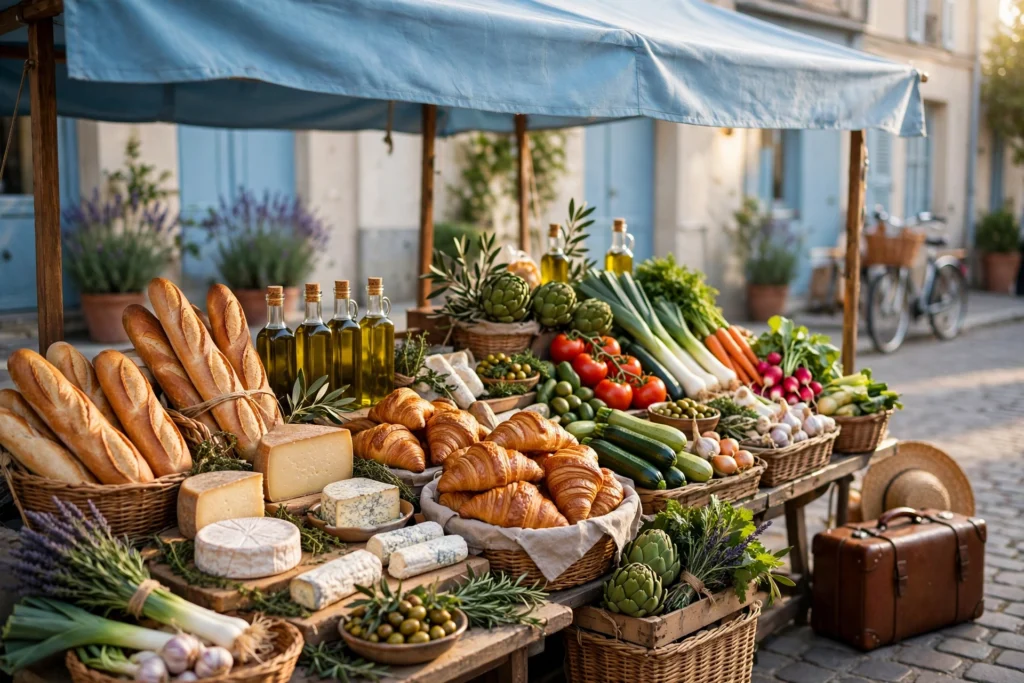
France does not have one cuisine; it has a dozen, and the food changes with the region as surely as the landscape does. The rule is to eat what the region is famous for, in the region where it is made: oysters on the Atlantic coast, bouillabaisse in Marseille, cassoulet in Toulouse, choucroute in Alsace, and the cheese of the mountains in the mountains. A traveller who eats the same thing in Paris and in Provence is missing the point of French food, which is that it is local, seasonal, and tied to the place in a way that few other cuisines are.
Paris is the city of the bistro, and the bistro is the most important institution in French food. A bistro is a small, informal restaurant with a short menu, a blackboard, and a formule — a fixed-price lunch of two or three courses, usually around €18–€25 at lunch and €28–€38 at dinner. The dishes to look for are the classics: steak frites, duck confit, onion soup, escargots, and the crème brûlée at the end. The rule for choosing a bistro is to look at the menu: if it is short, handwritten and in French only, it is probably good; if it is long, laminated, photographed and translated into six languages, walk on. The best bistros are a street away from the tourist sights, and the best lunch in Paris is often the cheapest — a jambon-beurre sandwich from a bakery, a baguette with ham and butter, costs around €5–€7 and is one of the great sandwiches in the world.
Food by region
| Region | The dish to order | The drink | What it costs |
|---|---|---|---|
| Paris | Steak frites, duck confit, onion soup | House red, a glass €6–€9 | Formule €18–€25 at lunch |
| Normandy | Camembert, cider, mussels, scallops | Cider, a bottle €5–€8 | Bistro meal €20–€30 |
| Brittany | Galettes, crêpes, oysters | Cider, Muscadet | Galette €8–€12 |
| Loire | Goat’s cheese, rillettes, river fish | Vouvray, Sancerre | Tasting €10–€15 |
| Bordeaux | Entrecôte, canelés, oysters at Arcachon | Bordeaux red, a glass €6–€10 | Tasting €10–€20 |
| Provence | Ratatouille, bouillabaisse, tapenade | Rosé, a glass €5–€8 | Bouillabaisse €35–€55 |
| Riviera | Socca, salade niçoise, seafood | Rosé, local white | Socca €3–€4, meal €25–€40 |
| Lyon | Quenelles, saucisson, praline tart | Beaujolais, Côtes du Rhône | Bouchon meal €25–€35 |
| Alsace | Choucroute, tarte flambée | Riesling, Gewurztraminer | Choucroute €18–€25 |
| Alps | Fondue, raclette, tartiflette | Savoy white, génépi | Fondue €20–€28 per person |
Lyon deserves a paragraph of its own, because it is the city the French themselves call the capital of gastronomy. The bouchons of Lyon — small, family-run restaurants with checked tablecloths and a menu of pork, offal, quenelles and praline tarts — are the most distinctive eating experience in France, and a meal in a good bouchon costs around €25–€35. Paul Bocuse, the most famous chef in French history, was from Lyon, and the city’s food market, Les Halles de Lyon Paul Bocuse, is the best food market in the country: a hall of cheese, charcuterie, oysters, bread and wine, where you can eat lunch standing at a counter for €15–€20. If food is the reason you are going to France, Lyon should be on your list — and the TGV from Paris takes about two hours.
The practical rules of eating in France are few and worth knowing. Lunch is served from noon to about 2 p.m., and dinner from 7 p.m. — restaurants that serve all day are usually tourist restaurants, and the food shows it. Tipping is not expected in the way it is in the United States, because a 15% service charge is included in the price by law; leaving a few coins or rounding up the bill is polite, and leaving 5–10% for exceptional service is generous. Water is free if you ask for a carafe d’eau, and a bottle of water costs €4–€6. Bread is free and refilled without asking. And the coffee rule: order a café at the bar for around €1.50, at a table for around €2.50, and on a terrace for €4–€5 — the same coffee, three prices, depending on where you sit.
How Much Does a France Trip Cost? The Costed Budget
France is not a cheap destination, but it is a destination where the costs are predictable, and where the difference between a comfortable trip and an expensive one is mostly a matter of when you book and where you eat. The budget below is for a 10-day trip for two people sharing a room, in shoulder season — May or September — and it is costed in euros, because that is the currency you will actually spend. The ranges are planning figures, checked against live prices in November 2026, not quotes; check the current figure before you pay.
The big costs are the flights, the hotels and the trains. A return flight from the US East Coast to Paris in shoulder season costs around $600–$900 per person in economy, and from the West Coast around $800–$1,200. Hotels are the largest daily cost: a good three-star hotel in Paris costs €150–€250 a night, in the Loire or Provence €100–€180, and on the Riviera €150–€250. Trains are the cost that varies most with booking time: a TGV ticket booked three months ahead costs €19–€29, and the same ticket bought the day before costs €80–€120, so the difference between booking early and booking late can be several hundred euros across a trip. Food is the most flexible cost: a traveller who eats a bakery breakfast, a bistro lunch and a market dinner can eat well on €40–€50 a day, while a traveller who eats in restaurants three times a day will spend €80–€120.
The costed 10-day trip for two people
| Item | Cost for two people | Notes |
|---|---|---|
| Return flights from the US East Coast | $1,200–$1,800 | Economy, shoulder season, booked early |
| Hotels, 9 nights | €1,350–€2,250 | Three-star, Paris €150–€250, regions €100–€180 |
| Tourist tax, 9 nights | €80–€100 | Paris €5.53 a night per adult, regions less |
| TGV and local trains | €150–€350 | Booked 3 months ahead; double if booked late |
| Car hire, 4 days in the regions | €240–€320 | Small car with insurance, €60–€80 a day |
| Fuel and tolls | €120–€180 | Motorway tolls Paris–Riviera €70–€90 |
| Food and drink | €800–€1,200 | €40–€60 per person per day |
| Museum and site tickets | €250–€400 | Louvre €32, Eiffel summit ~€30, châteaux €15–€17 each |
| Metro and local transport | €60–€100 | Navigo Easy, buses, trams |
| Total, excluding flights | €3,050–€4,900 | Roughly €1,525–€2,450 per person |
| Total, including flights | $4,500–$7,000 | For two people, shoulder season |
The daily budget table below is the quick version of the same numbers, for a single traveller, and it is the table to use when you are planning day by day. The budget column is a traveller who stays in hostels or two-star hotels, eats from bakeries and markets, and uses public transport. The mid-range column is the traveller this guide is written for: three-star hotels, bistro lunches, and a museum a day. The comfortable column is the traveller who stays in four-star hotels, eats in restaurants, and takes taxis when it rains.
Daily budget per person
| Style | Hotel | Food | Transport and sights | Total per day |
|---|---|---|---|---|
| Budget | €60–€90 | €25–€35 | €15–€25 | €100–€150 |
| Mid-range | €100–€180 | €40–€60 | €25–€40 | €165–€280 |
| Comfortable | €200–€350 | €70–€110 | €40–€70 | €310–€530 |
How to spend less without enjoying it less
The savings that matter are the big ones, not the small ones. Book the TGV three months ahead and you save hundreds of euros. Travel in May or September instead of July and you save hundreds more on hotels. Eat lunch in a bistro and dinner from a market instead of eating in restaurants twice a day, and you save €30–€40 a day without eating worse — the market dinner is often the better meal. Visit the museums on the first Sunday of the month from October to March, when the national museums are free, and you save €30–€50 in a weekend. Stay in an apartment with a kitchen for a week instead of a hotel, and the savings on breakfast and dinner pay for the car. And remember that the best things in France are free: the view from the steps of Sacré-Cœur, the walk along the Seine, the market in the morning, the sunset from Castle Hill in Nice, and the beach at Omaha at dawn.
Practical France: Strikes, Pickpockets, Tipping and Packing
France is a country that works beautifully most of the time and stops working, briefly and loudly, some of the time — and the practical section of this guide is about the second part. Strikes are the first thing to understand. France has more strike days than any other country in Western Europe, and the transport strikes are the ones that affect travellers: the metro, the RER, the TGV and the airlines can all be disrupted, usually announced a few days in advance, and usually lasting a day or two. The practical response is not to worry but to plan: check the SNCF Connect app the day before you travel, keep your plans flexible on the days you move between cities, and never book a flight home on the same day as a long train journey if you can avoid it. If a strike cancels your train, SNCF will rebook you or refund you, and the refund is usually straightforward through the app. The protests that accompany strikes are the reason the advisory tells you to avoid demonstrations — stay away from them, and they will not affect you.
Pickpockets are the second practical reality, and they are the risk that actually affects tourists. Paris has some of the most skilled pickpockets in Europe, and they work in teams, in the places where tourists are distracted: the queues at the Eiffel Tower, the steps of Sacré-Cœur, the RER from the airport, the crowded carriages of metro line 1, and the markets. The defence is simple and it works: a cross-body bag with a zip, worn in front of you; a money belt or an inside pocket for your passport and your main card; a cheap phone case and a hand on your phone in a crowd; and nothing valuable in a back pocket or an open tote bag. The classic distractions are the petition, the ring trick — someone “finds” a gold ring and offers it to you — and the group of children with a clipboard. Walk past them all, say nothing, and keep walking. If you are robbed, report it to the police — you will need the report for your insurance claim — and then call your bank and your insurer. Our guide to travel safety tips covers the same ground in more detail.
Tipping in France is simple, because the service charge is included by law. A 15% service charge is built into every restaurant price, so the tip is not expected and the staff are paid whether you tip or not. The custom is to leave the small change, or to round up the bill, and to leave 5–10% only for service that was genuinely exceptional. In cafés, leave the coins from your change. In taxis, round up to the nearest euro. In hotels, a euro or two for the porter and for housekeeping is polite but not expected. Do not tip 20% as you would in the United States — it is not expected, it is not needed, and it marks you out as a tourist who has not read the menu.
What to pack for France
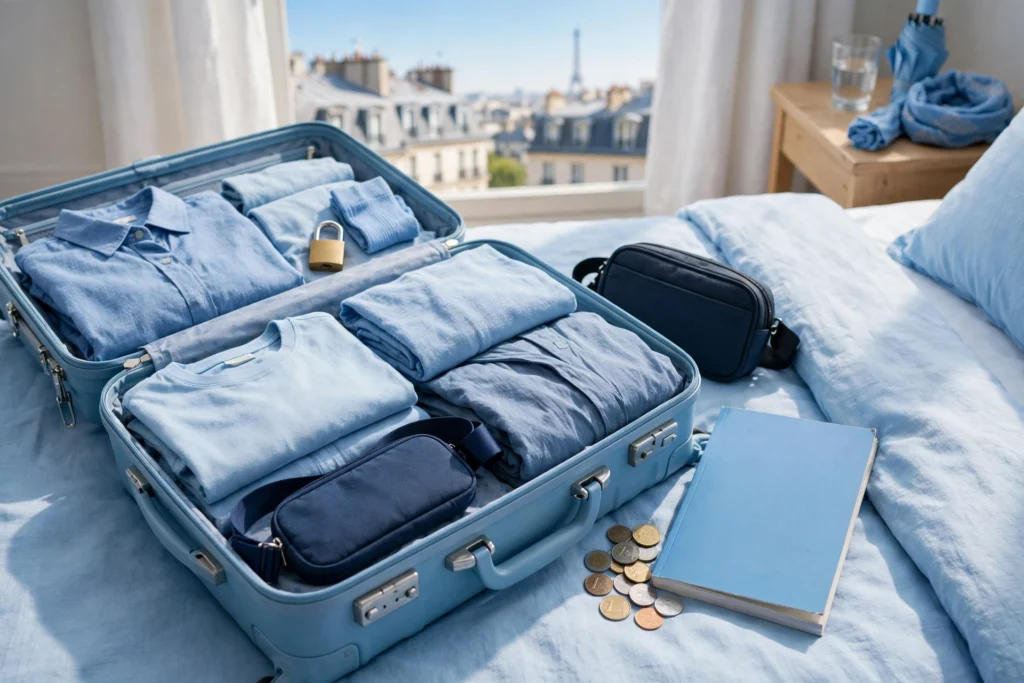
Pack light, because you will be carrying your bag up metro stairs, across cobbled streets, and into small hotel lifts that fit one person and one bag. One medium suitcase and one day pack is the right amount for a ten-day trip, and a packing cube set will save you from living out of a mess. The clothes depend on the season, but the constants are the same: comfortable walking shoes with good soles, because you will walk 15,000–20,000 steps a day in Paris; a light waterproof jacket, because Paris rain is sudden and brief; a scarf, because the French wear them and they are the most versatile item you can pack; and one smart outfit, because the French dress well and a restaurant will feel better in it. In summer, add sunscreen and a hat — the Riviera sun is strong — and water shoes for the pebble beaches of Nice. In winter, add a warm coat, gloves and a hat, because Paris in January is cold and damp. And in every season, bring a reusable water bottle, a small day pack, and a power adapter: France uses the two-pin Europlug, type C and E, at 230 volts, and US plugs do not fit.
Money, phones and language
France uses the euro, and cards are accepted almost everywhere, including in taxis, markets and small cafés — but carry some cash, around €50–€100, for the places that are not, and for the markets, where cash is still king. Tell your bank you are travelling, so your card is not blocked on the first transaction, and use ATMs inside banks rather than the standalone machines in tourist areas, which charge higher fees. For your phone, buy a local SIM or an eSIM on arrival, or check your US carrier’s international plan before you leave — the roaming charges for a two-week trip can be more than the cost of a local SIM. And for language: learn ten phrases of French, and use them. Bonjour, merci, s’il vous plaît, l’addition s’il vous plaît, parlez-vous anglais? — the effort matters far more than the accent, and the French are far warmer to a traveller who tries than to one who opens in English. In Paris and on the Riviera, English is widely spoken; in the villages of the Loire and Provence, it is less so, and a phrasebook app on your phone will earn you smiles and better service.
The mistakes first-timers make
The first mistake is the cluster mistake, covered at the start of this guide: trying to see all of France in one trip. The second is the booking mistake: buying TGV tickets at the station on the day, and paying three times the early price. The third is the Louvre mistake: arriving without a timed ticket, and spending two hours in a queue. The fourth is the Tuesday mistake: planning the Louvre for a Tuesday, when it is closed, or Versailles for a Monday, when the palace is closed. The fifth is the August mistake: booking a village hotel in August and finding the village half-closed for holidays. And the sixth is the ETIAS mistake: paying a website for an authorisation that does not exist yet. Avoid those six, and the trip will work.
Frequently Asked Questions
Do US citizens need a visa to visit France?
No. US citizens do not need a visa for tourism or short business trips to France for up to 90 days in any 180-day period. Your passport must be valid for at least three months beyond your departure from the Schengen area, with six months recommended, and you must have at least one blank page. The 90 days count across the whole Schengen area, not just France.
What is ETIAS, and do I need it for France in 2026?
ETIAS is the European Travel Information and Authorisation System, an online pre-travel check that visa-exempt travellers, including US citizens, will eventually need before visiting France and 29 other European countries. As checked live on 26 November 2026, ETIAS is not in operation, no applications are being collected, and there is no confirmed launch date. You do not need an ETIAS authorisation to travel to France in 2026, and any website offering to sell you one today is fraudulent.
What is the EES, and how does it affect my arrival?
The Entry/Exit System is the EU’s digital border register, fully operational since 10 April 2026. On your first entry into the Schengen area, border officers record your fingerprints and a facial image, and the system creates a digital record of your entry and exit instead of stamping your passport. Allow extra time at passport control on your first trip, and do not expect a stamp as proof of your entry date.
How much does a Louvre ticket cost in 2026?
Since 14 January 2026, the Louvre has two adult prices: €32 for visitors from outside the European Economic Area, including US citizens, and €22 for EEA citizens and residents. Under-18s go in free, as do EEA residents aged 18 to 25. Book a timed ticket on the official Louvre ticket office, and remember the museum is closed every Tuesday.
What is the best month to visit France?
May and September are the best months for most travellers: warm weather, long days, manageable crowds and shoulder-season prices. April and October are nearly as good and cheaper. July and August are best for the coast but bring heat and crowds, and November to March is the cheapest season, best for Paris and the Alps.
How many days do I need in France?
Four days in Paris is the minimum for the capital, and seven days is the minimum for Paris plus one region. Ten days gives you Paris plus Provence and the Riviera, and fourteen days gives you the full arc of Paris, the Loire, Provence and the Riviera. Less than five days, and you should stay in Paris alone rather than rushing a region.
Is France safe for American tourists?
France is rated Level 2 by the US State Department — Exercise Increased Caution due to terrorism and unrest — the same level as Italy, Spain, Germany and the United Kingdom. The practical advice is to stay alert in crowded places, avoid demonstrations, and guard against pickpockets, who are the risk most likely to affect a tourist. Read the full advisory before you travel and again the week before you fly.
How do I get from Paris to the Riviera, the Loire or Normandy?
Take the TGV. Paris to Lyon takes about two hours, Paris to Bordeaux about two hours and five minutes, Paris to Avignon about two hours and forty minutes, Paris to Marseille about three hours and fifteen minutes, and Paris to Nice about five hours and thirty minutes. Book on SNCF Connect about three months ahead for the cheapest fares, and take a car only inside a region, not between regions.
Should I stay in Nice, Cannes or Antibes?
Nice is the best base for most travellers, because it is a real city with the best transport links, the best markets and the best food. Cannes is the most glamorous and the most expensive, and Antibes is the most charming, with the best market and the Picasso Museum, and prices lower than Nice. Stay in one town for four or five nights and use the coastal train to visit the others.
How much does a 10-day trip to France cost?
For two people sharing a room in shoulder season, excluding flights, budget roughly €3,050–€4,900 in total, or about €1,525–€2,450 per person. Including return flights from the US East Coast, the total is roughly $4,500–$7,000 for two people. A single traveller should budget around €165–€280 a day at a mid-range level.
Do I need to speak French to visit France?
No, but learning ten phrases will make the trip noticeably better. English is widely spoken in Paris and on the Riviera, and less so in the villages of the Loire and Provence. Start every interaction with “Bonjour”, say “Merci” and “S’il vous plaît”, and ask “Parlez-vous anglais?” before continuing in English.
When should I book my TGV tickets?
As early as you can — tickets go on sale about three to four months ahead, and the cheapest fares sell first. A Paris to Lyon ticket booked three months ahead can cost €19–€29, while the same ticket bought the day before can cost €80–€120. Avoid Friday evenings and Sunday evenings, when fares are highest, and check your departure station before you book an OUIGO ticket, because the low-cost trains sometimes leave from different stations.
Conclusion: Pick One Region, and France Will Reward You
France is the most visited country on earth for a reason, and that reason is not a single sight. It is the combination: a capital that contains a dozen villages, a river valley full of châteaux, a coastline of impossible blue, a region of lavender and markets, a history written on the beaches of Normandy, and a table that changes with every region you cross. The trip that works is the one that respects the distances and the pace — Paris plus one region, four days in the capital, three to five days in the cluster, and the train doing the long distances while you do the slow ones. Book the TGV early, book the Louvre and the Eiffel Tower in advance, check the ETIAS status before you fly, and leave room in the plan for the slow morning, the long lunch and the village you had not heard of. France rewards the traveller who slows down. Give it the time, and it will give you the trip back.
People also read:
- Italy travel guide — the Rome, Florence and Venice route that pairs naturally with a France trip
- Spain travel guide — Barcelona, Madrid and Andalusia, the other great southern European route
- Greece travel guide — Athens and the islands, for the next Mediterranean trip
- London travel guide — the easiest city to pair with Paris by Eurostar
- Venice travel guide — the canals, the lagoon and the practical visiting rules
- Travel safety tips — the full preparation checklist for any trip
- What travel insurance covers — the exclusions that catch travellers out, and how to choose a policy
- Cheapest time to travel — how shoulder seasons work, and how to pick the cheapest good month

M. Adil is the founder and editor of SoloTravelPro. He writes practical, research-based travel guides that help travellers plan with confidence — from first-time city breaks to national parks and island escapes. Every guide is built on official sources, current prices and honest, usable advice, so readers can plan smarter and travel better.

Other Articles