Vietnam Travel Guide: North to South the Slow Way in 2026–27
Vietnam is not one trip, it is three trips in one long, thin country: the misty mountains and old streets of the north, the imperial cities, lantern towns and beaches of the centre, and the energy, rivers and floating markets of the south. The mistake most first-timers make is trying to see all three at the same speed, in the same weather, on the same kind of transport. This Vietnam travel guide gives you the honest version: the north-to-south spine that actually works, the visa and e-visa rules for US citizens as they stand in late 2026, what the US travel advisory really means, the flight-versus-train-versus-bus decision for the 1,726-kilometre run from Hanoi to Ho Chi Minh City, 10-day, 12-day and 14-day itineraries built from the same spine, food by region, and real costs in dong and dollars, so you can plan a first trip to Vietnam without the mistakes most first-timers make.
Vietnam Travel Guide: The North-to-South Reality Check — One Country, Three Climates
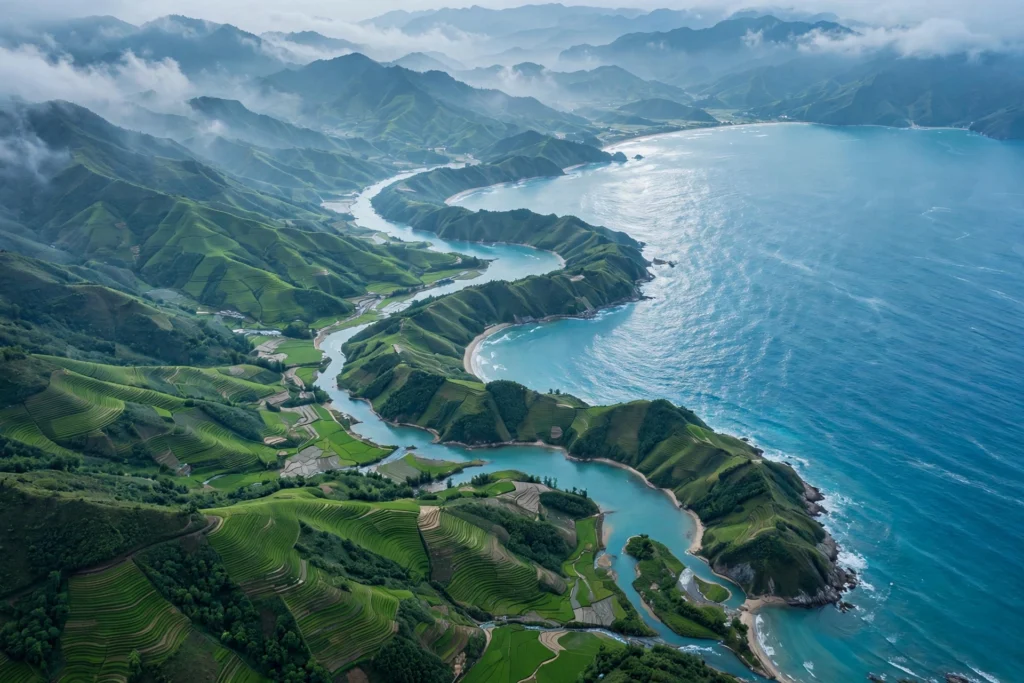
The single most important fact in this whole Vietnam travel guide is the shape of the country. Vietnam is about 1,650 kilometres long from north to south, with more than 3,000 kilometres of coastline, and at its narrowest point it is only about 50 kilometres wide. It is slightly larger than New Mexico, and it has three different climate zones, each with its own weather risks. The north has four seasons and a real winter. The centre has a long dry season and a sharp typhoon season. The south has two seasons — dry and wet — and stays warm all year. A traveller who packs for “Vietnam weather” without asking which Vietnam has packed wrong, because there is no single Vietnam weather.
The second reality check is about what the classic route actually is. For a first trip, it has five stops and almost nothing else: Hanoi and Ha Long Bay in the north, the mountains of Sa Pa or Ha Giang if you have the days, Hue and Hoi An in the centre, and Ho Chi Minh City with the Mekong Delta in the south. That is the route this guide builds, because it is the route that works in 10 to 14 days, and because every stop on it earns its place. Everything else — the far north-east, the Central Highlands around Da Lat, the islands of Phu Quoc and Con Dao — is a second trip, not a detour.
The third reality check is about direction. North to south is the classic way to do Vietnam, and it is classic for a reason. You start in Hanoi, where the country is at its most traditional, and you end in Ho Chi Minh City, where it is at its most modern and most energetic. The weather usually improves as you go: the north is coolest in winter, the centre is driest in late winter and spring, and the south is warm and dry from December to April.
The fourth reality check is about distance. Hanoi to Ho Chi Minh City is roughly 1,726 kilometres by road and rail. The overnight train takes about 32 to 36 hours. The flight takes about 2 hours. Travellers who try to do the whole country by train in ten days spend most of it on trains and arrive everywhere tired, and that is the most common way a first trip to Vietnam goes wrong. The fix is simple and it shapes everything else in this guide: fly the long legs, take the train for one scenic overnight stretch if you want the experience, and use buses and cars only inside a region. Treat the flight as part of the itinerary, not as an extra, and the classic route becomes easy: three days in Hanoi, two days on the bay, four days on the central coast, three days in the south, and the Mekong Delta to finish.
The five-stop route at a glance
| Stop | Nights | How you get there | Why it earns its place |
|---|---|---|---|
| Hanoi | 3 | Fly in from the US via a hub | Old Quarter, lakes, street food, the capital’s history |
| Ha Long Bay or Ninh Binh | 1–2 | 2.5–3 hours by road from Hanoi | Limestone karsts, caves, kayaking, the bay at dawn |
| Sa Pa or Ha Giang | 2–3 | Overnight train or bus from Hanoi | Rice terraces, mountain markets, the highlands |
| Hue, Hoi An and Da Nang | 4 | 1h20 flight Hanoi–Da Nang | Imperial city, lantern town, beaches, the Hai Van Pass |
| Ho Chi Minh City and the Mekong Delta | 3–4 | 2-hour flight Da Nang–Ho Chi Minh City | War history, markets, floating markets, river life |
The mistakes first-timers make
The first mistake is the transport mistake, covered above: trying to see the whole country by train or bus in ten days. The second is booking the Ha Long Bay cruise for a day trip only, so you see the bay at midday with every other boat and miss the quiet evening and the empty morning — the overnight cruise is the point, and the day trip is the compromise. The third is treating Hoi An as a half-day stop on the way to somewhere else; the town punishes that, because its best hours are after dark and its tailors, beaches and villages need a full day. The fourth is booking a trip in the central coast’s typhoon window, mid-September to mid-November, without knowing that storms can close the bay cruises and flood the old town. And the fifth is the visa mistake — believing an old blog post that says Americans get 45 days visa-free, or paying a third-party site for an e-visa that costs twice the official fee. The visa section below gives the current rule, checked against the official sources in November 2026, so you do not make it.
How to use this guide
Read the sections in order if this is your first trip: the best time to go, the visa rules, the safety picture, then the five stops, then the itineraries, food, costs and transport. If you already know when you are going, skip straight to the itinerary that matches your trip length — the 10-day, 12-day and 14-day plans are built from the same five stops, so you can see exactly what each extra day buys you. Every price in this guide is given as a range, because the dong moves against the dollar and a figure quoted as exact would be out of date within weeks; the ranges are checked against live operator and guide pages in November 2026.
Best Time to Visit Vietnam: Region by Region, Month by Month
There is no single best month for the whole of Vietnam, because the country has three climates at once. The answer depends on which stops matter most to you, but for the classic five-stop route the sweet spot is clear: February to April. Those are the months when the north is mild and dry, the central coast is at its driest and warmest, and the south is still in its dry season. February to April is the one window when all three regions are good at the same time, and it is the window this guide recommends for a first trip.
The north — Hanoi, Ha Long Bay, Sa Pa and Ha Giang — has four seasons. Winter, from December to February, is cool and misty, with temperatures in Hanoi around 15 to 20 degrees Celsius and much colder in the mountains, where Sa Pa can drop close to freezing. Spring, from March to April, is the best season in the north: mild days, clear skies, and the best light on Ha Long Bay. Summer, from May to September, is hot and humid with afternoon rain, and the mountains are at their greenest but also at their wettest. Autumn, from October to November, is the other good season: clear skies, comfortable temperatures, and the golden rice harvest in Sa Pa and Ha Giang in late September and October.
The centre — Hue, Da Nang, Hoi An and the central coast — has the sharpest weather in the country. The dry season runs roughly from February to August, with the best months February to early April, when the days are warm, the sea is calm, and the rain is rare. The wet season runs from September to January, and the typhoon window runs from mid-September to mid-November, when storms coming in from the South China Sea can bring heavy rain, flooding in Hoi An’s old town, and cancelled boat trips. The US State Department’s own guidance notes that storms hit the central and northern coasts from June to December, with the worst storms typically from September to November, and that flooding happens from September to December along the central coast. If your dates fall in that window, do not cancel the trip — but do not build it around the centre either. Put the centre first in your itinerary, keep a spare day, and be ready to swap a beach day for a city day.
The south — Ho Chi Minh City and the Mekong Delta — is the simplest region to plan. The dry season runs from December to April, with warm days, low humidity and almost no rain, and it is the best time to visit. The wet season runs from May to November, with short, heavy afternoon showers that rarely ruin a whole day but can flood the streets of the city for an hour or two. The south is warm all year, with temperatures rarely below 25 degrees, so the question is never whether it will be warm enough, only whether you mind the rain. December to April is the answer for most travellers, and it is also the busiest season, so book hotels and the Ha Long Bay cruise early.
Tet, the Vietnamese Lunar New Year, is the one festival that changes everything. Tet 2027 falls on Saturday 6 February 2027, the first day of the Year of the Goat, and the official public holiday runs from Thursday 4 to Wednesday 10 February 2027. During Tet, families travel home, shops and restaurants close for several days, transport is booked solid, and prices rise sharply. It is a wonderful time to be in Vietnam if you are in one place with local friends, and a difficult time to be moving between cities. If your trip falls over Tet, book every train, flight and hotel weeks ahead, spend the first three days of the new year in one place, and carry cash, because ATMs can run dry. The dates above are from the government’s approved 2027 holiday schedule, announced in October 2026.
Month-by-month at a glance
| Month | North (Hanoi, Ha Long, Sa Pa) | Centre (Hue, Hoi An, Da Nang) | South (Ho Chi Minh City, Mekong) | Verdict |
|---|---|---|---|---|
| January | Cool, misty, 15–20°C | Dry, mild, good beach days | Dry, warm, best season | Good, but cold in the north |
| February | Mild, clearing, Tet crowds | Dry, warm, best season | Dry, warm, best season | Excellent, except over Tet |
| March | Mild, clear, green terraces | Dry, warm, calm sea | Dry, warm, best season | Best month |
| April | Warm, clear, best light | Dry, warm, start of heat | Dry, hot, last dry month | Excellent |
| May–August | Hot, humid, afternoon rain | Hot, dry, beach season | Wet season, afternoon showers | Good for the centre |
| September | Golden rice, clear days | Rain starts, typhoon risk | Wet, heavy showers | Good for the north only |
| October | Clear, cool, harvest season | Wettest, typhoon window | Wet, easing late in the month | North only |
| November | Cool, dry, clear | Rain easing, still wet | Dry season begins | Good, centre still risky |
| December | Cold, misty, 15°C | Dry, mild, good beach days | Dry, warm, best season | Good, but cold in the north |
How the seasons affect prices
Prices follow the seasons more sharply in Vietnam than in most of Southeast Asia. Hotels in Hanoi and Hoi An can cost roughly half as much in the low season as in February and March. The Ha Long Bay cruise is cheapest from May to September and most expensive from November to April, when the weather is best and the boats sell out. Domestic flights are cheapest when booked a few weeks ahead and most expensive in the week before departure, especially around Tet and the summer school holidays. If your dates are flexible, the cheapest good-weather window is usually late November or late April. For more on picking cheap months in general, our guide to the cheapest time to travel explains how shoulder seasons work across destinations.
Do US Citizens Need a Visa for Vietnam? E-Visa, Exemptions and the 2026 Rules

The short answer, for most American travellers, is yes — you need a visa, and the e-visa is the way to get it. US passport holders do not get visa-free entry to Vietnam, and there is no visa on arrival without an approval letter arranged in advance. The good news is that the e-visa is simple, cheap, and entirely online, and it has been open to citizens of every country since August 2023. You apply before you travel, you pay online, and you receive the visa by email to print and show on arrival. There is no embassy visit and no queue for a stamp.
The e-visa is valid for up to 90 days, and it comes in two versions: single entry for 25 US dollars, and multiple entry for 50 US dollars. The fee is paid by card on the official portal and is non-refundable, including if the application is declined, so check every detail before you pay. Processing usually takes about three working days, though the US State Department’s guidance says three to five working days, and it can take longer in the high season and around Tet, when government offices close for several days. Apply at least two weeks before you fly, and apply earlier if you are travelling over Tet — the next Tet falls on 6 February 2027, and the offices are closed from 4 to 10 February. The only official portal is evisa.gov.vn, run by Vietnam’s Immigration Department. If a website ends in anything other than .gov.vn, it is not the Vietnamese government, even if it carries official-looking seals and Vietnamese flags. Private sites resell the same e-visa at two or three times the price, and some of them are outright scams.
This surprises a lot of travellers, because the exemption rules changed several times in the last few years and many travel websites never updated their advice. Citizens of 25 countries — including the United Kingdom, Germany, France, Italy, Spain, the Netherlands, the Nordic countries, Poland, Switzerland, Japan, South Korea and Russia — get 45 days visa-free, under exemptions that currently run to 2028. Citizens of most Southeast Asian countries get 14 to 30 days visa-free under bilateral deals, and citizens of Chile and Panama get 90 days. Americans, Canadians, Australians, New Zealanders, Irish and Dutch travellers are not on any exemption list, so they need the e-visa. If a website tells you that Americans get 45 days visa-free in Vietnam, that advice is wrong, and believing it will get you turned away at check-in.
The e-visa has edges, and they matter. It covers tourism only — it does not allow paid employment, running a company, or a degree or other long-term study. You must enter at the airport or border crossing you named in your application, so do not change your arrival airport after you apply. Your passport must be valid for at least six months beyond your arrival date, and you need at least two blank pages for stamps. Vietnam does not allow you to renew or extend an e-visa while you are in the country, so apply for the full length of your trip, not the minimum.
There are two more rules that catch people out. First, if you are entering Vietnam by air, you must also fill out a pre-arrival declaration form no earlier than three days before your arrival, according to the State Department’s current guidance — check the State Department’s Vietnam page before you fly, because this requirement is recent and still changing. Second, Phu Quoc island has its own rule: anyone of any nationality who arrives directly from abroad on an international flight to Phu Quoc airport, or by sea, can stay up to 30 days on the island without a visa — but only if you stay on the island. The moment you fly on to the mainland, the normal visa rules apply. And remember the practical side: even with a valid e-visa, border officers still check that you are a genuine visitor, so keep your return flight details and your first night’s hotel address easy to reach on your phone, and print your e-visa — do not rely on showing it on your phone.
Entry checklist for US citizens
| Requirement | The rule for US citizens (checked November 2026) |
|---|---|
| Visa for tourism | Required — e-visa, applied for before travel |
| E-visa fee | 25 USD single entry, 50 USD multiple entry, non-refundable |
| E-visa validity | Up to 90 days, single or multiple entry as chosen |
| Processing time | About 3 working days, allow 2 weeks, longer around Tet |
| Official portal | evisa.gov.vn only — never a reseller site |
| Visa-free entry | Not available for US passports; 45 days for 25 listed countries only |
| Passport validity | At least 6 months beyond your arrival date |
| Blank pages | At least 2 blank pages for stamps |
| Work or study | E-visa does not cover it; sponsored visa from an embassy |
| Phu Quoc | 30 days visa-free if arriving directly and staying on the island |
| Pre-arrival form | Required for air arrivals, within 3 days of arrival |
If someone in your party holds a different passport
The rule is decided passport by passport, not by the group. A spouse or travelling companion with a British, German, French or Japanese passport may enter visa-free for 45 days, while you need an e-visa, even though you are travelling together. Check every passport in your party separately on the official e-visa portal before you book, and apply only through evisa.gov.vn.
Is Vietnam Safe for US Travellers? The Advisory, Honestly Explained

The US State Department rates Vietnam at Level 1: Exercise Normal Precautions. That is the fact that matters most, and it is the best news in this guide, because Level 1 is the lowest tier the State Department gives — the same tier it gives to Japan, South Korea, Australia and most of Western Europe. The advisory was issued on 24 June 2026 and, checked live in November 2026, it reads: “Exercise normal precautions in Vietnam. Vietnam is generally a safe destination for travelers.” You can read the full text on the State Department’s Vietnam travel advisory page, and you should read it twice — once when you book, and again the week before you fly, because advisories change. Our own guide to is it safe to travel to Vietnam covers the same picture in more depth, with the Canadian, British and Australian advice alongside the American one.
The detail underneath the headline is where the real information lives. The advisory’s warnings are about petty crime, not about violence. Petty crime is common, especially in popular tourist locations — pickpocketing and bag snatching in crowded markets, on overnight trains, and on busy streets in Hanoi and Ho Chi Minh City. Stay aware of your surroundings, keep your bag in front of you in crowded places, do not hang a phone or camera from an open bag on a motorbike, and split your money and cards so one theft cannot strand you. Violent crime against tourists is rare, and no part of the country is rated at a higher level by the United States — there is no Level 2 region, no area to avoid, and no part of Vietnam that any of the major English-speaking governments advises against visiting.
The advisory also covers landmines and unexploded ordnance, and this part deserves a plain reading. Landmines and unexploded ordnance exist in Vietnam, left over from the war, and the areas of greatest risk are construction sites. The risk is low in urban and populated areas, including tourist destinations. The practical advice is straightforward: stay on marked paths and roads, do not wander into fields, forests or construction sites in the countryside, and do not pick up or approach unknown metal objects in the ground.
The risks that actually affect tourists most often are far more ordinary, and the biggest one is traffic. Vietnam’s roads are the most dangerous thing on most trips, and the State Department’s own embassy tips warn about it directly: renting a moped or motorbike without a Vietnamese driver’s licence is illegal, and if you have an accident without a licence, your travel insurance may not pay your medical bills. The scooters are the risk travellers underestimate most. Crossing the road in Hanoi or Ho Chi Minh City looks frightening the first time — the scooters flow around you like water — and the technique is to walk slowly and steadily in a straight line, without stopping, running, or stepping backwards, so the riders can predict where you will be. Never rent a scooter without a Vietnamese licence, and never ride without a helmet. Use Grab, the ride-hailing app that works across Vietnam, instead of unmarked taxis, and agree the fare or insist on the meter. Our full travel safety tips guide covers the same preparation in depth for any destination.
There are two other warnings worth taking seriously. The first is about drugs: using narcotic drugs in Vietnam is illegal, police sometimes test people’s blood for drugs, and if drugs are in your system — even if you used them in another country where they were legal — you can be arrested and face a long prison sentence. Some ingredients in common prescription drugs for conditions such as ADHD may also be illegal in Vietnam, so check your medication against Vietnamese law before you travel and carry a doctor’s letter. The second is about scams: the most common ones are the shoe-shine and cyclo scams in the Old Quarter, the “your hotel is closed” trick at the airport, and overcharging by unmetered taxis. The answer in every case is the same — go to the hotel yourself or call it on the number you already have, and never follow a stranger to a shop or a restaurant.
What to do before you go
Enrol in the Smart Traveler Enrollment Program, known as STEP, on the State Department’s STEP enrolment page. It is free, it takes about ten minutes, and it lets the nearest US embassy or consulate contact you in an emergency and help your family reach you. Save the emergency numbers — 113 for police, 114 for fire and rescue, and 115 for ambulance. Read the CDC Travelers’ Health pages for Vietnam: no vaccination is required for most travellers, but hepatitis A and B, typhoid and tetanus vaccines are recommended. Buy travel insurance that covers emergency medical care and evacuation, and read what it excludes before you need it — our guide to what travel insurance covers explains the exclusions that catch people out, including the one that matters most here: riding a motorbike without a local licence.
Staying safe day to day
Keep your bag in front of you in crowded places, use ATMs inside banks, and carry small notes, because large notes are hard to change in small shops and markets. Drink bottled water with an unbroken seal, and be careful with ice from street vendors if you are unsure of the source — the ice in hotels and restaurants is factory-made and safe. At the beach, swim only where it is supervised and be careful with strong currents on the central coast, especially during the storm season. If something goes wrong, call 113, 114 or 115 first, then your insurer’s 24-hour assistance line, then the embassy.
Hanoi in 3 Days: The Old Quarter, Lakes and Street Food
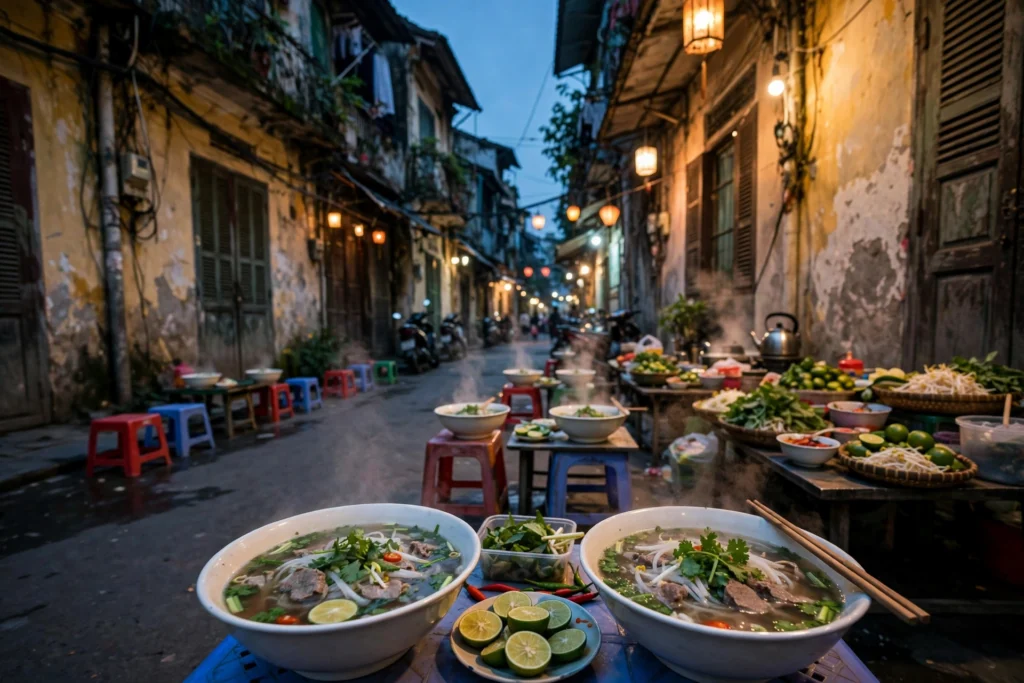
Hanoi is the city where most Vietnam trips begin, and it is the city that most rewards a slow start. It is older, quieter and more traditional than Ho Chi Minh City, and it behaves like a village that grew into a capital without ever quite losing the village. The Old Quarter is a thousand years old, a grid of 36 streets that were once organised by trade — Silk Street, Silver Street, Paper Street — and still carry those names. The lakes are the city’s lungs. The street food is the best in the country. Three days is the right amount of time: one day for the Old Quarter and the lakes, one day for the history and the museums, and one day for the food, the neighbourhoods and the slow hours that make Hanoi what it is. This section is a summary, not a rebuild — our full Hanoi travel guide covers the city street by street, with the hotels, the restaurants and the day-by-day plan in full.
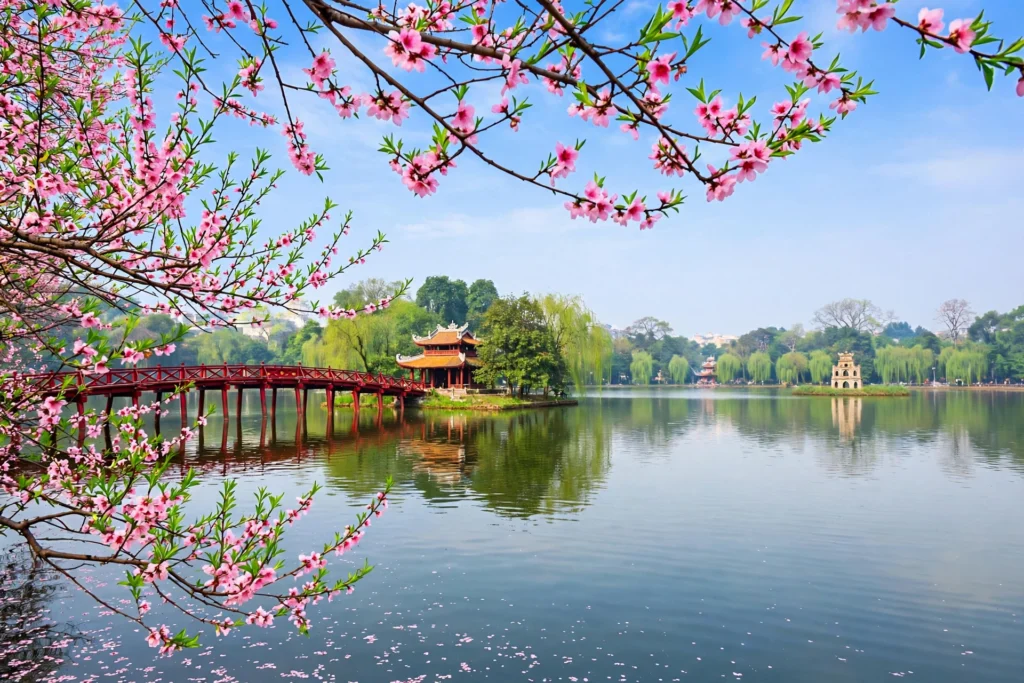
Start in the Old Quarter, and start early. The quarter wakes up at dawn, when the flower sellers cycle in from the countryside and the first bowls of pho are served on small plastic stools. Walk the 36 streets without a plan, because the quarter is best experienced as a wander: the silk shops on Hang Gai, the silver workshops on Hang Bac, the lantern makers, the coffee shops with their tiny chairs spilling onto the pavement. Hoan Kiem Lake, the lake in the centre of the city, is the place to go when the streets get too much — walk the loop around it in the morning, when the old men play badminton and the tai chi groups move slowly under the trees, and cross the red Huc Bridge to the Ngoc Son Temple on its island. In the evening, the streets around the lake close to traffic on weekends and fill with families, dancers and street performers, and the city feels like a festival.
The history of Hanoi is layered, and the second day is for the layers. The Temple of Literature, founded in 1070 as Vietnam’s first university, is the most peaceful place in the city — a series of courtyards, gardens and stone stelae that record the names of scholars, and the best introduction to the Confucian tradition that shaped Vietnamese education. The Ho Chi Minh Mausoleum and the Presidential Palace area are the other pole of the city’s history: the mausoleum itself, where Ho Chi Minh’s body lies in state, is a solemn place with a strict dress code and long queues, and the One Pillar Pagoda nearby is one of the oldest temples in the country. The Hoa Lo Prison, known to American visitors as the Hanoi Hilton, is a difficult but important visit — the museum tells the story of the prison under the French and during the war, and it is worth an hour of your day. The Vietnam Museum of Ethnology, a short drive out of the centre, is the best museum in the country for understanding Vietnam’s 54 ethnic groups, with full-size houses from the highlands standing in its gardens.
Day by day in Hanoi
Day one is the Old Quarter and the lakes: the 36 streets in the morning, Hoan Kiem Lake and the Ngoc Son Temple in the afternoon, and the night market and the beer corner in the evening. Day two is the history: the Temple of Literature in the morning, the Ho Chi Minh Mausoleum and the One Pillar Pagoda, the Hoa Lo Prison, and the Vietnam Museum of Ethnology in the afternoon. Day three is the food and the neighbourhoods: a street food walk in the morning, the French Quarter around the Opera House and St Joseph’s Cathedral, the Train Street, and the West Lake in the late afternoon, where the city goes to eat, drink coffee and watch the sunset.
Where to stay and how to get around
Stay in the Old Quarter if this is your first visit and you want the streets on foot, in the French Quarter if you want quieter streets and better hotels, or around West Lake if you prefer a local neighbourhood. The Old Quarter is noisy at night, so ask for a room at the back of the hotel if you are a light sleeper. Getting around Hanoi is easy on foot in the centre, and by Grab everywhere else — the app works well, the fares are fixed, and the drivers are used to tourists. Never drive in Hanoi, and do not take a taxi without the meter running or a fare agreed in advance. For the airport, Noi Bai is about 45 minutes from the centre by car, and the airport bus and Grab are both cheaper than a hotel transfer.
Eating in Hanoi
Hanoi is the best food city in the country, and the cheapest good meals are the simplest ones: a bowl of pho for breakfast; bun cha, the grilled pork with noodles and herbs that Hanoi claims as its own, for lunch; and egg coffee, the thick, sweet coffee topped with whipped egg yolk, in the afternoon. The food section later in this guide covers the regional dishes in full, but Hanoi is where you should eat widest, because the north’s cooking is at its most refined here.
Ha Long Bay vs Ninh Binh vs Lan Ha Bay: Which Bay Should You Pick?

Ha Long Bay is the image on every Vietnam postcard: nearly 2,000 limestone islands rising from emerald water, a UNESCO World Heritage site since 1994, and the single most visited natural wonder in the country. The bay covers 65,650 hectares and includes 1,133 islands and islets, and UNESCO describes it as the most extensive example of marine-invaded tower karst in the world. But Ha Long Bay is also the stop on the classic route that most often disappoints people — not because it is not beautiful, though it is, but because the classic day trip sees it at its worst: midday, crowded, rushed, and from a boat full of other day-trippers. The secret to Ha Long Bay is the same as the secret to every great sight in Vietnam: go slowly, stay overnight, and pick the right bay for the trip you actually want.
The first decision is between the three bays. Ha Long Bay itself is the famous one, with the biggest karsts, the most caves, and the most boats. Ninh Binh, often called Ha Long Bay on land, is the inland version: the same limestone towers rising from rice fields and rivers instead of the sea, with boat rides through caves and up rivers, temples on hills, and cycling through the countryside. Lan Ha Bay, off Cat Ba Island, is the quieter neighbour: the same karst landscape as Ha Long Bay, but with fewer boats, cleaner water, and better kayaking, and it is part of the same UNESCO property since the Cat Ba Archipelago was added in 2023. Bai Tu Long Bay, to the north-east of Ha Long Bay, is the quietest of all — the boats that go there are fewer, the water is emptier, and the experience is the closest to what Ha Long Bay must have felt like twenty years ago.
Pick Ha Long Bay if this is your first trip and you want the classic image, the big caves, and the full cruise experience with a sundeck, a cooking class and tai chi at dawn. Pick Ninh Binh if you want the karsts without the boats, or if you are short on time — it is closer to Hanoi, it works as a day trip, and it pairs the karsts with temples, cycling and the countryside. Pick Lan Ha Bay if you want to swim and kayak in cleaner water, or if you have already seen Ha Long Bay and want the same landscape without the crowds. Pick Bai Tu Long Bay if you want the quietest water and the most local experience. None of these is a wrong choice. The wrong choice is the rushed day trip to the busiest part of Ha Long Bay at midday, which is the version of the bay that most disappoints people.
The cruise: what it costs and how to book it
An overnight cruise is the point of Ha Long Bay, and the day trip is the compromise. A day cruise from Hanoi runs roughly 35 to 60 dollars at the budget end, 60 to 100 dollars for smaller groups and better food, and 100 to 150 dollars for premium boats. An overnight cruise — two days, one night — starts around 90 to 150 dollars per person for budget boats, sits at 145 to 200 dollars for the mid-range boats most travellers book, and climbs past 250 dollars for luxury, with the very best boats reaching 450 dollars and beyond. Two nights generally lands between 200 and 550 dollars. These are market ranges checked in November 2026, and they change with the season — the cheapest months are May to September, and the most expensive are November to April, when the weather is best and the boats sell out.
There are two separate costs, and operators often blur them: the cruise, which is market-priced, and the official sightseeing fee, which is fixed and published by the Quang Ninh provincial council. The fee is 250,000 dong, about 10 dollars, for the main day routes, and 550,000 dong, about 21 dollars, for a Route 2 overnight. The fee is usually included in the cruise price, but check before you pay, and check whether the transfer from Hanoi is included too — transfers are often extra, at 12 to 41 dollars per person return. Book the overnight cruise early, so a weather cancellation leaves you a second chance.
Ninh Binh: the bay on land
Ninh Binh is about 90 kilometres south of Hanoi, a drive of an hour and a half to two hours, and it works as a day trip or as an overnight. The classic day is the boat ride at Tam Coc or Trang An — a small rowing boat through caves and along a river between limestone towers — then the climb up the 500 steps at Hang Mua for the view over the rice fields and the river, and the temples at Hoa Lu, the ancient capital. The cycling is the other half of Ninh Binh: the back roads through the rice fields are flat, quiet and beautiful, and a bicycle is the best way to see them. Stay overnight if you can, because the early morning on the river, before the day-trip buses arrive, is the best hour in Ninh Binh.
The bay choice at a glance
| Ha Long Bay | Ninh Binh | Lan Ha Bay | Bai Tu Long Bay | |
|---|---|---|---|---|
| Best for | The classic image, big caves, full cruise | Karsts without boats, temples, cycling | Swimming, kayaking, quieter water | Quietest water, most local feel |
| From Hanoi | 160 km, 2.5–3 hours | 90 km, 1.5–2 hours | 160 km plus ferry to Cat Ba | 160 km, 2.5–3 hours |
| Overnight cruise | 90–150 budget, 145–200 mid-range | No cruise, stay in the countryside | 145–250 mid-range | 150–300, smaller boats |
| Crowds | Busiest, especially midday | Busy at Tam Coc, quiet elsewhere | Quieter | Quietest |
| Best for a day trip | No — overnight is the point | Yes, works well as a day trip | No — needs an overnight | No — needs an overnight |
| UNESCO | Yes, since 1994 | Trang An, since 2014 | Yes, since 2023 extension | Yes, part of Ha Long Bay |
Sa Pa vs Ha Giang: Mountains, Rice Terraces and the Loop
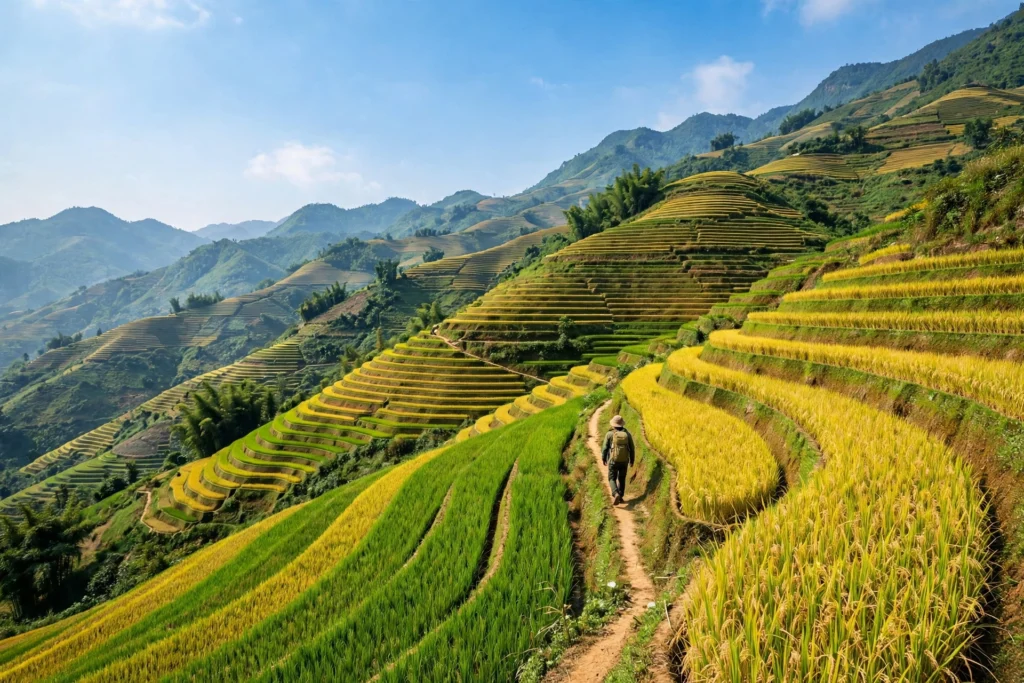
The mountains of the far north are the most beautiful part of Vietnam, and they are also the part most often done badly. Sa Pa and Ha Giang are the two names every traveller hears, and they are not the same trip. Sa Pa is the famous one: the rice terraces, the hill-tribe villages, the mountain town with its hotels and restaurants, and Fansipan, the highest mountain in Indochina at 3,143 metres. Ha Giang is the wilder one: the loop road through the Dong Van Karst Plateau, the Ma Pi Leng Pass, the deepest canyon in the country, and villages that see a fraction of Sa Pa’s visitors. Both are worth a trip. In 10 to 14 days you should pick one and do it properly rather than trying to do both badly.
Pick Sa Pa if this is your first trip to the mountains and you want the classic terraces, the easiest logistics, and the most comfortable stay. Sa Pa is reached by overnight train from Hanoi to Lao Cai, then an hour by road, or by a direct bus in about five to six hours. The town has good hotels, good restaurants, and a cable car to the top of Fansipan that takes about 15 minutes and gives you the view without the three-day climb. The rice terraces around the Muong Hoa Valley are the most photographed in Vietnam, and they are at their best in two windows: May to June, when the fields are flooded and mirror the sky, and September to October, when the rice turns gold before the harvest. The villages of Cat Cat, Lao Chai and Ta Van are the classic walks, and the homestays in Ta Van are the best way to spend a night in the valley rather than in the town.
Pick Ha Giang if you have already seen Sa Pa, or if you want the wildest road in Vietnam and you are comfortable on a motorbike or in a car on mountain roads. The Ha Giang Loop is a three- to four-day circuit from Ha Giang city through Yen Minh, Dong Van and Meo Vac, over the Ma Pi Leng Pass and back, and it is one of the great drives in Asia. The landscape is limestone karst on a scale that makes Ha Long Bay look small, the villages are Hmong, Dao, Tay and Lo Lo, and the Sunday markets are the most colourful in the country. The loop is best done with a local driver or on an organised tour, because the roads are steep, narrow and busy with trucks, and because riding a motorbike here without a Vietnamese licence is illegal and uninsured — the same rule that applies everywhere in Vietnam, and the same reason your travel insurance will not pay if you crash. The best months for Ha Giang are September to November, for the golden rice and the clear skies, and March to May, for the green fields and the wildflowers. Winter is cold and misty, and summer is wet.
The mountain choice at a glance
| Sa Pa | Ha Giang | |
|---|---|---|
| Best for | Classic terraces, easiest logistics, comfort | Wildest road, the loop, the least-visited villages |
| From Hanoi | Overnight train to Lao Cai, then 1 hour by road | Overnight bus, 6–7 hours, or flight to Hanoi then bus |
| Days needed | 2–3 days | 3–4 days for the loop |
| Signature experience | Muong Hoa Valley terraces, Fansipan cable car | Ma Pi Leng Pass, Dong Van Karst Plateau |
| Best months | May–June flooded fields, Sep–Oct golden rice | Sep–Nov golden rice, Mar–May green fields |
| Crowds | Busiest, especially weekends | Quieter, more local |
| Stay | Hotels in town, homestays in Ta Van | Homestays and small hotels along the loop |
How to do the mountains well
Book the train or the bus early, because the overnight train from Hanoi to Lao Cai sells out on weekends and around holidays. Go with a local guide for the village walks, because the trails are unmarked and the weather changes fast. Bring layers — the mountains are cold before dawn and hot by midday — and wear proper walking shoes, not sandals, because the terraces are muddy and the steps are uneven. Book the homestay in the valley, not the hotel in the town, for at least one night, because the evening in a village house is the experience you will remember longest.
Hue, Hoi An and Da Nang: The Central Coast in 4 Days
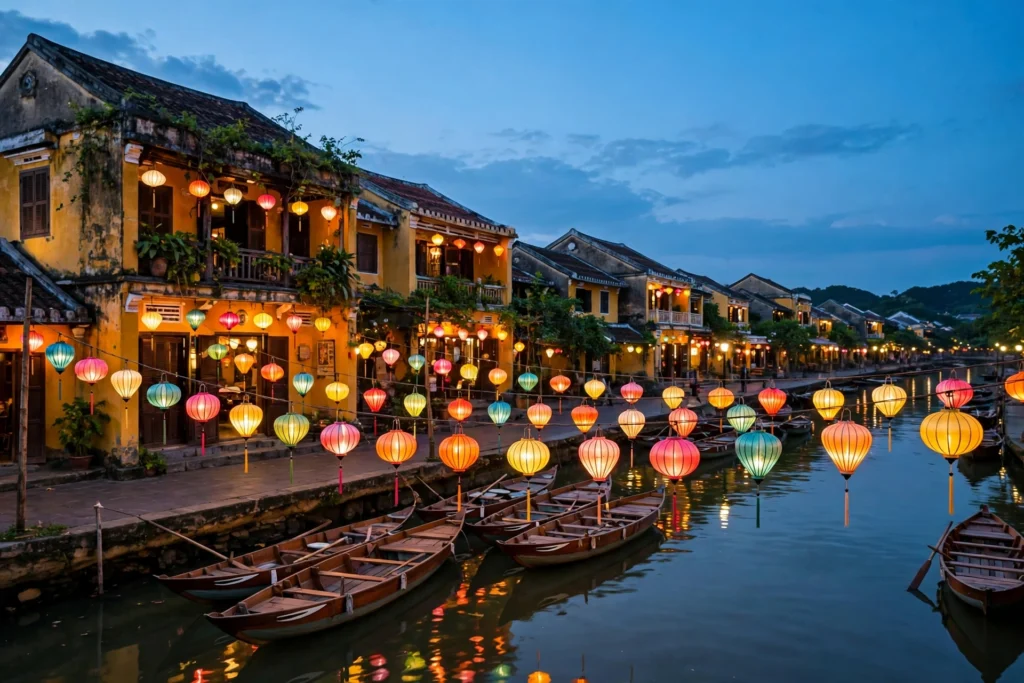
The central coast is the middle of Vietnam, and it is the middle in every sense: geographically, historically and in character. Hue is the old imperial capital, a city of citadels, tombs and royal cuisine. Hoi An is the lantern town, a trading port from the 15th to 19th centuries and a UNESCO World Heritage site since 1999. Da Nang is the modern city between them, with the best beaches on the central coast and the airport that serves the whole region. Four days is the right amount of time: one day in Hue, two days in Hoi An, and one day for Da Nang and the road between them, which includes the Hai Van Pass — one of the great coastal drives in Asia.
Start in Hue, and start with the Imperial City. The citadel is a walled city within the city, built in the early 19th century for the Nguyen emperors, and it is the most important historical site in Vietnam outside Hanoi. The Forbidden Purple City inside it was largely destroyed during the war, and the restoration is still going on, but the gates, the palaces and the temples that survive are worth a full morning. The royal tombs, a short drive out of the city along the Perfume River, are the other half of Hue: the tombs of Minh Mang, Tu Duc and Khai Dinh, each built as a palace for the afterlife, set in gardens and lakes. Hue is also the food city of the centre — the royal cuisine, with its small, refined dishes, is unlike the food anywhere else in Vietnam.
The road from Hue to Hoi An is the Hai Van Pass, and it is worth a day of its own. The pass climbs to about 500 metres above the sea, with views over Da Nang Bay on one side and the mountains on the other, and it is the natural border between the north and the south of Vietnam. The modern tunnel under the pass takes ten minutes, but the old road over the top is the drive to take, by car or by motorbike with a driver, stopping at the viewpoints and at Lang Co Beach on the far side. Da Nang itself is the base for the central coast: the city has the long My Khe Beach, the Marble Mountains — five limestone hills with caves, temples and viewpoints — and the Ba Na Hills, with the Golden Bridge held up by two giant stone hands.
Hoi An is the town most visitors love most, and it is the town that most rewards a slow stay. The old town is a compact grid of wooden shophouses, family chapels and assembly halls on the Thu Bon River, built by Vietnamese, Chinese and Japanese merchants between the 15th and 19th centuries, and it is one of the best-preserved trading ports in Southeast Asia. The Japanese Covered Bridge, the Chinese assembly halls, the merchant houses and the museums are the sights, but the town itself is the experience: the streets are car-free in the evening, the lanterns come on at dusk, and the river fills with small boats carrying candles. The old town ticket costs 120,000 dong, about 4.60 dollars, for foreign visitors, and it covers the town plus five heritage sites, valid for up to three days. Buy it at the official booths on the streets leading into the old town, and keep the stub, because staff at the edges of the old town may ask to see it.
Hoi An vs Hue vs Da Nang: the picker
| Hue | Hoi An | Da Nang | |
|---|---|---|---|
| Best for | History, imperial city, royal food | Lanterns, old town, tailors, slow days | Beaches, the Hai Van Pass, the airport |
| Days | 1 day | 2 days | 1 day |
| Signature experience | Imperial City and the royal tombs | The old town after dark, the lanterns | My Khe Beach, Marble Mountains |
| Food | Royal cuisine, bun bo Hue | Cao lau, white rose dumplings | Seafood, beach restaurants |
| Crowds | Quieter, more local | Busiest, especially in the evening | Busy at the beach, quieter in the city |
| Stay | Hotels near the Perfume River | In or near the old town, or at An Bang Beach | Near My Khe Beach |
A day in Hoi An
Give Hoi An two days: one for the old town and one for the beach, the villages and My Son. Day one is the old town: the Japanese Covered Bridge in the morning, the assembly halls and merchant houses, the markets, and the lantern-lit streets in the evening, with a boat ride on the river at dusk. Day two is the villages and the beach: a cycling trip to Tra Que, the vegetable village, and Cam Thanh, the coconut village with its round basket boats, then An Bang Beach in the afternoon, and the tailors in the evening — Hoi An’s tailors can make a suit or a dress in 24 to 48 hours, and the quality is good if you choose a reputable shop and have at least two fittings.
The 1 July 2025 change you should know about
On 1 July 2025 Vietnam reorganised its local government, merging provinces and redrawing boundaries. Hoi An is no longer a separate city — it is now a ward of Da Nang city, after the former Quang Nam province merged into Da Nang. Phu Quoc island is now under An Giang province, and Con Dao is now under Ho Chi Minh City. The change matters for practical reasons: the old town ticket is now set by Da Nang’s People’s Council, and some maps and guidebooks still show the old boundaries. It does not change the trip — Hoi An is still Hoi An — but it explains why some websites give different administrative names for the same places.
Ho Chi Minh City in 3 Days: Saigon Energy, Markets and the Mekong Doorway
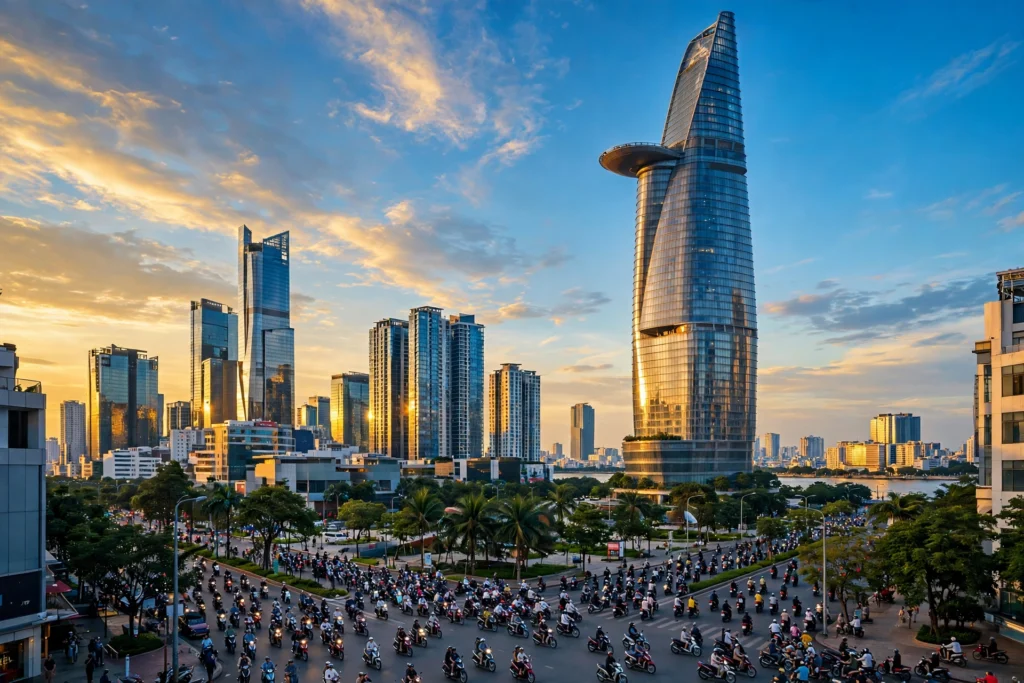
Ho Chi Minh City is the city most visitors still call Saigon, and the name fits, because the city still feels like Saigon: fast, loud, commercial, and full of energy. It is the largest city in Vietnam, with more than nine million people, and it is the economic heart of the country. The scooters are the first thing you notice — millions of them, flowing through the streets in a river that never quite stops — and the second thing you notice is the food, because the city eats all day and all night. Three days is the right amount of time: one day for the centre and the war history, one day for the markets and the neighbourhoods, and one day for the Cu Chi Tunnels or a slow day in the city before the Mekong Delta.
Start in District 1, the centre, and start with the history. The War Remnants Museum is the most important museum in the country, and it is a difficult visit — the photographs and the exhibits tell the story of the war from the Vietnamese side, and they are graphic. Go in the morning, give it two hours, and do not rush it. The Reunification Palace, a short walk away, is the building where the war ended in 1975, preserved as it was on the day the tanks arrived, with the basement command rooms, the president’s office and the helicopter on the roof. The Notre-Dame Cathedral and the Central Post Office, built by the French in the 19th century, are the colonial landmarks of the centre, and the post office is still a working post office, with its arched hall and its old maps. The Ben Thanh Market, the city’s most famous market, is the place to go for the noise and the colour, though the prices are aimed at tourists — bargain hard, or go to the Binh Tay Market in Cholon, the city’s Chinatown, where the locals shop.
The second day is for the neighbourhoods. Cholon, the Chinatown, is the oldest part of the city, with its temples, its medicine shops, and its markets, and it is the best place to understand that Ho Chi Minh City is a Chinese city as much as a Vietnamese one. The Binh Tay Market is the centre of Cholon, and the Thien Hau Temple, dedicated to the goddess of the sea, is the most beautiful temple in the city. District 3 and District 5 are the quieter, more local districts, with their street food, their coffee shops, and their parks. The Bitexco Tower has a sky deck on the 49th floor with a view over the whole city and the river, and it is the best place to go at sunset.
Day by day in Ho Chi Minh City
Day one is the centre and the war history: the War Remnants Museum in the morning, the Reunification Palace, the Notre-Dame Cathedral and the Central Post Office, and Ben Thanh Market in the late afternoon, finishing with dinner on Bui Vien, the backpacker street, or in District 1’s rooftop restaurants. Day two is the neighbourhoods: Cholon and the Binh Tay Market in the morning, the Thien Hau Temple, District 3 and District 5 in the afternoon, and the Bitexco Tower sky deck at sunset. Day three is the Cu Chi Tunnels, the tunnel network about 70 kilometres from the city that was used during the war, and which you can visit on a half-day tour, crawling through a section of the tunnels and seeing the traps, the kitchens and the workshops. If the tunnels are not for you, spend the third day slowly: the coffee shops of District 1, the book street, the parks, and the food — the city has the best banh mi, the best com tam, and the best street food in the south, and the food section later in this guide covers it in full.
Where to stay and how to get around
Stay in District 1 if this is your first visit and you want the sights on foot, in District 3 if you want quieter streets and better value, or in District 2, across the river, if you want modern apartments and riverside restaurants. Getting around Ho Chi Minh City is easy by Grab, which works well and has fixed fares, and by the city’s new metro, which opened its first line in late 2024 and is still expanding. Never drive in the city, and do not take a taxi without the meter running or a fare agreed in advance. For the airport, Tan Son Nhat is about 30 to 45 minutes from the centre by car, depending on traffic, and Grab is cheaper than a hotel transfer.
Eating in Ho Chi Minh City
Ho Chi Minh City is the best food city in the south, and the cheapest good meals are the simplest ones: a banh mi for breakfast; com tam, the broken rice with grilled pork, for lunch; and a bowl of hu tieu, the southern noodle soup, in the evening. The city eats late, and the street food stalls stay open until the early hours — the best food in Ho Chi Minh City happens after nine, when the night markets open and the plastic stools come out.
The Mekong Delta: Day Trip or Overnight?
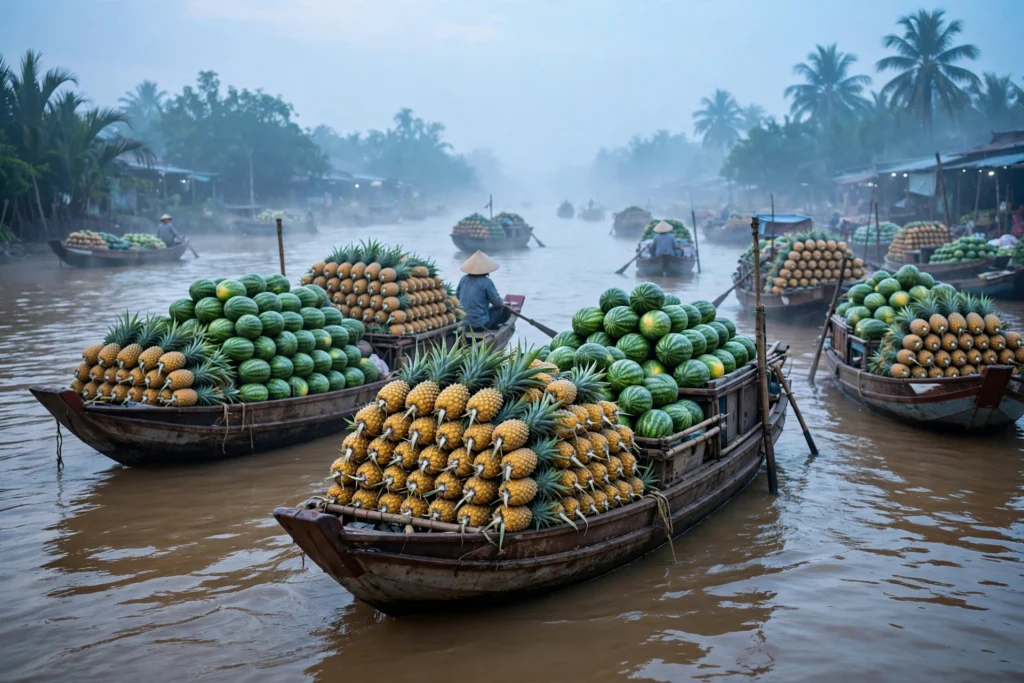
The Mekong Delta is the south of Vietnam, and it is the south in every sense: flat, wet, green, and built on water. The Mekong River splits into nine branches as it reaches the sea, and the delta is a maze of rivers, canals, floating markets, orchards and rice fields, home to about 17 million people. It is the rice bowl of Vietnam, and it is the region most visitors misunderstand, because the classic day trip from Ho Chi Minh City sees it at its worst: a rushed boat ride, a tourist village, a coconut candy workshop, and back to the city by dinner. The delta deserves an overnight, and this section explains why.
The first decision is between the day trip and the overnight, and the answer is the overnight. The floating markets — Cai Rang, near Can Tho, is the largest — happen at dawn, when the wholesalers gather on the river and the boats pile high with pineapples, watermelons and vegetables. A day trip from Ho Chi Minh City leaves the city at eight, arrives at ten, and misses the market entirely, because by ten the wholesalers have gone home and the river is quiet. An overnight in Can Tho, the delta’s largest city, puts you on the river at five in the morning, when the market is at its busiest, and gives you the evening in the city, with its riverside restaurants and its night market. The difference between the two trips is the difference between seeing the delta and seeing a tourist village, and it is worth the extra night.
The second decision is between Can Tho and Ben Tre. Can Tho is the base for the floating markets: the Cai Rang market at dawn, the smaller Phong Dien market, the boat ride through the canals, and the orchards. Ben Tre is the base for the canals and the countryside: the small boat rides through the narrow waterways, the coconut groves, the villages, and the cycling through the rice fields. Both are worth a visit, and in a 14-day trip you can do both — one night in Can Tho for the markets, and one night in Ben Tre for the canals. In a 10-day trip, pick Can Tho, because the floating market is the experience that defines the delta, and the canals are the bonus.
The delta choice at a glance
| Day trip from Ho Chi Minh City | Overnight in Can Tho | Overnight in Ben Tre | |
|---|---|---|---|
| Best for | A taste of the delta if you have no spare night | The floating markets at dawn | Canals, coconut groves, cycling |
| From Ho Chi Minh City | 2–3 hours each way | 3–4 hours, stay overnight | 2 hours, stay overnight |
| Floating market | Missed — arrives after 10 a.m. | Yes, at dawn, the best hour | No, smaller local markets |
| Canals | A short tourist boat ride | A half-day boat ride | The best canal rides in the delta |
| Cost | 25–40 dollars | 60–100 dollars with hotel | 50–90 dollars with hotel |
| Verdict | Only if you have no spare night | The recommended option | The quieter option |
A day in the delta
A good delta day starts at five in the morning, on a small boat on the river, watching the floating market wake up. The boats tie up in rows, the sellers hang a sample of their goods from a pole so buyers can see what they are selling, and the river fills with the noise of engines, voices and bargaining. After the market, the boat goes into the canals, where the water is narrow, the trees meet overhead, and the only sound is the paddle. The afternoon is for the villages: the rice paper workshops, the orchards, the cycling through the fields, and the lunch in a garden restaurant. The evening is for Can Tho: the riverside, the night market, and the dinner of hotpot and grilled fish.
The 10-Day, 12-Day and 14-Day Vietnam Itineraries
The itineraries below are built from the same five stops, so you can see exactly what each extra day buys. All of them assume you fly into Hanoi and out of Ho Chi Minh City, and use domestic flights between regions. All of them assume the Ha Long Bay cruise is booked as an overnight, not a day trip. And all of them leave the Central Highlands, Phu Quoc and Con Dao for a second trip — they are not omissions, they are a deliberate choice to do the classic route well.
The 10-day Vietnam itinerary: the classic route, tight
Ten days is the shortest trip that works, and it works by doing the five stops properly instead of seven badly. Days one to three are Hanoi: the Old Quarter and the lakes, the history and the museums, and the food and the neighbourhoods. Days four and five are Ha Long Bay: the overnight cruise, with the day trip to Ninh Binh only if you have a spare morning. Days six to eight are the central coast: one day in Hue, two days in Hoi An, with the Hai Van Pass on the way. Days nine and ten are Ho Chi Minh City, with the Mekong Delta as a day trip only — which means you will miss the floating markets at dawn, and you should accept that rather than trying to add an overnight by cutting Hanoi short.
| Day | Where | What |
|---|---|---|
| 1–3 | Hanoi | Old Quarter, lakes, Temple of Literature, street food |
| 4–5 | Ha Long Bay | Overnight cruise, caves, kayaking, dawn on the bay |
| 6 | Hue | Imperial City, royal tombs, Perfume River |
| 7–8 | Hoi An | Old town, lanterns, tailors, An Bang Beach |
| 9–10 | Ho Chi Minh City | War Remnants Museum, markets, Mekong day trip |
The 12-day Vietnam itinerary: the classic route, with the mountains
Twelve days is the version of this Vietnam travel guide that the guide recommends for a first trip, because it is the first length where nothing is rushed and the mountains fit. Days one to three are Hanoi, as above. Days four and five are Sa Pa: the overnight train to Lao Cai, the Muong Hoa Valley terraces, and a homestay in Ta Van. Days six and seven are Ha Long Bay, with the overnight cruise. Days eight to ten are the central coast: Hue, Hoi An and Da Nang, with the Hai Van Pass. Days eleven and twelve are Ho Chi Minh City and the Mekong Delta, with an overnight in Can Tho for the floating market at dawn. The twelfth day is the travel day home from Ho Chi Minh City, and the trip ends in the south rather than with a backtrack to Hanoi, which is the single best logistical decision you can make.
| Day | Where | What |
|---|---|---|
| 1–3 | Hanoi | As in the 10-day plan |
| 4–5 | Sa Pa | Overnight train, terraces, homestay in Ta Van |
| 6–7 | Ha Long Bay | Overnight cruise, caves, kayaking |
| 8–10 | Central coast | Hue, Hoi An, Da Nang, Hai Van Pass |
| 11–12 | Ho Chi Minh City and Can Tho | City sights, overnight in Can Tho, floating market at dawn |
The 14-day Vietnam itinerary: the classic route, done properly
Fourteen days is the version of this Vietnam travel guide that the guide recommends if you have the time, because it is the first length where the whole country breathes. Three days in Hanoi, two days in Sa Pa, two days on Ha Long Bay with a second night for Bai Tu Long Bay, four days on the central coast with a day for the Marble Mountains and a day for My Son, and three days in the south with two nights in the delta — one in Can Tho for the floating markets and one in Ben Tre for the canals. The fourteenth day is the travel day home from Ho Chi Minh City. If you have 17 days, add a day in Hanoi for the West Lake and a day in the delta for Chau Doc, near the Cambodian border; if you have 21, add the Central Highlands around Da Lat and the islands of Phu Quoc.
| Day | Where | What |
|---|---|---|
| 1–3 | Hanoi | Old Quarter, history, food, West Lake |
| 4–5 | Sa Pa | Terraces, villages, homestay, Fansipan |
| 6–7 | Ha Long Bay and Bai Tu Long Bay | Overnight cruise, quieter bay, kayaking |
| 8–11 | Central coast | Hue, Hoi An, Da Nang, Marble Mountains, My Son |
| 12–14 | Ho Chi Minh City and the delta | City sights, Can Tho, Ben Tre, floating markets |
Extending the trip: Da Lat and Phu Quoc
If you have an extra day and a particular interest in cooler weather, Da Lat in the Central Highlands makes a good extension from Ho Chi Minh City, and it is the only extension this guide recommends for a first trip. Da Lat is a mountain town at 1,500 metres, with pine forests, waterfalls, coffee plantations and a cool climate that feels like another country after the heat of the south. It is reached from Ho Chi Minh City by a one-hour flight or a six-hour bus ride. Phu Quoc, the island in the far south-west, is the beach extension: white sand, clear water, and the 30-day visa-free rule for direct arrivals, though the island is best in the dry season from November to April.
What to Eat in Vietnam: Food by Region
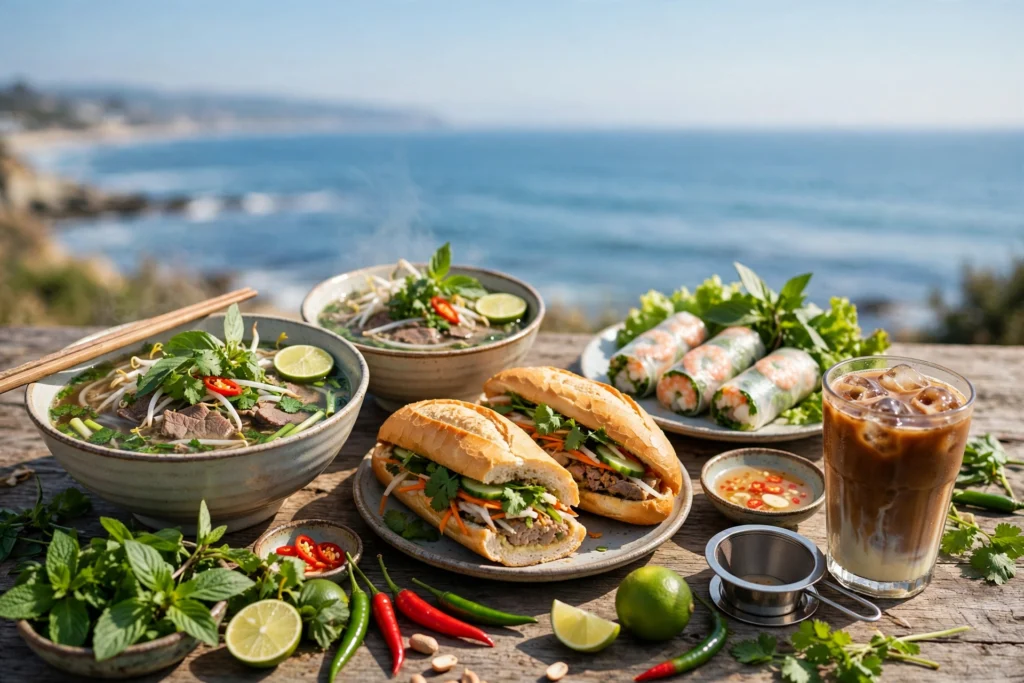
Vietnamese food is one of the world’s great cuisines, and it is also one of the most regional — the food changes as you travel, and eating your way along the route is part of the trip. The country sits at the meeting point of China, Southeast Asia and France, and its cooking carries all three: the noodle soups and the chopsticks of China, the herbs, the fish sauce and the chillies of Southeast Asia, and the baguettes, the coffee and the paté of France. The rule for eating well in Vietnam is simple: eat what the place you are in is known for, eat where locals eat, and do not judge a restaurant by its English menu — the best meals are usually in the places with the shortest menus.
Breakfast is the meal to take seriously. A bowl of pho, the beef noodle soup with its clear broth, its rice noodles, its herbs and its lime, is the breakfast of the north, and it is eaten standing up or sitting on a small stool, with chopsticks in one hand and a spoon in the other. In the centre, breakfast is bun bo Hue, the spicy beef noodle soup from the imperial city, with its lemongrass broth and its thick noodles. In the south, breakfast is hu tieu, the noodle soup with its sweet broth and its pork and seafood, or com tam, the broken rice with grilled pork, which is eaten at any hour. Lunch is the street food meal: a banh mi, the baguette sandwich with its paté, its pork, its pickled vegetables and its herbs, eaten on the move; or bun cha, the grilled pork with noodles and herbs that Hanoi claims as its own. Dinner is the family meal: a spread of dishes on the table, with rice in the middle, and everyone eating together.
Food by region
| Region | What to eat | Where to eat it |
|---|---|---|
| Hanoi and the north | Pho, bun cha, egg coffee, cha ca | Old Quarter, Hoan Kiem Lake, West Lake |
| Ha Long Bay and the coast | Seafood, squid, grilled fish, oysters | The cruise, the harbour restaurants |
| Sa Pa and the mountains | Thang co, grilled pork, sticky rice, corn wine | Ta Van, the markets, the homestays |
| Hue | Bun bo Hue, royal cuisine, banh beo | The Perfume River, the old city |
| Hoi An and the centre | Cao lau, white rose dumplings, banh mi | The old town, An Bang Beach |
| Da Nang | Seafood, mi Quang, banh xeo | My Khe Beach, the markets |
| Ho Chi Minh City and the south | Banh mi, com tam, hu tieu, hotpot | District 1, Cholon, Ben Thanh |
| Mekong Delta | Fish hotpot, grilled fish, tropical fruit | Can Tho, Ben Tre, the garden restaurants |
| Everywhere | Pho, spring rolls, iced coffee, fresh beer | Street stalls and small restaurants |
The dishes to know by name are few and they cover most menus. Pho is the beef or chicken noodle soup, with its clear broth, its rice noodles, its sliced meat, its herbs and its lime — and the northern version is plainer than the southern one, which adds bean sprouts and hoisin sauce. Bun cha is the Hanoi dish of grilled pork in a sweet broth, served with rice noodles and herbs, and it is the lunch to order in the capital. Banh mi is the baguette sandwich, with its crisp crust and its soft inside, filled with paté, pork, pickled vegetables, cucumber and herbs — and the best ones come from street stalls, not from restaurants. Cao lau, the Hoi An noodle dish, is made with thick noodles, sliced pork, greens and croutons, and it is said to be made with water from a particular well in the old town. And the drinks: ca phe sua da, the iced coffee with condensed milk, is the national drink and costs almost nothing. Bia hoi, the fresh beer brewed daily and sold on the street, is the cheapest beer in the world, at less than a dollar a glass.
Eating well without overpaying
The cheapest good food in Vietnam is street food: a bowl of pho costs 40,000 to 60,000 dong, about 1.50 to 2.50 dollars, a banh mi costs 20,000 to 40,000 dong, about one dollar, and a full lunch at a street stall costs less than a coffee back home. The most expensive food is the food aimed at tourists: the restaurants around Ben Thanh Market and the Old Quarter with picture menus and touts outside charge several times the local price for worse food. Walk two streets away from the sights and the price drops and the quality rises. Drink the iced coffee — ca phe sua da, served in a tall glass with condensed milk and ice, is the national drink and costs almost nothing. And a word on water: drink bottled water with an unbroken seal, and be careful with ice from street vendors if you are unsure of the source.
How Much Does a Vietnam Trip Cost? Budgets in Dong and Dollars

Vietnam is one of the best-value destinations in Asia for American travellers, and it is also one of the easiest to price, because the dong is stable and the prices are low. A bowl of pho costs about two dollars. A banh mi costs about one dollar. A comfortable hotel room costs 40 to 80 dollars. The honest way to present costs is as ranges, checked in November 2026, with the warning that a figure you read today may already be stale by the time you travel. Use the ranges below for planning, and check the live price before you pay for anything expensive. The exchange rate used here is about 26,000 dong to one US dollar, checked in November 2026.
The currency is the Vietnamese dong, abbreviated VND. Cards — Visa and Mastercard — are accepted in hotels, larger restaurants and shops in the cities, and contactless payment is common. But cash still matters: markets, street food stalls, small restaurants, rural guesthouses, buses and tips are often cash only, and some establishments have difficulty with foreign cards, so carry dong as well as cards. ATMs are everywhere in cities and accept US-issued bank cards, though they may charge high fees — use ATMs inside banks during opening hours, decline the machine’s offer to convert the withdrawal into dollars, and withdraw larger amounts less often. The State Department notes that you must declare any Vietnamese dong over 15,000,000 dong or any foreign currency over 5,000 dollars on entry or exit, so do not arrive with a large stack of cash.
Daily budgets
A budget traveller — hostels and guesthouses, street food, buses and walking — can manage on roughly 35 to 60 dollars a day, and the lower end of that range is realistic outside Hanoi and Ho Chi Minh City. A mid-range traveller — a comfortable hotel, sit-down meals, a domestic flight and a guided activity — should plan on roughly 53 to 91 dollars a day, which is the range from the best 10-day costed plan checked in November 2026. A comfortable trip with boutique hotels, good restaurants and a Ha Long Bay cruise runs higher, and the cruise alone is a significant cost. Hanoi and Ho Chi Minh City are the most expensive cities in the country, the countryside and the mountains are noticeably cheaper, and the coast is most expensive from February to April.
A 14-day trip, costed
| Item | Budget | Mid-range | Notes |
|---|---|---|---|
| International flights (US–Hanoi) | 700–1,100 | 900–1,600 | Return, booked weeks ahead, via a hub |
| Domestic flights (2 hops) | 50–150 | 100–250 | Hanoi–Da Nang, Da Nang–Ho Chi Minh City |
| Hotels (13 nights) | 260–650 | 520–1,300 | Guesthouses vs comfortable hotels |
| Food and drink | 200–400 | 400–800 | Street food vs sit-down restaurants |
| Transport on the ground | 100–200 | 150–350 | Trains, buses, Grab, airport transfers |
| Sites and activities | 100–250 | 200–450 | Museum entries, Ha Long Bay fee, tours |
| Ha Long Bay cruise (1 night) | 90–150 | 145–250 | Budget vs mid-range, per person |
| Total, excluding international flights | 800–1,900 | 1,915–4,400 | Per person, 14 days |
These are planning ranges, not quotes. The international flight is the largest single cost and the most variable: fares from the US West Coast to Hanoi are often in the 700 to 1,100 dollar range when booked a few weeks ahead, and higher from the East Coast and in peak season. Domestic flights are the bargain of the trip — short hops booked early are often cheaper than the train for the same journey, and the flight from Saigon to Da Nang takes one hour and 20 minutes and costs 24 to 72 dollars when booked ahead. And the Ha Long Bay cruise is the one cost worth splurging on: it is expensive, and it is also the experience people remember longest. Book it, budget for it, and do not let a cheap quote from an unlicensed operator tempt you into a worse cruise.
Money tips that save real money
Pay in dong where you can, and let your bank do the conversion rather than the merchant or the ATM — the machine’s rate is almost always worse. Keep small notes for markets, tips and street food, because large notes are hard to change in small shops. The largest commonly used note is 500,000 dong, about 19 dollars, and the smallest is 1,000 dong, about four cents — and the notes are easy to confuse, because the 20,000 and the 200,000 look alike at a glance, so check the zeros before you hand one over. Tipping is not expected in Vietnam, but small tips for guides, drivers and hotel staff are appreciated. Haggle in the market, but do not haggle in a restaurant or a shop with fixed prices.
Getting Around Vietnam: Flights, Trains, Buses and Crossing the Road

Getting around Vietnam is easy once you accept the one rule this guide keeps repeating: fly the long legs, take the train for one scenic overnight stretch if you want the experience, and use buses and cars inside a region. The country has good infrastructure — a large domestic flight network, comfortable sleeper buses, a single railway line running the length of the country, and ride-hailing that works everywhere — and the mistakes come from using the wrong mode for the wrong distance. A bus from Hanoi to Ho Chi Minh City is a two-day journey; a flight is two hours. A train from Hanoi to Da Nang is 16 hours; a flight is one hour and 20 minutes. A car is the best way to explore the Hai Van Pass; a car in Hanoi is a punishment.
Domestic flights are the backbone of the classic route. Vietnam Airlines flies the most routes and includes luggage, VietJet Air is the low-cost option with the widest network of cheap fares, and Bamboo Airways covers many of the same routes. Book a few weeks ahead for the best prices, and fly into the right airport: Noi Bai for Hanoi, Da Nang for the central coast, and Tan Son Nhat for Ho Chi Minh City. The flight from Hanoi to Da Nang takes about one hour and 20 minutes, and the flight from Da Nang to Ho Chi Minh City takes about one hour and 40 minutes. Remember the State Department’s note that you must enter and exit Vietnam on the same passport, and that domestic travel must also be done on the same passport you used for entry, so keep your passport with you for internal flights.
Trains deserve a special note, because they are the mode most visitors misunderstand. Vietnam has one railway line — the Reunification Express, running the 1,726 kilometres from Hanoi to Ho Chi Minh City in about 32 to 36 hours — and it is slow, scenic and worth doing once, for one stretch, rather than for the whole journey. The overnight train from Hanoi to Lao Cai, for Sa Pa, is the most useful train in the country: it leaves in the evening, arrives in the morning, and saves a hotel night. The train from Hanoi to Hue, about 13 hours overnight, is the other useful stretch, because you wake up in the imperial city. Everywhere else, the train is slower than the bus and more expensive than the flight. Do not plan a Vietnam trip around trains; plan it around flights, and use the train for one overnight stretch where it actually works.
Long-distance buses are the second backbone, and they are far better than most American travellers expect. Companies such as Hoang Long and Mai Linh run modern sleeper buses with reclining beds, and the network reaches almost every town in the country. An overnight bus saves a hotel night and is a legitimate way to cover a medium distance, though it is not a substitute for a flight on the longest routes. Inside a region, the local bus and the Grab car are the way to get from a town to a beach or a temple without a car. In Hanoi and Ho Chi Minh City, Grab is not just transport but the easiest way to move — the fares are fixed, the drivers are used to tourists, and the app works in English.
Transport at a glance
| Mode | Best for | Notes |
|---|---|---|
| Domestic flight | Between regions | 1–2 hours, book weeks ahead, Vietnam Airlines, VietJet, Bamboo |
| Overnight train | Hanoi–Lao Cai for Sa Pa, Hanoi–Hue | Saves a hotel night, book early, soft sleeper |
| Sleeper bus | Medium distances, overnight | Comfortable beds, Hoang Long and Mai Linh |
| Local bus | Short hops inside a region | Cheap, frequent, cash only |
| Grab | City trips, airport transfers | Fixed fares, works in English, best in cities |
| Rental car with driver | Hai Van Pass, Ha Giang Loop, countryside | Best for scenic roads; never self-drive |
| Motorbike rental | Nowhere without a Vietnamese licence | Illegal without a local licence, insurance will not pay |
Driving is the right choice on the scenic roads and the wrong choice in the cities. A car with a driver on the Hai Van Pass gives you the freedom to stop at viewpoints and beaches that buses do not reach, and a car with a driver on the Ha Giang Loop is the only sensible way to do the loop if you cannot ride a motorbike legally. A car in Hanoi or Ho Chi Minh City is a punishment — the traffic is heavy, the parking is difficult, and the public transport is better. If you do hire a car with a driver, agree the price and the route in advance, and make sure your travel insurance covers the journey. And the rule that matters most: never rent a motorbike or a scooter without a Vietnamese driver’s licence. It is illegal, your travel insurance will not pay your medical bills if you crash, and the police can fine you and impound the bike. Use Grab instead.
Crossing the road: the skill that matters most
Crossing the road in Vietnam is the skill that matters most, and it is a skill, not a gamble. The scooters flow around you like water, and the technique is to walk slowly and steadily in a straight line, without stopping, running, or stepping backwards, so the riders can predict where you will be. Do not wait for a gap in the traffic, because there will not be one. Do not run, because the riders cannot predict a runner. Walk at a steady pace, look ahead, keep your hands at your sides, and let the scooters flow around you. The first crossing is frightening. The tenth is routine. And if you are ever unsure, follow a local — cross beside them, at their pace, and let them set the rhythm.
Frequently Asked Questions About Vietnam Travel
Do US citizens need a visa for Vietnam?
Yes. US passport holders need an e-visa, applied for before travel on the official portal evisa.gov.vn. It costs 25 US dollars for single entry and 50 US dollars for multiple entry, it is valid for up to 90 days, and processing usually takes about three working days. Americans do not get the 45 days visa-free that citizens of 25 listed countries, including the UK, Germany, France, Japan and South Korea, receive. Apply at least two weeks before you fly, and earlier if you are travelling over Tet.
Is Vietnam safe for US tourists?
The US State Department rates Vietnam at Level 1, Exercise Normal Precautions, issued 24 June 2026 — its lowest tier, the same as Japan and South Korea. The advisory says Vietnam is generally a safe destination for travellers, with petty crime common in tourist areas and a low risk from landmines and unexploded ordnance, mainly at construction sites. No part of the country is rated at a higher level. Exercise normal caution, stay on marked paths in the countryside, and read the full advisory before you travel and again the week before you fly.
How many days do you need in Vietnam?
Seven days is the minimum for a good trip — three days in Hanoi and the bay, and three days on the central coast or in the south. Ten days covers the classic route tightly: Hanoi, Ha Long Bay, the central coast and Ho Chi Minh City. Twelve days is the recommended length, because it adds the mountains and the Mekong Delta overnight. Fourteen days is the version this guide recommends if you have the time, because it adds a second night on the bay and a second night in the delta.
What is the best time to visit Vietnam?
February to April is the best window for the whole country — the north is mild and dry, the central coast is at its driest and warmest, and the south is still in its dry season. March is the single best month. Avoid the central coast’s typhoon window, mid-September to mid-November, unless you are prepared for rain and cancelled boat trips. Tet 2027 falls on Saturday 6 February 2027, with the official holiday running from 4 to 10 February — a wonderful time to be in one place, and a difficult time to be moving between cities.
How much does a Ha Long Bay cruise cost?
An overnight cruise — two days, one night — starts around 90 to 150 dollars per person for budget boats, sits at 145 to 200 dollars for the mid-range boats most travellers book, and climbs past 250 dollars for luxury. A day cruise runs roughly 35 to 60 dollars at the budget end. The official sightseeing fee is 550,000 dong, about 21 dollars, for a Route 2 overnight, and it is usually included in the cruise price. Book the overnight cruise, not the day trip, and book it early, because the boats sell out from November to April.
How much does a trip to Vietnam cost?
A budget traveller can manage on roughly 35 to 60 dollars a day, a mid-range traveller on roughly 53 to 91 dollars a day, excluding international flights. A 14-day trip excluding international flights runs roughly 800 to 1,900 dollars on a budget and 1,915 to 4,400 dollars mid-range, with the Ha Long Bay cruise, hotels and season making the biggest difference.
What is the currency in Vietnam?
The Vietnamese dong (VND), at about 26,000 dong to one US dollar in November 2026. Cards are widely accepted in cities, but carry cash for markets, street food, small restaurants and buses. Use ATMs inside banks, decline the machine’s currency conversion, and check the zeros on the notes before you hand one over — the 20,000 and the 200,000 look alike at a glance.
Do I need travel insurance for Vietnam?
Yes, for any international trip. Your US health plan usually does not cover you abroad, and a hospital stay or a medical evacuation can cost far more than the trip itself. Buy a policy that covers emergency medical care, evacuation and trip cancellation, and read the exclusions for adventure activities — including riding a motorbike — before you buy. Riding without a Vietnamese licence is illegal, and your insurer will not pay if you crash.
Is it easy to get around Vietnam without a car?
Yes, if you fly between regions. Domestic flights connect Hanoi, Da Nang and Ho Chi Minh City in one to two hours, the overnight train to Lao Cai is the best way to reach Sa Pa, sleeper buses cover medium distances, and Grab works in every city with fixed fares. A car with a driver is useful for the Hai Van Pass and the Ha Giang Loop, but do not drive in Hanoi or Ho Chi Minh City — the traffic is heavy, and Grab is better.
What should I wear in Vietnam?
Dress as you would for a tropical trip, with layers for the mountains — Sa Pa is cold before dawn and hot by midday — and modest clothing for temples and pagodas: cover shoulders and knees, and remove your shoes before entering. Carry a light rain jacket in the wet season, and proper walking shoes for the terraces, the caves and the old towns. The sun is strong all year, so bring sunscreen and a hat.
Can I drink the tap water in Vietnam?
No. Drink bottled water with an unbroken seal, which is cheap and sold everywhere, and use it for brushing your teeth as well. The ice in hotels and restaurants is factory-made and safe, but be careful with ice from street vendors if you are unsure of the source. Check the CDC Travelers’ Health pages for Vietnam before you travel.
Is Vietnam a good first trip to Asia?
Yes, and it is one of the best first trips in Asia for an American traveller: a single country with a great capital, a world-famous bay, mountain terraces, lantern towns, a modern southern city and a river delta, good infrastructure, friendly people, and prices that are still reasonable. The only things it demands are the ones this guide covers — fly the long legs, book the bay cruise as an overnight, read the advisory, apply for the e-visa early, and give yourself enough days.
Conclusion: Vietnam Rewards the Traveller Who Goes Slowly
Vietnam is not a country to rush, and the travellers who love it most are rarely the ones who saw the most places. They are the ones who gave Hanoi three days instead of one, who slept on Ha Long Bay instead of seeing it at midday, who stayed in Hoi An after dark instead of passing through, and who spent a dawn on the Mekong instead of a rushed afternoon. The country punishes hurry and rewards patience, and the classic route works precisely because it does five things well instead of ten things badly. Plan it the way the guide lays it out. Fly the long legs and take the train for one overnight stretch. Go in February, March or April if you can. Book the bay cruise as an overnight, not a day trip. Apply for the e-visa early, enrol in STEP, buy the insurance, and carry the passport that gets you in for 90 days. Eat what each region is known for, pay in dong where you can, and cross the road slowly and steadily. Do those things, and Vietnam gives you what few destinations can: a capital that still feels like a village, a bay unlike anywhere else on earth, mountains that make you stop and stare, a lantern town that glows after dark, and a river delta that wakes before dawn. The trip is worth the planning, and the planning is mostly done — now go and book it.
People also read:
- Hanoi Travel Guide
- Is It Safe to Travel to Vietnam?
- Thailand Travel Guide
- Bali Travel Guide
- Travel Safety Tips
- What Does Travel Insurance Cover?

M. Adil is the founder and editor of SoloTravelPro. He writes practical, research-based travel guides that help travellers plan with confidence — from first-time city breaks to national parks and island escapes. Every guide is built on official sources, current prices and honest, usable advice, so readers can plan smarter and travel better.

Other Articles

Bali Travel Guide: Two Bases, One Island, Zero Regrets in 2026–27
Portugal Travel Guide: Lisbon, Porto and the Algarve by Train in 2026–27