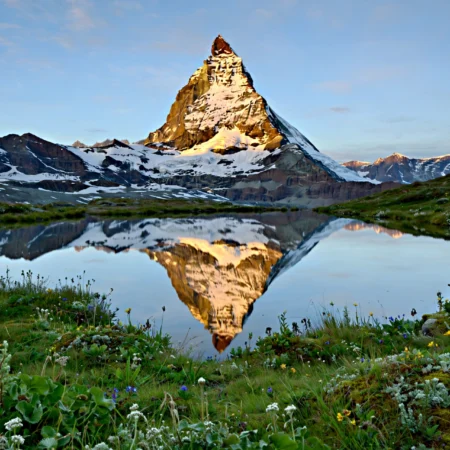
Austria is a small country that punishes travellers who try to see all of it at once. It is about the size of Maine, it holds an imperial capital, a baroque music city, a lake district that the internet broke, and the eastern edge of the Alps — and the train line that joins them runs straight from east to west in under five hours. This Austria travel guide gives you the honest version: the two-base rule that actually works, Vienna and Salzburg with Hallstatt as a day trip, the rail spine that connects them, the visa and border rules for US citizens as they stand in late 2026, what the US travel advisory really means, the Vienna Pass and Salzburg Card worked out in real numbers, and 5-day, 7-day, 10-day and 14-day itineraries built from the same spine, so you can plan a first trip to Austria without the mistakes most first-timers make.
Austria Travel Guide: The Two-Base Reality Check — Vienna, Salzburg and the Rail Spine Between Them
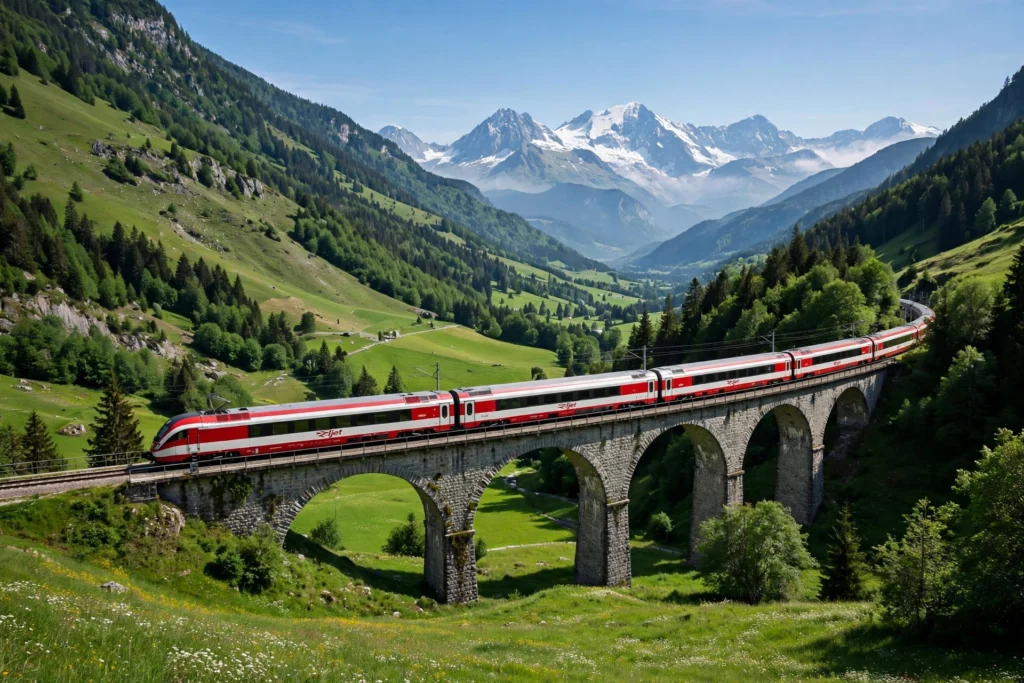
The single most important fact in this whole Austria travel guide is the shape of the trip. Austria is 83,879 square kilometres, smaller than Portugal, with about 9.2 million people and nine states, and it borders eight countries. The classic first trip uses almost none of that geography. It uses one line: Vienna in the east, Salzburg in the west, and the Salzkammergut lake district — Hallstatt, St Wolfgang, the Wolfgangsee — between them, with the Wachau Valley on the Danube as the day trip out of Vienna and Innsbruck and the Tyrol as the extension if you have the days. That is the route this guide builds, because it is the route that works in 5 to 14 days, and because every stop on it earns its place. Everything else — Graz and the Styrian wine country, the Vorarlberg and the Bregenzerwald, Carinthia’s lakes, the far west — is a second trip, not a detour.
The second reality check is about bases. The mistake most first-timers make in Austria is sleeping in a different place every night: one night in Vienna, one in Melk, one in Hallstatt, one in Salzburg, one in Innsbruck. Austria punishes that, because the country is built for trains and the trains are built for cities. Every time you change hotels you lose half a day to packing, checking out, hauling bags to a station, and checking in again — and in Hallstatt, where the village has one lakeside street and a few hundred residents, a one-night stay means arriving at midday with every other visitor and leaving before the village is quiet again. The fix is the two-base rule, and it shapes everything else in this guide: base one in Vienna for three or four nights, base two in Salzburg for two or three nights, and do Hallstatt as a day trip from Salzburg. Never sleep one night per stop. The rail spine makes it easy — Vienna to Salzburg is about two hours and twenty minutes by railjet, and Salzburg to Hallstatt is about two hours by train and ferry — so the two bases give you the whole classic route without a single wasted half-day.
The third reality check is about direction. East to west is the way to do Austria, and it is the way for a practical reason, not a romantic one. You fly into Vienna, where the long-haul flights land, and you travel west as the trip goes on: Vienna first, then the Wachau Valley on the way out of the capital, then Salzburg, then Hallstatt as a day trip, then Innsbruck and the Tyrol if you have the days, and then you fly home from Munich, about two hours west of Salzburg by train, or back from Vienna if your ticket demands it. The scenery improves as you go — the flat Danube plain gives way to the lake district and then to the Alps — and the trip gets quieter as you leave the capital behind. Travellers who do it backwards, flying into Munich and starting in the mountains, spend their first jet-lagged day on the hardest logistics of the trip instead of the easiest.
The fourth reality check is about what Austria costs. Austria sits between its neighbours: noticeably dearer than Hungary or the Czech Republic, noticeably cheaper than Switzerland. A mid-range day in Vienna or Salzburg runs roughly €80 to €125 per person, a budget day €60 to €85, and a comfortable day €160 to €230, before international flights. The cities are unusually good value for culture — standing tickets at the Vienna State Opera cost €13 to €18, Schönbrunn’s gardens are free, and a 24-hour Vienna transport ticket costs about €10 — and the mountains are where the money goes, with ski passes and resort food priced for people who are not counting. The costs section below prices a full 10-day trip line by line, so you can see where the money actually goes before you book anything.
The two-base route at a glance
| Base | Nights | How you get there | Why it earns its place |
|---|---|---|---|
| Vienna | 3–4 | Fly into Vienna International Airport | Schönbrunn, the Hofburg, the Ringstrasse, coffee houses, opera |
| Wachau Valley | Day trip | 1 hour by train to Melk or Krems | Danube vineyards, Melk Abbey, cycling, wine taverns |
| Salzburg | 2–3 | 2h20 by railjet from Vienna | Fortress, Mozart, baroque old town, Sound of Music country |
| Hallstatt | Day trip | ~2 hours by train and ferry from Salzburg | Lakeside village, salt mine, Skywalk, the classic photo |
| Innsbruck | 2 (optional) | Under 2 hours by train from Salzburg | Nordkette cable car, old town, the Alps from the city centre |
The mistakes first-timers make
The first mistake is the base-hopping mistake, covered above: a different hotel every night, which turns a holiday into a luggage-moving exercise. The second is treating Hallstatt as a place to sleep rather than a place to visit — the village is at its best before 10 in the morning and after 4 in the afternoon, when the day-trippers have gone, and a day trip that arrives early and leaves late sees more of it than a one-night stay that arrives at midday. The third is buying a Vienna Pass or a Salzburg Card without doing the arithmetic first: both passes only save money if you visit four or more paid sights a day, and the passes section below works out exactly when they pay and when they do not. The fourth is driving when the train would do — Austria’s motorways need a vignette, winter tyres are compulsory in wintry conditions from 1 November to 15 April, and parking in Hallstatt costs €15 a day while the train and ferry cost €8 return for the boat. And the fifth is booking the mountains in April or November without knowing that half the lifts, huts and lake boats close in those months — the best-time section below gives the month-by-month picture so you do not arrive to find the cable car shut.
How to use this guide
Read the sections in order if this is your first trip: the best time to go, the visa and border rules, the safety picture, then the two bases, then Hallstatt, the Wachau and Innsbruck, then the itineraries, food, costs and transport. If you already know when you are going, skip straight to the itinerary that matches your trip length — the 5-day, 7-day, 10-day and 14-day plans are built from the same two bases, so you can see exactly what each extra day buys you. Every price in this guide is given as a range or with a checked date, because the euro moves against the dollar and a figure quoted as exact would be out of date within weeks; the prices that matter most — Schönbrunn, the fortress, the ferry, the passes — were checked against live official pages in late November 2026, and the guide says so where it matters.
Best Time to Visit Austria: Month by Month, City by City
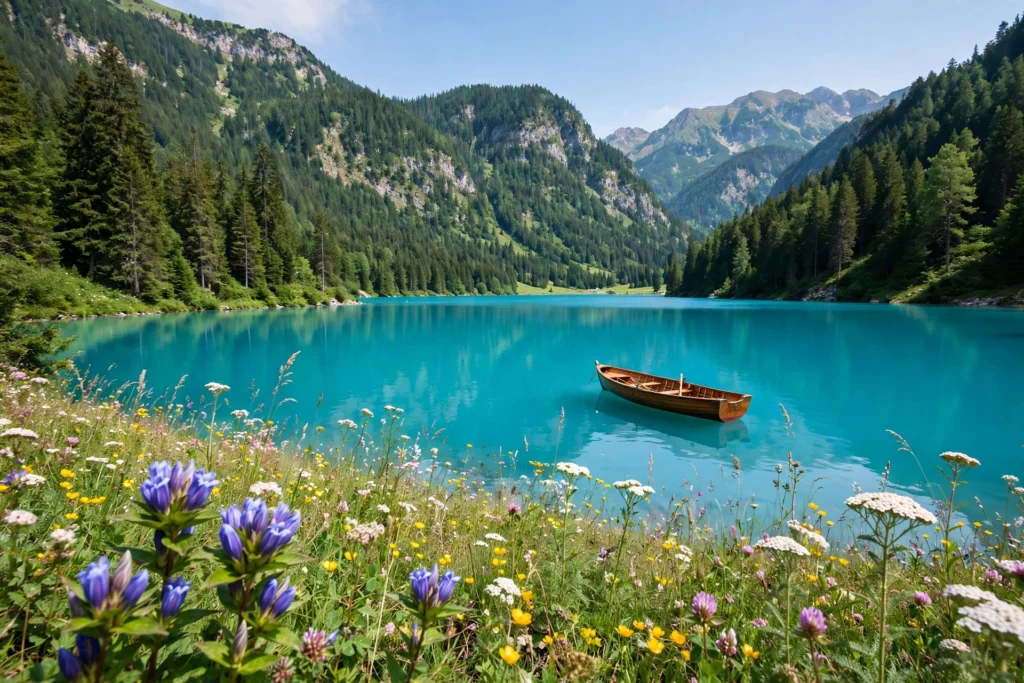
There is no single best month for the whole of Austria, because the country has two trips in it at once: the city trip and the mountain trip, and they peak in opposite seasons. Vienna and Salzburg are at their best in May, June and September, when the days reach 18 to 25 degrees Celsius, the mountain huts and cable cars are open, and the July and August peak has not arrived or has passed. The ski season runs from December to March, and the Christmas markets fill Vienna, Salzburg and Innsbruck from mid-November. The months that work for both trips at once are May, June and September, and for a first trip built on the two-base rule, those are the months this guide recommends.
Spring, from March to May, starts cold and unsettled. March and April are still cold in the mountains, with night frost and snow at altitude, and many high trails stay under snow into May. But the cities warm up fast: May is reliably pleasant in Vienna and Salzburg, the gardens are out, the café terraces fill, and the crowds are still thin. If you are coming for the cities and the lakes rather than the high trails, late April and May are excellent, and they are also among the cheapest months for flights and hotels.
Summer, from June to August, is the warmest season and the busiest. Days in Vienna average around 25 degrees and can reach 35, the Alpine trails are fully open, the lake boats run their full timetables, and the Salzburg Festival fills the city in late July and August. It is also the most expensive season: hotels in Salzburg and the lake towns charge peak prices, Hallstatt is at its most crowded, and the best rooms sell out weeks ahead. June is the sweet spot inside summer — long days, warm weather, open trails, and prices and crowds still below the July and August peak. July and August are the months to avoid if you dislike crowds, and the months to book earliest if you are coming anyway.
Autumn, from September to October, is the other great season. September is superb: warm, clear days, the hiking at its best, the crowds gone, and the wine harvest in the Wachau Valley. Early October is still good in the cities, with the Almabtrieb cattle processions in the mountains — decorated cattle walked down from the high pastures — as the season’s most distinctive festival. By late October the mountain huts start closing, the mist settles in the valleys, and the nights turn frosty. October is a city month in Austria, not a mountain month.
Winter, from November to March, splits the country in two. November is the dead month: the cheapest beds of the year in the cities, but the mountain infrastructure is closing and the lake boats have stopped. From mid-November the Christmas markets open — Vienna’s markets run from mid-November to late December, Salzburg’s Christkindlmarkt fills the Domplatz, and Innsbruck’s markets light up the old town — and the cities become worth visiting for the markets alone. January to March is ski season proper, with January the coldest month and temperatures often below freezing, and the resorts in the Tyrol and Salzburgerland at their most expensive. Vienna in January is cheap and quiet, and the ball season — the great Viennese balls — runs through January and February, which is a reason to come to the capital in the depth of winter that has nothing to do with skiing.
The shoulder months deserve a plain warning. April and November are when half the mountain infrastructure closes: lifts shut for maintenance, high huts close, lake boats stop running, and mountain villages go quiet. If your trip is built on the cities, April and November are fine and cheap. If it is built on the mountains, they are the two months to avoid. The funicular to the Hohensalzburg Fortress closes for refurbishment from 11 January to 14 March 2027, which is worth knowing if you are planning a winter trip to Salzburg — the fortress itself stays open and the footpath up is still there, but the easy ride is not.
Month-by-month at a glance
| Month | Vienna and Salzburg | Mountains and lakes | Verdict |
|---|---|---|---|
| January | Cold, quiet, cheap; ball season | Peak ski season, expensive resorts | Skiers and ball-goers only |
| February | Cold, ball season, cheap hotels | Ski season, best snow | Good for skiing and Vienna |
| March | Warming up, cities pleasant | Spring skiing, high trails still snowy | Cities yes, high trails no |
| April | Pleasant, quiet, cheap | Lifts closing, boats not running | Cities only |
| May | Excellent, gardens out, thin crowds | Trails opening, huts opening | Excellent |
| June | Best month, long days | Trails open, lakes warm | Best month |
| July | Hot in Vienna, busy everywhere | Perfect in the mountains | Good, book early |
| August | Hot, Salzburg Festival crowds | Busy, peak prices | Good, book earliest |
| September | Superb, warm and clear | Hiking at its best, crowds gone | Best month |
| October | Cool, quiet, harvest season | Huts closing, mist in valleys | Cities yes, mountains fading |
| November | Dead month, cheapest beds | Infrastructure closed | Cities cheap, mountains shut |
| December | Christmas markets, festive | Ski season starts | Markets and skiing |
How the seasons affect prices
Prices follow the seasons more sharply in the mountains than in the cities. A hotel room in Salzburg or Hallstatt can cost roughly half as much in November or January as in July or August, while a Vienna hotel varies less across the year. Ski passes in the big resorts run roughly €65 to €85 a day in season, with equipment hire another €25 to €35, and resort food is priced for people who are not counting. Domestic trains do not have seasonal pricing, but the Sparschiene advance fares on ÖBB — the cheap tickets that cost a fraction of the walk-up price — sell out earliest in the summer and at Christmas, so book Vienna to Salzburg weeks ahead in July and December. If your dates are flexible, the cheapest good-weather window is usually late May or late September, when the weather is at its best and the prices have not yet peaked or have already fallen. For more on picking cheap months in general, our guide to the cheapest time to travel explains how shoulder seasons work across destinations.
Do US Citizens Need a Visa for Austria? Schengen, EES and ETIAS in 2026–27

The short answer, for most American travellers, is no — you do not need a visa for a short trip to Austria, and you have not needed one for years. Austria is in the Schengen Area, and US passport holders enter visa-free for up to 90 days in any 180-day period, counted across the whole Schengen Area rather than per country. That 90-day clock is the thing to understand, because it is the rule that catches people out: your 90 days in Austria, Germany, Italy, France and every other Schengen country are counted together, and the count is now automatic. The US State Department’s Austria page confirms the rule in plain language — no visa is required for 90 days or less — and it adds the passport rules that matter: your passport must be valid at the time of entry and must have three months’ validity beyond your date of departure.
The 90-in-180 rule deserves a worked example, because it is the most misunderstood rule in European travel. If you spend 14 days in Austria, then 10 days in Germany and 7 days in Italy, you have used 31 days of your 90. If you then fly home and come back two months later for another three weeks, the clock looks back 180 days from each entry and counts every Schengen day inside that window. The days do not reset when you leave — they roll. For a single Austria trip of 5 to 14 days, the rule is irrelevant in practice; you would need to be spending months in Europe for it to bite. But if you are combining Austria with a longer European trip, or if you have already spent time in the Schengen Area this year, count your days before you book. The Entry/Exit System, described below, now counts them for you at the border, and it counts them exactly.
The Entry/Exit System — EES — is the change that actually affects your arrival. The EES is the EU’s digital border register: when a non-EU traveller crosses a Schengen external border, the system records the passport details, fingerprints and a facial image, and the date and place of each entry and exit. The system began a progressive roll-out on 12 October 2025 and became fully operational on 10 April 2026 at all external border crossing points except those of Cyprus and Ireland. In practice, that means your first entry into Austria — or into any Schengen country on the way there — now involves giving fingerprints and a photo at the border instead of getting a passport stamp. The passport stamp is gone; the database is the record. Allow extra time at the airport on arrival, especially at Vienna International, because the biometric step adds minutes to each passenger and the queues are longest in the summer and at Christmas.
ETIAS is the other system, and it is the one that causes the most confusion, because it has been announced, delayed and re-announced for years. ETIAS — the European Travel Information and Authorisation System — is an online travel authorisation that visa-exempt travellers, including Americans, will need before travelling to 30 European countries, including Austria. It is not a visa. When it starts, you will apply online before you travel, and the announced fee is €20, raised from the €7 originally planned. But as of late November 2026, ETIAS is not in operation, and no applications are being taken. The EU has said it will announce the start date several months before launch, and the official site — travel-europe.europa.eu/etias — is the only official ETIAS website. The EU’s own information pack, published in February 2026, says ETIAS will start in the last quarter of 2026, but other official sources have since removed that target date, and as of late November 2026 there is still no confirmed launch date. The practical advice is simple: you do not need an ETIAS for a trip to Austria in 2026, and you should not pay anyone for one. Any website taking ETIAS applications today is not official — more than 150 unofficial or fake ETIAS websites have been reported — and any site charging you for an ETIAS authorisation before the system opens is a scam. Check the official EU site before you travel, and check it again the week before you fly, because the launch date will be announced there first.
There are two more rules that catch people out. First, the passport rule is stricter than many Americans expect: the State Department says your passport must be valid at the time of entry and must have three months’ validity beyond your date of departure, and the Schengen rule also requires that the passport was issued within the last ten years. If your passport expires within three months of your return date, renew it before you travel. Second, border officers can ask for proof of your trip — return flight details, your first night’s hotel address, travel insurance, and evidence of funds — so keep those easy to reach on your phone. Austria also has currency rules: you must declare cash of €10,000 or more when entering or leaving the country. And remember the practical side: even with visa-free entry, border officers still check that you are a genuine visitor, so keep your return flight and hotel details handy and do not rely on a story — rely on the documents.
Entry checklist for US citizens
| Requirement | The rule for US citizens (checked November 2026) |
|---|---|
| Visa for tourism | Not required for 90 days or less |
| Schengen limit | 90 days in any 180-day period, counted across all Schengen countries |
| Passport validity | Valid at entry, 3 months beyond departure, issued within the last 10 years |
| EES biometrics | Fingerprints and photo at first Schengen entry; fully operational since 10 April 2026 |
| ETIAS | Not in operation as of late November 2026; no applications being taken; announced fee €20 |
| Official ETIAS site | travel-europe.europa.eu/etias only — never a lookalike site |
| Cash declaration | €10,000 or more must be declared at entry and exit |
| Vaccinations | No vaccinations required for Austria |
If someone in your party holds a different passport
The rule is decided passport by passport, not by the group. A spouse or travelling companion with a British, Canadian or Australian passport enters under the same visa-free Schengen rule as you, but a companion holding a passport that does need a Schengen visa — for example, an Indian, Chinese or South African passport — must apply for a Schengen visa from an Austrian embassy or consulate before travelling, and the visa they get covers Austria and the other Schengen states. Check every passport in your party separately before you book, and apply early, because Schengen visa appointments can take weeks in the summer.
Is Austria Safe for US Travellers? The Advisory, Honestly Explained
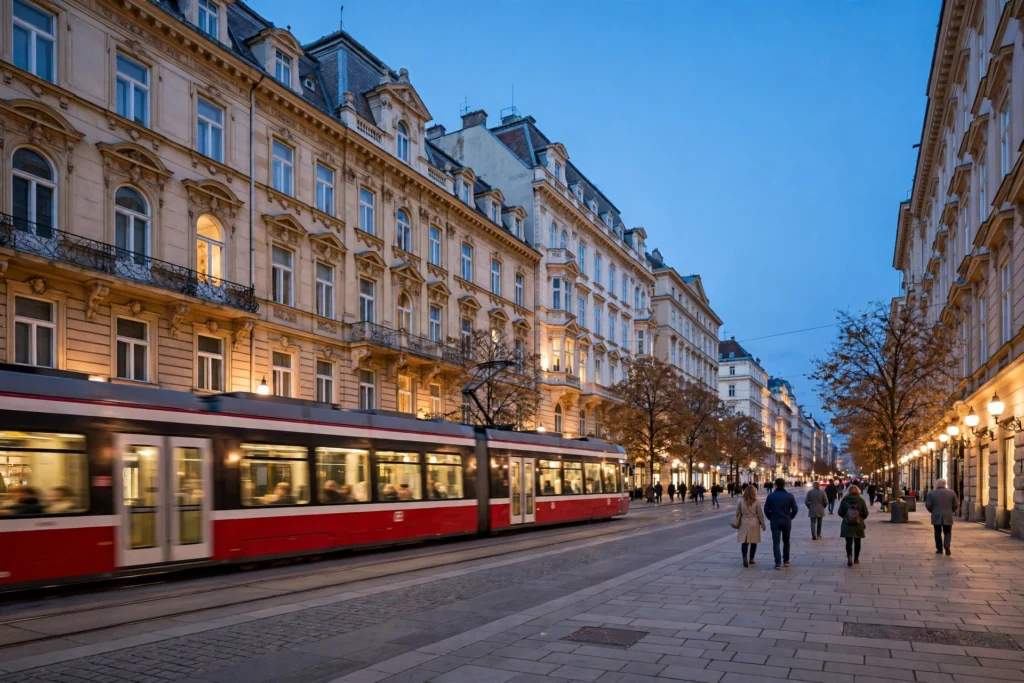
The US State Department rates Austria at Level 1: Exercise Normal Precautions. That is the fact that matters most, and it is the best news in this guide, because Level 1 is the lowest tier the State Department gives — the same tier it gives to Japan, South Korea, Australia and most of Western Europe. The advisory was issued on 10 September 2026 and, checked live in November 2026, it reads: “Exercise normal precautions in Austria. Austria is generally a safe destination for travelers.” You can read the full text on the State Department’s Austria travel advisory page, and you should read it twice — once when you book, and again the week before you fly, because advisories change. Our own guide to travel safety tips covers the same preparation in depth for any destination.
The detail underneath the headline is where the real information lives. Austria is one of the safest countries in Europe, and Vienna is safe at any hour, including on public transport. The advisory’s warnings are about ordinary urban crime, not about violence. Pickpocketing occurs around Stephansplatz, the main stations and on the U-Bahn, at ordinary European levels — the same levels you would expect in Paris or Rome. Stay aware of your surroundings in crowded places, keep your bag in front of you in the Christmas markets and on busy trams, do not hang a phone or camera from an open bag, and split your money and cards so one theft cannot strand you. Violent crime against tourists is rare, and no part of the country is rated at a higher level by the United States — there is no Level 2 region, no area to avoid, and no part of Austria that any of the major English-speaking governments advises against visiting.
The risks that actually affect tourists most often are alpine, not urban, and the biggest one is the mountains themselves. Weather in the Alps changes fast, marked trails are graded by difficulty for a reason, and people get into trouble every summer by starting a long route in the afternoon and being caught out by darkness or a thunderstorm. Check the forecast before you walk, tell someone your plan, carry water and a charged phone, and turn back earlier than you want to. In winter, avalanche risk is published daily and taken seriously by everyone who lives in the mountains. Off-piste skiing without a guide, a transceiver and the training to use it is how people die in the Austrian Alps, and it happens every season. Stay on the marked pistes unless you have the equipment and the training, and check the avalanche bulletin — the same way the locals do — before you go out.
There are two other warnings worth taking seriously. The first is about driving: Austria’s motorways need a vignette, winter tyres are compulsory in wintry conditions from 1 November to 15 April, and several Alpine roads and tunnels charge their own tolls on top of the vignette. If you hire a car, check before you drive into the mountains that it has winter tyres fitted — the hire company is obliged to provide them in winter, but you should confirm it rather than assume it. The second is about the mountains’ other hazard, the one nobody warns you about: altitude and sun. The high Alpine trails and cable cars take you above 2,000 metres quickly, where the sun is strong and the air is thin, and a summer hike at altitude without sunscreen, water and a hat will punish you faster than the same walk at sea level.
What to do before you go
Enrol in the Smart Traveler Enrollment Program, known as STEP, on the State Department’s STEP enrolment page. It is free, it takes about ten minutes, and it lets the nearest US embassy or consulate contact you in an emergency and help your family reach you. Save the emergency numbers — 112 works from any phone across Europe, and Austria’s own numbers are 133 for police, 122 for fire and 144 for ambulance. Read the CDC Travelers’ Health pages for Austria: no vaccination is required for most travellers. Buy travel insurance that covers emergency medical care and evacuation, and read what it excludes before you need it — if you are skiing or hiking, check that your policy covers winter sports and mountain rescue specifically, because standard policies often do not, and a helicopter evacuation from a mountain is billed at full cost.
Staying safe day to day
In the cities, the rules are the ordinary ones: watch your bag in crowds, be careful on the U-Bahn late at night, and do not leave valuables visible in a parked car. In the mountains, the rules are different and they matter more: never start a long hike in the afternoon, never leave the marked trail in winter, and never assume the weather at the top is the weather at the bottom. The Austrian Alpine Club publishes route conditions and hut opening times, and the mountain rescue service — reachable on 140 in Austria — is professional and fast, but it is not free if you needed it because you ignored the warnings. The safest trip to Austria is the one where the cities get the ordinary precautions and the mountains get the serious ones.
Vienna in 3 Days: Palaces, Coffee Houses and the Ringstrasse
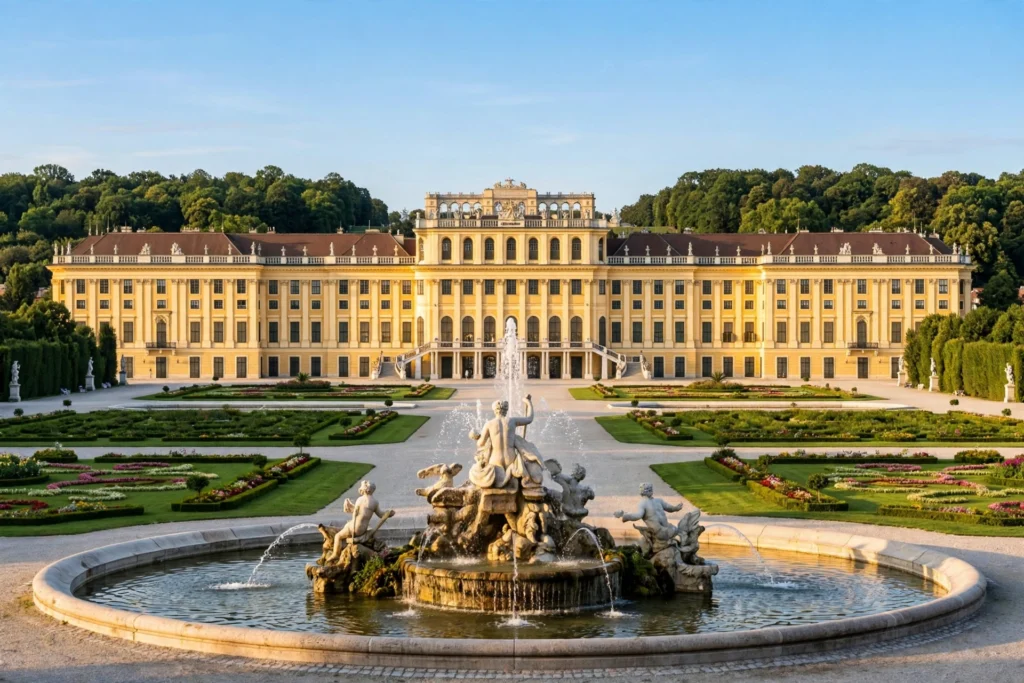
Vienna was the centre of an empire of fifty million people and it still has the buildings for it, which is why a city of under two million has palaces, opera houses and boulevards on a scale that makes no sense until you know the history. It is also regularly at or near the top of rankings of the world’s most liveable cities, which shows in the transport, the parks and the drinking water piped from the Alps. Three days is the right amount for a first visit: one day for the imperial centre, one day for Schönbrunn and the museums, and one day for the coffee houses, the markets and the city at walking pace. Vienna rewards slowness more than almost any city in Europe, because its best experiences — a coffee house afternoon, a standing ticket at the opera, a walk around the Ringstrasse at dusk — are not things you can rush.
Day one belongs to the Innere Stadt, the historic centre, and it should be done on foot. Start at St Stephen’s Cathedral, the Stephansdom, the great Gothic cathedral that anchors the city, and climb the south tower if the day is clear — the view over the rooftops is the best orientation you will get. From there, walk the Graben and the Kohlmarkt to the Hofburg, the imperial palace complex that was the Habsburgs’ home for six centuries. The Hofburg is not one building but a small city of courtyards, museums and offices, and the parts worth your time are the Imperial Apartments and the Sisi Museum, which tell the story of Empress Elisabeth — Sisi — whose life and death have become Vienna’s founding myth, and the Imperial Treasury, which holds the crown jewels and the Holy Lance. The Sisi Pass, which combines Schönbrunn with the Sisi Museum and the Furniture Museum, costs €69 for adults and is worth considering if you are doing both palaces — but do the arithmetic first, because the pass only saves money if you actually visit all three.
Day one should end on the Ringstrasse, the great boulevard that replaced the city walls in the nineteenth century and is lined with the buildings that define Vienna: the State Opera, the Parliament, the City Hall, the University, and the museums. The trams are the cheapest sightseeing in the city — the ring line passes most of the imperial architecture — and a slow circuit at dusk, when the buildings are lit, is one of the best hours in Vienna. If you have the energy, end the day at the opera: the cheapest cultural experience in the country is a standing ticket at the Vienna State Opera, €13 to €18, sold online from 10:00 on the day of the performance, for the same show the stalls paid two hundred euros for. Standing for three hours is not comfortable, but it is the single best value in European culture, and it is how most Viennese first saw the opera.
Day two belongs to Schönbrunn, the Habsburgs’ summer palace, and it needs a full morning. Schönbrunn is the single busiest sight in Austria, a UNESCO World Heritage site, and the palace you should book ahead for — the tickets have fixed entry times, and the popular morning slots sell out days ahead in summer. The official prices, checked live on the palace’s own site in late November 2026, are €42 for adults for the Palace Ticket — the full route through the state rooms and the imperial couple’s private apartments, about 75 minutes with an audio guide — and €30 for the shorter State Apartments route, about 40 minutes. Children aged 6 to 18 pay €30 and €20 respectively, students aged 19 to 25 pay €31.50 and €23, and the guided Maria Theresa tour costs €44. The Sisi Pass is €69, and the Winter Pass — palace plus zoo, Palm House and Desert House, valid from 3 November 2026 to 31 March 2027 — is €73. Buy only through the palace’s own site, schoenbrunn.at, which sells online exclusively through its own shop, imperialtickets.com; any other site selling Schönbrunn tickets is a reseller, and the resellers charge more. The gardens are free, and they are the part most visitors underrate: the Gloriette on the hill above the palace gives the classic view back over the palace and the city, and the gardens are at their best in May and June.
The afternoon of day two belongs to the museums, and Vienna has too many to do in one trip, so choose one and do it properly. The Kunsthistorisches Museum is one of the great collections in Europe and quieter than its equivalents in Paris or London — the Habsburgs collected for centuries, and the Bruegels alone are worth the visit. The Belvedere holds Klimt’s The Kiss and the best single room of Austrian art anywhere, in a baroque palace with gardens that are free to walk. The Albertina has the drawings and the modern collection, and the Leopold Museum has the Schiele and the Secessionist story. Pick the one that matches your taste and give it two unhurried hours; the mistake is trying to do two museums in an afternoon and remembering neither.
Day three is the slow day, and it is the day that makes the difference between a trip and a holiday. Start in a coffee house — the Viennese coffee house is an institution, on Austria’s national list of intangible cultural heritage under UNESCO, and the rule is that you buy one coffee, you get a newspaper and a glass of water, and you may sit for three hours without anyone suggesting otherwise. It is the best value in the city if you use it properly. Then walk the Naschmarkt, the great food market, for lunch — the stalls run from the city centre out to the west, and the cheap eating in Vienna is here, at the sausage stands, the Würstelstände, that operate late into the night, and in the supermarkets, which are the only way to keep food costs low in a country where a restaurant dinner is €18 to €25. Spend the afternoon in the MuseumsQuartier, or in the Prater, the great park with the Riesenrad Ferris wheel, or on the Danube Canal, which fills with outdoor bars from May to September. And if you have a third evening, book a concert — Vienna’s concert halls run nightly, and the standing and last-minute tickets are far cheaper than the guidebooks suggest.
Where to stay and how to get around
Stay inside the Ringstrasse or just outside it, in the Innere Stadt or the districts immediately around it — the 1st, 3rd, 4th and 7th districts put you within walking distance of everything that matters and within a tram ride of Schönbrunn. The areas around the main stations are cheaper but further out, and the savings are not worth the extra travel time on a three-day stay. Vienna’s public transport is excellent and cheap: a 24-hour ticket costs €10.20 on paper or €9.70 bought digitally, and covers the U-Bahn, trams and buses, and the 7-day ticket costs €25.20 digitally. The 48-hour and 72-hour tourist tickets were withdrawn in 2026, so for a three-day stay the choice is three 24-hour tickets or one 7-day ticket — the 7-day ticket is cheaper and simpler. Vienna International Airport is about 20 minutes from the city by train, and the S7 line between Praterstern and Hauptbahnhof is closed from 7 September 2026 to October 2027, so check the current airport route before you travel.
Eating in Vienna
Austrian food is imperial leftovers: schnitzel from Milan, goulash from Hungary, dumplings from Bohemia, all absorbed and made heavier. A proper Wiener Schnitzel is veal, pounded thin, and overhangs the plate; the pork version is cheaper and legally must be labelled differently, so if the menu says “Schnitzel Wiener Art” rather than “Wiener Schnitzel”, it is pork. The coffee house is where Vienna eats slowly — order a Melange, the Viennese coffee with steamed milk, and a slice of Sachertorte or Apfelstrudel, and take your time. For cheap eating, the Naschmarkt for lunch, the sausage stands late at night, and the supermarkets for breakfast supplies. For a proper dinner, the restaurants in the 7th district, around the MuseumsQuartier, are better value than the ones on the Graben, where you are paying for the address.
Salzburg in 2 Days: Fortress, Mozart and the Baroque Old Town
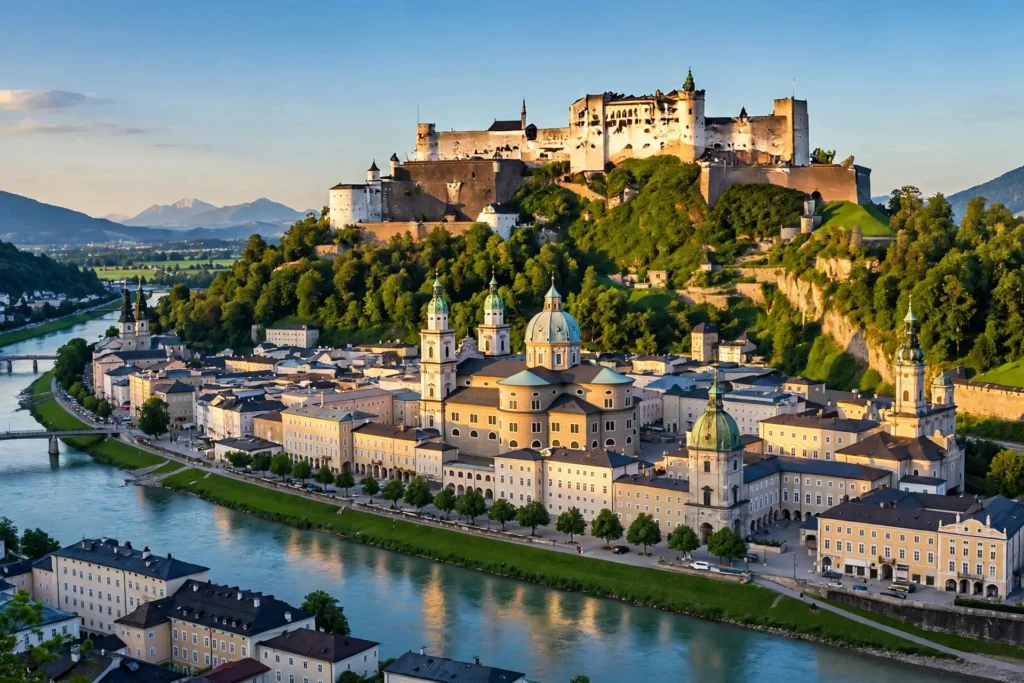
Salzburg sits where the Salzach river squeezes between two hills, with the Hohensalzburg Fortress on one side and the Kapuzinerberg on the other, and it is the most compact of Austria’s great cities. The old town is a UNESCO World Heritage site, a baroque centre made for slow walking, and two days is exactly right: one day for the old town and the fortress, one day for Mozart, the gardens and the Sound of Music country around the city. Salzburg is smaller than Vienna and more expensive per square metre, and it fills completely during the Salzburg Festival in late July and August, when the hotels charge their highest prices of the year and the city is at its most crowded. Come in May, June or September and you get the same city with half the people.
Day one starts at the fortress. The Hohensalzburg Fortress is the largest fully preserved fortress in Central Europe, and it dominates the city from its hilltop — you see it from everywhere, and the view from it is the reason to go up. The prices, checked live against the official sources in late November 2026, are €19.20 for adults for the all-inclusive ticket with the FestungsBahn funicular, which covers the ride up and down, the State Rooms, the Magic Theatre, the panorama tour and all the museums; the basic ticket with the funicular is €15.50, and walking up the footpath drops the prices to €14.50 and €12. Children aged 6 to 14 pay €7.30 and €6.30 with the funicular. The all-inclusive ticket is the one to buy — the State Rooms are the best part of the fortress, and the basic ticket leaves them out. One warning: the funicular closes for refurbishment from 11 January to 14 March 2027, so on a winter trip in those months you walk up, which takes about 20 to 30 minutes on a steep but well-made path. Give the fortress a full morning, including the panorama tour and the museums, and come down for lunch in the old town.
The afternoon of day one is for the old town itself, and it should be walked slowly. The Getreidegasse is the main shopping street, with its wrought-iron guild signs hanging over the pavement, and Mozart’s Birthplace is at number 9 — the house where Wolfgang Amadeus Mozart was born in 1756, now a museum. The cathedral, the Dom, anchors the Domplatz, and the DomQuartier connects the cathedral, the Residenz palace and the museums in a single circuit. The Residenzplatz, with its great fountain, is the square where the Christmas market — the Christkindlmarkt — fills the Domplatz from late November. Walk the river along the Salzach, cross the Marko-Feingold-Steg, the love-lock bridge, and climb the Kapuzinerberg on the far side for the view back over the old town with the fortress behind it. The old town is small enough to walk in an afternoon and rich enough to fill one.
Day two belongs to Mozart and to the city’s green side. Start at Mozart’s Birthplace and the Mozart Residence across the river on Makartplatz — the two houses together tell the story of the composer’s Salzburg years, and the combined ticket is the sensible way to see both. Then walk to the Mirabell Gardens, the baroque gardens where the Sound of Music’s “Do-Re-Mi” sequence was filmed, and which are at their best in May and June when the flowers are out. The afternoon is for the Sound of Music country or for Hellbrunn Palace, south of the city: Hellbrunn’s trick fountains — the Wasserspiele — are the most enjoyable half-day in Salzburg in summer, a palace built for practical jokes, where the garden fountains spray the guests without warning. In winter, when the fountains are off, the Untersberg cable car is the better choice — the mountain rises to 1,853 metres above the city, and the view from the top takes in Salzburg, the lakes and the Alps in a single panorama.
The Salzburg Card: the arithmetic
The Salzburg Card is the city’s all-inclusive pass, and it is the pass in Austria where the arithmetic is closest. The official 2026 prices, from the Salzburg tourism board’s own price list, are €38 for 24 hours, €45 for 48 hours and €49 for 72 hours in the summer season from 1 April to 31 October, and €35, €41 and €44 in the winter season from 1 November to 31 March; children aged 6 to 15 pay half. The card covers one free admission to each included attraction — the fortress with the funicular, Mozart’s Birthplace, the Mozart Residence, the DomQuartier and Hellbrunn Palace — plus one return ride on the Untersberg cable car, one Salzach city cruise, and free city public transport, though not the S-Bahn. The break-even is tight: the fortress all-inclusive ticket (€19.20) plus Mozart’s Birthplace (about €18) together cost roughly €37, which is just under the €38 summer price of the 24-hour card. So a day built around the fortress and one Mozart house loses money on the card, and a day that adds Hellbrunn (€16.50) and the Untersberg cable car saves money on it. The rule is simple: buy the card only if you are doing three or more paid sights in 24 hours, and buy the 48-hour card if your two days in Salzburg are both sight-heavy. Buy the digital card on the official Salzburg tourism site, salzburg.info, and remember that the clock starts at first use, not at purchase, and that the card cannot be paused.
Where to stay and how to get around
Stay in the old town or just across the river in the Neustadt, within walking distance of the Getreidegasse — Salzburg is small enough that almost everything is a 15-minute walk, and the bus is only needed for Hellbrunn and the Untersberg. The old town hotels are the most expensive in the city, and the ones across the river are better value for the same walk. Salzburg’s public transport is a single ticket system covering buses and trolleybuses, and the Salzburg Card includes it, which is one more reason the card pays on a busy day. The train station is a 20-minute walk from the old town, or a short bus ride, and the airport is a 20-minute bus ride. Book early for the Festival weeks and for Advent, when the Christmas market fills the city and the hotels sell out.
Hallstatt as a Day Trip: The Honest Logistics
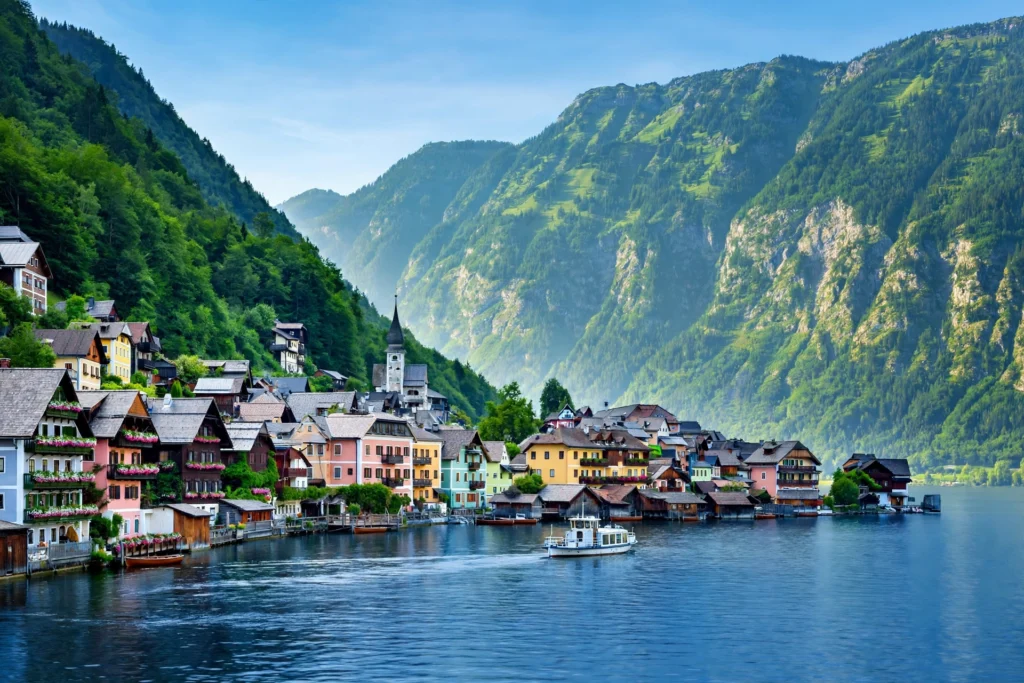
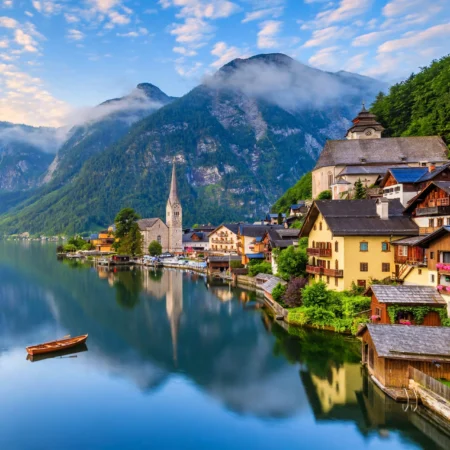
Hallstatt is the most photographed village in Austria and the most misunderstood. It is a lakeside village of a few hundred residents on Lake Hallstatt, in the UNESCO-listed Hallstatt-Dachstein Salzkammergut landscape, and it is so heavily visited that on busy days it gets up to 10,000 visitors — more than ten times its population — and its one lakeside street is fullest from late morning to mid-afternoon. The village itself is free and never closes, and anyone charging you to “enter Hallstatt” is not official. What you pay for is the transport to get there, the salt mine, the funicular and Skywalk, the museum, and the boats. This section gives you the honest logistics, because Hallstatt is the stop in Austria where the logistics are the trip: get them wrong and you spend the day in queues; get them right and you see the village at its best.
The first decision is where to base yourself, and the answer is Salzburg, not Hallstatt. The train from Salzburg to Hallstatt takes about two hours each way, and the day trip is straightforward: Salzburg Hauptbahnhof to Attnang-Puchheim on the main line, then the Salzkammergut line to Hallstatt station, then the ferry across the lake to the village. The station is not in the village — it sits on the opposite, eastern shore of the lake, a two-minute walk below the platform to the dock, where the ferry Stefanie departs. The crossing takes about seven minutes and costs €4 one way or €8 for an open return ticket, cash only — the boat takes no cards at all, so bring euros in small bills and coins. The boats are timed to meet the trains, and they run all year, but sailings can be cancelled in bad weather. The last boat from the village to the station leaves at 17:45 and the last from the station to the village at 18:30 on the November 2026 timetable, and the ferry leaves the village about 20 minutes before most train departures — so catch the boat back with time to spare, and check the current timetable on the operator’s site before you choose your return train.
The second decision is when to go, and the answer is early or late. The village is at its best before 10 in the morning and after 4 in the afternoon, when the day-trippers have gone. A day trip that catches the first train out of Salzburg — arriving in the village by about 9:30 — and stays until the last boat gives you the quiet morning, the busy middle of the day for the salt mine and the museum, and the quiet evening light on the lake. The mistake is arriving at midday, when the coaches arrive, and leaving at 3 in the afternoon, when you have seen the village only at its worst. If you do want to stay the night, book months ahead — the village has very few rooms, they are expensive, and the night in Hallstatt is the only way to see the village properly after dark — but for most travellers the early day trip is the better plan, and it is the plan this guide builds.
The third decision is what to do when you get there, and the answer is the salt mine first. The Hallstatt salt mine is the oldest salt mine in the world, and the combined ticket with the funicular and the Skywalk costs €49 for adults — the funicular alone is €29 return. The mine reopened on 29 August 2026 after about a year’s closure, with a new step-free funicular, and the Skywalk — the viewing platform that hangs over the village — gives the classic photograph of Hallstatt from above. The mine tour takes about 90 minutes and runs on a fixed schedule, so book the first tour of the day and do the Skywalk straight afterwards, while the light is still good and the crowds are still thin. The Beinhaus, the bone house in the church above the village, is the other sight worth the climb — a small chapel filled with painted skulls, a tradition of the Salzkammergut that is strange and moving in equal measure. The village museum, the Welterbemuseum, tells the story of the salt trade that built the village, and the lakeside promenade, which runs along the western shore from the ferry dock to the southern end of the village, is the walk to take in the late afternoon, when the light is low and the boats are coming in.
The Dachstein is the extension if you have a second day in the lakes, and it is worth knowing about even on a day trip. The Dachstein Krippenstein cable car runs from Obertraun, across the lake from Hallstatt, and the combined ticket for the Giant Ice Cave and the Mammut Cave costs about €50 for adults in the 2026 season. The southern lake round trip by boat — Hallstatt Markt to Hallstatt Lahn and Obertraun and back, calling at every landing — costs €18 and runs from May to September, and the boat from Hallstatt to Obertraun alone is €12. These are summer options: the cable car runs from 1 May to 1 November, and the salt mine and funicular stay open until 6 January 2027 with shorter hours. In winter, Hallstatt is a different place — quiet, misty, and beautiful in a way the summer crowds never see — and the ferry is the best way to see it.
The Hallstatt day trip, timed
| Time | What happens |
|---|---|
| 07:30 | Leave Salzburg Hauptbahnhof; change at Attnang-Puchheim |
| 09:30 | Arrive Hallstatt station; ferry across the lake (€4, cash) |
| 09:45 | Village quiet; walk the promenade and the Marktplatz |
| 10:30 | Funicular up; salt mine tour and Skywalk (€49 combined) |
| 13:00 | Lunch in the village; Beinhaus and museum |
| 15:00 | Lake boat round trip in summer (€18) or lakeside walk |
| 16:30 | Coffee on the Marktplatz as the day-trippers leave |
| 17:45 | Last boat back to the station; train to Salzburg |
The Wachau Valley and the Danube: Vienna’s Best Day Trip
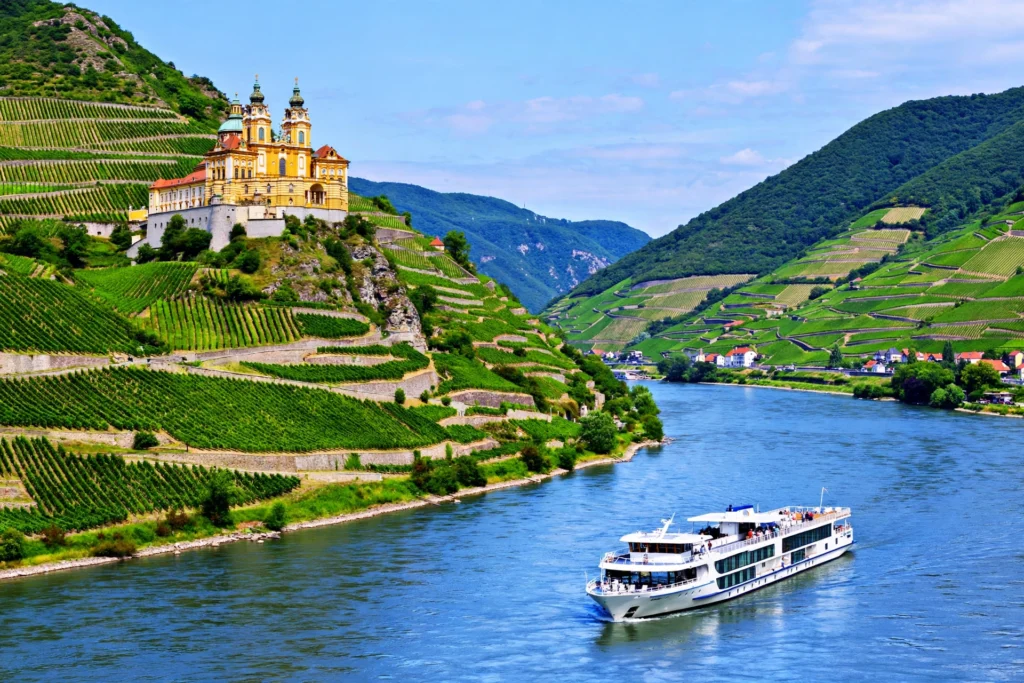
The Wachau Valley is the day trip out of Vienna that the guidebooks all recommend and that almost nobody regrets. It is a UNESCO-listed stretch of the Danube between Melk and Krems, about an hour west of Vienna by train, with terraced vineyards of Grüner Veltliner and Riesling, ruined castles on the hills, and the great abbey of Melk at the western end. It is the one place in Austria where the wine country and the river country are the same place, and it is best done slowly — by train to one end, by boat or bicycle along the river, and by train back from the other end.
The classic way to do it is the Melk to Krems line. Take the train from Vienna to Melk in the morning — about an hour — and start at Melk Abbey, the great baroque abbey that sits above the Danube and is the headline stop of the valley. The abbey is a working Benedictine monastery, and the tour takes you through the marble hall, the library and the church, which is one of the great baroque interiors in Europe. From Melk, the valley runs east along the river through Spitz and Weissenkirchen to Dürnstein, the village where Richard the Lionheart was held prisoner in the twelfth century and whose ruined castle sits on the hill above the river, and then to Krems, the wine town at the eastern end. In summer, the boats run between the towns, and the cycle path along the river is flat, well-made and one of the best day rides in Europe — hire a bicycle in Melk or Krems and ride the valley in a day, stopping at the wine taverns, the Heurigen, that serve the new wine with cold food in the gardens.
The wine is the point of the Wachau, and the grape to know is Grüner Veltliner, Austria’s signature white, grown on the terraced slopes above the river. The Wachau’s wine taverns are the place to try it, and the rule is the same as in Vienna: the Heurigen serves its own wine with simple food, and the best ones are in the villages rather than on the riverfront. September and October are the harvest months, when the valley is at its busiest and its best, and the wine festivals fill the villages. April and May are quieter and cheaper, and the vineyards are green and the river is high. The boats run from April to October, and outside those months the valley is done by train and on foot, which is quieter and still worth it — Melk Abbey is open all year, and the winter light on the river is beautiful.
The practical details are simple. The train from Vienna to Melk takes about an hour, and to Krems about the same; the valley railway connects the towns along the river, and the boats connect them in summer. A day in the Wachau costs little beyond the train fare and the abbey ticket — the cycling is cheap, the wine taverns are reasonable, and the river is free. Do not try to combine the Wachau with Hallstatt in a single day trip from Vienna: the two are in opposite directions, and each deserves its own day. And do not drive the Wachau if you can avoid it — the road along the river is narrow, the parking in the villages is limited, and the train and the bicycle are the better way to see a valley that was built for the river, not the road.
Innsbruck and the Tyrol: Adding the Alps
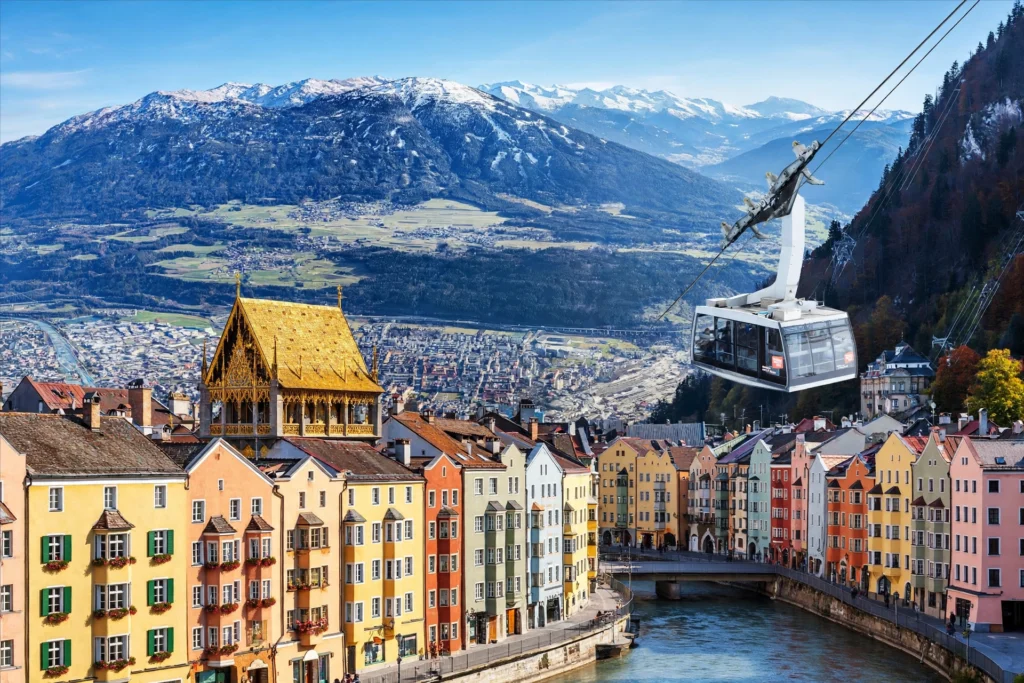
Innsbruck is the city in Austria where the mountains stop being a view and start being the place. It sits in the Inn Valley in the Tyrol, ringed by mountains in every direction, with ski lifts running from the city itself and a funicular designed by Zaha Hadid climbing from the old town to the Nordkette. Two days is the right amount: one day for the city and the Nordkette, one day for a valley — the Zillertal, the Ötztal or the Stubaital — or for a ski day in winter. Innsbruck is the extension to the two-base route, not a third base on a first trip, and it earns its place on the 10-day and 14-day itineraries, not on the 5-day one.
The Nordkette is the reason to come to Innsbruck, and it is the most accessible mountain in Austria. The Hungerburgbahn funicular leaves from the Congress station in the old town and climbs to Hungerburg in eight minutes; from there the cable car continues to the Seegrube at 1,905 metres and then to the Hafelekar at 2,300 metres, where the view takes in the city below and the Alps in every direction. The whole journey from the city centre to 2,300 metres takes about twenty minutes, and it is the fastest way in Austria to go from a coffee house to a high Alpine ridge. In summer, the trails from the top are the best easy hiking in the country — the Goetheweg along the ridge is a half-day walk with the city always in view. In winter, the Nordkette is a ski area with the city at its foot, and the après-ski starts in the old town rather than in a resort village.
The old town itself is small and walkable, and it is worth half a day. The Golden Roof — the Goldenes Dachl — is the symbol of the city, a late Gothic oriel window with a roof of gilded copper tiles, built for Emperor Maximilian I. The Hofkirche holds the emperor’s great tomb, guarded by 28 larger-than-life bronze statues, and the Hofburg is the Habsburgs’ Tyrolean palace. The Maria-Theresien-Strasse is the main shopping street, with the mountains at the end of it in both directions, and the Christmas market fills the old town from mid-November. Innsbruck is also the city for the Swarovski Crystal Worlds in Wattens, a short bus ride away, which is either a delight or a tourist trap depending on your taste — the gardens and the crystal installations are genuinely impressive, and the shop is enormous.
The Tyrol beyond Innsbruck is the Austria of the postcards: the Zillertal behind Mayrhofen, with its glacier and its summer trails; the Ötztal, with its waterfalls and its high Alpine road; the Krimml waterfalls, the tallest in Austria at 380 metres in three stages, with a path beside the whole drop; and the ski areas of St Anton, Kitzbühel, Mayrhofen and Ischgl, which are among the best in the world and priced accordingly. A day in the Zillertal from Innsbruck is easy by train, and a day at the Krimml waterfalls is a full day by train and bus. The Grossglockner High Alpine Road, the toll road of switchbacks up to 2,504 metres facing Austria’s highest mountain, is open roughly from May to October and is the best drive in the country — but it is a drive, and it needs a car, which is the one place in this guide where a car earns its place.
The practical warning for the Tyrol is the same as for the rest of Austria’s mountains: the seasons matter more here than anywhere else. The ski season runs from December to March, the hiking season from June to September, and April and November are the dead months when the lifts close and the villages go quiet. The Hintertux glacier runs all year, which is the exception that proves the rule. Book the ski weeks early — the resorts fill for Christmas, New Year and the February school holidays — and book the summer hotels early too, because the Zillertal and the Ötztal are busy in July and August. If you are coming from Salzburg, the train to Innsbruck takes under two hours, and the route itself — through the Salzach valley and over the passes — is one of the best train rides in Austria.
Vienna vs Salzburg: Which City Should Get Your Extra Day?
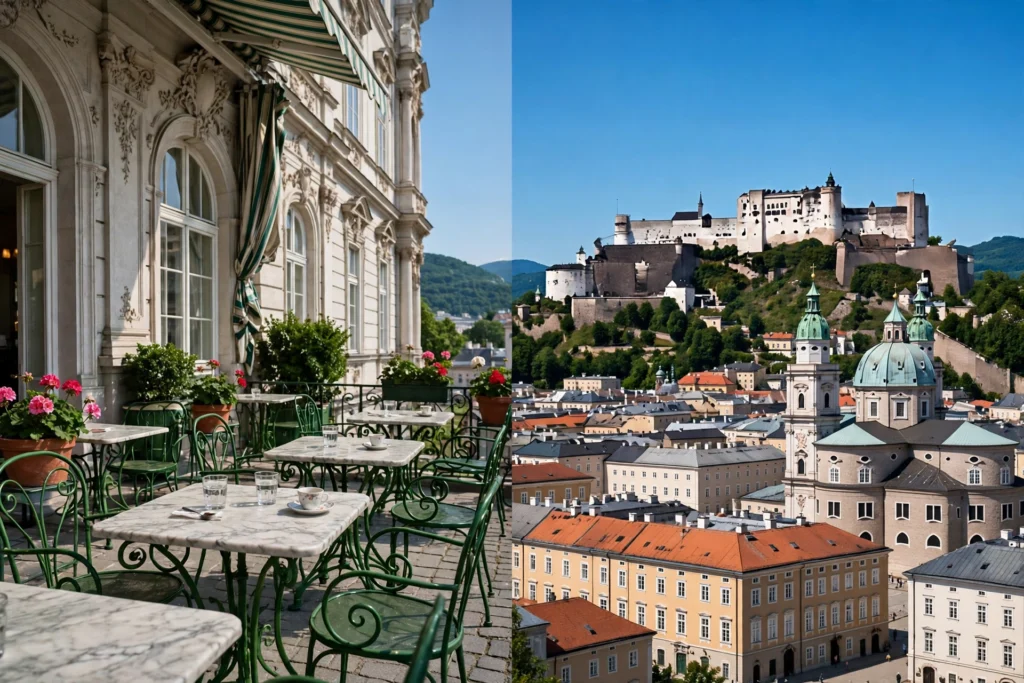
Every first trip to Austria faces the same question, usually on about day three: Vienna and Salzburg are both wonderful, the train between them is only two and a half hours, and there is never enough time for both. The answer is not that one city is better than the other — it is that they are different trips, and the right split depends on what kind of traveller you are. This section makes the choice explicit, so you can give your extra day to the city that will use it best.
Vienna is the bigger city in every sense: bigger palaces, bigger museums, bigger coffee houses, bigger music. It is the city for the traveller who wants depth — three days in Vienna still leaves the Belvedere and the Albertina undone, and the city rewards a fourth day more than any other stop in Austria. Vienna is also the cheaper city to be in: the hotels cost less, the transport is cheaper, the food is cheaper, and the free things — the palace gardens, the Ringstrasse walk, the coffee house afternoon — are the best free things in the country. Vienna is the city for the first-timer who loves museums, music and imperial history, and for the traveller on a budget, because a day in Vienna costs less than a day in Salzburg and gives you more for it.
Salzburg is the smaller city and the more beautiful one, in the postcard sense: the fortress above the old town, the river below it, the mountains at the edge of town. It is the city for the traveller who wants atmosphere over depth — two days in Salzburg covers the old town, the fortress and Mozart properly, and a third day is best spent outside the city, in the lakes or the mountains, rather than in it. Salzburg is also the more expensive city: the hotels cost more, the restaurants cost more, and the Salzburg Card only pays if you are doing three paid sights a day. Salzburg is the city for the traveller who loves music and mountains in equal measure, and for the traveller who wants the most beautiful two days in Austria rather than the most complete four.
The honest answer for most first-timers is three days in Vienna and two in Salzburg, which is the split this guide builds. But there are two cases where you should change it. If you love museums and music and you are travelling in winter, when the mountains are closed and the lakes are quiet, give Vienna four days and Salzburg two — the extra day in Vienna buys you the Belvedere and a concert, while the extra day in Salzburg in January buys you very little. And if you love the mountains and you are travelling in June or September, give Vienna three days and Salzburg three — the third Salzburg day is a day in the lakes or on the Untersberg, which is a better use of the day than a fourth day in Vienna. The table below makes the trade-off concrete.
Vienna vs Salzburg at a glance
| Question | Vienna | Salzburg |
|---|---|---|
| How many days does it need? | 3–4 days | 2 days, plus a day trip |
| Best for | Museums, opera, coffee houses, imperial history | Fortress, Mozart, baroque streets, mountain views |
| Daily cost (mid-range) | €80–€120 | €90–€140 |
| Free highlights | Schönbrunn gardens, Ringstrasse walk, coffee house | Mirabell Gardens, Kapuzinerberg view, old town walk |
| Best pass | Vienna Pass only if 4+ sights a day; City Card for transport | Salzburg Card if 3+ sights a day |
| Worst season | July heat, August crowds | Festival weeks (late Jul–Aug), Advent crowds |
| Day trips | Wachau Valley, Bratislava | Hallstatt, Salzkammergut, Berchtesgaden |
| Fly in or out? | Fly in — the long-haul gateway | Fly out via Munich, 2 hours west |
The Sound of Music question
Salzburg is the city of The Sound of Music, and the question every visitor asks is whether the tour is worth it. The honest answer is that it depends on what you want from it. The film was shot in and around Salzburg — the Mirabell Gardens, the Nonnberg Abbey, the Leopoldskron Palace, the Mondsee church — and the half-day bus tour takes you to all of them with the songs playing. If you grew up with the film, the tour is a delight, and it is the one organised tour in Austria that most people remember fondly. If you did not grow up with the film, the same half-day is better spent on the Untersberg or in the lakes. The Mirabell Gardens and the Nonnberg Abbey are free to visit on your own, and you can see the most famous locations without paying for the bus. Do not let the tour eat a day that the fortress or the lakes would have used better.
The 5-Day, 7-Day, 10-Day and 14-Day Austria Itineraries
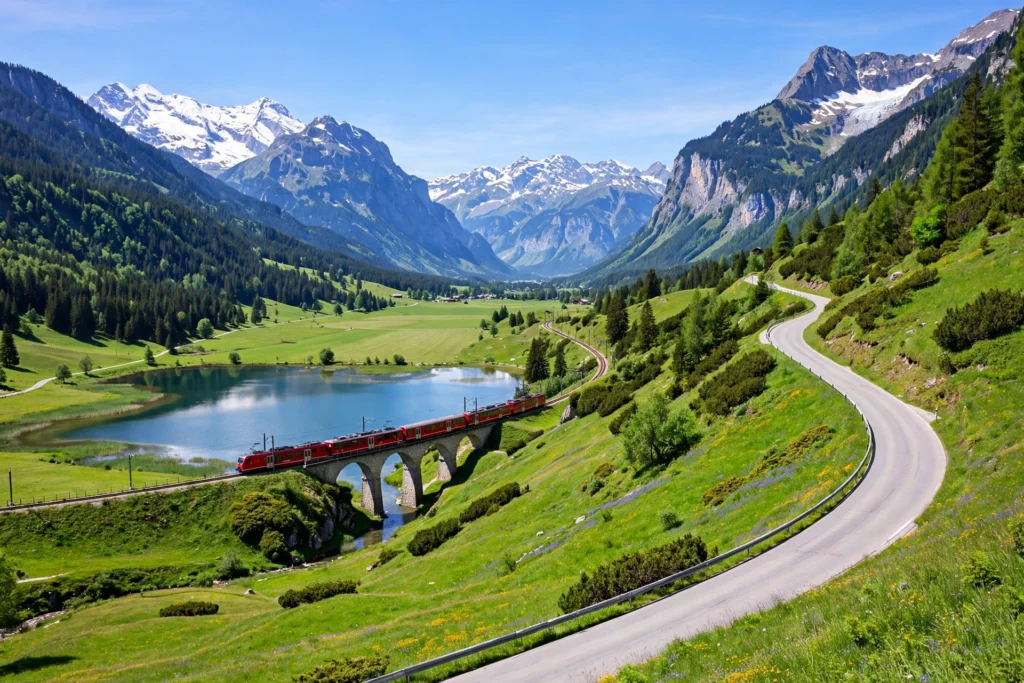
All four itineraries in this section are built from the same spine — Vienna, then Salzburg, then the extension — so you can see exactly what each extra day buys you. The 5-day trip is the minimum that does the country justice. The 7-day trip is the classic first trip and the one this guide recommends. The 10-day trip adds the Alps properly. The 14-day trip adds the west and the wine country, and it is the trip for the traveller who wants to see Austria rather than sample it. None of them sleeps one night per stop, none of them drives when the train would do, and all of them fly into Vienna and out of Munich or Vienna.
The 5-day itinerary is Vienna and Salzburg with a Hallstatt day trip, and it is tight but honest. Days 1 to 3 are Vienna: the imperial centre and the Ringstrasse on day one, Schönbrunn and one museum on day two, the coffee houses and the Naschmarkt on day three. Day 4 is the train to Salzburg in the morning — the railjet takes about two hours and twenty minutes, so you arrive before lunch — and the afternoon is the old town and the fortress. Day 5 is the Hallstatt day trip from Salzburg, early train out and late boat back, and the evening train or the night in Salzburg before flying home. The 5-day trip skips the Wachau and Innsbruck entirely, and it should: five days is not enough for a third stop, and the Wachau is a day trip that deserves its own day rather than a squeezed half-day.
The 7-day itinerary is the classic first trip, and it is the one to choose if you can only pick one. Days 1 to 3 are Vienna, exactly as above. Day 4 is the Wachau Valley day trip from Vienna — train to Melk in the morning, the abbey, the river towns and the wine taverns, train back in the evening — which is the day the 5-day trip sacrifices. Day 5 is the train to Salzburg and the old town and the fortress. Day 6 is the Hallstatt day trip. Day 7 is Mozart, the Mirabell Gardens and Hellbrunn or the Untersberg, and the evening is the last night in Salzburg. The 7-day trip is the first itinerary that feels complete rather than rushed, because every stop gets the time it needs and nothing is squeezed.
The 10-day itinerary adds the Alps. Days 1 to 4 are Vienna, with the extra day buying the Belvedere and a concert or a second museum. Day 5 is the Wachau. Days 6 and 7 are Salzburg, with Hallstatt on day 7. Days 8 and 9 are Innsbruck and the Nordkette, with the train from Salzburg taking under two hours, and day 10 is a valley day — the Zillertal or the Krimml waterfalls — before the train to Munich or back to Vienna. The 10-day trip is the first one where the mountains get proper time, and it is the trip for the traveller who came to Austria for the Alps as well as the cities.
The 14-day itinerary adds the west and the wine country, and it is the trip for the traveller who wants the whole country. Days 1 to 4 are Vienna and the Wachau. Days 5 to 7 are Salzburg and Hallstatt. Days 8 to 10 are Innsbruck and the Tyrol, with a valley day and a ski day or a hiking day. Days 11 and 12 are the Vorarlberg and the Bregenzerwald, the far west, reached by train from Innsbruck. Days 13 and 14 are Graz and the Styrian wine country, or a return to Vienna by way of the Danube, with the last night in the capital. The 14-day trip is the only one that does justice to the nine states, and it is also the only one where a car earns its place — for the Grossglockner High Alpine Road and the Bregenzerwald, the car is worth the vignette and the parking.
The four itineraries compared
| Trip length | Vienna | Salzburg | Extension | Who it suits |
|---|---|---|---|---|
| 5 days | 3 nights | 2 nights | Hallstatt day trip | First-timers short on time |
| 7 days | 3 nights | 3 nights | Wachau + Hallstatt day trips | The classic first trip |
| 10 days | 4 nights | 3 nights | Wachau, Hallstatt, Innsbruck 2 nights | Cities plus the Alps |
| 14 days | 4 nights | 3 nights | Wachau, Hallstatt, Innsbruck, Vorarlberg, Graz | The whole country, slowly |
Extending the trip: Germany and Switzerland
Austria sits in the middle of Europe, and the two most natural extensions are its neighbours to the west and the north. Germany is two hours west of Salzburg by train — Munich is the obvious next stop, and our Germany travel guide covers the country from Munich and the Bavarian Alps north to Berlin. Switzerland is south-west of the Tyrol, and our Switzerland travel guide covers the lakes, the scenic trains and the Alps from Lucerne and Interlaken. Both guides are built on the same two-base idea as this one, and both connect to Austria by direct train — Salzburg to Munich in under two hours, Innsbruck to Zurich in about three and a half. If you have 14 days and you are choosing between seeing more of Austria and crossing a border, the border is the better choice: the contrast between Austria and Switzerland, or between Austria and Bavaria, is sharper than the contrast between Austria’s ninth and tenth stops.
What to Eat in Austria: Food by Region
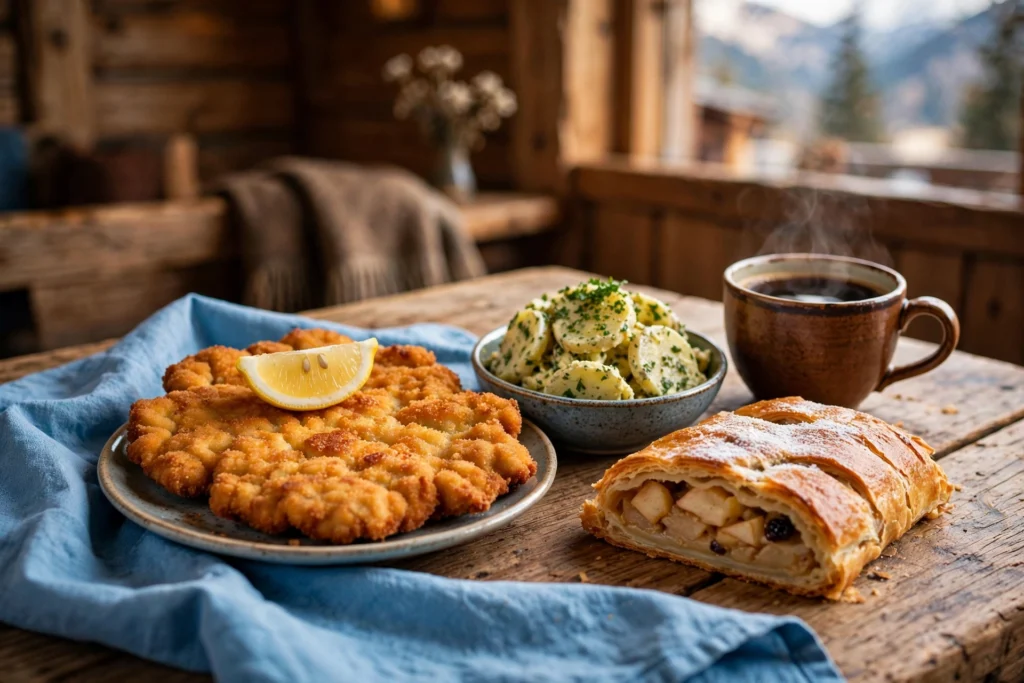
Austrian food is imperial leftovers, and that is a compliment: schnitzel from Milan, goulash from Hungary, dumplings from Bohemia, strudel from the Ottoman world, all absorbed over centuries and made heavier, richer and more Austrian. The food changes by region, and the table below is the map. The rule for eating well in Austria is the same as the rule for travelling well in it: eat where the locals eat, eat the dish the region is known for, and do not pay tourist prices for food you could get better two streets away.
In Vienna, the dish is the Wiener Schnitzel, and the rule about it matters: a proper Wiener Schnitzel is veal, pounded thin, breaded and fried, and it overhangs the plate. The pork version is cheaper and legally must be labelled differently — if the menu says “Schnitzel Wiener Art”, it is pork, and it should cost less. Order it with potato salad or with lingonberry jam, never with sauce, and never with ketchup. The other Viennese dish is the Tafelspitz, boiled beef in broth with horseradish and roast potatoes, which was Emperor Franz Joseph’s favourite and is still the most Viennese thing on any menu. The coffee house is where Vienna eats slowly: a Melange — coffee with steamed milk — and a slice of Sachertorte, the chocolate cake with apricot jam, or Apfelstrudel, the apple strudel with vanilla sauce. The Naschmarkt is the place for lunch, and the sausage stands are the place for late-night eating: order a Käsekrainer, the cheese-filled sausage, with mustard and a bread roll, and eat it standing up like everyone else.
In Salzburg and the Salzkammergut, the food is mountain food: dumplings, soups and sweet things. The Salzburger Nockerl is the city’s signature dessert — a sweet soufflé of egg white and sugar, served in a dish and meant to look like the snow-covered mountains around the city. The dumplings — Knödel — come in every form: bread dumplings with roast pork, spinach dumplings with brown butter, apricot dumplings in summer. The fish is the lake fish: the Salzkammergut’s lakes give trout and whitefish, served simply with butter and potatoes in the lakeside restaurants. And the beer is the other drink: Salzburg has its own brewing tradition, and the Augustiner Bräu, the monastery brewery with the great beer hall, is the place to drink it — order a Mass, a litre, and sit at the long tables with everyone else.
In the Wachau and the wine country, the food is the wine tavern food: the Heurigen serves its own wine with cold food — cured meats, cheeses, bread, pickles — in the garden, and the meal is the wine as much as the food. The grape to know is Grüner Veltliner, Austria’s signature white, peppery and crisp, and the Wachau’s terraced vineyards grow the best of it. In Styria, the wine is the white wine of the south and the pumpkin seed oil, the dark green oil that goes on everything from salads to soups. In the Tyrol, the food is the mountain food at its heaviest: Tiroler Gröstl, the fried potatoes with egg and bacon served in the pan, and the dumplings and soups that fuel a day in the mountains. The mountain huts serve the best version of this food in Austria — simple, hot, and exactly what you need after a climb.
Food by region
| Region | The dish to order | Where to eat it | What to drink |
|---|---|---|---|
| Vienna | Wiener Schnitzel (veal), Tafelspitz | Beisln in the 7th district, Naschmarkt | Melange coffee, Grüner Veltliner |
| Salzburg | Salzburger Nockerl, Knödel | Old town restaurants, Augustiner Bräu | Salzburg beer, Mozart wine |
| Salzkammergut | Lake trout, whitefish | Lakeside restaurants in Hallstatt | Local white wine, lake water |
| Wachau Valley | Heurigen cold plates, apricot dumplings | Wine taverns in Spitz and Weissenkirchen | Grüner Veltliner, Riesling |
| Styria | Pumpkin seed oil dishes, Backhendl | Wine roads south of Graz | Styrian white wine |
| Tyrol | Tiroler Gröstl, dumplings, soups | Mountain huts, Innsbruck old town | Tyrolean beer, schnapps |
Eating well without overpaying
The cheapest eating in Austria is the supermarket, and the rule is the same as in Vienna: buy breakfast supplies and picnic food at Billa or Spar, and save the restaurant money for one good meal a day. The second cheapest is the Naschmarkt and the sausage stands, which feed you properly for under €10. The third is the lunch menu: most restaurants serve a Mittagsmenü, a set lunch, for €12 to €16, which is the same food as the evening menu for half the price. The most expensive eating is the restaurant on the Graben or the Getreidegasse with a view of the postcard — you are paying for the address, and the food two streets away is better. Tipping is simple: round up or add about 5 to 10 percent at table service, and tell the server the total you will pay when you hand over the money.
How Much Does an Austria Trip Cost? Budgets in Euros

Austria costs more than Germany or the Czech Republic and less than Switzerland, and the daily budget depends more on where you are than on how you travel. Vienna is the cheapest of the big stops, Salzburg is dearer, Hallstatt and the lake towns are dearer still in summer, and the ski resorts in winter are a different market entirely. The budgets below are per person per day, excluding international flights, and they are built from the prices checked live in November 2026 and the competitor ranges that agree with them.
A budget day in Austria runs about €60 to €85: a dorm bed or a budget hostel from around €25, supermarket food and a sausage stand, regional buses and the occasional budget attraction, and a 24-hour transport ticket. A mid-range day runs about €80 to €125: a private room in a two-star or three-star hotel, restaurant meals, regional trains and some paid attractions. A comfortable day runs about €160 to €230: a four-star hotel, regular dining out, guided excursions and taxis when you want them. A ski day in a big resort adds roughly €90 to €120 on top of any of those — a day pass at roughly €65 to €85, equipment hire at €25 to €35, and resort food at resort prices. The daily budget table below breaks it down by line, so you can see where the money goes and where it can be saved.
The single biggest saving in Austria is the train fare, and it is the one most travellers miss. The Sparschiene advance fares on ÖBB — the cheap tickets that cost a fraction of the walk-up price — are the difference between a €20 train and a €60 train on the same route, and they sell out weeks ahead in summer and at Christmas. Vienna to Salzburg is €20 to €35 booked ahead on ÖBB or Westbahn, and the same journey bought on the day costs far more. Book the long trains when you book the hotels, and the transport budget falls by a third. The second biggest saving is the pass arithmetic: the Vienna Pass and the Salzburg Card only save money if you visit enough paid sights, and the passes section of this guide works out the break-even for each. The third is the food rule above: one restaurant meal a day, bought at lunch, and the supermarket for the rest.
Daily budgets
| Style | Bed | Food | Getting around | Doing things | Total per day |
|---|---|---|---|---|---|
| Budget | €25–€40 dorm or hostel | €15–€25 supermarket and stands | €10 transport ticket | €10–€15 one sight | €60–€85 |
| Mid-range | €60–€90 private room | €30–€45 restaurants | €10–€15 trains and tickets | €20–€35 two sights | €80–€125 |
| Comfort | €120–€180 four-star hotel | €50–€80 dining out | €15–€25 trains and taxis | €40–€60 tours and sights | €160–€230 |
| Ski resort (winter) | €100–€200 resort hotel | €40–€70 resort food | €10–€20 resort buses | €90–€120 pass and hire | €240–€410 |
A 10-day trip, costed
| Item | Mid-range cost (per person) |
|---|---|
| International flights (US–Vienna return) | $700–$1,100 (planning range, not a quote) |
| Hotels, 9 nights (Vienna 4, Salzburg 3, Innsbruck 2) | €540–€810 |
| Food, 10 days | €300–€450 |
| Trains (Vienna–Salzburg, Salzburg–Innsbruck, day trips) | €80–€140 |
| City transport (Vienna 7-day, Salzburg buses) | €35–€50 |
| Sights (Schönbrunn, fortress, museums, Hallstatt mine) | €150–€200 |
| Vienna Pass or Salzburg Card (only if the arithmetic works) | €0–€90 |
| Total on the ground, excluding flights | €1,105–€1,740 |
| Total including flights | Roughly $1,900–$2,900 |
Money tips that save real money
Cash still matters in Austria, and the rule is to carry it for the small places: the Hallstatt ferry is cash only, the mountain huts are often cash-first, the Christmas markets are mostly cash, and the small wine taverns in the Wachau may not take cards. Cards are accepted in most places in the cities, and the euro is the currency — Austria has used the euro since 2002, and there is no other money to worry about. ATMs are everywhere in the cities and rare in the mountains, so take out cash in town before heading into a valley. The tap water is safe to drink everywhere, and Vienna’s comes straight from Alpine springs, so carry a reusable bottle and never pay for water in a restaurant. And the cheapest cultural experience in the country is still the standing ticket at the Vienna State Opera — €13 to €18 for the same show the stalls paid two hundred euros for — which is the single best value in Austria, and the one saving that is also the best experience.
Getting Around Austria: Trains, Passes and the Vignette
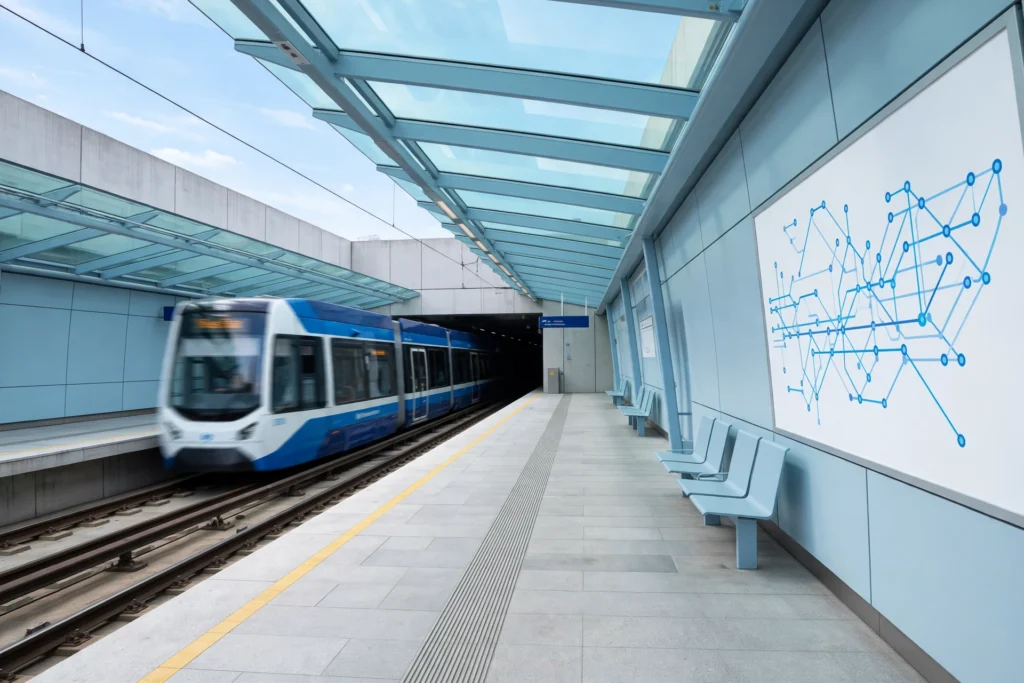
Austria is a train country, and the two-base route in this guide is built on that fact. ÖBB runs one of the better rail networks in Europe: Vienna to Salzburg in two hours and twenty minutes by railjet, Salzburg to Innsbruck in under two hours, and no two cities in the country more than five hours apart. Westbahn competes with ÖBB on the Vienna to Salzburg line and is often cheaper, and the Nightjet sleeper network reaches Vienna from Hamburg, Brussels, Paris, Amsterdam, Rome and Zurich, which makes an overnight train a genuine alternative to a flight if you are coming from elsewhere in Europe. The trains are fast, frequent and on time, and the stations are in the centre of the cities, which is why the train beats the car for the whole classic route.
The fare rule is the one that matters most: Sparschiene advance fares cost a fraction of the walk-up price, and they sell out. Vienna to Salzburg is €20 to €35 booked ahead on ÖBB or Westbahn, and the same journey bought on the day can cost twice as much. Book the long trains when you book the hotels — weeks ahead in July, August and December, days ahead in the shoulder seasons — and check both ÖBB and Westbahn, because the cheaper one changes by the day. The regional trains have no advance discount and no reservation, so the Hallstatt and Wachau day trips can be bought on the day without penalty. The Postbus network — the yellow buses — covers the villages the railway does not reach, including the Salzkammergut villages and the mountain valleys, and the mountain resorts run their own free or included ski buses in season.
The Vienna Pass and the Salzburg Card are the two passes in this guide, and the honest summary is that both are good products that most travellers should not buy. The Vienna Pass costs from €109 for one day for adults on the official site’s list price, with lower promotional prices in the online shop — recent shop prices have run about €98 for one day, €134 for two, €157 for three and €179 for six — and it covers free one-time entry to about 90 attractions plus the hop-on hop-off bus. It does not include public transport, which many people miss: you still need a Wiener Linien ticket as well. The pass only saves money if you visit four or more paid sights a day, because the big sights cost €15 to €30 each and the pass costs about €100 a day. Most travellers visit two or three sights a day and lose money on it. The cheaper alternative for most people is the Vienna City Card, which combines transport with discounts at the sights, or simply buying single tickets — Schönbrunn’s State Apartments are €30, the Palace Ticket €42, and the gardens are free. The pass counts calendar days from activation, not 24-hour blocks, so activating in the afternoon gives away half a day. Check the live shop on viennapass.com before you buy, because the promotional prices change constantly, and confirm before you buy which Schönbrunn route the pass covers — independent reviews in 2026 report that it covers the shorter State Apartments route, not the €42 Palace Ticket, and the official pages do not say.
The Salzburg Card is the better pass of the two, because the arithmetic is closer: €38 for 24 hours in summer, €45 for 48 and €49 for 72, with winter prices of €35, €41 and €44, and children at half price. It covers the fortress with the funicular, both Mozart houses, the DomQuartier, Hellbrunn Palace, the Untersberg cable car and the city transport, and it pays if you do three or more paid sights in a day. The Vienna Pass and the Salzburg Card share the same lesson: do the arithmetic with your own itinerary before you buy, and never buy a pass because it feels like a saving.
The car earns its place in exactly two places in Austria: the lake district and the remote valleys, and the Alpine passes. A car is unnecessary in Vienna — the public transport is better and the parking is expensive — and it is unnecessary on the Vienna to Salzburg line, where the train is faster and cheaper. But for the Grossglockner High Alpine Road, for the Bregenzerwald, and for the small villages of the Salzkammergut that the bus reaches only twice a day, a car is worth it. If you hire one, know the rules before you drive: every car on an Austrian motorway needs a vignette, which for 2026 costs €9.60 for one day, €12.80 for ten days, €32 for two months or €106.80 for the year, and the digital version can be set to start immediately when you buy it online. Winter tyres are compulsory in wintry conditions from 1 November to 15 April, so check that a hire car has them before you drive into the mountains. Several Alpine roads, including the Grossglockner, charge their own toll on top of the vignette, and some tunnels and passes add tolls too. Drive on the right, carry your licence and the car’s documents, and remember that the speed limits are enforced and the fines are real.
Transport at a glance
| Leg | Best way | Time | Cost (planning range) |
|---|---|---|---|
| Vienna airport to city centre | Train (CAT or S-Bahn) | ~20 minutes | €5–€12 |
| Vienna to Salzburg | Railjet or Westbahn | 2h20 | €20–€35 booked ahead |
| Salzburg to Hallstatt | Train + ferry | ~2 hours each way | Train fare + €8 ferry return |
| Salzburg to Innsbruck | Railjet | Under 2 hours | €20–€35 booked ahead |
| Vienna to Melk (Wachau) | Train | ~1 hour | Regional fare |
| Vienna city transport | U-Bahn, tram, bus | — | €10.20 24-hour, €25.20 7-day digital |
| Salzburg city transport | Bus and trolleybus | — | Single ticket or Salzburg Card |
| Driving | Motorway vignette required | — | €9.60 1-day, €12.80 10-day, €106.80 annual |
Frequently Asked Questions About Austria Travel
How many days do you need in Austria?
Five days covers Vienna and Salzburg by train with a Hallstatt day trip. Seven days is the classic first trip, adding the Wachau Valley and a proper Salzburg stay. Ten days adds Innsbruck and the Alps, and fourteen days covers the whole country, including the Vorarlberg and Graz. If you are skiing or hiking, a week in one valley is a different trip entirely, and it is worth doing on its own.
Is Austria expensive?
Mid-range: dearer than Hungary or the Czech Republic, cheaper than Switzerland. Budget travellers spend about €60 to €85 a day, mid-range travellers €80 to €125, and comfortable travellers €160 to €230. Vienna dorms start around €25, a restaurant dinner is €18 to €25, and ski resorts in season are the expensive exception, with a day pass at roughly €65 to €85 before hire.
Do US citizens need a visa for Austria?
No, for trips of 90 days or less. Austria is in the Schengen Area, and US passport holders enter visa-free for up to 90 days in any 180-day period, counted across all Schengen countries. Your passport must be valid at entry and have three months’ validity beyond your departure date. ETIAS, the online travel authorisation, is not in operation as of late November 2026 — you do not need one, and you should not pay anyone for one.
What is the best time to visit Austria?
May, June and September for the cities, the lakes and the hiking, when the days reach 18 to 25 degrees and the crowds are thin. December to March is the ski season, and mid-November to December is the Christmas market season. April and November are the two dead months, when the lifts close and the mountain villages shut down — though the cities are cheap then.
Is Hallstatt worth visiting?
Yes, if you go early or late. The village is at its best before 10 in the morning and after 4 in the afternoon, when the day-trippers have gone, and the salt mine and the Skywalk are worth the €49 combined ticket. Go as a day trip from Salzburg on the first train out, take the ferry across the lake, and stay until the last boat. Arriving at midday and leaving at 3 in the afternoon is the way to see Hallstatt at its worst.
Is the Vienna Pass worth it?
Only if you visit four or more paid sights a day. The pass costs from €109 for one day on the official list price, with lower promotional prices in the online shop, and it covers about 90 attractions but not public transport. Most travellers visit two or three sights a day and lose money on it. Do the arithmetic with your own itinerary before you buy, and check the live shop, because the promotional prices change constantly.
Is the Salzburg Card worth it?
Usually, if you are doing the fortress, Mozart’s Birthplace and another paid sight in 24 hours. The card costs €38 for 24 hours in summer and €35 in winter, €45 and €41 for 48 hours, and it covers the fortress with the funicular, both Mozart houses, the DomQuartier, Hellbrunn Palace, the Untersberg cable car and the city transport. A day built around the fortress and one Mozart house alone loses money on the card.
How do I get from Salzburg to Hallstatt?
By train and ferry, in about two hours each way. Take the train from Salzburg to Attnang-Puchheim, change onto the Salzkammergut line to Hallstatt station, and take the ferry Stefanie across the lake to the village — €4 one way or €8 return, cash only, about seven minutes, timed to the trains. The last boat from the village to the station leaves at 17:45, so catch the boat back with time to spare.
What is the cheapest way to see the Vienna opera?
Standing tickets at the Vienna State Opera, sold online from 10:00 on the day of the performance for €13 to €18. Same performance, same orchestra, no seat. It is the best cultural bargain in Europe, and the one saving that is also the best experience.
Do I need a car in Austria?
No, for the classic route. The train covers Vienna, Salzburg, Hallstatt, the Wachau and Innsbruck, and the cities are better without a car. A car earns its place only for the lake district’s small villages, the remote valleys and the Alpine passes like the Grossglockner. If you do drive, buy the motorway vignette before you use a motorway, and check the car has winter tyres from 1 November to 15 April.
Is Austria safe?
Yes. The US State Department rates Austria at Level 1 — Exercise Normal Precautions — the lowest tier it gives, and Austria is one of the safest countries in Europe. The main risks are in the mountains: fast-changing weather, avalanches in winter, and hiking accidents in summer. In the cities, the risk is pickpocketing in crowded places, at ordinary European levels.
Can I visit Austria in winter if I do not ski?
Yes, and Vienna in winter is one of the best city trips in Europe. The Christmas markets run from mid-November, the ball season runs through January and February, the museums and coffee houses are at their best when it is cold outside, and the hotels are at their cheapest. Salzburg’s old town and the fortress are open all year, though the funicular closes for refurbishment from 11 January to 14 March 2027. The mountains are the part that needs skis — the cities do not.
Conclusion: Austria Rewards the Traveller Who Goes Slowly
Austria is a small country, and the temptation is to treat it as a small trip — a few days, a few cities, a checklist of palaces and lakes. The country punishes that, because its best experiences are slow ones: the coffee house afternoon, the evening walk around the Ringstrasse, the morning in Hallstatt before the crowds arrive, the train ride west as the flat Danube plain gives way to the lakes and then to the Alps. The two-base rule in this guide is not a shortcut; it is the opposite. It is the decision to stay put, to let Vienna and Salzburg do their work over days rather than hours, and to let Hallstatt be a day trip rather than a night in a village that is better visited than slept in.
The practical version of that is simple. Fly into Vienna. Give the capital three or four days. Take the train west to Salzburg and give it two or three. Do Hallstatt as a day trip, early and late. Add the Wachau if you have a week, Innsbruck if you have ten days, and the west and the wine country if you have fourteen. Book the trains ahead, do the pass arithmetic before you buy, carry cash for the ferry, and check the official pages — the advisory, the ETIAS site, the palace and the fortress — the week before you fly, because the rules and the prices change. Austria in 2026 and 2027 is the same country it has always been: an imperial capital, a music city, a lake district and the Alps, joined by one of the best railways in Europe. Go slowly, and it gives you all of it.
People also read:
- Italy Travel Guide — the country south of the Alps, from Rome to the Dolomites
- Germany Travel Guide — Munich and the Bavarian Alps, two hours west of Salzburg by train
- Switzerland Travel Guide — the lakes, the scenic trains and the Alps beyond the Tyrol
- France Travel Guide — Paris and the French Alps, the classic next stop west

M. Adil is the founder and editor of SoloTravelPro. He writes practical, research-based travel guides that help travellers plan with confidence — from first-time city breaks to national parks and island escapes. Every guide is built on official sources, current prices and honest, usable advice, so readers can plan smarter and travel better.

Other Articles
Germany Travel Guide: North to South in 7, 10 or 14 Days (2026–27)