Norway Travel Guide: One Region Per Week — Fjords, Bergen and the North (2026–27)
Norway is the easiest country in Europe to plan badly and the most rewarding to plan slowly, and the difference between the two trips is a single decision made before anything is booked: how many regions you try to cover. Most first-timers arrive with a list that reads like a greatest-hits album — Oslo, the fjords, Bergen, Geiranger, the Lofoten Islands, Tromsø and the northern lights — and try to fit it into seven or ten days in a country that is roughly 1,100 miles long from south to north, where Oslo to the North Cape is about as far as Oslo to Rome, and where a two-hour drive on the map can easily eat half a day once ferries, single-lane stretches, tunnels and photo stops are counted. This Norway travel guide is built on the opposite rule, the one every experienced Norway writer converges on: pick one region per week. Give the fjords a week, or give the Arctic north a week, and the country opens up. Try to do both in a week and you will remember the transfers, not the fjords. Inside this guide you will find the one-region-per-week rule worked out in full, the month-by-month season calendar with daylight, road closures and aurora odds, the entry rules for US citizens as they stand in late 2026 — including the biometric Entry/Exit System that is now running at Norway’s borders and the travel authorisation that is not — the car-free spine of the Bergen Railway, the Flåm Railway and the Nærøyfjord cruise compared honestly with self-driving, Norway in a Nutshell priced and judged against doing it yourself, Oslo and Bergen in practical detail, Lofoten and Tromsø as separate trips rather than side trips, Stavanger and the Pulpit Rock, Ålesund and the Geirangerfjord, the Hardangerfjord in blossom season, the great train journeys, stave churches and Viking heritage, fjord cruises and the coastal voyage, the far north beyond Tromsø, and a fully costed budget for 2026–27, so you can plan a first trip to Norway that is actually enjoyable instead of merely ambitious.
Norway Travel Guide: The One-Region-Per-Week Rule — How This Guide Is Organised
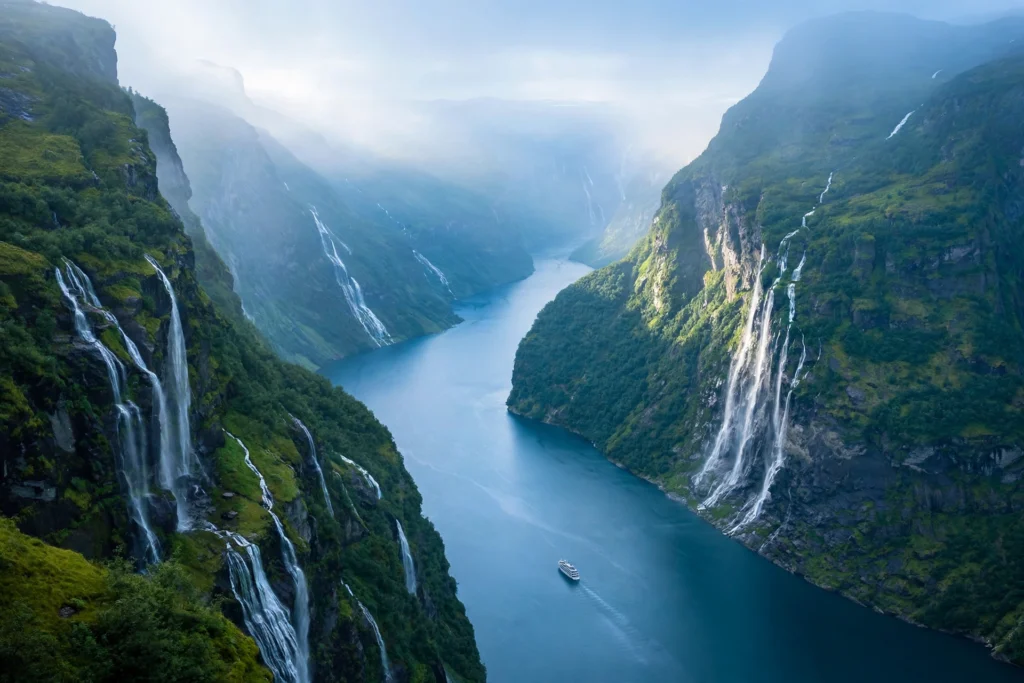
The single most important fact in this whole Norway travel guide is the shape of the country. Norway is a country of about five and a half million people stretched along one of the most broken-up coastlines on earth, so long that its southern tip is nearly as far from the North Cape as it is from Rome, and so folded that its mainland shore, counting every fjord and island, runs to tens of thousands of miles. That shape explains almost everything about travelling here: why the train and the boat beat the car on the classic route, why distances cost more time than the map suggests, and why the country behaves like three separate holidays — the capital and the south-east, the western fjords, and the Arctic north — that happen to share a flag and a currency. The travellers who love Norway most are rarely the ones who saw the most places. They are the ones who gave the Sognefjord three nights instead of one, who slept in Bergen instead of passing through it, and who watched the light change on the same stretch of water for a whole slow morning.
The second reality check is about what the classic route actually is. For a first trip, it has three bases and almost nothing else: Oslo for two nights, the fjord corridor around Flåm and Aurland for two or three nights, and Bergen for two or three nights, connected by one of the world’s great train rides and one of its great boat rides. That is the route this guide builds first, because it is the route that works in seven to ten days, and because every stop on it earns its place. Everything else — Stavanger and the Pulpit Rock, Ålesund and the Geirangerfjord, the Hardangerfjord, the Lofoten Islands, Tromsø and the northern lights, the North Cape — is a second region, not a detour. Norway rewards depth over breadth more than almost any country in Europe, because its best experiences are slow ones: a morning boat on a fjord, a full day on one mountain, a village walk that starts at your hotel door, and a weather window you were patient enough to wait for.
The third reality check is the rule itself, and it shapes everything else in this guide. Pick one region per week. With five days, do one region properly — the fjord highlights from a single base, done car-free by train and boat, or a quick Oslo-to-Bergen run. With seven days, do the classic Oslo-to-fjords-to-Bergen route and nothing else. With ten days, do the fjords properly and add the great mountain roads — Geiranger, Trollstigen and Ålesund — or fly north and add one Arctic base. With fourteen days, do the whole south and west without rushing, or run the seven-day classic and then spend a full second week in Lofoten or Tromsø. The most common first-timer mistake, named the same way by every serious Norway guide, is trying to combine the southern fjords, the far north and the cities in seven to ten days, which leaves you with a blur of driving and airports and not much actually seen. A trip that adds Lofoten as a one-night detour from Bergen is not a trip that includes Lofoten; it is a trip that includes two airports and a ferry queue.
The fourth reality check is about bases, because the base is the unit Norway trips are really measured in. Stay at least two nights everywhere, and three where the weather matters. A one-night stay in fjord country costs you most of a day: you check out by ten, you carry your bags to the station or the boat, you ride two hours, you check in at three, and by the time you have found dinner you have seen nothing but the inside of a train and a hotel lobby. Two nights in one place buys you something no timetable can: a spare morning for the viewpoint when the first day is cloudy, a day trip you had not planned, and the chance to learn which bakery opens first. The bases in this guide are chosen so that each one unlocks a different Norway — Oslo for the capital and the museums, Flåm and Aurland for the fjords at water level, Bergen for the harbour city and the rain, Lofoten for the Arctic islands, Tromsø for the lights — and so that the journey between them is itself one of the best days of the trip.
The fifth reality check is about direction. There is no single correct direction, but there is a wrong one: zigzagging. Fly into Oslo and out of Bergen, or the other way round, and move in one direction — east to west, or west to east — so you never cross the country twice. Oslo is the better arrival airport for the classic route, because the Bergen Railway runs west from Oslo and the scenery builds as you go, and Bergen is the better departure airport, because it has the onward connections and because leaving from the city you finish in saves a full day of backtracking. If you can only fly in and out of the same city, do the route in reverse — Bergen, Flåm, Oslo — and sit on the other side of the train. If the north is the point of the trip, fly straight to Tromsø or Bodø and skip the south entirely; the Arctic is a trip in its own right, not an extension.
The 5, 7, 10 and 14-day versions of the same trip
The table below is the whole guide in miniature. Every version below uses the same spine — Oslo, the Bergen Railway, the Flåm Railway, the Nærøyfjord, Bergen — and the longer versions add one region at a time, never two. Read it before you book a single flight, because the version you choose decides everything else: which airport you fly into, whether you need a car at all, and what the trip will cost.
| Trip length | The route | Nights | What you give up | Best season |
|---|---|---|---|---|
| 5 days | Bergen base, fjord cruise, Flåm by rail and boat, Bergen | Bergen 2, Flåm 2 | Oslo, the north, the mountain roads | May–Sep |
| 7 days | Oslo 2, Bergen Railway to Flåm, Nærøyfjord, Bergen 2 | Oslo 2, Flåm 2, Bergen 2 | Lofoten, Tromsø, Geiranger | May–Sep |
| 10 days | 7-day classic, then Geiranger, Trollstigen and Ålesund, or fly north to Lofoten | Oslo 2, Flåm 2, Bergen 2, Ålesund 1, Lofoten 3 | One of the two — fjords or north, not both in depth | Jun–Aug for roads; Sep–Mar for lights |
| 14 days | 10-day fjord route, then a full week in Lofoten or Tromsø, or the fjords done slowly with Hardanger added | Oslo 2, Flåm 2, Bergen 2, Ålesund 2, Lofoten 5 | Very little, other than budget | Jun–Aug, or Feb–Mar for winter north |
The five-day version deserves a word of its own, because it is the version most people actually have and the one most often planned badly. Five days holds one city and one fjord. Bergen plus a fjord works beautifully: fly into Bergen, spend two nights in the city, take the train to Flåm, cruise the Nærøyfjord, spend two nights in the fjord, and come back. Oslo plus the Sognefjord works too, returning to Oslo. What five days does not hold is Oslo, the fjords and Bergen with the train in between — that is the seven-day trip compressed, and the compression always lands on the fjord, which is the part you came for. If five days is all you have, choose the fjord and let the city be the bookend, not the other way round.
The seven-day version is the sweet spot for first-timers, and it is the shape this guide spends the most time on: two nights in Oslo, one scenic travel day on the Bergen Railway and the Flåm Railway, two nights on the Sognefjord, and two nights in Bergen, flying home from Bergen. Seven days survives one bad weather day, which five does not, and it gives you two cities, one of Europe’s famous rail rides, a UNESCO fjord and a day to absorb it all. The ten-day version buys you the Arctic, and it needs a flight — Lofoten in summer, for mountains rising straight from the sea, fishing villages and the midnight sun, or Tromsø in winter, for the northern lights, whale watching and a small city with somewhere to eat. The fourteen-day version is the first length where you can do both halves without rushing, and even then the honest shape is seven days in the south and seven in the north, with a flight between them, not a heroic drive.
Before you book: entry, EES and ETIAS for US citizens
Norway is not in the European Union, but it has applied the Schengen rules since 2001, together with the other Nordic countries. US citizens can visit without a visa for up to 90 days in any 180-day period, and time spent elsewhere in Schengen counts toward the same 90 days, so a week in France before Norway is a week off the allowance. Your passport must be valid for at least three months after the date you plan to leave Norway, and it must have been issued within the last ten years. The Norwegian Directorate of Immigration, UDI, keeps the official list of visa-free countries and the full conditions, and it is the page to check if your situation is anything other than a straightforward US passport holder on a short holiday.
Two European border systems affect most non-EU citizens travelling to Norway, and they are easy to confuse, so here they are separately. The Entry/Exit System, EES, is now fully operational across all border crossing points in Norway and the Schengen Area. It replaces manual passport stamps for non-EU travellers entering for a short stay, and on your first arrival it registers your identity, travel document data and biometric information — a facial image and fingerprints. There is nothing to do before travelling; you are registered at the border, and the first registration can take extra time, so avoid a tight connection at Oslo Airport on arrival day. The system counts your days automatically, so overstaying unnoticed is harder than before. EU and EEA citizens are not registered in EES, and neither are people with a residence permit in Norway or another Schengen country. Children under 12 do not give fingerprints. The official Visit Norway page on the Entry/Exit System sets this out plainly, and the European Union’s own EES pages carry the full detail.
The European Travel Information and Authorisation System, ETIAS, is the one to be careful about, because a great deal of what is written about it online is out of date. ETIAS is a travel authorisation for visa-exempt travellers that will one day be needed before short stays in 30 European countries, including Norway. As of November 2026 it is not in operation, no applications for travel authorisations are being accepted, and the European Union has not announced a start date — the Commission has said it will announce the date several months before launch, and the earlier expectation of the last quarter of 2026 has lapsed. Do not pay any website that offers to sell you an ETIAS authorisation today; no official website is issuing one, and any site asking for payment is not the official channel. When ETIAS does start, the fee is planned at EUR 20 for applicants aged 18 to 70, and there will be a transitional period in which its use is optional. For a trip in 2026–27, the practical position is simple: you do not need an ETIAS, you cannot apply for one, and you should check the official EU position again only if your travel date moves into late 2027. This guide will not repeat any claim that ETIAS applies from late 2026, because that claim is no longer the official position.
What a Norway trip costs in 2026–27
Norway is one of Europe’s priciest countries, and the honest way to handle that is to cost the trip before you fall in love with it, not after. The table below is a mid-range estimate per person, excluding international flights to Norway, based on 2026 prices verified against operator listings in November 2026. Prices move with the season and the krone, so treat these as planning figures and check the operator’s booking page for your date — never convert a price once and keep using that number for months.
| Item | 7-day classic (per person) | 10-day fjords + north (per person) | Notes |
|---|---|---|---|
| Mid-range hotels, double room shared | NOK 9,000–12,000 | NOK 13,000–18,000 | Oslo and Bergen dearest; fjord hotels and rorbu cabins vary widely |
| Bergen Railway + Flåm Railway + Nærøyfjord cruise | NOK 1,850–2,700 | NOK 1,850–2,700 | DIY from about NOK 1,850; Norway in a Nutshell package from NOK 2,698 |
| Domestic flight Bergen–Bodø or Bergen–Tromsø | — | NOK 800–2,000 | Book early; summer and aurora season cost more |
| Car hire (if you add a driving leg) | — | NOK 4,000–6,000 for 4–5 days | Compact in summer; automatic costs more; one-way fees extra |
| Food: groceries + café lunches + restaurant dinners | NOK 4,000–6,000 | NOK 6,000–9,000 | Supermarket breakfasts and packed lunches are the big saver |
| Museums, passes, viewpoints, one guided activity | NOK 1,500–2,500 | NOK 2,500–4,000 | Oslo Pass and Bergen Card pay only if you use them hard |
| Total, excluding international flights | NOK 16,000–23,000 | NOK 28,000–42,000 | Roughly USD 1,500–2,200 and USD 2,600–4,000 at late-2026 rates |
The single biggest saving in Norway is not a discount card. It is reducing geographic ambition. Fewer hotel changes mean fewer transfers, easier grocery stops, and more chances to use one carefully chosen boat ride or museum ticket well. The second biggest saving is self-catering: a room or cabin with a kitchenette, supermarket breakfasts, packed lunches, and one good restaurant dinner a day will cut a food bill by a third against eating every meal out. The third is timing: June and late August are the sweet spots, with full services and slightly lower prices than July, and September is the value-and-aurora alternative. Winter in the north is cheaper for hotels but dearer for guided activities, which is the trade to understand before you choose a season. For a sense of how Norway’s costs compare with another famously expensive Alpine country, our Switzerland travel guide works through the same exercise in Swiss francs — the pattern is the same, and the conclusion is the same: the country is expensive, the scenery is free, and the budget is decided by how many places you sleep, not by how many things you tick off.
When to Visit Norway: Seasons, Daylight and the Mountain Roads
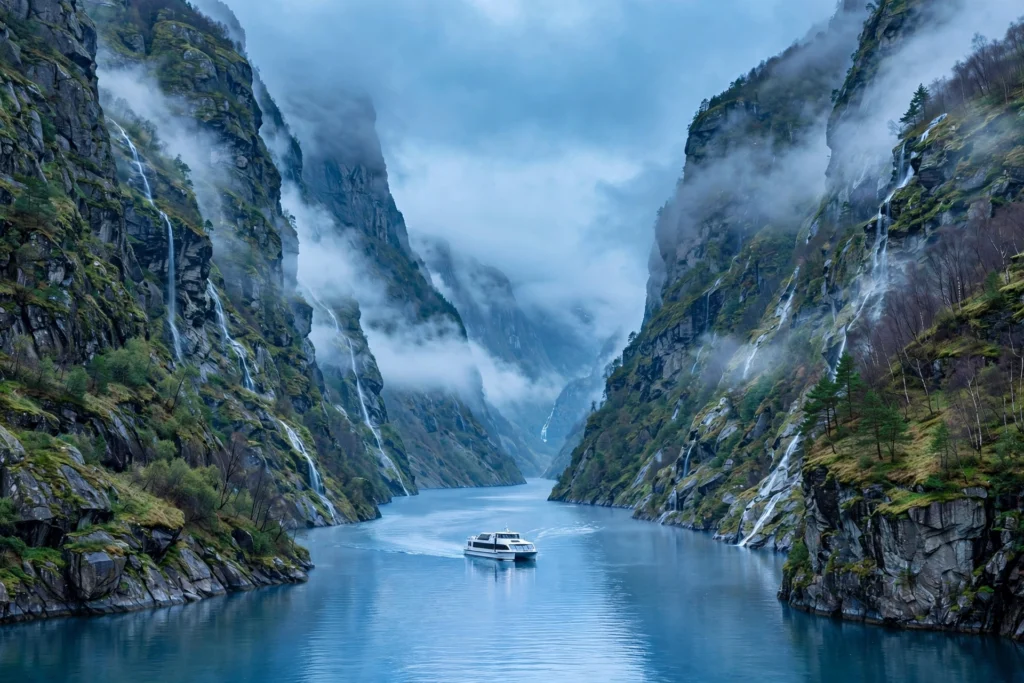
There is no bad time to visit Norway, but each season delivers a very different trip, and choosing the wrong season for the trip you actually want is the second most common first-timer mistake after trying to cover too much ground. The country runs on light. In the far north the sun does not set at all from late May to late July, and in midwinter it barely rises; in the south, Oslo gets around 18 hours of daylight in June and about six in December. The fjords, the mountain roads, the ferries and the hiking trails all follow the same calendar, and the northern lights follow the opposite one. Pick the season by the experience you want, not by the cheapest flight.
Late spring, May and June, is the season this guide recommends most for a first fjord trip. Days are long, waterfalls are fed by snowmelt and at their strongest, the landscape is waking up after winter, and the crowds have not yet reached July weight. June is the fullest version — longest days, waterfalls strong, roads opening, and the midnight sun already running in the north. The catch is that some high mountain roads, hikes and seasonal visitor services may still be closed in early May, so never let a bright valley forecast answer a mountain-access question. May is the month of blossom in the Hardangerfjord, when the orchards flower against the snow, and it is one of the most beautiful sights in the country.
July and August are high summer: the broadest selection of ferries, tours, hikes and long daylight, along with peak demand. Reserve the scarce pieces first, especially small fjord lodging, popular rail departures, car rentals and one-way transport connections. July is the busiest month and the dearest, and the fjord villages are at their liveliest — which also means at their most crowded around cruise-ship calls. Late August is the quieter twin of July, with almost all the same services running, slightly lower prices, and the first chance of an aurora in the north as the nights return.
September and October are the shoulder season with the most character. Early autumn can be beautiful for colour and city travel, and September is the value-and-aurora alternative that experienced Norway travellers quietly prefer: the fjords are still open, the crowds have gone, hotel prices soften, and the dark nights are back in the north. But daylight and seasonal schedules contract quickly. Build each rural day from current transport and attraction calendars rather than assuming summer frequency continues, and expect the first mountain-road closures from October onward. October and November are the mud season in the north — the least rewarding weeks of the year, with short days, closed roads and no snow yet — and the honest advice is to avoid them unless the trip is purely a city break in Oslo or Bergen.
November through April is winter, and winter is a distinct trip built around snow, short daylight, city culture and northern-lights chances, not a cheaper copy of July. Aurora sightings are never guaranteed, and winter driving or independent mountain travel requires skills that a normal summer road trip does not teach. The best winter months are February and March, when the light is returning, the snow is reliable, and the aurora season is at its strongest. December brings Christmas markets and the deep dark, January the coldest weeks, and both are magical if you accept the darkness as the point rather than fighting it.
The mountain roads: what closes, and when
Several of the roads this guide celebrates are summer-season roads, and the dates move by weeks every year, so this section gives you the pattern and the place to check, not a date to bet a trip on. Trollstigen, the eleven-hairpin climb on County Road 63 between Åndalsnes and Valldal, is the most famous of them: it opened for the 2026 season on 27 April, the earliest opening on record, and closed for winter on 10 November 2026. In a normal year it runs from around mid-May to October or November, and the official Norwegian Scenic Routes page lists earlier openings between late April and mid-June and earlier closures between early October and early December. The Geiranger to Langvatnet section of the same road follows a similar pattern, with earlier openings from late April to mid-June. The Sognefjellet and Aurlandsfjellet scenic routes, the Gamle Strynefjellsvegen, and the other high passes follow the same logic: open from late May or June into October, weather deciding, and never on a fixed date. The main passes on the national road network, Haukelifjell and Hardangervidda among them, are not closed for the season, but they can be shut or run in convoy at short notice in bad weather. Check the live road status with the Norwegian Public Roads Administration the evening before every driving day and again in the morning, and keep a Plan B that does not need the pass — the tunnel or the valley road underneath it. A trip built around a single mountain road in May or October is a trip built on a hope; build it in June, July, August or September and the road is part of the plan, not a gamble.
Safety, daylight and the practicalities of the light
The US State Department rates Norway at Level 1 — Exercise Normal Precautions — its lowest advisory level, updated 6 July 2026, and describes Norway as generally a safe destination for travellers. That matches the experience of almost everyone who goes: the risks in Norway are not crime but nature — weather that changes fast in the mountains, trails that are real mountain outings rather than scenery props, and water that is cold all year. The Norwegian Mountain Code says to match the route to your ability and conditions, check the weather and avalanche information, carry proper equipment, and be willing to turn around. A dry forecast in Bergen does not establish conditions at elevation, and summer dates do not guarantee a snow-free trail. Hire a qualified local guide when conditions, route-finding, exposure, winter terrain or your experience make independent travel questionable. For a fuller treatment of staying safe on the road in general, our travel safety tips guide covers the habits that matter everywhere, and they matter in Norway too — travel insurance that covers mountain rescue and medical evacuation, a charged phone, and someone who knows where you are going each day.
What to pack follows from the light and the weather rather than from a list. Layers, in every season: the valleys can be warm in July while a summit is close to freezing, and the weather changes fast in the mountains. Bring a properly waterproof jacket — Bergen rains a lot, and the fjords make their own weather — proper walking shoes with grip, a warm layer for every summit, sun protection, because the sun is strong at altitude and stronger still when it never sets, and in winter warm clothes and shoes with grip for ice. Our travel packing checklist guide is a useful starting point for the documents, charging gear and day-bag essentials, but the Norway-specific rule is simple: pack for two seasons in one bag, and buy anything you forget before Sunday, because shops are closed on Sundays outside stations and the supermarkets stop selling beer after 20:00 on weekdays and 18:00 on Saturdays.
The Car-Free Spine: Bergen Railway, Flåm Railway and the Nærøyfjord Cruise
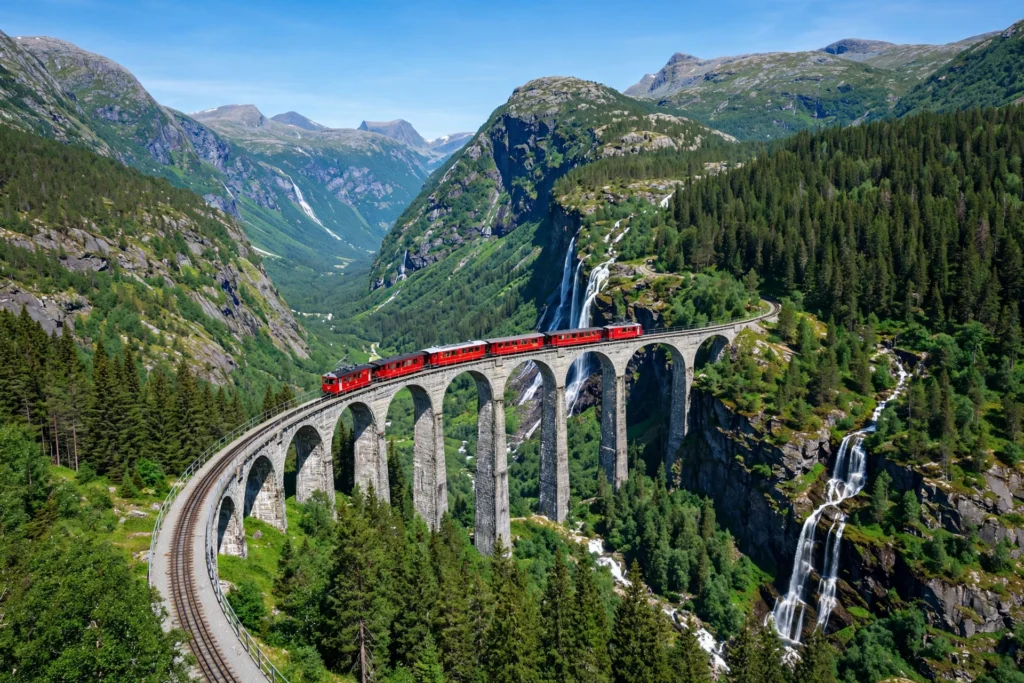
If there is one journey that defines a first trip to Norway, it is the car-free spine: the Bergen Railway from Oslo across the Hardangervidda plateau to Myrdal, the Flåm Railway down the steep valley to the fjord at Flåm, and the cruise through the UNESCO-listed Nærøyfjord to Gudvangen, with a bus and a train onward to Bergen. It is the journey every competitor guide builds its itinerary around, and for good reason — it packs the three things Norway does best, a great train, a great mountain railway and a great fjord, into a single day of travel that is itself the sightseeing. It also needs no car, no driving, no parking and no ferry queues, which is why it is the right spine for a first trip even if you rent a car later for Lofoten or the mountain roads.
The Bergen Railway, the Bergensbanen, runs about 471 kilometres from Oslo to Bergen through 182 tunnels and over the Hardangervidda, Europe’s largest mountain plateau, topping out at 1,237 metres and passing Finse station at 1,222 metres, the highest station on the Norwegian railway network. The full journey takes about six and a half to seven and a half hours, with six to seven departures a day, and the scenery in the middle of the journey — the snow, the frozen lakes, the bare plateau — is the reason to take a daylight departure rather than the night train. Sit on the left leaving Oslo, westbound, for the best of the Hardangervidda in the afternoon light; eastbound, sit on the right. Book early: the cheapest fares go first, standard tickets go on sale about 115 days ahead, and the popular summer departures sell out. The railway’s own operator, Vy, publishes the timetable and sells the tickets, and its timetable pages for the winter season starting 13 December 2026 are the ones to check for a trip in the new year.
At Myrdal you change for the Flåm Railway, the Flåmsbana, and the change is the part to plan carefully. The Flåm Railway runs 20 kilometres down from Myrdal to Flåm, through 20 tunnels, dropping 867 metres in about an hour, with a five-minute stop at the Kjosfossen waterfall. There is no ticket office or ticket machine at Myrdal, so buy the Flåm Railway ticket before you arrive — an adult single costs from NOK 399, with children aged 6 to 17 at half price, and tickets go on sale 120 days ahead. The railway is one of the steepest standard-gauge lines in the world, and the descent is the drama: the train spirals down the valley, the waterfalls appear and vanish, and the fjord opens up at the bottom. Take the first connection at Myrdal if you can, because a missed connection here costs hours, not minutes, and because the light in the valley is best in the morning.
From Flåm the cruise is the third leg, and it is the one people remember longest. The Flåm to Gudvangen cruise runs about two hours through the Nærøyfjord, the narrowest navigable fjord in the world in places, part of the West Norwegian Fjords UNESCO World Heritage site inscribed in 2005. The cliffs rise a thousand metres straight from the water, waterfalls thread down the rock, and the boat — the modern electric boats are quiet enough to hear the water — moves slowly enough to look properly. From Gudvangen a bus runs to Voss station, advertised at one to two hours, and the train from Voss to Bergen takes roughly an hour and a quarter to an hour and a half. Allow six to seven hours overall from Flåm to Bergen including lunch and waiting, and at least 30 minutes at independently booked connections. Do not pair the last boat with the last train when separate reservations leave no recovery time; the fjord is not the place to learn that lesson.
Norway in a Nutshell: the package versus doing it yourself
Norway in a Nutshell is the packaged version of this spine, sold by Fjord Tours of Bergen as a single self-guided ticket: the Bergen Railway, the Flåm Railway, the Nærøyfjord cruise and the bus, with the connections arranged for you, starting in Oslo, Bergen, Flåm, Voss or Geilo, in a single day or spread over several, year-round. It is a ticket, not a tour — there is no guide, and you change between the trains, boat and bus yourself — and that is exactly what makes it good for first-timers. The decision is whether to buy the package or to book each leg yourself, and the honest answer depends on how much certainty you want to pay for.
| Option | What you get | 2026 price (adult) | Best for |
|---|---|---|---|
| Norway in a Nutshell package (Fjord Tours) | All legs arranged, connections guaranteed, one booking | From NOK 2,698 | First-timers who want every connection arranged |
| Do it yourself (Vy + Flåm Railway + cruise) | Same legs, booked separately, specified departures | From about NOK 1,850–2,100 | Confident planners who book early |
| Sognefjord in a Nutshell | Nutshell plus the wider Sognefjord, April–October | From NOK 2,745 | Travellers who want more fjord time |
| Hardangerfjord in a Nutshell | Bergen round trip, May–September | From NOK 1,991 | Bergen-based travellers with one day |
| Geirangerfjord in a Nutshell | Nutshell plus Geiranger, June–September, from 2 days | From NOK 5,968 | Travellers adding the Golden Route |
| Winter two-day package from Bergen | Nutshell in winter, hotel and Stegastein included | From NOK 4,983 | Winter travellers who want the fjords with a roof |
The prices above are the figures Fjord Tours lists on its own pages and through Visit Norway, checked in November 2026: Norway in a Nutshell from NOK 2,698, the Flåm Railway single from NOK 399, the winter two-day package from Bergen from NOK 4,983 and from Oslo from NOK 5,626. Two cautions belong here. First, the “from” price is the starting price, and the price you are actually offered depends on the direction, the date and any nights you add — one Bergen listing in November 2026 showed the same tour from NOK 2,968, and peak-season one-way fares have been quoted higher still, so check the booking page for your date and do not treat any single figure as fixed. Second, the DIY saving of roughly NOK 700 to 1,500 per person is real but comes with real conditions: DIY tickets are for specified departures, not open tickets, train prices on Vy rise the closer you get to the date, and if you miss a connection on separate tickets, the next leg is your problem. The package buys the guarantee that the connections will wait for you. For a first trip, with a flight to catch at the end of it, that guarantee is usually worth the difference. For a second trip, when you know the rhythm, DIY is the better deal.
Car-free versus self-drive: the honest comparison
The spine above is the car-free answer, but it is not the only answer, and the guides that pretend otherwise are selling a preference as a fact. Here is the comparison as it actually works out, leg by leg, so you can choose per leg rather than for the whole trip.
| Question | Car-free (train + boat + bus) | Self-drive |
|---|---|---|
| Oslo to Bergen | The Bergen Railway, 6.5–7.5 hours, scenery all the way | 7–8.5 hours driving plus ferries; the Rv7 over Hardangervidda is scenic, the E16 via the Lærdal Tunnel is faster |
| The fjord itself | The Nærøyfjord cruise, two hours, no driving | The fjord roads are beautiful but you watch the road, not the water |
| Flåm and Aurland | Trains and boats connect; Stegastein by bus | Freedom to stop at viewpoints and drive the Aurlandsfjellet Snow Road in summer |
| Lofoten | Flights plus buses; a car is worth having once there | The E10 spine and village-hopping reward wheels; the car earns its keep here |
| Mountain roads | Not possible — Trollstigen and Geiranger need a car or a tour | The whole point: Geiranger, Trollstigen, Sognefjellet, the Atlantic Road |
| Cost | Cheaper for two people on the classic route | Cheaper for a family of four on a loop, dearer for two |
| Stress | Low — the timetable does the work | Higher — ferries, tolls, parking, one-way fees, weather |
The pattern is clear, and it is the pattern this guide is built on: use the train and the boat for the classic Oslo-to-Bergen crossing, and use a car only where the car actually earns its keep — the mountain-road loop around Geiranger and Trollstigen, and Lofoten, where the E10 spine and the village-hopping reward wheels. Most great Norwegian itineraries use three kinds of transport, not one. The drivers who love Norway most are the ones who drive the middle of the trip and take the train at both ends; the train travellers who love it most are the ones who never pretend the train goes everywhere.
Bergen: The Gateway City of the Fjords
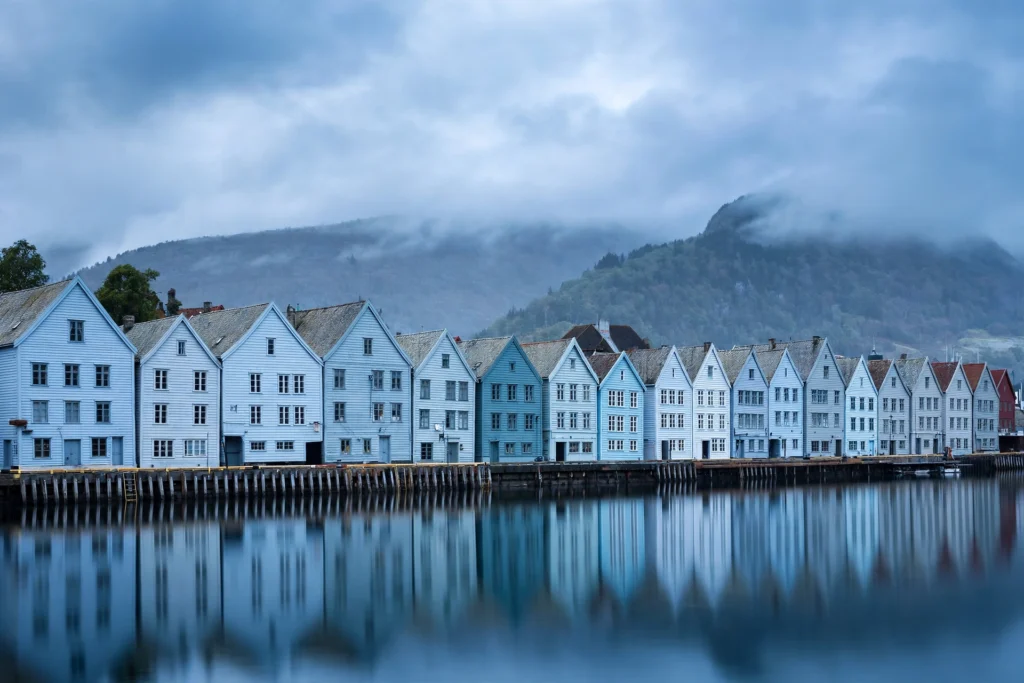
Bergen is the city the fjords belong to, and it is the right place to end the classic route rather than to start it, because it is the city that rewards a slow arrival. It sits on the west coast between seven mountains and the sea, it rains famously often, and it is the most beautiful city in Norway precisely because of the weather rather than in spite of it — the light after rain on the harbour, the clouds breaking over the mountains, the wooden houses dark with damp. Give it two full days and a spare half-day against the rain, and stay near the harbour so that a wet morning costs you nothing and a clear evening costs you a funicular ride.
Bryggen is where to start. The UNESCO-listed Hanseatic wharf is a row of colourful wooden gabled houses along the harbour, built by the German merchants who ran the dried-fish trade here for centuries, and it is the most photographed street in Norway for a reason. Walk it twice: once along the waterfront, where the houses face the harbour and the fish market, and once through the narrow alleys behind them, where the wooden passages, the leaning staircases and the small workshops show what the wharf actually was — a working trading post, not a stage set. The Hanseatic Museum, in one of the old merchant houses, is the place that makes the wharf make sense: the merchants lived and worked in these buildings, slept in unheated rooms, and ate dried fish for months at a time. The fish market beside the harbour is the easy lunch — the stalls sell the catch of the day, and the cooked-to-order counters are the honest version of the Bergen food scene, which is otherwise dear.
The second Bergen essential is a viewpoint, and the choice is between the Fløibanen funicular up Mount Fløyen and the Ulriken cable car, and the answer is to take whichever one the weather gives you. Fløibanen is the convenient one, a few minutes from the harbour, and the view from Fløyen over the city, the harbour and the fjord is the postcard. Ulriken is higher and wilder, and the walk between the two across the mountain ridge is one of the best city walks in Europe on a clear day — but only on a clear day, and only with proper footwear and a weather check. Use the clearest window for the viewpoint, whatever else you move around it, because Bergen’s rain is not a trip failure but a wet viewpoint is a wasted morning. The third essential is the fjord on Bergen’s doorstep: the Mostraumen cruise, a three to three-and-a-half-hour trip up the narrow Osterfjord from the harbour, is the easy local pick for a half-day, and it is the right amount of fjord for a traveller who has already cruised the Nærøyfjord — close, beautiful, and back in time for dinner.
Bergen’s practicalities are the practicalities of a harbour city that rains. Stay near the harbour or the station, because wet stone and luggage make a well-located room unusually valuable. The Bergen Card, NOK 400 for 24 hours, gives free local buses and Light Rail but not Vy trains, and it pays only if you use the museums and transport hard; most travellers do better buying the Fløibanen and the museum tickets separately. The light rail from Bergen Airport Flesland takes about 45 minutes to the city centre and costs around NOK 51, which is the cheap way in, and the airport bus is the faster one. Eat fish, because Bergen is the fish city — the restaurants around the harbour are dear but the quality is real — and buy groceries for breakfast, because a Norwegian hotel breakfast is often the best meal of the day and the cheapest way to start it. And keep one day flexible: if the first half of the trip already included a strong fjord experience, you do not need another long boat ride simply because Bergen sells one. Use the spare day for the city, for the rain, and for the walk up Fløyen that the weather finally allows.
Oslo: Two Days in the Capital Before You Head West
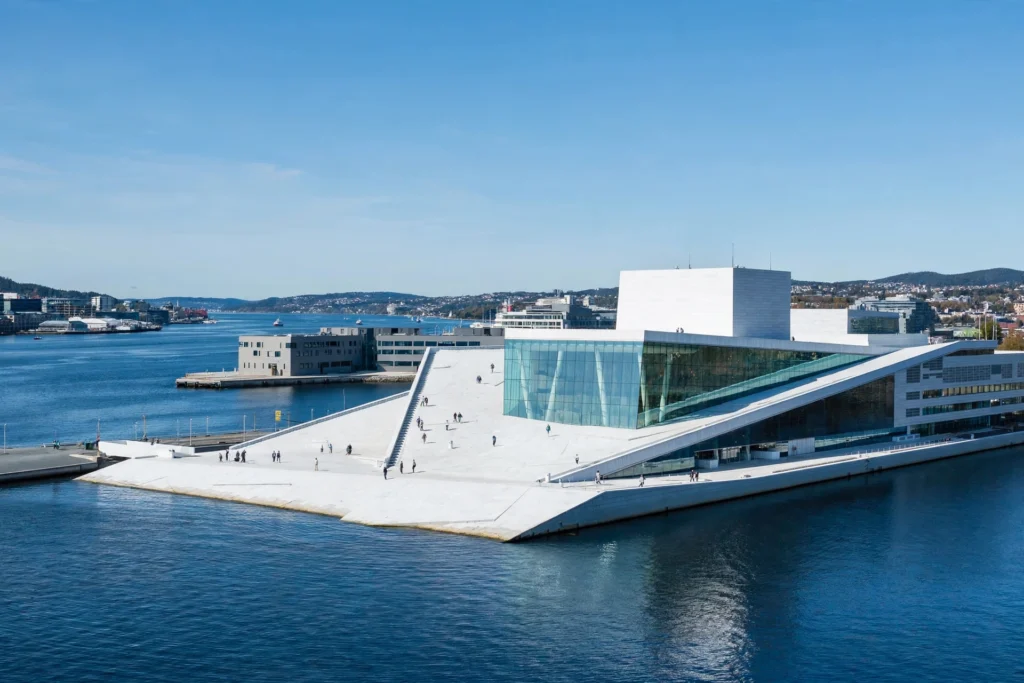
Oslo deserves two days, and it deserves them at the start of the trip, when you are fresh and the city can do its real job: to ease you into Norway before the fjords take over. It is a small capital, compact enough that the station, Karl Johans gate and the waterfront are all within a twenty-minute walk, and it is a city that has rebuilt its harbour in the last twenty years into one of the most interesting waterfronts in Europe. The mistake is to treat Oslo as a transit stop and try to see it in an afternoon; the city rewards exactly one full day on a first pass, and the second day is what makes the first one make sense.
Start at the waterfront. The Opera House is the building to walk on, not just to look at: its white marble roof slopes down to the water like an iceberg, and you can walk up it for free and look back over the Oslofjord. Beside it, the MUNCH museum and the new National Museum hold the art, and the harbour promenade runs from the Opera House past Aker Brygge, the old shipyard turned restaurant quarter, to the City Hall and the ferry piers. The second cluster is Bygdøy, the museum peninsula across the water: the Fram polar ship, the Kon-Tiki raft, the Norwegian Folk Museum and the Viking-age exhibitions are all within walking distance of each other, and the ferry from City Hall Pier 3 runs every twenty minutes in summer. Pick one museum cluster and one city area per day, because the National Museum, MUNCH, the Opera House roof, Akershus Fortress, the Vigeland Sculpture Park and the Bygdøy museums cannot all receive thoughtful visits before dinner. Vigeland is the free one — the sculpture park is always open, always free, and always worth an hour — and Akershus Fortress is the history in one building, a medieval castle above the harbour that has guarded the city since the 1300s.
The practicalities of Oslo are the practicalities of a capital that is easy to arrive in and easy to leave. Oslo Airport Gardermoen is about 50 kilometres north of the city, and the train makes it painless: the Flytoget express takes 19 minutes to Oslo Central and costs around NOK 276, while the Vy regional train takes 23 minutes and costs roughly half. Stay near Oslo Central Station for the cleanest onward departure, because the Bergen Railway leaves from there and a room near the station saves a morning of luggage-hauling; Grünerløkka, across the river, is the alternative for evening character, with its restaurant streets and its younger crowd. The Oslo Pass costs NOK 580 for 24 hours, NOK 845 for 48 and NOK 995 for 72, and covers the Fram, Kon-Tiki, Holmenkollen, MUNCH, Akershus Castle and the Bygdøy ferry — it pays if you do three museums in a day, and it does not pay if you spend the day walking the waterfront, which is free. One note for 2026–27: the Viking ships are off view until the new Museum of the Viking Age opens, planned for November 2027, so check before you promise yourself the Oseberg ship.
Oslo’s food and evenings are the gentlest introduction to Norwegian prices. Eat at Aker Brygge and Grünerløkka for the choice, buy breakfast from a supermarket for the saving, and try the harbour saunas — the floating saunas at the Opera House are the city’s most Norwegian experience, a hot wooden room and a cold fjord swim, and they are the right way to shake off a long flight on arrival day. Use the arrival day for the waterfront, a neighbourhood walk and an early night rather than booking a timed attraction after an overnight flight; the city will still be there in the morning, and the train west leaves early.
Lofoten: The Arctic Islands That Deserve Their Own Week
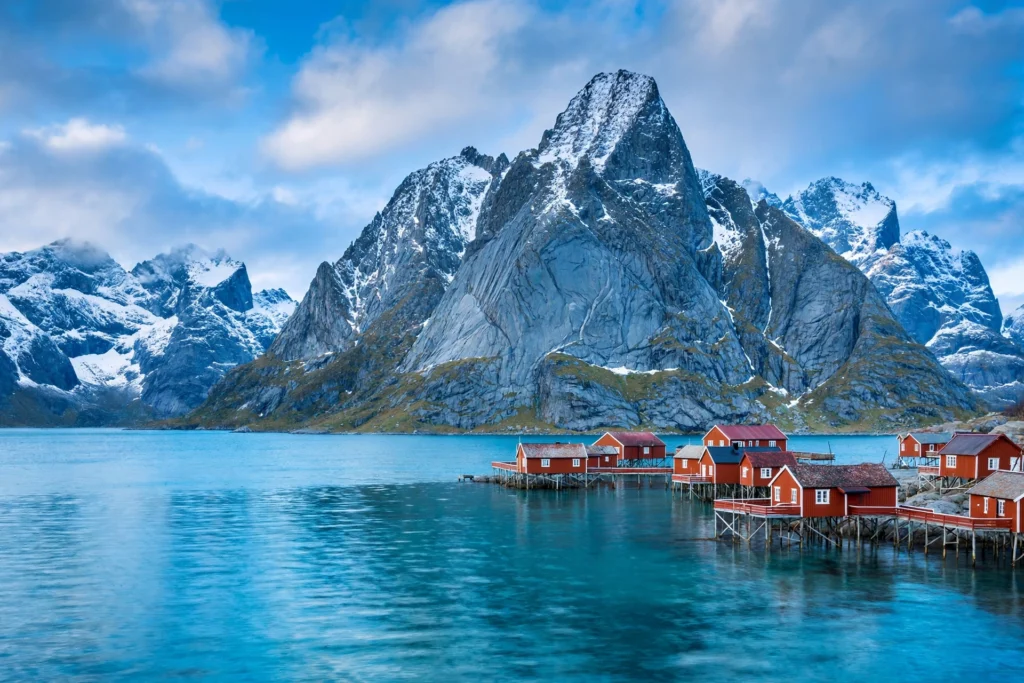
Lofoten is the place in Norway that most rewards the one-region-per-week rule and most punishes breaking it. The islands sit inside the Arctic Circle, about a thousand kilometres north of Bergen, with mountains rising straight from the sea, fishing villages beneath them, and beaches that look like the Caribbean until you touch the water. They are a destination in their own right, with their own flights, their own week, and their own weather, and adding them to a fjord trip means dropping the fjords, not extending the trip by a day. Give them five nights at least, three of them in the south of the islands, and they give you one of the great landscapes of Europe. Give them one night as a detour from Bergen and they give you two airports and a ferry queue.
Getting there is the first decision, and it sets the shape of the week. Fly from Bergen or Oslo to Bodø and take the ferry to Moskenes, or fly via Bodø to Svolvær or Leknes, and pick up the rental car on arrival — Lofoten is the one place in this guide where the car genuinely earns its keep, because the E10 spine runs the length of the islands and the village-hopping, the beach stops and the dawn and dusk photography all need wheels. The ferry from Bodø to Moskenes is the romantic arrival and the one to book ahead in summer, because it is busy and it is the only way the car gets there; the flight to Svolvær or Leknes is the practical one. Once there, base yourself in two places: Svolvær in the north-east for the first nights, and Reine in the south for the rest, because the islands are long and the light moves, and a single base means an hour of driving to everything at the far end.
The days write themselves once the base is right. Reine and Hamnøy are the postcards, the red rorbu cabins on stilts beneath the sharp peak of Olstinden, and the Reinebringen hike is the viewpoint that justifies the climb — a steep stone staircase to one of the great views in Norway, and a hike to do only in good weather, with proper footwear and an early start, because the ridge is exposed and the weather turns fast. Henningsvær is the fishing village on the water, built on stilts and islands, and the place to eat fish and to watch the light. The beaches at Uttakleiv and Haukland are the surprise — white sand and turquoise water under Arctic mountains, and the best place in the islands to watch the midnight sun in June, when the sun never sets and the light goes gold for hours. Nusfjord is the preserved fishing village, a working museum of the cod trade that built the islands, and the place that explains why the red cabins exist at all: they were the fishermen’s lodgings, and the cod that dried on the racks around them was Norway’s first great export.
The practicalities of Lofoten are the practicalities of a place that is popular, small and weather-driven. Book the rorbu cabins, the fjord hotels and the rental car early for June to August, because they sell out, and shoulder seasons — May and September — forgive later booking and cost less. Keep one movable day per base, because the forecasts from Yr, the Norwegian Meteorological Institute’s service, are excellent at 48 hours and honest about uncertainty beyond that, and the single most common casualty of a tight Lofoten plan is the Reinebringen hike lost to rain. Drive the E10 slowly: the speed limits are low, the road is narrow, and every hour of it is the holiday, not a transfer. Eat fish, buy groceries in Svolvær or Leknes before heading south, and carry cashless payment — cards work everywhere, even in the smallest village shop. And in winter, rebuild the whole plan: Lofoten in February is snow-covered peaks, long aurora nights, cod fisheries and storm-watching from a rorbu with a wood stove, and the driving needs studded rental tyres, short daylight and a willingness to base in Svolvær and take tours out rather than driving the full length of the islands in the dark.
Tromsø and the Northern Lights: Winter in the Arctic North
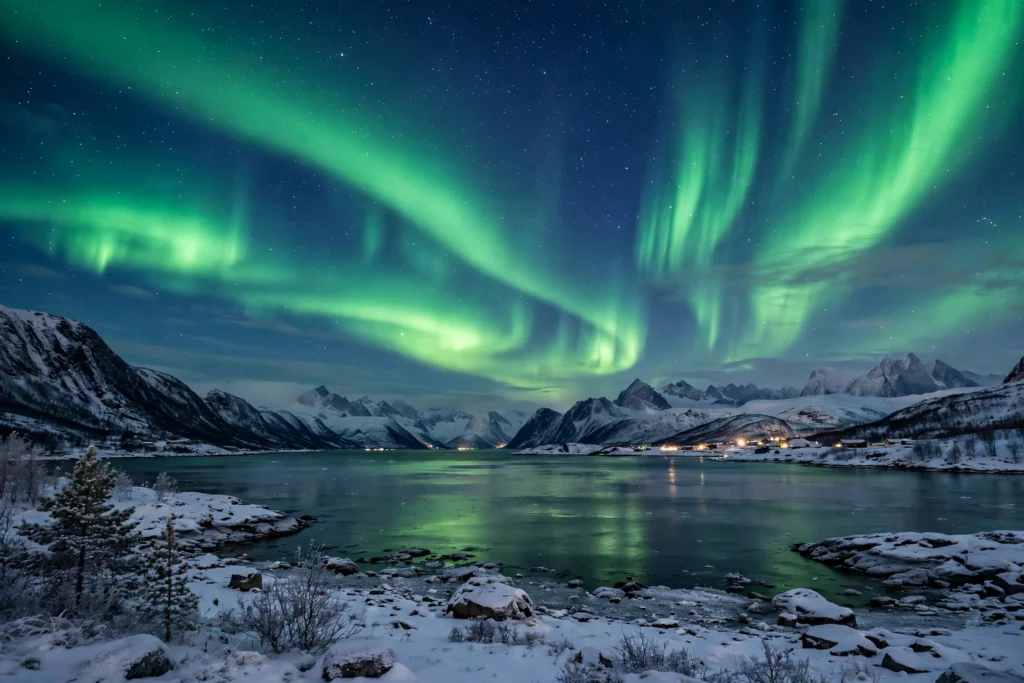
Tromsø is the Arctic capital, and it is the right base for the northern lights for a simple reason: it is a real city in the Arctic, with restaurants, museums, a cathedral and a cable car, and with the infrastructure that turns a lottery into a plan. The lights can appear from roughly late August to early April, and they need darkness, clear skies and solar activity at the same time, which is why any single night is a coin toss and why three nights is the sensible minimum and four is better. Tromsø, Alta and Senja are the usual bases, and the chase tours that drive for hours to find a gap in the cloud are how most successful sightings happen — the guides read the sky, the cloud radar and the solar wind, and they move. Book the chase for your first night, not your last, so a cloudy first night still leaves you two more chances.
The city itself is worth the days between the nights. The Arctic Cathedral, white and angular against the water, is the landmark; the Fjellheisen cable car runs up the mountain across the water for the view over the city, the fjord and the islands; the Polar Museum tells the story of the trappers and the polar expeditions that left from here; and the harbour front is the place to eat, because Tromsø has the best restaurant scene in the Arctic and the fish is as fresh as it gets. In summer the city is a different trip: the midnight sun runs from late May to late July, the fjord cruises and the whale watching replace the aurora, and the hiking on the island’s mountains is the draw. In winter the days are for dog sledding, snowshoeing, reindeer sledding with Sámi guides, and the Arctic Cathedral’s midnight concerts, and the nights are for the sky.
The practicalities of a Tromsø winter trip are the practicalities of darkness and cold, and they are worth taking seriously. Daylight in midwinter is a few hours of blue twilight rather than a day, and the cold is a dry cold that bites through thin layers — pack a proper winter coat, insulated boots with grip, a hat, gloves and a warm layer for standing still outside for hours, because aurora hunting is mostly standing still. Book the aurora tours and the dog sledding early, because the good operators sell out in February and March, and read the cancellation terms, because winter weather cancels plans with regularity and a spare day is what turns a cancelled aurora night into a second chance instead of a lost trip. Fly directly to Tromsø, because the flight from Oslo is about two hours and the drive is not a holiday, and stay in the city centre on the island, where the restaurants and the tour pick-ups are. And set expectations honestly: the lights are never guaranteed, the photographs you have seen are long exposures that the eye does not see, and the night you do see them — green ribbons moving across a sky full of stars over a snowy fjord — is worth every cloudy night that came before it.
Tromsø or Lofoten: the north, chosen once
If you only have time for one northern base, the choice is the shape of the trip. Tromsø for winter activities and easy logistics: a city base, a flight in and out, tours that pick you up at the hotel, and the best aurora infrastructure in the country. Lofoten for scenery, hiking and photography: the islands themselves are the sight, and the aurora is the bonus on top of the mountains and the fishing villages. In summer, Lofoten, without question; in midwinter, Tromsø, unless the northern lights plus a rorbu cabin is the dream, in which case Lofoten again. What neither choice supports is both in a week with the fjords as well. The north is a week, the fjords are a week, and the trip that tries to do both in ten days spends the middle of it in airports. Choose one, do it properly, and keep the other for the return.
Stavanger, Preikestolen and the Lysefjord
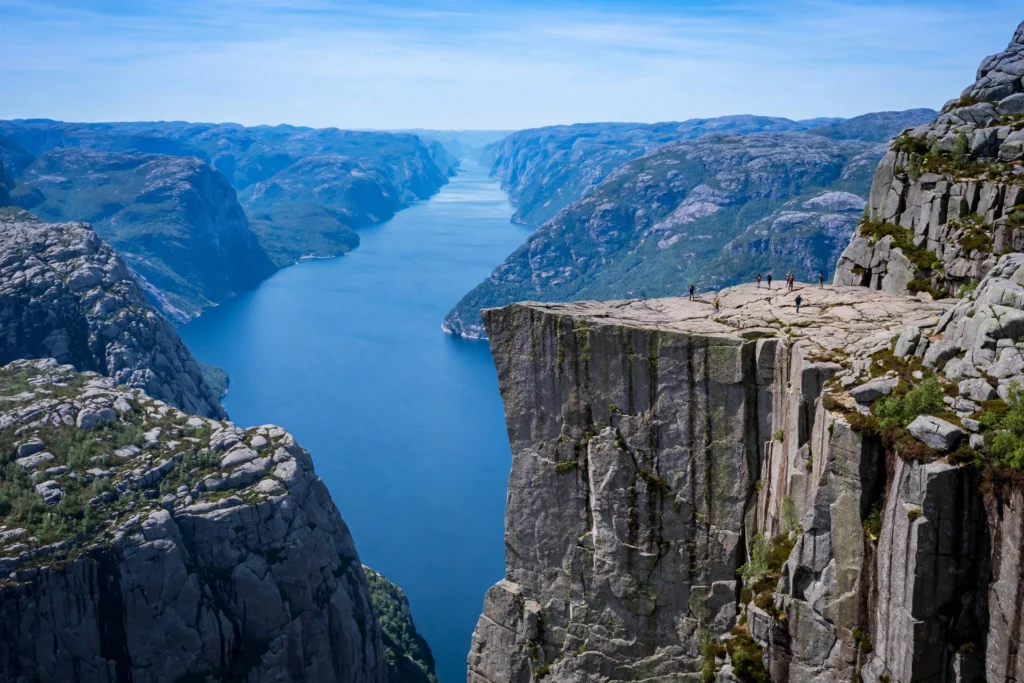
Stavanger is the city most first-timers skip, and it is the city that most rewards the ones who do not. It is Norway’s oil city on the south-west coast, with a pretty wooden old town of white-painted houses, a harbour that still feels like a working port, and the Lysefjord on its doorstep — and the Lysefjord is where Preikestolen, the Pulpit Rock, stands. The case for adding Stavanger is simple: it is the most dramatic single day-hike in southern Norway, it fits into a longer fjord trip as a two-night stop, and it is the one famous Norwegian viewpoint that is a genuinely achievable day out rather than a multi-day expedition. The case against adding it to a seven-day first trip is just as simple: it needs its own two nights, and those two nights come out of Bergen or the fjord, which is why the realistic advice is to add Stavanger only with twelve to fourteen nights, never as a squeeze.
Preikestolen itself is a flat-topped cliff 604 metres above the Lysefjord, a square platform of rock about 25 metres across, with no fence and a straight drop on three sides. The hike is about 8 kilometres return, four to five hours including time at the top, and it is a proper mountain path — rocky, steep in places, and exposed at the top — so it needs proper footwear, water, a weather check and an early start, and it is not a walk to do in trainers after a late breakfast. Go early, because the trail is the busiest in Norway in July and the platform is crowded by midday, and go in good weather, because the view in cloud is a grey wall and the rock is slippery when wet. The reward is the view down the Lysefjord, blue water between grey cliffs stretching to the horizon, with tiny boats far below, and the strange calm of standing on a platform that has stood there for ten thousand years. The mountain code applies here more than anywhere in this guide: match the route to your ability, check the weather, carry proper equipment, and be willing to turn around.
Stavanger itself deserves the rest of the two nights. The old town, Gamle Stavanger, is a grid of 170 white wooden houses from the 18th and 19th centuries, the best-preserved wooden settlement in northern Europe, and the place to walk in the evening when the day-trippers have gone. The Norwegian Petroleum Museum tells the story of the oil that built the modern city, and it is better than it sounds — the history of how a fishing town became an energy capital in a generation. The harbour restaurants are the place to eat fish, and the city is the base for the Lysefjord cruise as well as the hike: the boat from the harbour runs up the fjord beneath Preikestolen, past the waterfalls and the goat farms on the cliffs, and it is the way to see the rock from below, which is the view the hikers never get. The practicalities are straightforward: fly to Stavanger Airport Sola, take the bus or taxi the short hop into the city, stay near the harbour, and book the Preikestolen hike as a full day with nothing else timed after it, because the mountain sets its own schedule.
Ålesund and the Geirangerfjord: The Golden Route
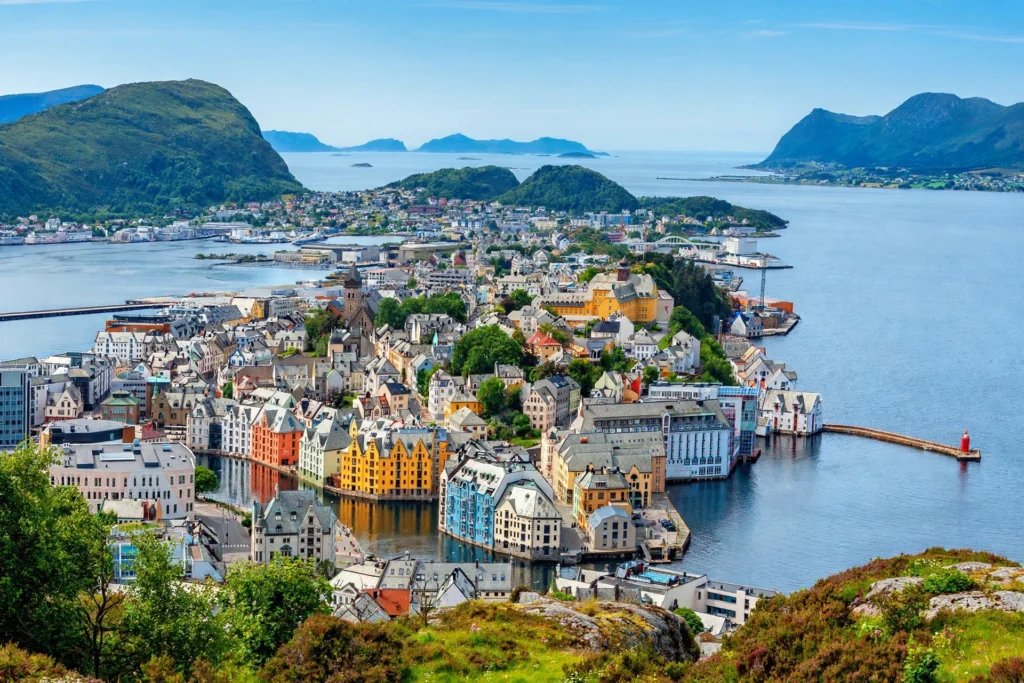
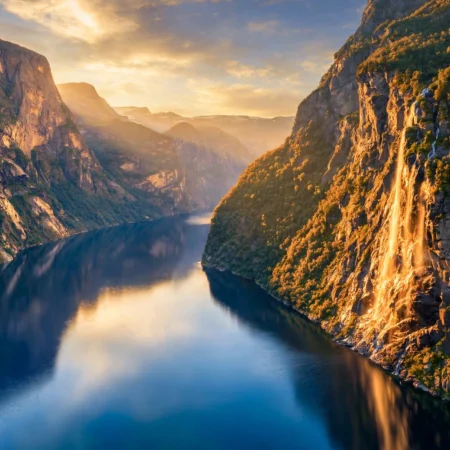
Ålesund is the town that makes the Golden Route work, and the Geirangerfjord is the reason the Golden Route exists. Together they are the most dramatic stretch of road and water in Norway: the UNESCO-listed Geirangerfjord, the Eagle Road and Dalsnibba above it, the eleven hairpins of Trollstigen, and the bridge-hopping Atlantic Ocean Road out on the open coast. It is the centrepiece of the ten-day itinerary and, for many travellers, the whole reason to rent a car. It is also the part of Norway that most needs a car, or a tour, because the fjord and the mountain roads do not connect by train — and the part that most needs the season to be right, because the roads close in winter and the fjord cruises thin out.
Start in Ålesund, the Art Nouveau town rebuilt in stone and pastel colour after the fire of 1904, when the whole wooden town burned in a single night and was rebuilt in the fashionable style of the day, with turrets, spires and carved facades. Climb the 418 steps to the Aksla viewpoint for the view over the town, the harbour and the islands, and walk the Brosundet canal in the evening, when the pastel houses reflect in the water and the town is at its quietest. Ålesund is a base, not a day trip: two nights here gives you the town, the fjord and the mountain road without a heroic drive, and the hotels on the waterfront are the place to stay, because the view is the point. From Ålesund the Geirangerfjord is a day out by boat or by road, and the boat is the better way to see it: the sightseeing cruise runs up the fjord past the Seven Sisters waterfall, the Suitor across the water, and the abandoned mountain farms clinging to the cliffs, and the scale of the place — cliffs a thousand metres high, water a hundred metres deep — only makes sense from the water.
The Golden Route by road is the drive to plan around. From Geiranger, the Eagle Road climbs in hairpins to the Ørnesvingen viewpoint and on to Dalsnibba, the skywalk at 1,500 metres above the fjord, and then the road runs on to Trollstigen, the eleven hairpins down to Åndalsnes, and the Atlantic Ocean Road, the bridge-hopping coastal road out to the open sea. Driven unhurried, this loop wants six to eight days from Bergen, and it delivers nearly every postcard in the west. The rules that keep it joyful rather than exhausting are the same as for any Norway road trip: cap driving at three to four hours a day, because a short 150 miles can be five hours with ferries and photo stops; treat ferries as part of the road, because most fjord ferries need no booking, you queue, board and pay by card, but they set your rhythm, so never plan a same-day flight after two ferry crossings; and check the mountain roads the night before, because Trollstigen and the Geiranger to Langvatnet section close in winter, normally from early November to late May, and after opening they can still close at night and in bad weather. The Geiranger to Hellesylt ferry is suspended until further notice, so check the operator’s page for the 2027 season before you build a route around it.
Driving in Norway: ferries, tolls and the plus-25-percent rule
Self-driving is the best way to see fjord and mountain Norway, but there is a learning curve, and the learning curve is mostly about time. Norwegian roads are slow, so take map estimates and add roughly 25 percent for real-world driving, ferries and stops — and then add the photo stops on top, because the roads here are scenic and slow and every hour of them is the holiday. The table below is the reality check to read before you rent.
| Route | Driving time, no stops | Distance | What slows you down |
|---|---|---|---|
| Oslo to Bergen | 7–8.5 hours | Varies by route | Hardangervidda plateau or the Lærdal Tunnel; no ferry either way |
| Bergen to Ålesund | About 7.5 hours plus ferries | About 420 km | Two or three fjord ferries and the mountain roads |
| Bergen to Stavanger | About 4 hours plus ferries | About 210 km | Ferries across the fjords; the coastal road is slow |
| Oslo to Tromsø | Fly: about 2 hours | Too far to drive | Driving there and back inside two weeks is an endurance event, not a holiday |
| Bergen to Geiranger | A long day | Via ferries and mountain roads | Trollstigen and the fjord ferries set the pace |
Renting a car means a few things that catch people out. Expect roughly USD 60 to 85 a day for a compact in summer, more for an SUV and much less in shoulder season, and book early, because peak-season cars sell out. Most Norwegian rental cars are manual, so reserve an automatic well ahead if you need one, and one-way drop-off fees — picking up in Oslo and dropping in Bergen — can be steep, so weigh that against the time an open-jaw route saves. You will usually need to have held your licence for at least a year and to have a credit card in the main driver’s name. Tolls and ferries are almost all automatic: cameras read your plate, there are no booths, rental cars come fitted with an AutoPASS tag, and the tolls are billed to your card. Individual passages run from about EUR 1 to EUR 15, and they add up over a long road trip, so budget for them rather than being surprised. Car ferries are a scenic part of the trip rather than a chore: you drive on, payment is taken on board or read automatically from your plate through AutoPASS, short hops cost roughly NOK 60 to 100 for car and driver, and a handful of routes now run free — but the busy summer ones, such as Bodø to Moskenes for Lofoten, are worth pre-booking. Norway has one of the world’s highest shares of electric cars, so road-tripping in an electric rental is easy: there are more than 32,000 public charging points, including many fast chargers, most now take a contactless tap-to-pay card, and the EV perks include reduced tolls. Plan your charge stops around the fast chargers on your route, unplug around 80 percent, and enjoy the quiet. A motorhome is a popular way to do Norway, rolling transport and bed into one at roughly NOK 1,500 a day for a small van, more in peak summer — but check the size limits on Trollstigen, where buses are limited to 13.3 metres and large motorhomes should check the current rule before they commit, and remember that wild camping has rules and that marked campsites are the kinder choice.
Hardangerfjord: Waterfalls, Orchards and the Vøringsfossen
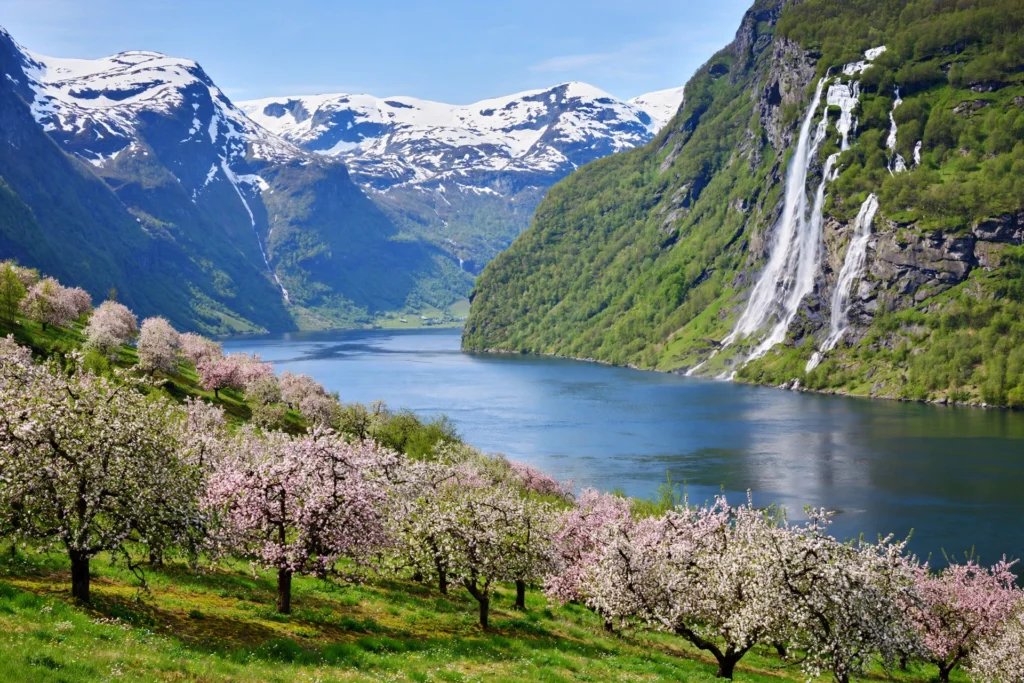
The Hardangerfjord is the fjord the seven-day classic often skips, and it is the fjord that most rewards the travellers who do not. It is the second-longest fjord in Norway, running inland from the coast near Bergen through orchard country, past waterfalls and glaciers, to the mountain plateau, and it is the gentlest of the great fjords — greener, softer and more settled than the Sognefjord, with farms and villages along the water rather than sheer cliffs. It is the fjord for the traveller who wants the water, the waterfalls and the walking without the drama of the Geirangerfjord, and it is the fjord that fits into the classic route as a single extra day, driving the Rv7 over the Hardangervidda plateau from Oslo, stopping at the Vøringsfossen waterfall, and coming down into the orchards.
Vøringsfossen is the waterfall to see first. It falls 182 metres into the Måbødalen valley, and the viewpoint from the top of the gorge is the one that makes people stop the car — the water, the rock, the valley opening below, and the road winding down through it. Walk behind Steinsdalsfossen, the waterfall you can walk behind on a path cut into the rock, and you will understand why the Hardangerfjord is the waterfall fjord: the water comes off the plateau in dozens of falls, and in May and June, when the snow is melting, they are at their strongest. The orchards are the other half of the story. The fjord’s south-facing slopes are Norway’s fruit country, and in May the apple and cherry blossom covers the hillsides in white and pink against the snow on the mountains behind — the most beautiful sight in the country, and the reason May is the month to come here. In autumn the same orchards produce the cider that has become the fjord’s signature: the cider farms around Ulvik and Eidfjord open their doors for tastings, and the local cider, made from the same apples, is the drink to try with the fjord trout.
The Hardangerfjord works as a day or as a base. As a day, drive from Oslo over the Hardangervidda, stop at Vøringsfossen, come down to Eidfjord or Ulvik, walk the orchards, and carry on to Voss or Flåm. As a base, stay two nights in Eidfjord or Ulvik and walk the fjord-side paths, take the boat, and climb to the viewpoints above the water. The Hardangerfjord in a Nutshell, the Fjord Tours package from Bergen, is the car-free version: a round trip from Bergen by train, bus and boat, cruising past the orchards and the mountains and the Vøringsfossen waterfall, from NOK 1,991, running May to September. It is the right choice for a Bergen-based traveller with one day, and the right way to see the fjord without a car. Either way, the fjord is the reminder that Norway’s beauty is not only in the drama of the cliffs but in the settled landscape between them — the farms, the orchards, the villages, and the water that has fed them for a thousand years.
The Bergen Railway and Norway’s Great Train Journeys
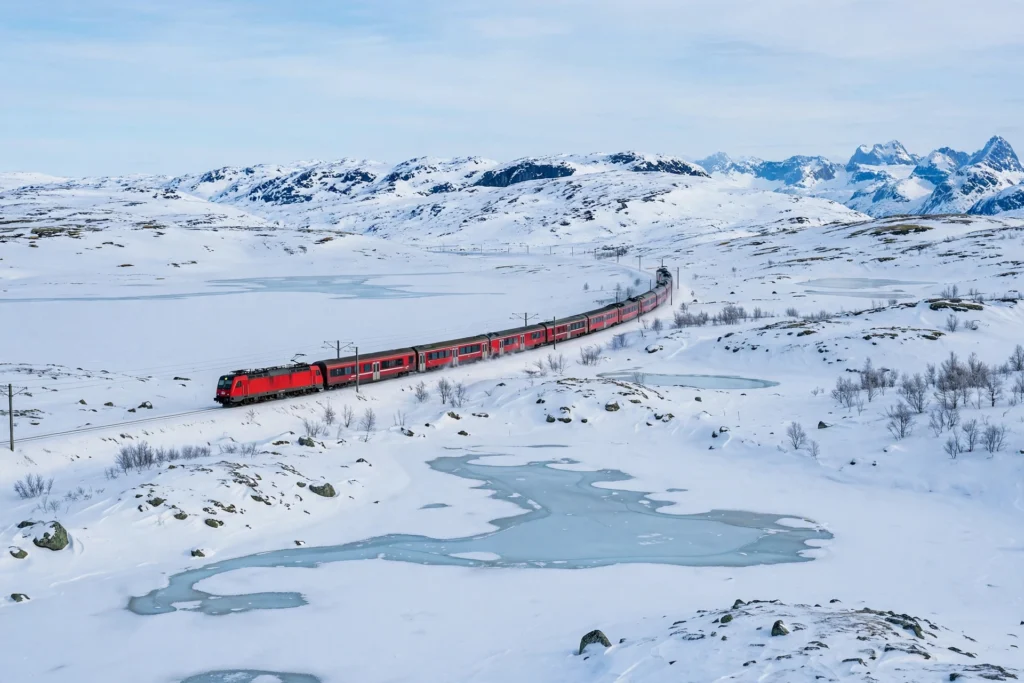
Norway is a train country in a way that surprises first-timers, because the trains here are not just transport but the sightseeing itself. The Bergen Railway is the great one, and this section gives it the space it deserves, along with the other lines that are worth building a trip around — because a Norway trip planned around the trains is a Norway trip that works, and a Norway trip that ignores them is a trip that spends its best hours on the road.
The Bergen Railway deserves a daylight departure, a window seat and a slow lunch. The line runs 471 kilometres from Oslo to Bergen, through 182 tunnels and over the Hardangervidda plateau, topping out at 1,237 metres, and the middle of the journey is the reason to be awake for it: the snow, the frozen lakes, the bare plateau, the little station at Finse at 1,222 metres, where the snow can lie all year and where the polar explorers trained. The full journey takes six and a half to seven and a half hours, and the best of it comes in the middle, after lunch westbound, when the train climbs onto the plateau and the world turns white. Book the cheapest fares early, because standard tickets go on sale about 115 days ahead and the popular summer departures sell out, and check the timetable for your date, because the winter timetable starts on 13 December 2026 and some trains have been cancelled by strike action in the autumn of 2026. The night train is the alternative for travellers who want to save a hotel night, but it wastes the scenery, which is the point, and the daylight train is the better choice for a first trip.
The other lines are worth knowing even if you only ride one of them. The Flåm Railway is the steep one, 20 kilometres down from Myrdal to the fjord, and it is covered in the car-free spine section above. The Rauma Railway runs from Dombås to Åndalsnes through the Romsdal valley, under the Troll Wall, the tallest vertical rock face in Europe, and it is the way into the Romsdal Alps and Trollstigen without a car. The Nordland Railway runs from Trondheim to Bodø, crossing the Arctic Circle, and it is the slow way north for travellers who want the journey to be the holiday — the train runs through forests and valleys and across the Saltfjellet plateau, and it connects in Bodø with the ferry to Lofoten. The Dovre Railway runs from Oslo to Trondheim through the Gudbrandsdalen valley, past Lillehammer and the Dovrefjell mountains, and it is the way to the medieval cathedral city of Trondheim, which is the stop most first-timers skip and most second-timers wish they had not. The table below compares them at a glance.
| Railway | Route | Time | Why ride it |
|---|---|---|---|
| Bergen Railway | Oslo to Bergen | 6.5–7.5 hours | The great crossing; Hardangervidda plateau, Finse, the snow |
| Flåm Railway | Myrdal to Flåm | About 1 hour | The steep descent; 20 tunnels, 867 metres down, Kjosfossen |
| Rauma Railway | Dombås to Åndalsnes | About 2 hours | The Romsdal valley; Troll Wall, Trollstigen country |
| Nordland Railway | Trondheim to Bodø | About 10 hours | The slow way north; Arctic Circle crossing, Saltfjellet |
| Dovre Railway | Oslo to Trondheim | About 7 hours | Gudbrandsdalen valley; Lillehammer, Dovrefjell, Trondheim |
Booking trains in Norway is straightforward once you know the two names that matter. Vy is the main operator, and its site sells the Bergen Railway, the Flåm Railway and the long-distance lines, with the cheapest fares released first and rising as the date approaches. Entur is the national journey planner, and it sells train journeys across Norway without an added fee, combining bus, train, boat, tram, metro and flight options in one search — but always open the individual leg and read the connection notes, because the planner’s connection is not always a guaranteed connection, and the operating carrier’s conditions still govern the trip. The practical rules are simple: book the long-distance trains as early as you can, buy the Flåm Railway ticket before you reach Myrdal, because there is no ticket office or machine there, sit on the left leaving Oslo westbound, and never book separate segments with a heroic transfer unless you understand the protection attached to each ticket. The train is the part of Norway that runs to the minute, and the timetable is the part of the trip that rewards respect.
Stave Churches, Viking Heritage and Norwegian Culture
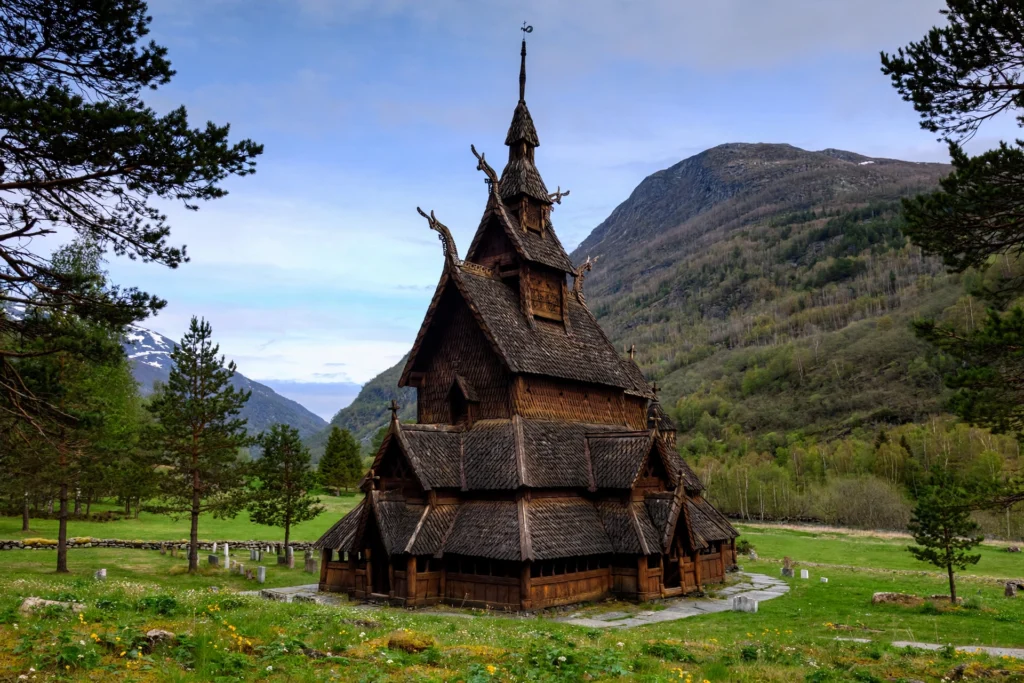
Norway’s history is written in wood, and the stave churches are the buildings that prove it. Twenty-eight of them survive, built between the 12th and 14th centuries, and they are the oldest wooden buildings in Europe still in use. They are called stave churches because they are built around staves — great upright posts of pine, tarred black against the weather — and their tiered shingled roofs, their dragon-head carvings and their tall spires make them look like something out of a saga. Borgund, in the Lærdal valley on the way to the Sognefjord, is the best-preserved and the one to see if you see only one: it stands in a green valley with the mountains behind it, its roofs stacked like a wedding cake, its carvings still sharp after eight hundred years. Urnes, on the Lustrafjord, is the oldest and the UNESCO-listed one, its carvings a tangle of animals and vines that predate the church itself. Lom, on the road to the Sognefjellet pass, is the one you will pass anyway on the ten-day driving route, and it is worth the stop. The churches are small inside — dark, wooden, smelling of tar and pine — and they are the most Norwegian buildings in the country, because they are the buildings that were built by the people who lived here, from the trees that grew here, in a style that came from the Viking ships and the pagan temples before them.
The Viking heritage is the other half of the story, and it is best understood as a seafaring culture rather than a warrior one. The Vikings were traders, explorers and settlers, and the ships they built — long, shallow, fast, able to cross oceans and to sail up rivers — are the reason Norway’s history is a history of the sea. The Fram Museum on Bygdøy tells the polar half of that story, with the ship that carried Nansen and Amundsen to the ice, and the Kon-Tiki Museum beside it tells the other half, with the balsa raft that Thor Heyerdahl sailed across the Pacific to prove that ancient peoples could have crossed oceans. The Viking ships themselves are off view until the new Museum of the Viking Age opens, planned for November 2027, and that is worth checking before you promise yourself the Oseberg ship — but the story is everywhere else in the meantime, in the stave churches, in the place names, and in the fjords themselves, which were the Vikings’ highways.
The culture that grew out of that history is the culture you meet in the villages: the rorbu cabins, the fishing villages, the cod trade, the Sami people of the north, and the food. The Sami are Norway’s indigenous people, and their culture — the reindeer herding, the joik singing, the bright red and blue clothing — is a living culture in the north, not a museum piece. A Sami experience in Tromsø or Finnmark, with reindeer sledding and a meal in a lavvu tent, is the respectful way to meet it, and the guides who run them are Sami themselves. The food is the other half of the culture, and it is simpler than the restaurant menus suggest: salmon and cod, fresh from the water, lamb from the mountains, cloudberries from the marshes, brown cheese — brunost — on crispbread, and the flatbread and the butter that go with everything. Eat the fish, try the brunost, and buy the cloudberry jam in a supermarket rather than a souvenir shop, because it is the same jam at a third of the price. The language is the last piece: Norwegian has two written forms, Bokmål and Nynorsk, and English is spoken fluently almost universally, so you do not need Norwegian to travel well — but learning “hei” for hello, “takk” for thank you, and “vær så snill” for please buys you a warmer welcome everywhere, and the Norwegians you meet will notice.
Fjord Cruises, Coastal Voyages and Life on the Water
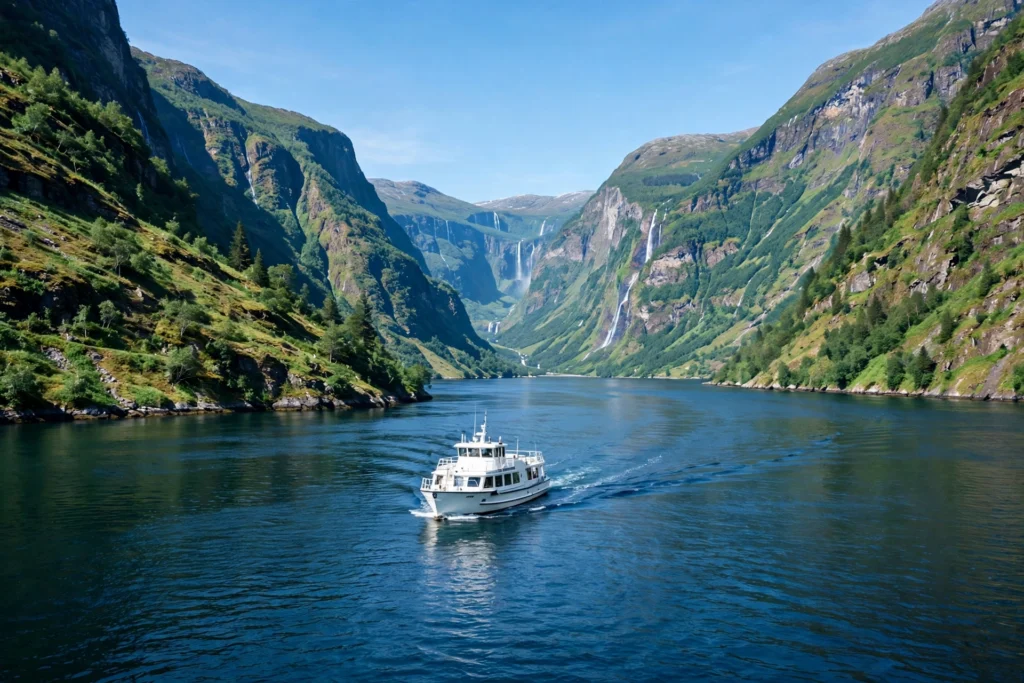
Norway is a country best seen from the water, and the question is not whether to take a boat but which boat, and how many. The fjords were made by water, the villages were built for water, and the view from the deck — the cliffs rising a thousand metres, the waterfalls threading down, the farms clinging to the shore — is the view the road never gives you. The mistake is to book multiple fjord cruises that repeat the same kind of day. One great cruise, done properly, is worth three short ones, and the choice is between the fjord cruise, the coastal voyage, and the local boat — three different experiences that suit three different trips.
The fjord cruise is the one this guide has already covered in the car-free spine: the Flåm to Gudvangen cruise through the Nærøyfjord, two hours, quiet electric boats, and the most beautiful water in the country. It is the cruise to take first, and for most travellers it is the only fjord cruise they need. The alternatives are the Geirangerfjord sightseeing cruise from Ålesund, ten hours there and back, running April to October, and the Mostraumen cruise from Bergen, three to three and a half hours up the narrow Osterfjord, which is the easy half-day for a Bergen-based traveller. The Hardangerfjord cruise from Bergen, the Rødne Hardangerfjord Express, runs Monday to Friday from Bergen to Rosendal in about seven and a half hours, and it is the way to see the orchard fjord without a car. Choose one, and choose it by the fjord you are already in, not by the brochure.
The coastal voyage is the other kind of boat, and it is a different holiday altogether. The Hurtigruten and Havila ships run the length of the coast from Bergen to Kirkenes, calling at 34 ports over six or seven days one way, and they are working ships as much as cruise ships — they carry cargo, cars and local passengers as well as tourists, and they sail through the night while you sleep. A segment aboard one of them — Bergen to Trondheim overnight, or the Lofoten to Tromsø leg — combines transport, hotel and sightseeing in a way no road can, and it is the indulgence to consider with fourteen days. The full voyage is the trip for travellers who want the coast itself to be the holiday, and it is the way to see the places the road never reaches: the fishing villages, the lighthouses, the islands, and the North Cape from the sea. Book a cabin with a window if you can, because the light at three in the morning in June is worth waking up for, and pack for the deck, because the best seat on the ship is outside.
The table below compares the water options at a glance, so you can choose one and stop there.
| On the water | Duration | 2026 price (adult, from) | Best for |
|---|---|---|---|
| Nærøyfjord cruise, Flåm–Gudvangen | About 2 hours | About NOK 550–665 | Every first trip; the essential fjord cruise |
| Mostraumen fjord cruise from Bergen | 3–3.5 hours | About NOK 840 | Bergen-based travellers with half a day |
| Geirangerfjord cruise from Ålesund | About 10 hours | From NOK 2,247 | Travellers based on the north-west coast |
| Hardangerfjord Express from Bergen | About 7.5 hours | About NOK 872 | The orchard fjord without a car |
| Coastal voyage segment, Bergen–Trondheim | Overnight | Varies by cabin and season | Fourteen-day trips; transport, hotel and sightseeing in one |
| Full coastal voyage, Bergen–Kirkenes | 6–7 days one way | Varies by cabin and season | Travellers who want the coast itself to be the holiday |
Life on the water has its own practicalities. The boats run in almost all weather, but the fjord in rain is a different fjord — the waterfalls are stronger, the clouds sit on the cliffs, and the photographs are moodier — so do not cancel for rain, and do bring a waterproof jacket and a warm layer for the deck. Sit outside if you can, because the glass is never as good as the air, and stand at the front of the boat for the narrowest part of the Nærøyfjord, where the cliffs close in and the water goes still. And remember that the boat is also the transport: the fjord cruise from Flåm to Gudvangen is not a round trip but a leg of the journey to Bergen, and the bus that meets it at Gudvangen is part of the same ticket if you booked the package, or a separate booking if you did it yourself. Check the connection before you board, not after you land.
The Arctic Coast, the North Cape and the Far North
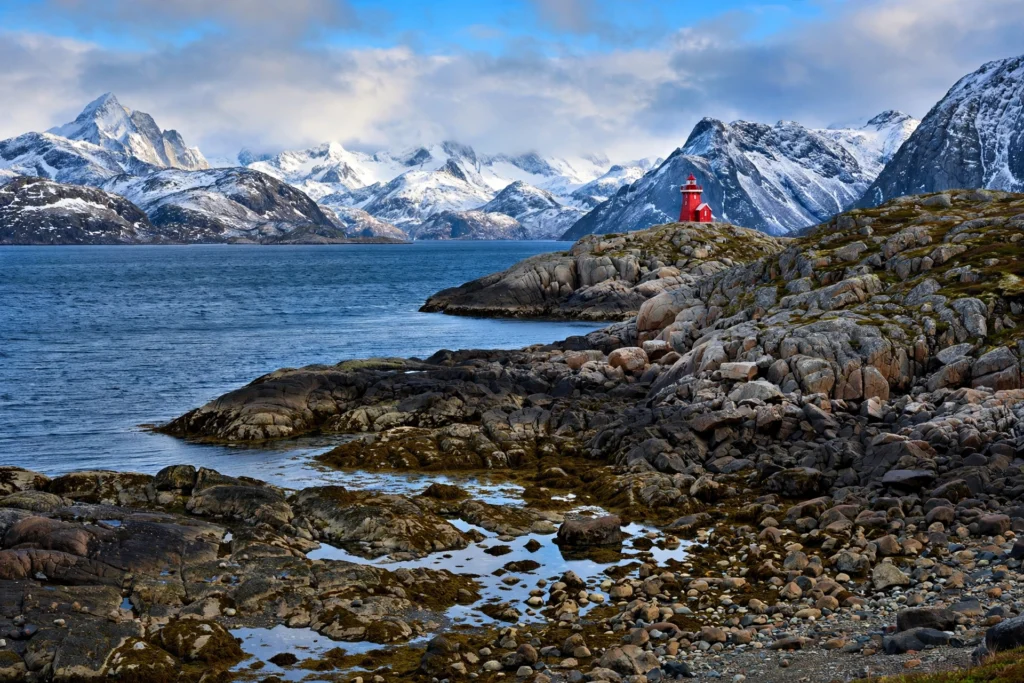
Beyond Tromsø, Norway keeps going for another thousand kilometres, and the far north is the part of the country that most travellers never see and most second-timers wish they had saved for a second trip. It is a different Norway: treeless tundra, fishing villages on the edge of the Barents Sea, the midnight sun in summer and the polar night in winter, and the North Cape, the cliff that has been the symbolic end of Europe for centuries. It is not a detour from the fjords. It is a trip in its own right, and it needs its own week, its own flights, and its own expectations.
The North Cape, Nordkapp, is the destination, and it is worth being honest about what it is. It is a cliff, 307 metres above the Barents Sea, at 71 degrees north, with a globe monument, a visitor centre, and a view to the horizon that has drawn travellers since the 16th century. The midnight sun shines here from mid-May to late July, and the sun never sets, and the light at two in the morning is the reason to go. The road to it runs through Honningsvåg, the fishing town that is the base, and the drive from Alta or the flight to Honningsvåg are the ways in. Go in summer, because the road is open and the light is there, and go with the expectation that the weather will do what it wants — the fog rolls in off the sea and the cliff vanishes, and the travellers who wait it out are the ones who see it. The North Cape is not the northernmost point of mainland Europe — that honour belongs to Knivskjellodden, a hike away — but it is the place that has always meant the end of the road, and it feels like it.
The rest of the far north is the reward for going beyond the Cape. Alta is the town of the rock carvings, the UNESCO-listed petroglyphs that are five thousand years old, and the base for the northern lights in the deep winter, when the sky is dark enough and the air is clear enough for the best displays in the country. Senja is the island the Norwegians call a miniature Norway, with mountains, fjords, beaches and fishing villages in a single day’s drive, and it is the quieter alternative to Lofoten, with fewer visitors and the same drama. Vesterålen, between Lofoten and Senja, is the whale-watching coast, where the sperm whales feed in the deep water off Andenes in summer, and the boat trips from there are the best whale watching in Europe. And Svalbard, the archipelago far to the north, is a destination in its own right — a place of glaciers, polar bears and the midnight sun, reached by flight from Oslo or Tromsø, and a trip that needs its own planning, its own insurance and its own respect for the Arctic. For travellers continuing a Scandinavian journey beyond Norway, our Sweden travel guide and our Denmark travel guide cover the two neighbours that connect naturally to a Norway trip — Sweden by the night train to Kiruna and Abisko in the north, and Denmark by the ferry and the flight south — and the three countries together make a northern Europe trip that no single country can match.
The practicalities of the far north are the practicalities of distance and darkness. Fly, because the distances are too great to drive in a holiday, and the domestic flights from Oslo and Tromsø are frequent and save days behind the wheel. Pack for the Arctic even in summer, because the wind off the Barents Sea is cold and the weather changes in minutes, and pack for the dark in winter, because the polar night in the far north means the sun does not rise at all for weeks, and the light is a blue twilight at midday. Book the hotels and the tours early, because the far north is small and the good places sell out, and build in a spare day, because the weather cancels plans here with regularity and the spare day is what turns a cancelled whale trip into a second chance. And go with the right expectation: the far north is not the fjords with more snow. It is a different country, and it rewards the traveller who goes there to see it, not the traveller who goes there to tick it off.
Frequently Asked Questions About Norway Travel
How many days do you need for Norway?
Seven days is the sweet spot for a first trip — the classic Oslo to fjords to Bergen route, with time to breathe. Five days holds one region done properly, either the fjords from a single base or Bergen with a fjord cruise. Ten days adds the Arctic, with a flight north to Lofoten or Tromsø, or adds the great mountain roads around Geiranger and Ålesund. Fourteen days is the first length that does both halves without rushing. The golden rule is one region per week, and the most common mistake is trying to combine the southern fjords, the far north and the cities in seven to ten days.
What is the best month to visit Norway?
June for the fullest version — longest days, waterfalls strong, roads opening, crowds not yet at July weight. Late August is the quieter twin of July, with almost all the same services running and slightly lower prices. September is the value-and-aurora alternative, with the fjords still open, the crowds gone and the dark nights back in the north. For the northern lights, February and March are the best months, with reliable snow, returning light and the aurora season at its strongest. Avoid October and November in the north unless the trip is purely a city break.
Do US citizens need a visa for Norway?
No, for a short visit. Norway is in the Schengen Area but not the European Union, and US citizens can visit without a visa for up to 90 days in any 180-day period, with time spent elsewhere in Schengen counting toward the same 90 days. Your passport must be valid for at least three months after the date you plan to leave Norway, and it must have been issued within the last ten years. The Norwegian Directorate of Immigration, UDI, keeps the official conditions.
What is EES, and does it affect my trip?
The Entry/Exit System is the biometric border system that is now fully operational across Norway and the Schengen Area, since 10 April 2026, after a gradual rollout from 12 October 2025. On your first arrival it registers your passport, four fingerprints and a facial image, replacing the manual passport stamp. There is nothing to do before travelling; you are registered at the border, and the first registration can take extra time, so avoid a tight connection at Oslo Airport on arrival day. EU and EEA citizens are not registered, and neither are people with a residence permit in Norway or another Schengen country.
Do I need an ETIAS authorisation for Norway?
No, not as of November 2026. ETIAS is not in operation, no applications are being accepted, and the European Union has not announced a start date — the earlier expectation of the last quarter of 2026 has lapsed, and the Commission has said it will announce the date several months before launch. Do not pay any website that offers to sell you an ETIAS authorisation today. When it does start, the fee is planned at EUR 20 for applicants aged 18 to 70, with a transitional period in which its use is optional.
Is Norway safe to visit?
Yes. The US State Department rates Norway at Level 1 — Exercise Normal Precautions — its lowest advisory level, updated 6 July 2026, and describes Norway as generally a safe destination for travellers. The risks are natural rather than criminal: weather that changes fast in the mountains, trails that are real mountain outings, and cold water all year. Follow the Norwegian Mountain Code, check the weather, carry proper equipment, and be willing to turn around.
How much does a trip to Norway cost?
For a mid-range seven-day classic trip, excluding international flights, budget roughly NOK 16,000 to 23,000 per person — about USD 1,500 to 2,200 at late-2026 rates — covering hotels, the Bergen Railway and Flåm Railway and the Nærøyfjord cruise, food and a few museums and activities. A ten-day trip with a flight north costs roughly NOK 28,000 to 42,000 per person. The biggest savings come from fewer hotel changes, supermarket breakfasts and packed lunches, and travelling in June or September rather than July.
Is Norway in a Nutshell worth it?
For a first trip, yes, usually. The Fjord Tours package sells the Bergen Railway, the Flåm Railway, the Nærøyfjord cruise and the bus as a single ticket from NOK 2,698, with the connections arranged and guaranteed. Doing it yourself costs from about NOK 1,850 to 2,100, saving roughly NOK 700 to 1,500 per person, but the tickets are for specified departures and a missed connection on separate tickets is your problem. If you have a flight to catch at the end of the trip, the guarantee is usually worth the difference; on a second trip, DIY is the better deal.
Can I do Norway without a car?
Yes, and for the classic route it is the better way. The Oslo to Bergen crossing is designed for the train and the boat: the Bergen Railway, the Flåm Railway and the Nærøyfjord cruise connect without a car, and Bergen and Oslo are easy by public transport. A car earns its keep only in two places — the mountain-road loop around Geiranger and Trollstigen, and Lofoten, where the E10 spine and the village-hopping reward wheels. Most great Norwegian itineraries use three kinds of transport, not one.
When do the mountain roads open?
The high scenic roads are summer-season roads with no fixed opening date. Trollstigen opened for the 2026 season on 27 April, the earliest opening on record, and closed for winter on 10 November 2026; in a normal year it runs from around mid-May to October or November. The Geiranger to Langvatnet section, the Sognefjellet and the Aurlandsfjellet follow the same pattern. The main passes on the national road network, Haukelifjell and Hardangervidda among them, are not closed for the season but can shut at short notice in bad weather. Check the live road status with the Norwegian Public Roads Administration the evening before every driving day.
What is the currency in Norway, and do I need cash?
The Norwegian krone, NOK. Norway is not in the European Union and does not use the euro, and shops rarely accept euros. Cards and mobile payments work almost everywhere, including ticket machines, buses, ferries and the smallest village shops, and cash is nearly obsolete — you do not need to carry it, but do carry a backup card and know its PIN. Tipping is optional and not expected; Norwegians often leave 5 to 15 percent in restaurants when they are happy, and nobody minds if you leave nothing.
Should I visit Tromsø or Lofoten if I only have time for one?
Tromsø for winter activities and easy logistics — a city base, a flight in and out, tours that pick you up at the hotel, and the best aurora infrastructure in the country. Lofoten for scenery, hiking and photography — the islands themselves are the sight, and the aurora is the bonus. In summer, Lofoten, without question; in midwinter, Tromsø, unless the northern lights plus a rorbu cabin is the dream, in which case Lofoten again. Neither choice supports both in a week with the fjords as well.
Conclusion: Norway Rewards the Traveller Who Chooses One Region Well
Norway is not a country to rush, and the travellers who love it most are rarely the ones who saw the most places. They are the ones who gave the Sognefjord three nights instead of one, who slept in Bergen instead of passing through it, who waited for the light on the fjord instead of chasing the next viewpoint, and who took the train across the plateau instead of the fastest road around it. The country punishes hurry and rewards patience, and the classic route works precisely because it does three things well instead of ten things badly. Plan it the way this guide lays it out. Pick one region per week and stay two nights everywhere. Fly into Oslo and out of Bergen, and move in one direction. Ride the Bergen Railway in daylight, change at Myrdal for the Flåm Railway, and cruise the Nærøyfjord slowly. Go in June or September if you can, and keep a spare morning at every mountain base. Book the scarce pieces early — the fjord hotels, the Flåm Railway, the rental car in Lofoten — and cost the trip honestly before you fall in love with it. Check the advisory again the week before you fly, remember that EES will register you at the border and that ETIAS is not running, and check the mountain roads the night before you drive them. Do those things, and Norway gives you what few destinations can: a fjord with waterfalls threading down cliffs a thousand metres high, a railway across a snow plateau, a wharf of wooden houses by a rainy harbour, a capital you can walk across in an afternoon, islands where the mountains rise straight from the sea, and a sky in winter that moves with green light. The trip is worth the planning, and the planning is mostly done — now go and book it.
People also read:
- Sweden Travel Guide (https://solotravelpro.com/sweden-travel-guide/)
- Denmark Travel Guide (https://solotravelpro.com/denmark-travel-guide/)
- Switzerland Travel Guide (https://solotravelpro.com/switzerland-travel-guide/)
- Germany Travel Guide (https://solotravelpro.com/germany-travel-guide/)
- France Travel Guide (https://solotravelpro.com/france-travel-guide/)
- Travel Safety Tips (https://solotravelpro.com/travel-safety-tips/)
- Travel Packing Checklist PDF Free (https://solotravelpro.com/travel-packing-checklist-pdf-free/)

M. Adil is the founder and editor of SoloTravelPro. He writes practical, research-based travel guides that help travellers plan with confidence — from first-time city breaks to national parks and island escapes. Every guide is built on official sources, current prices and honest, usable advice, so readers can plan smarter and travel better.