Quick Answer: Is Curaçao Worth Visiting?
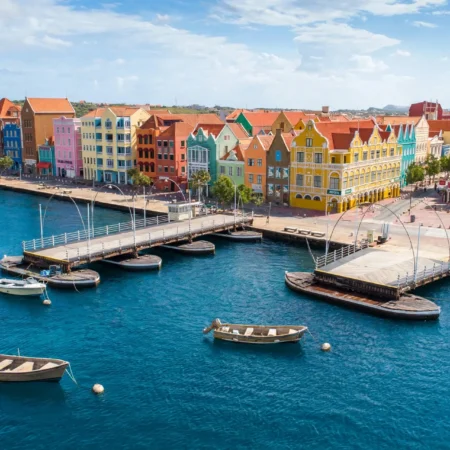
Yes — and curacao travel rewards travellers who want more than a single resort beach. This is a Dutch Caribbean island with a UNESCO-listed capital, Willemstad, where pastel gabled houses line the Handelskade waterfront and a floating bridge swings open for ships. It has more than 35 beaches, a reef that starts steps from the sand, and a dry, sunny climate that sits outside the hurricane belt, so it works as a year-round destination.
The best time to visit Curaçao is December to April, the dry season, when the trade winds keep the heat comfortable and the rain is at its lowest. The island is at its cheapest and quietest from May to November, and the weather stays warm enough to swim every month of the year. Plan on at least five to seven days: two for Willemstad and the east, two or three for the west-end beaches and the national parks, and one full day for the Klein Curaçao boat trip.
You need a rental car. The best beaches, the Christoffel National Park climb, Shete Boka and the quiet west coast are spread along the island, and public transport does not reach them reliably. Budget roughly US$110–170 per person for the Klein Curaçao day trip, US$15 per adult for each national park, and US$30–50 a day for a rental car — all figures in this guide are planning ranges unless they are quoted from an official source. The US State Department rates Curaçao Level 1: Exercise Normal Precautions, its lowest advisory level, with travel guidance dated 10 September 2026.
Where Is Curaçao? The Island in a Nutshell
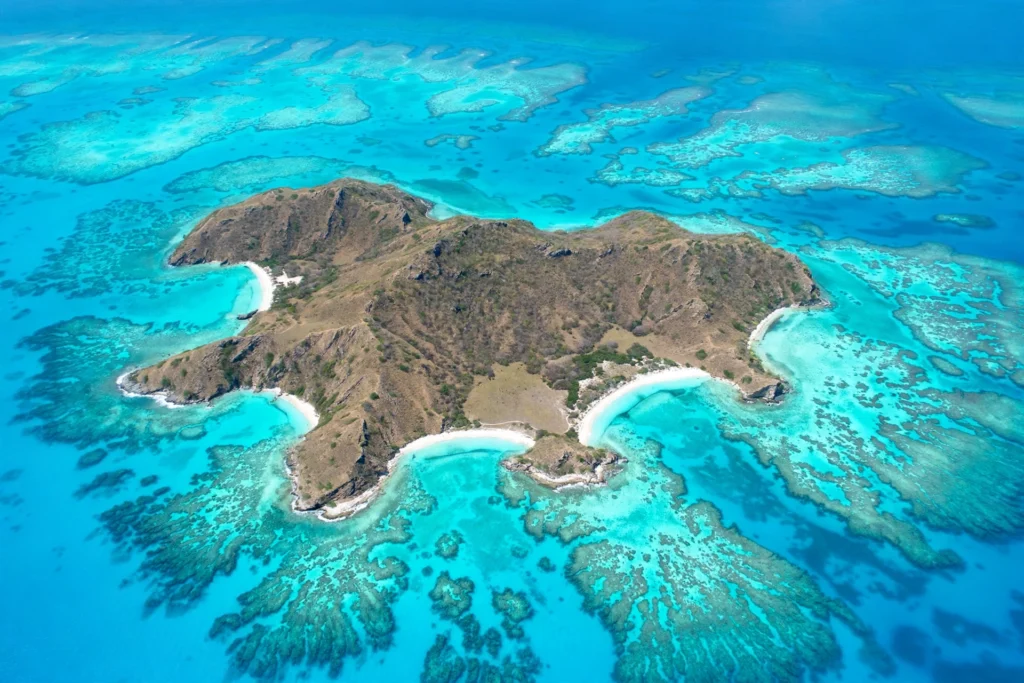
Curaçao is a constituent country of the Kingdom of the Netherlands, sitting in the southern Caribbean Sea about 37 miles (60 km) off the coast of Venezuela. It is the largest of the ABC islands — Aruba, Bonaire and Curaçao — and the US State Department describes it as slightly smaller than Washington, D.C. There are no land borders, only sea: the island is ringed by the Caribbean Sea and the Venezuelan Basin, and its time zone is Atlantic Standard Time (UTC−4), with no daylight saving. During Eastern Standard Time it is one hour ahead of Washington, D.C.
That southern position is the first thing to understand about curacao travel, because it shapes the whole trip. Curaçao sits outside the hurricane belt, below the usual path of Atlantic storms. Hurricanes are not impossible — the island can still catch rain and rough seas from a passing system — but the risk is far lower than on islands further north and east, and the island stays warm and swimmable all year. The landscape shows it: this is a dry, cactus-covered island of limestone cliffs, salt flats and scrub, not a lush rainforest island. The famous divi-divi trees lean permanently sideways in the trade wind, and the hills in the northwest are brown and gold for much of the year.
The capital is Willemstad, on the south coast, and most visitors spend their first night there. The international airport, Hato International Airport (CUR), is about 15–20 minutes by car from the city centre. The island is roughly 61 km (38 miles) long and up to about 14 km (9 miles) wide, so nowhere is more than about an hour’s drive from Willemstad — but the roads to the west end are winding, and the best beaches are strung along the leeward west coast, one after another, each in its own small cove.
The language you will hear
Four languages are part of daily life. Papiamentu is the local Creole language and the one you will hear most on the street. Dutch is the official language of government and schools. English is widely spoken in hotels, restaurants, dive shops and tourist areas, and Spanish is common too, given the island’s closeness to Venezuela and Colombia. As a visitor from the United States you can get by entirely in English, but a few Papiamentu words go a long way: “bon dia” (good morning), “bon tardi” (good afternoon), “danki” (thank you) and “dushi” — a word that means sweet or lovely and is used for everything from a person to a plate of food.
A short history that explains what you see
Curaçao’s history is visible in its buildings. The Dutch West India Company took the island in 1634, and Willemstad grew into one of the Caribbean’s great trading ports, built around the deep natural harbour of the Schottegat. Fort Amsterdam, built in the 1630s, still guards the entrance to St. Anna Bay, and the Handelskade row of Dutch gabled merchant houses — painted in the bright colours the island is known for — lines the Punda waterfront. The historic area of Willemstad, its inner city and harbour, was inscribed on the UNESCO World Heritage List in 1997, and the listing covers four districts: Punda, Otrobanda, Pietermaai and Scharloo.
The island’s past also includes slavery, and that history is not hidden. The Kura Hulanda Museum in Otrobanda documents the transatlantic slave trade and the African diaspora in the Caribbean, and the Tula rebellion of 1795, led by the enslaved man Tula, is commemorated at Landhuis Kenepa. A visit to Curaçao is richer for spending an hour or two with that history rather than only photographing the colourful facades. The landhuizen — the old plantation houses, some restored as restaurants, museums or hotels — are another thread of the same story, and several are worth a stop on a drive west.
Curaçao became a constituent country within the Kingdom of the Netherlands in 2010, when the Netherlands Antilles was dissolved. It is not part of the Netherlands and not part of the European Union, and it is not US territory: US citizens need a passport, and the island has its own immigration rules, including the ED Card described in the arrival section below.
The island at a glance
The easiest way to orient yourself is by coast. The south, or leeward, coast is where almost everything happens: Willemstad, the resorts of Jan Thiel and Mambo Beach, the dive sites, the calm coves and the marinas at Spanish Water. The west end, known locally as Banda Ariba’s opposite — Banda Abou, the “lower side” — is the quiet, rural end of the island, with the best-known beaches (Grote Knip, Cas Abao, Playa Lagun), the flamingo salt flats at Jan Kok, and the two national parks. The north coast is wild: limestone cliffs, blowholes and sea caves, with almost no beaches and no swimming in most places. The east, around Spanish Water and the Jan Thiel area, is where many of the larger resorts and the departure point for Klein Curaçao sit.
If you only remember one geographical fact, make it this one: the calm, swimmable water is on the south and west coasts. The north coast is for looking at, not swimming in.
Why Go to Curaçao? What Makes It Different
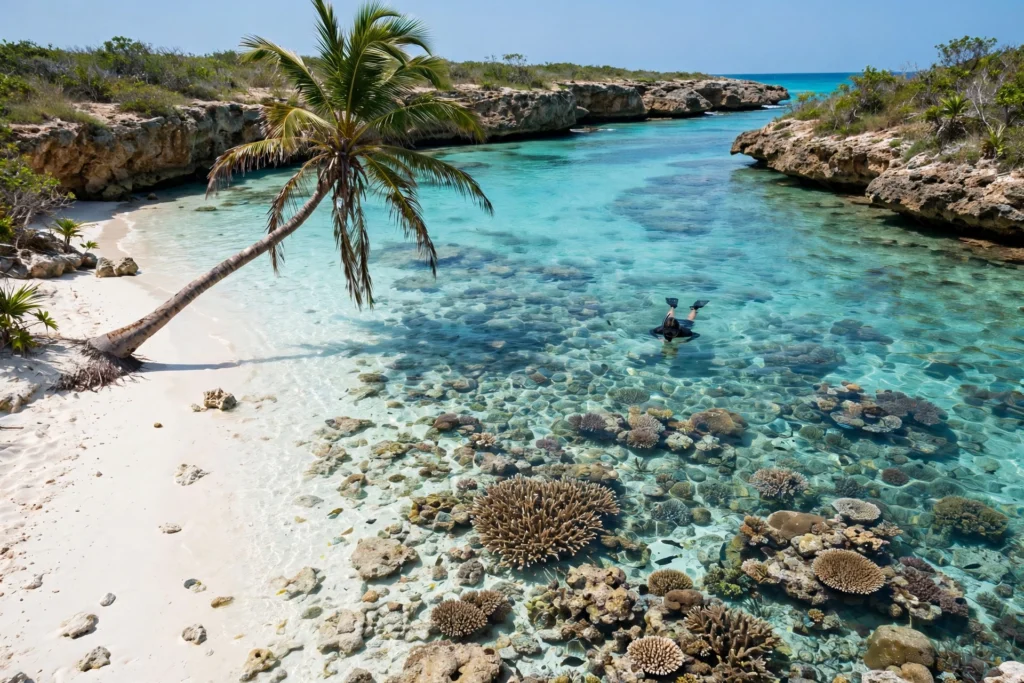
The Caribbean has no shortage of pretty islands, so the honest question is what Curaçao does that the others do not. The answer is a combination no single competitor offers in one trip: a genuinely interesting historic city, shore diving and snorkelling that starts at the beach, a desert-dry landscape with flamingos and cacti, and weather that holds up all year because the island sits outside the hurricane belt.
Most Caribbean trips force a choice between a beach holiday and a cultural one. Curaçao does not. You can spend the morning snorkelling with turtles at Playa Piskado, the afternoon walking the UNESCO-listed streets of Willemstad, and the evening eating stewed goat and funchi at a market hall where the other customers are locals. The island is small enough that all three fit in a single day, and varied enough that a week does not repeat itself.
The diving and snorkelling are the headline
Curaçao’s reef is a fringing reef: it starts close to shore, in shallow water, and drops away steeply. That matters more than it sounds. On many Caribbean islands you need a boat to reach the reef; on Curaçao you walk in from the beach with a mask and fins and you are over coral within minutes. The Tugboat wreck, a small tug that sank in shallow water near Caracasbaai, is one of the most photographed snorkel sites in the Caribbean precisely because it sits in about 5 metres (16 feet) of clear water, reachable from the shore. Playa Piskado, on the west coast, is where local fishermen clean their catch and sea turtles gather to feed — you can watch them from the surface with a snorkel, no boat required.
For certified divers the island is one of the best shore-diving destinations in the world, in the same conversation as its sister island Bonaire and the barrier-reef diving in Belize. There are dozens of marked shore dive sites along the south coast, many with a dive shop or a tank-rental station at the beach. The water is warm, around 27–28°C (81–82°F) year-round, visibility is often 25–30 metres, and the reef is healthy enough that you can still see large elkhorn coral, sea fans and turtles on a routine dive. If you are not a diver, none of this is out of reach: the snorkelling alone is reason enough to come, and several operators run beginner discovery dives from the beach.
Willemstad is a real city, not a cruise port set
Many Caribbean capitals feel like they exist for cruise passengers. Willemstad does not. It is a working city of about 150,000 people across the island, with government offices, a university, neighbourhoods, a floating market where Venezuelan boats sell fruit and vegetables, and districts like Pietermaai and Scharloo that have been restored into streets of restaurants, bars and small hotels. The Handelskade facades are the postcard, but the reason to stay is the life behind them: the morning market, the synagogue with a sand floor dating to 1732, the street art of Scharloo, and the evening happy hour in Pietermaai, where the old merchant houses now hold cafes and cocktail bars.
The dry season never really ends
Because Curaçao sits outside the hurricane belt and the trade winds blow steadily, the island has no true off season for weather. Daytime highs sit around 30–31°C (86–88°F) all year and nights around 25–26°C (77–79°F). The sea stays warm enough to swim without a wetsuit in every month. Rain falls mostly in short, sharp showers between October and December, and even then the sun usually returns within the hour. That reliability is the practical reason the island suits travellers who can only take a holiday in the summer or autumn, when much of the rest of the Caribbean is watching the hurricane forecast.
Who Curaçao suits — and who it does not
Curaçao suits travellers who like to explore on their own: drivers, snorkellers, divers, walkers and people who enjoy a city as much as a beach. It suits families who want calm, shallow beaches with facilities, and it suits couples who want a mix of beach days and evenings out in Willemstad. It is also a strong choice for a first Caribbean trip, because the infrastructure is solid, English is widely spoken and the US dollar is accepted almost everywhere.
It suits less well anyone who wants an all-inclusive resort where everything happens inside the gates — Curaçao has some larger resorts, but the island’s strength is getting out — and anyone who wants long, wide, powder-sand beaches like those in the Bahamas or the Dominican Republic. Curaçao’s beaches are mostly small coves with a mix of sand, coral rubble and rock, and some have an entry fee or a charge for loungers. If your idea of a holiday is a single endless beach, a neighbouring island may fit better; if your idea is a different cove every day, with a reef at the edge of each one, Curaçao is hard to beat.
A sensible 7-day Curaçao itinerary
| Day | Plan | Where you sleep |
|---|---|---|
| 1 | Arrive, pick up the rental car, sunset walk across the Queen Emma Bridge and dinner in Pietermaai | Willemstad |
| 2 | Willemstad on foot: Punda, Otrobanda, the floating market, Scharloo street art, Kura Hulanda Museum | Willemstad |
| 3 | West-end beach day: Grote Knip in the morning, Playa Lagun for lunch, sunset at Cas Abao | Willemstad or the west end |
| 4 | Christoffel National Park at dawn, then Shete Boka in the afternoon | Willemstad or the west end |
| 5 | Klein Curaçao full-day boat trip | Willemstad or Jan Thiel |
| 6 | Snorkelling day: Tugboat wreck in the morning, Playa Piskado turtles in the afternoon, Mambo Beach in the evening | Jan Thiel or Willemstad |
| 7 | Hato Caves, a landhuis lunch, last swim at Jan Thiel, fly home | — |
Shorter trips work too: three days covers Willemstad, one west-end beach day and either Klein Curaçao or the parks, but not both. Five days is the minimum that does the island justice.
When Is the Best Time to Visit Curaçao?
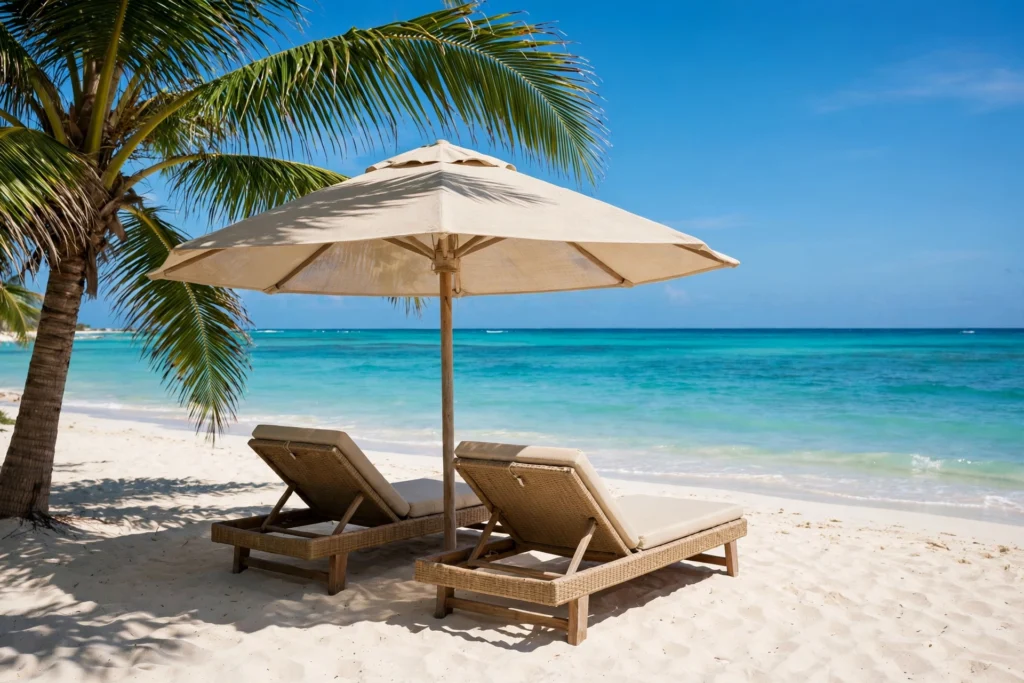
The short answer is December to April. Those are the driest months, with the steadiest trade winds, the lowest humidity and the least rain. It is also the busiest and most expensive time on the island, because it lines up with the North American and European winter, when everyone else in the Caribbean is also travelling. If you can travel in that window, take it — but do not treat the other eight months as a bad time. Curaçao’s weather is unusually reliable for a Caribbean island, and the trade-off between price and perfection is real.
Month by month
| Month | Typical high / low | Rain | Sea | What it feels like |
|---|---|---|---|---|
| January | 30°C / 25°C (86°F / 77°F) | Low | 27°C (81°F) | Dry, breezy, peak season |
| February | 30°C / 25°C (86°F / 77°F) | Low | 27°C (81°F) | Dry, breezy, peak season |
| March | 31°C / 25°C (88°F / 77°F) | Very low | 27°C (81°F) | Driest month, excellent diving |
| April | 31°C / 26°C (88°F / 79°F) | Very low | 27°C (81°F) | Dry, warm, still peak prices |
| May | 31°C / 26°C (88°F / 79°F) | Low | 28°C (82°F) | Warm, quieter, prices easing |
| June | 32°C / 26°C (90°F / 79°F) | Low | 28°C (82°F) | Hot, dry, good value |
| July | 32°C / 26°C (90°F / 79°F) | Low | 28°C (82°F) | Hot, dry, summer holidays |
| August | 32°C / 27°C (90°F / 81°F) | Low | 28°C (82°F) | Hottest month, family travel |
| September | 32°C / 27°C (90°F / 81°F) | Moderate | 29°C (84°F) | Warmest sea, quietest island |
| October | 31°C / 26°C (88°F / 79°F) | Moderate | 29°C (84°F) | First rains, short showers |
| November | 31°C / 26°C (88°F / 79°F) | Moderate | 28°C (82°F) | Rainy season, still warm |
| December | 30°C / 25°C (86°F / 77°F) | Moderate | 28°C (82°F) | Dry season returns, festive |
Temperatures in this table are typical averages for planning, not a forecast. The island’s climate is famously steady: the difference between the warmest and coolest months is only a couple of degrees, and the sea temperature barely moves. What changes through the year is rain and wind, not heat.
The dry season: December to April
This is the classic window and the one most guides recommend, including the top-ranking guides for this keyword. The trade winds are at their strongest, which keeps the heat comfortable and the mosquitoes down. Rain is rare, the sea is calm on the leeward coast, and visibility for diving and snorkelling is at its best. The downsides are price and crowds: hotels and rental cars cost more, the Klein Curaçao boats fill up, and the popular west-end beaches are at their busiest. Book the car and the boat trip early if you travel in this window, especially around Christmas, New Year and the February Carnival period.
Carnival deserves a note of its own. Curaçao’s Carnival, held in the weeks before Lent (usually February), is one of the biggest events on the island, with parades, music and street parties in Willemstad. It is a wonderful time to visit and a terrible time to arrive unprepared: hotels book out, prices rise and the city is loud late into the night. If you want Carnival, book months ahead and stay in the middle of it. If you want quiet, avoid those two weeks.
The value season: May to November
From May onwards the island empties, prices fall and the trade winds ease slightly, which makes it feel hotter. June to August is the hottest stretch, with highs around 32°C (90°F), but it is still dry, and it is the best-value time for a family trip because the sea is warm and the beaches are quiet. September is the quietest month of all and the warmest in the water, at around 29°C (84°F).
October to December is the rainy season, such as it is. Rain usually arrives as short, heavy showers in the late afternoon or overnight, and the sun comes back quickly. November is the wettest month, but even then Curaçao gets far less rain than most Caribbean islands, and a full day of rain is rare. The advantage of travelling in this window is price: hotels and car hire can be noticeably cheaper than in the dry season, and you will have the west-end beaches almost to yourself. The disadvantage is that the sea can be rougher after rain, and the Klein Curaçao crossing is more likely to be choppy.
Hurricanes: the risk is low, not zero
Curaçao sits outside the hurricane belt, south of the usual storm tracks, and a direct hurricane hit is very rare. That is a genuine advantage over islands further north, and it is one of the reasons the island is marketed as a year-round destination. But “outside the hurricane belt” is not the same as “hurricane-proof”. A storm passing to the north can still send heavy rain, rough seas and cancelled boat trips, and the Klein Curaçao boats do not sail in bad weather. Check the forecast in the week before you travel in September and October, and keep one flexible day in your plan so a cancelled boat trip can be moved rather than lost.
When to avoid, if you must choose
There is no month to avoid outright. If you dislike heat, skip August and September. If you dislike rain, skip November. If you dislike crowds and high prices, skip late December to early January and the Carnival weeks. For most travellers the best compromise is late April, May or early December: dry-season weather without dry-season prices, and the island still feels relaxed.
How to Get to Curaçao: Flights and Arrival
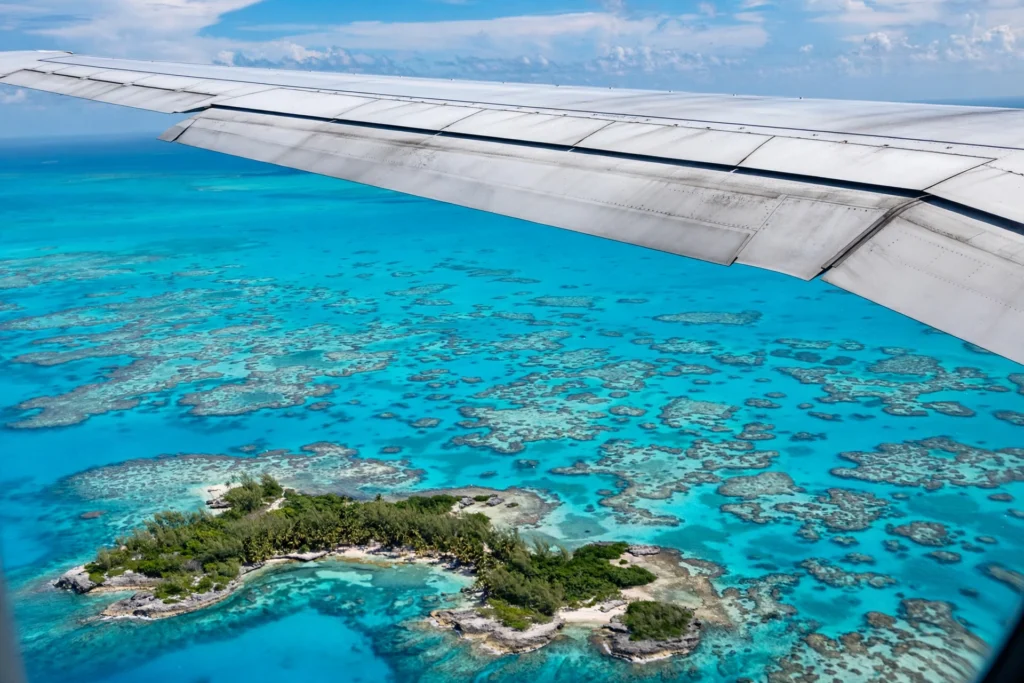
Getting to Curaçao from the United States is straightforward. Hato International Airport (CUR) has nonstop flights from several US cities, including Miami, New York and Charlotte, plus connections through those hubs from almost anywhere in the country. There are also nonstop flights from Toronto, Amsterdam and several Caribbean neighbours, plus connections through Miami, Charlotte, Atlanta and Panama City. Flight time from Miami is about three hours; from New York it is about four and a half. If you are flying from the west coast, expect a connection, usually in Miami, Charlotte or Atlanta, and a total journey of seven to nine hours.
Fares follow the dry season. Expect the highest prices from mid-December to mid-April and around Carnival, and the lowest from May to November, especially in September and October. Booking two to three months ahead usually gives the best balance of price and choice, and Tuesday and Wednesday departures are often cheaper than weekend ones. Because the island is small and the airport is quiet, there is no reason to pay extra for a particular arrival time — but an afternoon arrival is the most convenient, since it gives you daylight to collect the rental car and drive to your hotel.
The ED Card: do this before you fly
Every visitor must complete Curaçao’s online Embarkation and Disembarkation Card — the ED Card — before arrival. The US State Department’s Curaçao page states it plainly: if your ED Card is not complete, you could face delays or denial of entry. Complete it online in the days before departure through the official Curaçao tourist board site, and keep the confirmation on your phone. It asks for your passport details, flight and accommodation information, and it takes only a few minutes. Do not pay anyone to do it for you — the official form is free, and third-party sites that charge a fee for it are not needed.
Entry requirements for US citizens
US citizens do not need a visa for stays of 180 days or less. Your passport must be valid for the duration of your stay, and you need at least one blank page for the entry stamp. You also need a return or onward ticket and proof of sufficient funds to cover your accommodation and food during your stay. Yellow fever vaccination is required only if you are arriving from certain countries in South America or Africa, which does not apply to a direct flight from the United States. The State Department’s page also notes that amounts over US$10,000 or 18,000 Caribbean guilders must be declared on entry and exit.
If you are travelling with children, bring a copy of each child’s birth certificate or other evidence of your legal relationship to them. Minors travelling without both parents need a notarised letter from the absent parent or parents giving permission, plus evidence of the legal relationship — the State Department’s Curaçao guidance sets this out in detail, and it is worth reading before you travel rather than discovering it at the airport.
Arriving at Hato Airport
Hato is a small, modern airport and immigration is usually quick outside the peak arrival banks. After passport control and baggage reclaim, the car rental desks are in and just outside the terminal. If you have pre-booked — and you should — collection takes about fifteen minutes. Taxis are available at the terminal and charge a set fare into Willemstad, roughly US$20–25, but agree the price before you get in. There is no regular public bus that visitors can rely on from the airport, which is the first sign of a pattern that runs through the whole trip: Curaçao is a driving island.
Cruise arrivals
Curaçao is a regular cruise stop, and ships dock at the Mega Pier in Otrobanda, a short walk across the Queen Emma Bridge from Punda. If you are arriving by cruise, you have a different trip from the one this guide describes: a day in Willemstad, a beach club at Mambo Beach or a snorkel trip to the Tugboat wreck are all easy from the pier, but the west-end beaches and the national parks need a rental car and more time than a port day allows. If Curaçao wins you over, come back by air.
Getting Around Curaçao: Why a Rental Car Is Essential
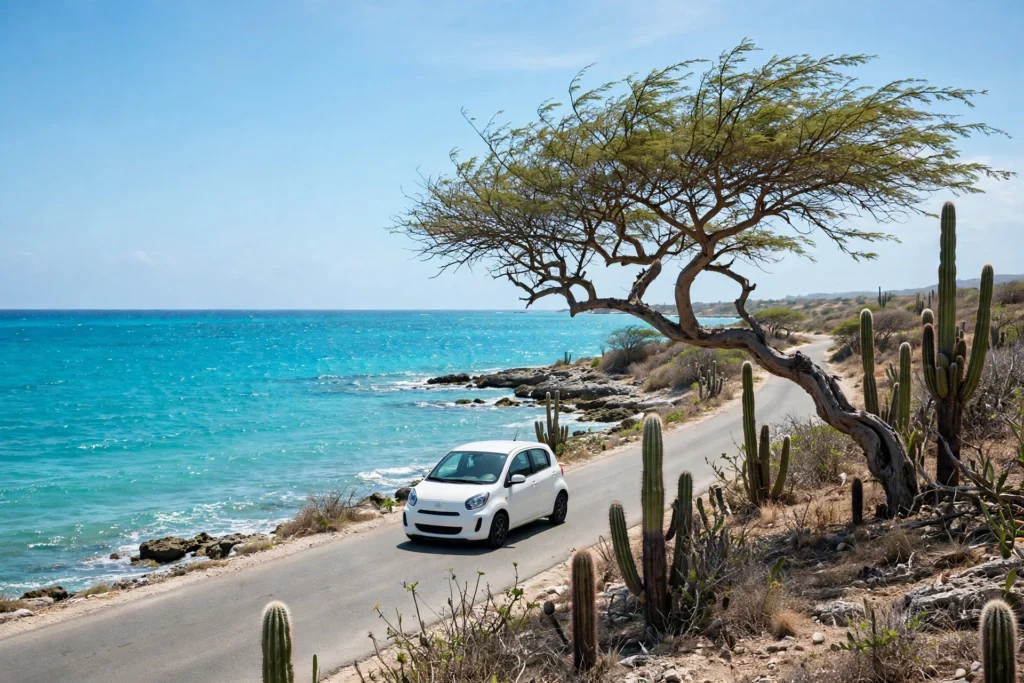
Every serious guide to Curaçao says the same thing, and this one is no exception: rent a car. It is the single most important practical decision of the trip, more important than which hotel you choose. Without a car you will see Willemstad and one or two nearby beaches. With a car you will see the whole island, at your own pace, for less money than a week of taxis would cost.
The reason is geography. Curaçao’s best beaches are spread along 40 km of west coast, each at the end of its own side road. Christoffel National Park and Shete Boka are in the far northwest. The flamingo salt flats, the landhuizen and the quiet fishing villages sit between them. Public buses, known as konvois, run mainly between Willemstad and the larger towns, on no fixed timetable a visitor can plan around, and they do not go to the beaches. Taxis exist but are expensive for the distances involved, and there is no ride-hailing app that covers the island reliably. A day of taxis to the west end and back can cost more than a day’s car rental.
What to rent and what it costs
A small car is enough. The roads are paved almost everywhere tourists go, and a compact hatchback handles the island easily. If you plan to drive the unpaved tracks inside Christoffel National Park, a higher-clearance vehicle helps, but it is not required for the main sights. Book an automatic if you are not comfortable with a manual — most rental fleets have both, but automatics go first in peak season.
As a planning range, expect roughly US$30–50 a day for a small car from an international brand, less from a local operator, more for an SUV or a 4×4. Weekly rates are usually cheaper per day than daily rates. Book before you travel, especially in the dry season: the island’s rental fleets are small and they do sell out at Christmas and Carnival. Fuel is sold by the litre and costs roughly what you would pay in the United States; a full week of driving around the island typically uses two to three tanks in a small car. Parking in Willemstad is metered in the centre and free in most beach car parks, though a few beaches charge a small fee.
Driving rules and road sense
Curaçao drives on the right, and a valid US driving licence is accepted. Speed limits are posted in km/h: generally 60 km/h in built-up areas and 80 km/h outside them, with lower limits near schools and in Willemstad’s centre. Roundabouts are common and work the usual way. The main roads are well signed in Dutch and Papiamentu, and the island is small enough that getting lost is hard — but download an offline map before you leave home, because mobile signal drops out in the far west and inside the national parks.
Three local habits are worth knowing. First, drivers slow down for speed bumps that are often unmarked, especially in villages. Second, goats, donkeys and iguanas cross the road in the west end — drive slowly on the rural roads and expect animals around every bend. Third, the roads to the west-end beaches are narrow and winding, with soft shoulders; take your time, pull over to let faster drivers past, and never park blocking a track or a gate.
Car break-ins: the one real annoyance
The US State Department notes that car break-ins are increasing, and that most crimes against visitors are crimes of opportunity, such as theft of unsecured property or vehicle break-ins. The practical rule is simple and it works: never leave anything visible in the car. Not a bag, not a phone charger, not a beach towel that looks like it covers something. Take valuables with you or leave them at the hotel, park in attended or busy car parks where possible, and avoid isolated parking areas at remote beaches and dive sites, where the State Department notes thefts and assaults have been reported. The Politur, the tourist police, patrol the popular tourist zones and are available around the clock. A hire car with nothing in it is a boring target, and boring targets are left alone.
Getting around without a car
If you genuinely cannot drive, base yourself in Willemstad or Jan Thiel and plan around it. Willemstad is walkable, Jan Thiel and Mambo Beach are served by taxis, and several tour operators run full-day island tours, west-end beach trips and Klein Curaçao boats with hotel pickup. That works for a short stay, but it costs more and moves at someone else’s pace. For most visitors the honest advice is that a car pays for itself by the second day, and the freedom it buys is the difference between seeing Curaçao and only seeing Willemstad.
Willemstad: Punda, Otrobanda and the Floating Bridge
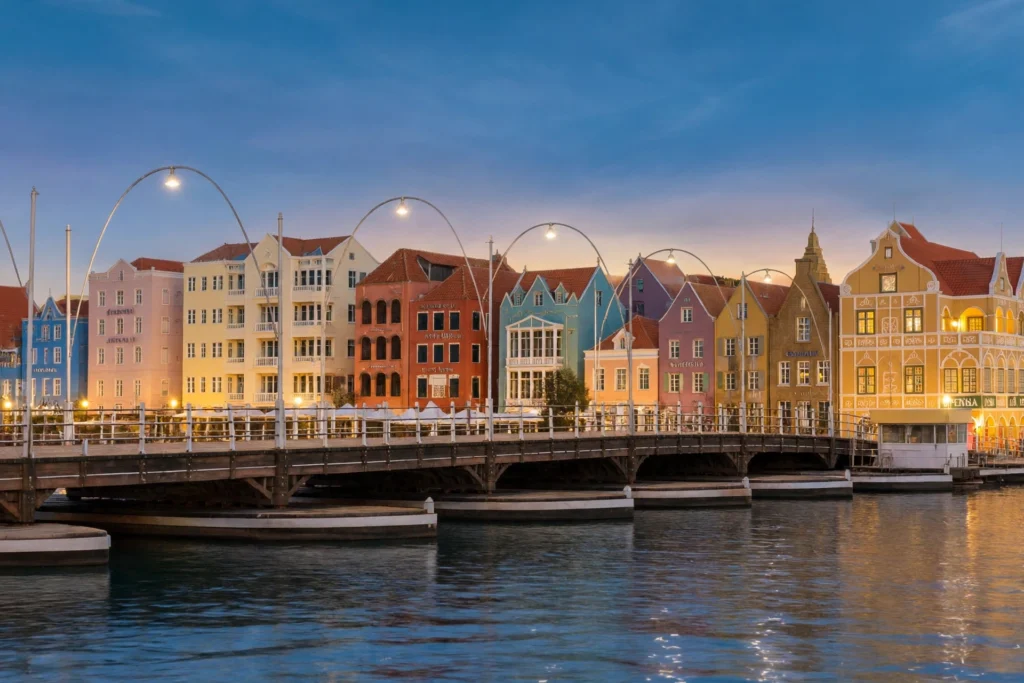
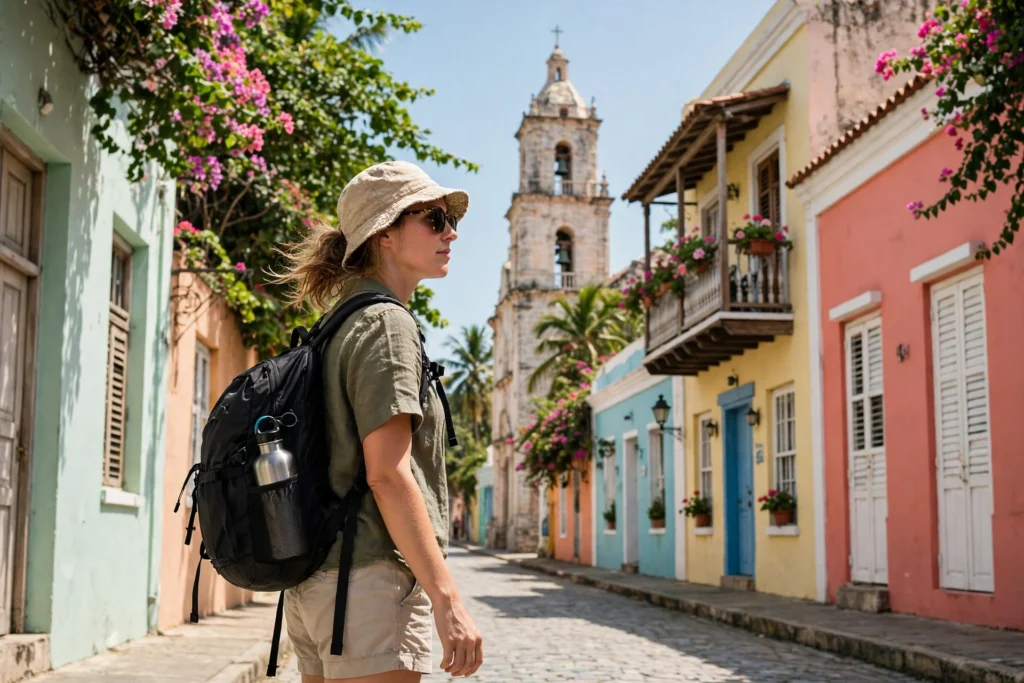
Willemstad is the reason many people choose Curaçao over its neighbours, and it is the part of the trip the beach-only guides underplay. The capital’s waterfront of gabled, pastel-painted merchants’ houses looks like Amsterdam relocated to the tropics, and the historic centre has been a UNESCO World Heritage Site since 1997. But the city is more than a backdrop: it is where you will eat best, walk most and understand the island.
The city is split in two by St. Anna Bay, the channel that connects the Caribbean Sea to the great natural harbour of the Schottegat. Punda, on the eastern side, is the oldest quarter, founded with Fort Amsterdam in the 1630s. Otrobanda, on the western side — its name means “the other side” in Papiamentu — grew up later as the working-class district across the water. The two are linked on foot by the Queen Emma Bridge and, high above, by the Queen Juliana Bridge, which carries cars.
The Queen Emma Bridge
The Queen Emma Bridge is the city’s most famous object and it is still a working piece of infrastructure, not a monument. It is a floating pontoon bridge, opened in 1888, that swings aside on its pontoons to let ships into the harbour — locals call it the “Swinging Old Lady”. When it is open, free ferries carry pedestrians across the bay, and watching the bridge swing is one of the small pleasures of a Willemstad day: it happens many times a day, takes only a few minutes, and the whole waterfront pauses to watch.
Cross it at least twice: once in daylight, when the Handelskade facades are at their brightest, and once at dusk, when the lights come on and the facades reflect in the water. The bridge is pedestrian-only, and the walk takes about five minutes. If you are staying in Punda and eating in Pietermaai, or staying in Otrobanda and shopping in Punda, you will cross it several times a day and it will become the centre of your trip without you noticing.
Punda: the Handelskade and the old town
Start in Punda, on the eastern bank. The Handelskade is the row of Dutch colonial facades on the waterfront, and it is the view on every postcard — but walk behind it into the streets of Punda and the city gets more interesting. The narrow streets hold jewellery shops, cafes, the old floating market, and the Mikvé Israel-Emanuel Synagogue, built in 1732 and the oldest synagogue in continuous use in the Americas, with a sand floor that is worth stepping inside to see. Fort Amsterdam, at the entrance to the bay, holds the governor’s residence and a small church, and the Rif Fort across the water in Otrobanda is now a shopping and dining complex with views back over the bay.
The floating market is one of Punda’s most local sights: Venezuelan boats tie up along the waterfront and sell fruit, vegetables and fish from their decks. It is at its best in the morning. The nearby Marshe Nobo, the new market hall, is where locals shop for produce, and the Plasa Bieu food hall inside it — covered in the food section below — is the best cheap lunch in the city.
Otrobanda: Kura Hulanda, the Rif Fort and the quiet streets
Cross the bridge to Otrobanda and the mood changes. This is the older, rougher, more lived-in half of the city, and it rewards walking. The Kura Hulanda Museum documents the history of the transatlantic slave trade and the African presence in the Caribbean, and it is the most important museum on the island — allow at least an hour, ideally two. The streets around it have been restored into a small hotel and restaurant quarter, and the nearby neighbourhood of Scharloo, on the Punda side of the Waaigat inlet, is now known for its street art: large murals cover the walls of the old merchant houses, and a self-guided walk through Scharloo is one of the best free things to do in Willemstad.
The Rif Fort, at the Otrobanda end of the bridge, is a restored 19th-century fort that now holds shops and restaurants with a terrace over the water. It is a good place for a sunset drink, and the view back across the bay to the Handelskade is the one to photograph.
Pietermaai: where to spend the evening
Pietermaai, just east of Punda, is the district that has changed most in recent years. Its restored 19th-century houses now hold the island’s best concentration of small hotels, cafes, bars and restaurants, and it is where most visitors end up spending their evenings. The main street is pedestrian-friendly, the happy hours are generous, and the atmosphere is relaxed rather than loud — with the exception of Carnival and the occasional street party. If you are choosing where to stay in Willemstad, Pietermaai is the first place to look.
How long to give Willemstad
Give the city a full day on foot, and a second evening. A day covers Punda, the bridge, Otrobanda, the Kura Hulanda Museum, Scharloo and the floating market. A second day lets you slow down: a morning at the market, a long lunch at Plasa Bieu, an afternoon at the Maritime Museum or the synagogue, and an evening in Pietermaai. Visitors who treat Willemstad as a half-day stop before the beach miss the part of Curaçao that makes it different from every other Caribbean island.
The Best Beaches in Curaçao: By Type, Not Just by Name
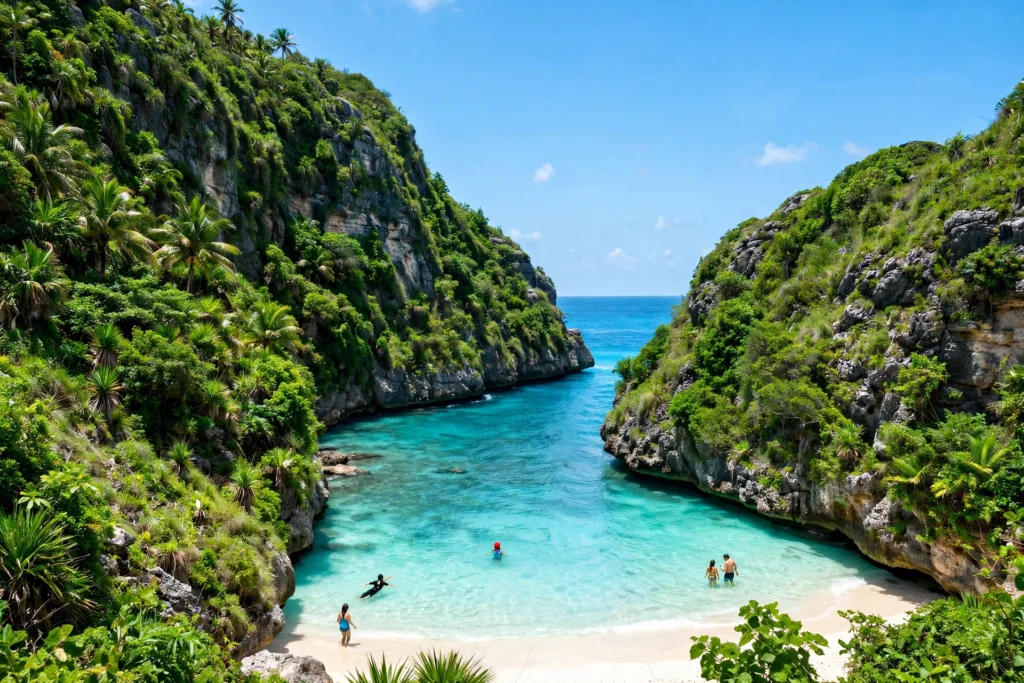
Curaçao has more than 35 beaches, and the top-ranking guides for curacao travel mostly list them. That is useful, but it answers the wrong question. The question that matters is which beach fits your day: a family beach with shade and facilities, a snorkel beach with a reef at the water’s edge, a quiet cove with nobody on it, or a beach club with music and cocktails. This section answers that question, because two beaches ten minutes apart can feel like different islands.
Almost all of Curaçao’s beaches are on the leeward south and west coasts, where the water is calm. Most are small coves rather than long stretches of sand, and the sand is often mixed with coral rubble — bring water shoes if you dislike stepping on rough ground. Most beaches are free to enter; a few charge a small entry fee or a fee for a lounger and shade, typically under US$15 per person. Facilities vary widely: some beaches have a full restaurant, showers and dive shop, others have nothing at all, so carry water, sunscreen and snacks when you head west.
Beaches by type
| Type | Best picks | What to expect |
|---|---|---|
| Best overall | Grote Knip (Kenepa Grandi), Cas Abao | The postcard coves: white sand, turquoise water, cliffs |
| Best for families | Mambo Beach, Jan Thiel Beach, Cas Abao | Calm water, shade, food, toilets, loungers |
| Best for snorkelling | Playa Piskado, Tugboat Beach, Playa Lagun | Reef or turtles steps from the sand |
| Quietest | Playa Forti, Playa Jeremi, Playa Santa Cruz | Few people, few facilities, bring everything |
| Best beach club | Mambo Beach, Jan Thiel Beach | Music, bars, restaurants, lively weekends |
| Best for cliff diving | Playa Forti | A cliff jump into deep water — only for strong swimmers |
| Best for sunset | Cas Abao, Grote Knip, Playa Lagun | West-facing coves, the sun drops into the sea |
Grote Knip (Kenepa Grandi): the famous one
Grote Knip, also called Kenepa Grandi, is the beach on most of the island’s postcards: a curve of white sand between two limestone cliffs, with water so blue it looks edited. It is in the far northwest, about 40 minutes from Willemstad, and it is worth the drive. Go early — before 10 am — and you may have it nearly to yourself; by midday it fills up, especially at weekends. There are basic facilities and a snack bar, and a small entry or parking charge has been reported by some guides, so bring a little cash. The water is calm, the swimming is easy and the cliffs on either side make it one of the most photographed places on the island. Its smaller neighbour, Kleine Knip (Kenepa Chiki), is a ten-minute drive away and is quieter, with fewer facilities.
Cas Abao: the all-rounder
Cas Abao is the beach to choose if you only pick one west-end beach. It has white sand, palm shade, a restaurant and bar, showers, toilets, loungers for hire and a dive shop, and the snorkelling off the rocks at either end of the bay is good. It is a private beach with a small entry fee, and it is popular with families and with cruise excursions, so arrive before 10 am for the best spot. The sunset here is one of the best on the island.
Playa Lagun: the snorkellers’ cove
Playa Lagun is a narrow cove between cliffs, with a small beach, a couple of restaurants and a dive shop. It is not the prettiest beach on the island, but the snorkelling is among the best: turtles, rays and reef fish are regulars in the bay, and the water is calm and clear. It is a good choice for a long, slow afternoon — swim, eat at one of the waterfront restaurants, swim again.
Playa Piskado: turtles at the water’s edge
Playa Piskado, also known as Playa Grandi, is a working fishing beach where local fishermen clean their catch off the small pier — and the sea turtles know it. Turtles gather in the shallow water by the pier to feed on the scraps, and you can watch them from the surface with a snorkel. It is a remarkable, free experience, and it is also a fragile one: do not touch the turtles, do not chase them, do not feed them, and keep your distance. The beach itself is small and rocky, with a couple of food shacks, and the fishermen’s boats make it feel like a real place rather than a resort. Go in the morning, when the fishermen are working and the turtles are active.
Playa Forti: the cliff jump
Playa Forti, near the village of Westpunt, is a small beach with a restaurant on the cliff above it and a famous jump: a platform on the cliff edge from which people leap into the deep water below. It is only for strong, confident swimmers — the jump is about 10 metres, the water is deep, and there is no lifeguard. If you do not want to jump, the restaurant terrace is a fine place to watch those who do, and the snorkelling in the bay is good. The beach below is rocky and narrow, so most people come for the jump and the view rather than a day on the sand.
Mambo Beach and Jan Thiel: the beach clubs
If you want a beach with music, cocktails and a crowd, head east to Mambo Beach or Jan Thiel Beach. Mambo Beach is a long stretch of sand lined with restaurants, bars and shops, with a lively weekend atmosphere and regular events. Jan Thiel Beach is a similar setup in a sheltered bay, with beach clubs, dive shops and restaurants, and it is a popular base for visitors staying in the area. Both are good for families, both have full facilities, and both are the easiest beaches to reach without a car. They are not the prettiest beaches on the island — the west-end coves win that contest — but they are the most convenient, and on a Friday evening there is nowhere better to be.
The practical rules for beach days
Arrive early at the west-end beaches, especially at weekends: the car parks are small and they fill up. Carry cash in small bills — some beaches and beach bars do not take cards, and change often comes back in guilders. Bring reef-safe sunscreen, a hat and more water than you think you need: there is little shade on most west-end beaches and the sun is strong. Never leave valuables in the car at a beach car park, and take your phone and wallet with you in a dry bag or leave them at the hotel. And check the wind before you swim: the leeward coast is calm most days, but after a northerly swell the water at the more exposed coves can be rough, and there are no lifeguards at most beaches.
Snorkelling and Shore Diving in Curaçao
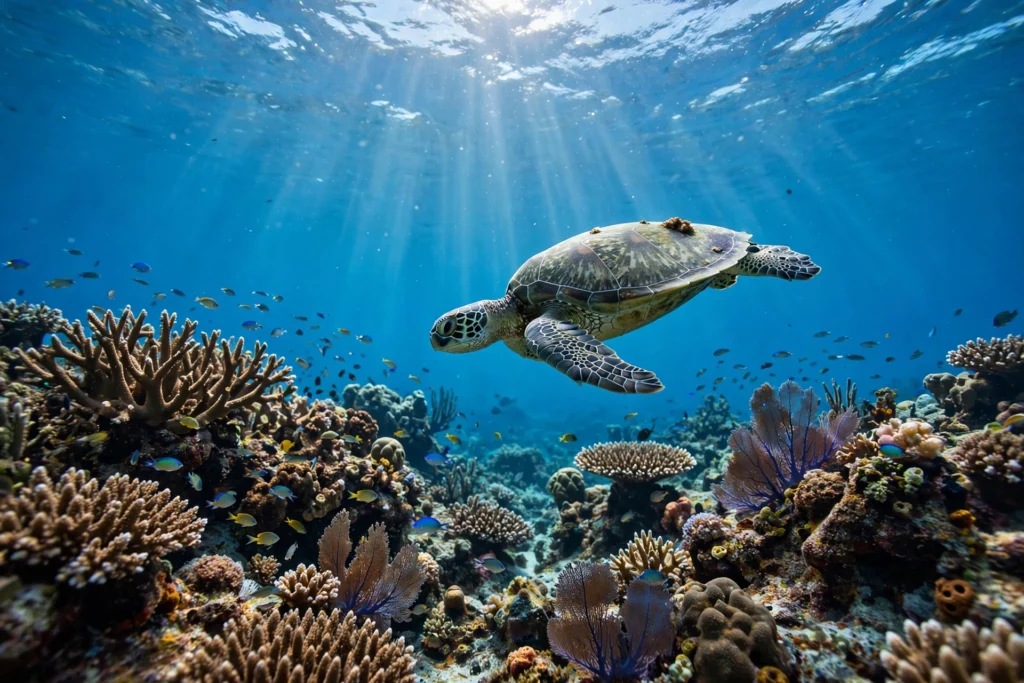
If Curaçao has a single superpower, it is this: the reef starts at the beach. The island’s fringing reef runs along the whole leeward coast, close enough to shore that a snorkeller with a mask and fins can be over coral within minutes of walking into the water. That is why the top-ranking guides for curacao travel all lead with the water, and it is why divers rate the island alongside Bonaire as one of the best shore-diving destinations in the Caribbean.
The water is warm all year, around 27–28°C (81–82°F), and visibility is often 25–30 metres. The reef is a mix of hard coral, sea fans, sponges and sandy patches, and the fish life is generous: parrotfish, angelfish, blue tangs, trumpetfish and the occasional ray or turtle. You do not need to be an expert to enjoy it — the best snorkel sites are shallow, calm and close to shore — but a little knowledge makes the experience much better.
The best snorkel and shore dive sites
| Site | Depth | What you will see | Access |
|---|---|---|---|
| Tugboat Beach | 3–5 m (10–16 ft) | The Tugboat wreck, reef fish, coral | Shore, near Caracasbaai |
| Playa Piskado | 2–5 m (7–16 ft) | Sea turtles feeding by the pier | Shore, Westpunt |
| Playa Lagun | 3–10 m (10–33 ft) | Turtles, rays, reef fish | Shore, Lagun |
| Cas Abao | 3–12 m (10–40 ft) | Coral heads, reef fish, turtles | Shore, west coast |
| Playa Forti | 5–15 m (16–50 ft) | Deep wall, pelagics, clear water | Shore, Westpunt |
| Superior Producer wreck | 30 m (100 ft) | Large wreck for advanced divers | Boat, Willemstad harbour |
| Mushroom Forest | 15–20 m (50–65 ft) | Mushroom-shaped coral formations | Boat, west coast |
The Tugboat wreck
The Tugboat is the most famous snorkel site on Curaçao and the easiest to love. A small tugboat sank in the shallow bay at Caracasbaai, just east of Willemstad, and it now sits upright in about 5 metres (16 feet) of clear water, covered in coral and surrounded by fish. You can reach it from the shore: walk in from the small beach, swim out for a few minutes, and the wreck appears below you. It is shallow enough for a confident snorkeller and popular enough that it can be busy by midday, so go early. The site is also a shore dive, and dive shops nearby rent tanks. Take care around the wreck itself — do not climb on it, and watch for the occasional lionfish sheltering in its structure.
Playa Piskado and the turtles
Playa Piskado is covered in the beaches section above, but it deserves a second mention here because the turtle encounter is the single most memorable snorkel on the island for most visitors. The turtles gather where the fishermen clean their catch, in water only a few metres deep. The rules matter: keep at least a few metres away, never touch a turtle, never block its path to the surface, and never feed it. Turtles are protected, and the fishermen and the dive community take the rules seriously. A morning visit, when the fishermen are working, gives the best chance of a close encounter.
Shore diving: how it works
For certified divers, Curaçao’s system is simple. Dozens of dive sites along the south coast are marked with yellow stones at the roadside, each with a name and a number. You drive to the site, kit up at the car or at the beach facility, walk in, and dive. Many sites have a dive shop or a tank station at the beach — Jan Thiel, Mambo Beach, Cas Abao and Playa Lagun all have one — and you can rent tanks, weights and a guide by the day. A two-tank day from the shore costs far less than the equivalent boat diving elsewhere in the Caribbean, and the freedom to choose your own site and your own pace is the point.
If you are not certified, several operators run beginner discovery dives from the beach, with an instructor and a short pool-style briefing. It is a gentle introduction and it takes place in shallow, calm water. If you want to get certified, the island has many well-regarded dive schools, and an open-water course takes three to four days — a good use of a week-long trip.
The Superior Producer and Mushroom Forest
Two sites are worth knowing about even if you never dive them, because they show the range of the island’s diving. The Superior Producer is a large freighter that sank in the harbour entrance in 1977 and now lies at about 30 metres (100 feet), upright and intact — an advanced dive, and one of the best wreck dives in the Caribbean. Mushroom Forest, off the west coast, is a dive site named for its mushroom-shaped coral formations, a landscape that looks like nothing else underwater. Both are boat dives and both need to be booked through a dive operator.
Snorkelling safely
The rules are simple but worth stating. Never snorkel alone. Stay inside the bay and watch the current — the leeward coast is calm, but a wind shift can push you along the shore faster than you expect. Wear a rash guard or reef-safe sunscreen; the sun reflects off the water and burns quickly. Do not stand on coral: it is a living animal, and a single footstep can destroy years of growth. Do not touch turtles, rays or any marine life, and do not feed the fish. Carry your mask, snorkel and fins from home if you have them — rental gear is available at most beach dive shops, but your own fits better — and bring a dry bag for your phone and car key.
Klein Curaçao: The Full-Day Boat Trip
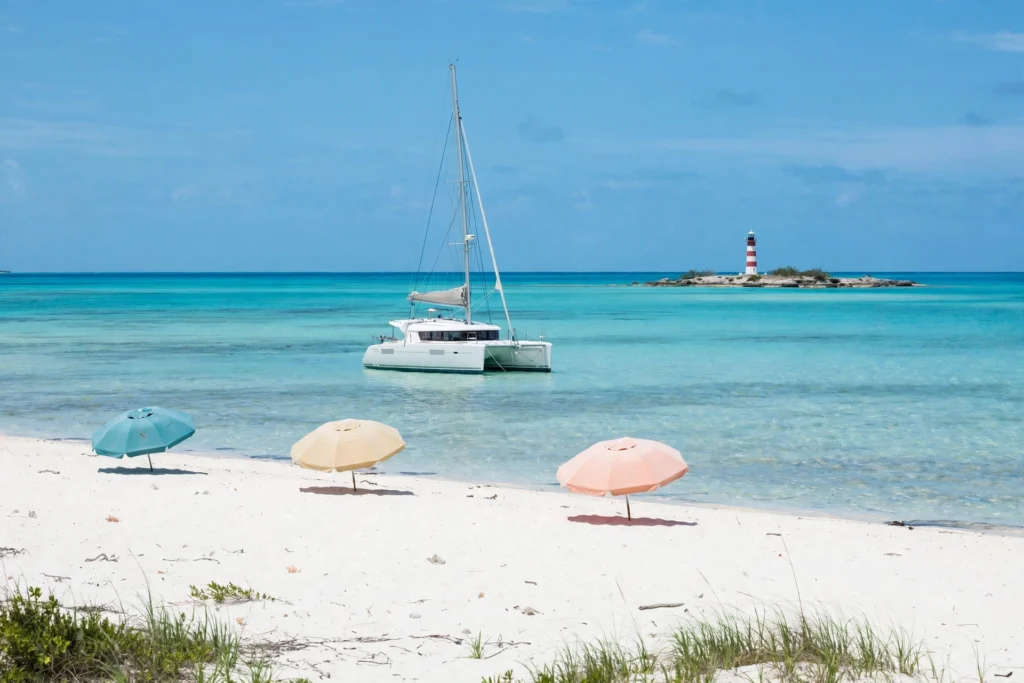
Klein Curaçao — “Little Curaçao” — is a small, uninhabited island about two hours by boat southeast of the main island, and the day trip there is the most popular excursion on Curaçao. Every one of the top-ranking guides for this keyword lists it in their top five, and for once the consensus is right: it is the best day trip on the island, and it is worth planning your week around it.
The island itself is a low, flat strip of white sand and scrub, with a candy-striped lighthouse at one end, a rusting shipwreck on the windward reef, and water so clear and shallow that it looks Photoshopped. There are no hotels, no shops and no permanent residents — just a few beach shelters, a beach house run by one of the tour operators, and the boats that arrive in the morning and leave in the late afternoon. You spend the day swimming, snorkelling with turtles, walking the beach and eating a barbecue lunch under a palapa.
How the trip works
There is no scheduled ferry. Every visit is a guided day trip on a boat that leaves in the early morning and returns in the late afternoon — an eight to nine hour day in total. Boats depart from Spanish Water (Spaanse Water) or the nearby Fishermen’s Pier on the island’s south coast, so you will need a taxi or a rental car to reach the marina by around 07:00. The crossing takes between 50 minutes on a fast powerboat and about two hours on a sailing catamaran, depending on the vessel and the sea.
Most trips include the boat, a barbecue lunch, an open bar, snorkel gear and beach chairs or a spot under a shelter. Some operators have their own beach house on the island; others set up under palapas on the sand. The day is unstructured by design: swim, snorkel, walk to the lighthouse, visit the shipwreck on the windward side, and lie on the beach. The snorkelling off the island is excellent — turtles are common, the water is shallow and clear, and the reef on the leeward side is easy to reach from the sand.
What it costs
Prices vary by operator and by boat, so treat any single figure with suspicion. Across the operators advertising for 2026, shared group trips run roughly US$110–170 per person, with most catamaran trips around US$130–150 and faster powerboats at the top of the range. Children often pay half price. Private charters start around US$1,200 and climb from there. The price usually covers the boat, lunch, drinks and snorkel gear; crew gratuities are not included, and US$10–20 per person is the accepted norm. Book a day or two ahead in the dry season — the popular boats fill up — and confirm the current price with the operator when you book, because rates change and operators run specials.
Which boat to choose
The choice is between a sailing catamaran and a powerboat, and it matters more than the price. A catamaran is slower, steadier and more sociable: the crossing takes up to two hours, but the deck is large, the motion is gentle and the atmosphere is relaxed. A powerboat is faster — 50 minutes to an hour — but the ride is rougher and wetter, and it suits travellers who want to maximise time on the island or who are short on patience. If you are prone to seasickness, choose the catamaran, sit near the centre of the boat, and take preventive medicine before you board. The crossing is open water and it can be choppy, especially in the trade-wind season from January to April and after rain.
What to bring and what to know
Bring reef-safe sunscreen and reapply often — there is almost no shade on Klein Curaçao outside the shelters, and the sun reflects off the white sand. Bring a hat, sunglasses, a dry bag for your phone and a light cover-up for the boat ride back, which can be windy. Water shoes help on the windward side, where the sand gives way to coral rubble near the shipwreck. There are basic toilets on the island and a beach house with shade, but no shops: everything you need for the day comes with you on the boat.
Two warnings. First, the shipwreck on the windward side is worth the walk, but the sea on that side is rough and the shore is rocky — look, photograph, and do not swim there. Second, the boats do not sail in bad weather. If the sea is too rough, the trip is cancelled, usually with a refund or a rebooking. That is why it is wise to schedule Klein Curaçao early in your trip, with a spare day later in the week to try again.
Is Klein Curaçao worth it?
Yes, for most travellers. It is the one day trip that everyone from the beach-only visitor to the experienced diver enjoys, and the combination of the empty white beach, the lighthouse, the turtles and the sheer clarity of the water is not available anywhere on the main island. The only travellers who should skip it are those who get seriously seasick — the crossing is the price of admission — and those who genuinely dislike boat trips. Everyone else should put it at the top of the list and book it early.
Christoffel National Park and Shete Boka: The Wild North Coast
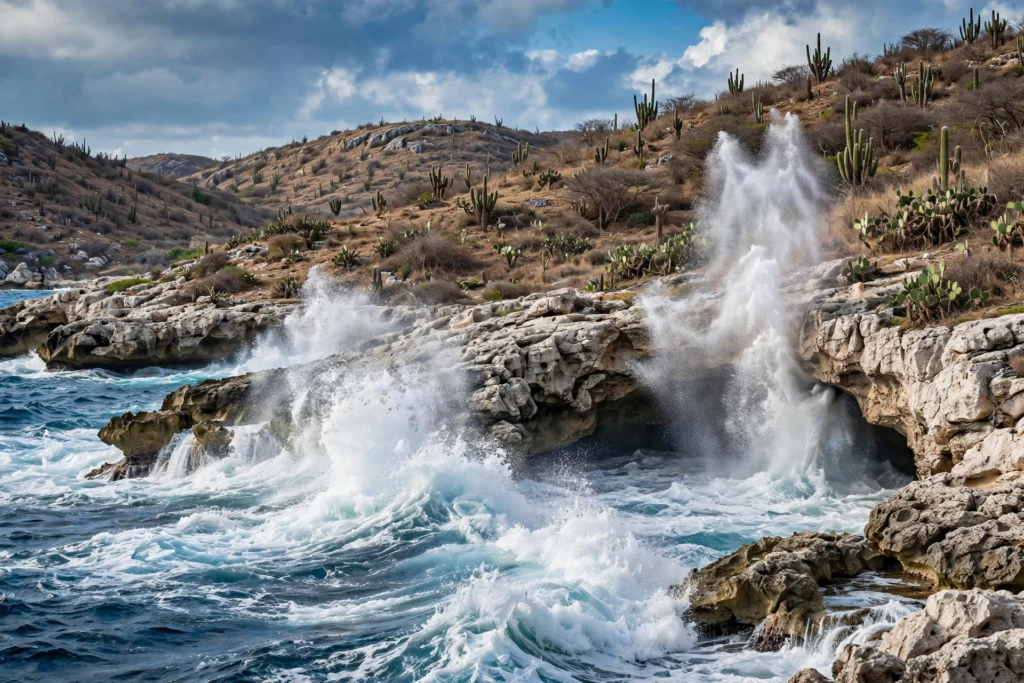
The north coast of Curaçao is the opposite of the beachy south: a wild, dry, cactus-covered landscape of limestone cliffs, sea caves and blowholes, with the island’s highest mountain at its centre. Two national parks protect it — Christoffel National Park and Shete Boka National Park — and together they make the best day trip on the main island after Klein Curaçao. Go early, bring water, and expect to be surprised by how different this side of the island feels.
Climbing Mount Christoffel
Mount Christoffel, at 372 metres (1,220 feet), is the highest point on Curaçao, and the climb to the top is the island’s best hike. It is short but steep: allow two to three hours up and down, with a rocky final stretch where you use your hands. The reward is a 360-degree view over the whole island, from the city to the west-end beaches. The park opens at 06:00, and the climb must be started before 10:00 — after that, no new climbers are allowed, because of the heat. The rule is strict and it is enforced. Start as early as you can, ideally at opening time, bring at least two litres of water per person, wear sturdy closed shoes, and expect to be hot and sweaty by the top.
Entry to Christoffel National Park costs US$15 per adult and US$2 for children aged 6 to 12; children under 6 go free. Those figures are from the park’s own published prices, checked in November 2026, and they are the same figures the top-ranking guides for curacao travel use. The ticket desk closes at 13:30 and the park closes in the mid-afternoon, so this is a morning activity, not an afternoon one. The park also has seven other hiking trails, two driving routes through the hills, and the Savonet Museum near the visitor centre, which covers the history of the plantation that once occupied the land. Guided climbs and jeep safaris are available if you prefer not to walk alone, and a guided climb typically costs around US$30 per person on top of the park entry.
Shete Boka: blowholes and sea caves
Shete Boka National Park, on the north coast a short drive from Christoffel, protects about 10 km of rugged coastline where the sea has carved coves, caves and blowholes into the limestone. The name means “seven mouths” in Papiamentu, for the seven inlets — the bokas — along the coast. The three to see are Boka Tabla, a sea cave where the waves thunder in; Boka Pistol, where the sea bursts upward through a blowhole with a sound like a gunshot; and Boka Wandomi, where steps lead down into a cavern. There are two walking trails of about an hour each, and the park is made for walking on your own, with viewpoints and short paths between the bokas.
Entry costs US$15 per adult and US$2 for children aged 6 to 12, the same as Christoffel, and the figures are from the park’s own published prices, checked in November 2026. The opening hours are less clear than the price: the park’s own pages give two different times, one saying 08:00 to 16:00 with no entry after 15:00 and another saying 09:00 to 17:00 with no entry after 16:00. Arrive before 15:00 to be safe, and expect to leave by late afternoon. Do not swim at Shete Boka: the sea here is powerful, the rocks are slippery, and the coves are for looking at. Three species of sea turtle nest on the beaches inside the park, roughly from May to December, and the park asks visitors to keep off the marked nesting areas.
Hato Caves: the underground side of the island
Half an hour from Willemstad, near the airport, the Hato Caves offer a different kind of nature: a limestone cave system with guided tours of about 45 minutes, every hour from 09:00 to 15:00. The tour descends 49 steps into chambers of stalactites, stalagmites and underground pools, with a colony of long-nose fruit bats in residence. Entry costs US$10 per adult and US$8 for children aged 5 to 12; children under 5 go free. Those figures are from the Curaçao visitors’ guide listing the caves’ official prices, checked in November 2026. The caves are a good choice for a hot afternoon or a rainy day, and they pair well with a visit to the nearby Ostrich Farm, which charges around US$20 for a tour, and the Curaçao Sea Aquarium, which is popular with families.
Planning the north-coast day
The parks are best done as a single day, starting at Christoffel at dawn. Arrive at the park at 06:00, climb the mountain, and be down by late morning. Drive to Shete Boka for the early afternoon, walk the Boka Tabla and Boka Pistol trails, and be out before the park closes. Bring two litres of water per person, sunscreen, a hat and sturdy shoes — there is almost no shade in either park, and the sun is fierce by 09:00. There are no restaurants inside the parks, so carry snacks or plan lunch in Westpunt or Lagun on the way back. And check the weather: the parks close in heavy rain, and the trails become slippery.
Where to Stay in Curaçao: Willemstad, Jan Thiel, the West End and the East
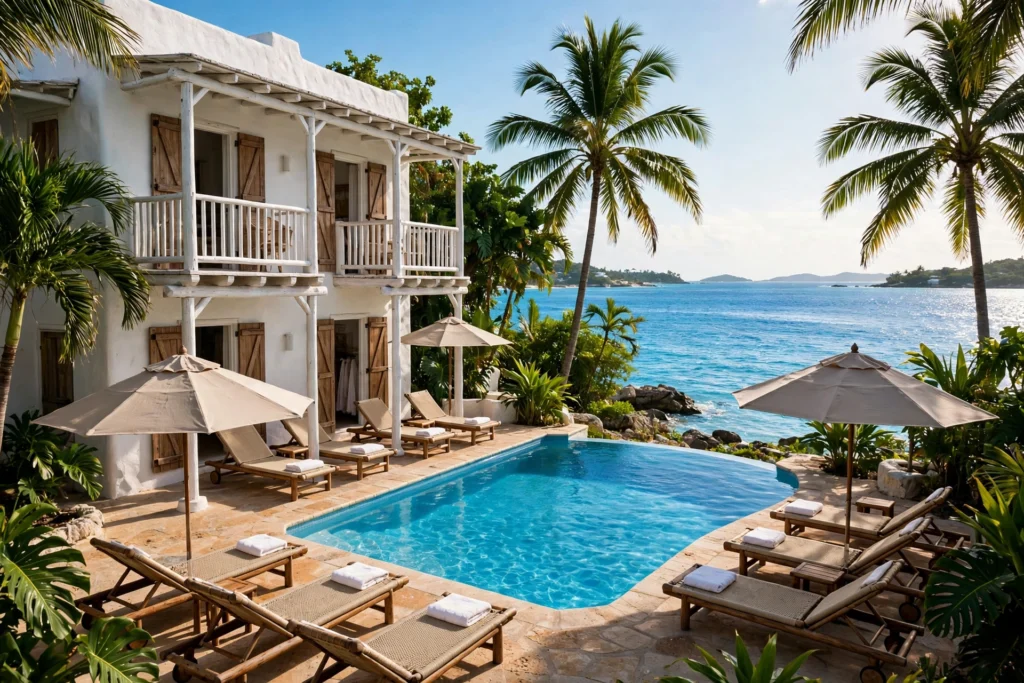
Where you stay on Curaçao changes the trip more than it does on most Caribbean islands, because the island’s sights are spread out and the districts have very different characters. The right choice depends on how you like to spend your evenings: in the city, at a beach club, or in silence. There is no single best area — there is a best area for your kind of trip.
Where to stay by area
| Area | Suits | Atmosphere | Typical price (planning range) |
|---|---|---|---|
| Pietermaai, Willemstad | First-timers, food lovers, walkers | Lively, historic, restaurants and bars | US$120–250 a night |
| Punda / Otrobanda, Willemstad | City lovers, culture-first trips | Historic, central, walkable | US$100–220 a night |
| Jan Thiel | Families, beach-club lovers | Resort-style, calm bay, restaurants | US$150–300 a night |
| Mambo Beach | Nightlife, younger travellers | Busy, bars, events, shops | US$130–280 a night |
| West end (Lagun, Westpunt) | Quiet seekers, divers, nature lovers | Rural, dark skies, few restaurants | US$80–200 a night |
| Spanish Water / east | Boaters, longer stays, villas | Quiet, residential, marina life | US$150–400 a night (villas) |
Prices in this table are planning ranges for a standard double room in the dry season, not live quotes. Apartments and small guesthouses are often cheaper, especially in the west end, and weekly rates bring the nightly cost down.
Willemstad: Pietermaai first
For a first trip, stay in Willemstad, and within Willemstad, look at Pietermaai first. The district’s restored merchant houses now hold the island’s best small hotels and guesthouses, and the main street is a five-minute walk from Punda and the Queen Emma Bridge. You can walk to dinner every night, you can explore the city on foot, and you can drive to the beaches in the morning. Punda and Otrobanda have hotels too, including some in historic buildings, and they suit travellers who want to be in the middle of the old town. The trade-off is noise: the centre is lively at weekends and during Carnival, so ask for a room away from the street if you are a light sleeper.
Jan Thiel and Mambo Beach: the resort strip
East of Willemstad, Jan Thiel and Mambo Beach are the island’s resort areas. Jan Thiel is a sheltered bay with a beach, dive shops, restaurants and a cluster of hotels and apartments, and it suits families and travellers who want a beach on their doorstep. Mambo Beach is livelier, with a long strip of bars, restaurants and shops, regular events and a younger crowd. Both areas have full facilities and are easy to reach by taxi from Willemstad, but they are less walkable than the city and you will still want a car for the west end. If your trip is mainly about the beach and the evenings out, either works well; if your trip is mainly about exploring, the city is a better base.
The west end: quiet, dark and far from everything
The west end — Lagun, Westpunt, Santa Cruz and the villages between them — is the quiet choice. Accommodation here is mostly small apartments, guesthouses and a handful of dive lodges, and the nights are dark and silent in a way the city never is. It suits divers, nature lovers and travellers who want to wake up near Grote Knip or Playa Lagun and be in the water before anyone else arrives. The trade-off is real: there are few restaurants, no nightlife to speak of, and you will drive 40 minutes to Willemstad for a proper dinner. Many visitors split their stay — a few nights in the city, a few nights in the west — and that is often the best answer.
Spanish Water and the east: villas and boats
The east of the island, around Spanish Water, is a quiet, residential area of villas and marinas, and it is where the Klein Curaçao boats depart. It suits longer stays and groups, because the accommodation is mostly villas with kitchens and pools, and it suits boaters, because the marina is the centre of the area. It is not a good base for a first trip: there is little within walking distance, and you will drive everywhere.
Booking advice
Book early for the dry season, especially December to April and Carnival: the island’s hotel stock is small and the good small hotels in Pietermaai sell out. Apartments and guesthouses are often better value than hotels, and many have kitchens, which saves money on breakfast and lunch. Check whether parking is included — it usually is outside the city centre and sometimes is not in it — and confirm the cancellation policy, because boat trips and park visits depend on the weather. And read the location carefully: a hotel described as “Willemstad” can be a 15-minute drive from the centre, and a hotel described as “beachfront” can be on a rocky shore with no swimming.
What to Eat in Curaçao: Plasa Bieu and Local Dishes
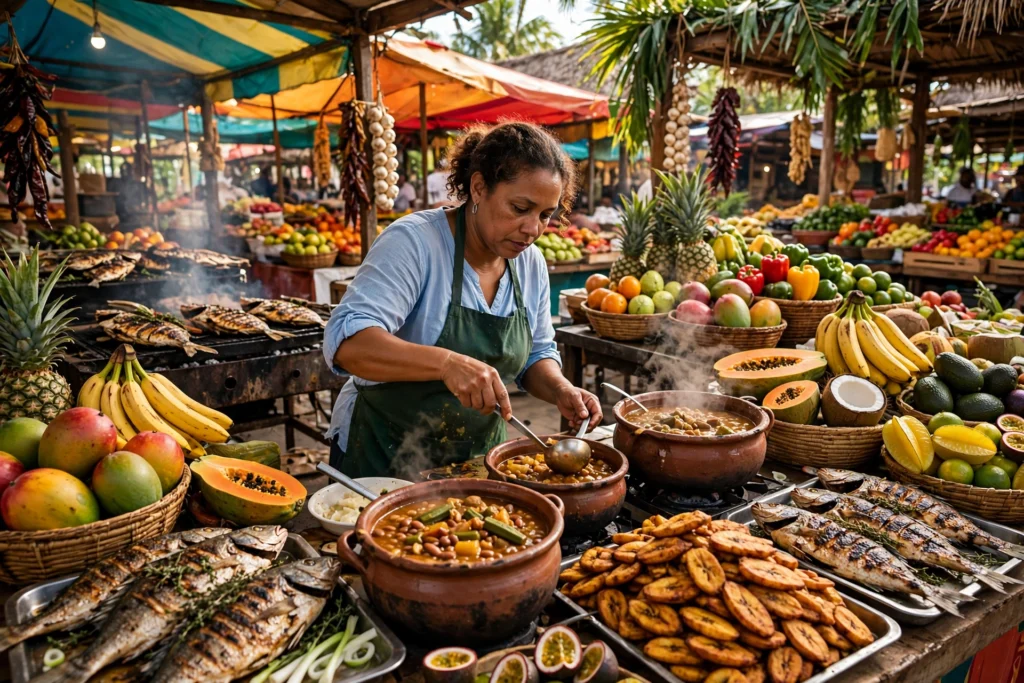
Curaçao’s food is a mix of Dutch, African, Latin American and Caribbean influences, and it is better than the island’s size suggests. The best meals are not in the resort restaurants — though those are good — but in the market halls, the roadside snèks (snack bars) and the small local restaurants in Willemstad and the west-end villages. Eat where the locals eat and you will eat well for very little money.
Plasa Bieu: start here
The single best food experience on the island is Plasa Bieu, the old market hall inside the Marshe Nobo in Punda. It is a hall of small food stalls, each run by a different cook, each serving a handful of dishes from a steam table. You order at the counter, sit at a shared table, and eat what the locals eat. It is open for lunch, Monday to Saturday, and it is closed on Sundays — plan around that.
What to order: keshi yena, a baked dish of spiced meat or chicken in a shell of melted Gouda cheese, is the island’s most famous dish and the one to try first. Stoba, a slow stew, comes in many forms — goat stoba is the classic, and it is rich and deeply flavoured. Karni stoba (beef stew), kabritu stoba (goat stew) and iguana stew, for the adventurous, all appear on the steam tables. Funchi, a stiff cornmeal porridge, is the usual accompaniment, along with fried plantain, rice and beans, and a side of pickled onion. A full lunch at Plasa Bieu costs roughly US$10–15, and it is the best value on the island.
Dishes to look for
Beyond Plasa Bieu, a few dishes define the island’s cooking. Pastechi are small, fried, half-moon pastries filled with cheese, meat or tuna, sold at bakeries and snack bars all over the island — the perfect beach-day breakfast, usually under US$2 each. Sopi mondongo, a tripe soup, and sopi di piská, a fish soup, are the local soups, and they appear on menus in Willemstad’s older restaurants. Fresh fish is everywhere: red snapper, mahi-mahi and wahoo, usually grilled simply and served with rice, funchi and a Creole sauce. Lionfish, an invasive species that threatens the reef, is now served in many restaurants as a conservation measure — ordering it is both good eating and good for the reef.
For dessert, look for bolo di pruim (prune cake) and kos dushi, the general term for local sweets. And for a drink, the island’s most famous export is Blue Curaçao, the orange-flavoured liqueur made from the peel of the bitter Laraha orange, which grows only on the island. The distillery at Landhuis Chobolobo offers tours and tastings, and it is a pleasant stop on a drive. The local beer is Amstel Bright, brewed on the island, and it is the default order at any beach bar.
Where to eat, by mood
For a special dinner, Pietermaai has the island’s best concentration of restaurants, from fine dining in restored merchant houses to casual cafes with tables on the street. The waterfront in Punda has several restaurants with views over the bay, and the Rif Fort in Otrobanda has a terrace that is hard to beat at sunset. For a beach lunch, the restaurants at Cas Abao, Playa Lagun and Mambo Beach serve grilled fish and cold beer with your feet in the sand. For a local lunch, the snèks — small roadside bars with a grill and a few tables — are the island’s great secret: the food is simple, the prices are low, and the atmosphere is entirely local. And for self-catering, the supermarkets in Willemstad and Jan Thiel are well stocked, with Dutch, American and Latin American products, and the floating market in Punda sells fresh fruit and vegetables from Venezuelan boats in the morning.
Food budgets
Eating out on Curaçao is not cheap by Caribbean standards, but it is manageable. A lunch at a market hall or a snèk runs US$10–15 per person. A casual dinner in Willemstad runs US$20–35 per person without drinks. A dinner at a good restaurant runs US$40–60 per person. A beach-bar lunch of grilled fish and a beer runs US$15–25. Self-catering from a supermarket, for breakfast and some lunches, can cut a week’s food bill substantially, and most apartments have kitchens for exactly that reason. Tipping is around 10 percent when service is not already included — check the bill first, because some restaurants add it.
How Much Does a Trip to Curaçao Cost?
Curaçao is a mid-priced Caribbean island: cheaper than Aruba and the Bahamas, more expensive than the Dominican Republic or parts of Mexico. The big costs are the flight and the hotel; once you are on the island, the daily spending is moderate, and many of the best things — the beaches, the snorkelling, the walk across the Queen Emma Bridge — are free or nearly free. All figures in this section are planning ranges, not live prices, and they are for one person sharing a double room, excluding flights, for a seven-night trip.
The money: guilders and dollars
The currency is the Caribbean guilder, written Cg and coded XCG. It became legal tender on 31 March 2025, replacing the Netherlands Antillean guilder one for one, and it is pegged to the US dollar at a fixed rate of Cg 1.79 to US$1 — the same peg the old guilder used. The practical consequence for visitors is simple: US dollars are accepted almost everywhere on the island, from supermarkets to beach bars to taxis, and your change will often come back in guilders. Euros, by contrast, are usually not accepted, and Canadian dollars are not either — bring US dollars or a card. Cards are widely accepted at hotels, restaurants, beach clubs and dive operators, but carry some cash in small US bills for taxis, tips, beach fees and the market stalls at Plasa Bieu. ATMs accept US-issued bankcards, and the US State Department notes that all major credit cards are accepted on the island. If you pay by card, choose to pay in guilders rather than your home currency when the terminal offers the choice, because the conversion rate is usually worse.
A seven-night trip, by budget
| Item (per person, 7 nights) | Budget | Mid-range | Comfortable |
|---|---|---|---|
| Hotel (shared double room) | US$500–700 | US$900–1,400 | US$1,600–2,500 |
| Rental car (shared) | US$150–200 | US$200–300 | US$300–450 |
| Food and drink | US$250–350 | US$400–600 | US$700–1,000 |
| Klein Curaçao boat trip | US$110–170 | US$110–170 | US$140–170 |
| National parks (Christoffel + Shete Boka) | US$30 | US$30 | US$30 |
| Hato Caves | US$10 | US$10 | US$10 |
| Snorkel gear rental / dive tanks | US$0–50 | US$50–150 | US$150–300 |
| Taxis, parking, miscellaneous | US$50–100 | US$80–150 | US$150–250 |
| Total on the ground (excl. flights) | US$1,100–1,610 | US$1,780–2,820 | US$3,080–4,720 |
Flights from the US east coast typically add US$400–800 return in the value season and US$600–1,200 in the dry season, as planning ranges — actual fares vary by route, date and how far ahead you book. A mid-range week on Curaçao, flights included, therefore lands roughly around US$2,200–3,600 per person, and a budget week can be done for meaningfully less if you stay in an apartment, cook some meals and skip the boat trip.
Where the money goes — and where it does not
The flight and the hotel are the two costs that matter, and both are set by when you travel. The dry season (December to April) raises both; the value season (May to November) lowers both. The Klein Curaçao trip is the one big activity cost, and it is worth it. The national parks, at US$15 each, are cheap for what they offer. The beaches are mostly free. Snorkelling costs nothing if you bring your own gear, and a surprising amount of the island’s best experiences — the walk across the Queen Emma Bridge, the street art of Scharloo, the floating market, the sunset at Cas Abao — cost nothing at all.
The costs that catch people out are the small ones: the rental car insurance excess, the taxi from the airport if you do not have a car, the beach lounger and umbrella hire that adds up over a week, and the eating-out bill, which is the single biggest daily variable. Cook breakfast, eat lunch at a market hall or a snèk, and save the restaurant budget for dinner, and a week on Curaçao is noticeably cheaper than the same week spent eating three restaurant meals a day.
Saving money without missing anything
Stay in an apartment with a kitchen, especially for a week or more. Travel in May, June or September, when hotels and car hire are cheapest and the weather is still good. Book the flight and the car together, early, and check both again a month before departure — prices move. Bring your own snorkel gear: a mask and fins cost less than a week’s rental and they fit better. Eat at Plasa Bieu and the snèks for lunch, and save the restaurant money for two or three dinners in Pietermaai. And skip the excursions you can do yourself: the west-end beaches, the national parks and the snorkel sites are all reachable in your own car, and the only trip that genuinely needs an operator is Klein Curaçao.
Is Curaçao Safe? Practical Tips for a Smooth Trip
Curaçao is one of the safer Caribbean islands for visitors, and the official advice agrees. The US State Department rates Curaçao Level 1: Exercise Normal Precautions, its lowest advisory level. For comparison, our guide to whether it is safe to travel to Belize right now shows how a Level 2 neighbour, with a state of emergency in force in November 2026, compares. The travel guidance on the live State Department Curaçao page is dated 10 September 2026 (the advisory listing itself carries 9 September 2026), and it describes Curaçao as generally a safe destination for travellers. The older date of 19 August 2024 that appears on a cached listing is out of date and should not be relied on. Advisory levels can change, so check the State Department page again in the week before you travel, and again before you fly.
Level 1 does not mean nothing ever happens. It means the ordinary precautions you would take anywhere apply, and the State Department’s guidance is specific about what those are on Curaçao. Petty crime is most likely in popular tourist locations. Most crimes against foreigners are crimes of opportunity — theft of unsecured property, vehicle break-ins, and the occasional overcharge in a tourist area. Crime rates are low, but armed robberies do occur at businesses storing large amounts of cash or involved in drug or gang activity. Stay aware of your surroundings, do not leave valuables unsecured or unattended in vehicles or on beaches, and avoid parking lots without attendants or security gates, where break-ins are more common.
The practical rules
The rules that keep a Curaçao trip smooth are mostly common sense, and they are the same ones that apply on any Caribbean island. Do not leave anything visible in a parked car — not a bag, not a charger, not a towel that looks like it covers something. Do not leave valuables unattended on a beach; take them with you in a dry bag or leave them at the hotel. Stay in well-travelled tourist areas after dark, and travel in pairs or groups at night in Willemstad’s bar districts. If you drink, do so responsibly, do not leave your drink unattended, and do not accept open containers from strangers. Be cautious about unsolicited offers and overly friendly strangers, and report suspicious activity to the local police or the US consulate. The Politur, the tourist police, patrol the popular tourist zones and offer round-the-clock support.
Two legal points deserve attention because they surprise American visitors. It is illegal to bring guns, ammunition and even spent shells or casings into Curaçao — the State Department warns that you may face arrest and detention for long periods, and it recommends using different bags for travel than the ones you use to store weapons at home, so that a stray casing does not travel with you by accident. It is also illegal to bring marijuana, cannabis, CBD products or derivatives into Curaçao, even if they are legal or prescribed in the United States. Do not test either rule.
Health: what to know before you go
The US Centers for Disease Control and Prevention puts Curaçao at Level 1, Practice Usual Precautions, for travel health. Its only travel health notice for the island is the global measles notice, and dengue appears in the routine disease information rather than as a separate notice. There is no malaria on Curaçao. The practical health advice is simple: use insect repellent, especially at dawn and dusk, and wear long sleeves in the evening during the rainy season. The tap water is desalinated and generally safe to drink, and bottled water is widely available. The sun is the biggest health risk on the island: use reef-safe sunscreen, reapply often, wear a hat, and drink more water than you think you need, especially on the Christoffel climb and the Klein Curaçao trip.
Travel insurance is worth having, and the State Department recommends it explicitly, including medical evacuation cover. The island has a hospital in Willemstad, but serious injuries may require evacuation, and first responders cannot reach remote areas quickly — the State Department’s guidance says so directly, and it is a reason to take the safety rules at the parks and the beaches seriously rather than treating them as suggestions.
Emergency numbers
Dial 911 for police and fire, 912 for an ambulance, and 913 for the Coast Guard. The US Consulate General in Curaçao, which also covers the Dutch Caribbean, can replace a lost or stolen passport, help you find medical care, and assist with reporting a crime. Keep a copy of your passport in a secure location separate from the original, and enrol in the State Department’s Smart Traveler Enrollment Program (STEP) before you travel, so the embassy can contact you in an emergency.
Common scams and annoyances
The State Department lists the common tourist scams on Curaçao, and they are the usual Caribbean ones: overcharging by taxis and on bar bills, fake vehicle and vacation rentals, distraction theft, unsolicited “tour guides”, jet ski and water sports overcharging, ATM skimming and currency exchange scams, and people claiming to be US military personnel or detained travellers asking for money. The defences are simple: agree taxi fares before you get in, check your bar bill line by line, book vehicles and accommodation through established channels, use ATMs inside banks, and never send money to a stranger. If a deal feels too good to be true — a villa at half the market rate, a car with no deposit — it is.
A few last practical notes
Curaçao drives on the right, and a US driving licence is accepted. The island’s electricity is 127 volts at 50 Hz, with US-style plugs in most places — but some older buildings use European plugs, so a universal adapter is a useful thing to pack. Mobile coverage is good in Willemstad and Jan Thiel and patchy in the far west and inside the national parks, so download offline maps. The island’s shops close on Sundays except in the tourist areas, and Plasa Bieu is closed on Sundays too — plan your market lunch for a weekday. And finally: the trade wind is constant, the sun is strong, and the water is warm. Pack light, pack sunscreen, and leave room in the suitcase for the one thing every visitor ends up buying — a bottle of Blue Curaçao from the distillery at Landhuis Chobolobo.
Frequently Asked Questions About Curaçao Travel
Is Curaçao safe for tourists?
Yes. The US State Department rates Curaçao Level 1: Exercise Normal Precautions, its lowest advisory level, with travel guidance dated 10 September 2026. Crime rates are low, and most crime against visitors is opportunistic theft — vehicle break-ins and theft of unsecured property in tourist areas. Take the normal precautions: do not leave valuables visible in a car or unattended on a beach, stay in well-travelled areas at night, and use the tourist police (Politur) if you need help.
What is the best time to visit Curaçao?
December to April is the best time, with the driest weather, the strongest trade winds and the calmest seas. May to November is cheaper and quieter, and the weather stays warm enough to swim in every month. The island sits outside the hurricane belt, so there is no bad month — the trade-off is between price and perfection, not between good and bad weather.
Do US citizens need a visa for Curaçao?
No, not for stays of 180 days or less. You need a passport valid for the duration of your stay, a return or onward ticket, proof of sufficient funds, and a completed ED Card, which must be done online before arrival. Yellow fever vaccination is required only if you are arriving from certain countries in South America or Africa.
Do I need a rental car in Curaçao?
Yes, for most trips. The best beaches, the national parks and the west coast are spread along the island and public transport does not reach them reliably. A small car costs roughly US$30–50 a day as a planning range, and it pays for itself by the second day compared with taxis. If you cannot drive, base yourself in Willemstad or Jan Thiel and use tours and taxis.
How much does a Klein Curaçao day trip cost?
Shared group trips run roughly US$110–170 per person in 2026, with most catamaran trips around US$130–150 and faster powerboats at the top of the range. Children often pay half price. The price usually includes the boat, a barbecue lunch, an open bar and snorkel gear. Confirm the current price with the operator when you book, because rates change.
What currency is used in Curaçao?
The Caribbean guilder (Cg, code XCG), legal tender since 31 March 2025, pegged to the US dollar at Cg 1.79 to US$1. US dollars are accepted almost everywhere, and your change often comes back in guilders. Euros are usually not accepted. Cards are widely accepted, but carry small US bills for taxis, tips and market stalls.
Is Curaçao in the hurricane belt?
No. Curaçao sits outside the hurricane belt, south of the usual storm tracks, and a direct hurricane hit is very rare. That is one of the reasons the island is a year-round destination. The risk is low, not zero: a storm passing to the north can still bring rain, rough seas and cancelled boat trips, especially in September and October.
What are the best beaches in Curaçao?
Grote Knip (Kenepa Grandi) and Cas Abao are the best all-rounders, with white sand and turquoise water. Playa Piskado is the best for turtles, the Tugboat wreck is the best for snorkelling from the shore, Mambo Beach and Jan Thiel are the best beach clubs, and Playa Forti is the one for cliff diving. The beaches section of this guide breaks them down by type, because the best beach depends on what kind of day you want.
Can you snorkel with turtles in Curaçao?
Yes, at Playa Piskado on the west coast, where sea turtles gather in the shallow water by the fishermen’s pier. Go in the morning, keep several metres away, never touch or chase a turtle, and never feed one. Turtles are also common off Klein Curaçao and at Playa Lagun.
How many days do you need in Curaçao?
Five to seven days is the right amount. Three days covers Willemstad, one west-end beach day and either Klein Curaçao or the national parks. Seven days covers all of it, with time to repeat your favourite beach. Less than three days is a rushed visit, and more than a week suits travellers who want to dive or explore slowly.
Is Curaçao expensive?
It is mid-priced for the Caribbean. A mid-range week, excluding flights, runs roughly US$1,780–2,820 per person as a planning range, and a budget week can be done for roughly US$1,100–1,610. The flight and the hotel are the big costs, and both fall in the value season from May to November.
Is the water safe to drink in Curaçao?
Yes. The tap water is desalinated and generally safe to drink, and bottled water is widely available. The bigger health concern is the sun: use reef-safe sunscreen, reapply often, and drink plenty of water, especially on hikes and boat trips.
Conclusion: Curaçao Travel Is a Week Well Spent
Curaçao is not the Caribbean’s loudest island, and that is the point. It does not shout. It offers a UNESCO-listed city you can walk, a reef you can reach from the sand, a desert landscape with flamingos and blowholes, and a boat trip to an empty island with a lighthouse at the end of it — all in a week, all in one small, dry, sunny place that sits outside the hurricane belt. The competitors for this keyword are lists of things to do; this guide is the trip itself, and the trip works. That is what good curacao travel planning looks like: the logistics sorted early, the best days kept flexible, and the island explored at its own pace.
Go in the dry season if you can, go in the value season if you want the island to yourself, rent the car, book the Klein Curaçao boat early, climb Christoffel at dawn, eat lunch at Plasa Bieu, and cross the Queen Emma Bridge at dusk. Do those six things and you will have had the Curaçao trip this guide promises. The rest — the quiet cove you find by accident, the turtle at Playa Piskado, the sunset at Cas Abao — is the part no guide can plan for you, and it is the part you will remember.
People also read:
- Belize Travel Guide: Beaches, Reefs, Jungles and Maya Ruins
- Panama Travel Guide: The Canal, Beaches and Highlands
- Colombia Travel Guide: Cities, Coffee Country and Caribbean Coast
- Malta Travel Guide: Valletta, Gozo and the Blue Lagoon
- Seattle Travel Guide: The Emerald City in 2026
- Yellowstone Travel Guide: Geysers, Wildlife and Planning
- Best Places to Travel in January
- How Much to Travel to Japan
- Best Places to Travel With a Baby
- Is It Safe to Travel to Belize Right Now?

M. Adil is the founder and editor of SoloTravelPro. He writes practical, research-based travel guides that help travellers plan with confidence — from first-time city breaks to national parks and island escapes. Every guide is built on official sources, current prices and honest, usable advice, so readers can plan smarter and travel better.

Other Articles