Taiwan Travel Guide: Taipei, Taroko Gorge, Night Markets and the Best of the Island (2026–27)
Taiwan packs an entire continent of variety into an island roughly the size of Maryland: a 508-metre tower and a 300-year-old temple in the same afternoon, marble gorges, misty tea mountains, the best street food in Asia and a high-speed train that crosses the whole west coast in under two hours. This taiwan travel guide covers everything a first-time visitor from the United States needs — entry rules, Taipei, Jiufen, Taroko Gorge, Sun Moon Lake, Alishan, Tainan, Kaohsiung, night markets, transport, the best months to go, realistic costs and ready-made 5, 7 and 14-day itineraries — so you can plan the trip in one place and travel it without surprises.
How to Plan Your Taiwan Travel Trip: First Steps

Taiwan is one of the easiest first trips in Asia, and that is the first thing to understand before you start planning. The island is compact, the trains run on time, English signage covers the cities and the rail network, and the US State Department rates the whole country at its lowest advisory level. What takes planning is not safety or language, it is the sheer number of places worth seeing in a small space: Taipei alone deserves three full days, and the east coast, the central mountains and the historic south each deserve their own. The framework below is the one this taiwan travel guide follows, and it works whether you have five days or two weeks.
Start with the three decisions that shape everything else. First, how many days you have. Five to seven days covers Taipei, one northern day trip and one other region well, usually Sun Moon Lake or Tainan. Ten to fourteen days lets you circle the whole island, adding Alishan, the east coast and Taroko Gorge without rushing. Second, how you will move between regions, because Taiwan rewards a simple rule: high-speed rail down the west coast, conventional express trains on the east coast, and the MRT and buses inside the cities. Third, when you will go, because the difference between October and July in Taiwan is the difference between a comfortable walking holiday and a hot, humid, typhoon-watched one. The month-by-month guide later in this article lays that out in full.
The entry rules for US citizens are straightforward and worth getting right before you book anything non-refundable. US passport holders enter Taiwan visa-free for stays of 90 days or less, and a visa is required only for longer stays, according to the US State Department’s own travel advisory for Taiwan, which you can read on the US State Department Taiwan travel advisory page. Your passport must be valid through your intended stay, and you need at least one blank page for the entry stamp. Since 1 October 2025 every visitor without a Taiwanese resident certificate must also complete the free Taiwan Arrival Card online, within three days before arrival, at twac.immigration.gov.tw. It takes a few minutes and asks for a valid email address, your passport details and your travel itinerary. Airlines can deny boarding without it, so do it the week you fly rather than at the gate. The Bureau of Consular Affairs publishes the visa-exempt rules for every nationality at www.boca.gov.tw, which is the authoritative source if your passport is not American or your plans change.
Money is the next practical piece. The currency is the New Taiwan Dollar (NTD), and all prices in this guide are given in NTD as planning figures, with rough US dollar equivalents where they help. Cash still matters more than in the United States: night markets, small restaurants, taxis and rural guesthouses are often cash only, while hotels, department stores and chain restaurants take cards. Convenience store ATMs accept foreign cards and are the easiest cash source on the island. Tipping is not expected anywhere, and many restaurants add a 10 percent service charge, which is the whole story on tipping in Taiwan. Power is 110 volts with US-style two-pin plugs, so American devices plug straight in. A local SIM or eSIM bought at the airport or in advance gives you fast, cheap data, and with maps and a translation app on your phone, the whole island opens up. If you like to plan on paper, a ready-made itinerary template and a simple travel budget plan will help you turn this guide into a day-by-day schedule before you leave.
| Taiwan at a glance | Detail |
|---|---|
| Capital | Taipei |
| Language | Mandarin Chinese; Taiwanese Hokkien and Hakka widely spoken; English on transport and in cities |
| Currency | New Taiwan Dollar (NTD); roughly NT$30 to US$1 at the time of writing |
| US entry | Visa-free for 90 days or less; free Taiwan Arrival Card required within 3 days of arrival |
| Best months | October to December, then March to April |
| Getting around | High Speed Rail on the west coast, Taiwan Railway on the east coast, MRT in Taipei and Kaohsiung, EasyCard for local travel |
| Emergency numbers | 110 police, 119 ambulance |
| Power | 110V, US-style Type A and B plugs |
| Time zone | 13 hours ahead of Washington, D.C. during Eastern Standard Time |
A final planning note before the sightseeing begins: Taiwan sits on an active seismic zone and in the path of Pacific typhoons, and the April 2024 Hualien earthquake and the typhoons that followed did real, lasting damage to parts of Taroko Gorge. Some trails are still closed in 2026, and mountain roads can close with a day or two of notice in typhoon season. None of that should put you off. It means you check trail and road status the week you travel, keep one flexible day in your itinerary, and buy travel insurance that covers medical evacuation. The safety section near the end of this guide explains exactly what to watch for and what to ignore.
Taipei: Taiwan’s Capital and Best First Base
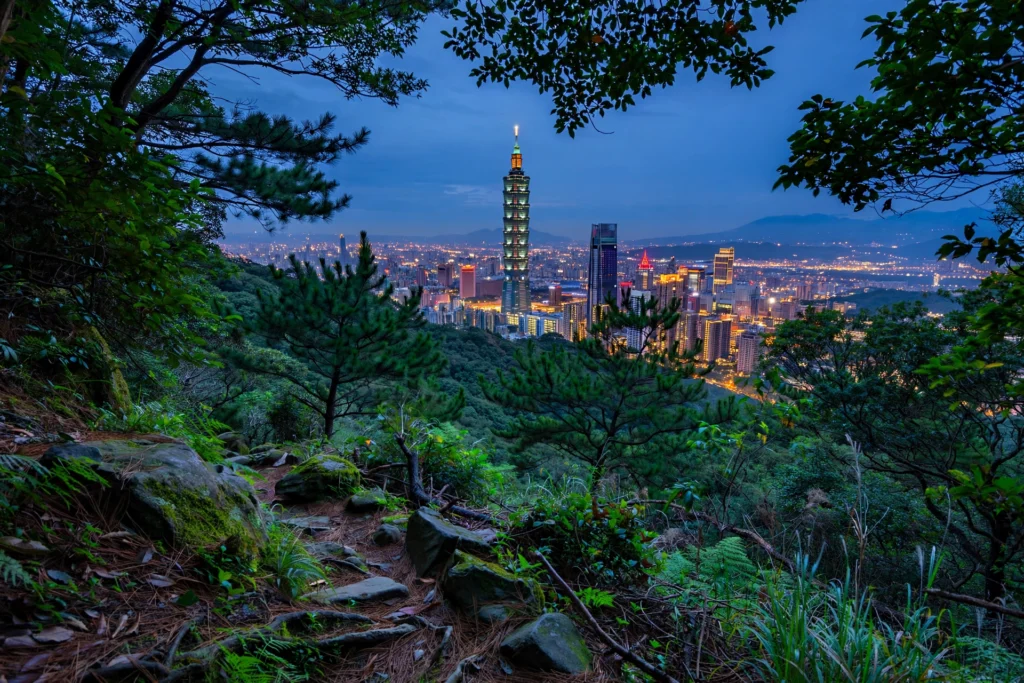
Taipei is the near-universal first stop in Taiwan, and it earns that position. It is the main international gateway, it has the best transit network on the island, and it holds the widest range of hotels, food and day trips of anywhere in the country. Three days here barely scratches the surface, but three days is also enough to understand why travellers keep coming back: few capitals let you walk from an 18th-century temple to a 508-metre tower in a single afternoon on the metro.
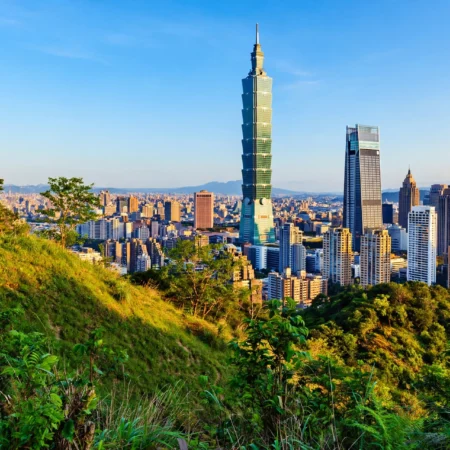
Start with Taipei 101, because it orients the whole city. The tower stands 508 metres tall and was the world’s tallest building from 2004 to 2010, and its lift climbs to the 89th-floor observatory in about 37 seconds. Inside the tower hangs a 660-tonne steel ball, a tuned mass damper that steadies the building in typhoons and earthquakes. The observatory ticket is a planning figure of around NT$600, and the classic view of the tower is not from the observatory at all but from the trail up Elephant Mountain, a 184-metre climb of steps that takes about half an hour from the Xiangshan MRT station and rewards you with the postcard shot of the tower over the city. Go late in the afternoon and stay for the lights coming on.
The National Palace Museum deserves half a day, and it is the single best museum in Taiwan. It holds nearly 700,000 objects from the imperial collections, shows about 3,000 at a time, and charges a planning figure of around NT$350 for entry. It is closed on Mondays, so do not build your first day around it without checking the calendar. The famous pieces rotate, which means even repeat visitors see something new, and the museum sits in the green hills north of the city, so the trip there doubles as a break from the downtown pace.
Longshan Temple in the Wanhua district is the other essential stop, and it is free to walk in. The temple dates from 1738 and was rebuilt after bombing in 1945, and it is still a working temple rather than a museum piece: incense, chanting, fortune sticks and people dropping moon blocks to ask the gods yes-or-no questions. Enter by the right-hand dragon door and leave by the left, step over the threshold rather than on it, keep your voice low near worshippers, and do not point at the deities. The temple sits in one of Taipei’s oldest neighbourhoods, and the streets around it, including the historic Dihua Street with its tea shops and dried goods, are worth an unhurried hour on foot.
Ximending is Taipei’s neon youth district, all pedestrian streets, cinemas, street performers and snack stalls, and it is the best place to feel the city’s energy after dark. Yongkang Street, near the Da’an Park area, is the food street to prioritise if you only have one evening: small restaurants, shaved ice, beef noodle shops and cafes line a few walkable blocks, and it sits in one of the nicest neighbourhoods for an evening stroll. The Chiang Kai-shek Memorial Hall, with its vast plaza and hourly changing of the guard, is the grand civic set piece, and the National Dr. Sun Yat-sen Memorial Hall nearby offers a quieter version of the same. Beitou, a metro ride north of the centre, is where Taipei’s Japanese-era hot spring culture survives: the Beitou Hot Spring Museum sits in a bathhouse built in 1911–13, the public Millennium Hot Spring charges a planning figure of around NT$60, and Thermal Valley steams away at 50–90 degrees Celsius, which is a sight to look at rather than touch.
The Taipei MRT is one of the best metro systems in Asia: clean, on time, English-signed throughout, with fares from NT$20 to NT$65 depending on distance. Eating and drinking are prohibited on the MRT, queues form in marked lines on the platform, and standing on the right of escalators is the local rule. Between the MRT, the buses and your own feet, you will not need a car in Taipei, and you should not want one: scooters are the dominant form of transport in Taiwanese cities, there are nearly 15 million of them on an island of about 23 million people, and they move in patterns that take visitors a day or two to read. Look both ways even on one-way streets, and do not assume a scooter will stop at a crossing just because you have the right of way.
| Taipei’s essential sights | Time needed | Planning cost |
|---|---|---|
| Taipei 101 observatory | 1.5–2 hours | Around NT$600 |
| Elephant Mountain viewpoint | 1.5 hours | Free |
| National Palace Museum | Half a day | Around NT$350, closed Mondays |
| Longshan Temple | 45 minutes | Free |
| Chiang Kai-shek Memorial Hall | 1 hour | Free |
| Beitou hot springs and museum | Half a day | Around NT$60 for the public spring |
| Ximending evening walk | 2 hours | Free, food extra |
| Yongkang Street food crawl | 2 hours | NT$300–600 per person |
| Dihua Street and old Taipei | 1–2 hours | Free, shopping extra |
| Maokong Gondola and tea houses | Half a day | Around NT$120–240 return |
Three days in Taipei works well as a rhythm rather than a checklist. Day one covers the Xinyi district, Taipei 101 and Elephant Mountain at dusk, plus a night market for dinner. Day two takes the National Palace Museum in the morning, Longshan Temple and Dihua Street in the afternoon, and Ximending in the evening. Day three goes to Beitou for the hot springs and Yangmingshan National Park, or to the Maokong Gondola, which runs 4.03 kilometres into the hills above the city in about 12 minutes and drops you among tea houses where high-mountain oolong is the order of the day. If you are weighing Taiwan against its neighbours, the comparison with how much a trip to Japan costs is instructive: Taiwan delivers a similar standard of trains, food and safety for noticeably less money, and with far fewer crowds at the major sights.
Jiufen, Shifen and Taiwan’s North Coast
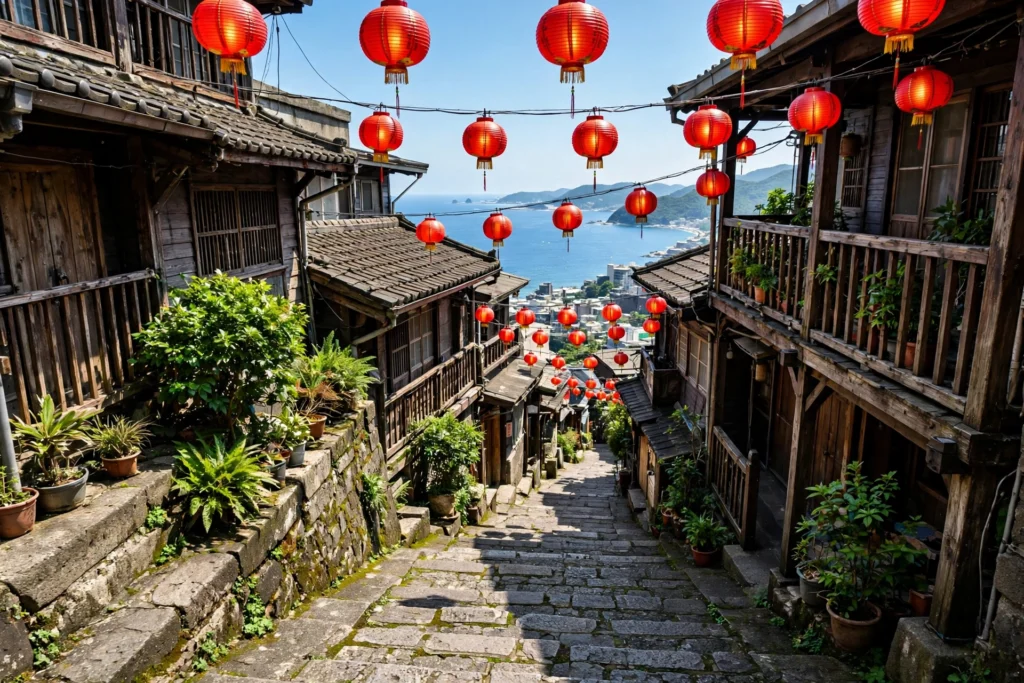
The best day trip from Taipei runs north-east, into the hills and along the coast where Taiwan’s mining past survives as one of the most photographed towns in Asia. Jiufen grew out of an 1890s gold rush, and after the mine closed in 1971 the town faded until Hou Hsiao-hsien’s film A City of Sadness, released in 1989, brought visitors back. Today its narrow stone lanes climb a hillside above the sea, lined with red lanterns, teahouses and snack stalls, and the view down to the coast from the top of the old street is the reason most people come. Go on a weekday morning if you can, because a Saturday afternoon in those lanes is a slow shuffle, and the town rewards the early hours when the teahouses are quiet and the light is soft.
The practical route is simple. Bus 1062 runs from Zhongxiao Fuxing MRT station in Taipei to Jiufen for a planning fare of around NT$94, and the ride takes about an hour depending on traffic. Give Jiufen two to three hours: the main old street, a teahouse stop for high-mountain oolong with a sea view, the small shrines and viewpoints at the top of the hill, and the walk down through the lanes that most visitors skip. The teahouses are not cheap by Taiwanese standards, but you are paying for the view and the unhurried hour, and that is the point of the place.
Pair Jiufen with the Pingxi Line, a 12.9-kilometre single-track branch railway opened in 1921 to carry coal, which now carries visitors through a string of small valley towns. A day ticket costs a planning figure of around NT$80 and covers the hop from Ruifang to Shifen and on to Jingtong. Shifen is where the sky lanterns rise: visitors write wishes on paper lanterns and release them into the sky, a tradition that peaks around the Lantern Festival in February. Shifen Waterfall, a short walk from the station, is 20 metres high and 40 metres wide, and it is the widest waterfall in Taiwan. The combination of Jiufen in the morning and the Pingxi Line in the afternoon makes a full, satisfying day out of Taipei without a car, and it is the single best use of one day if you only have one day to spare.
The north coast beyond Jiufen rewards a second day if you have it. Yehliu Geopark, about an hour north of Taipei, holds strange mushroom-shaped rock formations carved by the sea, including the famous Queen’s Head, and it is an easy half-day by bus from the city. Keelung, the working harbour city between Taipei and the coast, has a lively night market and a waterfront that shows a different, grittier side of northern Taiwan. The north coast road itself, winding between green cliffs and the Pacific, is one of the prettiest drives on the island for anyone hiring a car, and it connects easily with the east coast route described in the next section.
| Northern day trips from Taipei | Travel time | Planning cost |
|---|---|---|
| Jiufen old street | About 1 hour by bus 1062 | Around NT$94 each way |
| Pingxi Line and Shifen | About 1.5 hours via Ruifang | Around NT$80 day ticket |
| Shifen Waterfall | 15-minute walk from Shifen station | Free |
| Yehliu Geopark | About 1 hour by bus | Around NT$120 entry |
| Beitou hot springs | 30 minutes by MRT | Around NT$60 public spring |
| Yangmingshan National Park | 40 minutes by bus | Free, buses extra |
| Keelung night market | 45 minutes by train | Free, food extra |
Yangmingshan deserves its own mention here because it is the easiest mountain day out of Taipei. The national park was set up in 1985, covers 113 square kilometres of volcanic hills, and its highest peak, Qixingshan, rises to 1,120 metres and makes a solid morning hike. Between mid-March and mid-April the calla lily fields at Zhuzihu are in flower, and in late autumn the silvergrass turns the hillsides gold. Buses run from the city to the park, and the loop from Yangmingshan down to Beitou, a volcano in the morning and a hot spring by dinner, is the best single day out of Taipei for anyone who likes walking.
Taroko Gorge and the East Coast
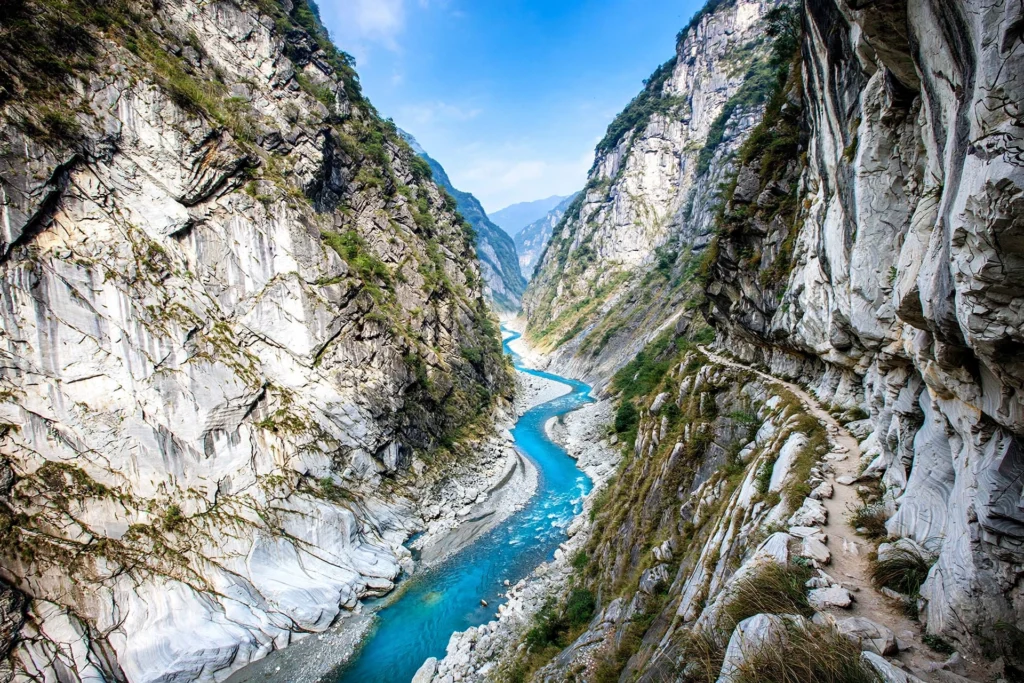
Taroko Gorge is the single most dramatic landscape in Taiwan, and it is also the place where honest planning matters most. The gorge is a marble canyon cut by the Liwu River through the mountains near Hualien on the east coast, with sheer white cliffs, turquoise water and trails clinging to the rock. The April 2024 Hualien earthquake and the typhoons that followed did real, lasting damage to the trail network, and as of 2026 the gorge is only partly open. The famous Shakadang Trail and Swallow Grotto remain closed, and rebuilding them is estimated to take about seven years. Highway 8 through the gorge opens to traffic in timed windows only, and the shuttle bus to Tianxiang is suspended. Tianxiang and Xiangde Temple are still reachable, the Qingshui Cliffs viewpoints and the Dekalun Trail reopened in July 2025, and Taroko National Park has announced fuller reopening in stages. The message is simple: Taroko is still worth it, but check the Taroko National Park trail notices before you go, and build your Hualien days with flexibility rather than fixed bookings.
Getting there is part of the experience. The Puyuma and Taroko express trains run from Taipei to Hualien in about two hours for a planning fare of around NT$583, and every seat is reserved, so book the day tickets open, 28 days ahead, because weekend seats sell out. Slow trains take three to four hours if the expresses are full, and splitting the journey at Yilan is a useful fallback. Hualien itself is a relaxed coastal city and the right base for the gorge: Qixingtan is a long pebble beach with a cycle path along it, though swimming is not allowed, Dongdamen Night Market has its own Indigenous food street, and whale-watching boats run from April to October on trips of about two and a half hours. The east has been quieter since the earthquake and the typhoons, which means the welcome is warmer and the crowds thinner than before.
South of Hualien, the East Rift Valley runs between the Central Mountain Range and the Coastal Range, and it is the prettiest slow travel in Taiwan. Rent a bike in Chishang and ride the paddy roads: Brown Boulevard, named after a coffee advertisement, cuts through rice fields that turn gold from mid-May to early June and again from late October to early November, and the Rice Harvest Arts Festival is held there in late October. Chishang is about 50 minutes from Taitung by local train. Further south, the Luye Highland hosts a hot-air balloon festival from early July into August, with tethered rides for a planning figure of around NT$500. Taitung itself is a small, sunny city with a strong Indigenous presence, and it is the gateway to Green Island, where ferries from Fugang Harbour take about 50 minutes to an hour and cost a planning figure of around NT$600 one way. Green Island is best between April and October; the Zhaori Hot Spring there is one of only a handful of seawater hot springs in the world, charging a planning figure of around NT$250, and the White Terror Memorial Park, in the former political prison, is free and sobering.
The Qingshui Cliffs, south of Hualien on the coastal highway, are the east coast’s other great sight: sheer cliffs dropping straight into the turquoise Pacific, best seen from the viewpoints along Highway 9. The coastal highway itself, Highway 11, runs from Hualien to Taitung past fishing villages, surf beaches and headlands, and it is the drive to choose if you hire a car for a day. Cycling Route No. 1 loops 968 kilometres around the whole island and usually takes nine to twelve days, but you do not have to commit to the lot: the Chishang rice roads and the Sun Moon Lake loop both make a good day’s ride, and YouBike stations in the cities take an EasyCard. The east coast rewards slowness more than anywhere else in Taiwan, and this taiwan travel guide puts Hualien first for that reason. Give it at least two nights, Hualien and Taitung or Hualien and the Rift Valley, and let the timetable bend around the weather rather than the other way round.
Sun Moon Lake and Alishan: Taiwan’s Mountain Heart
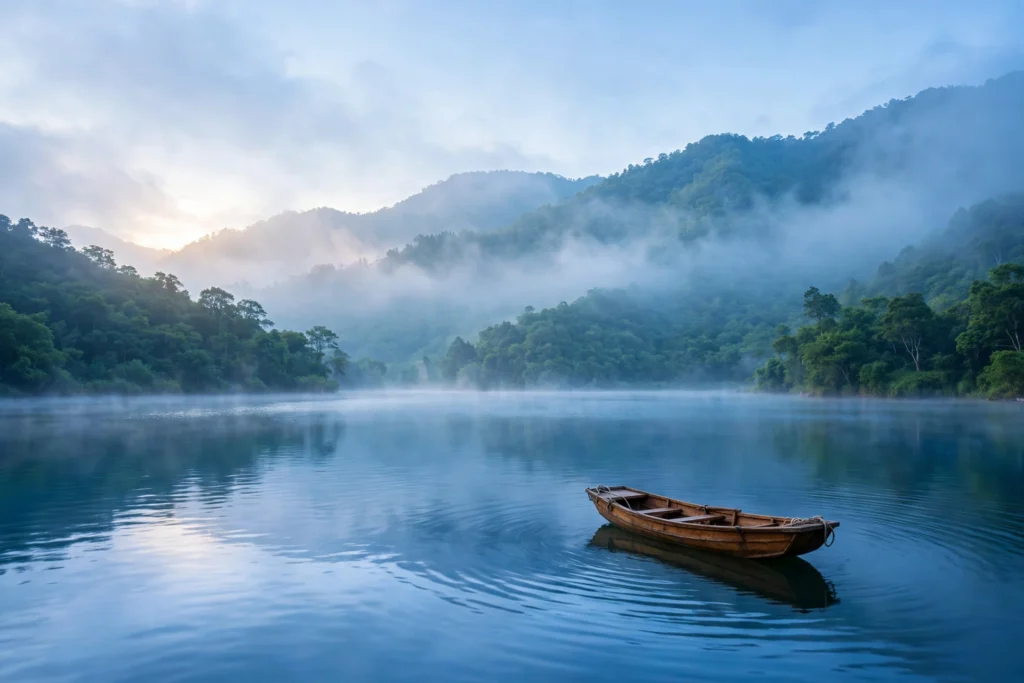
Central Taiwan is where the island slows down, and Sun Moon Lake is the place to feel it. The lake sits at 748 metres above sea level and is Taiwan’s largest body of water, and Lalu Island out on the lake is sacred to the Thao people, the Indigenous group who have lived on its shores for centuries. Get on a bike at dawn and you will have the lakeshore mostly to yourself until the tour buses arrive: the full loop is about 30 kilometres, and the 3.4-kilometre stretch between Shuishe and Xiangshan is the one to ride if you only do part of it. The ropeway glides 1,877 metres in about seven minutes up to the Formosan Aboriginal Culture Village, and the Taiwan Tourist Shuttle bus 6670 gets you here from Taichung High Speed Rail station in about one hour and twenty minutes for a planning fare of around NT$195. Stay a night at the lake if you can, because the mist on the water at sunrise and the quiet of the shore after the day visitors leave are the two best things about the place, and they both belong to the people who stay.
Alishan is the mountain half of the same trip, and it runs on a different clock. The Alishan Forest Railway climbs 86 kilometres from Chiayi, at 30 metres above sea level, to Alishan at 2,216 metres, on track just 762 millimetres wide, using spirals and switchbacks to gain the height. The full line only reopened in July 2024 after fifteen years, and Typhoon Champi suspended it again in late October 2026, so check the railway’s service status before you plan around it. The point of Alishan is the sunrise over a sea of cloud, and that means staying the night: a day trip is all train and no sunrise. Up top, the Zhushan sunrise train costs a planning figure of around NT$150, and the dawn light over the layered ridges, with cypress forest and tea fields below, is the image that defines Taiwan’s mountains. Trains leave from Chiayi’s Taiwan Railway station, not the high-speed rail station, and online tickets open one to fourteen days ahead and are paid when you book.
Between the lake and the mountains, Taichung is the practical hub. It is the gateway city for Sun Moon Lake, it sits midway down the west coast on the high-speed line, and it has its own claim to fame: bubble tea. Who invented it is still argued over, with Hanlin Tea Room in Tainan saying 1986 and Chun Shui Tang in Taichung saying 1988, and a 2019 court ruled that neither could patent it. Either way, Taiwan is the place to drink it, and Taichung is a good place to start. The city also has the Rainbow Village, a former military dependents’ village painted in bright colours by a retired soldier, and a lively night market scene that is less crowded than Taipei’s. One night in Taichung, one night at the lake and one night at Alishan is the classic central Taiwan loop, and it fits neatly into a seven-day itinerary between Taipei and the south.
The tea culture of the central mountains deserves a paragraph of its own, because it is the thread that ties the region together. High-mountain oolong grows on the slopes around Alishan and Lishan, and the tea houses of the Maokong hills above Taipei and the Alishan area serve it in the traditional style: small cups, many infusions, no rush. Oriental Beauty, the honey-sweet oolong from Hsinchu County, owes its flavour to leaves bitten by leafhoppers before picking, which is why the farms skip pesticides. You do not need to be a tea expert to enjoy any of this. Order what the house recommends, watch how it is poured, and let the hour stretch. It is the most Taiwanese way there is to spend an afternoon.
Tainan and Kaohsiung: The Historic South
If you only have room for one city outside Taipei, make it Tainan, and give it two nights. It is Taiwan’s oldest city and was the capital until 1887, and its streets hold more history per square kilometre than anywhere else on the island. Fort Zeelandia in Anping dates from 1624, built by the Dutch East India Company, and the Confucius Temple, Taiwan’s first, dates from 1665. The food matches the history: Tainan has 30 Bib Gourmand listings in the 2026 Michelin Guide, more than anywhere in Taiwan except Taipei, and danzai noodles were first served here around 1895, a shrimp broth topped with minced pork that is best ordered as a snack between other stops rather than as a full meal. Book somewhere in or near the West Central District, the old centre, and plan your nights around the Garden Night Market, which only opens on Thursdays, Saturdays and Sundays.
Tainan’s temples are the heart of the city, and they reward slow walking rather than a checklist. The Confucius Temple, the Grand Mazu Temple, the City God Temple and dozens of smaller shrines sit within a few walkable blocks, and each one is still in daily use. The rules are the same as at Longshan Temple in Taipei: enter by the right-hand dragon door, leave by the left, step over the threshold, keep your voice low, and do not point at the deities. The Anping district, on the old harbour, holds Fort Zeelandia and the Anping Old Street, where shrimp crackers, dried goods and old merchant houses tell the story of the port. Tainan is also the city where Taiwanese people themselves say the food is best, and that is a claim worth testing thoroughly, one small bowl at a time.
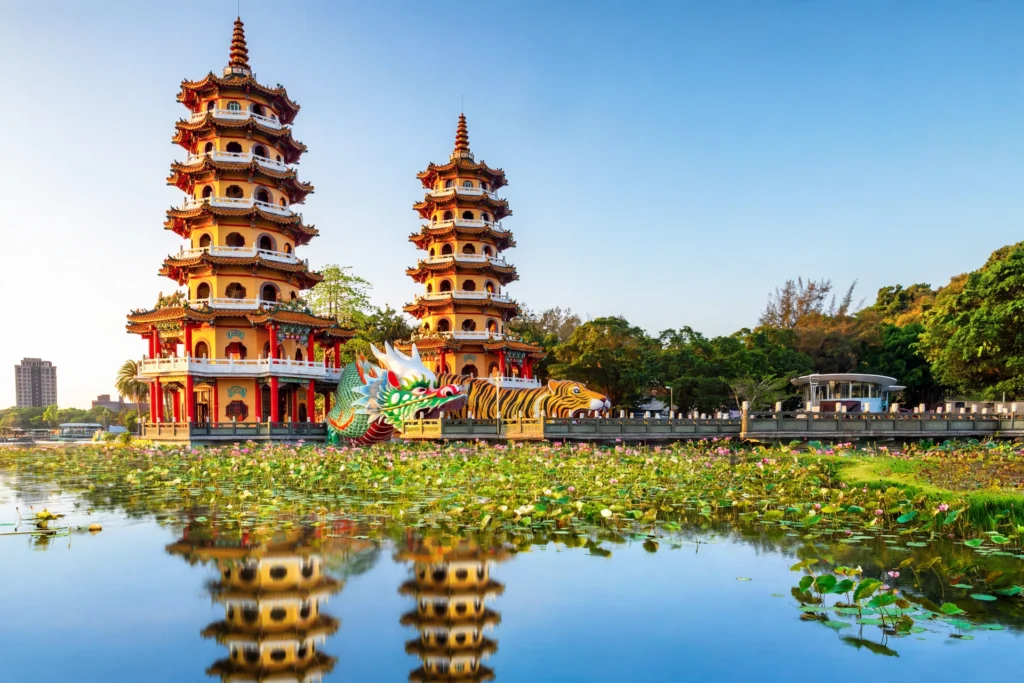
Kaohsiung, an hour and a half south of Tainan by high-speed rail, is Taiwan’s most underrated big city: warmer and cheaper than Taipei, and under two hours away by high-speed train from the capital. At Lotus Pond, the Dragon and Tiger Pagodas went up in 1976, seven storeys each, and the custom is to walk in through the dragon’s mouth and out through the tiger’s, which is said to turn bad luck into good. Pier-2 Art Center fills old harbour warehouses with galleries, shops and street art, and Liuhe Night Market has been running since the 1950s. The city has 21 Bib Gourmand listings in the 2026 Michelin Guide, so it is worth more than a quick stop between trains. Look for a base near Formosa Boulevard or Central Park MRT stations, and take the light rail along the waterfront at sunset for the best free view in the city.
The far south, Kenting, is the tropical tip of the island and the place to go if your trip runs long enough. Kenting became Taiwan’s first national park on 1 January 1984 and covers 333 square kilometres, of which 152 square kilometres is sea. Eluanbi Lighthouse, built in 1883, marks the southern point, and the Spring Scream music festival has been held here every March since 1995. Buses from Zuoying High Speed Rail station take about two and a half hours, and once you are there a scooter or a car makes it far easier to hop between beaches. Kenting is at its best in the cooler months, when the beaches are quiet and the sun is strong without the summer crowds, and it is the natural end point of a full island loop before you head back north.
Taiwan Night Markets: Eating Your Way Around the Island
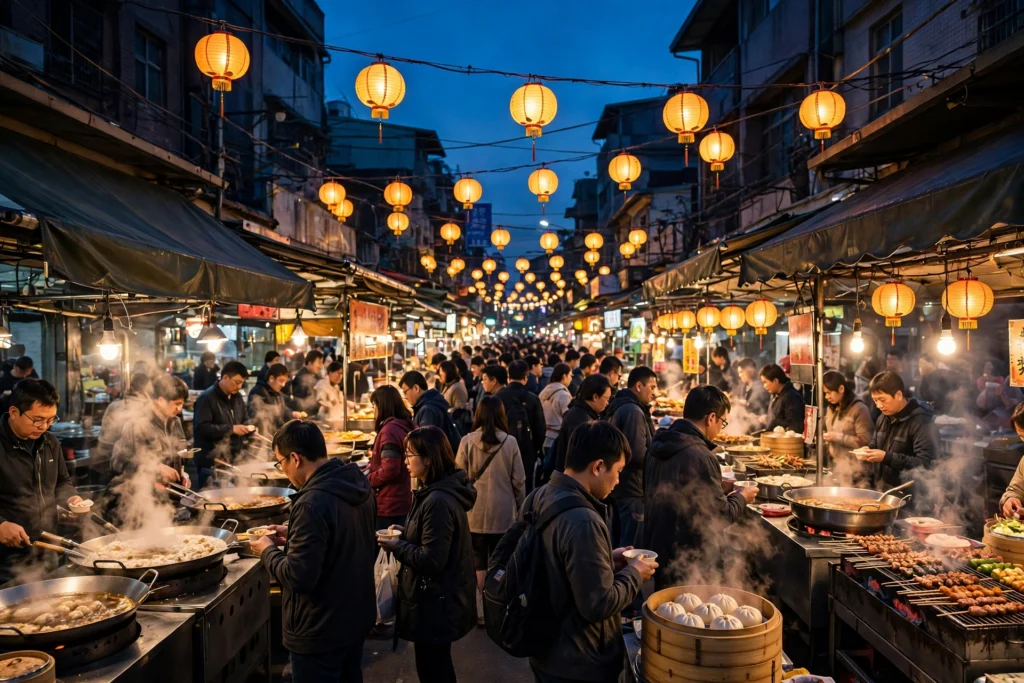
Night markets are what most people picture when they think of Taiwan, and they live up to the picture. They are more than a food destination: they function as informal town squares, where families, students and elderly regulars treat them as a nightly social ritual rather than a tourist attraction, which is part of why they still feel authentic despite their popularity with visitors. The strategy is the same at every market: order small portions from multiple stalls rather than filling up at the first one, because that is how locals eat them, and it is the only way to sample a proper range in one visit. Most snacks cost under NT$100, a full meal at a market runs about NT$100–200, and cash is essential, since most stalls do not take cards.
Shilin Night Market in Taipei is the biggest and busiest, trading since 1899, and it is the one to visit if you want scale: hundreds of stalls spread over several blocks, plus games, clothes and gadgets alongside the food. Raohe Night Market is the better first night for most visitors, a single 600-metre strip with Ciyou Temple at one end, compact enough to walk end to end without a map and dense enough to eat very well. Ningxia is the food specialist’s pick, smaller and more focused on eating than shopping. In Tainan, the Garden Night Market only opens on Thursdays, Saturdays and Sundays, so plan your nights there around it. In Kaohsiung, Liuhe has been running since the 1950s and sits in the city centre, while Ruifeng draws a younger crowd. In Hualien, Dongdamen Night Market has its own Indigenous food street, which is the best place on the island to try Indigenous Taiwanese cooking.
What to eat at a market is a question with a hundred right answers, but a first-timer’s shortlist runs like this. Pepper buns, baked in a clay oven and filled with peppery pork and spring onion. Oyster omelettes, the classic market dish of eggs, oysters and sweet potato starch. Grilled squid on a stick. Scallion pancakes, crisp and flaky. Stinky tofu, which smells far worse than it tastes and is worth one brave bite. Mango shaved ice in summer. And bubble tea, in its birthplace, with fresher tapioca pearls and less sugar-forward tea than the export version. Vegetarians do surprisingly well at the markets thanks to a strong Buddhist vegetarian tradition, and the vegetable stalls, sweet potato balls and fruit stands are easy to find.
A few market habits will make the evening smoother. Go hungry and go early, because the best stalls sell out and the crowds peak after eight. Carry small notes and coins, because a NT$1,000 note at a NT$50 stall slows everyone down. Point at what other diners are eating when the menu is only in Chinese, and use a translation app with a camera function for the rest. Rubbish bins are rare on the streets, so carry a small bag for your litter. And do not be surprised by the music from the rubbish trucks in the evening: residents bring their bags out to meet the truck when they hear the tune, which in Taiwan is usually Für Elise or A Maiden’s Prayer.
What to Eat in Taiwan: Beyond the Night Markets
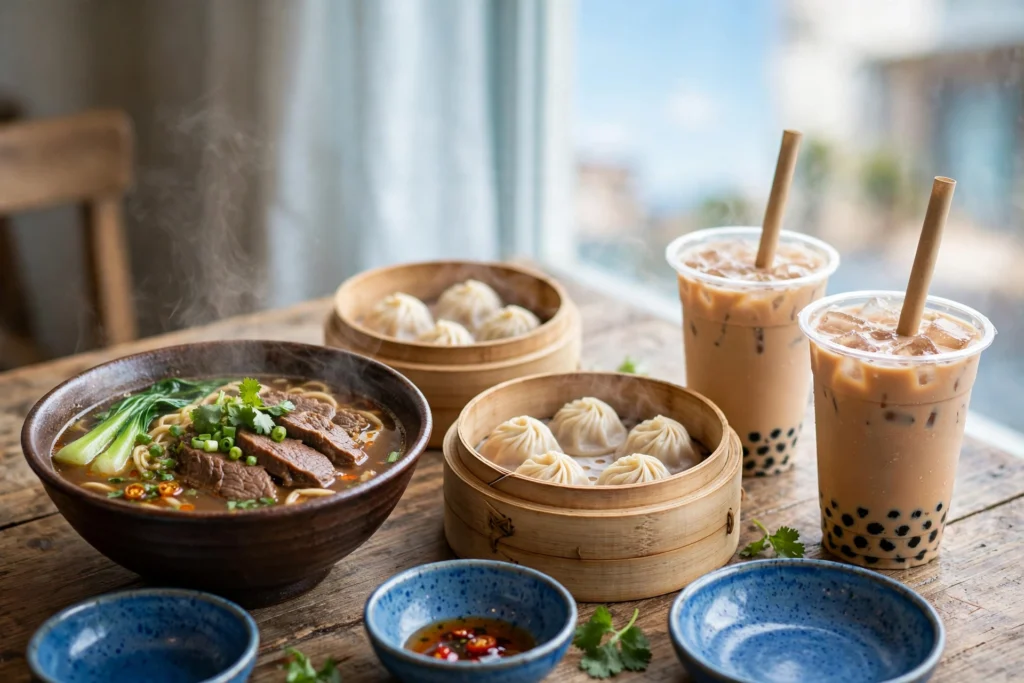
Taiwan is the best food destination in East Asia for the money, and the night markets are only the beginning. The island’s food draws on Fujianese, Hakka, Japanese and Indigenous influences, and the result is a cuisine that is cheap, everywhere and eaten standing up as often as sitting down. The 2026 Michelin Guide lists 146 Bib Gourmand spots and 61 starred restaurants across the island, which tells you how seriously the food is taken, but the real story is the everyday eating: the noodle shop on the corner, the breakfast stall at seven in the morning, the beef noodle soup that every city claims to do best.
Beef noodle soup is the dish to start with, and it is widely regarded as Taiwan’s unofficial national dish. Slow-braised beef in a deep broth, either clear or spiced with soy and chilli, over hand-pulled noodles, at a planning price of around NT$120–200 a bowl. Taipei holds an International Beef Noodle Festival in October, and every city has a beloved local shop, so ask your hotel or guesthouse host where they eat rather than following a list. Xiao long bao, the soup dumplings, are Taiwan’s most internationally famous dish, thanks to Din Tai Fung, which started in 1958 as a cooking-oil shop on Xinyi Road in Taipei and only switched to dumplings in 1972. A basket costs a planning figure of around NT$250 for twelve, and the original Taipei location still sets the standard. The technique is to bite a small hole, drink the broth, and then eat the dumpling, and the first basket is worth doing properly rather than rushed.
Beyond those two, the dishes to seek out are lu rou fan, braised pork on rice, the humble bowl that appears on every menu and costs almost nothing; gua bao, the steamed bun folded around braised pork, pickled mustard greens and crushed peanuts; danzai noodles from Tainan, a shrimp broth topped with minced pork; and the Taiwanese breakfast of warm soy milk and egg pancakes, best eaten at a traditional breakfast shop before eight in the morning. Oyster omelettes, fried chicken steak and sweet potato balls fill out the market menu, and mango shaved ice is the summer dessert that every visitor should try at least once. Taiwan Beer has carried that name since 1946, and a half-litre can from a convenience store costs a planning figure of around NT$51. For something stronger, the Kavalan distillery in Yilan opened in 2005, and its Solist Vinho Barrique was named the World’s Best Single Malt in 2015.
The practical side of eating in Taiwan is easy once you know the rules. Many small eateries display menus only in Chinese, so a translation app with a camera function makes ordering far less daunting, and pointing at what other diners are eating works well too. Convenience stores are a genuine part of the food culture rather than a fallback: 7-Eleven and FamilyMart are on nearly every block, there are more than 7,300 7-Elevens on an island of about 23 million people, and they sell hot meals, snacks, SIM top-ups and transport card credit, with tables for a quick bite. Breakfast shops, lunchbox counters and night markets mean you can eat very well for very little, and a mid-range restaurant meal runs a planning figure of around NT$300–600 per person. If you are comparing street food cultures across Asia, Hanoi’s street food scene is the closest rival, and the two cities make a natural pair for anyone planning a wider East Asia trip.
Getting Around Taiwan: MRT, High Speed Rail and EasyCard
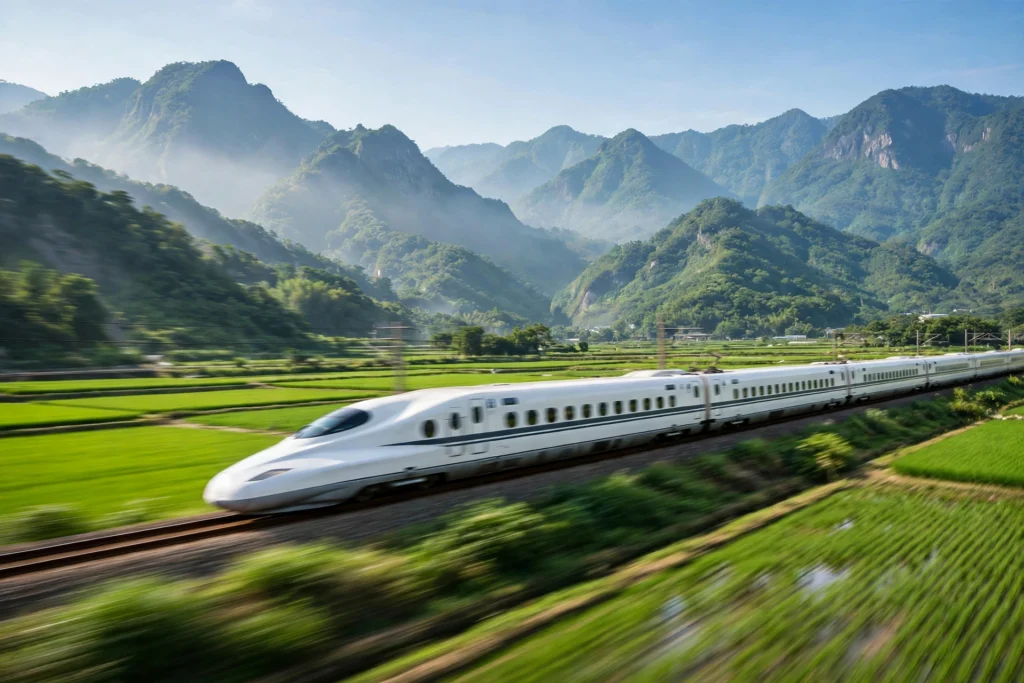
Getting around Taiwan is refreshingly simple, and this taiwan travel guide is built around three pieces: the high-speed rail down the west coast, the conventional railway on the east coast, and the EasyCard for everything local. Once you understand those three, the rest of the island falls into place.
The Taiwan High Speed Rail runs 12 stations from Nangang in Taipei to Zuoying in Kaohsiung at up to 300 kilometres per hour, which makes the west coast simple to travel. A standard reserved seat from Taipei to Zuoying costs a planning fare of around NT$1,490, with business class at around NT$1,950, and the journey takes about one and a half to two hours. Book on the high-speed rail’s own site or app from about four weeks ahead, and look for early-bird discounts of up to 35 percent. Foreign visitors can buy a three-day THSR Pass for a planning figure of around NT$2,400, which is worth it if you are making two or more long journeys in three days. Several stations, including Taichung and Tainan, sit outside the city centres, so allow time for a local train or bus at the far end. The high-speed rail’s official site is thsrc.com.tw, where you can check timetables and fares before you travel.
The Taiwan Railway is how you reach the east. The Puyuma and Taroko express trains to Hualien and Taitung are reserved-seat only, and the fare from Taipei to Hualien is a planning figure of around NT$583 for the roughly two-hour journey. Tickets open 28 days ahead, and weekend seats sell out, so book the day sales open. If the expresses are full, split the journey, Taipei to Yilan and then Yilan to Hualien, on slower trains that take three to four hours. EasyCards do not work on these expresses, so book them separately and early. The conventional railway also covers the whole island, including the scenic east coast line and the branch lines to Pingxi and Neiwan, and it is the network to use for any town the high-speed line does not serve.
Inside the cities, get an EasyCard on day one. The card itself costs a planning figure of around NT$100 at any MRT station or convenience store, and you load credit onto it. It covers the metros, city buses, local trains and YouBike bike-share stations, and it works for small purchases in convenience stores. Taipei MRT fares run from NT$20 to NT$65, and since 1 July 2026 you can also tap a contactless bank card or phone at the gates. The Taoyuan Airport MRT express reaches Taipei Main Station in 35 to 40 minutes for a planning fare of around NT$150, which is the easiest way into the city from the main international airport. Kaohsiung has its own MRT and a light rail line along the waterfront, and Taichung’s MRT covers the city centre. Between cities, Kuo-Kuang and UBus run intercity coaches, and the Taiwan Tourist Shuttle network covers scenic areas such as Sun Moon Lake and Alishan.
A car pays off on the east coast and around Kenting, and costs a planning figure of around NT$1,200–3,000 a day. Visitors from the United States should check with their embassy or the car hire company about licence requirements before booking, since Taiwan’s rules for foreign drivers depend on your licence type and an international driving permit is commonly required. Scooters need a licence that covers motorcycles, and they are not a good idea for first-time visitors: the traffic patterns take a day or two to read, and the scooter is the more common hazard for pedestrians in the cities. Ferries serve the outlying islands, including Green Island and Penghu, and domestic flights are mainly useful for those same islands rather than for mainland travel, where the trains are faster and easier.
| Transport option | Planning cost | Time and notes |
|---|---|---|
| Airport MRT, Taoyuan to Taipei | Around NT$150 | 35–40 minutes, express to Taipei Main Station |
| Taipei MRT | NT$20–65 per ride | EasyCard or contactless bank card at the gates |
| High Speed Rail, Taipei to Kaohsiung | Around NT$1,490 standard | 1.5–2 hours, 12 stations, book 4 weeks ahead |
| THSR 3-day pass for visitors | Around NT$2,400 | Unlimited rides for 3 days, passport required |
| Taiwan Railway express, Taipei to Hualien | Around NT$583 | About 2 hours, reserved seats only, book 28 days ahead |
| Taiwan Tourist Shuttle 6670 to Sun Moon Lake | Around NT$195 | About 1 hour 20 minutes from Taichung HSR station |
| Bus 1062 to Jiufen | Around NT$94 | About 1 hour from Zhongxiao Fuxing MRT |
| Intercity coach | NT$150–400 typical | Kuo-Kuang and UBus between cities |
| Car hire | Around NT$1,200–3,000 per day | Best for the east coast and Kenting |
| EasyCard | Around NT$100 for the card | MRT, buses, local trains, YouBike, convenience stores |
Where to Stay in Taiwan: Taipei, the South and the East Coast
Where you stay in Taiwan matters less than in most countries, because the trains are so good that a well-chosen base covers a wide area. The rule that works best is one long stay in Taipei and stops of one or two nights elsewhere, rather than moving every night. Prices jump at weekends and on holidays, and Lunar New Year, which falls on 6 February 2027, fills trains and hotels across the island, so book well ahead if your trip overlaps with it.
In Taipei, stay in Zhongshan, with its cafes and boutique hotels on two MRT lines, or Da’an, the leafy alternative close to the food on Yongkang Street. Xinyi puts you beside Taipei 101 at luxury prices, while the Main Station area wins if you will be catching early trains. A mid-range double room runs a planning figure of around NT$2,000–4,500 a night, and hostel dorm beds run around NT$450–1,000. Outside the big cities, the usual stay is a minsu, a licensed family-run guesthouse, and hosts often prefer to message on LINE. One rule to know before booking anything: unlicensed short-term rentals, including most city apartments listed on short-term rental sites, are illegal in Taiwan, with fines of up to NT$2 million. Before booking an apartment or minsu, look it up on TaiwanStay, the Tourism Administration’s register, and check for the licence certificate. If it is not licensed, book something that is.
In Tainan, book somewhere in or near the West Central District, the old centre, where the temples, the food streets and the night market are all within walking distance. In Hualien, the train station area is the practical choice, and Qixingtan puts you by the sea. The hotel inside Taroko National Park is open and taking bookings if you want to wake up in the gorge, but check road access before you commit to a night there, since Highway 8 runs on timed windows. In Kaohsiung, look near Formosa Boulevard or Central Park MRT stations, which put you on the metro and within walking distance of the harbour and the night markets. At Sun Moon Lake, the Shuishe side of the lake has the most places to stay and the best transport links, while the Ita Thao side is quieter and closer to the Indigenous village. At Alishan, stay inside the park area so you can catch the sunrise train without a pre-dawn drive.
For a seven-day trip, a sensible pattern is three nights in Taipei, one night at Sun Moon Lake or in Taichung, two nights in Tainan, and a final night back in Taipei before your flight. For a fourteen-day loop, add a night in Alishan, a night in Kaohsiung, a night in Kenting, and two nights on the east coast in Hualien and Taitung. The point is not to optimise every night but to avoid the trap of moving every day: Taiwan’s trains make day trips easy, and a base you return to for two or three nights is worth more than a new bed every night.
The Best Time to Visit Taiwan: A Month-by-Month Guide
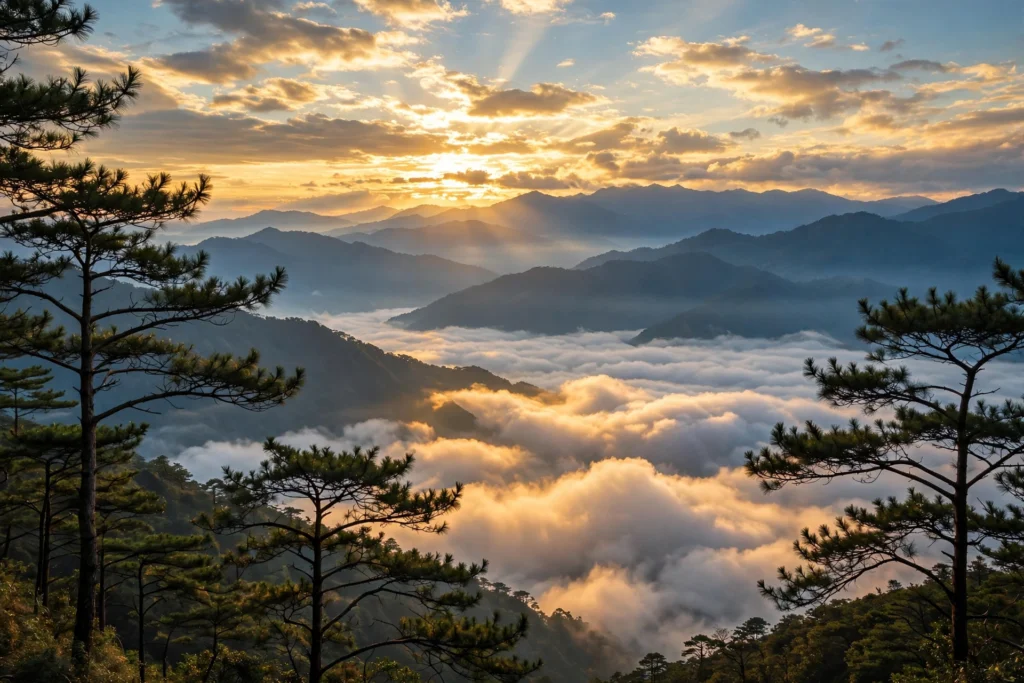
October to December and March to April are Taiwan’s best months: cooler, drier, and outside the worst of typhoon season. That is the short answer this taiwan travel guide gives, and it is the answer the whole table below supports. Taipei’s average high is 27.6 degrees Celsius in October and 26.4 degrees in April, against 34.8 degrees in July, which is the difference between walking all day in comfort and walking all day in heat and humidity. The longer answer is that Taiwan has no bad month, only months that suit different trips, and the table below lets you match your dates to your plans.
Spring runs from March to May. March and April are the sweet spot: mild days, cherry blossom in the mountains, calla lilies on Yangmingshan, and the high mountains still cool enough for comfortable hiking. May brings the plum rains, periodic heavy showers that start in the north and move south, and the humidity begins to climb. Summer runs from June to September, and it is hot, humid and the peak of typhoon season: Taipei sits around 33–35 degrees with afternoon storms, and about three to five typhoons affect Taiwan each year, mostly between July and October. A direct hit can shut trains and attractions for a day or two, so summer trips need flexible days built in. The upside of summer is the south and the islands: Green Island and Kenting are at their best, the sea is warm, and the long days suit the beaches.
Autumn, from September to November, is the best all-round season, and October is the single best month. The typhoon risk falls away, the air dries out, the rice fields of the East Rift Valley turn gold in late October, and Taipei Pride and the Chishang rice harvest fall in the same weeks. Winter, from December to February, is mild in the south and damp in the north: Kaohsiung stays dry and sunny while Taipei and Yilan get the grey drizzle of the northeast monsoon, which runs from November to March. Winter is the cheapest season for hotels and the quietest for the major sights, and it suits a southern trip, Tainan and Kaohsiung and Kenting, better than a northern one. Lunar New Year, on 6 February 2027, is the one winter date to plan around rather than into: trains fill, prices rise, and many small restaurants close for several days.
| Month | Taipei, typical daytime highs | Rain and weather | Best for |
|---|---|---|---|
| January | 12–19°C | Damp, grey drizzle in the north | Kaohsiung and the south, quiet sights |
| February | 13–20°C | Damp in the north, dry in the south | Lantern Festival, southern Taiwan |
| March | 18–24°C | Drying out, mild | Cherry blossom, hiking, first trips |
| April | 22–27°C, average high 26.4°C | Mild, some showers | The best spring month, Alishan |
| May | 24–29°C | Plum rains arrive | Early May before the rains set in |
| June | 28–33°C | Plum rains, then hot and humid | Green Island, Kenting, beaches |
| July | 30–35°C, average high 34.8°C | Typhoon season, afternoon storms | Beaches, with flexible days |
| August | 30–35°C | Typhoon season, hottest month | Beaches, with flexible days |
| September | 28–33°C | Typhoons still possible | Late September as the heat breaks |
| October | 24–29°C, average high 27.6°C | Drier, comfortable | The best month overall |
| November | 20–26°C | Dry in the south, drizzle in the north | Autumn colours, rice harvest |
| December | 16–23°C | Dry in the south, grey in the north | Southern Taiwan, Christmas markets |
Two dates are worth building a trip around if your calendar is flexible. The Lantern Festival falls on 20 February 2027, with the official Taiwan Lantern Festival in Miaoli County running from around 20 February to 7 March, and Pingxi releasing its sky lanterns around the same time. Spring brings the Dajia Mazu Pilgrimage, nine days and about 340 kilometres on foot, with dates chosen by divination each year. Keelung’s Ghost Festival is the big event of Ghost Month, with the main day on 16 August 2027. If you are choosing between the colder months, the best places to travel in January guide is a useful cross-check, since Taiwan’s winter is mild enough to rank well among warm winter escapes.
How Much Does Taiwan Travel Cost? Budgets by Trip Style
Taiwan sits in the middle on cost, and this taiwan travel guide prices it honestly: roughly half the cost of Tokyo, Singapore or Hong Kong for comparable quality, and food and local transport are especially cheap, while accommodation and shopping sit closer to regional mid-range pricing. Eating out is cheaper than in Japan, and the island is noticeably more expensive than Vietnam or the Philippines. All figures in this section are planning figures, not live prices or guarantees: check the current fare or menu before you commit, and treat the tables as a baseline for budgeting rather than a quote.
The daily budget that most travellers land on is around NT$1,400–2,000 a day for a budget trip, NT$3,500–6,000 a day for a mid-range trip, and NT$8,000 or more a day for a comfortable trip. A budget day means a hostel dorm at NT$500–900, night market meals at NT$100–200, MRT and buses on an EasyCard, and free temples and viewpoints. A mid-range day means a three or four-star hotel at NT$2,500–5,000, restaurant meals at NT$300–600, high-speed rail travel between cities, and one paid attraction or tour. A comfortable day means a five-star hotel, fine dining and tasting menus, private drivers and guided tours, and hot spring resort stays. The biggest single variable is accommodation in Taipei, where a mid-range double runs around NT$2,000–4,500 a night and prices jump at weekends and on holidays.
| Trip style | Daily budget per person | What it covers |
|---|---|---|
| Budget | NT$1,400–2,000 (about US$45–65) | Hostel dorm, night market meals, MRT and buses, free sights |
| Mid-range | NT$3,500–6,000 (about US$115–200) | 3–4 star hotel, restaurant meals, high-speed rail, one paid attraction |
| Comfortable | NT$8,000+ (about US$265+) | 5-star hotel, fine dining, private driver, hot spring resort |
| Family of four | NT$10,000–14,000 (about US$330–465) | Two rooms or a family room, restaurant meals, rail passes, attractions |
A seven-day trip for one person, mid-range, works out roughly like this. Accommodation at NT$3,000 a night for six nights comes to NT$18,000. Food at NT$800 a day for seven days comes to NT$5,600. Transport, including the airport MRT, two high-speed rail journeys and local travel on an EasyCard, comes to around NT$4,500. Attractions, including Taipei 101, the National Palace Museum and a day trip to Jiufen, come to around NT$2,000. That is roughly NT$30,000 for the week, or about US$1,000, before flights. A budget version of the same week, with hostel dorms and market meals, comes to roughly NT$14,000, or about US$465. A comfortable version, with five-star hotels and private drivers, comes to NT$56,000 or more. The exchange rate used here is roughly NT$30 to the US dollar, and it moves, so check the rate when you travel. If you want to build the numbers out properly before you book, a simple travel budget plan and a packing checklist will help you turn these planning figures into a real trip budget.
The costs that surprise first-time visitors are the small ones, and they are almost all good surprises. A bubble tea costs NT$40–70. A coffee in a cafe costs NT$100–150. A bowl of beef noodle soup costs NT$120–200. A night market meal costs NT$100–200. An MRT ride costs NT$20 or more. The National Palace Museum costs around NT$350, and Taipei 101’s observatory around NT$600. The high-speed rail from Taipei to Kaohsiung costs around NT$1,490. None of these will break a trip, and the pattern they show is the real lesson of Taiwan’s prices: the food and the trains are cheap, the bed is the expensive part, and the best things, the temples, the viewpoints, the night markets at dusk, cost nothing at all.
Staying Safe in Taiwan: Earthquakes, Typhoons and Practical Etiquette
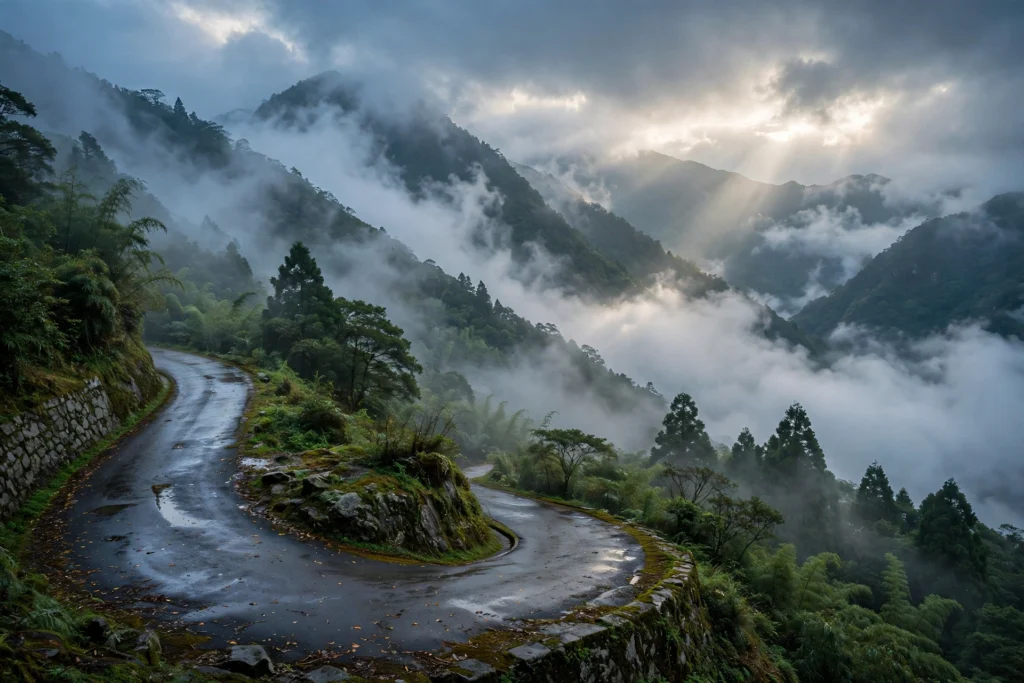
Taiwan is one of the safest destinations in Asia, and the official advice agrees. The US State Department rates Taiwan Level 1, Exercise Normal Precautions, its lowest advisory tier, in an advisory issued on 17 September 2026, which you can read on the US State Department Taiwan travel advisory page. The advisory’s own summary is that there is a risk of natural disasters in Taiwan, including earthquakes, tsunamis, typhoons, flooding and extreme heat, and that is the honest shape of the risk: crime is very low, and nature is the thing to respect. Violent crime against visitors is rare, cities are safe to walk at night, and the country’s real risks are natural, not criminal. For a wider comparison of safety across the region, the guide to whether it is safe to travel to Vietnam right now shows how the same advisory system reads in a neighbouring country.
Earthquakes are the first natural hazard to understand. Taiwan sits on an active seismic zone, and minor tremors are routine and mostly unnoticed. Buildings are built to strict seismic codes, and the practical advice is simple: familiarise yourself with basic drop, cover and hold guidance, and know that your phone will receive emergency alerts automatically. The April 2024 Hualien earthquake was a reminder that large quakes do happen, and it is the reason parts of Taroko Gorge are still closed. If an earthquake happens while you are in a building, stay inside, drop under a sturdy table, and wait. If you are outside, move away from buildings, power lines and anything that could fall. Aftershocks are normal after a large quake, and mountain roads can close for inspection.
Typhoons are the second hazard, and they are the one that will actually change your plans. Peak season is June to September, and about three to five typhoons affect Taiwan each year. A storm can cancel flights and close mountain roads with a day or two of notice, so check the forecast if you are travelling in this window and build flexibility into your itinerary. When a typhoon warning is issued, stay indoors, keep your phone charged, and follow the instructions of local authorities. Government offices and schools close during typhoon warnings, and public transport may be suspended. The Central Weather Administration publishes typhoon tracks and warnings in English, and your hotel will know the local arrangements.
Petty theft is rare even by regional standards, but standard awareness at night markets and on crowded transit is still sensible. Scooters are the more relevant everyday risk: they are the dominant form of transport in Taiwanese cities, and they move in patterns that take visitors a day or two to read, so look both ways even on one-way streets and do not assume a scooter will stop at a crossing just because you have the right of way. The emergency numbers are 110 for police and 119 for ambulance, and 112 works as a mobile SOS number. Taiwan’s healthcare system is high-standard and affordable even for visitors paying out of pocket, hospitals in Taipei have English-speaking staff, and travel insurance is still recommended for anything beyond a minor visit. The State Department also notes that Taiwan has strict laws against driving under the influence, with fines, vehicle impoundment and licence restrictions for blood alcohol content of 0.03 percent or higher, and that drug laws are extremely strict, with the death penalty possible for trafficking. Enrolling in the Smart Traveler Enrollment Program before you travel means the American Institute in Taiwan can contact you or your emergency contact in an emergency.
The etiquette that matters most is the etiquette of temples, queues and public transport. Take off your shoes indoors at homes, some guesthouses and traditional restaurants with tatami-style seating, and look for the shoe rack at the door. Use two hands when giving or receiving money and business cards, a small formality that reads as genuine respect, especially with older people. Queue properly on the MRT, where the platforms have marked lines for boarding, and stand on the right of escalators. Do not stick chopsticks upright in a rice bowl, since it resembles funeral incense and is considered bad luck; rest them on the provided holder instead. Do not eat or drink on the MRT, where it is prohibited, and keep phone calls and conversation quiet on public transport. At a temple, dress modestly, keep your voice low, enter by the right-hand dragon door and leave by the left, step over the threshold rather than on it, and do not point at the deities. Tipping is not expected anywhere. And one rule that can cost real money: do not bring pork products into Taiwan. Bringing them in from African swine fever areas can mean a fine of up to NT$200,000, and foreigners who do not pay are refused entry, so leave pork products at home.
Taiwan Travel Itineraries: 5 Days, 7 Days and 14 Days
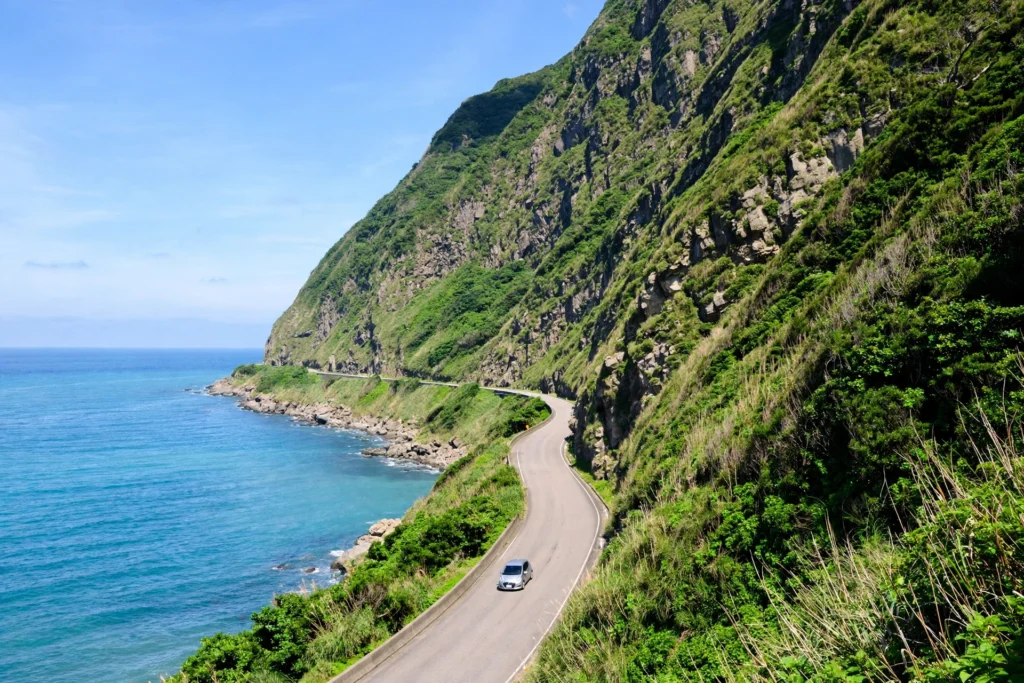
A week covers Taipei plus one other region well. Two weeks lets you do both the east coast and the central mountains, plus Kaohsiung or Tainan in the south. The High Speed Rail makes longer loops realistic even on a one-week trip, and the itineraries below are built around the transport that actually works: high-speed rail down the west coast, express trains on the east coast, and the MRT and buses inside the cities. Each one assumes you arrive at Taoyuan International Airport and take the Airport MRT into Taipei, and each one keeps one flexible day for weather, because Taiwan rewards a loose grip on the schedule.
The 5-day first trip
Day one is Taipei’s Xinyi district: Taipei 101 and its observatory, the city views from the tower, and Elephant Mountain at dusk for the classic shot of the tower over the city, then Raohe Night Market for dinner. Day two is the National Palace Museum in the morning, Longshan Temple and Dihua Street in the afternoon, and Ximending in the evening. Day three is the north coast: bus 1062 to Jiufen in the morning, the Pingxi Line to Shifen and its waterfall in the afternoon, and back to Taipei for a final night market. Day four is the high-speed rail to Taichung and the shuttle bus to Sun Moon Lake, with an afternoon cycling the lakeshore and an evening by the water. Day five is the high-speed rail to Tainan for the temples and the food streets, then back to Taipei the same evening. This is a fast trip, and it works because the trains are fast, but it leaves the east coast and Alishan for next time.
The 7-day complete introduction
Days one to three are Taipei, with Taipei 101, the National Palace Museum, Longshan Temple, Beitou hot springs and a night market crawl, plus a morning in Yangmingshan if the weather is clear. Day four is Jiufen and Shifen, the full-day northern loop. Days five and six are Sun Moon Lake via Taichung, with a night at the lake and a morning cycle before the buses arrive. Day seven is Tainan by high-speed rail, with the temples and the Garden Night Market if it falls on a Thursday, Saturday or Sunday, then back to Taipei. This is the itinerary to choose if you have one week and want to say you have seen Taiwan rather than just Taipei: it covers the capital, the north coast, the central lake and the historic south, and it does so without a single rushed morning.
The 14-day round-island loop
Days one to three are Taipei, Beitou and Yangmingshan. Day four is Jiufen and the Pingxi Line. Days five and six are Sun Moon Lake via Taichung. Days seven and eight are Alishan via Chiayi, staying overnight for the sunrise, with the railway’s service status checked before you go. Days nine and ten are Tainan. Day eleven is Kaohsiung, with Lotus Pond, Pier-2 and Liuhe Night Market. Day twelve is Kenting, or straight on to Taitung if the weather favours the east. Day thirteen is the East Rift Valley and Chishang, ending in Hualien. Day fourteen is the open parts of Taroko Gorge and the Qingshui Cliffs, then the express train back to Taipei. This loop runs anticlockwise from Taipei, down the west coast and back up the east, and it is the trip to choose if Taiwan is your main holiday rather than a stop on a longer journey. It also leaves room for the detours that make a trip memorable: a morning in a tea house, an extra night at the lake, a festival you had not planned for. If you want to plan a wider East Asia journey around this loop, the best travel destinations and dream travel destinations guides will help you place Taiwan alongside the other places on your list.
Frequently Asked Questions About Taiwan Travel
Is Taiwan safe to visit?
Yes, very. The US State Department rates Taiwan Level 1, Exercise Normal Precautions, its lowest risk tier, in an advisory issued on 17 September 2026. Violent crime against visitors is rare, and the real risks are natural ones: earthquakes, typhoons and mountain weather, not crime.
Do US citizens need a visa for Taiwan?
No, for stays of 90 days or less. US passport holders enter visa-free, and a visa is required only for longer stays. Since 1 October 2025 every visitor must also complete the free Taiwan Arrival Card online within three days before arrival.
How many days do I need in Taiwan?
Five to seven days covers Taipei, Jiufen, Sun Moon Lake and Tainan. With ten to fourteen days you can circle the whole island, adding Alishan, the east coast and Taroko Gorge.
What is the best time to visit Taiwan?
October to December and March to April are best: cooler, drier and outside typhoon season. October is the single best month. Avoid July to September if possible, the peak typhoon season, and book well ahead if your trip lands on Lunar New Year, 6 February 2027.
Is Taroko Gorge open in 2026?
Partly. The gorge is open in stages after the April 2024 earthquake: Tianxiang, Xiangde Temple, the Qingshui Cliffs viewpoints and the Dekalun Trail are accessible, but the Shakadang Trail and Swallow Grotto remain closed, Highway 8 opens in timed windows only, and the shuttle bus to Tianxiang is suspended. Check the Taroko National Park trail notices before you go.
How much does Taiwan cost per day?
Budget travellers manage on NT$1,400–2,000 a day, about US$45–65, with hostel dorms, night market food and the MRT. Mid-range travel runs NT$3,500–6,000 a day. Taiwan is roughly half the cost of Tokyo, Singapore or Hong Kong for comparable quality.
What is the best area to stay in Taipei?
Zhongshan, with its cafes and boutique hotels on two MRT lines, is the best all-round base. Da’an is the leafy alternative close to the food on Yongkang Street, Xinyi puts you beside Taipei 101, and the Main Station area wins if you will be catching early trains.
How do I get from Taoyuan Airport to Taipei?
The Airport MRT express runs directly from Taoyuan International Airport to Taipei Main Station in 35 to 40 minutes for a planning fare of around NT$150. Taxis and airport buses are the other options, both slower in traffic and pricier.
What should I eat in Taiwan?
Start with beef noodle soup, xiao long bao soup dumplings, lu rou fan braised pork rice and danzai noodles in Tainan, then eat your way through the night markets: pepper buns, oyster omelettes, grilled squid, scallion pancakes and bubble tea in its birthplace.
Do I need to speak Mandarin to travel in Taiwan?
No. You can get by in English in the main cities and on transport, where signage is in English. A translation app helps with menus and in rural areas, and a few words such as xie xie, thank you, are always appreciated.
Is Taiwan cheaper than Japan?
Yes, especially for food and local transport: MRT fares start around NT$20 versus roughly double for the Tokyo subway, and eating out is cheaper. Taiwan also draws far fewer international tourists, so popular sights feel noticeably less crowded than Japan’s.
Can I travel around Taiwan without a car?
Yes. Trains and Taiwan Tourist Shuttle buses reach almost everywhere on a typical route, and the High Speed Rail covers the whole west coast in under two hours. A car or scooter makes the east coast and Kenting easier, but it is not necessary.
Conclusion: Taiwan Rewards Travellers Who Give It Time
Taiwan is the island that keeps getting recommended in a whisper, and this taiwan travel guide has tried to show why. It is safe, compact and easy to navigate, the trains run on time, the food is the best value in East Asia, and the variety is absurd for an island this size: a 508-metre tower and a 300-year-old temple in one afternoon, marble gorges and misty tea mountains, night markets that feel like town squares and a high-speed train that crosses the whole west coast before lunch. The travellers who love Taiwan most are the ones who give it time: three days in Taipei rather than one, a night at Sun Moon Lake rather than a day trip, two nights in Tainan rather than a whistle-stop. Plan the framework, check the trail and railway status the week you travel, keep one day flexible for the weather, and let the island fill in the rest. Taiwan will do the rest itself.
People also read:
- How Much to Travel to Japan
- Is It Safe to Travel to Vietnam Right Now?
- Hanoi Travel
- Best Travel Destinations
- Dream Travel Destinations
- Singapore Travel Guide
- Thailand Travel Guide
- Best Places to Travel in January
- Christmas Travel
- Places to Travel in Texas
- Travel Packing Checklist PDF Free
- How to Prepare a Travel Budget

M. Adil is the founder and editor of SoloTravelPro. He writes practical, research-based travel guides that help travellers plan with confidence — from first-time city breaks to national parks and island escapes. Every guide is built on official sources, current prices and honest, usable advice, so readers can plan smarter and travel better.