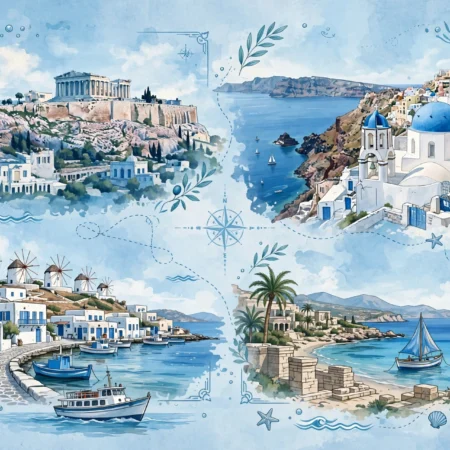
Greece is the rare country where one trip holds the birthplace of democracy, a drowned volcano you can sail across, monasteries balanced on rock pillars, a gorge you walk for a full day to reach the sea, and a taverna table where the food arrives late and nobody minds. This greece travel guide covers everything a first-time visitor from the United States needs — Athens and the Acropolis with its timed tickets, Santorini and Mykonos without the traps, the quieter Cyclades, Crete, the classical mainland of Delphi and Meteora, the Ionian islands, Rhodes, ferries and driving, the best months to go, realistic costs in euros, and ready-made 7, 10 and 14-day itineraries — so you can plan the trip in one place and travel it without surprises.
How to Plan Your Greece Trip: First Steps
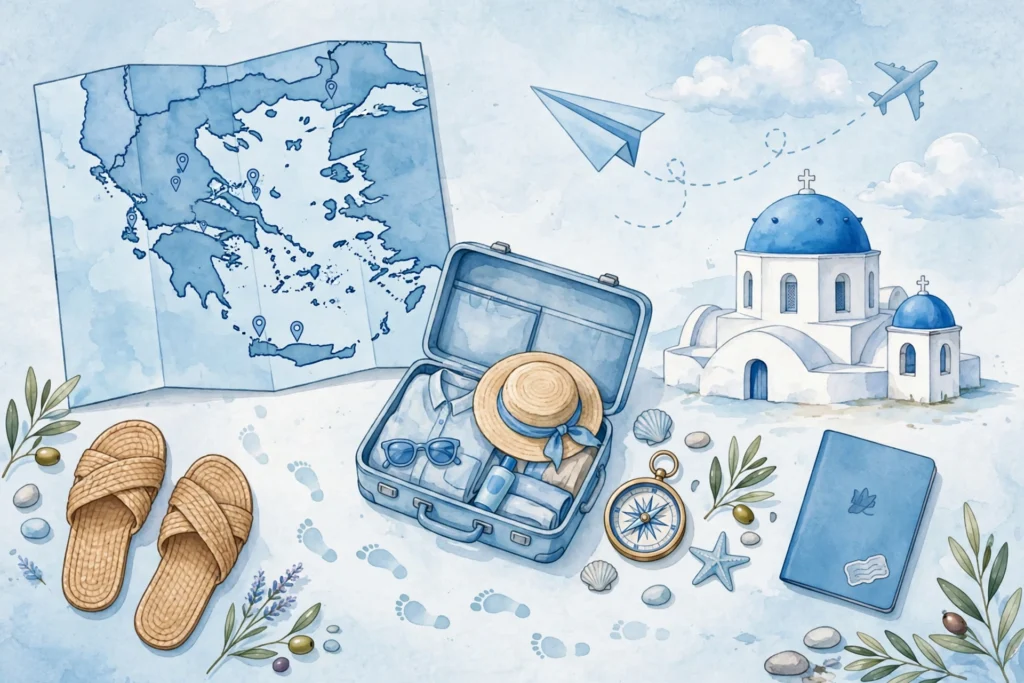
Greece rewards the traveller who books the hard things first and leaves the rest flexible. Three bookings decide whether your trip works: the Acropolis timed-entry ticket, the ferry or flight between Athens and the islands, and the hotel on Santorini or Mykonos if you are going in summer. Everything else — tavernas, buses, day trips, a hire car on Crete — can be sorted weeks or even days ahead. The mistake first-timers make is treating Greece like a country you can improvise in full. You can improvise in Athens and on the Peloponnese. You cannot improvise a July ferry to Santorini or an August room in Oia, and that is the first thing this greece travel guide wants you to understand.
Start with the three decisions that shape everything else. First, how many days you have. Seven days covers Athens and one island group at a reasonable pace. Ten days adds a second island or a mainland loop through Delphi and Meteora. Fourteen days lets you combine Athens, the classical mainland and two island groups without rushing, or give Crete the full week it deserves. Second, when you will go, because the difference between June and August in Greece is the difference between a warm sea and a thin crowd and a 40-degree afternoon with every ferry sold out — the month-by-month guide later in this article lays that out in full. Third, how you will move between the islands, because the ferry timetable is the real skeleton of a Greek trip: in summer it runs constantly, in winter it thins out sharply, and the high-speed catamarans that make island-hopping easy are mostly laid up from November to March.
The entry rules for US citizens are straightforward and worth getting right before you book anything non-refundable. US passport holders enter Greece visa-free for tourism for stays of up to 90 days in any 180-day period under the Schengen rules, and your passport should be valid for at least three months beyond your date of departure. The European Union’s Entry/Exit System now records non-EU travellers on arrival, and passports are no longer stamped, so count your Schengen days carefully — overstaying is picked up automatically. The separate ETIAS travel authorisation for visa-exempt visitors is expected to start in 2027; check the current position on the official EU travel authorisation page before you fly, because the start date has already moved once. There is no visa to arrange for a normal holiday, which makes Greece one of the simplest European destinations to enter.
The US State Department rates Greece at Level 1: Exercise Normal Precautions, in an advisory issued on 19 February 2026. Greece is a generally safe destination, but petty crime is common in popular tourist locations, especially pickpocketing on the Athens metro and around busy sites, and large demonstrations can occur with little notice and disrupt transport. Read the full text on the US State Department Greece travel advisory page before you book, and check it again before you fly, because advisories change. The single emergency number across Greece is 112, and the tourist police, who are obliged to speak English, can be reached on 171.
Money is the next practical piece. The currency is the euro, and all prices in this guide are given in euros as planning figures. Cards — Visa and Mastercard, contactless included — are accepted almost everywhere in Athens, Thessaloniki and the larger islands, including small tavernas, though American Express is patchier outside hotels and larger restaurants. Cash still matters: village bakeries, farmers’ markets, beach loungers, kiosks and many taxis want notes, and 200 and 500 euro bills are effectively unusable, so break large amounts at a bank. Private exchange offices in tourist areas can take as much as 15 percent, so arrive with euros or use an ATM. When a card terminal asks, always choose to be billed in euros rather than dollars. One charge first-timers miss is the climate resilience fee, a per-night fee charged at tourist accommodation that is higher from April to October and varies with the hotel category — it is usually added to your bill, so it is worth knowing it exists before you compare room prices. If you like to plan on paper, a ready-made itinerary template and a simple travel budget plan will help you turn this guide into a day-by-day schedule before you leave, and if you are still deciding between Mediterranean destinations, the Venice travel guide and the Croatia travel guide cover the two closest alternatives across the Adriatic.
| Greece at a glance | Detail |
|---|---|
| Capital | Athens |
| Language | Greek; English widely spoken in tourist areas, hotels and on ferries |
| Currency | Euro (€); cards accepted almost everywhere, cash still needed in villages and taxis |
| US entry | Visa-free for tourism, up to 90 days in 180 under Schengen; passport valid 3 months beyond departure |
| Best months | May, June, September and early October — warm sea, long days, thinner crowds |
| Getting around | Ferries between islands, KTEL intercity buses, domestic flights, hire cars on the mainland and Crete |
| Emergency numbers | 112 for all services; 171 tourist police (English-speaking) |
| Power | 230V, plugs Type C and F — US travellers need an adapter |
| Time zone | Eastern European Time (UTC+2), Eastern European Summer Time (UTC+3) in summer; 7 hours ahead of Washington, D.C. |
| US State Dept advisory | Level 1: Exercise Normal Precautions, issued 19 February 2026 |
How many days do you need in Greece?
Most first-time visitors need 10 to 14 days. With 7 days, spend two nights in Athens, then five days on two islands in one group — Naxos and Paros, or Santorini and a calmer neighbour. With 10 days you can add Delphi and Meteora from Athens, or give Crete a proper stretch. With 14 days you can do Athens, the classical mainland and a week in the Cyclades, or Athens plus a full week on Crete. Crete alone can fill a week and still leave things undone. Greece is a country where the distances look small on the map and the ferries take hours, so the honest rule is the same as anywhere: fewer places, more time in each, rather than a new island every night.
| Itinerary | Days | Route |
|---|---|---|
| The classic first trip | 7 | Athens (2 nights) — Santorini (3 nights) — Naxos (2 nights) |
| The calmer classic | 7 | Athens (2 nights) — Paros (3 nights) — Naxos or Antiparos (2 nights) |
| Mainland + islands | 10 | Athens (2 nights) — Delphi and Meteora (3 nights) — Santorini (3 nights) — Naxos (2 nights) |
| The Crete trip | 10 | Athens (2 nights) — Crete (7 nights): Chania, Rethymno, Heraklion and Knossos — Athens (1 night) |
| The full trip | 14 | Athens (2 nights) — Nafplio and the Peloponnese (3 nights) — Delphi and Meteora (2 nights) — Cyclades (5 nights) — Athens (2 nights) |
| The slow north | 14+ | Athens — Thessaloniki — Zagori and the Vikos Gorge — Meteora — Corfu |
What to pack for Greece
Greece is a country of sun, stone and sea in one trip, and your bag has to cover all three. The sun is the thing visitors underestimate most: the Aegean sun burns fast, sunscreen costs far more near a beach than at home, and a hat and a light long-sleeved layer earn their place on the first day. The stone is the second surprise — the marble on ancient sites has been polished mirror-smooth by millions of feet, so wear trainers with real grip; fashionable sandals cause a steady stream of slips. Pack light layers and breathable fabrics for the day, something warmer for evenings and for the mountains, and a light sweater or scarf for churches and monasteries, where shoulders and knees must be covered. Bring a day pack, a reusable water bottle — tap water is fine to drink in Athens and on Crete, but on the smaller islands it can be brackish, so buy bottled there — and a power bank, because a day of maps, photos and ferry tickets drains a phone fast. A small first-aid kit is worth carrying, and travel insurance must cover the activities you actually plan, including water sports and scooter hire, because standard policies often exclude both. Our guide to what travel insurance covers explains the gaps worth checking before you buy.
Staying safe in Greece
Greece is safe overall, and the problems visitors actually meet are small and preventable. Pickpockets work the Athens metro, especially the lines to the airport and Piraeus, and the crowds around Monastiraki flea market — keep your bag in front of you, do not stand near the doors, and do not leave bags unattended on public transport. The restaurant trap is the second one: avoid anywhere with someone outside trying to talk you in, particularly on the main streets of Plaka, where the food is mediocre and a “service” line can appear on the bill at the price of a main course. The heat is the third risk and the most serious — July in central Athens can reach 40°C, climbing the Acropolis at midday is a genuinely bad idea, and you want at least a litre and a half of water on you at any time. Quad bikes and mopeds deserve a warning of their own: they pose a real risk of serious injury, rental companies typically offer only third-party insurance, and many travel insurance policies exclude them entirely, so check your cover before you ride. Finally, do not remove anything, no matter how small, from an archaeological site — customs authorities strictly regulate the export of Greek antiquities, including rocks, and photography of police, military personnel or installations is prohibited.
Athens: The Acropolis and Two Full Days in the Capital
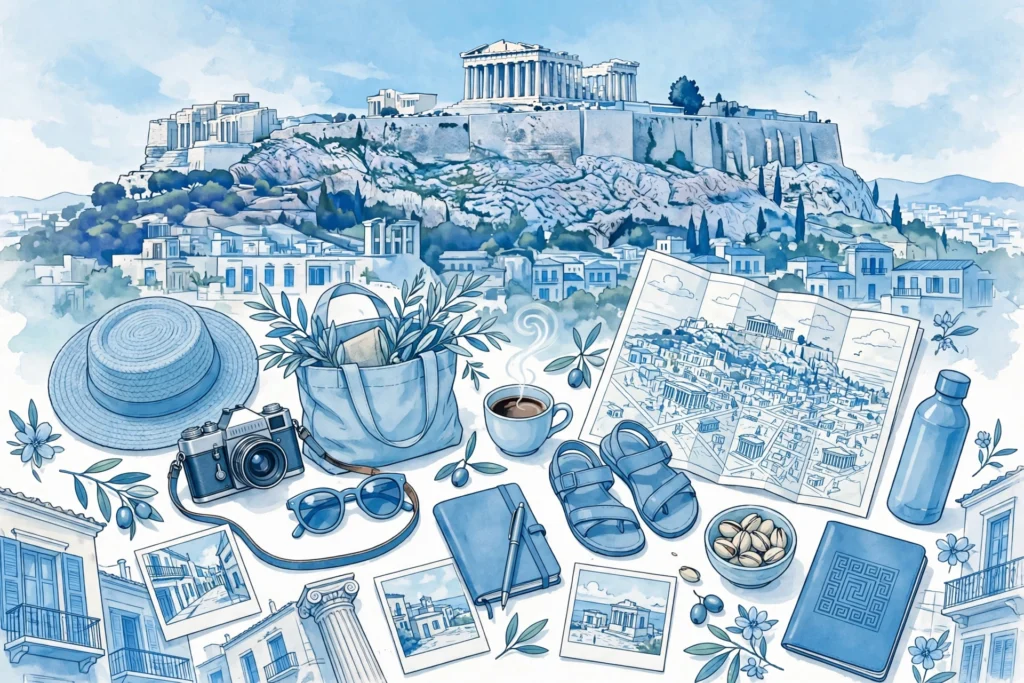
Athens is a city with a temple on a rock in the middle of it, visible from most street corners, and that is the whole proposition in one glance. It is also a working city of three million people, noisy, creative and chaotic, where neoclassical facades sit beside street art and rooftop bars, and where the best neighbourhoods reward the traveller who walks rather than the one who taxis between sights. Give Athens two full days, not a layover. One day is the Acropolis and its museum; the second is the rest of the ancient city, the neighbourhoods and the food. Arriving and leaving both run through Athens International Airport, and metro line 3 links the airport to Syntagma Square in the city centre in about 40 minutes, then continues to the port of Piraeus — the X95 bus runs around the clock to Syntagma as well, and both cost a fraction of the taxi, which charges a fixed airport fare.
Start on the rock itself, and start early. The Acropolis is the most striking and complete ancient Greek monumental complex still standing, a hill about 156 metres high with a nearly flat top, fortified for more than 3,300 years. The monuments you see today were built in the 5th century BC under the statesman Perikles: the Parthenon, built between 447 and 432 BC, the Propylaia gateway of 437–432 BC, the small Temple of Athena Nike of 427–424 BC, and the Erechtheion of 421–406 BC, whose porch rests on six carved women instead of columns. UNESCO lists the Acropolis as a World Heritage site, and its own description calls it the place where democracy, philosophy, theatre and freedom of speech were born — which is a large claim for one hill, and standing on it at eight in the morning, with the city still quiet below, it does not feel exaggerated. The full ticket and timing system is covered in the next section, because getting it wrong is the single most common way to waste a morning in Athens.
Below the rock, the Acropolis Museum is not an add-on but a masterpiece in its own right, and it deserves half a day on its own. The Parthenon gallery on the top floor lets you see the friezes at full height in natural light, with the hill itself visible through the glass, and the museum is a separate institution with its own ticket — around €20, bought on the museum’s own site — so do not expect the Acropolis ticket to cover it. From the museum, walk through Plaka, the old neighbourhood of neoclassical lanes under the rock, and up to Anafiotika, a pocket of whitewashed Cycladic houses that feels like an island village dropped into the capital. Then cross to the Ancient Agora, the marketplace and civic heart of classical Athens, and the Roman Agora beside it, and finish the day on Filopappou Hill, where the view back across to the Parthenon at golden hour is the best free sight in the city.
The second day belongs to the rest of Athens. The National Archaeological Museum holds the gold of Mycenae and the bronzes pulled from the sea, and it needs two unhurried hours. The Temple of Olympian Zeus and Hadrian’s Arch sit a short walk from the Acropolis, and the Panathenaic Stadium — the marble stadium of the first modern Olympic Games — is worth the detour for the view from the top tier alone. For a change of pace, take the metro to the coast: the Athenian Riviera runs south from Piraeus to Vouliagmeni, with palm-lined promenades, beach clubs and the Temple of Poseidon at Cape Sounion, two hours each way, where sunset on the cliff above the sea justifies the journey. Back in the centre, the neighbourhoods are the point. Koukaki, just south of the Acropolis, is the best place to sleep — full of local coffee shops and a short walk from everything — while Exarchia is artsy and loud, Kolonaki is polished and expensive, and the cheap listings around Omonia Square are worth avoiding. Eat where Greeks eat lunch: tavernas with paper tablecloths, away from the main streets of Plaka, where a salad and one hot dish frequently feeds two people and asking to take the rest away is completely normal.
Athens in two days: a workable plan
Day one starts at the Acropolis in the first entry slot, then the Acropolis Museum, lunch in Koukaki, the Ancient Agora and the Roman Agora in the afternoon, and sunset from Filopappou Hill. Day two starts at the National Archaeological Museum, then the Temple of Olympian Zeus, Hadrian’s Arch and the Panathenaic Stadium, an afternoon on the Athenian Riviera or at Cape Sounion, and dinner in Plaka or Psiri — but in a side street, not on the main drag. If you only have one day, do the Acropolis first thing, the museum, and the Agora, and skip the rest; Athens punishes the traveller who tries to see it all in a day, and the city is better at a walk than at a sprint.
A few words of Greek go a long way
English is almost universal in tourist areas, and younger Greeks speak it fluently, but a few words are noticed and repaid, especially away from the resorts. Kalimera is good morning, efharisto is thank you, parakalo is please and you are welcome, nai is yes, ohi is no, and signomi is sorry or excuse me. Learn the head gesture too, because it runs backwards from what you expect: a sharp upward jerk of the head means no, and a downward nod means yes. Get it wrong while ordering coffee and the conversation gets unexpectedly long. Menus are printed in English everywhere, road signs and metro stations are duplicated in Latin script, and Google Maps handles the KTEL bus routes well, so the Greek alphabet is no barrier to getting around.
The Acropolis: Tickets, Timed Entry and Beating the Crowds
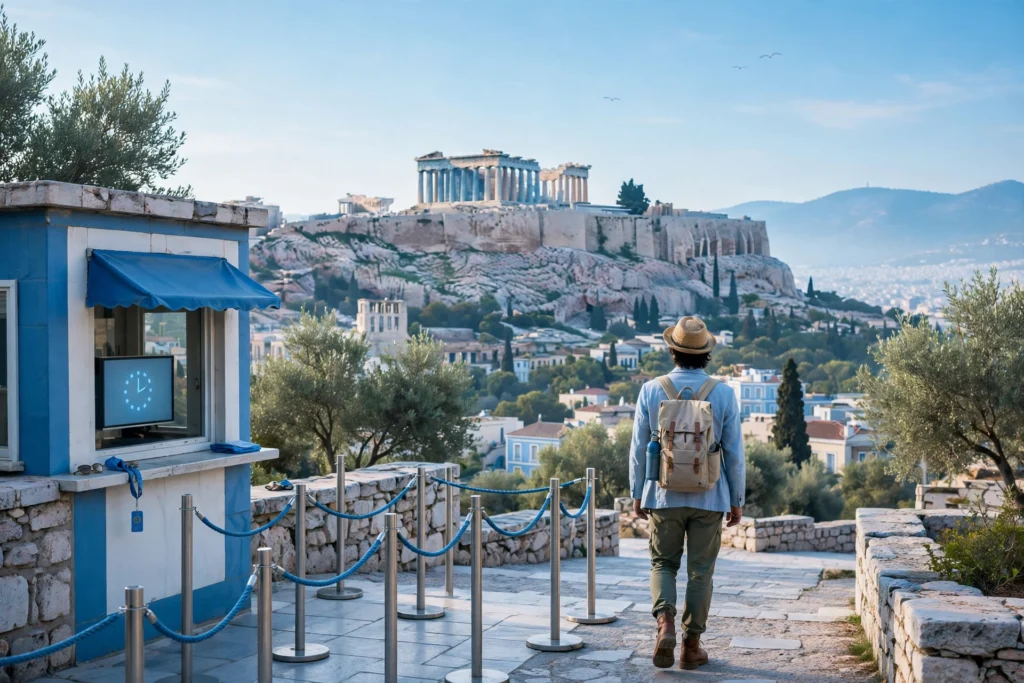
Visiting the Acropolis now runs on timed entry, and the visit is won or lost before you reach the rock. Every ticket carries a specific one-hour entry slot, the popular morning slots sell out days ahead from spring to autumn, and the site admits you within that hour only. Book online, in advance, on the official Hellenic Heritage ticketing platform at tickets.hh.gr — the e-ticket service of the Greek Ministry of Culture, run through ODAP, the organisation that runs the state’s archaeological sites and museums. It is the only government-run seller. Any product promising to “skip the line” is selling you a timed ticket, a guide, or both, at a markup, because every ticket holder already has a timed slot and the only queue left is for security checks.
The prices were checked against the official platform in November 2026 and are the same all year: €30 for a standard adult ticket and €15 for a reduced ticket, with no reduced winter rate and no separate Parthenon ticket — one ticket covers the whole site, including the north and south slopes, the Theatre of Dionysus and the Odeon of Herodes Atticus. The old multi-site combined ticket is no longer sold, so the Ancient Agora, the Roman Agora and the other sites each sell their own entry now. The Digital Guide app is included with the Acropolis ticket. Several categories enter free, including EU citizens under 25 and all visitors under 18, but every free ticket still needs a timed slot reserved in advance, and reduced and free eligibility must be proven with photo ID or a passport at the gate. Tickets are non-refundable, and the platform’s terms allow limited changes to a booking — check the current change rules in the checkout itself at the moment you book, because they have changed during 2026, rather than relying on a figure in any guide, including this one. There are also selected free-entry days, including some Sundays in the winter months, when the site is busier than usual and a slot is still required.
Opening hours change with the season. From 1 April to 31 August the site runs from 08:00 to 20:00; from 1 November to 31 March it runs from 08:00 to 17:00, with September and October closing earlier in steps. Last admission is shortly before closing. The practical advice is simple and it is the same advice every good Athens guide gives: book the earliest 08:00 slot, about a week ahead in high season, and arrive a little before your slot. By midday the buses have delivered the main wave and the Propylaea — the single narrow gateway onto the summit — becomes a crush. The south-east entrance on Dionysiou Areopagitou, by the Theatre of Dionysus, is the calmer approach, and walking the site in a sensible order makes the visit coherent rather than a shuffle: the south slope first, then up through the Propylaea, the Parthenon, the Erechtheion and down past the north slope. Allow two to three hours inside. The Acropolis has closed at midday during heatwaves, so in July and August an early slot is not a preference but a necessity, and the marble underfoot is slippery even when dry — wear shoes with grip.
| Acropolis at a glance | Detail |
|---|---|
| Official tickets | tickets.hh.gr — Hellenic Heritage, Ministry of Culture / ODAP; the only official online seller |
| Standard adult ticket | €30, same price all year; covers the whole site including both slopes |
| Reduced ticket | €15; EU students, under-25s and other listed categories, with ID at the gate |
| Free entry | EU citizens under 25, all visitors under 18, and selected free days — a timed slot is still required |
| Entry system | Timed one-hour slots; non-refundable; limited changes allowed — check terms at booking |
| Summer hours | 1 April–31 August, 08:00–20:00 |
| Winter hours | 1 November–31 March, 08:00–17:00 |
| Best slot | 08:00, booked about a week ahead in high season |
| Time inside | 2–3 hours |
| Museum | Separate ticket, around €20, on the Acropolis Museum site |
The other Athens sites and how they fit
The Acropolis ticket no longer bundles the other sites, so plan them separately. The Ancient Agora and the Roman Agora are a short walk from the rock and pair naturally with a Plaka afternoon. The Temple of Olympian Zeus, Hadrian’s Arch and the Panathenaic Stadium cluster together south-east of the centre and make a good second-morning loop. Kerameikos, the ancient cemetery, is quieter and worth it if you like your ruins without a crowd. Each site sells its own ticket on the same official platform, so buy them together in one session rather than queuing at each gate. The Acropolis itself is listed by UNESCO as a World Heritage site, and the listing’s own description is worth reading before you go — it explains, better than any guidebook, why this one hill carries the weight it does.
Santorini: The Caldera, Oia and the Volcano
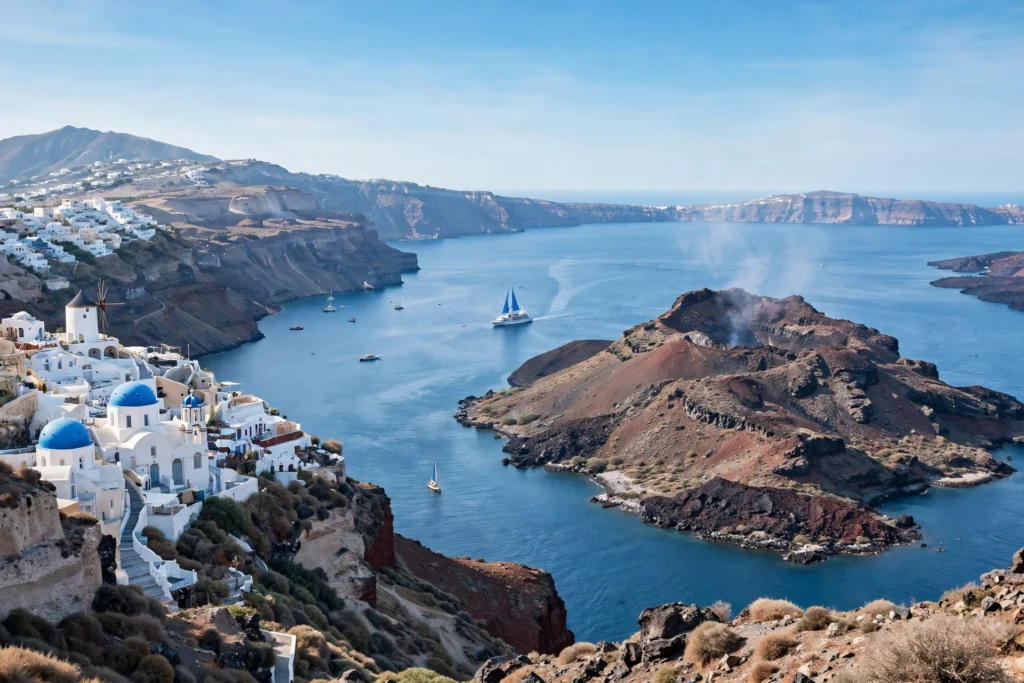
Santorini is the island every Greece trip is measured against, and it is also the island most likely to disappoint if you arrive with the wrong expectations. The caldera is real and it is spectacular: a drowned volcano, three hundred metres of cliff, white villages perched on the rim, and a sunset in Oia that draws a crowd every single evening. The island is also small, expensive in summer, and crowded from June to September, and the villages are not a resort but a working rim of cave houses, hotels and tavernas strung along a cliff edge. The trick is to treat Santorini as a three-night stop, not a week, and to spend the days on the water, on the south coast, or in the villages nobody photographs.
Oia sits on the northern tip of the crater rim, its cave houses dug into the cliff and rebuilt after an earthquake flattened the village in 1956. The sunset from the castle ruins is famous, and famous means crowded: arrive an hour early, or watch it from Imerovigli, the quieter village along the rim, where the same sun sets over the same sea with a fraction of the crowd. Fira, the capital, sits in the middle of the rim above the old port — three minutes by cable car down to the water, ten minutes by boat across to the black volcano at the centre of the caldera. The caldera boat trip is the single best thing to do on Santorini: a half-day sail that walks the volcanic island, swims in the hot springs, and watches the cliffs from inside the crater rather than above it. Book it for the morning, when the light is softer and the boats are fewer, and choose a smaller boat if you can — the big catamarans are comfortable and the small ones are memorable.
The south of the island is where Santorini stops performing and starts relaxing. The Red Beach looks like Mars and is always packed; take the boat on to the White Beach, where the cliffs come right down to the water and there are far fewer people. Kamari and Perissa, the black-sand beaches, are the practical base for swimmers, with loungers, tavernas and buses that actually run. Akrotiri, the Minoan town buried by the eruption around 1600 BC and excavated under a roof, is the island’s best ancient site and the one most visitors skip — go at opening time, before the heat and the coach parties. And eat in the villages, not on the caldera rim: Megalochori, the medieval village around a 400-year-old winery, and Pyrgos, the highest village on the island, serve the same food at half the price of a sunset table in Oia, and the local cherry-tomato fritters, tomatokeftedes, are the dish Santorini is quietly proud of.
Santorini’s costs are the highest in Greece. A good room costs roughly double in August what it costs in May, and late booking in summer is punished severely — book three to four months ahead for June to September, and expect to pay a premium for a caldera view. The same room with a village view a street back from the rim can cost half as much and sleep just as well. Getting around is the other practical problem: public buses are available but get crowded fast, taxis are limited and pricey, and a hire car or a hotel transfer is the comfortable way across an island whose roads were not built for the number of vehicles now on them. If you are flying in, Santorini Airport takes direct flights from much of Europe in summer; otherwise the ferry from Piraeus is the classic arrival, and the first sight of the caldera from the water is the moment the island earns its reputation.
Santorini without the traps
Book the caldera-view room only if the view is the point of the trip — otherwise take the village room and spend the difference on the boat trip. Eat one sunset dinner on the rim and every other meal a street back. Walk the rim path from Fira to Oia early in the morning, before the heat, rather than in the afternoon crush. Skip the donkeys at the old port — the cable car is faster, cheaper and kinder. And if the crowds are the problem, remember that the island in May or late September is a different place: the same sea, the same light, and a fraction of the people. The Malta travel guide covers a smaller, cheaper Mediterranean island break if Santorini’s summer prices put you off, and the Lisbon travel guide is the other classic European city-and-coast combination at a lower price.
Mykonos: Windmills, Little Venice and the Party Coast
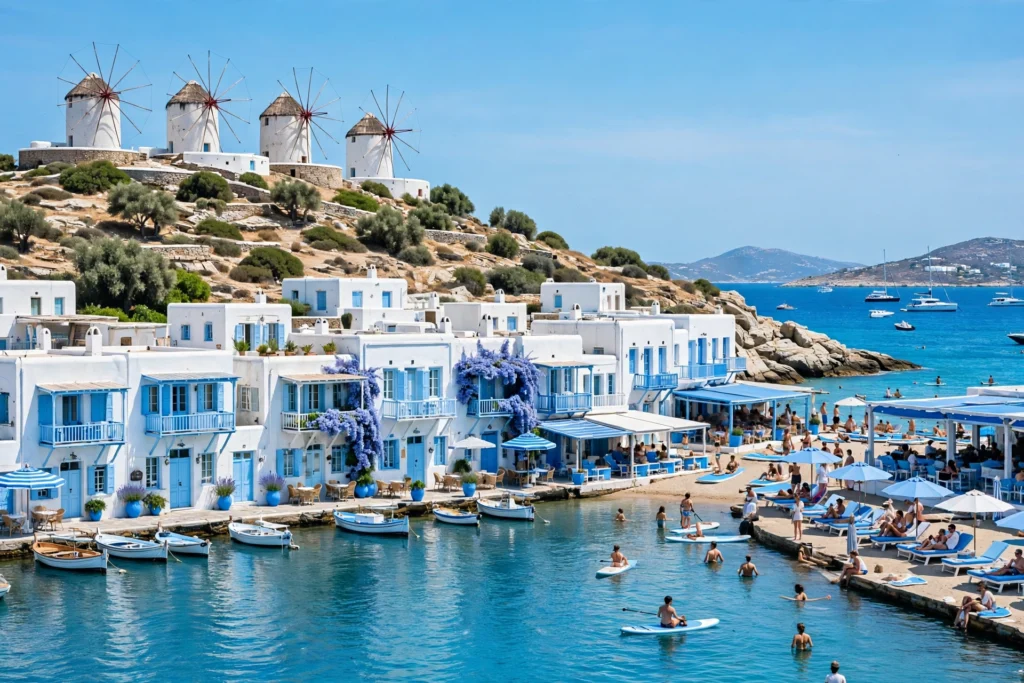
Mykonos is the glamorous island, and it knows it. Equal parts champagne-soaked beach clubs, dazzling white Cycladic lanes, designer shops and legendary beach parties, it is also, underneath the scene, a pretty and walkable island with a Venetian harbour, a working fishing fleet and quiet corners if you know where to look. The question is not whether Mykonos is worth it but whether it is worth it for you: if you want nightlife, beach clubs and a see-and-be-seen scene, there is nowhere better in Greece; if you want a quiet island, Naxos and Paros are a ferry away and a third of the price.
Mykonos Town — Chora — is the heart of it. The windmills on the hill above the harbour are the postcard, and Little Venice, the row of houses with balconies hanging over the water, is where the sunset drink happens. The lanes behind them are a maze of whitewashed walls and bougainvillea, deliberately confusing — the story goes that they were built to baffle pirates — and getting lost in them is half the pleasure. The best time to walk them is early morning, before the shops open and the cruise passengers arrive, or late evening, when the lanes fill with people heading out and the light turns gold. The island’s best day trip is not on Mykonos at all: Delos, the uninhabited sacred island a short boat ride away, was the birthplace of Apollo and Artemis and is one of the most important archaeological sites in Greece, a whole ancient city of temples, houses and mosaics lying open under the sun. Go early, take water and a hat, and allow half a day.
The beaches are the other half of the island, and they split into two kinds. The south-coast party beaches — Paradise, Super Paradise, Psarou — are where the beach clubs, the music and the prices live. The north and east coasts are quieter: Agios Sostis has no loungers and no music, just sand and a taverna, and it is where the island feels like itself. A hire car or a small scooter opens the island up, but taxis are limited and pricey, so pre-book transport or arrange transfers through your hotel, and agree the fare before you get in. Mykonos Airport takes direct flights from much of Europe in summer, and the ferry from Piraeus or Rafina is the slower, cheaper arrival. Two to three nights is enough for most visitors; more than that and you are either committed to the scene or paying for it.
Mykonos on a budget — or at least not a fortune
Mykonos is the most expensive island in Greece, and the gap between the scene and the rest of the island is the gap in your budget. Stay in Mykonos Town rather than at a beach club, eat in the lanes rather than on the sand, drink the house wine rather than the imported label, and take the bus to the beaches rather than a taxi. The beaches are public — only the loungers and the sections run by private operators cost money — so bring a towel and arrive early. And if the prices still sting, remember that the same Aegean light, the same whitewashed lanes and the same sea are available on Paros for a fraction of the cost, which is the subject of the next section.
The Cyclades Beyond Santorini and Mykonos: Naxos, Paros and Milos
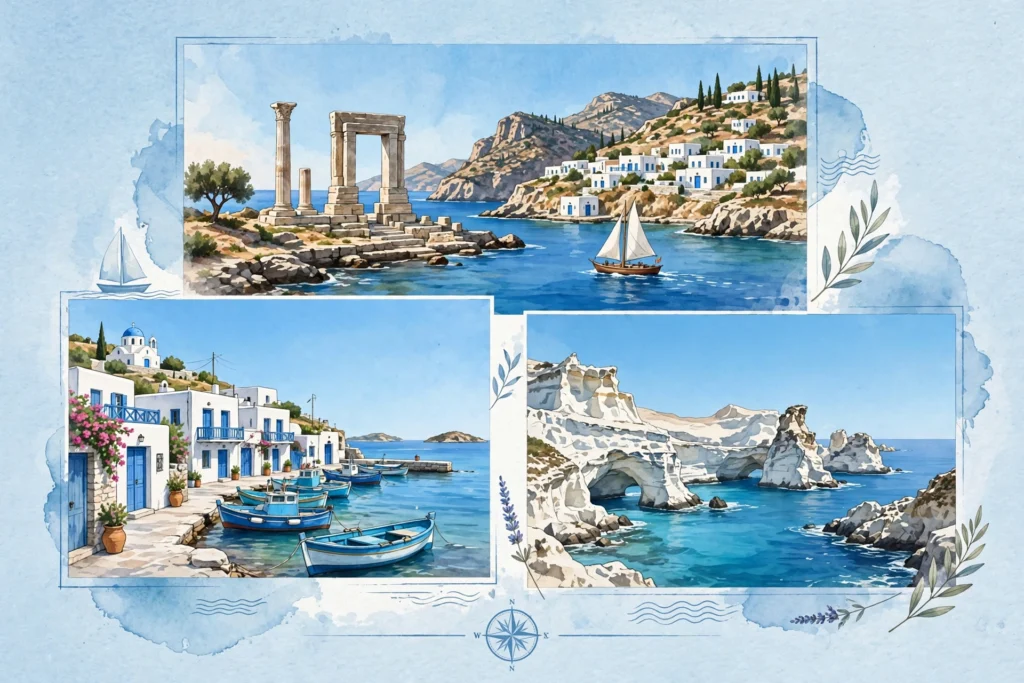
The Cyclades are more than their two famous islands, and the best Greek island trip most visitors never take is the one that skips both of them. The island group is a ring of whitewashed towns, clear water and sandy beaches around a blue sea, and the quieter islands are where the food is better, the prices are lower, the beaches are emptier, and the Greeks themselves go on holiday. If Santorini and Mykonos are the shop window, Naxos, Paros and Milos are the shop. Pair two of them with Athens and you have a first trip that costs less, moves slower, and leaves you with better memories than the famous pair alone.
Naxos is the largest island in the Cyclades and the most complete: long sandy beaches, a mountain interior with villages that still farm, a Venetian old town above the port, and the Portara, the giant marble doorway of an unfinished temple to Apollo standing on the islet at the harbour entrance. It is the island for families and for travellers who want a base rather than a scene — three or four nights here covers the beaches, the mountain villages of Halki and Apiranthos, and a day trip to the small Cyclades. Paros hits the sweet spot between laid-back and stylish, where cobblestone villages meet buzzy harbours and calm beaches give way to long, leisurely lunches. Base yourself in Naoussa, the fishing port turned elegant town, or in Parikia, the main port, and take the short ferry to Antiparos, the smaller island across the water, where the pace drops another gear and the caves and beaches are the whole agenda. Paros is very drivable, with good roads, and the local buses hop between the villages well enough that a car is a pleasure rather than a necessity.
Milos is the odd one out and the most distinctive: a volcanic island of coloured cliffs, sea caves and beaches that look like nowhere else in Greece, including Sarakiniko, the white lunar landscape on the north coast, and Kleftiko, the sea caves on the south-west that you reach by boat. It is quieter than its neighbours, harder to get to, and all the better for it. The island is also where the Venus de Milo was found, though the statue itself is in Paris. For the rest of the Cyclades, the pattern holds: Tinos is the pilgrimage island with a marble-working tradition, Sifnos is the food island with the best tavernas in the group, Andros is green and close to Athens, and each of them is a day or two by ferry from the others. The ferries are the key: from Piraeus and Rafina the network runs constantly in summer, and the smaller islands are joined by local boats that do not appear on the big booking sites, so ask at the port.
| Island | Best for | Nights | Character |
|---|---|---|---|
| Santorini | First-timers, the caldera, sunsets | 3 | Dramatic, expensive, crowded in summer |
| Mykonos | Nightlife, beach clubs, the scene | 2–3 | Glamorous, pricey, best in small doses |
| Naxos | Families, beaches, mountain villages | 3–4 | The most complete Cycladic island |
| Paros | Relaxed style, food, Antiparos | 3–4 | The sweet spot between lively and calm |
| Milos | Sea caves, strange beaches, quiet | 2–3 | Volcanic, distinctive, harder to reach |
| Sifnos | Food, walking, quiet villages | 2–3 | The connoisseur’s island |
| Tinos | Culture, marble villages, pilgrimage | 1–2 | Traditional, unpolished, rewarding |
| Antiparos | Total serenity, caves, slow days | 1–2 | Paros’s smaller, quieter sibling |
How to choose your Cyclades
The honest way to choose is to pick one famous island and one quiet one. Santorini plus Naxos gives you the drama and the depth. Mykonos plus Paros gives you the scene and the recovery. Naxos plus Paros, with a day on Antiparos, is the trip for travellers who want the Cyclades without the crowds at all, and it costs roughly half what the famous pair costs in August. Whichever you choose, book the ferry between islands when you book the hotel — in July and August the fast catamarans sell out, and the conventional ferries take hours longer. The meltemi, the strong north wind of July and August, can cancel catamarans for a day or more, so build a spare day into any island-hopping plan rather than a tight connection on the day you fly home.
Crete: Knossos, Chania, Rethymno and the Samaria Gorge
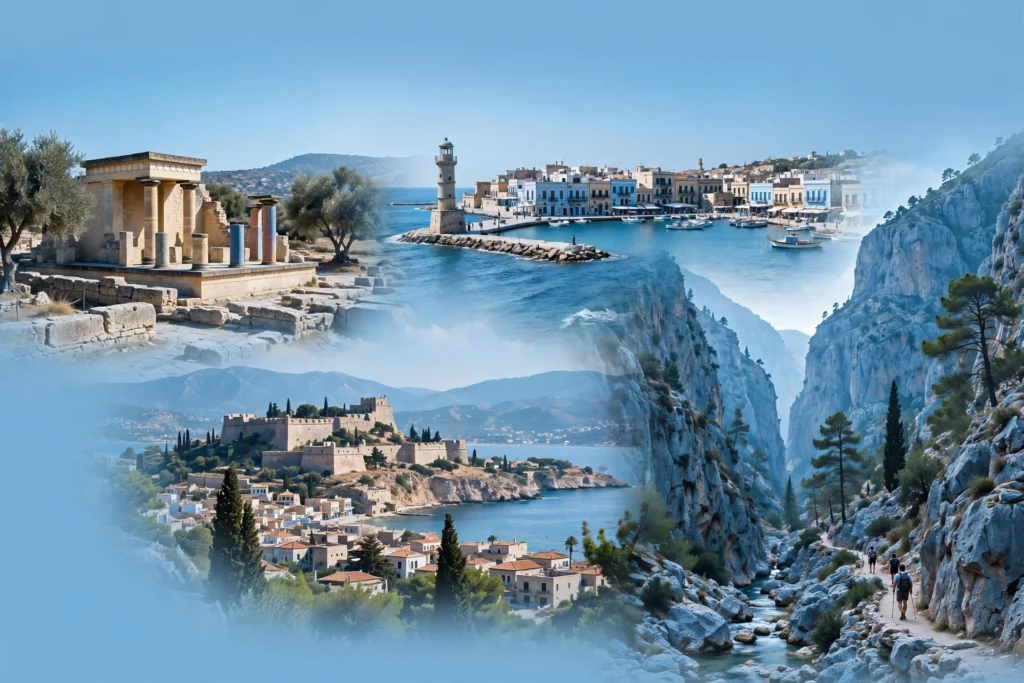
Crete deserves the most time of any place in Greece, and it is the island most visitors under-plan. It is the largest Greek island, a country in miniature: Minoan palaces, Venetian harbour towns, a mountain interior with gorges and villages, beaches of pink sand and turquoise lagoon, and a food culture that is the most distinctive in Greece. A week here feels like a separate trip from the Aegean islands, and it is. Fly into Heraklion or Chania, hire a car — on Crete a car is not optional, it is the trip — and plan on two bases rather than one, because the island is long and the roads are slow.
Start in Heraklion, the capital, for the Palace of Knossos. What to see first is the palace itself, without much argument: the palace of the Minotaur legend, rebuilt in part so that walls, stairs and colour rise above the ground again, which lets you picture the rooms Cretans lived and worked in 3,500 years ago. Go at opening time, before the heat turns the site into an oven and the coach parties arrive, and pair it with the Heraklion Archaeological Museum, which holds the finds from the palace and is one of the best museums in Greece. Heraklion itself is a working city rather than a pretty one, and a night or two is enough — the island’s beauty is west.
Chania is the prettiest old town on Crete, a Venetian harbour wrapped in Ottoman domes and a stone lighthouse, and it is the base for the west of the island. From here, the beaches: Elafonissi, the pink-sand beach and turquoise lagoon on the south-west, and Balos, the set piece of the north-west, where the road in is hard on the nerves and on a hire car, so take the boat from Kissamos instead. Between them sits Rethymno, the third town, with a long shallow sandy beach that suits families and a Venetian old town that is quieter than Chania’s. The interior holds the island’s best walking: the Samaria Gorge, a full day’s walk from the White Mountains down to the Libyan Sea, is the most famous hike in Greece and it earns the reputation — start early, carry water, wear proper shoes, and take the boat from Agia Roumeli at the end rather than walking back. The Lasithi Plateau, the mountain villages and the olive groves are the Crete that most visitors never see, and they are the reason to have a car.
Cretan food is a trip in itself. Dakos, the salad-like dish built on a barley rusk base with fresh tomato, crumbled white cheese, olive oil and oregano, is the island’s signature. The mountain villages serve lamb, snails, wild greens and the local spirit, raki, which arrives at the end of a meal whether you ordered it or not — refusing it is not really done. The island’s olive oil is among the best in the world, and the tavernas with paper tablecloths where Cretans themselves eat lunch are the places to find it. Crete is also the island where the season runs longest: Heraklion and Chania stay open through the winter, the sites are quiet, and the walking is at its best in spring and autumn, when the gorges are green and the heat has gone.
Crete in a week: a workable plan
Two nights in Heraklion for Knossos and the museum, then drive west along the north coast to Rethymno for a night, then three nights in Chania for the old town, Elafonissi and Balos, with a day for the Samaria Gorge if you are fit and the season is right. The south coast — Matala, the hippie caves, and the Libyan Sea beaches — makes a good final two nights if you have them. Crete’s size is the trap: the drive from Heraklion to Chania takes the best part of a day once you stop, so do not try to see the island from a single base. If you only have three or four days, base yourself in Chania and take Knossos as a long day trip, or base yourself in Heraklion and accept that the west will have to wait.
The Classical Mainland: Delphi, Meteora, Nafplio and Olympia
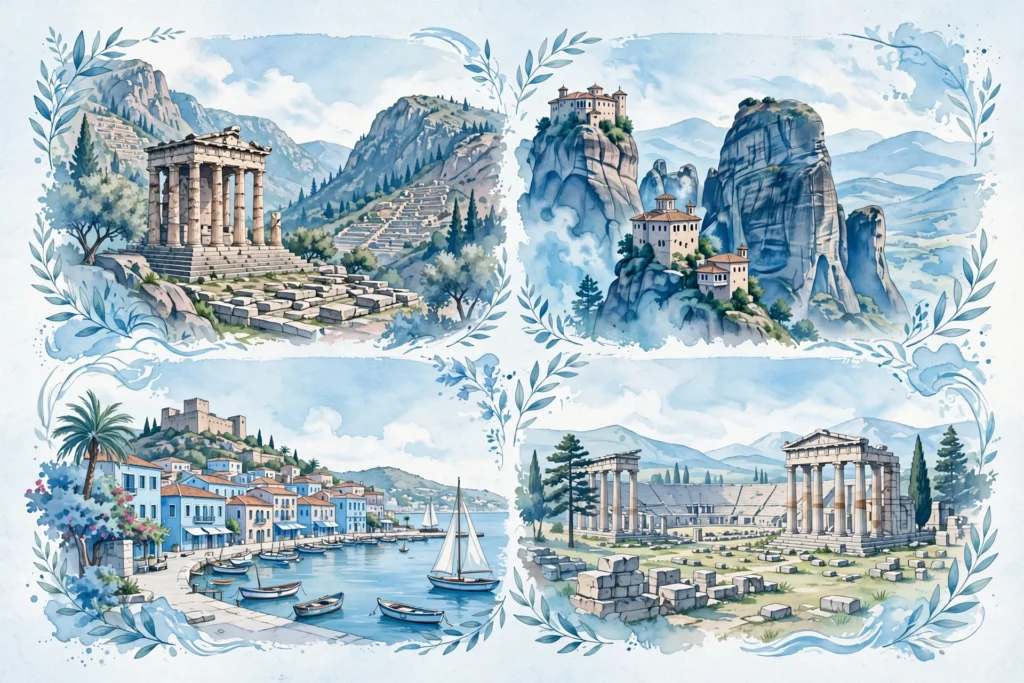
The mainland is the counterweight to the islands, and it is where Greece stops being a beach holiday and becomes the country that invented the things the beach holiday is named after. Delphi, Meteora, Nafplio and Olympia all lie within a few hours’ drive of Athens, and they are all reachable by KTEL bus if you do not want to drive — though a hire car makes the loop far easier, and the mountain roads are part of the pleasure. The north and west are the other half of the country: Zagori has stone villages and the Vikos Gorge, one of the deepest in the world, and the mountains of Epirus are the Greece that the island brochures never show.
Delphi sits on the slopes of Mount Parnassus, above the Gulf of Corinth, and it was the centre of the ancient world — the place where the oracle spoke and kings came to ask. The site is a theatre, a temple of Apollo, a stadium and a museum holding the bronze Charioteer, and the setting is the point: the mountains drop away below the sanctuary and the light in the late afternoon is extraordinary. Stay the night in the village of Delphi or in nearby Arachova, the mountain town with stone lanes and good tavernas, rather than rushing back to Athens. Meteora is the most extraordinary sight on the mainland, and one of the most extraordinary in Europe: monasteries balanced on rock pillars that rise four hundred metres above the plain of Thessaly, built by monks who wanted to be closer to heaven and harder to reach. Six monasteries still let visitors in, each on its own rock, and the crowds can make them feel overhyped — but architecturally the place is a genuine thrill, and the drive up is half of it. Dress code matters here: shoulders and knees must be covered, and most sites hand out free wraps or long skirts at the entrance if you turn up unprepared. Base yourself in Kalabaka, the plain market town at the foot of the pillars, and go at opening time, when the rocks are empty and the light is low.
Nafplio is the first capital of modern Greece, a romantic port city with the Venetian fortress of Palamidi above it and paved neoclassical lanes below, and it is the best base for the Peloponnese. From here, Mycenae, the citadel of Agamemnon with its Lion Gate, is a short drive, as is Epidaurus, whose ancient theatre is so perfectly preserved that you can hear a coin drop from the top row. Olympia, further west, is where the Olympic Games were born, and the site — the stadium, the temple of Zeus, the museum with the Hermes of Praxiteles — rewards a full day rather than a stop. Thessaloniki, the second city, is worth two nights on a longer trip: the White Tower on the waterfront, the Byzantine churches, the street food, and the ferries towards Mount Athos. The Peloponnese loop — Athens to Nafplio, Mycenae and Epidaurus, then Olympia, then back through the mountains — is the best road trip in Greece, and it needs at least four days to do properly.
The mainland loop in four days
Day one: Athens to Delphi, overnight in Delphi or Arachova. Day two: Delphi in the morning, drive to Meteora, overnight in Kalabaka. Day three: the monasteries at opening time, then drive south to Nafplio. Day four: Palamidi and the old town in the morning, Mycenae and Epidaurus in the afternoon, and back to Athens in the evening — or stay another night and add Olympia. The buses work if you plan around them, but the loop is built for a car, and the mountain roads between Delphi and Meteora are among the most beautiful drives in Europe. If you are choosing between the mainland and a second island, the mainland wins on depth: it is the Greece that explains the islands, rather than the other way round.
The Ionian Islands: Corfu, Kefalonia and Zakynthos
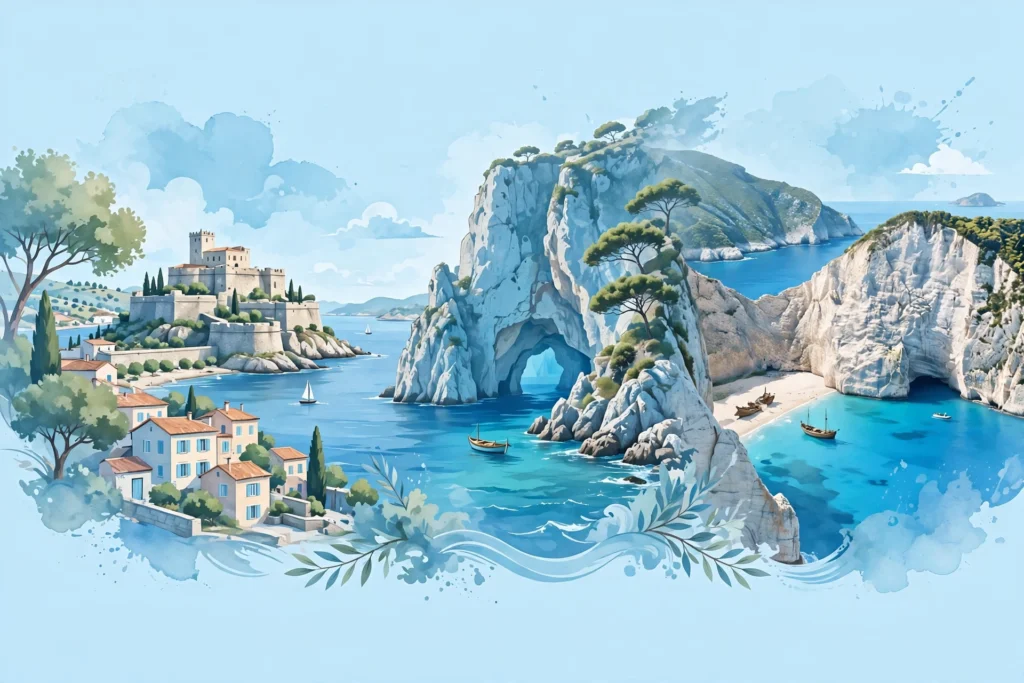
The Ionian islands are the other Greece: greener, wetter, Venetian rather than Cycladic, with Italianate towns, olive groves and cliff-backed beaches on the west coast of the mainland. They are the islands for travellers who have done the Cyclades and want something different, and they are closer to Italy than to Athens — which is why the food, the architecture and the pace all feel a little Italian. The three big ones — Corfu, Kefalonia and Zakynthos — each have a different character, and choosing between them is a matter of what kind of trip you want.
Corfu is an emerald island of Venetian forts, olive groves, turquoise bays and a refined Greco-Italian cuisine, and its old town is a UNESCO-listed maze of arcades, squares and fortresses. The island’s north-east coast, around Kassiopi, is quiet and green; the west coast has the big sandy beaches and the sunsets; and the south is where the package resorts cluster. Corfu is the easiest Ionian island to reach, with direct flights from much of Europe in summer and ferries from the mainland port of Igoumenitsa, and it is the best base for a first Ionian trip. Kefalonia is larger, wilder and emptier: the cliff-backed beaches of Myrtos and Antisamos, the underground lake of Melissani, the mountain villages of the interior, and a capital, Argostoli, that feels like a working town rather than a resort. It is the island for walkers and swimmers, and it needs a car. Zakynthos is the famous one, for one beach: Navagio, the shipwreck beach, a strip of white sand under limestone cliffs with a rusting wreck on it, reachable only by boat. It is spectacular and it is crowded, and the island beyond it — the Venetian town, the loggerhead turtle beaches of Laganas Bay, the blue caves — is quieter and better than the postcard suggests.
The Ionian islands are also the practical choice for a particular kind of trip: a fly-drive from Italy, a sailing holiday, or a late-season break. The season runs long here, the sea stays warm into October, and the islands are green in a way the Cyclades never are. The food is different too — pastitsada on Corfu, meat pies on Kefalonia, and a cuisine that owes as much to Venice as to Athens. If the Cyclades are the Greece of the postcard, the Ionian islands are the Greece of the novel, and they reward the traveller who stays a week rather than a weekend.
Which Ionian island?
Corfu for a first visit and for the old town, Kefalonia for beaches and walking and space, Zakynthos for the shipwreck beach and the turtles. All three are reached by direct flights in summer or by ferry from the mainland, and all three are best with a car. If you are combining the Ionian islands with the mainland, the route through Epirus — Ioannina, the Zagori villages and the Vikos Gorge — is one of the finest drives in Greece, and it turns an island trip into a proper journey.
Rhodes and the Dodecanese: Medieval Rhodes and Island Hopping
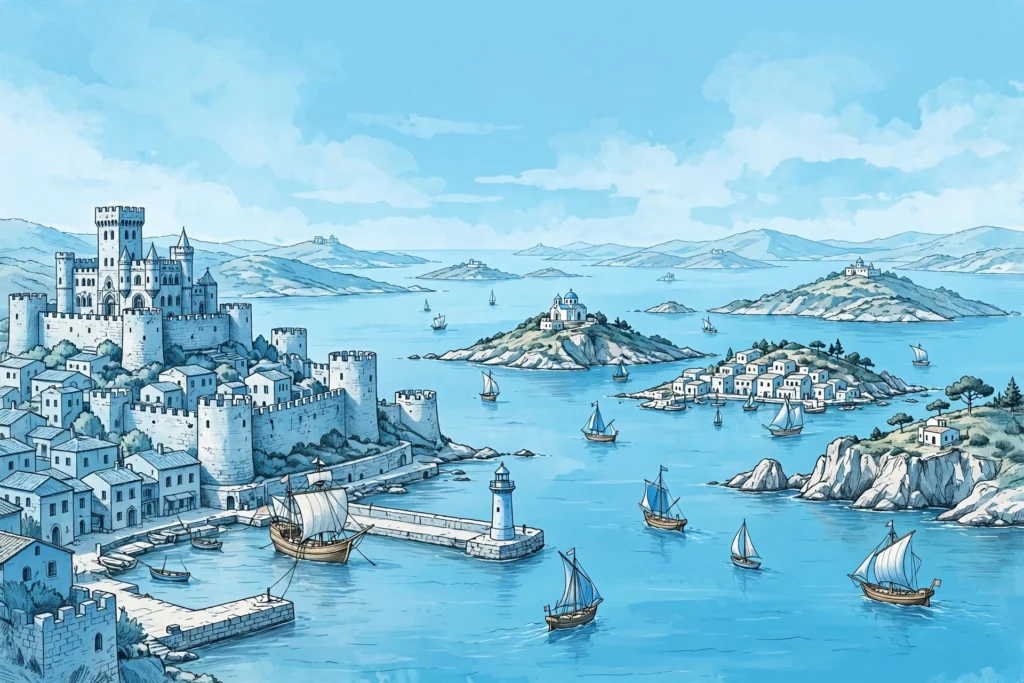
Rhodes is an island with a remarkably preserved medieval city built by the Knights Hospitaller, and it is the one Greek island where history, not the beach, is the reason to go. The Old Town is a walled city of cobbled streets, the Street of the Knights, the Palace of the Grand Master and the hospital of the knights, and it is one of the best-preserved medieval towns in Europe — UNESCO lists it, and walking it at dusk, when the day-trippers have gone, is one of the great experiences in Greece. Beyond the walls, the island is long and varied: Lindos, the white village under its own acropolis on the east coast, with a sandy bay below it; the Valley of the Butterflies in summer; the beaches of the east coast; and the wilder, windier west coast, where the surfers gather.
The Dodecanese, the island group Rhodes belongs to, is the least visited of the big Greek groups, and that is its appeal. The chain runs down the Turkish coast, and each island has a different story. Symi, a short ferry from Rhodes, is a harbour of neoclassical houses in pastel colours, with no cars in the main town and a monastery across the bay. Patmos is where St John wrote the Book of Revelation, and the monastery above the white town of Chora is a place of pilgrimage and of quiet. Kos is the birthplace of Hippocrates, with a castle, an ancient agora and long sandy beaches. Nisyros is a volcanic island with a crater you can walk into, and it is the strangest half-day in the Dodecanese. The ferries between them run through the summer, and the island-hopping here is slower and more local than in the Cyclades — which is the point, if you want Greece without the crowds.
Rhodes itself needs three or four nights: two for the Old Town and the new town, one for Lindos, and one for the rest of the island. The island is reached by direct flights from much of Europe in summer, by ferry from Piraeus, and by ferry from the Turkish coast, which makes it the natural end of a trip that starts in Athens and works east. The Dodecanese are also the warmest part of Greece in late season — the sea stays swimmable into late October, and the crowds thin earlier than in the Cyclades. If you have two weeks and you have already done the Cyclades, the Dodecanese are the next chapter, and Rhodes is where it begins.
Rhodes in three days
Day one in the Old Town: the Street of the Knights, the Palace of the Grand Master, the Archaeological Museum, and dinner inside the walls. Day two: Lindos in the morning, before the coaches, then the east-coast beaches in the afternoon. Day three: a ferry to Symi for the day, or the Valley of the Butterflies and the west coast. Add a fourth day and take the boat to Patmos or Nisyros — the Dodecanese reward the traveller who leaves Rhodes, not the one who stays.
Ferries, Flights, Buses and Driving: Getting Around Greece
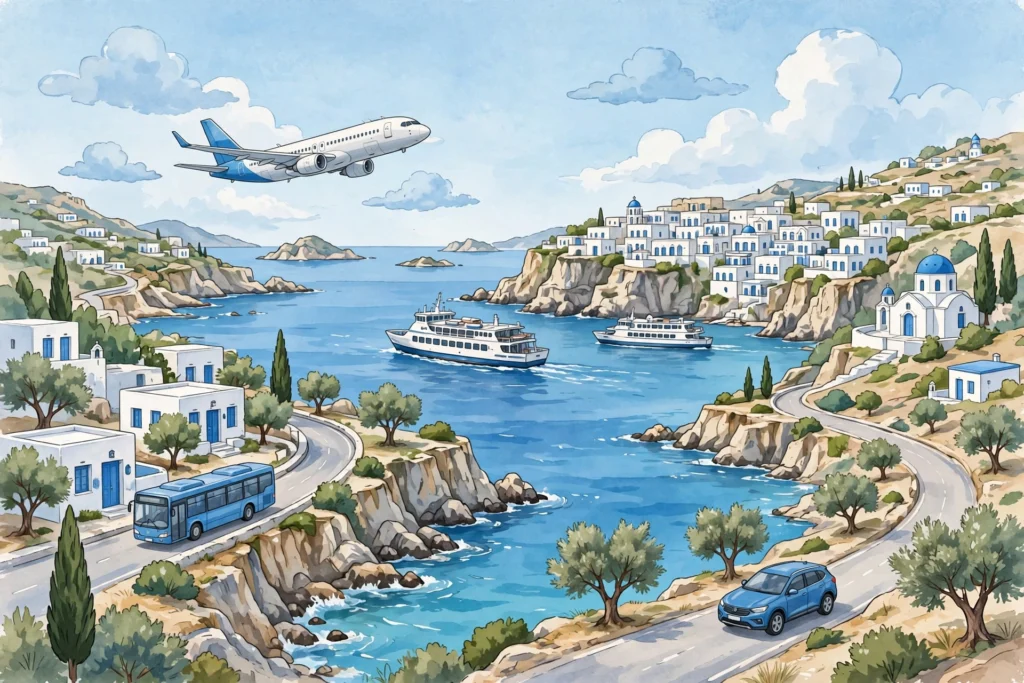
Getting around Greece is a system with four parts, and each part suits a different leg of the trip. The ferries carry the islands, the buses carry the mainland, the domestic flights skip the slow bits, and the hire car opens up everything the other three cannot reach. The mistake is to rely on only one of them. The trip that works uses all four: a flight into Athens, a ferry to the islands, a bus or a car on the mainland, and a flight home from the last island rather than a ferry back to Athens on the final day.
The ferries are the heart of it. Piraeus, Greece’s largest port, runs daily sailings to the Cyclades, the Dodecanese, Crete, the Saronic Islands and the North Aegean, all year. Rafina, smaller and close to the airport, runs many Cyclades crossings and some to Crete, and it is the practical port if you are flying in and heading straight to an island. The boats come in two kinds: conventional ferries, which are slower, cheaper, steadier in rough weather and take cars, and high-speed catamarans, which are faster, more expensive, and the first to be cancelled when the meltemi blows. Book Crete or Santorini crossings online a couple of months out in summer — turning up at the port in August is a good way to find the fast catamarans already sold out. From November to March there are far fewer sailings, most high-speed boats are laid up, and the smaller islands may have only a few boats a week, so check the timetable and build slack into the plan. Arrive at the port early, especially in peak season, because ferries move fast and the queues for vehicles are long. And never plan a tight connection on the day you fly home: the meltemi can cancel a catamaran for a day or more, and a missed flight costs more than a spare night in Athens.
The KTEL buses are the mainland’s backbone and they are better than their reputation. The intercity network is excellent: fares run to roughly five euros per 100 kilometres, buses keep to the timetable, and the air conditioning always works. They connect Athens to Delphi, Meteora, Nafplio, Olympia and Thessaloniki, and they are the cheapest way to do the mainland loop if you do not want to drive. The catch is that the buses serve towns, not sites — you will need a taxi or a walk for the last few kilometres to a monastery or a ruin — and the timetables are thinner on Sundays and in winter. Domestic flights link Athens to the larger islands — Heraklion and Chania on Crete, Rhodes, Corfu, Santorini, Mykonos, Zakynthos and Kefalonia — and Aegean and Sky Express start around €20 if you book well ahead. Hopping between islands is often faster and cheaper by air than by sea, and a flight from Santorini to Athens on the last day beats a five-hour ferry every time.
Driving in Greece is a pleasure and a test in equal measure. The islands really do open up with a car — Crete, the Peloponnese and the mainland are not properly visible without one — but Greek drivers are impulsive and treat some rules as suggestions, and the fines are not gentle: €350 for an unfastened seatbelt, and running a red light can cost you your licence. Greek police can ask for an International Driving Permit alongside a non-EU licence, and the fine for not carrying one runs into the hundreds, so check what your own licence needs before you fly and carry the permit if there is any doubt. Book the car through an aggregator rather than at the desk on arrival, read the deposit terms, which vary wildly between local suppliers, and photograph the car before you drive it away. On the islands, the roads are narrow and the parking is scarce in summer; on the mainland, the motorways are good and the mountain roads are slow and beautiful. Petrol costs roughly €2 per litre at the time of writing, so budget for it on a long road trip. Our guide to travel apps covers the maps, translation and transport apps worth having on your phone before you land.
| Transport | Best for | Booking | Watch out for |
|---|---|---|---|
| Conventional ferry | Cars, rough weather, cheaper crossings | Weeks ahead in summer | Slow — allow half a day per crossing |
| High-speed catamaran | Fast island hops | Months ahead in summer | First cancelled in the meltemi |
| KTEL bus | Mainland towns, budget travel | Day before or on the day | Thin timetables on Sundays and in winter |
| Domestic flight | Long jumps, last-day returns | Well ahead for €20 fares | Luggage limits on small planes |
| Hire car | Crete, Peloponnese, mainland, islands | Before you fly | International Driving Permit; deposits vary |
| Athens metro | Airport to city, city centre | On the day | Pickpockets on the airport and Piraeus lines |
Arriving and leaving
Athens International Airport is the main gateway, and metro line 3 reaches Syntagma in about 40 minutes. Thessaloniki, Heraklion and Chania are the other useful airports, and in summer Rhodes, Corfu, Santorini, Mykonos, Zakynthos and Kefalonia take direct flights from much of Europe, which saves a ferry or a connection through Athens. From North America there are seasonal nonstops to Athens; otherwise connect through London, Frankfurt, Paris or Istanbul. If your trip ends on an island, fly home from that island’s airport rather than ferrying back to Athens — the flight is usually cheaper than the night you would spend waiting for the boat.
When to Go to Greece: Best Months and Shoulder Seasons
Greece is a year-round destination, but the month you choose changes the trip more than almost anywhere else in Europe. The islands and the mainland run on different calendars, and the shoulder seasons — May and June, September and early October — are the golden months for almost every kind of traveller. The sea is warm at both ends, the crowds are a fraction of August, room rates are far kinder, and the sites are open long hours. July and August bring the most ferries, the most heat and the most people, and the trade is rarely worth it unless the dates are fixed. Winter is the secret season for Athens and the mainland, and the closed season for the small islands.
May and September are the best compromise in the whole calendar. In May the wildflowers are out, the sea is warming, the tavernas have opened and the beaches are empty. In September the sea is at its warmest, the crowds have gone, a good room costs roughly €60 where the identical room cost €150 in August, and the light is the best of the year. June is the other sweet spot: long days, warm water, and the summer season in full swing without the August crush. July and August are the peak, and they are the months to avoid if you can — Athens averages highs near 33°C and regularly passes 35°C, the Acropolis has closed at midday during heatwaves, the ferries are full, the rooms are at their most expensive, and the famous islands are at their most crowded. If you must go in August, book everything months ahead, take the earliest slots, and spend the middle of the day in the sea or in the shade.
Winter changes the map. From November to March, Athens, Thessaloniki and the mainland stay open and get quieter, cooler and cheaper — the Acropolis in January, with the hill to yourself and the light low over the city, is a different experience from the Acropolis in August, and the winter opening hours, 08:00 to 17:00, are still generous. The islands, though, slow down sharply: many hotels and tavernas shut, ferry links are reduced, and the smaller islands can feel half-closed. The larger islands — Crete, Rhodes, Corfu — stay open longer and are worth a winter trip for the walking, the food and the prices, but a small Cycladic island in February is a trip for the committed, not the casual. The official Greek tourism portal, Visit Greece, is the place to check what is open in the month you are travelling, because the season’s edges move a little every year.
| Month | Weather | Crowds | Prices | Best for |
|---|---|---|---|---|
| January–February | Cool, 10–15°C, rain possible | Very low | Lowest | Athens, mainland sites, city breaks |
| March | Mild, 15–18°C, spring begins | Low | Low | Athens, Thessaloniki, early walking |
| April | Warm, 18–22°C, wildflowers | Low–medium | Low–medium | Mainland, Delphi, Meteora, Easter |
| May | Warm, 22–26°C, sea warming | Medium | Medium | The golden month — everything open, few crowds |
| June | Hot, 26–30°C, sea warm | Medium–high | Medium–high | Islands, beaches, long days |
| July | Very hot, 30–35°C+ | High | High | Ferries and festivals — book months ahead |
| August | Hottest, 35–40°C in Athens | Highest | Highest | Only if dates are fixed; expect crowds |
| September | Warm, 26–30°C, sea warmest | Medium | Medium | The other golden month — best value |
| October | Mild, 22–26°C, sea still warm | Low–medium | Low–medium | Crete, Rhodes, Ionian islands, walking |
| November | Cool, 15–20°C, rain returns | Low | Low | Athens, mainland, late-season Crete |
| December | Cool, 10–15°C, festive Athens | Low | Lowest | City breaks, Christmas in Athens |
Festivals, holidays and the days to know
Greek Easter, which falls on a different date from Western Easter, is the biggest festival of the year, and the Holy Week processions on the islands are worth planning a trip around — but book early, because Greeks travel too. The 15th of August, the Feast of the Assumption, is the biggest summer holiday, and the islands fill with Greek families. The Athens and Epidaurus Festival runs through the summer, with performances in the ancient Odeon of Herodes Atticus under the Acropolis — check the programme before you go, because a night there is the best evening in Athens. And if you are travelling in winter, the first and third Sundays of the month from November to March are among the free-entry days at state sites, which is a genuine saving if your dates happen to fall on one.
What to Eat and Drink in Greece
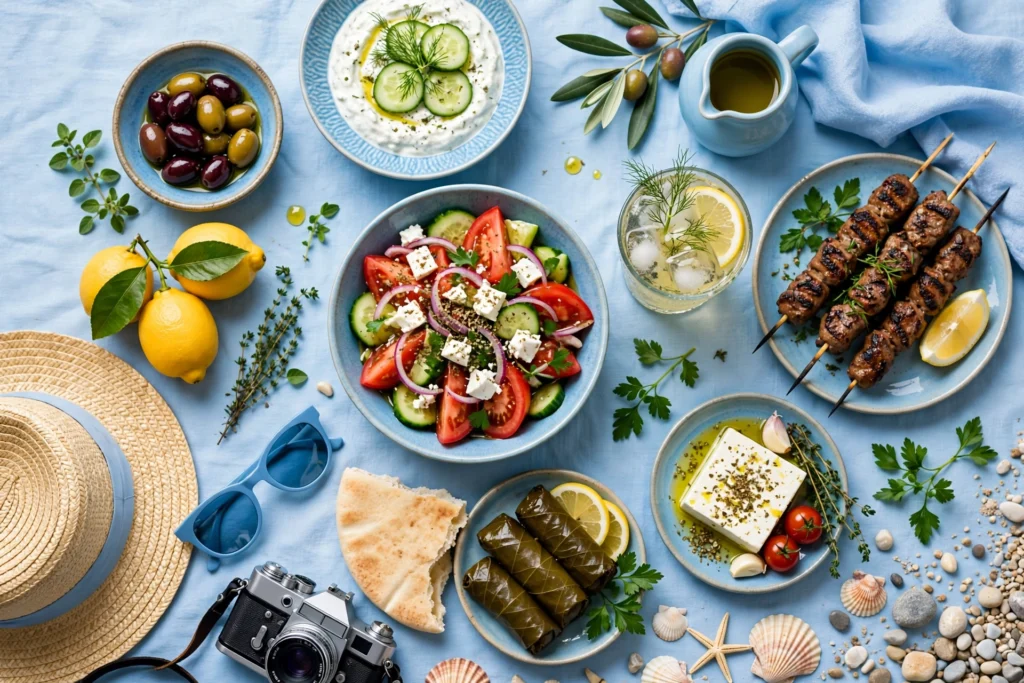
Greek cooking is about the freshness of the ingredients rather than clever technique, and the best places are the tavernas with paper tablecloths where Greeks themselves eat lunch. The principle is simple: a salad and one hot dish frequently feeds two people, portions are enormous, almost always, and asking to take the rest away is completely normal and nobody blinks. Many tavernas close through the afternoon and reopen around eight, so get used to eating late, because that is when the food and the company are at their best. And the meal rarely ends when you expect it to: family tavernas often bring a free dessert or a shot of homemade liqueur after the meal, a genuine gesture of hospitality — philoxenia — and refusing it is not really done.
Start with the dishes that define the country. Moussaka, the baked dish of eggplant, spiced ground meat and creamy béchamel, is the one everyone knows, and the one most worth ordering where it is made fresh rather than reheated. Souvlaki is the street food of Athens: grilled meat, usually chicken, wrapped in warm pita with tomatoes, onions, fries and tzatziki, for three or four euros, sold on every corner well into the small hours. The Greek salad — horiatiki — is tomatoes, cucumber, onion, olives and a generous slab of feta, with no lettuce in sight, and it is the dish that tells you whether a taverna is serious. Tzatziki, taramasalata, aubergine dip, grilled feta, olives and bread arrive as meze to share, and the meal is built around them rather than around a main course. On Crete, dakos is the signature: a barley rusk base with fresh tomato, crumbled white cheese, olive oil and oregano. On Santorini, tomatokeftedes are the fried tomato fritters made with local cherry tomatoes and herbs, crisped up and golden. And for dessert, loukoumades are fried dough balls soaked in honey syrup and sprinkled with cinnamon, best eaten hot from a shop that makes nothing else.
Seafood is the other half of the table, and it has a rule: order mussels and octopus only in dedicated fish tavernas rather than generic tourist places. At the market, a kilo of very fresh mussels costs about four euros, and the fish tavernas by the harbour are where the catch is cooked simply — grilled, with lemon and olive oil, and nothing else. The drinks are part of the meal too. Try a frappe, the whipped iced coffee that locals nurse for hours, and the Greek coffee, thick and sweet, that arrives in a small cup with the grounds at the bottom. For something stronger, ouzo is light with an anise flavour, best over ice with a plate of something salty, and tsipouro is more robust and fruity. The wines have improved enormously: Assyrtiko from Santorini is the white to ask for, and the reds from Nemea and Naoussa are the ones to try with grilled meat. In season, nectarines, peaches and figs cost one to one and a half euros a kilo at the market — cheaper and infinitely better than the supermarket version.
How to eat well and spend less
Eat where Greeks eat lunch, away from the main streets and the waterfronts, and look for the handwritten menu, the paper tablecloths and the absence of a tout outside. Order meze to share and one hot dish between two, and you will eat better for less than a three-course meal at a tourist restaurant. Drink the house wine, which is usually local and good, rather than the imported label. Buy fruit, bread, cheese and olives at the market for a picnic lunch, and save the restaurant budget for dinner. And learn the rhythm: lunch is late, dinner is later, and the bill — siga siga, slowly, slowly — does not arrive quickly, because the point is to sit there enjoying it. If you are still deciding what to eat on your first night, the rule that never fails is to walk two streets back from the water and choose the place with the most Greek voices inside.
How Much a Greece Trip Costs and Where to Stay
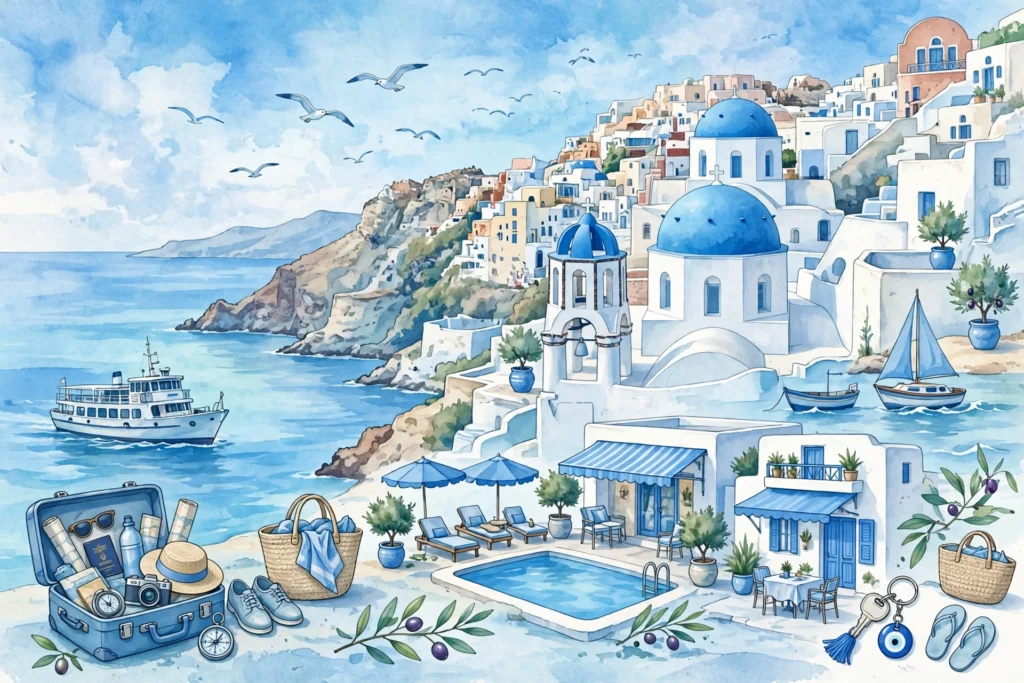
Greece is one of the best-value destinations in western Europe, and it is also one of the easiest to overspend in, because the gap between May and August, between a village room and a caldera view, and between a taverna lunch and a beach-club dinner is enormous. The honest answer to what a trip costs is that it depends on the month and the island more than on anything else. A good room costs around €60 in May and €150 for the identical thing in August, and September is the best compromise: warm sea, sane prices. The figures below are planning ranges in euros, not live prices — check the total at booking, because the season’s edges move every year.
A budget traveller can manage on roughly €50–80 a day before big-ticket items: a hostel bed or a simple room, gyros and market food, buses and the metro, and the free pleasures — the beaches, the walks, the sunsets — which in Greece are the best things and cost nothing. A mid-range traveller should budget roughly €110–190 a day: a comfortable double room, taverna dinners, a hire car for part of the trip, ferry crossings and site entries. A comfort traveller should plan from €250 a day: a boutique hotel or a caldera-view room, guided tours, private transfers and the better restaurants. Budget separately for the big-ticket items: the Acropolis at €30, a caldera boat trip at roughly €40–80, a domestic flight at €20–80 if booked early, and a hire car at roughly €25–40 a day in season. All figures in this guide are planning ranges, and the cheapest lever you have is the month: the same trip in September costs roughly a third less than the same trip in August.
| Daily budget | Accommodation | Food | Transport | Total per day |
|---|---|---|---|---|
| Budget | Hostel or simple room, €25–45 | Gyros, markets, bakeries, €15–25 | Buses, metro, walking, €5–10 | €50–80 |
| Mid-range | Comfortable double, €70–120 | Taverna lunches and dinners, €30–45 | Ferries, hire car some days, €15–25 | €110–190 |
| Comfort | Boutique or caldera-view room, €150–300 | Restaurants, wine, €50–80 | Private transfers, tours, €30–50 | €250–400+ |
| Big-ticket items (separate) | Acropolis €30 | Caldera boat €40–80 | Domestic flight €20–80 | Hire car €25–40/day |
Money tips that save real euros
Arrive with euros or use an ATM, and never change money at a private exchange office in a tourist area. Always choose to be billed in euros when a card terminal asks. Book the ferry and the hotel together, because the island you can reach cheaply is the island you can afford to stay on. Travel in May, June, September or October, and the same trip costs a third less. And keep some cash: village bakeries, farmers’ markets, beach loungers and taxis often want notes, and a small island may have only one or two cash machines. If you are weighing Greece against other Mediterranean trips, our best travel destinations guide compares the options, and the dream travel destinations list is the place to start if Greece is the first of several trips you are planning.
Frequently Asked Questions About Greece Travel
How many days do you need in Greece?
Ten days suits a first trip: two or three nights in Athens, then two islands in one group, such as Naxos and Santorini in the Cyclades, joined by ferry. A week covers Athens and a single island well. Two weeks adds the mainland, with Delphi and Meteora by road, or the Peloponnese loop through Nafplio, Mycenae and Olympia. Crete alone can fill a week.
What is the best time to visit Greece?
May, June, September and early October are the most comfortable months: the sea is warm, the sites are open long hours and the islands are fully running. July and August bring the most ferries and the most heat, with Athens averaging highs near 33°C and regularly passing 35°C, and the Acropolis has closed at midday during heatwaves. From November to March many island hotels and tavernas shut, while Athens, Thessaloniki and the mainland stay open.
Do US citizens need a visa for Greece?
No. US passport holders enter Greece visa-free for tourism for stays of up to 90 days in any 180-day period under the Schengen rules, and your passport should be valid for at least three months beyond your date of departure. The EU’s Entry/Exit System now records non-EU travellers on arrival, and the separate ETIAS authorisation is expected to start in 2027 — check the official EU page before you fly.
How do I buy Acropolis tickets?
Buy them online on the official Hellenic Heritage platform, tickets.hh.gr, as early as you can — the 08:00 slot sells out days ahead from spring to autumn. A standard adult ticket costs €30 and a reduced ticket €15, the same price all year, and every ticket carries a specific one-hour entry slot. The ticket is non-refundable, and the platform’s terms allow limited changes, so check the rules in the checkout at the moment you book.
Is Greece safe for tourists?
Greece is a generally safe destination and most trips go smoothly. The US State Department rates the country at Level 1: Exercise Normal Precautions, issued 19 February 2026. The most common problems are pickpocketing on the Athens metro and around busy sites, and the heat in July and August — not violence. Demonstrations can occur with little notice and disrupt transport, so check local news on the day.
How do I get between the Greek islands?
By ferry, from Piraeus or Rafina, with conventional ferries and faster high-speed catamarans. Book Crete or Santorini crossings online a couple of months out in summer, because the fast boats sell out, and remember that from November to March there are far fewer sailings and most high-speed boats are laid up. Domestic flights link Athens to the larger islands and are often faster and cheaper than a ferry for a long jump.
How much does a Greece trip cost?
A budget traveller can manage on roughly €50–80 a day before big-ticket items; a mid-range traveller should budget roughly €110–190 a day; a comfort traveller should plan from €250 a day. Budget separately for the Acropolis (€30), a caldera boat trip (€40–80), a domestic flight (€20–80 if booked early) and a hire car (€25–40 a day). The same trip in September costs roughly a third less than in August.
What currency is used in Greece?
The euro. Cards — Visa and Mastercard, contactless included — are accepted almost everywhere in Athens, Thessaloniki and the larger islands, including most tavernas. Cash is still needed at village bakeries, farmers’ markets, beach loungers, kiosks and many taxis, and 200 and 500 euro bills are effectively unusable, so break large amounts at a bank.
Do I need to speak Greek in Greece?
No. English is widely spoken in tourist areas, hotels, on ferries and at the major sites, and menus are printed in English everywhere. A few words — kalimera for good morning, efharisto for thank you, parakalo for please — are noticed and repaid, especially away from the resorts, and road signs and metro stations are duplicated in Latin script.
Which Greek island should I choose first?
Santorini for the caldera and the sunset, Mykonos for nightlife and beach clubs, Naxos for the most complete island holiday, Paros for the sweet spot between lively and calm, Crete for a full week of palaces, gorges and beaches, and Rhodes for a medieval city and the Dodecanese. The best first trip pairs one famous island with one quiet one — Santorini plus Naxos, or Mykonos plus Paros.
Can I drive in Greece with a US licence?
Yes, but Greek police can ask for an International Driving Permit alongside a non-EU licence, and the fine for not carrying one runs into the hundreds, so carry the permit if there is any doubt. Driving is on the right, the motorways are good, the mountain roads are slow and beautiful, and fines are not gentle — €350 for an unfastened seatbelt. A car is essential on Crete and the Peloponnese, and useful on the larger islands.
What should I pack for Greece?
Light layers and breathable fabrics, a hat and sunscreen — the Aegean sun burns fast — trainers with real grip for the slippery marble on ancient sites, a light sweater or scarf for churches and monasteries, a day pack, a reusable water bottle and a power bank. Tap water is fine to drink in Athens and on Crete, but on the smaller islands it can be brackish, so buy bottled there. Add travel insurance that covers water sports and scooter hire, because standard policies often exclude both.
Conclusion: Greece Is a Trip You Plan Once and Remember for Years
Greece is not a country you tick off in a weekend, and that is the point. It is a place where a single journey holds a 5th-century temple on a rock above a modern city, a drowned volcano you can sail across, monasteries balanced on pillars of stone, a gorge you walk for a full day to reach the sea, a medieval city inside walls built by knights, and a taverna table where the food arrives late and nobody minds. The trips that go well are the ones planned the way this greece travel guide is built: the hard bookings first — the Acropolis timed ticket, the ferry, the summer room — then the shoulder season chosen, then the rest left flexible enough to bend around the meltemi and a ferry that runs late. Book the rock at eight in the morning, give the islands time instead of rushing them, eat where the Greeks eat, and let the country set the pace. Greece rewards the traveller who arrives prepared and then stops hurrying, and the memories that last are rarely the ones on the checklist: the light on the Parthenon at first light, the cliffs of the caldera from inside the crater, the quiet of a mountain monastery at opening time, the pink sand at Elafonissi at the end of a long day. Plan it once, plan it properly, and go.
People also read:
- Dream Travel Destinations
- Best Travel Destinations
- Luxury Travel Destinations
- Ecuador Travel Guide
- Tanzania Travel Guide
- Best Places to Travel in January
- Best Places to Travel in December
- How to Prepare a Travel Budget
- Travel Itinerary Template
- Travel Apps

M. Adil is the founder and editor of SoloTravelPro. He writes practical, research-based travel guides that help travellers plan with confidence — from first-time city breaks to national parks and island escapes. Every guide is built on official sources, current prices and honest, usable advice, so readers can plan smarter and travel better.

Other Articles

Travel Safety Tips: 60+ Ways to Stay Safe While Traveling in 2026–27
Egypt Travel Guide: Pyramids, the Nile, Luxor and the Red Sea (2026–27)