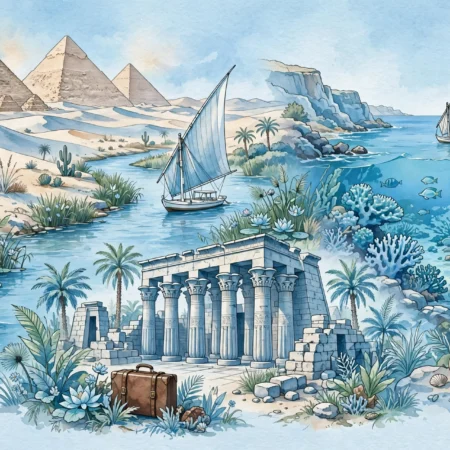
Egypt is the oldest bucket-list destination on Earth: the last surviving Wonder of the Ancient World standing on the edge of a modern city, a river valley crowded with more temples and tombs than anywhere else on the planet, a brand-new museum holding the complete treasure of Tutankhamun, and a coral coast that rivals any tropical island for diving. This egypt travel guide covers everything a first-time visitor from the United States needs — the Pyramids of Giza and the Grand Egyptian Museum, Cairo, Saqqara and Dahshur, Luxor and the Valley of the Kings, Aswan and Abu Simbel, a Nile cruise between Luxor and Aswan, the Red Sea resorts, Alexandria and the Western Desert, the best months to go, realistic costs in Egyptian pounds, safety and scams, and ready-made 7, 10 and 14-day itineraries — so you can plan the trip in one place and travel it without surprises.
How to Plan Your Egypt Trip: First Steps
Egypt rewards the traveller who books the hard things first and leaves the rest flexible. Four bookings decide whether your trip works: your international flights, your Grand Egyptian Museum timed-entry ticket, your Nile cruise cabin if you want one, and your domestic flights between Cairo, Luxor and Aswan. Everything else — hotels in Cairo and Luxor, day tours, felucca rides, Red Sea diving — can be sorted weeks or even days ahead. The mistake first-timers make is treating Egypt like a country you can improvise in full. You can improvise in Cairo and in Dahab. You cannot improvise a Nile cruise in December, and that is the first thing this egypt travel guide wants you to understand.
Start with the three decisions that shape everything else. First, how many days you have. Seven days covers Cairo and Giza, Luxor and Aswan at a reasonable pace, with Abu Simbel as a long day trip. Ten days adds a three- or four-night Nile cruise between Luxor and Aswan, which is the classic way to see the temples between the two cities. Fourteen days lets you add the Red Sea coast or the Western Desert without rushing, and that is the trip most first-timers actually want once they start reading. Second, when you will go, because the difference between January and July in Luxor is the difference between a comfortable morning among the tombs and a 45-degree afternoon that empties the temples — the month-by-month guide later in this article lays that out in full. Third, how you will move between the Nile Valley cities, because Egypt is a long, thin country and the distances are bigger than the map suggests: Cairo to Luxor is about 650 kilometres, and the overnight sleeper train takes most of the night.
The entry rules for US citizens are straightforward and worth getting right before you book anything non-refundable. US passport holders can buy a visa on arrival at Egyptian airports for US$25, valid for a single entry of up to 30 days, or apply in advance for an e-visa on the official portal visa2egypt.gov.eg. Your passport should be valid for at least six months beyond your arrival date. Travellers staying only in the South Sinai resorts of Sharm El Sheikh, Dahab and Nuweiba for up to 15 days may enter on a free Sinai-only stamp instead, but that stamp does not cover travel to Cairo, Luxor or the rest of Egypt, so most first-timers should simply buy the full visa. The US State Department rates Egypt at Level 2: Exercise Increased Caution, in an advisory issued on 15 July 2025 and still in force when checked in November 2026, citing terrorism, crime and health, with a Do Not Travel rating only for the Northern and Middle Sinai Peninsula, parts of the Western Desert without a licensed tour company, and Egyptian border areas that are military zones. Cairo, Giza, Luxor, Aswan, the Nile cruise route and the Red Sea resorts are not in the affected areas. Read the full text on the US State Department Egypt travel advisory page before you book, and check it again before you fly, because advisories change.
Money is the next practical piece. The currency is the Egyptian pound (EGP), locally called the geneih and written LE, and all prices in this guide are given in pounds as planning figures, with rough US dollar equivalents where they help. The pound has traded around EGP 50 to the US dollar in late 2026, so build slack into your sums rather than budgeting to the last pound, and check the live rate before you travel because it moves. Cash still matters more than in the United States: markets, small restaurants, taxis, felucca captains and rural guesthouses are often cash only, while hotels, larger restaurants and chain shops take cards. Visa and Mastercard are accepted without fuss in cities and resorts; American Express much less so. ATMs are widespread in Cairo, Luxor, Aswan and the Red Sea towns, but always decline the machine’s own currency conversion and take the local-currency option. Tipping, known as baksheesh, is part of daily life in Egypt in a way it is not in most other destinations: small notes for guards, drivers, guides, bathroom attendants and hotel staff are expected almost everywhere, so carry a pocketful of small pound notes at all times. A 10 to 15 percent tip in restaurants where no service charge appears is normal. If you like to plan on paper, a ready-made itinerary template and a simple travel budget plan will help you turn this guide into a day-by-day schedule before you leave.
| Egypt at a glance | Detail |
|---|---|
| Capital | Cairo |
| Language | Arabic; English widely spoken in tourist areas |
| Currency | Egyptian pound (EGP, LE); roughly EGP 50 to US$1 in late 2026 |
| US entry | Visa on arrival US$25 for 30 days, or e-visa in advance; passport valid 6 months |
| Best months | October to April for sightseeing; the Red Sea all year |
| Getting around | Domestic flights, overnight sleeper trains, Nile cruises, Uber and Careem in cities |
| Emergency numbers | 122 police, 123 ambulance, 126 tourist police |
| Power | 220V, plugs Type C and F — US travellers need an adapter |
| Time zone | Egypt Time (GMT+2), with daylight saving (GMT+3) in summer |
| US State Dept advisory | Level 2: Exercise Increased Caution, issued 15 July 2025, still current November 2026; Level 4 for Northern and Middle Sinai and parts of the Western Desert only |
How many days do you need in Egypt?
Most first-time visitors need 10 to 14 days. With 7 days, spend three nights in Cairo for Giza, the Grand Egyptian Museum, Islamic and Coptic Cairo and Saqqara, then fly to Luxor for two nights and Aswan for two, with Abu Simbel as an early-morning day trip. With 10 days you can replace the Luxor-to-Aswan hop with a three- or four-night Nile cruise, stopping at Edfu and Kom Ombo, which is the single most relaxing way to see the temples. With 14 days you can add four or five nights on the Red Sea at Hurghada, Marsa Alam or Dahab, or two or three nights in the Western Desert at Siwa or the White Desert. Allow an extra day in Cairo if the Grand Egyptian Museum matters to you — it deserves a full day, not a rushed morning. Egypt is a long country with slow desert roads, so the honest rule is the same as everywhere else on this site: fewer places, more time in each, rather than a new city every night. The itineraries below are the skeleton; the chapters that follow fill in every stop.
| Itinerary | Days | Route |
|---|---|---|
| The classic first trip | 7 | Cairo and Giza (3 nights) — Luxor (2 nights) — Aswan (2 nights), Abu Simbel day trip |
| The Nile cruise trip | 10 | Classic 7 days, with a 3–4 night Nile cruise from Luxor to Aswan replacing the overland hop |
| The full trip | 14 | Cruise trip plus 4 nights on the Red Sea at Hurghada, Marsa Alam or Dahab |
| The desert trip | 14 | Classic 7 days, then 3 nights in the White Desert and Siwa Oasis instead of the Red Sea |
| The slow trip | 18+ | Full 14 days plus Alexandria (2 nights) and Mount Sinai and St Catherine’s Monastery (2 nights) |
Getting to Egypt from the United States
Cairo International Airport is the main gateway, with Luxor, Hurghada, Sharm El Sheikh and Marsa Alam also receiving international flights, many of them seasonal charters from Europe. From the United States, EgyptAir flies nonstop from New York to Cairo in roughly 11 hours, or you can connect through European or Gulf hubs such as Istanbul, Doha or Dubai, which often works out cheaper and opens up more departure cities. Book the nonstop if you can: arriving in Cairo rested matters, because your first day will probably include the pyramids. Cairo airport to central Cairo takes 45 minutes to an hour and a half depending on traffic, so arrange a hotel transfer or use Uber or Careem from the terminal rather than haggling with the taxi queue at arrivals. Domestic flights save the most time inside Egypt: Cairo to Luxor is about an hour in the air against nine or ten hours by road, and EgyptAir runs several flights a day on the Cairo–Luxor and Cairo–Aswan routes. The overnight sleeper train between Cairo, Luxor and Aswan is the romantic alternative and a genuine experience in its own right, but book a proper sleeper cabin rather than a seat, and expect to arrive early in the morning.
What to pack for Egypt
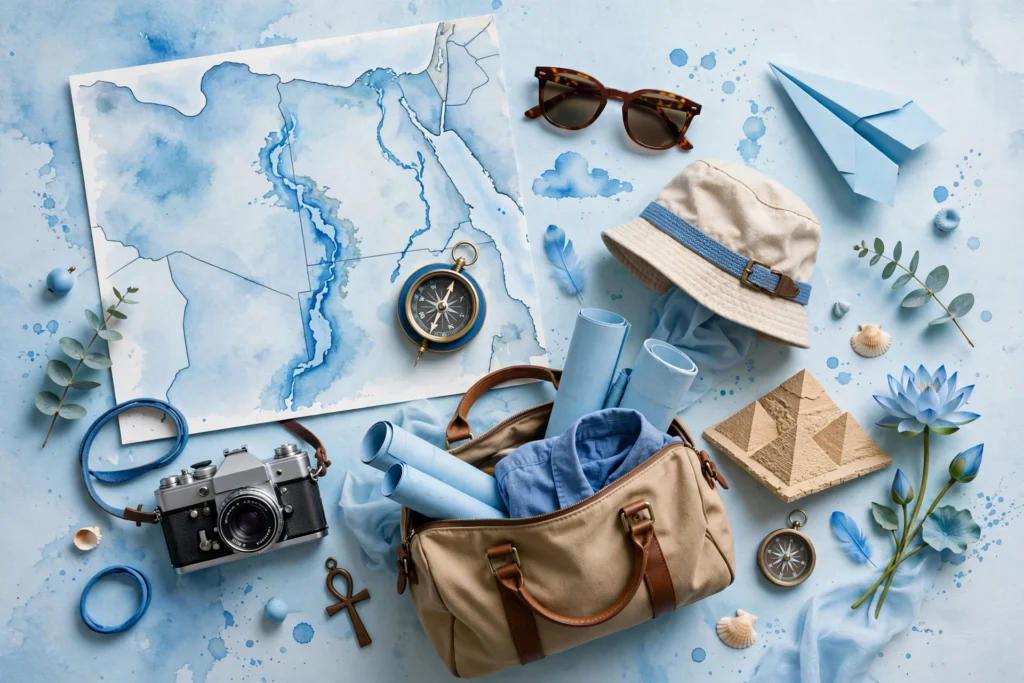
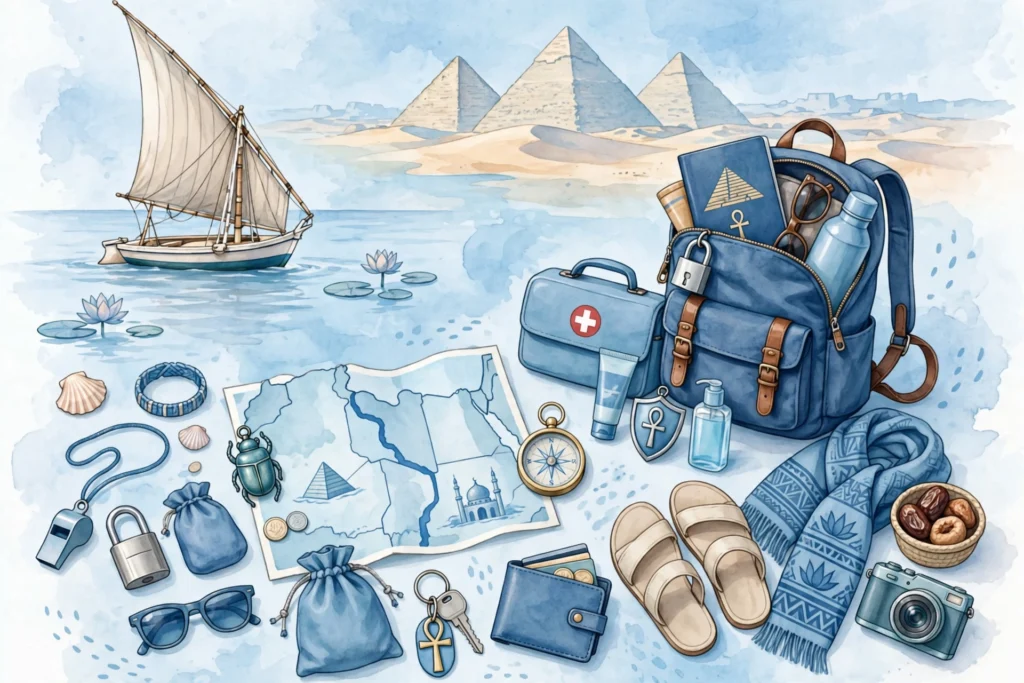
Egypt is a country of two climates in one trip, and your bag has to cover both. The Nile Valley is warm and dry by day from October to April and ferociously hot from May to September, while nights in Cairo and the desert can be genuinely cold in December and January, and the summit of Mount Sinai at dawn is cold at any time of year. Pack layers rather than one heavy coat: light, loose, breathable cotton for the days, a warm fleece for the evenings and the desert, and a scarf or shawl that covers shoulders for mosque visits and doubles as sun protection. Sun protection matters more than most visitors expect: the desert sun is strong even in winter, there is almost no shade at Giza or in the Valley of the Kings, and a hat, sunglasses and high-factor sunscreen are daily essentials. Good walking shoes with grip are non-negotiable for temple steps, uneven tomb floors and desert sand. Bring a day pack, a reusable water bottle, a power bank, and a small first-aid kit with rehydration salts and stomach remedies. Drink bottled water everywhere, including for brushing your teeth in smaller towns, and be careful with ice and raw salads outside the larger hotels. Travel insurance should cover medical evacuation, because emergency and intensive care facilities are limited outside Cairo and ambulances are rare and unreliable in remote areas — the guide to what travel insurance covers explains what to look for in a policy.
The Pyramids of Giza and the Great Sphinx
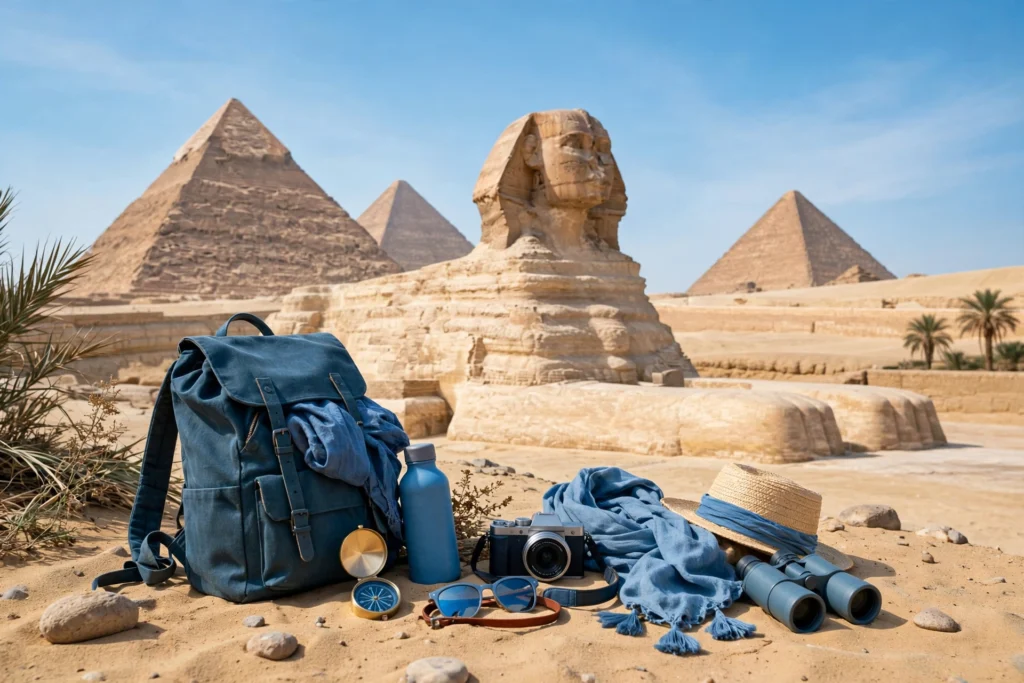
The Pyramids of Giza are the reason most people come to Egypt, and they are also the part of the trip that most often disappoints first-timers who arrive unprepared — not because the pyramids disappoint, but because the experience around them does. Go at opening time, go with a plan, and go knowing what you are looking at, and the morning will be one of the great travel days of your life. Go at midday in July with no plan, and you will remember the heat and the touts instead of the stones. This is the one chapter of this egypt travel guide to read twice.
The three pyramids on the Giza plateau are the tombs of the Fourth Dynasty kings Khufu, Khafre and Menkaure, built around 4,500 years ago on the edge of the Western Desert, just outside modern Cairo. The Great Pyramid of Khufu is the largest of the three and the only surviving Wonder of the Ancient World, standing about 139 metres tall today after losing its smooth limestone casing and its capstone over the centuries. Khafre’s pyramid looks taller because it stands on higher ground and keeps a cap of its original casing near the top. Menkaure’s is the smallest of the three and the easiest to walk all the way around. The Great Sphinx, a colossal lion with a pharaoh’s face carved from a single ridge of limestone, guards the plateau at the end of a ceremonial causeway, and the panoramic viewpoint on the south-west edge of the plateau is where the classic photograph is taken — all three pyramids in a line against the desert, with the city behind you. Together with the pyramid fields from Giza to Dahshur, the plateau is part of the UNESCO World Heritage site of Memphis and its Necropolis, inscribed in 1979, and UNESCO’s own description calls the Great Pyramid one of the most important monuments in the history of humankind.
The practical side matters as much as the history. Arrive at the 8 a.m. opening, or as close to it as you can, and head for the panoramic viewpoint first while the light is soft and the plateau is quiet; by midday the tour buses have arrived and the viewpoints are full. A licensed guide is worth the money here more than anywhere else in Egypt: the plateau is large, the signage is thin, and the difference between a pile of stones and a 4,500-year-old royal cemetery is the story. Agree the price, the route and the duration before you set off, and make sure your guide is licensed — the plateau is also where Egypt’s most persistent touts work, offering camel rides, horse rides and photographs at prices that multiply once you are on the animal. The honest rule is simple: agree every price in pounds before you mount anything, pay nothing in advance, and walk away from any offer that starts with a free photograph. Inside the Great Pyramid, the climb to the King’s Chamber is a steep, narrow, hot passage that takes about 20 minutes up and down; it is claustrophobic and not for everyone, and the chamber itself is bare. Most visitors are happier spending that time at the Solar Boat Museum, now part of the Grand Egyptian Museum, or walking the plateau. Allow three to four hours for the plateau itself, and a full day if you combine it with the Grand Egyptian Museum, which sits about two kilometres away on the desert road and is covered in the next chapter.
Giza in one morning: a plan that works
Start at the main entrance near the Mena House end of the plateau, walk up to the Great Pyramid and around its base, then to Khafre’s pyramid and the Sphinx, and finish at the panoramic viewpoint for the wide photograph. If you have booked a camel ride, do it at the viewpoint, where the animals are part of the scene and the price is easiest to fix in advance. Eat lunch after the plateau, not before: the restaurants around the plateau are overpriced and underwhelming, while central Cairo is 30 minutes away and has some of the best food in the country. The best months for Giza are October to April, when the desert air is clear and the light is at its best; in summer, go at opening and be finished by late morning, because there is almost no shade on the plateau and the stone radiates heat by noon. Photography is allowed across the plateau, but tripods and drones need permission, and always ask before photographing people. If you only have one morning in Egypt, spend it here — and spend it early.
| Giza at a glance | Detail |
|---|---|
| What it is | Tombs of Khufu, Khafre and Menkaure, Fourth Dynasty, about 4,500 years old |
| Great Pyramid | About 139 m tall today; the only surviving Wonder of the Ancient World |
| Sphinx | Colossal lion with a pharaoh’s face, carved from a single limestone ridge |
| Opening | Daily from 8 a.m.; go at opening for light and quiet |
| Time needed | 3–4 hours for the plateau; a full day with the Grand Egyptian Museum |
| Best months | October to April; in summer, finish by late morning |
| Watch out for | Camel and horse ride prices agreed after mounting; free-photograph offers |
The Grand Egyptian Museum: What to See and How to Book
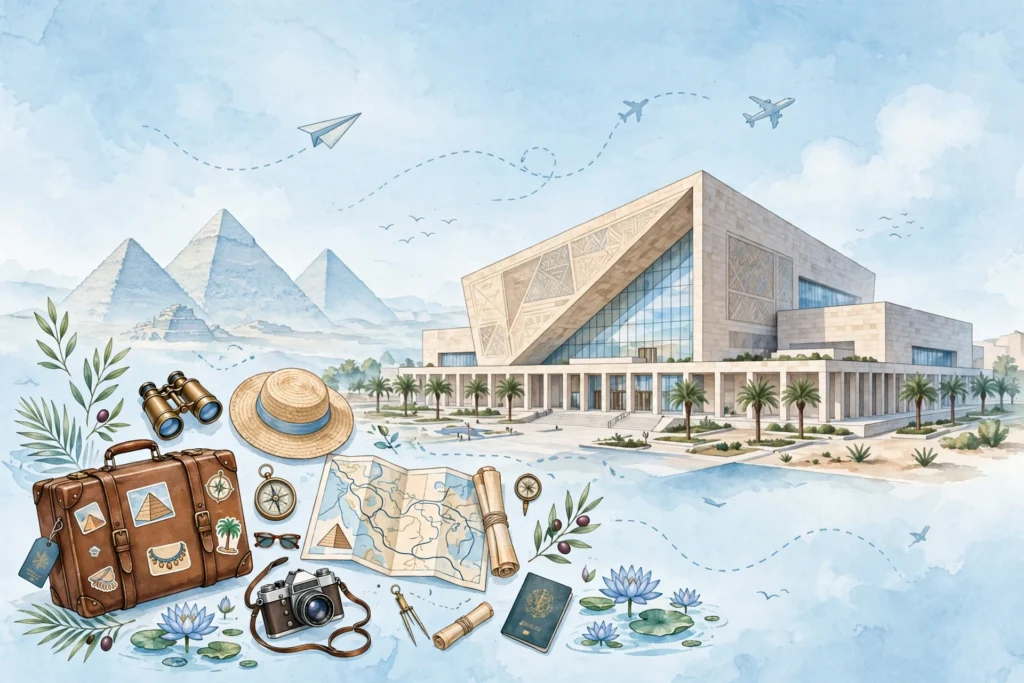
The Grand Egyptian Museum, always called the GEM, is the single biggest change to an Egypt trip in a generation, and the reason many travellers are rebuilding their Cairo itineraries around it. After more than two decades of construction and delay, the museum was officially inaugurated on 1 November 2025 and opened in full to the public on 4 November 2025, with the Tutankhamun galleries open for the first time. It stands on the desert road about two kilometres from the pyramids of Giza, and it is now the largest archaeological museum in the world, holding the complete treasure from Tutankhamun’s tomb — more than 5,000 objects — displayed together in one place for the first time since Howard Carter’s excavation in the 1920s. If you are visiting Egypt in 2026 or 2027, the GEM is not an optional extra. It is the centrepiece of Cairo, and it deserves a full day.
The building itself is part of the experience. The Grand Hall is dominated by the colossal statue of Ramesses II, moved here from Cairo’s Ramses Square, and the Grand Staircase rises through the building past monumental statues towards a window framing the pyramids in the distance — the museum was designed so that the ancient and the modern face each other across two kilometres of desert. Inside, the main galleries tell the story of ancient Egypt chronologically, from the earliest settlements to the Roman period, and the Tutankhamun galleries hold the golden burial mask, the nested coffins, the throne, the chariots and the jewellery, all in one sequence. The Khufu boats, the great wooden vessels buried beside the Great Pyramid, are displayed in their own hall. Allow three to five hours as a minimum and a full day if you like museums; the galleries are large, the collection is enormous, and rushing it is the most common regret visitors report.
Booking is where most first-timers go wrong, so get this right. Tickets are sold for a set date and entry time on the museum’s official ticketing site, tickets.gem.eg, and the museum says it is not responsible for tickets bought anywhere else — lookalike sites exist, so use only the official portal linked from the museum’s own website, gem.eg. Booking online is the main route and a daily visitor limit applies, so book ahead, especially in the December to February peak. A ticket for a foreign adult costs EGP 1,830 from 1 November 2026, and EGP 920 for a foreign student or child, with children under six free; prices are set in Egyptian pounds and do change, so confirm the exact figure on the official ticketing site at the moment you book rather than relying on any figure in a guide, including this one. The galleries are open from 9 a.m. to 6 p.m. on Sunday, Monday, Tuesday, Thursday and Friday, and from 9 a.m. to 9 p.m. on Wednesday and Saturday; the grounds open at 8:30 a.m. Your ticket sets the time you go in, not how long you may stay, and tickets are non-refundable and non-transferable. Photography rules vary by gallery, so check the signs in each room, and bring your passport or student ID if you are claiming a student price.
The old Egyptian Museum on Tahrir Square is still open and still worth an hour or two for its atmosphere and its mummies of the great kings, but the centre of gravity has moved to Giza: the Tutankhamun treasure and the finest pieces are now at the GEM, and the Tahrir museum is best visited as a companion, not a substitute. Combine the GEM with the pyramids in a single day only if you are disciplined — pyramids at opening, GEM from late morning — and expect to be tired by the end of it. Most travellers are happier giving the GEM its own day, with a slow lunch in Zamalek or Downtown Cairo afterwards. If you are choosing between a guide for the pyramids and a guide for the museum, choose the museum: a good Egyptologist turns a hall of beautiful objects into a story, and the Tutankhamun galleries in particular repay an hour with someone who knows them.
| Grand Egyptian Museum at a glance | Detail |
|---|---|
| Where | Giza, on the desert road, about 2 km from the pyramids |
| Opened in full | 4 November 2025 (inaugurated 1 November 2025); Tutankhamun galleries included |
| Foreign adult ticket | EGP 1,830 from 1 November 2026; student/child EGP 920; under 6 free |
| Booking | Timed entry only, on the official site tickets.gem.eg; book ahead |
| Hours | Galleries 9 a.m.–6 p.m. (9 p.m. Wed and Sat); grounds from 8:30 a.m. |
| Time needed | 3–5 hours minimum; a full day if you like museums |
| Highlights | Tutankhamun’s complete treasure, Ramesses II colossus, Grand Staircase, Khufu boats |
Cairo: Islamic Cairo, Coptic Cairo and Khan el-Khalili
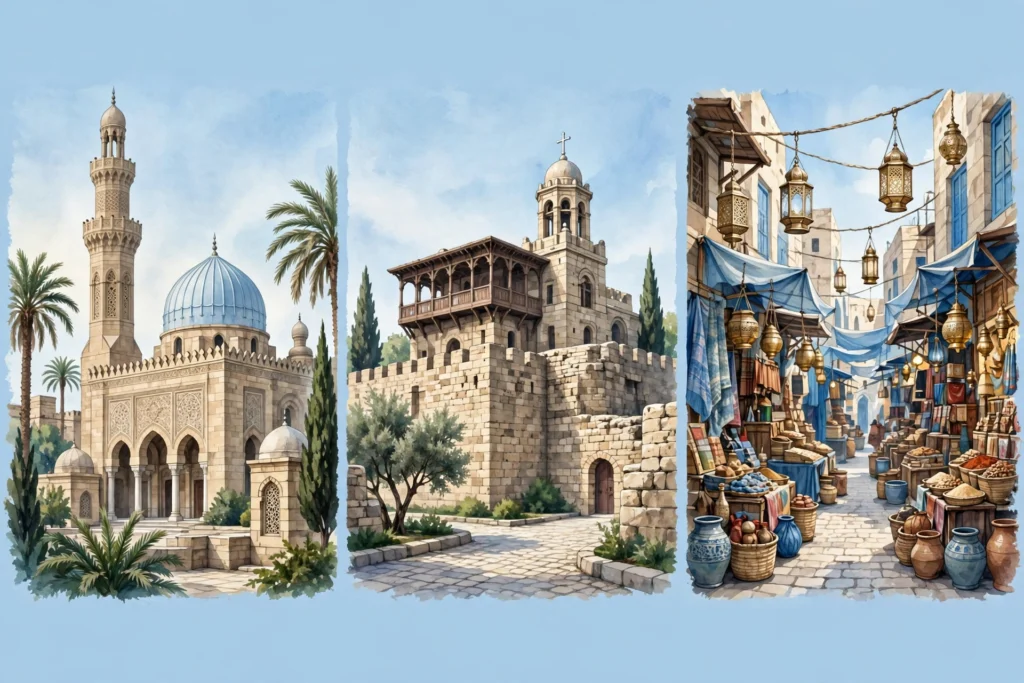
Cairo is the largest city in Africa and the Arab world, home to about 20 million people in its metropolitan area, and it is the most intense city most first-time visitors to Egypt will ever walk through. It is also the most rewarding: nowhere else in the country do a thousand years of history sit so close together, with a medieval mosque, a Roman fortress church, a 19th-century palace and a street-food stall on the same block. The mistake is to treat Cairo as a transit stop on the way to the pyramids. Give it two full days, and it will give you the trip’s best food, its best street life, and its most surprising moments.
Start with Islamic Cairo, the medieval heart of the city and a UNESCO World Heritage site in its own right as part of Historic Cairo. The Citadel of Saladin stands on its hill above the city, crowned by the Mosque of Muhammad Ali with its Ottoman domes and slender minarets, and the view from its walls across the sprawl of Cairo is the best in the city. Below it, the Mosque of Ibn Tulun, built in the 9th century, is the oldest mosque in the city in its original form and the quietest of the great ones — climb its spiral minaret for a view over the rooftops. The Mosque of Sultan Hassan and the Mosque of Al-Azhar, founded in the 10th century and still one of the leading centres of Islamic learning in the world, anchor the medieval streets, and the lanes between them are full of craftsmen’s workshops, spice sellers and coffeehouses that have barely changed in a century. Dress modestly for mosque visits — shoulders and knees covered, a scarf for women — remove your shoes at the door, and visit outside prayer times where possible.
Khan el-Khalili, the great medieval bazaar beside Al-Azhar, is the place most visitors picture when they think of Cairo, and it is worth an evening rather than a rushed hour. The lanes sell lamps, brass, spices, perfume, textiles and jewellery, and the historic cafes on its edges — El Fishawy, open since 1773 — are as much the point as the shopping. Haggling is expected and part of the fun: offer about a third of the opening price and meet in the middle, keep it friendly, and walk away smiling if the price does not come down. The most useful Arabic phrase in the market is “la, shukran” — no, thank you — said with a smile, and it will save you a hundred unwanted conversations a day. Buy small things here and leave the big purchases for fixed-price shops, where the price on the tag is the price you pay.
Coptic Cairo, inside the walls of the Roman fortress of Babylon, is a different world: quiet lanes, churches and a synagogue within a few minutes’ walk of each other. The Hanging Church, built over a Roman gatehouse in the 3rd or 4th century, is one of the oldest churches in Egypt, and the Coptic Museum beside it holds the finest collection of Coptic art anywhere. The Ben Ezra Synagogue, on the site where Moses is traditionally said to have been found in the Nile, completes a remarkable concentration of faiths in a single small quarter. The whole area is walkable in a morning and makes a calm counterpoint to the noise of the rest of the city — go early, before the tour groups arrive.
Downtown Cairo and the island of Zamalek are where modern Cairo lives. Downtown’s belle-epoque buildings, bookshops and cafes around Tahrir Square are the place for an evening walk, and Zamalek, the leafy island district in the Nile, is where the city’s best restaurants, galleries and cafes cluster — the most comfortable base for a first stay, with Nile views and streets you can actually walk. The Cairo Tower on Gezira Island gives the classic panorama of the city and the river. For food, start with the dishes this guide’s food section covers in full: koshari, the national street dish of rice, lentils, pasta, chickpeas and spiced tomato sauce; ful medames, stewed fava beans eaten for breakfast; and ta’ameya, the Egyptian falafel made with fava beans rather than chickpeas. Eat where Egyptians eat, at places that are busy and turn over fast, and drink bottled water. Cairo’s traffic is famously chaotic — use Uber or Careem rather than haggling with street taxis, use the metro to cross the city, and cross streets in a steady, predictable line, following the locals rather than waiting for a gap that never comes.
What to eat in Egypt
Egyptian food is hearty, inexpensive and largely vegetarian-friendly, and eating well in Egypt is one of the cheapest pleasures of the trip. Koshari is the dish to try first: a layered bowl of rice, lentils, macaroni, chickpeas and fried onions under a spiced tomato sauce, sold from street carts and dedicated restaurants for a few pounds, and it is the closest thing Egypt has to a national dish. Ful medames — fava beans stewed with lemon, garlic and olive oil — is breakfast, eaten with warm bread, and ta’ameya, the fava-bean falafel, is its usual companion. Grilled kofta and kebab, roast chicken and fresh fish on the coast are the standard restaurant mains, and molokhia, a green leaf stew, is the acquired taste worth acquiring. Desserts run sweet: om ali, a bread pudding with nuts and cream, and basbousa, a syrup-soaked semolina cake. To drink, there is karkade, the deep-red hibiscus infusion served hot or iced, sugar-cane juice pressed to order on street corners, and strong mint tea in every cafe. Eat at busy places, avoid ice and raw salads in small restaurants, and keep a small bottle of hand sanitiser in your day pack. A full restaurant meal for two in Cairo costs a fraction of the same meal in the United States, and the street food costs almost nothing at all — food is one of the reasons Egypt remains one of the best-value destinations in the world.
| Cairo at a glance | Detail |
|---|---|
| Must-see | Citadel and Mosque of Muhammad Ali, Mosque of Ibn Tulun, Al-Azhar, Khan el-Khalili |
| Coptic Cairo | Hanging Church, Coptic Museum, Ben Ezra Synagogue — a calm morning |
| Best base | Zamalek for comfort and restaurants; Downtown for value and atmosphere |
| Getting around | Uber and Careem, metro to cross the city; avoid street-taxi haggling |
| Food to try | Koshari, ful medames, ta’ameya, grilled kofta, karkade hibiscus drink |
| Time needed | 2 full days plus the Giza and GEM days |
| Watch out for | Mosque dress code; market haggling; chaotic traffic when crossing streets |
Saqqara and Dahshur: The First Pyramids
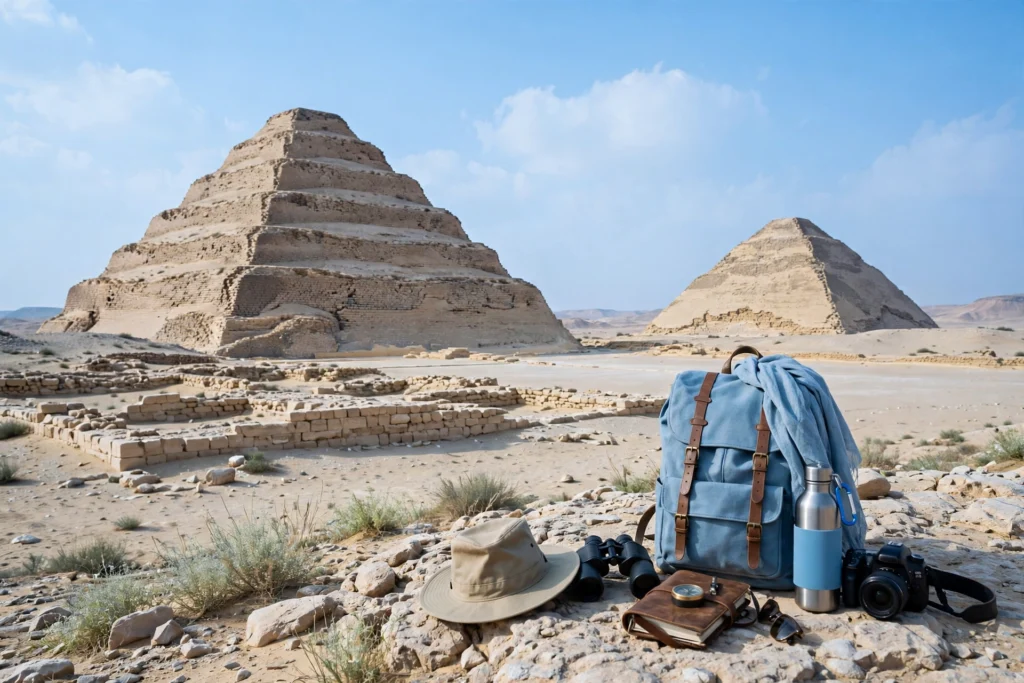
Saqqara and Dahshur are the day trip from Cairo that most first-timers skip and most second-timers wish they had taken first. They are quieter than Giza, cheaper, and in one important sense more interesting: this is where the pyramid was invented. The necropolis of Saqqara stretches across the desert west of the Nile for kilometres, and it contains the first monumental stone building in history, the tombs of kings and nobles, and some of the best-preserved painted tombs in Egypt. Dahshur, a short drive south, holds the two pyramids that show the engineering learning curve in stone. Together they turn the Giza pyramids from a wonder into a story, and that is why this egypt travel guide gives them a chapter of their own.
The Step Pyramid of Djoser at Saqqara, built around 2670 BC for the Second Dynasty king Djoser and designed by his architect Imhotep, is the oldest pyramid ever built and the first monumental building in stone anywhere in the world. It began as a mastaba, the flat-topped tomb of the period, and grew in six steps into a pyramid 60 metres tall, surrounded by a vast limestone enclosure with courtyards, colonnades and chapels — a whole ceremonial city in stone. Around it, the tombs of nobles are the real surprise of Saqqara: the painted walls of the tombs of Ti, Ptahhotep and others show daily life in the Old Kingdom in extraordinary detail — farming, fishing, dancing, craftsmen at work — in colours that have survived 4,500 years underground. The Serapeum, the underground gallery where the sacred Apis bulls were buried in enormous granite sarcophagi, is one of the strangest and most impressive sights in Egypt, and the new Imhotep Museum at the site entrance explains the whole necropolis clearly. Allow a full morning for Saqqara, and go with a guide: the site is large, the tombs are spread out, and the stories are what make the stones speak.
Dahshur, 10 kilometres south of Saqqara, is where the pyramid builders learned their craft. The Bent Pyramid, built for King Sneferu around 2600 BC, changes angle halfway up — the builders realised the original slope was too steep and corrected it mid-construction, leaving a pyramid with a visible kink that tells the whole story of trial and error. The Red Pyramid, Sneferu’s next attempt, is the first true smooth-sided pyramid ever built, and it is the only one of Egypt’s great pyramids you can still enter by climbing down a long passage into its burial chambers — a proper adventure, hot and steep and unforgettable. Dahshur is almost empty of visitors, the desert is open and silent, and the contrast with the crowds at Giza could hardly be greater. Combine Saqqara and Dahshur in a single day trip from Cairo, leaving at 8 a.m. and returning by mid-afternoon, and you will have seen the birth of the pyramid and the place where it was perfected. The Memphis open-air museum at Mit Rahina, with its colossal fallen statue of Ramesses II, sits on the way back and is worth a 30-minute stop if your driver passes it.
| Saqqara and Dahshur at a glance | Detail |
|---|---|
| Step Pyramid of Djoser | Oldest pyramid ever built, about 2670 BC, designed by Imhotep |
| Noble tombs | Painted tombs of Ti and Ptahhotep — daily life in the Old Kingdom |
| Serapeum | Underground gallery of the sacred Apis bulls in granite sarcophagi |
| Bent Pyramid | Sneferu’s pyramid with the famous mid-construction angle change |
| Red Pyramid | First true smooth-sided pyramid; the only great pyramid you can enter |
| How to visit | Half-day trip from Cairo with Saqqara; leave at 8 a.m., back by mid-afternoon |
| Best for | Travellers who want the story behind Giza without the crowds |
Luxor: Karnak, Luxor Temple and the Valley of the Kings
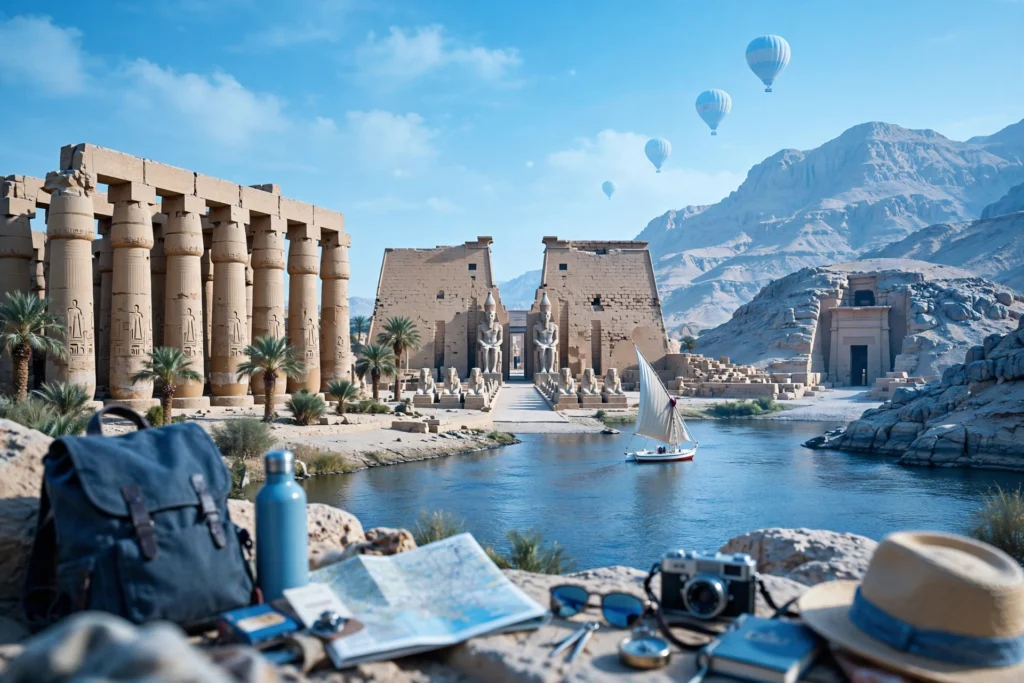
Luxor is the greatest open-air museum in the world, and the claim is not marketing. The modern town sits on the site of ancient Thebes, and its temples and tombs are so numerous and so well preserved that two full days here still feel short. The east bank holds the great temples of Karnak and Luxor; the west bank holds the Valley of the Kings, the Valley of the Queens, the temple of Hatshepsut and the Colossi of Memnon. Between them runs the Nile, and the rhythm of a Luxor trip is the rhythm of crossing it: temples in the morning, tombs in the afternoon, the corniche at sunset. Plan Luxor the way the ancient Egyptians built it — in two halves, divided by the river.
Start on the east bank with Karnak, the largest religious complex ever built and the centre of Egyptian religion for more than 2,000 years. The Great Hypostyle Hall alone is worth the trip: 134 towering columns, some 23 metres high, standing in a forest of stone that was once roofed and painted, with hieroglyphs still carrying traces of colour on the upper reaches. Walk the Avenue of Sphinxes that once linked Karnak to Luxor Temple three kilometres to the south — it has been excavated and restored in recent years and is one of the great walks in Egypt. Luxor Temple itself, built largely under Amenhotep III and Ramesses II, is at its best at dusk, when the floodlights come on and the columns glow against the darkening sky; go in the late afternoon, after the heat of the day, and stay for the lighting. Both temples are in the town, easy to reach on foot from the corniche hotels, and both reward a guide who can read the walls: the battle scenes, the festival processions and the lists of conquered peoples are a history book carved in stone.
The west bank is a different world: a desert valley of tombs, temples and silence, reached by ferry or bridge across the Nile. The Valley of the Kings holds the tombs of more than 60 New Kingdom pharaohs, including Tutankhamun, whose tomb was found here in 1922 and whose treasure now fills the Grand Egyptian Museum. A standard ticket covers entry to the valley and three tombs of your choice, with the most famous — Tutankhamun’s, Seti I’s and Ramesses V and VI’s — charged as extras. Go early, when the valley is cool and quiet, and choose your tombs with care: the tomb of Ramesses IX is among the most colourful, the tomb of Seti I is the finest and the most expensive, and Tutankhamun’s is small and, now that its treasure has moved to Cairo, best visited for the history of its discovery rather than its decoration. The temple of Hatshepsut, the terraced mortuary temple of Egypt’s female pharaoh set against the cliffs of Deir el-Bahari, is the most beautiful building on the west bank and the one photograph everyone takes home. The Colossi of Memnon, two 18-metre statues of Amenhotep III standing alone in the fields, are the gateway to the valley and the place where the hot-air balloons land at sunrise.
The sunrise balloon over the west bank is the single most popular experience in Luxor, and it deserves its reputation: floating over the temples, tombs and green fields as the sun comes up over the Nile is the best hour of many Egypt trips. Book it two or three days ahead through your hotel, expect an early start around 5 a.m., and know that flights are weather-dependent — if yours is cancelled, most operators reschedule for the following morning. The alternative sunrise is simpler and free: watch it from the corniche with a cup of tea, as the feluccas put out onto the river. Allow two full days for Luxor as a minimum: one for the east bank and one for the west bank, with the balloon on the second morning. Stay on the east bank for the restaurants and the corniche, or on the west bank for quiet guesthouses close to the tombs — the choice is between convenience and calm, and both work.
Luxor’s tombs: which ones to choose
With a standard ticket covering three tombs, the choice matters. The tomb of Ramesses IX is the best all-rounder: long, colourful and easy to walk through, with well-preserved paintings from ceiling to floor. The tomb of Ramesses III is deeper and more dramatic, with scenes of the king’s wars and daily life. The tomb of Tuthmosis III is a climb — a steep staircase down into a cartouche-shaped burial chamber painted like a starry sky — and the most atmospheric of the standard tombs. If you pay extra, the tomb of Seti I is the finest in the valley, with the most complete and beautiful decoration, and the tomb of Tutankhamun is worth it for the history: the smallest royal tomb in the valley, found intact in 1922, and the reason the world’s most famous treasure exists. Skip the tombs that are closed for restoration on your day — the list changes — and ask your guide which three are open and in the best condition. Photography inside the tombs is restricted and flash is forbidden everywhere; buy the photography permit if you want to take pictures, and respect the guards who enforce the rules.
| Luxor at a glance | Detail |
|---|---|
| East bank | Karnak Temple, Luxor Temple, Avenue of Sphinxes, Luxor Museum |
| West bank | Valley of the Kings, Valley of the Queens, Temple of Hatshepsut, Colossi of Memnon |
| Karnak highlight | Great Hypostyle Hall — 134 columns, some 23 m high |
| Valley of the Kings | 60+ royal tombs; standard ticket covers 3, famous tombs extra |
| Hot-air balloon | Sunrise over the west bank; book 2–3 days ahead, weather-dependent |
| Time needed | 2 full days minimum; 3 days with a balloon and a slow pace |
| Best time of day | Temples at opening or dusk; tombs in the morning before the heat |
Aswan and Abu Simbel: The Nubian South
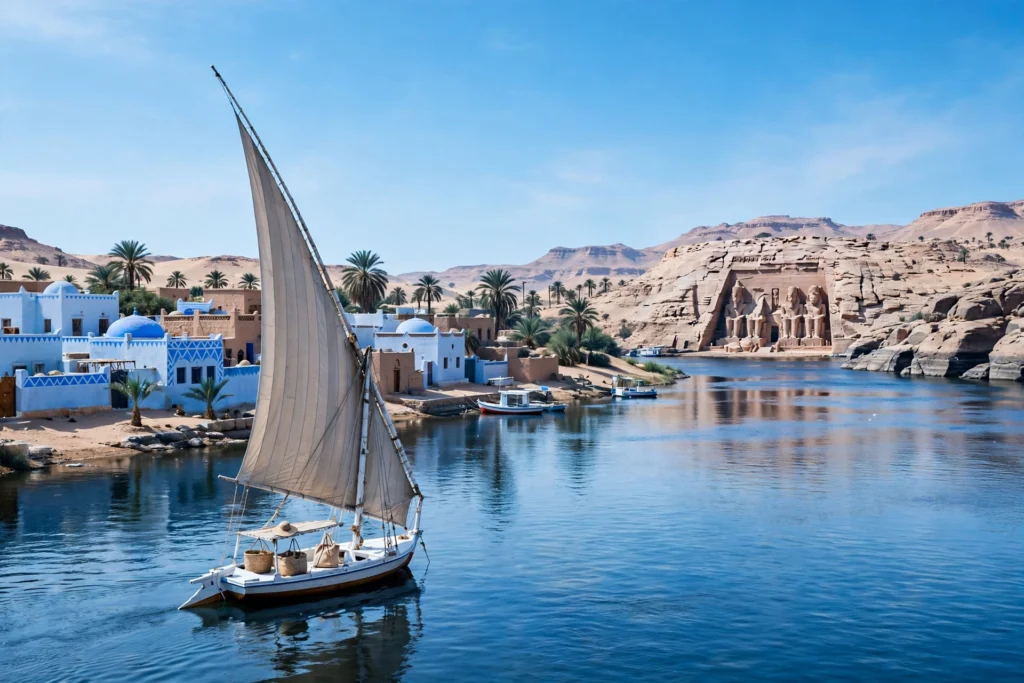
Aswan is the calmest city in Egypt and the one most travellers fall in love with. Where Cairo is noise and Luxor is monuments, Aswan is the Nile itself: granite islands, white-sailed feluccas, palm groves and Nubian villages painted in bright colours along the banks. It is the gateway to Abu Simbel, the base for the temples of Philae and Kalabsha, and the place where the pace of an Egypt trip finally slows down. Give it two nights, and let the river set the schedule.
The Temple of Philae, dedicated to the goddess Isis, sits on its own island in the Nile and is reached by a short boat ride — one of the prettiest journeys in Egypt, with the temple rising from the water as you approach. Philae was moved stone by stone to its present island in the 1960s, when the building of the Aswan High Dam created Lake Nasser and threatened to drown it, and the rescue is part of the story: the temple you see is the temple the engineers saved. Go in the late afternoon, when the light turns the stone gold, and stay for the sound-and-light show if you enjoy that kind of thing — it is the best one in Egypt. The High Dam itself, the great engineering project that created Lake Nasser and changed Egypt’s agriculture and electricity, is worth a short visit for the view over the lake, and the Unfinished Obelisk in the ancient granite quarries shows how the great stones were cut: a 42-metre obelisk, abandoned in the bedrock when a crack appeared, still lying where the quarrymen left it 3,500 years ago.
The Nubian villages on the west bank and on Elephantine Island are the cultural heart of Aswan. Nubia is a distinct culture with its own language, music and architecture, and the villages — with their brightly painted houses, domed roofs and courtyards — are the most colourful places in Egypt. Take a felucca, the traditional white-sailed wooden boat, for a sunset sail among the islands: it is the cheapest and most peaceful pleasure in Egypt, and the hour before sunset, when the light turns the granite pink and the river goes still, is the one to choose. Agree the price and the duration before you board, and bring small notes for the captain. The Aswan Botanical Garden on Kitchener’s Island and the Monastery of St Simeon on the west bank are quieter stops for a second day, and the Nubian Museum, winner of international architecture awards, tells the story of Nubia from prehistory to the present better than any book.
Abu Simbel is the day trip that justifies the early alarm. The two great temples of Ramesses II stand 280 kilometres south of Aswan, near the Sudanese border, carved into a cliff above Lake Nasser and moved block by block in the 1960s to save them from the rising waters — one of the great engineering rescues of the 20th century, carried out under UNESCO. The Great Temple’s facade is dominated by four colossal seated statues of Ramesses II, each 20 metres tall, and twice a year, on 22 February and 22 October, the rising sun reaches into the inner sanctuary and illuminates the statues of the gods inside. Most visitors leave Aswan at 4 a.m. by road, in a convoy, and arrive at sunrise when the temples are at their most dramatic and the crowds are still thin. The alternative is a 45-minute flight from Aswan, more expensive and more flexible. Either way, allow a full morning and be back in Aswan for a late lunch. Abu Simbel is the single most impressive temple in Egypt for many visitors, and the one most worth the effort of the early start.
| Aswan and Abu Simbel at a glance | Detail |
|---|---|
| Philae Temple | Island temple of Isis, moved stone by stone in the 1960s; best at sunset |
| High Dam | Created Lake Nasser; visit for the view over the lake |
| Unfinished Obelisk | 42 m obelisk abandoned in the granite quarry 3,500 years ago |
| Felucca sailing | Sunset sail among the islands; agree price and duration before boarding |
| Nubian villages | Brightly painted houses on Elephantine Island and the west bank |
| Abu Simbel | 280 km south of Aswan; 4 a.m. road convoy or 45-minute flight |
| Sun alignment | 22 February and 22 October — sunlight reaches the inner sanctuary |
| Time needed | 2 nights in Aswan; Abu Simbel is a full morning |
A Nile Cruise: Luxor to Aswan by Boat
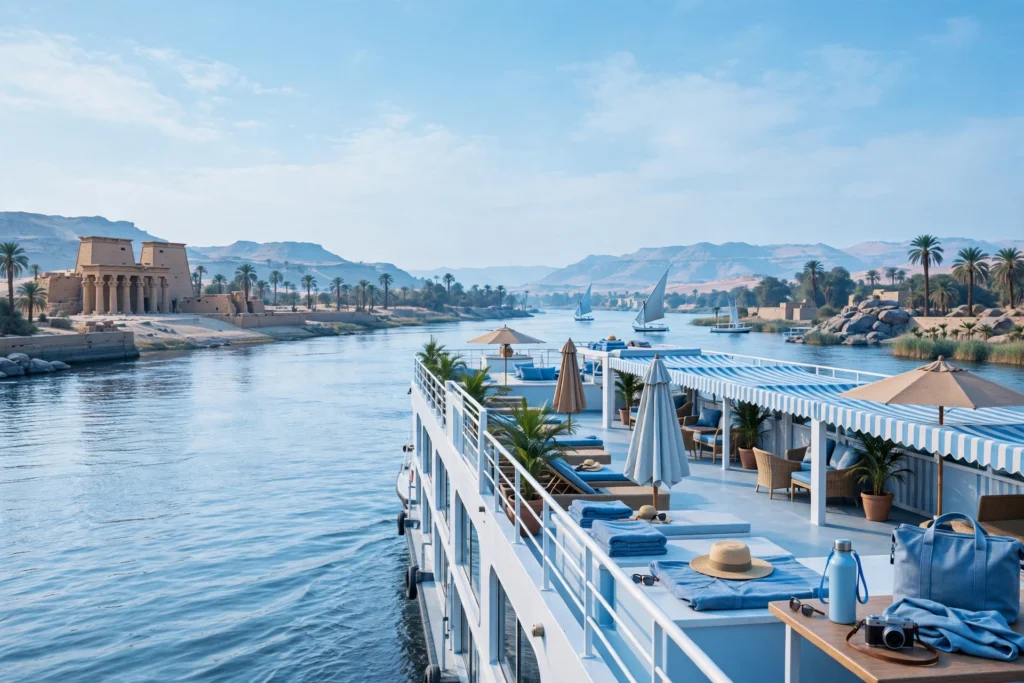
The classic way to travel between Luxor and Aswan is by boat, over three or four nights, stopping at the temples of Edfu and Kom Ombo along the way. You sleep on board, wake up to the river, and see the countryside as Egyptians have for thousands of years: green fields, water buffalo, palm groves, fishermen casting nets, and desert cliffs rising behind the farmland. It is the most relaxing part of an Egypt trip and the part most travellers remember best — and it is also the part that needs the most careful booking, because the difference between a good cruise and a bad one is the difference between a holiday and a regret.
There are three kinds of boat, and choosing between them is the main decision. The large cruise ships, carrying 100 or more passengers, are floating hotels with sun decks, pools, restaurants and evening entertainment; they are comfortable, social and good value, and the standard three- or four-night Luxor-to-Aswan sailing is the most popular trip in Egypt. The dahabiyas, traditional wooden sailing boats carrying 10 to 20 passengers, are slower, quieter and more personal, with no engine noise and stops at smaller temples and villages the big ships pass by; they cost more and take longer, usually five to seven nights, and they are the choice for travellers who want the river rather than the resort. The feluccas, the small white-sailed boats, are for short sails of an hour or two, not for multi-day cruising, though some operators run simple two-night felucca trips between Aswan and Luxor with camping on the riverbank — cheap, basic and genuinely adventurous. For a first trip, the large cruise ship is the safe choice; for a second trip, the dahabiya is the upgrade.
The route is the same whichever boat you take. From Luxor you sail south to Edfu, home to the Temple of Horus, the best-preserved temple in all of Egypt, built in the Ptolemaic period and so complete that it feels as though the priests have only just left. From Edfu you continue to Kom Ombo, an unusual double temple on a bend in the Nile, dedicated to two gods at once — the falcon god Haroeris and the crocodile god Sobek — with a small museum of mummified crocodiles beside it. From Kom Ombo you sail into Aswan, where the cruise ends and the temples of Philae and Abu Simbel begin. The days on board fall into a rhythm: an early temple visit, a slow morning on the sun deck, lunch as the river slides past, an afternoon temple, and dinner as the boat ties up for the night. The food on board is usually buffet-style and generous, the cabins are small but comfortable, and the sun deck is where the trip happens — bring a book, a hat and sunscreen, and plan to do very little.
Book the cruise the way you would book a hotel: read recent reviews, check what is included, and book through a reputable operator or your hotel rather than the cheapest listing you find. The price should include all meals, the temple visits with a guide, and transfers; check whether drinks, tips and the Abu Simbel excursion are included or extra, and budget for tips for the crew and the guide, which are expected. December to February is the peak season for cruises and the boats sell out, so book two to three months ahead for a winter sailing; in summer, prices drop sharply and the river is quieter, but the heat is intense and the temple visits are best done at dawn. A three-night cruise from Aswan to Luxor runs in the opposite direction and is equally good; the choice is usually decided by your flight schedule. Whichever direction you sail, the Nile cruise is the part of Egypt that slows you down, and that is exactly what a trip this rich needs.
| Nile cruise at a glance | Detail |
|---|---|
| Classic route | Luxor to Aswan, 3–4 nights, via Edfu and Kom Ombo |
| Large cruise ships | 100+ passengers, floating hotels, best value for a first trip |
| Dahabiyas | 10–20 passengers, slow and quiet, 5–7 nights, costs more |
| Feluccas | Short sails only; basic 2-night camping trips for the adventurous |
| Edfu | Temple of Horus, the best-preserved temple in Egypt |
| Kom Ombo | Double temple of Haroeris and Sobek, with mummified crocodiles |
| Book ahead | 2–3 months ahead for December–February sailings |
| Check the price | Meals, temple visits and transfers included; drinks, tips and Abu Simbel often extra |
The Red Sea: Hurghada, Sharm El Sheikh, Dahab and Marsa Alam
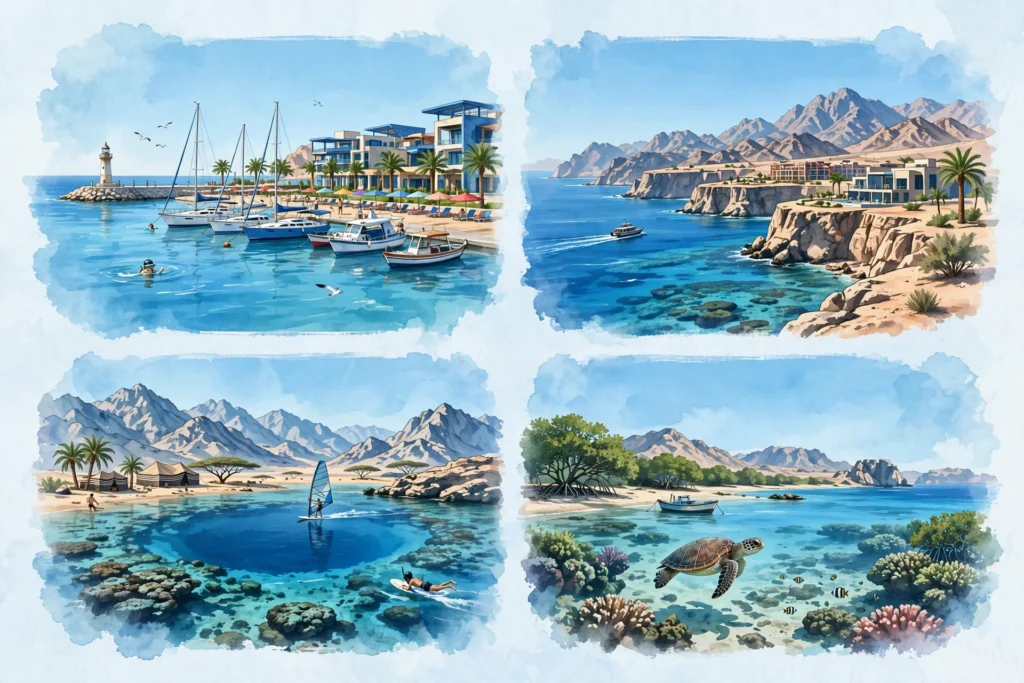
Egypt’s Red Sea coast has some of the best coral reefs in the world, warm water all year, and resorts for every style, from big hotels in Hurghada to quieter bays around Marsa Alam. It is the part of Egypt that most first-timers underestimate and most often wish they had given more time: after a week of temples and tombs, four days on the reef is not a break from the trip, it is the second half of it. The water is warm enough to swim in all year, the visibility regularly exceeds 30 metres, and the marine life — reef sharks, dolphins, turtles, Napoleon wrasse, rays and clouds of reef fish — is extraordinary. Even if you have never dived, the snorkelling from the beach is among the best anywhere.
Hurghada, on the western shore, is the biggest resort town and the best choice for a first Red Sea stay. It has the widest choice of hotels, the easiest diving for beginners, and the Giftun Islands offshore, where the reefs are shallow, the fish are abundant and the sand is white. The town itself is a working Egyptian city as well as a resort, with a marina, restaurants and markets, and it is the easiest Red Sea base to reach from Luxor by road. Sharm El Sheikh, at the southern tip of the Sinai Peninsula, is the diving capital: Ras Mohammed National Park, where the Red Sea meets the Gulf of Aqaba, has coral walls that drop into deep blue water and attract pelagic fish and sharks, and the wreck of the SS Thistlegorm, a Second World War cargo ship sunk in 1941, is widely regarded as one of the ten best wreck dives in the world. Sharm’s Naama Bay has the liveliest nightlife on the coast, and the town is an hour’s flight from Cairo.
Dahab, further up the Sinai coast, is the laid-back alternative: a former Bedouin fishing village turned diving town, with a seafront promenade of cafes and dive centres, shore diving straight from the reef, and the famous Blue Hole, a deep marine sinkhole surrounded by coral that is a legendary site for experienced divers — and a site that demands respect, because its depth has caught out divers who were not ready for it. Snorkel the Blue Hole from the surface rather than diving it unless you are properly qualified. Marsa Alam, south of Hurghada on the western shore, is the quietest of the four: newer resorts, house reefs you can walk into from the beach, and the best chance in Egypt of swimming with dugongs and sea turtles. Choose Hurghada for convenience and families, Sharm El Sheikh for serious diving and nightlife, Dahab for a slow, cheap, bohemian week, and Marsa Alam for quiet reefs and wildlife.
The practical side of the Red Sea is simple. The water is warmest for swimming from June to October and coolest, though still swimmable, from December to February, when a wetsuit makes longer dives comfortable. Book diving only with licensed centres that maintain their equipment and employ qualified instructors, and never dive beyond your certification. The sun is stronger on the water than on land, so reapply sunscreen after every swim, and wear a rash guard or T-shirt in the water to avoid burning. The resorts are safe and well policed, and the towns are used to visitors, but the desert and mountains behind them are a different matter: the Sinai interior, including the Mount Sinai climb, should only be visited with a licensed guide, and the Northern and Middle Sinai are under a Do Not Travel advisory — the Red Sea resorts themselves are not. Allow at least three nights on the coast; four or five is better, because the first day is for arriving and the reef deserves more than a single morning.
| Red Sea at a glance | Detail |
|---|---|
| Hurghada | Biggest resort town, best for families and beginners, Giftun Islands |
| Sharm El Sheikh | Diving capital, Ras Mohammed, SS Thistlegorm wreck, Naama Bay nightlife |
| Dahab | Laid-back Bedouin town, shore diving, the Blue Hole, cheap and slow |
| Marsa Alam | Quietest coast, house reefs, dugongs and turtles |
| Water | Warm all year; warmest June–October; visibility regularly over 30 m |
| Best diving | Ras Mohammed, Thistlegorm, Blue Hole (experienced divers only), Giftun |
| Time needed | 3 nights minimum; 4–5 nights is better |
| Watch out for | Dive only with licensed centres; sun is stronger on the water |
Mount Sinai and St Catherine’s Monastery
From Sharm El Sheikh or Dahab, the night climb of Mount Sinai is the classic desert excursion. You climb through the night with a Bedouin guide, following the camel path or the 3,750 Steps of Repentance, to reach the summit for sunrise over the granite mountains — one of the great sunrises in the world, and cold at the top even in summer, so bring a warm layer. At the foot of the mountain stands St Catherine’s Monastery, one of the oldest working Christian monasteries in the world and a UNESCO World Heritage site since 2002, built at the site of the Burning Bush and holding a library of ancient manuscripts second only to the Vatican’s. The climb is a genuine hike — allow three hours up and two down, go with a licensed guide, and carry water and a torch. It is the one Sinai excursion worth the early start, and the one that most travellers remember long after the reefs have faded.
Alexandria and the Mediterranean Coast
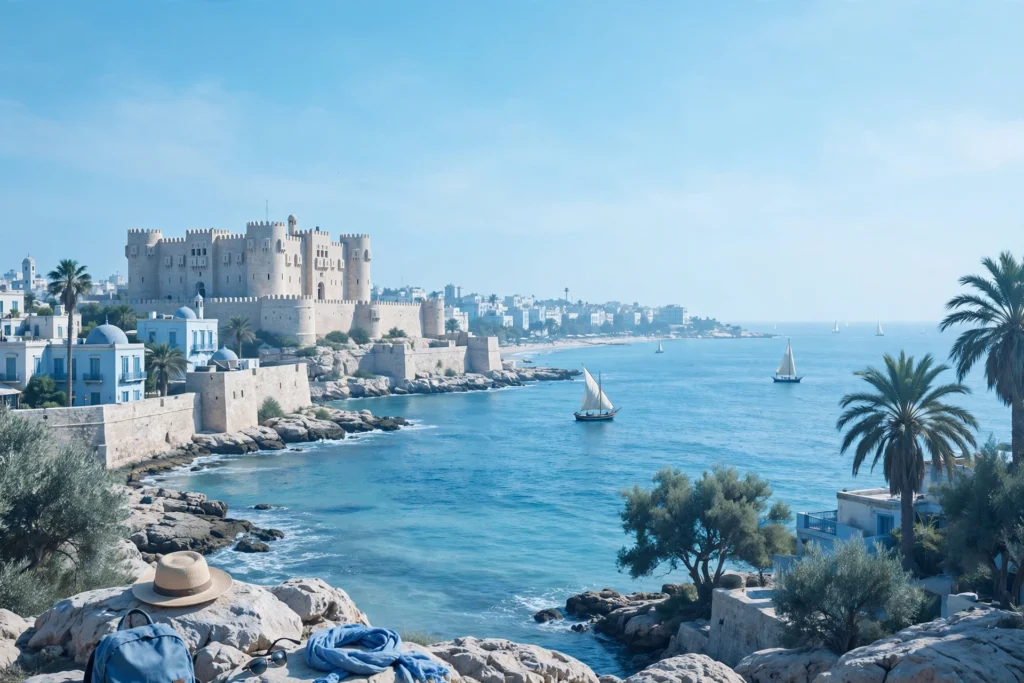
Alexandria is Egypt’s second city and its most Mediterranean — a place where Greek columns stand beside Arabic coffeehouses, where the ghost of Cleopatra lingers in the salt air off the sea, and where the pace of life feels noticeably different from the intensity of Cairo. Founded by Alexander the Great in 331 BC, it was for centuries the intellectual capital of the ancient world, home to the Great Library and the Pharos Lighthouse, one of the Seven Wonders of the Ancient World. The city that stands there now is a 19th- and 20th-century port city of faded colonial grandeur, a long corniche curving along the bay, and some of the best seafood in Egypt. It is an easy day trip or overnight from Cairo, about three hours by road or train, and it is the best antidote to a week of desert and temples.
Start on the corniche, the long seafront promenade that is the spine of the city. Walk it in the late afternoon, when the light over the Mediterranean turns the water a deep blue-green and the cafes fill with families, and you will understand why every writer who has spent time here eventually writes about the light. At the eastern end of the corniche stands the Citadel of Qaitbay, a 15th-century fortress built on the site of the Pharos Lighthouse, and the best place in the city for a view of the harbour. At the other end, the Bibliotheca Alexandrina, the striking modern library and cultural centre inspired by the ancient library, holds a vast reading room, museums and exhibitions, and is the city’s most visited building. Between them, the Roman catacombs of Kom el-Shoqafa, one of the Seven Wonders of the Middle Ages, descend underground into a burial complex where Egyptian, Greek and Roman styles mix in the carvings, and the Roman amphitheatre and Pompey’s Pillar complete the ancient circuit.
Alexandria’s food is significantly underrated, and the city’s position on the Mediterranean has produced a food culture unlike anywhere else in Egypt. The fish restaurants along the harbour serve the morning’s catch grilled simply with lemon and herbs, and the cafes of the corniche — some of them a century old — are the place for a slow afternoon of coffee and people-watching. The city is also the best place in Egypt to understand the country’s modern history: its Greek, Italian and Jewish communities, its cosmopolitan past, and the Alexandria of Lawrence Durrell’s novels are still visible in the faded facades of the old European quarters. One night is enough for the highlights, two if you want to slow down and eat your way along the corniche. Go in spring or autumn, when the Mediterranean is at its best; in summer the city fills with Cairenes escaping the heat, and in winter the sea wind is cold.
| Alexandria at a glance | Detail |
|---|---|
| Founded | 331 BC by Alexander the Great; home of the Great Library and Pharos Lighthouse |
| Citadel of Qaitbay | 15th-century fortress on the site of the ancient lighthouse |
| Bibliotheca Alexandrina | Modern library and cultural centre on the seafront |
| Kom el-Shoqafa | Roman catacombs, one of the Seven Wonders of the Middle Ages |
| Food | Harbour fish restaurants, century-old corniche cafes |
| How to visit | Day trip or overnight from Cairo, about 3 hours by road or train |
| Best months | Spring and autumn; summer is crowded, winter is windy |
The Western Desert: Siwa Oasis and the White Desert
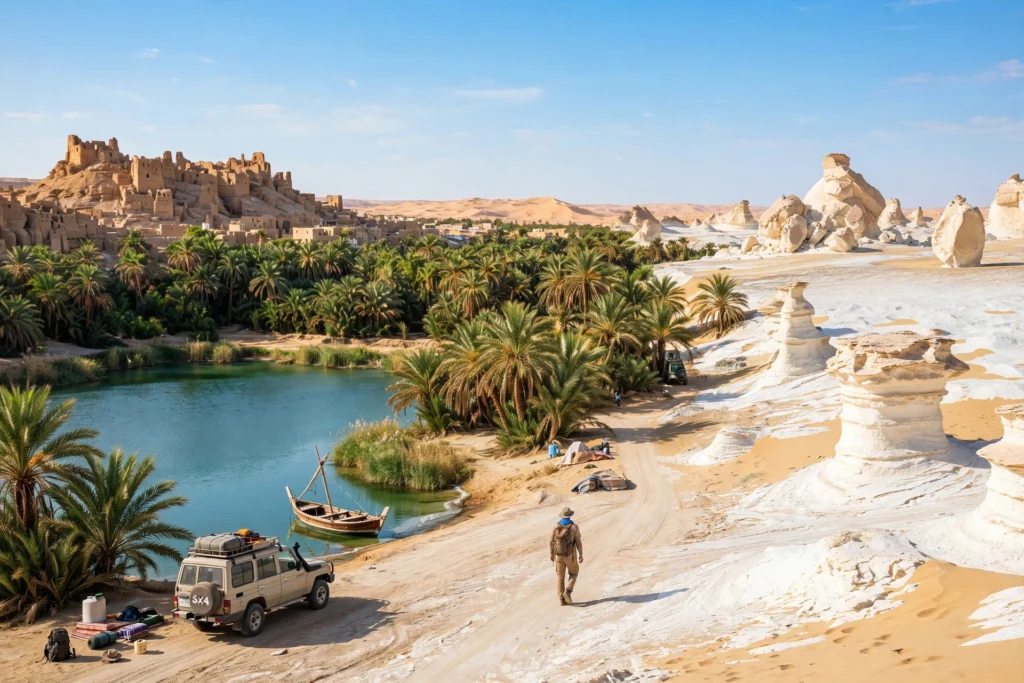
West of the Nile, the desert has its own wonders, and they are the most remote and most extraordinary places in Egypt. The Western Desert covers two-thirds of the country, and its oases — Fayoum, Bahariya, Farafra, Dakhla, Kharga and Siwa — are green islands in a sea of sand, each with its own character, its own history and its own reason to go. Two of them belong on a first trip if you have the time: the White Desert, for the strangest landscape in Egypt, and Siwa Oasis, for the most remote and most beautiful oasis of them all. Both need a licensed guide and a 4×4, and both reward the effort many times over.
The White Desert, near the Farafra oasis about five hours’ drive from Cairo, is a surreal landscape of chalk towers and mushroom-shaped formations, carved by the wind into shapes that look like animals, birds and castles, glowing white against the golden sand. The classic trip is an overnight camp: drive out from Bahariya oasis in the afternoon, stop at the Black Desert with its volcanic hills, watch the sun set over the chalk sculptures, and sleep in a tent under a sky full of stars, with a Bedouin dinner cooked over the fire. It is one of the best nights in Egypt, and one of the cheapest — a two-day trip from Cairo with camping, food and transport costs a fraction of a Nile cruise. Go between October and April, when the desert nights are cold but bearable; in summer the heat is extreme and the camping is miserable. Bring a warm sleeping bag, a head torch, and layers for the night, because the desert temperature drops sharply after sunset.
Siwa Oasis sits 560 kilometres west of Cairo, close to the Libyan border, in the heart of the Western Desert, and it feels like another country. The Siwan people have their own language, Siwi, a Berber dialect, their own traditions, and a relationship with their landscape that has remained largely unchanged for centuries. The oasis is a world of palm groves and olive trees, salt lakes you can float in, hot springs, and the crumbling mud-brick fortress of Shali, which rises above the town like a ruin from another age. Alexander the Great made a legendary pilgrimage to Siwa in 331 BC to consult the Oracle of Amun, one of the most celebrated oracular shrines of the ancient world, and the temple where he is said to have been declared the son of the god still stands among the palms. The Great Sand Sea, a vast expanse of dunes stretching towards Libya, begins at the edge of the oasis, and a desert safari into it at sunset is the finest dune landscape in Egypt. Allow two nights for Siwa: one to arrive and explore the town and the salt lakes, and one for the desert safari and the oracle temple. The road from Cairo takes eight or nine hours, so most travellers go by overnight bus or private car, and the journey is part of the experience — the desert opens out around you and the towns thin to nothing.
A word of caution, because it matters. The Western Desert is a border region, and the US State Department advises against travel to parts of it without a professionally licensed tour company. Go with a licensed operator, not on your own, carry your passport, and do not drive into the desert without a guide who knows the tracks and the permits. The oases themselves — Siwa, Bahariya, Farafra and Fayoum — are visited safely by thousands of travellers every year with licensed guides, and the risk is in the remote border areas, not in the oasis towns. The Fayoum oasis, the closest to Cairo, is the easy introduction: lakes, waterfalls at Wadi el-Rayan, and the fossil whales of Wadi al-Hitan, a UNESCO World Heritage site where the skeletons of ancient whales lie in the desert sand, two hours from the city. If Siwa is too far for your trip, Fayoum gives you the desert in a day.
| Western Desert at a glance | Detail |
|---|---|
| White Desert | Chalk towers near Farafra; overnight camping trip from Bahariya |
| Black Desert | Volcanic hills on the way to the White Desert |
| Siwa Oasis | 560 km west of Cairo; palm groves, salt lakes, Shali fortress, Oracle of Amun |
| Great Sand Sea | Dune safari at sunset from Siwa |
| Fayoum | Closest oasis to Cairo; Wadi al-Hitan fossil whales (UNESCO) |
| How to visit | Licensed guide and 4×4 only; never drive into the desert alone |
| Best months | October to April; desert nights are cold, days are warm |
| Time needed | 2 days for the White Desert; 2–3 nights for Siwa |
When to Go to Egypt: Month-by-Month Weather and the Best Time
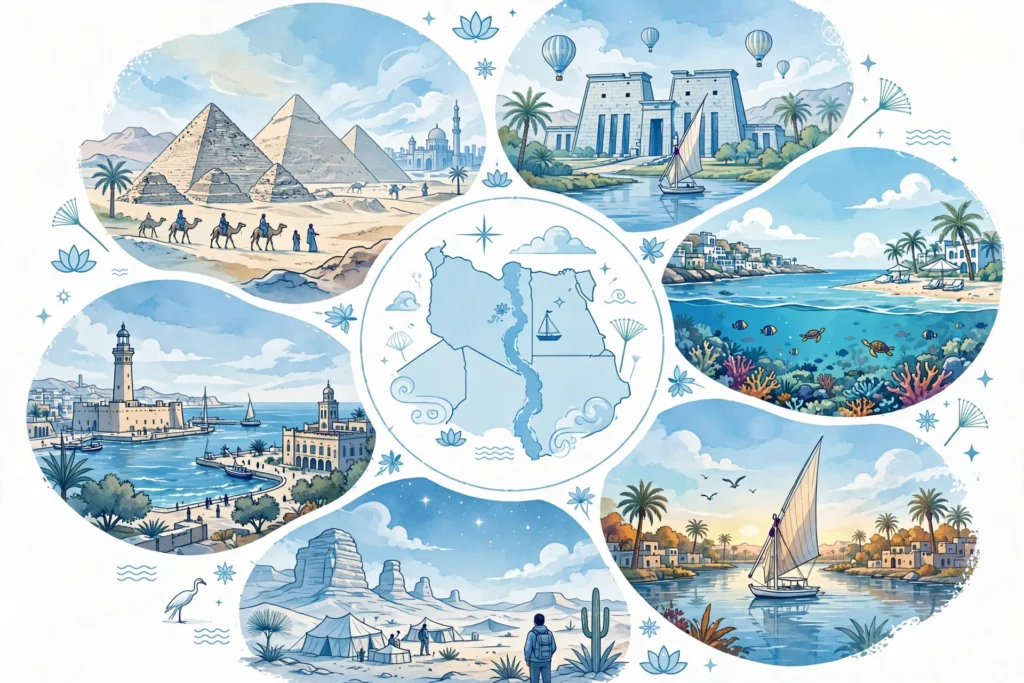
October to April is the best time to visit Egypt for sightseeing, and every source that matters agrees on it. The days are warm and dry, the desert light is clear, the temples are comfortable in the morning and the evenings are cool enough for a jacket. December and January are the peak, with the biggest crowds and the highest prices, and nights in Cairo and the desert can be chilly. March and April and October and November are the sweet spot: comfortable everywhere, warm sea on the Red Sea coast, and fewer crowds than midwinter. From May to September, Upper Egypt is extremely hot — Luxor and Aswan regularly pass 40 degrees Celsius, and the temples empty by midday — so visit the sites at dawn and spend the afternoons by a pool or on the river. The Red Sea is the exception: it is a year-round destination, warmest for swimming from June to October, and summer is the best time to be on the coast rather than inland. Spring can bring the khamsin, a hot dusty wind from the desert that turns the sky yellow for a few days at a time and is the one weather event that can genuinely disrupt a trip.
The month-by-month table below is the planning tool to use alongside the itineraries. The temperatures are daytime highs in the Nile Valley, and the Red Sea coast is usually a few degrees cooler in summer and a few degrees warmer in winter. The single most important row is the heat: if your trip is fixed for July or August, build it around the Red Sea and the early mornings, and do not plan a full day of temples in Luxor. If you can choose, choose October, November, March or April, and you will have Egypt at its best.
| Month | Cairo | Luxor and Aswan | Red Sea | Verdict |
|---|---|---|---|---|
| January | 19°C, cool nights | 23°C, perfect | 22°C, swimmable | Peak season; best for temples, cold desert nights |
| February | 20°C, mild | 25°C, perfect | 23°C, swimmable | Peak season; Abu Simbel sun festival on 22 February |
| March | 23°C, warming | 28°C, warm | 25°C, warming | Sweet spot; good everywhere, thinner crowds |
| April | 27°C, warm | 33°C, hot | 27°C, warm | Sweet spot; khamsin wind possible |
| May | 31°C, hot | 38°C, very hot | 30°C, warm | Shoulder; temples at dawn, Red Sea best |
| June | 34°C, hot | 41°C, extreme | 33°C, hot | Summer; Red Sea season, inland at dawn only |
| July | 35°C, hot | 42°C, extreme | 34°C, hot | Hottest month; coast, not temples |
| August | 35°C, hot | 42°C, extreme | 34°C, hot | Hottest month; coast, not temples |
| September | 32°C, warm | 39°C, very hot | 32°C, hot | Summer ending; sea at its warmest |
| October | 28°C, warm | 35°C, hot | 30°C, warm | Sweet spot; best month for a full trip |
| November | 24°C, mild | 29°C, warm | 27°C, warm | Sweet spot; comfortable everywhere |
| December | 20°C, cool nights | 24°C, perfect | 23°C, swimmable | Peak season; best for temples, festive crowds |
Egypt’s festivals and events worth timing
Two dates are worth building a trip around. The Abu Simbel Sun Festival, on 22 February and 22 October, is the morning when the rising sun reaches into the inner sanctuary of the Great Temple and illuminates the statues inside — the temple was designed for it, and the festival draws crowds from around the world, so book Aswan and Abu Simbel months ahead if you want to be there. Ramadan, the holy month, moves through the calendar and falls in late winter in 2026–27; travelling during Ramadan is perfectly possible and in some ways more interesting — the evenings come alive with lights and food after sunset — but restaurants close during the day, opening hours shift, and the pace slows, so plan temple visits for the morning and expect a quieter, more local Egypt. The Cairo International Film Festival in November and the Luxor African Film Festival in the spring are smaller events worth knowing about if you are in the country at the time, and the Coptic Christmas on 7 January is a public holiday with its own celebrations in Coptic Cairo.
How Much Does an Egypt Trip Cost? A Planning Budget in Egyptian Pounds
Egypt is inexpensive for day-to-day costs, and it is one of the best-value destinations in the world for what you get — but the entry tickets to the major sites have risen sharply and now make up a large share of the budget, so plan for them separately. A budget traveller using hostels, trains and local food can get by on roughly US$30 to US$50 a day before major ticket fees. A mid-range traveller with good hotels, a guide, a Nile cruise and domestic flights should budget roughly US$120 to US$250 a day. A comfort traveller on a dahabiya cruise, in historic hotels such as the Old Cataract in Aswan, with a private Egyptologist guide, can pass US$400 a day without trying. The tables below are planning ranges in Egyptian pounds, using a working rate of about EGP 50 to the US dollar in late 2026 — check the live rate before you travel, because the pound moves, and treat every figure here as a planning range, not a live price.
The big-ticket items are the ones to budget first. The Grand Egyptian Museum costs EGP 1,830 for a foreign adult from 1 November 2026, and the Giza plateau, the Valley of the Kings, Karnak and Abu Simbel each charge their own entry, so a week of temples can add up to several hundred dollars in tickets alone — the single biggest surprise in most Egypt budgets. Domestic flights between Cairo, Luxor and Aswan are the next big item, and they rise sharply close to departure, so book them early. Hotels are the good news: a comfortable double room in Cairo or Luxor costs a fraction of the same room in Western Europe or the United States, and even the grand hotels are affordable by international standards. Food is the best news of all: a full restaurant meal for two costs very little, and street food costs almost nothing. Tipping is the cost that catches people out, because it is constant and small — a few pounds here, a few pounds there, all day, every day — so carry a pocketful of small notes and budget roughly EGP 300 to EGP 500 a day for tips across drivers, guides, guards and hotel staff.
| Daily budget | Budget | Mid-range | Comfort |
|---|---|---|---|
| Hotel (double room) | EGP 800–1,500 | EGP 2,500–5,000 | EGP 7,500+ |
| Food and drink | EGP 400–800 | EGP 1,000–2,000 | EGP 2,500+ |
| Local transport | EGP 200–400 | EGP 500–1,000 | EGP 1,500+ |
| Tips (baksheesh) | EGP 200–300 | EGP 300–500 | EGP 500–1,000 |
| Total per day | EGP 1,600–3,000 | EGP 4,300–8,500 | EGP 12,000+ |
| Total per day (US$) | US$30–60 | US$85–170 | US$240+ |
| Big-ticket item | Planning price |
|---|---|
| Grand Egyptian Museum, foreign adult | EGP 1,830 (from 1 November 2026) |
| Visa on arrival, US citizen | US$25 (30 days, single entry) |
| Domestic flight Cairo–Luxor (one way) | EGP 2,500–5,000, booked early |
| Nile cruise, 3–4 nights (per person) | EGP 15,000–40,000, depending on ship and season |
| Hot-air balloon, Luxor sunrise | EGP 4,000–7,000 per person |
| Abu Simbel day trip from Aswan | EGP 2,000–4,000 by road; more by flight |
| White Desert overnight camping | EGP 3,000–6,000 per person, all-inclusive |
| 7-day trip, mid-range (per person) | Roughly US$1,200–1,800 excluding international flights |
| 14-day trip, mid-range (per person) | Roughly US$2,200–3,200 excluding international flights |
How to save money in Egypt without missing anything
Book domestic flights and the Nile cruise early — both rise steeply in the December to February peak, and the difference between booking two months ahead and two weeks ahead can be hundreds of dollars. Travel in the shoulder months of March, April, October and November, when hotels and cruises are cheaper than midwinter and the weather is just as good. Eat where Egyptians eat: the best meals in Egypt are also the cheapest, and a koshari restaurant feeds you for the price of a coffee back home. Use Uber and Careem instead of street taxis, and agree every price in pounds before you get in a car, on a camel or onto a felucca. Carry small notes and break large ones at hotels, because nobody in a market or a taxi will have change for a big bill. And budget the tickets honestly: the temples are the reason you came, and skipping one to save its entry fee is the false economy this guide most wants you to avoid. If money is tight, cut a hotel night, not a temple.
Is Egypt Safe? Safety, Scams and Practical Rules
Is Egypt safe for tourists? It is the first question most first-timers ask, and it deserves a straight answer. Most visitors to Egypt’s main tourist areas — Cairo, Giza, Luxor, Aswan, the Nile cruise route and the Red Sea resorts — travel without serious problems, and security at the major sites is visible and thorough. The US State Department rates the country at Level 2: Exercise Increased Caution, in an advisory issued on 15 July 2025 and still in force when checked in November 2026, which is the same level as France, Germany, Italy and dozens of other popular destinations. The advisory cites terrorism, crime and health as the reasons for the rating, and it carries a Do Not Travel rating only for the Northern and Middle Sinai Peninsula, parts of the Western Desert without a licensed tour company, and Egyptian border areas that are military zones. The UK Foreign Office updated its Egypt travel advice on 27 October 2026, and it takes the same approach: no advice against travel to the main tourist areas, and advice against travel to specific regions. Read the US State Department Egypt travel advisory and the UK Foreign Office Egypt travel advice before you book, check both again before you fly, and enrol in the US State Department’s STEP programme so the embassy can reach you in an emergency.
The real risks in Egypt are not the ones in the headlines. The most common problems are petty theft, taxi and camel-ride scams, overcharging in tourist areas, and harassment of women — the advisory is explicit that harassment of women, including foreigners, is a problem and can include unwanted comments, gestures and physical contact. The practical rules are simple and they work: keep valuables out of sight and bags in front of you in crowds, use Uber or Careem rather than street taxis, agree every price before you commit to anything, dress conservatively outside the resorts — shoulders and knees covered, especially for women — and avoid walking alone late at night in quiet areas. In the markets, a firm and friendly “la, shukran” ends most unwanted attention. At Giza, the camel and horse touts are the most persistent in the country: never mount an animal before agreeing the price in pounds, never accept a free photograph, and walk away from anyone who follows you. At the temples, the guards and attendants who offer to take your photograph or show you a hidden chamber will expect a tip — decide in advance whether you want the service, and agree the tip first.
Health and road safety deserve more attention than crime. Emergency and intensive care facilities are limited in Egypt and may be unavailable in remote areas, and ambulances are rare and unreliable outside the main cities — which is why your travel insurance must cover medical evacuation, and why you should carry a small first-aid kit. Make sure your routine vaccinations are up to date, including polio: the advisory notes that Egypt has circulating poliovirus, so check the current recommendations with your doctor before you travel. Drink bottled water, avoid ice and raw salads outside the larger hotels, and wash your hands often. Road safety is a genuine risk: Egyptian driving is fast and unpredictable, traffic accidents are common, and the best advice is to avoid driving yourself entirely — use licensed drivers, domestic flights and trains, and never travel by road at night in the desert. Demonstrations can occur suddenly and without warning, and the advisory warns that individuals have been arrested for being in the vicinity of protests, even without participating, and that you may be detained for posting anything on social media seen as critical of Egypt or its allies — so avoid all protests, avoid political discussion online while you are in the country, and respect the rules at religious and archaeological sites. The emergency numbers are 122 for police, 123 for ambulance and 126 for tourist police, and the tourist police in particular are used to helping visitors. Egypt is a country where common sense and respect go a very long way: travel with your eyes open, follow the advisory, use licensed guides in remote areas, and the overwhelming likelihood is a trip with no trouble at all.
| Safety at a glance | Detail |
|---|---|
| US advisory | Level 2: Exercise Increased Caution, issued 15 July 2025, current November 2026 |
| Do Not Travel areas | Northern and Middle Sinai; Western Desert without a licensed tour company; border military zones |
| Main tourist areas | Cairo, Giza, Luxor, Aswan, Nile cruise, Red Sea resorts — not in the affected areas |
| Most common problems | Petty theft, taxi and camel-ride scams, overcharging, harassment of women |
| Health | Limited emergency care outside cities; polio vaccination check; bottled water only |
| Roads | Do not drive yourself; use licensed drivers, flights and trains; avoid desert roads at night |
| Demonstrations | Avoid all protests; do not post critical content on social media while in Egypt |
| Emergency numbers | 122 police, 123 ambulance, 126 tourist police |
| Before you go | Read the US and UK advisories; enrol in STEP; check insurance covers evacuation |
Frequently Asked Questions About Egypt Travel
How many days do you need in Egypt?
Most first-time visitors need 10 to 14 days. Seven days covers Cairo and Giza, Luxor and Aswan with Abu Simbel as a day trip. Ten days adds a three- or four-night Nile cruise between Luxor and Aswan. Fourteen days adds the Red Sea coast or the Western Desert. Allow an extra day in Cairo if the Grand Egyptian Museum matters to you — it deserves a full day, not a rushed morning.
What is the best time to visit Egypt?
October to April is the best time for sightseeing, with warm, dry days and cool nights. March and April and October and November are the sweet spot: comfortable everywhere, warm sea on the Red Sea coast, and fewer crowds than the December to January peak. From May to September, Luxor and Aswan regularly pass 40 degrees Celsius, so visit temples at dawn. The Red Sea is a year-round destination and warmest for swimming from June to October.
Do US citizens need a visa for Egypt?
Yes, but it is simple. US passport holders can buy a visa on arrival at Egyptian airports for US$25, valid for a single entry of up to 30 days, or apply in advance for an e-visa on the official portal visa2egypt.gov.eg. Your passport should be valid for at least six months beyond your arrival date. Travellers staying only in the South Sinai resorts for up to 15 days may enter on a free Sinai-only stamp, but it does not cover Cairo, Luxor or the rest of Egypt.
Is Egypt safe for tourists?
Most visitors to the main tourist areas — Cairo, Giza, Luxor, Aswan, the Nile cruise route and the Red Sea resorts — travel without serious problems. The US State Department rates Egypt at Level 2: Exercise Increased Caution, issued 15 July 2025 and still current in November 2026, with a Do Not Travel rating only for the Northern and Middle Sinai, parts of the Western Desert without a licensed tour company, and border military zones. The most common problems are petty theft, taxi scams and overcharging, not violence. Read the advisory before you book and check it again before you fly.
How much does an Egypt trip cost?
A budget traveller can manage on roughly US$30 to US$50 a day before major ticket fees; a mid-range traveller should budget roughly US$120 to US$250 a day; a comfort traveller should plan from US$400 a day. Budget separately for the big tickets: the Grand Egyptian Museum is EGP 1,830 for a foreign adult, domestic flights and a Nile cruise are the next big items, and food is very cheap. A mid-range 7-day trip runs roughly US$1,200 to US$1,800 per person excluding international flights.
How much is a Grand Egyptian Museum ticket?
A ticket for a foreign adult costs EGP 1,830 from 1 November 2026, and EGP 920 for a foreign student or child, with children under six free. Tickets are for a set date and entry time and are sold only on the official ticketing site tickets.gem.eg — the museum says it is not responsible for tickets bought anywhere else. Book ahead, especially in the December to February peak, because a daily visitor limit applies. Prices are set in Egyptian pounds and do change, so confirm the figure on the official site at booking.
Should I take a Nile cruise or travel overland?
For a first trip, take the cruise. A three- or four-night sailing between Luxor and Aswan is the most relaxing part of an Egypt trip, it stops at Edfu and Kom Ombo on the way, and it turns the journey between the two cities into a holiday in itself. Overland travel by train or flight is faster and cheaper, but you miss the river, and the river is the point. Book two to three months ahead for a December to February sailing.
Can you visit the pyramids and the Grand Egyptian Museum in one day?
Yes, but only if you are disciplined: the pyramids at the 8 a.m. opening, then the museum from late morning, and expect to be tired by the end of it. Most travellers are happier giving the museum its own day, with a slow lunch in Zamalek or Downtown Cairo afterwards. The museum needs three to five hours as a minimum, and the pyramids need three to four hours, so a combined day is a long one.
What should I pack for Egypt?
Light, loose, breathable cotton for the days, a warm fleece for the evenings and the desert, and a scarf or shawl for mosque visits and sun protection. Add a hat, sunglasses and high-factor sunscreen, good walking shoes with grip, a day pack, a reusable water bottle, a power bank and a small first-aid kit with rehydration salts. Bring an adapter for Type C and F plugs, and carry small pound notes for tipping everywhere you go.
What is the best way to get around Egypt?
Domestic flights between Cairo, Luxor and Aswan save the most time — about an hour in the air against nine or ten hours by road. The overnight sleeper train is the romantic alternative. In the cities, use Uber or Careem rather than haggling with street taxis, and use the metro to cross Cairo. Between Luxor and Aswan, the Nile cruise is the journey. Do not drive yourself: Egyptian roads are fast and unpredictable, and the best advice is to leave the driving to licensed drivers.
Is the Red Sea good for non-divers?
Yes. The snorkelling from the beach at Hurghada, Marsa Alam and Dahab is among the best anywhere, with shallow reefs full of fish a few metres from the shore, and the water is warm enough to swim in all year. You do not need to dive to enjoy the Red Sea, and a boat trip to the Giftun Islands or Ras Mohammed is worth it for the snorkelling alone. The Blue Hole at Dahab is for experienced divers only — snorkel it from the surface instead.
Do I need to speak Arabic in Egypt?
No. English is widely spoken in tourist hotels, agencies, restaurants and at the major sites in Cairo, Luxor, Aswan and the Red Sea resorts. A dozen phrases of Arabic — greetings, numbers, thank you, how much — will save real frustration and open doors everywhere, and the two most useful are “shukran” for thank you and “la, shukran” for no, thank you, which ends most unwanted sales conversations with a smile.
Conclusion: Egypt Is a Trip You Plan Once and Remember for Years
Egypt is not a country you tick off in a weekend, and that is the point. It is a place where a single journey holds the last surviving Wonder of the Ancient World, the complete treasure of a boy king in a museum that did not exist two years ago, a river valley crowded with more temples and tombs than anywhere else on Earth, a desert of white chalk castles and salt lakes, and a coral coast that rivals any tropical island. The trips that go well are the ones planned the way this egypt travel guide is built: the hard bookings first — the museum ticket, the cruise cabin, the domestic flights — then the heat respected, then the rest left flexible enough to bend around a desert wind and a road that closes for a day. Book the museum weeks ahead, go to the pyramids at opening, sail the river instead of rushing it, eat the koshari at lunch and the grilled fish on the coast, and let the country set the pace. Egypt rewards the traveller who arrives prepared and then stops hurrying, and the memories that last are rarely the ones on the checklist: the light on the plateau at dawn, the silence of the Valley of the Kings, the sun setting over the Nile from a felucca, the stars over the White Desert. Plan it once, plan it properly, and go.
People also read:
- Peru Travel Guide
- Japan Travel Guide
- Tanzania Travel Guide
- Ecuador Travel Guide
- Morocco Travel
- Dream Travel Destinations
- Best Places to Travel in December
- What Does Travel Insurance Cover
- Is It Safe to Travel to Vietnam
- Travel Itinerary Template

M. Adil is the founder and editor of SoloTravelPro. He writes practical, research-based travel guides that help travellers plan with confidence — from first-time city breaks to national parks and island escapes. Every guide is built on official sources, current prices and honest, usable advice, so readers can plan smarter and travel better.