Peru Travel Guide: Machu Picchu, Cusco, Lima and the Best of Peru (2026–27)
Peru is the most complete first trip in South America: a 15th-century Inca citadel above the clouds, a former imperial capital at 3,400 metres, one of the world’s great food cities on the Pacific, a lake so high it floats whole villages, a desert with lines only visible from the air, and a rainforest that covers 60 percent of the country. This peru travel guide covers everything a first-time visitor from the United States needs — Machu Picchu tickets and the ten circuits, Cusco and altitude, the Sacred Valley, the Inca Trail and its alternatives, Lima, Arequipa and the Colca Canyon, Lake Titicaca, the Nazca Lines, Rainbow Mountain, the Amazon, the best months to go, realistic costs in soles and ready-made 7, 10 and 14-day itineraries — so you can plan the trip in one place and travel it without surprises.
How to Plan Your Peru Trip: First Steps
Peru rewards the traveller who books the hard things first and leaves the rest flexible. Three bookings decide whether your trip works: Machu Picchu entry tickets, the train to Aguas Calientes, and, if you want it, an Inca Trail permit. Everything else — hotels in Lima and Cusco, buses, restaurants, day tours — can be sorted weeks or even days ahead. The mistake first-timers make is treating Peru like a country you can improvise in full. You can improvise in Lima and Arequipa. You cannot improvise Machu Picchu, and that is the first thing this peru travel guide wants you to understand.
Start with the three decisions that shape everything else. First, how many days you have. Seven days covers Lima, Cusco, the Sacred Valley and Machu Picchu at a reasonable pace. Ten days adds Arequipa and the Colca Canyon, or Lake Titicaca from Puno. Fourteen days lets you combine the classic southern circuit with the Amazon or the desert coast without rushing. Second, when you will go, because the difference between June and February in the Andes is the difference between a clear mountain morning and a washed-out trail — the month-by-month guide later in this article lays that out in full. Third, how much altitude you are willing to take on in your first days, because Cusco sits at about 3,400 metres and altitude sickness is the single most common reason a Peru trip starts badly. The altitude section in the Cusco chapter explains exactly how to handle it.
The entry rules for US citizens are straightforward and worth getting right before you book anything non-refundable. US passport holders enter Peru visa-free for tourism for stays of up to 90 days, and your passport should be valid for the length of your stay. There is no visa to arrange and no arrival card to complete in advance, which makes Peru one of the simplest South American destinations to enter. The US State Department rates Peru at Level 2: Exercise Increased Caution, in an advisory updated on 4 September 2026, with a small number of specific areas — the Colombia–Peru border area in the Loreto Region and the Valley of the Apurímac, Ene, and Mantaro Rivers, known as the VRAEM — carrying a stricter Do Not Travel rating. Cusco, the Sacred Valley, the Inca Trail and Machu Picchu are not in the affected areas. Read the full text on the US State Department Peru travel advisory page before you book, and check it again before you fly, because advisories change.
Money is the next practical piece. The currency is the Peruvian sol (PEN), written S/, and all prices in this guide are given in soles as planning figures, with rough US dollar equivalents where they help. The sol has traded around S/3.4 to S/3.8 to the dollar in recent months, so build slack into your sums rather than budgeting to the last sol. Cash still matters more than in the United States: markets, small restaurants, taxis, shared minibuses and rural guesthouses are often cash only, while hotels, department stores and chain restaurants take cards. Visa and Mastercard are accepted without fuss in cities; American Express much less so. ATMs are widespread in Lima, Cusco and Arequipa, but some tourist-area machines charge high withdrawal fees, so withdraw larger amounts at bank branches where the fee is lower, and always decline the machine’s own currency conversion. Tipping is around 10 percent in restaurants where no service charge appears, and guides on multi-day treks are tipped considerably more — it forms a real part of their income. If you like to plan on paper, a ready-made itinerary template and a simple travel budget plan will help you turn this guide into a day-by-day schedule before you leave.
| Peru at a glance | Detail |
|---|---|
| Capital | Lima |
| Language | Spanish; Quechua and Aymara are co-official and widely spoken in the Andes |
| Currency | Peruvian sol (PEN, S/); roughly S/3.4–3.8 to US$1 at the time of writing |
| US entry | Visa-free for tourism, up to 90 days; passport valid for the length of your stay |
| Best months | May to September for the Andes; December to March for Lima and the coast |
| Getting around | Domestic flights between regions, long-distance buses, one tourist train to Machu Picchu |
| Emergency numbers | 105 police, 117 ambulance, 116 fire |
| Power | 220V, plugs Type A and C — US plugs fit, but check your device handles 220V |
| Time zone | Peru Time (UTC−5), the same as US Eastern Standard Time, no daylight saving |
| US State Dept advisory | Level 2: Exercise Increased Caution, updated 4 September 2026; Level 4 for the Loreto border area and the VRAEM only |
How many days do you need in Peru?
Most first-time visitors need 10 to 14 days. With 7 days, fly into Lima, spend a night there, fly to Cusco, acclimatise in the Sacred Valley, visit Machu Picchu and fly home from Lima. With 10 days you can add Arequipa and the Colca Canyon, or Lake Titicaca from Puno. With 14 days you can do the full southern circuit and add either the Amazon near Puerto Maldonado or the desert coast around Paracas and Huacachina. Allow four or five extra days for the Inca Trail or a trek such as Salkantay, and three or four more for an Amazon lodge. Peru is a big country with slow mountain roads, so the honest rule is: fewer places, more time in each, rather than a new city every night.
| Itinerary | Days | Route |
|---|---|---|
| The classic first trip | 7 | Lima (1 night) — Cusco and acclimatisation (2 nights) — Sacred Valley (2 nights) — Machu Picchu via Aguas Calientes (1 night) — Lima (1 night) |
| The southern circuit | 10 | Classic 7 days, then Arequipa (2 nights) and the Colca Canyon (1 night), or Puno and Lake Titicaca instead |
| The full trip | 14 | Southern circuit plus 3–4 nights in the Amazon near Puerto Maldonado, or the desert coast: Paracas, Huacachina and the Nazca Lines |
| With the Inca Trail | 12–14 | Classic route with 4 days and 3 nights on the Inca Trail replacing the train-and-bus Machu Picchu day, booked months ahead |
| The slow north | 14+ | Lima — Huaraz and the Cordillera Blanca — Trujillo and Chan Chan — Chachapoyas, Kuélap and Gocta waterfall |
What to pack for Peru
Peru is a country of three climates in one trip, and your bag has to cover all of them. The Andes are cold at night even in the dry season — Cusco regularly drops close to freezing after dark in June and July — while Lima is mild and grey in the same months and the Amazon is hot and humid all year. Pack layers rather than one heavy coat: a warm fleece or down jacket, a waterproof shell, sun protection for the high-altitude sun, and good walking shoes with grip for stone steps that are slippery when wet. Bring a day pack, a reusable water bottle, and a power bank, because there is no electricity on the treks. Sunscreen matters more than most visitors expect: at 3,400 metres the sun burns fast, and the thin air does not feel hot while it does it. A small first-aid kit with altitude medication, rehydration salts and stomach remedies is worth carrying, and travel insurance must cover altitudes above 4,000 metres and evacuation from a trek, because standard policies often exclude both.
Machu Picchu: Tickets, Circuits and How to Get There
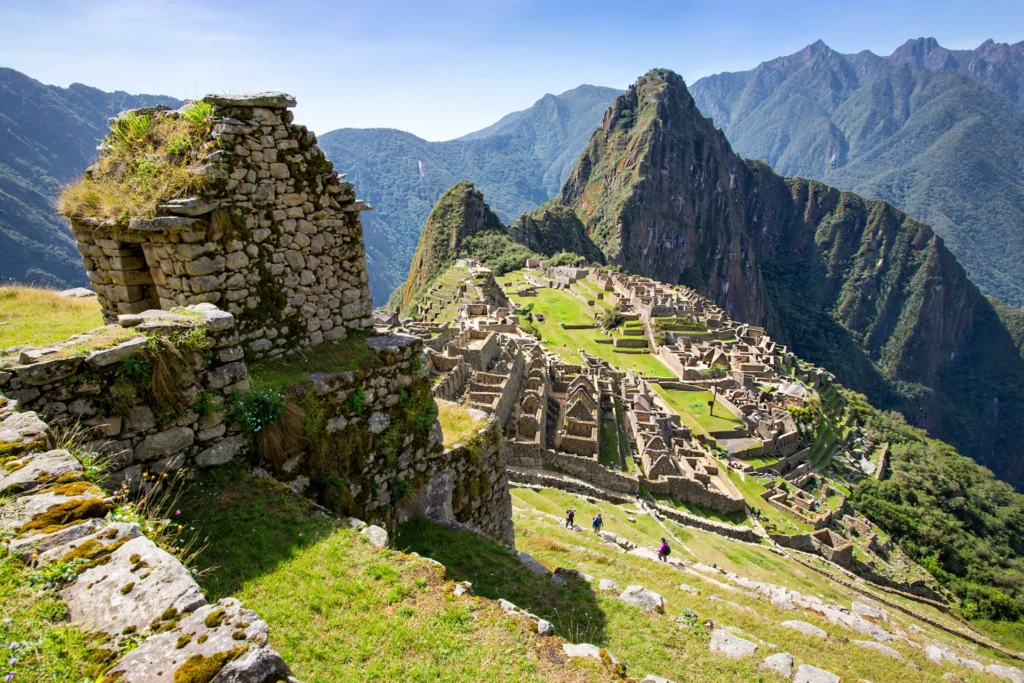
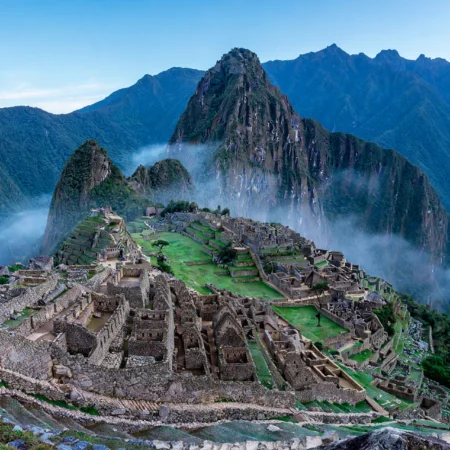
Machu Picchu is the reason most people come to Peru, and it is also the part of the trip that most often goes wrong, because the ticket system changed in June 2024 and most of the advice online still describes the old one. Since 1 June 2024 every visit to the Inca citadel has been organised into 3 circuits containing 10 routes. Each ticket is for one specific circuit and route, one date and one hourly entry slot, and you follow that route one way through the site — you cannot switch routes inside, you cannot backtrack, and once you exit, that is it. The choice of route is the single most consequential decision of your whole visit, so it deserves a full section of its own in this peru travel guide.
For a first visit, Circuit 2 is the most complete tour of the temples and plazas. Route 2-A, the classic designed route, takes you through the upper terraces for the classic photograph and then down through the urban and ceremonial sector, and it is the route to buy if you only visit once. If the famous elevated postcard photograph is your priority above all else, Circuit 1 is the safer choice: Route 1-B, the Upper Terrace, gives you the viewpoint from the Guardhouse platform and nothing else, which is fine if the photograph is the point and underwhelming as your only visit. Circuit 3 covers the lower royal sector — the Temple of the Sun area and the royal residences — and the mountain climbs: Huayna Picchu on Route 3-A and Machu Picchu Mountain on Route 1-A. The four seasonal routes — 1-C to the Sun Gate, 1-D to the Inca Bridge, 3-C to the Great Cavern and 3-D to Huchuy Picchu — run only in high season, roughly 19 June to 2 November, plus the peak dates around New Year and Easter week. The Intihuatana stone has been closed to the public since 2024 because of collapse risk and wear, so do not build your visit around it.
Tickets are sold officially by Peru’s Ministry of Culture on the portal tuboleto.cultura.pe, and that is the only place to buy them online. A non-resident foreign adult pays S/152 for a standard route, and S/200 for a route that includes a mountain climb or the Great Cavern. A separate S/11 sanctuary fee charged by SERNANP has applied to visits since 1 May 2026, bringing the planning totals to S/163 for a standard route and S/211 for a mountain route — although some sources report the fee waived from 14 November to 31 December 2026, so check the total on the portal itself at the moment you book rather than relying on a figure in any guide, including this one. Entry slots run hourly from 6:00 a.m. to 3:00 p.m., and your ticket admits you within that hour. Daily capacity in 2026 is 4,500 visitors on regular days and 5,600 on designated peak dates. That sounds like a lot until you learn that the popular routes and hours are small slices of it — Circuit 2 mornings vanish months ahead in high season, and the Huayna Picchu and Machu Picchu Mountain climbs sell out two to three months ahead. A limited batch of 1,000 tickets a day is also sold in person at the Machu Picchu Cultural Center in Aguas Calientes for the following days, but queuing for those is a gamble, not a plan.
| Machu Picchu circuits and routes (in force since 1 June 2024) | What you see | Season |
|---|---|---|
| 1-A Machu Picchu Mountain | Upper viewpoints plus the long climb to Machu Picchu Mountain (3,082 m) | Year-round |
| 1-B Upper Terrace | The classic postcard view from the upper terraces and Guardhouse | Year-round |
| 1-C Inti Punku (Sun Gate) | Upper terraces plus the hike to the Sun Gate | High season only |
| 1-D Inca Bridge | Upper terraces plus the trail to the Inca Bridge | High season only |
| 2-A Designed Route | Terraces plus the main urban and ceremonial sector — best first visit | Year-round |
| 2-B Lower Terrace | Similar to 2-A, starting from the lower terrace | Year-round |
| 3-A Huayna Picchu | Lower royal sector plus the steep Huayna Picchu climb | Year-round |
| 3-B Designed Route | Temple of the Sun area and royal residences | Year-round |
| 3-C Great Cavern | Lower sector plus the trail to the Temple of the Moon | High season only |
| 3-D Huchuy Picchu | Lower sector plus the short Huchuy Picchu climb | High season only |
Getting to Machu Picchu from Cusco
There is no road to Machu Picchu. The journey has three legs, and each one needs its own ticket. First, the train from Ollantaytambo in the Sacred Valley to Aguas Calientes, the town below the citadel, takes about 90 minutes along the Urubamba River with PeruRail or Inca Rail. Book the train as early as you book the citadel ticket, because high-season seats go early and the cheapest departures sell first. Second, the bus from Aguas Calientes up the switchbacks to the citadel entrance takes about 25 to 30 minutes; buy the bus ticket in town or online and arrive at the gate with time to spare. Third, your timed citadel entry itself. The budget alternative is a minibus from Cusco to Hidroeléctrica and then a two-to-three-hour walk along the railway line to Aguas Calientes — cheaper, and a long hot walk that eats most of a day. Most visitors stay one night in Aguas Calientes so they can take an early entry slot, when the terraces are quiet and the light is soft; by midday the buses deliver the main wave and the viewpoints are full. Aguas Calientes charges a premium for its captive audience, so expect a basic double to cost noticeably more than the same room in Cusco, and book early in June, July and August.
Machu Picchu itself sits at 2,430 metres, which is lower than Cusco, so the altitude is easier here than in the city — but the stone steps are steep, the routes are one-way, and there is almost no shade. Go with water, sun protection and a hat, wear shoes with grip, and allow two and a half to three hours inside for a standard route, four to six for a mountain route. The official site for visitor information is machupicchu.gob.pe, and Peru’s official tourism portal peru.travel is the place to check for wider trip planning. A guide is not legally required for every route, but a good one transforms the visit: the stones are the same whether you understand them or not, and the difference between a pile of walls and a 15th-century royal estate is the story. Hire through your hotel or a licensed agency, agree the price and the route in advance, and make sure your guide knows which circuit you hold — a guide cannot take you onto a route your ticket does not cover.
Cusco: The Inca Capital and How to Handle the Altitude
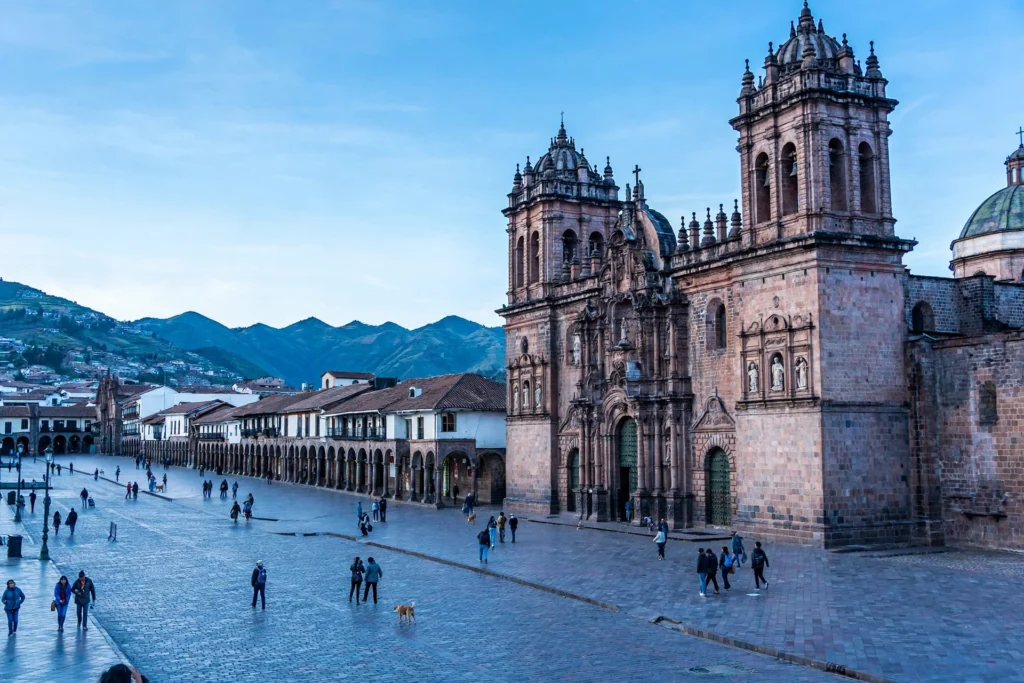
Cusco is the former capital of the Inca Empire and the base for almost everything in this peru travel guide, and it is also the place where altitude sickness hits hardest. The city sits at about 3,400 metres above sea level, and at that height most arrivals feel something in the first day: a headache, nausea, sleeplessness, a heart that beats faster on a flight of stairs. The cure is unglamorous and it works: a first day with no exertion, plenty of water, light food, coca tea, and no alcohol. What does not work is toughing it out or drinking through it. If symptoms get worse rather than better, descend — the Sacred Valley floor around Ollantaytambo sits several hundred metres lower and is a gentler place to spend your first night, which is why many experienced travellers sleep in the valley first and save Cusco for the return. If you arrive by air from Lima, you go from sea level to 3,400 metres in ninety minutes, which is the fastest possible way to feel it. Give yourself two full days in Cusco or the lower Sacred Valley before any strenuous hike, and do not plan Rainbow Mountain or the Inca Trail for day two.
The city itself earns the time. The Plaza de Armas is the heart of Cusco, ringed by colonial arcades and two great churches: the Cathedral, built on the site of an Inca palace, and the Church of La Compañía de Jesús. Above the city, Sacsayhuamán is a fortress of massive zigzag walls built from stones fitted so precisely that no mortar was needed — the scale of the blocks is the first thing that makes visitors stop and stare. Below it, Qorikancha was the Inca Empire’s most important temple, its walls once covered in gold, now standing beneath the Santo Domingo convent in one of the most striking collisions of two worlds anywhere in the Americas. The San Blas quarter, up the hill from the plaza, is the artisan neighbourhood: narrow lanes, workshops, small galleries and the best views over the city’s red-tiled roofs. The San Pedro Market, a few blocks from the plaza, is where Cusco actually eats — fruit, bread, cheese, flowers and juice stalls, with set lunches for a few soles. Enter churches with shoulders and knees covered, ask before photographing people, and agree the price before the shutter if a woman with a lamb poses for a photograph on the plaza: posing for money is a professional arrangement, not a favour.
Cusco is also the city of festivals, and the biggest is Inti Raymi, the Festival of the Sun, held every year on 24 June. Hundreds of performers re-enact the Inca winter solstice ceremony at Sacsayhuamán, and the city fills for days around it — book a month ahead at least if your trip touches that week, and expect the highest hotel prices of the year. The Cusco Tourist Ticket, the Boleto Turístico, covers most Sacred Valley sites and Cusco museums for a planning price of around S/130 for the full version, and it pays for itself from the third site onward, so buy it at the first site you visit rather than paying entry by entry. Stay a couple of blocks from the Plaza de Armas rather than on it, since the square is loud at night, and ask specifically about heating and hot water: Cusco has plenty of beautiful colonial buildings in the centre, but old stone walls at 3,400 metres without heating add up to genuinely cold nights. The city is patrolled and the centre is busy and safe in the evening, but the lanes above San Blas empty out at night — take a taxi back up the hill after dark; it costs almost nothing.
Cusco’s essential sights
| Sight | Time needed | Planning cost |
|---|---|---|
| Sacsayhuamán fortress | 1.5–2 hours | Covered by Boleto Turístico |
| Qorikancha and Santo Domingo | 1 hour | Covered by Boleto Turístico |
| Cusco Cathedral, Plaza de Armas | 1 hour | Around S/25–40 |
| San Blas quarter and viewpoints | 2 hours | Free |
| San Pedro Market | 1 hour | Free, food extra |
| Church of La Compañía de Jesús | 45 minutes | Around S/15–25 |
| Museo de Arte Precolombino | 1 hour | Around S/20 |
| Inti Raymi festival (24 June) | Full day | Tickets and hotels book out a month ahead |
The Sacred Valley: Pisac, Ollantaytambo, Moray and Maras
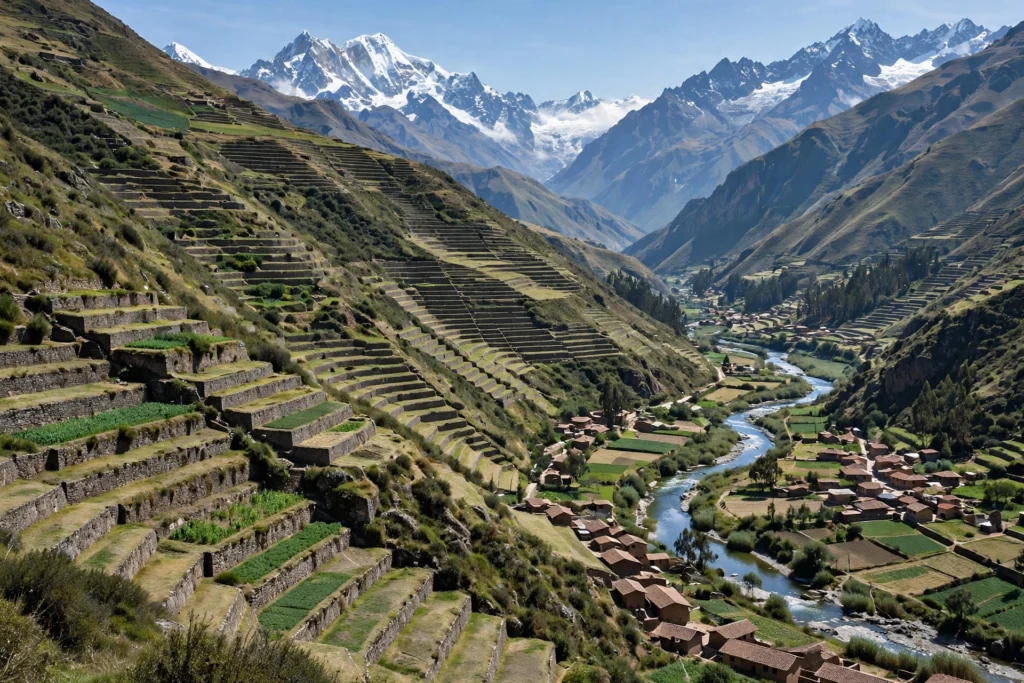
The Sacred Valley is the fertile Urubamba valley between Cusco and Machu Picchu, and it is the part of Peru that rewards slowing down. The valley floor sits lower than Cusco, the air is warmer, the light is softer, and the Inca sites here are spread along a river that has been farmed for a thousand years. Give it two days, not one, and stay overnight in Ollantaytambo or Urubamba rather than rushing back to Cusco each evening. The valley is also the smartest place to acclimatise: sleep here on your first night and your body gets a gentler introduction to the altitude than a night in Cusco.
Pisac is the usual first stop, an hour from Cusco. The hilltop citadel above the town holds sweeping agricultural terraces and a cemetery of hundreds of tombs cut into the cliff, and the town below holds one of the valley’s best markets — strongest on Sundays, when villagers from the surrounding communities come in with textiles and produce, and worth timing your visit for. The market is at its worst on a tour-bus afternoon, when the lanes are crowded and the goods are the same as everywhere else; go in the morning, buy from the stalls where locals are shopping, and haggle calmly at souvenir stalls while remembering that restaurants, supermarkets and transport have fixed prices.
Ollantaytambo is the only place in Peru where the Inca street plan still functions: the same blocks, the same water channels, the same narrow lanes, with people still living in houses built on Inca foundations. Everyone storms the fortress above the town, and it deserves the climb — massive terraces and unfinished stones that show how the Inca moved rock on a scale that still puzzles engineers — but the Pinkuylluna granaries on the opposite slope are empty and the view from there is better. Ollantaytambo is also where the train to Aguas Calientes leaves from, which makes it the natural last night before Machu Picchu: stay here, take a morning train, and you arrive at the citadel rested instead of exhausted.
Moray and Maras make a natural half-day pair. Moray is a set of giant concentric terraces sunk into the earth, thought to have been used by the Inca as an agricultural laboratory: the temperature difference between the top and bottom rings is around 15 degrees, so different crops could be tested at different altitudes in one place. Next door, the Maras salt pans are thousands of terraced salt pools cascading down a valley, worked by local families since before the Inca, and still harvested by hand today. Go in the morning for the best light on the white pools, and buy salt from the stalls at the entrance rather than from a tour shop in Cusco. The valley’s other stops — the colonial church at Chinchero with its weaving cooperatives, and the quiet town of Urubamba with its riverside hotels — are worth an hour each if your schedule allows, but they are extras, not essentials. The essential rhythm is simple: Pisac in the morning, Moray and Maras in the afternoon, Ollantaytambo for the night, and the train to Machu Picchu the next morning.
| Sacred Valley stop | What it is | Time needed |
|---|---|---|
| Pisac citadel and market | Hilltop terraces and tombs; Sunday market is the strongest | Half a day |
| Ollantaytambo fortress | Living Inca town, terraced fortress, train station for Machu Picchu | Half a day, overnight stay |
| Moray terraces | Concentric agricultural laboratory with a 15-degree microclimate range | 1 hour |
| Maras salt pans | Thousands of hand-worked salt pools, farmed since before the Inca | 1 hour |
| Chinchero | Colonial church and weaving cooperatives on the road from Cusco | 1 hour |
| Urubamba | Quiet riverside town, good hotels and restaurants at valley altitude | Overnight base |
The Inca Trail and Alternative Treks: Salkantay, Lares and Choquequirao
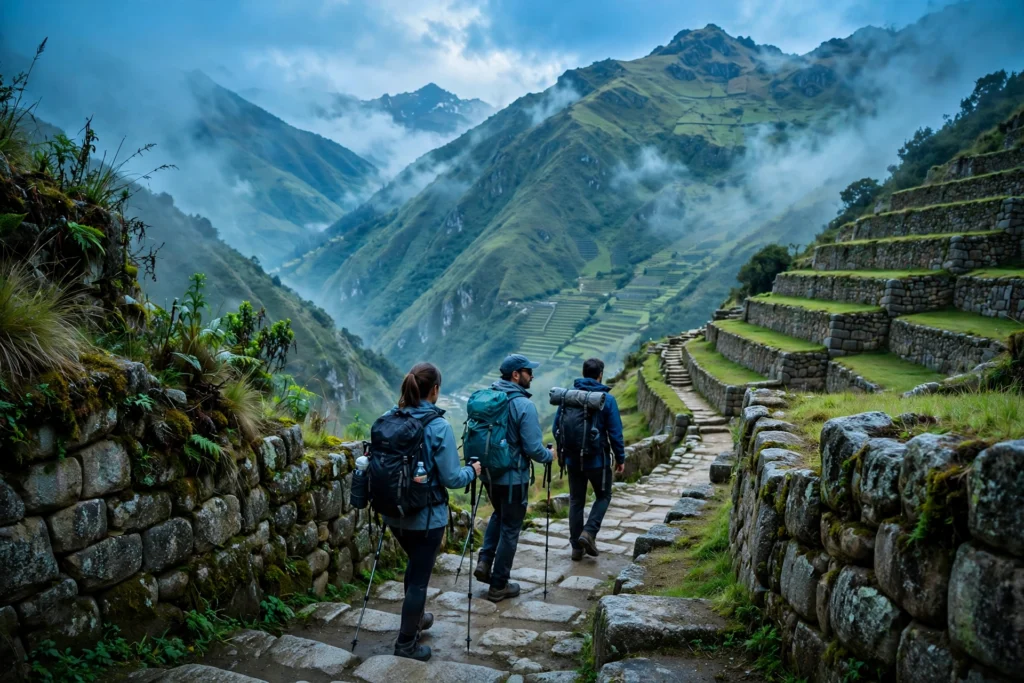
The classic Inca Trail is the most famous walk in South America, and it is also the one that needs the most advance planning. The four-day, roughly 43-kilometre route follows original Inca stone paths from Km 82 to Machu Picchu, arriving through the Sun Gate at dawn on the final morning. You cannot walk it independently: the trail is permit-only, it must be booked through a licensed operator, and permits are capped at 500 people a day including guides and porters. Permits for the dry season go on sale in January and the popular dates sell out within hours of opening, so if the Inca Trail is your priority, set a calendar reminder for the release date and book the moment it opens. The trail closes entirely every February for maintenance, and it is not bookable last-minute at any time of year — any operator promising you a permit for next week in July is selling something that does not exist. Guided four-day treks cost a planning range of roughly US$600–800 per person including the permit, food, porters and camping, with prices varying by operator and group size. The highest point is Dead Woman’s Pass at 4,215 metres, which is why the trail belongs after your acclimatisation days, never before them.
The alternatives are not consolation prizes — for many travellers they are the better walk. The Salkantay Trek runs five days and about 75 kilometres from Mollepata to Aguas Calientes, crossing the 4,630-metre Salkantay Pass beneath a glaciated peak, then descending through cloud forest to the hot springs at Santa Teresa. It needs no permit, it is cheaper than the Inca Trail, and it ends at Machu Picchu, though you arrive by the town rather than through the Sun Gate. The Lares Trek runs three to four days through the highland villages north of Cusco, with homestays and hot springs and far fewer walkers; it suits travellers who want culture and quiet over the classic route’s drama. Choquequirao is the hardest and the most rewarding: a four-to-five-day out-and-back trek to a vast Inca city that rivals Machu Picchu in scale and receives a fraction of its visitors, reached only on foot down one side of a canyon and up the other. It is strenuous, remote, and the closest thing to discovering a ruin for yourself that Peru still offers.
| Trek | Days | Distance | Highest point | Permit | Best for |
|---|---|---|---|---|---|
| Classic Inca Trail | 4 | About 43 km | 4,215 m Dead Woman’s Pass | Yes, capped at 500/day, book months ahead | First-timers who want the Sun Gate arrival |
| Salkantay Trek | 5 | About 75 km | 4,630 m Salkantay Pass | No permit needed | High mountain scenery without the permit race |
| Lares Trek | 3–4 | About 33 km | About 4,400 m | No permit needed | Village culture, homestays, quiet trails |
| Choquequirao | 4–5 | About 60 km return | About 3,100 m at the site | No permit needed | Experienced hikers who want a near-empty ruin |
| Short Inca Trail (2-day) | 2 | About 12 km | 2,730 m at Wiñay Wayna | Yes, limited permits | Travellers short on time who still want to walk in |
Whichever trek you choose, the same rules apply. Book with a licensed operator and check what is included: permits, food, camping equipment, porters and the Machu Picchu entry ticket are the items that get quietly left out of cheap quotes. Train for the altitude, not just the distance: the walking is moderate, but the thin air makes every climb harder than it looks on paper. Pack a waterproof shell even in the dry season, because mountain weather changes in an hour. Carry cash for the communities you pass through, ask before photographing people, and tip your guides and porters properly — on a multi-day trek their tips form a real part of their income. And check that your travel insurance covers trekking above 4,000 metres and evacuation from a trail, because many standard policies exclude both and the nearest hospital is a long way from a mountain pass.
Lima: The Food Capital of South America
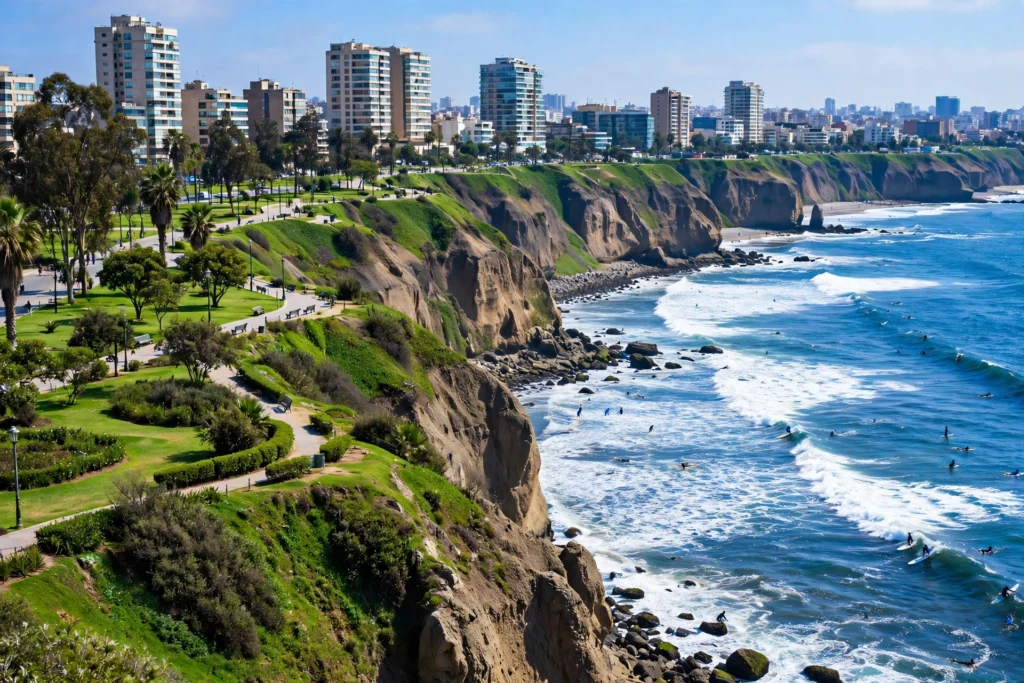
Most travellers treat Lima as a transit stop, and that is a mistake. The Peruvian capital is one of the world’s great food cities, a clifftop metropolis of ten million people where pre-Inca pyramids sit between apartment blocks and the Pacific crashes against the cliffs below the Malecón. Give it two nights — one at the start of your trip and one at the end — and it will repay you. If you are comparing it with other capitals in the region, the difference is the food: Lima’s restaurants have spent a decade at the top of the world’s best lists, and the city’s markets and cevicherías are just as rewarding as its fine dining.
Miraflores is where to stay: safe, central, walkable, on the clifftop Malecón with its parks, sculptures and paragliders floating above the surf. Barranco, next door, is the bohemian quarter — murals, mansions, galleries and lively bars, with cheaper guesthouses than Miraflores and a genuine neighbourhood feel. San Isidro is quiet and upmarket, close to the top restaurants. The historic centre, with its grand Plaza Mayor, cathedral and colonial balconies, is a daytime visit: beautiful in the morning, and not a place to linger after dark. Do not stay in Callao, La Victoria or the outskirts, particularly with a camera out.
The food is the main event, and it starts with ceviche: raw white fish cured in lime juice with onion, chilli and coriander, served with sweet potato and choclo corn. It is a lunch dish only, because by evening the fish is no longer today’s and locals know it. A good cevichería will also bring you leche de tigre, the marinade, drunk on its own. Lomo saltado is beef stir-fried with tomato, onion and soy sauce, served with chips and rice at the same time — Peruvian-Chinese chifa cooking made visible, the soy sauce arriving with Chinese labourers in the nineteenth century. Ají de gallina is chicken in a creamy nut sauce with yellow ají amarillo pepper; despite the colour, it is not hot. Anticuchos are beef heart skewers with a sharp sauce, the classic street food — buy where there is a queue of locals and you will be fine. Cuy, guinea pig roasted whole, is a traditional Andean dish served in Cusco: impressive to look at and short on actual meat. Papa a la huancaína and causa are potato dishes, and Peru has more than three thousand potato varieties, so the country takes the subject seriously. A menú del día — a set lunch of soup, main and a drink in a plain café — costs a planning range of S/12–20 and is cheap, filling and usually better than the tourist restaurants on the square. Worth drinking: chicha morada from purple corn, and a pisco sour with its foam of egg white. A sit-down meal at a mid-tier restaurant in Miraflores runs S/45–90 per person, while a tasting menu at one of Lima’s world-famous restaurants costs a planning range of around US$150–200 per person.
Beyond the table, Lima has more to offer than most visitors expect. Huaca Pucllana is a great adobe pyramid built by the Lima culture, rising unexpectedly among the apartment blocks of Miraflores, and it is the easiest pre-Inca site to reach in the city. The Larco Museum holds one of the finest collections of pre-Columbian art in the country, and the historic centre’s churches and catacombs reward a guided morning. The Malecón itself is the best free walk in Lima: six miles of clifftop parks above the surf, best at sunset, when the paragliders come down and the city lights come on. Getting around is simple: order taxis through Uber, InDriver or Cabify rather than flagging one down in the street, use the Metropolitano busway for the quickest crossing at rush hour, and from the airport use the official taxi counters inside arrivals — fares to Miraflores run a planning range of about S/65–80 and the ride takes 35 to 60 minutes depending on traffic, which can be brutal at rush hour. There is no metro or train from the airport to the city.
Lima’s weather surprises first-timers. The coast is a desert: the city averages only 8–12 millimetres of rain a year, making it one of the driest capitals on earth. From December to March it is sunny and warm, the best time to be on the coast. From June to October the garúa rolls in — a sea fog that brings grey skies without actual rain — and the city feels cool and damp even though it never rains. Pack a light jacket for a Lima evening in any month, and do not judge the whole country by the capital’s weather: the Andes and the coast run on opposite seasons, which is why this peru travel guide treats them separately.
Arequipa and the Colca Canyon: Condors and the White City
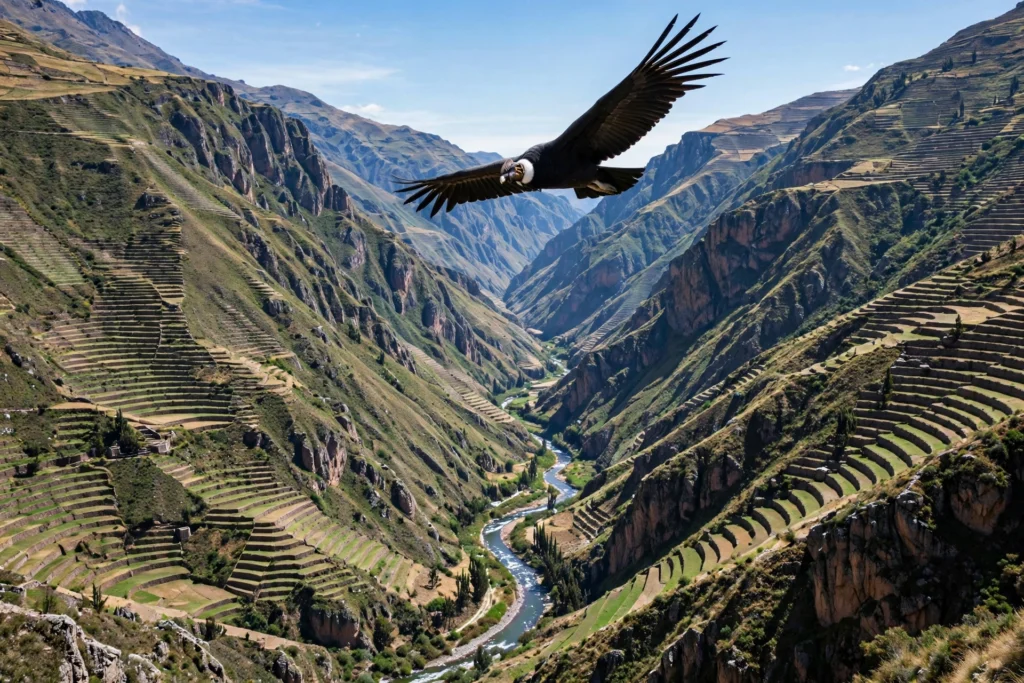
Arequipa is Peru’s most underrated big city, and the Colca Canyon is one of the deepest canyons on earth — together they make the best three-day addition to a classic Peru trip. The city is known as the White City for the pale volcanic stone, sillar, that its colonial buildings are made from, and it sits in the shadow of El Misti, a near-perfect volcanic cone that dominates the skyline. It is warmer and cheaper than Cusco, its historic centre is a UNESCO-listed grid of plazas and monasteries, and it is the gateway to the canyon. Fly from Lima or Cusco, stay two nights in the centre, and take the canyon as an overnight trip rather than a day tour.
The Santa Catalina Monastery is the city’s essential stop: a walled city within the city, home to nuns since 1579, with painted streets, courtyards and chapels that feel like a small town frozen in the colonial era. Give it two hours and go early, before the tour groups arrive. The Plaza de Armas, ringed by arcades and overlooked by the cathedral, is the evening meeting point, and the San Lázaro quarter — the oldest in the city — is the quietest place to stay. Yanahuara, across the river, has the classic viewpoint over the city with El Misti behind it. Arequipa’s food deserves its own paragraph: the picanterías, traditional restaurants serving spicy stews and river shrimp, are a cuisine of their own, and the city is one of the best places in Peru to eat well for little money.
The Colca Canyon is the reason to come. At more than 3,000 metres deep it is one of the deepest canyons in the world, and its scale only becomes clear when you stand at the rim and watch the river far below. The condors are the draw: Andean condors with wingspans of three metres ride the morning thermals at Cruz del Cóndor, and the best chance of seeing them is early, while the updrafts are running — which is why the overnight trip beats the day trip. A day tour from Arequipa means a 3 a.m. start and half a day on a bus; staying overnight in Cabanaconde, the village at the canyon’s far end, is incomparably better, and lets you walk down to the oasis village of Sangalle at the canyon floor. The canyon is also terraced farmland, worked for centuries, and the villages of Chivay, Yanque and Maca hold churches, hot springs and weaving cooperatives that most day tours rush past. Go in the dry season for the clearest condor mornings, carry sun protection and water for the altitude — the canyon rim sits above 3,400 metres — and build in a day for Arequipa itself on the way back, because the city is worth more than a quick stop between buses.
| Arequipa and Colca stop | What it is | Time needed |
|---|---|---|
| Santa Catalina Monastery | Walled monastery city, home to nuns since 1579 | 2 hours |
| Plaza de Armas and cathedral | Colonial heart of the White City | 1 hour |
| Yanahuara viewpoint | Classic view of Arequipa with El Misti behind | 30 minutes |
| Cruz del Cóndor | Condor viewpoint, best in the early morning | 2–3 hours from Chivay |
| Cabanaconde and Sangalle | Canyon village and oasis at the canyon floor | Overnight, half-day walk |
| Chivay hot springs | Thermal baths near the canyon entrance | 1–2 hours |
Lake Titicaca: The Floating Islands of the Uros
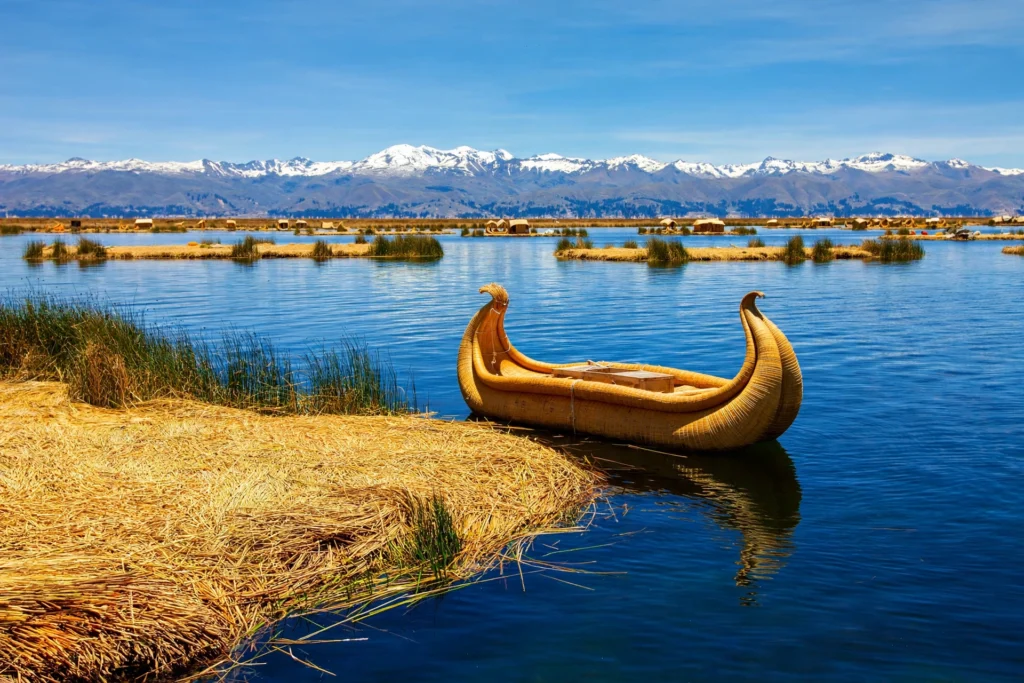
Lake Titicaca is the world’s highest navigable lake, at 3,812 metres above sea level, and it is one of the strangest and most memorable places in Peru. The draw is the Uros: floating islands built entirely from totora reeds, layered and re-layered by hand, with reed houses, reed boats and reed watchtowers on top. The islands are real and the families who live on them are real, but the visit is also the most tourist-facing experience in Peru, and it is worth knowing that before you go. The islands nearest Puno are the most visited and the most commercial; the islands further out, and the homestays on Amantaní and Taquile, are quieter and closer to how the lake is actually lived on. A rushed half-day tick-box visit is the worst way to see Titicaca, and it is the version most day tours sell.
Puno is the base: a working lakeside city, plain and cold, with little to detain you beyond its port and plaza. Stay one night, take the boat in the morning, and spend the night on an island if you can. Taquile is the island to prioritise: a steep climb from the jetty to the village square, terraced fields, and a weaving tradition so distinctive that UNESCO lists it — the men knit, the women weave, and the patterns and hats signal marital status to anyone who can read them. Amantaní offers homestays with local families, simple rooms, shared meals and a walk up to the island’s pre-Inca temples for sunset. The lake is cold and the sun is fierce at this altitude, so pack a warm layer and sun protection even on a clear day, and give yourself a day to acclimatise in Puno before the island climb: at 3,812 metres the steps up from the jetty are harder than they look.
Getting there is straightforward. From Cusco the scenic train to Puno takes about ten hours across the Altiplano, and the bus is faster and cheaper; from Arequipa it is a six-hour bus ride. The lake is shared with Bolivia, and the Bolivian side — Copacabana and the Island of the Sun — is a natural extension if your trip continues west, though it needs a border crossing and a separate day. On the Peruvian side, two days is enough: one day for the Uros and Taquile, one for an Amantaní homestay or a slow morning on the lake. The lake’s scale is the thing that stays with you — a sea at the top of the world, with snow on the horizon and reeds under your feet.
The Nazca Lines and Huacachina: Desert Peru
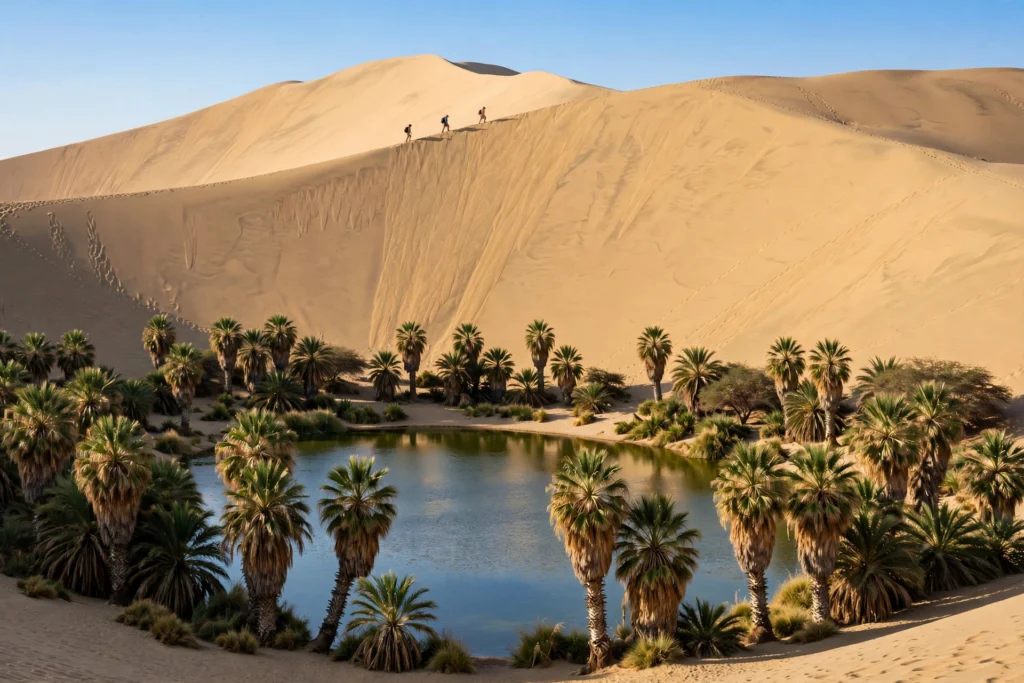
South of Lima, the coast turns to desert, and the desert holds two of Peru’s strangest sights. The Nazca Lines are giant geoglyphs — a hummingbird, a spider, a monkey, a condor — etched into the desert floor some 2,000 years ago by the Nazca culture, and they are only legible from the air. The flight is a 30-to-35-minute ride in a small aircraft that banks steeply over each figure, and it makes a lot of people queasy: take motion-sickness tablets an hour before, eat lightly, and sit by a window. Book with a reputable operator from Nazca town, fly in the morning when the light is clearest, and keep your expectations honest — the figures are shallow lines in the sand, not grand monuments, and their power is in the mystery of why they were made, not in their size. The town of Nazca itself is a dusty staging post with little to detain you, so most visitors pass through in a day on the way between Lima and Arequipa.
Huacachina is the desert’s other face: a palm-fringed oasis ringed by towering sand dunes, a lagoon at the bottom of a bowl of sand, and a small village of hostels and restaurants around it. The draw is the dunes themselves — sandboarding down them and dune-buggy rides across them at sunset, when the sand turns gold and the oasis lights come on. It is a half-day stop from Ica, the regional capital an hour away, and it pairs naturally with a Nazca Lines flight or a Paracas boat trip on the way south. Go for the sunset ride, stay one night if you want the oasis quiet after the day visitors leave, and carry water and sun protection: the desert sun is strong and there is no shade on a dune.
The coast between Lima and Huacachina holds a third stop worth your time. Paracas is a desert-meets-ocean resort town and the gateway to the Ballestas Islands, rocky guano islands teeming with sea lions, Humboldt penguins and huge seabird colonies, reached by a two-hour morning boat trip. The Paracas National Reserve, next door, is a coastal desert of red beaches, sea cliffs and fossil beds, best explored by bike or car in the afternoon when the light turns the cliffs copper. Together, Paracas, Huacachina and Nazca make a two-to-three-day desert loop from Lima that is the best warm-weather break from the Andes in the middle of a Peru trip — and the coast is at its sunniest from December to March, exactly when the highlands are at their wettest.
Rainbow Mountain and the High Andes: Vinicunca and Palcoyo
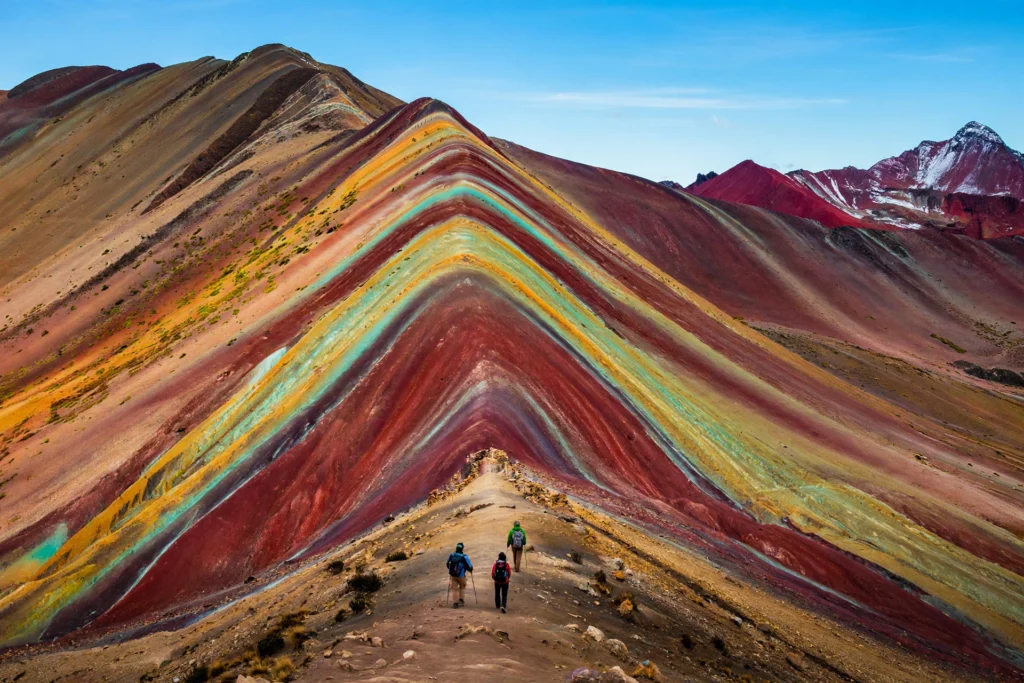
Rainbow Mountain, Vinicunca, is the striped mineral ridge south-east of Cusco that has gone from obscurity to one of Peru’s most visited day trips in a decade — and it is the one that most often disappoints people who go unprepared. The colours are real: bands of red, orange, yellow and green mineral deposits in the rock, most vivid in dry weather before noon. But the mountain sits at about 5,200 metres, the climb is hard even when you are acclimatised, the weather changes fast, and on a cloudy day the colours mute to brown. The practical rules are simple. Go in the dry season, go early, go on a weekday if you can, and do not attempt it before you have spent at least two days at altitude in Cusco or the Sacred Valley. The walk from the trailhead takes about two to three hours up and less down, and horses are available for hire at the start for those who struggle — agree the price before you mount, and tip the handler. Bring warm layers, a waterproof shell, sun protection and water, and take the altitude seriously: 5,200 metres is higher than any point most visitors will ever stand on, and the headache that starts at the top is not a mood, it is the air.
Palcoyo is the alternative without the crowds, and for many travellers it is the better choice. Lower, calmer, and reached by a short walk rather than a long climb, Palcoyo offers the same idea — striped mineral slopes, a red valley, a stone forest — with a fraction of the visitors. If your knees or your lungs are a concern, or if you simply prefer a quiet mountain to a busy one, choose Palcoyo. The two mountains are often sold as a pair on the same day, but they deserve separate days if you have them, and neither should be attempted on your first day in Cusco.
Beyond Rainbow Mountain, the high Andes around Cusco hold the region’s best trekking beyond the Inca Trail. Huaraz, further north, is Peru’s trekking and climbing capital, set beneath the glaciated peaks of the Cordillera Blanca in Huascarán National Park, a UNESCO-listed park protecting the world’s highest tropical mountain range. The classic day hike is Laguna 69, a startlingly turquoise lake beneath the peak of Chacraraju, and the multi-day Santa Cruz trek is one of the finest walks in South America. Huaraz sits at 3,050 metres and the trails go higher, so the same acclimatisation rules apply. The north of Peru holds more still: Trujillo, on the coast, is surrounded by the great pre-Inca sites of the Moche and Chimú, including Chan Chan, the largest adobe city in the Americas; and Chachapoyas, in the cloud-forested north, is the base for Kuélap, a massive walled citadel of the Chachapoya people perched on a ridge, and Gocta waterfall, one of the world’s tallest. These are the places to go when you have already seen the south and want the Peru that most visitors never reach.
The Amazon: Iquitos and Tambopata
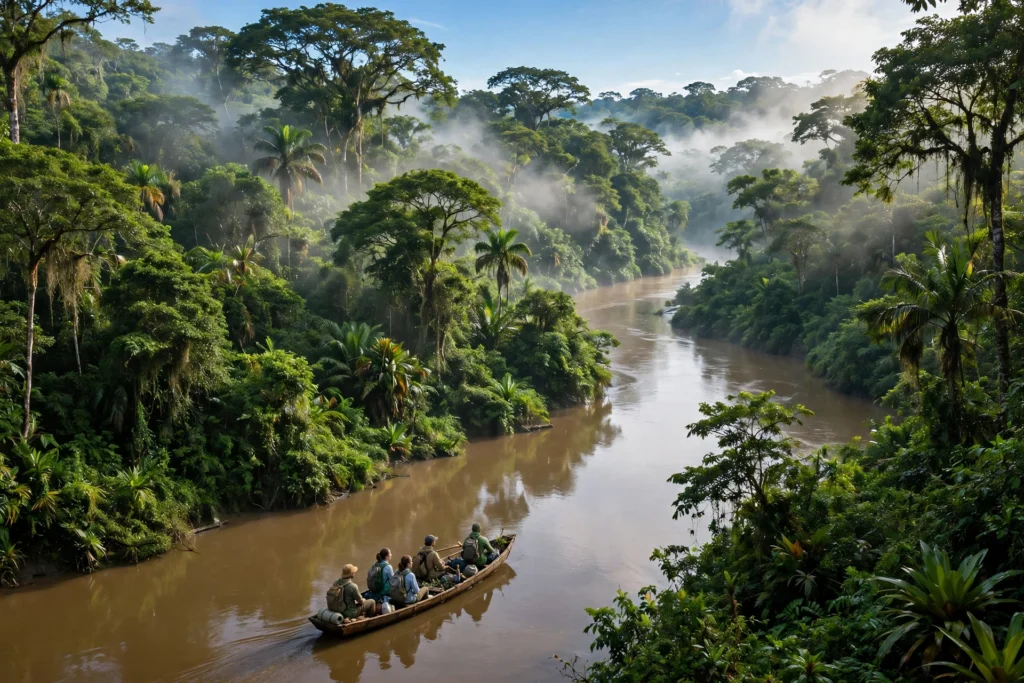
The Amazon covers 60 percent of Peru, and it is a different country from the Andes: hot, humid, flat, green to the horizon, and reached by boat or plane rather than road. Iquitos is the largest city in the world unreachable by road — a river port on the Amazon, reached only by air or by a multi-day boat journey — and it is the classic base for a Peruvian jungle trip. Puerto Maldonado, further south, is the easier choice for most first-timers: closer to Cusco, better wildlife density at the Tambopata National Reserve, and lodges that run three-to-four-night packages with meals and guided excursions included. For a first Amazon trip, Puerto Maldonado beats Iquitos on access and value; Iquitos wins on scale and remoteness, and on the flooded-forest reserves of Pacaya-Samiria, Peru’s largest protected area, where pink river dolphins swim through drowned trees.
The Amazon runs on its own seasons. October to April is high water, which actually improves wildlife viewing on river excursions, because animals concentrate near flooded forests and boats can reach further into the forest. June to November is low water, better for walking trails and seeing the forest floor. The rainforest is wet year-round and wettest from November to April, so pack a waterproof shell and quick-drying clothes whenever you go, and expect afternoon rain as a normal part of the day rather than a disruption. The lodges sell packages rather than rooms, because there is essentially nowhere else to stay out there: a three-to-four-night package at a good lodge runs a planning range of roughly US$800–1,200 all-inclusive, including transfers, meals and guided walks, and it is genuinely good value given the remoteness and the expertise involved. Manú National Park, further west, is the most biodiverse corner of all, a vast UNESCO-listed park descending from the Andes to the Amazon lowlands — but it is a long, rough journey in, and it suits travellers with a week to spare rather than a weekend.
The wildlife is the point, and it rewards patience. Macaw clay licks at dawn, where dozens of bright parrots gather on a riverbank; caiman on night boat rides, their eyes catching the torchlight; monkeys in the canopy at first light; and the pink river dolphin, the Amazon’s most improbable animal, surfacing in the brown water of a tributary. Bring binoculars, a headlamp, insect repellent, and a camera with a good zoom — the animals are rarely close. Yellow fever vaccination is recommended for the Amazon lowlands, and malaria prophylaxis is worth discussing with your doctor before you go; check the current advice with your own government’s travel health service well before departure, because recommendations change. And one practical warning: the Amazon has no roads, no ATMs in the forest, and no phone signal at most lodges, so carry cash, download your maps and tickets in advance, and tell people at home that you will be offline for a few days.
When to Go to Peru: Month-by-Month Weather and the Best Time
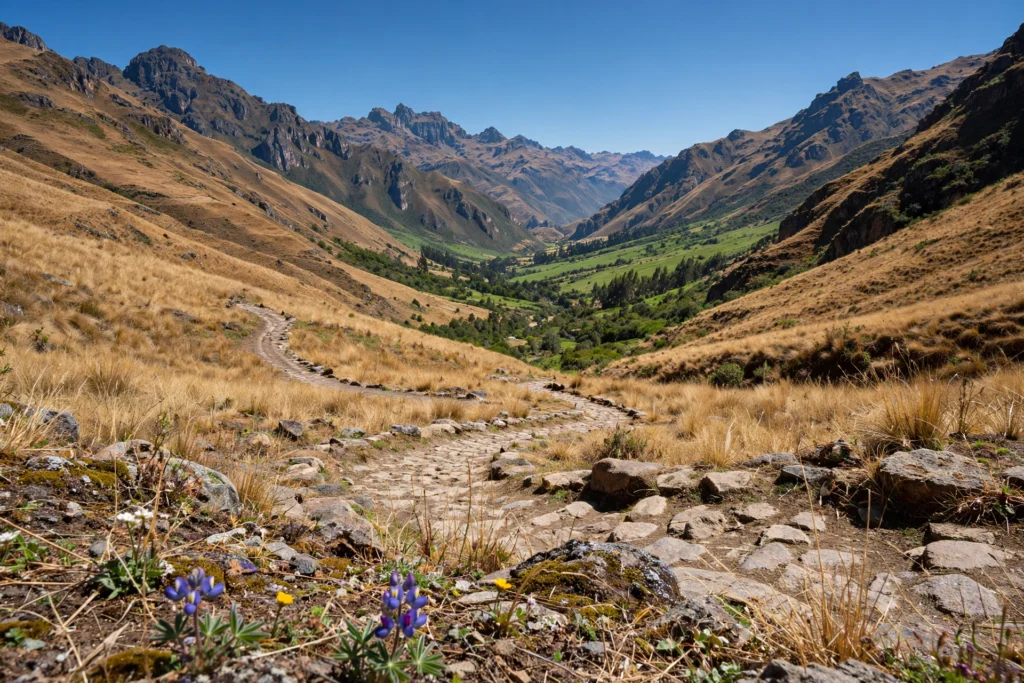
Peru has no single best month, because the country has three climates that run on opposite seasons. The Andes are dry from May to September and wet from November to March. Lima and the coast are sunny from December to March and grey and misty from June to October. The Amazon is wet year-round and wettest from November to April. The question is not when Peru is best, but when the part of Peru you most want to see is best — and the honest answer for a first trip built around Machu Picchu is the dry season in the Andes, May to September, with the shoulder months of April and October as the sweet spot for travellers who want good weather and thinner crowds. If you are weighing the shoulder season against the peak, the comparison with other destinations helps: the trade-offs of timing a trip are the same everywhere, and the best places to travel in January show how a well-timed shoulder-season trip can beat a peak-season one.
The dry season, May to September, is the best time for trekking and Machu Picchu, with clear skies, crisp mountain air and the lowest chance of rain on the trails. It is also the busiest and the most expensive: June to August is peak season, Machu Picchu tickets hit their daily cap, Cusco hotels charge peak supplements, and the Inca Trail permits for these months sell out within hours of their January release. The landscape in the dry season is brown and gold rather than green, the nights are cold — Cusco regularly drops close to freezing after dark in June and July — and the popular viewpoints are crowded by midday. Go in the dry season for the weather, and accept the crowds and the prices as the cost of it.
The shoulder months, April and October, are the best compromise for most travellers. The rains are ending in April and have not yet begun in October, the landscape is greener than in midwinter, the crowds are thinner, and prices drop noticeably from the peak. Late April and October are the two months this peru travel guide would pick for a first trip if the calendar allows. The rainy season, November to March, is the cheapest time to travel and the quietest — February is the lowest month of all, and the Inca Trail is closed entirely that month — but the trails are muddy, the mountain views hide behind cloud, and some sites become inaccessible. The landscape, though, is dramatically green, and for travellers who do not mind rain, the rainy season offers the Andes almost to themselves. Lima inverts the whole picture: the coast is at its sunniest from December to March, when the Andes are at their wettest, so a trip that pairs Lima and the desert coast with a short highland visit works best in the southern summer.
| Month | Andes (Cusco, Machu Picchu) | Coast (Lima, Paracas) | Amazon | Crowds and prices |
|---|---|---|---|---|
| January | Rainy, green, afternoon rain | Sunny and warm | High water, wet | Low, cheapest |
| February | Rainiest month; Inca Trail closed | Sunny and warm | High water, wet | Lowest of the year |
| March | Rain easing, still wet | Sunny and warm | High water, wet | Low |
| April | Rain ending, landscape green | Sunny, cooling | High water easing | Shoulder, good value |
| May | Dry season begins, clear skies | Grey garúa arriving | Low water begins | Rising |
| June | Dry, cold nights, Inti Raymi 24 June | Grey and misty | Low water, good walking | Peak begins |
| July | Driest, clearest, coldest nights | Grey and misty | Low water | Peak, most expensive |
| August | Dry and clear | Grey and misty | Low water | Peak |
| September | Dry, warming, last of the peak | Grey, warming | Low water | High, easing |
| October | Shoulder, green, light rain returns | Sunny returning | High water begins | Shoulder, good value |
| November | Rain returning | Sunny and warm | Wettest period begins | Low |
| December | Rainy, green, festive | Sunny and warm | High water, wet | Low, rising at Christmas |
Weather figures in this table are typical seasonal patterns for planning, not a forecast. The Andes can rain in July and shine in February, and the only certainty is that mountain weather changes fast. Check the forecast the week you travel, keep one flexible day in your itinerary, and buy travel insurance that covers trip disruption.
How Much Does a Peru Trip Cost? A Planning Budget in Soles
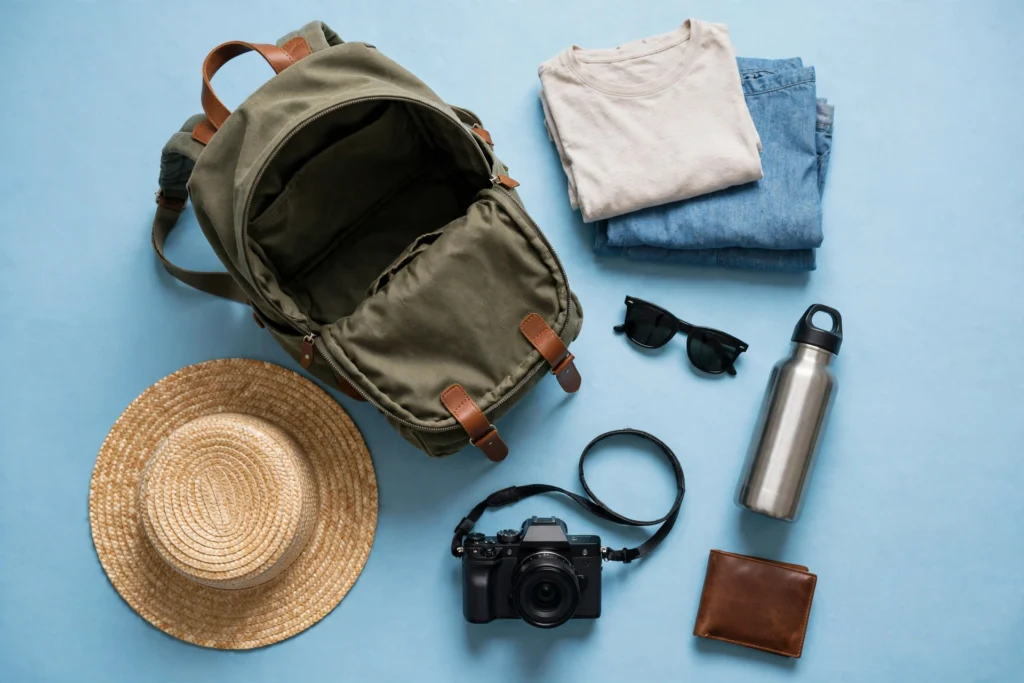
Peru suits a wide range of budgets, and the difference between a cheap trip and an expensive one is mostly the cost of getting to Machu Picchu, not the cost of being in Peru. Hostels, set lunches and buses are inexpensive, while Cusco and the Sacred Valley have a strong mid-range and luxury scene. The big costs are Machu Picchu entry, the train to Aguas Calientes, and any permit-based trek, and those three items should be budgeted separately from your daily spending, because they dwarf everything else. The figures below are planning ranges in soles and US dollars, built from the prices published by the official ticket portal and the going rates reported by recent guides — they are not live prices, and you should confirm the big-ticket items at the moment you book.
A budget traveller in hostels, eating set-menu lunches and using buses, can get by on roughly US$25–50 a day before the big-ticket items. A mid-range traveller in private rooms, good restaurants and domestic flights should budget roughly US$60–160 a day. A comfort traveller with good hotels, domestic flights instead of buses and private guides should plan from US$200 a day. The Machu Picchu circuit alone — train, entry ticket, bus up the mountain and one night in Aguas Calientes — costs a minimum of roughly US$120–180 per person regardless of your overall budget level, and a guided four-day Inca Trail runs a planning range of roughly US$600–800 per person including the permit. Fine dining in Lima is the other splurge: a tasting menu at one of the city’s world-famous restaurants costs a planning range of around US$150–200 per person. If you are building the numbers into a full trip budget, a simple travel budget plan will help you lay them out before you book anything non-refundable.
| Item | Planning price (soles) | Planning price (US$) |
|---|---|---|
| Menú del día lunch | S/12–20 | About US$3–5 |
| Dinner in a tourist restaurant | S/50–90 | About US$15–25 |
| Ceviche in a cevichería | S/25–45 | About US$7–12 |
| Pisco sour | S/18–30 | About US$5–8 |
| 1.5L bottled water | S/2–4 | About US$0.70 |
| Hostel dorm bed | S/35–70 | About US$10–20 |
| Private room in a guesthouse | S/85–170 | About US$25–50 |
| Mid-range hotel double | S/200–400 | About US$60–120 |
| Night bus Lima–Cusco, cama seat | S/150–200 | About US$45 |
| Domestic flight Lima–Cusco | S/200–400 | About US$60–120 |
| Train Ollantaytambo–Aguas Calientes | S/240–500 | About US$70–150 return |
| Machu Picchu entry, standard route | S/152 + S/11 fee | About US$44 |
| Machu Picchu entry, mountain route | S/200 + S/11 fee | About US$57 |
| Boleto Turístico, full version | S/130 | About US$34 |
| Inca Trail, 4 days guided | — | About US$600–800 |
| Colca Canyon day tour | S/100–140 | About US$30 |
| Rainbow Mountain day tour | S/100–140 | About US$30 |
| Budget level | Per day (excluding Machu Picchu and treks) | 10-day trip, all-in planning range |
|---|---|---|
| Budget | US$25–50 | US$700–1,200 including Machu Picchu |
| Mid-range | US$60–160 | US$1,500–2,800 including Machu Picchu |
| Comfort | US$200 and up | US$3,000 and up including Machu Picchu |
Where the money actually goes
The single biggest saving in Peru is the choice between bus and plane. Domestic flights with LATAM, Sky Airline and JetSmart take an hour to Cusco and ninety minutes to Arequipa, and booked ahead a flight often undercuts a business-class night bus while saving a full day. Long-distance buses are the budget backbone: Cruz del Sur, Oltursa and Tepsa run double-deckers with cama seats that recline almost flat, and an overnight Lima–Arequipa or Lima–Cusco saves you a hotel night — but stick to the reputable companies, because the cheapest operators have the worst safety record on mountain switchbacks. Entrance fees stack up fast in the archaeology circuit: the Boleto Turístico covers 16 sites but excludes Machu Picchu, and the mountain add-ons at Machu Picchu cost extra. The hidden costs most guides omit are the ATM fees — tourist-targeted machines in Cusco charge high fees per withdrawal, so withdraw larger amounts at bank branches where fees are lower — and the Aguas Calientes premium, where a basic double easily costs far more than the same room in Cusco. If luxury is the goal rather than the budget, the comparison is instructive: Peru’s high-end lodges and premium trains deliver a level of comfort that rivals anywhere in South America, and the best luxury travel destinations put that kind of trip in context.
Is Peru Safe? Safety, Scams and Practical Rules
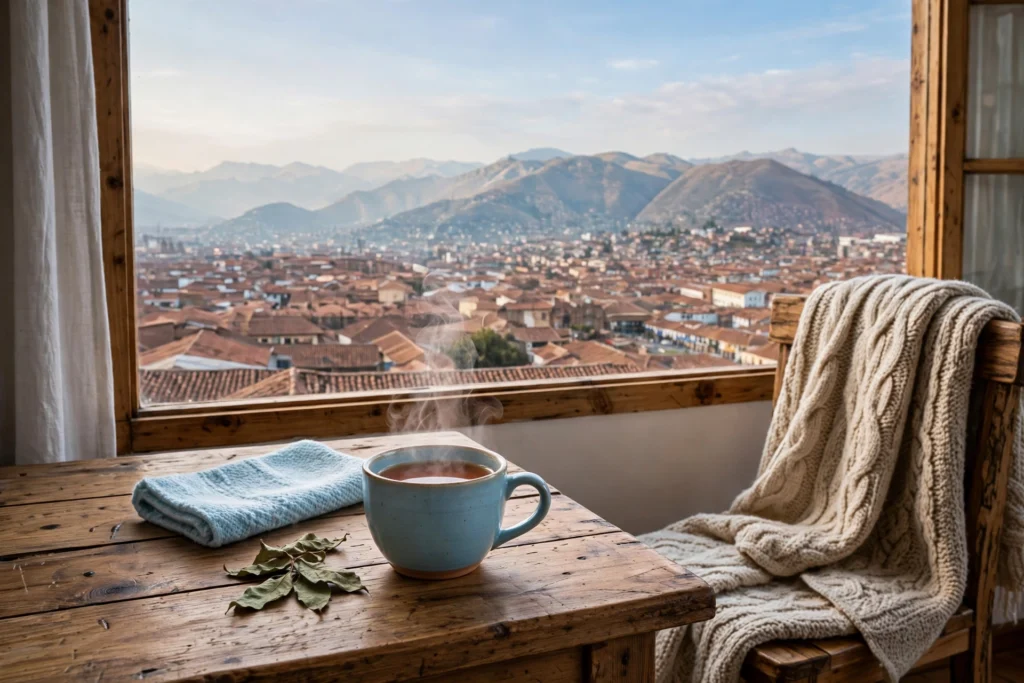
Peru is a well-established destination and most trips go smoothly, but the country asks for everyday attention, and the main problem is petty theft rather than violence. The honest summary is: the tourist routes are straightforward, the cities need street sense, and the remote border areas are the only places with a serious warning. The US State Department rates Peru at Level 2: Exercise Increased Caution, updated on 4 September 2026, the same rating given to France and the United Kingdom. Two specific areas carry a stricter Do Not Travel rating: the Colombia–Peru border area in the Loreto Region, and the VRAEM, the Valley of the Apurímac, Ene, and Mantaro Rivers. The advisory states explicitly that Cusco, the Sacred Valley, the Inca Trail and Machu Picchu are not in the affected areas. Political protests and road blockades flare up from time to time, sometimes disrupting trains to Machu Picchu or flights, so build flexibility into your plans and check the news the week you travel. The comparison with other destinations helps put the rating in context: the same Level 2 wording covers many of the world’s most visited countries, and whether Belize is safe to travel to right now shows how the same advisory system reads in another country.
In Lima, Miraflores, San Isidro and Barranco are fine day and evening. The historic centre is daytime only. Callao, La Victoria and the outskirts are not worth it at all, particularly with a camera out. In Cusco the centre is patrolled, but the lanes above San Blas empty out at night — take a taxi back up the hill after dark. The common setups are the same across the country: taxis flagged in the street in Lima are occasionally express kidnappings, where the car drives you around ATMs until the card is empty, so use an app where the driver is logged. At bus stations the classic is a spilt drink and a helpful stranger while your backpack leaves. Check the watermark and raised print on 100 and 200 sol notes, because counterfeits circulate, and never accept a torn or written-on US dollar bill — banks and money changers refuse them outright.
Altitude sickness is a bigger danger than crime, and it deserves its own paragraph in any honest peru travel guide. At 3,400 metres it hits most arrivals with headaches, nausea and sleeplessness. What works: a first day with no exertion, plenty of water, light food, coca tea, and if needed, soroche tablets from a Cusco pharmacy. What does not: alcohol and toughing it out. If it gets worse rather than better, descend, which is the only reliable cure. Coca is not a drug and is legal in Peru: the leaves are chewed, brewed and sold in any shop. Taking them out of the country is another matter entirely — tea bags included — and airport customs read it one way only. Tap water is not drinkable anywhere in the country, so buy bottled water or carry a filter, and in street food the real risk is not the meat but unwashed salad and ice in drinks.
Practical rules for Peru
- Transport: order taxis through an app; buy long-distance bus tickets from the operator’s own site or counter; never flag a taxi on the street in Lima at night.
- Money: carry cash in small notes for markets and rural areas; withdraw at bank branches; check 100 and 200 sol notes for counterfeits; refuse torn US dollar bills.
- Altitude: two days of acclimatisation before strenuous hikes; no alcohol on the first day; descend if symptoms worsen.
- Health: drink bottled water only; pack sun protection for the high-altitude sun; check yellow fever and malaria advice with your doctor before Amazon travel.
- Culture: ask before photographing people; dress modestly at churches and sacred sites; agree photo prices before the shutter; haggle calmly at markets, never at restaurants or transport.
- Connectivity: Claro has the best coverage in the mountains, Movistar matches it in cities; buy a local SIM at the airport with your passport, or use an eSIM before you fly. WhatsApp is the messenger everyone uses for guides, hotels and drivers. A good set of travel apps covers maps, translation and transport in one place.
- Emergencies: 105 for police, 117 for ambulance, 116 for fire. Keep your travel insurance details and your embassy’s number on your phone.
Frequently Asked Questions About Peru Travel
How many days do you need in Peru?
Most first-time visitors need 10 to 14 days. Seven days covers Lima, Cusco, the Sacred Valley and Machu Picchu at a reasonable pace. Ten days adds Arequipa and the Colca Canyon, or Lake Titicaca from Puno. Fourteen days lets you combine the classic southern circuit with the Amazon or the desert coast. Allow four or five extra days for the Inca Trail or a trek such as Salkantay, and three or four more for an Amazon lodge.
What is the best time to visit Peru?
May to September is the dry season in the Andes and the best time for trekking and Machu Picchu, with clear skies and the lowest chance of rain. April and October are the sweet spot: good weather, greener landscapes, thinner crowds and lower prices. Lima and the coast are sunniest from December to March, which is the rainy season in the highlands. The Inca Trail closes every February.
How do I buy Machu Picchu tickets?
Buy them online on the official Ministry of Culture portal, tuboleto.cultura.pe, as early as you can — Circuit 2 mornings sell out months ahead in high season, and the Huayna Picchu and Machu Picchu Mountain climbs sell out two to three months ahead. Each ticket is for one circuit and route, one date and one hourly entry slot, and you cannot switch routes inside. A standard route costs S/152 for a foreign adult, plus a S/11 sanctuary fee that has applied since 1 May 2026; check the total on the portal at booking, because the fee position has changed during 2026.
Which Machu Picchu circuit should I choose?
For a first visit, Circuit 2, Route 2-A, the classic designed route: it covers the upper terraces for the classic photograph and then the whole urban and ceremonial sector. If the photograph matters more than the ruins, Circuit 1, Route 1-B, the Upper Terrace, gives you the viewpoint and nothing else. For a mountain climb, Route 3-A for Huayna Picchu or Route 1-A for Machu Picchu Mountain, booked two to three months ahead.
Do US citizens need a visa for Peru?
No. US passport holders enter Peru visa-free for tourism for stays of up to 90 days, and your passport should be valid for the length of your stay. There is no arrival card to complete in advance.
Is Peru safe for tourists?
Peru is a well-established destination and most trips go smoothly. The US State Department rates the country at Level 2: Exercise Increased Caution, updated 4 September 2026, with a Do Not Travel rating only for the Colombia–Peru border area in Loreto and the VRAEM. Cusco, the Sacred Valley, the Inca Trail and Machu Picchu are not in the affected areas. The most common problems are petty theft, taxi scams and altitude sickness, not violence.
How do I handle altitude sickness in Cusco?
Spend your first day with no exertion, drink plenty of water, eat lightly, drink coca tea and avoid alcohol. Give yourself two full days in Cusco or the lower Sacred Valley before any strenuous hike. If symptoms get worse rather than better, descend — the Sacred Valley floor sits several hundred metres lower than Cusco. Soroche tablets from a Cusco pharmacy help many travellers, and your insurance should cover altitudes above 4,000 metres.
Can I book the Inca Trail last-minute?
No. The Inca Trail is permit-only, capped at 500 people a day including guides and porters, and it must be booked through a licensed operator. Permits for the dry season go on sale in January and the popular dates sell out within hours. The trail closes entirely every February for maintenance. If the permits are gone, the Salkantay Trek and the Lares Trek need no permit and end at Machu Picchu.
How much does a Peru trip cost?
A budget traveller can manage on roughly US$25–50 a day before big-ticket items; a mid-range traveller should budget roughly US$60–160 a day; a comfort traveller should plan from US$200 a day. Budget separately for the Machu Picchu circuit, roughly US$120–180 per person including train, entry, bus and a night in Aguas Calientes, and for a guided four-day Inca Trail, roughly US$600–800 per person. All figures in this guide are planning ranges, not live prices.
What currency is used in Peru?
The Peruvian sol (PEN, S/). Cash is essential at markets, in small restaurants and in rural areas; Visa and Mastercard are widely accepted in cities, American Express much less so. The sol has traded around S/3.4–3.8 to the dollar in recent months, so build slack into your sums.
Do I need to speak Spanish in Peru?
English is spoken in tourist hotels, agencies and restaurants in Lima and Cusco, but it is rare outside the tourist trade. A dozen phrases of Spanish — greetings, numbers, directions, ordering food — will save real frustration, and a translation app with Spanish downloaded earns its keep. Two words of Quechua open doors in mountain villages: añay for thank you, and allillanchu for how are you.
What should I pack for Peru?
Layers for three climates in one trip: a warm fleece or down jacket and a waterproof shell for the Andes, light clothes for Lima and the Amazon, sun protection for the high-altitude sun, and good walking shoes with grip for wet stone steps. Add a day pack, a reusable water bottle, a power bank and a small first-aid kit with altitude medication and rehydration salts. There is no electricity on the treks.
Conclusion: Peru Is a Trip You Plan Once and Remember for Years
Peru is not a country you tick off in a weekend, and that is the point. It is a place where a single journey holds a 15th-century citadel, a colonial capital at 3,400 metres, a food city on the Pacific, a lake that floats whole villages, a desert drawn with lines only the sky can read, and a rainforest that covers most of the map. The trips that go well are the ones planned the way this peru travel guide is built: the hard bookings first — Machu Picchu tickets, the train, the Inca Trail permit — then the altitude respected, then the rest left flexible enough to bend around mountain weather and a road that closes for a day. Book the citadel months ahead, give your body two days to learn the altitude, eat the ceviche at lunch and the lomo saltado at dinner, and let the country set the pace. Peru rewards the traveller who arrives prepared and then stops hurrying, and the memories that last are rarely the ones on the checklist: the condor over the canyon at dawn, the light on the terraces at Machu Picchu, the quiet of the lake at first light. Plan it once, plan it properly, and go.
People also read:
- Dream Travel Destinations
- Best Travel Destinations
- Luxury Travel Destinations
- Ecuador Travel Guide
- Tanzania Travel Guide
- Best Places to Travel in January
- How to Prepare a Travel Budget
- Travel Itinerary Template
- Is It Safe to Travel to Belize Right Now?
- Travel Apps

M. Adil is the founder and editor of SoloTravelPro. He writes practical, research-based travel guides that help travellers plan with confidence — from first-time city breaks to national parks and island escapes. Every guide is built on official sources, current prices and honest, usable advice, so readers can plan smarter and travel better.