Travel for Work: The Complete Business Travel Guide — Flights, Packing, Expenses, Bleisure and Burnout (2026–27)
Travel for work means travelling because your job sends you somewhere — to meet a client, attend a conference, visit another office, train a team or close a deal — and this guide covers the whole trip, from booking the flight and packing a carry-on to claiming expenses, beating jet lag, adding personal days and knowing when the travel itself has become too much.
What Travel for Work Actually Looks Like

Travel for work is not a holiday with a laptop. It is a working day that happens to take place in another city, and the sooner you treat it that way, the smoother every trip becomes. You are travelling on someone else’s schedule, with meetings fixed in advance, a dress code you did not choose and a return flight that leaves whether you are ready or not. The glamour people imagine — airport lounges, hotel breakfasts, new cities — is real, but it sits on top of early alarms, delayed flights, unfamiliar beds and a inbox that keeps filling while you are in the air.
Most work trips fall into a small number of patterns, and recognising which pattern you are on changes how you prepare. A one-day trip is a sprint: fly out in the morning, meet, fly home at night, and everything you need must fit in one bag under the seat. A two-to-three-night trip is the most common business trip in the United States — long enough to need a hotel and a change of clothes, short enough that a carry-on is plenty. A week-long trip usually means a conference, a training course or a project visit, and it is the one where laundry, routine and rest start to matter. Then there is the regular route: the same city every month, the same hotel, the same client. Frequent travellers on a regular route learn the shortcuts — which security lane moves fastest, which hotel has the quiet rooms, which restaurant near the office does a decent lunch in twenty minutes — and that familiarity is worth more than any packing hack.
The main types of work trip
| Trip type | Typical length | What it usually involves | What to plan for |
|---|---|---|---|
| Client visit | 1–2 days | Meetings, a site tour, dinner with the client | A sharp outfit, printed or offline notes, a buffer before the first meeting |
| Conference or trade show | 2–4 days | Sessions, an exhibition hall, evening networking | Comfortable shoes, a portable charger, a plan for which sessions matter |
| Internal office visit | 2–3 days | Team meetings, planning sessions, training | Time with colleagues, a hotel near the office, evening downtime |
| Training or certification | 3–5 days | Full-day classes, exams, group work | Study materials, a quiet room, an early night before exam day |
| Project or site work | 1–2 weeks | On-site work, long days, changing schedules | Laundry plan, a routine, a hotel with a desk and good wifi |
| Regular route | 1–3 days, repeating | The same city and client, monthly or more | A loyalty routine, a favourite hotel, a packed bag that never fully unpacks |
Who pays, who decides, and what the rules are
Before you book anything, read your company’s travel policy. Every employer has one, even if it is only a page long, and it answers the questions that cause the most trouble later: which cabin you may book, which hotel price range is allowed, whether you need approval before booking, what counts as a reimbursable expense and how quickly you must submit claims after you return. Some companies book everything through a travel management system; others let you book yourself and claim it back. Some pay a daily per diem for meals; others want a receipt for every coffee. The policy is not a suggestion — it is the document that decides whether a $200 dinner comes out of your pocket or the company’s.
If your employer has no written policy, ask for the rules in writing before your first trip: who approves travel, what the daily meal limit is, whether personal days can be added to a work trip, and who to call when a flight is cancelled at 11 pm. A five-minute conversation before the trip saves an awkward one after it. And keep a copy of the policy on your phone, because the moment you need it is always the moment you are standing at a hotel desk being asked for a card.
The three rules that make every work trip easier
First, protect the work, not the trip. The meeting is the reason you are travelling; everything else is support. That means arriving the night before an important meeting when the flight is tight, keeping your presentation on your laptop and on a USB stick and in the cloud, and never scheduling a flight that lands an hour before the meeting starts. Second, keep one bag of essentials with you at all times. If your checked bag goes missing, your trip should still work — laptop, charger, phone, medication, a change of shirt and your meeting notes travel in your carry-on, not in the hold. Third, build in a buffer. Travel for work runs on other people’s timetables — air traffic control, hotel check-in, a client who runs twenty minutes late — and the travellers who look calm are usually the ones who left an hour earlier than they needed to.
A realistic pre-trip checklist
A short checklist, used the same way every time, beats a long one you never finish. The day your trip is confirmed, check your passport or ID, confirm the meeting time and place in the right time zone, book the flight and hotel, and tell someone at home your itinerary. The day before you leave, charge everything, download your boarding pass and any offline maps, pack using the list in the packing section of this guide, and set two alarms. On the morning of travel, check the flight status before you leave for the airport, keep your ID and boarding pass where you can reach them without opening your bag, and text your hotel’s check-in time to yourself so you are not guessing at midnight. None of this is complicated. The value is in doing it the same way every time, so nothing depends on memory at 5 am.
For readers weighing whether a job that involves travel is right for them in the first place, the site’s guide to jobs that allow you to travel covers careers built around being on the road, while this guide is for people whose job already sends them travelling and who want to do it well. And if your work trip involves healthcare settings, the guide to what travel nurses do explains one of the most travel-heavy professions in detail.
Booking Flights for Work Travel: What to Choose and Why
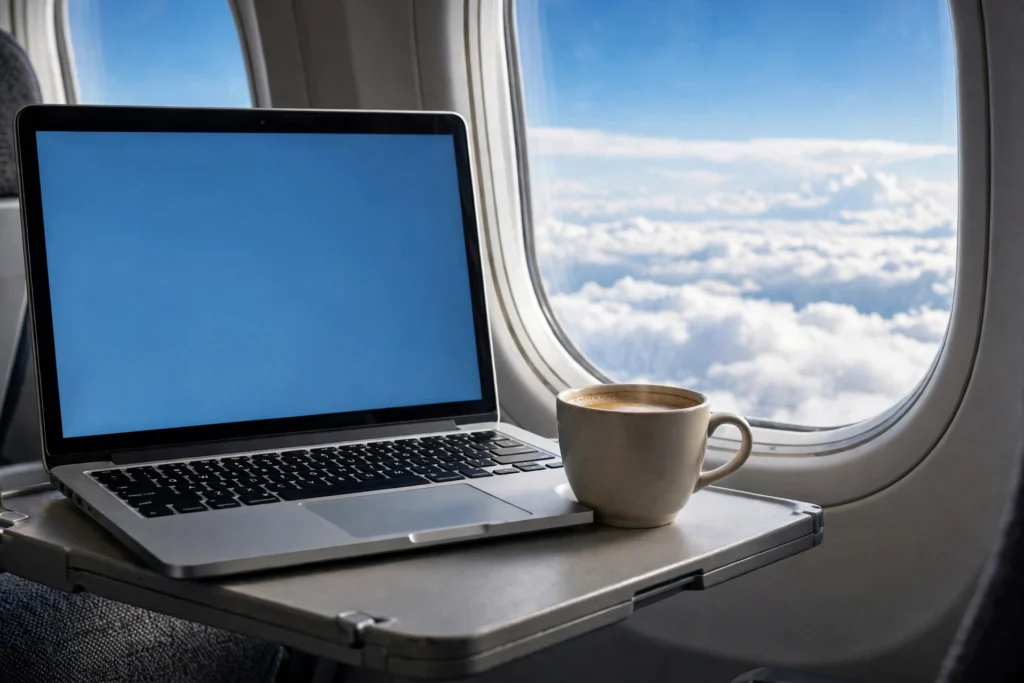
The flight is the skeleton of a work trip: everything else — the hotel, the meeting, the return — hangs off it. Booking the cheapest fare is rarely the right move for business travel, because the cheapest fare is usually the least flexible one, and work trips change. A client moves a meeting by a day, a project runs long, a flight is cancelled, and suddenly the fare that saved $60 costs $400 to change or strands you overnight. When you book for work, you are buying reliability and flexibility, not just a seat.
Non-stop beats cheap, almost every time
If a non-stop flight exists, take it. A connection adds a second chance for something to go wrong — a late first leg, a missed connection, a bag that goes to a different city — and it adds an hour or more to a day that is already long. The general rule frequent business travellers use is simple: a non-stop flight is worth paying more for when the meeting matters, and most meetings matter. Connections make sense when they save a large amount, when no non-stop exists, or when the trip is long and the layover is planned as working time rather than dead time. If you do connect, give yourself at least ninety minutes between flights on a domestic connection and two hours on an international one, and avoid the last connection of the day, because if you miss it there is no later flight to catch.
When to fly for a work trip
Fly the evening before an important morning meeting whenever you can. Arriving the night before costs one hotel night and buys you a good night’s sleep, a calm morning and a buffer against delays. The alternative — an early flight on the morning of the meeting — works only when the flight is short, the airport is close and the meeting starts late enough to absorb a delay. For the return, the last sensible flight of the day is usually better than the first flight the next morning: you sleep in your own bed, and you start the next day at your own desk instead of in a departure lounge. The exception is a trip that ends late — a dinner that runs past 9 pm, a conference that closes in the evening — where an early flight the next morning is kinder than a midnight dash to the airport.
Choosing a seat and a cabin
Seat choice matters more on a work trip than on a holiday, because how you arrive affects how you perform. An aisle seat lets you get up, work without climbing over anyone and leave quickly on arrival. A window seat is better if you plan to sleep or work without interruption. The exit row and the bulkhead give legroom; the rows near the front get you off the plane first. Book your seat when you book the flight — the good seats go first, and on a full flight the only seats left are the middle ones at the back. As for cabin, most companies book economy for domestic trips and premium economy or business for long international flights, and the policy usually decides. If you are paying yourself or have a choice, the upgrade that pays for itself most often on a work trip is not a bigger seat but a refundable or changeable fare, because a changed meeting is far more common than a sore back.
Booking choices compared
| Choice | When it is right | The trade-off |
|---|---|---|
| Non-stop flight | Any trip with a fixed meeting time | Usually costs more than a connection |
| Connecting flight | No non-stop exists, or a big saving | A missed connection can cost you the meeting |
| Evening flight before the meeting | Important morning meetings | One extra hotel night |
| Early morning flight, same day | Short flights, late-start meetings | No buffer if the flight is delayed |
| Refundable or changeable fare | Trips that might move | Higher price up front |
| Cheapest non-refundable fare | A fixed, certain trip | Expensive or impossible to change |
| Seat near the front, aisle | You need to leave fast or work | Goes early — book it at booking time |
Trusted traveller programmes and airport time
If you fly for work more than a few times a year, the time you spend in security lines adds up to real hours of your life. TSA PreCheck costs $78 for a five-year membership and lets you use a faster security lane on domestic departures, keeping your shoes on and your laptop in your bag. Global Entry costs $120 for five years, includes TSA PreCheck, and adds faster processing through US Customs when you return from an international trip. For most people who travel internationally even once in five years, Global Entry is the better value, because it costs only $42 more and covers both. Apply through the official TSA and US Customs and Border Protection sites — the CBP Global Entry programme page is the place to start — and watch out for third-party sites that charge extra to do the same application. Some employers reimburse the fee, so ask before you pay it yourself. Both programmes need an in-person appointment, so apply well before your next trip, not the week of it.
Arrive at the airport with time to spare. The standard advice is two hours before a domestic flight and three before an international one, and for a work trip that is a minimum, not a target. A missed flight on a holiday is an annoyance; a missed flight on a work trip can mean a missed meeting, a lost client and a very expensive rebooking. Use the waiting time well: the airport is one of the few places where nobody can interrupt you, and an hour in a lounge or at a gate with a coffee is often the most productive hour of the trip.
Packing for a Work Trip: Carry-On Only, Done Right
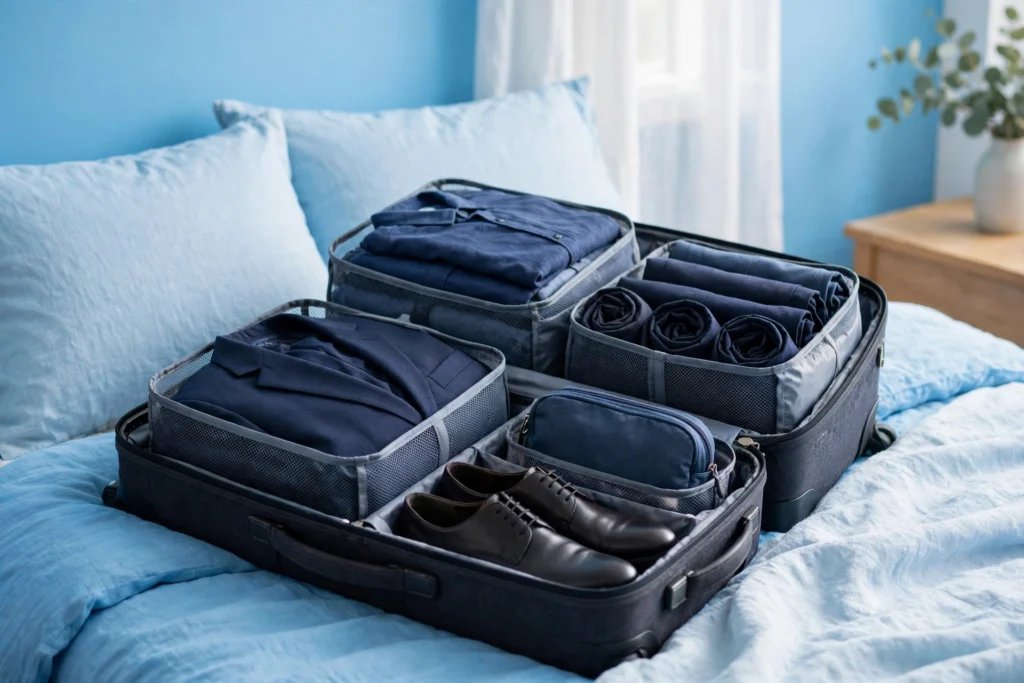
The single best habit in business travel is travelling with a carry-on only. A checked bag adds a queue at check-in, a wait at baggage claim, a risk of loss and a delay at both ends of every trip. A carry-on means you walk off the plane and straight to your meeting, your hotel or your car. For trips of up to four or five nights, a carry-on is not a sacrifice — it is a skill, and it is one you can learn in a single trip.
The carry-on packing system
Start with the bag itself: a hard or soft carry-on that fits your airline’s size limit, with a laptop bag or backpack that slides over the handle. Pack by outfit, not by item. For a three-day trip you need three work outfits, not five; for a five-day trip, four outfits and a laundry stop, or outfits you can wear twice. Choose a colour scheme — navy, grey and white, or black, grey and white — so every top works with every bottom and one blazer works with everything. Roll soft clothes and fold structured ones; packing cubes keep the bag organised and make repacking at the hotel take two minutes instead of twenty.
What goes in the bag
| Category | Pack | Leave behind |
|---|---|---|
| Work clothes | 1 blazer, 2–3 shirts or blouses, 2 trousers or skirts, 1 tie if needed | A different outfit for every day, a second blazer |
| Shoes | 1 pair of work shoes, worn on the plane; 1 pair of comfortable walking shoes | A third pair, heels you cannot walk in |
| Tech | Laptop, charger, phone charger, power bank, headphones, adapters for international trips | A second laptop, a full-size keyboard, gadgets you will not use |
| Toiletries | Travel-size liquids in a clear quart bag, toothbrush, deodorant, medication | Full-size bottles, anything you can buy at the destination |
| Documents | ID or passport, boarding pass on your phone, meeting notes, business cards | Paper copies of everything — keep them digital |
| Comfort | Eye mask, earplugs, a snack, a refillable water bottle (empty through security) | A pillow, a blanket, books you will not finish |
The liquids rule is the one that catches people out. The TSA’s 3-1-1 rule allows liquids, gels and creams in containers of 3.4 ounces (100 millilitres) or less, all inside one clear quart-size bag, one bag per passenger. A half-empty large bottle still counts as large — the container size is what matters, not how much is left in it. Medications are exempt in reasonable quantities. Put the liquids bag at the top of your carry-on so you can pull it out at security without unpacking the whole bag, and keep your laptop in a sleeve that comes out easily for the same reason. The TSA’s own liquids, aerosols and gels rule page sets out the rule in full and is worth a read before your first trip.
Work clothes that survive a suitcase
Wrinkle-resistant fabrics are the business traveller’s best friend. A wool-blend blazer, a non-iron shirt and trousers that do not crease will look freshly pressed after a flight; a linen suit will not. Hang your work clothes in the hotel bathroom while you shower — the steam takes out most creases — and most hotels will press a shirt for a small fee if you ask at check-in rather than at 7 am. Pack a small stain-removal wipe and a lint roller; they weigh nothing and have saved more meetings than any tie. And wear your heaviest shoes and your blazer on the plane: it saves space in the bag and keeps you warm on a cold flight.
The personal item is your safety net
Your laptop bag or backpack is not just extra storage — it is your insurance. If the overhead bins fill up and your carry-on is gate-checked, everything you need for the meeting should be in the bag under the seat in front of you: laptop, charger, phone, medication, meeting notes, a change of shirt and your ID. Pack the personal item as if the carry-on will disappear, and on the rare trip when it does, you will still be able to walk into the meeting and do your job. The site’s travel packing checklist gives a printable version of a full packing list you can adapt for work trips, and the travel essentials list covers the small items people most often forget.
Packing for longer trips
For trips longer than five nights, a carry-on can still work if you plan a laundry stop. Most hotels offer laundry with a next-day return, and many cities have a same-day laundry service near business districts. Pack for five days, wash on day four, and you can travel for two weeks out of one bag. The alternative is to check a bag and accept the wait — which is fine for a two-week project trip, where the time saved at the airport is small compared with the time on site. The mistake is checking a bag for a two-night trip, where the baggage wait can be longer than the flight.
Hotels for Work Travel: Location, Sleep and a Real Workspace

On a work trip, your hotel is not a place to relax — it is your office, your bedroom and your base, and the wrong hotel can quietly ruin a trip. A beautiful hotel twenty minutes from the meeting is worse than a plain one across the street, because every commute is time you could have spent preparing, sleeping or eating properly. Choose the hotel by location first, by sleep quality second and by workspace third. Everything else is a bonus.
Location beats luxury
Book as close to your meeting or the office as your policy allows. A hotel next to the client’s office means you can walk to the meeting, arrive calm and get back to your room between sessions. A hotel near the airport makes sense only if your trip is a single overnight stay with an early flight — otherwise you will spend the trip commuting into the city. Before you book, check the neighbourhood at night: a business district can be empty and dark after 7 pm, with nowhere to eat, while a hotel two streets over in a mixed neighbourhood has restaurants, a pharmacy and a coffee shop. Ask the client or a local colleague where they would stay; they know which streets are safe and which hotel has the reliable wifi.
What to check before you book
Sleep is the single most important hotel feature on a work trip, and it is the hardest to judge from a website. Read recent reviews for mentions of noise — a hotel next to a bar, above a nightclub or beside a railway line will cost you a night’s sleep before an important day. Ask for a room on a high floor, away from the lift and the ice machine, and on the side away from the main road. Check that the room has a proper desk and chair, not a dressing table, and that there is a power socket near the desk — some older hotels have one socket in the whole room, behind the bed. Wifi matters more than the minibar: check whether it is free, whether it is fast enough for video calls, and whether there is a charge for a second device. If you need to take calls, ask whether the hotel has a business centre or a quiet lounge, because a video call from a hotel bed with a noisy air conditioner behind you is not a good look.
The hotel routine that works
Check in, unpack properly and set up your workspace before you do anything else. Hang your work clothes, put your chargers by the desk, and lay out tomorrow’s outfit. This takes ten minutes and means you are not hunting for a shirt at 7 am. Eat a real breakfast — a work trip is not the time to skip meals and run on coffee — and keep a bottle of water and a snack in the room for late evenings. If the hotel has a gym, use it in the morning rather than the evening; a short workout before a day of meetings does more for your energy than an extra hour in bed. And keep the room dark, cool and quiet at night: close the blackout curtains fully, turn the air conditioning down a degree or two, and use the eye mask and earplugs you packed.
When the hotel goes wrong
Things go wrong on work trips — a noisy room, a broken shower, a wifi outage — and the difference between a bad night and a ruined trip is how quickly you act. Report the problem at the front desk as soon as you notice it, and ask for a room change rather than a repair that will take hours. If the hotel cannot fix it, ask the front desk for help finding an alternative nearby; most hotels would rather help you move than have you write about the stay later. Keep receipts for anything the hotel charges you for a problem that was theirs, and note the name of the person who helped you. And if you travel to the same city regularly, find one hotel that works and stay there every time — the staff will know you, the room will be familiar, and the trip will feel routine instead of new every month.
Travel for Work Expenses: Per Diem, Receipts and Reimbursement

Expenses are the least glamorous part of travel for work and the part that causes the most arguments. The system is simple once you understand it: your employer either pays you a fixed daily amount, called a per diem, or reimburses what you actually spend against receipts. Both systems work, but they fail in different ways, and knowing which one you are on changes how you spend.
Per diem: a fixed daily allowance
A per diem is a fixed amount per day for meals and incidental expenses, paid whether you spend it or not. The most widely used benchmark in the United States is the federal government’s per diem, set by the US General Services Administration (GSA). For the federal fiscal year 2027, which runs from 1 October 2026 to 30 September 2027, the standard rate for most of the continental United States is $181 a day — $113 for lodging and $68 for meals and incidental expenses. In the previous fiscal year the standard rate was $178 a day ($110 lodging, $68 meals), so the lodging figure rose while the meals figure stayed flat. Higher-cost cities have higher rates: New York, San Francisco and Boston, for example, carry lodging rates well above the standard, and the meals figure rises to as much as $92 a day in the most expensive places. Many private employers use the GSA rates as their own ceiling even though they are not required to, because the rates are public, defensible and easy to look up by city on the GSA per diem rates page.
| Item | Standard CONUS rate, FY2027 | What it covers |
|---|---|---|
| Lodging | $113 per night | Hotel room, reimbursed at actual cost up to the cap |
| Meals and incidentals (M&IE) | $68 per day | Breakfast, lunch, dinner and tips, as a flat allowance |
| Total standard per diem | $181 per day | Lodging plus meals and incidentals |
| First and last travel days | 75% of M&IE ($51) | Reduced meals allowance on partial travel days |
| Incidentals only | $5 per day | Tips to porters, bellhops and hotel staff |
| High-cost city M&IE | Up to $92 per day | Meals in the most expensive locations |
If your employer pays a per diem, you do not need a receipt for every meal — that is the point of the system. You still need to know the rate for your city, because the rate in the city you are visiting may be higher than the standard, and you should check it before you travel rather than discovering it afterwards. Note that the GSA rates are for federal employees; your employer’s rates may be different, and your employer’s policy is the one that decides what you are paid.
Receipts: the system that rewards paperwork
If your employer reimburses actual expenses, receipts are everything. Photograph every receipt the moment you get it — a paper receipt left in a jacket pocket is a receipt lost — and store the photos in one folder on your phone, or in your company’s expense app if it has one. Keep the receipt for every meal, every taxi, every parking charge and every coffee you claim. Most companies want receipts for anything over $25, and many want them for everything. Note on each receipt what it was for and who was there, because a dinner receipt with no context looks like a personal meal, and a dinner with a client is a business expense. Submit your claim within a few days of returning, while the trip is fresh in your mind; a claim submitted three weeks later takes three times as long and is three times as likely to be rejected for a missing receipt.
The corporate card and mileage
Many employers issue a corporate card for travel. If you have one, use it for every work expense and keep your personal card out of it — mixing the two is how claims get messy. If you drive your own car for work, track the miles: the IRS business mileage rate was 72.5 cents per mile for the first half of 2026 and rose to 76 cents per mile from 1 July 2026, and your employer will usually reimburse at or near that rate, but only if you have a record of the trips. A simple note in your phone — date, destination, miles — is enough. One important note: this guide is practical travel advice, not tax advice. Tax rules change, and how your employer treats per diem, mileage and reimbursements depends on their own accountable plan. If a tax question matters to you, ask your employer’s finance team or a qualified tax professional, not a travel article.
Common expense mistakes
The most common mistake is not knowing the policy before you spend. A $150 dinner is fine if your daily limit is $200 and a problem if it is $75. The second mistake is losing receipts, which is entirely preventable with a phone photo. The third is claiming personal spending as business spending — the minibar, the movie, the souvenir — which is the fastest way to lose your manager’s trust. The fourth is forgetting the small things: airport parking, tolls, tips and the taxi from the hotel to the office all add up, and they are all legitimate business expenses if your policy covers them. And finally, keep your personal days separate. If you add personal days to a work trip — which the bleisure section of this guide covers — the hotel nights, meals and transport for those days are yours, not the company’s, and your expense claim should show exactly where the work trip ended and the personal trip began.
If you are still building a system for managing travel money, the guide to how to prepare a travel budget sets out the same discipline for personal trips, and the travel itinerary template can be adapted to hold your flight, hotel and meeting details in one place.
Staying Productive on the Road: Flights, Wifi and Time Zones

A work trip does not pause your normal job. Emails arrive, deadlines pass, colleagues need answers, and the meeting you flew in for is only part of the work you owe that week. Staying productive while travelling is not about working every waking hour — it is about choosing the right work for each part of the trip, and protecting the hours that matter.
Use the flight well
A flight is the most interruption-free time in a working week, and it is a shame to waste it on a film when your inbox is full. Before you board, decide what you will do in the air: prepare for the meeting, write the report, clear the emails that need short answers. Download everything you need before takeoff, because in-flight wifi is slow, expensive and unreliable, and it often drops out exactly when you need it. Keep your laptop in your personal item, not in the overhead bin, so you can start working the moment the seatbelt sign goes off. And be realistic: a three-hour flight gives you about two hours of real work after boarding, settling and landing. Plan for two hours, not three.
Wifi, security and staying connected
Hotel and airport wifi is convenient and not to be trusted with sensitive work. Never do banking, log in to company systems with saved passwords or open confidential documents on a public network without protection. Use your phone’s hotspot when you can — it is usually faster and safer than hotel wifi — and use a VPN when you must use a public network, which your employer’s IT team can set up for you. Keep your devices locked with a passcode or fingerprint, turn on automatic updates before you travel, and back up your work to the cloud every evening. If your laptop is lost or stolen, the hardware is replaceable; the presentation you were carrying for tomorrow’s meeting is not, unless it is also in the cloud. Before you travel, check the time zone of your destination and set your phone and laptop to update automatically, so your calendar shows the meeting in the right time.
Working across time zones
Time zones are the quiet productivity killer on work trips. A meeting scheduled for 9 am in New York is 6 am in Los Angeles, and a colleague who says “let’s talk at 2” may mean 2 in their time zone, not yours. Put the time zone in every meeting invite and every message about a time, and check your calendar the night before a trip to make sure nothing is scheduled for the hours you will be in the air. When you are away, set two clocks on your phone — home time and local time — so you know when it is reasonable to call the office and when it is not. The simplest rule is to do your deep work in the morning, when you are freshest, and leave the afternoon for meetings and admin. And when you return home, block the first morning after the trip for catching up, not for meetings — you will need it.
The apps and tools that actually help
You do not need many apps, but the ones you need should be installed and tested before you leave. Your airline’s app, for check-in, gate changes and rebooking. A maps app with offline maps of your destination, so you can navigate without data. Your company’s email and messaging apps, with notifications set so that only urgent messages interrupt you. A notes app for meeting notes, and a scan app for receipts. A translation app if you are travelling internationally. Keep it to that list: every extra app is another password, another notification and another distraction. The site’s guide to travel apps covers the wider set of apps worth having on any trip.
Health and Sleep on Work Trips: Beating Jet Lag

Jet lag is not a minor inconvenience on a work trip — it is a performance problem. A meeting at 9 am after a red-eye flight is a meeting you will perform badly in, however good your preparation. The CDC’s travel health guidance on jet lag is clear about the basics: jet lag comes from the mismatch between your body clock and the new time zone, it affects mood, concentration and physical and mental performance, and it can be reduced with planning. The good news is that most of the fixes are simple and free.
Before you fly
A few days before a trip across several time zones, start shifting your sleep towards your destination. If you are flying east, go to bed an hour or two earlier than usual; if you are flying west, go to bed an hour or two later. The CDC suggests shifting by about an hour a day for two to three days before departure, and its Yellow Book notes that most people adjust by about one hour a day after flying east and about one and a half hours a day after flying west — which is why eastward travel usually feels harder. If you can, schedule your travel so you arrive at least two days before an important event, to give your body time to adjust. That is not always possible, but when the meeting is the reason for the trip, the extra hotel night is cheaper than a bad performance.
On the flight
On the plane, set your watch and your meals to destination time as soon as you board. Eat small meals, drink plenty of water, and go easy on alcohol and caffeine — both disrupt sleep and add to dehydration, and the dry cabin air makes it worse. If you need to sleep on the flight, use an eye mask and earplugs, and a neck pillow if it helps you doze sitting up. On flights longer than four hours, get up and walk around every hour or two and stretch your legs; the CDC recommends this for comfort and circulation, and it helps you arrive feeling human rather than stiff. Talk to your doctor before the trip if you are considering melatonin or any sleep medicine — the CDC notes that melatonin should be timed carefully, because taking it at the wrong time can make the mismatch worse, and it is not a substitute for sleep itself.
After you arrive
When you land, switch to local time immediately. Eat meals at local times, get daylight as soon as you can — morning light helps your clock shift earlier after flying east, evening light helps it shift later after flying west — and stay awake during the local day even if you are tired. If you must nap, keep it short: the CDC suggests no more than 15 to 20 minutes in the daytime, so you can still sleep at night. Avoid a long afternoon nap on arrival day, however tempting it is, because it will push your bedtime later and stretch the jet lag into a second day. And do not make important decisions on your first day in a new time zone if you can avoid it — your judgement is worse than you think when you are tired.
The routine that protects your health
Work trips break every healthy routine at once: you eat at odd hours, sleep in a strange bed, sit for hours and drink more coffee than usual. The fix is not a strict regime but a few anchors. Keep your sleep and wake times roughly the same as at home, adjusted to local time. Eat a proper breakfast and one proper meal a day, even if the other meals are sandwiches between meetings. Walk instead of taking a car for short trips — it is exercise, fresh air and a look at the city in one. Keep water on your desk and in your bag, and refill it often. And if you take regular medication, keep it in your carry-on, carry a few days’ extra supply, and keep a note of the prescription on your phone. A missed dose because your bag went to another city is an avoidable problem.
Eating Well and Staying Active While Travelling for Work

Business travel is hard on the body in a way that is easy to ignore until it catches up with you. Airport food, hotel breakfasts, client dinners, long lunches and late nights add up, and after a few months of regular travel many people find they have gained weight, sleep worse and feel tired all the time. You do not need a diet plan on a work trip — you need a few defaults that keep you steady.
Eating on a work trip
Start the day with a real breakfast. A hotel breakfast with fruit, yoghurt, eggs and whole-grain bread will carry you through a morning of meetings far better than a pastry and a coffee, and it costs you nothing extra if breakfast is included in the room. At lunch, choose the lighter option when you have an afternoon of meetings — a heavy lunch and a warm conference room are a recipe for an unproductive afternoon. At client dinners, eat what is served and enjoy it; the dinner is part of the work, and nobody judges you for ordering a salad or skipping dessert. Keep a small supply of snacks in your bag — nuts, dried fruit, a protein bar — for the moments when the only alternative is an overpriced airport sandwich or nothing at all. And drink water constantly: the combination of flying, air conditioning and coffee dehydrates you quietly, and tiredness that feels like jet lag is often just dehydration.
Moving your body
You do not need a gym routine on a work trip, but you do need to move. Walk to the meeting if it is under twenty minutes away. Take the stairs in the hotel. If the hotel has a gym, a twenty-minute session in the morning is enough — the point is to wake your body up, not to train for anything. If there is no gym, a brisk walk around the block before breakfast does the same job. On long flights, stand up and walk the aisle every hour or two, and stretch your calves and shoulders in your seat. The CDC’s travel guidance recommends moving on flights longer than four hours, and it is advice worth following even on shorter ones. And if you are in a new city, a morning run or walk is the best sightseeing you will do on a work trip — you see the city before the traffic starts, and you arrive at breakfast feeling awake.
Alcohol, coffee and the long evening
Work trips come with social drinking — a welcome drink, a dinner with wine, a nightcap with colleagues — and it is fine to join in, but it is worth knowing your limits. Alcohol disrupts sleep, and a poor night’s sleep before a meeting costs you more than the drink was worth. A useful rule is to stop drinking at least two hours before bed, and to alternate each alcoholic drink with a glass of water. Coffee is the other trap: it helps in the morning and hurts after mid-afternoon, when it starts to steal the night’s sleep. Switch to decaf or tea after lunch, and keep the last coffee of the day before 2 pm if you want to sleep well. None of this requires willpower so much as a decision made in advance — decide your limits before the dinner starts, not during it.
Bleisure: Adding Personal Days to a Work Trip

Bleisure — business plus leisure — is the practice of adding personal days to a work trip: staying the weekend after a Friday meeting, arriving a day early to see a city, or bringing a partner along for the extra days. It is one of the best deals in travel, because the expensive part of the trip — the flight — is already paid for, and the extra days cost only the hotel, food and activities. It is also the part of work travel where the rules matter most, because the line between the company’s money and yours has to stay clear.
Check the policy first
Before you plan any personal days, check your employer’s policy on them. Most companies allow bleisure, but the details vary: some require the personal days to be approved in advance, some cap how many days you can add, some require you to pay the difference if the flight is more expensive because of the changed dates, and some require you to use annual leave for the extra days. The most important rule is about costs. The company pays for the work days — the flight to the meeting, the hotel nights before and during the work, the meals on work days. You pay for the personal days — the extra hotel nights, your meals, your activities, and any flight change fee that exists only because you changed the dates. Keep the two sets of expenses separate from the start: separate receipts, separate days on the claim, and a clear note of where the work trip ended and the personal trip began.
How to split a bleisure trip
| Item | Work days — company pays | Personal days — you pay |
|---|---|---|
| Flight | The flight to and from the work trip | Any extra cost from changing the return date |
| Hotel | Nights before and during the work | Extra nights after the work ends |
| Meals | Meals on work days, within policy | Meals on personal days |
| Transport | Taxis and transport for work | Transport for sightseeing and personal trips |
| Activities | Conference fees, client entertainment | Sightseeing, tours, personal activities |
| Travel insurance | The company’s policy, if it covers you | Your own cover for the personal days — check it |
If your partner or family joins you for the personal days, their costs are yours: their flight, their share of the hotel, their meals. Some hotels will let a second person stay in the room at no extra charge; others charge a supplement, so check before you assume. And if you are travelling internationally, check the visa and insurance position for the personal days — your company’s travel insurance may cover only the work portion of the trip, and you may need your own cover for the extra days.
Making bleisure work in practice
The best bleisure trips are planned, not improvised. Choose a work trip to a city you actually want to see, and add the days at the end of the trip rather than the beginning, so the work is done and you can relax properly. Book the extra hotel nights early, because the hotel you are already in may be full or expensive for the weekend. Plan one or two things you genuinely want to do — a walk through the old town, a museum, a meal at a local restaurant — and leave the rest open. If you only have a single free afternoon, use it well: a walk, a coffee in a local cafe and an hour in a park will do more for you than a rushed tour of five sights. And if your trip lands somewhere worth exploring, the destination guides on this site — from Seattle and Yellowstone to Malta and Panama — are written for exactly that kind of short, practical visit.
Loyalty Programs and Travel Rewards for Work Travellers

If you travel for work regularly, loyalty programmes are the one part of business travel that pays you back personally. The flights and hotel nights your employer pays for earn points and status in your name, and those points can become free flights, free hotel nights and upgrades on your own holidays. The key word is “regularly”: loyalty programmes reward consistency, and the traveller who flies one airline and stays with one hotel group will always do better than the traveller who chases the cheapest option every time.
How loyalty programmes work
Airline programmes give you miles or points for each flight, based on the distance flown and the fare you paid, and hotel programmes give you points for each night and each dollar spent. As you earn more, you climb status tiers, and each tier brings benefits: free checked bags, priority boarding, lounge access, late checkout, room upgrades and bonus points on every stay. The first tier is usually easy to reach — a handful of trips a year — and the benefits at that level are already useful. The top tiers take serious travel, and they are worth chasing only if you are already travelling that much. The important rule is to join before you need it: sign up for the programme before your first flight with that airline, and add your membership number to every booking, because points for a flight you took before you joined are usually lost.
One airline, one hotel group
The most valuable decision in loyalty is concentration. Pick one airline alliance and one hotel group that serve the cities you visit most, and use them whenever the price and schedule are reasonable. A traveller who flies one airline ten times a year earns status; a traveller who flies five airlines twice each earns nothing. The same applies to hotels: ten nights with one group earns a free night and an upgrade; ten nights spread across five groups earns nothing. That does not mean always paying more — if the preferred airline costs twice as much for the same route, take the cheaper flight — but when the prices are close, the loyalty points are worth more than the small saving.
What loyalty is worth, and what it is not
| Programme type | What you earn | What it is good for | What to watch |
|---|---|---|---|
| Airline frequent flyer | Miles or points per flight | Free flights, upgrades, lounge access | Points can expire; award seats are limited |
| Hotel loyalty | Points per night and per dollar | Free nights, room upgrades, late checkout | Points lose value if you switch groups |
| Car rental loyalty | Points per rental day | Free rental days, faster pickup, upgrades | Only worth it if you rent often |
| Airport lounge membership | Access, not points | Quiet workspace, food, wifi, showers | Annual cost — check if your employer covers it |
| Trusted traveller (PreCheck / Global Entry) | Time, not points | Faster security and customs | $78 / $120 for five years; apply early |
A word of caution: loyalty programmes are designed to keep you loyal, and they work. Do not let points decide a flight that does not suit your schedule, and do not stay in a bad hotel because it earns points. The points are a bonus on top of a good trip, not a reason to take a bad one. And check your employer’s policy: some companies require you to use the points for business travel, some let you keep them for personal use, and a few have rules about who owns the points earned on company-paid travel. Know the rule before you book your holiday with them. This guide names no credit card and recommends no card product — cards come with fees and terms that change, and the right choice depends on your own spending, so compare the current terms yourself and never take a card because a travel article mentioned it.
Travelling With Colleagues and Clients: Team Trips Done Well

Travelling with colleagues is a different skill from travelling alone for work. You are sharing flights, meals, cars and long days with people you normally see in an office, and the trip will either strengthen the working relationship or strain it. The difference is usually preparation, not personality.
Agree the plan before you leave
Before a team trip, agree the basics in writing: who is booking what, which flights everyone is on, where you are staying, who is paying for what, and what the schedule is. The most common source of friction on team trips is money — one person books a taxi and nobody knows who owes what — so decide in advance whether one person pays and claims it back, or everyone pays their own way. Share the itinerary with the whole group, including flight numbers, hotel addresses and meeting times, and agree a meeting point and a time for the first morning. If you are travelling with a client, the standard is higher: confirm every detail with them in advance, arrive early, and have a plan for what happens if a flight is delayed.
On the trip: be a good travelling companion
Be on time, every time. On a team trip, one late person delays everyone, and the colleague who makes the group miss a flight is remembered for a long time. Be flexible about the small things — where to eat, which car to take, who sits where — and save your energy for the things that matter. Respect that people have different travelling styles: some want to work on the flight, some want to sleep, some want to talk. Do not take it personally if a colleague puts headphones on. And keep the evenings balanced: a team dinner is part of the trip, but nobody needs to socialise every night, and the colleague who wants an early night before a big meeting is being sensible, not antisocial.
Clients, dinners and professional boundaries
Dinners and drinks with clients are work, and the rules of the office still apply. Be punctual, dress for the occasion, and know something about the client and their business before you sit down. Order food you can eat while talking, avoid the messiest dish on the menu, and keep your phone in your pocket. If alcohol is served, match the pace of the room and stop before you have had too much — a client dinner is not the place to discover your limits. The same applies to expenses: if you are hosting, the dinner is a business expense and you should keep the receipt and note who attended; if the client is hosting, a thank-you message the next morning costs nothing and is remembered. And if you are the most senior person on the trip, the team will take its cue from you — set the standard for punctuality, preparation and behaviour, and the trip will run well.
When things go wrong as a group
Flights get cancelled, hotels lose bookings, and meetings move. When it happens on a team trip, the person who stays calm and finds a solution becomes the person everyone trusts. Have a backup plan for the important things: a second flight option, the client’s phone number, the hotel’s address in the local language. If the group is split across flights, make sure everyone has the same information and a way to contact each other. And if a colleague is struggling — tired, unwell, stressed — a small kindness, like offering to take the early meeting or finding them a quiet room, costs little and is remembered long after the trip.
International Work Travel: Passports, Visas and Staying Connected

International work travel adds a layer of paperwork and planning that domestic trips do not have, and the consequences of getting it wrong are sharper: a missing visa can mean a refused boarding, and an expired passport can end a trip before it starts. The rule is to start the paperwork the moment the trip is confirmed, not the week before it.
Passports: the six-month rule
Many countries require your passport to be valid for at least six months beyond your date of entry, and airlines will often refuse to board you if it is not — the check happens at the airport, not at the border. The US State Department warns travellers about this regularly, and its advice is simple: check your passport’s expiry date as soon as a trip is confirmed, and renew it if it has less than six months left. A standard US passport renewal currently costs at least $130, with more for expedited service, and routine processing takes weeks, so do not leave it to the last minute. Keep a photo of your passport’s data page on your phone and a copy in your email, separate from the passport itself, so that if it is lost or stolen you can prove who you are and get a replacement faster. The site’s guide to what a travel document number is explains the numbers on your passport and where to find them.
Visas and entry requirements
A visa is permission to enter a country, and whether you need one depends on your nationality, your destination and the purpose of your visit. Business travel sometimes needs a different visa from tourism, even for the same country, so check the requirement for a business visit specifically, not just for a holiday. The US State Department’s travel advisories page lists entry requirements and safety information for every destination, and it is the first place to check for any international work trip. Apply for a visa as soon as the trip is confirmed, because processing times vary from days to weeks and some countries require an interview or a visit to an embassy. Keep a copy of your visa approval and your return ticket with you, because immigration officers may ask for both, and keep your employer’s letter confirming the purpose of the trip — it is the document that explains why you are there.
Staying connected abroad
Before you leave, check what your phone plan charges for international roaming — the bill for a week of data abroad can be larger than the hotel bill. The usual options are an international plan from your carrier, a local SIM card bought at the destination, or an eSIM, which you can install before you leave and activate on arrival. An eSIM is the simplest option for most short business trips: no physical card to swap, no visit to a phone shop, and you keep your own number for calls. Download offline maps of your destination before you fly, and make sure your banking and email apps work without text-message verification, because your usual SIM may not receive texts abroad. If you need to work on the trip, test your company’s VPN and video-call apps before you leave, not from the hotel on the first night.
Money, safety and health abroad
Carry two ways to pay — a card and some local cash — and tell your bank you are travelling, so a foreign transaction does not freeze your card. Keep your passport, your phone and your wallet in different places, and use the hotel safe for anything you do not need during the day. Read the State Department’s advisory for your destination before you travel, and register your trip with the Smart Traveler Enrollment Program (STEP) if you are a US citizen travelling to a place with any security concerns — it is free, and it means the nearest US embassy can contact you in an emergency. Check whether your employer’s travel insurance covers you abroad, and what it covers: medical care, trip cancellation, lost luggage and emergency evacuation are the four things to confirm. The site’s guide to business travel accident insurance explains one of the more specialised forms of cover that some employers carry.
Coming Home From a Work Trip: The Post-Trip Reset

The trip does not end when you land. It ends when your expenses are submitted, your notes are written up, your bag is unpacked and your next week is planned — and the travellers who do this well treat the return as part of the trip, not an afterthought. A good post-trip routine takes about an hour, and it saves you several hours of confusion later.
The first hour back
Do the admin while the trip is fresh. Photograph any receipts you have not already photographed, and submit the expense claim within a day or two of returning — your finance team will thank you, and you will be reimbursed faster. Write up your meeting notes the same day, while you still remember what was agreed and who promised what; notes written a week later are guesswork. Send a short follow-up to the client or colleague you visited: a thank-you, a summary of what was agreed, and the next steps. It takes ten minutes and it is the single most useful thing you can do after a work trip, because it turns a meeting into a relationship. Then unpack properly. A bag left half-packed on the floor becomes a source of low-level stress for days, and it guarantees you will forget something on the next trip.
Catching up without drowning
The morning after a trip is the worst time to schedule meetings, because your inbox will be full and your head will still be in another city. Block the first two hours after your return for catching up: clear the urgent emails, check what changed while you were away, and make a list of the three things that matter most this week. Tell your team what happened on the trip — a short message or a five-minute update in the morning meeting is enough — because the people who stayed behind need to know what was decided. And if the trip produced work that someone else needs to do, hand it over on the first day back, not the third. The value of a work trip fades fast if nothing happens after it.
Learning from every trip
After each trip, take five minutes to note what worked and what did not: the hotel that was too noisy, the flight time that was too tight, the restaurant that was perfect for a client dinner, the packing choice you regretted. Keep the notes in one place — a note on your phone, a document, a page in your travel notebook — and read them before the next trip to the same city. Over a year, these notes become a personal travel guide that no article can match: your hotels, your restaurants, your shortcuts. The frequent travellers who seem effortless are not naturally organised; they have simply written down what they learned and they read it before the next trip. If your job regularly takes you to new places, the site’s guide to how to become a travel agent for free is a different kind of resource, but the same discipline — learning from every trip and keeping notes — is what turns occasional travel into expertise.
When Travel for Work Becomes Too Much: Burnout and Boundaries

Travel for work is enjoyable in small doses and exhausting in large ones, and the line between the two is different for everyone. A trip a month can feel like a perk. Two trips a month can feel like a routine. Three or four a month, with early flights and late returns, can quietly become a problem — and the problem usually shows up not as a single crisis but as a slow erosion: worse sleep, less patience at home, less enthusiasm for the work itself, and a feeling of always being slightly behind.
The signs that travel has become too much
The signs are usually visible to everyone except the traveller. You dread the next trip instead of looking forward to it. You come home exhausted and need a day to recover from a two-day trip. You are sleeping badly in hotels and worse at home. You are missing family events, cancelling plans and eating badly for days at a time. Your work is slipping, not because you are lazy but because you are tired, and the meetings you used to enjoy now feel like an obligation. If several of these are true at once, the problem is not your attitude — it is the amount of travel, and it needs a conversation, not a better packing list.
Boundaries that protect you
The most useful boundary is a limit on travel days, agreed with your manager before you are exhausted rather than after. Some people can travel ten days a month and be fine; others struggle at five. There is no correct number, only your number, and it is worth knowing it. Other boundaries that work: no more than two consecutive weeks on the road; no flights on Sunday evenings if you can avoid them; one full day at home between trips; and a rule that trips are batched, so that three meetings in one city happen in one trip rather than three. Ask whether a meeting needs to be in person at all — a video call is not a substitute for a client dinner, but it is a perfectly good substitute for a status update, and every trip you avoid is a day of your life back. And protect your recovery: the day after a long trip is not a day to schedule six meetings.
Having the conversation at work
If travel is wearing you down, say so early, and say it in practical terms. A manager responds better to “I have travelled twelve days this month and my sleep and my work are suffering, so I need to cut next month to six” than to “I am burned out.” Come with a suggestion: which trips can be combined, which meetings can be virtual, which trips someone else can take. Frame it as a performance issue, because it is one — a tired traveller does worse work, and your employer has an interest in you doing good work. If your employer has an employee assistance programme or a wellbeing resource, use it; that is what it is for. And if the travel load does not change after an honest conversation, that tells you something important about the job, and it is worth thinking about whether the role still fits your life. The site’s guide to jobs that allow you to travel is written for people choosing a travel-heavy career, but its core question applies here too: how much travel do you actually want in your life, and is your current job giving you that amount?
Making travel sustainable
The travellers who sustain heavy travel for years share a few habits. They keep a routine at home that does not depend on being at home — the same wake time, the same morning walk, the same meals — so that the trip is an interruption, not a collapse. They protect their relationships by being present when they are home: phone away at dinner, plans kept, the trip talked about rather than complained about. They treat rest as part of the job, not as a reward for finishing it. And they review the travel load regularly, not once a year at appraisal time. Travel for work should add to your life — new places, new people, new skills — and when it starts to subtract more than it adds, the right move is not to travel better but to travel less.
Frequently Asked Questions About Travel for Work
What does travel for work mean?
Travel for work means travelling because your job requires it — to meet a client, attend a conference, visit another office, deliver training or work on site — rather than travelling for a holiday. Your employer usually pays the travel costs, and the trip is scheduled around the work, not around sightseeing.
How do I pack for a work trip?
Pack a carry-on only for trips of up to four or five nights: one blazer, two or three shirts, two trousers, one pair of work shoes worn on the plane, toiletries in travel-size containers under the TSA 3-1-1 rule, and your laptop, charger and meeting notes in your personal item. Choose one colour scheme so everything matches, and roll soft clothes to save space.
What is a per diem for work travel?
A per diem is a fixed daily allowance your employer pays for meals and incidental expenses while you travel, instead of reimbursing each receipt. The US federal benchmark set by the GSA is $181 a day for most of the continental United States in fiscal year 2027 — $113 for lodging and $68 for meals — with higher rates in expensive cities. Your employer’s own rates may differ, so check your company policy.
Does my employer have to pay for my travel?
In most cases, yes — when your employer sends you on a trip, they pay the flight, hotel and reasonable meal and transport costs, either by booking them directly, giving you a corporate card, or reimbursing your expenses. The exact rules are in your company’s travel policy, so read it before you spend anything.
Should I fly the night before a work meeting?
Yes, whenever the meeting is important. Arriving the night before costs one extra hotel night and buys you a good night’s sleep and a buffer against flight delays. A same-day early flight only works when the flight is short, the airport is close and the meeting starts late enough to absorb a delay.
How do I claim expenses after a work trip?
Photograph every receipt as soon as you get it, keep the photos in one folder, and submit the claim within a few days of returning, with a short note on each receipt saying what it was for. If your employer pays a per diem for meals, you do not need a receipt for every meal — but you still need receipts for the hotel, transport and anything else the policy requires.
What is bleisure travel?
Bleisure is adding personal days to a work trip — staying the weekend after a Friday meeting, for example. The company pays for the work days and you pay for the personal days, including extra hotel nights, meals and activities. Check your employer’s policy first, because most companies require the personal days to be approved in advance and taken as annual leave.
Is TSA PreCheck or Global Entry worth it for work travel?
If you fly for work more than a few times a year, yes. TSA PreCheck costs $78 for five years and speeds up domestic security. Global Entry costs $120 for five years, includes TSA PreCheck, and adds faster US customs processing when you return from abroad. Apply through the official TSA and CBP sites, and ask your employer whether the fee is reimbursed.
How do I beat jet lag on a work trip?
Shift your sleep by about an hour a day for two to three days before you fly, set your watch to destination time when you board, drink water and go easy on alcohol and caffeine, get daylight as soon as you land, and keep any daytime nap to 15 to 20 minutes. The CDC’s travel health guidance gives the same advice, and notes that most people adjust by about one hour a day after flying east and about one and a half hours a day after flying west.
Do I need a visa for a business trip?
It depends on your nationality and destination, and business visits sometimes need a different visa from tourist visits. Check the entry requirements for a business visit specifically on the US State Department’s travel advisories page, and apply as soon as the trip is confirmed, because processing can take days or weeks.
Can I earn loyalty points on work travel?
Usually yes — the flights and hotel nights your employer pays for earn points and status in your name, and you can normally use them for personal trips. Join the programmes before your first trip, concentrate on one airline and one hotel group, and check your employer’s policy, because a few companies have rules about who owns the points.
How much travel for work is too much?
There is no single number, but the signs are consistent: you dread the next trip, you need a day to recover from a two-day trip, your sleep and your work are slipping, and you are missing family time. If several of those are true, talk to your manager in practical terms about cutting the travel load, combining trips or moving some meetings to video calls.
Conclusion: Travel for Work Works When the System Works
Travel for work is not about the glamour of new cities or the comfort of airport lounges. It is about a system: a flight booked for reliability rather than the lowest price, a carry-on packed the same way every time, a hotel chosen for location and sleep, expenses photographed and claimed promptly, and a body looked after with sleep, water and daylight. Get the system right and the trips become routine — even enjoyable — and the work you travelled to do gets done well. Get it wrong and every trip is a scramble, and the scramble becomes the story of the job. The best business travellers are not the ones with the most tips. They are the ones with a routine they trust, a bag that is always half-packed, and the judgement to know when to add a personal day, when to take the night flight home, and when to say that the travel itself has become too much. Build the routine, use it every time, and travel for work will work for you.
People also read:
- Jobs That Allow You to Travel
- What Do Travel Nurses Do?
- How to Become a Travel Agent for Free
- Travel Packing Checklist PDF Free
- How to Prepare a Travel Budget
- Travel Itinerary Template
- What Is a Travel Document Number?
- Travel Apps
- Best Travel Destinations
- Fun Places to Travel in the US
- Business Travel Accident Insurance
- How to Get Paid to Travel

M. Adil is the founder and editor of SoloTravelPro. He writes practical, research-based travel guides that help travellers plan with confidence — from first-time city breaks to national parks and island escapes. Every guide is built on official sources, current prices and honest, usable advice, so readers can plan smarter and travel better.