Luxury Travel Destinations: The Best Places to Go in 2026 and 2027
Quick Answer: Where Should You Go for a Luxury Trip?
The best luxury travel destinations in 2026 and 2027 are the ones where the extra money buys something you cannot get at home: real privacy, real service, or scenery that does the work for you. If you want a private island and an overwater villa, go to the Maldives in the dry season, roughly November to April, or to Bora Bora between May and October. For a honeymoon, the Maldives, Bora Bora and the Seychelles are the classic three, and they stay classic because they are built around couples. For food, go to Tokyo. For a safari, go to Kenya or Botswana in the dry season. For winter sun without a long flight from the US East Coast, go to St. Barts or Turks and Caicos between December and April. And for the northern lights, go to Iceland or northern Norway in the 2026–27 season, which runs roughly September to April.
The honest short version is this: luxury is not a price. It is a trade. You are paying to remove friction — no queues, no crowds, no logistics, no decisions you did not ask to make — and to buy time in a place that is worth your time. The destinations in this guide are the ones where that trade is genuinely worth it, and the ones where it is not. This guide also tells you what a five-night luxury trip actually costs, in broad ranges rather than fake exact prices, which months are worth the premium and which are not, and when luxury is wasted money. No specific hotel or resort is recommended here, because a recommendation that names a property is a booking decision, and this guide is a planning guide: it tells you where to go, when to go, and how to choose once you get there.
Everything about safety in this guide comes from official sources checked in November 2026, and the dates are given so you can check them again yourself. Prices are planning ranges for 2026 and 2027, not live quotes — they move with the season, the exchange rate and how far ahead you book, and any guide that gives you an exact hotel price for a date months away is guessing.
What Luxury Travel Actually Means in 2026
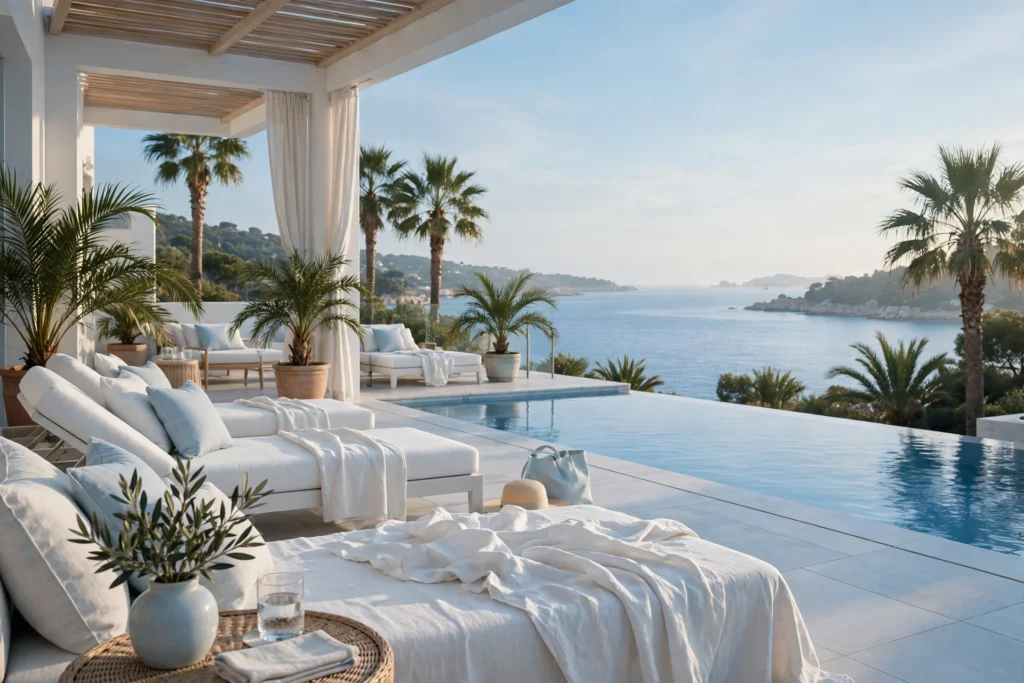
Ask ten people what luxury travel means and you will get ten answers, and most of them will be about thread counts. That is the wrong place to start. The top luxury guides for 2026 agree on a better definition, and it is the one this guide uses: luxury is where the hotel, the service, the scenery, the food, the timing, the privacy and the logistics together justify the premium. It is not just spending more. A very expensive room in a crowded place at the wrong time of year is not luxury. It is an expensive mistake.
Think of luxury as buying five things, and judge every destination in this guide against them.
Privacy
The first thing real luxury buys is space that belongs to you. A private island in the Maldives, where the only people on the beach are the people you arrived with. A villa in Bali with its own pool, where nobody walks past your breakfast. A safari camp in Botswana with six tents and a hundred square kilometres of reserve around it. Privacy is the one luxury that cannot be faked, and it is the reason the island destinations and the safari destinations dominate every luxury list: they are the places where privacy is built into the geography, not added as a service.
Privacy is also the thing that disappears first when you choose the wrong date. A private island in peak season is still private. A famous beach in peak season is a queue with sand. That is why the “best months” column in the comparison table later in this guide matters more than the “budget band” column: the same destination can be luxurious in February and miserable in August, at the same price or higher.
Service that removes decisions
The second thing luxury buys is service that takes work off you. A concierge who has already booked the restaurant, the transfer and the table. A butler who knows you want coffee at seven and does not need to be told twice. A private transfer that meets you at the plane, so the journey from the airport to the bed takes minutes instead of hours. A safari guide who has been tracking one leopard for three days and knows where it will be at dawn.
The test is simple: after a day of good luxury service, you should have made fewer decisions, not more. If you spent the day choosing between menus, negotiating transfers and reading fine print, the service failed, whatever it cost. This is also why the best luxury trips are often the ones with the fewest moving parts: one island, one camp, one city, done properly, beats three destinations stitched together with flights.
Scenery and food you cannot get at home
The third and fourth things are the ones that justify the flight. Scenery: the granite boulders of the Seychelles, the blue lagoon of Bora Bora, the dunes of the Namib, the ice of a glacier lagoon in Iceland, the skyline of Dubai at night. Food: a tasting menu in Tokyo, a private beach barbecue in the Maldives, a chef’s table in the Dolomites. Luxury food is not about the number of courses. It is about eating something, somewhere, that you could not have eaten at home — and the best luxury destinations are the ones where the food is part of the place, not imported into it.
Timing
The fifth thing luxury buys is the right week. The dry season in the Maldives. The cherry blossom in Kyoto. The great migration in Kenya. The northern lights in Iceland in the dark months. The powder in Aspen in February. Timing is the cheapest luxury there is, because it costs nothing except planning — and it is the one most travellers get wrong, because they book the date that suits their calendar instead of the date that suits the destination.
What luxury is not
Luxury is not a star rating, and it is not a brand. A five-star hotel in a city you do not like is still a city you do not like, and a famous resort name on a booking confirmation does not make a rainy week in the wrong season into a good trip. Luxury is also not the same as comfort. A safari tent with a bucket shower and a view of elephants at the waterhole can be more luxurious than a marble bathroom in a city hotel, because the tent gives you something the bathroom cannot: a morning you will remember for the rest of your life.
There is one more thing luxury is not: a reason to stop thinking. The most expensive trips are the ones where people stop checking the weather window, the transfer time, the visa rules and the safety advice, because they assume the price has taken care of it. It has not. The price buys service. The planning is still yours, and this guide is built to do most of it for you.
How this guide is organised
The next section matches destinations to traveller types — honeymoon, family, food, wildlife, wellness and winter sun — and gives you a comparison table with best months, budget band, ideal trip length, the main tradeoff and who each place suits. Then there is a full section on each destination, in the same shape every time: what it is, when to go, what the luxury actually buys there, who it suits, and what to watch out for. Then a realistic cost table for a five-night trip, and a section on when luxury is wasted money. At the end, twelve questions travellers actually ask, answered honestly.
A note on names: this guide names destinations, not properties. No specific hotel, resort or brand is recommended as a booking pick, and there are no affiliate or product links anywhere in this article. That is deliberate. A destination guide that names three resorts has told you where to stay; a destination guide that tells you what to look for in a resort has taught you how to choose. The second one is worth more, because it still works when the resort you read about has changed hands, changed its prices, or closed.
The Best Luxury Travel Destinations by Traveller Type
Most luxury lists are ranked — number one, number two, number three — and ranked lists are useless, because the best luxury destination for a honeymoon is not the best luxury destination for a family, and neither is the best for a food trip. The honest way to choose is by traveller type first, destination second. Start with who is travelling and what the trip is for, and the list narrows itself.
Honeymoon
The honeymoon is the trip where privacy matters most, and where the “one island, one resort, no decisions” formula works best. The Maldives is the default for a reason: a private island, an overwater villa, a seaplane transfer, and nothing to do except eat, swim and be left alone. Bora Bora is the same idea in French Polynesia, with a lagoon that is, if anything, more beautiful and a longer flight from the United States. The Seychelles is the quieter third option — fewer honeymooners, more space, granite beaches that look like nowhere else on earth, and a slower pace that suits couples who want to explore rather than stay in the villa all week.
If you are choosing between the three, the deciding questions are practical, not romantic. How long is the flight, and how much of the honeymoon do you want to spend in the air? What is the weather doing in the month you can actually travel? And do you want to leave the resort — the Seychelles rewards leaving, the Maldives mostly does not need you to. Our dream travel destinations guide covers the same shortlist from the other direction, if you want a second view before you decide.
Family
Luxury with children is a different product, and the destinations that work are the ones with space, staff and structure. Maui is the strongest family pick on this list: direct flights from the US mainland, a time zone that does not destroy small children, beaches that are safe for swimming, and resorts with kids’ clubs, family suites and babysitting. Bali works for older children, with villas that have their own pools, private drivers who cost far less than in the US or Europe, and a culture that is genuinely warm toward children. The Maldives and Bora Bora, by contrast, are poor family picks for young children: the transfers are long, the villas are built for two, and a toddler on a seaplane is a memory nobody needs.
The rule for family luxury is simple: choose the destination where the luxury is in the service and the space, not in the romance. A family suite with a kitchen, a kids’ club that the children actually want to go to, and a beach you can walk to without a boat — those are worth more than a private plunge pool your children are not allowed to use unsupervised.
Food
If food is the point of the trip, go to Tokyo. This is not a close call. Tokyo has more Michelin-starred restaurants than any other city in the world, and the range runs from a ten-seat sushi counter where the chef decides what you eat, to a neighbourhood ramen shop that would be the best meal of your month back home. Kyoto is the slower, more traditional counterpart: kaiseki dinners, temple food, tea houses, and a pace that lets you taste the city instead of rushing through it. The luxury in Japan is not the hotel room. It is the service, the precision, and the fact that the food culture treats a bowl of noodles with the same seriousness as a tasting menu.
The Amalfi Coast and the Dolomites are the European food pick: coastal seafood and lemons on the Amalfi Coast, mountain cooking and wine in the Dolomites. Dubai is the third food city on this list, with a restaurant scene that imports the world’s best chefs — impressive, and worth a visit, but not a substitute for a food culture that grew where you are standing.
Wildlife
For wildlife, the choice is Kenya or Botswana, and the difference between them is the difference between a spectacle and a solitude. Kenya’s Masai Mara is the spectacle: the great migration, big cats, vast herds, and the greatest wildlife show on earth, in the dry season roughly July to October. Botswana’s Okavango Delta is the solitude: fewer camps, fewer vehicles, water-based safaris by mokoro canoe, and the feeling that the animals are not performing for an audience. Both are expensive, and both are worth it, for different reasons. The safari section later in this guide goes into the detail, including the one cost that surprises first-timers: the internal flights.
Costa Rica, named in the top luxury forecasts for 2026 for its Osa Peninsula, is the softer wildlife pick: rainforest lodges, sloths and toucans without the long flights or the safari prices, and a good choice if the family includes children who are too young for a malaria area or a ten-hour drive.
Wellness
Wellness is the most misused word in luxury travel, and the test is whether the place does the work or just sells it. Bali is the strongest wellness destination on this list, because the wellness is built into the island: jungle villas with open-air bathrooms, yoga at dawn, spa treatments that cost a fraction of the same treatment in London or Los Angeles, and a pace of life that slows you down whether you book a programme or not. The Seychelles and the Maldives are the second pick: the wellness is the setting — the sea, the quiet, the absence of anything to do — and a good spa is a bonus, not the reason to go.
Be suspicious of any “wellness retreat” that is really a hotel with a spa menu and a juice bar. Real wellness luxury is a place where you sleep better, eat better and move more, and where the schedule is yours. If the programme is doing the relaxing for you, it is not relaxing.
Winter sun
Winter sun is the most practical kind of luxury, because it is the one with a deadline: you are cold, it is January, and you want to be warm by the weekend. From the US East Coast, St. Barts and Turks and Caicos are the answer — short flights, December to April, reliable warmth, and a luxury scene that is built for the season. From the US West Coast, Maui and Cabo are the answer. The Maldives and Bora Bora are the long-haul winter sun options, and they are worth the flight only if you are staying long enough — five nights minimum, seven better — because a ten-hour flight for a three-night trip is not luxury, whatever the hotel costs. Our guide to the best places to travel in January covers the winter-sun map in more detail, including the places that are warm and cheap rather than warm and expensive.
Destinations by traveller type
| Traveller type | Best picks | Why it works | Watch out for |
|---|---|---|---|
| Honeymoon | Maldives, Bora Bora, Seychelles | Privacy, overwater villas, one-island simplicity | Long flights; bad weather in the wrong month |
| Family | Maui, Bali, Costa Rica | Space, kids’ clubs, easy transfers, warm culture | Maldives and Bora Bora suit couples, not small children |
| Food | Tokyo, Kyoto, Amalfi Coast, Dubai | World-class dining, food culture, service | Book restaurants weeks ahead; tasting menus add up fast |
| Wildlife | Kenya, Botswana, Costa Rica | Migration, big cats, Okavango water safaris | Internal flights; malaria areas; dry season only |
| Wellness | Bali, Seychelles, Maldives | Jungle villas, spas, slow pace, quiet | “Wellness” labels on ordinary hotels |
| Winter sun | St. Barts, Turks and Caicos, Maldives, Maui | Short flights from the US, reliable warmth Dec–Apr | Holiday-week prices; book months ahead |
The comparison table: best months, budget, trip length, tradeoff, who it suits
| Destination | Best months | Budget band (5 nights, per person, excl. international flights) | Ideal trip length | Main tradeoff | Who it suits |
|---|---|---|---|---|---|
| Maldives | Nov–Apr | High to very high | 5–8 nights | Long transfer; little to do off the island | Honeymooners, couples |
| Bora Bora | May–Oct | Very high | 5–8 nights | Longest flight from the US; small island | Honeymooners |
| Seychelles | Apr–May, Oct–Nov | High | 6–9 nights | Slower pace; fewer direct flights | Couples, slow travellers |
| St. Barts | Dec–Apr | Very high | 5–7 nights | Extreme holiday-week prices | Winter sun, couples |
| Turks and Caicos | Dec–Apr | High | 5–7 nights | Shorter season; hurricane risk Jun–Nov | Families, winter sun |
| Dubai | Nov–Mar | Mid to high | 4–6 nights | Summer heat is extreme; city, not beach | First luxury trip, food, shopping |
| Tokyo | Mar–May, Oct–Nov | Mid to high | 5–7 nights | Cherry blossom and autumn weeks book out | Food, design, culture |
| Bali | May–Sep | Mid | 7–10 nights | Rainy season Nov–Mar; traffic in the south | Wellness, families, long stays |
| Amalfi Coast | May–Jun, Sep–Oct | High | 5–7 nights | Crowds in July–August; steep prices | Couples, food, coast |
| Dolomites | Dec–Mar (ski), Jun–Sep (hiking) | Mid to high | 4–7 nights | Two seasons, two trips; book huts early | Mountains, slow travel |
| Maui | Apr–Jun, Sep–Oct | High | 5–7 nights | Peak winter prices; wildfire recovery areas | Families, first Hawaii trip |
| Iceland | Sep–Apr (lights), Jun–Aug (summer) | High | 5–8 nights | Weather rules everything; expensive | Northern lights, coolcations |
| Kenya | Jul–Oct | High to very high | 6–9 nights | Internal flights; dry season only | Wildlife, migration |
| Botswana | May–Oct | Very high | 6–9 nights | The most expensive safari on this list | Wildlife, privacy, solitude |
The budget bands in this table are planning ranges, not quotes. “Mid” means roughly $2,000–$4,000 per person for five nights excluding international flights, in a good hotel with meals and transfers. “High” means roughly $4,000–$8,000. “Very high” means $8,000 and up, and in the Maldives, Bora Bora and Botswana it can go far beyond that. The full cost table is in the final section, with the ranges broken down by tier so you can see what the money actually buys.
Maldives: Private Islands and Overwater Villas
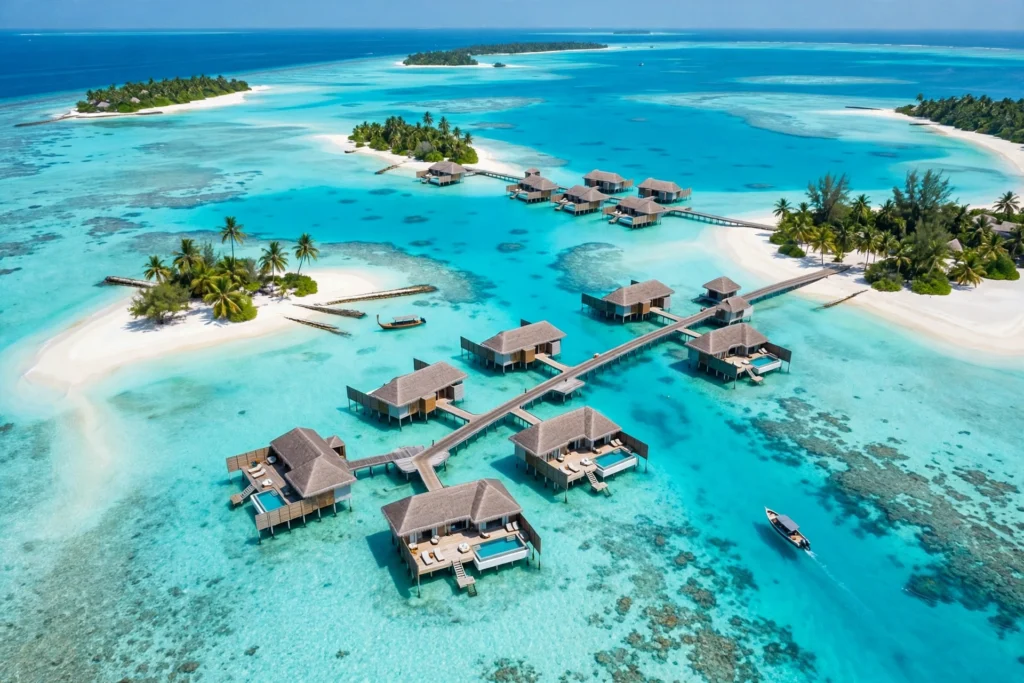
The Maldives is the first name on almost every luxury list, and it earns the place. The country is a chain of low coral atolls in the Indian Ocean, and the luxury version of it is simple: one island, one resort, one beach, and a villa that stands on stilts over a lagoon so clear you can see the fish from your bed. There is no other destination on this list where privacy is so complete. You arrive by seaplane or speedboat, and from that moment the island is yours in every way that matters — the beach, the reef, the restaurant, the sunset.
When to go
The dry season, the northeast monsoon, runs roughly November to April, and that is when to go. The weather is drier, the sea is calmer, the visibility underwater is at its best, and the sky does what the photographs promise. The wet season, the southwest monsoon from May to October, brings more rain, rougher seas and lower prices — and the lower prices are the tell. If you can only travel in the wet season, the Maldives still works, but go knowing that you may lose a day or two to rain, and that the seaplane transfers are the first thing to be delayed when the weather turns. The US State Department’s Maldives advisory notes the same two seasons, and warns that heavy rain during the southwest monsoon can cause localised flooding in low-lying areas — a reminder that this is a country of islands barely above sea level, not a mainland with somewhere to retreat to.
The best months inside the dry season are December to March, when the rain is least and the sea is calmest. November and April are the shoulder months: slightly cheaper, slightly less certain, and often the best value on the island. Avoid the Christmas and New Year weeks unless you have booked a year ahead and you are comfortable with the highest prices of the year — the same villa can cost twice as much between Christmas and New Year as it does in February, and the island is no more beautiful for it.
What the luxury actually buys
In the Maldives, the luxury buys three things. The first is the villa itself, and the difference between the villa types matters more than the difference between the islands. An overwater villa gives you the lagoon, the ladder into the water, and the photograph. A beach villa gives you the sand, the shade, and a garden you can walk barefoot in. Families with small children should take the beach villa every time; honeymooners usually take the overwater villa and never regret it. The second is the reef. The house reef — the coral reef that rings the island — is the real attraction, and the quality of the reef varies more between islands than the quality of the rooms does. Ask about the reef before you book, not after you arrive: a great reef with a good room beats a great room with a dead reef.
The third is the transfer, and it is the part first-timers underestimate. The Maldives is not one place. It is a hundred islands spread over hundreds of kilometres of ocean, and getting to your island takes a seaplane, a speedboat, or a domestic flight plus a boat. The seaplane is part of the experience — the flight over the atolls is one of the great arrivals in travel — but it only flies in daylight, it is weather-dependent, and it adds a real cost to the trip. If your international flight lands late in the evening, you will spend the first night near the airport island and transfer in the morning. Build that into the plan. It is not a problem. It is a fact, and the trips that go wrong are the ones where nobody mentioned it.
Who it suits, and who it does not
The Maldives suits couples, honeymooners and anyone who wants a week of doing very little, very well. It suits snorkellers and divers, who will find some of the best house reefs in the world. It suits people who are happy to eat in the same few restaurants for a week, because on a one-island resort that is what you do. It does not suit travellers who want to explore, because there is nowhere to explore to — the island is the destination, and the day trip to a local island is a morning out, not a second destination. It does not suit small children well, for the transfer and the villa reasons above, and it does not suit anyone who gets bored easily. If you need a town, a market, a museum or a mountain, go somewhere else.
What to watch out for
The first thing to watch is the meal plan. Most Maldives resorts sell half-board or full-board or all-inclusive, and the difference between them is several hundred dollars a day. On a private island there is nowhere else to eat, so the meal plan is not optional in practice — it is the food budget, and you should price the trip with the meal plan included, not added later as a surprise. The second is the seaplane transfer cost, which is often quoted separately from the room rate. The third is the weather window: book the dry season, and if you are travelling in the shoulder months, accept that one rainy day is possible and plan a spa day for it. The official Visit Maldives site is the place to check island and transfer information before you book, and it is the only source you need for the geography — the atolls, the distances and the seasons.
Bora Bora: The Classic Overwater Honeymoon
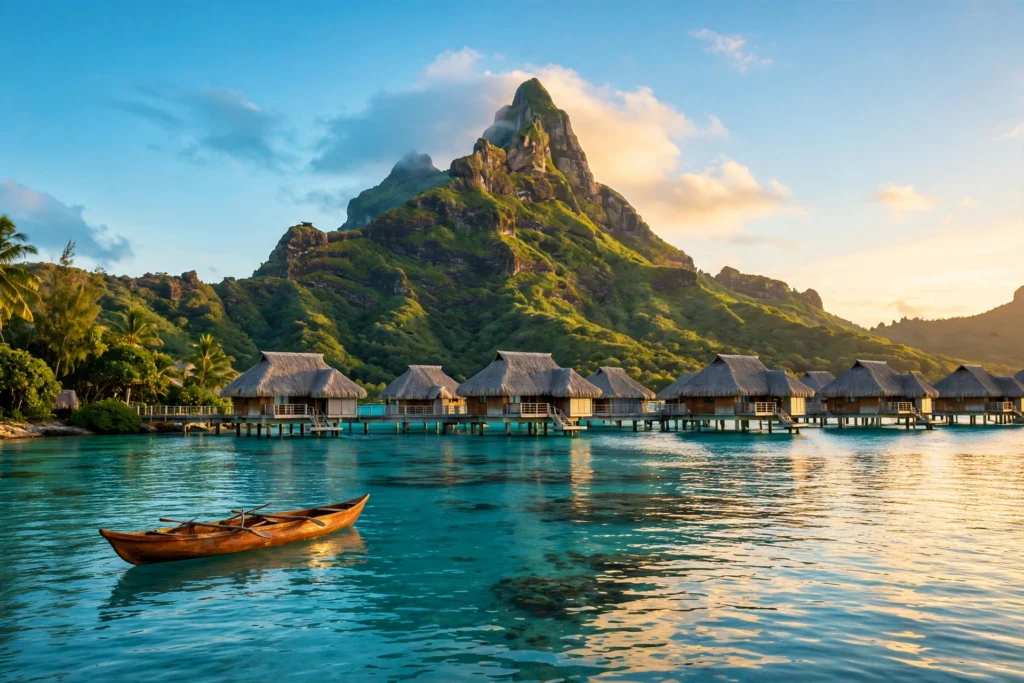
Bora Bora is the destination that invented the overwater villa, and the lagoon is the reason. The island rises out of a lagoon so blue it looks edited, with Mount Otemanu in the middle and a ring of coral motu — small islets — around the edge, and the overwater villas stand on the motu facing the mountain. It is the most photographed honeymoon view in the world, and unlike most photographed views, it looks like the photograph when you get there.
When to go
May to October is the dry season and the best time to go: cooler, drier, less humid, and the lagoon at its clearest. November to April is the wet season, warmer and more humid, with short tropical showers and a higher chance of a grey day. The difference is real but not dramatic — Bora Bora is warm all year, and the wet season is not a washout — but the dry season is when the island is at its best, and the prices know it. The other timing question is the flight. From the United States, Bora Bora is a long journey: a flight to Tahiti, then a short flight to Bora Bora, then a boat to the resort. From Los Angeles it is the best part of a day each way. That is why the ideal trip length is five to eight nights, and why a three-night Bora Bora trip is a mistake — you will spend two of your five days travelling, and you will feel it.
What the luxury actually buys
In Bora Bora, the luxury buys the view and the quiet. The overwater villa here is the original, and it is bigger and better built than in most places that copied it: a deck over the lagoon, a glass panel in the floor, a ladder into water warm enough to swim in at midnight. The second thing it buys is the lagoon itself, which is a playground in a way the Maldives is not — you can swim, snorkel, paddle and sail without leaving the resort’s water, and the coral gardens are a short boat ride away. The third is the French Polynesian welcome, which is warmer and more personal than the polished service of the Maldives: flower garlands on arrival, ukulele music at dinner, and a sense that the island is glad you came.
The tradeoff is the size of the island. Bora Bora is small, and once you have done the lagoon tour, the shark and ray snorkelling, and the sunset cruise, you have done Bora Bora. That is fine for a honeymoon, where doing nothing is the plan. It is less fine for a two-week trip, where the smallness starts to show. If you want a longer French Polynesia trip, add a second island — Moorea, an hour by ferry from Tahiti, is the easy one — rather than stretching Bora Bora beyond a week.
Who it suits, and who it does not
Bora Bora suits honeymooners and couples celebrating something, and it suits them better than anywhere else on this list except the Maldives. It suits swimmers and snorkellers. It does not suit families with young children, for the same villa and transfer reasons as the Maldives, and it does not suit travellers on a budget, because Bora Bora has no budget version — the flights, the transfers and the rooms are all expensive, and there is no cheap neighbourhood to retreat to. It does not suit anyone who wants nightlife or culture, because the island has very little of either, and that is the point.
What to watch out for
The first thing is the total cost, not the room rate. The room is the headline, but the flights to Tahiti, the flight to Bora Bora, the boat transfer, the meals and the activities add up to as much again, and the meal plans work the same way as in the Maldives — price the trip with food included. The second is the season: book May to October if you can, and if you go in the wet season, accept the showers and enjoy the lower prices. The third is the length: five nights minimum, seven better, and do not try to do Bora Bora as a stopover. It is a destination, not a detour.
Seychelles: Granite Islands and Slow Luxury
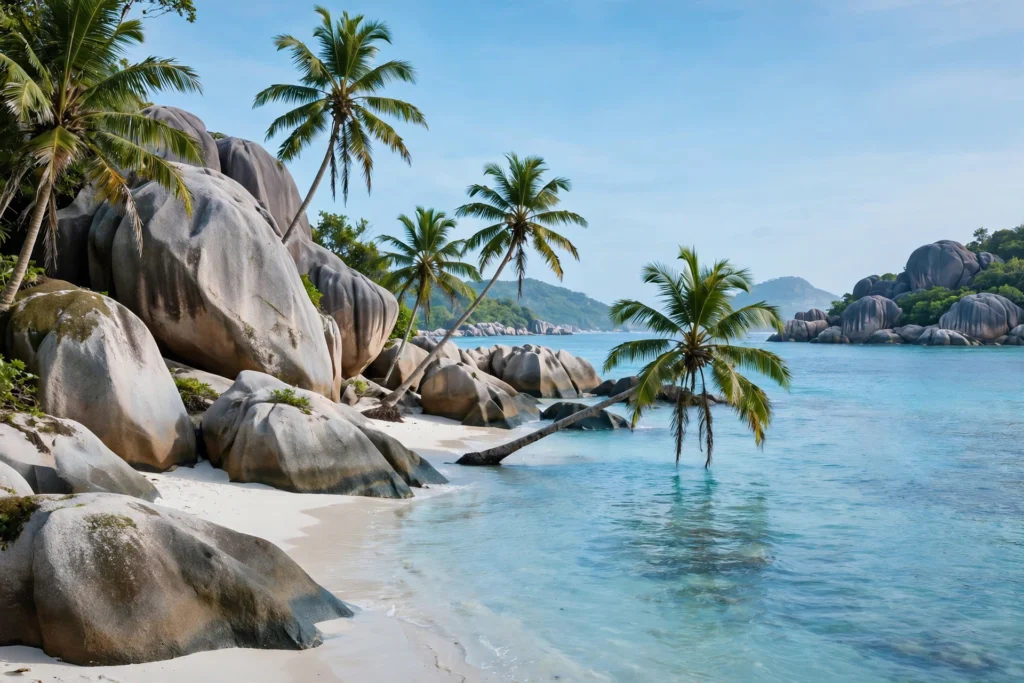
The Seychelles is the quietest destination on this list, and that is its appeal. The islands sit in the Indian Ocean off East Africa, and they look like nowhere else: granite boulders the size of houses on white sand beaches, takamaka trees leaning over the shore, and a sea that changes colour with the light. The most famous beach, Anse Source d’Argent on La Digue, is the most photographed beach in the world, and the reason is not marketing — it is the boulders, which no other beach has.
When to go
April to May and October to November are the best months: the trade winds ease, the sea is calm, the visibility is good, and the weather is warm without being oppressive. December to March is the northwest monsoon, warmer and wetter, with rain and rougher seas on the western coasts. June to September is the southeast monsoon, drier and windier, with rougher seas on the southeastern coasts and better conditions for sailing and windsurfing. The Seychelles is warm all year, so the choice is not about temperature — it is about wind, sea and rain, and the shoulder months are when all three are at their kindest.
What the luxury actually buys
In the Seychelles, the luxury buys space and slowness. The islands are not built for crowds: the resorts are small, the beaches are often empty, and the pace is the pace of an island where nothing is urgent. The second thing it buys is nature that is genuinely unusual — giant tortoises on the beaches, coco de mer palms in the Vallée de Mai, and reefs and birds that exist nowhere else. The third is the freedom to move: unlike the Maldives, where you are on one island, the Seychelles rewards island-hopping. Mahé, the main island, has the airport and the capital, Victoria. Praslin has the Vallée de Mai and the best beaches for a base. La Digue, reached by ferry, is the island to cycle around, with no cars to speak of and beaches that feel undiscovered. A week split between two islands is a better Seychelles trip than a week on one.
Who it suits, and who it does not
The Seychelles suits couples who want quiet, slow travellers who want to explore at walking pace, and anyone who has already done the Maldives and wants something less polished and more real. It suits walkers and cyclists, snorkellers, and people who like the idea of a beach with nobody else on it. It does not suit travellers who want nightlife, shopping or a resort scene, because there is very little of any of those, and it does not suit anyone who wants everything arranged — the Seychelles rewards the traveller who hires a car, takes the ferry, and figures it out. It is a gentler, more independent luxury than the Maldives, and that is either the reason to go or the reason not to.
What to watch out for
The first thing is the flights: there are fewer direct flights to the Seychelles than to the Maldives, and most travellers connect through the Middle East or Europe, so the journey is longer than the map suggests. The second is the cost of moving between islands — ferries and domestic flights add up, and they need to be booked ahead in high season. The third is the season: the wind matters here more than in the Maldives, so check which coast your hotel is on and which monsoon will be blowing when you go. The official Seychelles tourism site is the place to check ferry routes, island information and the seasons before you book.
St. Barts and Turks and Caicos: Caribbean Winter Sun
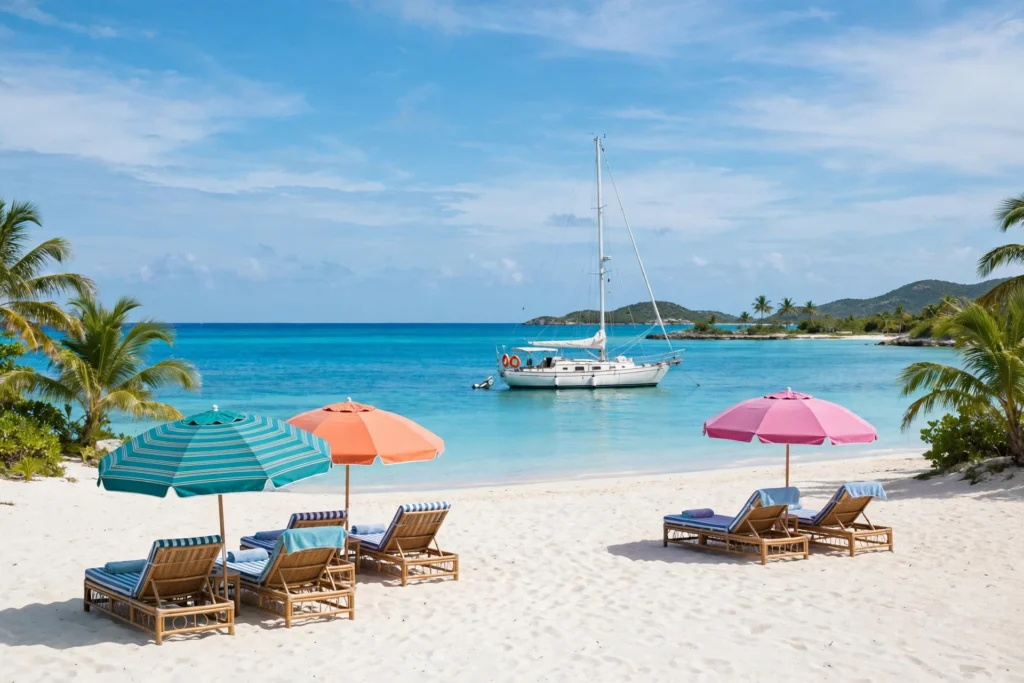
For travellers on the US East Coast, the Caribbean is the luxury that does not require a long-haul flight, and St. Barts and Turks and Caicos are the two names that matter at the top of the market. They are different islands with a different feel, and choosing between them is a useful exercise in what luxury means to you: St. Barts is small, French, chic and expensive; Turks and Caicos is bigger, quieter, and built around one of the best beaches in the Caribbean.
St. Barts
St. Barts is a small French island in the Caribbean, eight square miles of hills, beaches and villages, and the luxury capital of the region. The island is French in language, food and style — the restaurants are serious, the bakeries are real, and the shopping is the kind you find in Paris, not in a resort. The beaches are small and varied: St. Jean for the scene, Flamands for the long walk, Colombier for the hike in and the feeling that you have found something. The island is expensive at every level, and the Christmas and New Year weeks are among the most expensive hotel weeks anywhere in the world, when villas and hotels are booked a year ahead and the harbour fills with yachts.
The best months are December to April, the dry season, when the weather is warm, the rain is rare and the island is at its liveliest. May to November is quieter and cheaper, with more rain and the hurricane season to watch from June onwards. The tradeoff is the price: St. Barts is the most expensive Caribbean island by a clear margin, and the value is in the style and the food, not in the size of the room. If you want the Caribbean with a French accent and you do not mind paying for it, this is the island. If you want a beach holiday, go to Turks and Caicos instead.
Turks and Caicos
Turks and Caicos is a British Overseas Territory south of the Bahamas, and its luxury is simpler: Grace Bay Beach on Providenciales, a twelve-mile stretch of white sand and turquoise water that is consistently rated one of the best beaches in the world, and a line of resorts and villas along it that are built to face it. The island is flat, quiet and easy, and the luxury here is the beach itself — long walks, calm water, and a sunset that needs no restaurant to improve it.
The best months are December to April, the same dry season as St. Barts, with the same warning about hurricane season from June to November. The ideal trip is five to seven nights, based on Providenciales, with a day trip to the smaller islands if you want to see more. The tradeoff is that Turks and Caicos is quieter than St. Barts, with less dining, less shopping and less scene — which is either a relief or a bore, depending on what you want from a holiday. For families, it is the better pick: the beach is safe for children, the resorts have family suites and kids’ clubs, and the flights from the US East Coast are short.
What to watch out for in the Caribbean
The first thing is the hurricane season, June to November, with the peak in August to October. The winter sun season exists for a reason, and the reason is the weather. If you travel in the shoulder months, buy travel insurance that covers hurricanes, and check the forecast before you fly. The second is the holiday-week price spike: Christmas, New Year and Presidents’ Day week are the most expensive weeks in the Caribbean, and the same room can cost twice as much as it does in late January. The third is the transfer: St. Barts has a tiny airport with a short runway, and most visitors arrive via St. Martin and a short flight or ferry — build the connection into the plan, and do not book a tight connection out. The US State Department’s Caribbean advisories are worth a read before you book, and the travel apps guide on this site covers the offline maps and weather apps that work best when the signal does not.
Dubai: City Luxury, Desert and Design
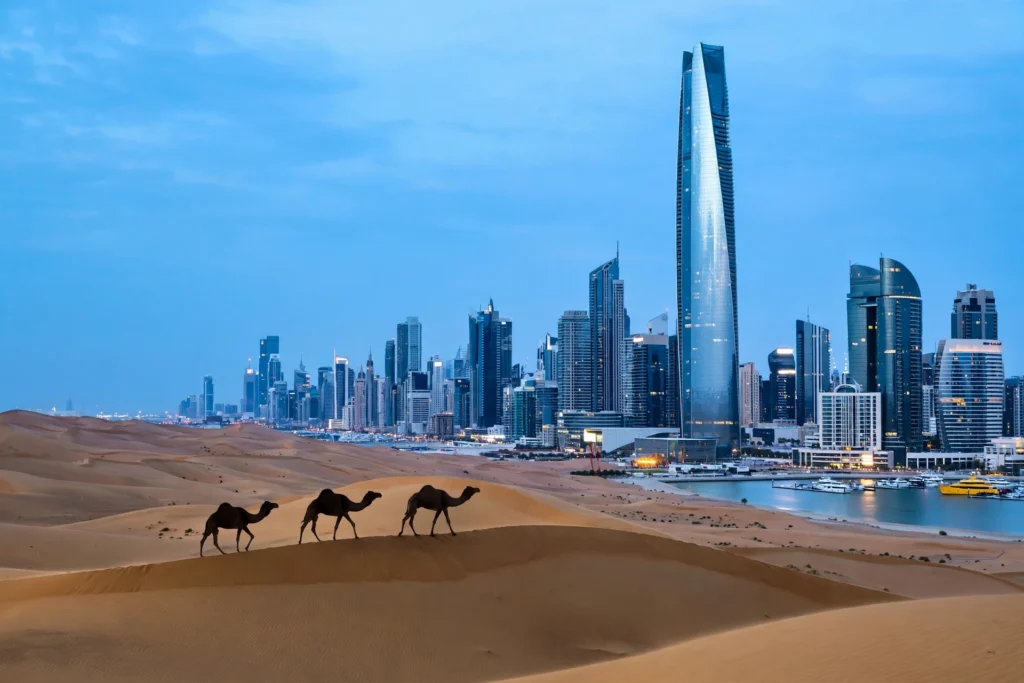
Dubai is the easiest luxury trip on this list, and that is a compliment. The flights are frequent, the airport is efficient, the hotels are new, the service is polished, and the city is built to make a first luxury trip feel effortless. If you have never taken a luxury trip and you want to know what the fuss is about, Dubai is the place to find out — and if you have taken many, Dubai is the place to go when you want a city break that works without a plan.
When to go
November to March is the season. The weather is warm and pleasant, the beaches are usable, the desert is cool in the evening, and the city is outdoors. April and October are the shoulders: hotter, cheaper, and still workable if you plan around the middle of the day. May to September is the summer, and the heat is extreme — daytime temperatures that make the beach and the desert a morning-only activity, and a city that moves indoors, into malls and hotels, for the afternoon. The summer prices are the lowest of the year for a reason, and the reason is the heat. Do not book a summer Dubai trip for the beach. Book it for the hotels, the restaurants and the shopping, and accept that you will be indoors between noon and five.
What the luxury actually buys
In Dubai, the luxury buys the city itself: the skyline, the architecture, the restaurants, and the sense that everything is new and everything works. The Burj Khalifa, the tallest building in the world, is worth going up once, at sunset if you can book it. The desert is the second thing it buys, and the desert safari — dunes at sunset, a camp dinner under the stars — is the part of a Dubai trip that people remember, more than the hotel. The third is the food: Dubai imports the world’s best chefs, and the restaurant scene is one of the most ambitious on earth, from tasting menus to street food in the old neighbourhoods of Deira and Bur Dubai.
The other thing Dubai buys is ease. The metro is clean and cheap, the taxis are regulated, the hotels will arrange anything, and English is spoken everywhere. For a first luxury trip, that ease is worth more than a more beautiful destination that requires more work. Dubai is also the best stopover luxury on this list: four to six nights is the ideal length, and it pairs naturally with the Maldives or the Seychelles, a short flight away, for travellers who want a city and an island in one trip.
Who it suits, and who it does not
Dubai suits first-time luxury travellers, food lovers, shoppers, and anyone who wants a city break with guaranteed sunshine in the winter. It suits families, with water parks, desert safaris and beaches that are safe for children, and it suits couples who want a short trip — four nights in Dubai is a complete holiday, where four nights in the Maldives is barely the beginning. It does not suit travellers who want nature, history or quiet, because Dubai has very little of any of those, and it does not suit anyone who wants a beach holiday in the summer, when the heat makes the beach a brief morning visit. If you want the desert, the dunes and the skyline, go. If you want a wild coast or an old town, go somewhere else.
What to watch out for
The first thing is the summer heat, which is not a detail — it is the trip, from May to September. The second is the cost of the extras: the hotel room is the headline, but the restaurants, the desert safari, the Burj Khalifa tickets and the beach clubs add up fast, and Dubai is a city where it is easy to spend a lot without noticing. The third is the law: Dubai is a modern, welcoming city, and it is also a place with strict laws on alcohol, public behaviour and medication — check the rules before you go, and do not assume that what is normal at home is normal there. The US State Department’s UAE advisory is the place to check the current guidance, and the rules on what you can bring into the country are worth reading in full.
Tokyo and Kyoto: Food, Service and Design
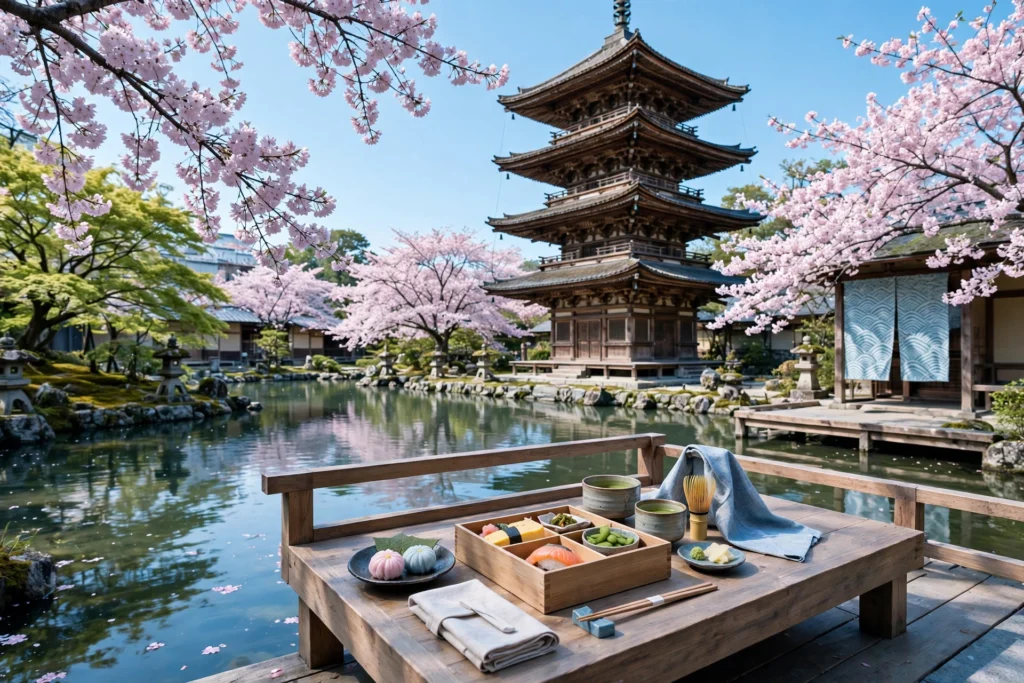
If the Maldives is the best luxury for privacy, Tokyo is the best luxury for everything else. The city has more Michelin-starred restaurants than any other city in the world, the service is the most precise on earth, the design — from a ryokan room to a train station — is considered down to the last detail, and the whole city runs on time. Luxury in Japan is not about gold taps. It is about a place where every detail has been thought about, and where the person serving you has thought about it more than you have.
When to go
March to May and October to November are the best months. Late March to early April is cherry blossom season, the most beautiful two weeks in Japan and the most crowded, when hotels and flights book out months ahead and prices peak. October to November is autumn, with maple leaves, clear skies and cooler weather, and it is the better pick if you can choose — the same beauty, fewer crowds, lower prices. June to September is summer: hot, humid, and rainy in June, with festivals that are worth seeing if you can take the heat. December to February is winter: cold, clear, quiet, and the cheapest season, with illuminations in the cities and snow in the mountains an hour away.
What the luxury actually buys
The first thing it buys is the food. Tokyo’s food scene is not a scene — it is the city. A ten-seat sushi counter where the chef decides the menu and you eat what is in front of you. A ramen shop with a queue out the door that serves the best bowl of noodles you will ever eat for the price of a sandwich. A department-store food hall where the standard is higher than most restaurants back home. Kyoto’s food is slower and more formal: kaiseki, the multi-course dinner that is as much a ceremony as a meal, served in a ryokan or a machiya townhouse, with ingredients that change with the season. The luxury is not the price of the meal. It is the fact that the food is taken this seriously at every level, from the convenience store to the three-star counter.
The second thing it buys is the service. Japanese service is not servile and it is not showy. It is precise: the hotel that has your bags in the room before you are, the restaurant that remembers you do not eat shellfish, the train that leaves at the minute it says it will. The third is the design: the ryokan, the traditional inn, with tatami floors, a futon, a hot spring bath and a kaiseki dinner, is the most luxurious room on this list that does not have a sea view, and it is worth one night of any Japan trip. The fourth is the city itself: Tokyo is the most exciting city in the world to walk in, and Kyoto is the most beautiful.
The practical details
Japan is Level 1, the lowest level, on the US State Department Japan travel advisory, which was issued on 28 September 2026 and was read live for this guide. US citizens need no visa for stays under 90 days, and the passport must be valid for the entire stay. The emergency numbers are 110 for police and 119 for fire or ambulance. The advisory also warns about spiked drinks and overcharging in nightlife districts in Tokyo — Roppongi, Kabuki-cho, Shibuya and Ikebukuro — which is worth knowing, because the risk in Japan is not on the street, it is in the bar. The other practical detail is the money: Japan is still a cash country in places, and the food costs in this guide’s cost table assume you eat well but not extravagantly — a tasting menu in Tokyo is a special night, not a nightly habit.
Our guide to how much to travel to Japan breaks down the full cost of a Japan trip, including the rail pass, the hotels and the food, and the official Japan National Tourism Organization site is the place to check seasons, festivals and the cherry blossom forecast before you book.
Who it suits, and who it does not
Tokyo and Kyoto suit food lovers, design lovers, and travellers who want a city trip that rewards attention. They suit couples, and they suit travellers who like to walk, because the best of both cities is found on foot. They do not suit anyone who wants a beach holiday or a slow week, because Japan is a trip that asks you to be curious, and it rewards curiosity generously. They do not suit travellers who want everything in English — Japan is welcoming, but the language barrier is real outside the hotels, and the best meals are often in places with no English menu at all. That is part of the experience, not a flaw in it, but go knowing it.
Bali: Wellness Retreats and Slow Travel
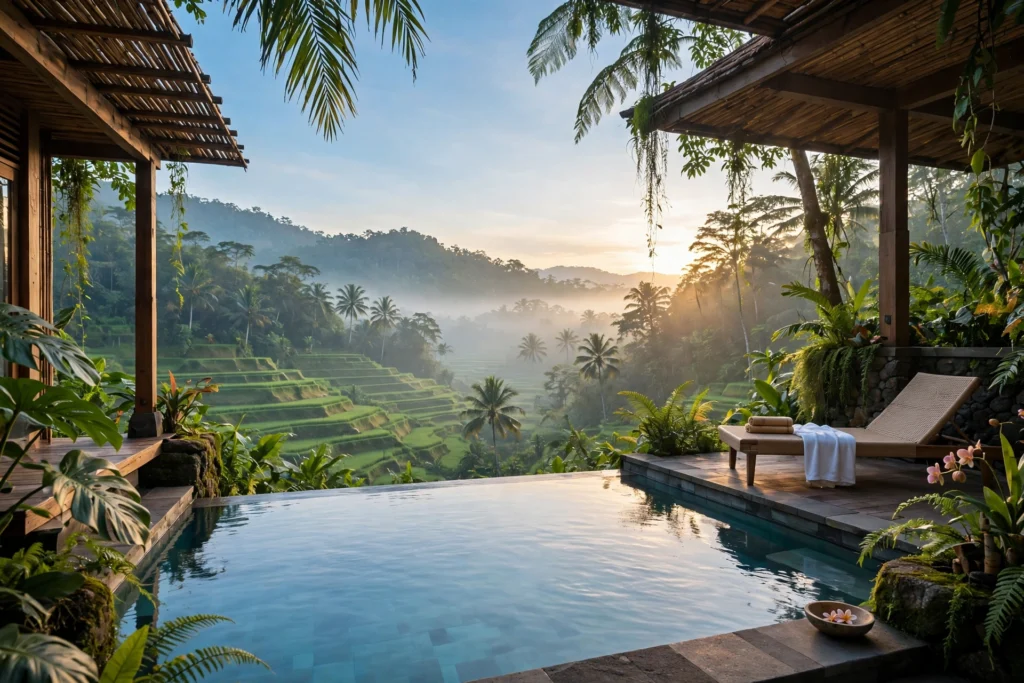
Bali is the cheapest luxury on this list, and the most misunderstood. The island is famous for two things that are both true and both incomplete: the wellness scene, and the crowds. The wellness is real — jungle villas, yoga at dawn, spa treatments that cost a fraction of the same treatment in London or Los Angeles, and a pace of life that slows you down. The crowds are also real, in the south, around Seminyak and Canggu, where the traffic is the worst thing about the island. The trick to a luxury Bali trip is to go where the island is still itself: Ubud in the hills, Uluwatu on the cliffs, and the north and east coasts, where the pace is slower and the beaches are emptier.
When to go
May to September is the dry season and the best time to go: sunny, dry, and cooler in the hills. October to April is the wet season, with short tropical showers and higher humidity, and lower prices. The difference is not as stark as in the Maldives — Bali is warm and green all year — but the dry season is when the island is at its best, and the traffic is at its worst, because everyone else has had the same idea. The ideal trip is seven to ten nights, longer than the other destinations on this list, because Bali rewards a slow trip: a few days in Ubud, a few days on the coast, and a day or two with nothing planned.
What the luxury actually buys
In Bali, the luxury buys space and staff, at a price that would be impossible anywhere else on this list. A private villa with its own pool, a garden, a kitchen and a staff who cook, clean and arrange everything, costs less than a hotel room in the Maldives — and that is the whole point of Bali. The villa is the luxury. The second thing it buys is the wellness, and the wellness in Bali is not a spa menu — it is the island: the rice terraces at dawn, the temples, the yoga, the food, and the fact that the island’s culture treats rest as a normal part of life, not a product. The third is the service culture: Bali is famous for the warmth of its people, and a good villa staff will make the trip in a way that no hotel concierge can.
Who it suits, and who it does not
Bali suits wellness travellers, long-stay travellers, families with older children, and anyone who wants a luxury trip that does not cost a fortune. It suits people who want a villa, not a hotel, and a trip that is slow rather than packed. It does not suit anyone who wants a pristine beach holiday, because Bali’s beaches are not its strength — the sand is dark in places, the surf is strong, and the best beaches are a drive away. It does not suit travellers who want everything arranged and nothing to think about, because Bali rewards the traveller who hires a driver, chooses a villa, and makes a few decisions. And it does not suit anyone who is in a hurry: Bali is a slow island, and the traffic in the south will punish anyone who tries to see it all in three days.
What to watch out for
The first thing is the traffic in the south, which is the single worst thing about a Bali trip, and the reason to stay in Ubud or Uluwatu rather than Seminyak if you want quiet. The second is the rainy season, November to March, when the showers are short but the humidity is high. The third is the villa: book through a reputable source, read the recent reviews, and check what is included — a villa with staff, a pool and a kitchen is a different product from a villa that is just a house, and the price will tell you which one you are looking at. The fourth is the scooter: Bali’s roads are dangerous, and the hospitals are not what you are used to. Hire a driver. It costs little, and it is the best money you will spend on the island.
The Amalfi Coast and the Dolomites: Italy Two Ways
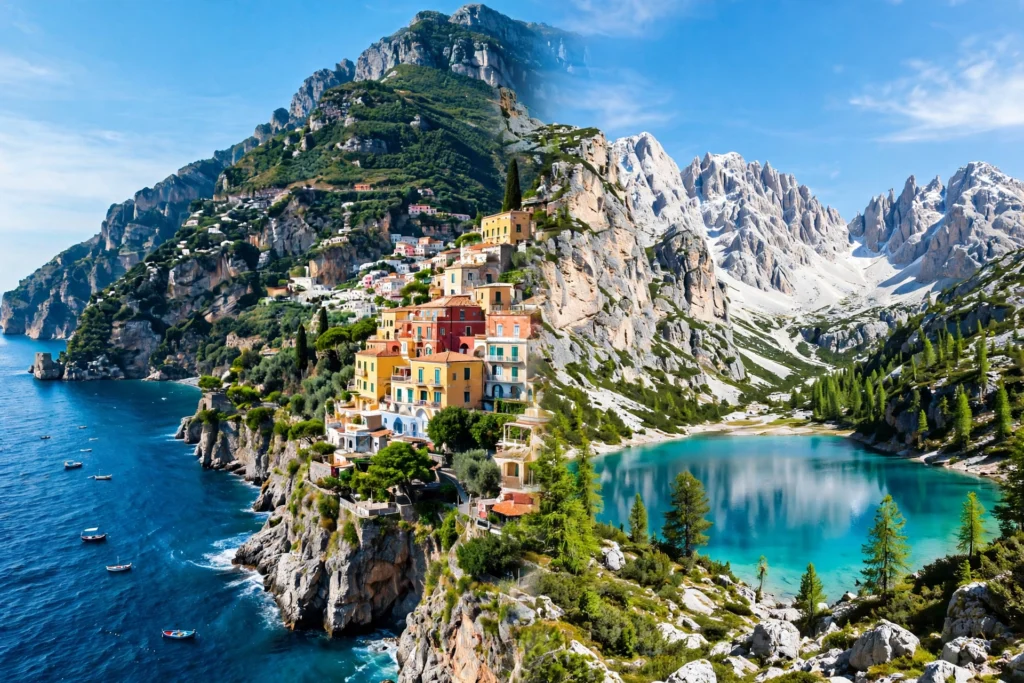
Italy appears twice on this list because Italy offers two completely different luxury trips, and the choice between them tells you what kind of traveller you are. The Amalfi Coast is the coast: lemons, seafood, cliff villages, and the sea. The Dolomites are the mountains: peaks, lakes, huts, and the air. Both are beautiful, both are expensive in season, and both are worth it — but they are not interchangeable, and the mistake is to try to do both in one week.
The Amalfi Coast
The Amalfi Coast is a stretch of cliff road south of Naples, with villages — Positano, Amalfi, Ravello — that hang over the sea. The luxury is the view: a terrace over the water, a lemon grove, a seafood dinner at sunset. The best months are May to June and September to October, when the weather is warm, the sea is swimmable, and the crowds are thinner. July and August are the peak, and the peak is the problem: the road is a single lane of traffic, the villages are crowded, and the prices are at their highest. If you can only go in July or August, go, but base yourself in Ravello or Amalfi rather than Positano, and do your sightseeing early in the morning.
The Amalfi Coast suits couples and food lovers, and it suits anyone who wants a beautiful coast with good food and a slow pace. It does not suit families with small children, because the villages are steep and the beaches are small and pebbly, and it does not suit anyone who wants to drive — the coast road is narrow, the parking is scarce, and the bus or a private driver is the way to see it. The ideal trip is five to seven nights, based in one village, with day trips by boat to Capri and along the coast.
The Dolomites
The Dolomites are a mountain range in northern Italy, and the luxury is the opposite of the coast: silence, air, and scale. The peaks are pale limestone, the valleys are green, the lakes are turquoise, and the food is a mix of Italian and Austrian — mountain cooking, wine, and a hospitality that is warmer than the altitude suggests. The range has two seasons, and they are two different trips: December to March for skiing, with the 2026 Winter Olympics having put the region’s resorts in the spotlight, and June to September for hiking, when the mountain huts are open and the trails are clear. The luxury in winter is a ski hotel with a spa and a view of the peaks. The luxury in summer is a hike to a rifugio, a mountain hut, for lunch, and a lake to swim in.
The Dolomites suit mountain lovers, slow travellers, and anyone who wants a luxury trip that involves walking rather than lying down. They suit families with older children, who will remember the lakes and the hikes longer than any hotel. They do not suit anyone who wants a beach, and they do not suit a short trip — the mountains reward a stay of four to seven nights, with time to walk, eat and look. Our Venice travel guide is the natural companion to a Dolomites trip, because Venice is the city to add at the start or the end, and the train from Venice to the mountains is part of the journey.
What to watch out for in Italy
The first thing is the season: Italy is a country where the month matters more than the destination, and July and August on the Amalfi Coast are a different trip from May or September. The second is the booking window: the best hotels on the Amalfi Coast and the best rifugios in the Dolomites book out months ahead, and the walk-in traveller in high season will be disappointed. The third is the driving: do not drive the Amalfi Coast road if you do not have to, and do not drive the mountain passes in winter without winter tyres and experience. The fourth is the food: eat where the locals eat, not where the view is, and the view will still be there when you finish.
Maui: Island Luxury Closer to Home
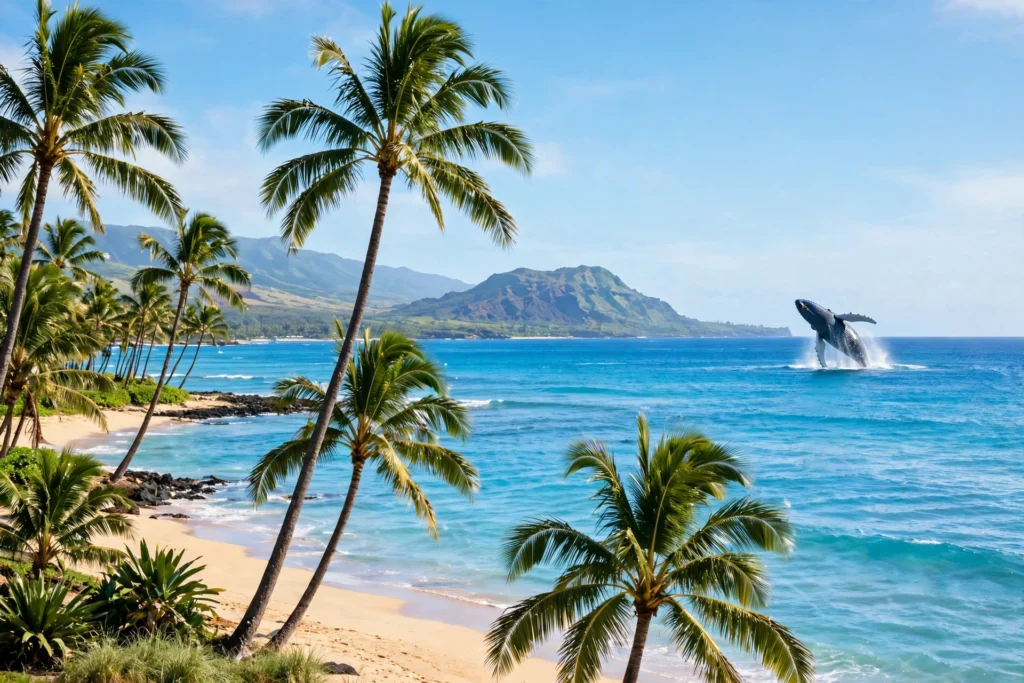
Maui is the luxury destination that does not require a passport, a long-haul flight, or a language you do not speak, and for American travellers that is worth more than it sounds. The island is the best of Hawaii in one place: beaches, a volcano, a road to Hana that is one of the great drives in the world, and a food scene that has grown up around the farms and the sea. It is also the best family luxury destination on this list, and the best first luxury trip for anyone who has never left the United States for a holiday.
When to go
April to June and September to October are the best months: warm, dry, and quieter, with lower prices than the winter peak. December to March is the winter season, when the weather is still warm, the whales are in the channel between Maui and Lanai, and the prices are at their highest. July and August are the summer peak, busy and hot. The whale season, roughly December to April, is the reason to go in winter if you can: the humpback whales come to the warm water to breed, and a whale-watching trip from Lahaina or Maalaea is one of the best wildlife experiences in the United States.
What the luxury actually buys
In Maui, the luxury buys the beach and the ease. The beaches — Wailea, Kaanapali, Kapalua — are the best in Hawaii for swimming, with calm water, white sand and resorts that face them directly. The second thing it buys is the island’s variety: a sunrise at Haleakala, the volcano that rises ten thousand feet above the sea, and the Road to Hana, a winding drive through rainforest and waterfalls, are both day trips from the same hotel, and that variety is what makes Maui a complete holiday rather than a beach with a hotel on it. The third is the food: Maui’s farm-to-table scene, built on the island’s farms and the Pacific catch, is the best in Hawaii, and the restaurants in Wailea and Lahaina are worth planning the trip around.
Who it suits, and who it does not
Maui suits families, first-time Hawaii travellers, and anyone who wants a luxury trip without the long flight or the passport. It suits couples who want a honeymoon that is easy rather than exotic, and it suits travellers who want a beach, a volcano and a good dinner in the same day. It does not suit anyone who wants a private island, because Maui is a real island with real towns and real traffic, and it does not suit anyone who wants a bargain — Maui is expensive, and the winter prices are the highest in Hawaii. It is also worth knowing that parts of Lahaina are still recovering from the wildfires of 2023, and the town is rebuilding: check the current situation before you plan a stay in Lahaina itself, and consider Wailea or Kapalua as a base if you are unsure.
What to watch out for
The first thing is the price: Maui is the most expensive Hawaiian island for hotels, and the winter peak is the most expensive time. The second is the driving: the Road to Hana is beautiful and slow, and the drive back in the dark is not recommended — plan it as a full day, start early, and do not try to do it and Haleakala on the same day. The third is the sun: the Hawaiian sun is strong, and the trade winds make you forget you are burning. Wear sunscreen, drink water, and do not spend your first day in the sun without shade.
Iceland and the Nordics: Coolcations and the Northern Lights
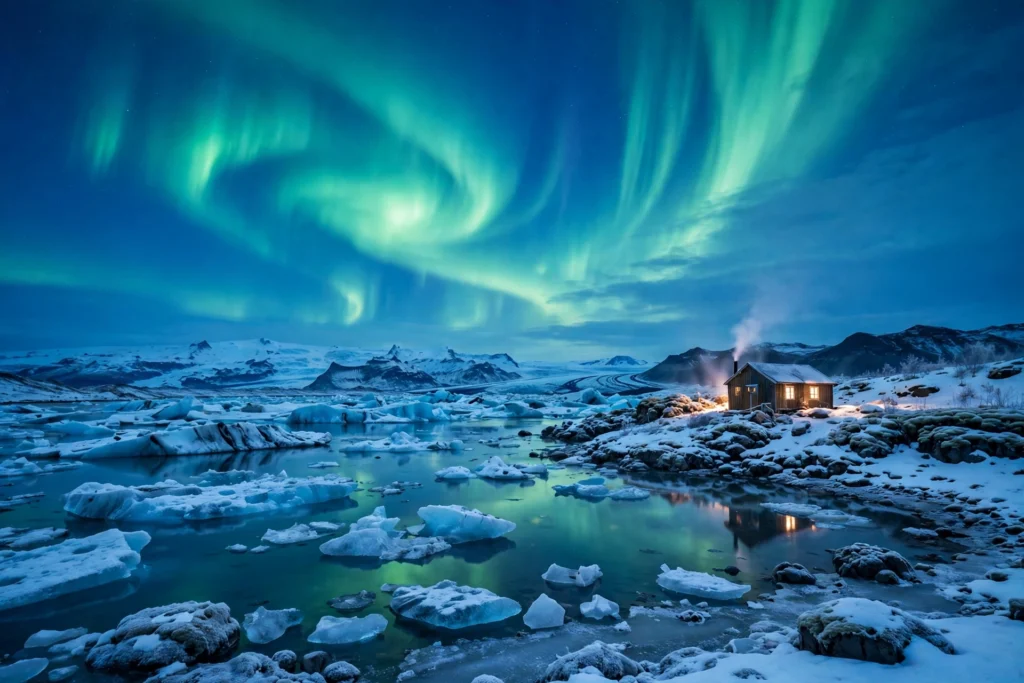
The newest idea in luxury travel is the coolcation: a holiday to somewhere cool, instead of somewhere hot. The idea grew out of the hot summers of the last few years, and the forecasts for 2026 name Iceland, Norway and Finland as the places to go — not just for the cool air, but for the light, the landscape, and the northern lights. This is the luxury of space and silence, and it is the opposite of the beach: a glacier lagoon, a black-sand beach, a hot spring in the snow, and a sky that turns green at midnight.
The northern lights in the 2026–27 season
The northern lights season runs roughly September to April, and the 2026–27 season is a good one to catch — with an important correction to something you will read elsewhere. The sun reached the peak of its current cycle, Solar Cycle 25, in October 2024, when NASA and NOAA announced that the solar maximum period had begun. The cycle is now in its declining phase, and the smoothed sunspot number has been falling since the peak. That does not mean the lights are over. Strong geomagnetic storms still happen in the declining phase — severe storms struck in November 2025 and January 2026 — and at Arctic latitudes you do not need a big storm to see the lights, only a dark sky and clear weather. The honest position, from NOAA’s Space Weather Prediction Center and the official aurora guides, is that 2026–27 is still a strong season, the weeks around the equinoxes in September and March are statistically the most active, and the best viewing is usually within an hour or two of midnight. Clouds, not solar activity, are the bigger risk on any given night — which is why the advice is to plan at least three or four nights under the auroral zone, not one.
One more correction, because the forecasts for 2026 still mention it: the total solar eclipse of 12 August 2026, which was widely listed as a reason to go to Iceland in 2026, is now in the past. It happened, and it is over. Do not book a trip to Iceland for an eclipse that has already happened, and do not trust any guide that still lists it as upcoming. The northern lights are the reason to go now, and they will be there all winter. NOAA’s tips for viewing the aurora are the best short read before you go.
Iceland
Iceland is the easiest coolcation to plan from the United States: a five-hour flight from the East Coast, no visa for US citizens for up to 90 days, and an island that is small enough to see properly in a week. The luxury in Iceland is the landscape — waterfalls, glaciers, black-sand beaches, geothermal pools — and the service that takes you to it without the logistics. The US State Department rates Iceland Level 1, Exercise Normal Precautions, its lowest level, in an Iceland travel advisory issued on 14 May 2026, and the risks it names are the natural ones: quickly changing weather, dangerous natural features, active volcanoes and earthquakes. As of 16 November 2026 there is no volcanic eruption under way in Iceland; the last one ended on 5 August 2025, and the Icelandic Met Office’s update of 10 November 2026 says ground uplift continues and a new eruption remains possible, with the system at alert level 2. Check the Met Office before you visit the Reykjanes Peninsula, and check the weather every morning. Our Iceland solo travel guide covers the same island in first-timer detail, and the Iceland travel itinerary is the route companion to it.
The best months depend on what you want. September to April is northern lights season, with the darkest skies from November to February. June to August is the midnight sun, with long days, open roads and the highest prices. May and September are the balance: long days, mostly open roads, lower prices and fewer crowds. The luxury in Iceland is a good hotel in Reykjavik, a small-group tour to the places you cannot drive to alone, and a geothermal pool at the end of the day. The cost is high — Iceland is one of the most expensive destinations in Europe — but the experience is unlike anywhere else on this list.
Norway and Finland
Norway is the fjord version of the coolcation: a train or a cruise through fjords that are deeper and narrower than anything in Iceland, and the city of Tromsø, above the Arctic Circle, which is one of the best bases in the world for the northern lights, with a season that runs from late August to early April. Finland is the Lapland version: Rovaniemi, the home of Santa Claus, glass igloos under the sky, reindeer, huskies, and a winter that is colder, darker and more magical than Iceland’s. Lonely Planet named Finland the best place in its Best in Travel 2026 for finding happiness in wild places, and the reason is the same as Iceland’s: space, silence, and a culture that treats nature as normal life, not as a attraction.
The tradeoff for both is the cold and the dark. A northern lights trip in January means a few hours of daylight, temperatures well below freezing, and a trip that is built around the night. If that sounds like a hardship, go in September or March, when the nights are dark enough for the lights and the days are long enough to enjoy. If it sounds like the point, go in January, and book a glass igloo or a cabin with a view of the sky, so you can watch the lights from your bed.
Who it suits, and who it does not
The Nordics suit travellers who want something different from a beach, photographers, and anyone who has already done the island holidays and wants a trip that feels new. They suit couples and they suit families with older children, who will remember the lights and the ice longer than any hotel. They do not suit anyone who wants warmth, and they do not suit a short trip — the lights need at least three nights, and the cold needs a day to get used to. They are also the most weather-dependent luxury on this list: the lights, the roads and the tours all depend on the sky, and a week of cloud is a real possibility. Book the trip for the landscape and the culture, and treat the lights as the bonus, not the guarantee.
Kenya and Botswana: Safari Luxury in the Wild
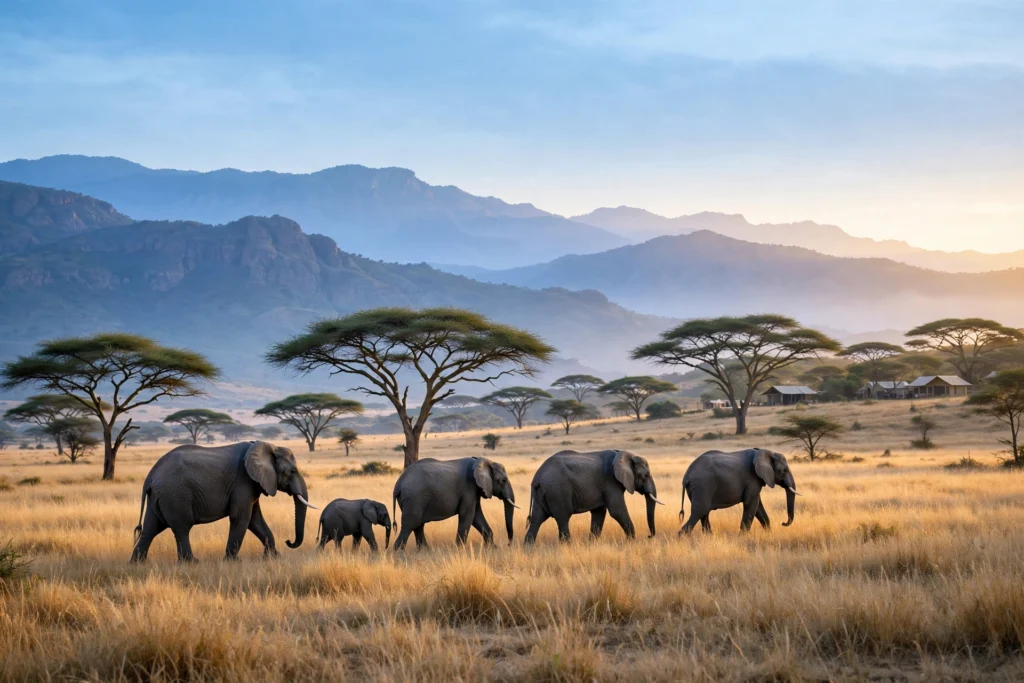
A safari is the luxury trip that changes people, and it is the one where the word luxury means something different from everywhere else on this list. A safari camp is not luxurious because of the thread count. It is luxurious because you wake up to elephants at the waterhole, because your guide has been tracking one leopard for three days, and because the tent you sleep in is the only building for a hundred kilometres. The luxury is the wild, and the service is the people who keep you safe in it.
Kenya: the great migration
Kenya’s Masai Mara is the greatest wildlife show on earth, and the reason is the great migration: more than a million wildebeest, zebra and gazelle moving between the Serengeti in Tanzania and the Mara in Kenya, following the rain and the grass, and the predators that follow them. The best months are July to October, the dry season, when the herds are in the Mara, the grass is short, the animals are easy to see, and the river crossings — the herds crossing the Mara River, with crocodiles waiting — are at their most dramatic. The dry season is also when the prices are highest and the camps are fullest, and that is the tradeoff: the best wildlife and the most people, at the same time.
The luxury in Kenya buys the camp and the guide. A good camp is small, with a handful of tents, a communal fire, and a guide who knows the reserve. A great guide is worth more than a great room, because the guide is the difference between seeing a leopard and seeing grass. The ideal trip is six to nine nights, split between two camps in different parts of the Mara, so you see different country and different animals. The other thing the luxury buys is the flight: the Mara is a long drive from Nairobi, and the internal flight to the reserve is part of the trip, not an extra — budget for it, and do not try to drive it in a day.
Botswana: the Okavango Delta
Botswana is the quieter, more expensive, more private safari, and the Okavango Delta is the reason. The Delta is a river that never reaches the sea: it spreads out into a maze of channels, islands and lagoons in the Kalahari, and the wildlife comes to the water. The safari here is different from Kenya’s: you travel by mokoro, a dugout canoe, poled through the reeds, and by boat, and by vehicle on the islands, and the pace is slower, quieter and closer. The animals are the same — elephants, lions, leopards, hippos — but the feeling is different, because there are fewer vehicles, fewer camps, and fewer people.
The best months are May to October, the dry season, when the flood waters arrive from Angola and the Delta is at its fullest, and the animals gather at the water. The tradeoff is the price: Botswana is the most expensive safari on this list, and the reason is the policy — the country has chosen low-volume, high-value tourism, with fewer camps and higher prices, and the result is a safari where you may not see another vehicle all day. The ideal trip is six to nine nights, split between a water camp in the Delta and a land camp in Chobe or the Makgadikgadi, so you see both sides of the country. The official Botswana Tourism site is the place to check the seasons and the parks before you book.
What to watch out for on safari
The first thing is the health preparation. Kenya and Botswana are malaria areas, and you need to talk to your doctor about antimalarials, vaccinations and the yellow fever certificate well before you travel — not the week before. The second is the internal flights and the luggage: the bush planes have strict weight limits, usually in soft bags, and the camp will tell you the limit when you book. The third is the season: the dry season is the best wildlife and the highest price, and the wet season is the cheapest and the hardest to see animals in, because the grass is long and the animals are spread out. The fourth is the expectation: a safari is not a zoo. The animals are wild, the sightings are not guaranteed, and the best days are the ones where you saw nothing for hours and then everything at once. If you want a guarantee, go to a different kind of holiday.
Who it suits, and who it does not
A safari suits travellers who want the wild, photographers, and anyone who has dreamed of Africa since childhood. It suits couples, and it suits families with children old enough to sit quietly in a vehicle for hours — most camps have a minimum age, usually around six or eight, and the family camps are the ones to ask for. It does not suit small children, it does not suit anyone who is uncomfortable with early mornings — the game drives start at dawn, and dawn is the point — and it does not suit a short trip. A safari needs at least five nights to work, and six to nine is better. If you only have a long weekend, go to the Caribbean instead.
How Much Does a Luxury Trip Really Cost?

This is the question every luxury guide avoids, and it is the question that matters most, because the room rate is not the trip. A luxury trip has five costs, and the room is only the first: the room, the food, the transfers, the activities, and the flights to get there. The table below gives a realistic five-night cost per person, excluding international flights, in broad ranges for 2026 and 2027. The ranges are wide on purpose, because the price of the same trip can double between February and Christmas, and any guide that gives you an exact price for a date months away is guessing. Use these as planning ranges, and get a live quote before you book.
A realistic five-night cost table (per person, excluding international flights)
| Destination | Comfortable (good hotel, meals, transfers) | High-end (top hotel, private transfers, activities) | What drives the price | Cheapest good month |
|---|---|---|---|---|
| Maldives | $5,000–$8,000 | $10,000–$20,000+ | Seaplane transfer, meal plan, villa type | February (after New Year) |
| Bora Bora | $6,000–$9,000 | $12,000–$22,000+ | Flights to Tahiti, transfers, meal plan | May or October (shoulder) |
| Seychelles | $4,000–$7,000 | $8,000–$15,000 | Inter-island travel, villa vs hotel | April or October (shoulder) |
| St. Barts | $6,000–$10,000 | $12,000–$20,000+ | Holiday-week rates, villa rental | Late January (after New Year) |
| Turks and Caicos | $4,000–$6,000 | $8,000–$14,000 | Resort rates, activities | Late January or early May |
| Dubai | $2,500–$4,500 | $5,000–$9,000 | Hotel, restaurants, desert safari | June–September (summer heat) |
| Tokyo | $3,000–$5,000 | $6,000–$10,000 | Hotel, tasting menus, rail | January–February (winter) |
| Bali | $2,000–$3,500 | $4,000–$7,000 | Villa, driver, spa | May or September (shoulder) |
| Amalfi Coast | $4,000–$6,500 | $7,000–$12,000 | Hotel, restaurants, boat trips | May or late September |
| Dolomites | $2,500–$4,500 | $5,000–$8,000 | Hotel, ski pass or guides | June or September (hiking) |
| Maui | $4,000–$6,000 | $7,000–$12,000 | Hotel, car hire, activities | April–May or September |
| Iceland | $4,000–$6,500 | $7,000–$12,000 | Hotel, car hire, tours | May or September (shoulder) |
| Kenya | $5,000–$8,000 | $10,000–$18,000+ | Internal flights, park fees, camp | June or November (shoulder) |
| Botswana | $7,000–$11,000 | $14,000–$25,000+ | Internal flights, camp rates | May or November (shoulder) |
A note on what is not in the table: international flights, travel insurance, and the cost of getting to the airport. Flights are the most variable part of any luxury trip, and the most important to book early — a business-class flight to the Maldives can cost more than the hotel, and a flight booked a week before departure can cost twice what it cost three months earlier. Our guide to how to prepare a travel budget shows how to build a trip budget that includes all five costs, so the total does not surprise you at the end.
When luxury is wasted money
There are five situations where luxury is wasted money, and knowing them will save you more than any discount.
The wrong week. The most expensive way to travel is to pay peak prices for off-peak weather. Christmas week in St. Barts, New Year in the Maldives, cherry blossom week in Tokyo without a booking — these are the weeks where the price doubles and the experience does not. The cheapest luxury there is, is the right week: late January in the Caribbean, February in the Maldives, October in Tokyo. The destination is the same. The price is half. The crowds are gone.
The wrong season. A beach holiday in the rainy season, a safari in the wet season, a ski trip with no snow — these are not bargains, they are mistakes. The lower price is the market telling you something, and the something is that the trip will not be what you imagined. If you can only travel in the wrong season, choose a destination whose season fits your dates, rather than forcing the destination you wanted into the month you have.
The transfer you did not price. The seaplane in the Maldives, the internal flights on safari, the boat to Bora Bora — these are real costs, and they are often quoted separately from the room rate. A trip that looks affordable on the hotel website can become unaffordable when the transfers are added, and the trips that go wrong are the ones where the transfer was discovered at the airport. Price the whole journey, door to door, before you book.
The hotel that is the whole trip. A luxury hotel in a place you do not like is still a place you do not like, and a week in a beautiful room with nothing to do outside it is a week wasted. The best luxury trips are the ones where the destination does the work, not the hotel — the reef, the lagoon, the mountains, the city. If the hotel is the reason to go, go to a cheaper hotel in a better place.
The trip that is too short. A five-night trip with two days of travel is a three-night trip, and a three-night trip to the Maldives or Bora Bora is not luxury — it is jet lag with a nice view. The rule is simple: the longer the flight, the longer the stay. Five nights minimum for the Maldives and Bora Bora, six to nine for a safari, seven to ten for Bali. If you cannot stay long enough, go somewhere closer. The Caribbean from the East Coast, Maui from the West Coast, and Dubai as a stopover are all luxury trips that work in four nights, because the flight is short.
How to book a luxury trip well
The last piece of advice is about how, not where. Book the flights and the hotel at the same time, not one and then the other, because the price of one affects the value of the other. Book the restaurants and the activities when you book the hotel, not when you arrive, because the best tables and the best guides are gone by then. Buy travel insurance that covers the trip you actually booked — medical expenses, cancellation, and the activities you plan — and read what it does not cover. And consider a travel agent for the complicated trips: a safari, a multi-island honeymoon, a Japan trip with ryokans and trains. A good agent is paid by the suppliers, not by you, and the value is in the logistics, not the price — which is why our guide to are travel agents free explains how agents are actually paid, and when they are worth it. If you book it yourself, the same rules apply: price the whole trip, book the season, and leave a day of slack at each end. The best luxury trips are the ones with a day to spare, because the day to spare is the day the trip becomes a memory instead of a schedule.
Frequently Asked Questions About Luxury Travel Destinations
What are the best luxury travel destinations in 2026?
The best luxury travel destinations in 2026 are the Maldives, Bora Bora and the Seychelles for private islands and honeymoons; Tokyo for food; Kenya and Botswana for safari; Iceland and northern Norway for the northern lights; and St. Barts and Turks and Caicos for winter sun. The right pick depends on who is travelling and what the trip is for — the comparison table in this guide matches each destination to the traveller type it suits.
What is the cheapest month for a luxury trip?
Late January and February are the cheapest good months for most luxury destinations: the holiday weeks are over, the weather is still good in the Caribbean, the Maldives and Dubai, and the prices drop sharply. May and September are the shoulder months for Europe and Bali. The most expensive weeks are Christmas, New Year and cherry blossom week in Japan — avoid them unless you have booked a year ahead.
What is the best luxury honeymoon destination?
The Maldives is the best luxury honeymoon destination for most couples, because it is built for two people who want privacy and nothing to decide. Bora Bora is the second pick, with the most beautiful lagoon in the world and a longer flight. The Seychelles is the third pick, for couples who want to explore as well as relax. Choose by flight time, weather in your month, and whether you want to leave the resort.
How much does a luxury trip cost?
As a planning range for five nights per person, excluding international flights: roughly $2,000–$4,000 in Bali or Dubai, $3,000–$5,000 in Tokyo, $4,000–$8,000 in the Maldives, the Seychelles or Maui, and $7,000–$11,000 or more in Botswana. The high end can go far beyond that in the Maldives, Bora Bora and Botswana. The full cost table in this guide breaks it down by destination and tier.
Do you need a travel agent for a luxury trip?
Not always, but for a safari, a multi-island honeymoon or a Japan trip with ryokans and trains, a good agent is worth it — the value is in the logistics, not the price, and agents are usually paid by the suppliers rather than by you. For a single hotel in Dubai or Maui, booking it yourself is straightforward. Our guide to are travel agents free explains how agents are paid and when they are worth using.
Is the Maldives or Bora Bora better?
The Maldives is better for most travellers: shorter flights from Europe and the Middle East, more islands to choose from, and better diving. Bora Bora is better for the lagoon itself, which is more beautiful, and for travellers coming from the US West Coast, where the flight is shorter. The Maldives suits a week of doing very little. Bora Bora suits a honeymoon where the view is the point.
When is the best time to see the northern lights?
The northern lights season runs roughly September to April, and the best months are the dark months from November to February, with the weeks around the equinoxes in September and March statistically the most active. The 2026–27 season is still strong, even though the sun passed the peak of Solar Cycle 25 in October 2024 and is now in its declining phase — strong storms still happen, and at Arctic latitudes you need only a dark sky and clear weather. Plan at least three or four nights, because clouds are the bigger risk on any given night.
Is luxury travel worth it?
It is worth it when the extra money buys privacy, service, scenery or timing that you cannot get for less — a private island, a great guide, a table that is otherwise impossible to book, or a week in the right season. It is not worth it when you pay peak prices for the wrong week, when the hotel is the whole trip, or when the transfer costs more than the room. The test is simple: after the trip, will you remember the place, or the price? If the answer is the place, it was worth it.
What is a coolcation?
A coolcation is a holiday to somewhere cool instead of somewhere hot — Iceland, Norway, Finland, the Dolomites — chosen for the light, the landscape and the northern lights rather than the beach. The idea grew out of the hot summers of recent years, and the 2026 forecasts name the Nordics as the places to go. It is a real trend, not a marketing word, and it suits travellers who want space and silence rather than sun.
Is Dubai good for a first luxury trip?
Yes. Dubai is the easiest luxury trip on this list: frequent flights, an efficient airport, new hotels, polished service, and a city that works without a plan. Go between November and March, when the weather is warm and the city is outdoors, and avoid May to September, when the heat is extreme. Four to six nights is the ideal length.
Is Bali still worth it for luxury travel?
Yes, if you go to the right part of the island. Stay in Ubud, Uluwatu or the north and east coasts, where the pace is slower and the villas are private, and avoid the traffic in the south around Seminyak and Canggu. Go in the dry season, May to September, and stay seven to ten nights, so the island has time to slow you down. Bali is the cheapest luxury on this list, and the villa — a private pool, a garden, a staff — is the reason.
Is a safari safe?
A safari with a reputable camp is safe, and the risks are different from the ones travellers imagine. The animals are wild, and you stay in the vehicle and follow the guide’s instructions. The real preparation is health: Kenya and Botswana are malaria areas, so talk to your doctor about antimalarials and vaccinations well before you travel, and check the current guidance on the US State Department’s advisory pages for both countries before you book.
Conclusion: How to Choose Your Luxury Travel Destination
The best luxury travel destinations are not the most expensive ones. They are the ones where the money buys something real: a private island in the Maldives, a lagoon in Bora Bora, a table in Tokyo, a leopard in Kenya, a sky full of northern lights in Iceland. The choice is not between luxury and budget. It is between a trip that was planned around the destination and a trip that was planned around the price, and the first one is always the better trip.
Start with the traveller, not the destination. A honeymoon wants privacy, a family wants space, a food trip wants a city, a wildlife trip wants a guide, and a winter sun trip wants a short flight. Then choose the month, because the month is the cheapest luxury there is and the one most travellers get wrong. Then price the whole trip — flights, transfers, food, activities — before you book the room, because the room is only the first of five costs. And then leave a day of slack at each end, because the best luxury trips are the ones with a day to spare.
Go to the Maldives if you want to disappear for a week. Go to Bora Bora if you want the most beautiful lagoon in the world. Go to Tokyo if you want to eat better than you have ever eaten. Go to Kenya or Botswana if you want to see the wild while it is still wild. Go to Iceland if you want the sky to do something you have never seen it do. Whichever you choose, go in the right month, stay long enough for the flight to be worth it, and book the trip for the place, not the price. The price is forgotten. The place is not.
People also read:
- Dream Travel Destinations
- Iceland Solo Travel: The Complete First-Timer’s Guide for 2026
- Iceland Travel Itinerary
- How Much to Travel to Japan
- Best Places to Travel in January
- How to Prepare a Travel Budget
- Venice Travel Guide
- Rio de Janeiro Travel

M. Adil is the founder and editor of SoloTravelPro. He writes practical, research-based travel guides that help travellers plan with confidence — from first-time city breaks to national parks and island escapes. Every guide is built on official sources, current prices and honest, usable advice, so readers can plan smarter and travel better.