Quick Answer: Is Iceland Good for Solo Travel?
Yes — Iceland is one of the best first solo trips in the world, and the honest answer is that it is good precisely because the hard parts are predictable. Iceland solo travel works because the country is small, English is widely spoken, the roads are well marked, and the thing most solo travellers worry about — other people — is the smallest risk you will face. Iceland has ranked first on the Global Peace Index for 19 consecutive years, and the US State Department rates it Level 1: Exercise Normal Precautions, its lowest level. Violent crime is rare, and the State Department’s own words are that Iceland “has very little crime, and almost no violent crime.”
But that does not mean Iceland is a trip you can wing. The risks that actually catch solo travellers in Iceland are natural, not criminal: weather that changes in an hour, wind that can rip a car door off its hinges, black-sand beaches with sneaker waves that have killed visitors, glacial rivers, and an active volcanic system on the Reykjanes Peninsula that is quiet right now but under close watch. Travelling alone means there is nobody to share the driving, nobody to split the cost of a hire car or a hotel room, and nobody to notice if you do not come back from a hike. That is the real price of solo travel in Iceland — and it is entirely manageable if you plan for it.
This guide is built for a first-timer going alone: what the official advisories actually say, the current volcanic situation with dates you can check, safety broken down by risk type, a solo-female section, whether you need a car (and how to do Iceland without one), where to stay alone and what the single supplement really costs, a full daily budget for one person, a 5-day itinerary and a 7-day Ring Road itinerary, how to meet people without booking a tour, and a month-by-month table so you can pick your season. Everything about the advisory and the volcano was checked against the official sources on 17 November 2026, and the dates are given so you can check them again yourself before you fly.
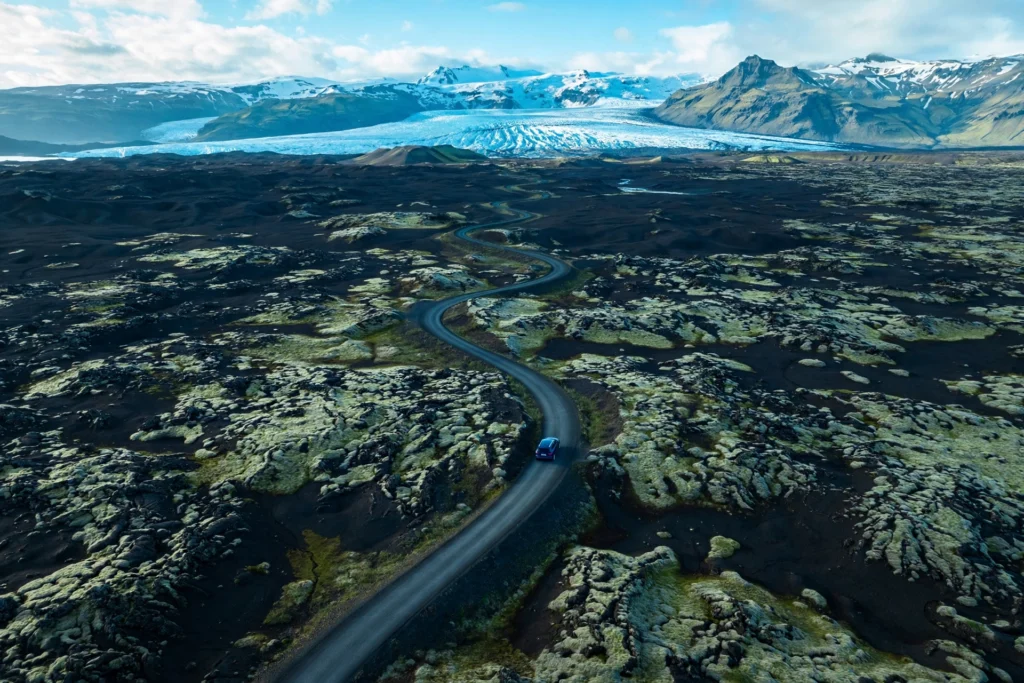
Is Iceland Safe for Solo Travellers in 2026? The Short Answer
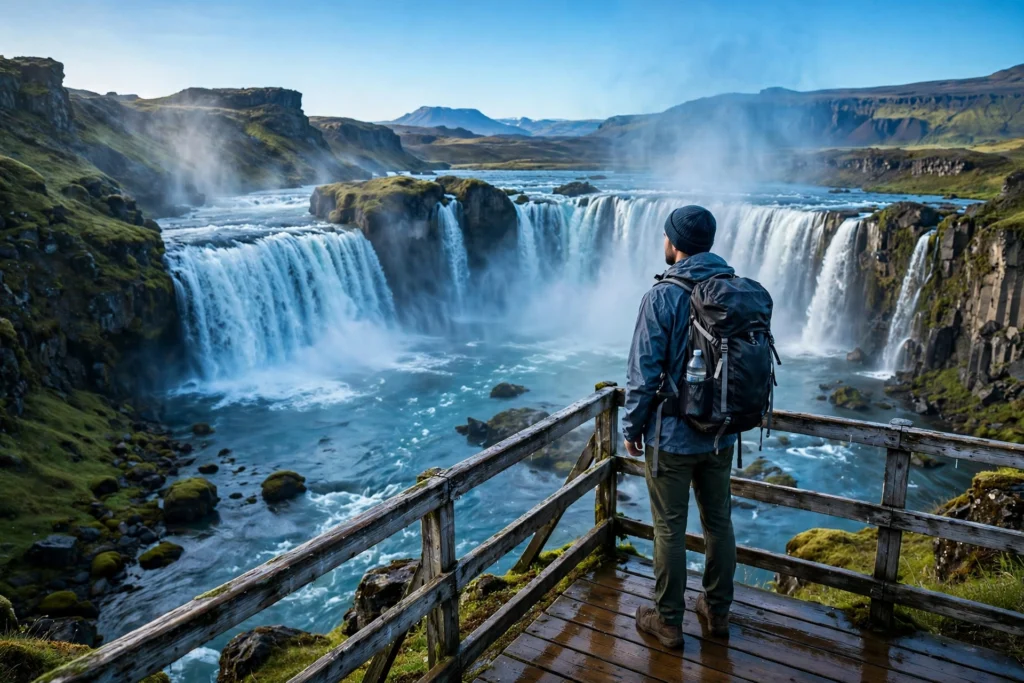
Yes. Iceland is safe for solo travellers in the sense that matters most: the country is peaceful, the police are trusted, and the dangers are the kind you can prepare for rather than the kind that ambush you. That is the consistent message of every source that matters — the US State Department, the UK Foreign Office, and the Global Peace Index — and it is also what the three top-ranking solo Iceland guides agree on. The competitor guides put it plainly: in Iceland, safety is about weather, not people.
Start with the numbers that frame the whole trip. The 2026 Global Peace Index, published by the Institute for Economics & Peace in June 2026, ranks Iceland first of 163 countries, with a score of 1.161 — its 19th consecutive year at number one. The index is not a crime survey; it measures peacefulness across conflict, militarisation and societal safety, so treat it as a statement about the country, not a guarantee about your trip. But it is the reason Iceland keeps appearing at the top of “safest country” lists, and it matches what travellers actually experience: a small, high-trust society where hitchhiking is still normal, where children walk to school alone, and where the police are famously unarmed for most duties.
The US State Department agrees at its lowest level. Its Iceland advisory, issued 14 May 2026, is Level 1: Exercise Normal Precautions. The summary says Iceland “is generally a safe destination for travelers,” then immediately adds the qualification that defines the whole trip: the country “regularly experiences quickly changing weather, dangerous natural features, active volcanoes, and earthquakes.” The UK Foreign Office, similarly, advises against travel to no part of Iceland. So the official picture is unanimous: go, and respect the landscape.
What does that mean in practice for someone travelling alone? Three things. First, the crime you need to plan for is petty and opportunistic, not violent. The State Department warns that petty crime is common, especially in popular tourist locations — pickpocketing and small thefts at the Golden Circle sites, in downtown Reykjavik around Laugavegur and Hallgrímskirkja, and at ATMs and supermarkets. Organised groups from other European countries are believed to be behind some of it. The fix is ordinary: keep your passport and cards secure, use tap-to-pay on your phone where you can, do not leave valuables in a parked car even if it is locked, and stay alert in downtown Reykjavik late at night when people are leaving the bars. None of that is different from any European city break.
Second, being alone changes the maths of the natural risks. A twisted ankle on a trail, a car stuck in a snowdrift, a wrong turn onto an F-road — with a companion these are stories; alone, they are problems. That is why this guide spends so much time on the boring infrastructure of solo safety: registering your travel plan on safetravel.is, checking vedur.is and road.is every morning, saving 112 in your phone, and telling your accommodation where you are going each day. None of it is difficult. All of it is the difference between a solo trip and a solo emergency.
Third, Iceland rewards the solo traveller in ways a group trip does not. You set the pace at the waterfall. You can drive the Ring Road in the direction that suits the weather, not the group. You can spend an hour at a black-sand beach and skip the stop that does not interest you. Hostels, guesthouses and small-group tours are built around people travelling alone, and the local pool — the hot pot — is the most social place in the country. Iceland solo travel is not a compromise version of an Iceland trip. For a first-timer who likes their own company and their own schedule, it is the best version of it.
What the Official Travel Advisories Say About Iceland
Before you trust any blog — including this one — check what governments say. Three major sources publish Iceland advice, and as of 17 November 2026 they agree: Iceland is safe to visit, and the risks are weather, nature and volcanoes, not crime.
| Government / source | Level for Iceland | Date | What it flags |
|---|---|---|---|
| United States (State Department) | Level 1: Exercise Normal Precautions (lowest of 4 levels) | Issued 14 May 2026 | Quickly changing weather, dangerous natural features, active volcanoes, earthquakes; petty crime in tourist locations |
| United Kingdom (FCDO) | No advice against travel to any part of Iceland | Checked 17 November 2026 | Volcanic activity on the Reykjanes Peninsula, weather and driving conditions |
| Global Peace Index (Institute for Economics & Peace) | Ranked 1st of 163 countries, score 1.161 | 2026 edition, published June 2026 | Most peaceful country for the 19th consecutive year |
A note on dates, because you will see older ones online. The US advisory was issued on 14 May 2026 — that is the date on the live State Department page as read on 17 November 2026. If the page shows a newer date when you check it, read the new text; the level has been Level 1 for years, but the details underneath it change. The Global Peace Index is an annual publication, so the 2026 edition is the current one until the 2027 edition appears, usually in June.
What Level 1 actually means
The US uses four levels. Level 1, “exercise normal precautions,” is the lowest — the level it gives to countries including Japan, Canada and most of Western Europe. It means the risk to a visitor is comparable to the risk at home, with the specific local hazards named in the advisory. It does not mean “nothing can go wrong.” In Iceland’s case the advisory names the hazards plainly: weather, natural features, volcanoes and earthquakes. Read that as the itinerary for your precautions: check the forecast, respect the signs, and do not treat a volcanic system as a photo opportunity.
The practical details on the State Department page
The advisory page carries a long list of practical facts that are worth knowing before you go, because they are the small things that catch first-timers out. US citizens need no visa for up to 90 days for tourism, but your passport should be valid for at least three months beyond your departure from the Schengen Area — six months is recommended — with two blank pages, and you must be able to show proof of funds and an onward or return ticket. Since October 2025 the Schengen Entry and Exit System records biometric data on arrival, so expect a photograph and fingerprints at Keflavik. The State Department page still mentions ETIAS as a coming requirement, but as of November 2026 ETIAS is not in operation: the EU removed its last-quarter-of-2026 launch target in July 2026, has announced no start date, and no application is possible yet — the earliest realistic launch is 2027. Check the official portal at travel-europe.europa.eu/etias before you book, and ignore any site that offers to sell you an ETIAS today.
The money and law details matter for a solo traveller. Cards are widely accepted and you will rarely need cash; if you use an ATM, use one inside a bank. Tipping is not expected because a service charge is usually included. It is illegal to bring marijuana, cannabis or CBD products — fines start at 50,000 Icelandic króna and you can face arrest. It is illegal to bring guns, ammunition or even spent shell casings, with fines starting at 100,000 to 200,000 króna. It is illegal for tourists to use satellite phones. Drones are legal but strictly regulated: you must register with the Icelandic Transport Authority, drones over 250 grams require an online exam, you need permission in national parks, and the maximum altitude is 120 metres. If you are travelling with children, they need a car seat under 135 centimetres, and a single parent travelling with a child should carry a notarised consent letter from the absent parent.
The emergency number for everything — police, ambulance, fire — is 112. Save it before you land. The State Department also recommends enrolling in the Smart Traveler Enrollment Program (STEP) before you travel, so the US Embassy can contact you with updates and alerts; the enrolment is free and takes a few minutes. Our travel apps guide covers the offline maps and document apps that work best when the signal does not, and the Iceland travel itinerary on this site is the route companion to this guide — this article is the “how to do it alone” companion to that “where to go” guide.
Volcanoes on the Reykjanes Peninsula: What Is Happening Right Now
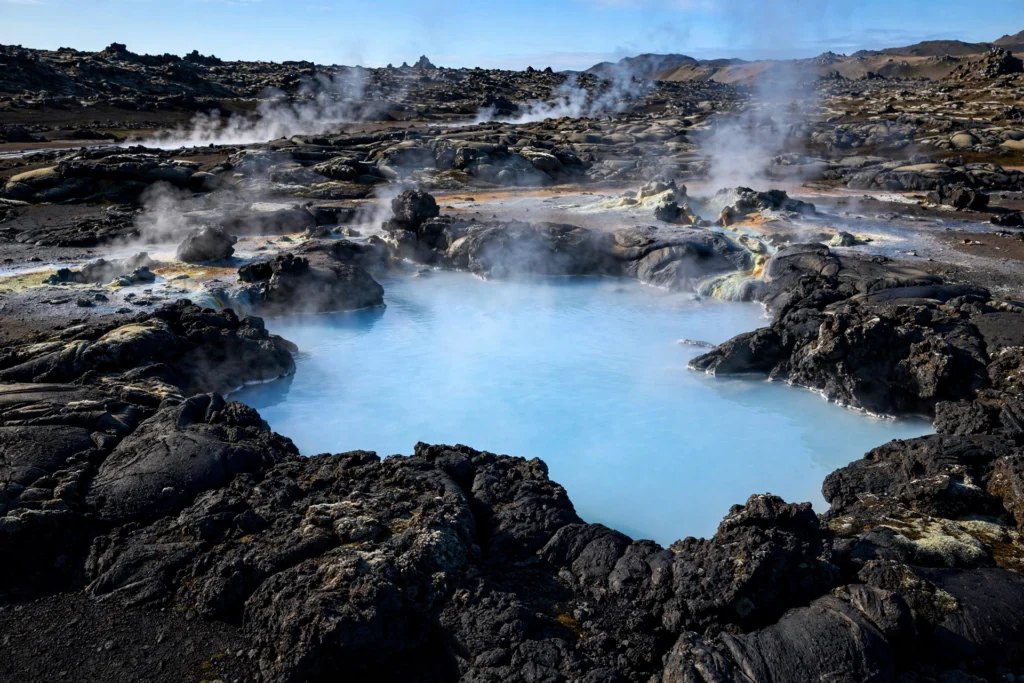
This is the section that goes out of date fastest, so read the dates first. As of 16 November 2026, there is no volcanic eruption under way anywhere in Iceland. The most recent eruption — the ninth on the Sundhnúkur crater row near Grindavík — began on 16 July 2025 and ended on 5 August 2025. That is the current position, and it is also not the whole story: the ground underneath the Reykjanes Peninsula is still rising, magma is still collecting, and the Icelandic Meteorological Office (the Met Office, at vedur.is) says a new eruption remains possible. A quiet volcano and a finished volcano are not the same thing, and on the Reykjanes Peninsula you need to know the difference.
What the Met Office actually says
The Met Office’s latest Reykjanes update, published on 10 November 2026, says GPS measurements still show steady uplift at Svartsengi — the area around the Svartsengi power plant and the Blue Lagoon — which means magma is collecting a few kilometres underground. The last volume estimate, from 18 August 2026, put the magma accumulated since July 2025 at about 29 million cubic metres. Earthquake activity is very low. The update’s conclusion is careful and worth quoting in spirit: a magma intrusion into the Sundhnúkur crater row, which could end in an eruption, “remains the most likely scenario” — but no one can say when. Warning times before past eruptions have ranged from about 20 minutes to just over four hours, so an eruption could start at short notice.
The Reykjanes–Svartsengi volcanic system has been kept at alert level 2 (orange) throughout this pause, confirmed in the Met Office update of 27 October 2026. The current hazard map for the area is valid until 5 January 2027 unless it is revised earlier, and Grindavík itself remains in the “considerable” hazard category under the hazard assessment that took effect on 30 September 2026. The Met Office also stresses that a long pause between eruptions is not, on its own, a sign that the episode is over — and that the longer the interval since the last event, the greater the uncertainty about the timing of the next one.
What this means for your trip
For a solo traveller, the practical consequences are simple and specific. First, Keflavik International Airport, Reykjavik, the Golden Circle and the Ring Road are all operating normally, and there is no eruption affecting travel right now. Do not cancel a trip because of the volcano, and do not let a dramatic headline do your planning for you. Second, the only area to watch is the Reykjanes Peninsula around Grindavík and Svartsengi. If you plan to visit the Blue Lagoon, the old Fagradalsfjall lava fields, or the Grindavík area, check the Met Office’s dated update and the hazard map on the morning you go, and check safetravel.is for closures. A monitoring update is not permission to enter a closed area, and a closed area is closed for a reason: the ground can open, gas can pool in low places, and new lava can cover a road in minutes.
Third, do not walk on lava. Safetravel’s advice on the Fagradalsfjall eruption site is blunt about it: the lava may look solid and cool on top while it is still hot underneath, and people have been seriously injured by falling through thin crust. The marked path from the P1 car park to the 2021 and 2022 eruption site is about 6 to 8 kilometres one way, roughly two to two and a half hours of hiking — go in daylight, take water, and turn back if the weather closes in. Fourth, if an eruption does start while you are in Iceland, follow the instructions of the authorities and the Civil Protection alerts, keep away from the eruption site, and do not drive toward it. Eruption tourism is real, and it is also how solo travellers get into trouble: the roads around an eruption close, the gas drifts with the wind, and the emergency services are busy with everyone else who drove toward it.
Check the volcano the way you check the weather: the Icelandic Met Office, Safetravel and the road conditions site, every morning, and again before you set out for the Reykjanes Peninsula. If any of those pages shows a newer date than the ones in this article, the newer page wins.
Is Iceland Safe for Solo Female Travellers?
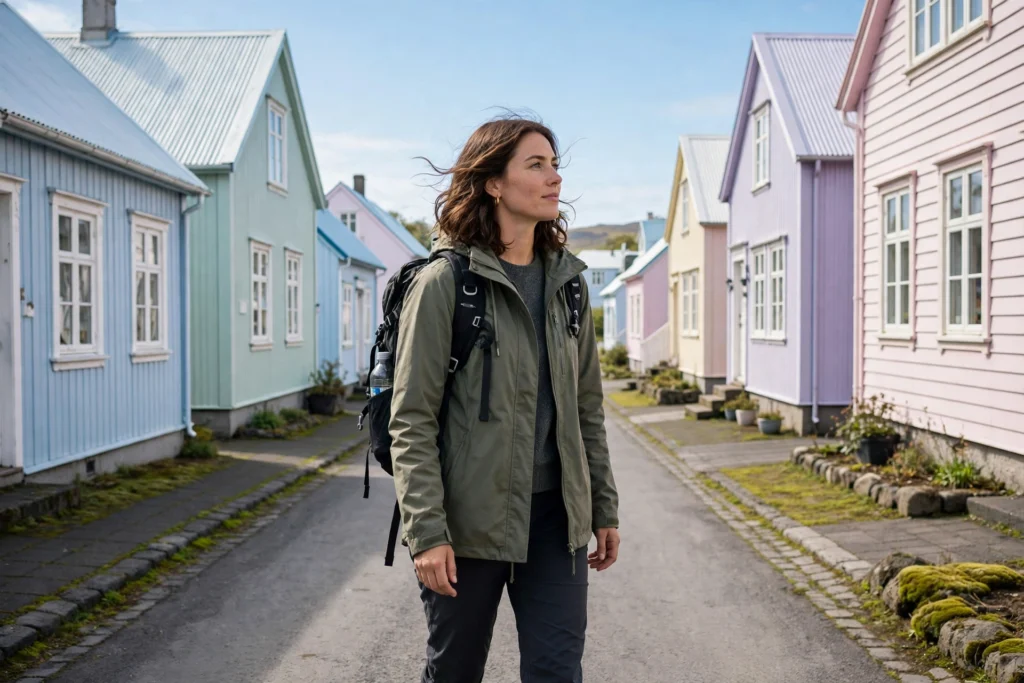
Yes — and Iceland is one of the most popular first solo trips for women for reasons that go beyond the crime statistics. Iceland is consistently ranked among the most gender-equal countries in the world, women travel alone there in large numbers, and the competitor guides agree that Iceland is especially safe for women travelling alone. That is the honest starting point. The rest of this section is the practical detail that makes the difference between feeling safe and being safe, because the risks for a solo woman in Iceland are the same as the risks for any solo traveller, with a few extra considerations at night and on the road.
The first consideration is Reykjavik at night. Iceland’s capital is a small, walkable city, and its centre is safe during the day and the early evening. The State Department’s advice is specific about the late hours: downtown Reykjavik can become disorderly in the late night to early morning hours when people are leaving bars and clubs, and you should stay alert. The practical version: enjoy the bars on Laugavegur, but walk home on the lit main streets, not the dark lanes, and take a taxi if you are on your own after midnight. Iceland has no Uber; taxis are regulated and safe, and your accommodation can call one for you. Harassment is rare, but it is not unknown, and the same rule applies here as anywhere: if someone makes you uncomfortable, leave, and do not worry about being polite about it.
The second consideration is the road. A woman driving alone in Iceland is unremarkable — you will see plenty of them — but a lone driver is also more visible when something goes wrong. If your car breaks down on a remote stretch of the Ring Road, you are the one who has to deal with it. That is why the solo-female advice and the general solo advice are the same advice: keep your fuel tank above half, keep your phone charged, register your route on safetravel.is, and tell your accommodation where you are going and when you expect to be back. If you are not comfortable driving alone in winter conditions, do not force it — take the bus, or base yourself in Reykjavik and take small-group day tours. There is no prize for driving in a storm.
The third consideration is accommodation. Stay in places with a staffed reception and good reviews from other solo women, and read the recent reviews rather than the overall score. Hostels in Iceland are well run and social, and a women-only dorm is available in several Reykjavik hostels if you want it. Guesthouses in the countryside are often family-run, and the host will usually be your best source of local advice — road conditions, which hot pot the locals use, whether the northern lights are likely tonight. Tell the host your plans each morning. It takes thirty seconds, and it means someone knows where you are.
The fourth consideration is the hot springs and pools. Iceland’s pools are communal, social and very safe, but they have rules that catch first-timers out: you shower naked before entering the pool, and everyone does it, and the attendants enforce it. That is normal in Iceland and not something to be embarrassed about, but know it before you go so it is not a surprise. Do not leave valuables in an unlocked pool locker or on the side of a remote hot pot; take only what you need, and keep your phone and wallet in your bag at the pool’s edge or in a locker with your own padlock.
If you want a broader view of solo travel for women, our guide to the best places to travel solo female in the US covers the same planning habits — accommodation choice, night transport, and telling someone your plans — in a domestic setting. The habits transfer directly; only the landscape changes.
Do You Need a Car for Iceland Solo Travel?
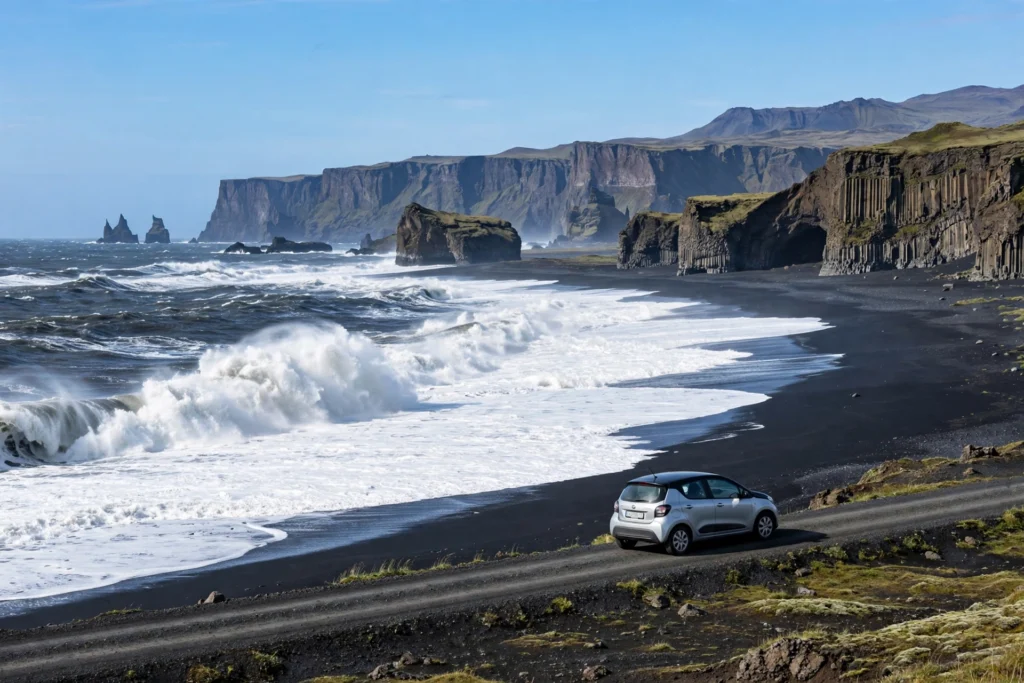
No — but the trip you get without a car is a different trip, and you should choose it with your eyes open. Iceland solo travel splits cleanly into two versions: with a car, you go where you want, when you want, and you pay for the privilege alone; without a car, you see the highlights from Reykjavik on day tours and buses, you meet more people, and you spend less — but you do not see the empty east fjords at sunrise, and you do not stop at the waterfall that is not on anyone’s list. Neither version is wrong. Here is how to decide.
With a car
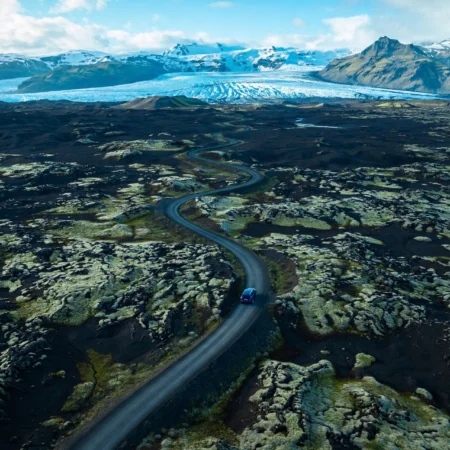
A hire car is the best way to see Iceland solo, and the most expensive way to do it alone. The Ring Road is about 1,330 kilometres of mostly two-lane tarmac around the island, and the driving is straightforward in summer: one road, good markings, and nowhere to get properly lost. The costs are the problem. A small car is the cheapest option and is enough for the Ring Road and the Golden Circle in summer; a four-wheel drive is needed for F-roads into the Highlands, which are unpaved mountain roads that require a proper vehicle and, for river crossings, real experience. A solo driver pays the whole rental, the whole insurance and the whole fuel bill — there is nobody to split it with — and fuel in Iceland is expensive, so budget for it as a major line, not a rounding error. The cost table later in this guide puts planning ranges on all of it.
Driving in Iceland has rules that surprise visitors. Speed limits are low — generally 90 km/h on paved rural roads, 80 km/h on gravel, 50 km/h in built-up areas — and fines are heavy. Headlights must be on at all times, day and night. Sheep wander onto the road, especially in summer, and hitting one means paying the farmer. Off-road driving is illegal and the fines are serious; Iceland’s moss-covered lava fields take decades to recover from tyre tracks, and the damage is visible for years. In winter, add snow, ice, and wind that can gust hard enough to damage a car door if you open it carelessly. If you have never driven in snow, do not make Iceland your first winter drive — take a tour instead.
The State Department adds two driving warnings worth heeding. First, research the safety of routes your GPS recommends, because the fastest route is not always the safest, and GPS can send you onto an F-road or a closed track. Second, before driving on any F-road, ask the nearest tourist information centre whether the road is open and safe. Check road.is every morning for closures, and check vedur.is for the wind forecast — wind is the Icelandic driving hazard that visitors underestimate most.
Without a car
Iceland without a car is entirely doable, and for a first-timer who does not want to drive, it is often the better trip. Base yourself in Reykjavik and take small-group day tours: the Golden Circle, the South Coast, the Snæfellsnes Peninsula, the northern lights in winter, and glacier hikes and ice caves in the south. Day tours solve the two biggest solo problems at once — transport and company — and the guides are trained, the vehicles are built for the conditions, and you meet other travellers. The downside is the schedule: you see what the tour sees, you stop where the tour stops, and you do not have the freedom to wait for the light or skip a stop. Book small-group tours rather than big coaches where you can; the difference in experience is large and the price difference is usually modest.
Public transport exists but is thin outside Reykjavik. Long-distance buses run along the Ring Road in summer and connect the main towns, and they are a real option for a slow solo trip if you plan around their timetables — but they are infrequent, they do not stop at waterfalls, and in winter the network shrinks. Domestic flights connect Reykjavik with Akureyri and a handful of smaller towns, and they are worth considering if you want to see the north without driving the whole island. Hitchhiking is legal and common in Iceland, and many solo travellers do it in summer; it is not something to rely on as a plan, and it is not something to do alone after dark or in bad weather.
| With a car | Without a car | |
|---|---|---|
| Freedom | Go anywhere, stop anywhere, set your own pace | Fixed tour schedules and bus timetables |
| Cost for one person | High — you pay the whole rental, insurance and fuel | Lower — day tours cost more per day but there is no rental bill |
| Company | Solitude unless you join a tour for the day | Built in — day tours and hostels are social |
| Winter | Only if you are confident driving in snow and wind | Safer and simpler — let a professional drive |
| Best for | 7-day Ring Road, photographers, repeat visitors | First-timers, 3–5 days, northern lights, no-drive travellers |
| Biggest risk | Weather, F-roads, fatigue from driving alone | Missing the places tours do not stop |
If you do hire a car, take the insurance conversation seriously. Gravel damage, sand and ash damage, and wind damage are real Icelandic risks, and the basic rental cover often excludes them. Read what is covered before you sign, photograph the car from every angle before you leave the lot, and keep the rental company’s emergency number in your phone. And whatever you drive, fill the tank before a remote stretch: petrol stations are far apart in the east and the north, and some are unmanned card-only pumps.
Safety in Iceland by Risk Type: Weather, Driving, Water and Volcanoes
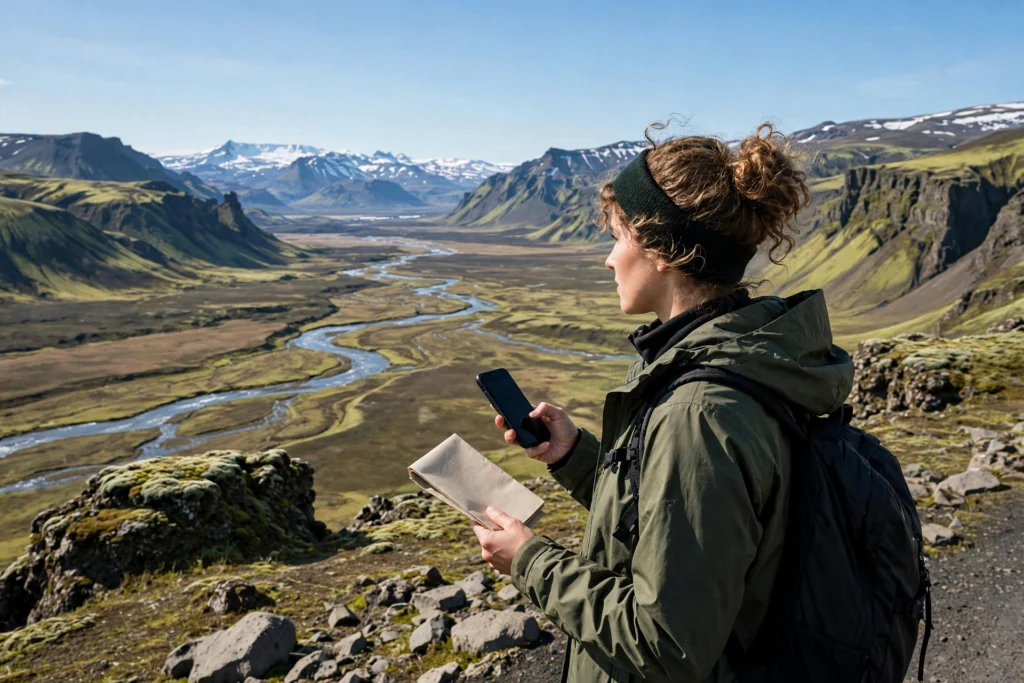
The top-ranking guides agree on one thing: in Iceland, the danger is nature, and nature gives warnings if you know where to look. Here is the risk picture broken down by type, with the check you do for each one and the mistake that catches visitors.
| Risk type | What actually happens | Your daily check | The mistake to avoid |
|---|---|---|---|
| Weather | Wind, rain and snow can arrive within an hour; a sunny morning can become a storm by afternoon | vedur.is forecast + wind warning every morning | Trusting the morning sky and leaving your waterproofs behind |
| Driving | Single-lane bridges, gravel, blind hills, sheep, wind gusts, F-roads, winter ice | road.is closures + conditions every morning | Following GPS onto an F-road or a closed track |
| Water | Sneaker waves at black-sand beaches, strong currents, cold glacial rivers, hot springs that scald | Read the signs at every beach and river; never turn your back on the sea | Walking close to the water at Reynisfjara for a photo |
| Volcano | Eruption at short notice, gas, lava, closed areas on the Reykjanes Peninsula | Met Office update + safetravel.is before any Reykjanes visit | Driving toward an eruption or entering a closed area |
| People | Pickpocketing and small thefts at busy tourist sites and in downtown Reykjavik | Keep valuables on your body, use tap-to-pay | Leaving bags visible in a parked car |
| Getting lost | No signal in remote areas, unmarked trails, white-out in winter | Register your plan on safetravel.is; tell your host | Hiking alone without telling anyone your route |
Weather
Icelandic weather is the country’s most famous hazard and its most underestimated one. The saying that you can experience four seasons in a day is not a joke; it is a planning instruction. The wind is the part visitors get wrong. It can be strong enough to make walking difficult, to push a car sideways on an exposed road, and to tear a car door from its hinges if you open it into the wind — hold the door with both hands on a windy day, and park facing into the wind where you can. Rain is frequent and horizontal. Snow can fall in any month in the Highlands and from October to April elsewhere. The check is vedur.is, the Met Office site, every morning, and again before you drive anywhere remote. Pay attention to the wind warnings, not just the rain forecast, and take the colour-coded weather warnings seriously — they are issued for a reason.
Dress for it, because being cold and wet alone is how a good day becomes a bad one. The layering system is simple: a thermal base layer, a warm middle layer, and a waterproof and windproof outer layer, plus a hat, gloves and warm socks. The State Department’s own embassy tips say exactly this: dress in layers, pack waterproof outerwear, thermal base layers, a hat, gloves and warm socks. Waterproof means waterproof, not water-resistant; a showerproof jacket will not survive an Icelandic afternoon.
Driving
The driving risks are covered in detail in the car section above, but the solo-specific point is fatigue. Driving the Ring Road alone means you do all the driving, all the navigating and all the decision-making, and the landscape is so distracting that you will be tempted to look at it instead of the road. Plan no more than three to four hours of driving a day, stop at every viewpoint that has a proper pull-off rather than stopping on the road, and never drive after dark in winter unless you have to. If you feel tired, stop — there is always a guesthouse, a petrol station or a viewpoint with a bench. The accident you avoid by stopping is worth more than the hour you save.
Water
Water kills more visitors in Iceland than crime ever will, and the black-sand beaches are where it happens. Reynisfjara, the famous black-sand beach near Vík, has signs warning about sneaker waves — waves that run much further up the beach than the ones before them, without warning, and that have swept visitors into the sea. The rule is absolute: never turn your back on the ocean at a black-sand beach, never stand close to the water’s edge, and never climb the rocks. The same applies to every beach on the south coast. Glacial rivers are cold enough to cause cold-water shock in minutes, and river crossings on F-roads are for experienced drivers in proper vehicles only — never attempt one in a small hire car, and never cross a river on foot. Hot springs are the opposite risk: natural hot pools can be scalding, and the temperature varies from pool to pool. Only bathe in pools that are marked as safe, test the water with your hand first, and never put your head under the water in a natural hot spring.
Volcanoes and earthquakes
The volcanic risk is covered in its own section above. Earthquakes are part of the same picture: Iceland sits on the Mid-Atlantic Ridge, and small earthquakes are frequent, especially on the Reykjanes Peninsula. Most are too small to feel. If you feel a strong one, the advice is the same as anywhere: drop, cover and hold on, stay away from cliffs and loose rock, and check the Met Office for updates before you travel on. Do not let the earthquake risk put you off — it is background noise for most of the country, most of the time.
If something goes wrong
Save 112 in your phone before you land, and know that it works even without a SIM card or signal in some areas. If you are injured or lost, call 112 and stay where you are if it is safe to do so — the rescue teams, staffed largely by volunteers from ICE-SAR, the Icelandic search and rescue association, are experienced at finding people in bad weather, but they need to know where to look. That is the real reason to register your travel plan on safetravel.is: it is not paperwork, it is the difference between a search that starts in an hour and a search that starts the next day.
Where to Stay Solo in Iceland: Hostels, Single Rooms and Guesthouses
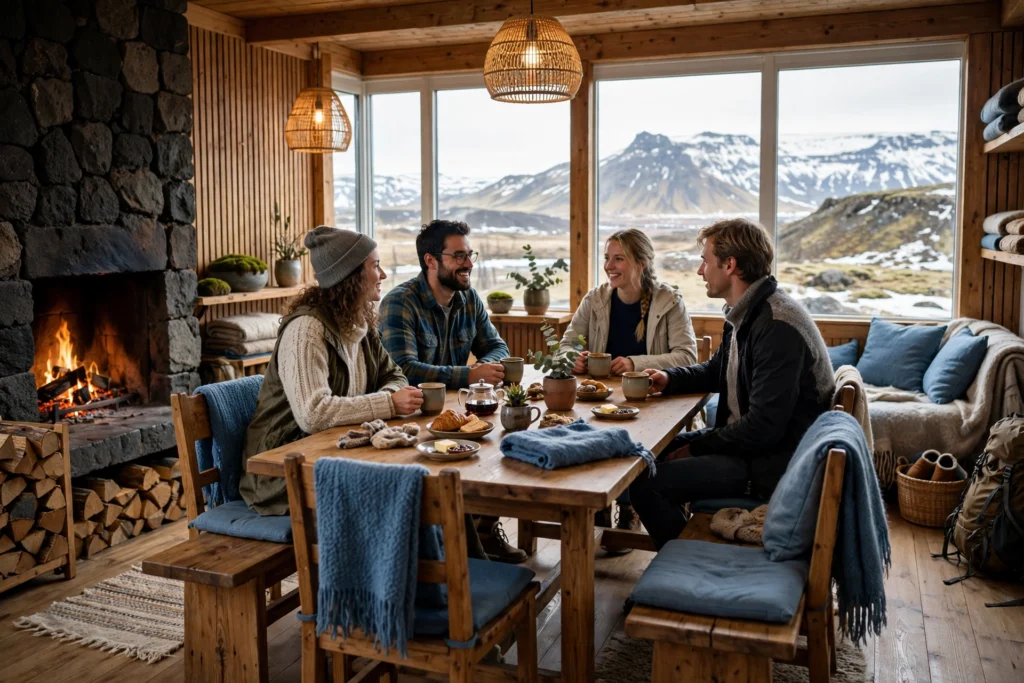
Accommodation is where solo travel in Iceland gets expensive, because you pay for a room built for two. The single supplement — the extra charge for one person in a double room — is the cost that surprises first-timers most, and it is the reason hostels are the default choice for solo travellers on a budget. Here is the honest comparison.
| Option | What you get | Planning range per night (one person) | Best for |
|---|---|---|---|
| Hostel dorm bed | A bed in a shared room, shared kitchen and bathrooms, common room | $60–$100 | Budget travellers, meeting people, Reykjavik and the main towns |
| Hostel private room | A small private room, sometimes with a shared bathroom | $130–$200 | Solo travellers who want privacy without hotel prices |
| Guesthouse single room | A private room in a small family-run place, often with breakfast | $150–$230 | The Ring Road, countryside stays, local advice |
| Hotel single room | A double room for one person, often with a single supplement | $200–$350 | Comfort, winter, Reykjavik, a treat night |
| Farm stay / apartment | A room or small apartment, often with a kitchen | $160–$280 | Longer stays, self-catering, the north and east |
| Camping (summer) | A tent pitch at a campsite, with facilities | $15–$25 per person | The cheapest option, summer only, experienced campers |
These are planning ranges for 2026, not live prices — accommodation prices in Iceland move sharply with the season, and a room that costs $150 in February can cost $300 in July. Book early for summer, especially June to August, and expect the cheapest options to sell out first. In winter the prices drop and the choice widens, which is one of the real advantages of a winter trip.
Hostels: the solo default
Hostels are the natural home of the solo traveller in Iceland, and the quality is high. The main hostel chains have locations in Reykjavik and along the Ring Road, and the common rooms are where you will meet other solo travellers, swap route advice, and find someone to share a glacier hike or a car for a day. A dorm bed is the cheapest roof in Iceland, and a private room in a hostel is often the best value for a solo traveller who wants a door that locks and a bed to themselves. Book a bed in a dorm if you want company; book a private room if you want sleep. Bring earplugs either way, and a padlock for the lockers.
Guesthouses: the Ring Road workhorse
Guesthouses are the backbone of a Ring Road trip. They are small, family-run, and usually in the countryside near the places you want to see, which matters when the next town is an hour away. The host is often your best source of information: they know which road is closed, whether the northern lights are likely, and which hot pot the locals use. Breakfast is often included and is usually generous — eat well, because it may be hours until the next meal. Some guesthouses have shared bathrooms and a shared kitchen; read the listing carefully so you know what you are booking. If you are driving the Ring Road, book every night in advance in summer; in winter you have more flexibility, but do not assume a room will be available in a small village without a booking.
Hotels and the single supplement
Hotels in Iceland are comfortable and expensive, and the single supplement is where the cost bites. A double room booked for one person often costs nearly the same as for two, because the hotel’s cost is the room, not the people. Some hotels offer genuine single rooms at a lower price; search for them specifically, and compare the single-room price rather than the double-room price. If you want one comfortable night — a hot shower, a proper bed, a restaurant dinner — book it in Reykjavik at the start or the end of your trip, when the choice is widest.
Camping: the cheapest roof, with conditions
Camping is the cheapest way to stay in Iceland, and in summer it is popular with solo travellers, but it is not a casual option. You need a proper tent, a warm sleeping bag, and the ability to put the tent up in wind and rain. Wild camping is restricted — you must use designated campsites, and many landowners prohibit it — so plan your campsites along your route. In winter, camping is for experienced winter campers only; for everyone else, it is not a sensible option.
Wherever you stay, tell your host your plans each morning. It takes thirty seconds, it is normal in Iceland, and it is the single most useful safety habit a solo traveller can build.
How Much Does Iceland Solo Travel Cost? A Full Daily Budget for One Person
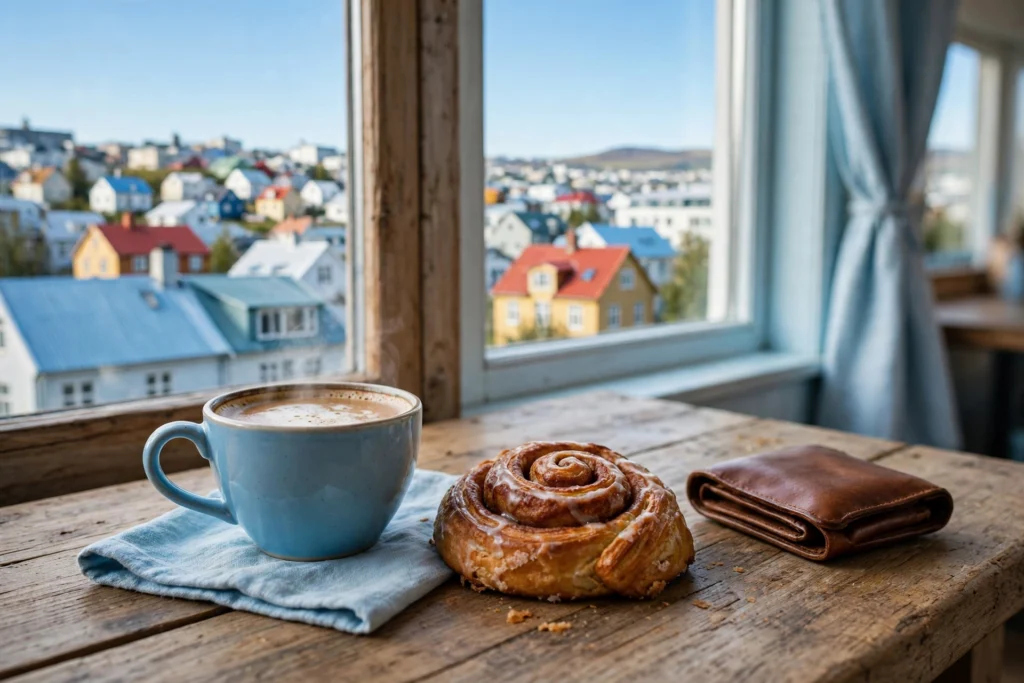
Iceland is expensive, and solo travel makes it more expensive, because there is nobody to split the car, the room or the fuel. That is the honest starting point, and the competitor guides agree: cost is the challenge of Iceland solo travel, not safety. The table below gives a full daily budget for one person, in US dollars, as planning ranges for 2026. Prices move with the season and the exchange rate, so use these ranges to build your trip total and then check live prices before you book. Our guide on how to prepare a travel budget shows how to build these lines into a trip total, and our how much to travel to Japan guide uses the same daily-cost method for another expensive destination.
| Daily cost for one person | Budget | Mid-range | Comfortable |
|---|---|---|---|
| Accommodation (hostel dorm / guesthouse / hotel) | $60–$100 | $150–$230 | $250–$350 |
| Food (self-catering / café + restaurant / restaurants) | $40–$60 | $70–$110 | $120–$180 |
| Hire car + fuel (small car, shared over the trip) | $90–$130 | $130–$180 | $180–$250 |
| Activities (one paid tour or entry per day, averaged) | $40–$80 | $80–$150 | $150–$250 |
| Local transport / parking / misc | $10–$20 | $15–$30 | $20–$40 |
| Total per day (excluding international flights) | $240–$390 | $445–$700 | $720–$1,070 |
Read the table carefully, because the columns are not the same trip. The budget column assumes a hostel dorm, self-catering from supermarkets, and a small hire car — or no car at all, using buses and day tours instead, which can bring the daily total down further. The mid-range column is the realistic figure for most first-timers: a guesthouse, a café lunch and a restaurant dinner, a small car, and one paid activity a day. The comfortable column is a hotel, restaurants, a larger car and two paid activities. A 7-day mid-range trip, on these ranges, is roughly $3,100 to $4,900 excluding international flights — and that is before the glacier hike, the ice cave and the whale-watching tour you will inevitably add.
Where the money actually goes
Food is the line that shocks people most. A restaurant main course in Reykjavik commonly costs $30 to $50, a coffee is $5 to $7, and a beer is $10 or more. The fix is supermarkets: the main chains are well stocked, and cooking in a hostel or guesthouse kitchen — or eating the generous guesthouse breakfast and carrying a packed lunch — can cut the food bill in half. Tap water is safe and excellent throughout Iceland, so carry a reusable bottle and never pay for bottled water; the State Department makes the same point, noting that overpriced bottled water is one of the small tourist scams to avoid.
The car is the second-biggest line, and the one where solo travellers lose the most money. A small car, booked early, is far cheaper than a four-wheel drive booked late, and the insurance extras — gravel, sand and ash, wind damage — add up. If the car is the difference between affording the trip and not affording it, consider the no-car version: Reykjavik plus day tours is a real Iceland trip, and it costs less than a week with a hire car.
Activities are the third line, and the one worth spending on. The waterfalls, the beaches and the viewpoints are free. The paid experiences — a guided glacier hike, an ice cave in winter, a whale-watching boat, a snorkel in the Silfra fissure — are what you will remember, and they are also the things you cannot safely do alone. Budget for one paid activity a day, and book the glacier and ice-cave tours in advance in summer, because the small-group departures sell out.
How to bring the cost down
Five things make the biggest difference. Travel in the shoulder season — May or September — when accommodation and car prices drop and the weather is still workable. Stay in hostels and guesthouses with kitchens and cook. Share a day tour or a car for a day with someone from your hostel; Iceland’s solo travellers do this constantly, and it halves the cost of the day. Skip the Blue Lagoon’s premium packages and use a local pool instead — the local pools cost a few dollars, the water is the same geothermal water, and the locals are there. And fly with hand luggage only if you can; the budget airlines charge heavily for checked bags, and Iceland’s weather means you will be wearing the same layers most days anyway.
Iceland Solo Travel: A 5-Day Itinerary for First-Timers
Five days is the shortest trip that feels like Iceland rather than a taster of it, and it is the length the competitor uides agree is comfortable for a first solo trip. This itinerary works with or without a car: with a car you drive it yourself, without a car you take the same days as small-group tours from Reykjavik. It stays in the south-west, where the roads are best and the sights are densest, and it leaves the full Ring Road for the 7-day trip below.
Day 1 — Reykjavik: arrive, walk, eat, sleep
Land at Keflavik, take the airport bus into the city, and spend the day on foot. Walk Laugavegur and the side streets of painted wooden houses, climb the Hallgrímskirkja tower for the view over the coloured rooftops, walk the waterfront to the Sun Voyager sculpture, and end the day at a local pool — the hot pot is the best jet-lag cure in Iceland. Eat in the city, buy your supplies for the days ahead, and get an early night. If you arrive in winter, this is also the night to check the northern lights forecast on vedur.is before you decide whether to book a tour.
Day 2 — The Golden Circle: Thingvellir, Geysir and Gullfoss
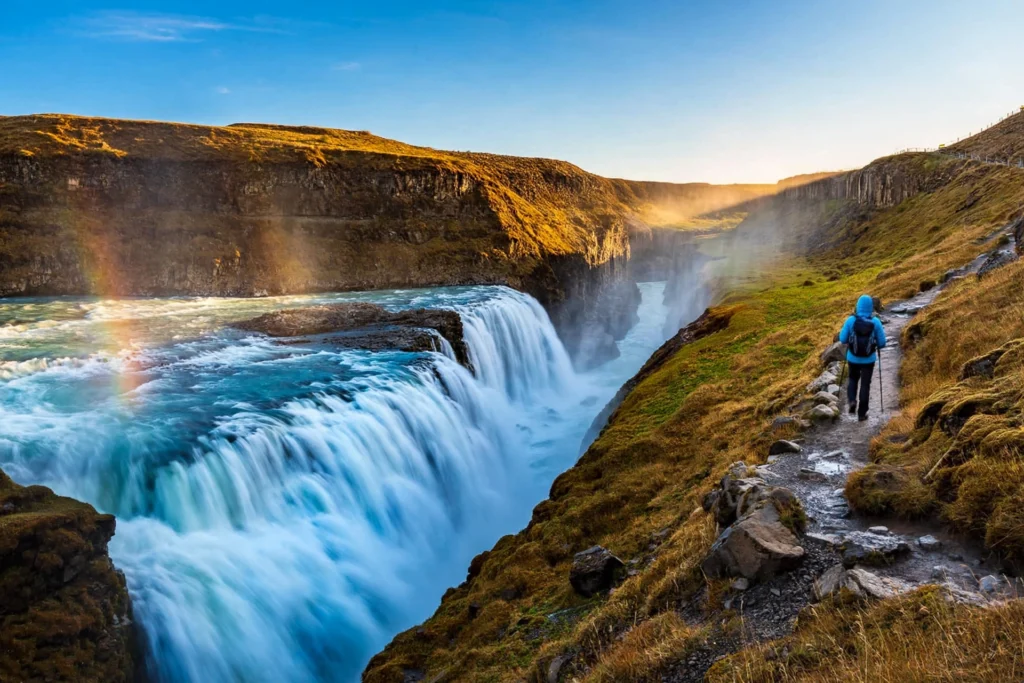
The Golden Circle is the classic first day trip from Reykjavik, a roughly 300-kilometre loop, and it is the best introduction to Iceland’s geology. At Thingvellir National Park you walk between the North American and Eurasian tectonic plates — the rift valley is visible, and the park is a UNESCO World Heritage site. At Geysir, the Strokkur geyser erupts every few minutes, throwing water high into the air; watch it from upwind unless you enjoy being soaked. At Gullfoss, the wide waterfall drops in two steps into a canyon, and on a sunny day the mist makes a rainbow. The State Department names Thingvellir, Strokkur and Gullfoss as the places where pickpockets operate, so keep your bag on your body and your phone in a zipped pocket. Stay the night in the Golden Circle area or return to Reykjavik, whichever suits your next day.
Day 3 — The South Coast: Seljalandsfoss, Skógafoss and Reynisfjara
Drive or take a tour east along the South Coast, where the waterfalls come thick and fast. Seljalandsfoss is the one you can walk behind — take the waterproofs, because you will get wet. Skógafoss is the big one, wide and powerful, with a staircase to the top for the view down the coast. Then Reynisfjara, the black-sand beach, where the basalt sea stacks stand offshore and the sneaker waves are a real danger: stay well back from the water, never turn your back on the sea, and do not climb the rocks. Stay the night in Vík or Hella, and eat early — restaurants in the small towns close earlier than you expect.
Day 4 — Glaciers and ice: Sólheimajökull and the black-sand coast
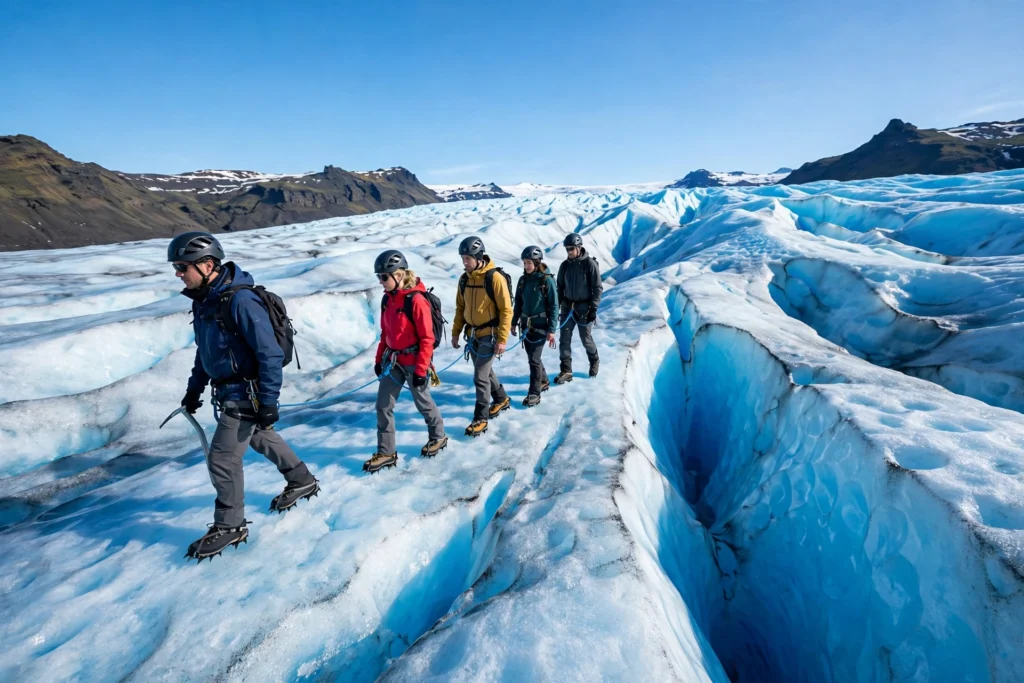
This is the day to do the thing you cannot do alone: a guided glacier hike. Book a small-group hike on Sólheimajökull, the glacier tongue near the South Coast, where the guide provides crampons, a helmet and a harness, and you walk on blue ice between crevasses. Never walk on a glacier without a guide — the crevasses are hidden, the ice moves, and people die doing it alone. In the afternoon, drive on to the Dyrhólaey viewpoint and the quieter black-sand stretches, or take a boat trip if the season allows. Stay the night in Vík or start back toward Reykjavik.
Day 5 — Reykjanes Peninsula and the Blue Lagoon, then home
Use the last day for the Reykjanes Peninsula, on the way back to Keflavik. Check the Met Office update first — this is the volcanic peninsula, and the advice in the volcano section applies. If conditions are good, see the steaming geothermal fields, the Bridge Between Continents, and the old Fagradalsfjall lava fields from the marked path. Then the Blue Lagoon or, better for a solo traveller on a budget, a local pool on the peninsula, before your flight. Leave plenty of time: the road to the airport is short, but you do not want to rush the last day.
Iceland Solo Travel: A 7-Day Ring Road Itinerary
Seven days is the classic Ring Road trip, and it is the one to take if you want to see the whole island rather than just the south. The Ring Road is about 1,330 kilometres, and seven days means roughly 200 kilometres of driving a day — comfortable, with time to stop. This itinerary assumes you have a car; without one, the same route is possible by long-distance bus in summer, but it is slower and needs more planning. Book every night in advance in summer. Drive clockwise from Reykjavik, so the weather usually improves as you go east, and so the south coast — the most crowded stretch — comes at the end, when you know the roads.
Day 1 — Reykjavik to the Golden Circle and Hella
As in the 5-day itinerary, start with the Golden Circle: Thingvellir, Geysir and Gullfoss. Stay the night in Hella or Selfoss, so you start day two already on the road east.
Day 2 — The South Coast to Vík
Seljalandsfoss, Skógafoss and Reynisfjara, as above — but take it slowly, because this is the day with the most to see per kilometre. Stop at the viewpoints, walk the beach at a safe distance from the water, and stay the night in Vík.
Day 3 — Vík to Höfn: glaciers, lagoons and black sand
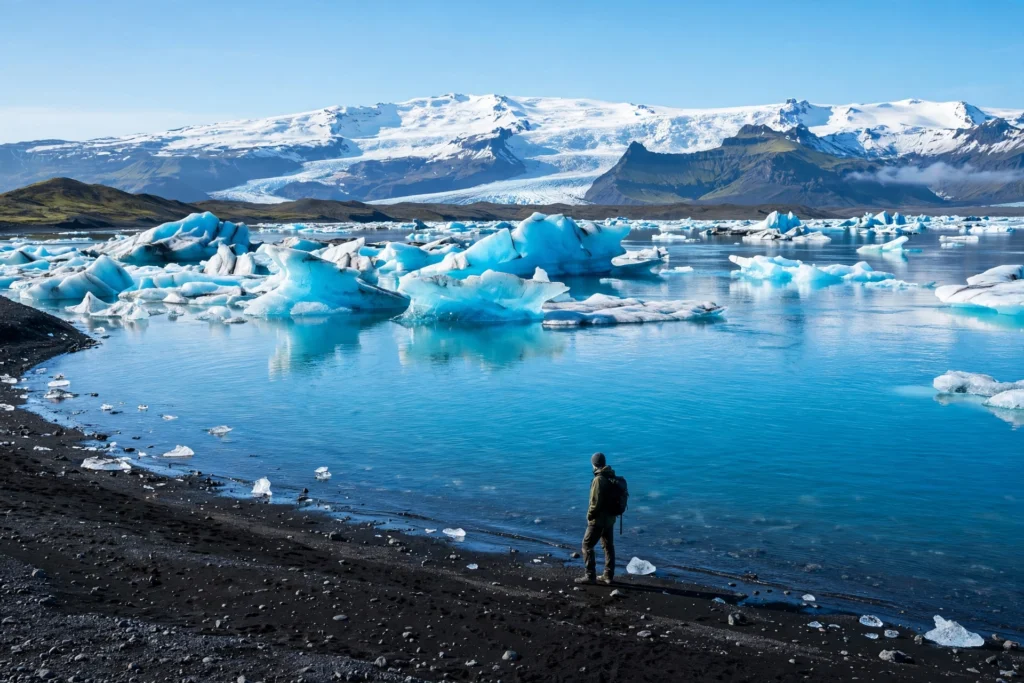
Drive east past the vast black-sand plains to the glacier lagoon at Jökulsárlón, where blue icebergs drift in a lagoon under the Vatnajökull ice cap, and across the road to Diamond Beach, where the ice washes up on the black sand. This is one of the most photographed places in Iceland, and it is also one of the easiest to enjoy alone — walk the shore, take your time, and keep your distance from the water. In winter, this is the day to take a guided ice cave tour, which only runs when the ice is stable. Stay the night in Höfn.
Day 4 — Höfn to Egilsstaðir: the Eastfjords
The Eastfjords are the quietest part of the Ring Road, and the most rewarding for a solo driver. The road winds through small fishing villages and over mountain passes, the traffic thins out, and the fjords open up around every bend. Stop in the villages, fill the tank whenever you see a petrol station, and stay the night in Egilsstaðir, the east’s main town. If the weather closes in, this is the day to shorten the drive and wait it out — the passes are the first roads to close.
Day 5 — Egilsstaðir to Akureyri: the north
Drive north to the Mývatn area, with its geothermal fields, craters and the milky-blue nature baths, and on to Akureyri, Iceland’s second city. The north is whale country in summer, and a whale-watching boat from Akureyri or Húsavík is worth the money if the season is right. Stay the night in Akureyri, eat properly, and do your laundry — you will be glad of it.
Day 6 — Akureyri to the Snæfellsnes Peninsula
Drive west along the north coast and down to the Snæfellsnes Peninsula, the “Iceland in miniature” — a volcanic peninsula with a glacier, black-sand beaches, lava fields and fishing villages in a single day’s drive. The roads here are quiet, the light is extraordinary, and the peninsula is the best place on this itinerary to feel properly alone in a good way. Stay the night on the peninsula.
Day 7 — Snæfellsnes to Reykjavik
Drive back to Reykjavik through the fjords and the farmland of the west, stopping at the viewpoints and the small towns. If you have a late flight, spend the afternoon in the city and the evening at a local pool. Return the car with a full tank, keep the fuel receipt, and photograph the car before you hand it back.
A note on driving the Ring Road alone
Two things make the Ring Road harder alone than with a companion: fatigue and fuel. You do all the driving, so keep the daily distance under control — if a day looks too long, split it, and stay an extra night somewhere. And fill the tank at half, not at empty, because the east and the north have long stretches without a petrol station. The rest is the same advice as everywhere else in this guide: check road.is and vedur.is every morning, register your plan on safetravel.is, and tell your host where you are going.
Meeting People in Iceland Without Booking a Tour
Solo travel in Iceland does not mean lonely travel, and the country is set up for it. The competitor guides all make the same point: the easiest way to meet people is to stay in hostels and take small-group tours, and the most Icelandic way is the hot pot. Here is how each one works in practice.
Hostels are the obvious starting point. The common room, the shared kitchen and the dorm are all built for conversation, and the question “where are you going tomorrow?” is the standard opening line. Hostel noticeboards and group chats are full of people looking to share a car, a glacier hike or a northern lights tour for a day, and sharing a car for a day halves the cost of the most expensive part of the trip. If you are shy, the shared kitchen is the easiest place to start: offer someone a coffee, ask about their route, and the conversation follows.
Small-group day tours are the second-best way to meet people, and they have the advantage that the company comes with a guide, a vehicle and a plan. A glacier hike, an ice cave, a snorkelling trip in the Silfra fissure or a northern lights tour all put you in a small group for several hours, and the shared experience does the social work for you. Book the small-group departures rather than the big coaches, and choose the tours that involve doing something — hiking, snorkelling, riding — rather than just looking, because doing something together is what turns strangers into travelling companions for a day.
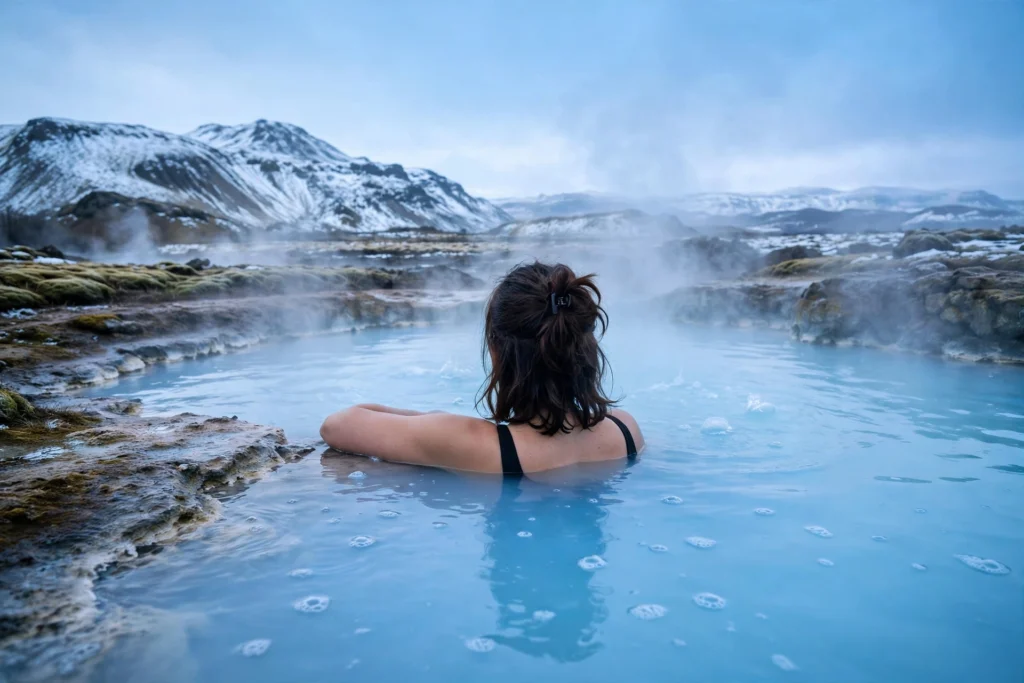
The hot pot is the third way, and the most Icelandic. Every town has a public pool, and the hot pots — the outdoor hot tubs — are where Icelanders go to talk. The etiquette is simple: shower first, sit in the hot pot, and talk. Icelanders are reserved at first and friendly once you start, and a question about the weather, the northern lights or the road conditions is a perfectly normal opening. The pools are also the cheapest social life in Iceland: entry is a few dollars, the water is geothermal, and you can spend an evening there for less than the price of a drink in a Reykjavik bar.
Beyond those three, the small things add up. Eat at the bar or the communal table rather than a table for one. Join the free walking tour in Reykjavik on your first day — it is full of other solo travellers, and it is the best orientation to the city. Use the hostel’s group chat or the noticeboard to find a walking partner for a day hike. And if you want company for a specific activity, ask at your accommodation: guesthouse hosts know who else is travelling alone, and they are usually happy to introduce you.
One caution, because it matters: Iceland is safe, but meeting strangers still needs the same judgement as anywhere. Meet in public places, tell someone where you are going, do not get into a car with someone you have just met if you are not comfortable, and trust your instincts. The solo travellers who have the best time in Iceland are the ones who are open to company and careful about it at the same time.
The Best Time to Go to Iceland Solo: Month by Month
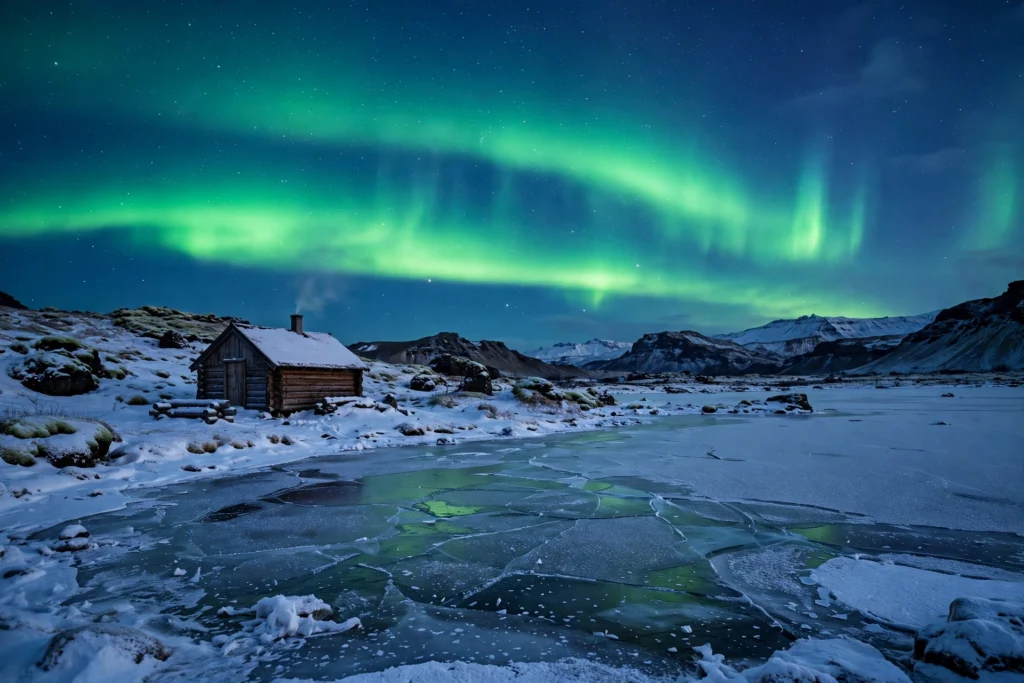
There is no single best month for Iceland solo travel — there is a best month for the trip you want. The competitor guides agree on the shape of the year: summer for the midnight sun and the easy driving, winter for the northern lights, and the shoulder months of May and September as the sweet spot. The table below sets out the trade-offs so you can choose.
| Month | Daylight | Weather and roads | What is special | Solo note |
|---|---|---|---|---|
| January | 4–5 hours | Cold, snow, ice; some roads closed | Northern lights, ice caves, few tourists | Shortest days; best for a Reykjavik-based trip |
| February | 7–8 hours | Cold, snow, storms possible | Northern lights, ice caves, winter festivals | Good value; check road closures daily |
| March | 10–11 hours | Still winter, improving light | Northern lights into early March, ice caves | A good compromise winter month |
| April | 13–14 hours | Unsettled, snow and rain mix | Spring light, fewer tourists, puffins arrive late April | Shoulder prices; pack for everything |
| May | 16–17 hours | Milder, roads mostly open | Long days, green landscapes, puffins, fewer crowds | One of the two best months for a first trip |
| June | 20–24 hours | Mildest, best driving | Midnight sun, best road access, Highlands open | Peak prices begin; book early |
| July | 20–22 hours | Warmest, most rain-free | Midnight sun, Highlands, festivals, puffins | Most expensive and most crowded |
| August | 17–18 hours | Mild, some rain | Long days, Highlands, whale watching | Still peak; slightly quieter than July |
| September | 13–14 hours | Cooling, first northern lights | Northern lights return, autumn colours, fewer crowds | The other best month for a first trip |
| October | 10–11 hours | Unsettled, first snow | Northern lights, autumn colours, low prices | Roads start to close; check daily |
| November | 7–8 hours | Cold, dark, storms | Northern lights, ice caves begin, very few tourists | Best for a short, cheap, Reykjavik-based trip |
| December | 4–5 hours | Cold, snow, short days | Northern lights, Christmas lights, ice caves | Shortest days; magical but demanding |
Summer: June to August, the midnight sun
Summer is the easiest Iceland, and the most expensive. The days are endless — in June the sun barely sets — which means you can drive, hike and sightsee at ten in the evening, and a solo traveller can cover more ground in a day than in any other season. The Highlands open, the F-roads become passable, and every tour runs. The price is the crowds and the cost: accommodation and cars are at their highest, the popular sites are busy, and you must book everything in advance. If you go in summer, book early, start your days early to beat the coaches, and use the long evenings for the quiet hours at the waterfalls.
Winter: November to March, the northern lights
Winter is the hardest Iceland, and the most rewarding for the right traveller. The northern lights season runs roughly from September to April, and the dark skies and long nights give you the best chance of seeing them. The ice caves — which only exist in winter, when the glacier ice is stable — are a genuinely once-in-a-lifetime experience, and only ever with a guide. The prices drop, the tourists thin out, and Reykjavik in the snow is beautiful. But the days are short — four or five hours of daylight in December and January — the roads can close, and driving in snow and wind is not for a first-timer. A winter solo trip works best as a Reykjavik-based trip with day tours, rather than a self-drive Ring Road trip.
Shoulder: May and September, the sweet spot
May and September are the two months this guide recommends for a first solo trip. The days are long, the roads are mostly open, the prices have dropped from the summer peak, and the crowds have thinned. In May the puffins are back and the landscapes are turning green; in September the northern lights return and the autumn colours arrive. The weather is still changeable — it always is — but the combination of long days, open roads, lower prices and fewer people is the best balance Iceland offers. If you can only pick one month, pick September for the northern lights or May for the midnight sun’s approach. Our guide to the best places to travel in January covers winter travel planning in the same practical style if you are leaning toward a cold-weather trip.
Packing for Iceland Solo: What to Bring and What to Leave
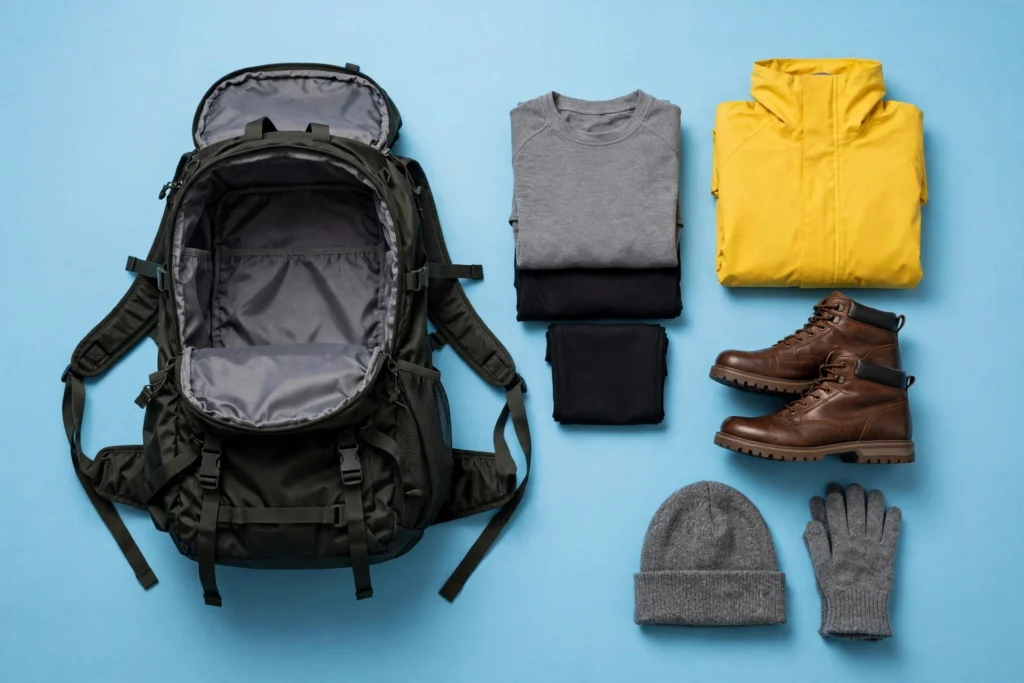
Packing for Iceland is a solved problem, and the solution is layers. The weather changes fast, the wind is real, and you will be outdoors in rain, sun and wind on the same day. Pack for that, and leave the rest behind — you are carrying your own bag, and Iceland’s pavements, gravel paths and hostel stairs are not kind to heavy luggage.
Bring
- A waterproof and windproof jacket and trousers. Not showerproof — properly waterproof, with a hood. This is the most important thing you pack.
- Thermal base layers, top and bottom. Merino wool if you can afford it; synthetic if you cannot. Two sets are enough.
- A warm middle layer. A fleece or a light down jacket that packs small.
- A wool hat, gloves and a scarf or neck gaiter. Even in summer, the wind at a waterfall or on a glacier is cold.
- Waterproof hiking boots with ankle support, already broken in. Do not bring new boots to Iceland. Add warm socks and a spare pair.
- A daypack. For water, snacks, a camera and the layers you take off when the sun comes out.
- A reusable water bottle. The tap water is excellent, and you will save money and plastic.
- A swimsuit. For the pools and hot pots, which you will use more than you expect.
- A portable phone charger. Cold drains batteries, and you will use your phone for maps, photos and the weather.
- Sunscreen and sunglasses. The sun is strong, especially on snow and ice, and the wind makes you forget you are burning.
- Earplugs and an eye mask. For hostel dorms, and for the midnight sun in summer.
- Your medication in its original packaging, with the prescription. And a small first-aid kit: plasters, painkillers, and anything you normally use.
Leave behind
- An umbrella. The wind will destroy it in minutes. A waterproof hood is the Icelandic umbrella.
- Smart clothes you will not wear. Iceland is a hiking-boot country; the only place you might dress up is a restaurant in Reykjavik, and even there the dress code is relaxed.
- A hairdryer and styling tools. Most accommodation has them, and the wind will undo the work anyway.
- Too many clothes. You will wear the same layers most days. Laundry facilities exist in hostels and guesthouses, and a washing machine is cheaper than an extra suitcase.
- A satellite phone. They are illegal for tourists in Iceland, and the State Department says so plainly.
- Cannabis or CBD products. They are illegal to bring into Iceland, with fines starting at 50,000 króna.
- Valuables you do not need. Leave the expensive jewellery and the extra cards at home. Bring one card and a backup, kept separately.
Pack light, pack waterproof, and pack in a bag you can carry up a flight of stairs and across a gravel car park without help. That is the whole packing philosophy for Iceland solo travel.
Practical Tips for Solo Travellers in Iceland: A Checklist Before You Go
Everything in this guide, boiled down to the list you can actually use. Work through it before you fly, and again on arrival.
Before you fly
- Check the US State Department Iceland advisory, the UK Foreign Office Iceland travel advice and the Icelandic Met Office — and check them again in the week before departure. If the volcanic situation has changed, or the advisory level has moved, adjust your plans.
- Check whether ETIAS applies to your trip, and make sure your passport is valid for at least three months beyond your departure from the Schengen Area, with two blank pages.
- Buy travel insurance that covers medical expenses, trip cancellation and the activities you plan — glacier hikes, ice caves and snorkelling are not always covered by a basic policy. Carry the policy number and the insurer’s emergency number with you.
- Enrol in STEP, or your own government’s equivalent, and leave your itinerary with someone at home.
- Book your accommodation for every night in summer, and your car, glacier hike and ice-cave tour in advance. In winter, book the tours and keep the accommodation flexible.
- Register on Safetravel and save 112, vedur.is and road.is on your phone before you land.
On arrival
- Buy your supplies at a supermarket on the first day, and fill a reusable bottle with tap water.
- Save the emergency number 112 in your phone, and tell your accommodation where you are going each day.
- Check the weather and the road conditions before you set out, every morning, without exception.
- If you hire a car, photograph it from every angle before you leave the lot, check what the insurance covers, and fill the tank before a remote stretch.
Every day you are there
- Check vedur.is and road.is before you drive anywhere, and register your route on safetravel.is if you are going somewhere remote.
- Dress in layers, carry your waterproofs even if the morning is sunny, and keep your phone charged.
- Never turn your back on the sea at a black-sand beach, never walk on a glacier without a guide, and never walk on lava.
- Keep your valuables on your body, use tap-to-pay where you can, and do not leave bags visible in a parked car.
- Eat the guesthouse breakfast, carry a packed lunch, and end the day at a local pool — the hot pot is where the day’s stories get told, and it costs a few dollars.
Money and documents
- Iceland uses the króna, but cards are accepted almost everywhere and you will rarely need cash. If you use an ATM, use one inside a bank.
- Tipping is not expected. Keep one card and a backup, stored separately, and photograph your passport, insurance policy and bookings, keeping the copies somewhere separate from the originals.
- If something goes wrong, call 112, and contact your embassy — US citizens can also enrol in the free Smart Traveler Enrollment Program (STEP) before travelling so the embassy can reach them with updates and alerts.
Frequently Asked Questions About Iceland Solo Travel
Is Iceland safe for solo travel?
Yes. Iceland is ranked first on the 2026 Global Peace Index for the 19th consecutive year, and the US State Department rates it Level 1: Exercise Normal Precautions, its lowest level. Violent crime is rare. The real risks are natural — weather, driving, water and volcanoes — and they are manageable with the checks in this guide: vedur.is, road.is, safetravel.is and 112.
Is Iceland safe for solo female travellers?
Yes, and Iceland is one of the most popular first solo trips for women. Stay in well-reviewed accommodation, walk on lit streets at night in Reykjavik, take a taxi after midnight, and tell your host your plans each day. The risks for a solo woman are the same natural risks as for any solo traveller, plus the usual night-time caution in the city centre.
Do I need a car to travel solo in Iceland?
No. You can base yourself in Reykjavik and take small-group day tours to the Golden Circle, the South Coast and the Snæfellsnes Peninsula, which is a complete first trip. A car gives you freedom and is the best way to drive the full Ring Road, but you pay the whole rental and fuel bill alone, so it costs more.
How much does Iceland solo travel cost?
As a planning range for one person, excluding international flights: roughly $240–$390 a day on a budget, $445–$700 mid-range, and $720–$1,070 comfortable. A 7-day mid-range trip is roughly $3,100–$4,900. The biggest costs are accommodation and the hire car, because you pay for both alone. Prices move with the season, so check live prices before you book.
Is there a volcanic eruption in Iceland right now?
No. As of 16 November 2026 there is no eruption under way anywhere in Iceland; the last one, on the Sundhnúkur crater row, ended on 5 August 2025. The Met Office’s update of 10 November 2026 says ground uplift continues at Svartsengi and a new magma intrusion remains the most likely scenario, with the Reykjanes–Svartsengi system at alert level 2 (orange). Check the Met Office’s dated update before you visit the Reykjanes Peninsula.
What is the best time to go to Iceland solo?
May and September are the best balance for a first trip: long days, mostly open roads, lower prices and fewer crowds. June to August gives the midnight sun and the easiest driving but the highest prices. September to April is northern lights season, and the ice caves only run in winter.
Can I see the northern lights travelling solo?
Yes. The northern lights season runs roughly September to April, and you can see them on a guided tour from Reykjavik, which solves the transport and the company in one booking. Check the aurora forecast on vedur.is, get away from the city lights, and dress warmly — you will be standing outside in the cold for a while.
Do I need a visa for Iceland?
US citizens need no visa for up to 90 days for tourism. Your passport should be valid for at least three months beyond your departure from the Schengen Area, with two blank pages, and you must show proof of funds and an onward or return ticket. ETIAS, the EU’s pre-travel authorisation, is not in operation as of November 2026 and no start date has been announced, so there is nothing to apply for yet — check the official portal at travel-europe.europa.eu/etias before you book.
Is Iceland expensive for one person?
Yes — it is one of the most expensive destinations in Europe for a solo traveller, because there is nobody to split the car or the room with. The ways to bring the cost down are hostels and guesthouses with kitchens, shoulder-season travel, supermarket food, local pools instead of premium lagoons, and sharing a day tour or a car for a day with someone from your hostel.
Can I travel Iceland solo in winter?
Yes, but plan it differently. Winter is best as a Reykjavik-based trip with small-group day tours, rather than a self-drive Ring Road trip, unless you are confident driving in snow and wind. The days are short, some roads close, and the northern lights and ice caves are the reward. Check road.is and vedur.is every morning.
What should I pack for Iceland solo travel?
Layers: thermal base layers, a warm middle layer, and a waterproof and windproof outer layer, plus a hat, gloves, waterproof hiking boots, a swimsuit for the pools, a reusable water bottle and a portable phone charger. Leave the umbrella behind — the wind will destroy it — and do not bring cannabis, CBD products or a satellite phone, all of which are illegal for tourists.
Do I need travel insurance for Iceland?
Yes. Medical care is expensive, and a rescue or evacuation from a remote area can cost far more than the trip itself. Buy insurance that covers medical expenses and the activities you plan — glacier hikes, ice caves and snorkelling are not always covered by a basic policy — and carry the policy number with you.
Conclusion: Should You Travel to Iceland Solo?
Iceland is the rare destination where the solo trip is not a lesser version of the trip — it is the trip the country was made for. The roads are good, the people are honest, the crime rate is among the lowest on earth, and the landscape is so large and so empty that travelling alone feels like the natural way to see it. The price is real: you pay for the car alone, you pay for the room alone, and you carry the responsibility for your own safety alone. But the planning that closes those gaps is simple, and it is all in this guide: check the forecast, check the roads, register your plan, tell someone where you are going, and respect the water, the weather and the volcano.
Go in May or September if you want the best balance. Go in winter if you want the northern lights and the ice caves. Go in summer if you want the midnight sun and the Highlands. Whichever you choose, go with the habits in this guide and Iceland will give you one of the best solo trips you will ever take — waterfalls at midnight, black sand under your boots, blue ice under your crampons, and a hot pot at the end of the day with strangers who feel like travelling companions by the time you climb out.
People also read:
- Iceland Travel Itinerary
- Best Places to Travel Solo Female in the US
- Dream Travel Destinations
- How Much to Travel to Japan
- Is It Safe to Travel to Vietnam? An Honest 2026 Guide
- Travel Apps
- How to Prepare a Travel Budget
- Best Places to Travel in January

M. Adil is the founder and editor of SoloTravelPro. He writes practical, research-based travel guides that help travellers plan with confidence — from first-time city breaks to national parks and island escapes. Every guide is built on official sources, current prices and honest, usable advice, so readers can plan smarter and travel better.

Other Articles
Are Travel Agents Free? The Honest 2026 Answer