Quick Answer: What Are the Best Places to Travel With a Baby?
The best places to travel with a baby are short-flight, warm-weather places with good healthcare, easy transport and somewhere comfortable to base yourself for a few days: Florida, Hawaii, the Riviera Maya in Mexico, Belize, Thailand, Singapore, London, Lisbon, Switzerland and Iceland are the strongest first trips for most American families. The single best first trip for most parents is a beach resort or a walkable city no more than one short flight from home, in the destination’s mild season, with a kitchen or kitchenette, a proper cot and a hospital within a short drive.
There is no single “best” age for a baby’s first trip, and this guide does not pretend otherwise. A newborn under 3 months sleeps a lot and travels light, but needs more care and is more vulnerable to germs; a baby of 3 to 6 months is often the easiest traveller of all — settled into a routine, still happy in a carrier, not yet crawling; a baby of 6 to 12 months is more fun and more mobile, but needs solid food, more gear and constant watching. The right destination depends on which stage your baby is at, how far you are willing to fly, and how much disruption your family can absorb. That is why this guide is organised by trip type — beach, city, mountain and resort — and by age, instead of one flat list.
Everything practical is covered too: when a baby can fly and what airlines actually allow, whether a baby needs a passport (yes, even a newborn), what the CDC says about immunizations and health on the road, what a baby trip really costs, and a packing checklist you can use as-is. No destination here is ranked “safest” — safety depends on the season, the neighbourhood and your baby’s health, and the official sources linked in this guide are the place to check before you book. When in doubt about your baby’s health or your flight, check with your pediatrician and your airline — this article is general information, not medical advice.
Best Places to Travel With a Baby: The Short Answer

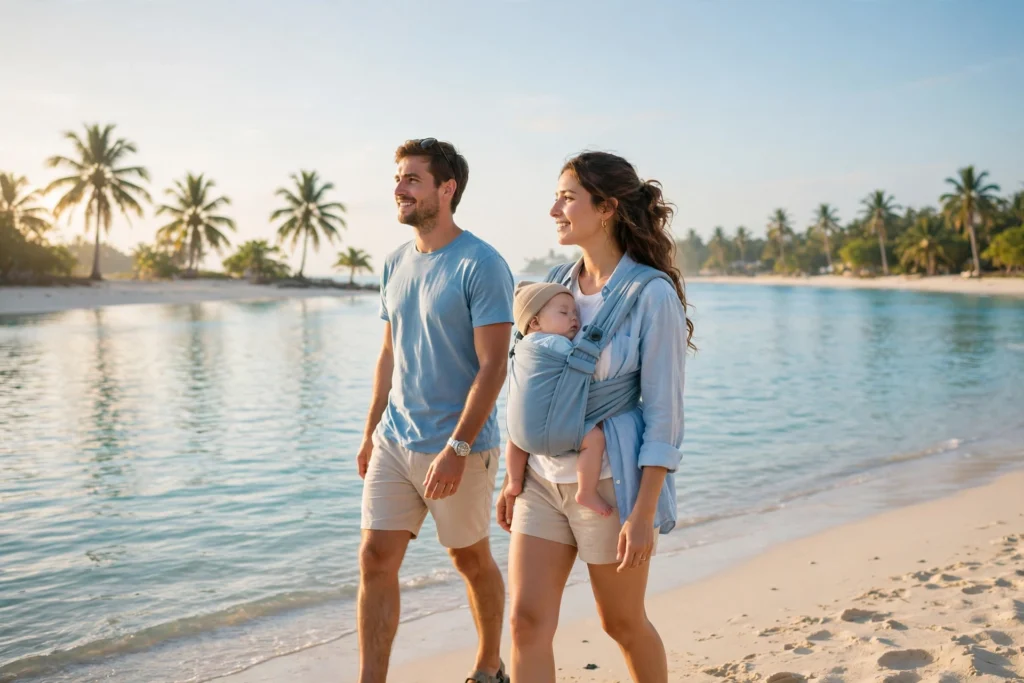
If you want the short list first, here it is. These are the 16 destinations this guide covers in full, grouped the way parents actually choose: by the kind of trip, not by geography.
Beach trips: Florida (Orlando and the Keys), Hawaii (Maui and Oahu), Riviera Maya in Mexico, Belize (Ambergris Caye and Caye Caulker), Thailand (Phuket), Mauritius, Mallorca.
City breaks: Singapore, London, Lisbon, Dubai, Bermuda.
Mountain and nature: Switzerland, Iceland, Cornwall, Sri Lanka.
Why these 16 and not the 10-item lists the top-ranking articles use? Because a beach holiday and a city break are different trips with different gear, different days and different risks, and parents choosing between them need both. The KAYAK list of 10 baby-friendly holidays is a good starting point, but it mixes continents and trip types without saying which baby age suits which place, and it says little about flying, passports or health. The family-blogger round-ups are honest about what worked for one family, but one family’s trip to Bali is not a plan for your 4-month-old. This guide covers more destinations, organises them by trip type, adds an age-by-age section, a full flying chapter, a health section built on CDC guidance, a budget table and a packing checklist — the parts the top 3 leave out.
A few ground rules before the destinations. First, shorter is better for a first trip. A 2-hour flight with a baby is a different experience from a 10-hour one, and a first trip is the wrong time to test a long-haul flight, a big time-zone change and a new climate all at once. Second, one base beats three bases. Babies do best with a sleep schedule and a familiar room; unpacking once and doing day trips is calmer than moving hotels every night. Third, healthcare matters more than scenery. Before you fall in love with a place, check where the nearest hospital or clinic is, whether your travel insurance covers your baby, and whether the destination needs any vaccines or malaria precautions — the CDC’s Yellow Book chapter on travelling safely with infants and children is the authoritative starting point, and it is linked in the health section below. Fourth, the season is the destination. Mallorca in May and Mallorca in August are two different trips; the best-time table in this guide tells you when each place is at its easiest for a baby.
The comparison table below gives you the whole list at a glance. The sections after it go deep on each trip type, then the practical chapters — flying, passports, health, cost and packing — give you everything else you need to book with confidence.
| Destination | Trip type | Best for baby age | Flight from US East Coast | Best months | Why it works with a baby |
|---|---|---|---|---|---|
| Florida (Orlando / Keys) | Beach + resort | Any age | 2–3 hours | Nov–Apr | No passport, short flights, resorts with cots and kitchens |
| Hawaii (Maui / Oahu) | Beach | 3–12 months | 10–11 hours | Apr–Jun, Sep–Oct | Warm, safe, excellent hospitals, no passport |
| Riviera Maya, Mexico | Beach + resort | 3–12 months | 3–4 hours | Nov–Apr | All-inclusive resorts, short flight, calm beaches |
| Belize (Ambergris / Caye Caulker) | Beach + island | 6–12 months | 3–4 hours | Dec–Apr | Slow pace, English-speaking, calm cayes; see the Belize travel guide |
| Thailand (Phuket) | Beach + resort | 6–12 months | 17+ hours | Nov–Feb | Great value, family resorts, warm sea; see the Thailand travel guide |
| Mauritius | Beach + resort | 6–12 months | 18+ hours | May–Dec | Calm lagoons, family resorts, low malaria risk in resorts |
| Mallorca, Spain | Beach + island | 3–12 months | 8–9 hours | May–Jun, Sep–Oct | Short transfers, sandy beaches, Spanish family culture |
| Singapore | City | Any age | 18+ hours | Feb–Apr | Clean, safe, stroller-friendly, superb healthcare |
| London, England | City | 3–12 months | 7–8 hours | May–Jun, Sep | Parks everywhere, free museums, English-speaking |
| Lisbon, Portugal | City | 3–12 months | 7–8 hours | Apr–Jun, Sep–Oct | Mild weather, compact centre, family-friendly cafes; see the Lisbon travel guide |
| Dubai, UAE | City + resort | 6–12 months | 13–14 hours | Nov–Mar | Modern hotels, malls with baby facilities, warm winters |
| Bermuda | City + beach | 3–12 months | 2 hours | May–Oct | Very short flight, pink-sand beaches, safe and tidy |
| Switzerland | Mountain | 6–12 months | 8–9 hours | Jun–Sep | Trains, lakes, clean air, excellent healthcare |
| Iceland | Nature + road trip | 6–12 months | 5–6 hours | Jun–Aug | Short flight, dramatic nature, one-base road trips; see the Iceland travel itinerary |
| Cornwall, England | Coast + nature | 3–12 months | 7–8 hours | May–Sep | Sandy beaches, short drives, cottage stays |
| Sri Lanka | Nature + beach | 6–12 months | 16+ hours | Dec–Mar | Warm, affordable, elephants and beaches in one trip |
A note on what this table does not do: it does not rank these places by safety, because no honest source ranks whole countries that way for babies. What it does is tell you the practical facts — flight time, best months, and what makes each place easy — so you can match a destination to your baby’s age and your tolerance for travel time. The rest of this guide fills in the detail.
What Age Is Best for a Baby’s First Trip? Newborns, 3–6 Months and 6–12 Months

There is no official minimum age for travel, and no age that is “best” for every family. What changes with age is what is hard: newborns need feeding and sleep protection, 3- to 6-month-olds need routine and shade, and 6- to 12-month-olds need space, solid food and supervision. The American Academy of Pediatrics (AAP) says it is generally safe for a newborn to fly once they are at least 7 days old, but ideally you wait until your baby is 2 to 3 months old — crowded airports and planes raise a young baby’s exposure to colds, flu and other illnesses, so waiting a few weeks when you can gives extra protection. Airlines set their own minimums on top of that: American Airlines accepts infants from 2 days old, and both American and Delta require a doctor’s letter for babies under 7 days old. Those are airline rules, not medical clearance — check with your pediatrician before flying with a newborn, especially if your baby was premature or has any health condition.
Newborns: 0–3 months
Newborns are, in one sense, the easiest travellers: they sleep most of the day, they eat on demand, and they are happy in a carrier or a bassinet. In another sense they are the most fragile: their immune systems are still developing, they cannot regulate their temperature well, and they should not be in direct sun at all. The CDC advises not to use insect repellent on babies younger than 2 months old, and to protect them instead with mosquito netting draped over the carrier or car seat. For a newborn trip, choose somewhere close, warm but not hot, with excellent healthcare and a short flight — Florida, Bermuda, Lisbon in late spring, or a drive-to beach cottage. Keep the trip short (3–4 nights), keep one base, and plan your days around feeds and naps rather than sightseeing. Do not plan a newborn trip to a place that needs malaria prophylaxis, a long-haul flight or a remote location far from a hospital.
Babies 3–6 months: often the sweet spot
Ask experienced travelling parents which age was easiest and most will say 3 to 6 months. The baby has had early vaccines, is feeding on a more predictable schedule, can hold their head up and enjoy looking around, and still cannot crawl away. A baby this age is happy in a carrier for hours, sleeps in a travel cot, and does not yet need solid food — which removes the hardest part of feeding on the road. This is the age for the slightly longer trips on the list: Singapore, London, Lisbon, Mallorca, Hawaii, the Riviera Maya. The main cautions are sun and heat — a 4-month-old still needs shade, a hat and light covering rather than sunscreen as the first line of defence — and sleep: protect the nap schedule, because an overtired baby on holiday is miserable for everyone. This is also the age when many airlines’ bassinets still fit: most airlines offering bassinets require the baby to be under about 6 months or 20 pounds (about 9 kg) and not yet sitting up alone, though each airline sets its own limits.
Babies 6–12 months: more fun, more work
From 6 months, your baby is eating solid food, sitting up, crawling and then pulling up to stand. Trips get more fun — your baby reacts to the sea, to animals, to new faces — and more demanding. You need a high chair or a lap, a safe floor space, baby food or a kitchen, and eyes on your baby at all times near water, stairs and streets. The CDC notes that infants 6 to 11 months old should get one dose of the MMR vaccine before international travel, even though the routine schedule gives it later — ask your pediatrician about this at the pre-travel visit, which the CDC recommends at least one month before an international trip. This is the age for the adventure end of the list: Thailand, Belize, Iceland, Switzerland, Sri Lanka and Mauritius all work well from 6 months, because your baby can sit in a high chair at a restaurant, splash in a shallow pool and enjoy a boat trip. It is also the age when a travel cot, a lightweight stroller and a carrier all earn their place in the luggage — you will use all three in one day.
| Age | What is easy | What is hard | Best trip types | Avoid |
|---|---|---|---|---|
| 0–3 months (newborn) | Sleeps a lot, feeds on demand, travels light | Fragile immunity, no sun exposure, needs warmth and quiet | Short flight, one base, beach cottage or city hotel | Long-haul flights, malaria areas, remote places, extreme heat |
| 3–6 months | Settled routine, happy in a carrier, no solid food yet | Sun and heat, nap protection, bassinet weight limits | Beach resorts, city breaks, Mallorca, Singapore, Lisbon | Very hot seasons, high-altitude destinations |
| 6–12 months | Interactive, eats solids, enjoys new places | Crawling and climbing, needs safe space, more gear | Thailand, Belize, Iceland, Switzerland, Sri Lanka | Unfenced pools, busy roads, places without baby food or clinics |
Whatever age you travel at, the same rule applies: build the trip around the baby’s day, not the other way round. One outing in the morning, a long nap, one gentle outing in the late afternoon, and an early night will give you a happier baby and a better holiday than a packed itinerary. The destinations in this guide were chosen because they all allow that rhythm — none of them requires dawn starts, long drives or all-day tours to enjoy.
Flying With a Baby: Lap Infant, Car Seats, Bassinets and Ear Pressure
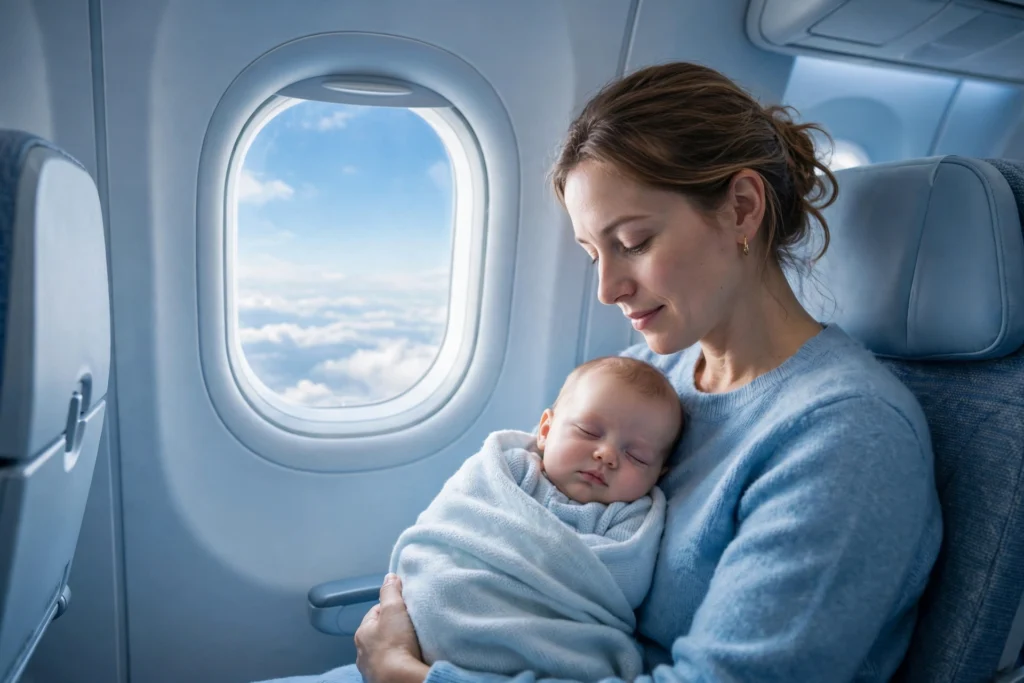
Flying with a baby is the part parents worry about most, and it is also the part with the clearest official guidance. The rules are simple once you separate the three questions: how old the baby must be, whether the baby gets a seat, and what happens to their ears.
How young can a baby fly?
There is no US federal minimum age for flying. The AAP says it is generally safe to fly once a newborn is at least 7 days old, but ideally you wait until 2 to 3 months old. Airlines set their own rules: American Airlines accepts infants from 2 days old, and both American and Delta require a doctor’s letter for a baby under 7 days old. If your baby had an ear infection or ear surgery in the two weeks before the trip, ask your pediatrician first — the AAP flags this specifically. Premature babies and babies with lung or heart conditions need individual advice; an airline’s minimum age is not medical clearance. For international flights, the CDC recommends seeing your child’s doctor or a travel medicine specialist at least a month before you leave.
Lap infant or their own seat?
On US airlines, a child under 2 may fly on an adult’s lap. On domestic flights a lap infant usually flies free; on international flights the fare is typically about 10% of the adult fare plus taxes. Only one lap infant is allowed per adult, and the baby must be added to the reservation and given a boarding pass even when no seat is bought. That is the cheap option — and the FAA is clear that it is not the safest one. The FAA says the safest place for a child under 2 on a US airplane is in an approved child restraint system, not on a lap, because your arms cannot hold a child securely during unexpected turbulence. The AAP agrees, and notes that turbulence is the leading cause of children’s injuries on airplanes. Buying a ticket for your baby is the only way to guarantee you can use a car seat on board.
If you buy a seat, bring a hard-backed, rear-facing car seat with the label “This restraint is certified for use in motor vehicles and aircraft.” It usually goes in a window seat so it does not block the aisle. The FAA prohibits baby carriers, booster seats and backless restraints during taxi, takeoff and landing — your baby must be out of the carrier and held or buckled in for those phases. The CARES harness is an FAA-approved alternative, but it is certified only for children weighing 22 to 44 pounds who can sit upright alone, so it is not an option for a baby.
Bassinets: what airlines actually offer
On some long-haul flights, airlines offer bassinets — also called sky cots — that attach to the bulkhead wall. There is no single US rule: bassinets are an airline amenity, not an FAA requirement, and only some carriers offer them, only on widebody aircraft. Delta offers free SkyCots on widebody international flights and on widebody domestic flights over 1,500 miles, with a limit of under 25 pounds; American offers bassinets on certain Boeing 777 and 787 aircraft on a first-come, first-served basis; United, Alaska and Hawaiian also offer them on some widebody routes, while JetBlue does not offer bassinets at all. The usual pattern across airlines is a baby under about 6 months or 20 pounds (9 kg) who cannot yet sit up alone. You must request a bassinet when you book, confirm it before the flight, and book a bulkhead seat — and expect to take your baby out of the bassinet for takeoff, landing and whenever the seatbelt sign is on. A bassinet is a sleep aid for cruise flight, not a safety device.
Ear pressure, feeding and the airport
Babies cannot equalise ear pressure by chewing gum the way adults do, so the trick is to get them swallowing during ascent and descent: breastfeed, offer a bottle or give a pacifier exactly when the plane is climbing or coming down. The CDC and AAP both recommend feeding during takeoff and landing for this reason. At security, tell the TSA officer at the start of screening that you are carrying formula or breast milk; US airports must provide a private, non-bathroom space for expressing milk in each terminal, and milk that has been X-rayed is safe to feed your baby. Most airlines let you check one stroller and one car seat free per ticketed customer, and you can usually take a collapsible stroller to the gate. Book a flight that lines up with your baby’s sleep, choose a window seat if you are using a car seat, and pack the nappy bag as your carry-on — nappies, wipes, a change of clothes for you as well as the baby, formula or snacks, a pacifier, and one new quiet toy. The golden rule of flying with a baby is that the flight is a few hours and it ends; every parent on the plane has been there, and the crew has seen it all before.
Does a Baby Need a Passport? Documents, Photos and Consent
Yes. Every US citizen needs a valid passport for international air travel, and that includes newborns — there is no minimum age, and a baby cannot travel on a parent’s passport. For domestic US flights, a baby flying as a lap infant needs no ID of their own, though airlines may ask for proof of age such as a birth certificate. For any international trip, including to Mexico, Canada and the Caribbean, your baby needs their own passport book. A passport card is cheaper but is not valid for international air travel, so for a flying holiday you need the book.
The rules for a child’s passport are different from an adult’s, and they catch first-time parents out. The US State Department’s page for applying for a child’s passport under 16 sets out the full process, and the key points are:
- Form DS-11, in person, every time. A child under 16 applies on Form DS-11 at a passport acceptance facility, with the child present. You cannot renew a child’s passport by mail — when it expires, you apply in person again.
- Both parents must be present. Both parents or guardians must appear in person with the child and give approval. If one parent cannot attend, that parent must complete Form DS-3053 (Statement of Consent), signed before a notary public, and provide a photocopy of the ID shown to the notary. The DS-3053 must be submitted within 90 days of being signed or notarised.
- Proof of citizenship and relationship. You need the child’s certified US birth certificate (or Consular Report of Birth Abroad, Certificate of Citizenship or a full-validity US passport), plus a photocopy of it, and photocopies of the front and back of each parent’s photo ID.
- Valid for 5 years, not 10. Passports for children under 16 are valid for 5 years.
- Fees and timing. The application fee is $100 for a child’s passport book plus a $35 facility acceptance fee — $135 in total. Routine processing takes 4 to 6 weeks; expedited service costs an extra $60 and takes 2 to 3 weeks. Those processing times do not include mailing time, and the State Department notes it can take 2 weeks for the application to reach them and 2 more weeks for the passport to reach you — so allow at least 10 weeks from application to passport in hand for routine service, and apply earlier than you think you need to.
The passport photo is the part parents find hardest. It must be 2 by 2 inches, in colour, taken within the last six months, against a plain white or off-white background, showing only the child. For a baby who cannot sit up, the State Department suggests laying the baby on a plain white sheet or blanket and photographing from directly above. A newborn’s eyes do not need to be fully open. Do not attach or staple the photo to the form — the acceptance agent will do that.
Two more documents are worth sorting before an international baby trip. First, travel insurance that covers your baby — check that the policy covers your infant as a named traveller, including medical evacuation, because the CDC’s Yellow Book advises planning where and how to seek medical care while travelling and discussing travel health insurance at the pre-travel visit. Second, a consent letter if only one parent is travelling. The State Department’s rules are about issuing the passport; border officers in some countries may also ask a parent travelling alone with a child for evidence of the other parent’s consent. A short notarised letter from the non-travelling parent, plus a copy of their passport, is cheap insurance against a long conversation at the border. If you are travelling without a passport — to Hawaii, Florida, Puerto Rico or the US Virgin Islands, for example — none of this applies, which is one reason the US destinations in this guide are such easy first trips. Our guide to places to travel without a passport covers the domestic and territory options in full.
Health and Safety: Immunizations, Sun, Water, Food and Mosquitoes
This section is built on the CDC’s guidance, not on blog advice. The CDC’s Yellow Book chapter on travelling safely with infants and children is the authoritative source for this topic, and the US State Department’s child passport page is the authoritative source for documents. Everything below summarises those sources and standard pediatric guidance; for your baby’s specific situation, check with your pediatrician. This article is general information, not medical advice.
Before you go: the pre-travel visit
The CDC recommends that families see a healthcare provider or travel medicine specialist at least one month before an international trip, to get needed vaccines and medicines. That visit is the time to check three things: that your baby’s routine childhood vaccines are up to date, whether any routine vaccine should be given earlier than usual for travel, and whether the destination needs any travel-related vaccine or malaria prophylaxis. The CDC notes that some routine vaccines, such as MMR or hepatitis A, may need to be given earlier than routinely recommended for travel — and specifically that infants 6 to 11 months old should get one dose of the MMR vaccine before international travel. Some travel vaccines cannot be given to very young children, so it is important to check with a travel medicine doctor, who should consult your child’s pediatrician, as early as possible before travel. The pre-travel visit is also the time to discuss where and how to seek medical care at your destination, to sort travel health insurance, and to carry an adequate supply of any medicines your baby needs.
The most common problems — and how to prevent them
The CDC lists the most commonly reported health problems among child travellers as skin conditions (including insect bites and sunburn), diarrhoeal illnesses, respiratory disorders and feverish illnesses including malaria. Motor vehicle and water-related injuries, including drowning, are other major concerns. The good news is that the prevention is mostly practical:
- Diarrhoea and dehydration. Diarrhoea is among the most common illnesses in children travelling abroad, and infants with diarrhoea can become dehydrated more quickly than adults. Breastfeeding is the best way to prevent diarrhoea in infants. For formula, use only water that has been boiled, treated or bought sealed — including the water used to prepare formula — and use potable water for cleaning bottles, pacifiers and toys. Drink only beverages from sealed containers. Wash hands with soap and water, or use a hand sanitiser with at least 60% alcohol. If your baby has diarrhoea, the treatment is plenty of fluids and oral rehydration solution; seek medical attention if your baby seems dehydrated, has a fever or bloody stools, or cannot keep fluids down.
- Sun. Babies burn fast and cannot tell you they are hot. Keep babies under 6 months out of direct sun entirely — shade, a hat and light clothing are the protection, not sunscreen. For older babies, use shade first, then clothing, then sunscreen on exposed skin. The CDC lists sunburn among the most common travel health problems for children, and a shaded beach umbrella and a morning-or-late-afternoon beach routine prevent most of it.
- Mosquitoes and malaria. Malaria is among the most serious and life-threatening infections children can acquire abroad, and children travelling to a malaria area should take prevention medicine — ask a healthcare professional which one, because doses are weight-based and some drugs cannot be given to very young children. For bites generally: do not use insect repellent on babies younger than 2 months old — protect them with mosquito netting over the carrier or car seat instead. Do not use products containing oil of lemon eucalyptus or para-menthane-diol on children younger than 3 years. Dress children in clothing that covers arms and legs, and use a net over the cot or stroller at night. This is why the destination choice matters: a resort in Mauritius or a city break in Lisbon carries a very different mosquito risk from a jungle lodge, and the CDC’s destination pages let you check the risk before you book.
- Water and swimming. Never leave a baby unsupervised near water — not a pool, not a bath, not a shallow beach edge. The CDC notes that lifeguards may not be present, and that swimming lessons should be considered for non-swimmers planning travel near water. At the beach, a baby should be in the shade, in shallow water only while held, and never in a pool or sea without an adult in the water with them.
- Cars and roads. Discuss road safety, including helmets and car seats, with your pediatrician before you go. A car seat approved in the US may not be approved in another country, so research the car seat rules for your destination, and remember that children are generally safest in the back seat. In many of the destinations in this guide — Singapore, London, Lisbon — you can avoid cars almost entirely by using metros, buses and walking, which removes one of the biggest risks of all.
What to pack for health
A small health kit goes in the hand luggage, not the hold: your baby’s regular medicines with prescriptions, oral rehydration solution packets, a thermometer, infant fever medicine in the dose your pediatrician recommends for your baby’s weight, nappy rash cream, saline nose drops, and the phone number of your pediatrician and your travel insurer. Take more nappies, formula and baby food than you think you need for the journey — delays happen, and a hungry baby in a departure lounge is a problem you can prevent. If your baby takes formula, consider bringing formula from home: the CDC notes that infant formulas available abroad might not have the same nutritional composition or manufacturing safety standards as at home, and liquid formula is sterile. Finally, know where the nearest hospital is before you arrive, not after you need it — a five-minute check on a map is worth more than any packing list.
How to Choose a Baby-Friendly Destination: The 8-Point Checklist
Before you pick from the 16 destinations below, run any candidate through this checklist. A place that passes all eight is a good baby trip; a place that fails two or more will be hard work, however pretty the photos are.
- Flight time. Under 4 hours is ideal for a first trip; under 8 hours is fine from 3 months up. Over 10 hours is a second or third trip, not a first.
- Time-zone change. A 1–3 hour difference is barely noticeable to a baby. A 6-hour change disrupts sleep for days; a 12-hour change disrupts it for a week. Short-haul first, long-haul later.
- Healthcare. Is there a hospital or clinic within 30 minutes of where you will sleep? Does your travel insurance cover your baby? The CDC advises planning where to seek care before you travel — do it on a map, not in an emergency.
- Health risks. Check the CDC destination page for the country: routine vaccines, any travel vaccine, and whether malaria prophylaxis is needed. If a destination needs malaria medicine for a baby, think hard about whether it is the right first trip.
- Sleep setup. Does the hotel provide a proper cot, not just a “crib on request” that turns out to be a playpen? Is there a separate sleeping area, or at least a dark corner? A kitchen or kitchenette for bottles and baby food?
- Getting around. Can you walk, use a metro or take short taxi rides, or does every outing need a long drive on rough roads? Stroller-friendly pavements and lifts matter more than you think with a baby and a bag.
- Weather in your travel month. Not the annual average — the actual month you are going. Heat above 30°C (86°F) with high humidity is hard for a baby; so is a cold, wet week with a newborn. Use the best-time table below.
- One base, slow days. Can you stay in one place for 4–7 nights and do short day trips, or does the destination demand constant moving? One base wins every time with a baby.
If a destination passes the checklist, the rest is preference: beach or city, resort or apartment, familiar food or new flavours. The 16 destinations below all pass it in their best months — the differences are in the kind of trip they give you.
Best Beach Destinations for a Baby
Beach trips are the classic first trip with a baby for a reason: the days are slow, the entertainment is free, and a baby who can sit in the shade and watch the sea is a happy baby. The trick is choosing a beach that is calm, shaded and close to your room — not a surf beach with a long walk from the car park.
Florida: Orlando and the Florida Keys
Florida is the easiest first beach trip for most American families, and it is the only beach destination on this list that needs no passport, no long flight and no time-zone change for most of the US. Orlando’s resorts are built for families: proper cots, kitchenettes, kids’ pools with shallow areas, and restaurants used to high chairs and early dinners. The theme parks are there if you want them, but with a baby under 1, the resort pool and a slow day are the holiday — save the parks for a later trip. The Florida Keys are the quieter alternative: a single road down a chain of islands, calm water, and small resorts where you can walk to the beach. Go November to April, when the heat and humidity ease and the hurricane season is over. The trade-off is that Florida in winter is popular and not cheap; book the room with the kitchenette early.
Hawaii: Maui and Oahu
Hawaii is the long-haul beach trip that still feels easy, because everything works: excellent hospitals, clean water, safe beaches and no passport needed. Maui is the calmer choice for a baby — wide sandy beaches, gentle waves at Kaanapali and Wailea, and resorts with family pools and kids’ clubs for older siblings. Oahu has Waikiki’s calm, protected beach and the convenience of Honolulu’s shops and hospitals, but it is busier. The flight is the challenge: 10 to 11 hours from the East Coast, so fly direct if you can, and book the baby’s own seat with a car seat for a flight that long. The best months are April to June and September to October, when the weather is warm and the crowds thin. Hawaii is expensive — budget for it honestly, using the cost table later in this guide — but it is one of the few tropical beach destinations where a baby trip feels genuinely low-stress.
Riviera Maya, Mexico
The Riviera Maya — Playa del Carmen, Tulum and the coast south of Cancun — is the best-value beach resort trip on this list. The flight is 3 to 4 hours from the US East Coast, the resorts are all-inclusive with cots, high chairs, kids’ pools and beach service, and the sea is calm and warm. Choose a resort with a beach that has shade palapas and a shallow entry, and avoid the spring-break party resorts. Our guide to the best places to travel in Mexico covers the coast in detail, including which towns suit families. Go November to April for dry weather; May to October is hotter, more humid and in hurricane season. The food is a bonus: fresh fruit, rice, beans and tortillas are easy baby food from 6 months, and most resorts will puree or mash on request.
Belize: Ambergris Caye and Caye Caulker
Belize is the slow, English-speaking Caribbean alternative to a big resort — and it is a place this site knows well: our Belize travel guide covers the cayes in depth. Ambergris Caye has calm, shallow water, family-run guesthouses and resorts with cots, and a main town, San Pedro, where you can walk everywhere with a stroller. Caye Caulker is even slower: no cars, sandy streets, and a lazy beach area known as the Split. The pace is the point — there is nothing to rush to, and a baby’s day of sleep, swim and shade fits the island exactly. Go December to April for dry weather. One honest note: Belize’s mainland towns and Belize City need more caution than the cayes, so base yourself on the islands and keep mainland trips to organised day tours. The flight is 3 to 4 hours from the US, and English is the official language, which makes everything from the pharmacy to the paediatric clinic easier.
Thailand: Phuket
Phuket is the long-haul beach trip with the best value for money. Family resorts on the quieter beaches — Kata, Karon and Bang Tao rather than Patong — offer big rooms, kids’ pools, babysitting and restaurants that welcome babies. The sea is warm, the food is cheap and fresh, and Thai culture is famously warm towards babies — expect smiles, help and high chairs everywhere. The flight is the hurdle: 17 hours or more from the US, so this is a trip for babies 6 months and up, and it is worth buying the baby’s own seat for a flight this long. Go November to February for dry, cooler weather. Our Thailand travel guide covers entry rules, seasons and costs. Do the pre-travel health visit carefully for Thailand: check the CDC page for the vaccines and mosquito precautions for the region you are visiting, and pack repellent suitable for your baby’s age.
Mauritius and Mallorca
Mauritius is the Indian Ocean resort trip: calm lagoons protected by a reef, family resorts with kids’ clubs and babysitting, and a warm, English- and French-speaking island where the pace is slow. The best months are May to December, when it is cooler and drier. The flight is long — 18 hours or more from the US — so treat it as a second baby trip rather than a first, and a special-occasion one. Mallorca is the opposite: a short, easy European beach island with sandy beaches, short transfers from the airport, and a Spanish culture that treats children as part of everyday life — late dinners, family restaurants, and no one batting an eye at a baby in a cafe. The best months are May to June and September to early October, when the sea is warm and the summer crowds have gone. Both are proof of the same point: a beach trip works when the beach is calm, the room is close, and the days are slow.
Best City Breaks With a Baby
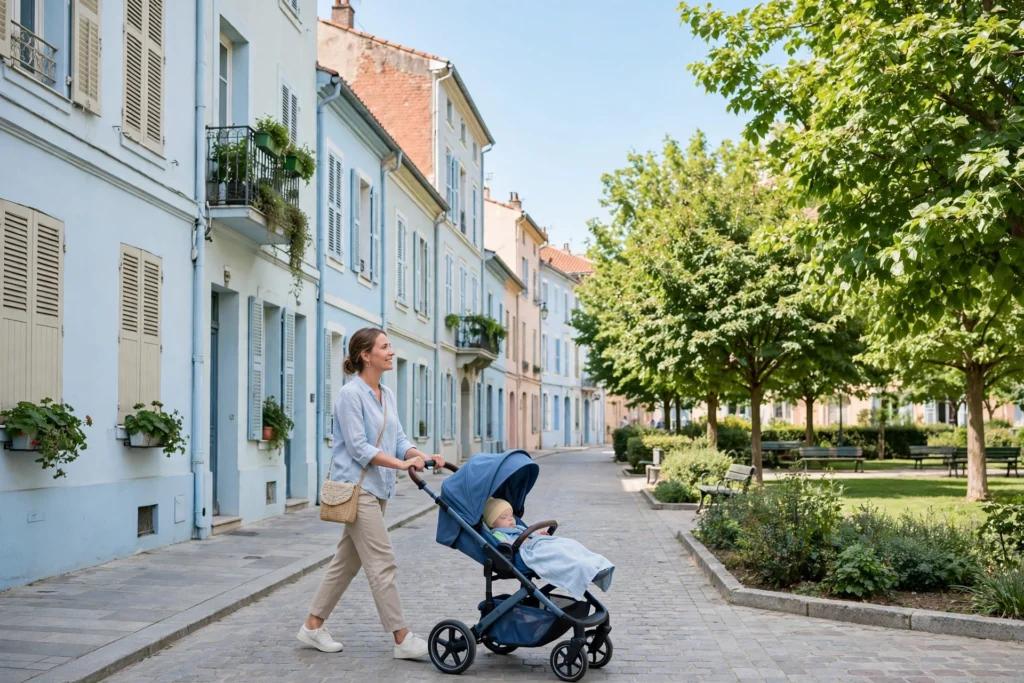
City breaks suit babies better than most parents expect. A city has pavements, cafes, parks, museums with lifts, and a pharmacy on every corner — and a baby in a carrier is welcome almost everywhere. The best baby cities are walkable, have good public transport, and give you a park or a square to stop in every hour or so.
Singapore
Singapore is the most baby-friendly city on this list, and the one with the best healthcare. It is clean, safe, stroller-friendly and almost entirely in English. The metro is step-free, the malls have proper baby-changing rooms and nursing rooms, the Botanic Gardens and Gardens by the Bay give you shade and space, and Sentosa Island is a beach day without leaving the city. The food is a highlight: hawker centres serve rice, noodles, fruit and soup that work well as baby food from 6 months. The flight is long — 18 hours or more from the US — so Singapore suits a baby of 3 months and up on a trip of a week or more. The best months are February to April, the driest stretch. Our Singapore travel guide covers the neighbourhoods, transport and costs in full.
London
London is the easiest European city break with a baby: no language barrier, free museums, parks everywhere, and a culture that is used to babies in pubs, cafes and on the Tube. The practical tips are simple — stay near a park, use the bus more than the Tube (many stations have no lift), and plan one sight a day rather than five. Hyde Park, Regent’s Park and the South Bank give you open space in the middle of the city; the Natural History Museum and the V&A are free, warm and buggy-friendly. The best months are May to June and September, when the weather is mild and the summer crowds have eased. The flight is 7 to 8 hours from the US East Coast, and the time difference is 5 hours — manageable with a baby who naps on schedule.
Lisbon
Lisbon is the warm, compact, affordable European city break. The centre is small enough to walk with a carrier, the food is simple and baby-friendly, and the light and the weather are kind for most of the year — go April to June or September to October for the best of it. The honest catch is the hills: Lisbon is steep, and a stroller is hard work on cobbles and tram lines, so bring a carrier as your main transport and a lightweight stroller for flat areas. Our Lisbon travel guide covers the neighbourhoods and day trips, including the flat, buggy-friendly riverfront at Belem. Cafes are relaxed about babies, restaurants serve grilled fish, rice and soup that suit a baby from 6 months, and the city’s slow pace fits a baby’s day well.
Dubai and Bermuda
Dubai is the modern city-resort hybrid: spotless malls with baby facilities, hotels with kids’ pools and babysitting, a warm winter, and a beach on the doorstep. Go November to March, when the weather is warm rather than brutally hot — summer in Dubai is not a baby trip. The flight is 13 to 14 hours from the US, so it suits a longer trip with a baby of 6 months and up. Bermuda is the opposite in scale: a tiny, tidy Atlantic island two hours from the US East Coast, with pink-sand beaches, a safe and walkable capital in Hamilton, and a rhythm that suits a first trip perfectly. The best months are May to October. Bermuda is expensive, but the flight is so short that the total cost of a long weekend can be lower than a week in a faraway resort — and for a first trip with a baby, short and easy beats far and fancy.
Best Mountain and Nature Destinations With a Baby
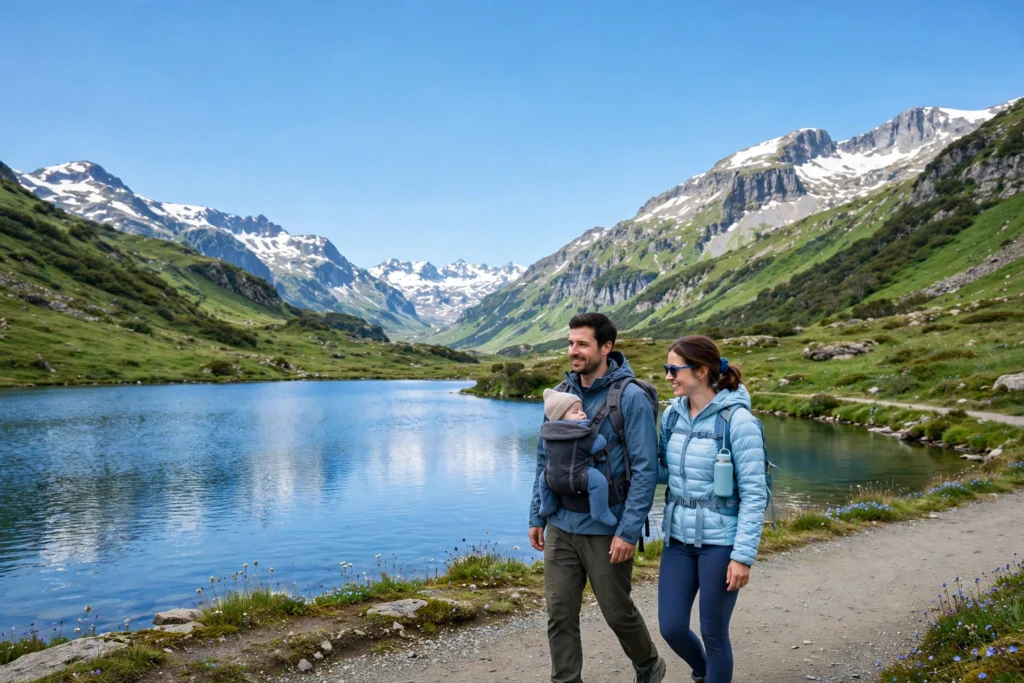
Mountains and nature suit babies from 6 months, when they can sit up, look around and enjoy being outdoors. The rules are different from a beach trip: altitude, weather changes and distance from help matter more than the view. Keep the altitude moderate, keep the drives short, and keep one base.
Switzerland
Switzerland is the easiest mountain trip with a baby: trains run on time, the air is clean, the lakes are calm, and the healthcare is excellent. Base yourself in one lakeside town — Lucerne, Interlaken or Lugano — and do short train and boat trips from there: a lake cruise, a mountain railway, a walk around a flat lakeside path. A baby in a carrier on a lakeside walk is one of the great simple pleasures of travel. Go June to September for warm weather and open mountain transport. The cautions are cost — Switzerland is the most expensive destination on this list — and altitude: keep day trips to moderate heights and watch your baby for fussiness or poor feeding at altitude, and ask your pediatrician before planning a high-mountain trip with a baby under 6 months.
Iceland
Iceland is the nature trip with the shortest flight from the US East Coast — 5 to 6 hours — and it is one of the most rewarding. Base yourself in Reykjavik and do short day trips: the Golden Circle’s waterfalls and geysers, a black-sand beach, a geothermal lagoon, a whale-watching boat. A baby in a warm carrier, with layers and a windproof cover, is fine outdoors in the Icelandic summer. Our Iceland travel itinerary shows how to build a one-base trip with realistic driving times. Go June to August for the mildest weather and the longest days. The cautions are the weather, which changes fast, and the driving: keep drives under two hours a day, and never leave a baby in a car to look at a waterfall — take turns, or carry the baby with you.
Cornwall and Sri Lanka
Cornwall, in south-west England, is the gentle coastal nature trip: sandy beaches, cliff walks with a carrier, fishing villages, and cottage stays with a kitchen and a garden. The flight to London plus a 4- to 5-hour drive or train is the trade-off, but once you are there the days are slow and the distances are short. Go May to September. Sri Lanka is the wilder option: elephants, hill-country trains, and warm beaches in one small island, at prices far below the other destinations on this list. It suits babies 6 months and up, and it needs the most careful health preparation of any destination here — check the CDC page for Sri Lanka, sort malaria precautions for the regions you will visit, and keep the trip to the cultural triangle and the south coast rather than trying to see the whole island. Go December to March for the best weather on the south and west coasts.
Best All-Inclusive Resorts and Easy Beach Resorts With a Baby

Sometimes the right answer is not a destination but a format: a resort where everything is in one place. A good baby resort removes the three hardest parts of travelling with a baby — feeding, sleeping and getting around — and replaces them with a room near the beach, a restaurant that serves food all day, and a cot that is already made up when you arrive.
What makes a resort genuinely baby-friendly is specific, and it is worth checking before you book rather than trusting the word “family-friendly” on a website. Look for: a proper cot provided free, not a playpen; a kitchenette or a fridge and microwave in the room; a kids’ pool with a shallow, shaded area; high chairs in every restaurant; a beach with shade and a gentle entry; a pharmacy or shop within walking distance; and babysitting available for an evening, even if you never use it. Ask the hotel directly by email — “Do you provide a full-size cot, a high chair and a fridge in the room?” — and keep the reply. Resorts that answer clearly are the ones that actually cater to babies.
The best resort trips on this list are the Riviera Maya, Phuket, Mauritius and Florida’s resort coast, all covered above. The pattern that works is the same in each: a direct flight, a transfer under an hour, one resort for the whole stay, and a daily rhythm of morning beach, long nap, late-afternoon pool, early dinner. Book a ground-floor room or one near a lift if you are using a stroller, and a room away from the evening entertainment if your baby sleeps at 7pm. A resort holiday with a baby is not a cheaper holiday — the room with the kitchenette and the beachfront location cost more — but it is a calmer one, and calm is what you are buying.
One warning about resorts: do not book a resort in a destination you have not health-checked. A beautiful resort in a malaria area or a place with unsafe tap water is still in a malaria area with unsafe tap water. Check the CDC destination page, check the water, and pack accordingly. And check the resort’s own reviews from parents of babies, not just the star rating — a five-star resort built for couples is worse for a baby than a three-star resort built for families.
Best Places to Travel With a Baby in the USA (No Passport Needed)
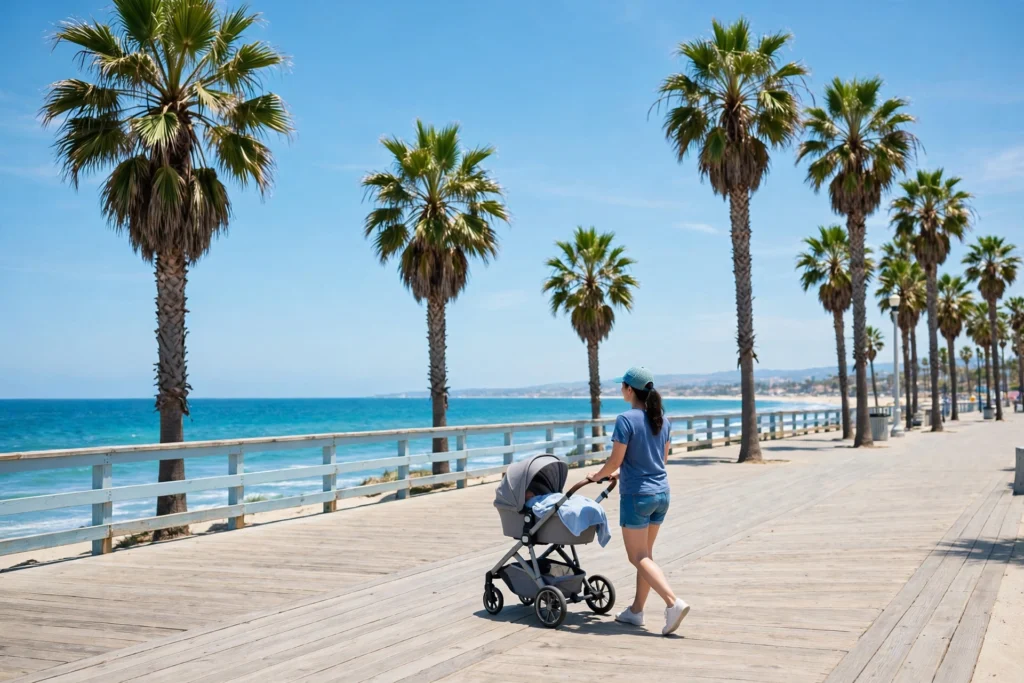
If the passport, the long flight and the health paperwork feel like too much for a first trip, stay in the USA. A domestic first trip is a real holiday, and it lets you learn how your baby travels before you add borders, currencies and time zones. These are the best of them, and they cover every kind of trip in this guide.
Florida is the default first trip: a 2- to 3-hour flight from most of the eastern US, warm weather from November to April, and resorts that have been catering to babies for decades. Orlando for the resorts, the Keys for the slow pace, the Gulf Coast for the calmest beaches.
Hawaii is the special-occasion domestic trip: no passport, excellent hospitals, warm water and a real sense of escape, with a 5- to 6-hour flight from the West Coast and 10 to 11 hours from the East. Maui and Oahu are the easiest islands for a baby.
Southern California (San Diego) is the city-and-beach trip in one: a walkable waterfront, a world-class zoo, calm beaches at La Jolla and Coronado, and mild weather almost all year. The flight is short from the western US, and the city is built for families.
Charleston, South Carolina is the gentle city break: a compact, walkable historic centre, warm weather from March to May and September to November, and beaches at Sullivan’s Island and Folly Beach a short drive away.
The US Virgin Islands (St. Thomas and St. John) are the Caribbean without a passport: US territory, so no passport is needed for US citizens, with calm beaches and a slow pace. St. John is the quieter island and the better baby choice.
Puerto Rico is the same deal on a bigger island: no passport for US citizens, warm weather, beaches, and the rainforest at El Yunque for a gentle day trip. San Juan’s old town is walkable with a carrier.
The practical advantage of a domestic trip goes beyond the passport. Your health insurance works as normal, your phone works as normal, the food and the water are familiar, and if anything goes wrong you are a domestic flight from home. Our guide to places to travel without a passport covers these and more, and our travel itinerary template will help you plan the days around naps rather than around sights. If this is your baby’s very first trip, a domestic trip is the smart choice — and it will make the international trip that follows it much easier.
What Does a Baby Trip Cost? A Realistic Budget Table

A baby does not eat restaurant meals or need a museum ticket, but a baby trip is not a cheap trip. The baby’s costs are hidden: the bigger room with a kitchenette, the baby’s own seat on a long flight, the travel cot hire, the extra luggage, the travel insurance that covers an infant, and the resort or hotel that actually welcomes babies — which is rarely the cheapest one. The table below is a realistic daily budget for a family of two adults and one baby, excluding international flights, for a 7-night trip in the best months. These are planning ranges, not quotes: prices change with season, and a self-catering apartment is always cheaper than a resort. Our guide to how to prepare a travel budget shows how to build the full trip budget around these daily figures.
| Destination | Hotel / apartment per night | Food per day | Transport per day | Activities per day | Total per day (2 adults + baby) |
|---|---|---|---|---|---|
| Florida (Orlando / Keys) | $150–$300 | $60–$100 | $40–$70 (rental car) | $0–$60 | $250–$530 |
| Hawaii (Maui / Oahu) | $250–$450 | $80–$130 | $50–$80 (rental car) | $0–$80 | $380–$740 |
| Riviera Maya, Mexico | $150–$350 (all-inclusive) | Included–$60 | $20–$50 | $0–$50 | $170–$460 |
| Belize (cayes) | $120–$250 | $50–$90 | $20–$40 (golf cart / boat) | $0–$60 | $190–$440 |
| Thailand (Phuket) | $80–$200 | $30–$60 | $15–$30 | $0–$40 | $125–$330 |
| Mauritius | $180–$350 (resort) | $50–$90 | $30–$60 | $0–$50 | $260–$550 |
| Mallorca, Spain | $120–$250 | $50–$90 | $30–$60 (rental car) | $0–$40 | $200–$440 |
| Singapore | $150–$300 | $50–$90 | $15–$30 (metro) | $0–$50 | $215–$470 |
| London, England | $180–$350 | $60–$100 | $20–$35 (bus / Tube) | $0–$40 | $260–$525 |
| Lisbon, Portugal | $100–$220 | $40–$80 | $10–$25 | $0–$30 | $150–$355 |
| Dubai, UAE | $150–$350 | $60–$100 | $20–$40 | $0–$60 | $230–$550 |
| Bermuda | $250–$450 | $80–$120 | $20–$40 (bus / taxi) | $0–$50 | $350–$660 |
| Switzerland | $200–$400 | $70–$120 | $40–$80 (trains) | $0–$60 | $310–$660 |
| Iceland | $180–$350 | $70–$110 | $60–$100 (rental car) | $0–$60 | $310–$620 |
| Cornwall, England | $120–$250 (cottage) | $50–$80 | $30–$50 (car) | $0–$30 | $200–$410 |
| Sri Lanka | $60–$150 | $25–$50 | $20–$40 (driver) | $0–$40 | $105–$280 |
Three ways to keep the cost down without making the trip harder. First, go in shoulder season: May to June and September to October are cheaper and quieter in Europe, and April to June and September to October are cheaper in Hawaii. Second, book an apartment with a kitchen instead of a hotel room — cooking breakfast and warming bottles yourself saves more than any flight deal. Third, fly direct and fly once: a cheap connecting flight that adds four hours and a missed nap costs more in misery than it saves in money. The cheapest baby trip on this list is Sri Lanka or Thailand; the most expensive is Switzerland or Bermuda — but the best-value baby trip for most American families is Florida or the Riviera Maya, where a short flight and a family resort keep both the money and the stress low. For the apps that help you track all of this — flights, stays and spending — see our guide to the best travel apps.
The Baby Travel Packing Checklist: What to Pack and What to Leave
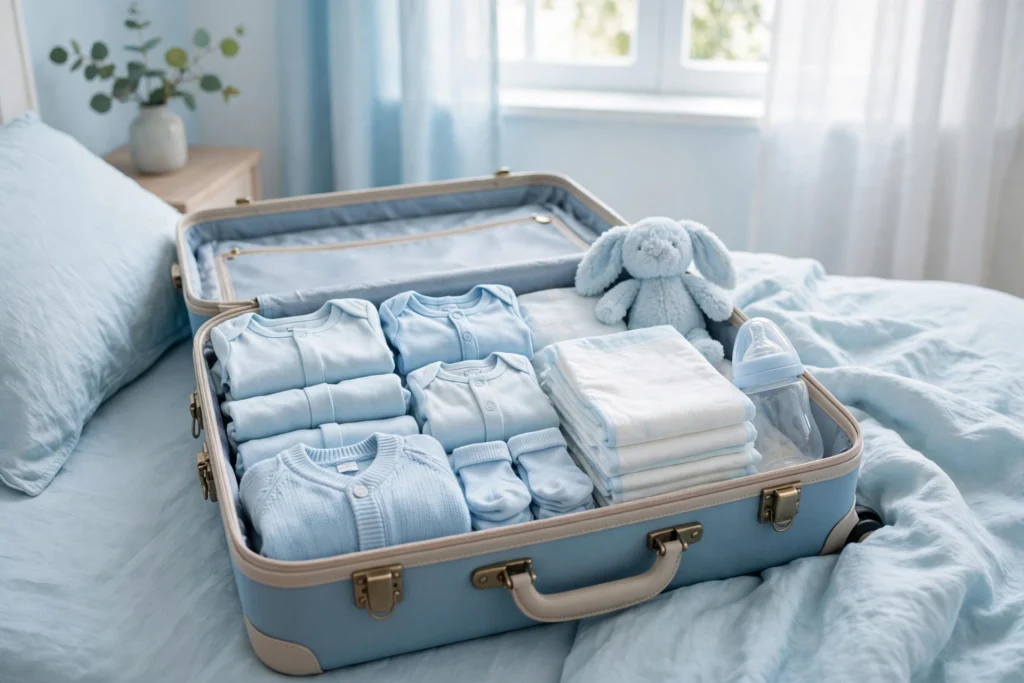
Over-packing is the classic first-trip mistake, and under-packing is the second. The rule is simple: pack for the journey in the carry-on, and pack for the destination in the hold — and buy the bulky things (nappies, formula, baby food) at the destination when you can. The table below is the full checklist; the notes after it explain the choices that matter.
| Category | Pack it | Leave it |
|---|---|---|
| Sleep | Travel cot or request hotel cot, baby’s sleep sack, white-noise app, blackout shade | Full-size cot, baby monitor (use the room’s phone or a travel monitor) |
| Feeding | Formula / food for the journey + 1 day, bottles, bottle brush, bibs, baby spoon, snacks from 6 months | Full week’s formula (buy at destination), blender, steriliser (use hotel kettle + cold-water tablets if needed) |
| Nappies & care | Nappies for the journey + 1 day, wipes, nappy bags, rash cream, thermometer, baby medicines | Full week’s nappies (buy at destination), full medicine cabinet |
| Clothing | 2 outfits per day, sleep suits, sun hat, light layers, swim nappy, baby towel | Too many “just in case” outfits, shoes (babies do not need them) |
| Transport | Lightweight stroller or carrier (or both), car seat if driving or buying a plane seat, sun shade | Heavy travel system, second stroller, car seat base (usually not needed on a plane) |
| Sun & insects | Sun hat, light long-sleeve cover, shade for stroller, mosquito net for cot/carrier, repellent if baby is over 2 months | Sunscreen as the only protection (shade and clothing come first) |
| Documents & health | Passports, birth certificate copy, travel insurance details, pediatrician’s number, health kit | Originals you do not need (leave them at home) |
| Entertainment | 2–3 small toys, a familiar comfort toy, a new quiet toy for the flight, books | Tablet for a baby under 18 months, noisy toys |
The three decisions that matter most are the carrier, the stroller and the car seat. A carrier is the best way to move through airports, old towns and beaches — it keeps your hands free and your baby close, and it works where a stroller cannot. A lightweight, foldable stroller is the best way to move through a city and to give your baby a nap on the go — choose one that folds with one hand and fits in an overhead bin or at the gate. A car seat is needed if you are driving at the destination or buying your baby their own plane seat; if you are not doing either, leave it at home and use the airline’s free checked allowance only if you need it there. The AAP advises that babies 12 months old and younger should only spend two to three hours in a car seat at a time, including on long road trips — so on a driving holiday, stop every two hours, take the baby out, and let them stretch and feed. Check with your pediatrician about car-seat time for your baby.
For the flight, the carry-on nappy bag is the most important bag you pack. It should hold: nappies for the flight plus two spare, wipes, a change of clothes for the baby and for you, formula or milk for the flight plus one spare feed, a bottle or pacifier for takeoff and landing, a small blanket, a familiar toy, and the health kit. Everything else can go in the hold. And remember the golden rule of baby packing: you can buy almost everything at the destination — nappies, wipes, formula, baby food and sun cream are sold everywhere on this list — so do not carry a week’s supply through an airport to save a trip to a supermarket.
Mistakes to Avoid When Travelling With a Baby
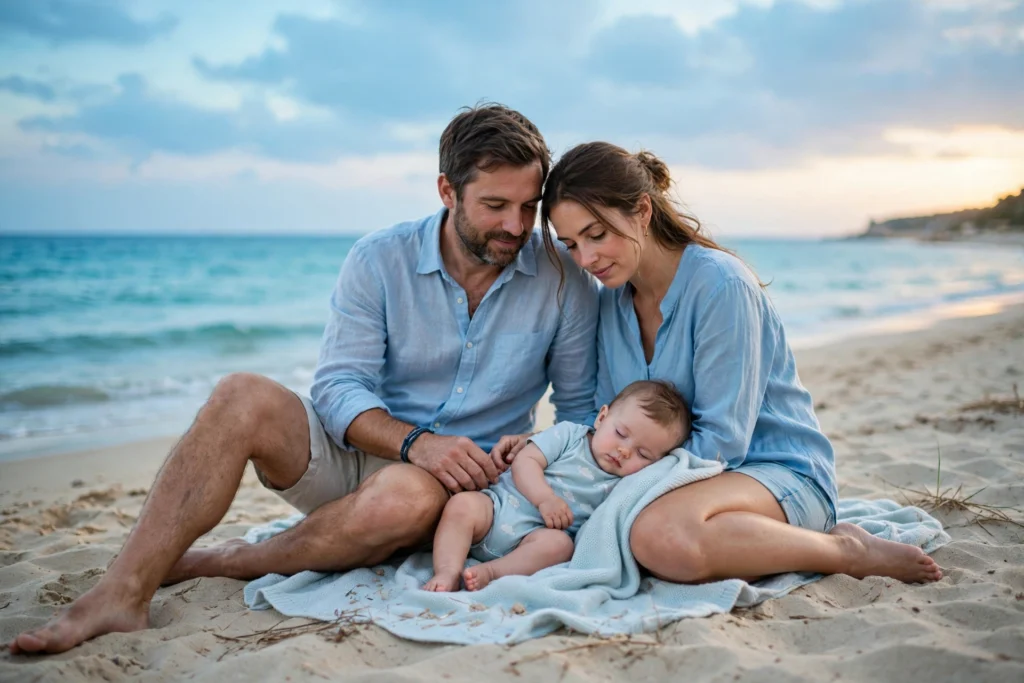
Most baby trips go wrong in the same few ways, and all of them are avoidable. This is the short list of the mistakes experienced parents warn about most.
Packing a sightseeing itinerary instead of a baby’s day. A baby needs a morning outing, a long nap, a gentle afternoon and an early night. Five sights a day, a 7am start and a late dinner will make everyone miserable. Plan one thing a day and let the rest be a bonus.
Choosing the destination for the photos, not the flight. A 17-hour flight to a beautiful beach is a worse first trip than a 3-hour flight to a good beach. Save the long-haul destinations for the second or third trip, when you know how your baby travels.
Forgetting the passport and the paperwork. A baby needs their own passport book for international travel, applied for in person on Form DS-11 with both parents present, valid for 5 years, at $135 with routine processing of 4 to 6 weeks. Apply at least 10 weeks before you travel. The number of families who discover this a month before departure is larger than you would think.
Skipping the pre-travel health visit. The CDC recommends seeing a healthcare provider at least a month before an international trip. That visit covers vaccines — including the early MMR dose for infants 6 to 11 months travelling internationally — malaria precautions, and where to seek care at your destination. It is the single most valuable hour of preparation in this whole guide.
Sunburn and dehydration. Babies burn fast and dehydrate fast. Shade first, clothing second, sunscreen third; keep the baby out of the midday sun; offer feeds often in the heat. The CDC lists sunburn and diarrhoeal illness among the most common problems for child travellers, and both are largely preventable.
The wrong room. A room without a cot, without a fridge, next to the bar, up three flights of stairs with no lift — any one of these can ruin a trip. Email the hotel before you book and confirm the cot, the fridge and the room location in writing.
No plan for illness. Know where the nearest hospital or clinic is before you arrive. Carry your travel insurance details and your pediatrician’s number in your phone. Pack oral rehydration solution and a thermometer. If your baby develops a fever, persistent vomiting, bloody stools or signs of dehydration, seek medical attention — the CDC is explicit that severe dehydration in an infant is a medical emergency.
Trying to do it all. The best baby trips are the slow ones. A week in one place, a beach in the morning, a nap in the afternoon, a walk at sunset — that is the holiday. The sights will still be there when your baby is older, and the trip you actually enjoy is worth more than the trip that looks good on a list.
Frequently Asked Questions About Travelling With a Baby
When can a baby fly for the first time?
The AAP says it is generally safe to fly once a newborn is at least 7 days old, but ideally you wait until 2 to 3 months old. Airlines set their own minimums — American accepts infants from 2 days old, and both American and Delta require a doctor’s letter for a baby under 7 days. Check with your pediatrician first, especially if your baby was premature or has a health condition.
Do babies need a passport to travel?
Yes, for international air travel — every US citizen, including a newborn, needs their own passport book. A baby applies in person on Form DS-11 with both parents present; the passport is valid for 5 years and costs $135 ($100 application fee plus $35 acceptance fee), with routine processing of 4 to 6 weeks. For domestic US flights a lap infant needs no ID, though airlines may ask for proof of age.
What age is easiest to travel with a baby?
Most experienced parents say 3 to 6 months: the baby is feeding on a schedule, happy in a carrier, not yet crawling, and does not need solid food. Newborns under 3 months sleep a lot but need more protection; babies 6 to 12 months are more fun but need solid food, more gear and constant supervision.
Can a baby fly on my lap?
Yes — a child under 2 may fly on an adult’s lap on US airlines, free on domestic flights and typically about 10% of the adult fare internationally. But the FAA says the safest place for a child under 2 is in an approved child restraint in their own seat, not on a lap, because your arms cannot hold a child securely in unexpected turbulence. Only one lap infant is allowed per adult.
Can I request a bassinet on the plane?
On some long-haul widebody flights, yes — Delta, American, United, Alaska and Hawaiian offer bassinets on certain aircraft, usually for babies under about 6 months or 20 pounds who cannot sit up alone. Request one when you book, confirm it before the flight, and book a bulkhead seat. Your baby must come out of the bassinet for takeoff, landing and whenever the seatbelt sign is on.
How do I stop my baby’s ears hurting on a plane?
Feed your baby — breastfeed, offer a bottle or give a pacifier — during takeoff and landing, so they swallow as the pressure changes. If your baby has an active ear infection or had ear surgery in the last two weeks, ask your pediatrician before flying.
What vaccinations does a baby need to travel?
It depends on the destination and your baby’s age. The CDC recommends a pre-travel visit at least a month before an international trip, and notes that infants 6 to 11 months old should get one dose of MMR before international travel. Some travel vaccines cannot be given to very young children, so check with a travel medicine doctor and your pediatrician early.
Is it safe to take a baby to the beach?
Yes, with shade and supervision. Keep babies under 6 months out of direct sun entirely, use a shaded beach umbrella, a hat and light covering, and never leave a baby unsupervised near water — not a pool, not a bath, not a shallow beach edge. Choose calm beaches with a gentle entry and a room close by.
What should I pack for a baby’s first trip?
The carry-on nappy bag matters most: nappies, wipes, a change of clothes for you and the baby, formula or milk, a bottle or pacifier, a blanket and a familiar toy. In the hold: a travel cot or a confirmed hotel cot, a carrier and a lightweight stroller, sun protection, a mosquito net, and a small health kit. Buy nappies, formula and baby food at the destination when you can.
How much does it cost to travel with a baby?
A baby flies free as a lap infant on domestic US flights, but the trip is not free: expect $150–$550 a day for two adults and a baby depending on the destination, with Florida, Lisbon and Thailand at the cheaper end and Hawaii, Bermuda and Switzerland at the expensive end. The biggest hidden costs are the bigger room, the baby’s own plane seat on long flights, and travel insurance that covers your infant.
Should I travel with a baby under 1 year at all?
Yes — under-1s are some of the easiest travel companions, if you pick the right trip. Keep the flight short, stay in one place, build the days around naps and feeds, and choose a destination with good healthcare. The families who enjoy baby travel most are the ones who slow down, not the ones who try to see everything.
What is the best first trip with a baby?
For most American families, Florida or the Riviera Maya: a 2- to 4-hour flight, a beach resort with a cot and a kitchenette, warm weather, and no passport needed for Florida. If you want a city, Lisbon or London; if you want nature, Iceland. All four are covered in full above.
Conclusion: The Best Places to Travel With a Baby Are the Easy Ones
The best places to travel with a baby are not the most exotic places on a map. They are the places where the flight is short, the room has a cot and a fridge, the beach is calm, the city is walkable, the hospital is close, and the days can be slow. Florida, Hawaii, the Riviera Maya, Belize, Thailand, Singapore, London, Lisbon, Switzerland and Iceland all pass that test in their best months — and the other six destinations in this guide pass it too, for the right baby at the right age.
Start close and start slow. A long weekend in Florida or a week in Lisbon will teach you more about travelling with your baby than any guide, including this one — and it will make the long-haul trip that follows it feel easy instead of daunting. Book the passport early, see your pediatrician a month before an international trip, protect your baby from sun and mosquitoes, and build the days around naps and feeds. Do that, and your baby’s first trip will be what it should be: not a test of endurance, but the first of many good holidays together.
If you are still choosing, start with the comparison table at the top of this guide, match a destination to your baby’s age and your flight tolerance, and then read the practical chapters — flying, passports, health, cost and packing — before you book. For help turning the choice into a plan, our travel itinerary template and our guide to how to find travel inspiration are good next steps, and our guide to the best places to travel in January is the place to look if your first trip falls in the winter months.
People also read:
- How to Prepare a Travel Budget
- Places to Travel Without a Passport
- Best Places to Travel in January
- Travel Itinerary Template
- How to Find Travel Inspiration
- Travel Apps

M. Adil is the founder and editor of SoloTravelPro. He writes practical, research-based travel guides that help travellers plan with confidence — from first-time city breaks to national parks and island escapes. Every guide is built on official sources, current prices and honest, usable advice, so readers can plan smarter and travel better.

Other Articles

Best Time to Travel to Chile: A Month-by-Month Guide for Every Region
Is It Safe to Travel to Belize Right Now? An Honest 2026 Guide