Quick Answer
Copenhagen is three or four days of a Denmark trip, not the trip itself. This Denmark travel guide treats the capital as the first base, then moves west by train to Aarhus as the second base, with Odense as a stop on the way rather than a place to unpack twice. Seven days is the sweet spot: three or four nights in Copenhagen with day trips to Roskilde and North Zealand, then two nights in Aarhus, with one of the days given to the white cliffs of Møn or the coast. Ten days adds Billund, more of Funen and the far north around Skagen. Three days works if you stay in Copenhagen and take one day trip — and that is still a good trip, just not the whole country.
Denmark rewards a slower pace more than almost any other country in northern Europe. The distances are short — Copenhagen to Aarhus is under three hours by train — but the pleasure of the place is in the unhurried parts: a morning bike ride through Nørrebro, an afternoon at a harbour bath, a long lunch in a market hall, an evening in Tivoli when the lights come on. The castles and Viking ships are real and worth seeing, but they are not the reason Denmark stays with people. The reason is hygge, the Danish art of cosiness, and a design culture that treats everyday things — a chair, a lamp, a bicycle, a street — as worth doing beautifully. This guide is built around that idea: see the famous sights, then give yourself time to live in the country for a few days.
Everything in this guide was planned around the train. Denmark is one of the few European countries where the train genuinely covers the whole trip: Copenhagen, Roskilde, Odense and Aarhus are all on one fast line, and the coastal day trips run on frequent regional trains. A car only earns its keep in western Jutland, around the Wadden Sea and the far north, where buses thin out. The train times, ticket prices and entry rules below were checked against official sources in late November 2026, and where a price moves with the season — Tivoli’s entry is the big one — this guide says so rather than printing a number that will be wrong by the time you travel.
What this guide does differently from the itineraries it was measured against is the structure. The competing guides all agree on the same skeleton — Copenhagen, then Roskilde, then Odense, then Aarhus — but most of them rush the second half, giving Aarhus a single night and treating Odense as a place to sleep rather than a place to stop. This guide reverses that: Aarhus gets two full days, Odense gets a half-day stop with your bag in a locker, and the cliffs, the coast and the food get the space they deserve. The result is a trip that is longer on the page and slower on the ground, which is exactly the point. Denmark is not a country to be collected; it is a country to be lived in for a week.
The Trip at a Glance: 3, 7 and 10 Days in Denmark
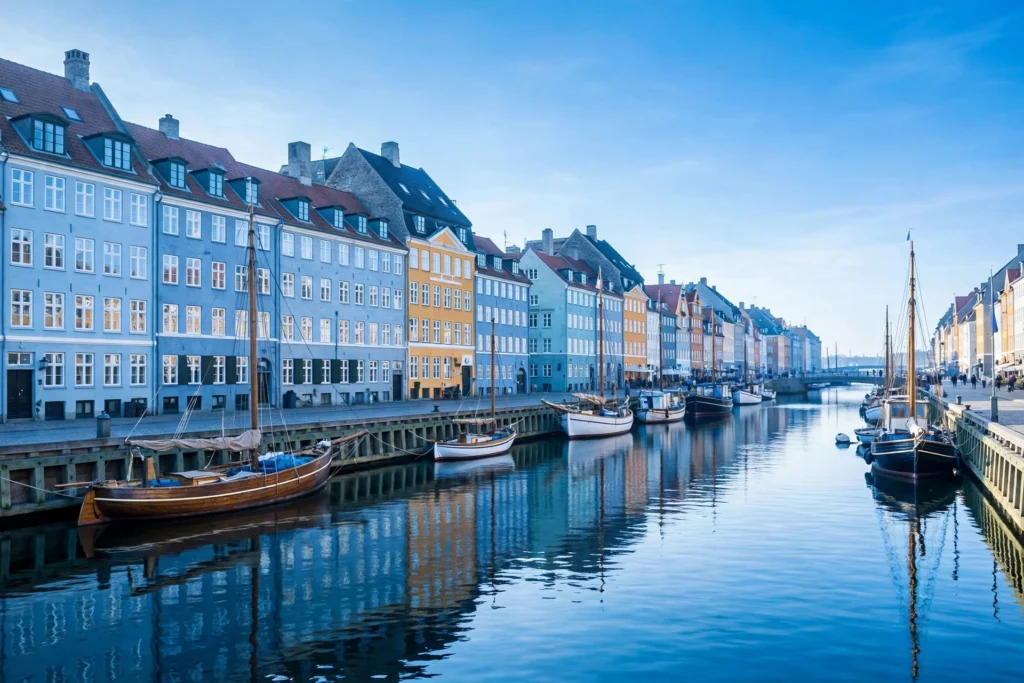
Most Denmark itineraries make the same mistake: they treat Copenhagen as Denmark and everything else as an optional extra. The capital deserves its three or four days — Nyhavn, Tivoli Gardens, Rosenborg Castle, the harbour, the food halls and the cycling streets are the best introduction to the country — but the Denmark that surprises people is the one west of the Great Belt bridge. Aarhus is younger, cheaper and more relaxed than the capital, with two of the best museums in Scandinavia and a Latin Quarter that feels lived in rather than staged. Odense is the fairy-tale town of Hans Christian Andersen, all low yellow cottages and cobbled lanes. Roskilde holds the Viking ships and the cathedral where around forty Danish monarchs are buried. And then there is the coast: white chalk cliffs at Møns Klint, wide sandy beaches on the west coast of Jutland, and Skagen at the very tip of the country, where two seas meet in a visible line.
The structure that works best is two bases. Base one is Copenhagen, for three or four nights, covering the capital and its day trips. Base two is Aarhus, for two or three nights, covering Jutland’s east coast. Odense sits between them on the train line and works as a half-day stop with your bag in a station locker, not as a third base — it is a small, walkable town and a full day there is plenty for most travellers. This two-base shape is what the best competing itineraries converge on, and it is what this guide uses for all three route lengths below. The difference is that this guide does not rush the second base: Aarhus gets two full days, not a single overnight, because Den Gamle By, the ARoS art museum and the Moesgaard Museum each deserve half a day, and the city itself deserves an unhurried evening.
The 3-day route: Copenhagen and one day trip
Three days in Denmark means Copenhagen, and that is fine. Day one is the old city on foot: Nyhavn in the morning before the crowds, the walk up Strøget, Rosenborg Castle and the King’s Garden, and the Round Tower for the view over the rooftops. Day two is for the bike and the water: rent a bike, ride the harbour loop through Christianshavn, take a canal boat, and spend the evening in Tivoli Gardens when the lights come on. Day three is a single day trip — Roskilde for Viking ships and the cathedral, or Helsingør for Kronborg Castle and the Louisiana Museum of Modern Art on the way back. Pick one; trying to do both in a day is how a good trip turns into a checklist. Stay in one hotel near Copenhagen Central Station or Kongens Nytorv so every day starts on foot.
The 7-day route: Copenhagen, then Aarhus (the sweet spot)
Seven days is the length this guide recommends for a first trip, and it is the length most of the best itineraries settle on. Days one to three are Copenhagen, exactly as in the three-day route, with the second day trip added on day three. Day four is the move west: a morning train to Roskilde if you have not been yet, or a direct train to Odense for a half-day stop at the Hans Christian Andersen House and the old town, then on to Aarhus in the late afternoon. Days five and six are Aarhus: Den Gamle By and the Latin Quarter on one day, ARoS and the waterfront on the other, with Moesgaard Museum to the south if you want a third museum. Day seven is the return to Copenhagen for a final night, or a straight run to the airport — the train takes under three hours, so a midday flight is comfortable. This is the route that gives you royal Copenhagen, Viking Roskilde, fairy-tale Odense and modern Aarhus without ever feeling rushed, and it is the route the rest of this guide follows in detail.
The 10-day route: add the coast, Billund and the far north
Ten days lets the trip breathe. Keep the seven-day shape and add three days: one for Billund and Legoland, reached from Aarhus by bus in about an hour, or as a stop on the way back east; one for Møns Klint and Stevns Klint, the white cliffs south of Copenhagen, which need a car or a bus-and-bike combination and a full day; and one for the far north — the train to Skagen, where the Kattegat and the Skagerrak meet at Grenen, the northern tip of the country. With ten days you can also slow the Copenhagen base down to four nights and give North Zealand its own full day instead of squeezing Louisiana and Kronborg into one afternoon. If you have to choose between the extra days, take the cliffs over Skagen in summer and Skagen over the cliffs in winter, when the cliff paths can be muddy and the light is short.
Two bases, not four: where to stay
Denmark is small enough that moving hotels every night is a waste of good travel time. Two bases cover the whole country by train. In Copenhagen, stay near the Central Station for the cheapest rooms and the easiest train mornings, or around Kongens Nytorv and Nyhavn if you want to step out into the old city. In Aarhus, stay near the central station or the Latin Quarter; the city is compact and almost everything is a fifteen-minute walk. Odense, Roskilde, Helsingør and Hillerød are all day trips from Copenhagen by train, so there is no reason to sleep in any of them on a first trip. Billund is the exception: if you are going to Legoland with children, one night there saves a very early start. Book Copenhagen hotels two to three months ahead for May to September, when the city fills up and prices rise; Aarhus is easier, but the weekends around university term dates still book out.
When to go: daylight decides, not temperature
Denmark is a country where the length of the day matters more than the temperature. In June the sun sets after 21:30 and the evenings stretch long enough for a harbour swim after dinner; in December it sets before 16:00 and the trip becomes a museum-and-café trip, which is a perfectly good trip if that is what you plan for. May, June and September are the best months: long days, mild weather, gardens in flower, and the summer crowds not yet at their worst. July is the warmest month and also the busiest, when Danes themselves take their holidays and the coastal summer houses fill up. April and October are the shoulder months — changeable weather, fewer visitors, lower prices, and a real chance of a bright, cold, beautiful day. November to March is the quiet season: short days, grey skies, rain, and the cheapest rooms, but also the Christmas season at Tivoli, which is one of the best reasons to visit Denmark in winter. Whatever month you choose, pack a waterproof jacket and layers; Danish weather changes fast, and the wind off the sea is cold even in June.
| Month | Daylight and weather | Crowds and prices | Best for |
|---|---|---|---|
| April–May | Lengthening days, 10–16°C, changeable | Moderate, prices rising | Gardens, cycling, first warmth |
| June | Longest days, sunset after 21:30, 15–22°C | Busy, high season begins | Everything, especially the coast |
| July–August | Warmest, 17–23°C, occasional rain | Peak crowds and prices | Harbour swimming, festivals, Tivoli |
| September | Mild, 13–19°C, golden light | Easing, good value | Cycling, museums, fewer queues |
| October | Shorter days, 8–13°C, autumn colour | Quiet, cheaper rooms | Halloween at Tivoli, city breaks |
| November–March | Short days, 0–7°C, rain and wind | Quietest, cheapest | Christmas at Tivoli, hygge, museums |
What a Denmark trip costs
Denmark is expensive, and it is better to know that before you go than to discover it over a restaurant bill. The official tourist board, Visit Copenhagen, published daily budget bands in September 2026 that are the most honest figures available: around DKK 700 a day on a tight budget, with a hostel bed, inexpensive food and mainly free experiences; around DKK 1,800 a day for a mid-range trip, including accommodation, restaurant meals, public transport and paid attractions; and around DKK 4,500 a day for a luxury stay. Those figures include accommodation but not the flight to Denmark. In euros, at the krone’s fixed rate of about 7.46 to the euro, that is roughly €94, €241 and €603 a day. The often-quoted figure of $150–200 a day for Copenhagen sits between the tight and mid-range bands: it is achievable if you stay in a hostel, eat at market halls and bakeries, and pick your paid sights carefully, but a comfortable mid-range trip with a hotel room and restaurant dinners runs closer to $240–260 a day. The single biggest lever on your budget is where you sleep — hostel beds start from around DKK 145 a night, while the average Copenhagen hotel room costs about DKK 1,255 a day — and the second is food, where a bakery lunch costs a fraction of a sit-down dinner.
| Daily cost | Tight budget | Mid-range | Comfortable |
|---|---|---|---|
| Accommodation | Hostel bed from DKK 145 | Mid-range hotel, about DKK 1,255 | Boutique or luxury hotel, DKK 2,500+ |
| Food and drink | Bakeries and market halls, about DKK 250 | Café lunch and restaurant dinner, about DKK 550 | Restaurant meals, DKK 900+ |
| Transport | City Pass or bike, about DKK 100 | City Pass and one train, about DKK 200 | Taxis and trains, DKK 300+ |
| Sights | Free sights and one museum, about DKK 100 | Two paid sights, about DKK 300 | Three paid sights, about DKK 450 |
| Total per day | About DKK 700 (€94) | About DKK 1,800 (€241) | About DKK 4,500 (€603) |
These are Visit Copenhagen’s published bands, updated September 2026, and they match what independent budget checks found in October 2026. A few prices to keep in your head: a cappuccino costs DKK 45–55, a draught beer DKK 55–65, a meal at an inexpensive restaurant DKK 140–160, and a three-course meal at a mid-range restaurant DKK 350–450 per person, excluding drinks. A single journey on Copenhagen public transport starts at DKK 24. Denmark uses the krone, not the euro, and cards work almost everywhere — buses, bakeries and market stalls included — so you can travel with almost no cash. If you are used to southern European prices, the food bill will be the shock; if you are used to London or New York, it will feel familiar.
| Trip length | Tight budget | Mid-range | Comfortable |
|---|---|---|---|
| 3 days in Copenhagen | About DKK 2,100 (€281) | About DKK 5,400 (€724) | About DKK 13,500 (€1,809) |
| 7 days, two bases | About DKK 4,900 (€657) | About DKK 12,600 (€1,689) | About DKK 31,500 (€4,223) |
| 10 days, full country | About DKK 7,000 (€938) | About DKK 18,000 (€2,413) | About DKK 45,000 (€6,032) |
Totals exclude international flights and are per person, based on the daily bands above. Two people sharing a hotel room cut the mid-range daily figure by roughly a quarter each.
Is Denmark safe, and what do you need to enter?
Denmark is one of the safest countries in Europe for violent crime, and the risks a visitor actually faces are petty theft, bicycle accidents and the weather. The US State Department rates Denmark Level 2, “Exercise Increased Caution”, because of terrorism — the advisory was reissued at Level 2 on 23 November 2026, with the level unchanged — and the UK advises normal precautions. Read that in context: Level 2 is the same rating the US gives to much of western Europe, and it reflects a general terrorism risk, not a specific threat to tourists. The practical advice is the same as in any European capital: stay aware in crowded places, keep your bag closed on public transport, and follow police instructions if you ever see a cordon. Cycling is the one safety issue that catches visitors out: Copenhagen’s bike lanes are roads, they move faster than they look, and stepping into one while leaving a bus is the classic visitor mistake.
Denmark is in the Schengen Area. EU, EEA and Swiss citizens travel visa-free, and many other nationalities — including US, Canadian, Australian and British passport holders — can enter visa-free for short stays of up to 90 days in any 180-day period. Since 10 April 2026 the EU’s Entry/Exit System has been running at external borders, which means non-EU visitors give fingerprints and a photograph at the border on their first entry, and arrival can be slower than it used to be. ETIAS, the new online travel authorisation for visa-exempt visitors, is not in operation as of November 2026: the EU dropped its late-2026 launch target in July 2026 and has not announced a new start date, with 2027 the earliest realistic expectation. There is nothing to apply for yet, and any website offering to sell you an ETIAS authorisation today is not legitimate. Check the official EU ETIAS page before you travel, because the start date will be announced several months in advance. Your passport should be valid for at least three months beyond your planned departure from Schengen, and the emergency number in Denmark is 112.
Copenhagen in Three or Four Days
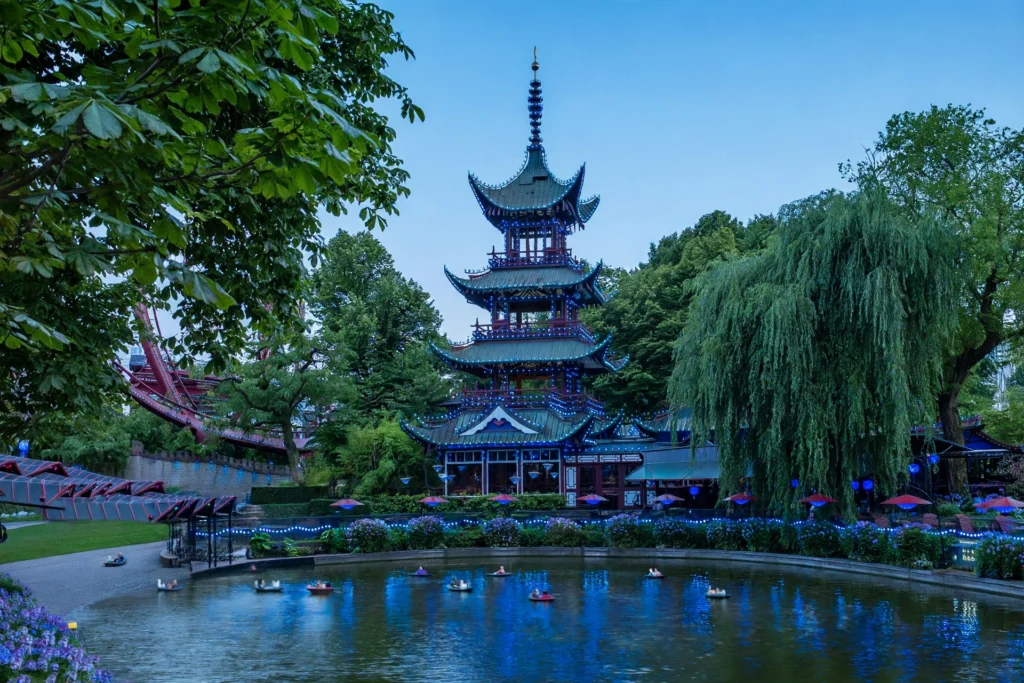
Copenhagen is a small capital — about 6 million people live in the whole of Denmark, and the capital region holds roughly a third of them — and that smallness is its charm. The historic centre is walkable end to end in half an hour, the harbour is clean enough to swim in, and the city has spent twenty years turning its industrial waterfront into public space: harbour baths, swimming platforms, and promenades where people sit with their feet in the water on a summer evening. Three days is the right allocation for a first visit. Two days leaves you rushing between the famous sights and missing the city itself; five days is lovely but better spent with one of them given to North Zealand.
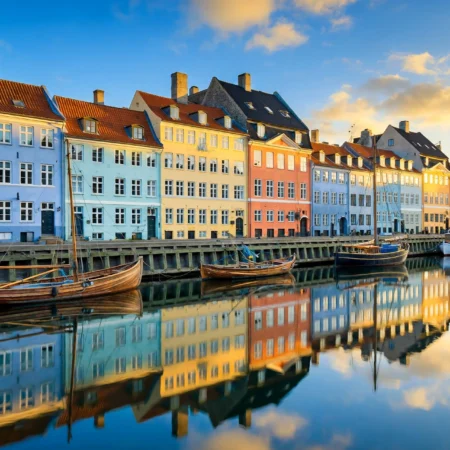
Day one is the old city on foot. Start at Nyhavn in the morning, before the tour groups arrive, when the coloured townhouses along the canal catch the light and the cafés are just opening. Walk up Strøget, the long pedestrian shopping street, to the Round Tower, and climb it for the view over the copper roofs. Rosenborg Castle and the King’s Garden are a short walk north, and the crown jewels in the castle treasury are the single most impressive royal sight in the city. In the afternoon, cross to Christiansborg Palace — the seat of the Danish parliament, with its tower open for one of the best free views in the city — and finish at Amalienborg Palace for the changing of the guard at noon if your timing allows. Eat in Torvehallerne, the covered food market near Nørreport station, where a Danish open sandwich, smørrebrød, costs a fraction of a restaurant meal and tastes better.
Day two belongs to the bike and the water. Rent a bike — the city has more bicycles than people, and the lanes are wide, flat and separated from traffic — and ride the harbour loop: from the centre across the Inderhavnsbroen bridge to Christianshavn, along the canals to the Church of Our Saviour with its spiral spire, and back through the Meatpacking District, Kødbyen, where old slaughterhouses are now restaurants and bars. A canal boat tour in the afternoon shows you the city from the water and passes the Little Mermaid statue, which is smaller than you expect and best seen from a boat rather than fought over from the shore. The evening is for Tivoli Gardens, the pleasure gardens in the centre of the city, which opened in 1843 and are at their best after dark when the lights come on.
Day three is your first day trip, and day four — if you have it — is the second. Roskilde and North Zealand are both within an hour by train, and they are covered in detail later in this guide. A fourth day in the city itself is best spent in the neighbourhoods: Nørrebro for its multicultural streets and the Superkilen park, Vesterbro for its cafés and the Meatpacking District by day, and the Design Museum and the National Museum for the two indoor days if the weather turns. The National Museum’s Viking and prehistory galleries are the best in the country, and the Design Museum explains why Danish chairs cost as much as they do.
Where the money goes in Copenhagen
Copenhagen is the most expensive part of Denmark, and the card question is worth settling before you arrive. The Copenhagen Card Discover costs DKK 589 for 24 hours, DKK 859 for 48 hours and DKK 1,039 for 72 hours for an adult, with longer versions up to 120 hours at DKK 1,419, according to the official card website in November 2026. It covers unlimited public transport across the whole capital region, including the airport and the regional trains to North Zealand, plus free entry to more than 80 attractions, including Rosenborg Castle, Tivoli Gardens and the canal tours. It pays for itself if you visit three or four paid sights a day and use it for a day trip on the train; it loses money if you mostly walk the centre and visit one museum. Do the arithmetic for your own days: add up the gate prices of the sights you actually plan to visit, add the transport you would otherwise buy, and compare. If you are not buying the card, the City Pass Small covers central Copenhagen and the airport for about DKK 100 a day, and a single journey starts at DKK 24.
Eating in Copenhagen: from smørrebrød to New Nordic
Copenhagen’s food scene is one of the best in Europe, and it works at every price. At the cheap end, a bakery sells a cinnamon roll or a cardamom bun for the price of a coffee, and a smørrebrød — rye bread with pickled herring, roast pork or smoked salmon — is a complete lunch for around DKK 100–150 at a market hall. Torvehallerne and the street-food halls are where most visitors should eat most meals: the quality is high, the prices are honest, and you can try five different things in one visit. At the middle, the city’s bistros and the Meatpacking District restaurants serve modern Danish cooking — seasonal, vegetable-forward, with excellent seafood — for DKK 350–450 for a main course. At the top, Copenhagen holds more Michelin-starred restaurants than any other Nordic city, and the New Nordic cooking that started here has shaped restaurants around the world. Book the famous tables weeks ahead in summer; for everything else, walk in at lunch, when many good restaurants serve a cheaper set menu. And drink the tap water — it is excellent, and restaurants will happily refill your bottle.
Hygge and Danish design: the idea behind the trip
Hygge is the Danish word visitors hear most and understand least. It is not a product and it is not a candle — it is the feeling of cosiness and contentment that Danes build into ordinary life: a lit candle on a winter afternoon, a long lunch with friends, a warm room when it is raining outside. You will feel it most in the city’s cafés in November, in the low light of a bakery at 16:00, and in the way Danes sit outside with blankets on the first mild evening of spring. Danish design is the visible half of the same idea: furniture, lighting and everyday objects made simply, from good materials, to be used for decades. The Design Museum in Copenhagen tells the story, but you will see it better by walking through the city — in the chairs in the cafés, the lamps in the windows, the bicycles parked in rows outside the station. This is the part of Denmark that no checklist of castles captures, and it is the reason this guide keeps telling you to slow down. Give the city an unhurried evening, sit in a café with a coffee and a pastry, and watch the light change over the harbour. That is the trip working as intended.
Christmas in Denmark: Tivoli and the December city
December is the one winter month when Denmark is at its best rather than merely bearable. Tivoli’s Christmas season runs from 13 November 2026 to 3 January 2027, and it is the only Christmas market in Copenhagen that charges admission — which is also why it is the best one. The gardens fill with millions of lights, the stalls sell gløgg, the spiced mulled wine, and roasted almonds, and the Snow Queen ballet plays in the concert hall. The park is closed on Christmas Eve, 24 December, every year without exception, and the weekends in December are very busy, so go on a weekday if you can. Entry is dynamic-priced: in the Christmas season, adult entry costs from DKK 210 Monday to Thursday and DKK 230 Friday to Sunday, with an entry-plus-ride pass from DKK 419. Outside Tivoli, the city’s own Christmas markets — at Nyhavn, at Højbro Plads and at Kongens Nytorv — are free, smaller and more local, and the bakeries fill with pebernødder, the small spiced biscuits that are the taste of a Danish Christmas. The light is short in December, with sunset before 16:00, but the city compensates with candles: every café, shop and home seems to have one lit, and the darkness is part of the atmosphere rather than a drawback. If you are choosing between a November trip and a December one, take December, book your hotel early, and plan your days around the indoor sights — the museums, the food halls and the cafés — with Tivoli as the evening.
The National Museum and the Design Museum
Two museums in Copenhagen deserve a half-day each, and they are the ones visitors most often skip in favour of another palace. The National Museum, a short walk from Christiansborg, holds the best Viking and prehistory galleries in the country: the Trundholm Sun Chariot, a Bronze Age masterpiece of gold and bronze; the Viking hoards and weapons; and the bog bodies, including the Grauballe Man’s counterparts, preserved by the peat for two thousand years. The museum’s Danish history galleries run from the Stone Age to the present day, and the children’s Viking section is one of the best in Europe. It is the museum that makes the rest of the trip make sense — after you have seen the Viking ships at Roskilde and the runestones at Jelling, the National Museum ties the whole story together. The Design Museum, on the other hand, explains why Danish chairs cost as much as they do. Set in a former royal hospital near Amalienborg, it traces Danish design from the eighteenth century to the present: the chairs of Arne Jacobsen and Hans Wegner, the lamps of Poul Henningsen, the silver of Georg Jensen, and the posters and textiles that made Danish design a global export. It is a quiet, beautiful museum, and it is the best preparation for walking through the city afterwards, when you start noticing the chairs in the cafés, the lamps in the windows and the bicycles parked in rows outside the station. Both museums are covered by the Copenhagen Card, and both are at their quietest on weekday mornings.
Cycling Copenhagen: The City on Two Wheels
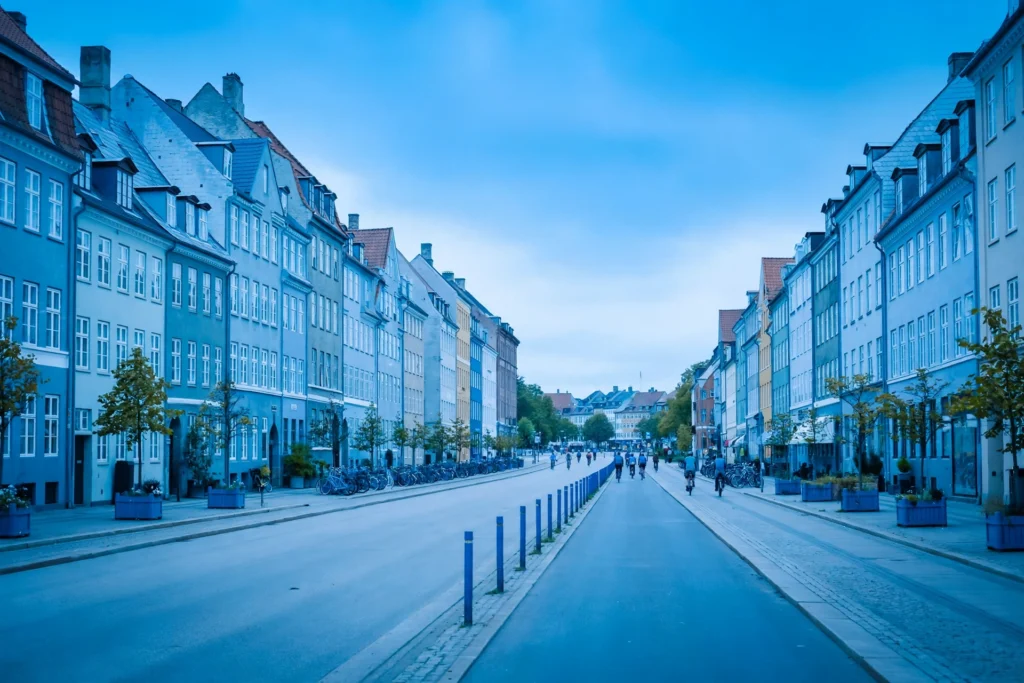
Copenhagen is the most bicycle-friendly city in the world, and seeing it by bike is not a novelty activity — it is how the city actually works. Roughly half of all commutes in the capital are made by bicycle, and the infrastructure is built for it: wide, separated lanes, bicycle bridges over the harbour, traffic lights timed for cyclists, and footrests and rails at junctions so you never have to put a foot down. For a visitor, a bike turns Copenhagen from a walkable city into a small one. Nyhavn to the Little Mermaid is a ten-minute ride; the centre to the beach at Amager Strandpark is twenty minutes; the harbour loop through Christianshavn and back takes an hour at a dawdling pace. Rent from a bike shop rather than a dockless scheme if you want a proper city bike with gears and a basket, and budget around DKK 100–150 a day, less for multi-day rental.
The rules are simple and worth learning before you set off. Stay in the bike lane, never on the pavement and never in the road with the cars. Signal with your hand before you turn, and look over your shoulder before you move out to overtake. Do not stop in the middle of the lane — pull over to the side. Ring your bell early and politely. And never, ever walk in a bike lane: it is a road, it moves faster than it looks, and stepping into one while leaving a bus is the classic visitor mistake, repeated daily. Copenhagen’s cyclists are fast and silent, and they expect you to behave like a cyclist, not a pedestrian on wheels.
The best rides are the ones that follow the water. The harbour loop starts at Nyhavn, crosses the Inderhavnsbroen bridge to Christianshavn, follows the canal past the Church of Our Saviour, and returns across the Bryggebroen bridge past the harbour baths. The lakes route runs along the three Sortedam lakes through Nørrebro, where the city feels younger and more everyday. And the ride out to Amager Strandpark takes you to a proper sandy beach with a view back across the water to the city, and to the modern architecture of Ørestad on the way. In summer, add a swim: the harbour baths at Islands Brygge are free, the water is clean, and on a warm evening half the city seems to be in it. Denmark’s cycling culture is also the reason the countryside sections of this guide work by bike — Funen and Bornholm in particular are built for slow cycling between villages — and if you enjoy the Copenhagen rides, consider renting a bike for a day in Aarhus or Odense too.
Palaces, Castles and the Royal Story
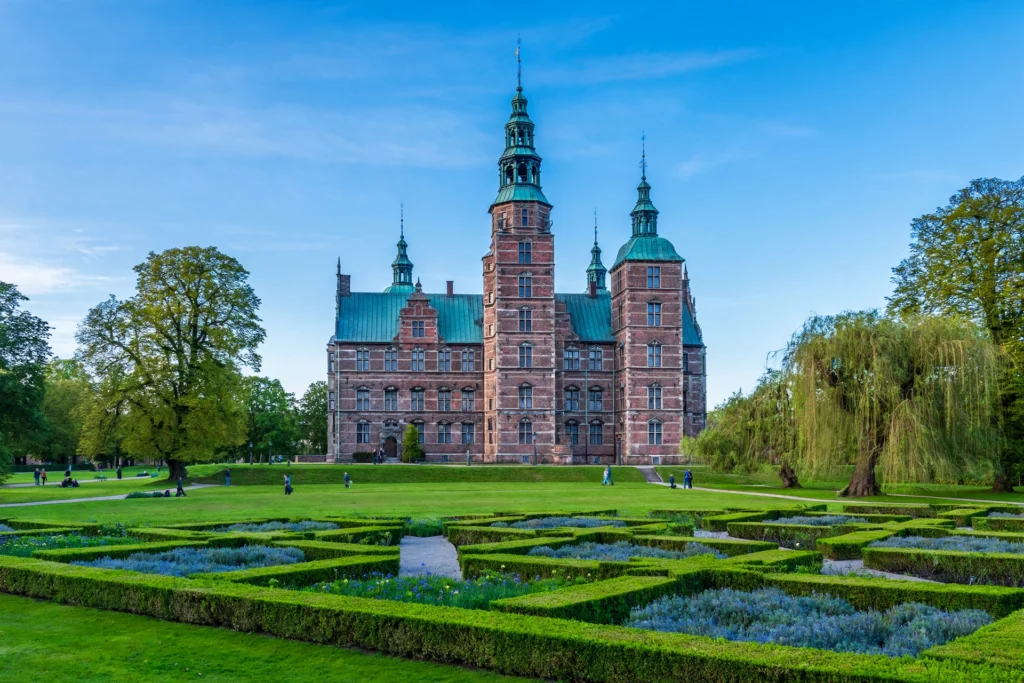
Denmark is a monarchy, and the royal story is woven through the capital in a way that is easy to follow on foot. King Frederik X has been head of state since 14 January 2024, when Queen Margrethe II abdicated, and the royal family still uses Amalienborg Palace in the centre of Copenhagen as its winter residence. The four identical palaces around the octagonal square at Amalienborg are the ceremonial heart of the monarchy: the changing of the guard takes place at noon, the museum in one of the palaces tells the story of the modern royal family, and on a clear day the square frames the Marble Church and the harbour in a single view.
Rosenborg Castle, a short walk away, is the more rewarding visit. Built in the early seventeenth century as a royal summer house, it is a red-brick Renaissance castle with green copper spires, set in the King’s Garden, the oldest royal garden in the country. Inside are the crown jewels and the royal regalia, displayed in the treasury in the basement, and rooms that have barely changed since the kings who lived in them. The castle is covered by the Copenhagen Card, and it is worth going early in the day before the tour groups arrive. Christiansborg Palace, on the island of Slotsholmen, is the third palace in the triangle: it houses the Danish parliament, the prime minister’s office and the supreme court, and its tower is the tallest in the city, open to the public for one of the best free views in Copenhagen. The Royal Reception Rooms, with their tapestries and great hall, are the grandest interiors in the country.
The royal story continues beyond the capital, and it is the thread that ties the day trips together. Roskilde Cathedral holds the tombs of around forty Danish monarchs. Frederiksborg Castle in Hillerød is the grandest Renaissance palace in Scandinavia, built by the same king who built Rosenborg. Kronborg Castle in Helsingør guarded the narrow strait between Denmark and Sweden and collected the tolls that made the kings rich. Visit the three palaces in the capital first, then the three outside it, and you will have followed the monarchy from its ceremonial home to its tombs, its pleasure palace and its fortress — which is a better way to understand Denmark than any single museum.
| Palace or castle | Where | What it is | Time needed |
|---|---|---|---|
| Amalienborg Palace | Central Copenhagen | Royal residence, changing of the guard at noon | 1 hour |
| Rosenborg Castle | King’s Garden, Copenhagen | Renaissance castle, crown jewels | 2 hours |
| Christiansborg Palace | Slotsholmen, Copenhagen | Parliament, tower, reception rooms | 2 hours |
| Roskilde Cathedral | Roskilde, 25 minutes by train | Royal tombs, UNESCO site | 1 hour |
| Frederiksborg Castle | Hillerød, 40 minutes by train | Grand Renaissance palace on a lake | 2–3 hours |
| Kronborg Castle | Helsingør, 45 minutes by train | Hamlet’s Elsinore, sea fortress | 2 hours |
The Little Mermaid and the harbour walk
The Little Mermaid is the most famous statue in Denmark and the most disappointing sight for visitors who walk to it expecting grandeur. It is small — a little over a metre tall — and it sits on a rock at the water’s edge at Langelinie, a twenty-minute walk from the city centre. The right way to see it is from the water, on a canal boat tour, where it appears as it was meant to be seen: a small, quiet figure on the rocks, with the harbour behind her. The walk out to the statue is still worth doing once, because the route along the harbour passes the Kastellet, the star-shaped fortress that is one of the best-preserved in northern Europe and a pleasant green space for a walk, and the Gefion Fountain, the great bronze fountain of the goddess Gefion ploughing Zealand out of Sweden with her four oxen. The fountain’s story is the founding myth of Zealand itself — Gefion was promised as much land as she could plough in a night, so she turned her four sons into oxen and ploughed the island out of Sweden — and it is the kind of story that makes the city’s statues worth stopping for. See the Mermaid from a boat, walk the Kastellet, and spend the time you saved in the Design Museum instead.
Roskilde: Vikings and Royal Tombs
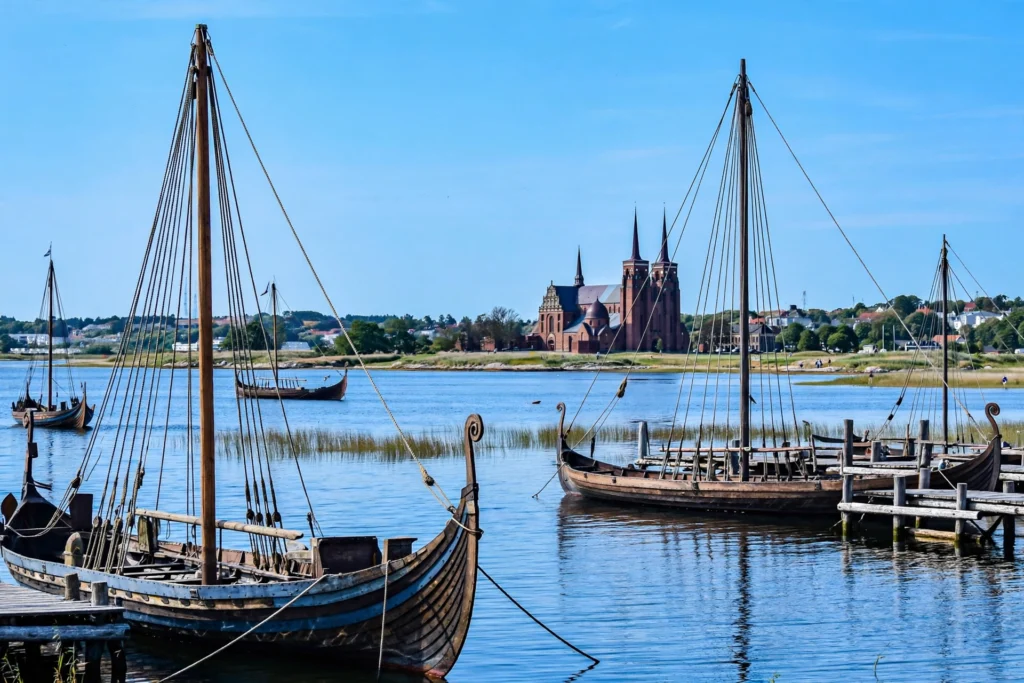
Roskilde is the easiest day trip from Copenhagen and the one that changes your picture of Denmark most. The train from Copenhagen Central Station takes about 25 minutes, and the walk from the station down through the old town to the fjord takes another fifteen. What you find is a small, quiet city that was once the capital of Denmark and the seat of its kings, and that still holds the two things that matter most to Danish history: the Viking ships and the royal tombs.
The Viking Ship Museum sits on the shore of Roskilde Fjord, and it is built around five Viking ships that were deliberately sunk around 1070 to block a channel, then excavated from the fjord bed in the 1960s. The ships are displayed in a hall with the water behind them, and the museum’s boatyard builds reconstructions using Viking tools and techniques — on a good day you can watch a shipwright at work and, in summer, sail out on a reconstructed Viking ship yourself. The museum makes the Viking age feel practical rather than mythical: these were working ships, built for cargo and war, and the people who sailed them were traders and settlers as much as raiders. Allow two hours, and walk the fjord path afterwards for the view back to the town.
Roskilde Cathedral is a five-minute walk uphill from the museum, and it is the other half of the day. The cathedral is a UNESCO World Heritage Site, a great brick Gothic church where around forty Danish kings and queens are buried, from the Middle Ages to the present day. The tombs are not in a crypt you hurry through — they are chapels and monuments spread through the building, each one a piece of Danish history in stone and marble. The cathedral is still a working church, so visit outside service times and give it an hour. Between the museum and the cathedral, stop for lunch in the old town: the pedestrian streets around the cathedral square have bakeries and cafés that are cheaper and quieter than anything in Copenhagen, and the town’s market square on a Saturday morning is one of the most Danish scenes in the country.
Roskilde also works as a stop rather than a day trip. On the seven-day route in this guide, the move west to Aarhus passes through Roskilde, and a morning there — museum, cathedral, lunch — followed by an afternoon train to Odense and on to Aarhus is the most efficient use of a travel day in Denmark. The station has luggage lockers, and the walk from the station to the fjord is flat and easy with a bag. If you do it this way, buy your train tickets as two separate legs, Copenhagen to Roskilde and Roskilde to Aarhus, so you can choose how long the stop lasts. One more tip for the fjord: the sailing trips on the reconstructed Viking ships run in the summer season and book out on sunny weekends, so reserve ahead if you want to be on the water rather than just looking at it. And if you are travelling with children, the museum’s boatyard — where you can try Viking rope-making, woodwork and sailing knots — will hold their attention far longer than the cathedral will.
Practical details for Roskilde
The train from Copenhagen runs several times an hour and takes about 25 minutes. The Viking Ship Museum and the cathedral are both covered by the Copenhagen Card’s regional transport, and the card also covers entry to the cathedral. The museum’s adult entry is around DKK 160 in summer and less in winter, with the sailing trips extra in the summer season. Both sights are closed on some Mondays in winter, so check the day before you go. The fjord path is a pleasant walk in any weather, but it is exposed to the wind, so bring a layer even on a warm day.
Frederiksborg Castle and North Zealand
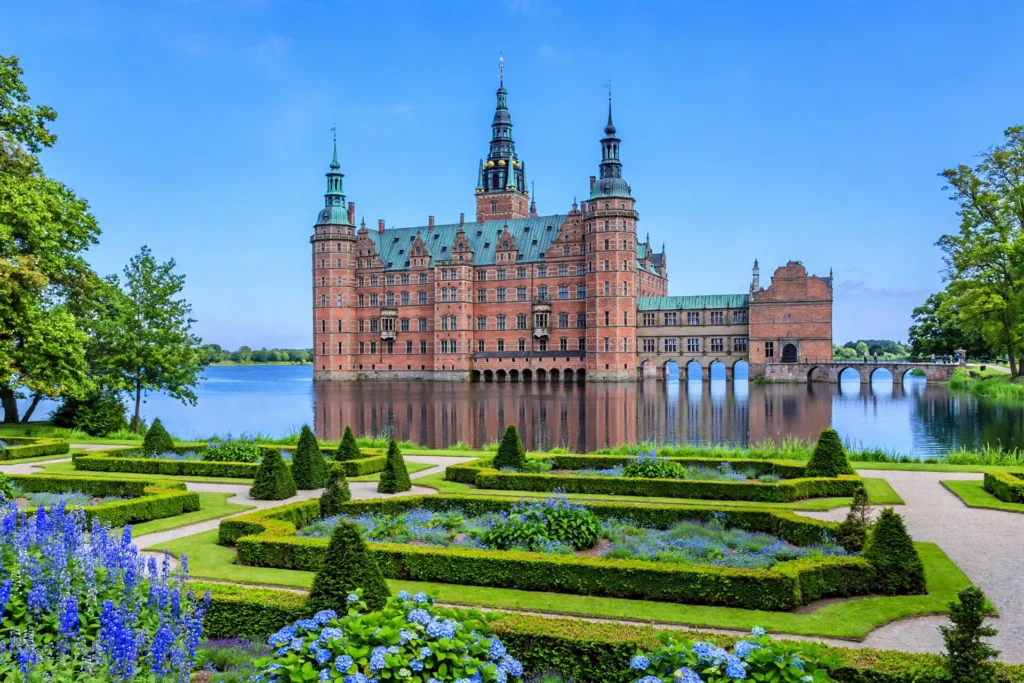
North Zealand is Copenhagen’s favourite day-trip belt, and Frederiksborg Castle is its centrepiece. The train from Copenhagen Central Station to Hillerød takes about 40 minutes, and the castle is a ten-minute walk from the station through the town. What you find is the grandest Renaissance palace in Scandinavia: a red-brick castle with copper spires, built on three small islands in a lake, with formal Baroque gardens on the far shore. It was built by King Christian IV, the same king who built Rosenborg, and it was meant to impress — and it still does. Inside is the Museum of National History, with portraits and paintings that tell the story of Denmark from the Reformation to the present day, and the castle chapel, where Danish kings were crowned, with its great organ and carved woodwork.
Give Frederiksborg a full morning. Walk the gardens first, when the light is good and the crowds are thin, then cross the bridge into the castle and work through the great hall, the chapel and the portrait galleries. The castle café serves lunch in the old kitchen wing, and the walk back through Hillerød’s old streets is worth the detour. If you have the afternoon, the Louisiana Museum of Modern Art is a 25-minute train ride north at Humlebæk, on the coast of the Øresund strait. Louisiana is one of the finest modern art museums in Europe, set in a park above the sea with sculptures on the lawns and a view across the water to Sweden. It is the single best day trip from Copenhagen for anyone who likes modern art, and it pairs naturally with Frederiksborg: castle in the morning, modern art in the afternoon, dinner back in the city.
North Zealand’s coast is worth a slow drive or a bike ride if you have a second day. The fishing villages along the Øresund — Hornbæk, Gilleleje, Tisvildeleje — are small, whitewashed and quiet outside July, with sandy beaches and smokehouses selling fresh fish. The beech forests of Gribskov, north of Hillerød, are at their best in May, when the forest floor is covered in wild garlic and wood anemones, and the deer park at Dyrehaven, north of Copenhagen, is the oldest amusement park in the world in miniature — Bakken, running since 1583, sits inside it, and the deer roam free among the trees. These are the places Copenhageners go on a Sunday, and they are the Denmark that most visitors never see.
Kronborg Castle and Helsingør
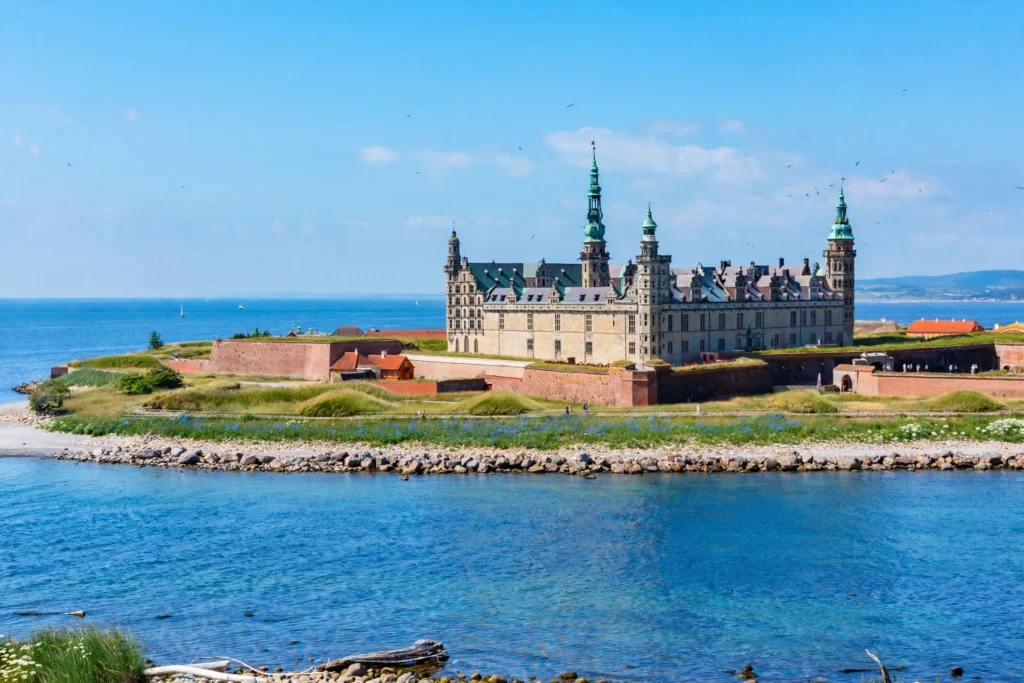
Kronborg Castle stands at the narrowest point of the Øresund, the strait between Denmark and Sweden, and for three hundred years it was the toll booth of northern Europe. Every ship that passed between the Baltic and the North Sea paid the Sound Dues to the Danish king, and the castle’s guns made sure they did. Shakespeare set Hamlet here — Elsinore is the English name for Helsingør — and the castle leans into the connection with performances in the courtyard in summer, but the real story is the tolls, the trade and the fortress itself. The train from Copenhagen Central Station to Helsingør takes about 45 minutes along the coast, and the castle is a ten-minute walk from the station through the old town.
Inside, Kronborg is darker and more military than Frederiksborg: great halls, royal apartments, and the casemates underneath, long underground passages where soldiers lived and where the statue of Holger Danske, the sleeping hero of Danish legend, sits waiting for the day Denmark needs him. The view from the castle platform across the strait to Sweden — Helsingborg is only four kilometres away — is the best illustration of why this place mattered. On a clear day you can see the Swedish coast in detail, and the ferry crossing between the two towns takes twenty minutes. Allow two hours for the castle, and an hour for Helsingør’s old town, which has one of the best-preserved medieval street plans in Denmark, with half-timbered houses and the Carmelite monastery of St Mary, one of the finest medieval monasteries in northern Europe.
Helsingør pairs well with Louisiana, which is two stops south on the same coastal train line. Do Louisiana in the morning, Kronborg in the afternoon, and you have the two best sights on the North Zealand coast in a single day, with the train doing all the work. If you are continuing to Sweden, the ferry from Helsingør to Helsingborg is the quickest crossing, and from there the train to Malmö and on to Stockholm is straightforward. Our companion guide to Sweden picks up the story on the other side of the strait, and the crossing is the natural next step for anyone with more than ten days. The coastal train itself is part of the pleasure: it runs along the Øresund for most of the way, and the sea is on your right all the way north from Copenhagen.
Møns Klint and Stevns Klint: Denmark’s White Cliffs
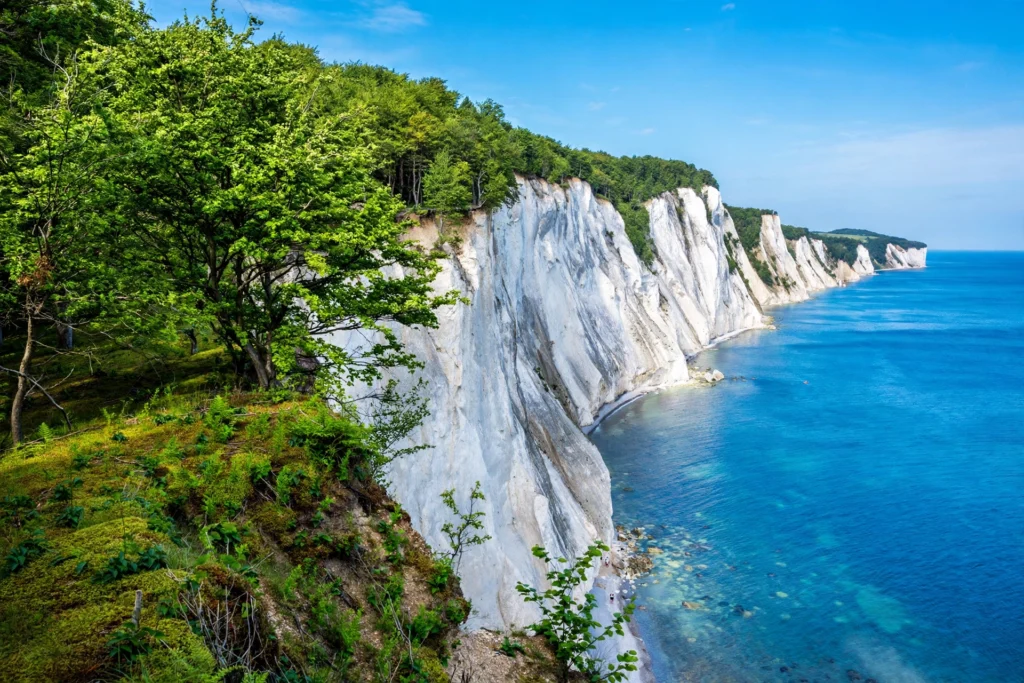
Denmark’s most dramatic landscape is not a castle or a city — it is a cliff. Møns Klint, on the south coast of the island of Møn, is a line of white chalk cliffs rising above a turquoise sea, topped with beech forest and dropping to a beach of white flints. On a sunny day, with the sea below and the white cliffs against a blue sky, it looks like the south coast of England, and it is the single most photographed natural sight in Denmark. Stevns Klint, further north on the island of Zealand, is the quieter sibling: a lower, longer cliff of chalk and limestone, with the little church at Højerup perched on its edge and a UNESCO-listed cliff face that records the asteroid impact that ended the age of the dinosaurs. Both cliffs are a full day from Copenhagen, and both need a car or a combination of bus and bicycle — the public transport to the cliff tops is thin, and this is the one part of Denmark where a hire car genuinely helps.
Møns Klint is the more spectacular of the two. The cliffs run for about six kilometres, and the walking trails along the top and down the steps to the beach take half a day. The GeoCenter at the top is a good museum for children and for anyone who wants to understand how the cliffs were formed by the ice age, and the beach below is a place to hunt for fossils — the chalk is full of them, and the flints on the shore are polished by the sea. The steps down to the beach are steep — several hundred of them — and the climb back up is a proper workout, so go down once and make it count. The island of Møn itself is worth the drive: quiet villages, thatched farmhouses, and the dark-sky park at the eastern end, where the night sky is among the darkest in Denmark.
Stevns Klint is the more thoughtful visit. The cliff is a UNESCO World Heritage Site because the thin layer of fish clay in its face is the boundary between the Cretaceous and the Tertiary periods — the moment, 66 million years ago, when an asteroid struck the earth and the dinosaurs died. The museum at the cliff explains it well, and the church at Højerup, half of which fell into the sea in 1928, stands as a reminder that the cliff is still eroding. The walk along the cliff top from Højerup to Rødvig takes about two hours and is one of the best coastal walks in Denmark. Stevns is closer to Copenhagen than Møn — about an hour and a half by car — and it works as a day trip combined with a stop at the Viking fortress at Trelleborg or the medieval town of Køge on the way back.
Choose Møns Klint for the drama and the beach, Stevns Klint for the science and the walk. Do not try to do both in one day — the islands are in opposite directions, and each deserves a full day. Go in May or September, when the paths are dry and the light is good; in winter the cliff paths can be muddy and slippery, and the steps at Møns Klint can be closed in bad weather. Bring proper walking shoes, water and a windproof layer: the wind off the Baltic is cold even in June, and there is no shelter on the cliff tops.
Aarhus: Denmark’s Second City
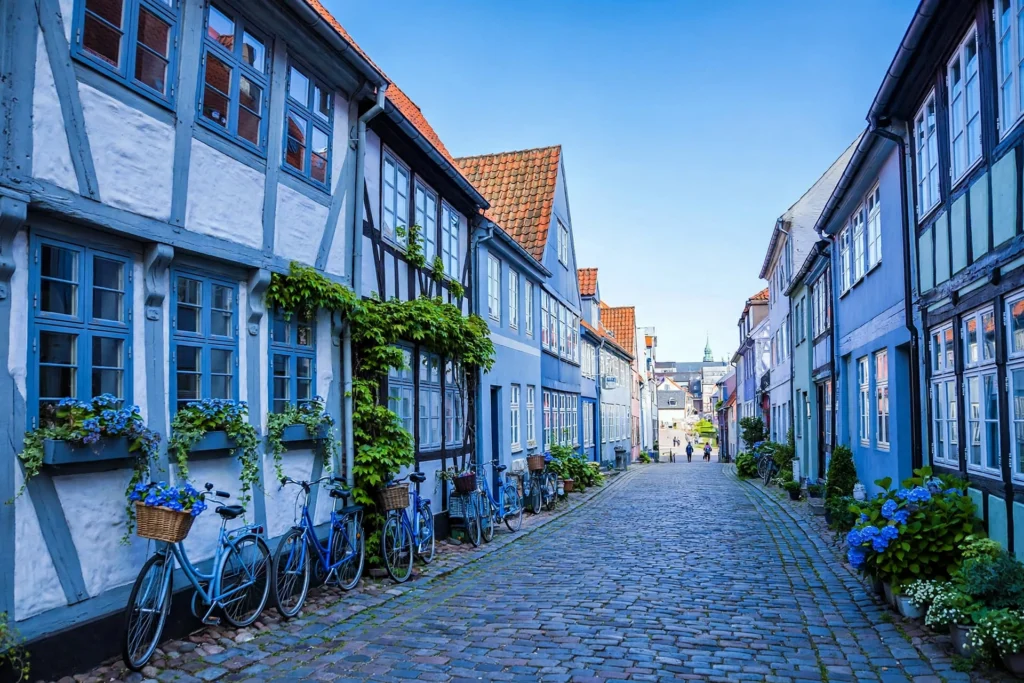
Aarhus is the city most visitors to Denmark never reach, and it is the one that rewards the train journey most. Denmark’s second city is a university town of around 350,000 people on the east coast of Jutland, three hours west of Copenhagen by train, and it is younger, cheaper and more relaxed than the capital. The Latin Quarter, the old town centre, is a tangle of cobbled streets, independent cafés and vintage shops that feels genuinely lived in — this is where Aarhus students and families actually spend their evenings, not a stage set for tourists. The harbour has been rebuilt in the last twenty years with modern architecture, a swimming platform and the Dokk1 library, and the walk along the water from the station to the old town is one of the best introductions to the city.
Give Aarhus two full days. The first belongs to Den Gamle By, the Old Town open-air museum, which is the single best museum in the city and one of the best in Denmark. It is a whole town of historic houses, moved here from across the country and rebuilt street by street, from a seventeenth-century merchant’s house to a 1970s street complete with a period television shop. You can walk through three centuries of Danish life in an afternoon, and it is the place that makes the rest of Denmark’s history — the castles, the cathedrals, the Viking ships — feel like it belonged to real people. The second day belongs to ARoS, the art museum capped by Olafur Eliasson’s Your Rainbow Panorama, a 150-metre circular walkway of coloured glass on the roof through which the whole city is seen in every colour of the spectrum. The museum’s collection is strong on Danish art, and the rooftop is the best view in Aarhus. After ARoS, walk down to the harbour for dinner in the Latin Quarter.
The third museum, if you have the time, is Moesgaard, south of the city in a forest above the sea. It is a museum of prehistory and archaeology, built into a grassy hillside, and its star is the Grauballe Man, a two-thousand-year-old bog body preserved so well that you can see his hair and his fingerprints. The museum’s Viking and Iron Age galleries are the best in Jutland, and the walk through the forest to the beach at Moesgaard is a good half-day in itself. The bus from the city centre takes twenty minutes. Between the three museums, the Latin Quarter and the harbour, Aarhus earns its two days — and it is cheaper than Copenhagen for hotels, restaurants and drinks, which is another reason to make it the second base rather than a day trip.
Aarhus in a day, if you must
If you only have one day in Aarhus, do this: Den Gamle By in the morning, lunch in the Latin Quarter, ARoS in the afternoon, and the rooftop panorama before dinner on the harbour. It is a full day and it skips Moesgaard, but it gives you the two essential museums and the two essential neighbourhoods. The train from Copenhagen arrives at Aarhus Central Station, which is a ten-minute walk from the Latin Quarter and fifteen from Den Gamle By, so the day starts on foot. If you are staying overnight, stay near the station or the Latin Quarter — the city is compact, and almost everything is a fifteen-minute walk from either.
Where to eat and drink in Aarhus
Aarhus eats better than its size suggests, and cheaper than Copenhagen. The Latin Quarter is the centre of it: small restaurants and wine bars in old timber houses, with menus that change with the seasons and prices a third lower than the capital. Aarhus Street Food, the covered market near the station, is the budget option — stalls serving everything from Danish smørrebrød to ramen, with long communal tables and a lively evening crowd. The harbour has the newer restaurants, including several with Michelin recognition, and the Meatpacking District equivalent is the area around Mejlgade and the old harbour warehouses. For breakfast, find a bakery: the Danish pastry, wienerbrød, is at its best in the morning, still warm, and a cardamom bun with a coffee is the standard Danish start to the day. For a drink, the city’s microbreweries and the bars around the university are the liveliest in Denmark outside Copenhagen, and the prices — a beer for around DKK 50–60 rather than DKK 65–75 — are a small but real saving over a week. Aarhus is also the best place in Denmark to try the New Nordic cooking at a price that does not require a special occasion: several restaurants serve a set lunch menu for half the price of dinner, and the quality is the same.
Odense and Funen: Fairy-Tale Denmark
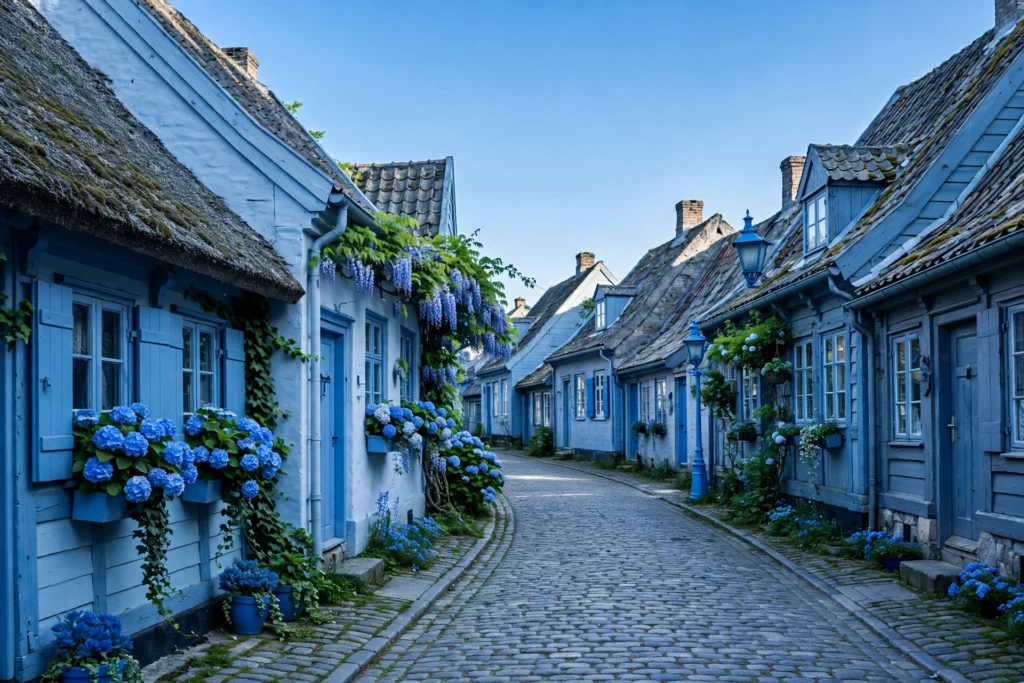
Odense is the birthplace of Hans Christian Andersen, and the city leans into it — but gently, and with more charm than you might expect. The old town around Andersen’s childhood home is a pocket of low yellow cottages and cobbled lanes, and the H.C. Andersen House, the museum designed by the Japanese architect Kengo Kuma, is half underground and threaded with timber pavilions and gardens. It is a museum about stories and imagination rather than a house full of furniture, and it is worth an hour even if you have never read a fairy tale. The streets around it are the real attraction: small, quiet, and full of the details — a painted door, a garden wall, a bakery — that make a Danish town feel like a storybook.
Funen, the island Odense sits on, is Denmark’s garden island: orchards, manor houses, thatched villages and short coastal drives. Egeskov Castle, half an hour south of Odense, is the best-preserved Renaissance water castle in Europe, set in a moat with gardens, a maze and a collection of veteran cars and aircraft in its outbuildings. It is the fairy-tale castle Denmark actually has, and it is a better visit than many of the more famous ones because it is still a family home. The South Funen Archipelago, the scatter of small islands south of Funen, is the quietest part of Denmark — reached by ferry, best explored by bicycle, and the place to go if you want a day with almost no other tourists. Ærø, the prettiest of the islands, has a main town, Ærøskøbing, that looks like a film set of eighteenth-century Denmark, all painted cottages and hollyhocks.
Odense works best as a half-day stop on the train between Copenhagen and Aarhus, which is how this guide uses it. The train from Copenhagen takes about an hour and ten minutes on the fastest services, and the walk from Odense station to the old town takes ten minutes. The station has luggage lockers, and the Andersen House and the old quarter are close enough to see comfortably in three hours. If you want more of Funen, stay a night: the city has good restaurants around the Brandts Klædefabrik, the old textile mill turned cultural centre, and the riverside walk through Munke Mose park is a pleasant evening. But do not make Odense a third base on a first trip — the town is small, and a full day there is plenty for most travellers. The half-day stop, with lunch in the old town and the afternoon train to Aarhus, is the right shape.
Billund and Legoland: Worth It for Adults Too?
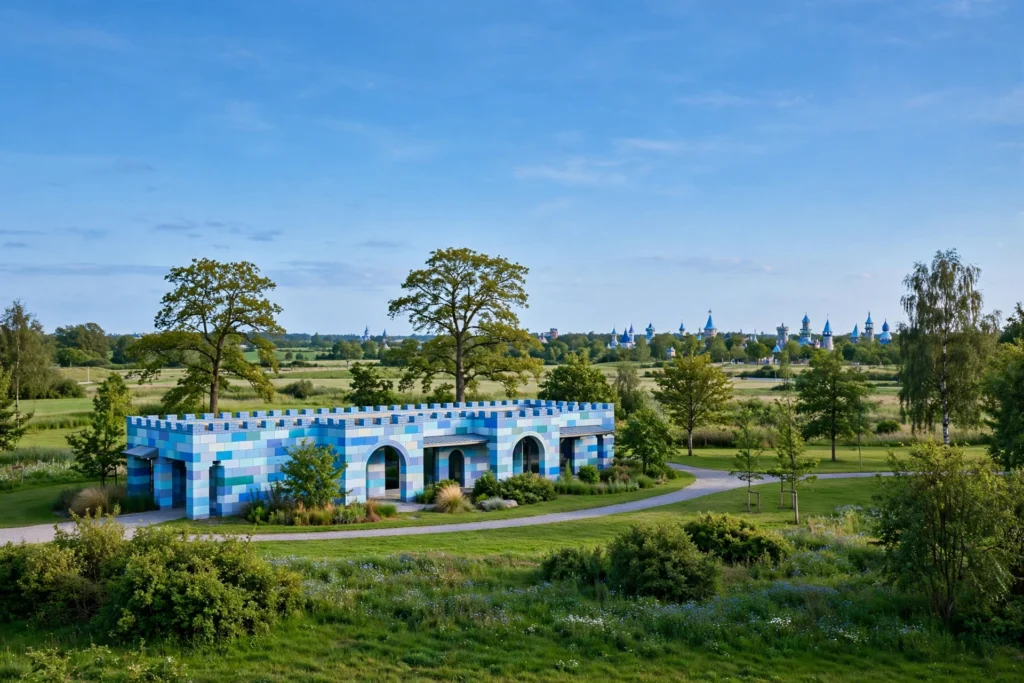
Billund is a small town in western Jutland with an outsized claim on the world’s imagination: it is the home of Lego, and the original Legoland park. The question most adult travellers ask is whether it is worth a day of a Denmark trip, and the honest answer is that it depends on who you are travelling with. With children between four and twelve, it is one of the best days of the trip — the park is built for them, the Miniland models of world landmarks built from Lego bricks are genuinely impressive, and the town has a water park and a Lego-themed hotel for the full experience. Without children, it is a pleasant half-day: Miniland and the park’s gardens are worth seeing, but the rides are aimed at families, and you will be done by mid-afternoon.
The park’s opening season runs from late March to early November, with the longest hours in the summer holidays. Tickets are cheaper bought online in advance, and the price varies by date, so check the day you plan to go. The bus from Aarhus takes about an hour, and from Odense about the same, so Billund works as a day trip from either base — but if you are going with children, one night in Billund saves a very early start and lets you use the second day for the water park. The town itself is small and quiet, and there is little to do outside the park, which is why this guide treats Billund as a single-purpose stop rather than a base.
For adults travelling without children, the better use of the same day is usually the Wadden Sea coast or the Viking sites of southern Jutland — Jelling, with its tenth-century runestones and the burial mounds of the first Danish kings, is a UNESCO site and a forty-minute train ride from Billund. But if you grew up with Lego, or you are travelling with children, Billund is a pilgrimage, and Denmark is the right place to make it. The brick itself was invented here, the first park opened here, and the Miniland models — Copenhagen’s Nyhavn, a working airport, a whole miniature Denmark — are a reminder that Denmark’s design culture starts with a small plastic brick.
The Danish Coast and Islands
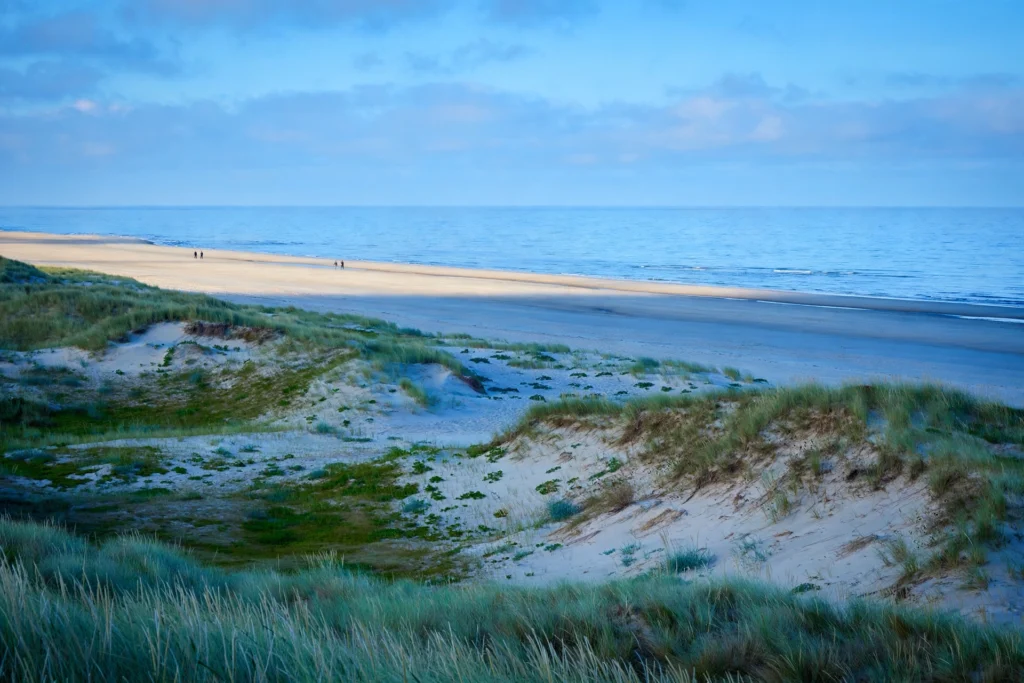
Denmark has more than 7,000 kilometres of coastline, and the sea is never far away — no point in the country is more than about 50 kilometres from the coast. That fact shapes the trip more than most visitors expect. The beaches are wide and sandy, the water is clean, and the light over the sea is the thing photographers come for. The west coast of Jutland, facing the North Sea, is the wild side: long sandy beaches, dunes, and the Wadden Sea, a tidal landscape of mudflats and islands that is a UNESCO World Heritage Site. At low tide you can walk out onto the mudflats with a guide, and the birdlife — thousands of waders and geese — is among the best in Europe. The east coast, facing the Baltic and the Kattegat, is gentler: sheltered bays, small harbours, and the islands of Funen and Zealand with their orchards and fishing villages.
The island of Bornholm, far out in the Baltic, is the most different part of Denmark. It has rocky coasts instead of sand, round medieval churches, fishing villages with smokehouses, and some of the best cycling in the country. It is a trip of its own, not a day out — the ferry from Køge takes five hours, or you can fly from Copenhagen in under an hour — and it rewards two or three nights. The South Funen Archipelago is the quieter alternative: a scatter of small islands reached by short ferries, best explored by bicycle, with almost no traffic and a pace of life that feels like Denmark fifty years ago. And Skagen, at the very tip of Jutland, is where the two seas meet: at Grenen, the northern point, the Kattegat and the Skagerrak collide in a visible line, and you can stand with one foot in each sea.
For most first trips, the coast comes in three manageable pieces: the beaches and harbour baths around Copenhagen, which need no planning at all; the cliffs of Møn and Stevns, which need a full day each; and the west coast or Skagen, which need the extra days of a ten-day trip. The practical rule is that the coast is a summer pleasure and a winter walk: in June and July the water is warm enough to swim and the beaches are busy, while in November the same beach is a windswept walk with a café at the end. Both are good, but they are different trips, and the packing list changes accordingly. Bring a swimsuit in summer — the harbour baths in Copenhagen and Aarhus are free, and the water is clean — and bring a windproof jacket in every season. The Danish sea breeze is the one thing about the weather that never changes.
| Coastal stop | Where | How to get there | Best for |
|---|---|---|---|
| Amager Strandpark | Copenhagen | Metro and bike, 20 minutes | City beach, swimming, sunset |
| Møns Klint | Island of Møn | Car or bus, full day | White cliffs, fossils, drama |
| Stevns Klint | Zealand, south of Copenhagen | Car, 1.5 hours | UNESCO cliff, coastal walk |
| Wadden Sea | West Jutland | Train to Ribe, then bus | Mudflat walks, birds, wide skies |
| Skagen and Grenen | Tip of Jutland | Train via Frederikshavn, 4–5 hours | Two seas meeting, light, art |
| Bornholm | Baltic island | Ferry or flight | Cycling, fishing villages, rocky coast |
Ribe and the Wadden Sea: Denmark’s oldest town
Ribe, on the west coast of Jutland, is the oldest town in Denmark, founded in the eighth century as a Viking trading port, and it is the gateway to the Wadden Sea. The town itself is small and beautifully preserved: cobbled streets, half-timbered houses, and a great Romanesque cathedral with a tower you can climb for the view over the marshes. The cathedral is the oldest in Denmark, and the town’s Viking museum tells the story of the trading port that stood here twelve hundred years ago. But the reason to come is the Wadden Sea itself — the vast tidal landscape of mudflats, salt marshes and islands that runs down the west coast, a UNESCO World Heritage Site shared with Germany and the Netherlands. At low tide, the sea retreats for kilometres, and guided walks out onto the mudflats let you see the worms, shells and crabs that feed the thousands of wading birds. The guides are essential: the tide comes back fast, the mud is deeper than it looks, and the channels shift. The best time for the birds is spring and autumn, when the migrations pass through in their hundreds of thousands, and the sight of a murmuration of starlings over the marshes at dusk — the Black Sun, as the Danes call it — is one of the great wildlife spectacles in Europe. Ribe is about three hours from Copenhagen by train, and it works as a day trip from Aarhus or as an overnight stop on a ten-day trip that takes in the west coast.
Copenhagen’s Harbour: Boats, Baths and the Waterfront
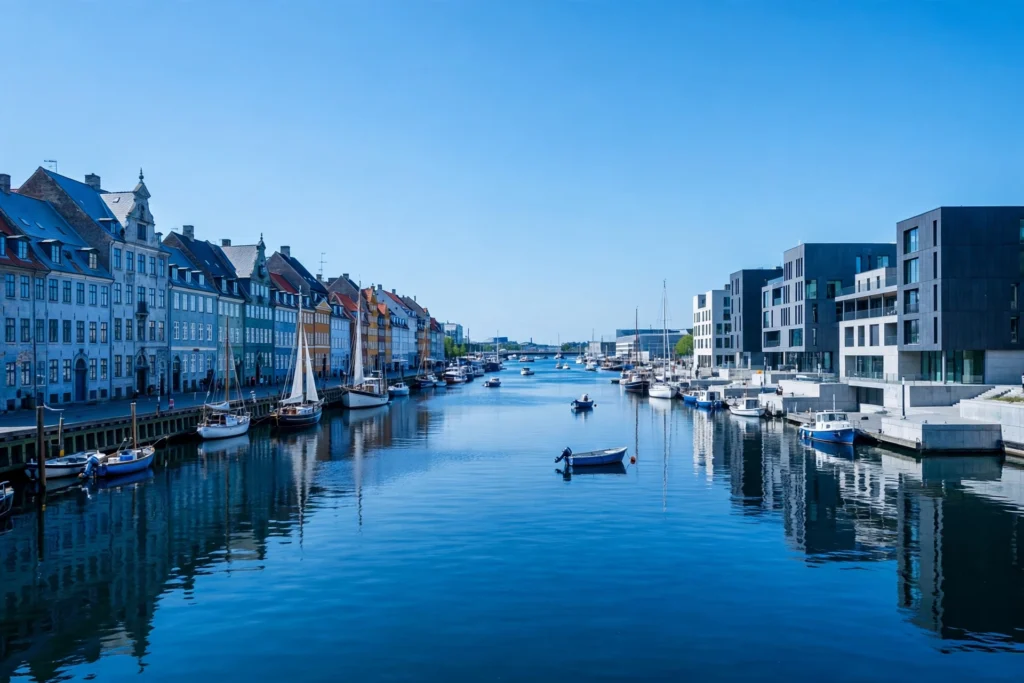
The harbour is Copenhagen’s living room, and it is the part of the city that has changed most in the last twenty years. The water is clean enough to swim in — the city cleaned up its harbour in the 1990s, and the harbour baths at Islands Brygge are now one of the most popular places in the city on a summer evening. The industrial waterfront has been rebuilt with public promenades, swimming platforms and modern architecture: the Opera House across the water from Amalienborg, the Black Diamond library on the waterfront, and the Paper Island, now a food and culture district. The best way to see it is from the water. A canal boat tour takes about an hour, passes Nyhavn, Christiansborg, the Opera House and the Little Mermaid, and costs around DKK 100–130. It is the one boat trip worth paying for in Copenhagen, and it is covered by the Copenhagen Card.
The harbour baths are free and open to everyone, and they are the most Danish experience in the city. At Islands Brygge, the main bath has five pools, diving platforms and a lawn where half the city seems to gather on a warm evening. At Amager Strandpark, the beach is a proper sandy stretch with a view back to the city. And at the harbour baths in Aarhus, the same idea works on a smaller scale. Bring a swimsuit in summer and a towel; there are changing facilities and lockers, and the water is cold even in July, which is part of the point. Danes swim in it all year — the winter bathing clubs are a serious institution — but visitors are welcome to stick to June, July and August.
The waterfront walk is the best free evening in Copenhagen. Start at Nyhavn, walk along the harbour to Amalienborg and the Opera House, cross the Inderhavnsbroen bridge to Christianshavn, and follow the canal to the Church of Our Saviour. The light in the evening, especially in May and June when the sun sets after 21:30, is extraordinary — the low sun turns the water gold and the coloured houses along Nyhavn glow. End the walk at a harbour-side bar or a food hall, and you have had the city’s best evening for the price of a drink. The harbour is also where Copenhagen’s design culture is most visible: the bridges, the baths, the Opera House and the library are all the work of Danish architects, and they are all public, free and used daily. This is the Denmark that works — a city that gave its waterfront back to its people.
Getting Around Denmark: Trains, Bikes and the Car Question
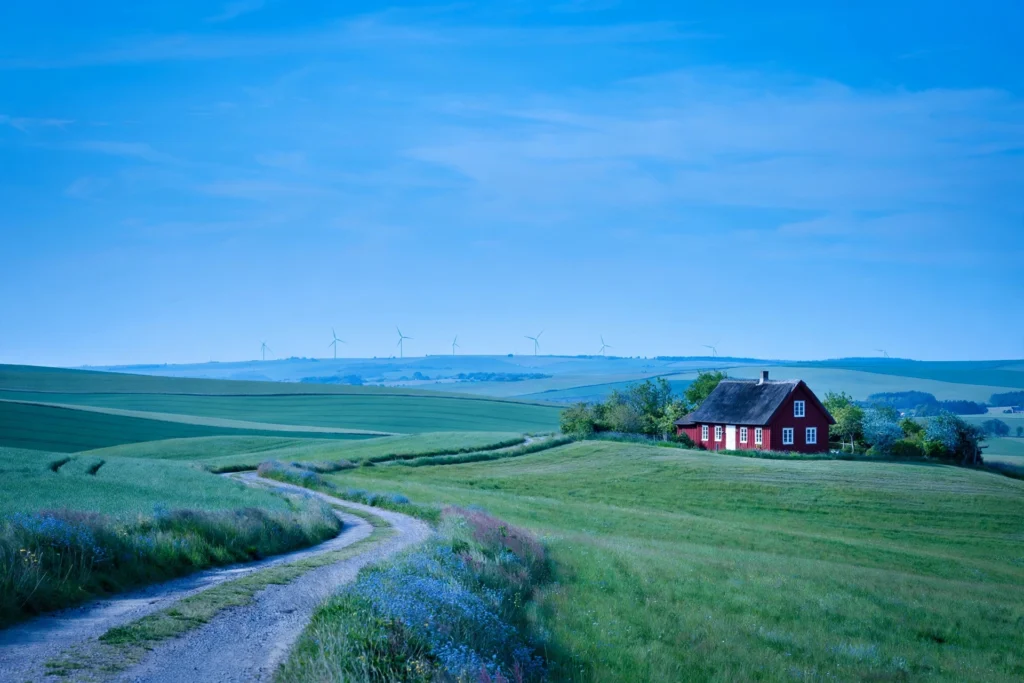
Denmark is one of the easiest countries in Europe to travel by train, and the train is the right choice for almost the whole trip. The national operator, DSB, runs the intercity network, and the main line runs from Copenhagen through Roskilde and Odense to Aarhus and on to Aalborg, with regional trains branching off to Helsingør, Hillerød and the coastal towns. The headline journey is Copenhagen to Aarhus: about 2 hours 48 minutes on the fastest InterCityLyn trains, with more than 30 departures a day, and the express crosses the Great Belt bridge, a tunnel and bridge over the strait between Zealand and Funen that is one of the great engineering sights of northern Europe. Copenhagen to Odense takes about 1 hour 10 minutes. Copenhagen to Helsingør takes about 45 minutes, and to Roskilde about 25 minutes.
Tickets are cheapest bought in advance. DSB’s Orange tickets are fixed-departure saver fares that go on sale about two months before the travel date: Copenhagen to Aarhus from DKK 119, Copenhagen to Odense from around DKK 89, and the earlier you book, the better your chance of one. A standard ticket, which lets you take any departure on the day, costs roughly DKK 300–450 for Copenhagen to Aarhus. A seat reservation costs DKK 30 and is worth adding on busy Friday and Sunday trains in summer. Two children under twelve travel free with each adult. Buy tickets in the DSB app or on the DSB website, and check the timetable on the day — a new timetable starts on 13 December 2026, and engineering work in 2027 may change some services. The old blue Rejsekort travel card was retired in 2026; visitors now use the Rejsekort app or buy individual tickets, and in Copenhagen the DOT Rejsebillet app covers metro, buses and S-trains.
Train or car? The honest answer
A car only earns its keep in two parts of Denmark: western Jutland and the far north, where buses thin out, and the cliff coasts of Møn and Stevns, where the public transport to the cliff tops is thin. Everywhere else — Copenhagen, Roskilde, Odense, Aarhus, Helsingør, Hillerød, Billund — the train is faster, cheaper and less stressful than driving, and parking in Copenhagen is expensive and scarce. If you do hire a car, take it for the days you need it and return it before the city days: a three-day hire for the Jutland coast or the cliffs, picked up in Aarhus or Odense, costs far less than a week-long hire with city parking. Driving in Denmark is easy — the roads are good, the traffic is light outside Copenhagen, and the speed limits are well signed — but the Great Belt bridge toll and the cost of fuel add up, and the train lets you look out of the window instead of at the road. The ferry from Helsingør to Helsingborg, twenty minutes across the strait to Sweden, is the one sea crossing worth building into a longer trip, and our companion guide to Sweden continues the journey from the other side.
| Journey | By train | By car | Our recommendation |
|---|---|---|---|
| Copenhagen to Roskilde | 25 minutes, several trains an hour | 35 minutes plus parking | Train |
| Copenhagen to Helsingør | 45 minutes, coastal line | 50 minutes | Train |
| Copenhagen to Odense | About 1 hour 10 minutes | About 2 hours | Train |
| Copenhagen to Aarhus | 2 hours 48 minutes, from DKK 119 | About 3 hours plus bridge toll | Train |
| Aarhus to Billund | Bus, about 1 hour | 1 hour | Either |
| Copenhagen to Møns Klint | Bus and bike, slow | 1.5 hours | Car |
| Aarhus to Skagen | 3 hours 20 minutes, one change | 2.5 hours | Car if continuing north |
| Copenhagen to the Wadden Sea | Train to Ribe, then bus | 3 hours | Car for the coast |
Money, phones and practical details
Denmark is one of the easiest countries in Europe for the practical details, and most of them sort themselves out on arrival. The currency is the Danish krone, pegged to the euro at about 7.46 kroner to the euro, and cards work almost everywhere — buses, bakeries, market stalls and harbour baths included — so you can travel with almost no cash. If you do need kroner, ATMs are common and there is no need to change money before you arrive. Tipping is not expected: service is included in the price, and rounding up a bill is a compliment, never an obligation. The language is Danish, and almost everyone speaks excellent English, including bus drivers and market stallholders; learning a few words — tak for thank you, hej for hello — is appreciated but never necessary. The emergency number is 112, and the tap water is excellent everywhere in the country. Mobile coverage is good, including on the trains, and EU visitors can use their home data plan; visitors from outside the EU should buy a local SIM or an eSIM at the airport. The plugs are type K, 230 volts, and type C plugs fit, so most European visitors need no adapter and Americans need a simple plug adapter. Shops generally open from 10:00 to 18:00 on weekdays, with shorter hours on Saturdays and most closed on Sundays outside the city centres. And one piece of etiquette that matters: Danes queue properly, they do not jaywalk, and they expect you to do the same. Stand on the right on escalators, wait for the green man, and never stand in a bike lane.
Getting there and away
Most visitors fly into Copenhagen Airport, which is fifteen minutes from the city centre by metro or train — the metro runs to Terminal 3, and the train to Copenhagen Central Station takes about fifteen minutes. Aarhus Airport is smaller, with fewer international flights, and Billund Airport serves western Jutland and is the closest airport to Legoland. From Germany, the train runs from Hamburg to Copenhagen in about five hours, and the ferry from Puttgarden is part of the journey. From Sweden, the Øresund bridge carries trains from Malmö to Copenhagen in about forty minutes, and the ferry from Helsingør to Helsingborg takes twenty minutes. If you are combining Denmark with its neighbours, the train from Copenhagen to Malmö is the easiest border crossing in northern Europe, and the guides to Sweden and Norway in this series continue the journey north.
Frequently Asked Questions
How many days do you need in Denmark?
Seven days is the sweet spot for a first trip: three or four nights in Copenhagen with day trips, then two nights in Aarhus. Three days works for Copenhagen alone with one day trip. Ten days adds Billund, the white cliffs and Skagen. Less than three days is a city break, not a Denmark trip.
Is Copenhagen the same as Denmark?
No, and that is the point of this guide. Copenhagen is three or four days of a seven-to-ten-day country trip. Aarhus, Odense, Roskilde, the cliffs and the coast are a different Denmark — younger, quieter, cheaper — and the train between them is under three hours.
How much does a Denmark trip cost?
Visit Copenhagen’s published bands, updated September 2026, are about DKK 700 a day on a tight budget, DKK 1,800 a day mid-range, and DKK 4,500 a day for a luxury stay, including accommodation but not flights. A mid-range seven-day trip runs about DKK 12,600, roughly €1,689, per person.
Is Denmark expensive?
Yes — it is one of the most expensive countries in Europe. The levers are accommodation and food: hostel beds start from around DKK 145 a night, bakeries and market halls keep food costs down, and the Copenhagen Card pays for itself if you visit three or four paid sights a day.
Is Denmark safe for tourists?
Denmark is very safe for violent crime. The US State Department rates it Level 2, “Exercise Increased Caution”, because of terrorism — reissued at Level 2 on 23 November 2026 — and the UK advises normal precautions. The practical risks are petty theft and bicycle accidents. Stay aware in crowded places and never walk in a bike lane.
Do I need a visa for Denmark?
Denmark is in Schengen. US, Canadian, Australian and British passport holders can enter visa-free for up to 90 days in any 180-day period. Since 10 April 2026, non-EU visitors give fingerprints and a photograph at the border under the Entry/Exit System. ETIAS is not in operation as of November 2026 and has no announced start date.
What is the best time to visit Denmark?
May, June and September are the best months: long days, mild weather and fewer crowds than July. July is warmest and busiest. November to March is the quiet season with short days — good for museums and Christmas at Tivoli, which runs from 13 November 2026 to 3 January 2027.
Is Tivoli Gardens worth it?
Yes, especially in the evening when the lights come on. Entry is dynamic-priced: in the Christmas season, adult entry costs from DKK 210 Monday to Thursday and DKK 230 Friday to Sunday, with an entry-plus-ride pass from DKK 419. The park is closed between seasons and on Christmas Eve, 24 December, so check the dates before you go.
Should I buy the Copenhagen Card?
Buy it if you will visit three or four paid sights a day and take a day trip on the train. The Discover card costs DKK 589 for 24 hours, DKK 859 for 48 hours and DKK 1,039 for 72 hours, and covers more than 80 attractions plus unlimited public transport. If you mostly walk the centre and visit one museum, pay as you go.
Do I need a car in Denmark?
No, for the standard trip. The train covers Copenhagen, Roskilde, Odense and Aarhus, and the coastal day trips run on regional trains. A car only earns its keep in western Jutland, around the Wadden Sea and Skagen, and for the cliffs of Møn and Stevns.
Can you do Denmark by train?
Yes, and it is the best way to do it. Copenhagen to Aarhus takes 2 hours 48 minutes on the fastest trains, with more than 30 departures a day, and Orange saver fares start from DKK 119 if you book about two months ahead. The old Rejsekort card was retired in 2026; use the DSB app or the Rejsekort app.
What is hygge?
Hygge is the Danish idea of cosiness and contentment: a lit candle on a winter afternoon, a long lunch with friends, a warm room when it is raining outside. You will feel it in Copenhagen’s cafés in November and in the harbour baths on a summer evening. It is not a product — it is the feeling the whole trip is built around.
Conclusion
Denmark is a small country that rewards a slow trip. The castles and Viking ships are real, and they are worth seeing, but the Denmark that stays with you is the quieter one: the bike ride along the harbour at dusk, the long lunch in a market hall, the evening in Tivoli when the lights come on, the white cliffs above a turquoise sea, and the second city that most visitors never reach. The shape of the trip is simple — Copenhagen as the first base, Aarhus as the second, Odense as a stop on the way, and the train doing all the work in between — and it works at three days, seven days and ten days. Seven is the length to aim for, and ten is the length that lets you add the coast, the cliffs and the far north without rushing any of them. Book the Orange train fares two months ahead, buy the Copenhagen Card only if your days are full of paid sights, pack a waterproof jacket whatever the month, and give yourself at least one unhurried evening with nowhere to be. Sit in a café with a coffee and a pastry, watch the light change over the harbour, and let the country do what it does best — slow you down. That evening is the trip, and it is the reason Denmark, more than almost anywhere else in northern Europe, is a place people come back to.
People also read: Sweden Travel Guide • Norway Travel Guide • Netherlands Travel Guide • Germany Travel Guide • Travel Packing Checklist PDF Free

M. Adil is the founder and editor of SoloTravelPro. He writes practical, research-based travel guides that help travellers plan with confidence — from first-time city breaks to national parks and island escapes. Every guide is built on official sources, current prices and honest, usable advice, so readers can plan smarter and travel better.