Fun Places to Travel in the US: 25+ Quirky, Immersive and Family-Friendly Adventures for 2026
Quick Answer: The most fun places to travel in the US in 2026 are the ones that let you do something, not just look at something: walk through a house that opens into other worlds at Meow Wolf in Santa Fe, climb through a converted factory at the City Museum in St. Louis, surf a standing river wave in Cedar Falls, Iowa, eat and dance your way through New Orleans, ride a wooden roller coaster in a town literally called Santa Claus, sandboard beneath snowy peaks in Colorado, and watch hundreds of balloons rise at dawn in Albuquerque. This guide organises 25+ fun places to travel in the US by the kind of fun — immersive and quirky, adventure, food, family, water and festivals — with a “what makes it fun, who it suits and best season” line for every place, so you can pick by mood instead of scrolling another ranked list. 2026 is also America 250, the country’s 250th birthday, which makes the summer of 2026 the loudest, busiest and most festive year in a generation to visit.
Fun is a slippery word. A place can be beautiful and boring, or strange and unforgettable. The places in this guide earned their spot because they ask something of you: climb it, touch it, taste it, solve it, ride it, or laugh at it. That is the difference between a sightseeing list and a fun list, and it is why the usual “best places” rankings miss most of these. Lonely Planet’s 14 best places in the US is a fine list of beautiful destinations, and AFAR’s 52 places is a fine bucket list — but neither is organised around fun itself. This guide is. Every place below is in the United States, every one is visitable in 2026, and every one is chosen because the fun is the point, not a side effect.
A note on how to use this guide: start with the two tables below. The first sorts the fun by kind, so if you know you want water fun or food fun or family fun, jump straight there. The second is the master at-a-glance table — every main place, what makes it fun, who it suits and the best season — which is the fastest way to build a shortlist. Then read the sections that made your shortlist. If you want the dreamy, aspirational side of American travel instead, our dream travel destinations guide covers that mood; this one is about getting your hands dirty.
| Kind of fun | Where to find it in this guide | Best for |
|---|---|---|
| Immersive and quirky | Meow Wolf (Santa Fe), City Museum (St. Louis), American Giants Museum (Route 66), Winchester Mystery House (San Jose) | Curious adults, teens, art lovers, anyone bored of ordinary museums |
| Outdoor adventure | Great Sand Dunes (Colorado), Mammoth Cave (Kentucky), Sleeping Bear Dunes (Michigan), Black Hills (South Dakota) | Active families, teens, hikers, first-time national park visitors |
| Food and music | New Orleans, Nashville, Asheville | Food lovers, couples, groups of friends, festival chasers |
| Family fun | Santa Claus (Indiana), Black Hills, Diggerland (New Jersey), Salem (Massachusetts) | Families with kids aged 4–14, grandparents travelling with grandchildren |
| Water fun | Cedar Falls river surfing (Iowa), Sleeping Bear Dunes (Michigan), Key West (Florida), Kauai (Hawaii) | Swimmers, surfers, kayakers, beach families |
| Festivals and big events | Albuquerque Balloon Fiesta, America 250 celebrations, Mardi Gras (New Orleans) | Anyone who loves a crowd, a parade and a sky full of colour |
| Night fun | Flagstaff dark skies (Arizona), Ouray Ice Park (Colorado), Minnesota sauna road trip | Stargazers, winter travellers, couples, quiet-adventure seekers |
Every fun place at a glance:
| Place | What makes it fun | Who it suits | Best season |
|---|---|---|---|
| America 250 celebrations (nationwide) | A once-in-a-lifetime 250th birthday party | Everyone | Summer 2026, especially July 3–4 |
| Meow Wolf, Santa Fe | A house that opens into other worlds | Curious adults, teens, families | Spring and autumn |
| City Museum, St. Louis | A factory turned into a climbable playground | Kids 5+, teens, playful adults | Year-round (indoors) |
| American Giants Museum, Atlanta IL | Giant fibreglass Muffler Men on Route 66 | Road trippers, photographers, kids | Late spring to autumn |
| Cedar Falls river surfing, Iowa | Surf a standing wave in the Corn Belt | Adventurous beginners, teens, spectators | Late spring to early autumn |
| New Orleans, Louisiana | Food, jazz and parades on every corner | Food lovers, couples, groups | October to May |
| Santa Claus, Indiana | A theme park in a town named Santa Claus | Families with kids 4–14 | May to October |
| Black Hills, South Dakota | Dinosaurs, caves and Mount Rushmore | Families, first-time road trippers | June to September |
| Great Sand Dunes, Colorado | Sandboarding under snowy peaks | Active families, teens, hikers | May to September |
| Mammoth Cave, Kentucky | The world’s longest cave system | Families, curious kids, adults | Year-round (underground) |
| Sleeping Bear Dunes, Michigan | Climb a dune, run down to a turquoise lake | Active families, swimmers, teens | June to September |
| Albuquerque Balloon Fiesta | Hundreds of balloons at dawn | Everyone, photographers, families | October |
| Flagstaff, Arizona | Dark skies, observatories and the Milky Way | Stargazers, couples, quiet travellers | March to October |
| Minnesota sauna road trip | Hot sauna, cold lake, repeat | Winter lovers, couples, wellness fans | December to March |
America 250 in 2026: The Year the Whole Country Throws a Party

There has never been a year quite like 2026 to look for fun places to travel in the US, because the whole country is throwing itself a birthday party. On July 4, 2026, the United States turns 250 — the semiquincentennial of the Declaration of Independence — and the celebration, branded America 250, runs all year, with the biggest weekend falling on July 3–4. The official America250 organisation, created by Congress, has named host cities for “America’s Block Party” events, and the line-up reads like a fun-places list on its own: New York will drop the Times Square Ball on July 3 for the first time ever outside New Year’s Eve, Los Angeles hosts a huge July 4 concert at the Memorial Coliseum, Milwaukee folds its celebration into Summerfest on Lake Michigan, and Fort Campbell in Kentucky hosts a festival for military families and the public.
What makes it fun
The fun of America 250 is that it turns ordinary places into stages. Philadelphia, where the Declaration was adopted, is the spiritual home of the year, and Boston, Charleston and New York all have their own deep 1776 stories — but the party is genuinely national. Small towns are holding their own parades, tall ships are sailing, and national parks are joining in: the National Park Service has made July 3–5, 2026 fee-free entrance days for US citizens and residents, which makes the Independence Day weekend one of the cheapest times of the year to visit a national park. If you have ever wanted to see a big American celebration done properly, this is the year to be there for it, because the next one is in 2076.
Who it suits
Everyone, honestly — but it suits two groups best. Families with school-age kids will find the history suddenly alive: a child who yawns at a textbook will remember fireworks over Independence Hall. And anyone who loves festivals, parades and live music will find the summer of 2026 packed wall to wall. If you dislike crowds, the trick is to pick a smaller host city or a mid-size town celebration rather than Times Square or Philadelphia on the day itself.
Best season to go
Summer, obviously — and specifically the week around July 4. Book accommodation early, because the host cities will fill up, and expect the biggest crowds on July 3–4 themselves. If you want the atmosphere without the crush, go in late June or mid-July, when many towns still have their decorations up and their events running but the peak crowds have gone.
America 250 at a glance
| City | What is happening | When |
|---|---|---|
| New York, New York | Times Square Ball drop outside New Year’s Eve for the first time in its history | July 3, 2026, at 11:59 p.m. |
| Los Angeles, California | Family-friendly July 4 concert at the Los Angeles Memorial Coliseum | July 4, 2026 |
| Milwaukee, Wisconsin | America’s Block Party at Summerfest on Lake Michigan | July 4, 2026 |
| Fort Campbell, Kentucky | July 4 festival for military families and the public | July 4, 2026 |
| Philadelphia, Pennsylvania | The heart of the 250th — Independence Hall and the historic district | All year, peaking July 4 |
| National parks (nationwide) | Fee-free entrance days for US citizens and residents | July 3–5, 2026 |
Check the official America250 announcements for the full host-city list before you book, because new cities and events are still being added. And if you are planning national park visits around the fee-free days, the National Park Service’s own fee-free parks page lists every 2026 date.
Practical tips
Treat America 250 like a festival, not a sightseeing trip: book the hotel first and the itinerary second, because rooms in the host cities will go first. Arrive a day early for the big events so you are not fighting arrival-day traffic, and plan one quiet day after the party — a park, a lake, a slow morning — because a full day of crowds and fireworks is more tiring than it looks, especially with kids.
Santa Fe, New Mexico: Walk Into a House That Is Not a House
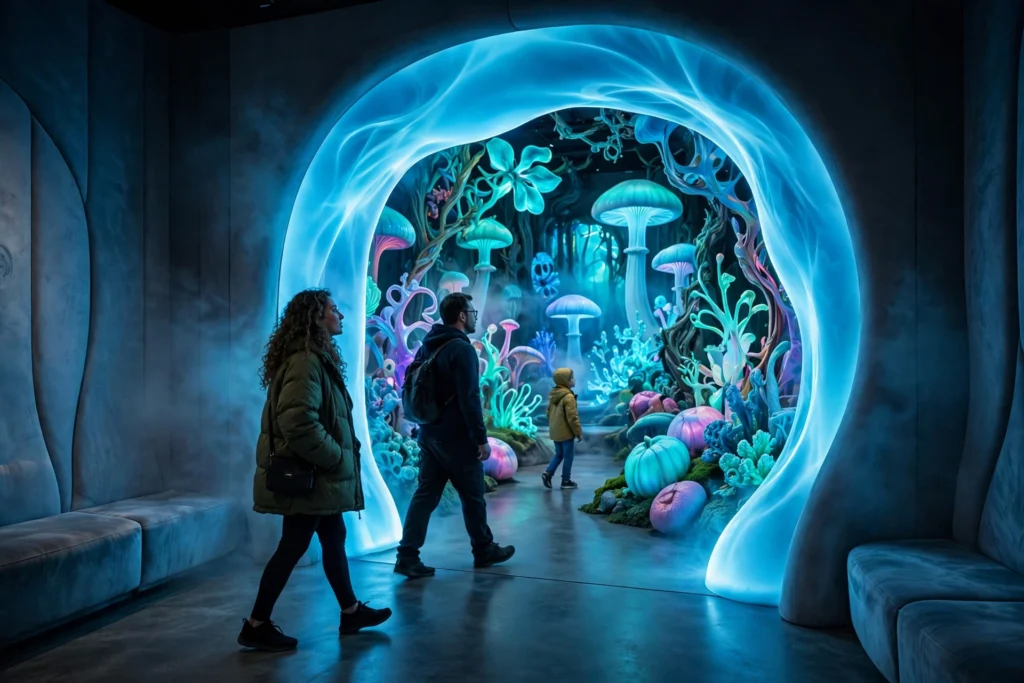
Santa Fe is the oldest state capital in the United States, a high-desert city of adobe walls and art galleries — and it is home to the single most fun indoor experience in America. Meow Wolf’s House of Eternal Return is an immersive art installation built inside a former bowling alley: you walk through the front door of an ordinary-looking Victorian house, open a door that should lead to a bedroom, and step into a glowing forest, or a spaceship, or a concert venue in a neon town. It opened in March 2016, it now holds more than 70 rooms of handmade, touchable, climbable art, and it tells the mystery story of the Selig family, who vanished after a physics experiment went wrong. There is no single right way through it. That is the point.
What makes it fun
Most museums ask you to look and not touch. Meow Wolf asks you to open every drawer, crawl through every tunnel, press every button and follow every corridor to see where it leads. The house is designed as a choose-your-own-adventure: one door leads to a kitchen, the next to a glowing cave, the next to a room full of musical instruments you can play. Kids treat it like the world’s best playground; adults treat it like a puzzle box. The companion app adds a layer of story — a “psychic sensor” that reveals hidden pieces of the mystery as you explore — but you do not need it to have a wonderful time. Allow several hours. People who plan for one hour regret it; people who plan for three still wish they had stayed longer. Check the Meow Wolf Santa Fe visit page for current hours and ticket options before you go.
Who it suits
Curious adults and teens get the most out of it, because the story rewards attention and the art rewards patience. Families with kids aged about 6 and up love it — younger children enjoy the colours and tunnels but may find some rooms dark or loud. It is also one of the rare attractions that works brilliantly for a group of friends, because everyone finds different rooms and then compares notes afterwards over food in Santa Fe’s Plaza. If someone in your group uses a wheelchair or has limited mobility, check the accessibility information on the official site first: much of the space is accessible, but some of the crawl-through passages are not.
Best season to go
Spring (April–May) and autumn (September–October) are the sweet spots: warm days, cool evenings, and smaller crowds than summer. Santa Fe sits at about 7,000 feet, so the sun is strong even in winter — bring sunscreen in every season. The city also hosts a 300-year-old fiesta in the autumn and a famous Christmas Eve farolito walk, so if your dates line up with either, you get two kinds of fun in one trip.
Practical tips
Book timed tickets in advance, especially on weekends and in summer, because the house can sell out. Go early in the day if you can: the rooms are quieter, and the light inside is easier to enjoy. Wear comfortable shoes — you will be on your feet, climbing, crouching and doubling back for hours. And eat before you go or plan a proper meal afterwards: Santa Fe’s food scene, from green-chile dishes to the restaurants around the Plaza, is half the fun of the city, and you will be hungry.
St. Louis, Missouri: The City Museum Is a Playground Built From a Factory

The City Museum in St. Louis is what happens when artists get hold of a 10-storey former shoe factory and decide to build the playground they always wanted. It is part museum, part jungle gym, part architectural salvage yard: a giant whale you can walk through, a repurposed aeroplane fuselage you can climb into, slides that drop you through several floors, caves, tunnels, a rooftop with a Ferris wheel and a school bus hanging off the edge of the building. Almost everything is made from reclaimed materials — old chimneys, salvaged tiles, industrial machinery — and almost everything is designed to be climbed on. It is indoors, it is open year-round, and it is the single best rainy-day fun place in the US.
What makes it fun
The fun here is physical in a way that almost no other museum allows. You are not looking at exhibits; you are inside them. The caves wind through the basement, the slides connect floors in ways that feel like a secret, and the rooftop — MonstroCity, with its climbing structures and the famous bus — is the best view in St. Louis with a thrill attached. Adults who arrive planning to watch their kids usually end up climbing themselves within twenty minutes. That is the museum’s real trick: it gives grown-ups permission to play, and then makes it impossible not to.
Who it suits
Kids aged about 5 to 14 are the core audience, and teenagers who think they are too cool for museums tend to change their minds about halfway up the first climbing structure. Adults without kids will still enjoy it, especially the architecture, the rooftop and the sheer inventiveness of the place — but be honest with yourself: if you are not going to climb anything, you will see about half of it. It is also a genuinely good option for a multi-generational trip, because grandparents can watch from the café areas while the younger ones vanish into the tunnels.
Best season to go
Any time, because most of it is indoors. Winter is actually a smart choice: St. Louis is cold and grey in January, and the City Museum is warm, dry and full of energy. Summer weekends are the busiest, so if you are visiting in June or July, arrive at opening time. The rooftop is best in late afternoon, when the light over the city is golden and the climbing structures are less crowded.
Practical tips
Wear clothes you can climb in — long trousers, closed shoes, nothing you mind getting dusty — and leave the nice bag at the hotel. Bring knee pads if you have them; the museum sells them, but bringing your own saves a queue. Small children need close supervision in the caves and on the rooftop, and the slides are genuinely fast, so warn first-timers. Plan for three to four hours minimum, and do not try to pair it with another big attraction the same day: you will be tired, dusty and happy, and that is enough.
Atlanta, Illinois: Route 66’s American Giants Museum and the Muffler Men
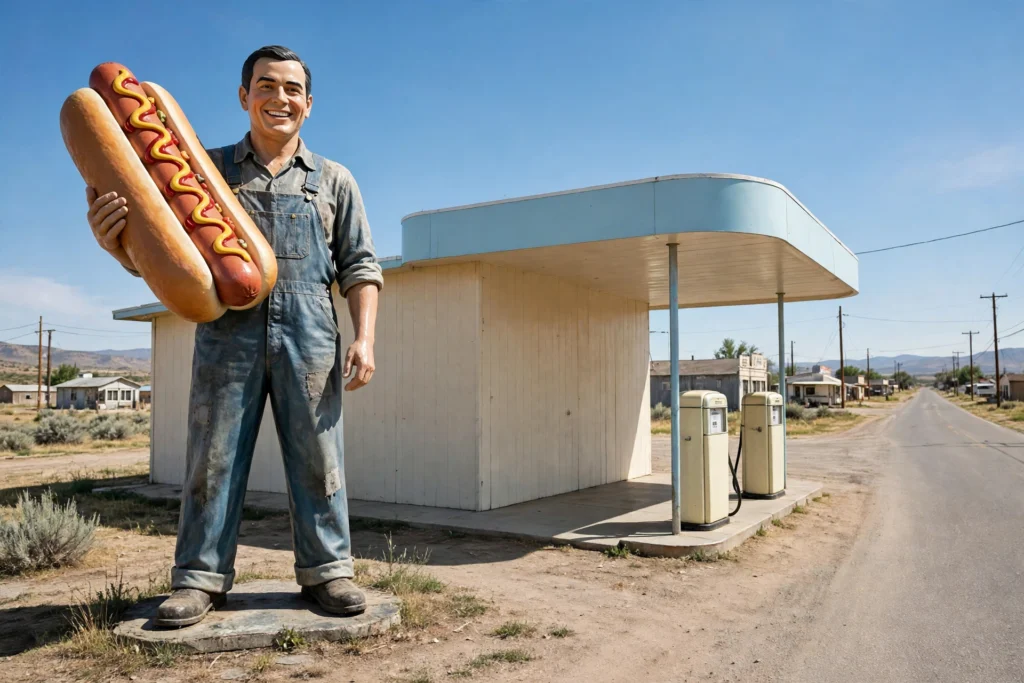
Route 66 turns 100 in 2026 — the Mother Road was established in 1926 — and there is no better year to go looking for its strangest survivors. The best of them stands in Atlanta, Illinois, a town of fewer than 1,600 people on the old 1926 alignment of the highway: the American Giants Museum, a small museum in a building designed to look like a vintage Texaco service station, dedicated to the Muffler Men. These are the giant fibreglass advertising statues, 14 to 25 feet tall, that once stood outside gas stations, muffler shops and restaurants all across America in the 1960s and 70s. The museum, which held its grand opening in May 2024, gathers them together — six giants stand outside in the adjoining Land of the Giants rest stop, including a 24-foot Texaco Big Friend and Atlanta’s own 19-foot Paul Bunyan holding a giant hot dog — and inside are the moulds, body parts, photographs and memorabilia of a vanished American art form.
What makes it fun
The fun is the scale of it. Standing next to a 24-foot fibreglass man who is waving at you is funny in a way that photographs never quite capture, and the museum leans into the joke: disembodied heads on the walls, a seven-foot Esso tiger, a Miss Uniroyal leg. It is also a genuinely interesting piece of Americana — these giants were mass-produced by the International Fiberglass Company of Venice, California, between 1963 and 1972, and most have since been lost, broken or forgotten. The museum is small and the visit is short, which is exactly right: this is a roadside stop, not a day trip, and the pleasure is in the stop itself, the photos, and the story you will tell afterwards.
Who it suits
Road trippers, photographers and anyone driving Route 66 in 2026 — the centennial year makes the whole highway busier and more festive than usual. Kids love the giants instantly, and the outdoor rest stop with its picnic tables makes a natural lunch break. It also suits travellers who like their fun in small doses: if a full day at a theme park sounds exhausting, an hour with the giants is the opposite kind of pleasure.
Best season to go
Late spring to autumn, when the giants are best photographed in daylight and the Route 66 towns are alive. Summer is peak road-trip season, so expect company at the popular stops; May and September are quieter and the light is better. Winter on Route 66 in Illinois is cold and many small-town stops keep shorter hours, so check ahead if you are travelling off-season.
More giants worth the detour
The Muffler Men are only the start. If giant things are your kind of fun, the same road trip can collect several more, and each one is free to see from the roadside:
- Cadillac Ranch, Amarillo, Texas — ten Cadillacs buried nose-first in a field since 1974, covered in spray paint that visitors are invited to add to. Our places to travel in Texas guide has the full Amarillo picture if you are building a Texas leg into the trip.
- Carhenge, Alliance, Nebraska — a full-scale replica of Stonehenge built in 1987 from 38 vintage American cars, standing in the high plains like a joke that became a landmark.
- Cabazon Dinosaurs, Cabazon, California — two enormous concrete dinosaurs, Dinny the brontosaurus and Mr. Rex, beside Interstate 10 near Palm Springs. You can see them from the highway; stopping to stand underneath them is better.
- The Fremont Troll, Seattle, Washington — a huge concrete troll clutching a real Volkswagen Beetle, living under the Aurora Bridge. Our Seattle travel guide covers the neighbourhood around it.
Practical tips
Atlanta is a small town, so do not expect a big visitor centre or long opening hours — check the museum’s current hours before you set out, and treat it as one stop on a Route 66 day rather than a destination on its own. Pair it with the rest of Illinois Route 66: Springfield’s Abraham Lincoln sites, the chain of small towns along the old alignment, and a night in a vintage motel if you can find one. Bring a camera with a wide lens or a phone with a good panorama mode, because the giants do not fit in a normal frame.
Cedar Falls, Iowa: Surf a River in the Middle of the Corn Belt
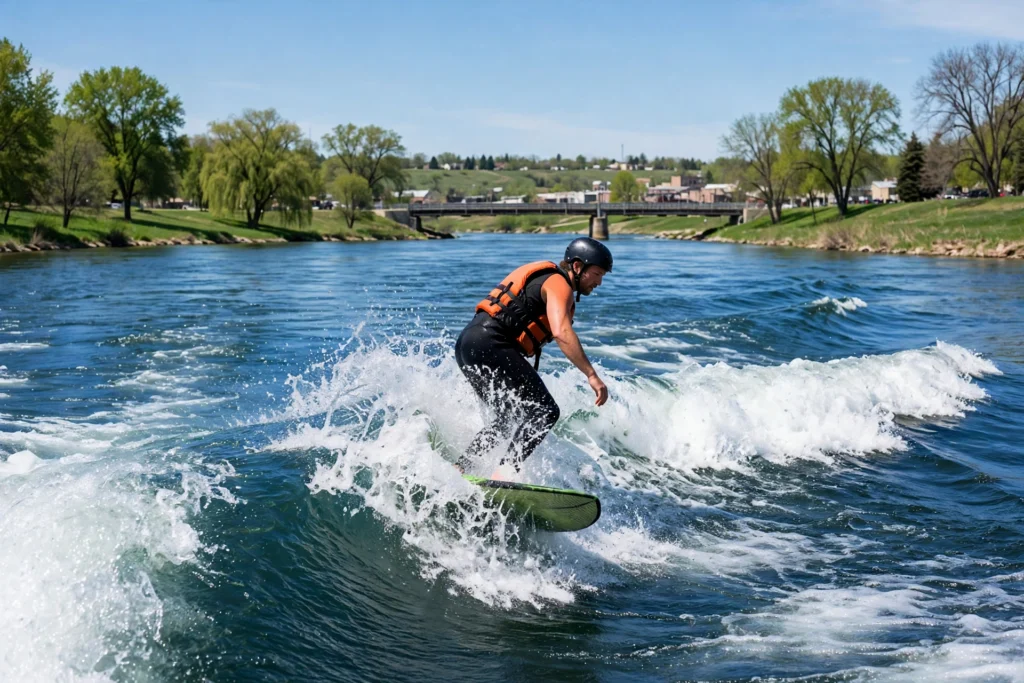
Surfing in Iowa sounds like a joke, and that is exactly why it is so much fun. Cedar Falls, a college town on the Cedar River, has built Gateway River Park — a free, purpose-built whitewater park in the heart of the historic downtown district, completed in 2025, with four engineered features named Alpha, Bravo, Charlie and Clay Hole that create a standing wave you can surf, kayak or paddleboard on, all day, without waiting for the ocean. The river’s steady flow means the wave never stops: unlike ocean surfing, where you wait for the next set, here you ride, fall off, climb back on and ride again. Beginners start with boogie boarding and work up to standing on the board, and expert-led lessons run through the season.
What makes it fun
The fun is the surprise of it. You are in Iowa — cornfields, college town, bike trails — and suddenly you are watching someone surf a river wave while people eat tacos on the bank and a band plays at the plaza. The park is genuinely beginner-friendly: the features are designed so that first-timers can learn, the water is shallow enough to stand in at the edges, and the whole scene is social rather than competitive. Even if you never get on a board, watching from the bank with a coffee is one of the most enjoyable free afternoons in the Midwest. Check Gateway River Park’s own recreation page for lesson dates and current conditions before you go.
Who it suits
Adventurous beginners and teens get the most out of it — river surfing is easier to learn than ocean surfing, and the wipeouts are softer. It suits spectators just as well: the park has bank seating, the downtown is steps away, and the whole thing is free to watch. It is also a good pick for a group of friends, because some can surf while others kayak, tube or just sit on the bank. If you are an experienced ocean surfer, manage your expectations: this is a standing river wave, not a beach break, and the joy is in the novelty and the repetition, not the size of the wave.
Best season to go
Late spring to early autumn. Spring melt can make the wave bigger and the water colder; summer brings friendlier temperatures and consistent after-work sessions; autumn brings the prettiest light, with the trees along the river turning colour. Always check the river flow before you go — the wave depends on water levels, and after heavy rain the park can be too high to use safely.
Practical tips
Bring a helmet and a life vest if you have them; if you do not, book a lesson, which usually includes the gear and the safety briefing. Wear booties or water shoes with grip, because the riverbed is rocky and mossy. Never surf alone, and read the water from the bank before you get in — the features shift with the flow, and the locals on the bank are usually happy to tell you which feature is working that day. Afterwards, the downtown has breweries, coffee shops and more than 130 miles of connected trails, so the surf session is easily the start of a full day, not the whole of it.
New Orleans, Louisiana: Eat, Dance and Parade Through America’s Funniest Food City

New Orleans is the only American city where fun is not an activity but the local weather. It is the birthplace of jazz, the home of Creole and Cajun cooking, a city where a brass band can appear on a street corner at any hour and a parade can form around nothing at all. Eat a beignet heaped with powdered sugar at Café du Monde, then walk the French Quarter and let the city happen to you: a second-line parade, a jazz club on Frenchmen Street, a po’boy eaten standing up, a streetcar ride down St. Charles Avenue past the Garden District mansions. Lonely Planet lists New Orleans as the best place in the US for foodies and art lovers, and it is right — but the real reason it belongs on a fun list is that the city treats pleasure as a public good, and it shows.
What makes it fun
The fun in New Orleans is that it is participatory. You do not watch the music; you dance to it. You do not admire the food; you eat it with your hands. The festivals run all year — Mardi Gras in late winter, Jazz Fest in spring, French Quarter Fest, and dozens of smaller neighbourhood festivals — and even on an ordinary Tuesday there is live music somewhere within a few blocks. The food is the other half of it: gumbo, jambalaya, crawfish, oysters, po’boys, beignets, chicory coffee, and the particular joy of a city where a casual lunch can be the best meal of your trip. No other American city combines food, music and street life this densely, and no other city is this much fun on foot.
Who it suits
Food lovers first, couples second, and groups of friends third — New Orleans is a city that rewards sharing, whether that is a table full of small plates or a bar full of people. Families can enjoy it too, especially in the daytime: the French Quarter, the streetcar, the Audubon Zoo and the riverfront are all family-friendly, and the city is at its most relaxed in the morning. It is less suited to travellers who want quiet and order; New Orleans is loud, humid, occasionally chaotic, and proud of it.
Best season to go
October to May. The weather is warm but not punishing, the festival calendar is full, and the hurricane season (June to November, with August and September the most active months) is mostly behind you. Mardi Gras, which falls in February or early March depending on the year, is the biggest party of all — and also the most crowded and expensive, so book far ahead if that is your plan. Summer is hot, humid and quieter, which suits travellers who prefer lower prices and do not mind sweating.
Practical tips
Stay in or near the French Quarter or the Garden District so you can walk everywhere, and use the streetcars rather than driving — parking is expensive and the streets are narrow. Budget for food as the main event, not an afterthought: the best meals in New Orleans are often the cheapest ones. Drink water, wear comfortable shoes, and keep an eye on your belongings in the busiest crowds, as you would in any big party city. And if you are travelling with kids, plan the loud late-night parts for the adults and the daytime parts — the zoo, the aquarium, the streetcar, the beignets — for the whole family.
Santa Claus, Indiana: A Whole Town Named After Christmas

There is a town in southern Indiana called Santa Claus, and it has decided to commit to the joke completely. The streets are named after Christmas, the post office gets thousands of letters to Santa every year, and the town’s main attraction is Holiday World, a family theme park with wooden roller coasters, a water park, and a famously friendly atmosphere — including free soft drinks, which is the kind of detail that makes parents love a place. The park is divided into themed sections — Christmas, Halloween, Thanksgiving and the Fourth of July — so you can ride a coaster in the Christmas section in the morning and slide down a water slide in the Halloween section in the afternoon. It is the most family-friendly fun place in this guide, and the one that most rewards a full day.
What makes it fun
The fun is the total commitment to the theme. A town named Santa Claus could have been a single photo opportunity; instead it is a real place with a real theme park, and the park itself is the kind of old-fashioned, well-run family park that bigger parks used to be: clean, affordable by theme-park standards, and built around the idea that a family should be able to spend a whole day together without a spreadsheet. The wooden coasters are the stars — The Raven and The Legend are the kind of rides that roller-coaster fans travel for — and the water park, Splashin’ Safari, is big enough to be a destination on its own. If you are planning a family trip and want more ideas for travelling with children, our places to travel with kids guide covers the age-by-age picture, and our best places to travel with a baby guide covers the under-twos.
Who it suits
Families with kids aged about 4 to 14, full stop. This is the age range the park is built for: small kids have their own rides and the water park, older kids have the coasters, and parents have shade, seating and free soft drinks. Grandparents travelling with grandchildren will find it easier than a mega-park — it is walkable, the queues are manageable, and the atmosphere is relaxed. Teenagers who want the biggest, fastest coasters in America will find bigger thrills elsewhere, but they will still have a good day here.
Best season to go
May to October, when the park is open and the weather is warm enough for the water park. Summer is the busiest season, so weekday visits are calmer than weekends, and the park’s Halloween events in the autumn are a lovely, less crowded alternative. Christmas in Santa Claus is, unsurprisingly, a real event — the town lights up and the post office is at its busiest — and if you want more Christmas travel ideas, our Christmas travel guide covers the season across the country.
Fun by age: what works for whom
| Age group | Best fun in this guide | Why it works |
|---|---|---|
| Ages 4–7 | Santa Claus (Holiday World), Dinosaur Park (Rapid City), Meow Wolf’s colours and tunnels | Short queues, gentle rides, big visual payoff |
| Ages 8–12 | City Museum, Mammoth Cave, Great Sand Dunes, Black Hills | Climbing, exploring and hands-on adventure |
| Ages 13–17 | Meow Wolf, Cedar Falls river surfing, Sleeping Bear Dunes, American Giants Museum | Independence, physical challenge, photo-worthy weirdness |
| Adults without kids | Meow Wolf, New Orleans, Flagstaff dark skies, Minnesota sauna trip | Atmosphere, food, music and quiet adventure |
| Grandparents + grandchildren | Santa Claus, Albuquerque Balloon Fiesta, America 250 events | Shared spectacle, easy pacing, something for every age |
Practical tips
Arrive at opening and head for the coasters first, before the queues build, then move to the water park in the afternoon when the sun is strongest. Bring swimsuits and a change of clothes even if you only plan to ride the dry rides — the water park is too tempting to skip. Sunscreen and water are essential in July, and the free soft drinks are a genuine money-saver for a family of four, so take advantage of them.
Rapid City and the Black Hills, South Dakota: Dinosaurs, Caves and a Mountain of Faces

Rapid City is the gateway to the Black Hills, and the Black Hills are the most fun square of America that most people have never properly explored. Start at Dinosaur Park, a hilltop park above the city where life-size concrete dinosaurs — built in the 1930s, green and weathered and wonderful — stand looking out over the town, with a brontosaurus so big that children can barely take it in. Then drive into the hills themselves: Mount Rushmore, where four 60-foot presidential faces are carved into a granite mountain; the Needles Highway, a road that threads through impossibly thin rock spires; Jewel Cave and Wind Cave, two of the longest cave systems in the world, both offering guided tours; and Custer State Park, where bison roam free and the wildlife loop is one of the best free drives in the country.
What makes it fun
The fun is the variety packed into a small area. In a single day you can stand under a concrete brontosaurus, look up at Mount Rushmore, drive through a tunnel carved through solid rock, walk through a cave lit like a cathedral, and watch a herd of bison cross the road in front of your car. It is the rare destination where the drive itself is the attraction: the Needles Highway and Iron Mountain Road are engineered as entertainment, with spiral bridges, tunnels that frame Mount Rushmore perfectly, and viewpoints around every bend. Kids who have never cared about history care about Rushmore when they see it in person, and adults who expected a postcard find themselves genuinely moved by the scale of it.
Who it suits
Families on a first American road trip, first-time visitors to the West, and anyone who wants a lot of different fun without a lot of driving between stops. It suits multi-generational groups particularly well, because the pace is flexible: the caves and the mountain are easy walking, the drives are scenic rather than strenuous, and there is a good mix of free viewpoints and paid tours. It is less suited to travellers who want nightlife or city energy — Rapid City is a small, friendly city, and the Hills are quiet after dark.
Best season to go
June to September, when the roads are clear, the caves are running full tour schedules, and the days are long. Late May and early October are quieter and still lovely, but some seasonal businesses close and the weather can turn quickly. Winter in the Black Hills is beautiful and very cold, and several attractions reduce their hours, so check ahead if you are travelling off-season.
Practical tips
Base yourself in Rapid City or Keystone and give the Hills at least two full days: one for Mount Rushmore, the Needles Highway and Custer State Park, and one for the caves and Dinosaur Park. Book cave tours in advance in summer, because they sell out. Bring layers even in July — the caves are cool underground, the mountain viewpoints are windy, and the temperature drops fast after sunset. And fill the tank before you head into the Hills: the distances are short but the petrol stations are few.
Great Sand Dunes, Colorado: Surf the Sand Beneath Snow-Capped Peaks

Great Sand Dunes National Park in southern Colorado is one of the strangest landscapes in America: the tallest sand dunes in North America, rising hundreds of feet out of a high desert valley, with the snow-capped Sangre de Cristo mountains standing guard behind them. The fun is simple and physical. You rent a sandboard or a sand sled, you hike up the dune — which is much harder than it looks, because every step slides back — and then you ride down, fast, with the mountains filling the whole horizon. The sand is soft, the falls are harmless, and the laughter is constant. In spring, Medano Creek runs at the base of the dunes, and children splash in water that is barely ankle-deep while the dunes tower above them.
What makes it fun
The fun is the contrast: desert sand and snow peaks in the same view, and the pure silliness of sliding down a mountain of sand. Sandboarding is easier to learn than snowboarding — there is no lift queue, no chairlift, no skill barrier, just a board and a slope — and sand sledding is even simpler, which is why it is so good for families. The park is also one of the best places in America to see the stars, because the San Luis Valley is remote and the night sky is famously dark. If you like the idea of outdoor adventure but want a different flavour, our Yellowstone travel guide covers geysers, hot springs and wildlife in the same spirit of hands-on wonder.
Who it suits
Active families and teens get the most out of it — the hike up the dune is a workout, and the ride down is the reward. It suits first-time national park visitors beautifully, because the park is compact and the fun is immediate: you do not need to hike for hours to reach the good part. It is less suited to travellers with limited mobility, because the dunes themselves are soft sand and hard going, though the visitor centre, the creek area and the viewpoints are accessible.
Best season to go
May to September, with late spring and early autumn the best of all: the sand is cooler, the creek is running, and the crowds are thinner. In July and August the sand can get very hot underfoot by midday, so go early in the morning or late in the afternoon, and bring closed shoes for the hike. Winter is quiet and beautiful, but the sand is cold and the creek is dry, so save it for the warmer months if sandboarding is your goal.
Practical tips
Rent sandboards and sleds from the shop near the park entrance rather than bringing your own — the rental boards are waxed and shaped for the sand, and the staff will show you how to use them. Bring plenty of water, sunscreen and a hat: the altitude is high, the sun is strong, and there is no shade on the dunes. Wear closed shoes for the hike up and take them off for the ride down if you like, and bring a bandana or buff to keep the sand out of your mouth on a windy day. Stay for sunset if you can: the dunes turn gold and pink, and the mountains behind them go purple.
Mammoth Cave, Kentucky: The World’s Longest Cave Is a Playground Underground

Mammoth Cave in Kentucky is the longest known cave system on Earth, with more than 400 miles of surveyed passageways beneath the rolling hills of south-central Kentucky — and it is one of the most fun underground experiences in America. The ranger-led tours range from gentle walks through enormous chambers with names like the Rotunda and the Grand Avenue to crawling, lantern-lit adventures through narrow passages for the brave. The cave stays at a steady cool temperature all year, the formations are lit like a stage set, and the sense of being deep inside the Earth, in a place that has been forming for millions of years, is genuinely thrilling. Above ground, the park has hiking trails, a river, and the kind of quiet, green Kentucky countryside that makes a good contrast to the darkness below.
What makes it fun
The fun is the feeling of discovery. A cave is the one place where adults feel the same wonder as children, because the scale is so far outside normal life: chambers big enough to hold a cathedral, passages so narrow you have to turn sideways, and a darkness so complete that the rangers turn the lights off for a moment just to show you what true dark feels like. The lantern tours are the most fun of all — walking by flickering light the way the cave’s first explorers did — and the crawling tours are the closest thing to a real adventure that a national park offers. It is also one of the few fun places in this guide that is completely weather-proof: rain, snow, heat, it does not matter, because you are underground.
Who it suits
Families with curious kids aged about 6 and up, adults who like geology and history, and anyone who wants a fun place that is also genuinely awe-inspiring. The easy tours suit almost everyone, including grandparents, while the crawling and lantern tours suit teens and adventurous adults. It is not suited to travellers with claustrophobia — the narrow passages are real, and the cave is honest about that — so pick the big-chamber tours if enclosed spaces bother you.
Best season to go
Year-round, because the cave is always the same cool temperature underground. That makes it one of the best fun places in America in the middle of summer, when the surface is hot and humid and the cave is a cool 54 degrees, and one of the best in winter, when the park is quiet and the tours are small. Book tours in advance in summer and on holiday weekends, because the popular tours sell out.
Practical tips
Book your tour before you arrive, and arrive early: the cave is a national park, and the ranger-led tours are the only way in. Wear a light jacket even in summer — the cave is cool — and closed shoes with good grip, because the paths can be damp. Bring a torch for the lantern tours if the rangers recommend it, and leave the big backpack behind: the passages are narrow and the less you carry, the more you enjoy it. Above ground, allow an hour for the trails and the river, and stop at the visitor centre first for the day’s tour schedule.
Sleeping Bear Dunes, Michigan: Climb a Dune, Then Run Down to a Turquoise Lake

Sleeping Bear Dunes National Lakeshore, on the north-west coast of Michigan’s Lower Peninsula, is the Great Lakes at their most beautiful: enormous sand dunes rising hundreds of feet above Lake Michigan, which on a sunny day is so blue and clear that it looks like the Caribbean. The signature fun is the Dune Climb, a 450-foot climb up a wall of sand that takes most people far longer than they expect — the sand slides back with every step — followed by the run back down, which takes about thirty seconds and is one of the most joyful things you can do in America. At the bottom is the lake, cold and clear and perfect for a swim after the climb. The park also has the Pierce Stocking Scenic Drive, a seven-mile loop with viewpoints over the dunes and the lake, and the historic village of Glen Haven.
What makes it fun
The fun is the honesty of the challenge. The Dune Climb does not pretend to be easy: it is a proper workout, and everyone on the dune is in it together, laughing, slipping, and cheering each other on. The run down is pure reward — a long, soft, bouncing descent with the lake spread out below you — and the swim at the bottom is the coldest, most refreshing payoff in the Midwest. It is also one of the few places in this guide where the fun costs almost nothing: the park entrance fee is modest, the climb is free, and the lake is free. If you want more water fun in a warmer climate, our Kauai travel guide covers Hawaii’s beaches, bays and snorkelling in the same spirit.
Who it suits
Active families, teens and swimmers get the most out of it — the climb is a challenge and the run down is a thrill. It suits groups of friends beautifully, because the climb turns into a friendly race and the beach at the bottom turns into a long, lazy afternoon. It is less suited to travellers with limited mobility, though the scenic drive and the viewpoints are accessible and the views from the top are worth the drive alone.
Best season to go
June to September, when the lake is warm enough to swim in and the days are long. July and August are the busiest months, so arrive early for the Dune Climb or go late in the afternoon when the light is golden and the crowds thin out. Autumn is beautiful — the trees turn, the light softens, and the park empties — but the lake is cold by October, so treat it as a hiking and driving trip rather than a swimming one.
Practical tips
Bring water and wear shoes you do not mind filling with sand, because the climb is harder barefoot than it looks and the sand is hot in the middle of the day. Do not try to climb down to the lake from the top of the dune and back up again unless you are very fit — the return climb from the water’s edge is famously gruelling, and the park warns visitors about it for good reason. Swim only in the marked areas and watch children closely, because Lake Michigan can have strong currents and sudden waves. And stay for sunset at one of the viewpoints: the sun dropping into the lake over the dunes is one of the best free shows in America.
Albuquerque, New Mexico: Hundreds of Balloons at Dawn
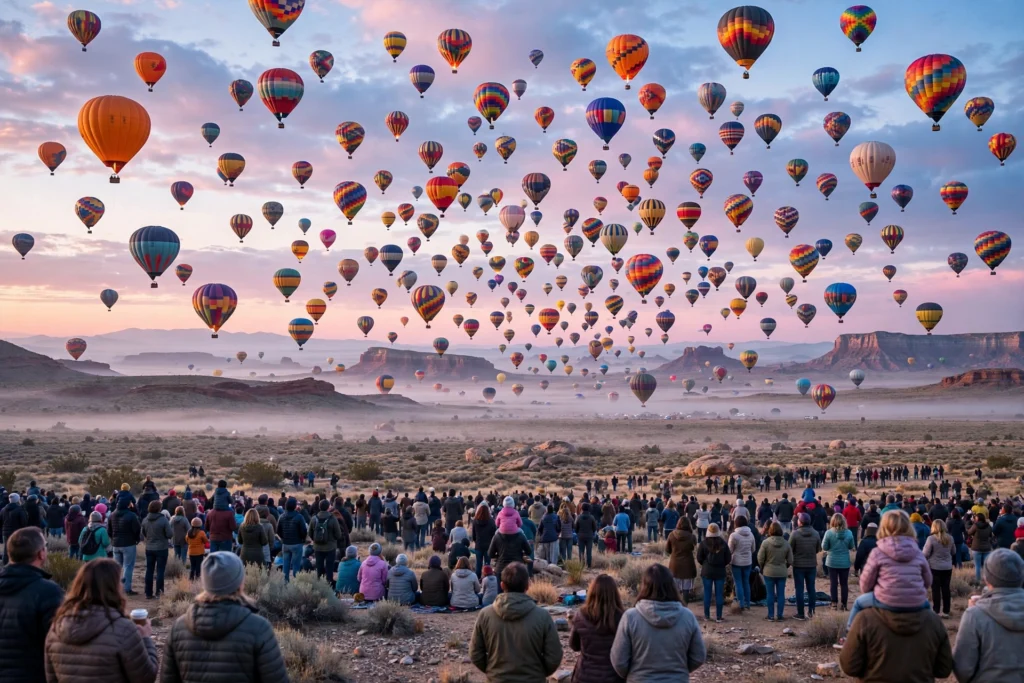
The Albuquerque International Balloon Fiesta, held each October in New Mexico, is the largest hot-air balloon festival in the world — and the single most photogenic fun event in America. At dawn, hundreds of balloons inflate in the dark on Balloon Fiesta Park, and then, as the sun comes up, they rise together in a slow, silent wave over the desert, with the Sandia Mountains behind them. There are special-shape balloons — a cow, a bee, a stagecoach, a giant pair of sunglasses — and evening events where the balloons glow like lanterns on the ground. It is the kind of event that makes even the most cynical traveller stand still and stare.
What makes it fun
The fun is the scale and the silence. Hundreds of balloons rising at once is a sight that does not get old, even for people who have seen it before, and the dawn launch — the Mass Ascension — is one of those travel moments that justifies getting up at 4 a.m. The festival is also wonderfully hands-on: you can walk among the balloons as they inflate, talk to the pilots, and watch the crews work, which makes it feel like a community event rather than a show. In the evening, the Balloon Glow turns the field into a garden of coloured light, and the fireworks that follow are the perfect end to the day.
Who it suits
Everyone, genuinely. Photographers will find the best light of their year; families will find a festival that is easy, open and full of wonder for small children; couples will find one of the most romantic dawns in America. It suits early risers best — the Mass Ascension happens at dawn, and the field is at its best in the first hour — but the evening events are just as good for people who prefer their fun after dark.
Best season to go
October, when the festival runs. The New Mexico autumn is warm in the day and cool at night, the air is clear, and the ballooning conditions are at their best. Book accommodation months ahead, because Albuquerque fills up completely during the fiesta, and consider staying a few days extra to explore the city: the Old Town, the Sandia Peak Tramway, and the food — green chile, sopapillas, and some of the best New Mexican cooking in the country.
Practical tips
Arrive before dawn for the Mass Ascension, dress warmly — the desert is cold at 5 a.m. even in October — and bring a blanket to sit on while you wait. Buy tickets in advance and use the park-and-ride buses rather than driving to the field, because the traffic is heavy and the parking is a long walk. If you want to fly in a balloon, book far in advance: the rides sell out early, and they are the one part of the festival that is genuinely expensive. For everyone else, the festival is remarkably affordable for the spectacle it delivers.
Flagstaff, Arizona: Look Up — Dark Skies, Observatories and the Milky Way

Flagstaff, Arizona, is the first International Dark Sky City in the world, a mountain town at 7,000 feet where the streetlights are dimmed on purpose and the Milky Way is visible from the edge of town. It is home to Lowell Observatory, founded in 1894, where Pluto was discovered in 1930 and where visitors can look through historic telescopes, join evening observing programmes, and learn the sky from astronomers who clearly love their work. The fun here is quieter than anywhere else in this guide, and that is exactly why it belongs: after a week of noise, crowds and rides, an evening under a truly dark sky feels like a different kind of adventure.
What makes it fun
The fun is the scale of the sky. Most Americans have never seen a genuinely dark sky — the kind where the Milky Way is a visible river of light and the stars are too many to count — and Flagstaff is one of the easiest places in the country to see one. The observatory programmes make it accessible: you do not need to know anything about astronomy, because the guides point the telescopes and tell the stories, and the experience of seeing Saturn’s rings or a distant galaxy with your own eyes is the kind of thing that stays with you. The town itself is fun too: a historic Route 66 downtown, good food, and the Grand Canyon only 80 miles away.
Who it suits
Stargazers, couples, quiet travellers and families with older children who are ready for something slower and more thoughtful. It suits anyone who has done the loud fun and wants the other kind — the fun of wonder rather than adrenaline. It is less suited to small children, who may find an evening of looking through telescopes too slow, though the observatory does run family programmes that work well for kids aged about 8 and up. If you are combining Flagstaff with a wider Arizona trip, our travel to Sedona guide covers the red rocks and desert just to the south.
Best season to go
March to October, when the nights are clear and the observatory programmes run at full strength. Summer is the busiest season, but also the warmest for evening observing; spring and autumn are quieter and the air is crisp. Winter nights are the clearest of all, but they are very cold at 7,000 feet, so dress for it if you go in December or January.
Practical tips
Book observatory tickets in advance, especially for the evening programmes, which are small and sell out. Arrive before sunset so you can see the observatory grounds in daylight and settle in for the dark. Bring warm layers even in summer — the temperature drops fast after sunset at altitude — and a red torch if you have one, because white light ruins night vision. Give your eyes twenty minutes to adjust to the dark before you expect to see the Milky Way properly, and put the phone away: the sky is the show.
Minnesota: The Sauna Road Trip — The Hottest Cold-Weather Fun in America
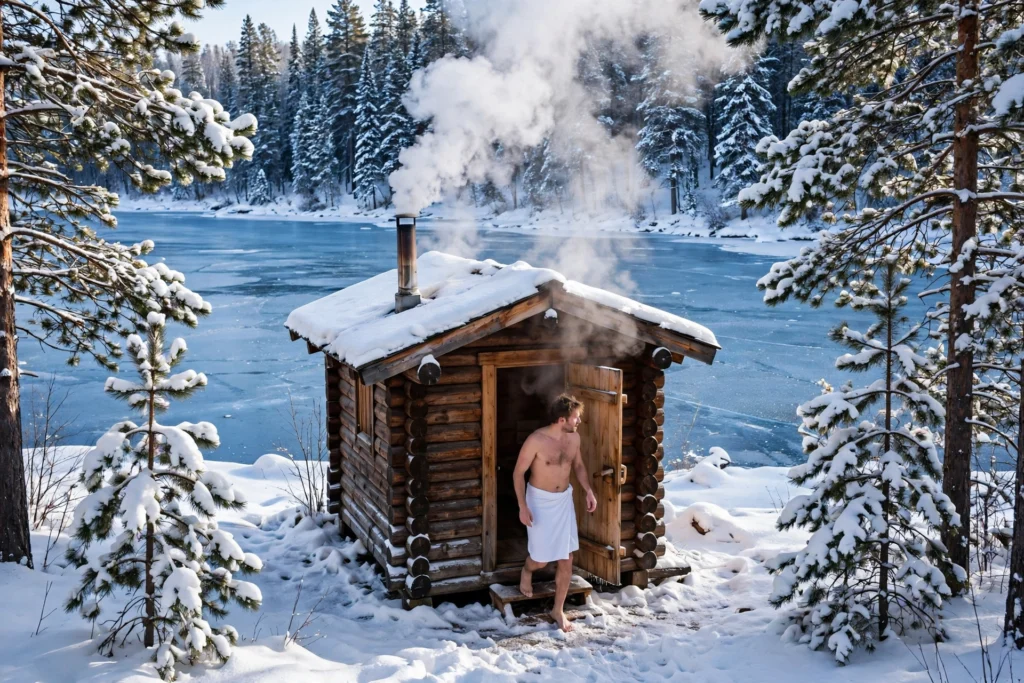
Minnesota has more saunas per person than anywhere else in the United States, and in the last few years it has turned that heritage into one of the most enjoyable winter trips in the country: a sauna road trip. The idea is simple and wonderful. You drive from one lakeside sauna to the next — wood-fired cabins on frozen lakes, floating saunas on the water, community saunas in small towns — sit in the heat until you are glowing, step outside into the snow or plunge into a cold lake, and then do it all over again. It is the Finnish tradition, kept alive by Minnesota’s large Scandinavian community, and it turns the coldest months of the year into the most fun ones.
What makes it fun
The fun is the contrast, and it is physical in the best way. The heat of the sauna, the shock of the cold air, the steam rising off your skin, the quiet of a frozen lake at dusk — it is a full-body experience that leaves you relaxed in a way that no spa treatment quite matches. The road trip element makes it social: each sauna is different, some are on wheels, some are on the water, some are in the woods, and the drive between them takes you through the small towns and frozen lakes of northern Minnesota. It is also gloriously low-tech: wood, water, heat, cold, and good company.
Who it suits
Winter lovers, couples, and wellness-minded travellers who like their fun slow and sensory. It suits groups of friends beautifully, because a sauna is a social place — you sit, you talk, you cool off, you go back in. It is less suited to travellers who hate the cold or who want a high-energy trip; this is a slow, warm, quiet kind of fun, and it works best if you lean into that. Families with older teens can enjoy it too, but check each sauna’s age policy first, because some are adults-only.
Best season to go
December to March, when the lakes are frozen and the contrast between the hot sauna and the cold outdoors is at its most dramatic. January and February are the coldest and the most atmospheric, but any winter month works. The saunas are at their busiest on winter weekends, so book ahead, and if you are planning a longer winter trip, look at the ice festivals and winter events that run across the state in the same season.
Practical tips
Book saunas in advance — the popular ones, especially the floating and lakeside saunas, sell out on winter weekends. Bring two towels, a swimsuit or a wrap, and warm clothes for the drive between saunas. Hydrate well: a sauna dehydrates you faster than you think, and the cold air makes it easy to forget to drink. If you are new to sauna culture, ask the host how it works — the etiquette is simple, but it varies, and Minnesotans are famously happy to explain it. And do not rush: the pleasure of a sauna road trip is in the slowness, so plan for two or three saunas in a day at most, with a long lunch and a slow drive in between.
More fun places worth a detour
The fourteen places above are the main course, but America is so full of playful, quirky, immersive fun that it would be wrong to stop there. These are the extra stops — the hidden gems and quick detours that make a good road trip great. Each one is a different kind of fun, and each one fits into the same trips as the main list.
| Place | The fun in one line | Best for |
|---|---|---|
| Winchester Mystery House, San Jose, California | A mansion of staircases to nowhere, doors into walls and 160 rooms of beautiful confusion | Curious adults, teens, mystery lovers |
| Diggerland, New Jersey | Drive a real excavator, ride a construction machine, dig a hole for fun | Kids 4–12, machine-mad adults |
| Nashville, Tennessee | Honky-tonks on Broadway, live music in every bar, all day and all night | Music lovers, groups of friends, couples |
| Key West, Florida | The Sunset Celebration at Mallory Square, then the weirdest mile in America | Couples, sunset chasers, free spirits |
| Salem, Massachusetts | Witch history, Halloween year-round, and a town that leans into its story | History lovers, Halloween fans, teens |
| Asheville, North Carolina | Breweries, street art, the Blue Ridge Parkway and a food scene that punches above its weight | Food lovers, couples, mountain fans |
| Ouray, Colorado | Climb a frozen waterfall in a box canyon at the Ouray Ice Park | Winter adventurers, climbers |
| Dinosaur Valley State Park, Texas | Real dinosaur tracks in a riverbed you can walk through | Families, dinosaur fans, Texas road trippers |
| Carlsbad Caverns, New Mexico | A cave so big it has its own weather, and a bat flight at dusk | Families, cave lovers, photographers |
| Joshua Tree, California | Climbable rocks shaped like skulls and hearts, and a desert sky full of stars | Climbers, photographers, stargazers |
What a fun trip costs: planning ranges
The figures below are planning ranges, not prices. Ticket prices, hotel rates and food costs change by season and by year, and the only reliable price is the one on the official site on the day you book. Use these ranges to build a budget, then check the real numbers before you commit.
| Item | Planning range (per person, per day, unless noted) | Notes |
|---|---|---|
| National park entrance | $0–$35 per vehicle for a 7-day pass; America the Beautiful annual pass $80 for US residents, $250 for non-residents from January 1, 2026 | The annual pass pays for itself in three or four park visits. Fee-free days in 2026 include February 16, May 25, June 14 and July 3–5. |
| Meow Wolf (Santa Fe) | Budget for a half-day ticket plus food in Santa Fe | Timed tickets; book ahead in summer |
| City Museum (St. Louis) | Budget for a half-day ticket plus rooftop time | Indoors, year-round; allow 3–4 hours |
| Theme park day (Santa Claus, Indiana) | Budget for a full-day ticket plus food for the family | Free soft drinks keep family costs down |
| River surfing lesson (Cedar Falls) | Budget for a lesson including gear hire | Watching from the bank is free |
| Food in New Orleans | Budget generously — food is the main event | The best meals are often the cheapest |
| Balloon Fiesta (Albuquerque) | Budget for festival tickets plus early-morning transport | Accommodation is the biggest cost; book months ahead |
| Observatory evening (Flagstaff) | Budget for an evening programme ticket | Book ahead; programmes are small |
| Sauna session (Minnesota) | Budget per session, plus the drive between saunas | Book winter weekends early |
| Road trip fuel and food | Budget per day for a car of four | The biggest variable is how far you drive |
The National Park Service’s announcement on the modernised America the Beautiful pass confirms the 2026 prices and the new digital pass, and our travel packing checklist covers what to pack for a trip that mixes cities, parks and water.
Frequently Asked Questions About Fun Places to Travel in the US
What are the most fun places to travel in the US for families?
Santa Claus, Indiana (Holiday World), the Black Hills of South Dakota, Great Sand Dunes in Colorado and Mammoth Cave in Kentucky are the strongest family picks in this guide, because each one mixes physical fun with wonder and works for a wide age range. The City Museum in St. Louis is the best rainy-day family option in the country. For the full age-by-age picture, see the “Fun by age” table in the Santa Claus section above.
What is the most fun state to visit in the US?
It depends on the kind of fun you want. New Mexico wins for quirky and immersive fun — Meow Wolf in Santa Fe plus the Balloon Fiesta in Albuquerque in the same state is hard to beat. Colorado wins for outdoor adventure, Louisiana for food and music, and Michigan for water fun on the Great Lakes. If you can only pick one state for a first fun trip, New Mexico gives you the most variety in the smallest area.
Where can you go in the US for quirky, unusual fun?
Start with the American Giants Museum on Route 66 in Atlanta, Illinois, then add Carhenge in Nebraska, Cadillac Ranch in Texas, the Cabazon Dinosaurs in California, the Fremont Troll in Seattle and the Winchester Mystery House in San Jose. The common thread is that none of these places is trying to be impressive — they are trying to be fun — and that is exactly why they work.
What is the best month to visit the US for fun trips?
October is the best all-round month: the Balloon Fiesta in Albuquerque, autumn colours in New England and Michigan, comfortable temperatures in New Orleans and Santa Fe, and smaller crowds almost everywhere. July is the best month for festivals and America 250 celebrations, and June is the best month for the national parks and the dunes. Avoid August in the desert Southwest unless you love extreme heat.
Are these fun places good for kids and teens?
Yes, with the right picks. Kids aged 4–7 do best at Santa Claus, Dinosaur Park and the gentler parts of Meow Wolf. Kids aged 8–12 do best at the City Museum, Mammoth Cave and the Great Sand Dunes. Teens do best at Meow Wolf, Cedar Falls river surfing, Sleeping Bear Dunes and the American Giants Museum. The “Fun by age” table above gives the full breakdown.
How much does a fun trip in the US cost?
It varies enormously, and the planning ranges table above is the honest starting point. A national park day can cost almost nothing beyond the entrance fee and food, while a theme park day for a family of four is one of the more expensive days in this guide. The cheapest fun in this guide — watching river surfing in Cedar Falls, walking among the balloons in Albuquerque, climbing the dune at Sleeping Bear — is free or nearly free, and it is often the most memorable.
What is America 250 and should I plan around it?
America 250 is the 250th anniversary of the Declaration of Independence, celebrated on July 4, 2026, with events all year and the biggest weekend on July 3–4. You should plan around it if you love festivals, parades and big national moments — and you should book accommodation early if you are going to a host city. If you dislike crowds, travel in late June or mid-July instead, when the atmosphere is still there but the peak crowds have gone.
Do I need a national parks pass for the outdoor fun places?
Not for a single visit — you can pay the entrance fee at the gate. But if you are visiting three or more national parks in a year, the America the Beautiful annual pass ($80 for US residents, $250 for non-residents from January 1, 2026) usually saves money. In 2026, entrance is free for US citizens and residents on the fee-free days, including July 3–5 for the America 250 weekend.
Can you really surf in Iowa?
Yes. Cedar Falls has a purpose-built whitewater park, Gateway River Park, completed in 2025, with four engineered features that create a standing wave on the Cedar River. Beginners start with boogie boarding and work up to standing on the board, and lessons are available through the season. The park is free to watch, and the wave runs whenever the river flow cooperates.
Is Meow Wolf worth it for adults without kids?
Yes — it is arguably better for adults, because the story, the art and the puzzle-box design reward attention and patience in a way that children do not always have. Many adults report that Meow Wolf is the most fun they have had in a museum in years, precisely because it does not treat them like children. Go early, allow three hours, and let yourself get lost.
What is the best fun place in the US in winter?
The Minnesota sauna road trip is the most distinctive winter fun in this guide, and the City Museum in St. Louis is the best indoor winter option. Mammoth Cave is the same temperature all year, which makes it a brilliant winter choice, and Flagstaff’s dark skies are at their clearest in winter. If you want snow and adventure, Ouray Ice Park in Colorado is the winter pick for climbers.
How do I plan a fun road trip across several of these places?
Pick one region and one kind of fun, then add a second kind. A Route 66 trip links the American Giants Museum, the Fremont Troll (via Seattle) and the roadside giants. A Southwest trip links Meow Wolf, the Balloon Fiesta and Flagstaff. A Midwest trip links the City Museum, Cedar Falls river surfing and Sleeping Bear Dunes. Do not try to do all fourteen places in one trip — the fun is in the depth, not the count.
Conclusion: Fun Is a Plan, Not an Accident
The most fun places to travel in the US are not the most famous ones. They are the ones that let you do something — climb a factory, surf a river, walk through a house that is not a house, slide down a dune, eat until you are happy, and look up at a sky full of stars. The fourteen places in this guide, plus the ten extra detours, cover every kind of fun: immersive, quirky, adventurous, food, family, water, festival and night. They are spread across the country, they work in every season, and they are at their best in 2026, when America 250 turns the whole summer into a celebration and Route 66 turns 100.
Pick one kind of fun, pick one place, and go. The rest of the list will still be there for the next trip — and the trip after that. Fun, done properly, is not a distraction from a good holiday. It is the holiday.
People also read:
- Places to Travel in Texas
- Places to Travel With Kids
- Best Places to Travel With a Baby
- Kauai Travel
- Yellowstone Travel Guide
- Seattle Travel Guide
- Travel to Sedona
- Christmas Travel
- Dream Travel Destinations
- Is It Safe to Travel to Chicago Right Now?

M. Adil is the founder and editor of SoloTravelPro. He writes practical, research-based travel guides that help travellers plan with confidence — from first-time city breaks to national parks and island escapes. Every guide is built on official sources, current prices and honest, usable advice, so readers can plan smarter and travel better.