Spain rewards travellers who plan around its regions, not around a single city list: fly into Madrid or Barcelona, pick one of the two proven routes in this Spain travel guide — the 7-day Madrid–Seville–Granada classic or the 10–14-day east route through Cuenca, Valencia and Barcelona to the Costa Brava — book the Alhambra and the Sagrada Família the moment your dates are fixed, ride the AVE high-speed trains between cities instead of driving, eat lunch between 2 and 4 pm and dinner after 9 pm, and budget roughly €110–€180 a day for a comfortable mid-range trip. US citizens need no visa for stays under 90 days, the US State Department rates Spain Level 2 (exercise increased caution) for terrorism and unrest, and the ETIAS travel authorisation is still not in operation, so there is nothing to apply for yet.
Spain at a Glance: What First-Timers Need to Know Before They Go
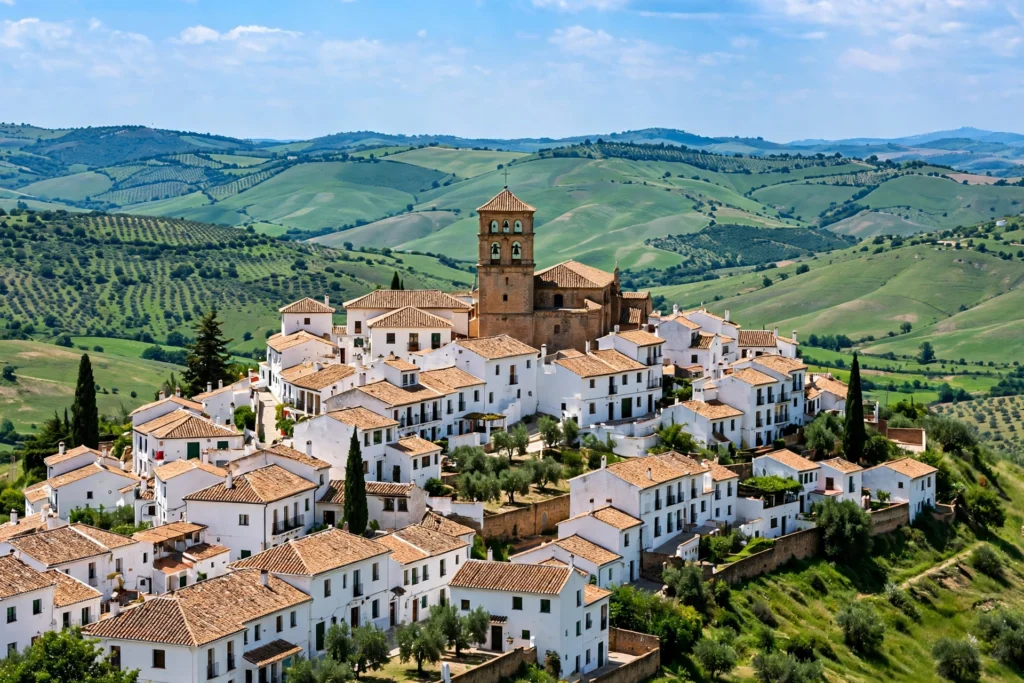
The first mistake most first-time visitors make in Spain is treating it as one country with one character. It is not. Spain is a set of very different regions sharing one passport — seventeen autonomous communities, each with its own food, festivals, accent and sometimes its own language — and a trip that tries to see all of them in a week sees none of them properly. The green Atlantic coast of the Basque Country and Galicia has more in common with Ireland than with the sun-baked plains of Andalusia. Barcelona feels Catalan first and Spanish second. The white villages of inland Andalusia run on a different clock from the beach towns of the Costa Brava. This Spain travel guide is built around that reality: instead of a list of places to visit in Spain, it gives you two complete routes, a way to choose between the north and the south, and the practical rules — trains, tickets, timing, money and safety — that decide whether the trip actually works.
The second mistake is underestimating the distances. Spain is the second-largest country in the European Union, and Madrid to Barcelona is about 620 kilometres by road. That sounds manageable until you add Seville, Granada, Valencia and the north, and suddenly a “quick tour of Spain” becomes a week of motorways. The good news is that Spain has one of the best high-speed rail networks in Europe, and the AVE trains turn those distances into two-to-three-hour journeys. The rule that runs through this whole guide is simple: use trains between cities, walk inside them, and only hire a car for the places trains do not reach — the white villages, the Rioja wine country, the Picos de Europa and the rural north.
The third mistake is booking the big sights late. Two of Spain’s most famous attractions sell timed tickets that run out weeks ahead, and neither can be fixed by turning up early on the day. The Alhambra in Granada admits the Nasrid Palaces in half-hour slots and sells out in spring, summer and on long weekends. The Sagrada Família in Barcelona sells its tickets online only, roughly two months ahead, and the popular dates go first. Both are covered in detail below, with the prices verified on the official sites in November 2026 — but the practical point is the same for both: fix your dates, book the tickets, and only then book the hotels around them.
The facts that shape every Spain trip
A few facts do more work than any list of attractions. Spain uses the euro, and cards are widely accepted in cities, though small family bars and rural markets still prefer cash for small amounts. The country drives on the right. The emergency number is 112. The main meal of the day is lunch, eaten between about 2 and 4 pm, and dinner rarely starts before 9 pm — a schedule that catches more first-timers off guard than any other single thing about the country. Many shops in smaller towns still close from around 2 to 5 pm, though big stores in Madrid and Barcelona now stay open all day. And Spanish is the national language, but Catalan is spoken in Catalonia, Basque in the Basque Country and Galician in Galicia; a few words of Spanish go a long way everywhere, and in the big cities you will manage in English, though in small bars and villages a translation app earns its keep.
US citizens need no visa for tourist stays of under 90 days in the Schengen Area, but the 90/180 rule applies: no more than 90 days in any 180-day period across the whole Schengen zone, not just Spain. Your passport must be valid at the time of entry and must have at least three months’ validity beyond your date of departure, with two blank pages. The US State Department rates Spain Level 2 — exercise increased caution — because of terrorism and unrest, and it rates Ceuta, the small Spanish city on the North African coast, Level 3 — reconsider travel — because of unrest there. The Level 2 rating is the same kind of rating the United States gives many Western European countries, and it does not mean “do not go”: it means be alert in crowded places, avoid demonstrations and keep an eye on local news. The full advisory is on the US State Department Spain travel advisory page, and you should read it when you book and again the week before you fly, because advisories change.
On entry rules, there is one piece of good news and one thing to understand. The good news: the ETIAS travel authorisation — the online pre-travel check for visa-exempt visitors that has been promised for years — is still not in operation. The official EU ETIAS page says plainly that no applications are being collected, and the EU will announce the start date several months before launch, so there is nothing for you to apply for and no website asking you for money today is legitimate. When it does launch, the fee will be €20. The thing to understand is the Entry/Exit System, or EES: it is fully operational, and on your first entry a border officer will scan your passport and take a facial image and fingerprints instead of stamping your passport. It adds a few minutes at the border and it counts your days against the 90/180 rule automatically. The official position is on the European Union ETIAS page.
How long do you need in Spain?
The honest answer is that a week is the minimum for a satisfying first trip, ten to fourteen days is the sweet spot, and three weeks still leaves things unseen. Five days works only if you pick one region and stay in it — Madrid plus Toledo and Segovia, or Barcelona plus the Costa Brava, or Seville plus Granada. Seven days is enough for the classic first-timer route. Ten to fourteen days lets you do the east route properly, with time in Valencia and on the coast. Anything less than five days means spending a third of your trip in transit, which is the most common way a Spain trip goes wrong. The two routes below are built on those numbers, and every day count in them includes travel time, so the days are real days, not wishful ones.
| Trip length | What it fits | Best for |
|---|---|---|
| 3–4 days | One city plus one day trip | A long weekend in Madrid or Barcelona |
| 5–7 days | The classic route: Madrid, Seville, Granada | First-timers who want the highlights |
| 10–14 days | The east route: Madrid, Cuenca, Valencia, Barcelona, Costa Brava | Travellers who want cities and the coast |
| 14–21 days | East or classic route plus the north or the islands | Second trips and slow travellers |
| 21+ days | Two regions in depth, plus the Camino or the islands | A full tour of the country |
The best time to visit Spain, region by region
There is no single best time to visit Spain, because the country has several climates and they peak at different times. April to June and September to October are the best months for most first-timers: warm but not scorching, long days, and the big cities at their most walkable. July and August bring the fiercest heat to Andalusia, where Seville and Córdoba regularly pass 40°C (104°F), and the biggest crowds to Barcelona, the Balearics and the Costa Brava — though the north stays mild and green, which is exactly when the Basque Country and Galicia are at their best. Winter is the quiet season: Madrid and Barcelona are cool and often sunny, the Costa del Sol is mild, and hotel prices drop, but the days are short and some coastal businesses close. The table below is the short version; the month-by-month detail is in the practical section at the end of this guide.
| Season | Where it works best | What to expect |
|---|---|---|
| Spring (Mar–May) | Andalusia, Madrid, Barcelona, Valencia | Warm days, festivals, wildflowers, moderate crowds |
| Summer (Jun–Aug) | The north, the islands, the coast | Hot inland and south, busy beaches, high prices |
| Autumn (Sep–Nov) | Everywhere, especially Andalusia and the east | Warm seas, harvest season, thinning crowds |
| Winter (Dec–Feb) | Madrid, Barcelona, Costa del Sol, the Canaries | Cool and quiet, low prices, short days |
The 7-Day Classic Route: Madrid, Seville and Granada
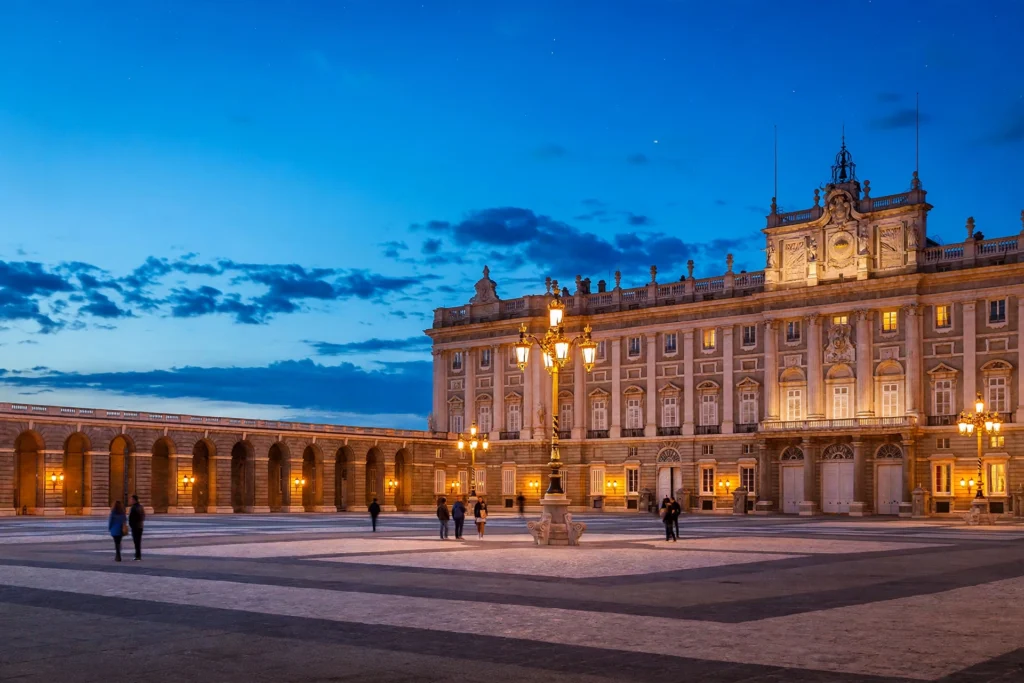
If you have one week and you have never been to Spain, this is the route to take. It is the classic first-timer itinerary for a reason: it covers the capital, the most beautiful city in Andalusia and the country’s single greatest monument, it moves entirely by high-speed train, and it wastes almost no time in transit. Madrid gives you the museums and the food; Seville gives you the Alcázar, the cathedral and the flamenco; Granada gives you the Alhambra and the Albaicín. Three cities, seven days, no car, no flights inside Spain, and every day has a clear purpose. It is also the route the rest of this Spain travel guide keeps coming back to, because the day-by-day detail for each city sits in the city sections below.
The shape of the week matters as much as the cities. Fly into Madrid and out of Málaga, or fly into Madrid and back out of Madrid — the first is better, because it saves a return leg. Spend three nights in Madrid, two nights in Seville and two nights in Granada, and take the train from Granada to Málaga airport on the last morning if you are flying home from there. The Madrid–Seville train takes about two and a half hours; Seville–Granada is about two and a half to three hours by train or bus. Book the trains early, because the cheapest fares sell first, and book the Alhambra before you book anything else — the Nasrid Palaces slot is the one fixed point your Granada days have to bend around, and everything else in the week is flexible except that.
Day by day: the 7-day classic
Day 1 is Madrid, and it should be a gentle one. Arrive, drop your bags, and spend the afternoon walking the old centre: Puerta del Sol, Plaza Mayor, the Royal Palace from the outside and the Almudena Cathedral. Eat tapas in the evening in La Latina or around the Plaza de Santa Ana, and go to bed early — the first day is for getting your bearings, not for ticking boxes. Day 2 is the museum day: the Prado in the morning, when your eyes are fresh, and the Retiro Park in the afternoon, with a rowing boat on the lake if the weather is kind. Day 3 is for the rest of Madrid — the Thyssen and the Reina Sofía if you want more art, the San Miguel market for lunch, the Malasaña and Chueca neighbourhoods for an evening of bars — and for a day trip if you prefer: Toledo is thirty minutes by train and Segovia is about the same, and either one is a fine use of a Madrid day.
Day 4 is the train to Seville. Arrive around midday, settle in, and spend the afternoon in the Santa Cruz quarter, the old Jewish neighbourhood of narrow streets and orange trees, ending at the Plaza de España as the light turns golden. Day 5 is the big Seville day: the Real Alcázar in the morning, the cathedral and the Giralda tower after lunch, and a flamenco show in the evening — book a small tablao rather than a dinner show, and treat it as music, not as a theme-park performance. Day 6 is the train to Granada. Arrive, climb to the Mirador de San Nicolás for the famous view of the Alhambra against the Sierra Nevada at sunset, and then eat your way through the Albaicín, where many bars still serve a free tapa with every drink. Day 7 is the Alhambra itself: the Nasrid Palaces at your booked slot, the Alcazaba and the Generalife gardens around it, and the afternoon in the Albaicín or the Sacromonte caves. Fly home from Málaga the next morning, or take the evening train back to Madrid if your flight leaves from there.
| Day | Base | What you do | Travel |
|---|---|---|---|
| 1 | Madrid | Old centre, Puerta del Sol, Plaza Mayor, Royal Palace | Arrive, walk |
| 2 | Madrid | Prado in the morning, Retiro Park in the afternoon | Walk and metro |
| 3 | Madrid | Thyssen and Reina Sofía, or a day trip to Toledo or Segovia | Walk, or 30-min train |
| 4 | Seville | Train to Seville, Santa Cruz quarter, Plaza de España | AVE, about 2.5 hours |
| 5 | Seville | Real Alcázar, cathedral and Giralda, flamenco in the evening | Walk |
| 6 | Granada | Train to Granada, Mirador de San Nicolás at sunset, Albaicín tapas | Train or bus, 2.5–3 hours |
| 7 | Granada | Alhambra all day: Nasrid Palaces, Alcazaba, Generalife | Walk and bus uphill |
Who the classic route suits — and who should skip it
The classic route suits first-timers, history lovers, food lovers and anyone who wants the greatest-hits version of Spain without a car. It suits couples and families, it suits travellers who like cities more than beaches, and it suits anyone travelling in spring or autumn, when Andalusia is at its best. It does not suit beach lovers — there is no beach on this route, and the nearest one is an hour from Granada at the Costa Tropical, or ninety minutes from Seville at Cádiz. It does not suit hikers, and it does not suit anyone who wants the green north: if the Basque Country, Galicia or the Picos de Europa are the reason you are coming, take the east route instead, or add a second week. And it does not suit July and August, when Seville and Granada are punishingly hot and the route’s pleasures — walking, sitting outside, climbing viewpoints — become chores. In high summer, flip the route: do the north first and save Andalusia for the shoulder seasons.
One more piece of advice about this route, and it is the one that saves more trips than any other: do not try to add Barcelona to it. Madrid, Seville, Granada and Barcelona in seven days is four cities in seven days, which means two of those days are spent entirely in transit and every city gets a rushed day and a half. Barcelona deserves three days of its own, and it has them in the east route below. The classic route is good because it is short. Keep it short.
The 10–14-Day East Route: Madrid, Cuenca, Valencia, Barcelona and the Costa Brava
The east route is the trip for travellers who have ten days or more and want Spain’s full range: the capital, a medieval cliff town, the city that invented paella, the Gaudí capital and the Mediterranean coast, in one unhurried line that follows the high-speed rail map eastward. It is longer than the classic route and it covers more ground, but it never feels rushed, because every stop is a genuine destination rather than a waypoint, and the trains between them are short. Madrid to Cuenca is under an hour by AVE. Cuenca to Valencia is a little over an hour. Valencia to Barcelona is about three hours. Barcelona to the Costa Brava is an hour by bus or train. The whole route moves in one direction, so you never backtrack, and you finish on the coast, which is the right place to finish a Spanish trip.
This is also the route to take if you are travelling with children, or with anyone who needs variety to stay interested. A ten-day trip that is all palaces and cathedrals gets long for a ten-year-old; a trip that mixes a capital, a gorge town, a beach city, Gaudí and a coast with coves to swim in does not. It is equally the route for food lovers who want more than Andalusian cooking: Valencia is where paella comes from, Barcelona is where Catalan cooking lives, and the Costa Brava has some of the best seafood restaurants in the country. And it is the route for travellers who want to end their trip with two or three slow days rather than a final sprint — the Costa Brava is built for that.
Day by day: the 10–14-day east route
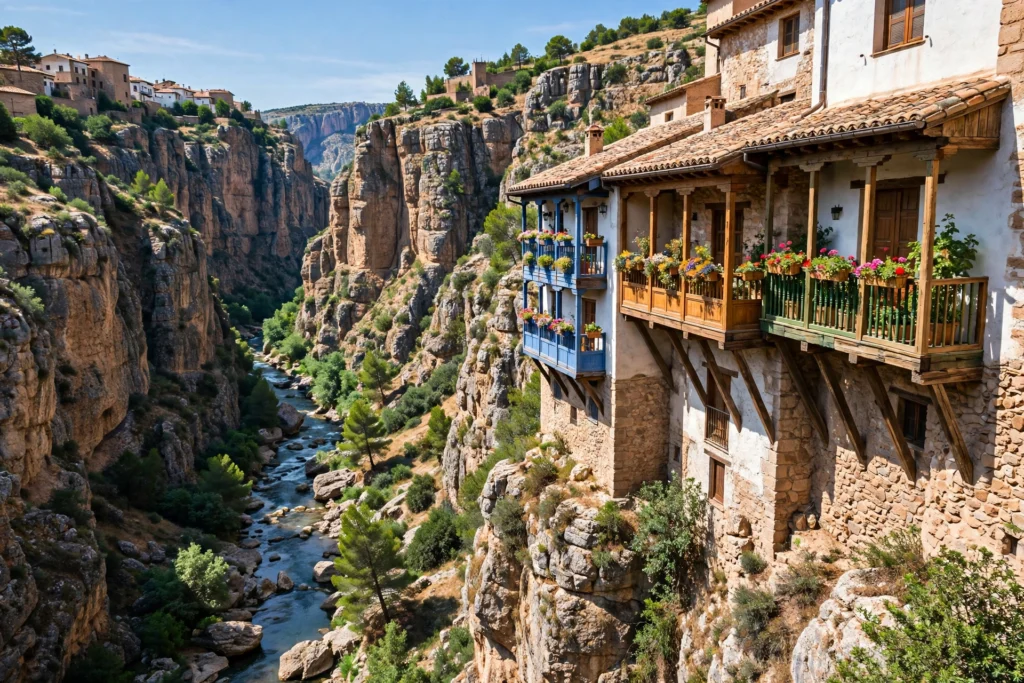
The first three days are Madrid, exactly as in the classic route above: the old centre on day 1, the Prado and Retiro on day 2, and the Thyssen, the Reina Sofía or a day trip to Toledo or Segovia on day 3. There is no reason to change a formula that works, and Madrid is the best place in Spain to start, because it is the transport hub everything else hangs off. On day 4, take the morning AVE to Cuenca — fifty minutes, and one of the shortest high-speed journeys in the country — and spend the day in a town that most first-timers never hear of and almost everyone who goes there loves. The Casas Colgadas, the hanging houses, jut out over the Huécar gorge on wooden balconies. The old town is a UNESCO World Heritage site. The cathedral is one of the first Gothic cathedrals in Spain. And the Ciudad Encantada, the Enchanted City of eroded limestone outside town, is a half-day of walking through rock formations that look carved. Cuenca is a one-night stop for most people, and one night is enough.
Day 5 is the train to Valencia. The city rewards two full days, and this route gives it two nights. The first afternoon is for the old town: the cathedral and its Micalet bell tower, the Silk Exchange — La Lonja — and the Central Market, one of the best food markets in Spain. The second day is for the contrast that makes Valencia special: the City of Arts and Sciences in the morning, a futuristic complex of white curves on water, and the Malvarrosa beach and the paella restaurants of El Cabanyal in the afternoon. Paella is a lunch dish in Valencia, cooked to order for at least two people, and the real thing is Paella Valenciana — chicken, rabbit and green beans, not seafood. If a restaurant offers paella for one person at dinner, walk away: it is almost certainly reheated, and it is not what you came for.
Days 7 to 9 are Barcelona, and three days is the minimum the city deserves. Day 7 is the Gothic Quarter and the old town: the cathedral, the Plaça del Rei, the streets of El Born and the Picasso Museum if you want it. Day 8 is Gaudí: the Sagrada Família in the morning — book the first slot of the day, when the light through the stained glass is at its best — and Park Güell in the afternoon, with the evening in Gràcia, the neighbourhood of small squares and local bars that feels most like the Barcelona locals actually live in. Day 9 is the rest: the beach at Barceloneta in the morning, the Boqueria market, Montjuïc and its castle and gardens, and a final evening of pintxos and vermouth. If you have a fourth Barcelona day, spend it on a day trip — Montserrat, the mountain monastery an hour away, or Girona, an hour north by train, or Sitges, forty minutes down the coast.
Days 10 to 12, or 10 to 14 if you have the time, belong to the Costa Brava. Base yourself in Girona, in Calella de Palafrugell, or in Cadaqués if you want the prettiest town on the coast, and spend the days the way the coast asks to be spent: walking the Camí de Ronda coastal path between coves, swimming in the turquoise water, eating seafood in the fishing villages, and doing very little else. The Costa Brava is not a place for a checklist. It is a place for slowing down, and that is why it is the end of the route rather than the middle. If you only have ten days, two nights on the coast is enough. If you have fourteen, take four, and come home rested instead of exhausted.
| Day | Base | What you do | Travel |
|---|---|---|---|
| 1–3 | Madrid | Old centre, Prado, Retiro, day trip to Toledo or Segovia | Walk and metro |
| 4 | Cuenca | Hanging houses, old town, cathedral, Enchanted City | AVE, under 1 hour |
| 5–6 | Valencia | Old town and markets, City of Arts and Sciences, paella lunch | Train, about 1 hour |
| 7–9 | Barcelona | Gothic Quarter, Sagrada Família, Park Güell, beach, Montjuïc | Train, about 3 hours |
| 10–12 | Costa Brava | Coastal walks, coves, fishing villages, slow days | Bus or train, about 1 hour |
| 13–14 | Costa Brava | More coast, or a day trip to Girona | Local buses |
How to choose between the two routes
The choice is simpler than it looks. If you have seven days, take the classic route. If you have ten or more, take the east route. If you love Moorish history, flamenco and white villages, take the classic route. If you want the sea, Gaudí and paella, take the east route. If you are travelling in July or August, take the east route, because the coast and the north are bearable in high summer and Andalusia is not. If you are travelling in April or October, either route is superb, and the classic route has the edge, because Andalusia is at its best in those months. And if you have three weeks, do both: the classic route first, then the train from Granada to Valencia and the east route from there. Spain is a country that rewards a second trip more than almost anywhere else in Europe, and the two routes together are the whole first visit.
Madrid: Three Days in the Capital
Madrid is the easiest Spanish city to underestimate and the hardest to leave. It has no single postcard sight to match the Sagrada Família or the Alhambra, and first-timers sometimes treat it as a transit stop on the way to somewhere prettier. That is a mistake. Madrid has the best art in Spain, the best food scene in Spain, the best parks, and the most infectious evening energy of any city in the country — and three days here is the right amount, because the city rewards slow looking rather than rushing. The Prado alone deserves a full morning. The Retiro Park deserves a full afternoon. And the evenings, when the plazas fill and the tapas bars get going, are the reason people come back.
Start with the old centre, because it is compact and walkable and it orients you. Puerta del Sol is the symbolic centre of Spain — kilometre zero, from which all the country’s roads are measured — and from there the Plaza Mayor is a five-minute walk through streets that have been commercial since the seventeenth century. The Royal Palace, the largest royal palace in Western Europe by floor area, sits at the western edge of the old town beside the Almudena Cathedral, and its state rooms and armoury are worth the visit even if palaces are not usually your thing. Around the corner, the Plaza de Oriente and the Sabatini Gardens are the quietest corner of the centre, and a good place to sit with a coffee and plan the rest of the day. For the bigger picture of the capital’s history, our Lisbon travel guide makes a useful companion read — the two Iberian capitals are an easy pairing, and many travellers do both in one trip.
The Prado, the Retiro and the art triangle
The Prado is the best museum in Spain and one of the best in the world, and the way to visit it is to go early, pick a route and stop when you are tired rather than trying to see everything. The highlights are the Spanish rooms — Velázquez, Goya and El Greco — and the Flemish and Italian rooms, and the museum’s own suggested routes are genuinely useful. A practical tip that saves money: the Prado is free during the last two hours of opening every evening, and the queue for the free hours moves quickly if you arrive a little before they start. The Thyssen-Bornemisza, a five-minute walk away, fills the gaps the Prado leaves — Impressionists, Expressionists and American art — and the Reina Sofía, home to Picasso’s Guernica, completes the triangle. Three museums in one day is too much for most people; the Prado in the morning and one of the other two in the afternoon is the right pace, with the Retiro Park between them as a break.
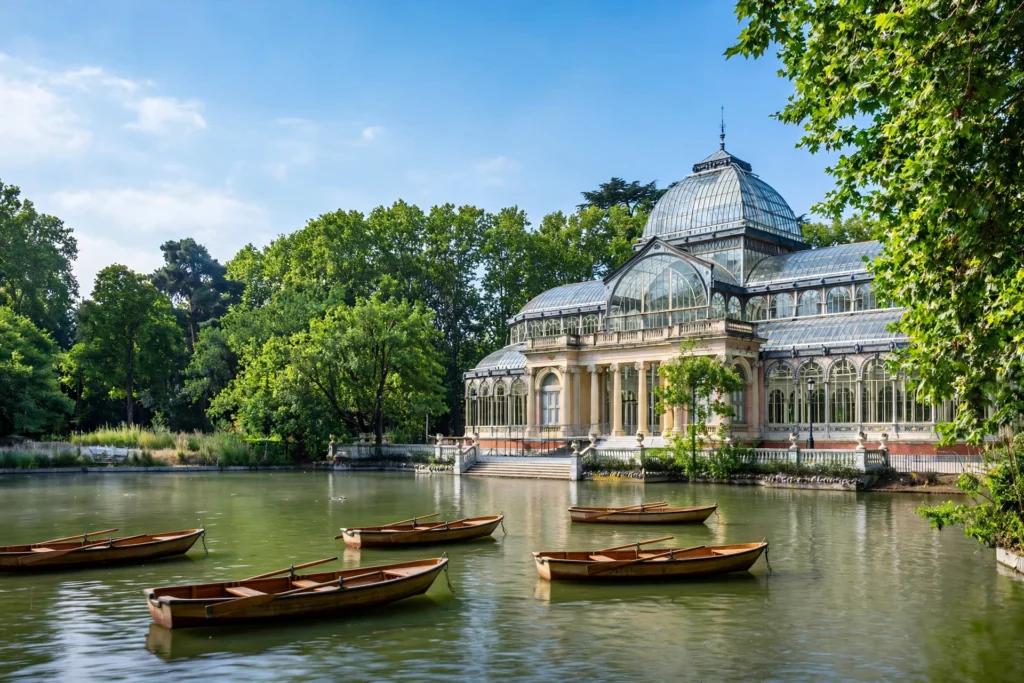
The Retiro is Madrid’s living room: 350 acres of gardens, a lake with rowing boats, the glass Crystal Palace, and avenues of plane trees where the whole city seems to come on a Sunday. Go in the late afternoon, when the light is low and the park is at its busiest, and take a boat on the lake if the weather is good. It is also the best place in Madrid to recover from a long morning in a museum, and the park’s cafés are a reasonable place for a late lunch. If you want a second park, the Casa de Campo, across the river, is bigger and wilder, and the Temple of Debod — an Egyptian temple given to Spain in the 1960s, standing on a hill above the Manzanares — is the best sunset viewpoint in the city. Go at dusk, when the temple is lit and the Royal Palace glows behind it.
Where to eat and drink in Madrid
Madrid’s food scene is the best argument for spending three days here. Start with the markets: the Mercado de San Miguel, beside the Plaza Mayor, is the famous one, and it is beautiful and crowded and expensive — worth a visit, but not the place to eat every meal. The Mercado de San Antón in Chueca and the Mercado de la Paz in Salamanca are where locals shop, and their upper floors have good, honest bars. For tapas, the rule is to eat standing at the bar, order one thing at a time, and move on: a caña of beer and a tapa of croquetas here, a vermouth and some anchovies there. La Latina, around the Cava Baja, is the classic tapas quarter, and it is at its best on a Sunday, when the El Rastro flea market fills the streets in the morning and the bars fill in the afternoon. Malasaña is the young, noisy quarter for the evening; Chueca is the lively LGBTQ-friendly heart of the city; and the area around the Plaza de Santa Ana is the safe bet for a first night, with good restaurants on every side.
The menú del día is the single best value in Spanish eating, and Madrid does it as well as anywhere. On weekdays between about 1.30 and 4 pm, most restaurants offer a set lunch — two courses, dessert, bread and a glass of wine or water — for roughly €12–€18. It is the main meal of the day, it is what office workers eat, and it is the cheapest way to eat well in the city. Dinner, by contrast, starts late and costs more: kitchens rarely open before 8 pm, most locals eat at 9.30 or 10, and the tapas hour between 7 and 9 pm exists precisely to bridge the gap. Adjust your clock on day one and the whole trip gets easier.
Where to stay in Madrid
Stay central, and stay in a neighbourhood rather than on a main road. The area around the Plaza de Santa Ana and the Barrio de las Letras is the best first-timer base: quiet streets, good restaurants, and a ten-minute walk to the Prado and the old centre. Malasaña and Chueca suit travellers who want nightlife on their doorstep. Salamanca, east of the Retiro, is the elegant, expensive quarter — good for a splurge, and the best shopping in the city. Chamberí, north of the centre, is the local favourite for a quieter stay: residential, well connected by metro, and full of good neighbourhood restaurants. Avoid staying right on the Gran Vía or the Puerta del Sol itself, where the noise runs late. And wherever you stay, check that the room has air conditioning if you are travelling between May and October — Madrid summers are hot, and the nights stay warm.
Seville: The Heart of Andalusia
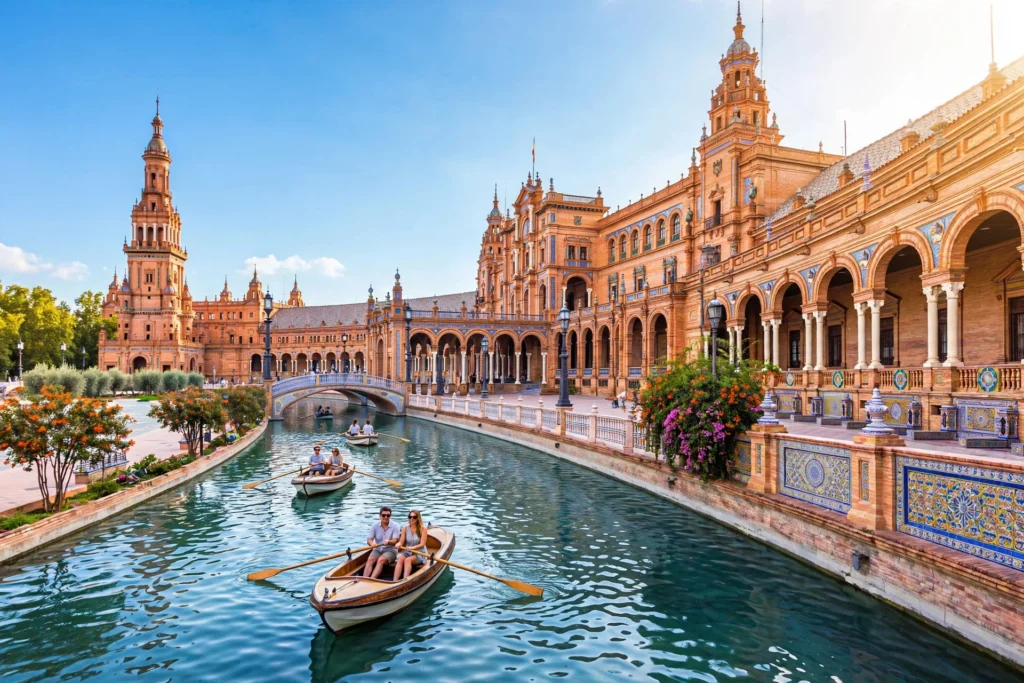
Seville is the city most travellers fall in love with in Spain, and it is easy to see why. It is beautiful in a way that feels effortless — orange trees on every street, tiled patios, the river, the cathedral tower rising over the old town — and it is also the most intensely Andalusian of the big cities, the place where flamenco, bullfighting, Holy Week and the Feria de Abril are not tourist shows but the calendar the city lives by. Two days is the minimum; three is better. The city is compact and walkable, the old town is one of the largest in Europe, and the heat, in the months when it matters, is the main thing you have to plan around.
Start at the Plaza de España, because it is the most beautiful public square in Spain and the best first sight in the city. Built for the 1929 Ibero-American Exposition, it is a great semicircle of brick and tile with a canal, four bridges and a tiled alcove for every province of Spain, and it is free to visit. Go early in the morning, before the heat and the crowds, or at sunset, when the tiles glow. From there it is a short walk to the María Luisa Park, the city’s great green space, and to the river, where the Torre del Oro stands. The old town is best explored on foot and without a strict plan: the Santa Cruz quarter, the former Jewish neighbourhood, is a maze of narrow streets, white walls and hidden plazas, and getting a little lost in it is part of the pleasure.
The Alcázar, the cathedral and the Giralda
The Real Alcázar is the sight that justifies the trip to Seville on its own. A royal palace still in use by the Spanish royal family, it is a layered masterpiece of Moorish, Gothic, Renaissance and Baroque building, with tiled courtyards, carved plasterwork and gardens of orange trees, peacocks and fountains. Book tickets in advance — the Alcázar sells timed entries, and the morning slots go first — and allow at least two hours, plus another hour for the gardens, which are a destination in themselves. The cathedral next door is the largest Gothic cathedral in the world, built on the site of the city’s great mosque, and its Giralda tower is the old minaret, rebuilt as a bell tower. Climb the Giralda — it is a ramp, not stairs, built so that a rider on horseback could go up — for the best view in Seville. The cathedral’s other claim to fame is the tomb of Christopher Columbus, which is worth a look for the sheer audacity of the monument.
The third great building in the centre is the Archivo de Indias, across the square from the cathedral, which holds the records of the Spanish empire in the Americas and is free to visit. Together the three buildings — cathedral, Alcázar and archive — form a UNESCO World Heritage site, and they sit within a few minutes of each other. Do them in one morning and one afternoon, and then spend the rest of your time in Seville doing what the city does best: eating, drinking and sitting in plazas.
Flamenco, food and the Sevillian evening
Flamenco in Seville is real, and it is also easy to get wrong. The tourist dinner shows in the centre are expensive and often mediocre. The better choice is a small tablao — a dedicated flamenco venue — where the performance is the point and the audience is close enough to feel it. Book a day or two ahead, go for the late show, and treat it as a concert: arrive on time, put your phone away, and listen. If you want to understand what you are hearing, a short introduction helps — flamenco is not one thing but a family of forms, from the solemn soleá to the joyful alegrías — but you do not need to understand it to be moved by it.
For food, Seville is a tapas city, and the rules are the same as in Madrid, with a Sevillian twist: the bars of the old town are small, crowded and wonderful, and the best strategy is to walk, look at what people are eating, and order what looks good. The Plaza del Salvador and the streets around it are the liveliest tapas quarter in the evening. Try the local specialities — salmorejo, the thick Cordoban cream soup; espinacas con garbanzos, spinach with chickpeas; and the fried fish of the Triana quarter, across the river, where the ceramics workshops and the market are worth a morning on their own. And remember the heat rule: in summer, plan your sightseeing for the morning and the evening, and spend the middle of the day inside — in a museum, in a restaurant, or in the shade of the Metropol Parasol, the great wooden structure in the Plaza de la Encarnación that the locals call the mushrooms.
A day trip from Seville: Córdoba, or Cádiz
If you have a third day in Seville, spend it on a day trip rather than a third day in the city. Córdoba is the obvious choice: ninety minutes by train, and home to the Mezquita, the mosque-cathedral that is one of the most extraordinary buildings in Europe — a forest of red-and-white arches inside a Christian cathedral. The old town around it, the Jewish quarter and the patios of the San Basilio neighbourhood, is a fine half-day on its own. Cádiz, on the coast, is the alternative: an hour and twenty minutes by train, a handsome old port city on a peninsula, with beaches, seafood and a very different atmosphere from inland Andalusia. Either one is a good day. Do not try to do both.
Granada and the Alhambra: Book It Before Anything Else
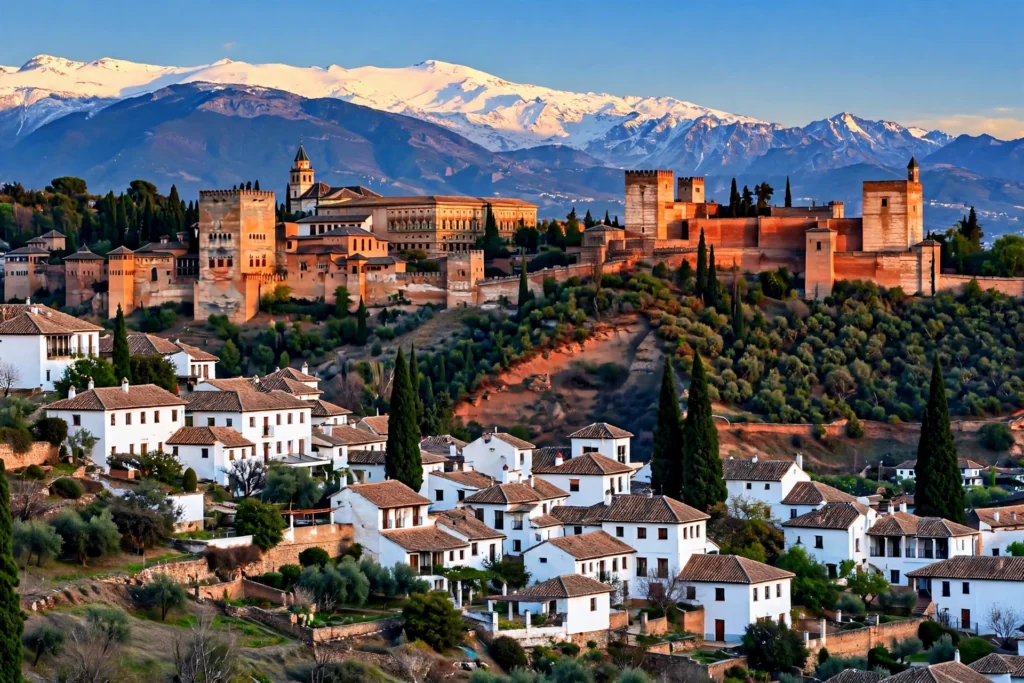
Granada is a small city with one enormous reason to visit, and the whole trip to Granada has to be organised around it. The Alhambra is the most visited monument in Spain and one of the great buildings of the world — a palace-city of the Nasrid dynasty, the last Muslim rulers of Iberia, with carved plasterwork, tiled courtyards, reflecting pools and gardens that have been admired for seven centuries. It is also the hardest major sight in Spain to get into, because entry is strictly limited and the tickets sell out weeks ahead in spring, summer and on long weekends. Everything in this section is practical first and poetic second, because the poetry is useless if you are standing outside the walls.
The ticket to buy is the Alhambra General day ticket, which covers the Alcazaba fortress, the Nasrid Palaces, the Partal and the Generalife gardens. As shown on the official Patronato site in November 2026, the online price is €22.27, which includes the booking fee on top of the regulated public price of €21. Children under 12 go free but still need a ticket. Buy only on the official sales site, tickets.alhambra-patronato.es, which is the only place that sells at face value; resellers charge more for the same ticket. Online sales close at 23:59 the night before your visit, and the ticket office at the monument sells same-day tickets only if any are left, which in high season they almost never are. The tickets are personal and non-transferable — each one carries the visitor’s name and ID number — and purchases are final, with no change of date or time and no refund. One person can buy no more than ten tickets a month. Book as soon as your dates are fixed, and if the general ticket is sold out for your day, check the alternatives on the same site: the gardens-only ticket at €12.73, which covers everything except the Nasrid Palaces, or the night visit to the palaces at the same price.
The Nasrid Palaces time slot: the rule that matters most
Every ticket that includes the Nasrid Palaces carries a fixed entry time, and this is the rule that catches people out. The palaces admit 300 people every half hour, and if you miss your slot you lose the palaces — there is no late entry, no exchange and no appeal. Plan the whole visit around the slot. If your slot is early, between 8 and 9.30 am, visit the Generalife first, when it is empty, and then go to the palaces. If your slot is mid-morning, go to the palaces first and do the Alcazaba and the Generalife afterwards. Allow about three hours for the whole visit, and longer if you like to linger. Each restricted area — the Nasrid Palaces, the Generalife Palace and the Alcazaba — can only be visited once, so do not rush through one expecting to come back. Bring your passport or ID, because the name on the ticket is checked. Leave large backpacks behind — bags over 40 by 40 centimetres are not allowed in — and do not bring a selfie stick, a flash or a tripod into the Nasrid Palaces. And wear comfortable shoes: the complex is large, the ground is uneven, and the walk from the main entrance to the palaces is long.
The palaces themselves are worth every bit of the effort. The Mexuar, the Comares Palace with its great Hall of the Ambassadors, and the Palace of the Lions with its famous courtyard and fountain are the heart of the visit, and the carved plasterwork, the wooden ceilings and the tilework are the finest Moorish decoration in Spain. The Generalife, the summer palace across the ravine, is quieter and greener, with water channels, myrtle hedges and views back across to the Alhambra. The Alcazaba, the fortress at the western end, gives the best views over the city and the Sierra Nevada. And the Partal, with its great pool reflecting the tower, is the photograph everyone takes — go there in the late afternoon, when the light is low and the crowds thin.
Granada beyond the Alhambra
Granada is worth two days, and the second day belongs to the Albaicín and the Sacromonte. The Albaicín is the old Moorish quarter on the hill opposite the Alhambra, a maze of whitewashed houses, narrow lanes and hidden squares, and the Mirador de San Nicolás is the viewpoint from which the classic photograph of the Alhambra is taken — go at sunset, when the red walls glow and the Sierra Nevada turns pink behind them, but expect a crowd. The Sacromonte, above the Albaicín, is the cave quarter, where flamenco shows in the caves are the most atmospheric in the city, and where the views over the Alhambra are quieter. Down in the centre, the cathedral and the Royal Chapel — where Ferdinand and Isabella, the Catholic Monarchs, are buried — are worth an hour, and the Alcaicería, the old silk market, is a good place to buy a souvenir that is not made of plastic.
Granada is also the best city in Spain for free tapas. In many bars, every drink you order comes with a free plate of food — olives, cheese, a small serving of paella, meatballs or fried fish — and two or three drinks can become a dinner. The quality varies, and the free tapa is chosen by the bar, not by you, but the tradition is real and it is one of the great pleasures of the city. The streets around the Plaza Nueva and the Calle Elvira are the best place to start, and the rule is to drink one drink in each bar and move on. For a fuller meal, the restaurants of the Albaicín serve good Andalusian cooking, and the tea houses of the Calle Calderería Nueva — the Moroccan quarter — are a reminder that Granada’s history is not only Spanish.
Córdoba, Ronda and the White Villages: Andalusia Beyond the Big Three
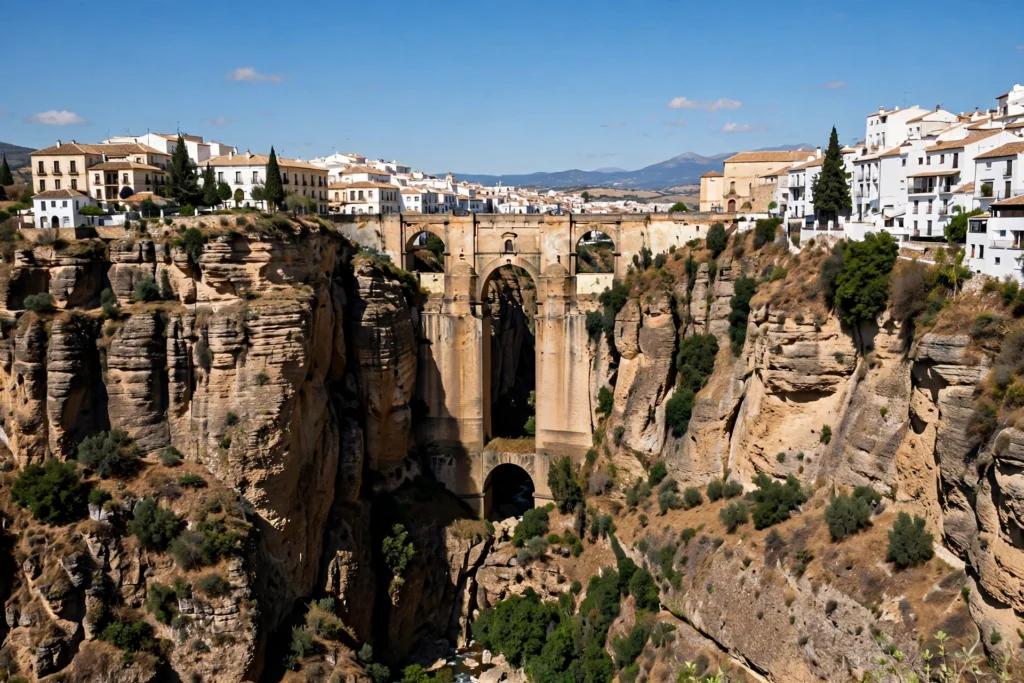
Andalusia is more than Seville and Granada, and the travellers who get the most from the region are the ones who leave the big cities for a day or two. Córdoba, Ronda and the white villages are three different kinds of Andalusia — a great historic city, a cliff town, and a string of small villages — and together they show what the region is when the tour buses are not there. You need a car for the white villages, and it helps for Ronda, but Córdoba is an easy train ride from Seville or Madrid, and it works as a day trip or an overnight stop on the way between the two.
Córdoba’s Mezquita is the reason to go, and it is a building that rewards unhurried looking. A mosque begun in the eighth century and expanded over two centuries, it became a cathedral after the Christian reconquest, and the result is a building that is both at once: a forest of 850 red-and-white arches, a Renaissance cathedral nave rising out of the middle of it, and a courtyard of orange trees that smells wonderful in spring. Go early, when it opens, and give it an hour and a half. The old town around it — the Jewish quarter, with its synagogue and its narrow streets, and the patios of San Basilio, which open to visitors during the Patio Festival in May and are worth seeing at any time of year — is a fine afternoon. Córdoba is also the home of salmorejo, the thick cream soup that is the region’s great dish, and the restaurants of the old town serve it as well as anywhere in Andalusia.
Ronda and the white villages
Ronda is the most dramatic town in Andalusia, and one of the most photographed in Spain. It sits on the edge of a gorge 120 metres deep, split by the Puente Nuevo, the great stone bridge that joins the old town to the new, and the views from the bridge and from the Alameda del Tajo are the reason to go. The town is also the home of the oldest bullring in Spain, the Plaza de Toros, which is now a museum, and of a long tradition of bandits and bullfighters that Hemingway and Orson Welles both fell for. Ronda is a day trip from Seville or Málaga, or a night’s stop on a driving route through the white villages, and either way it is worth the detour. Go in the morning, before the day-trippers arrive, and walk down into the gorge for the view back up at the bridge.
The white villages — the pueblos blancos — are the string of small hill towns between Ronda and the coast, and they are best seen by car, slowly, over a day or two. Arcos de la Frontera, with its castle and its views over the valley, is the classic first stop. Grazalema, in the mountains, is the wettest place in Spain and the greenest village in the range. Zahara de la Sierra, on its reservoir, is the prettiest. Setenil de las Bodegas, where the houses are built into the overhanging rock, is the strangest. None of them needs more than an hour or two, and the pleasure is in the driving between them — the winding roads, the olive groves, the views — rather than in any single sight. Stay a night in Ronda or in Arcos, eat in the village bars, and drive in daylight: the roads are narrow and the bends are sharp.
The Andalusia driving rules
If you are hiring a car for Andalusia, a few rules will save you trouble. Book an automatic if you do not drive a manual confidently, because the hill towns are steep and the gear changes are constant. Pick the car up in a city and drop it off in a city, not at an airport, if you can, because the airport queues are long and the city offices are quicker. Check the low-emission zones: many Andalusian cities now restrict access to the old centres, and the fines are real. Park outside the old town and walk in — the streets are too narrow for a hire car, and the parking is expensive. And remember that you need an International Driving Permit to drive in Spain as a US visitor, according to the State Department’s advice, and that petrol stations on the motorways are the reliable ones, while the village stations can be closed on Sundays. For the wider question of staying safe on the road and in the cities, our travel safety tips cover the habits that matter most.
Barcelona: Gaudí, the Gothic Quarter and the Beach
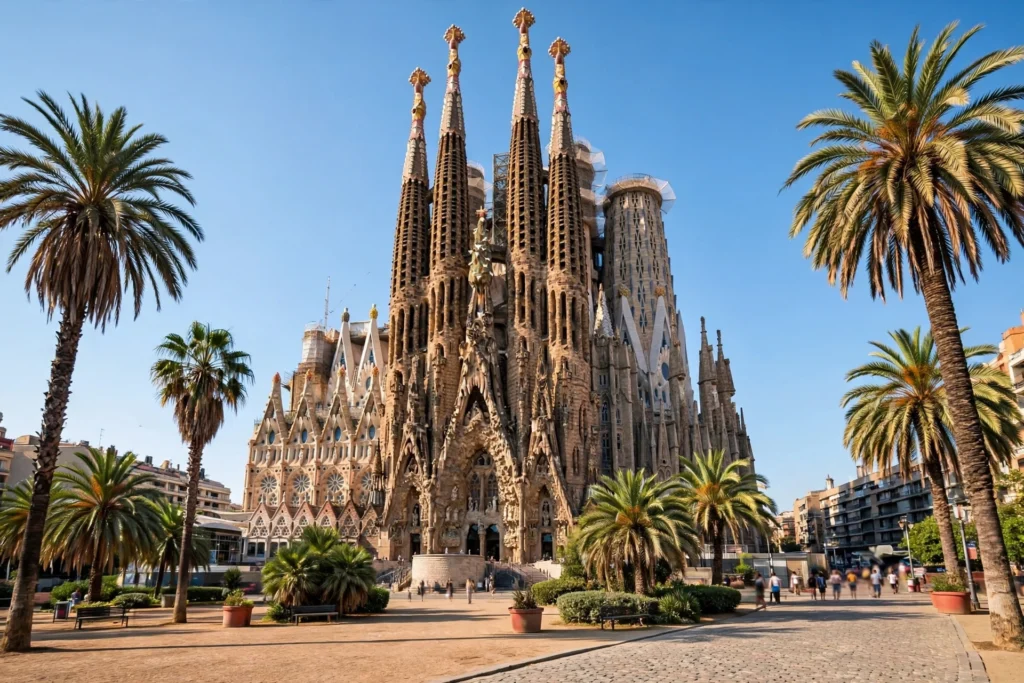
Barcelona is the city most first-timers picture when they picture Spain, and it is the city that most often surprises them — because it is not really a Spanish city at all, but a Catalan one, with its own language, its own flag and its own way of doing things. That is part of the pleasure. The Gaudí buildings, the Gothic Quarter, the beach, the food markets and the neighbourhoods of Gràcia and El Born add up to a city that needs three days at least, and that rewards a fourth. It is also the most visited city in Spain, and the crowds, the pickpockets and the prices are the price of its popularity. The advice in this section is built around that: book the big sights early, stay out of the worst of the crowds, and spend your evenings in the neighbourhoods where the city actually lives.
The Sagrada Família is the sight that defines Barcelona, and it is also the sight that needs the most planning. It is a basilica that has been under construction for more than 140 years, and it is genuinely impressive inside — the forest of columns, the coloured light through the stained glass, the sheer scale of it — in a way that photographs do not capture. Tickets are sold online only, through the official site, roughly two months ahead, and the popular dates sell out. The prices, read directly from the official Sagrada Família prices page in November 2026, are €26 for the basic ticket, which includes the basilica and museum and the audio guide in the official app; €30 with a guided tour of about fifty minutes; €36 with a tower; and €40 with a guided tour and a tower. Seniors pay €21, €23, €28 and €32 respectively; under-30s and students with a student card pay €24, €28, €34 and €38; children under 11 go free. The tower ticket is only for visitors aged six and over, and the lift goes up while you walk down. For most people the basic €26 ticket is the right one — the guided tour adds context, but the audio guide in the app covers the symbolism well, and the tower is worth it only if you want the view and everyone in your group is comfortable with heights and stairs. Book the first slot of the day, when the morning light through the stained glass is at its best, and allow about an hour inside, longer if you take the tower.
Park Güell, the Gothic Quarter and the neighbourhoods
Park Güell is Gaudí’s other great Barcelona work, a garden-city of mosaic lizards, wavy benches and gingerbread gatehouses on the hill above Gràcia, and it also sells timed tickets that should be booked ahead. The monumental zone — the part with the mosaics — is ticketed, and the rest of the park is free. Go in the late afternoon, when the light is low and the crowds thin, and then walk down into Gràcia for the evening. Gràcia is the neighbourhood that feels most like the Barcelona locals live in: small squares, local bars, no tour groups, and the best place in the city for an evening of vermouth and tapas. El Born, beside the Gothic Quarter, is the fashionable alternative — good restaurants, good shops, and the Picasso Museum, which is worth an hour if you like Picasso’s early work. The Gothic Quarter itself is the old heart of the city: the cathedral, the Plaça del Rei, the Roman walls, and streets so narrow that the sun barely reaches them. Walk it in the morning, when it is quiet, and be careful with your belongings — the quarter is the pickpocket capital of the city, and the crowds on La Rambla are where the professionals work. La Rambla itself, the famous tree-lined boulevard, is the most overrated walk in Barcelona: crowded, overpriced and full of stalls aimed at tourists. Walk it once, quickly, and then spend your time in the streets behind it.
The beach is the third part of Barcelona, and it is better than most visitors expect. Barceloneta, the old fishing quarter, has the city’s main beach, and it is a fine place for a morning swim and a seafood lunch — but the beach is also where bag theft is most common, so take only what you need and leave the rest in the hotel safe. For a quieter beach, walk north to Bogatell or Mar Bella, where the locals go. And for the best view in the city, take the cable car or the funicular up Montjuïc, the hill above the port, where the castle, the gardens and the Olympic stadium sit, and where the sunset over the harbour is the best in Barcelona.
Barcelona practicalities: where to stay, what it costs, what to watch
Stay in Eixample or Gràcia rather than on La Rambla or in the Gothic Quarter. Eixample, the grid of wide avenues around the Sagrada Família, is the best first-timer base: quiet streets, good restaurants, and the metro lines that reach everywhere. Gràcia suits travellers who want the local feel. The Gothic Quarter and El Born suit a short stay if you do not mind the noise, and the beachfront hotels of Barceloneta suit travellers who want to swim every day. Wherever you stay, remember that Barcelona and Catalonia charge a nightly tourist tax, paid to the hotel, and that the total is not always included in the price you see when you book. Check the amount when you book, so it is not a surprise at checkout.
On safety, Barcelona is the one Spanish city where pickpockets are a genuine, daily problem rather than a theoretical one. The professionals work the metro, the Rambla, the Gothic Quarter and the beach, and they are good at it. The defence is simple and it works: a cross-body bag worn in front of you, nothing in a back pocket, nothing on a café table, and your phone in a front pocket or a zipped bag. Never leave a bag on the beach while you swim, and never leave a bag on the back of a chair in a restaurant. The rest of the safety advice is the same as anywhere in Europe: be alert in crowds, avoid demonstrations, and keep your passport in the hotel safe rather than on your person. For the full picture, our travel safety tips cover the habits in detail, and the US State Department’s advisory for Spain is the official source to check before you go.
Valencia and the Costa Brava: The Mediterranean Middle
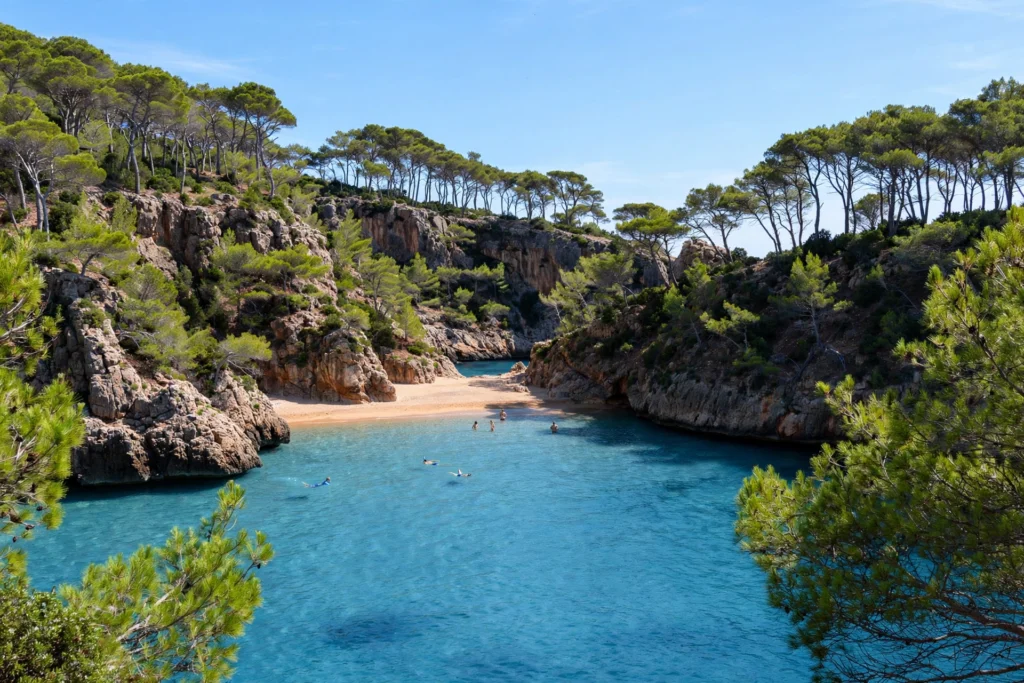
Valencia and the Costa Brava are the two places on the east route that most first-timers underestimate, and they are the two that most often become the favourite part of the trip. Valencia is Spain’s third city, and it feels like a secret: a beautiful old town, one of the best food markets in the country, the city that invented paella, and a beach that the locals use every day. The Costa Brava is the rugged coast north of Barcelona, and it is the opposite of the Costa del Sol — small coves instead of long resort beaches, fishing villages instead of high-rises, and a coastal path that links them all. Together they are the Mediterranean middle of this Spain travel guide, and they deserve more than the day or two most itineraries give them.
Valencia’s old town is the place to start. The cathedral and its Micalet bell tower, the Silk Exchange — La Lonja, a UNESCO World Heritage site and one of the great Gothic buildings of Europe — and the Central Market, a modernist iron-and-glass hall full of oranges, hams, cheeses and seafood, are all within a few minutes of each other. The market is the best place in Valencia to understand the city’s food: buy olives and cheese for a picnic, eat a bocadillo at one of the market bars, and watch the stallholders work. The other half of Valencia is the City of Arts and Sciences, the futuristic complex of white curves on water at the end of the Turia Gardens — the old riverbed turned into a park that runs through the city. The buildings are spectacular from the outside, and the Oceanogràfic aquarium and the science museum inside are worth the visit if you have children, or if you like aquariums. In the evening, the Ruzafa neighbourhood, south of the old town, is the place for dinner: the most interesting restaurants in the city are there, and the bars are full of locals rather than tourists.
Paella, the beach and the Fallas
Paella is Valencia’s gift to the world, and it is also the dish most often got wrong by visitors. The real thing is Paella Valenciana — chicken, rabbit and local green beans, cooked in a wide shallow pan over a wood fire, eaten at lunch, and cooked to order for at least two people. It is not a seafood dish, it is not a dinner dish, and it is not made for one person. The best paella restaurants are in El Cabanyal, the old fishing quarter by the beach, and in the villages of the Albufera lagoon south of the city, where the rice is grown. Book ahead, arrive hungry, and order the paella as the meal — it is a full lunch, not a starter. If a restaurant in the old town offers paella for one person at dinner, with a photograph on the menu, walk away: it is almost certainly frozen, and it is not what you came to Valencia for.
The Malvarrosa beach, the city’s main beach, is a fifteen-minute bus ride from the old town, and it is a proper city beach — wide, sandy, lined with restaurants, and busy with locals in summer. The Fallas, Valencia’s great festival, is in March, and it is one of the most extraordinary festivals in Europe: enormous satirical sculptures are built across the city, paraded, and then burned on the night of 19 March, in a night of fire and fireworks that has to be seen to be believed. If you can time your trip for the Fallas, do — but book months ahead, because the city fills completely. And if you are in Valencia in summer, the horchata — the sweet tiger-nut drink served in the cafés of the Alboraya district — is the local refreshment, and the best one in the city is a matter of fierce local debate.
The Costa Brava: coves, villages and the coastal path
The Costa Brava — the “wild coast” — runs from Blanes, north of Barcelona, to the French border, and it is the most beautiful stretch of Mediterranean coast in Spain. The pleasure of it is not in a single sight but in the way the coast works: small coves of turquoise water between pine-covered cliffs, fishing villages of white houses, and the Camí de Ronda, the coastal path that links them. The best way to see it is to base yourself in one place and walk: Calella de Palafrugell, with its arched waterfront and its coves, is the classic base; Cadaqués, at the end of a winding road, is the prettiest town on the coast and the one that Dalí made famous; Tossa de Mar, with its medieval walls above the beach, is the most dramatic. Girona, inland, is the other base: a beautiful old town with a cathedral, a Jewish quarter and a river, and an hour by train from Barcelona.
The food on the Costa Brava is the best seafood in Spain, and the restaurants of the fishing villages — the suquet de peix, the fish stew, and the anchovies of L’Escala — are worth the trip on their own. The water is clear and warm from June to October, and the coves are best reached on foot or by kayak, because the roads do not reach them all. And the crowds are real in July and August, when the coast fills with visitors from across Europe — if you can, go in May, June, September or October, when the water is still warm, the villages are quiet, and the prices are lower. The Costa Brava is the end of the east route for a reason: it is the place to slow down, and two or three days there at the end of a trip is the best way to come home rested.
North vs South: Which Spain Fits Your Trip
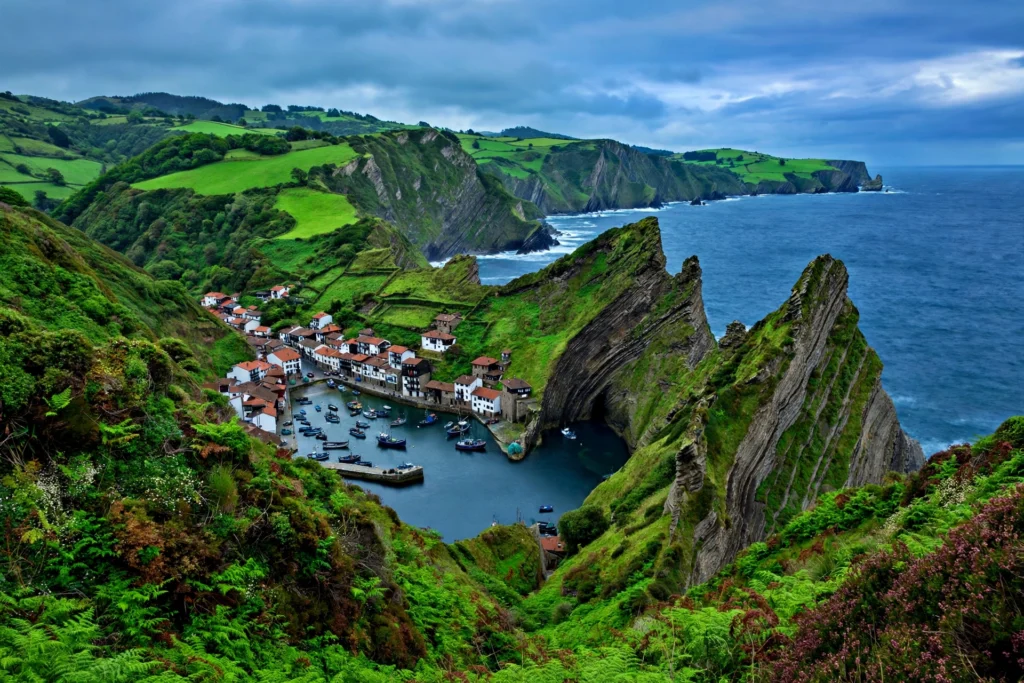
The most useful question in planning a Spain trip is not “where should I go” but “which Spain do I want”. The north and the south are two different countries in all but name, and the choice between them decides your weather, your food, your pace and your budget. The south is Andalusia and the Mediterranean: heat, Moorish palaces, flamenco, white villages, olive groves and beaches. The north is the Basque Country, Galicia, Asturias and Cantabria — “Green Spain”: green hills, Atlantic cliffs, fishing villages, cider, pintxos and rain. Both are wonderful. They are not interchangeable, and a trip that tries to do both in a week does neither properly. This section is the picker: read it, pick your side, and build your trip around it.
The south is the Spain most first-timers picture, and it is the right choice for most first trips. The weather is reliably warm from April to October, the sights are the famous ones — the Alhambra, the Alcázar, the Mezquita, the white villages — and the transport is easy, with high-speed trains linking Madrid, Seville, Córdoba, Granada and Málaga. The food is Andalusian: tapas, jamón, sherry, fried fish and the free tapa of Granada. The pace is slow in the middle of the day and late at night, and the evenings are long. The south’s weakness is the summer heat: in July and August, Seville and Córdoba are among the hottest cities in Europe, and sightseeing becomes a matter of getting up early and hiding in the afternoon. The south is also the more crowded half in summer, and the more expensive in the high season.
The north is the Spain that surprises people, and it is the right choice for second trips, for food lovers, for hikers and for summer travel. The Basque Country has the best food in Spain — San Sebastián has more Michelin stars per head than almost anywhere on earth, and its pintxos bars are a pilgrimage in themselves — and Bilbao, remade by the Guggenheim Museum, is one of the great urban reinventions of Europe. Galicia has the Camino de Santiago, the green cliffs of the Costa da Morte, and the best seafood in the country. Asturias and Cantabria have the Picos de Europa, the prehistoric caves of Altamira, and the cider houses where the cider is poured from a height. The north’s weakness is the weather: it rains, often, and the summers are mild rather than hot — which is a virtue in August and a disappointment if you wanted a beach holiday. The north also needs a car: the trains are slower and the villages are spread out, and the best of it is in the places the AVE does not reach.
| The South (Andalusia + Mediterranean) | The North (Basque Country, Galicia, Asturias) | |
|---|---|---|
| Best months | April–June, September–October | June–September |
| Weather | Hot and dry, 40°C+ in summer | Mild and green, rain year-round |
| Famous sights | Alhambra, Alcázar, Mezquita, white villages | Guggenheim, Camino, Picos de Europa, San Sebastián |
| Food | Tapas, jamón, sherry, fried fish, paella | Pintxos, cider, seafood, txakoli wine |
| Pace | Slow afternoons, late nights | Earlier, greener, more outdoors |
| Transport | AVE high-speed trains, easy | Car needed, slower trains |
| Best for | First-timers, history, culture | Food lovers, hikers, summer trips |
| Watch out for | Summer heat, crowds in high season | Rain, fewer famous sights, driving |
The north in a week: a sketch
If you pick the north, here is the week. Fly into Bilbao and spend two days there: the Guggenheim in the morning, the old town and the pintxos bars of the Plaza Nueva in the evening, and a day trip to the coast at Getaria or San Juan de Gaztelugazte, the island hermitage on its 241-step causeway. Then two days in San Sebastián: the pintxos bars of the old town, the sweep of La Concha beach, and a walk up Monte Igueldo for the view. Then drive west along the coast to the Picos de Europa for two days of walking, and finish in Santiago de Compostela, where the Camino ends and the cathedral stands. It is a different trip from the south, and it is a wonderful one — but it is a different trip, and it deserves its own week rather than being squeezed into the end of a southern one.
The one exception: the Camino de Santiago
The Camino is the exception to the north-versus-south rule, because it is not a region but a route, and it belongs to neither side. The French Way, from the Pyrenees to Santiago de Compostela, takes about a month on foot, and most people walk only part of it — the last 100 kilometres from Sarria, which takes five days and earns the Compostela certificate, is the most popular section. If the Camino is the reason you are coming to Spain, plan the trip around it: the walking, the hostels, the credential and the certificate are a world of their own, and this guide’s routes are not the way to do it. The Camino deserves its own article, and its own trip. What matters here is that it exists, that it ends in Galicia, and that it is the best reason to see the north slowly, on foot, rather than from a car window.
The Islands as a Separate Trip: Mallorca and the Canary Islands
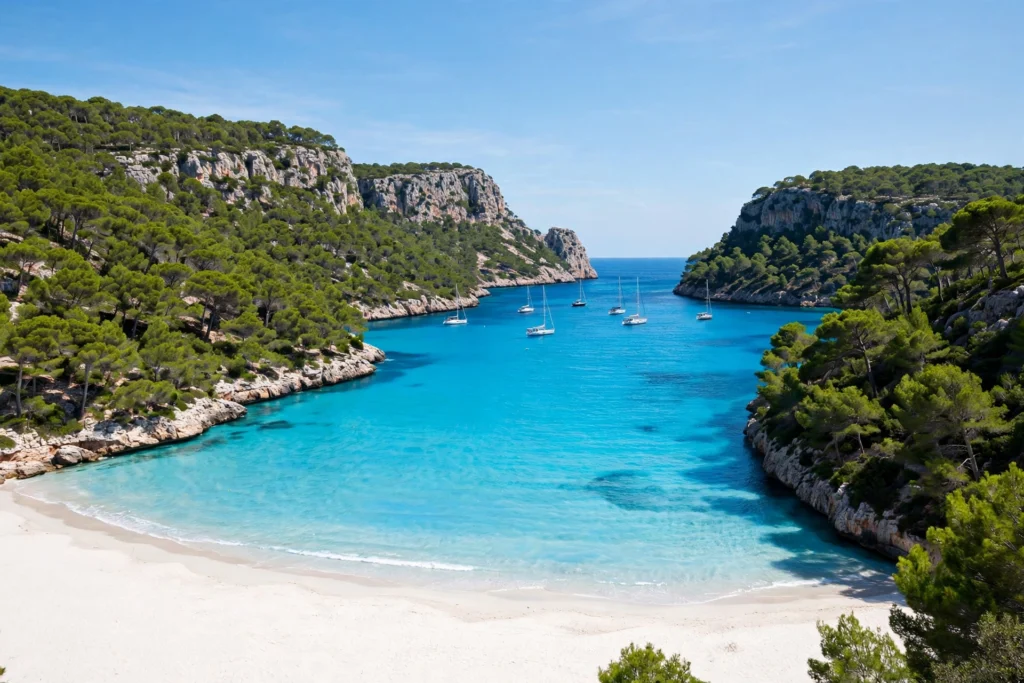
Spain has two island groups, and the most important thing to know about them is that they are not a side trip from the mainland. They are a trip of their own. The Balearic Islands — Mallorca, Menorca, Ibiza and Formentera — sit in the Mediterranean, and the Canary Islands — Tenerife, Gran Canaria, Lanzarote, Fuerteventura and the rest — sit in the Atlantic off the coast of Africa. Both are reached by a short flight from Madrid or Barcelona, and both are worth four or five days at least. The mistake is to try to add an island to a mainland itinerary: a day in Mallorca tacked onto a week in Andalusia is a day spent in airports, and the islands deserve better than that. Fly in, stay put, and treat the island as the trip.
Mallorca is the biggest Balearic and the most varied. Palma, the capital, is a proper city with a cathedral, an old town and a food scene that has improved enormously in recent years, and it is worth two days on its own. The Serra de Tramuntana, the mountain range along the north-west coast, is a UNESCO World Heritage site of terraced olive groves, stone villages and a narrow-gauge railway from Palma to Sóller that is one of the great train rides in Europe. The coves — the calas — of the east and south coasts are the turquoise water and white sand that the island is famous for, and the small towns of the interior, like Pollença and Valldemossa, are the quiet alternative to the resort coast. Menorca, the quietest Balearic, is the best choice for a slow trip: the Camí de Cavalls, the 115-mile trail that circles the island, is a walker’s paradise, and the beaches are the best in the Mediterranean. Ibiza is the party island, but it is also a beautiful one — the old town of Eivissa is a UNESCO site, and the north of the island is quiet, green and lovely. Formentera, the smallest Balearic, is a day trip from Ibiza and a beach paradise in its own right.
The Canary Islands: Europe’s winter sun
The Canary Islands are the winter-sun destination, and they are the one part of Spain where the weather is reliably warm all year. Tenerife, the largest, has Mount Teide, the highest peak in Spain, a volcano that rises 3,718 metres above the sea and that you can climb or take a cable car up, and the black-sand beaches of the north and the resort beaches of the south. Gran Canaria is the most varied island: beaches, dunes, mountains and a handsome old town in Las Palmas. Lanzarote is the most otherworldly: a volcanic landscape of black lava and white houses, shaped by the artist César Manrique, whose works are everywhere on the island. Fuerteventura is the windsurfer’s island, with long beaches and constant wind. The Canaries are a four-hour flight from the United States via Madrid, and they are the best choice for a winter trip, when the mainland is cool and the islands are still in the low twenties. They are also the best choice for a trip that is mostly about the outdoors: hiking, surfing, diving and stargazing, under some of the clearest skies in Europe.
A word on the practicalities of the islands: fly, do not take the ferry, unless you enjoy long sea crossings — the ferry from Barcelona to Mallorca takes seven hours overnight, and the flight takes under an hour. Hire a car on the islands, because the buses are slow and the best places are the ones the buses do not reach. Book accommodation early in July and August, when the Balearics fill completely, and in December and January, when the Canaries fill with winter sun-seekers. And remember that the Canaries are an hour behind mainland Spain, and that the islands have their own character — the Canarians are proud of it, and the food, the music and the festivals are distinct from the mainland.
Getting Around Spain: The AVE Train Logic

Spain’s high-speed rail network is the reason this whole guide’s routes work, and understanding how it works is the most useful practical knowledge in the article. The AVE — Alta Velocidad Española — is the high-speed service, running at up to 300 kilometres an hour on dedicated lines, and it links Madrid with Barcelona, Seville, Valencia, Málaga, Córdoba, Zaragoza, Alicante and a growing list of other cities. Around it sit the low-cost high-speed operators — Avlo, Renfe’s own budget brand, and Iryo and Ouigo, the private competitors — which run the same lines at lower prices, and the slower regional trains and the Alsa buses, which fill in the places the high-speed lines do not reach. The logic is simple: use the high-speed trains between cities, use the metro and buses inside them, and use a car only for the countryside.
The first rule of the AVE is to book early. The cheapest fares — the ones that make Madrid to Barcelona cost less than a tank of petrol — are released months ahead and sell first, and the price on the same route can triple between the early-bird fare and the walk-up fare. Book one to three months ahead on the Renfe website or on the Iryo and Ouigo sites, and compare the three operators on the same route, because the competition has driven prices down and the cheapest operator changes by the day. The second rule is to arrive early at the station: major stations like Atocha in Madrid have airport-style luggage scanners before the platforms, and the check takes a few minutes, so arrive twenty minutes before departure. The third rule is that the trains are comfortable and civilised — reserved seats, quiet cars, a café car — and the journey itself is part of the pleasure, especially the Madrid to Barcelona line, which crosses the plains of Aragón, and the Madrid to Seville line, which runs through the olive groves of La Mancha.
The key journeys, with times and tips
The journeys that matter most for a first trip are the ones in the table below. Madrid to Barcelona is about two and a half hours, and it is faster and easier than flying once you count the airport time at both ends. Madrid to Seville is about two and a half hours. Madrid to Valencia is under two hours. Madrid to Málaga is about two and a half hours. Seville to Granada is the exception: there is no direct high-speed line, and the journey is about two and a half to three hours by train or bus. Granada to Barcelona is a long day — about six hours by train — and the sensible way to do it is to fly, or to break the journey in Valencia. And the night trains that once linked Spain to Paris and Lisbon are gone, so international journeys now mean a flight or a slow daytime train.
| Journey | Time | Notes |
|---|---|---|
| Madrid–Barcelona | About 2.5 hours | AVE, Iryo, Ouigo, Avlo all run it; book early |
| Madrid–Seville | About 2.5 hours | AVE; the classic first-timer leg |
| Madrid–Valencia | Under 2 hours | AVE; short and frequent |
| Madrid–Málaga | About 2.5 hours | AVE; the gateway to the Costa del Sol |
| Madrid–Cuenca | Under 1 hour | AVE; one of the shortest high-speed runs |
| Valencia–Barcelona | About 3 hours | AVE and Euromed services |
| Seville–Granada | 2.5–3 hours | Train or Alsa bus; no direct AVE |
| Seville–Córdoba | About 45 minutes | AVE; an easy day trip |
| Madrid–Toledo | About 30 minutes | AVE; the easiest day trip in Spain |
| Madrid–Segovia | About 30 minutes | AVE; the aqueduct and the alcázar |
Buses, cars and city transport
Where the trains do not go, the buses do. Alsa is the main long-distance bus company, and its network reaches the white villages, the Picos de Europa, the small towns of Galicia and the places the rail map misses. The buses are modern, comfortable and cheap, and they are the right choice for a journey the trains do not serve. Inside the cities, the metro systems of Madrid and Barcelona are extensive, reliable and cheap — buy a ten-trip card, which can often be shared between two people — and the historic centres are best explored on foot. Taxis are plentiful and honest in the big cities, and ride-hailing apps work in Madrid and Barcelona. And a warning about driving in cities: do not. The old centres are a maze of one-way streets and low-emission zones, parking costs €40 a day in some places, and the fines for entering a restricted zone are real. Hire the car when you leave the city, not before.
If you do hire a car, the rules are straightforward. You need an International Driving Permit as a US visitor, according to the State Department. Book an automatic if you do not drive a manual well, because the hill towns are steep. Inspect the car before you drive away — tyres, lights, brakes, spare wheel — and photograph any existing damage. Fill up on the motorways, where the stations are reliable, and do not leave bags visible in a parked car, even for a few minutes: thieves smash windows to check a bag, especially in areas frequented by tourists. And never drive after drinking, never drive at night on rural roads you do not know, and never drive when you are tired after a long flight. The roads are good, the driving is fast, and the margin for error is smaller than at home.
What to Eat and Drink in Spain: Tapas, Paella and the Late Spanish Clock
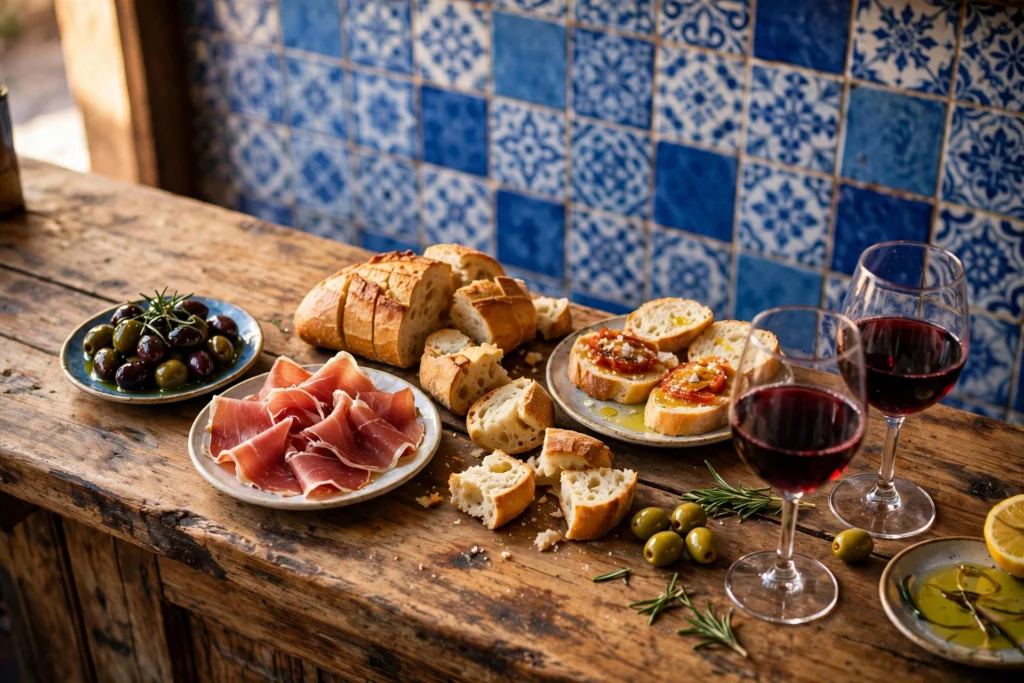
Spanish food is the best reason to come to Spain, and it is also the part of the trip most first-timers get wrong — not because the food is difficult, but because the rules are different. The meals are later, the portions are smaller, the sharing is the point, and the best food is often in the least impressive-looking places. This section is the guide to eating well in Spain: the dishes to seek out, the words to know, the traps to avoid, and the daily rhythm that makes it all work.
Start with the vocabulary, because it decides what you get. A tapa is a small savoury serving, traditionally a slice of bread or ham placed on top of a drink — the word means “lid” or “cover” — and it is the unit of Spanish eating. A pincho, or pintxo in the Basque Country, is a small snack pierced with a toothpick, and in San Sebastián and Bilbao you serve yourself from the counter and the bar counts your toothpicks at the end. A ración is a large portion, a full plate designed to be shared by three or four people. A menú del día is the set lunch: two courses, dessert, bread and a drink, for roughly €12–€18 on weekdays. And a caña is a small draft beer, the default drink of the tapas bar. Learn those five words and you can eat anywhere in Spain.
The dishes to seek out, region by region
The dishes that matter are regional, and the best version of each is found where it comes from. Paella belongs to Valencia, and the real thing is Paella Valenciana — chicken, rabbit and green beans, cooked over a wood fire, eaten at lunch, for at least two people. It is not a seafood dish, it is not a dinner dish, and it is not made for one person. The best paella restaurants are in El Cabanyal, the old fishing quarter by the beach, and in the villages of the Albufera lagoon south of the city, where the rice is grown. Book ahead, arrive hungry, and order the paella as the meal — it is a full lunch, not a starter. If a restaurant in the old town offers paella for one person at dinner, with a photograph on the menu, walk away: it is almost certainly frozen, and it is not what you came to Valencia for.
Jamón ibérico, the cured ham from the black Iberian pig, is best in Salamanca, Extremadura and Andalusia, and the highest quality — de bellota, from acorn-fed pigs — is aged for years and worth the price. Tortilla española, the potato omelette, is everywhere, and the great debate — with onions or without — is a conversation starter in any bar. Pulpo a la gallega, octopus with paprika and olive oil on a wooden plate, belongs to Galicia, and the seafood of the north is the best in the country. In the Basque Country, the pintxos are the meal: elaborate, artistic, and priced at €2–€5 each, eaten standing at the bar. In Catalonia, the crema catalana is the dessert, and the calcots — grilled spring onions dipped in romesco sauce — are the winter ritual. And everywhere, the bread, the olive oil and the wine are better than you expect, and cheaper: the house wine, the vino de la casa, is usually excellent, and a glass of Rioja or Albariño rarely costs more than a few euros.
The regional differences in the tapas system are worth knowing. In Granada, Almería and León, a drink comes with a free tapa — the bar chooses it, and the quality varies, but the tradition is real. In the Basque Country, the pintxos are paid for, and the toothpick count is the bill. In Madrid and Barcelona, you pay for your tapas, and a ración is the way to eat a full meal. And in all of Spain, the market halls are the best place to understand the food: the Boqueria in Barcelona, the Central Market in Valencia, the Mercado de San Miguel in Madrid and the Triana market in Seville are all worth a visit, and the market bars are often the best lunch in the city.
The late Spanish clock, and how to live by it
The single most useful cultural adjustment in Spain is the clock. Breakfast is light — coffee and toast, or a pastry. A heartier mid-morning almuerzo follows. Lunch, the comida, is between roughly 2 and 4 pm, and it is the main meal of the day. A light merienda bridges the afternoon. Dinner, the cena, is late — kitchens rarely open before 8 pm, most locals eat at 9.30 or 10, and the tapas hour between 7 and 9 pm exists to bridge the gap. The traditional siesta is fading in Madrid and Barcelona, where big stores stay open all day, but in smaller towns many shops still close from around 2 to 5 pm, and banks and government offices often shut for the whole afternoon. Social life starts late and runs long: the streets fill after 9 pm, the bars get busy after 11, and the clubs may not open until 1 am.
The practical advice is simple: shift your day later on day one, and do not fight it. Eat a big lunch, have a light dinner, and use the tapas hour to bridge the gap. Do not expect to eat dinner at 6 or 7 pm — most kitchens will not be open, and the restaurants that are open that early are aimed at tourists. Do not plan important errands or shopping between 2 and 5 pm in a small town. And do not be surprised by the noise: Spaniards are expressive and loud, the cities are noisy well into the night, and earplugs are a wise packing choice if you are a light sleeper. The late clock is not an inconvenience to be managed. It is the culture, and once you live by it, the trip gets much easier — and much more fun.
What to drink, and what it costs
Spain is a wine country, and the wine is the best value in Europe. Rioja, the red of the north, is the famous one; Ribera del Duero, the red of the central plateau, is the connoisseur’s choice; Albariño, the white of Galicia, is the seafood wine; and the sherry of Jerez — the dry fino and manzanilla — is the aperitif that most visitors never try and then love. A glass of house wine in a bar costs €2–€4. A bottle in a restaurant costs €12–€20 for something good. And the beer is good too: the caña, the small draft, is the default drink, and the local brands — Mahou in Madrid, Estrella Damm in Barcelona, Cruzcampo in the south — are all worth trying. The tinto de verano, red wine mixed with lemon soda, is the summer drink of choice, and it is more popular among locals than sangria, which is largely a tourist drink. Tipping is simple: service is included in the menu prices, and there is no obligation to tip. Locals leave a few coins or round the bill up to the nearest euro if the service was good. A percentage tip is not expected, and nobody will think less of you for not leaving one.
| Dish or drink | What it is | Where to eat it | Rough price |
|---|---|---|---|
| Paella Valenciana | Chicken, rabbit and green beans, wood-fired | Valencia, El Cabanyal, Albufera | €20–€25 per person |
| Jamón ibérico de bellota | Acorn-fed cured ham | Salamanca, Extremadura, Andalusia | €15–€25 per 100g |
| Pintxos | Small Basque bar snacks | San Sebastián, Bilbao old towns | €2–€5 each |
| Tortilla española | Potato omelette | Everywhere, best in bars | €3–€5 a slice |
| Pulpo a la gallega | Octopus with paprika and olive oil | Galicia | €12–€18 a ración |
| Menú del día | Two courses, dessert, bread, drink | Everywhere, weekdays 1.30–4 pm | €12–€18 |
| Caña (small beer) | Small draft beer | Every bar | €2–€3.50 |
| Glass of house wine | Vino de la casa | Every bar and restaurant | €2–€4 |
Costs, Safety, Timing and Entry Rules: The Practical Finish
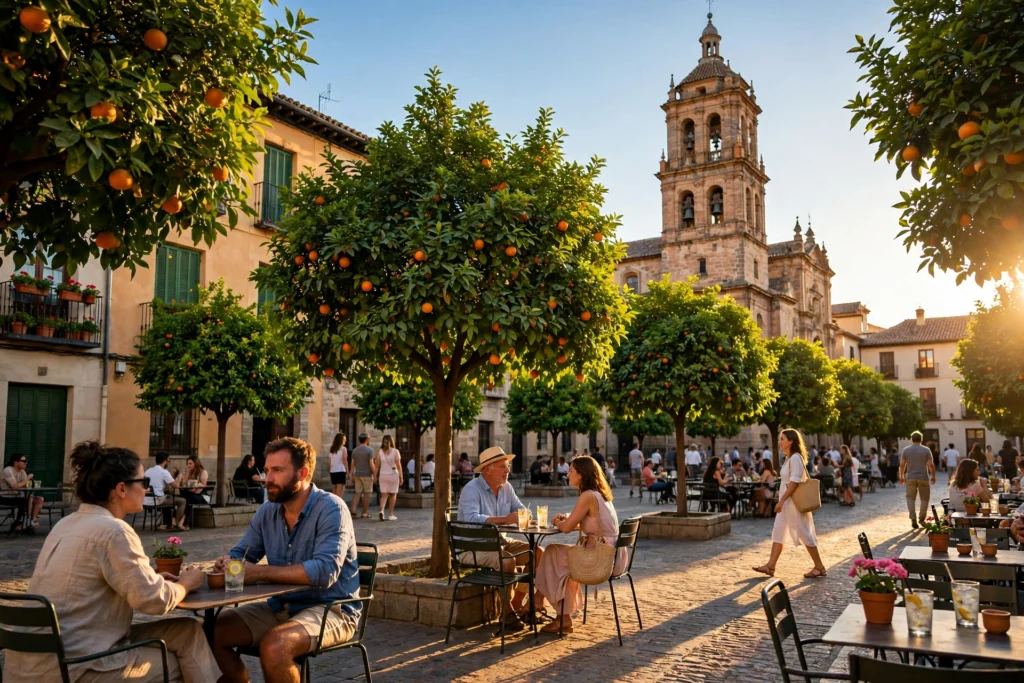
The last section of this Spain travel guide is the one to read twice: the money, the safety, the timing and the entry rules, all in one place, so you can plan the trip with real numbers and real rules rather than guesses. None of it is dramatic, and all of it matters — because a trip that is well planned on the practical side is a trip where the pleasures, the food and the sights, have room to happen.
How much does a trip to Spain cost?
Spain is one of the best-value countries in Western Europe, and a comfortable mid-range trip costs roughly €110–€180 a day per person, including a mid-range hotel, meals, transport and sightseeing. A budget trip — hostels or guesthouses, market food, public transport — can be done for €75–€100 a day. A comfortable trip with private rooms in central hotels and sit-down dinners with wine runs €150–€200 a day. The biggest variables are the hotels and the season: a central hotel in Barcelona in August can cost twice what the same room costs in February, and the best-located budget rooms are always the first to sell out. Book three to five months ahead for July and August, and one to two months ahead for the shoulder seasons. The table below is a realistic daily budget for a mid-range traveller, based on the prices first-timers actually pay in 2026.
| Item | Budget per day | Mid-range per day | Notes |
|---|---|---|---|
| Hotel (double room, per person) | €30–€45 | €55–€85 | Central hotels cost more; book early |
| Food and drink | €25–€35 | €40–€60 | Menú del día is the best value |
| Local transport | €5–€10 | €8–€15 | Metro, buses, ten-trip cards |
| Sightseeing and tickets | €10–€15 | €15–€25 | Alhambra €22.27, Sagrada Família €26 |
| Intercity trains | €10–€20 | €15–€30 | Averaged over the trip; book early |
| Total per person per day | €80–€125 | €130–€215 | Excluding international flights |
On money, the rules are simple. Cards are accepted almost everywhere in cities, and a card from a digital bank avoids the fees that some traditional banks charge abroad. Carry some cash for small bars, markets and rural areas, and keep it in a separate place from your cards. Use ATMs inside banks during opening hours, cover the keypad when you enter your PIN, and decline the machine’s offer to convert the withdrawal into your home currency — your bank’s rate is almost always better. Split your money and your cards so that one theft cannot strand you, and keep an emergency reserve — a folded note in your luggage lining — that you never touch except in a real emergency. And know the phone number to block each of your cards, saved in your phone and on paper, because the first hour after a theft is when a stolen card does its damage.
Is Spain safe? The advisory, the pickpockets and the heat
Spain is one of the safest countries in Europe for violent crime, and the main risk for visitors is opportunistic petty theft in crowded tourist areas, transport hubs and busy plazas. The US State Department rates Spain Level 2 — exercise increased caution — because of terrorism and unrest, and it rates Ceuta Level 3 — reconsider travel — because of unrest there. The advisory, which the State Department page itself dates 5 November 2025, is the official source, and it is worth reading in full before you book and again before you fly. The practical advice is the same as anywhere in Europe: be aware of your surroundings in crowded places, avoid demonstrations, follow the instructions of local authorities, and keep your valuables where a hand cannot reach them without you feeling it. Barcelona is the city where pickpockets are a genuine daily problem — a cross-body bag worn in front of you, nothing in a back pocket, nothing on a café table, and your phone in a front pocket is the defence that works. On the beaches, take only what you need and leave the rest in the hotel safe. In the summer, the heat is the other safety issue: Andalusia regularly passes 40°C, and the sun is a real danger. Carry water, wear sunscreen, stay indoors during the peak of the afternoon, and treat the siesta hours as a rest, not as wasted time. For the full checklist, read our travel safety tips and our guide to what travel insurance covers before you buy a policy — and remember that most US health plans do not cover you abroad, so travel insurance with medical and evacuation cover is worth having for every trip.
When to go: the best time to visit Spain month by month
The month-by-month picture is the detail behind the seasonal summary at the start of this guide. January and February are the quietest months: Madrid and Barcelona are cool and often sunny, the Costa del Sol is mild, the Canaries are warm, and hotel prices are at their lowest — but the days are short and some coastal businesses are closed. March brings the Fallas in Valencia and the first warmth. April and May are the best months for Andalusia: warm days, wildflowers, the Feria de Abril in Seville and Holy Week processions across the south, and the Alhambra’s gardens at their best. June is the last good month before the heat, and the beginning of the beach season. July and August are the hottest and busiest months: the north and the islands are at their best, the south is punishing, and the prices are at their highest. September is the best month in Spain — warm seas, thinning crowds, harvest season, and the cities at their most walkable. October is nearly as good, and the best month for the wine regions. November and December bring the Christmas markets, the quiet cities and the lowest prices, and the Canaries are the warm escape. If you can only pick one month, pick September. If you can only pick one season, pick spring or autumn, and avoid July and August unless the north or the islands are your destination.
| Month | Weather | Crowds | Prices | Best for |
|---|---|---|---|---|
| January–February | Cool, sunny in cities, mild on the coast | Very low | Lowest | City breaks, the Canaries, budget trips |
| March | Warming up, spring festivals | Low | Low | Valencia Fallas, Andalusia |
| April–May | Warm, wildflowers, long days | Moderate | Moderate | Andalusia, Madrid, Barcelona |
| June | Warm, beach season starts | Moderate | Moderate | The north, the coast, festivals |
| July–August | Very hot inland and south, mild north | Highest | Highest | The north, the islands, the beaches |
| September | Warm, warm seas, harvest | Moderate | Moderate | Everywhere — the best month |
| October | Warm, thinning crowds | Low | Moderate | Wine regions, Andalusia, the east |
| November–December | Cool, Christmas markets | Low | Low | City breaks, the Canaries, budget trips |
Entry rules, money and packing: the final checklist
The entry rules are short. US citizens need no visa for stays under 90 days, and the 90/180 rule applies across the whole Schengen Area. Your passport must be valid at the time of entry, with three months’ validity beyond your departure and two blank pages. The ETIAS authorisation is not in operation and no applications are being collected, so there is nothing to apply for — and any website asking you for money for ETIAS today is a scam. The EES border system is fully operational, so expect a facial image and fingerprints on your first entry instead of a passport stamp. You need an International Driving Permit to drive. Enrol in the State Department’s STEP programme before you fly, so the nearest US embassy can contact you in an emergency, and save the embassy’s number — the US Embassy in Madrid is on +34-91-587-2200 — and the local emergency number, 112, in your phone.
For packing, the rules are the same as for any European trip, with a few Spanish twists. Pack light and pack for walking: comfortable shoes with grip, because the old towns are cobbled and hilly, and you will walk further than you expect. Bring layers, because the mornings and evenings are cool even in summer, and the air conditioning is fierce. Bring sunscreen and a hat for the south, a light waterproof for the north, and a scarf or shawl for churches and religious sites, where shoulders and knees should be covered. Bring a power bank, because your phone is your map, your translator and your boarding pass. And bring earplugs, because Spanish cities are noisy late into the night. For the full packing list, our travel packing checklist covers the whole trip, and for the wider question of how Spain fits into a longer European trip, our Italy travel guide and our Greece travel guide cover the two countries most travellers pair with Spain. And if your journey continues west, our Lisbon travel guide covers the Portuguese capital, an easy train ride from Madrid and a natural next stop.
Frequently Asked Questions About Visiting Spain
How many days do I need in Spain for a first trip?
Seven days is the minimum for a satisfying first trip, and it fits the classic Madrid–Seville–Granada route. Ten to fourteen days is the sweet spot, and it fits the east route through Cuenca, Valencia, Barcelona and the Costa Brava. Five days works only if you pick one region and stay in it. Anything less than five days means spending a third of your trip in transit, which is the most common way a Spain trip goes wrong.
What is the best time to visit Spain?
April to June and September to October are the best months for most first-timers: warm but not scorching, long days, and the cities at their most walkable. September is the single best month — warm seas, thinning crowds and harvest season. July and August are best avoided in Andalusia, where temperatures regularly pass 40°C, and are the right time for the north and the islands instead.
Do US citizens need a visa to visit Spain?
No. US citizens need no visa for tourist stays of under 90 days in the Schengen Area. The 90/180 rule applies: no more than 90 days in any 180-day period across the whole Schengen zone. Your passport must be valid at entry, with three months’ validity beyond your departure and two blank pages.
Do I need ETIAS to travel to Spain?
Not yet. The ETIAS travel authorisation is not in operation, and no applications are being collected — the official EU ETIAS page says so plainly. The EU will announce the start date several months before launch, and the fee will be €20. Any website asking you for money for ETIAS today is a scam. The Entry/Exit System, EES, is fully operational, so expect a facial image and fingerprints at the border instead of a passport stamp.
Is Spain safe for tourists?
Spain is one of the safest countries in Europe for violent crime. The US State Department rates Spain Level 2 — exercise increased caution — because of terrorism and unrest, and Ceuta Level 3 — reconsider travel — because of unrest. The main everyday risk is pickpocketing in crowded tourist areas, especially in Barcelona, and the main seasonal risk is the summer heat in Andalusia. Read the official advisory before you book and again before you fly.
How much does a trip to Spain cost?
A comfortable mid-range trip costs roughly €110–€180 a day per person, including a mid-range hotel, meals, transport and sightseeing. A budget trip can be done for €75–€100 a day, and a comfortable trip with private rooms and sit-down dinners runs €150–€200 a day. The biggest variables are the hotels and the season, and the cheapest train fares sell months ahead.
How do I get around Spain — train, bus or car?
Use the AVE high-speed trains between cities, the metro and buses inside them, and a car only for the countryside. Madrid to Barcelona is about two and a half hours by AVE, Madrid to Seville is about the same, and the low-cost operators Avlo, Iryo and Ouigo run the same lines at lower prices. Book one to three months ahead for the cheapest fares. Hire a car for the white villages, the Rioja wine country and the rural north, and do not drive inside the big cities.
How far ahead should I book the Alhambra?
As soon as your dates are fixed. The Alhambra General ticket costs €22.27 online, and the Nasrid Palaces admit 300 people every half hour at a fixed time — miss your slot and you lose the palaces. Online sales close at 23:59 the night before, and in spring, summer and on long weekends the tickets sell out weeks ahead. Buy only on the official sales site, tickets.alhambra-patronato.es, and bring the passport or ID that matches the name on the ticket.
How much are Sagrada Família tickets?
The basic ticket costs €26 on the official site, sagradafamilia.org, and includes the basilica, the museum and the audio guide app. With a guided tour it is €30, with a tower €36, and with a guided tour and a tower €40. Seniors pay €21–€32, under-30s and students €24–€38, and children under 11 go free. Tickets are sold online only, roughly two months ahead, and the popular dates sell out.
What should I eat in Spain, and when?
Eat paella in Valencia at lunch, pintxos in San Sebastián standing at the bar, jamón ibérico wherever you find a good jamonería, and tortilla española in any bar. Take the menú del día at lunch — two courses, dessert, bread and a drink for roughly €12–€18. And adjust your clock: lunch is 2–4 pm, dinner starts at 9 pm or later, and the tapas hour between 7 and 9 pm bridges the gap.
Is it better to visit the north or the south of Spain?
It depends on what you want. The south — Andalusia and the Mediterranean — is best for first-timers, history, Moorish palaces and warm weather from April to October, but it is punishingly hot in July and August. The north — the Basque Country, Galicia and Asturias — is best for food, hiking and summer travel, with green hills, Atlantic cliffs and the best seafood in the country, but it rains and it needs a car. If you have one week, pick one side and do it properly.
Can I visit the Balearic or Canary Islands on the same trip?
Only if you have the time. The islands are a trip of their own, not a side trip: fly in, stay four or five days, and treat the island as the destination. Mallorca is the most varied Balearic, Menorca the quietest, Ibiza the liveliest, and the Canaries — Tenerife, Gran Canaria, Lanzarote and Fuerteventura — are the winter-sun choice, warm all year round.
Conclusion: How to Make Your Spain Trip Work
Spain is a country that rewards a plan and punishes a lack of one. The plan is not complicated: pick a route and stick to it, book the Alhambra and the Sagrada Família the moment your dates are fixed, ride the AVE trains between cities, eat lunch late and dinner later, and give the country the time it deserves — a week at least, ten days if you can. The rest is the pleasure of the place: the Prado in the morning, the Retiro in the afternoon, the tapas bars in the evening; the Alcázar in Seville, the Alhambra in Granada, the white villages in between; the Gaudí of Barcelona, the paella of Valencia, the coves of the Costa Brava; the green north, the hot south, and the islands for another trip. Spain is not a country you see once. It is a country you start, and then come back to. This Spain travel guide is the start. The rest is yours.
People also read:
- Lisbon Travel Guide: The Complete First-Timer’s Guide to Portugal’s Capital
- Italy Travel Guide: The Complete First-Timer’s Guide to Italy
- Greece Travel Guide: The Complete First-Timer’s Guide to Greece
- Travel Safety Tips: 60+ Ways to Stay Safe While Traveling
- What Does Travel Insurance Cover?

M. Adil is the founder and editor of SoloTravelPro. He writes practical, research-based travel guides that help travellers plan with confidence — from first-time city breaks to national parks and island escapes. Every guide is built on official sources, current prices and honest, usable advice, so readers can plan smarter and travel better.