Travel Massage Therapist: How to Get Paid to Travel the World With Massage (2026–27)
A travel massage therapist is a licensed massage therapist who earns a living by working in different places instead of one fixed clinic or spa. Most work on cruise ships, in resort and hotel spas, with sports teams, or as mobile therapists who carry a portable table to clients in new cities. The work is real, the travel is real, and so are the long hours, the licensing paperwork and the physical demands. This guide covers what the job looks like day to day, what it pays, how to qualify, and how to decide whether it fits your life — with every pay figure labelled with its source and year.
What Does a Travel Massage Therapist Do?
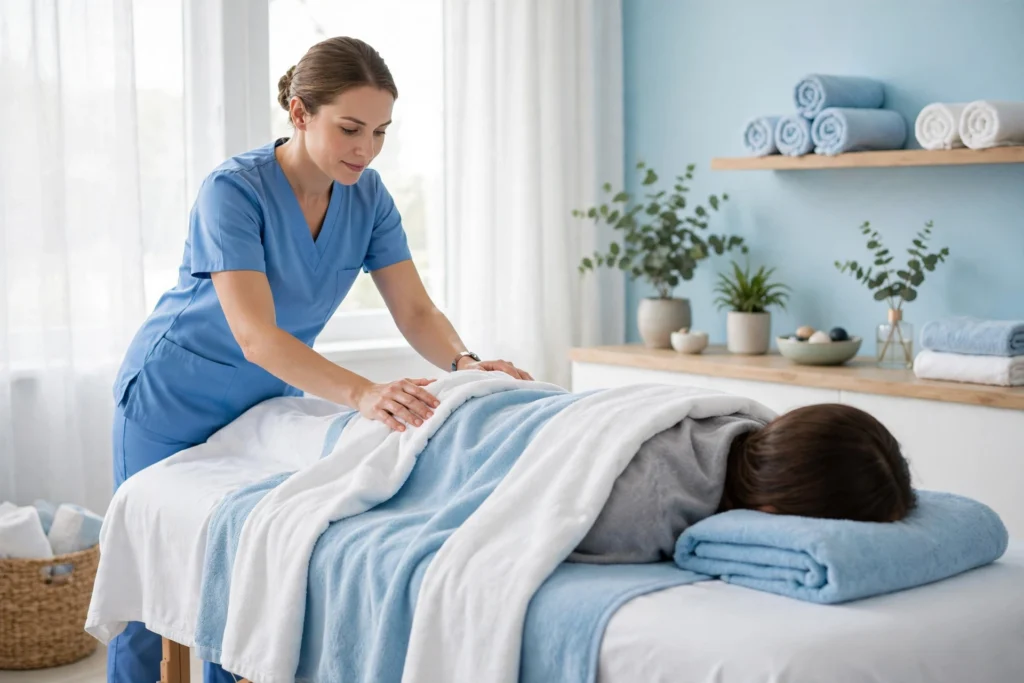
A travel massage therapist does the same core work as any massage therapist — using hands, forearms and elbows to work on muscles and soft tissue, easing pain, loosening tight areas and helping people relax — but the setting changes every few weeks or months. One contract might mean a spa on a cruise ship sailing the Caribbean. The next might mean a resort in Hawaii, a ski lodge in Colorado, or a season with a touring sports team. The massage itself stays familiar. Everything around it — the clients, the schedule, the housing, the licensing rules — keeps changing.
The US Bureau of Labor Statistics describes the job plainly: massage therapists talk with clients about symptoms, medical history and treatment goals, evaluate painful or tense areas before and during the session, manipulate muscles, tendons, ligaments and other soft tissues, help clients increase range of motion, give guidance on stretching and posture, and document conditions and progress. They also clean their workspace and sanitise equipment. A travel massage therapist does all of that, usually with a shorter window to learn each new workplace and a new group of clients every contract.
A typical day on the job
No two employers run the day the same way, but a working day for a travel massage therapist usually follows a recognisable shape. The morning starts with setting up the treatment room: fresh linens, clean towels, warmed oil or lotion, the table at the right height, the room at a comfortable temperature. Then comes the appointment book. A table massage typically lasts between 30 and 90 minutes, according to the Bureau of Labor Statistics, while a chair massage can be as short as 5 to 10 minutes. Between sessions there is laundry, notes, room turnover and sometimes a short break that is shorter than planned.
The busiest days are the ones with back-to-back bookings and almost no gap between clients. On a cruise ship, sea days are the busiest days in the spa, because guests are on board all day and the treatment rooms fill up early. On land, weekends, holidays and the first days of a holiday season tend to be the busiest. A therapist who gives five or six full sessions in a day has done a serious day of physical work, and the Bureau of Labor Statistics is clear about why: giving massages is physically demanding, and many therapists cannot perform massage services eight hours a day, five days a week.
The treatments clients actually ask for
Most travelling therapists are hired for a small set of reliable treatments rather than an exotic menu. Swedish massage is the gentle, flowing style most holiday guests ask for when they want to relax. Deep tissue massage works the deeper muscle layers and suits guests with stubborn knots and chronic tension. Sports massage is the style athletes and active travellers ask for, focused on specific muscles, flexibility and recovery. Many therapists also offer hot stone massage, aromatherapy massage, prenatal massage for pregnant guests, and reflexology, which works on pressure points in the feet.
The style that earns the most repeat bookings is rarely the most unusual one. It is the one the therapist does well, explains clearly and adapts to the person on the table. A guest who arrived with a stiff neck from a long flight wants a therapist who listens, checks pressure, and remembers what worked when they come back two days later. That listening habit is what turns a one-off holiday treatment into a returning client, and returning clients are what make a travel massage therapist valuable to an employer.
What the job is not
It helps to be honest about what this work is not. It is not a paid holiday. The travel massage therapists who last in the job are the ones who arrive understanding that the travel happens around the work, not instead of it. On a cruise ship contract, the ship sails to beautiful ports while the therapist is usually working. On a resort contract, the beach is outside while the therapist is inside the spa. The free time exists — a morning off in port, an evening after the last booking, a day between contracts — but it is earned around a full working schedule.
It is also not a job for someone who dislikes routine. Employers that hire travelling therapists, especially cruise lines and large resorts, want consistency. Guests should get the same quality of treatment whether they book on the first day of the voyage or the last. That means following the employer’s treatment routines, using the products the spa stocks, and keeping notes in the employer’s format. Therapists who love inventing a new treatment for every client often find that part of the job frustrating. Therapists who enjoy doing a small number of treatments very well tend to settle in quickly.
The skills that matter most
Massage technique is only the starting point. The Bureau of Labor Statistics lists the qualities that matter in this occupation, and they map neatly onto travel work. Communication skills matter because a therapist must listen carefully and explain clearly, often to guests who speak a different first language. Decision-making skills matter because every client needs a different treatment plan. Empathy matters because many clients are in pain. Integrity matters because therapists handle medical histories and private information. Interpersonal skills matter because trust is what brings a guest back for a second booking. Physical stamina and strength matter because the work is done standing up, session after session. Time management matters because the appointment book does not wait.
On top of those, travel work adds three more: adaptability, patience with paperwork, and the ability to live lightly. Adaptability, because every new employer has different routines, products and expectations. Patience with paperwork, because every new state or country can mean a new licence, a new background check or a new work permit. And the ability to live lightly, because a travelling therapist’s whole working life often fits in one or two suitcases plus a portable table.
Where Do Travel Massage Therapists Work? Cruise Ships, Resorts and More

There is no single employer for a travel massage therapist. The work is spread across several very different settings, and each one suits a different kind of person. Some therapists spend their whole travelling career on ships. Others move between resorts with the seasons. Others build a mobile practice and follow the work from city to city. Understanding the settings first makes every later decision — training, licensing, packing — much easier.
Cruise ships
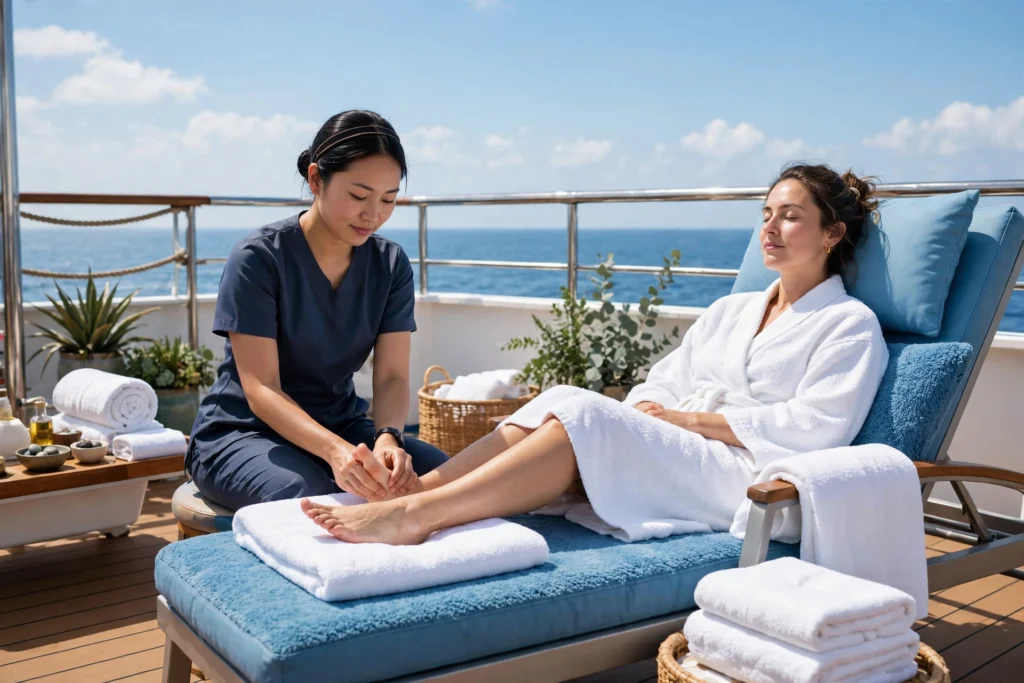
Cruise ships are the best-known workplace for a travel massage therapist, and for good reason: a ship is a floating resort with a spa, a steady stream of guests, and a contract that includes a cabin and meals. The spa is usually run by a specialist company contracted by the cruise line, and that company does the hiring. Contracts typically run six to nine months, and the therapist lives on board for the whole contract, working six or seven days a week with one day off in seven on many ships.
The pay structure is different from land work. There is usually a modest base pay, plus commission on treatments, commission on product sales, and gratuities from guests. Reported monthly earnings vary widely by ship, itinerary and the therapist’s sales ability, with published guides putting the common range at roughly $1,500 to $4,500 a month. The spread is wide because commission does most of the work: a therapist who sells treatments and products well on a busy luxury sailing earns far more than one on a quiet budget sailing. Room and board are typically included, which is why many therapists manage to save money at sea even when the headline pay looks modest.
Resorts and hotels
Resorts and hotels are the second major workplace. A resort spa hires therapists for a season or a full year, and the work is steadier and more predictable than ship life. Guests book treatments around their holiday plans, the therapist sleeps in staff housing or a rented room nearby, and days off are real days off. The Bureau of Labor Statistics reports that the median annual wage for massage therapists working in accommodation — hotels and resorts — was $43,840 in May 2025, the lowest of the major industries it tracks, which reflects the seasonal, part-time nature of much resort work. But that figure is a national median across all resort therapists, not a travel therapist’s total package: many resort jobs add staff housing, meals, tips and use of resort facilities, and the value of those extras varies so much that comparing the salary figure alone is misleading.
Resort work suits therapists who want travel without the intensity of ship life. A season in a mountain lodge, a summer at a beach resort, a winter in a desert spa town — the pattern repeats, and therapists who do good work are often invited back for the next season. Returning to the same resort year after year builds a base of returning guests, which is the closest thing to a regular client list that travel work offers.
Spas and wellness retreats
Standalone spas and wellness retreats hire travelling therapists for shorter stints: a retreat centre running a two-week programme, a spa covering staff holidays, a wellness resort opening a new location. These jobs are often found through word of mouth and through the professional networks therapists build over time. The work tends to be calmer than a cruise ship and more varied than a resort, with guests who have come specifically for wellness rather than for a holiday that happens to include a massage.
Sports teams and touring events
Sports massage is the most physically demanding corner of travel massage work, and the most exciting for therapists who love sport. Professional and college teams, touring events, marathons, cycling races and multi-day sporting events all hire massage therapists to travel with them. The work happens in locker rooms, on sidelines and in hotel rooms converted into treatment spaces. Sessions are short, focused and practical: loosening a tight hamstring before a match, working on a sore shoulder between events, helping an athlete recover after a long day.
This work usually goes to therapists with sports massage training and some experience, because teams want someone who can assess a problem quickly, work safely around injuries, and know when a problem needs a doctor rather than a massage. It is rarely a first job. It is a strong second or third step for a therapist who has built solid hands-on experience and wants to travel with a team rather than with tourists.
Corporate wellness and events
Companies increasingly bring massage therapists into offices, conferences and events for chair massage sessions. A corporate wellness contract might mean a week in one city, then a flight to the next. The sessions are short — often 10 to 20 minutes in a chair — and the clients are office workers with stiff necks, tight shoulders and too many hours at a desk. The work is lighter on the body than full table sessions, and the hours are closer to normal office hours, which appeals to therapists who want travel without the evening and weekend schedule of a resort spa.
Mobile and independent travel work
Some travel massage therapists work for themselves, carrying a portable table to clients’ homes, hotel rooms and holiday rentals. This is the most flexible version of the job and the least secure. The therapist finds the clients, sets the prices, carries the equipment, handles the bookings and sorts out the licensing for every place they work. The reward is freedom: no employer sets the schedule, and the therapist chooses where to go next. The cost is that every part of the business — marketing, administration, insurance, tax — falls on one person, and a slow week means no income at all.
The Bureau of Labor Statistics reports that 36 percent of massage therapists were self-employed in 2025, the largest single group in the occupation. Many travelling therapists start employed, build skills and contacts, and move into independent work later, once they know which places have demand and how to find clients there.
| Workplace | Typical contract | Housing | Best for |
|---|---|---|---|
| Cruise ship spa | 6–9 months | Shared cabin included | Saving money, seeing many ports, therapists who cope with long hours |
| Resort or hotel spa | One season to one year | Staff housing or local rental | Steady schedule, returning guests, slower pace than a ship |
| Wellness retreat | Days to weeks | On-site room usually included | Short stints, calm work, variety |
| Sports team or event | Event or season | Team hotel | Experienced therapists with sports massage training |
| Corporate wellness | Days to weeks per city | Hotel, usually arranged | Short sessions, office hours, lighter physical load |
| Mobile and independent | Ongoing, client by client | Self-arranged | Experienced therapists who want full freedom |
How Much Does a Travel Massage Therapist Make?

Pay is the question almost everyone asks first, and it deserves a straight answer with sources attached. The honest picture is that travel massage therapist pay varies more than almost any other part of the job, because it depends on the setting, the pay structure, the season and the therapist’s own sales ability. Anyone who quotes a single number as “the” travel massage therapist salary is simplifying a job that does not have one.
The national baseline
Start with the official baseline for the occupation as a whole. The US Bureau of Labor Statistics reports that the median annual wage for massage therapists was $58,450 in May 2025, or $28.10 per hour. Half of all massage therapists earned more than that amount and half earned less. The lowest 10 percent earned less than $33,640 a year, and the highest 10 percent earned more than $100,200 a year. Those figures cover the whole occupation — clinic therapists, spa therapists, self-employed therapists and travelling therapists together — and they describe employed therapists working a normal pattern of hours. Part-time work is common in this occupation, which pulls the median down for people who work fewer hours.
The same Bureau of Labor Statistics data shows how much the setting matters. In May 2025, the median annual wage was $72,800 in offices of chiropractors, $65,350 in offices of other health practitioners, $56,230 in personal care services, and $43,840 in accommodation — the hotels and resorts where many travelling therapists work. That gap is not a mistake. Resort and hotel work is often seasonal and part-time, and the headline wage does not count tips, housing, meals or other benefits that travel employers commonly provide. A resort therapist earning a lower base wage while living in free staff housing and keeping tips may end the season better off than a clinic therapist on a higher wage who pays full rent.
Cruise ship pay in practice
Cruise ship pay works differently from land pay, and understanding the structure matters more than any single figure. Most cruise ship massage therapists earn a modest base pay, plus commission on every treatment, plus commission on product sales, plus gratuities from guests. Published guides written for people considering ship work report monthly earnings commonly ranging from about $1,500 to $4,500 a month, with the wide spread reflecting how much commission does in the total. A therapist on a busy luxury sailing who sells treatments and products well can earn far more than one on a quieter sailing.
That range is a reported range from specialist guides, not an official statistic, and it should be read that way. No government body publishes a cruise ship massage therapist salary. What the range does tell you is the shape of the job: base pay is small, commission is everything, and the therapist’s own ability to recommend treatments and products honestly and well is the difference between the bottom and the top of the range. Room and board are typically included on a ship, so a large share of what a therapist earns can be saved — which is the real financial appeal of ship work for many people.
Resort, hotel and event pay
Resort and hotel therapists are usually paid by the hour or per treatment, plus tips. Seasonal resort work often pays at the lower end of the national range, with the employer’s housing and meals making up part of the package. Event and corporate work can pay more per hour, because the employer is buying a short burst of skilled work and the therapist brings their own equipment. Sports team work varies: some teams pay a daily rate, others a salary for the season, and the figures are agreed privately rather than published.
What tips and commission are really worth
Tips and commission deserve a clear-eyed look, because they are where travel massage therapist income is made or lost. In a resort spa, a guest who enjoyed a treatment often adds a tip of 15 to 20 percent, and regular tipping can add a meaningful amount to a weekly wage. On a cruise ship, gratuities are sometimes added automatically to the guest’s bill and sometimes left to the guest, depending on the line. Product commission works the same way everywhere: the therapist recommends a lotion, oil or skincare product that genuinely suits the guest, and earns a percentage of the sale.
The important point is that commission rewards therapists who are good with people, not just good with their hands. A therapist who listens, explains what they are doing, and suggests the next treatment a guest would actually benefit from will earn more than a technically excellent therapist who says nothing. That is not a flaw in the job. It is the job. Employers know it, which is why cruise ship training spends as much time on guest communication and honest product recommendation as it does on massage technique.
The outlook: is demand growing?
The demand picture is encouraging. The Bureau of Labor Statistics projects employment of massage therapists to grow 15 percent from 2025 to 2035, much faster than the average for all occupations, with about 20,400 openings projected each year over the decade. Most of those openings come from replacing workers who change occupations or leave the workforce, as well as from new jobs created by growing demand. The Bureau notes that demand is rising as more people use massage to manage pain and maintain overall health, and as massage becomes more accepted as a natural treatment method. For a travelling therapist, that growth means more spas, more resorts, more cruise ships and more wellness programmes hiring — though it does not guarantee any one person a job, and competition for the best contracts remains real.
| Pay figure | Amount | Source and year |
|---|---|---|
| Median annual wage, all massage therapists | $58,450 ($28.10 per hour) | US Bureau of Labor Statistics, May 2025 |
| Lowest 10 percent | Less than $33,640 | US Bureau of Labor Statistics, May 2025 |
| Highest 10 percent | More than $100,200 | US Bureau of Labor Statistics, May 2025 |
| Median, offices of chiropractors | $72,800 | US Bureau of Labor Statistics, May 2025 |
| Median, personal care services | $56,230 | US Bureau of Labor Statistics, May 2025 |
| Median, accommodation (hotels and resorts) | $43,840 | US Bureau of Labor Statistics, May 2025 |
| Cruise ship monthly earnings, reported range | About $1,500–$4,500 | Specialist cruise career guides, 2025–2026 (reported range, not an official statistic) |
| Projected employment growth | 15 percent, 2025–2035 | US Bureau of Labor Statistics |
| Projected openings per year | About 20,400 | US Bureau of Labor Statistics, 2025–2035 |
Cruise Ship Massage Therapist Jobs: Pay, Contracts and Life at Sea

Cruise ship work is the version of this career most people picture first, so it deserves a full, honest look — not the glossy version, and not the horror story version either. Life at sea as a massage therapist is demanding, structured and genuinely rewarding for the right person, and a poor fit for the wrong one.
A sea day, hour by hour
A sea day is the busiest day in a ship’s spa. Guests are on board all day, the treatment rooms are booked back to back, and the therapist’s day runs from the first appointment in the morning until the spa closes in the evening, often around 8:30 or 9:30 at night. Specialist guides describe shifts of around 12 hours, six days a week, with therapists delivering around 10 to 12 massages a day on the busiest sailings. That is a heavy physical load, and it is the single most important fact about ship work. Two one-hour breaks, one for lunch and one for dinner, are a common pattern on sea days, with the rest of the time spent treating, turning rooms over, and promoting the spa to guests walking past.
Port days are lighter in the treatment rooms but not shorter. Most guests go ashore, so fewer treatments are booked, but the therapist is still on duty for the same hours. The quiet time is often used for spa promotion, training, paperwork and preparation. Some therapists prefer port days because the pace is gentler. Others find them frustrating, because the hours are the same and the commission is lower.
Contracts and training
Cruise ship spa work is usually arranged through specialist spa companies that contract with the cruise lines, rather than directly with the line itself. Contracts commonly run six to nine months, and the hiring company usually provides training before the therapist boards the ship — often in the company’s training centre — covering the standardised treatment routines the ship’s spa uses, product knowledge, sales skills and shipboard procedures. The training matters because consistency is the point: a guest should receive the same treatment, done the same way, whichever therapist they book.
Most cruise lines require therapists to be at least 21 years old, and most hiring companies ask for a recognised massage qualification plus hands-on experience. A valid passport is essential, and some itineraries need additional visas or health certificates, which the hiring company usually helps arrange. A medical examination before boarding is standard.
Cabins, food and crew life
A massage therapist on a cruise ship typically shares a small cabin with one or two other crew members, below deck, with basic amenities and limited privacy. Meals are taken in the crew mess, and the food is plentiful and functional rather than luxurious. Laundry, internet and phone access cost money or are limited, and internet at sea is famously expensive and slow. These are the facts that surprise new crew members most, and they are worth knowing before signing a contract rather than discovering on the first week at sea.
The compensation is the other side of that bargain: room and board are included, so the money a therapist earns is mostly theirs to keep or save. Many therapists finish a contract with substantial savings, precisely because there is almost nothing to spend money on at sea. The crew community is the other reward. A ship’s crew comes from dozens of countries, and the friendships formed over a long contract are often the part therapists remember most fondly.
Time off and shore time
Time off on a ship is measured in hours rather than days. A common pattern is one day off in seven, often split so the therapist works a half day and has the other half free. On port days, a therapist with the morning off can go ashore and explore, though shore excursions organised by the ship are usually offered to senior crew first. Even a short walk through a new port, a coffee in a new town, or an hour on a new beach is a real break from ship life, and experienced crew learn to use those hours well.
Who thrives on a ship — and who does not
Ship life suits therapists who are physically strong, comfortable with routine, happy living in a small community, and motivated by commission. It suits people who can stay cheerful and focused through a long day, sell honestly and well, and handle being away from home for months. It does not suit therapists who need a lot of privacy, who struggle with seasickness, who dislike sales, or who need regular time with family and friends at home. Neither group is wrong. The question is only which group you are in, and it is better to answer it honestly before signing a nine-month contract than halfway through one.
Resort, Hotel and Spa Jobs for Travelling Massage Therapists

Resort and hotel spas are where most travelling massage therapists actually spend most of their careers, even though cruise ships get more attention. The work is steadier, the living conditions are more normal, and the travel happens in seasons rather than in one long stretch at sea.
What resort spa work looks like
A resort spa is a business inside a business. The resort brings the guests; the spa sells them relaxation. The therapist’s day is built around the appointment book, which fills up around the resort’s own rhythm: busy at weekends, busy in high season, quiet on changeover days when one group of guests leaves and the next has not arrived. Treatments are usually 50, 60 or 90 minutes, and the menu is built around what holiday guests want: relaxation massage, deep tissue work for tired travellers, treatments for sun-tired skin, and couples’ treatments for guests on a break together.
The therapist’s employer provides the room, the table, the oils and the laundry. The therapist provides the skill, the energy and the guest manner. In many resorts, therapists also help with reception tasks, retail sales and keeping the spa tidy between appointments. Small spas especially expect everyone to do a bit of everything.
Seasons and where the work is
Resort work follows the seasons, and travelling therapists learn to follow them too. Summer brings beach resorts, island spas and mountain lodges. Winter brings ski resorts, desert spas and warm-climate destinations. Spring and autumn bring the shoulder seasons, when some resorts close for maintenance and others run at a gentler pace. A therapist who plans around the seasons can work almost all year, moving from one resort to the next as each season opens.
The United States has resort work in every region, and the licensing rules change with the state — a practical point covered in full later in this guide. A therapist who holds licences in two or three states, or who works in states with friendlier rules, has far more options than one licensed in a single state. International resort work adds another layer: work permits, visas and local licensing rules that vary by country and must be sorted before travel, not after arrival.
Staff housing and the real value of a resort package
Resort jobs are often advertised with a wage that looks low on its own, and the rest of the package is where the value sits. Staff housing may be a shared apartment near the resort, a room in a staff building, or a housing allowance. Meals may be provided in the staff canteen. Tips are usually kept by the therapist. Some resorts add use of the gym, pool and other facilities, and discounts on food and treatments. Before accepting a resort job, a travelling therapist should ask for the whole package in writing — wage, hours, housing, meals, tips policy, laundry, uniform, and what happens in the low season — and work out what the package is actually worth in the place where the resort sits. A modest wage with free housing in an expensive resort town can be a better deal than a higher wage in a place where rent eats it all.
Returning to the same resort
The quiet secret of resort work is that the best jobs often go to returning therapists. A resort that knows a therapist’s work, trusts their guest manner and has seen their repeat bookings will invite them back season after season, sometimes with better hours and better rooms. Building that kind of reputation takes two or three seasons of reliable work, but it is the closest travel massage work comes to job security. Therapists who treat every resort contract as an audition for the next one — on time, professional, good with guests, easy to work with — find that the work starts coming to them.
Sports Massage on the Road: Teams, Events and Touring Work
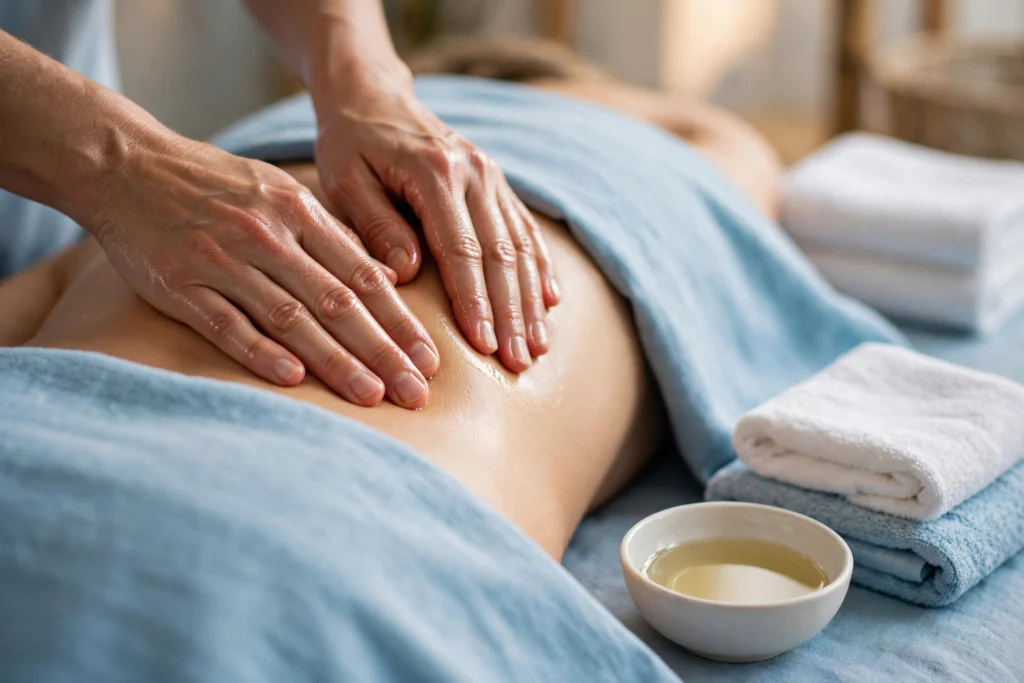
Sports massage is the corner of travel massage work where the clients are athletes, the sessions are short, and the stakes feel higher — because the client has a match, a race or a performance coming up, and the treatment has to help, not hinder.
What sports massage actually involves
Sports massage focuses on the muscles athletes use most, with the aim of improving flexibility, easing soreness, supporting recovery and helping prevent injury. The Bureau of Labor Statistics lists sports massage as one of the main specialties a massage therapist can focus on, alongside Swedish and deep tissue work. In practice, a sports massage session is more targeted than a relaxation massage: the therapist works on specific muscle groups, uses deeper pressure where it is needed, and often combines hands-on work with stretching and guidance the athlete can use between sessions.
On the road, sports massage happens wherever the team happens to be: a locker room, a hotel room, a tent beside a race course, a treatment room in a stadium. The therapist brings a portable table, oils, towels and tape, and sets up in whatever space is available. Sessions before an event are usually short and stimulating, aimed at warming muscles up. Sessions after an event are longer and slower, aimed at recovery. Knowing the difference matters, and getting it wrong can leave an athlete worse off — which is why teams hire therapists with proper training rather than general spa experience alone.
Who hires travelling sports massage therapists
Professional and college sports teams hire massage therapists to travel with them for a season or a tour. Endurance events — marathons, triathlons, cycling races — hire therapists for the event weekend, sometimes for a whole series. Touring performance companies, from dance troupes to circus shows, travel with massage therapists because their performers’ bodies are their working tools. Corporate wellness programmes that run sporting events also hire therapists for the day.
This work is usually found through contacts, not job boards. Team physiotherapists, athletic trainers and event organisers hire people they know or who come recommended by someone they trust. A therapist who wants this work should expect to start with local teams and events, build a reputation, and let the travelling work grow out of it.
The skills and experience teams look for
Teams look for therapists who understand the body under sporting stress, who can assess a problem quickly, who know their limits, and who can work calmly in a busy, noisy environment. A background in sports massage, additional training in areas such as myofascial release or trigger point therapy, and experience with athletes all help. So does a calm, professional manner: athletes talk about their bodies honestly to people they trust, and a therapist who listens well and keeps confidences will be asked back.
Just as important is knowing when not to massage. A therapist travelling with a team must be able to recognise when a pain needs a doctor, a physiotherapist or a scan, and say so clearly. That judgement is what separates a good sports massage therapist from a risky one, and it is the reason teams value experience so highly.
How to Become a Travel Massage Therapist: Education and Training

There is no shortcut into this career, and that is good news for everyone who takes it seriously. The path is clear, the steps are the same for travelling therapists as for any massage therapist, and the travel part comes after the qualification — not instead of it. Anyone who tells you that you can start working on a cruise ship or in a resort spa without training and a licence is selling you a problem, not a shortcut.
Step 1: Finish high school and choose a massage programme
Applicants to massage therapy programmes typically need at least a high school diploma or equivalent, according to the Bureau of Labor Statistics. Massage therapy education programmes are offered by private independent schools, community colleges and other public postsecondary institutions. Earning a diploma or certificate takes several months to a few years, depending on the programme.
Choosing the right programme matters more than choosing the fastest one. A good programme teaches anatomy, physiology, kinesiology and pathology — the science of how the body works and what can go wrong with it — alongside hands-on massage technique, business and ethics. It includes supervised practice on real clients, not just classroom demonstration. And it is approved or recognised by the state board where the school sits, which matters because that approval is what makes a graduate eligible for the licensing exam in most states.
Step 2: Complete the required hours
There is no single nationwide number of school hours. Most states require between 500 and 1,000 hours of massage education, depending on the state, and the exact figure is set by each state’s licensing board. That range is why a therapist should check the requirements of the state where they plan to be licensed before choosing a programme, not after finishing one. A programme that meets the rules in one state may fall short in another, and the hours cannot be made up quickly.
The hours themselves are a mix of classroom study and hands-on practice. Expect long days learning the muscles of the body, practising techniques on classmates, then on supervised clinic clients, and studying the rules that govern safe, professional practice — hygiene, consent, record keeping, and what to do when a client’s health history raises a concern.
Step 3: Pass the licensing exam
Most states that regulate massage therapy require a licensing exam, and the exam most states use is the Massage and Bodywork Licensing Examination, known as the MBLEx, run by the Federation of State Massage Therapy Boards (FSMTB). The exam is covered in detail in the next section, because it deserves its own space.
Step 4: Get licensed in your home state
Passing the exam does not itself grant a licence. The state board decides, using the exam result as one part of its own application process. The application usually also involves a background check, proof of education, and sometimes proof of liability insurance and CPR certification. Many states also require continuing education credits to keep a licence active, and periodic renewal. A travelling therapist should treat licence renewal dates like flight dates: miss one, and the whole plan stops.
Step 5: Get experience before you travel
This is the step impatient people want to skip, and the one employers care about most. Cruise lines, resorts and sports teams hire therapists with hands-on experience, because they need someone who can walk into a new spa and work a full book of clients from day one. A year or two in a busy spa, clinic or wellness centre builds the speed, stamina, guest manner and judgement that travel employers are actually buying. It also builds the client-handling skills — the consultation, the pressure check, the honest product recommendation — that make the difference between a therapist who survives a contract and one who thrives in it.
Extra training that opens travel doors
Once the basics are in place, additional training widens the travel options. Sports massage opens team and event work. Deep tissue and myofascial work open clinical and rehabilitation settings. Prenatal massage opens resort work with pregnant guests. Hot stone, aromatherapy and reflexology widen the spa menu. None of these is required to start, but each one is a door to a different kind of travel job, and therapists who collect two or three specialties over their first years have far more contracts to choose from than therapists with one.
| Step | What it involves | Time and cost (typical) |
|---|---|---|
| High school diploma | Entry requirement for most programmes | Already held by most applicants |
| Massage therapy programme | 500–1,000 hours, depending on the state | Several months to two years |
| MBLEx licensing exam | 100 questions, 110 minutes, $265 fee | One exam sitting; fee per attempt (FSMTB, 2026) |
| State licence application | Exam result, background check, proof of education | Varies by state; renewal and continuing education required |
| Hands-on experience | One to two years in a busy spa or clinic | Builds the speed and judgement travel employers want |
| Extra specialties | Sports, deep tissue, prenatal, hot stone, aromatherapy | Short courses; each opens a new kind of travel job |
The MBLEx Licensing Exam: What to Expect
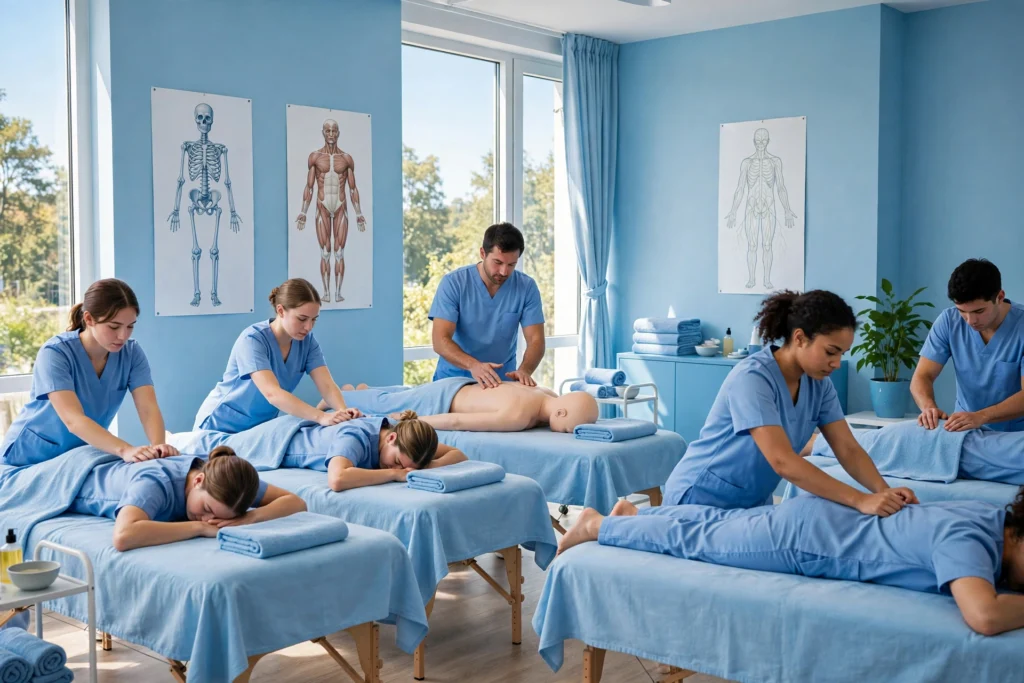
The MBLEx — the Massage and Bodywork Licensing Examination — is the exam most US states use to test massage therapists before licensing them. It is run by the Federation of State Massage Therapy Boards (FSMTB), and understanding it early saves a lot of confusion later.
Who can sit the exam
To take the MBLEx, a candidate must submit a complete application with the required fee, have their massage education programme verify their education directly with FSMTB, and agree to follow FSMTB’s exam policies. The fee is $265, according to FSMTB’s published requirements, and the application stays valid for six months while the school completes its verification. FSMTB processes a completed application within five business days.
There are two ways to qualify: graduation from an approved massage therapy education programme, or enrolment in one combined with having received education and training in every subject area on the MBLEx content outline. The important detail is that the school — not the candidate — submits the education verification directly to FSMTB through its Education Verification Center. The candidate’s job is to apply, pay the fee, and make sure the school sends the verification.
Candidates who trained through an apprenticeship or outside the United States face an extra step: they must first apply for licensure through their state board, which FSMTB confirms before approving them to test. FSMTB sets no nationwide school-hour minimum for exam eligibility; the hours are set by the state. There is also no work-experience requirement to sit the exam.
What the exam looks like
The MBLEx is a computer-based exam of 100 questions, answered in order with no skipping or going back, within 110 minutes. The questions cover the content areas in FSMTB’s published outline: anatomy and physiology, kinesiology, pathology, the effects and benefits of massage, client assessment, and professional practice including ethics, laws and business. The exam is administered year-round at Pearson VUE test centres.
Once FSMTB approves an application, it emails an Authorization to Test, which lists the dates the candidate is authorised to sit the exam. The authorisation is valid for a 120-day window, and if it expires before the candidate tests, they must reapply as a new applicant and pay the fee again. After the exam, the result goes to the state board the candidate named within five business days.
Passing is not the same as being licensed
This is the point most often misunderstood, and FSMTB states it plainly: passing the MBLEx does not license anyone. The exam result supports an application for a state licence, and only the state board issues the licence. A candidate who passes the exam still has to complete the state board’s own application, which may include a background check, proof of education, liability insurance and CPR certification. The exam is one step, not the whole journey.
A note on the exceptions
Most regulated states accept the MBLEx, but not all. New York and Hawaii use their own state exams. California has voluntary certification through the California Massage Therapy Council, with no exam required for that certification. Vermont registration needs no exam. A therapist planning to work in one of these states should check that state’s rules directly rather than assuming the MBLEx covers them.
How to prepare
The best preparation is a good massage programme that teaches the exam’s content areas properly, followed by focused revision using FSMTB’s own candidate handbook and content outline. Practice questions help with the format — 100 questions, in order, no going back, inside 110 minutes — because the time pressure is real. Therapists who passed the exam recently often say the same thing: the questions test understanding, not memorisation. Knowing why a technique is used, when it is not safe, and what a symptom might mean matters more than reciting muscle names from a list.
State Licensing Rules: What Changes When You Cross State Lines
Here is the part of travel massage work that surprises new therapists most: a massage licence is a state licence, not a national one. Being licensed in Florida does not automatically let you work in California. A therapist who moves between states for work needs a plan for licensing, and that plan should be made before the travel starts.
Most states regulate massage therapy
The Bureau of Labor Statistics notes that most states regulate massage therapy and require massage therapists to have a license or certification. The requirements vary, but they typically include graduation from an approved massage therapy programme and passing an exam. Other requirements may include a background check, liability insurance and CPR certification, and many states require continuing education credits and periodic renewal.
What changes from state to state
The differences that matter most for a travelling therapist are the required school hours, which exam is accepted, the background check process, the fees, and the renewal cycle. One state may require 500 hours of education; another may require 750 or 1,000. One state may accept the MBLEx; another may use its own exam. Some states process applications quickly; others take weeks. A therapist who assumes the rules are the same everywhere will eventually be caught out, usually at the worst moment — a contract starting next week in a state where the licence application takes six.
The practical approach for travelling therapists
Experienced travelling therapists handle licensing in one of three ways. The first is to hold licences in two or three states where they work most often, and renew them on schedule. The second is to work in settings where the employer handles the licensing questions — cruise ships in international waters, for example, operate under different rules from land-based spas, and the hiring company explains what is needed. The third is to check each new state’s board before accepting a contract, apply early, and never start work until the licence is in hand.
Whichever approach a therapist takes, three habits help: keep a folder, physical or digital, with every licence, certificate and exam result; set reminders for every renewal date; and check the state board’s own website for the current rules, because rules change and second-hand advice goes out of date fast. The Bureau of Labor Statistics points to CareerOneStop as a source for state licensing board information, and the state board itself is always the final authority.
Working abroad
International work adds visas and work permits to the licensing question. A US licence does not automatically authorise work in another country, and some countries have their own massage qualifications or registration systems. Cruise ship work is the common exception, because the ship’s spa operates under the rules of the hiring company and the ship’s flag state, and the company guides therapists through what is needed. Resort work abroad usually needs a work visa arranged by the employer, and the therapist should never travel on a tourist visa intending to work. The employer should confirm the visa and permit arrangements in writing before the therapist books a flight.
How to Find Travel Massage Therapist Jobs and Contracts
Finding travel massage work is part research, part reputation and part timing. The jobs exist — the Bureau of Labor Statistics projects about 20,400 openings a year for massage therapists across the decade to 2035 — but the travelling jobs are a smaller share of that total, and the best ones are rarely advertised widely. Knowing where to look, and what employers actually check, makes the search much shorter.
Where the jobs are listed
Cruise ship spa companies advertise on their own careers pages and on specialist cruise recruitment sites. Resort and hotel spas advertise on hospitality job boards and on the resort’s own website. Seasonal work appears on job boards a few months before the season starts — spring for summer resorts, autumn for winter resorts. Corporate wellness companies advertise on general job boards and through wellness agencies. Sports team and event work is rarely advertised at all; it moves through contacts.
A therapist looking for travel work should check the hiring company’s own careers page first, because that is where the real requirements, contract length and pay structure are listed. General job boards are useful for discovering employers, but the details on a job board listing are often incomplete or out of date.
What employers check before they hire
Employers hiring a travel massage therapist check four things before anything else: the licence, the qualification, the experience, and the person. The licence must be current and valid for the place of work. The qualification must come from an approved programme. The experience must show that the therapist can handle a full book of clients — cruise lines and resorts commonly ask for at least a year or two of hands-on work, and some ask for more. And the person must come across in interview as someone who can live and work in a small team, stay cheerful under pressure, and sell treatments and products honestly.
A practical CV for this work lists the qualification and licence first, then the settings worked in, the treatments offered, the number of clients handled per day at the busiest job, and any extra specialties. A short note about why the therapist wants to travel — and what they understand about the work — helps more than a long list of adjectives.
Agencies and recruiters: what to know
Some travel massage jobs come through staffing agencies and recruiters, especially cruise ship and resort work. A legitimate agency earns its fee from the employer, not from the therapist, and never asks a therapist to pay for a job, a placement or a guaranteed contract. Any recruiter asking for an upfront payment should be treated with caution. Before signing anything with an agency, a therapist should ask for the employer’s name, the contract terms, the pay structure, the housing arrangement and the cancellation terms in writing, and check that the agency is a real business with a traceable history.
No single agency is recommended here as a buying pick, because the right agency depends on the kind of work, the destination and the therapist’s experience. The general rule is enough: the employer pays the recruiter, the terms are in writing, and anything that asks the therapist to pay to get hired is a warning sign.
The timing of a travel job search
Timing matters. Cruise lines hire year-round but in larger groups before peak seasons. Resorts hire a few months before the season opens. Event work is booked weeks or months ahead. A therapist who starts looking the week they want to start working will find the pickings thin. Starting two to three months ahead, with licence, passport and documents ready, is a much better position — and it is the position employers prefer, because it signals a professional who plans ahead.
| Where to look | Kind of work | When to apply |
|---|---|---|
| Cruise spa company careers pages | Ship contracts, 6–9 months | Year-round; larger intakes before peak seasons |
| Resort and hotel websites | Seasonal and year-round spa roles | Two to three months before the season |
| Hospitality job boards | Resort, hotel and spa roles | Two to three months before the season |
| Corporate wellness companies | Office and event chair massage | A few weeks ahead; ongoing |
| Sports teams and events | Team and event work | Through contacts; often months ahead |
| Professional networks and referrals | All kinds, especially the best contracts | Ongoing — reputation builds over years |
Travel Logistics: Housing, Packing, Insurance and Taxes

The travel part of this career is not just the fun part. It is a logistics job in its own right, and the therapists who handle it well are the ones who arrive calm, equipped and ready to work, instead of arriving tired, missing equipment and unsure where they are sleeping.
Housing: what to expect and what to ask
Housing is usually part of the deal in travel massage work, but the details vary enormously. On a cruise ship, housing is a shared cabin. In a resort, it may be a shared staff apartment, a room in a staff building, or a housing allowance to rent nearby. For event and corporate work, the employer usually books a hotel. Before accepting any contract, a therapist should ask: what exactly is provided, is it shared or private, what does it cost if anything, how far is it from the workplace, and what happens on days off. Getting those answers in writing avoids the most common travel work disappointment — arriving to find the housing is nothing like the description.
Packing like a travelling therapist
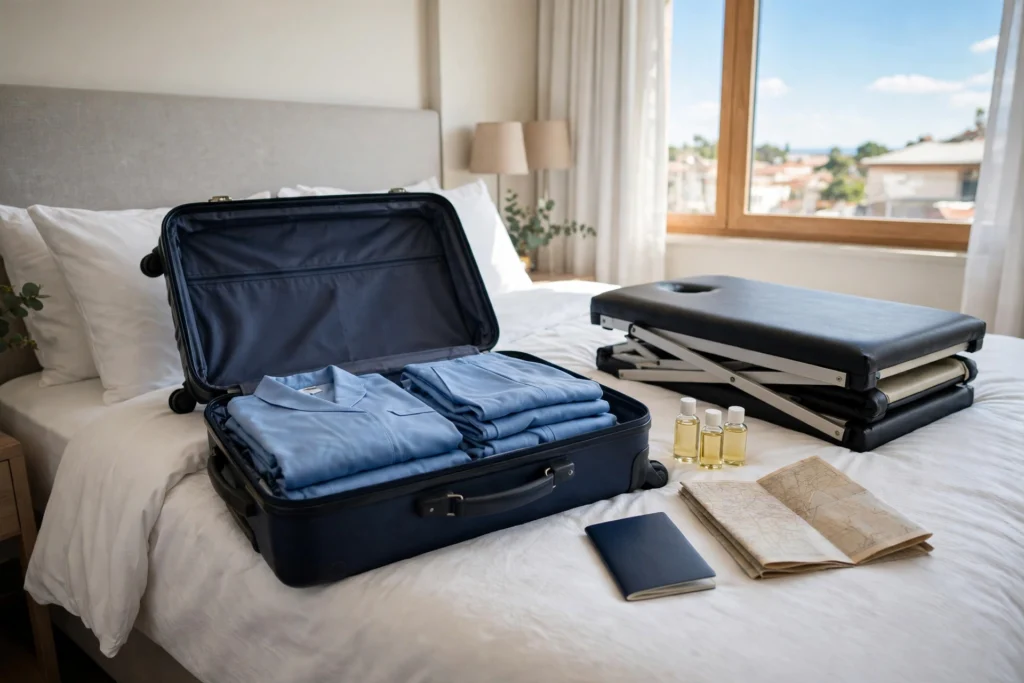
A travelling massage therapist packs for two lives at once: the working life and the living life. The working kit usually includes a portable massage table or chair, sheets and towels, oils and lotions, a bolster, and cleaning supplies. The living kit is whatever fits in the rest of the luggage. Experienced travelling therapists keep the kit light and standardised: one table they know well, one set of oils, a small set of clean linens, and a checklist that is used every time they pack. The checklist matters because forgetting a table part or a bottle of oil in a new town can mean a cancelled first day.
For a practical packing framework that works for any kind of travel, the travel packing checklist PDF free guide on this site lays out a packing system that adapts well to a working trip. The principle is the same whether the trip is a holiday or a contract: pack the essentials first, keep documents together, and leave room for the things you will need to buy on arrival.
Insurance: the part nobody wants to think about
Insurance is not exciting, but it is essential. A travelling massage therapist needs professional liability insurance that covers the places and settings where they work — and a policy written for one state or one clinic may not cover work on a ship, in another state, or abroad. Employers usually carry their own insurance for employed therapists, but a therapist should confirm what is covered and what is not, and whether personal liability cover is needed as well. Health insurance is a separate question, and it is especially important for ship work, where medical care at sea is available but limited, and for work abroad, where a US health plan may not cover treatment. Travel insurance that covers medical evacuation is worth considering for international contracts.
Taxes and the paperwork of moving around
Tax is the least glamorous part of travel work and the one that causes the most trouble when ignored. A therapist who works in several states in one year may owe tax in more than one state, and the rules depend on where the work was done and where the therapist lives. Self-employed therapists have their own obligations: tracking income, keeping receipts, setting aside money for tax, and filing correctly. Cruise ship therapists face additional questions about where their income is taxed, depending on the ship’s registry and their citizenship. None of this is a reason to avoid the career. It is a reason to keep good records from the first contract and to get professional tax advice before the first year of travelling work ends, rather than after a surprise bill arrives.
Staying connected and staying healthy
Two practical matters deserve a mention because they affect every contract. The first is staying connected: internet on a cruise ship is expensive and slow, and phone signal disappears at sea, so therapists should tell family and friends in advance how often they will be in touch. The second is staying healthy: the work is physical, the hours are long, and the temptation to skip meals, sleep and exercise is real. Therapists who last in travel work treat their own body like a work tool — regular stretching, good body mechanics, enough sleep, and receiving massage themselves — because a therapist with an injured back or burned-out hands cannot work, and there is no sick pay on a ship that replaces a lost contract.
The Pros and Cons of Being a Travel Massage Therapist

Every career guide that lists only the good parts is selling something. This one lists both sides, because the decision to become a travel massage therapist is a decision about a whole way of life, not just a job title.
The pros
The travel is real. A travel massage therapist can wake up in a new port, a new resort town or a new city, and that novelty is the reason most people choose this path. The work itself is meaningful: clients arrive tense and in pain and leave looser, calmer and grateful, and that feedback comes several times a day. The cost of living can be low while working — free or cheap housing, meals included, almost nothing to spend money on at sea — which lets disciplined therapists save. The skills grow fast, because every new workplace teaches something: a new treatment, a new kind of client, a new way of running a spa. And the friendships, especially on ships and in resort teams, are often deep and lasting, formed by people living and working closely together far from home.
There is also the career flexibility. Massage therapy is a portable skill in the most literal sense: the qualification, the licence and the hands travel with the therapist. A therapist can work a cruise contract, then a resort season, then a few months of mobile work, then go back to a clinic for a while. Few careers offer that much freedom to change direction without retraining.
The cons
The hours are long and the work is physical. A therapist giving 10 to 12 massages a day on a cruise ship is doing serious physical labour, and the Bureau of Labor Statistics warns plainly that repetitive-motion problems and fatigue from standing are the most common injuries in this occupation. The pay is uneven: commission-based income means a slow week pays less, and the headline figures for cruise and resort work are lower than many people expect. Time away from home is measured in months, not days, and that strains relationships, makes it hard to keep a home base, and means missing birthdays, holidays and ordinary life at home.
The living conditions can be basic: a shared cabin, a shared apartment, limited privacy, and little control over where you sleep or what you eat. The licensing paperwork never really ends, because every new state or country can mean a new application. And the career has a physical shelf life that office jobs do not: a therapist’s hands, back and shoulders are the tools, and they need care, rest and eventually a plan for what comes next — teaching, managing a spa, or moving into a less physical role.
| Pros | Cons |
|---|---|
| Real travel to new ports, resorts and cities | Long hours and heavy physical load |
| Meaningful work with grateful clients | Commission-based pay that varies week to week |
| Low living costs while on contract | Months away from home and family |
| Fast skill growth across many settings | Shared cabins and basic living conditions |
| Deep friendships with crew and colleagues | Licensing paperwork for every new state or country |
| A portable skill with flexible career options | Physical wear on hands, back and shoulders over time |
The honest balance
The therapists who stay in this career are not the ones who ignored the cons. They are the ones who knew them, accepted them, and built a life that works around them: saving during contracts, resting between them, keeping a home base where it matters, and looking after their bodies like professionals. The therapists who leave quickly are usually the ones who expected a paid holiday and found a demanding physical job instead. Knowing which group you are likely to join is the whole point of reading a guide like this before you start.
Who Is This Career Right For? A Realistic Self-Check

This career is not for everyone, and that is fine. It is a good fit for a particular kind of person, and a poor fit for others, and the difference has very little to do with talent and a lot to do with temperament and life circumstances.
Signs it could be a good fit
You are physically strong and enjoy hands-on work. You like meeting new people and can stay warm and professional with strangers several times a day. You are comfortable with routine and with following an employer’s treatment standards. You can handle being away from home for months without it wearing you down. You are organised enough to keep licences, documents and renewals in order. You are motivated by commission and enjoy the feeling of earning more when you do good work. You can live lightly, out of a suitcase, without needing a lot of space or possessions around you. And you genuinely like massage — not just the idea of travel, but the work itself, the repetition, the focus, the care.
Signs it might not fit right now
You need a lot of privacy and personal space. You struggle with seasickness or with living in small shared rooms. You dislike sales and feel uncomfortable recommending treatments or products. You need a fixed routine and a stable home base. You have caring responsibilities that make months away difficult. You are looking mainly for a holiday rather than a job. Or you have a physical issue — a bad back, wrist problems, shoulder trouble — that heavy daily massage work would make worse. Any of these is a good reason to pause, not a judgement. Some of them change with time: experience, savings and a stronger body can turn a poor fit into a good one a year or two later.
Try before you commit
The best way to test the fit is to try the work in its least extreme form first. Work in a busy land-based spa for a year. Take a short resort contract for one season. Do a weekend of event massage. Each step shows something about the work — the physical load, the guest manner, the hours — without the commitment of a nine-month ship contract. Therapists who enjoy the land-based version usually enjoy the travel version. Therapists who find the land-based work exhausting or dull rarely enjoy it more at sea.
For readers weighing this against other travel careers, the comparison is useful. Travel nursing is the best-known parallel: licensed professionals who take short contracts in different places. The site’s guide to what travel nurses do covers a similar pattern of licensing, contracts and life on the road, and the jobs that allow you to travel guide sets massage therapy alongside other careers that combine work with travel. Reading those alongside this guide gives a fuller picture of the options than any single career guide can.
How to Build a Long-Term Career as a Travel Massage Therapist

Getting the first travel contract is the start, not the finish. The therapists who turn this into a career lasting years rather than one adventurous season do a handful of things differently, and none of them is complicated.
Build a reputation, not just a CV
In travel massage work, reputation travels faster than a CV. Resort managers talk to each other. Cruise spa companies keep records. Sports teams hire on recommendation. A therapist who is on time, professional, good with guests and easy to live with will be remembered, invited back and recommended. A therapist who is unreliable or difficult will find the work drying up quietly, without anyone saying why. Every contract is an audition for the next one, and the audience is small and well connected.
Keep learning
The Bureau of Labor Statistics projects 15 percent employment growth for massage therapists from 2025 to 2035, which means more jobs — but also more newly qualified therapists competing for them. Continuing education is required by many states to keep a licence active, and it is also the way a travelling therapist stays valuable: a new specialty, a deeper understanding of a technique, a better grasp of injury assessment. Therapists who stop learning after their first qualification slowly become less employable. Therapists who keep adding skills keep getting the better contracts.
Look after your body
This is the career advice that matters most and gets followed least. The Bureau of Labor Statistics is direct about it: massage therapists may injure themselves if they do not use proper technique, and repetitive-motion problems and fatigue from standing are the most common problems. The Bureau’s own advice is to use good body mechanics, space sessions properly, exercise, and receive massage regularly. Travelling therapists should add to that list: sleep properly, eat properly, stretch daily, and take rest days seriously. A therapist’s body is the business. Looking after it is not self-indulgence. It is maintenance.
Plan the money
Travel massage work pays unevenly — good months and slow months, contracts and gaps between them. Therapists who last learn to treat the good months as the time to save, not the time to spend. A simple system works: keep a separate account for tax, keep an emergency fund that covers two or three months without work, and know the cost of the gap between contracts before taking the next one. The therapists who run into trouble are rarely the ones who earned too little. They are the ones who spent the good months as if every month would be a good month.
Think about what comes next
A massage therapist’s hands will not last forever at full intensity, and a smart travelling therapist plans for that from the start rather than when the body forces the issue. The options are real: teaching in a massage school, managing a spa, training other therapists, specialising in a gentler technique, moving into corporate wellness work with shorter sessions, or building a mobile practice with a schedule the therapist controls. None of these needs to be decided now. But knowing they exist makes the career feel like a path with a future, not a job with an expiry date.
A simple first-year plan
For a reader starting from zero, the path looks like this: choose an approved massage programme in the state where you plan to be licensed, complete the required hours, pass the MBLEx, get the state licence, and work for a year or two in a busy spa or clinic. Then take a first travel contract — a resort season is a gentler start than a cruise ship — and see how the life fits. After that first contract, you will know more about this career than any guide can tell you, including this one. That is the right time to decide whether the next contract is a ship, a team, a new resort, or a different direction entirely.
For readers who want to explore other ways of combining work with travel, the site’s guide on how to become a travel agent for free covers a very different route into travel work, and the guide to whether travel agents are free answers a question that comes up for almost everyone planning a trip. A year spent travelling for work also teaches lessons about planning and packing that a holiday never does — the travel itinerary template guide is a useful tool for organising any working trip, and a gap year of travel is one way some people test whether a travelling life suits them before committing to a career built around it.
Frequently Asked Questions About Travel Massage Therapists
How much does a travel massage therapist make?
It varies by setting and pay structure. The US Bureau of Labor Statistics reports a median annual wage of $58,450 for all massage therapists in May 2025. Cruise ship therapists commonly earn a reported range of about $1,500 to $4,500 a month, mostly from commission, tips and product sales, with room and board usually included. Resort therapists often earn less in base wage — the Bureau reports a median of $43,840 a year in accommodation — but housing, meals and tips can make up a large part of the package. No single figure covers the whole career.
Do you need a licence to be a travel massage therapist?
Yes, in most US states. Massage therapy is regulated in most states, and a licence or certification is required. The usual route is an approved massage programme of 500 to 1,000 hours, depending on the state, followed by the MBLEx licensing exam and a state licence application. A licence from one state does not automatically allow work in another state.
How long does it take to become a travel massage therapist?
The education programme takes several months to two years, depending on the programme and the state hours required. After that comes the MBLEx exam and the state licence application. Most travel employers also want a year or two of hands-on experience first, so a realistic timeline from starting school to the first travel contract is around two to four years.
What is the MBLEx exam?
The Massage and Bodywork Licensing Examination is the licensing exam run by the Federation of State Massage Therapy Boards (FSMTB) and accepted by most regulated states. It has 100 questions to be answered in order within 110 minutes, and the application fee is $265 (FSMTB, 2026). Passing it does not itself grant a licence; the state board issues the licence.
How long are cruise ship contracts for massage therapists?
Contracts commonly run six to nine months, with the therapist living on board for the whole contract. Training is usually provided by the hiring spa company before boarding. Most cruise lines require therapists to be at least 21 years old.
Can a travel massage therapist work abroad?
Yes, but the arrangements depend on the setting. Cruise ship work is usually arranged by the hiring spa company, which guides therapists through what is needed. Resort work abroad usually needs a work visa arranged by the employer. A US state licence does not automatically authorise work in another country, so the visa and local rules should be confirmed in writing before travelling.
Is being a travel massage therapist a good career?
It can be, for the right person. The Bureau of Labor Statistics projects employment of massage therapists to grow 15 percent from 2025 to 2035, much faster than average, with about 20,400 openings a year. The work suits people who are physically strong, enjoy meeting people, cope well with routine and time away from home, and genuinely like massage work itself. It suits people who want a paid holiday far less well.
Do travel massage therapists get free housing?
Often, yes, in some form. Cruise ships include a shared cabin and meals. Many resorts provide staff housing or a housing allowance, and some provide meals. Event and corporate work usually includes a hotel. The details vary by employer and should be confirmed in writing before accepting a contract.
What is the hardest part of the job?
Most working therapists point to the same three things: the physical load of many massages a day, the long hours, and the time away from home. The licensing paperwork for each new state or country is a close fourth. Therapists who manage these four things well tend to last in the career.
Can you be a travel massage therapist without experience?
Travel employers rarely hire therapists with no hands-on experience. Cruise lines, resorts and sports teams need someone who can work a full book of clients from day one. A year or two in a busy spa or clinic first is the normal route, and it is the route employers expect.
Do travel massage therapists have to sell products?
In cruise ship and resort spas, recommending treatments and products is usually part of the job, and commission on sales is a real part of the income. The recommendation should be honest and suited to the guest. Therapists who are uncomfortable with any selling at all often prefer clinic or mobile work, where it matters less.
What happens between contracts?
Most travelling therapists use the gap to rest, recover, renew licences, take continuing education courses, visit family and plan the next contract. Experienced therapists line up the next contract before the current one ends, and keep an emergency fund that covers two or three months without work.
Conclusion: A Real Career for People Who Love Massage and Travel in Equal Measure
A travel massage therapist is not a tourist who happens to give massages. It is a licensed professional who has done the training, passed the exam, earned the licence, built the experience, and chosen a working life that moves. The rewards are genuine — new places, grateful clients, low living costs on contract, skills that grow with every workplace — and so are the demands: long hours, physical work, months away from home, and paperwork in every new place.
The numbers give the decision a solid footing. The US Bureau of Labor Statistics reports a median annual wage of $58,450 for massage therapists in May 2025, with employment projected to grow 15 percent from 2025 to 2035 and about 20,400 openings a year. Cruise ship work adds a reported range of roughly $1,500 to $4,500 a month with room and board included, and resort work adds housing and tips to a lower base wage. None of those figures is a promise. All of them are a starting point for a realistic plan.
The best way to decide is the simplest one: train properly, get licensed, work in a busy spa for a year or two, and then take one travel contract — a resort season, a short cruise contract, a run of event work — and see how the life feels from the inside. If the work still feels good at the end of a long week, and the travel still feels worth it, you have found a career that very few jobs can match: a skill in your hands, a living made from helping people feel better, and a working life that moves with you.
People also read:
- What travel nurses do and how their contracts work
- Jobs that allow you to travel while you earn
- How to become a travel agent for free
- Are travel agents free? What they cost and how they are paid
- Gap year travel: how to plan a year away
- Travel itinerary template for planning any trip
- Travel packing checklist PDF free
- Best travel destinations for your next trip
- Christmas travel ideas and planning guide
- Unique travel experiences worth planning a trip around
- Mauritius travel: the complete island guide
- Hanoi travel: the complete guide to Vietnam’s capital

M. Adil is the founder and editor of SoloTravelPro. He writes practical, research-based travel guides that help travellers plan with confidence — from first-time city breaks to national parks and island escapes. Every guide is built on official sources, current prices and honest, usable advice, so readers can plan smarter and travel better.