Turkey is the rare destination where one trip genuinely contains three different holidays: the mosques, bazaars and Bosphorus ferries of Istanbul, the fairy-chimney valleys and dawn balloons of Cappadocia, and the turquoise water and Roman ruins of the Aegean and Mediterranean coasts. The catch is distance — the country is larger than Texas, and the classic route only works if you fly between regions instead of driving. This Turkey travel guide gives you the honest version: the core route that actually works, the visa rules for US citizens as they stand in late 2026, what the US travel advisory really means, 5-day, 7-day and 10-day itineraries, food by region, and real costs in lira and dollars, so you can plan a first trip to Türkiye without the mistakes most first-timers make.
Turkey Travel Guide: The Core-Route Reality Check — Distances Are Long, So Fly, Don’t Drive
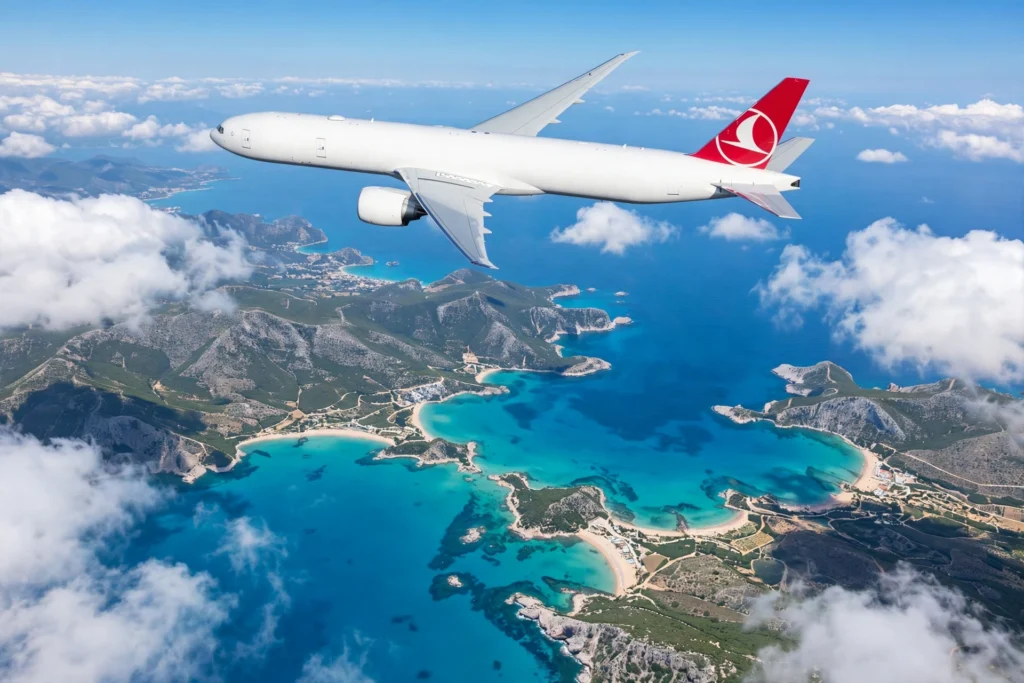
The single most important fact in this whole Turkey travel guide is the size of the country. Türkiye covers about 783,000 square kilometres, and its great sights are spread across it like pins on a map that looks small until you start measuring. Istanbul to Göreme, the village at the heart of Cappadocia, is roughly 730 kilometres by road — about nine hours of driving. Istanbul to Antalya is around 700 kilometres. Göreme to Pamukkale is about 600 kilometres. Travellers who try to drive the whole classic route in a week spend most of it on motorways and arrive everywhere tired, and that is the most common way a first trip to Turkey goes wrong.
The fix is simple and it shapes everything else in this guide: fly between regions, and drive or take the bus only inside a region. Domestic flights in Turkey are frequent, cheap when booked a few weeks ahead, and short — Istanbul to Nevşehir or Kayseri, the two airports for Cappadocia, takes about 1 hour 15 minutes; Istanbul to Antalya about 1 hour 10 minutes; Istanbul to İzmir about an hour. Turkish Airlines, Pegasus and AJet all fly these routes several times a day, and a short hop booked early is often cheaper than the bus fare for the same journey once you count the hotel night a long drive costs you. Treat the flight as part of the itinerary, not as an extra, and the classic route becomes easy: four days in Istanbul, fly to Cappadocia for two or three nights, fly or drive on to the coast, and fly home from Antalya or İzmir instead of backtracking to Istanbul.
The second reality check is about what the classic route actually is. For a first trip, it has four stops and almost nothing else: Istanbul, Cappadocia, Ephesus and Pamukkale, and one stretch of coast — either the Turquoise Coast around Fethiye and Kaş, or the Aegean around Selçuk and Bodrum. That is the route this guide builds, because it is the route that works in 7 to 10 days, and because every stop on it earns its place. Everything else — the Black Sea coast, the southeast, Mount Nemrut, Lake Van, the far east — is a second trip, not a detour. The southeast in particular is not a casual add-on: the US travel advisory puts the border region with Syria and Iraq at Level 4, Do Not Travel, and the great southeastern cities sit close enough to that region that they belong in a separate, carefully planned trip rather than squeezed into a first visit. The official tourism platform, GoTürkiye, is a good place to browse the regions you are skipping, so you know what a second trip could hold.
The third reality check is about pace. Turkey rewards slow days. Istanbul needs four days, not two, because the city is two cities — a European side and an Asian side — and because its best experiences are unhurried ones: a ferry across the Bosphorus, an hour in a hamam, a long lunch that turns into an afternoon. Cappadocia needs two full days on the ground, not one, because the balloon flight can be cancelled by wind and you need a spare morning. Ephesus needs a full day, not a half day tacked onto a drive. If your trip is shorter than five days, pick one place — Istanbul alone, or Cappadocia alone — and do it properly. A rushed Turkey trip is worse than a short one, because the distances punish every shortcut.
The four-stop route at a glance
| Stop | Nights | Fly or drive | Why it earns its place |
|---|---|---|---|
| Istanbul | 4 | Fly in from the US | Two continents, the great mosques, bazaars, Bosphorus |
| Cappadocia (Göreme) | 2–3 | 1h15 flight from Istanbul | Fairy chimneys, cave churches, underground cities, balloons |
| Ephesus and Pamukkale | 2 | Drive or bus from İzmir | The best-preserved Roman city and the white terraces |
| Turquoise Coast (Fethiye or Kaş) | 2–3 | Drive from Antalya or Dalaman | Turquoise water, Lycian ruins, gulet sailing, slow days |
The mistakes first-timers make
The first mistake is the driving mistake, covered above: trying to see the whole country by road in a week. The second is booking the balloon flight for the last morning, so a weather cancellation means no flight at all — book it for the first morning instead, and keep the second morning free. The third is treating Istanbul as a two-day stopover on the way to somewhere else; the city punishes that, because its queues are long and its pleasures are slow. The fourth is booking a hotel on the coast in winter and finding the resort half-closed, or booking Cappadocia in January without knowing that balloon cancellations are far more common in winter. And the fifth is the visa mistake — believing an old blog post that says Americans need an e-Visa, and paying a third-party site for a document that is no longer required at all. The visa section below gives the current rule, checked against the official sources in November 2026, so you do not make it.
How to use this guide
Read the sections in order if this is your first trip: the best time to go, the visa rules, the safety picture, then the four stops, then the itineraries, food, costs and transport. If you already know when you are going, skip straight to the itinerary that matches your trip length — the 5-day, 7-day and 10-day plans are built from the same four stops, so you can see exactly what each extra day buys you. Every price in this guide is given as a range, because Turkey’s inflation means a figure quoted as exact would be out of date within weeks; the ranges are checked against live operator and guide pages in November 2026, and the guide tells you where to check the current figure before you pay.
Best Time to Visit Turkey: When to Go and When to Skip It
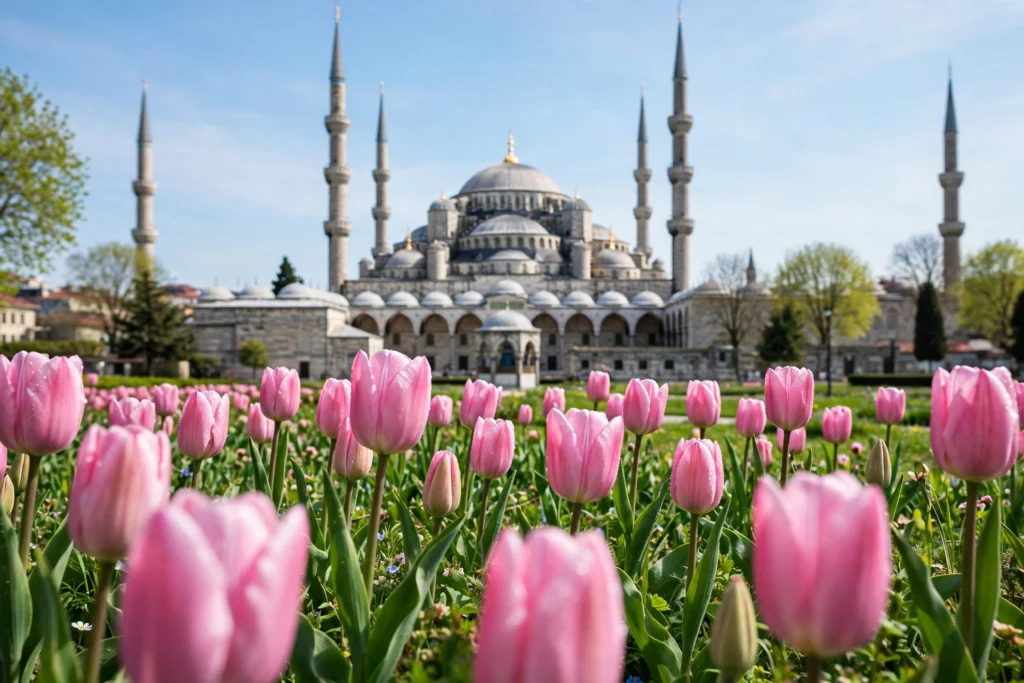
There is no single best month for the whole of Turkey, because the country has several climates at once: Istanbul is temperate and maritime, Cappadocia sits on a high continental plateau with cold winters and hot summers, and the southern coast is properly Mediterranean. The answer depends on which stops matter most to you, but for the classic four-stop route the sweet spot is clear: April to June, and September to October. Those are the months when Istanbul is comfortable, Cappadocia is at its most reliable for balloon flights, the ruins are walkable without heat exhaustion, and the sea is warm enough to swim in.
April is the month of tulips in Istanbul — the city plants millions of them, and the parks around Sultanahmet and Emirgan are at their best — and of mild days in Cappadocia, with wildflowers in the valleys and the highest balloon success rates of the year. May is, for most travellers, the single best month: warm everywhere, green in the valleys, warm enough to swim on the south coast by mid-May, and still ahead of the summer crowds. June is warm and long-dayed, with the coast in full season, but the inland sites start to get hot by midday, so plan ruin visits for the morning. September is the other great month: the sea is at its warmest after the summer, the crowds thin, the light in Cappadocia turns golden, and Istanbul is at its most pleasant. October keeps the sea warm into the first half of the month and brings autumn colour to the valleys, with cooler evenings that suit walking.
Summer — July and August — is the season to think about carefully rather than to avoid outright. The coasts are at their best, the sea is warm, the resorts are fully open, and the long evenings are made for harbour dinners. But Istanbul is hot and humid, the queues at the Hagia Sophia and Topkapı Palace are at their longest, Ephesus and Pamukkale are brutally hot by midday, and Cappadocia’s valleys are best walked at dawn and dusk rather than at noon. If summer is the only time you can go, build the trip around the coast and do the ruins early in the morning; do not try to do the whole classic route at midday pace in August.
Winter — November to March — is the cheapest season and the quietest, and it suits a particular kind of trip very well. Istanbul in winter is atmospheric, cheaper, and mostly free of queues, and the city belongs to locals again. Cappadocia under snow, with the fairy chimneys dusted white, is beautiful, and cave hotels are at their cheapest — but balloon cancellations are far more common, with roughly a third of winter mornings grounded in some years, so a winter Cappadocia trip needs at least three nights and a flexible attitude. The coasts, meanwhile, largely shut down: many hotels, restaurants and boat operators in Fethiye, Kaş and Bodrum close or cut back sharply from November, and the sea is too cold for swimming. A winter trip should be Istanbul plus Cappadocia, not the coast.
Ramadan moves each year, and it is worth knowing when it falls. In 2027 the Ramazan Bayramı holiday — the festival at the end of Ramadan — falls around 10 to 12 March, with the fasting month running through late February into early March. During Ramadan, restaurants in smaller towns may be closed during the day, and the evenings come alive after sunset; tourist areas and hotels continue to serve food, and the atmosphere in Istanbul at iftar is genuinely special. It is not a reason to avoid travelling, but it is a reason to plan meals and check opening times rather than assuming everything runs as normal.
Month-by-month at a glance
| Month | Istanbul | Cappadocia | Coast and ruins | Verdict |
|---|---|---|---|---|
| April | Mild, tulips | Mild, best balloons | Warming up, quiet | Excellent |
| May | Warm, pleasant | Warm, wildflowers | Warm sea by mid-May | Best month |
| June | Warm, long days | Warm, dry | Full beach season | Very good |
| July–August | Hot, humid, queues | Hot at midday | Best sea, busiest | Good for the coast |
| September | Pleasant, golden | Golden light | Warmest sea, thinner crowds | Excellent |
| October | Cool evenings | Cool, autumn colour | Warm sea early in the month | Very good |
| November–March | Cool, quiet, cheap | Cold, snow, balloon risk | Many resorts closed | Istanbul and Cappadocia only |
How the seasons affect prices
Prices follow the seasons more sharply in Turkey than in most of Europe. Cave hotels in Göreme can cost roughly half as much in January as in May. Coastal hotels peak in July and August and drop steeply in October. Domestic flights are cheapest when booked a few weeks ahead and most expensive in the week before departure, especially around the Ramazan Bayramı and summer school holidays. If your dates are flexible, the cheapest good-weather window is usually late April or late October — shoulder season prices with near-peak weather. For more on picking cheap months in general, our guide to the cheapest time to travel explains how shoulder seasons work across destinations.
Do US Citizens Need a Visa for Turkey? The 2026 Rules

The short answer, for most American travellers, is no. Ordinary US passport holders do not need a visa — or an e-Visa — to visit Türkiye for tourism or short business trips. You can stay visa-free for up to 90 days in any 180-day period, and there is no visa fee to pay. That rule was confirmed on the US State Department’s Turkey page, checked live in November 2026, which states plainly: “No visa is required for 90 days or less using a tourist passport.” It is also the rule published by Türkiye’s own Ministry of Foreign Affairs, which exempts ordinary US passport holders for touristic and business visits of up to 90 days in any 180 days.
This surprises a lot of travellers, because it used to be different. Until late 2023, Americans bought an e-Visa online before flying. The exemption came with a presidential decree in December 2023, and many travel websites — including some still ranking at the top of Google — never updated their advice. If a website tells you to buy a Turkey e-Visa for $50 and sends you to a payment page, that advice is out of date, and the payment page is, at best, selling you a document you do not need. The official e-Visa system at evisa.gov.tr still exists and still works, but it serves travellers from countries that are not visa-exempt. For an American on an ordinary passport travelling as a tourist, there is nothing to apply for, no form to fill in before you travel, and no fee to pay at the border. Close any tab that asks for your passport details and a payment for a Turkey visa.
The exemption has edges, and they matter. It covers ordinary (tourist) passports only — official and diplomatic passport holders still need a visa. It covers tourism and short business visits only. If you plan to work in Türkiye, study at a Turkish university, carry out academic research, or stay longer than 90 days in a 180-day period, you need a proper visa from a Turkish embassy or consulate before you travel, and for a stay beyond 90 days you must apply for a residence permit after arrival. The 90 days are counted over a rolling 180-day window, not per trip, so a long stay followed by a quick return can catch you out — count your days across the whole six-month period, not just the current trip.
Your passport itself has rules too. It must be valid for at least six months beyond your date of entry, and it must have at least one blank page for entry and exit stamps. Turkish authorities can deny entry if there is not enough space for the stamps, and airlines can refuse to board you if your passport does not meet the destination’s rules. Get both stamps: the State Department notes that you need a Turkish entry stamp to fly on domestic flights, and that leaving without an exit stamp can lead to a fine and problems on your next visit. If you are travelling with children, carry a copy of each child’s birth certificate, and if one parent is travelling alone with a child, a notarised consent letter from the absent parent is recommended.
Entry checklist for US citizens
| Requirement | The rule for US citizens (checked November 2026) |
|---|---|
| Visa for tourism | Not required — visa-free up to 90 days in any 180 days |
| e-Visa | Not needed for ordinary US passports; evisa.gov.tr serves non-exempt nationalities |
| Passport validity | At least 6 months beyond your date of entry |
| Blank pages | At least one page for entry and exit stamps |
| Work or study | Visa from a Turkish embassy or consulate, applied for in advance |
| Official or diplomatic passports | Visa required |
| Stay beyond 90 days | Residence permit, applied for after arrival |
| Entry and exit stamps | Get both — needed for domestic flights and for re-entry |
If someone in your party holds a different passport
The rule is decided passport by passport, not by the group. A spouse or travelling companion with a passport that is not visa-exempt may still need an e-Visa from the official government site, even though you do not. Check every passport in your party separately on the Ministry of Foreign Affairs visa information page before you book, and apply only through evisa.gov.tr — never through a third-party site that charges a markup. And remember the practical side: even without a visa, border officers still check that you are a genuine visitor, so keep your return flight details and your first night’s hotel address easy to reach on your phone.
Is Turkey Safe for US Travellers? The Advisory, Honestly Explained
The US State Department rates Türkiye at Level 2: Exercise Increased Caution. That is the fact that matters most, and it needs context, because a bare “Level 2” tells you almost nothing on its own. The advisory was issued on 11 June 2026 and, checked live in November 2026, it reads: “Exercise increased caution in Türkiye due to terrorism, armed conflict, and arbitrary detentions. Some areas have increased risk.” Level 2 is the same tier the United States gives to much of Western Europe, including France, Italy, Spain and the United Kingdom, and it means something specific: travel, but be more alert than you would be at home, and read the detail underneath the headline. You can read the full text on the State Department’s Turkey travel advisory page, and you should read it twice — once when you book, and again the week before you fly, because advisories change.
The detail underneath the headline is where the real information lives. The advisory’s Level 4 — Do Not Travel — applies to one precise area: the border region with Syria and Iraq, within 10 kilometres (6 miles) of the border, because of terrorism and armed conflict. The classic tourist route in this guide — Istanbul, Cappadocia, Ephesus, Pamukkale and the Turquoise Coast — is hundreds of kilometres from that border strip, and the advisory does not rate those places at Level 4. The Level 2 rating for the rest of the country reflects a background terrorism risk that Türkiye has managed for years, with a visible security presence at airports, major sites and transport hubs, and advice to exercise caution in crowded public spaces including transport hubs, markets, malls, government buildings, hotels, restaurants, places of worship, airports and major events. That is the right way to read it: ordinary urban alertness, plus one hard rule — stay away from the border strip the advisory names.
The advisory also covers arbitrary detentions, and this part deserves a plain reading. The State Department notes that the Turkish government has detained and arrested individuals, including Americans, for alleged links to terrorist groups based on scant evidence, that Americans have been subject to exit bans, and that protests not approved by the Turkish government can lead to arrest — as can criticising the government, including on social media. The practical advice is straightforward: avoid demonstrations entirely, do not photograph military sites or security installations, and delete anything sensitive from your social media and devices before you travel if it criticises the Turkish government, flag, President or security forces, because insulting Atatürk, religious feelings or the Turkish government is illegal in Türkiye. This is not a reason to avoid the country; it is a reason to behave like a guest, which is good advice anywhere.
The risks that actually affect tourists most often are far more ordinary. Istanbul has pickpockets in Sultanahmet and the Grand Bazaar, like every great tourist city. Traffic is the risk travellers underestimate most: Turkish drivers are fast, pedestrian crossings are not always respected, and the roads are the most dangerous thing on most trips. The State Department’s own embassy tips warn about fake alcohol — some tourists have died after drinking counterfeit drinks, so buy alcohol only from licensed shops, bars, hotels and restaurants and check that bottle seals are not broken. And the advisory notes that several sexual assaults against US citizens, especially women, have been reported at spas and hamams, nightclubs, bars, in taxis and while walking alone at night — a reason to choose reputable establishments, avoid walking alone late at night in unfamiliar areas, and use licensed taxis or ride-hailing rather than unmarked cars.
What to do before you go
Enrol in the Smart Traveler Enrollment Program, known as STEP, on the State Department’s STEP enrolment page. It is free, it takes about ten minutes, and it lets the nearest US embassy or consulate contact you in an emergency and help your family reach you. Save the emergency number — 112 works for police, ambulance and fire across Türkiye — and save the address of the nearest US embassy or consulate in your phone. Read the CDC Travelers’ Health pages for Türkiye: no vaccination is required for most travellers, but hepatitis A and B, meningococcal and tetanus vaccines are recommended, and proof of yellow fever immunisation is required if you arrive from a yellow-fever country. Buy travel insurance that covers emergency medical care and evacuation, and read what it excludes before you need it — our guide to what travel insurance covers explains the exclusions that catch people out, and our full travel safety tips guide covers the same preparation in depth for any destination.
Staying safe day to day
Keep your bag in front of you in crowded places, use ATMs inside banks, split your money and cards so one theft cannot strand you, and agree taxi fares or insist on the meter. Dress modestly at mosques — cover shoulders and knees, and women should cover their hair — and remove your shoes before entering. At the coast, swim only where it is supervised and be careful with strong currents on the Aegean side. If something goes wrong, call 112 first, then your insurer’s 24-hour assistance line, then the embassy. And if you are ever told by a stranger at the airport that your hotel is closed or overbooked, do not believe it — that is one of the oldest scams in the world, and the answer is to go to the hotel yourself or call it on the number you already have.
Istanbul in 4 Days: Two Continents, One City
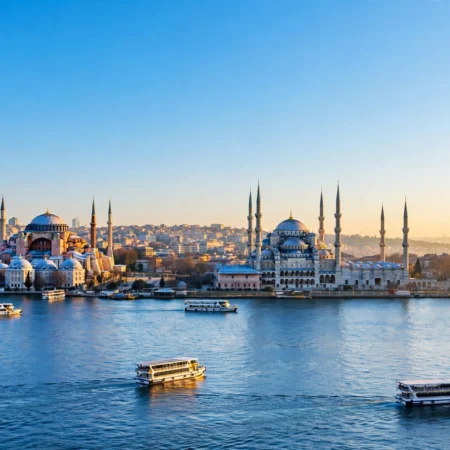
Istanbul is the only city in the world that sits on two continents, and it behaves like two cities stitched together by ferries. The European side holds the historic peninsula of Sultanahmet — the Hagia Sophia, the Blue Mosque, Topkapı Palace, the Grand Bazaar — and the lively modern districts of Beyoğlu and Galata across the Golden Horn. The Asian side, Kadıköy and Üsküdar, is where many locals live and eat, and where the city drops its tourist face. Four days is the right amount of time: two days for Sultanahmet and the historic core, one day for Beyoğlu, Galata and the Bosphorus, and one day for the Asian side and the neighbourhoods most visitors miss.
Start in Sultanahmet, and start early. The Hagia Sophia is the building that defines the city: a sixth-century Byzantine cathedral, later an Ottoman mosque, and now a working mosque again, with a visitor gallery for non-worshippers. Go in the morning, dress modestly, and remember that it closes to visitors during prayer times — plan around them rather than fighting them. Across the square stands the Blue Mosque, still an active mosque with six minarets and the blue İznik tiles that give it its name; it is free to enter outside prayer times, and women should cover their hair. Between them lies the Hippodrome, now a long square with an Egyptian obelisk and a German fountain, and beneath your feet, the Basilica Cistern — a vast underground Byzantine water store with columns rising out of shallow water, one of the most atmospheric sights in the city.
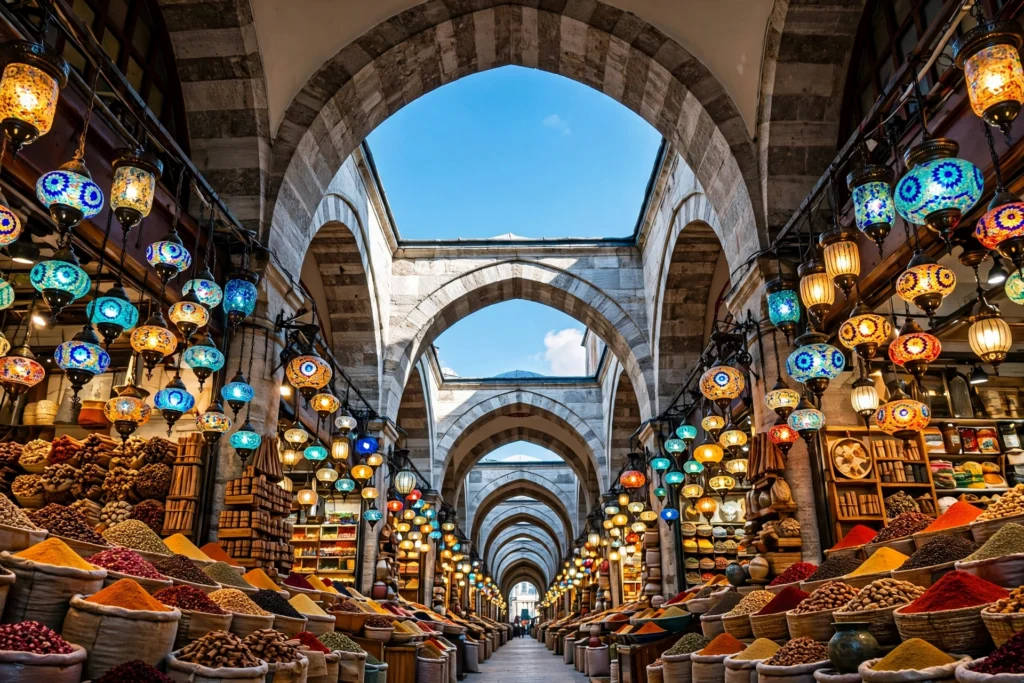
Topkapı Palace needs a half day on its own. This was the home of the Ottoman sultans for four centuries, and it is a complex of courtyards, pavilions, treasuries and the Harem quarters, with views over the Bosphorus and the Golden Horn that explain why the site was chosen. Buy the combined ticket that includes the Harem, and go to the Harem first, before the crowds build. After the palace, walk downhill to the Grand Bazaar, one of the oldest covered markets in the world, with more than sixty streets of shops selling carpets, ceramics, lanterns, gold and spices. The rule for the bazaar is to browse without buying on the first pass, to bargain politely and to walk away if the price does not feel right — the same carpet will be on sale in a dozen shops. For spices and Turkish delight, the smaller Spice Bazaar near the waterfront is calmer and often better value.
Day by day in Istanbul
Day one is Sultanahmet: the Hagia Sophia in the morning, the Blue Mosque and the Hippodrome, the Basilica Cistern, and Topkapı Palace in the afternoon, finishing with dinner in the streets behind the bazaar. Day two is the bazaars and the Golden Horn: the Grand Bazaar in the morning, the Spice Bazaar, a walk across the Galata Bridge with the fishermen, and the Süleymaniye Mosque — the masterpiece of the great architect Sinan, and, for many visitors, a more peaceful experience than the Blue Mosque. Day three is Beyoğlu and the Bosphorus: the Galata Tower for the view, a walk down İstiklal Street, the old tram, lunch in Karaköy, and a Bosphorus ferry in the late afternoon, when the light turns the water gold. The public ferries are better than the tourist cruises — cheaper, and they go where the city actually goes. Day four is the Asian side: the ferry to Kadıköy, the food market streets around the fish market, the Moda waterfront, and Üsküdar at sunset, looking back across the water at the skyline you have spent three days inside.
Where to stay and how to get around
Stay in Sultanahmet if this is your first visit and you want the sights on foot, in Beyoğlu or Galata if you want restaurants and nightlife, or in Kadıköy if you prefer a local neighbourhood and do not mind the ferry. Buy an Istanbulkart — the rechargeable transport card — on arrival at the airport or any metro station; it covers the trams, metro, Marmaray tunnel under the Bosphorus, and the ferries, and it is the single most useful thing you will buy in the city. The tram runs through Sultanahmet and is the easiest way to move around the historic core. Never drive in Istanbul, and do not take a taxi without the meter running or a fare agreed in advance; for short trips, the BiTaksi app works like a local ride-hailing service. For the airport, the metro and the Havaist bus both run from Istanbul Airport, and Sabiha Gökçen on the Asian side is closer to Kadıköy.
Eating in Istanbul
Istanbul is the best food city in the country, and the cheapest good meals are the simplest ones: simit, the sesame-crusted bread ring sold from red carts, with a glass of tea, for breakfast; a bowl of lentil soup and fresh bread at a lokanta, the canteen-style restaurants where locals eat; grilled fish sandwiches at Eminönü by the water; and a proper kebab dinner in Kadıköy. Save one evening for a meyhane — a traditional tavern serving meze and rakı — and one morning for a full Turkish breakfast, the long spread of cheeses, olives, tomatoes, eggs, honey and bread that is a meal in itself. The food section later in this guide covers the regional dishes in full, but Istanbul is where you should eat widest, because every region of Turkey is represented here.
Cappadocia Beyond the Balloon: Valleys, Cave Churches and Underground Cities
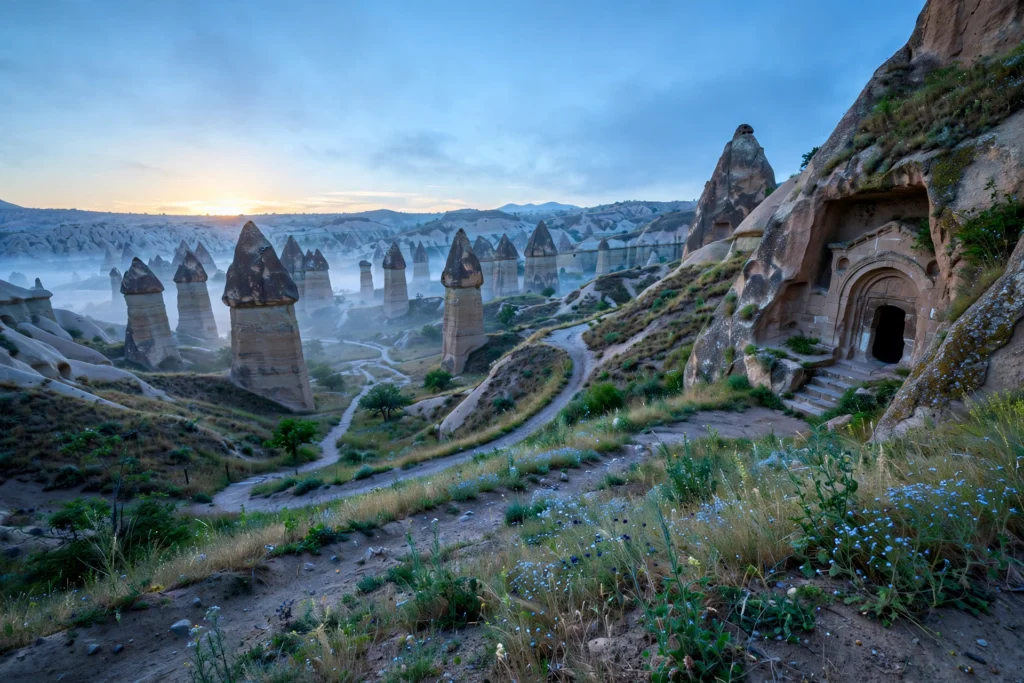
Cappadocia is the place most people picture when they think of Turkey, and the picture is usually a balloon. The balloon is worth it — there is a whole section on it below — but it is the least interesting thing about Cappadocia on the ground. The region is a landscape of soft volcanic rock, called tufa, that wind and water carved into towers, cones and valleys, and that people have been hollowing out for two thousand years: houses, churches, monasteries, stables and whole underground cities, cut into the stone. Stay in Göreme, the small village at the centre of it, sleep in a cave hotel at least once, and spend your days walking, because the valleys are the point and the balloon is only the view from above.
The Göreme Open-Air Museum is the essential first stop: a cluster of rock-cut churches from the tenth to twelfth centuries, painted with frescoes of biblical scenes in reds and ochres that have survived a thousand years in the dark. Go early, before the tour buses, and take your time in the Dark Church, the small chapel whose paintings are the best preserved in the region. From the museum, the valleys spread out in every direction, and they are best explored on foot. The Rose Valley and Red Valley, walked together as a loop in the late afternoon, are the classic hike: pink and red rock, dovecotes cut into the cliffs, small churches hidden in side valleys, and a sunset that turns the whole landscape the colour of the rock. The walk takes about three hours at a leisurely pace, and you need water, sun protection and proper shoes — the paths are dusty and uneven, and there is little shade.
The underground cities are the other half of Cappadocia, and they are stranger than the valleys. Derinkuyu and Kaymaklı are the two that are open to visitors, and both descend eight levels into the earth: stables, kitchens, wine cellars, chapels, schools and ventilation shafts, built as refuges where whole communities could hide for months. Derinkuyu is the deeper and more dramatic; Kaymaklı is wider and, for some visitors, less claustrophobic. Both involve narrow tunnels and low ceilings, so if you are claustrophobic, walk the valleys instead and visit the underground city only as far as you are comfortable. The Ihlara Valley, an hour’s drive south, is a different kind of walk altogether: a deep canyon with a river running through it, rock-cut churches along the banks, and a long, flat trail that is the gentlest hiking in the region.
A day in the valleys
A good Cappadocia day starts before dawn if you are flying, and at a civilised hour if you are not. Morning is for the Göreme Open-Air Museum, then a walk through the valley to Uçhisar, the village under the great rock castle that is the highest point in the region — climb it for the view over the whole landscape. Afternoon is for the underground city or the Ihlara Valley, and the late afternoon is for the Rose and Red Valley walk, finishing at a viewpoint as the sun goes down. Evening is for Göreme itself: the small restaurants along the main street, the pottery shops, and the cave hotel terrace. The second day is for the things you missed: the Zelve Open-Air Museum, a quieter cousin of Göreme’s with cave dwellings you can walk through; Avanos, the pottery town on the Red River, where you can sit at a wheel and try it yourself; and Paşabağ, the valley of the fairy chimneys with their distinctive dark caps, best visited early before the crowds.
Where to stay in Cappadocia
Stay in Göreme for the village atmosphere and the valley walks from your door, in Uçhisar for the views and the quieter boutique cave hotels, or in Ürgüp for a larger town with wineries and more restaurants. Cave hotels are the signature stay: rooms cut into the rock, cool in summer and warm in winter, often with a terrace facing the valleys. They range from simple family-run places to luxurious suites with private pools, and the price difference is mostly about the terrace and the bathroom. Book early for spring and autumn, when the best cave hotels sell out weeks ahead, and check the cancellation policy — a balloon cancellation should not ruin your stay, but a rigid booking can make a weather change expensive. Two nights is the minimum; three is better, because it gives you a spare morning for the balloon and a day to walk without rushing.
The Cappadocia Balloon Flight: What It Costs and How to Book It
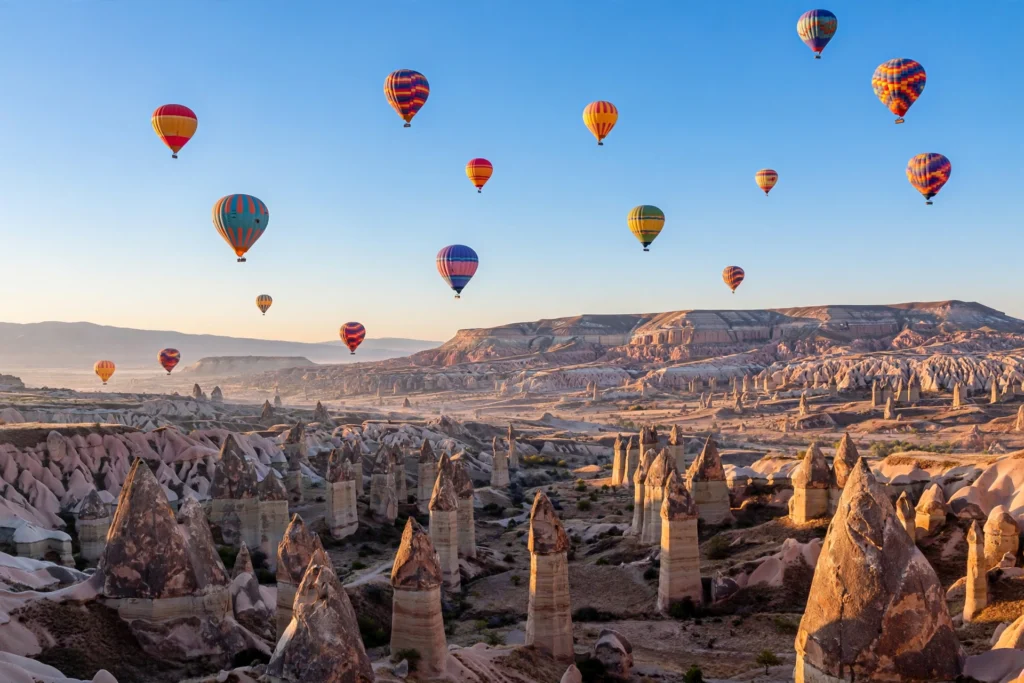
The balloon flight over Cappadocia at dawn is one of the great travel experiences in the world, and it is also one of the most misunderstood. It is not a fixed-price attraction with a ticket office. Prices are dynamic, they vary by season, basket size, flight duration and demand, and there is no official fixed tariff — the same flight can cost very different amounts on different mornings. That is why this section gives ranges rather than a single price, and why it tells you to check the live price for your dates before you book. The ranges below are drawn from live operator pages checked in November 2026, and they are the realistic picture for planning, not a quote.
A standard shared flight — a basket of 20 to 28 passengers, about 60 minutes in the air, with hotel pickup, a light breakfast before launch and a small celebration after landing — typically runs from about €90 to €100 per person in the low winter season, rising to roughly €150 to €200 in the shoulder months and €250 to €400 on the busiest spring and autumn dates. One live operator example from 11 November 2026 listed a standard flight at €90 and a classic flight for 20 passengers at €100, while another operator’s winter schedule listed a standard flight at €160 and a comfort flight at €180. Comfort and deluxe flights, with smaller baskets of 12 to 16 passengers and 60 to 75 minutes in the air, run higher — roughly €110 to €280 depending on season — and private baskets for two to eight passengers are priced per basket, usually from around €800 upwards, sometimes several thousand euros for a premium sunrise slot. If a standard shared flight is quoted well below about €120 in peak season, treat it as a warning sign and check the operator’s licence and safety record before booking.
How to book, and when
Book the flight for your first morning in Cappadocia, not your last. Balloons are grounded by wind and weather — Turkish aviation regulators decide each morning whether flying is allowed — and cancellations are common, especially in winter, when roughly a third of mornings can be grounded in the worst months. Booking for the first morning gives you a second morning to try again, and a reputable operator will offer a full refund or a free reschedule if your flight is cancelled. Book two to six weeks ahead for peak season, because the good operators sell out; in winter you can often book a few days ahead, but the same weather risk applies. Book directly with a licensed operator or through your hotel, and check that the price includes the transfer, the flight, the insurance and the landing celebration — a suspiciously cheap quote often excludes one of those.
The morning itself starts very early, with pickup from your hotel around 4 to 5 a.m. depending on the season, and a short drive to the launch site while it is still dark. You watch the balloons inflate in the pre-dawn light, climb into the basket, and lift off as the sun rises over the valleys. The flight lasts about an hour, drifting over the fairy chimneys, the valleys and Göreme itself, and ends with a landing in a field, a glass of sparkling wine or juice, and a flight certificate. Dress warmly — it is cold before dawn, even in summer — wear closed shoes you can walk in, and bring a camera with a strap. And remember the alternative that costs nothing: the valleys at dawn from the ground are extraordinary, and the rooftop terraces of Göreme fill with people watching the balloons rise. If your flight is cancelled, a sunrise walk in the Rose Valley is a fine consolation, not a wasted morning.
Balloon prices at a glance (checked November 2026)
| Flight type | Basket size | Typical price per person | Flight time |
|---|---|---|---|
| Standard shared | 20–28 passengers | €90–€200; peak €250–€400 | About 60 minutes |
| Comfort | 12–16 passengers | €110–€280 | 60–75 minutes |
| Deluxe | 8–12 passengers | €200–€400 or more | 75–90 minutes |
| Private basket | 2–8 passengers | €800 or more per basket | 60–90 minutes |
Prices are ranges from live operator pages, not a fixed tariff. Always check the live price for your dates and confirm what is included before you pay.
Ephesus and the Aegean Coast: Ruins, Villages and Slow Days
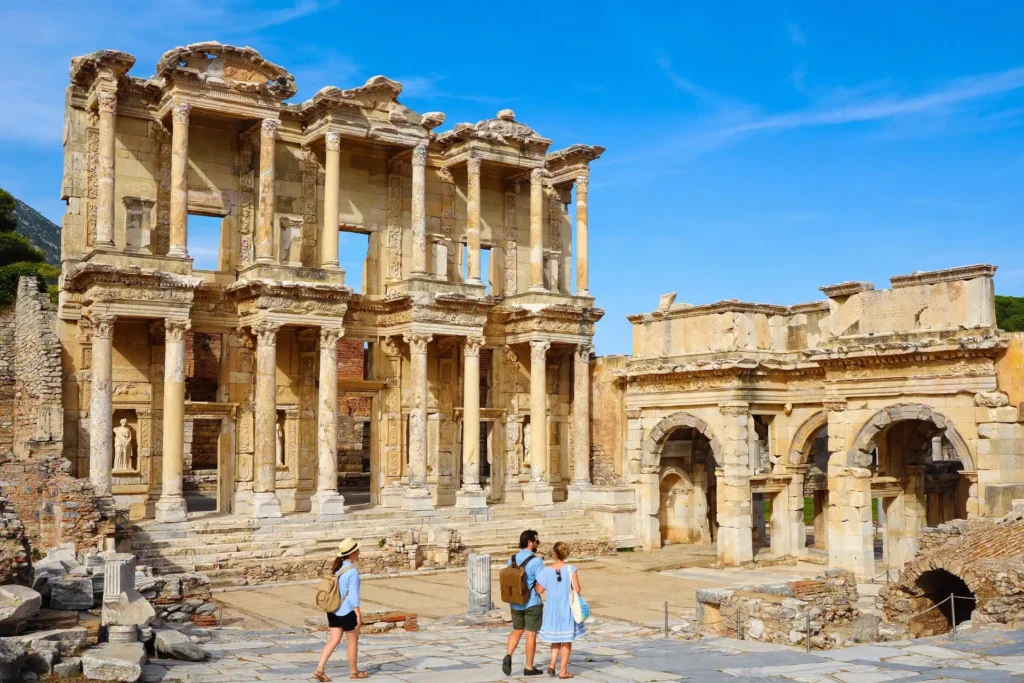
Ephesus is the best-preserved ancient city in Turkey and one of the great archaeological sites of the Mediterranean, and it is the stop on the classic route that most often surprises people — not because it is beautiful, though it is, but because of its scale. This was a city of a quarter of a million people, a port and a capital, and walking its marble streets feels less like visiting a ruin and more like walking through a city that has simply been emptied. The base for Ephesus is Selçuk, a small, friendly town a few kilometres from the site, and the Aegean coast around it — İzmir, the resort towns of Çeşme and Alaçatı, the Bodrum peninsula — is the slower, greener alternative to the Turquoise Coast, with olive groves, fishing villages and a food culture built on olive oil and herbs.
Start Ephesus at the upper gate, early in the morning, and walk downhill through the city. The Curetes Street, the marble-paved main street, leads past the Temple of Hadrian and the Fountain of Trajan to the Library of Celsus, the reconstructed facade that is the most photographed building in Turkey — and for good reason, because its two-storey columns and statues are genuinely monumental. Beyond it lies the Great Theatre, which held 25,000 people and still hosts performances, and the long Arcadian Way that once led to the harbour. The Terrace Houses, a separate ticket inside the site, are worth it: a block of wealthy Roman houses with mosaics, frescoes and underfloor heating, preserved under a modern shelter, and the closest thing to walking into a Roman home. Plan at least three hours for the site, and go early — by midday in summer the marble reflects the heat and the cruise-ship crowds arrive, and the experience is half as good.
Selçuk itself is worth an evening. The town has the remains of the Temple of Artemis — one of the Seven Wonders of the Ancient World, of which a single column now stands in a field — the Basilica of St John on the hill above the town, and the Isa Bey Mosque, a beautiful fourteenth-century building that is still in use. The Saturday market is one of the best in the region, and the small restaurants around the town square serve the Aegean food that defines this coast: olive oil dishes, herbs, grilled fish and the local wines. From Selçuk, the village of Şirince, a twenty-minute drive into the hills, is the classic half-day trip: a former Greek village of stone houses and narrow lanes, known for its fruit wines and its slow pace, and a good place to understand that the Aegean coast is not only about ruins.
The Aegean coast beyond Ephesus
İzmir, an hour north of Selçuk, is Turkey’s third city and its most relaxed big city: a long seafront promenade, the Kemeraltı bazaar, the hilltop castle, and a food scene that locals take seriously. It is a good place to base for a night if you are flying in or out of İzmir airport, and a better place to eat than to sightsee. South of Selçuk, Kuşadası is the cruise port and resort town — convenient, busy, and best used as a transport hub rather than a destination. West of İzmir, the Çeşme peninsula and the village of Alaçatı are the Aegean at its prettiest: whitewashed stone houses, bougainvillea, windsurfing at the beach, and boutique hotels in converted stone houses. Bodrum, further south, is the peninsula of harbours, castle and nightlife, with the Mausoleum — another of the Seven Wonders — and the underwater archaeology museum in the castle. The scale of ancient history here is the reason travellers who love the classical world often pair Turkey with the country across the water, and our Greece travel guide covers the other side of the Aegean in the same style, while the temples and tombs in our Egypt travel guide show what the same ancient world looked like further south.
How long to spend
Give Ephesus a full day, including Selçuk in the evening. If you are doing the Aegean as your coast — rather than the Turquoise Coast — add two days: one for İzmir and the Çeşme peninsula, and one for Bodrum or a slow day in Alaçatı. If you are doing the Turquoise Coast instead, Ephesus is a one-day stop on the way from Cappadocia to the coast, and that is enough. Either way, do not try to do Ephesus and Pamukkale in the same day: they are about 180 kilometres apart, the road takes around three hours, and each deserves a morning of its own.
Pamukkale and Hierapolis: White Terraces Done Right
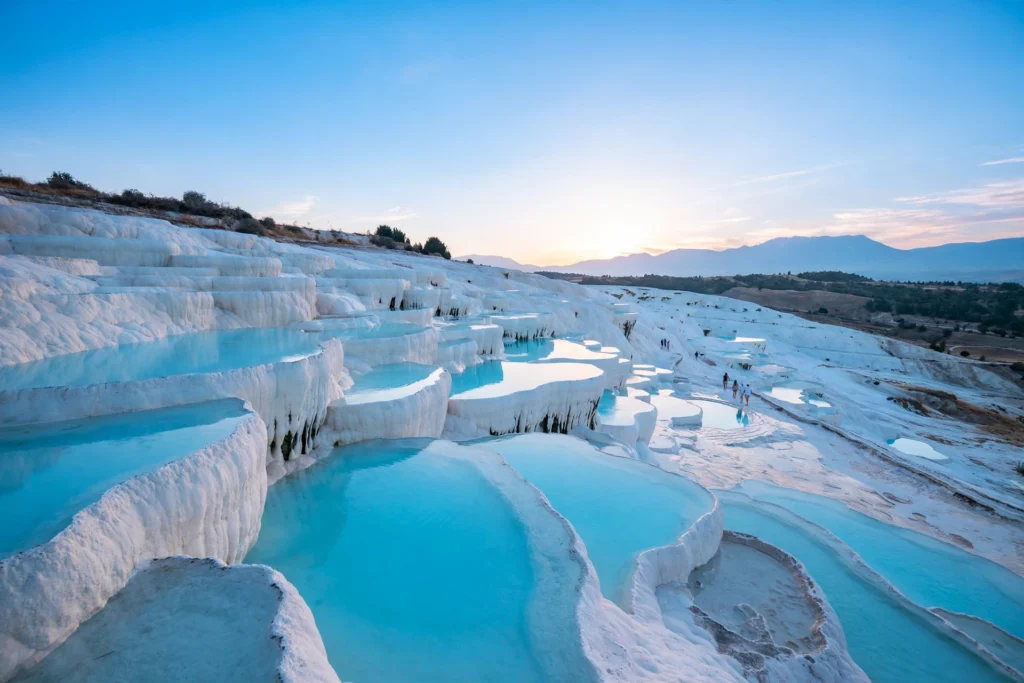
Pamukkale — the name means “cotton castle” — is the white hillside of travertine terraces that looks, in photographs, like snow or frozen waterfalls, and the photographs do not exaggerate. The terraces are formed by mineral-rich thermal water that has flowed down the hillside for thousands of years, depositing white calcium carbonate in pools and ledges. Above them sits Hierapolis, the ancient spa city that grew up around the hot springs, with a theatre, a necropolis and the Antique Pool, where you can swim among fallen Roman columns in warm mineral water. The two together — the natural wonder and the ancient city — make a half-day visit that is unlike anything else on the route, and they are also the stop most often done badly.
The secret to Pamukkale is the time of day. Arrive at the 8 a.m. opening, walk up the terraces from the lower entrance, and you will have the pools almost to yourself for an hour. By midday the site is full of tour coaches, and the experience is queues and crowds. Walk barefoot on the terraces — shoes are not allowed on the travertines, to protect them — and carry your shoes in a bag. The water is warm and shallow, the surface is smooth underfoot, and the best pools are the ones halfway up, away from the entrance. Do not climb on the dry terraces or walk outside the marked paths: the travertines are fragile, and the parts that look white and dry are the parts that have been damaged by visitors. Bring a towel and a change of clothes if you plan to paddle, and bring water and sun protection — there is no shade on the hillside.
Hierapolis, at the top of the hill, is a proper ancient city and deserves two hours of its own. The theatre is one of the best preserved in Turkey, with its stage building and seating restored, and the necropolis — the city of the dead, stretching for a kilometre along the road out of town — is one of the largest in the ancient world. The Antique Pool, the thermal pool among the columns, is a separate ticket and a genuine pleasure on a hot day; the water is warm, the columns are real, and swimming among them is one of those experiences that sounds like a gimmick and turns out to be wonderful. The archaeological museum, in the old Roman baths, is small and worth a quick visit for the statues and sarcophagi found on the site.
Getting there and where to stay
Pamukkale is about 180 kilometres, or three hours by road, from Selçuk and Ephesus, and about 600 kilometres from Göreme — too far to drive from Cappadocia in a day, which is why the classic route goes Cappadocia to Ephesus by flight and bus, then to Pamukkale by road. The nearest town is Denizli, but most visitors stay in the village of Pamukkale itself, at the foot of the terraces, in a small pension or hotel, and walk to the site in the morning. One night is enough. If you arrive the evening before, you can be at the gate at opening time and be finished by midday, leaving the afternoon for the drive to the coast. If you are short on time, Pamukkale can be a morning stop on the way from Ephesus to Fethiye or Antalya, but do not try to add Hierapolis properly to that plan — the theatre and the necropolis need their own time.
Turquoise Coast or Aegean Ruins: Which Coast Should You Pick?
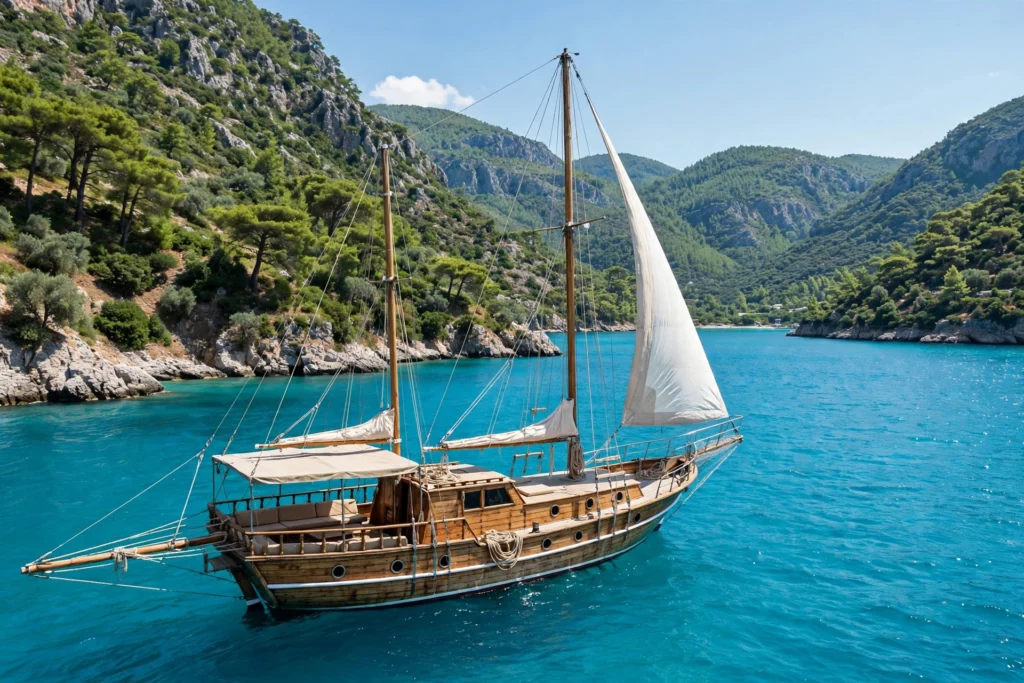
The classic route has room for one coast, and the choice between the Turquoise Coast and the Aegean is the most personal decision in this guide. They are not the same holiday. The Turquoise Coast — the Mediterranean shore from Antalya west through Fethiye, Ölüdeniz and Kaş — is about water: turquoise bays, gulet sailing, paragliding over the Blue Lagoon, the Lycian Way trail, and slow harbour towns. The Aegean — Selçuk, İzmir, Çeşme, Alaçatı and Bodrum — is about ruins, villages, olive groves and food, with beaches as a bonus rather than the point. Both are beautiful, both are worth a trip, and in 7 to 10 days you should pick one and do it properly rather than trying to do both badly.
Pick the Turquoise Coast if you want to swim, sail and slow down. Fethiye is the working harbour town and the best base: a lively market, a harbour full of gulets, and day trips to the Blue Lagoon at Ölüdeniz, where paragliders launch from Mount Babadağ and drift down over the turquoise water. Kaş, two hours further along the coast, is the prettiest town on the route — a small, whitewashed harbour town with Lycian tombs in the hills, diving and kayaking, and a slow pace that makes it the place people wish they had stayed longer. Kalkan, between the two, is the upmarket version: boutique hotels, rooftop restaurants and a harbour that fills with yachts. Antalya, at the eastern end, is the big city of the coast: the old town of Kaleiçi with its Ottoman houses and Roman harbour, the long beaches of Lara and Konyaaltı, and the Roman ruins of Aspendos and Perge nearby. A gulet cruise — a few days sailing between bays on a traditional wooden boat — is the classic Turquoise Coast experience, and a day trip from Fethiye gives you the flavour of it without the commitment.
Pick the Aegean if you want history and food more than beaches. The Aegean coast is greener and cooler than the south, its towns are smaller and its pace is slower, and its food — olive oil, herbs, grilled fish, village breakfasts — is the best in the country. Ephesus is here, and so are the villages, the vineyards and the windsurfing at Alaçatı. The Aegean suits travellers who have already had their beach holiday elsewhere, and travellers who want to walk through ruins in the morning and eat well in the evening. The sea is cooler than on the Turquoise Coast, the beaches are smaller, and the resorts are quieter — which is exactly the point.
The coast choice at a glance
| Turquoise Coast | Aegean Coast | |
|---|---|---|
| Best for | Swimming, sailing, paragliding, slow harbour towns | Ruins, villages, food, olive groves, windsurfing |
| Main bases | Fethiye, Kaş, Kalkan, Antalya | Selçuk, İzmir, Çeşme, Alaçatı, Bodrum |
| Sea | Warmest, turquoise, swimmable May–October | Cooler, smaller beaches, best June–September |
| Signature experience | Gulet cruise, Ölüdeniz paragliding | Ephesus, village breakfasts, Alaçatı streets |
| Pace | Slow, resort and harbour | Slower, more local, more food-focused |
| Best months | May–October | April–June, September–October |
If you have time for both
If your trip is 12 days or longer, you can do both coasts properly: Ephesus and the Aegean for three days, then the drive south along the coast road to Fethiye and Kaş for three more. The drive itself is part of the experience — the D400 coastal highway from Antalya to Fethiye, about 200 kilometres of cliffs, bays and pine forest, is one of the great drives in the Mediterranean. But do not try to squeeze both coasts into a 10-day trip by cutting Istanbul or Cappadocia short. The coasts will still be there for a second trip, and a rushed coast is a wasted coast.
The 5-Day, 7-Day and 10-Day Turkey Itineraries
The itineraries below are built from the same four stops, so you can see exactly what each extra day buys. All of them assume you fly into Istanbul and use domestic flights between regions. All of them assume the balloon flight is booked for the first morning in Cappadocia. And all of them leave the southeast, the Black Sea coast and the far east for a second trip — they are not omissions, they are a deliberate choice to do the classic route well.
The 5-day Turkey itinerary: Istanbul and Cappadocia
Five days is the shortest trip that works, and it works by doing two places properly instead of four badly. Days one to three are Istanbul: Sultanahmet and the historic core, the bazaars and the Golden Horn, and Beyoğlu with the Bosphorus ferry. On the evening of day three, or the morning of day four, fly to Cappadocia. Day four is the valleys and the Göreme Open-Air Museum, with the balloon flight on the morning of day five if the weather allows, and an afternoon flight back to Istanbul for the flight home. This is a city-and-landscape trip, and it is the right choice if your time is short or if you have already done a beach holiday this year. What it does not include is the coast or the ruins, and you should accept that rather than trying to add Ephesus as a day trip — it is too far, and the day would be spent in transit.
| Day | Where | What |
|---|---|---|
| 1 | Istanbul | Sultanahmet: Hagia Sophia, Blue Mosque, Basilica Cistern |
| 2 | Istanbul | Topkapı Palace, Grand Bazaar, Spice Bazaar, Süleymaniye |
| 3 | Istanbul | Galata, İstiklal Street, Bosphorus ferry; fly to Cappadocia in the evening |
| 4 | Cappadocia | Göreme Open-Air Museum, Uçhisar, Rose and Red Valley walk |
| 5 | Cappadocia | Balloon flight at dawn, underground city, fly back to Istanbul |
The 7-day Turkey itinerary: the classic route, tight
Seven days is the classic first trip, and it is the shortest version of the full route. Days one to three are Istanbul, as above. Day four is the flight to Cappadocia, the museum and the valleys. Day five is the balloon flight in the morning and the underground city in the afternoon, then an evening flight to İzmir. Day six is Ephesus and Selçuk, with Pamukkale on the morning of day seven, and an afternoon drive or flight to the coast — or, if you are flying home from İzmir, a final evening in the city. This itinerary works, but it is tight: the coast is a single night, and the trip is better if you treat day seven as a travel day rather than a sightseeing day. If you can add one day, add it to the coast, not to Istanbul.
| Day | Where | What |
|---|---|---|
| 1–3 | Istanbul | As in the 5-day plan |
| 4 | Cappadocia | Flight from Istanbul, Göreme museum, valley walk |
| 5 | Cappadocia | Balloon at dawn, underground city, evening flight to İzmir |
| 6 | Ephesus | Full day at Ephesus and Selçuk |
| 7 | Pamukkale and coast | Terraces at opening, Hierapolis, onward to the coast or İzmir |
The 10-day Turkey itinerary: the classic route, done properly
Ten days is the version of this Turkey travel guide that the guide recommends, because it is the first length where nothing is rushed. Four days in Istanbul, two full days in Cappadocia with a spare morning for the balloon, a day at Ephesus, a morning at Pamukkale, and three days on the Turquoise Coast — one for Fethiye and the Blue Lagoon, one for Kaş, and one slow day for a gulet trip or a beach. The tenth day is the travel day home from Antalya or Dalaman airport, and the trip ends on the coast rather than with a backtrack to Istanbul, which is the single best logistical decision you can make. If you have 12 days, add a day in Istanbul for the Asian side and a day on the coast for the Lycian Way; if you have 14, add the Aegean as well.
| Day | Where | What |
|---|---|---|
| 1–4 | Istanbul | Sultanahmet, bazaars, Beyoğlu and Bosphorus, Asian side |
| 5–6 | Cappadocia | Balloon on the first morning, valleys, underground cities |
| 7 | Ephesus | Flight to İzmir, full day at Ephesus and Selçuk |
| 8 | Pamukkale | Terraces at opening, Hierapolis, drive to Fethiye |
| 9 | Turquoise Coast | Ölüdeniz, Blue Lagoon, paragliding or a gulet day trip |
| 10 | Kaş and home | Morning in Kaş, afternoon flight from Dalaman or Antalya |
Extending the trip: Gallipoli and Troy
If you have an extra day and a particular interest in history, the Gallipoli peninsula and Troy make a good extension from Istanbul, and they are the only extension this guide recommends for a first trip. Gallipoli is the site of the First World War campaign, with cemeteries, memorials and the battlefields along the Dardanelles, and Troy is the layered ancient city of Homeric legend, near Çanakkale. Both are reached from Istanbul by a drive of four to five hours, or by a bus to Çanakkale and a local tour. They are worth a day, but they are not part of the core route, and they should not displace a day in Istanbul or Cappadocia on a first trip.
What to Eat in Turkey: Food by Region
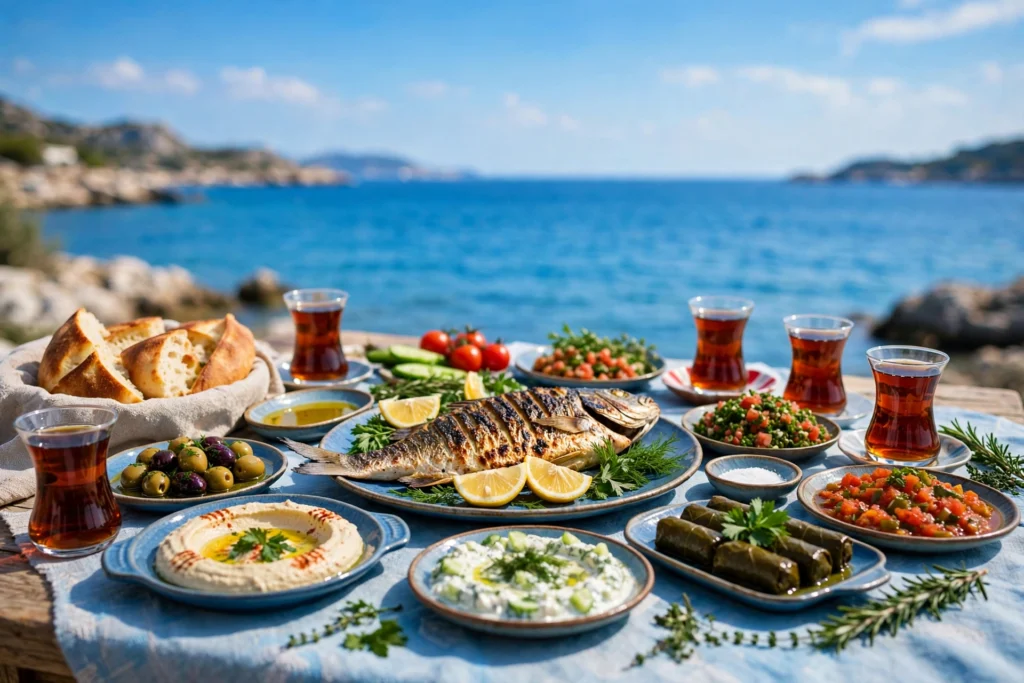
Turkish food is one of the world’s great cuisines, and it is also one of the most regional — the food changes as you travel, and eating your way along the route is part of the trip. The country sits at the meeting point of the Balkans, the Middle East and Central Asia, and its cooking carries all three: the grilled meats and breads of the steppe, the olive oil and vegetables of the Mediterranean, and the spices and sweets of the Ottoman palace kitchens. The rule for eating well in Turkey is simple: eat what the place you are in is known for, eat where locals eat, and do not judge a restaurant by its English menu — the best meals are usually in the places with the shortest menus.
Breakfast is the meal to take seriously. A Turkish breakfast — kahvaltı — is a spread rather than a plate: white cheese and aged kaşar, olives, tomatoes, cucumber, eggs, honey with clotted cream, jams, and bread, with endless glasses of tea. In the southeast it includes liver and spicy dishes; on the Aegean coast it includes herbs and olive oil; in Van, in the east, it is a famous local institution of its own. Eat it slowly, and do not plan anything strenuous for the hour afterwards. Lunch is the lokanta meal: a canteen-style restaurant where you point at the dishes behind glass — lentil soup, beans, stuffed vegetables, grilled meat — and pay very little for a very good meal. Dinner is kebabs, pide and meze, and the drink with it is rakı, the anise spirit served with water and ice, or ayran, the salted yoghurt drink that goes with grilled meat.
Food by region
| Region | What to eat | Where to eat it |
|---|---|---|
| Istanbul | Simit, fish sandwiches, kebabs, meyhane meze | Eminönü, Kadıköy, Beyoğlu |
| Cappadocia | Testi kebab (pottery kebab), apricot dishes, local wine | Göreme, Ürgüp, Avanos |
| Aegean coast | Olive oil dishes, herbs, grilled fish, village breakfast | Selçuk, Alaçatı, İzmir |
| Southeast | Adana kebab, İskender, baklava, pistachios | Gaziantep, Adana, Şanlıurfa |
| Turquoise Coast | Grilled sea bass, meze, gözleme, fresh figs | Fethiye, Kaş, Kalkan |
| Black Sea | Hamsi (anchovies), corn bread, tea | Trabzon, Rize |
| Everywhere | Turkish breakfast, pide, lahmacun, mantı, döner | Lokantas and bakeries |
The dishes to know by name are few and they cover most menus. Adana kebab is the spicy minced lamb kebab from the southeast, served with flatbread and grilled vegetables. İskender kebab, from Bursa, is sliced döner over bread with tomato sauce and yoghurt. Döner itself is the everyday version, sliced from the rotating spit into bread or onto a plate. Pide is the boat-shaped flatbread with cheese, meat or egg — the Turkish answer to pizza, and better than most pizza. Lahmacun is the thin, crisp flatbread with spiced minced meat, rolled up with parsley and lemon. Mantı are tiny dumplings in yoghurt and butter sauce. And the sweets: baklava, the layers of filo and pistachio or walnut in syrup, at its best in Gaziantep; künefe, the hot cheese pastry in syrup, eaten with a fork while it is still warm; and Turkish delight, the lokum sold in every bazaar, which is best bought from a proper confectioner rather than a tourist stall.
Eating well without overpaying
The cheapest good food in Turkey is street food and lokanta food: a simit costs a few lira, a bowl of soup and bread at a lokanta costs less than a coffee back home, and a full lunch at a lokanta is one of the best value meals in Europe. The most expensive food is the food aimed at tourists: the restaurants around Sultanahmet and the Grand Bazaar with picture menus and touts outside charge several times the local price for worse food. Walk two streets away from the sights and the price drops and the quality rises. Drink the tea — çay, served in small tulip glasses, is the national drink and costs almost nothing, and accepting a glass is a social gesture as much as a refreshment. Turkish coffee is thick, strong and served in a small cup; order it with sugar if you want it sweet, because it is not sweetened afterwards. And a word on alcohol: it is legal and widely served in tourist areas and big cities, but it is expensive because of high taxes, and it is not served everywhere — smaller towns and conservative areas may have no alcohol at all, and that is normal, not a problem.
How Much Does a Turkey Trip Cost? Budgets in Lira and Dollars
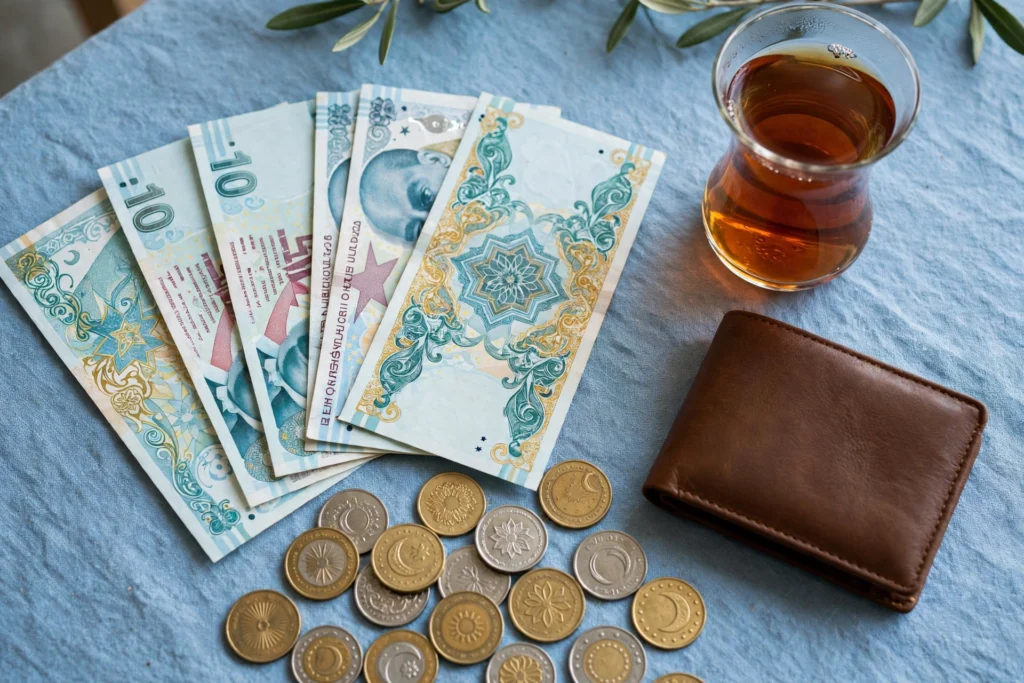
Turkey is one of the best-value destinations in Europe for American travellers, and it is also one of the hardest to price precisely, because the Turkish lira has been volatile and inflation has been high. Prices in tourist areas are increasingly quoted in euros — museum and site entry fees, balloon flights, and some hotels — while everyday prices are in lira and change often. The honest way to present costs is as ranges, checked in November 2026, with the warning that a figure you read today may already be stale by the time you travel. Use the ranges below for planning, and check the live price before you pay for anything expensive.
The currency is the Turkish lira, abbreviated TRY or TL. Cards — Visa and Mastercard — are accepted almost everywhere in cities, including most restaurants, hotels and shops, and contactless payment is common. But cash still matters: markets, small restaurants, rural guesthouses, dolmuş minibuses and tips are often cash only, and some establishments have difficulty with foreign cards, so carry lira as well as cards. ATMs are everywhere in cities and accept US-issued bank cards, though they may charge high fees — use ATMs inside banks during opening hours, decline the machine’s offer to convert the withdrawal into dollars, and withdraw larger amounts less often. The State Department notes that the maximum cash you can carry in or out of the country is 25,000 lira or 10,000 euros or the equivalent, so do not arrive with a large stack of cash.
Daily budgets
A budget traveller — hostels and pensions, lokanta meals and street food, buses and walking — can manage on roughly $45 to $80 a day, and the lower end of that range is realistic outside Istanbul. A mid-range traveller — a comfortable hotel or a cave hotel in the shoulder season, sit-down meals, a domestic flight and a guided activity — should plan on roughly $90 to $160 a day. A comfortable trip with boutique cave hotels, good restaurants and a balloon flight runs higher, and the balloon alone is a significant cost — see the price table in the balloon section. Istanbul is the most expensive city in the country, Cappadocia and the Aegean are noticeably cheaper, and the coast is most expensive in July and August. The single biggest saving on any Turkey trip is the season: a cave hotel in January can cost half what it costs in May, and a coastal hotel in October is a fraction of its August price.
A 10-day trip, costed
| Item | Budget | Mid-range | Notes |
|---|---|---|---|
| International flights (US–Istanbul) | $600–$900 | $800–$1,400 | Return, booked weeks ahead |
| Domestic flights (2 hops) | $80–$160 | $120–$250 | Istanbul–Cappadocia, Cappadocia–İzmir |
| Hotels (9 nights) | $270–$540 | $630–$1,350 | Pensions vs boutique cave hotels |
| Food and drink | $270–$450 | $450–$900 | Lokantas vs sit-down restaurants |
| Transport on the ground | $90–$180 | $150–$300 | Buses, ferries, taxis, car hire |
| Sites and activities | $100–$200 | $200–$400 | Museum entries, hamam, boat trip |
| Balloon flight | $0–$100 | $150–$250 | Winter low vs peak season |
| Total, excluding international flights | $810–$1,630 | $1,700–$3,450 | Per person, 10 days |
These are planning ranges, not quotes. The international flight is the largest single cost and the most variable: fares from the US East Coast to Istanbul are often in the $600 to $900 range when booked a few weeks ahead, and higher from the West Coast and in peak season. Domestic flights are the bargain of the trip — short hops booked early are often cheaper than the bus for the same journey. And the balloon flight is the one cost worth splurging on: it is expensive, and it is also the experience people remember longest. Book it, budget for it, and do not let a cheap quote from an unlicensed operator tempt you into a worse flight.
Money tips that save real money
Pay in lira where you can, and let your bank do the conversion rather than the merchant or the ATM — the machine’s rate is almost always worse. Keep small notes for markets, tips and dolmuş fares, because large notes are hard to change in small shops. Tipping is expected in restaurants — around 10 per cent if service is not included — and small tips for guides, drivers and hotel staff are appreciated. Haggle in the bazaar, but do not haggle in a restaurant or a shop with fixed prices. And keep an emergency reserve of cash separate from your day money, as our travel safety tips guide recommends, so that one lost wallet cannot strand you.
Getting Around Turkey: Flights, Buses, Trains and Driving
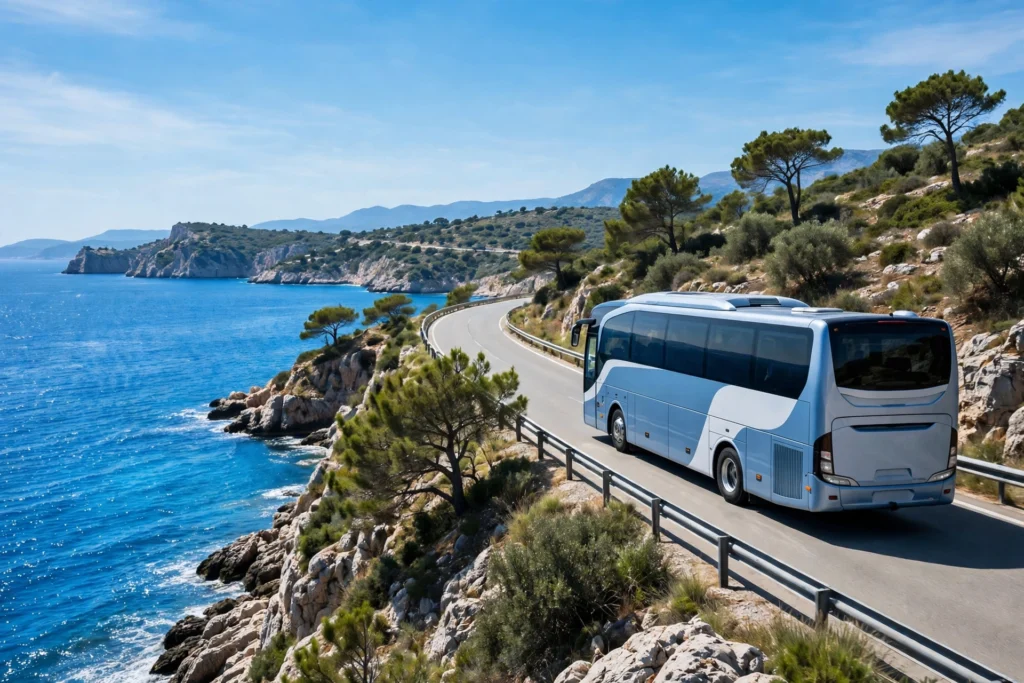
Getting around Turkey is easy once you accept the one rule this guide keeps repeating: fly between regions, and use buses and cars inside a region. The country has good infrastructure — a large domestic flight network, comfortable long-distance buses, a high-speed train line, and ferries that are a pleasure in themselves — and the mistakes come from using the wrong mode for the wrong distance. A bus from Istanbul to Cappadocia is a ten-hour overnight journey; a flight is 75 minutes. A car is the best way to explore the Turquoise Coast; a car in Istanbul is a punishment.
Domestic flights are the backbone of the classic route. Turkish Airlines flies the most routes and includes luggage, Pegasus is the low-cost option with the widest network of cheap fares, and AJet — Turkish Airlines’ low-cost arm — covers many of the same routes. Book a few weeks ahead for the best prices, and fly into the right airport: Nevşehir or Kayseri for Cappadocia (Nevşehir is closer to Göreme, Kayseri has more flights), İzmir Adnan Menderes for Ephesus, and Antalya or Dalaman for the Turquoise Coast (Dalaman is closer to Fethiye, Antalya to Kaş and the east). Remember the State Department’s note that you need your entry stamp in your passport to fly domestically, and keep your passport with you for internal flights.
Long-distance buses are the second backbone, and they are far better than most American travellers expect. Companies such as Kamil Koç and Pamukkale Turizm run modern coaches with reclining seats, onboard service and regular stops, and the network reaches almost every town in the country. An overnight bus saves a hotel night and is a legitimate way to cover a long distance, though it is not a substitute for a flight on the longest routes. Inside a region, the dolmuş — the shared minibus — is the local transport: cheap, frequent, and the way to get from a town to a beach or a ruin without a car. In Istanbul, the ferries are not just transport but the best sightseeing in the city; the public ferry across the Bosphorus costs a fraction of a tourist cruise and goes where the city goes.
Transport at a glance
| Mode | Best for | Notes |
|---|---|---|
| Domestic flight | Between regions | 1–1.5 hours, book weeks ahead, Turkish Airlines, Pegasus, AJet |
| Long-distance bus | Medium distances, overnight | Comfortable coaches, Kamil Koç and Pamukkale Turizm |
| Dolmuş minibus | Local hops | Cheap, frequent, cash only |
| High-speed train (YHT) | Istanbul–Ankara–Konya | Fast and comfortable; slow elsewhere |
| Ferry | Istanbul Bosphorus, Aegean islands | Public ferries beat tourist cruises |
| Rental car | Turquoise Coast, Aegean villages | Best for coasts; never drive in Istanbul |
| Taxi and ride-hailing | City trips | Meter running or price agreed; BiTaksi in Istanbul |
Trains deserve a special note, because they are the mode most visitors misunderstand. Turkey has one genuinely useful high-speed line — the YHT, linking Istanbul, Ankara and Konya in about four hours — and it is fast, comfortable and worth using if your route includes Konya or Ankara. Everywhere else, trains are slow and infrequent, and they are not a practical way to do the classic route. Do not plan a Turkey trip around trains; plan it around flights and buses, and use the high-speed train only where it actually runs.
Driving is the right choice on the coasts and the wrong choice in the cities. A rental car on the Turquoise Coast gives you the freedom to stop at bays, ruins and villages that buses do not reach, and the D400 coastal highway from Antalya to Fethiye is one of the great drives in the Mediterranean. A car in Cappadocia is useful for the Ihlara Valley and the underground cities, though Göreme itself is walkable. But do not drive in Istanbul — the traffic is heavy, the parking is difficult, and the public transport is better. If you do rent a car, inspect it before you drive away, check the tyres, lights and brakes, and make sure your travel insurance covers driving; wear a seatbelt, do not drive at night on rural roads you do not know, and do not drive after drinking. Petrol is expensive by local standards, and toll roads use an electronic system, so ask the rental company how tolls are handled before you set off.
Frequently Asked Questions About Turkey Travel
Do US citizens need a visa for Turkey?
No. Ordinary US passport holders are visa-free for tourism and short business visits of up to 90 days in any 180-day period, and there is no visa fee. Your passport must be valid for at least six months beyond your date of entry and have at least one blank page. The e-Visa system at evisa.gov.tr serves travellers from countries that are not visa-exempt — Americans on an ordinary passport do not need it, and any site asking you to pay for a Turkey visa is selling you something you do not need.
Is Turkey safe for US tourists?
The US State Department rates Türkiye at Level 2, Exercise Increased Caution, issued 11 June 2026, because of terrorism, armed conflict and arbitrary detentions — the same tier as France, Italy, Spain and the United Kingdom. The Level 4, Do Not Travel, warning applies only to the border region within 10 kilometres of Syria and Iraq, far from the classic tourist route. Exercise normal urban caution in Istanbul and the tourist areas, avoid demonstrations, and read the full advisory before you travel and again the week before you fly.
How many days do you need in Turkey?
Five days is the minimum for a good trip — three days in Istanbul and two in Cappadocia. Seven days covers the classic route tightly: Istanbul, Cappadocia, Ephesus and Pamukkale. Ten days is the recommended length, because it adds three unhurried days on the Turquoise Coast and a spare morning for the balloon flight. Fewer than five days, and you should pick one place and do it properly rather than rushing the whole route.
What is the best time to visit Turkey?
April to June and September to October are the best months for the classic route — mild weather, reliable balloon flights, warm seas and fewer crowds. May and September are the two best months overall. July and August are best for the coast but hot for the ruins and Istanbul. Winter is cheapest and quietest, and suits Istanbul and Cappadocia, but many coastal resorts close and balloon cancellations are more common.
How much does a Cappadocia balloon ride cost?
There is no fixed official tariff, and prices vary by season, basket size and demand. Live operator pages checked in November 2026 show standard shared flights from about €90 to €100 per person in winter, roughly €150 to €200 in the shoulder months, and €250 to €400 on the busiest spring and autumn dates. Comfort flights run roughly €110 to €280, and private baskets from around €800. Book for your first morning, not your last, so a weather cancellation leaves you a second chance.
How much does a trip to Turkey cost?
A budget traveller can manage on roughly $45 to $80 a day, a mid-range traveller on roughly $90 to $160 a day, excluding international flights. A 10-day trip excluding international flights runs roughly $810 to $1,630 on a budget and $1,700 to $3,450 mid-range, with the balloon flight, hotels and season making the biggest difference. Prices change quickly with inflation, so treat these as planning ranges and check live prices before you pay.
What is the currency in Turkey?
The Turkish lira (TRY). Cards are widely accepted in cities, but carry cash for markets, small restaurants, rural guesthouses and dolmuş minibuses. Use ATMs inside banks, decline the machine’s currency conversion, and keep a small emergency reserve of cash separate from your day money.
Do I need travel insurance for Turkey?
Yes, for any international trip. Your US health plan usually does not cover you abroad, and a hospital stay or a medical evacuation can cost far more than the trip itself. Buy a policy that covers emergency medical care, evacuation and trip cancellation, and read the exclusions for adventure activities — including the balloon flight — before you buy.
Is it easy to get around Turkey without a car?
Yes, if you fly between regions. Domestic flights connect Istanbul, Cappadocia, İzmir and Antalya in about an hour, long-distance buses are comfortable and reach almost every town, and dolmuş minibuses cover local hops. A rental car is useful on the Turquoise Coast and in Cappadocia, but do not drive in Istanbul — the trams, metro, ferries and Marmaray are better.
What should I wear in Turkey?
Dress as you would for a Mediterranean trip, with modest clothing for mosques: cover shoulders and knees, and women should cover their hair inside a mosque. Carry a scarf for the purpose. Outside religious sites, dress is relaxed in tourist areas and big cities, and more conservative in smaller towns and the southeast. Bring layers — Cappadocia is cold before dawn and the coast is hot by midday — and proper walking shoes for the valleys and ruins.
Can I drink the tap water in Turkey?
In Istanbul and the big cities the tap water is treated, but most travellers drink bottled water, which is cheap and sold everywhere, and use it for brushing their teeth as well. In smaller towns and rural areas, stick to bottled water with an unbroken seal. Avoid ice made from tap water if you are unsure, and check the CDC Travelers’ Health pages for Türkiye before you travel.
Is Turkey a good first trip outside the US?
Yes, and it is one of the best first trips in the world for an American traveller: a single country with a great city, a unique landscape, ancient ruins and a beautiful coast, good infrastructure, friendly people, and prices that are still reasonable. The only things it demands are the ones this guide covers — fly between regions, book the balloon for the first morning, read the advisory, and give yourself enough days.
Conclusion: Turkey Rewards the Traveller Who Slows Down
Turkey is not a country to rush, and the travellers who love it most are rarely the ones who saw the most places. They are the ones who gave Istanbul four days instead of two, who walked a Cappadocia valley at sunset instead of ticking off a viewpoint, who spent a slow afternoon in a harbour town instead of driving to the next one. The distances in this Turkey travel guide are the reason: a country this large punishes hurry and rewards patience, and the classic route works precisely because it does four things well instead of ten things badly.
Plan it the way the guide lays it out. Fly between regions and drive only inside them. Go in April, May, September or October if you can. Book the balloon for the first morning in Cappadocia. Read the advisory, enrol in STEP, buy the insurance, and carry the passport that gets you in visa-free for 90 days. Eat what each region is known for, pay in lira where you can, and keep a spare morning free for the weather. Do those things, and Turkey gives you what few destinations can: a city on two continents, a landscape unlike anywhere else on earth, ruins that make history feel close, and a coast that makes you want to stay. The trip is worth the planning, and the planning is mostly done — now go and book it.
People also read:
- Egypt Travel Guide
- Greece Travel Guide
- Travel Safety Tips
- What Does Travel Insurance Cover?
- Cheapest Time to Travel
- Venice Travel Guide
- What Is a Travel Document Number?

M. Adil is the founder and editor of SoloTravelPro. He writes practical, research-based travel guides that help travellers plan with confidence — from first-time city breaks to national parks and island escapes. Every guide is built on official sources, current prices and honest, usable advice, so readers can plan smarter and travel better.

Other Articles