

Quick Answer

For US citizens, the honest list of places you can visit without a passport is short, and that is the point. You can travel without a passport to the US territories — Puerto Rico, the US Virgin Islands, Guam, the Northern Mariana Islands, and American Samoa — and to the US states, including Hawaii and Alaska. You do not need a passport for those trips, because they are domestic travel, not international travel.
What you do need is valid identification, and for adults flying domestically that means a REAL ID-compliant licence or another accepted form of identification. You may also be asked for proof of citizenship, such as a certified birth certificate, particularly on cruises and on travel to some territories. “Without a passport” does not mean “without documents”, and any article that suggests otherwise is misleading you.
Just as important is what does not count. Canada and Mexico are not passport-free for US citizens travelling by air: flying to either country requires a passport book, and a passport card only covers land and sea crossings. Palau, the Marshall Islands, and Micronesia are visa-free for US citizens, but they still require a passport, so they do not belong on a passport-free list. And a trip that connects through another country can change the rules entirely, even if your final destination is a US territory. Entry rules change, so check the current rule before booking any trip on this list, and check it again before you fly.
What “Without a Passport” Actually Means

The phrase “without a passport” is used loosely online, and that looseness causes most of the confusion. It does not mean you can board a plane with no identification at all. It means your destination does not require a passport for entry, because the destination is part of the United States or a US territory, and the journey is treated as domestic travel. The airline and the airport still need to confirm who you are, and that is where identification comes in.
For domestic flights, adults need a REAL ID-compliant driver’s licence or state ID, or another form of identification accepted by the Transportation Security Administration. REAL ID enforcement began on 7 May 2025, and a standard licence without a REAL ID marking is no longer enough on its own for domestic air travel. The TSA REAL ID page explains what counts as REAL ID-ready and what alternatives are accepted, and it is worth checking directly rather than relying on a summary, because the accepted list can change. Children under 18 travelling domestically generally do not need identification for TSA screening, but airlines can have their own rules, so check with your airline if you are travelling with children.
Proof of citizenship is a separate matter from airport identification, and it catches people out. On a closed-loop cruise, for example, US citizens may travel with a government photo ID plus proof of citizenship, such as a certified birth certificate, instead of a passport. Some territory trips can also involve a request for proof of citizenship, particularly if your route is unusual or if you are travelling with children. A birth certificate is not a substitute for airport ID on a domestic flight, and airport ID is not always a substitute for proof of citizenship on a cruise. Carry both kinds of document when either might be asked for, and keep certified copies, not photocopies, where a certified document is required.
Connections are the other trap. A direct flight from the US mainland to Puerto Rico is domestic travel. A flight to Puerto Rico that connects through another country is not the same journey: the stop in another country can turn part of your trip into international travel, with that country’s entry and transit rules applying. The same logic applies to cruises that stop in foreign ports, even if the cruise starts and ends in the US. Before booking, look at the full route, not just the destination, and ask whether any leg passes through another country. If it does, assume a passport may be needed for that leg and check the current rule before booking.
Finally, remember that this article is a general guide, not legal or entry advice for your specific trip. Entry and identification rules change, airlines apply their own document checks, and individual circumstances — citizenship status, travelling with children, a criminal record, or a one-way ticket — can change what is required. The safest habit is simple: check the current rule before booking, check it again close to departure, and when in doubt, travel with a passport even if you believe you do not need one. A passport is the document that removes almost all of this uncertainty, and for many travellers it is worth having even for a trip that does not strictly require it.
US Territories, One by One

Puerto Rico. Puerto Rico is the easiest passport-free trip for most US citizens, and the most popular for good reason. Direct flights from the mainland are domestic, English and Spanish are both widely used, US dollars are the currency, and phone service works as it does at home. The island offers far more than beaches: Old San Juan’s forts and colourful streets, the El Yunque rainforest, bioluminescent bays, coffee country in the mountains, and a food scene that ranges from roadside kiosks to serious restaurants. Fly direct if you can, so the journey stays domestic, and carry REAL ID for the flight. Puerto Rico suits travellers who want a trip that feels different without the friction of international travel.
US Virgin Islands. The US Virgin Islands — St. Thomas, St. John, and St. Croix — are a second strong option, with a different character on each island. St. Thomas is the busiest, with cruise traffic, shopping, and easy connections. St. John is quieter, with much of the island protected as a national park, and beaches that are regularly described as among the best in the Caribbean. St. Croix is larger and more spread out, with a slower pace, historic towns, and good diving. Direct flights from the mainland are domestic travel, and US dollars are used throughout. Island-hopping between the three is straightforward, but check ferry and flight times in advance, because schedules are thinner than on the mainland and a missed connection can cost you a day.
Guam. Guam is the most distant territory on this list, and it feels the most different. It is a US territory in the western Pacific, with Chamorro culture, a strong military presence, tropical beaches, and a location that makes it a gateway to the wider Pacific — though onward travel from Guam to other Pacific islands is international and does require a passport. Guam itself is domestic travel for US citizens, but the flight time from the mainland is long, and most routes from the eastern US involve a connection, often through Hawaii or another hub. That connection is worth checking carefully: a route that passes through another country changes the document picture. Guam suits travellers who want a long, far-away-feeling trip without leaving US jurisdiction, and who are comfortable with a long journey to get there.
Northern Mariana Islands. The Northern Mariana Islands, including Saipan, Tinian, and Rota, are a quieter Pacific option. Saipan is the main island, with beaches, Second World War history, and a slower, less developed feel than Guam. Tinian and Rota are smaller and quieter still, and suit travellers who want to get away from crowds rather than find nightlife or shopping. As with Guam, the journey is long and connections matter: check the full route, because a connection through another country can change what documents you need. These islands are a good fit for travellers who have already visited the more popular territories and want somewhere less travelled, and for anyone who values quiet beaches and history over resorts.
American Samoa. American Samoa is the least visited territory on this list, and the most distinct. It is a US territory in the South Pacific, with a strong Samoan culture, dramatic volcanic landscapes, and a national park that is one of the least visited in the system. Travel here takes planning: flights are limited, connections are usually through Hawaii, and accommodation is simpler than in the Caribbean territories. It is not a trip to improvise. But for travellers who want a genuinely different Pacific experience without a passport, and who are happy to plan carefully and travel slowly, American Samoa is a remarkable option. Check the route and the current entry requirements before booking, because limited transport makes a document mistake harder to fix at the last minute.
US States That Feel Far Away

You do not need to leave the fifty states to feel far away, and for travellers who want the simplest possible trip, the states are the safest passport-free choice of all. No territory complications, no cruise rules, no connection traps beyond ordinary domestic travel: a REAL ID for the flight, and you are done.
Hawaii is the obvious example. It is a US state, so no passport is needed, yet it feels like a different world: volcanic landscapes, tropical beaches, surf culture, and a food scene shaped by Hawaiian, Japanese, Chinese, Filipino, and Portuguese influences. Each island has a different character, from Oahu’s city and surf to Maui’s road journeys, the Big Island’s volcanoes, and Kauai’s green cliffs. Hawaii is also a useful reminder that distance is not the same as difficulty: the flight is long, but the documents are simple, and that trade-off suits many travellers better than a shorter international trip with more paperwork.
Alaska is the opposite kind of far away: vast, wild, and seasonal. Summer brings long daylight, wildlife, glaciers, and small-ship cruising along the coast. Winter brings darkness, snow, and the northern lights. Alaska rewards travellers who plan around the season, because the same place in January and in July is effectively a different trip. It also rewards travellers who are comfortable with distance: towns are far apart, transport is limited outside the main routes, and weather can change plans. None of that requires a passport, but all of it requires planning.
The Florida Keys and Catalina Island are smaller-scale versions of the same idea. The Florida Keys are a chain of islands reached by road from the mainland, with a laid-back, tropical feel, fishing, diving, and sunsets that draw people back year after year. Catalina Island, off the coast of Southern California, is reached by ferry and feels like a small Mediterranean town, with walking, kayaking, and a car-free main town. Neither requires a flight at all if you travel by road or ferry, which makes them among the simplest passport-free trips available, and good choices for a first trip without a passport or for travellers who prefer not to fly.
Closed-Loop Cruises, Explained Properly
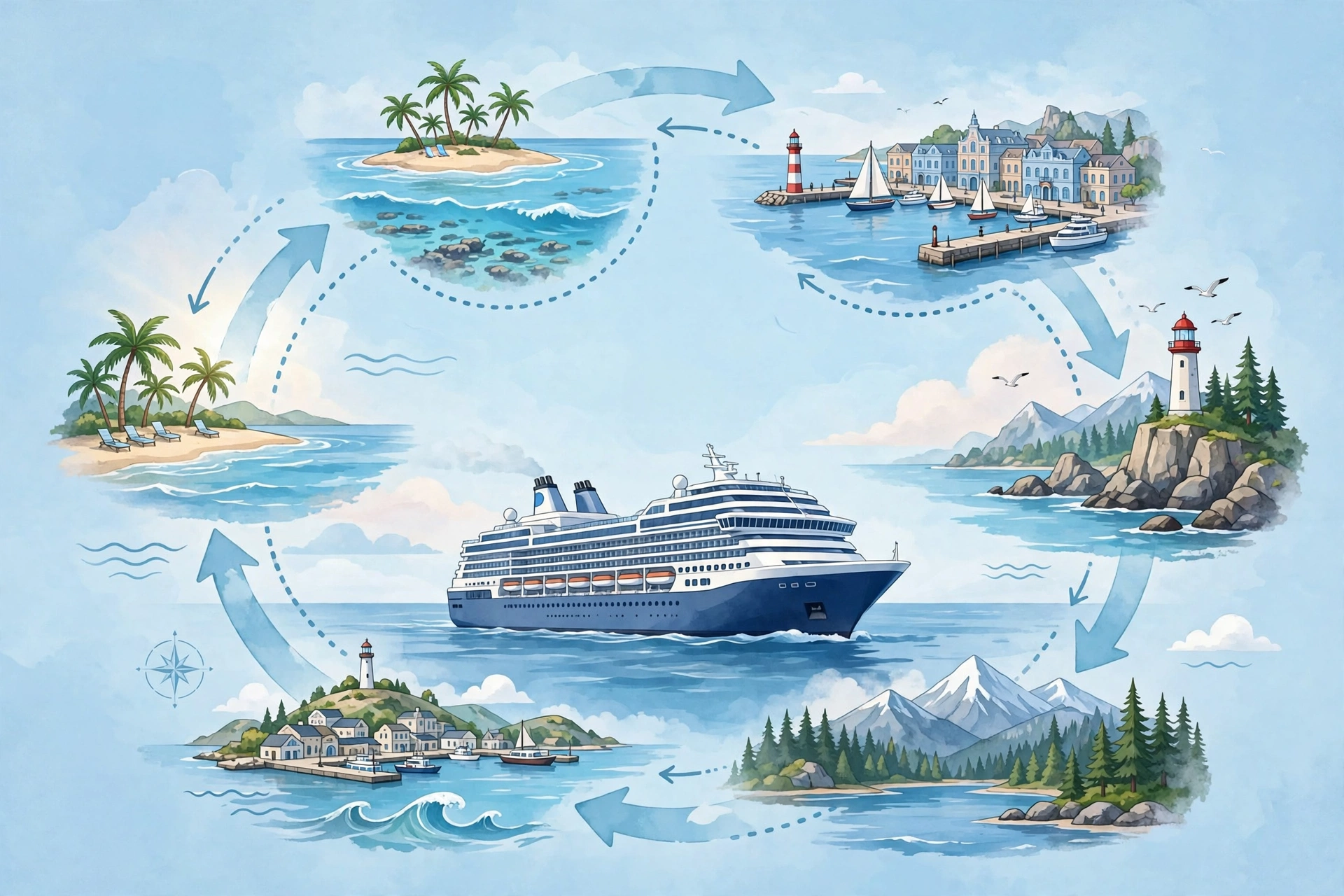
Closed-loop cruises are a separate route to passport-free travel, and they are often explained badly. A closed-loop cruise is one that starts and ends at the same US port and travels within the Western Hemisphere. On such a cruise, US citizens may generally travel with a government-issued photo ID plus proof of citizenship, such as a certified birth certificate, instead of a passport. That is the rule in outline, but the details matter, and they are where travellers get caught out.
First, the cruise must genuinely be closed-loop. A cruise that starts in one US port and ends in a different US port is not closed-loop, and a cruise that starts or ends outside the US is not closed-loop either. Second, the destinations matter: a closed-loop cruise can still visit foreign ports, and some of those ports, or the cruise line itself, may require a passport even if US rules would allow a birth certificate. Third, children travelling with only one parent, or with adults who are not their parents, may need extra documentation, such as a consent letter, regardless of the passport question. Fourth, if something goes wrong — a medical emergency, a missed ship in a foreign port, a need to fly home early — a passport is what lets you fly back to the US quickly. A birth certificate does not do that.
The practical advice is therefore cautious. A closed-loop cruise can be a legitimate passport-free trip, but check three things before booking: that the cruise is genuinely closed-loop, that every port on the itinerary accepts the documents you will carry, and that your cruise line accepts them too. Then ask yourself whether you are comfortable travelling without a passport in case of an emergency. Many experienced cruisers carry a passport even on a closed-loop cruise, precisely because it removes the risk of being stuck in a foreign port. That is not a requirement, but it is a sensible choice, and it is worth considering before you decide that a birth certificate is enough.
What Does NOT Count

This section exists because so many online lists get it wrong, and the mistakes are not harmless. Travelling on the wrong assumption about documents can mean being denied boarding, missing a trip you have paid for, or being stuck at a border. If a list tells you a place is passport-free and this section says otherwise, trust the correction, and check the current rule before booking.
Canada and Mexico by air do not count. This is the most common error. US citizens flying to Canada or Mexico need a passport book. A passport card is a real travel document, but it only covers land and sea crossings to Canada, Mexico, Bermuda, and the Caribbean. It does not cover air travel. If you fly to Toronto, Vancouver, Mexico City, or Cancun, you need a passport book, full stop. Driving across the border or taking a cruise to those countries is a different journey with different rules, and that difference is exactly why flat lists that say “Canada and Mexico, no passport needed” are wrong. Always match the document to the way you are travelling, not just to the destination.
Palau, the Marshall Islands, and Micronesia do not count. These are the Freely Associated States: independent countries in free association with the United States. US citizens can visit them without a visa, and that visa-free status is often confused with passport-free status. They are not the same thing. A visa is permission to enter; a passport is the document that proves who you are and where you are from. Palau, the Marshall Islands, and Micronesia all require a valid passport for entry, even though they do not require a visa. Any list that includes them as passport-free is confusing two different things, and you should not rely on it.
A trip connecting through another country does not count as purely domestic. This applies to flights and cruises alike. If your journey to a US territory passes through another country — a connection in a foreign hub, a cruise stop in a foreign port where you disembark, or a flight that lands in another country before continuing — that leg can be international travel, with its own passport and entry rules. The destination alone does not decide the documents. The whole route does. When you book, look at every stop, not just the final destination, and if any stop is in another country, assume a passport may be needed and check the current rule before booking.
A passport card is not a passport book. This confusion sits behind several of the errors above. A passport card is smaller, cheaper, and valid for land and sea travel to a limited set of nearby countries. It is not valid for international air travel anywhere. If your trip involves a flight to another country, a passport card will not get you on the plane. If you own a passport card but not a passport book, you are not equipped for air travel abroad, and you should not plan an international flight on the strength of the card alone.
Pick by Beach, Culture, Nature, or Budget

With the honest list established, the next question is which place suits you. The territories and states on this list are not interchangeable, and the best choice depends on what kind of trip you want, how far you are willing to travel, and how much you want to spend. The table below is a starting point, not a ranking, and the budget tiers are relative — low means lower cost compared with the other places on this list, not a guaranteed price, because fares, accommodation, and seasonal costs change constantly and no price in this guide should be treated as fixed.
| Place | Best for | Flight time from the US | Budget tier |
|---|---|---|---|
| Puerto Rico | Beaches, food, history, easy first trip | Short to medium (east and central US) | Low to medium |
| US Virgin Islands | Beaches, sailing, island-hopping | Short to medium (east US) | Medium to higher |
| Guam | Pacific culture, far-away feel | Long | Medium to higher |
| Northern Mariana Islands | Quiet beaches, history, getting away | Long | Medium |
| American Samoa | Remote Pacific culture and nature | Long, with connections | Medium |
| Hawaii | Beaches, volcanoes, food, family trips | Medium to long | Medium to higher |
| Alaska | Wilderness, wildlife, glaciers, northern lights | Medium to long | Medium to higher |
| Florida Keys / Catalina | Short, simple, no-flight or short-trip escapes | Short, or no flight | Low to medium |
If beaches are the priority, Puerto Rico, the US Virgin Islands, and Hawaii are the strongest choices, with Guam and Saipan as Pacific alternatives. If culture is the priority, Puerto Rico’s Old San Juan, American Samoa’s Samoan culture, and Guam’s Chamorro heritage stand out, each very different from the others. If nature is the priority, Alaska is in a class of its own for scale and wildlife, Hawaii offers volcanoes and rainforest, and American Samoa offers a national park few travellers ever see. If budget is the priority, Puerto Rico and the Florida Keys tend to be the most accessible, while the Pacific territories cost more mainly because of the journey, not because daily costs are necessarily high.
Once you have a shortlist, turn it into a plan. A day-by-day outline helps you see whether a place really fits: how many days you need, how you will move between sights, and where the costs actually fall. The Travel Itinerary Template gives a simple structure for that kind of plan, and because territory trips have their own cost patterns — longer flights, island transport, and resort or small-hotel pricing — it is worth costing the trip properly before you commit. The How to Prepare a Travel Budget guide walks through setting a total, breaking it into categories, and adding a buffer for surprises, which is especially useful for island trips where a missed connection or a weather change can add unexpected costs. As with all prices in this guide, treat any fare or cost you see elsewhere as a snapshot, not a promise: check current prices when you book, and build in room for them to move.
FAQ
Do US citizens need a passport for Puerto Rico?
No, not for a direct domestic flight. Puerto Rico is a US territory, so a direct flight from the mainland is domestic travel. You still need REAL ID or another accepted form of identification for the flight, and you should check the current rule before booking, especially if your route connects through another country.
Do I need a passport for the US Virgin Islands?
No, not for direct domestic travel to St. Thomas, St. John, or St. Croix. The same identification rules apply as for any domestic flight, and the same connection warning applies: a route through another country can change the requirements.
Can I travel to Canada or Mexico without a passport?
Not by air. Flying to Canada or Mexico requires a passport book. A passport card covers land and sea crossings only, so it does not help for a flight. If you are driving or cruising, the rules are different, but for air travel the answer is clear: you need a passport book.
Are Palau, the Marshall Islands, and Micronesia passport-free?
No. They are visa-free for US citizens, which is often confused with passport-free, but they still require a valid passport for entry. Do not include them on a passport-free list, and do not travel to them without a passport.
What ID do I need for a domestic flight if I do not have a passport?
Adults need a REAL ID-compliant licence or another form of identification accepted by the TSA. The TSA’s REAL ID page lists what counts and what alternatives are accepted. A standard licence without a REAL ID marking is no longer enough on its own for domestic air travel.
Can I take a cruise without a passport?
On a genuinely closed-loop cruise — starting and ending at the same US port, within the Western Hemisphere — US citizens may generally travel with a government photo ID plus proof of citizenship, such as a certified birth certificate. Check that the cruise is closed-loop, that every port accepts those documents, and that your cruise line does too. Carrying a passport is still the safer choice in case of an emergency in a foreign port.
Should I still get a passport even if my trip does not require one?
For many travellers, yes. A passport removes almost all of the uncertainty in this guide: connections, cruise stops, emergencies, and last-minute changes of plan all become simpler. If you travel regularly, or if your trip involves any route you are unsure about, a passport is worth having even for a trip that does not strictly require it.
Conclusion
The honest list of passport-free travel for US citizens is short, and that is good news, not bad. Puerto Rico, the US Virgin Islands, Guam, the Northern Mariana Islands, and American Samoa, plus the US states themselves, give you beaches, culture, wilderness, and far-away feeling without a passport — provided you travel direct, carry REAL ID, and bring proof of citizenship where it may be asked for. What does not belong on the list matters just as much: Canada and Mexico by air need a passport book, Palau, the Marshall Islands, and Micronesia need a passport despite being visa-free, and any connection through another country can change the rules for your whole journey. Pick by what kind of trip you want, cost it properly, and above all, check the current rule before booking, and check it again before you fly. Rules change, routes change, and the cheapest insurance against a ruined trip is a few minutes of checking before you commit.
People also read: Travel Itinerary Template: Plan Any Trip Without the Stress, How to Prepare a Travel Budget That Actually Works (Without Guessing)


Travel Hobby: How to Pick a Hobby That Makes Every Trip Better