

If you’ve started researching a trip to Africa, you’ve probably noticed a problem fast: most guides assume you already know where you’re going. Safari operators sell you Kenya or Tanzania before you’ve decided whether a safari is even what you want. Directory sites hand you a list of 54 countries and walk away. And most “tips” articles start at packing, not planning.
This guide starts one step earlier. It’s built for U.S. travelers taking their first trip to the continent, and it works through the decisions in the order you actually need to make them: where, when, how much, and what to arrange before you fly.
Quick Answer
Africa is a continent of 54 countries, not a single destination, so “travel to Africa” really means picking a region that matches what you want: East and Southern Africa for wildlife safaris (Kenya, Tanzania, Botswana, South Africa), North Africa for history and cities (Morocco, Egypt), or a single-country trip if it’s your first visit and budget or time is limited. A realistic first trip — international flights, 8–10 days, mid-range accommodations — typically runs $3,000–$6,000 per person for a safari-focused itinerary, or $1,800–$3,500 per person for Morocco or Egypt. Most countries require a visa (many available as an easy eVisa), and the CDC recommends specific vaccinations depending on your route — both should be confirmed with official sources before booking.
Key Takeaways
- Treat “Africa” as a region-selection problem first, not a single itinerary — East/Southern Africa (safari), North Africa (history/cities), and West Africa (culture/music, less touristed) are genuinely different trips.
- Safari season and North Africa’s best weather don’t overlap — check the calendar for your specific destination, not “Africa” as a whole.
- Budget in ranges, not fixed numbers, and build in a buffer for park fees, tipping, and visa costs that first-timers routinely forget.
- Visa and vaccination requirements vary by country and by your specific itinerary — verify both directly with the destination’s embassy and the CDC before booking flights.
- A first trip of 8–12 days covering one or two countries is more enjoyable and less exhausting than trying to see “Africa” in one loop.
Is “Travel to Africa” Even the Right Question?

Africa is roughly 3.5 times the land area of the continental United States and home to 54 countries, thousands of languages, and climates ranging from Sahara desert to alpine peaks to tropical coastline. Searching “travel to Africa” is a bit like searching “travel to the Americas” — technically answerable, but the real planning starts once you pick a region.
For a first trip, that usually means choosing between three broad paths:
- East and Southern Africa — the classic safari corridor: Kenya, Tanzania, Botswana, Namibia, South Africa, Zimbabwe/Zambia (Victoria Falls). Wildlife, landscapes, and lodges are the draw.
- North Africa — Morocco and Egypt are the two most-visited countries on the continent, offering cities, souks, deserts, and ancient history with easier logistics for a first trip.
- West Africa — Ghana, Senegal, Nigeria, and others, strong on culture, music, and history (including African diaspora heritage tourism), but with less built-out tourist infrastructure and fewer direct U.S. flight options — usually a better second or third trip than a first.
This guide focuses primarily on the first two paths, since they cover the large majority of first-time American travelers to the continent, with West Africa noted where relevant.
How to Choose Where in Africa to Go First

If You Want Wildlife and Safari
Kenya and Tanzania are the traditional entry points — both offer the Great Migration (seasonally), classic savanna scenery, and well-developed safari infrastructure with lodges ranging from budget tented camps to ultra-luxury. Botswana and Namibia offer a quieter, more exclusive safari experience (smaller camps, higher per-night cost, less crowding) and pair well with Victoria Falls. South Africa is the easiest safari country logistically — Kruger National Park is reachable by self-drive, it has the best general tourism infrastructure on the continent, and it pairs naturally with Cape Town for a wildlife-plus-city trip.
If You Want History and Culture
Egypt (Pyramids of Giza, Luxor, a Nile cruise) and Morocco (Marrakech, Fez, the Sahara, the Atlas Mountains) are the two most first-timer-friendly countries for history and culture, with well-established tourism systems, abundant direct and one-stop flights from the U.S., and costs generally lower than safari-focused trips.
If You Want Beaches and a Slower Pace
Zanzibar (Tanzania), the Seychelles, Cape Verde, and Morocco’s Atlantic coast all offer a beach-forward trip, and Zanzibar in particular pairs naturally as a post-safari add-on.
If You’re Short on Time or Budget
Pick one country, not a multi-country loop. South Africa or Morocco both offer enough variety (city, nature, culture) within a single country to fill 8–10 days without the added cost and complexity of multiple international or regional flights.
When to Go: Matching Season to Destination
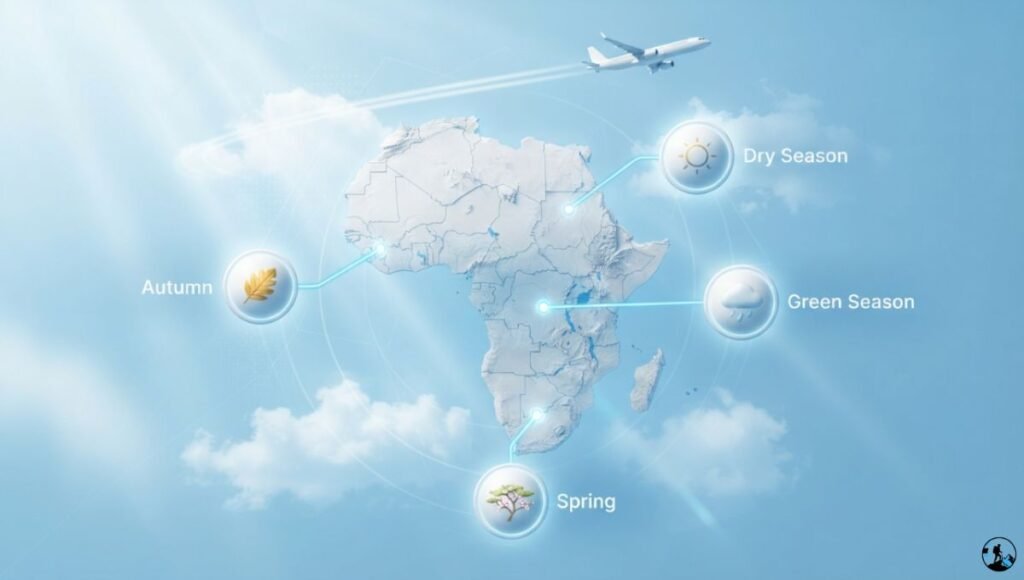
Seasonal advice for “Africa” as a whole is close to meaningless — the continent spans both hemispheres and multiple climate zones. What matters is the season for your specific destination.
East and Southern Africa (Safari Regions)
The dry season (roughly June–October in most of East and Southern Africa) is generally considered the strongest all-around safari window: vegetation thins out, animals cluster around water sources, and wildlife viewing is typically easier. It’s also the most expensive and most crowded period. The Great Migration’s river crossings in the Serengeti/Maasai Mara are most associated with roughly July–September, though exact timing shifts year to year with rainfall. Shoulder months just before or after the dry season can offer a meaningful cost saving with only a modest trade-off in viewing conditions — worth weighing if budget is a bigger constraint than guaranteeing peak wildlife density.
North Africa (Morocco, Egypt)
Spring (March–May) and fall (September–November) are generally the most comfortable windows for both Morocco and Egypt, avoiding both summer heat that regularly exceeds 100°F in desert regions and (in Egypt’s case) the busiest winter high season around the holidays.
Because exact seasonal windows shift, always confirm current-year conditions and any travel advisories for your specific destination before finalizing dates — the U.S. State Department’s country-specific travel advisories (travel.state.gov) are the most current primary source.
How Much Does a Trip to Africa Cost?

Published “Africa trip cost” figures online are frequently either misleadingly low (excluding flights and park fees) or inflated by ultra-luxury safari pricing. The ranges below are general estimates for a mid-range first trip and will vary by season, country, and travel style — treat them as planning ranges, not quotes.
| Expense Category | Safari Trip (Kenya/Tanzania, 8–10 days) | Morocco or Egypt (8–10 days) |
|---|---|---|
| International flights (round-trip, U.S.) | $1,000–$2,000 | $700–$1,400 |
| Accommodation | $150–$400/night (safari lodges often include meals/drives) | $60–$150/night |
| Food (not included in lodges) | $30–$60/day | $25–$50/day |
| Local transport / internal flights | $200–$600 | $100–$300 |
| Park fees / entry fees | $60–$120/day where applicable | $10–$40 per site |
| Visa costs | $0–$100+ depending on country | $0–$25 |
| Travel insurance | $50–$150 for the trip | $50–$150 for the trip |
| Rough per-person total | $3,000–$6,000+ | $1,800–$3,500 |
A simple formula to build your own estimate:
Total Trip Budget = Flights + (Accommodation × nights) + (Food × days) + Local Transport + Park/Entry Fees + Visa Costs + Insurance + Emergency Buffer
Daily Budget (for costs beyond flights/lodging) = Total Variable Expenses ÷ Number of Travel Days
Example: A traveler budgeting for 9 days in Kenya estimates $1,400 in flights, $1,800 in lodging (9 nights at ~$200), $360 in food, $300 in local transport, $600 in park fees, $50 in visa costs, and $100 in insurance — a subtotal of $4,610. Adding a 10% emergency buffer (~$460) brings the planning total to roughly $5,070. This is an illustrative example, not a guaranteed price — your actual costs will depend on the specific lodges, operator, and season you choose.
If your priority is saving money → travel in shoulder season, choose group/scheduled safari departures over private ones, and pick one country instead of a multi-country loop to cut internal flights.
If your priority is guaranteed wildlife density → book peak dry season and accept the higher lodge and flight pricing that comes with it.
If your priority is culture and history over wildlife → Morocco or Egypt will stretch a smaller budget considerably further than a safari itinerary.
What Things Actually Cost Day-to-Day, Once You’re There

Trip-cost tables answer “what will this cost to book,” but they don’t tell you what to expect once you’re spending money on the ground — and underestimating everyday prices is a common source of first-timer sticker shock (in both directions). These are illustrative, approximate ranges for common tourist-area purchases, not fixed prices — local prices vary by city, season, and whether you’re in a tourist zone or not.
| Item | Approximate Range (USD) |
|---|---|
| Local beer at a bar (Tanzania/Kenya) | $2–$4 |
| Dinner for two at a mid-range restaurant (South Africa) | $25–$45 |
| Bottled water, tourist area | $1–$2 |
| Short taxi/rideshare ride in a capital city | $3–$8 |
| Cup of coffee or tea | $1.50–$3 |
| SIM card with data (1–2 weeks) | $10–$20 |
| Tip for a safari guide/driver | $10–$20 per day, per traveler (common practice, not fixed) |
Why this matters more than it seems: these small daily costs compound. A traveler who budgets $30/day for food and incidentals based on guidebook averages but is actually averaging $50/day in a pricier city (Cape Town and Marrakech’s tourist districts run noticeably higher than rural areas) can blow through a multi-week budget faster than the big-ticket items (flights, lodging) ever would.
Africa: What Surprises Most First-Timers

A few realities that don’t match the two most common mental images of Africa (either “one uniform destination” or “one uniform danger zone”):
- It’s not one country or one experience. Africa spans 54 countries and, by some estimates, over 2,000 languages — Morocco and Madagascar have roughly as much in common as Norway and Nepal.
- Infrastructure varies enormously, and often for the better than expected. Mobile data and 4G coverage is genuinely strong in most cities and even many rural safari areas — this isn’t the “no connectivity” trip some first-timers picture.
- A “safari” isn’t the only version of an Africa trip. Overlanding, city breaks, beach trips, cultural/heritage tourism, and volunteering trips are all common — safari dominates marketing because it’s the highest-margin product for tour operators, not because it’s the only way to experience the continent.
- Some of the most-marketed experiences carry real ethical trade-offs. Practices like canned lion hunting exist in parts of the safari industry and are worth researching before booking with any specific operator — this is a genuine “know before you go” issue, not just a nice-to-have.
Entry Requirements: Visas, Vaccinations, and Health
Requirements vary by country and change over time, so this section is a starting checklist — not a substitute for checking the current rules for your specific itinerary.
- Visas: Many popular destinations (Kenya, Tanzania, Egypt) offer an eVisa system that can be completed online before departure; others require an application through an embassy or consulate. Confirm requirements directly on the destination country’s official immigration or embassy website, since fees and application windows change.
- Yellow fever vaccination: Some countries require proof of yellow fever vaccination if you’re arriving from — or have recently visited — a country where yellow fever is present, even if it’s not required for U.S. departures directly. Check both your destination’s requirements and any countries you’re transiting through.
- Malaria prevention: Malaria risk varies significantly by region and even by altitude within a country — for example, it’s a lower concern in high-altitude cities like Nairobi than in coastal or lower-elevation areas. Consult a travel medicine provider or the CDC’s destination-specific pages (cdc.gov/travel) for a personalized recommendation rather than a blanket rule.
- Routine vaccinations and travel health consult: The CDC generally recommends being up to date on routine vaccinations and consulting a travel medicine clinic 4–6 weeks before departure for destination-specific guidance.
- Travel insurance: Not always legally required, but strongly advisable given the cost of medical evacuation from remote safari areas — confirm your policy specifically covers medical evacuation, not just trip cancellation.
Getting There: Flights and Routing

Very few U.S. cities have direct flights to sub-Saharan Africa. Most itineraries route through a major connecting hub — common options include Amsterdam, Paris, London, Doha, Dubai, or Addis Ababa, depending on your departure city and destination. Ethiopian Airlines, Qatar Airways, Emirates, and Turkish Airlines are frequently used for their strong onward connections into multiple African cities. Booking 3–6 months ahead generally offers more fare and seat-selection flexibility for these longer routings, especially for peak safari season (June–October) or Egypt’s winter high season.
Common Mistakes First-Time Africa Travelers Make

- Treating “Africa” as one itinerary and trying to combine a safari with Morocco or Egypt in a single short trip — the flight time and cost between regions is substantial; these generally work better as separate trips.
- Booking based on flight price alone, without factoring in park fees, which can add $60–$120+ per person per day in safari destinations.
- Skipping the travel medicine consultation, then scrambling for malaria prophylaxis or vaccination records days before departure.
- Underestimating internal transport time and cost — many safari circuits involve small-plane transfers between parks that aren’t included in headline package prices.
- Packing based on generic “hot country” assumptions rather than checking actual conditions — desert nights in Morocco’s Sahara and high-altitude mornings on safari can both be genuinely cold.
- Not confirming visa and yellow-fever requirements early enough, since some processes take longer than a standard tourist e-visa turnaround.
Hidden Costs to Budget For

- Park and conservation fees (often charged per person, per day, separate from lodging)
- Tipping for guides, drivers, and lodge staff (a meaningful line item on safari — often $10–$20/day per traveler, by common practice)
- Visa and entry fees
- Airport transfers, especially between small regional airports
- Travel insurance with medical evacuation coverage
- SIM card or eSIM for data
- Optional activities (hot air balloon safaris, cultural village visits, additional excursions)
Safety: What the Data Actually Says

Africa’s most-visited tourist destinations and regions are not uniformly dangerous, and blanket statements in either direction (“perfectly safe everywhere” or “too dangerous to visit”) are both misleading. The most useful approach is destination-specific: check the U.S. State Department’s country-specific travel advisories (travel.state.gov) for your exact itinerary before booking, since advisory levels vary significantly even within a single country (a safari lodge and a border region can carry very different risk profiles). Standard safety practices — using reputable, pre-arranged transport, avoiding solo travel after dark in unfamiliar areas, keeping valuables low-key, and registering your trip with the State Department’s STEP program — apply in most tourist destinations, much as they would in any unfamiliar country.
A Sample 10-Day First-Timer Itinerary (East Africa)

| Day | Focus |
|---|---|
| 1–2 | Arrive Nairobi, Kenya; rest, orient, short city time |
| 3–5 | Fly to the Maasai Mara; game drives, camp/lodge stay |
| 6 | Transfer to Lake Nakuru or Amboseli (Kilimanjaro views) |
| 7–8 | Fly to Zanzibar for a beach add-on |
| 9 | Stone Town cultural tour, relax |
| 10 | Depart |
This is a sample framework, not a fixed template — swap in Tanzania’s Serengeti/Ngorongoro instead of Kenya’s Mara, or drop the beach add-on for a shorter, less expensive trip.
Tools and Resources
- A simple trip budget worksheet (flights, lodging, food, park fees, visa, insurance, buffer) using the formula above
- A pre-departure checklist: passport validity (6+ months recommended by most countries), visa confirmation, vaccination records, travel insurance policy number, copies of documents stored separately from originals
- Official sources to bookmark before booking: cdc.gov/travel, travel.state.gov, and the destination country’s official tourism board or embassy site
FAQs
How much does it cost to travel to Africa from the US?
A mid-range first trip typically runs $1,800–$3,500 per person for Morocco or Egypt, or $3,000–$6,000+ per person for an East or Southern Africa safari, including flights, lodging, food, and park fees. Costs vary significantly by season and travel style.
Is Africa safe for American tourists?
Popular tourist destinations across Africa see millions of international visitors safely each year, but safety varies significantly by country and even by region within a country. Check the U.S. State Department’s country-specific travel advisory for your exact itinerary before booking.
Do I need a visa to travel to Africa?
Most African countries require a visa for U.S. citizens, though many (including Kenya, Tanzania, and Egypt) offer a straightforward eVisa process. Requirements vary by country — confirm directly with the destination’s embassy or official immigration website.
What is the best time of year to visit Africa?
It depends entirely on the destination. For East and Southern Africa safaris, the dry season (roughly June–October) is generally strongest for wildlife viewing. For Morocco and Egypt, spring and fall offer the most comfortable temperatures.
Do I need vaccinations to travel to Africa?
Requirements and recommendations vary by country and itinerary. Some countries require proof of yellow fever vaccination under certain conditions, and the CDC may recommend additional vaccinations or malaria prevention depending on where you’re going. Consult a travel medicine provider or cdc.gov/travel for destination-specific guidance.
How many days do I need for a first trip to Africa?
8–12 days is a comfortable range for a first trip focused on one or two countries. Trying to cover multiple regions (e.g., a safari plus Morocco) in one trip usually isn’t practical given flight times and costs between regions.
Is Africa one country or many countries?
Africa is a continent of 54 countries with widely varying languages, cultures, climates, and travel infrastructure — not a single destination or experience.
What’s the difference between East Africa and Southern Africa safaris?
East Africa (Kenya, Tanzania) is closely associated with the Great Migration and classic savanna scenery. Southern Africa (Botswana, Namibia, South Africa) tends to offer more exclusive, lower-density camps, added scenery variety (Okavango Delta, Namib Desert), and easier self-drive options in South Africa specifically.
Should I book a guided safari or plan independently?
For a first safari, a guided tour or lodge-based safari with a professional operator is generally easier and often safer than independent self-driving, particularly in parks with limited infrastructure. South Africa’s Kruger area is the exception, where self-drive is well-established and common.
Is a safari the only way to experience Africa?
No. Safari is the most heavily marketed version of an Africa trip, but city breaks (Cape Town, Marrakech, Cairo), overlanding trips, beach travel, and cultural/heritage tourism are all common and don’t require safari-level budgets.
Are there ethical concerns to be aware of when booking a safari?
Yes, in parts of the industry — practices like canned lion hunting exist in some markets, particularly South Africa. It’s worth researching a specific operator’s wildlife and conservation practices before booking rather than assuming all safari products are equivalent.
What should I pack for a first trip to Africa?
Pack for both heat and cold — safari mornings and desert nights can be genuinely cold even in warm-climate countries. Neutral-colored clothing (avoiding white, which shows dust quickly, and bright colors/camouflage patterns, which are restricted in some countries), a headlamp, sun protection, and any prescribed malaria medication are commonly recommended.
People also read : Travel Trailer Repair: What Breaks, What It Costs, and When to DIY


Travel Trailer Repair: What Breaks, What It Costs, and When to DIY