
You can get through Italy in English. Hotels, major museums and most restaurants in big cities will manage. But a handful of Italian phrases for travel changes how the trip feels: staff warm up, directions get easier to follow, and you stop guessing what’s happening at the bar, the ticket machine or the end of dinner.
This guide is for first-time and returning visitors from the US. It’s organized by situation, not alphabet. It tells you which phrases matter most, how to say them, what people are likely to answer, and the small etiquette rules attached to them.
Quick Answer
The most useful Italian phrases for travel are buongiorno (good morning), per favore (please), grazie (thank you), mi scusi (excuse me), parla inglese? (do you speak English?), vorrei… (I would like…), quanto costa? (how much is it?), dov’è…? (where is…?) and il conto, per favore (the check, please). Greet people first, add per favore, and you’ll cover most tourist interactions.
Key Takeaways
- Learn the 12 phrases in the first table before anything else. They carry most of a trip.
- Greet first. Say buongiorno or buonasera when you enter a shop, café or small restaurant. It’s the single most useful habit.
- Ciao is informal. With staff and strangers, buongiorno/buonasera and mi scusi are safer.
- Learn to understand a few replies too (“Mi dica,” “Tutto dritto”). Asking is easy; hearing the answer is the hard part.
- Italian is pronounced the way it’s spelled. Five rules cover most of it.
- Download offline translation before you fly, and keep it as a backup, not a replacement.
How this list was built: it was compared against the pages currently ranking for this search, checked for the spelling and grammar slips that appear on some of them, and organized by what a visitor actually does. Pronunciation respellings are written for American English speakers. Regional speech varies across Italy, so treat this as a traveler’s working vocabulary, not a language course. [REVIEWED BY: add the reviewer’s name and credentials here once an Italian speaker has checked the phrases. Delete this line if no review has happened.]
The 12 Italian phrases to learn first
If you only have an evening, learn these. The pronunciation guide uses capital letters for the stressed syllable.
| # | Italian | Say it like | Meaning and when to use it |
|---|---|---|---|
| 1 | Buongiorno | bwohn-JOR-noh | Good morning / hello. Used from morning into the early afternoon. |
| 2 | Buonasera | bwoh-nah-SEH-rah | Good evening / good afternoon. Used from the afternoon on. |
| 3 | Per favore | pehr fah-VOH-reh | Please. Add it to every request. |
| 4 | Grazie | GRAHT-see-eh | Thank you. Grazie mille = thanks a lot. |
| 5 | Prego | PREH-goh | You’re welcome. Also “go ahead” or “how can I help?” |
| 6 | Mi scusi | mee SKOO-zee | Excuse me, to get attention or apologize (polite form). |
| 7 | Permesso | pehr-MEHS-soh | Excuse me, to squeeze past someone on a bus or in a crowd. |
| 8 | Non capisco | nohn kah-PEE-skoh | I don’t understand. |
| 9 | Parla inglese? | PAR-lah een-GLEH-zeh | Do you speak English? (polite form) |
| 10 | Vorrei… | vohr-RAY | I would like… The polite way to order or ask for anything. |
| 11 | Quanto costa? | KWAHN-toh KOH-stah | How much does it cost? |
| 12 | Dov’è…? | doh-VEH | Where is…? Add a noun: Dov’è il bagno? (the bathroom). |
Why this set? It covers the four things a visitor does constantly: greet, be polite, ask for something, and find something. Each phrase also works as a template. Vorrei un caffè (I’d like a coffee) becomes Vorrei un biglietto (a ticket) or Vorrei due gelati (two gelati) with one word swapped.
Decision rule: if you can say all 12 comfortably, stop adding phrases and start practicing listening (see “What you’ll hear back” below). That is where most learners are weakest.
Pronunciation in five minutes
Italian spelling is far more consistent than English. These rules handle most words you’ll meet.
| Rule | Example | Sounds like |
|---|---|---|
| Vowels are short and pure: a = ah, e = eh, i = ee, o = oh, u = oo | casa, bene | KAH-zah, BEH-neh |
| c before e or i = “ch”; ch = “k” | ciao, chiesa | chow, KYEH-zah |
| g before e or i = “j”; gh = hard “g” | gelato, spaghetti | jeh-LAH-toh, spah-GHEHT-tee |
| sc before e or i = “sh” | scena | SHEH-nah |
| gn = “ny”; gli = “ly” (like million) | gnocchi, biglietto | NYOHK-kee, beel-LYEHT-toh |
| Double consonants are held longer | penne vs pene; caro vs carro | Hold the “nn” or “rr” for a beat |
That last rule is the one most English speakers skip. It matters: ordering penne with a single n gets you a different word (and a laugh). Accents on final vowels mark stress: caffè is kahf-FEH, città is cheet-TAH.
Greetings and manners: what Italians expect
Buongiorno, buonasera, buonanotte: when to switch
| Phrase | Typical use |
|---|---|
| Buongiorno | Morning through lunchtime, often into the early afternoon |
| Buonasera | From the afternoon on; the changeover is loose and varies by person |
| Buonanotte | Said when someone is heading to bed or you’re parting late at night, not as an everyday evening hello |
The changeover between buongiorno and buonasera isn’t a fixed hour. If you’re unsure, echo whatever the person greets you with.
Buon pomeriggio (bwohn poh-meh-REE-joh) also exists for “good afternoon,” and some people use it in the early-to-mid afternoon. For a visitor, buongiorno before lunch and buonasera after is the simplest rule, and matching the person greeting you is the safest.
The etiquette rule that matters most: greet when you walk into a shop, bar, small restaurant or hotel lobby, and say arrivederci or buona giornata (have a good day) when you leave. Walking in silently reads as brusque. A plain buongiorno with a smile does more than any other phrase in this guide.
Ciao, salve and the Lei/tu question
Italian has a formal “you” (Lei) and an informal one (tu). Use the formal form with strangers, staff and older people; use the informal with friends and children.
| Situation | Formal (default for tourists) | Informal |
|---|---|---|
| Hello | Buongiorno / Buonasera | Ciao |
| Goodbye | Arrivederci | Ciao |
| How are you? | Come sta? (KOH-meh stah) | Come stai? (KOH-meh stai) |
| Excuse me | Mi scusi | Scusa |
| Do you speak English? | Parla inglese? | Parli inglese? |
Salve (SAHL-veh) is a neutral “hello” that works when you’re unsure how formal to be. Ciao is fine when someone your age uses it first, or with a young bartender, but it’s not the safe default with a hotel receptionist.
If you’re an Italian-American heritage traveler: family phrases may be dialect, not standard Italian. Neapolitan, Sicilian and other regional varieties differ noticeably from textbook Italian. Standard Italian is what you’ll hear on signs, trains and from most service staff, so it’s the right starting point; dialect phrases are a charming extra once you know a person well.
Introducing yourself

| Say this | Say it like | Meaning |
|---|---|---|
| Mi chiamo… | mee KYAH-moh | My name is… |
| Piacere | pyah-CHEH-reh | Nice to meet you |
| Come si chiama? | KOH-meh see KYAH-mah | What’s your name? (formal) |
| Sono americano / americana | SOH-noh ah-meh-ree-KAH-noh / -nah | I’m American (male / female) |
| Sono di… | SOH-noh dee | I’m from… (add your city) |
| Sto imparando l’italiano | stoh eem-pah-RAHN-doh lee-tah-LYAH-noh | I’m learning Italian |
| Come si dice… in italiano? | KOH-meh see DEE-cheh | How do you say… in Italian? |
Italian phrases for cafés and bars
Bars in Italy are where people have breakfast, a quick espresso and an afternoon drink. The mechanics differ from a US coffee shop.
How it usually works: many bars, especially busy ones in cities and train stations, have you pay at the register (la cassa) first and take the receipt (lo scontrino) to the counter. Others take payment afterwards. Watch what locals do, or ask. Drinking standing at the counter (al banco) is typically cheaper than sitting at a table (al tavolo), and table service can add a charge, so check the price list if cost matters.
| Say this | Say it like | You get |
|---|---|---|
| Un caffè, per favore | oon kahf-FEH | An espresso (“caffè” alone means espresso) |
| Un cappuccino | oon kahp-poo-CHEE-noh | Espresso with steamed milk and foam |
| Un caffè macchiato | oon kahf-FEH mahk-KYAH-toh | Espresso with a splash of milk |
| Un caffè latte / un latte macchiato | oon kahf-FEH LAHT-teh | Milky coffee. Careful: un latte alone gets you a glass of milk |
| Un caffè americano | oon kahf-FEH ah-meh-ree-KAH-noh | Espresso diluted with hot water |
| Un caffè decaffeinato | deh-kahf-feh-ee-NAH-toh | Decaf |
| Un’acqua naturale / frizzante | AH-kwah nah-too-RAH-leh / freed-DZAHN-teh | Still / sparkling water |
| Uno spritz | OO-noh spreets | The aperitivo cocktail |
| Da portare via | dah por-TAH-reh VEE-ah | To take away |
| Al banco / al tavolo | ahl BAHN-koh / ahl TAH-voh-loh | Standing at the counter / seated |
Custom, not a rule: Italians generally treat milky coffee (cappuccino, latte) as a morning drink. Ordering one after dinner will mark you as a visitor, but no bar will refuse you.
Gelato: Una coppetta (cup) o un cono? Due gusti (two flavors), per favore. Add con panna for whipped cream. Quali gusti avete? means “Which flavors do you have?”
Italian phrases for restaurants
Ordering, allergies and dietary needs
| Say this | Say it like | Meaning |
|---|---|---|
| Un tavolo per due, per favore | oon TAH-voh-loh pehr DOO-eh | A table for two, please |
| Siamo in tre / in quattro | SYAH-moh een treh / KWAHT-troh | There are three / four of us |
| Ho prenotato a nome… | oh preh-noh-TAH-toh ah NOH-meh | I have a reservation under the name… |
| Il menù, per favore | eel meh-NOO | The menu, please |
| Che cosa ci consiglia? | keh KOH-zah chee kohn-SEE-lyah | What do you recommend? |
| Vorrei… | vohr-RAY | I would like… |
| Per me… | pehr meh | For me… (handy when ordering around a table) |
| Sono vegetariano / vegetariana | soh-noh veh-jeh-tah-RYAH-noh/nah | I’m vegetarian (male / female) |
| Senza carne / senza glutine | SEN-tsah KAR-neh / GLOO-tee-neh | Without meat / without gluten |
| Sono allergico / allergica a… | SOH-noh ahl-LEHR-jee-koh/kah ah | I’m allergic to… (male / female) |
| Buon appetito! | bwohn ahp-peh-TEE-toh | Enjoy your meal! |
| Salute! / Cin cin! | sah-LOO-teh / cheen cheen | Cheers! |
Menu structure to expect: antipasto (starter), primo (first course: pasta, rice, soup), secondo (main: meat or fish), contorno (side dish, ordered separately), dolce (dessert). You aren’t required to order every course, but a restaurant expects more than one dish per person.
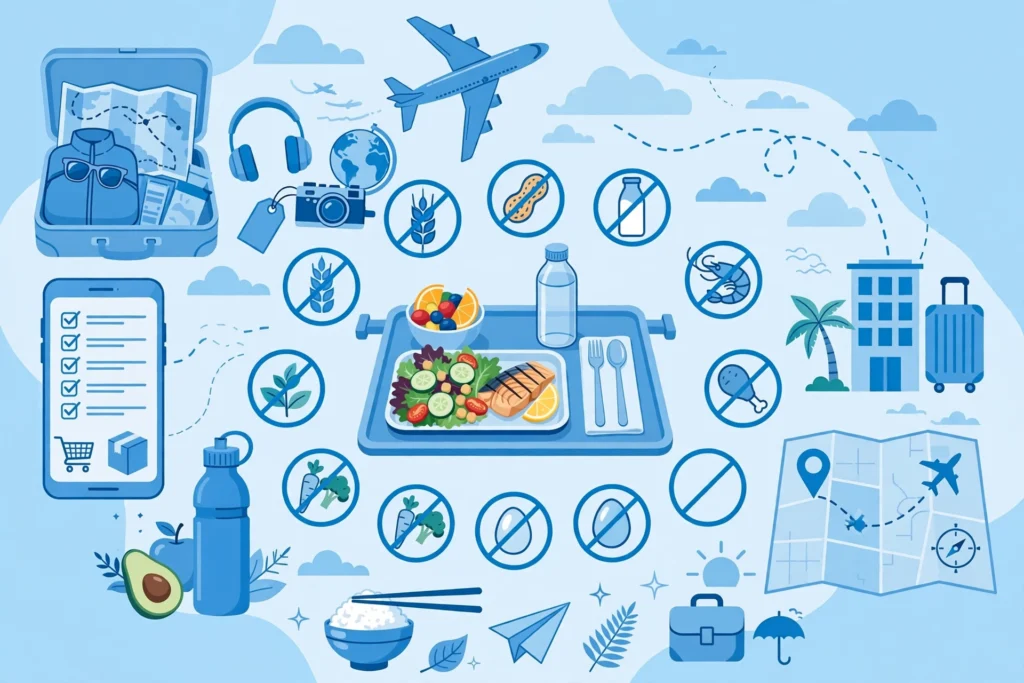
Allergies: say it plainly and early: Sono allergico/a ai frutti a guscio (tree nuts), alle arachidi (peanuts), ai crostacei (shellfish), al latte (milk). For celiac disease or a strict gluten need, name the condition to the server rather than only saying senza glutine, and consider asking about cross-contamination in the kitchen. Confirm anything high-stakes with a translation app too. These phrases are a starting point, not a safety guarantee.
More restaurant phrases:
| Say this | Say it like | Meaning |
|---|---|---|
| Vorrei prenotare un tavolo per le otto | vohr-RAY preh-noh-TAH-reh oon TAH-voh-loh pehr leh OHT-toh | I’d like to book a table for eight o’clock |
| Posso avere…? | POHS-soh ah-VEH-reh | Can I have…? |
| Non mangio… | nohn MAHN-joh | I don’t eat… (uova eggs, pesce fish, noci nuts) |
| Qual è la specialità della casa? | kwahl eh lah speh-chah-lee-TAH DEHL-lah KAH-zah | What’s the house specialty? |
| Il vino della casa | eel VEE-noh DEHL-lah KAH-zah | The house wine |
| C’è un errore nel conto | cheh oon ehr-ROH-reh nehl KOHN-toh | There’s a mistake on the bill |
The bill: il conto, coperto and servizio
The bill typically won’t arrive until you ask. Lingering is normal, and rushing you out would be rude. Catch the server’s eye and say “Il conto, per favore” (eel KOHN-toh pehr fah-VOH-reh). To pay by card: “Posso pagare con la carta?” (POHS-soh pah-GAH-reh kohn lah KAR-tah).
Two line items confuse many Americans:
- Coperto: a per-person cover charge for the table setting, and sometimes bread. It is not a tip. Reported amounts vary by city and restaurant, commonly in the range of a few euros per person, and it’s supposed to be disclosed on the menu or price list before you order. Rules and practice differ by region, so look at the menu rather than assuming.
- Servizio: a service charge, usually a percentage of the bill. If it’s on your check, you generally don’t need to tip again.
Tipping is not expected the way it is in the US. If service was excellent and no servizio was added, leaving a few extra euros is a kindness, not an obligation. If a line on the check confuses you, asking is fine: “Cos’è questa voce?” (koh-ZEH KWEH-stah VOH-cheh): “What is this item?”
Italian phrases for trains, buses, taxis and driving
| Say this | Say it like | Meaning |
|---|---|---|
| Un biglietto per Firenze, per favore | oon beel-LYEHT-toh pehr fee-REN-tseh | One ticket to Florence, please |
| Solo andata / andata e ritorno | SOH-loh ahn-DAH-tah / ahn-DAH-tah eh ree-TOR-noh | One-way / round trip |
| Da che binario parte il treno per Roma? | dah keh bee-NAH-ryoh PAR-teh eel TREH-noh pehr ROH-mah | Which platform does the train to Rome leave from? |
| Questo treno va a Napoli? | KWEH-stoh TREH-noh vah ah NAH-poh-lee | Does this train go to Naples? |
| È libero questo posto? | eh LEE-beh-roh KWEH-stoh POH-stoh | Is this seat free? |
| Dove devo convalidare il biglietto? | DOH-veh DEH-voh kohn-vah-lee-DAH-reh eel beel-LYEHT-toh | Where do I validate my ticket? |
| È in ritardo / È cancellato | eh een ree-TAR-doh / eh kahn-chel-LAH-toh | It’s delayed / It’s canceled |
| Scendo alla prossima | SHEN-doh AHL-lah PROHS-see-mah | I’m getting off at the next stop |
| Può chiamarmi un taxi? | pwoh kyah-MAR-mee oon TAHK-see | Can you call me a taxi? |
| Il pieno, per favore | eel PYEH-noh | Fill it up, please (at a gas station) |
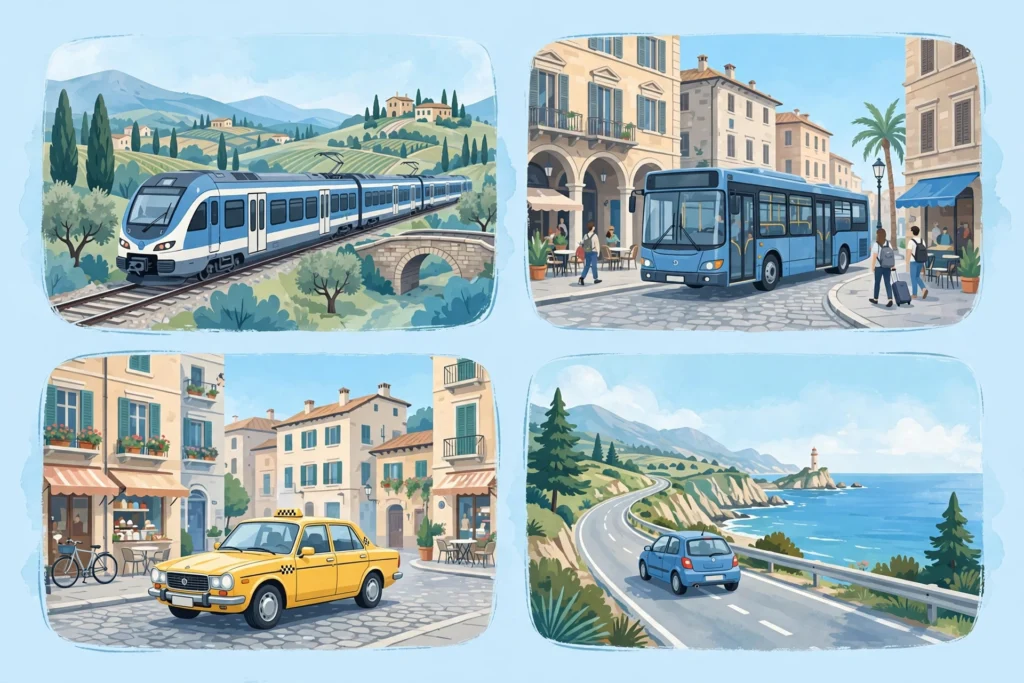
Words you’ll see on signs and boards: binario (platform), partenze / arrivi (departures / arrivals), ritardo (delay), sciopero (strike), biglietteria (ticket office), uscita (exit). Bus tickets are often sold at tabaccheria shops (tobacconists), not only on the bus.
More train, rental and parking phrases:
| Say this | Say it like | Meaning |
|---|---|---|
| Qual è il binario? | kwahl eh eel bee-NAH-ryoh | Which platform is it? |
| Qual è la carrozza? | kwahl eh lah kar-ROT-tsah | Which carriage is it? |
| A che ora parte / arriva? | ah keh OH-rah PAR-teh / ar-REE-vah | What time does it leave / arrive? |
| Quanto ci vuole? | KWAHN-toh chee VWOH-leh | How long does it take? |
| Si ferma a…? | see FEHR-mah ah | Does it stop at…? |
| Mi dice quando arriviamo a…? | mee DEE-cheh KWAHN-doh ar-ree-VYAH-moh ah | Can you tell me when we arrive at…? |
| Vorrei noleggiare una macchina / una bicicletta / uno scooter | vohr-RAY noh-lehj-JAH-reh | I’d like to rent a car / a bike / a scooter |
| Posso parcheggiare qui? | POHS-soh par-kehj-JAH-reh kwee | Can I park here? |
| Questa strada porta a…? | KWEH-stah STRAH-dah POR-tah ah | Does this road go to…? |
Finding your carriage: station displays often show where each carriage stops along the platform. In testa means at the front of the train, in coda at the rear, and centro treno in the middle. High-speed platforms are long, so read the display before you start walking.
Ticket validation (check before you board): some regional train tickets must be stamped or validated before boarding, while tickets with a fixed date and time, and many digital tickets, are already valid. Rules differ by operator and ticket type, so read your ticket or the current instructions on Trenitalia’s or Italo’s site. An unvalidated ticket can be treated as invalid, so ask if you’re unsure: Dove devo convalidare il biglietto?
Strikes: Italian transport strikes (scioperi) are usually announced in advance and can disrupt trains, buses or flights for hours or a day. If you see sciopero on a board, check the operator’s app or website for which services still run.
Driving: two details worth knowing. First, benzina is gasoline and gasolio is diesel. Check which your rental car takes before the pump. Second, many historic centers are ZTL (zona a traffico limitato, limited-traffic zones) where unauthorized cars can be fined by camera. If you rent a car, ask your hotel how to handle the ZTL near it.
Asking directions, and understanding the answer
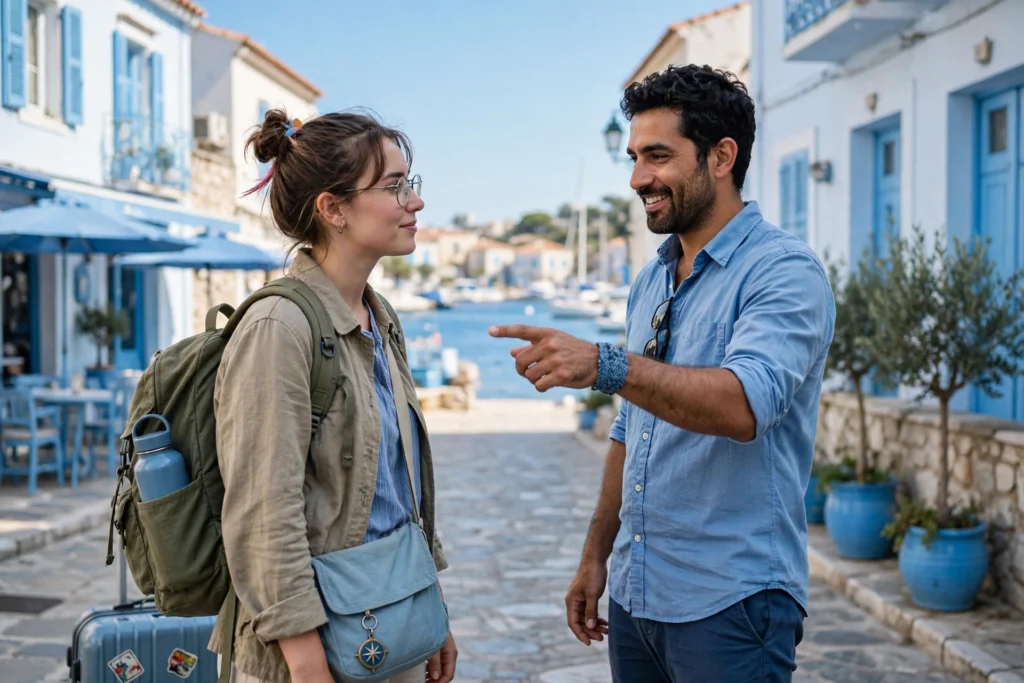
Asking is the easy half. Here is what you’re likely to hear back.
| You’ll hear | Say it like | Meaning |
|---|---|---|
| Dritto / Sempre dritto | DREET-toh / SEM-preh DREET-toh | Straight ahead / keep going straight |
| A destra / a sinistra | ah DEH-strah / ah see-NEE-strah | To the right / to the left |
| Alla prossima (strada) | AHL-lah PROHS-see-mah | At the next (street) |
| Al semaforo | ahl seh-mah-FOH-roh | At the traffic light |
| All’angolo | ahl-LAHN-goh-loh | At the corner |
| Davanti a… / vicino a… | dah-VAHN-tee ah / vee-CHEE-noh ah | In front of… / near… |
| È vicino / È lontano | eh vee-CHEE-noh / eh lohn-TAH-noh | It’s near / It’s far |
| A cinque minuti a piedi | ah CHEEN-kweh mee-NOO-tee ah PYEH-dee | Five minutes on foot |
And the quick service-counter replies:
| You’ll hear | Meaning |
|---|---|
| Mi dica / Dica pure | Tell me, how can I help? (staff opening line) |
| Desidera? | What would you like? |
| Un attimo | One moment |
| Prego | Go ahead / after you / you’re welcome |
| Va bene | Okay / fine |
| Non c’è più | We’re out of it |
Three phrases that make directions workable: Può ripetere, per favore? (Can you repeat that?), Più lentamente, per favore (More slowly, please), and Può indicarmelo sulla mappa? (Can you show me on the map?).
If you’re lost:
| Say this | Say it like | Meaning |
|---|---|---|
| Mi sono perso / persa | mee SOH-noh PEHR-soh / -sah | I’m lost (male / female) |
| Sto cercando… | stoh chehr-KAHN-doh | I’m looking for… |
| Qual è l’indirizzo? | kwahl eh leen-dee-REET-tsoh | What’s the address? |
| Può aiutarmi, per favore? | pwoh ah-yoo-TAR-mee | Can you help me, please? |
Hotels, shops and sights
| Say this | Meaning |
|---|---|
| Ho una prenotazione a nome… | I have a reservation under the name… |
| Posso lasciare i bagagli qui? | Can I leave my bags here? |
| A che ora è la colazione? | What time is breakfast? |
| A che ora è il check-out? | What time is check-out? |
| Qual è la password del Wi-Fi? | What’s the Wi-Fi password? |
| Non funziona l’aria condizionata | The air conditioning isn’t working |
| C’è l’ascensore? / Ci sono molti gradini? | Is there an elevator? / Are there many steps? |
| Sto solo guardando, grazie | I’m just looking, thanks |
| Posso provarlo? | Can I try it on? |
| Ha una taglia più grande / più piccola? | Do you have a bigger / smaller size? |
| Lo prendo | I’ll take it |
| Posso avere lo scontrino? | Can I have the receipt? |
| Due biglietti, per favore / Un adulto e un bambino | Two tickets, please / One adult and one child |
| A che ora chiude? | What time does it close? |
| Si può fotografare? | Is photography allowed? |
| C’è una visita guidata in inglese? | Is there a guided tour in English? |
| Un etto di prosciutto, per favore | 100 grams of prosciutto, please (un etto = 100 g; useful at markets and delis) |
Shopping extras:
| Say this | Say it like | Meaning |
|---|---|---|
| Quanto viene? | KWAHN-toh VYEH-neh | How much is it? (an everyday alternative to quanto costa?) |
| Vorrei comprare… | vohr-RAY kohm-PRAH-reh | I’d like to buy… |
| Posso dare un’occhiata? | POHS-soh DAH-reh oon ohk-KYAH-tah | Can I take a look? |
| Accettate carte di credito? | ah-chet-TAH-teh KAR-teh dee KREH-dee-toh | Do you take credit cards? |
| Questo articolo è tax free? | KWEH-stoh ar-TEE-koh-loh eh tax free | Does this qualify for a VAT refund? |
VAT refunds: visitors who live outside the EU can sometimes reclaim VAT on qualifying purchases from shops that offer tax-free shopping. A minimum purchase amount and paperwork apply, and the rules change, so ask before you buy and check the current requirements with the retailer and Italy’s customs agency.
Numbers and time
| Number | Italian | Say it like |
|---|---|---|
| 1 | uno | OO-noh |
| 2 | due | DOO-eh |
| 3 | tre | treh |
| 4 | quattro | KWAHT-troh |
| 5 | cinque | CHEEN-kweh |
| 6 | sei | say |
| 7 | sette | SEHT-teh |
| 8 | otto | OHT-toh |
| 9 | nove | NOH-veh |
| 10 | dieci | DYEH-chee |
| 20 | venti | VEN-tee |
| 50 | cinquanta | cheen-KWAHN-tah |
| 100 | cento | CHEN-toh |
Prices: €2.50 is due euro e cinquanta (DOO-eh EH-oo-roh eh cheen-KWAHN-tah). A price said fast is often shortened, so keep your eyes on the register or the printed check.
Time: Che ore sono? (What time is it?), A che ora? (At what time?), alle otto (at eight), mezzogiorno (noon), mezzanotte (midnight). Schedules often use the 24-hour clock, so le venti means 8 p.m. Days: lunedì, martedì, mercoledì, giovedì, venerdì, sabato, domenica. Also useful: oggi (today), domani (tomorrow), aperto (open), chiuso (closed). Many smaller shops and restaurants close for a midday break or on certain days, so check posted hours.
When something goes wrong
Learn these before you need them. Write the first row on your phone’s lock-screen note.
| Say this | Say it like | Meaning |
|---|---|---|
| Aiuto! | ay-YOO-toh | Help! |
| Ho bisogno di un medico | oh bee-ZOH-nyoh dee oon MEH-dee-koh | I need a doctor |
| Chiami un’ambulanza | KYAH-mee oon-ahm-boo-LAHN-tsah | Call an ambulance |
| Chiami la polizia | KYAH-mee lah poh-lee-TSEE-ah | Call the police |
| Non mi sento bene | nohn mee SEN-toh BEH-neh | I don’t feel well |
| Mi hanno rubato il portafoglio / il telefono / la borsa | mee AHN-noh roo-BAH-toh eel por-tah-FOH-lyoh | My wallet / phone / bag was stolen |
| Ho perso il passaporto | oh PEHR-soh eel pahs-sah-POR-toh | I lost my passport |
| Vorrei fare una denuncia | vohr-RAY FAH-reh OO-nah deh-NOON-chah | I’d like to file a police report |
| Dov’è la farmacia? / il pronto soccorso? | doh-VEH lah fahr-mah-CHEE-ah / eel PROHN-toh sohk-KOR-soh | Where’s the pharmacy? / the emergency room? |
| Ho mal di testa / mal di stomaco | oh mahl dee TEH-stah | I have a headache / stomachache |
Emergency numbers: 112 is the EU-wide emergency number and works across Italy. Sources also list 118 for an ambulance, 113 for the police and 115 for the fire brigade. If you remember only one, remember 112, and save it in your phone before you travel. Operators often handle English, but say your location first and speak slowly.
Pharmacy tip: a farmacia (look for the green cross) is often a quick first stop for minor ailments, and pharmacists can advise. Acetaminophen (the active ingredient in Tylenol) is called paracetamolo in Italy, and Tachipirina is a common brand. Ibuprofen is ibuprofene. Ask the pharmacist about the right dose for you, and tell them about any allergies or medications.
After a theft or loss: you’ll often need a police report (denuncia) to support a travel-insurance claim, and a lost US passport means contacting the nearest US embassy or consulate. Check your policy’s exact requirements before you travel. [INTERNAL LINK OPPORTUNITY: CREATE ARTICLE ABOUT travel insurance for Europe trips]
If you freeze: four rescue moves
Everyone blanks. Have a fallback ready.
- Reset politely: Mi scusi, non parlo bene l’italiano. (I don’t speak Italian well.) Then Parla inglese?
- Slow them down: Più lentamente, per favore. or Può ripetere?
- Get it in writing: Può scriverlo? (Can you write it down?) Numbers and times are easier to read than hear.
- Switch tools: open your offline translation app and show the screen. Treat the app as a bridge, not a failure.
In busy tourist areas, staff often reply in English the moment they hear an accent. That isn’t a rejection of your Italian. Say thanks, accept the help, and try the next phrase anyway.
Common mistakes to avoid
- Using ciao with everyone. It’s informal. Use buongiorno / buonasera with staff and strangers.
- Entering a shop or bar without a greeting. A quick buongiorno costs nothing and changes the tone of the whole interaction.
- Ordering un latte and expecting coffee. You’ll get milk. Say caffè latte or latte macchiato.
- Waiting for the bill to appear. Ask for it: Il conto, per favore.
- Tipping on top of servizio. Check the bill first. If a service charge is already listed, you generally don’t need to add another tip.
- Skipping the double consonants. Penne and pene, caro and carro: the length of the consonant changes the word.
- Using tu with strangers. Stay with Lei forms (Parla…? Può…?) unless invited otherwise.
- Mixing up fuel at the pump. Benzina is gasoline; gasolio is diesel.
- Trusting false friends. Parenti means relatives, not parents (parents is genitori). Camera means room, not camera. Preservativi means condoms, not preservatives (that’s conservanti).
- Letting a translation app choose your register. Apps can pick the wrong level of formality or mishandle regional speech. Compare against this guide for the high-stakes phrases.
[AUTHOR NOTE, optional: if the author has a real moment where a greeting or a mispronounced word changed an interaction in Italy, add it here in two sentences. Delete this note if there isn’t one.]
A 7-day plan (10 minutes a day)
Say the phrases out loud. Silent reading doesn’t train your mouth.
| Day | Focus | Practice |
|---|---|---|
| 1 | Greetings and politeness | Phrases 1–7 from the first table, said aloud with a smile |
| 2 | Pronunciation rules | Read the pronunciation table, then say gelato, gnocchi, ciao, biglietto, caffè |
| 3 | Bars and cafés | Order three drinks aloud, starting with Buongiorno |
| 4 | Restaurants | Practice the ordering table, then ask for il conto |
| 5 | Transport | Say the train and directions phrases; read the signs vocabulary |
| 6 | Numbers and emergencies | Count to ten, say a price, memorize 112 and the first emergency row |
| 7 | Review and role-play | Play both parts: Mi dica? / Vorrei… / Quanto costa? / Grazie |
When this works best: you have at least a week before departure and can practice aloud. When it doesn’t: you leave in two days. In that case do Day 1 and Day 3, memorize the first table, and download offline translation.
What to learn for your type of trip
Use this as a decision rule: add phrases that match what you’ll actually do.
| If your trip is… | Prioritize | Skip for now |
|---|---|---|
| A city break (Rome, Florence, Venice, Milan) | First table, bars, restaurants, directions | Driving phrases |
| Food-focused | Restaurants, allergies, market phrases (un etto di…), menu structure | Hotel details |
| Train-heavy | Trains, platform and strike vocabulary, numbers and time | Shopping |
| A road trip or small towns | Driving, directions, numbers, hotels; English is less likely in smaller places | Gelato flavors |
| Solo | Emergencies, the “freeze” moves, Un tavolo per uno, per favore (a table for one) | Idioms |
| Heritage trip | Standard Italian first, then dialect for family | Slang |
| Older travelers or limited mobility | Elevator and steps phrases, più lentamente, written numbers | Bargaining |
Tools that help (and their limits)
- Offline translation: Google Translate and Apple’s Translate app both let you download languages for offline use. Do it on Wi-Fi before you fly. Camera translation helps with menus and signs.
- Limits: apps can miss idioms, choose the wrong formality, or stumble on dialect and fast speech. Use them for reading and as a bridge, and use the phrases above for the high-frequency moments.
- Learning apps and courses: audio-first courses (Pimsleur), structured lessons (Babbel) and free daily practice (Duolingo) all work for travel Italian. Pick whichever you’ll actually use for 10 minutes a day, and check current pricing and trial terms.
- A paper backup: a small phrasebook or a printed cheat sheet works when your phone battery doesn’t.
- Printable cheat sheet (coming from SoloTravelPro): the first table and the emergency table on one page. [LINKABLE ASSET: see Section J]
Frequently Asked Questions
Do I need to speak Italian to travel in Italy?
No. In major cities and tourist areas, hotels and many restaurants manage in English. Still, a handful of Italian phrases improves service and helps in smaller towns, on public transport and at local bars, where English is less common.
What is the most useful Italian phrase for travelers?
A greeting. Buongiorno or buonasera when you enter a shop, bar or restaurant sets the tone for everything after. After that, per favore, grazie and vorrei… do the most work.
How do you say please and thank you in Italian?
Per favore (pehr fah-VOH-reh) for please and grazie (GRAHT-see-eh) for thank you. The reply to grazie is prego.
Is ciao rude to use with strangers?
Not rude, but informal. It suits friends, peers and children. With hotel staff, servers and older people, use buongiorno or buonasera.
What’s the difference between buongiorno and buonasera?
Buongiorno is the daytime greeting, from morning into the early afternoon. Buonasera takes over later in the day. The switch isn’t a fixed hour, so echo what the other person says.
How do you ask for the check in Italy?
Say Il conto, per favore. The bill usually isn’t brought until you ask. Look for coperto or servizio on it before tipping.
What does prego mean?
It means “you’re welcome” after grazie, but also “go ahead,” “after you” or “how can I help?” depending on the moment.
How many Italian phrases should I learn before a trip?
Start with the 12 in the first table. Add 15 to 20 from the situations you’ll actually meet (bars, restaurants, trains). After that, practice listening to replies. That adds more than a longer list.
How do I order coffee in Italy?
Say Un caffè, per favore for an espresso. For milk, say cappuccino or caffè latte. Don’t say only latte, which means milk. Standing at the bar is usually cheaper than sitting.
Can I rely on a translation app instead?
Use one as a backup. Download Italian for offline use before you travel, but expect occasional wrong formality or missed idioms. Knowing a few phrases is faster than typing into a phone.
Do Italians like it when tourists try Italian?
Generally the effort is welcomed, and many staff in tourist areas will switch to English anyway. That isn’t a rejection. Keep your grazie and per favore in Italian regardless.
What number do I call in an emergency in Italy?
112 works across Italy. Sources also list 118 (ambulance), 113 (police) and 115 (fire). Save 112 in your phone before you go.
How do I introduce myself in Italian?
Say Buongiorno, mi chiamo [name], and piacere when you meet someone. Sono americano (male) or sono americana (female) is a natural next line.
How do I find my train carriage in Italy?
Ask Qual è la carrozza? and read the platform display, which often shows where each carriage stops: in testa (front), in coda (rear) or centro treno (middle).
Can I get a VAT refund in Italy?
Visitors who live outside the EU may be able to on qualifying purchases from participating shops. A minimum spend and paperwork apply, so ask Questo articolo è tax free? before you buy and check the current rules.
What is Tylenol called in Italy?
The active ingredient, acetaminophen, is paracetamolo, and Tachipirina is a common brand. Ask the pharmacist about dosing.
Final Takeaway
You don’t need fluency. You need about a dozen Italian phrases for travel, said with a greeting and a per favore, plus a plan for the moment you blank. Learn the first table, practice the situations you’ll face, understand a few replies, and keep offline translation as backup. Do that, and bars, trains, restaurants and the bill stop being guesswork.
People also read : AmaWaterways Travel Agent Portal: Login, Registration and Commission (2026)