
Guatemala gives you a UNESCO-listed colonial city, a volcano-ringed lake, nightly eruptions you can watch from a mountain camp and one of the largest Maya cities in the Americas, all inside a country about the size of Tennessee. It also carries a U.S. State Department “Reconsider travel” advisory, which most guides either skip or dismiss.
This guide takes the advisory seriously and shows what that means in practice: where visitors actually go, how they move between places, what it costs and what to settle before you book. It is written for U.S. travelers planning anything from a long weekend to three weeks. It is built from official sources, current published prices and traveler reports, not from a personal trip, and it says where each figure comes from.
Quick Answer
U.S. citizens can enter Guatemala without a visa for up to 90 days. Most visitors stick to Antigua, Lake Atitlán and Tikal. The State Department rates the country Level 3 (“Reconsider travel”) and four areas Level 4 (“Do not travel”), none of them on the usual tourist circuit. Budget about $100–$200 a day mid-range (estimate), excluding flights.
Key Takeaways
- Know the advisory. Level 3 nationwide. Level 4: San Marcos Department, Huehuetenango Department, Zone 18 in Guatemala City and Villa Nueva (State Department, March 12, 2026).
- San Marcos is two places. The Level 4 department is not the lakeside village of San Marcos La Laguna.
- No visa for 90 days, but those days are shared across Guatemala, El Salvador, Honduras and Nicaragua.
- Fewer stops beat more. Distances are long and roads slow. Two or three bases make a better trip than five.
- Carry cash. Tikal’s counter, small boats and many shops want quetzales, and ATMs charge fees.
- Pre-book shuttles, travel in daylight, and never hike a volcano without a guide.
- Dry season (Nov–Apr) is the safe bet for views; mid-January to March is often the sweet spot.
The safety picture in October 2026

What the U.S. advisory says
The State Department last reissued its Guatemala advisory on March 12, 2026 at Level 3: Reconsider Travel, citing crime and terrorism risk from gangs and criminal organizations. It lists four Level 4: Do Not Travel areas: San Marcos Department, Huehuetenango Department, Zone 18 in Guatemala City and the city of Villa Nueva. The Department bars its own employees and their families from those places, and says they may move through the rest of Guatemala City, including at night.
In January 2026 the U.S. Embassy also issued a security alert after coordinated armed attacks on police in several zones of Guatemala City, according to news coverage of the alert. Read that as a reason to keep the capital to a short, planned transit.
Two things are true at once:
- Many travelers spend one to three weeks on the Antigua–Atitlán–Flores circuit without trouble, and some travel writers call the advisory too broad. It is a country-wide label over very different places.
- It is still your government’s risk assessment, and your insurer, employer or credit card may treat it as material. Read your policy before you assume you are covered.
Check this week: the live advisory at travel.state.gov, the U.S. Embassy alerts page and your insurer’s exclusions. Enroll in the State Department’s STEP program so the embassy can reach you.
The San Marcos trap
The San Marcos Department (Level 4) sits in the far west, along the Mexican border. San Marcos La Laguna is a small lakeside village in the Sololá Department on Lake Atitlán, known for yoga and retreats. Same name, different place. If a booking site, shuttle or friend says “San Marcos,” confirm which one.
Older guidebooks can point you at Level 4 areas
Some guidebooks recommend hiking in the Cuchumatanes mountains. Much of that range lies in Huehuetenango Department, a Level 4 area. Before you follow any older itinerary, check each stop against the advisory’s named areas.
How visitors reduce risk in practice
| Situation | What to do | Why |
|---|---|---|
| Arriving at the airport | Pre-book a pickup, or use an app and match the plate and driver | Street taxis are the usual airport risk |
| Guatemala City | Transit only; if you must overnight, travelers often choose Zona 10 near the airport | Level 4 applies to Zone 18, and the embassy’s January 2026 alert covered several capital zones |
| Between towns | Shared tourist shuttle in daylight; keep valuables on you | Door-to-door, fewer stops; luggage areas are a theft risk |
| Public “chicken” buses | Skip for long legs; if used, daytime only, light bag | Slow, many changes, theft risk |
| Walking at night | Stick to lit, busy streets in Antigua; take a ride after dark | Opportunistic theft |
| Volcano and jungle hikes | Licensed guide only | Remote trails, robberies reported, active volcanoes |
| ATMs | Inside banks or guarded lobbies, in daylight | Card skimming and robbery risk |
| Roads | Avoid driving yourself at night; expect roadblocks or protests to delay trips | Road conditions and political protests |
Entry rules for US citizens

- Visa: none for tourism up to 90 days. Confirm on the State Department’s Guatemala page before you fly.
- Passport: a valid U.S. passport is required. Many sources say six months of validity, and airlines are stricter than governments, so aim for six months.
- Onward ticket: officers can ask for proof you will leave, most often at the airport. Carry a return flight confirmation.
- Customs form: the State Department says travelers must complete a Regional Sworn Travel Declaration for customs when entering and leaving. Check the current process.
- CA-4 clock: 90 days shared across Guatemala, El Salvador, Honduras and Nicaragua. Moving between them does not reset it.
- Extension: one extension of up to 90 days at Guatemalan immigration (IGM) before your stay lapses. Reported fees are about $25–$26; confirm with IGM.
- Fees and “taxes”: there is no entry fee. Airline tickets usually include the exit fee. At land borders, travelers report unofficial “fees”; pay only what officials document and keep receipts.
- Do not buy fake stamps. The State Department has long warned U.S. citizens about this.
Best time to visit Guatemala

The dry season runs roughly November to April, the wet season May to October. Altitude changes everything: Antigua sits around 1,545 m (5,069 ft) and Lake Atitlán around 1,562 m (5,125 ft), with mild days and cool nights year-round. Flores in the north is hot and humid even in January, and Xela is colder at about 2,330 m.
| Period | Weather | Pros | Cons |
|---|---|---|---|
| Mid-Jan to Mar | Dry, clear, warm days | Best volcano views, lighter crowds than holidays | Higher prices than the wet season |
| Nov–Dec, Apr | Dry | Good weather | Christmas, New Year and Easter are busiest and priciest |
| May–Oct | Afternoon showers, wetter north | Cheaper, greener, fewer crowds | Cloud can hide Fuego; muddy trails; road delays |
| July–Aug | A dry spell called the canicula often interrupts the rains for a few weeks | Drier windows in the highlands | Timing varies year to year |
Decision rule: if Acatenango is your main goal, travel mid-January to March. If Tikal and Antigua matter more, the wet season saves money. Compare total trip cost, not just airfare.
Where to go

| Place | Why go | Time | Watch for |
|---|---|---|---|
| Antigua | UNESCO-listed colonial city, walkable, cafes, volcano views, base for hikes | 2–4 days | Cobblestones; many sites close Mondays |
| Lake Atitlán | Volcano-ringed lake, Maya villages reached by boat | 3–5 days | Confirm “San Marcos La Laguna”; last boats leave late afternoon |
| Tikal and Flores | Maya city in rainforest; Flores island town on Lake Petén Itzá | 2–4 days | Heat, mosquitoes, cash at the gate |
| Semuc Champey | Turquoise river pools near Lanquín | 2–3 days | A full day each way by road; limited ATMs in Lanquín |
| Chichicastenango | Large highland market, Thursdays and Sundays | Half day | Crowds, bargaining |
| Quetzaltenango (Xela) | Authentic second city, base for volcano hikes | 2–3 days | Colder; fewer tourist services |
| El Paredón | Pacific black-sand surf town | 2–3 days | Very hot; a detour |
| Río Dulce and Livingston | Jungle river, Caribbean Garífuna culture | 2–3 days | Far east, long travel; lowland mosquitoes |
| Pacaya | Easier volcano day hike near Antigua | Half day | Wear sturdy shoes |
Lake Atitlán villages in one line each (from published traveler accounts): Panajachel is the busy transport hub; San Juan La Laguna is artisan-focused; San Pedro La Laguna is the backpacker town; San Marcos La Laguna is yoga-retreat country; Santa Cruz is quiet and scenic.
Antigua or Atitlán? Antigua for walkability, food and logistics. Atitlán for scenery and slow days. With a week, do both.
Guatemala itineraries: 4 days to 3 weeks
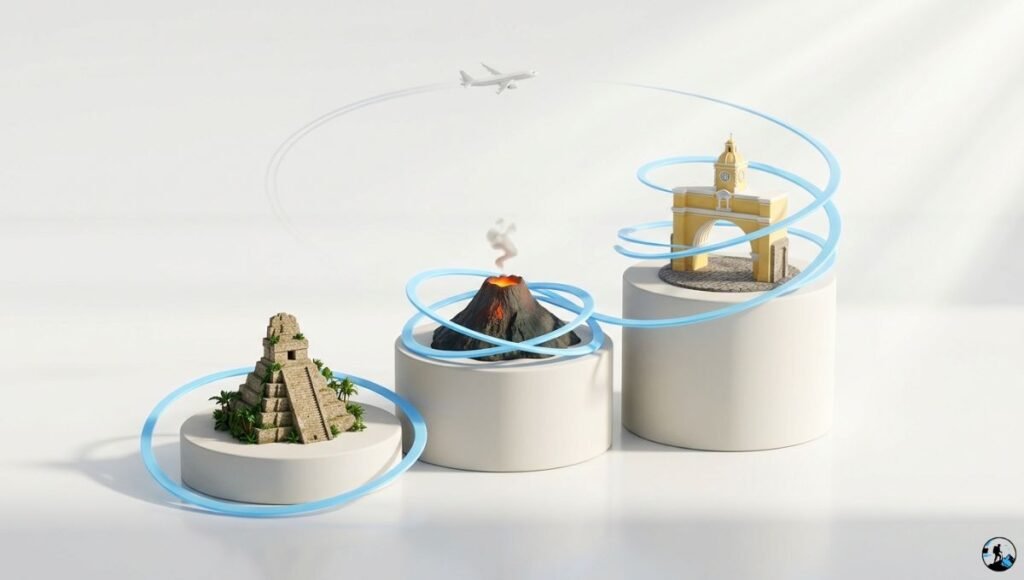
Transit times below are traveler-reported and should be checked against current schedules. Guatemala is bigger than it looks, roads are slow and day trips between regions rarely work, so fewer bases beat more. Roadblocks and protests can delay trips, so keep a spare day before any flight home.
4 days: Antigua only
- Day 1: Arrive at GUA, shuttle to Antigua (about 1.5 hours, longer in traffic).
- Days 2–3: Antigua on foot, a coffee-farm tour or the Pacaya half-day.
- Day 4: Shuttle back to the airport with a generous margin.
7 days: Antigua and Lake Atitlán
- Days 1–3: Antigua, with Pacaya as a half-day.
- Day 4: Shuttle to Lake Atitlán (about 2¼ hours).
- Days 5–6: Two villages by boat.
- Day 7: Shuttle to GUA (about 3 hours from Panajachel); fly home the next morning if you can.
10 days: Highlands plus Tikal
- Day 1: Arrive, shuttle to Antigua.
- Day 2: Antigua.
- Days 3–4: Acatenango overnight (optional; swap for Pacaya and slower days).
- Day 5: Rest in Antigua.
- Days 6–7: Lake Atitlán.
- Day 8: Shuttle to GUA, then the short flight to Flores.
- Day 9: Tikal (sunrise or sunset ticket optional), back to Flores.
- Day 10: Fly to GUA and connect home; book the international leg with a long margin.
14 days: Highlands, Tikal and room to breathe
- Days 1–5: Antigua, with Acatenango and a rest day.
- Days 6–9: Lake Atitlán, with a Chichicastenango stop on a Thursday or Sunday.
- Day 10: Shuttle to GUA, flight to Flores.
- Days 11–13: Tikal and, if time allows, a sunset at another Maya site near Flores.
- Day 14: Fly to GUA and connect home. Optional swap: trade a lake day for Xela.
3 weeks: Add Semuc Champey and one more region
- Follow the 14-day plan, then add Semuc Champey (2–3 nights) between Atitlán and Flores, plus either Río Dulce or El Paredón.
- Traveler reports put Flores to Semuc Champey at 10+ hours and Semuc Champey to Antigua at 8+ hours by shuttle. That is why under three weeks, most travelers skip it.
Rule of thumb: one new base every 3–4 days is comfortable; one every 2 days feels like commuting.
Getting around

| Option | Reported price or time | Pros | Cons | Best for |
|---|---|---|---|---|
| Shared tourist shuttle | About $15–$50 depending on distance; Flores to Semuc Champey about Q230 (~$30) | Door-to-door, fewer stops, bookable on WhatsApp or a platform | Cramped vans; pickup times drift | Most first-timers |
| Private transfer | One report: $65 total airport to Antigua | Flexible, direct | Pricier; traffic still applies | Late arrivals, small groups |
| Domestic flight GUA–Flores | About 1 hour, several flights a day (TAG, Avianca) | Saves a full day versus 10–15 hours by road | Extra baggage rules; weather delays | Anyone going to Tikal |
| Coach bus (Guatemala City–Flores, Flores–Río Dulce) | Overnight and day services | More comfortable than a van | Transits Guatemala City; book the bus, not a shuttle | Budget travelers who accept the capital transit |
| Lake boat (lancha) | About Q25–Q30 (~$3–$4) Panajachel to San Juan or San Pedro | Fast, scenic, frequent | Exact change; last boats mid-to-late afternoon | Lake hopping |
| Ride-hailing | Reported in Guatemala City, Antigua and Xela; short Antigua ride about Q30 | Cheap, convenient | Match driver and plate; availability varies | Short hops, airport to Antigua |
| Taxi / tuk-tuk | Negotiate first | Always available | Agree the price before you ride | Short town hops |
| Public “chicken” bus | A few dollars | Cheapest | Multiple changes, no timetables, theft risk | Short daytime hops only |
| Rental car | Varies | Freedom | Poor roads, roadblocks, hard parking at the lake and Flores island | Experienced drivers in dry season |
Book shuttles by WhatsApp or a booking platform before you arrive. Confirm pickup time and place the night before.
Tikal logistics (Ministry of Culture and CONAP sources, checked September–October 2026): foreign adult entry is Q150 (about $19–$20). Sunrise or sunset entry adds Q100. The museums add Q30. The park runs roughly 6 a.m. to evening, and the counter needs quetzales in cash (card payment is available on the online portal). A guided sunrise tour including entry was reported at about Q480 (~$60). Flores to the gate takes about an hour.
What a Guatemala trip costs

Prices below are planning estimates built from published fares, fees and 2025–2026 traveler reports, not quotes. The quetzal has stayed near Q7.6–7.8 per dollar for years, so quetzal prices convert predictably. Guatemala is better described as good value than rock-bottom cheap, and prices are rising.
Reported prices (2025–2026)
| Item | Reported price |
|---|---|
| Dorm bed in a popular hostel | $20–$25 (basic beds from about $15) |
| Private room, comfortable and basic | $40–$50 |
| Upper mid-range room | $90–$100 (four-star around $70 reported in 2025) |
| Typical breakfast | About Q40 (~$5–$6) |
| International-style main meal | Q60–Q90 (~$8–$12) |
| Barista coffee | About Q25 (~$3) |
| Pacaya guided hike | About Q120 (~$16) |
| Semuc Champey pools entry | About Q50 (~$7) |
| Acatenango overnight | About $70–$150 (extremes both lower and higher) |
| Fuego summit add-on | Reported at about Q200 or $20–$40 |
Daily budget (excluding international flights) — ESTIMATE
| Category | Budget | Mid-range | Premium |
|---|---|---|---|
| Lodging | $20–$45 | $50–$100 | $150–$300 |
| Food | $12–$25 | $25–$45 | $50–$90 |
| Local transport | $8–$20 | $10–$30 | $30–$80 |
| Activities | $8–$20 | $15–$45 | $50–$150 |
| Daily total | $50–$100 | $100–$220 | $280+ |
Budget formula and worked example
Total trip cost = international flights + lodging + food + local transport + activities + domestic flights + insurance + ATM fees + 10% buffer
Monthly savings target = total trip cost ÷ months until departure
Worked example (illustrative inputs): 10 days, mid-range, one traveler.
- Lodging: 9 nights × $70 = $630
- Food: 10 days × $35 = $350
- Shuttles, boats, rides: about $130
- Acatenango overnight: about $110 (optional)
- Tikal guided sunrise tour with entry: about $60
- Domestic flights, round trip: $200 placeholder (check current fares)
- ATM fees: 3 withdrawals × about $5 = $15
- Insurance: $60
- Subtotal $1,555 + 10% buffer ($156) = about $1,710 before international airfare
- Saving over 6 months = about $285 a month
Swap in live quotes before you rely on any line.
Hidden costs
- ATM fees: one traveler found no fee-free ATMs and reported charges of at least Q44 (~$5) per withdrawal, with limits around Q2,500 (about $330). Withdraw the maximum less often.
- Cash-only spots: Tikal’s counter, small boats, markets, many small shops.
- Dollar prices: hotels and tour sellers quoting in dollars often use a poor exchange rate.
- Sunrise or sunset surcharge at Tikal, plus museum tickets.
- Baggage: small extra charge on lake boats; fees on domestic flights.
- Park fees: reported at Q50–Q100 for volcano hikes, depending on source and whether your tour includes them.
- Card fees: foreign-transaction fees from your bank; surcharges at remote vendors.
Money, phones and tipping

Currency. The quetzal (Q) trades near Q7.6–7.8 per dollar. Check the Bank of Guatemala’s reference rate before you travel; real bank rates differ from it.
Cash and cards. Cards work in tourist centers like Antigua and Flores, less so elsewhere. Always carry cash. Banks are picky about US bill condition, and torn or marked $100 notes are often refused, so exchanging dollars is the weaker strategy; ATMs are simpler. Small notes matter, because change for large bills is hard to find.
Phones. Tigo and Claro are the main carriers. One traveler reported a 30-day prepaid plan with about 14 GB for Q115 (~$15), with free messaging apps. Bring your passport to buy a SIM, or use an eSIM if you want zero setup. Download offline maps and keep WhatsApp ready, because operators use it.
Tipping. Restaurants often add a 10% service charge; if not, 10% is a common gesture. Tips for guides and drivers are appreciated, not required.
Staying healthy

- Water: do not drink tap water. Many hotels provide filtered jugs; ask before you buy bottles.
- Food: choose busy stalls and food served hot; be careful with raw produce and ice you cannot verify.
- Mosquitoes: dengue, Zika and malaria are noted by travelers, with the highest risk in lowland areas such as Flores, Semuc Champey, Río Dulce and the Pacific coast. Use repellent and ask a doctor about malaria medication for your route.
- Vaccines: check the CDC’s Guatemala page and see a doctor 4–6 weeks before you go. Hepatitis A and typhoid are common topics.
- Altitude: Antigua and the lake sit near 1,500 m; Acatenango’s summit is 3,976 m. Ascend gradually, drink water, and descend if symptoms worsen.
- Insurance: buy medical cover with emergency evacuation, and read exclusions for advisory levels, adventure activities and altitude before you pay.
Volcano hikes: what to check

Acatenango is the overnight climb from which most visitors watch Fuego erupt. Fuego has erupted almost continuously since 2002, according to operator and traveler sources.
- Guide only. Published guides report hikers have died on the trail.
- Alert level: operators close the Fuego route at higher alerts; ask about the plan the week you go.
- Effort: expect 4–6 hours up and 3–4 down; the Fuego add-on is a further hard walk.
- Do not buy on price alone. Ask about group size, guide ratio, gear, food and cancellation terms.
- Season: dry season gives the clearest views; cloud can hide Fuego, especially in the wet season.
- Easier option: Pacaya, or a viewpoint hike near Xela.
- Pack: warm layers, gloves, hat, headlamp, rain shell, sturdy shoes. It gets cold at camp.
Solo and women travelers

Guatemala works for solo travelers, mostly on the tourist circuit with shared shuttles and guided hikes. A few habits help:
- Choose well-reviewed lodging with a guard or locked gate, and read recent reviews about the street at night.
- Arrive in daylight, and book the first transfer before you land.
- Use group tours for volcanoes and remote sites; skip solo trails.
- Share your live location and itinerary with someone at home.
- Take a ride after dark rather than walking, even short distances.
- Keep a card and some cash in a separate place from your main wallet.
What to do if…

| Situation | What to do |
|---|---|
| Your passport is lost or stolen | Report it, then contact the U.S. Embassy in Guatemala City for a replacement; carry a photocopy and a phone photo |
| You are robbed | Hand over valuables, move to a safe place, report to the tourist police and the embassy, cancel cards |
| Roadblock or protest delays you | Stay with your shuttle operator for advice, and keep a buffer day before flights |
| Fuego or another volcano raises its alert | Follow your operator and guide; never push into a closed route |
| You get sick after eating | Hydrate, see a pharmacist or clinic early, and seek medical care for fever, blood in stool or severe symptoms |
| An ATM eats your card | Call your bank at once; keep a backup card in a separate bag |
| The advisory changes before you fly | Read the new text, check your insurer and booking cancellation terms, and decide with that in hand |
Common mistakes
- Treating “Level 3” as either “never go” or “ignore it.” Read the Level 4 areas and plan around them.
- Confusing San Marcos Department with San Marcos La Laguna.
- Following an older guidebook to a Level 4 area.
- Packing five regions into ten days.
- Booking the flight home the same day as a long transfer.
- Arriving at Tikal without quetzales.
- Choosing the cheapest volcano tour.
- Exchanging dollars at hotels or the airport.
- Skipping insurance, or never reading its exclusions.
- Forgetting the shared 90-day CA-4 count when combining Central American countries.
Which plan fits you?

- First trip, a week or less, nervous about logistics: Antigua and Lake Atitlán by shared shuttle.
- Volcano is the point: mid-January to March, a vetted Acatenango operator, Pacaya as practice.
- Maya history is the point: fly to Flores, give Tikal a full day and consider sunrise.
- Tight budget: lodging and transport are your levers; shared shuttles, lake boats and local meals.
- Solo traveler: guarded lodging, daylight transfers, group tours for remote sites.
- Families: fewer base changes, shorter transfers, skip overnight volcano camping with young children.
- Digital nomads: count CA-4 days from day one.
- Three weeks or more: add Semuc Champey and a lowland stop, and accept slower pacing.
Pre-trip checklist
- Read the State Department advisory and embassy alerts; enroll in STEP
- Passport valid six months past entry; copies saved
- Return flight confirmation ready for the immigration desk
- Customs declaration process confirmed
- Insurance with evacuation, exclusions read
- First shuttle booked; first-night lodging in a safe area
- Quetzales ready for 48 hours; card with no foreign-transaction fee
- Volcano operator vetted (if booking)
- Doctor and vaccine visit; repellent; water plan
- Offline maps, WhatsApp, SIM or eSIM
- Buffer day before your flight home
Frequently Asked Questions
Is Guatemala safe for US tourists right now?
It depends on where you go. The State Department rates the country Level 3 and four areas Level 4 (advisory dated March 12, 2026). Most visitors stay on the Antigua, Lake Atitlán and Tikal circuit, travel by day and pre-book transport. Recheck advisories before you fly.
Do US citizens need a visa?
No, for tourism up to 90 days. Confirm on the State Department’s Guatemala page.
How long can I stay?
90 days, shared across the CA-4 countries, with one extension of up to 90 days at IGM.
How many days do I need?
Four days covers Antigua. Seven adds Atitlán. Nine to ten adds Tikal. Three weeks lets you add Semuc Champey.
When is the best time to go?
Mid-January to March for clear weather and volcano views. May to October is cheaper but cloudier.
Do they use US dollars?
Some tourist businesses quote them, usually at a poor rate. Pay in quetzales.
Can I drink the tap water?
No. Use filtered or bottled water.
How much does Guatemala cost per day?
Estimate: about $50–$100 budget, $100–$220 mid-range, $280+ premium, excluding international flights.
What does Tikal cost?
Q150 for foreign adults (about $19–$20), plus Q100 for sunrise or sunset entry and Q30 for the museums. Bring cash for the counter.
Antigua or Lake Atitlán?
Antigua for walkability and logistics; Atitlán for scenery and slower days. With a week, do both.
Is the Acatenango hike hard?
Yes. It is a long, high-altitude climb. Pacaya is the easier alternative.
Is Guatemala OK for solo travelers?
Many people travel solo here, mostly on the tourist circuit with shuttles and guided hikes. Use the precautions above and avoid isolated areas and night travel.
Do I need to speak Spanish?
English is common in tourist areas, but the more independent you travel, the more Spanish helps. More than 20 Mayan languages are also spoken.
Should I stay in Guatemala City?
Treat it as transit. If a late or early flight forces an overnight, travelers often choose Zona 10 near the airport.
Final takeaway
Guatemala rewards travelers who plan the unglamorous parts: advisory, entry rules, transport and cash. Pick a realistic route with two or three bases, pre-book your shuttles, carry quetzales, and reread the advisory a week before you fly. Do that, and the highlands, the lake and Tikal fit into a trip you can run with confidence.
People also read : Travel Light Aruba: How It Works, What It Costs, and Who Else Delivers Beach and Baby Gear