

Australia gets planned in stages, not all at once. Most first-time visitors from the US start with the same handful of questions: do I need a visa, what will this actually cost, when should I go, how many days is realistic, and where should I actually spend them. This guide answers those in order — with real 2026 numbers, not vague advice — then walks through the regional, seasonal, and practical decisions that follow.
Quick Answer
US citizens need an Electronic Travel Authority (ETA) to enter Australia — not a traditional visa — which currently costs around AUD 20 (roughly USD 13–14, though this moves with the exchange rate) and is usually approved within minutes online. Budget travelers can get by on roughly AUD 150–220 a day outside of flights; mid-range travelers should plan for AUD 350–500 a day. The flight itself, at 14+ hours from the US West Coast, is usually the single largest cost and the biggest scheduling constraint. Most first-timers need a minimum of 10–14 days to see more than one region without feeling rushed, and picking a season should depend on which region matters most, since Australia is big enough that no single month is ideal everywhere at once.
Do US Citizens Need a Visa for Australia?
Yes. US passport holders cannot enter Australia visa-free — but the process is closer to a quick online form than a traditional visa application. The relevant document is the Electronic Travel Authority (ETA), a visa waiver linked electronically to your passport rather than a stamp or sticker.
What the ETA allows: multiple entries into Australia over a 12-month period from the date of issue, with each individual stay capped at up to three months. It covers tourism and standard business-visitor activities — it does not permit paid work in Australia.
How to Apply for the ETA
- Apply through the official Australian government ETA app or website — not a third-party site, which may charge a markup for the same approval.
- The listed government fee is approximately AUD 20 (around USD 13–14 at current exchange rates, though this fluctuates — check a live converter before you pay).
- Most approvals come through within minutes; the government recommends allowing up to 72 hours in case additional review is needed.
- Apply at least one to two weeks before departure so an unexpected delay doesn’t threaten your flight.
- You do not need to print anything — the approval is linked electronically to your passport number.
If your circumstances don’t fit the ETA (longer stays, work purposes, or certain nationalities/situations), you’d instead need a Visitor visa (subclass 600) or, for travelers aged 18–30 looking to combine travel and work, a Work and Holiday visa (subclass 462) — both involving more documentation and longer processing than the ETA.
What the ETA Does and Doesn’t Cover
The ETA is entry authorization, not a guarantee of entry — Australian Border Force officers make the final call at the airport, same as US CBP does for visitors arriving in the US. Have your return or onward flight confirmed and be ready to state your travel purpose and length of stay.
Separately, Australia has strict biosecurity rules: you must declare food, plant material, wooden items, and some outdoor/camping or hiking gear on arrival, even if you’re confident it’s fine. Undeclared items can mean an on-the-spot fine; declared items are simply inspected, which takes a few extra minutes at customs.
How Much Does a Trip to Australia Cost?

Australia has a reputation for being expensive, and for certain categories — accommodation in Sydney, domestic flights, alcohol — that reputation is earned. But day-to-day costs outside the big cities are more moderate than most first-timers expect, especially since the Australian dollar typically trades well below the US dollar (as of mid-2026, roughly 1 USD buys somewhere in the AUD 1.4–1.5 range, though this moves — check a live rate close to your trip).
Sample Daily Budget by Travel Style
| Category | Budget | Mid-Range | Premium |
|---|---|---|---|
| Accommodation | Hostel dorm / budget motel | 3–4 star hotel or Airbnb | 4–5 star hotel/resort |
| Food | Groceries + counter meals, occasional café | Mix of casual restaurants and one nicer meal | Restaurant dining most meals |
| Local transport | Public transit, occasional rideshare | Mix of transit and rideshare | Private transfers, rental car |
| Activities | Free attractions, one paid activity every few days | 1–2 paid activities/tours per day | Guided tours, premium experiences (reef dives, scenic flights) |
| Estimated daily total (AUD) | ~150–220 | ~350–500 | 700+ |
| Estimated daily total (USD, approx.) | ~105–155 | ~245–350 | ~490+ |
These are planning estimates, not guaranteed prices — costs vary meaningfully by city and season, as the comparison below shows.
How Costs Compare City to City
Not every Australian destination costs the same, and this is where a lot of first-timers overspend without realizing it:
| City/Region | Relative cost | Why |
|---|---|---|
| Sydney | Highest | Australia’s most expensive accommodation and dining market, especially near the Harbour/CBD |
| Byron Bay / Whitsundays / Hamilton Island | High | Resort-driven pricing, limited budget accommodation on-island |
| Melbourne | High–moderate | Strong dining scene drives food costs up; accommodation slightly below Sydney |
| Brisbane / Gold Coast | Moderate | More budget and mid-range options than Sydney or Melbourne |
| Cairns / Port Douglas | Moderate | Reasonable base costs, but reef tours add up fast |
| Adelaide / Hobart | Lower | Smaller capital cities with noticeably cheaper accommodation and dining |
| Regional towns & the outback | Lower base cost, higher transport cost | Cheap to stay, but getting there (flights, fuel, tours) costs more |
Practical takeaway: if budget is a real constraint, anchor your trip around Adelaide, Brisbane, or regional stops rather than Sydney and the Whitsundays, or budget deliberately more for the days you spend in the expensive cities.
The Flight Is Usually the Biggest Line Item
Round-trip economy fares from the US West Coast typically fall in the roughly USD 1,000–2,200 range depending on season and how far ahead you book; fares from the East Coast run higher due to connections. December through late January — Australia’s summer and the US holiday season — is consistently the most expensive window. Shoulder months (April–June, September) tend to offer the best fare-to-weather tradeoff. Because this single expense can equal or exceed your entire on-ground budget, it’s worth comparing total trip cost across a few date ranges rather than optimizing for the cheapest flight alone: a cheaper flight during Australia’s peak season can still produce a more expensive trip once accommodation surges are factored in.
Total Trip Budget Formula
Total Trip Budget = Flights + (Daily Rate × Number of Days) + Domestic Transport Between Regions + Visa Fee + Travel Insurance + Buffer (10–15%)
Worked example: A mid-range 12-day trip covering Sydney and Cairns —
- Flights (US West Coast, shoulder season): ~$1,400
- Daily costs: 12 days × ~$300/day (AUD ~430) = ~$3,600
- One domestic flight (Sydney–Cairns): ~$150
- ETA visa: ~$14
- Travel insurance: ~$120
- 10% buffer: ~$530
Estimated total: ~$5,800 USD per person. Treat this as a planning anchor, not a quote — your actual number depends heavily on which cities you choose and how many paid activities (reef trips, wildlife tours, scenic flights, wine tastings) you add.
Savings needed per month = Total Trip Cost ÷ Number of Months Until Departure. For the example above, saving over 8 months works out to roughly $725/month.
When Is the Best Time to Visit Australia?
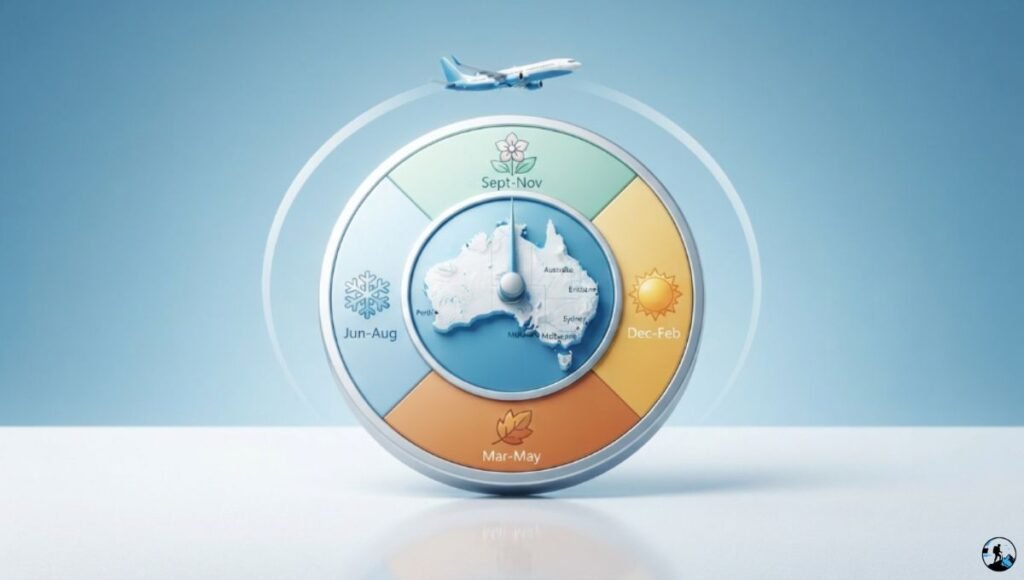
Because Australia is in the Southern Hemisphere, its seasons run opposite the US calendar. It’s also a continent-sized country, so “best time to visit” genuinely depends on where — there’s rarely one month that’s ideal everywhere at once.
Season-by-Season Breakdown
Summer (December–February): Peak season for the southern coastal cities — Sydney, Melbourne, Perth, and Tasmania are all at their warmest and busiest. This is also the most expensive and crowded window nationally, since it overlaps with the US/European holiday break, and it’s bushfire season in parts of the south, so it’s worth checking regional conditions before a national park or regional itinerary. Queensland and the tropical north are hot and humid, with the wet season (and “stinger season” in the water) running through this period.
Autumn (March–May): Widely considered the best all-around window for the southeast — mild temperatures in Sydney and Melbourne, and Victoria’s food and cultural festival season is in full swing. The tropical wet season winds down by around April/May, making late autumn a good transition point to head north.
Winter (June–August): The right time to chase Australia’s north — Queensland, the Northern Territory (Uluru, Kakadu), and Western Australia’s Broome are all at their most comfortable, avoiding the extreme summer heat that can exceed 100°F (38°C) in the Red Centre. It’s also whale-watching season along the east coast (roughly May–November) and, further south, ski season in the Australian Alps (Victoria/NSW high country). Melbourne and Tasmania get genuinely cold, though rarely snow at sea level.
Spring (September–November): Warm and mild almost everywhere, with jacaranda season turning parts of Sydney and Brisbane purple in October–November. Wet season starts building in the tropical north again by November, so aim for early-to-mid spring if that’s your target region.
Best Time by Region (Quick Reference)
- Sydney, Melbourne, Great Ocean Road: March–May or September–November
- Great Barrier Reef and Tropical North Queensland (Cairns, Port Douglas): May–October (dry season, better visibility, avoids stinger season)
- Uluru and the Red Centre: April–September (avoids extreme summer heat)
- Tasmania: December–March for hiking and reliable outdoor access
- Whale watching (east coast): May–November
If your trip spans multiple regions, decide which one matters most and let that drive your dates — trying to time a single trip perfectly for both Tasmania and Cairns, for instance, isn’t really possible.
How Many Days Do You Need?

Decision Framework by Trip Length
Australia is roughly the size of the contiguous United States, and its main draws — Sydney, the Reef, the Red Centre, Melbourne/Great Ocean Road, Tasmania — are hours apart by plane, not by car. This is the single most common planning mistake: treating Australia like a country you can “do” in a week.
- 7–9 days → pick one region and go deep. Sydney plus a short Blue Mountains day trip, or Cairns plus the Reef, works well. Adding a second distant region in under 9 days usually means more time in transit and airports than at your destination.
- 10–14 days → two regions is realistic — for example Sydney + Cairns/Reef, or Melbourne + Great Ocean Road + Tasmania. This is the sweet spot for most first-time visitors.
- 15–21 days → three regions become workable, such as an East Coast loop (Sydney–Melbourne–Cairns) or adding Uluru to a two-city trip.
- 21+ days → you can realistically combine the east coast, the Red Centre, and either Tasmania or Western Australia without feeling rushed.
Given the 14+ hour flight from the US, trips under a week rarely justify the travel time-to-ground-time ratio — if your schedule allows it, 10 days is a more efficient minimum than 7.
Where to Go: Matching Regions to Trip Type

- Solo travelers and first-timers wanting an easy entry point → Sydney and Melbourne have the most developed public transit, the widest range of hostel and budget accommodation, and the most tourist infrastructure, making them the lowest-friction starting point.
- Reef and wildlife-focused travelers → Cairns or Port Douglas in Tropical North Queensland put you closest to Great Barrier Reef day trips and Daintree Rainforest access — the only place on earth with two adjoining UNESCO World Heritage sites.
- Outback and cultural-heritage travelers → Uluru-Kata Tjuta National Park and the Red Centre (accessed via Alice Springs) offer Aboriginal-led tours and some of the most significant cultural sites in the world; this is genuinely remote, so plan and book further ahead than for a city stop.
- Road-trip and scenery-focused travelers → Melbourne plus the Great Ocean Road is Australia’s classic self-drive route, with koalas, coastal towns, and the Twelve Apostles rock formations along the way.
- Wine-region travelers → the Barossa Valley (near Adelaide) and the Yarra Valley or Mornington Peninsula (near Melbourne) are easy day-trip or overnight additions for travelers who want Australia’s wine culture alongside the cities.
- Slower-paced nature travelers → Tasmania offers hiking, wildlife sanctuaries, and a noticeably different, quieter pace from the mainland cities.
- Island and beach-resort travelers → The Whitsundays (via Hamilton Island or Airlie Beach) combine reef access with resort-style stays, though budget accommodation there is scarce — Airlie Beach on the mainland is the cheaper base.
Getting Around Australia

Because of the distances involved, domestic flights — not trains or driving — connect most first-time itineraries between regions. Qantas, Jetstar, and Virgin Australia are the main domestic carriers. Within a single region, options diverge:
- Cities (Sydney, Melbourne, Brisbane): public transit (train, tram, bus) covers most tourist needs; a car is a liability, not an asset, in central Sydney or Melbourne.
- Road trips (Great Ocean Road, outback drives): a rental car is the right call — driving is on the left, so give yourself a short adjustment period, and note that outback distances between fuel stops can be significant.
- Long-distance rail: the Ghan (Adelaide–Darwin, via Alice Springs) and the Indian Pacific (Sydney–Perth) are scenic, multi-day experiences rather than practical point-to-point transport — worth it if the journey itself is the goal, not a time-saver.
Eating and Drinking in Australia

Food is a bigger part of an Australia trip than most first-timers expect — Melbourne in particular has a globally regarded dining and coffee scene, and Australians take both seriously.
Dishes worth trying: fish and chips at a beachside takeaway shop; a chicken parma (schnitzel topped with ham, napoli sauce, and cheese) at a local pub; salt and pepper calamari as a starter; a lamington (sponge cake coated in chocolate and coconut) from a traditional bakery; and, if you’re near a coastline, fresh seafood generally.
Coffee culture: Australians are genuinely particular about coffee — a “flat white” originated here, and independent café culture (especially in Melbourne’s laneways) is a real part of the experience, not just a tourist talking point.
Wine regions: if your route passes near Adelaide, the Barossa Valley is Australia’s best-known wine region and an easy day trip. Near Melbourne, the Yarra Valley and Mornington Peninsula both work as half-day or full-day additions.
Budgeting for food: a “counter meal” at a pub (a casual sit-down meal ordered at the bar) typically runs AUD 20–30 and is one of the better value options for a proper meal; groceries and self-catering can cut daily food costs significantly if your accommodation allows it.
Common First-Timer Mistakes

- Underestimating distances. Assuming Sydney to Cairns or Uluru is a short hop; it’s a 2.5–3.5 hour flight, comparable to New York–Denver.
- Booking a fixed multi-region itinerary before checking domestic flight schedules. Not all regional airports have daily flights to every city — check connectivity before locking in dates.
- Skipping travel insurance to save money. Given the flight distance and the cost of medical care if something goes wrong, this is one of the few places where cutting corners creates outsized risk.
- Ignoring “stinger season” if visiting the tropical north in the wet season (Nov–May). Swimming outside of netted areas isn’t advisable during this window regardless of how good the water looks.
- Not declaring biosecurity items at customs. Even “obviously fine” snacks, wooden souvenirs, or hiking boots with dirt on them should be declared — it’s a quick check, and non-declaration risks a fine.
- Assuming a flight-cost or exchange-rate figure from an old article is still accurate. Both move constantly — always check a live rate and current fares close to booking.
- Concentrating the whole trip in expensive cities. Sydney, Byron Bay, and the Whitsundays carry the highest price tags; balancing them with lower-cost stops (Adelaide, Brisbane, regional towns) stretches a budget further without cutting the trip short.
- Packing for one climate. Depending on your route, you may hit tropical humidity, dry desert heat, and cool coastal evenings on the same trip.
Hidden Costs to Budget For

- Domestic flights or transfers between regions — often overlooked when travelers budget only for the international leg.
- Reef and outback tour add-ons — a Great Barrier Reef day trip (AUD 200–300) or an Uluru sunset/cultural tour aren’t included in a standard “Australia trip” estimate but are close to essential for most itineraries.
- eSIM or local SIM data — budget roughly AUD 20–40 for a short-trip data plan rather than relying on expensive international roaming.
- ATM and currency conversion fees — a no-foreign-transaction-fee card avoids the 1–3% most banks quietly charge on international purchases.
- National park entry fees — some parks, including parts of the Uluru-Kata Tjuta area, charge a separate entry fee not included in tour pricing.
- Resort fees and island surcharges — less common than in the US, but some island resorts add them; check the fine print, especially in the Whitsundays.
- Tipping — not required or expected the way it is in the US (more below), but rounding up for exceptional service is increasingly common in cities.
Safety, Wildlife, and Sun

Australia carries a Level 1 – Exercise Normal Precautions advisory from the US State Department (the lowest of four levels, current as of the May 2026 advisory), and general crime risk for tourists is low. The practical safety considerations for most visitors are environmental, not criminal:
- Sun exposure: Australia has some of the highest UV levels in the world. Reapply sunscreen more often than feels necessary, and don’t judge intensity by temperature alone — UV can be extreme even on a mild, overcast day.
- Ocean safety: swim between the red-and-yellow flags at patrolled beaches; rip currents are a real risk on open beaches even for strong swimmers.
- Wildlife: venomous snakes and spiders exist but rarely interact with tourists sticking to trails and developed areas; the more relevant tropical-water risks (box jellyfish, irukandji, saltwater crocodiles in the far north) are manageable by following posted local warnings and staying out of unmarked water in croc country.
- Bushfire season: generally summer (Dec–Feb) in the south, though timing varies by region and year — check local conditions and official alerts if traveling during this window, since conditions can change quickly.
None of this should function as a deterrent — it’s the same category of “check conditions, follow local guidance” advice you’d give a visitor to any large, geographically diverse country.
Practical Essentials

Currency: Australian Dollar (AUD). Cards are accepted almost everywhere, including for small purchases; carrying a lot of cash isn’t necessary.
Electrical plugs: Type I, 230V/50Hz — different from US Type A/B and 120V, so a universal adapter is required (and a voltage converter for high-wattage US devices like hairdryers).
Connectivity: an eSIM purchased and activated before or on arrival is typically the easiest option for a short trip, avoiding the need to find a physical SIM retailer.
Tipping: not culturally expected. Service staff are paid a legal minimum wage regardless of tips, so 0% is normal; rounding up or adding 10% for standout service in a nicer restaurant is a courtesy, not an obligation.
Language: English is the official and dominant language nationwide.
What to Pack
- Sunscreen (high SPF) — Australian sun is more intense than most US visitors are used to; buy it there too, since local formulations are held to strict standards.
- A light rain layer — even dry-season tropical Queensland gets occasional showers.
- Layers for temperature swings — a single day can move from a warm afternoon to a genuinely cool evening, especially in the south and in the outback.
- Reef-safe sunscreen and a rash guard — if snorkeling or diving the Great Barrier Reef, a rash guard cuts down on both sunburn and how much sunscreen washes into the reef.
- A universal power adapter — Australia’s Type I plug isn’t the same as UK, EU, or US standards.
- A physical or downloaded offline map — mobile coverage genuinely drops out in outback and remote coastal areas.
- Comfortable walking shoes — most first-time itineraries involve a lot of walking between beaches, city sights, and trailheads.
Sample Itineraries by Trip Length

10 days — Sydney + Cairns/Great Barrier Reef: 5 nights Sydney (city, Bondi, Blue Mountains day trip) → fly to Cairns → 4 nights (Reef day trip, Daintree Rainforest, Port Douglas) → depart.
14 days — Melbourne + Great Ocean Road + Sydney: 4 nights Melbourne (city, Yarra Valley) → 2 nights self-drive along the Great Ocean Road → fly to Sydney → 6 nights Sydney with a Blue Mountains day trip → depart.
18–21 days — East Coast + Uluru: 4 nights Sydney → fly to Alice Springs, 2 nights Uluru/Red Centre → fly to Cairns, 4 nights Reef/Daintree → fly to Melbourne, 3 nights + Great Ocean Road → return via Sydney → depart.
Frequently Asked Questions
Do US citizens need a visa to visit Australia?
Yes — US citizens need an Electronic Travel Authority (ETA), a visa waiver applied for online before departure. It is not obtained on arrival.
How much does the Australia ETA cost?
The official government fee is approximately AUD 20 (roughly USD 13–14, depending on the current exchange rate). Third-party sites may charge more for the same approval — apply through official government channels.
How long can you stay in Australia on an ETA?
Each individual stay is capped at up to three months, and the ETA itself remains valid for multiple entries over 12 months from issue.
Is Australia expensive to visit?
Major cities and specific categories (domestic flights, alcohol, Sydney and Whitsundays accommodation) run higher than US averages, but day-to-day costs outside big cities are moderate, especially when the Australian dollar is trading well below the US dollar. Budget travelers can realistically get by on roughly AUD 150–220/day outside flights, and choosing lower-cost bases like Adelaide or Brisbane stretches a budget further.
What is the best time of year to visit Australia?
It depends on the region: autumn or spring suits the southeast cities; May–October (dry season) is best for the Great Barrier Reef and tropical north; outback trips are most comfortable April–September; and Tasmania is best December–March.
How many days do I need for a first trip to Australia?
A minimum of 10 days is recommended given the long flight; 10–14 days covers two regions comfortably, and 18+ days allows three, including the outback.
Is Australia safe for solo travelers?
Australia carries the US State Department’s lowest advisory level (Level 1 – Exercise Normal Precautions). The main safety considerations for visitors are environmental — sun exposure, ocean conditions, and region-specific wildlife guidance — rather than crime.
How long is the flight from the US to Australia?
From the US West Coast, expect roughly 14–16 hours direct to major cities like Sydney or Melbourne; from the East Coast, expect one connection and 20+ hours total travel time.
Do I need to rent a car in Australia?
Not in the major cities, where public transit covers most tourist needs — a car is genuinely useful mainly for road trips like the Great Ocean Road or outback travel between towns with limited flight connections.
What should I declare at Australian customs?
Food, plant material, wooden items, and some outdoor or camping gear must be declared on arrival, even if you believe they’re permitted — declaring takes a few extra minutes; failing to declare risks a fine.
Is tipping expected in Australia?
No. Service staff earn a legal minimum wage, so tipping isn’t required. Rounding up or adding a small amount for exceptional service in a nicer restaurant is appreciated but optional.
Which Australian city is cheapest to visit?
Adelaide and Hobart are generally the most affordable capital cities for accommodation and dining, followed by Brisbane. Sydney, Byron Bay, and the Whitsundays run the highest.
Final Takeaway
The logistics of an Australia trip are more approachable than the flight time and price tag suggest — the ETA is a quick online form, day-to-day costs are moderate outside the big cities and expensive resort areas, and the main planning skill is matching your region and season choices to how many days you actually have rather than trying to cover the whole country in one visit. Start with the visa, build a realistic budget around your travel style and chosen cities, pick your season based on the regions you care about most, and let your day count — not a generic itinerary — decide how many regions belong in this trip.
People also read : 135 Short Travel Quotes for Captions, Journals, and Wanderlust (2026)


135 Short Travel Quotes for Captions, Journals, and Wanderlust (2026)